Rabbit Jointed Paper Craft: A Bunny with Ears That Turn
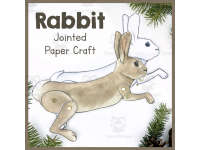
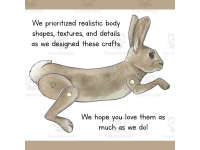
A paper rabbit with fastener joints at its ears and back feet lets children act out four true rabbit behaviors, from turning toward a sound to pushing off for a big hop.

- Grades
- Preschool–Pre-K, Grades 1–3, Elementary
- Pages
- 2
- File type
- Preparation
- Print ready


- Subject
- Holiday & Seasonal, Creative Arts, Art, Holidays, Easter
- Topic
- rabbits, paper animals
- Resource types
- Activities, Crafts
- Preparation
- Print ready
About this resource
What's inside this resource
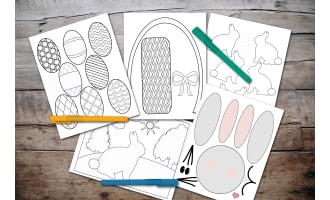
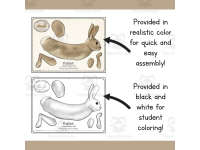
Long ears that swivel and big back feet that swing are the moving parts of a sitting paper bunny. Its five pieces, a head and body, two ears and two back feet, sit uncolored on page 2 with a thick cut outline and a dot at each fastener hole, while the front paws are drawn on the body.
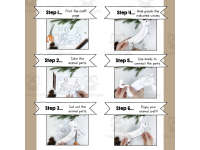
Page 1 lists what to gather (card stock, crayons, child-safe scissors, four paper fasteners, and a pencil with play dough for poking holes) and gives six illustrated steps, from adding pink inside the ears to laying each ear behind the head with its dots lined up and opening the fastener flat.
Rabbit facts then turn into poses. Each of four pose checks pairs one short fact with a drawing: ears turned toward a sound, one ear moving on its own, ears flattened when a rabbit is scared, and strong back legs pushing into a hop. Children make their bunny copy each picture and check the box, then give it a name and write what sound it is listening for.
Related resources
More resources teachers may find useful
24 related resources were found using this product's title, contributor, categories and tags.


In the classroom
Teaching tips & learning objectives

Learning objectives
- Assemble a five-piece paper model by following six illustrated steps.
- Explain that a fastener lets an ear or foot turn around one point.
- Describe four true facts about how rabbits use their ears and back legs.

Teaching tips
- Copy page 2 onto card stock so the ears stay upright when they are turned.
- Have a grown-up poke the four holes over a ball of play dough, as the tip on page 2 says.
- Show step 4 before children try it: each ear goes behind the head, not in front, with the two dots matched.

Skills covered
- Cutting curved shapes — children cut the rounded ears, feet and body on the thick outline.
- Sequencing directions — children follow numbered, illustrated steps to attach both ears and both feet.
- Joints and pivots — children see each ear and foot turn around a single fastener.
Good to know
Questions teachers ask about this resource
Which parts of the rabbit move?
The two ears and the two back feet, each on its own paper fastener. The front paws are drawn on the body, so the bunny sits up while its ears swivel and its feet swing.
How many paper fasteners does each rabbit need?
Four: one at the base of each ear and one at the top of each back foot. The supply list also calls for card stock, crayons, child-safe scissors and a pencil with play dough for poking the holes.
How do the rabbit facts fit with the craft?
Each of the four pose checks pairs one short fact, such as “Each ear can turn on its own,” with a drawing of the pose. Children move their finished rabbit to match and check the box, so the facts are acted out rather than written.

No reviews yet
Downloaded this resource? Tell other teachers how it went.
Resource details
Concepts & topics
Core concepts
 Core concepts
- Jointed paper craft
- Rabbits
- Animal behavior
- Following directions
- Fine-motor skills
 Topics
Explore more
Categories this resource belongs to
Explore related searches
More to explore
You may also like