Solid, Liquid, or Gas – States of Matter Sort

- Grades
- Grades 2–3, Elementary
- Pages
- 5
- File type
- Answer key
- Included


- Subject
- Science, Basic Science, Earth and Environmental Sciences, Earth Sciences
- Topic
- solid, liquid
- Resource types
- Worksheets & Printables, Worksheets
- Answer key
- Included
About this resource
What's inside this resource
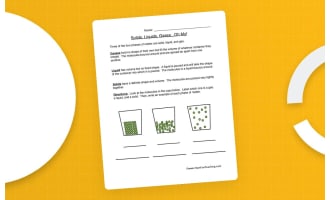
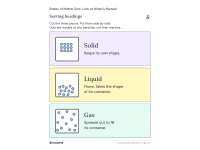
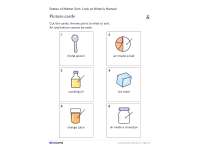
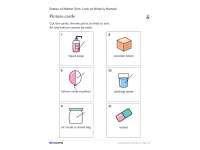
Children in grades 1–3 sort twelve picture cards under three large headings: Solid, Liquid and Gas. Each heading has a short description and a dot model of particles, labeled as a model rather than real size. The cards show everyday examples such as a metal spoon, cooking oil, an ice cube and helium inside a balloon.
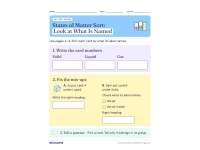
The activity teaches children to sort exactly what the label names. On cards like air inside a closed jar, an arrow points to the air, so students sort the gas instead of the container. After sorting, children record the card numbers for each state on page 1, fix two sorting mistakes made by pretend classmates, and tell a partner why one card belongs in its group. The teacher page covers setup, a worked model and the complete key, with notes on air, helium and ice.
- Grades 1–3: science, states of matter
- Five pages: a record sheet, three cut-apart headings, twelve picture cards and a teacher guide with key
- Print options: full-color and print-friendly black-and-white PDF versions
Related resources
More resources teachers may find useful
24 related resources were found using this product's title, contributor, categories and tags.


In the classroom
Teaching tips & learning objectives

Learning objectives
Sort everyday materials into solid, liquid and gas.
Classify the material a label names rather than its container.
Describe a solid as keeping its shape, a liquid as taking the shape of its container and a gas as spreading out to fill its container.

Teaching tips
Read the card labels aloud for emerging readers, as the setup notes suggest.
Model the metal key example on the teacher page before pairs start sorting.
Point out the arrows on container cards so children sort the oil, juice, air or helium inside, not the bottle, jar, balloon or bag.

Skills covered
Classifying matter: children sort twelve examples, such as orange juice and a wooden block, into solid, liquid or gas.
Careful reading: children sort what the label names, such as the air inside a closed jar rather than the jar itself.
Error correction: children decide where a misplaced ice cube belongs and which heading fits the air in a jar.
Good to know
Questions teachers ask about this resource
Which cards go in each group?
Solid: metal spoon, ice cube, wooden block and eraser. Liquid: cooking oil, orange juice, liquid soap and drinking water. Gas: air inside a ball, air inside a closed jar, helium inside a balloon and air inside a closed bag.
Why do some cards show containers?
Arrows point to what children should sort. Air inside a closed jar is sorted as a gas because the label names the air, not the jar.
Is an answer key included?
Yes. The teacher page lists the card numbers for each group and the answers to both mix-ups.
How much reading and writing is involved?
Labels are short, students write card numbers and one heading, and explanations are spoken. The guide suggests reading labels aloud as needed.

No reviews yet
Downloaded this resource? Tell other teachers how it went.
Resource details
Concepts & topics
Core concepts
 Core concepts
states of matter
solid
liquid
gas
classification
particle model
 Topics
Explore more
Categories this resource belongs to
Explore related searches
More to explore
You may also like