Teasing Social Story

- Grades
- Not Grade Specific
- Pages
- 13
- File type
- Preparation
- Print ready


- Subject
- Special Education Needs (SEN), Social Skills
- Topic
- Teasing, Kind communication
- Resource types
- Activities
- Preparation
- Print ready
Product description
From the author
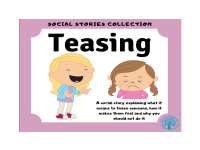
This first-person social story introduces teasing, gives examples and explores how a comment can feel different to the speaker and listener. A stop-and-think strategy leads to five questions: Is it true, helpful, inspiring, necessary and kind?
The 13-page PDF includes the story, checklist, closing commitment and credits, with illustrations by Kari Bolt. Read together, discuss fictional examples and revisit the checklist when useful. Pages can be placed in a display book or laminated and bound.
Related resources
More resources teachers may find useful
24 related resources were found using this product's title, contributor, categories and tags.


In the classroom
Teaching tips & learning objectives

Learning objectives
Identify examples of teasing behavior, such as name-calling or laughing at someone's mistake
Explain why a comment that feels funny to the speaker can still feel hurtful to the person it's directed at
Apply a five-question self-check (True, Helpful, Inspiring, Necessary, Kind) before speaking

Teaching tips
Read the story aloud one page at a time rather than all at once, since each page introduces a single idea (a definition, an example, a feeling, a strategy) meant to be discussed before moving to the next
Post or hand out the five-question self-check from page 11 separately as an ongoing classroom reference, since it's the story's concrete take-away strategy
Pair this story with a discussion of a recent classroom teasing situation, using the story's own contrast between how teasing feels to the speaker versus the person being teased as a discussion starter

Skills covered
Recognizing teasing behavior — the story names three concrete examples (name-calling, laughing at a mistake, mocking a skill gap) rather than defining teasing abstractly.
Perspective-taking — the story explicitly contrasts how teasing might feel funny to the person doing it with how it feels hurtful to the person being teased.
Self-regulation before speaking — a stop-and-think strategy and a five-question checklist give the student a concrete routine to apply before speaking.
Good to know
Questions teachers ask about this resource
How can I help students practice the checklist?
After reading, offer a fictional comment and ask students to consider whether it is true, helpful, inspiring, necessary and kind. Invite them to suggest a different way to speak if the original comment could hurt someone.

No reviews yet
Downloaded this resource? Tell other teachers how it went.
Resource details
Concepts & topics
Core concepts
 Core concepts
Teasing
Empathy
Self-regulation
Kind communication
 Topics
Explore related searches
More to explore