



Types of Plants word search, scramble and crossword
- Grades
- Grades 3–6, Elementary, Middle School
- Pages
- 6
- File type
- Answer key
- Included


- Subject
- ELA, Science, Spelling, Language Development, Vocabulary, Life Sciences
- Topic
- Word search, Word scramble
- Resource types
- Crosswords Puzzles, Worksheets, Worksheets & Printables
- Answer key
- Included
Product description
From the author
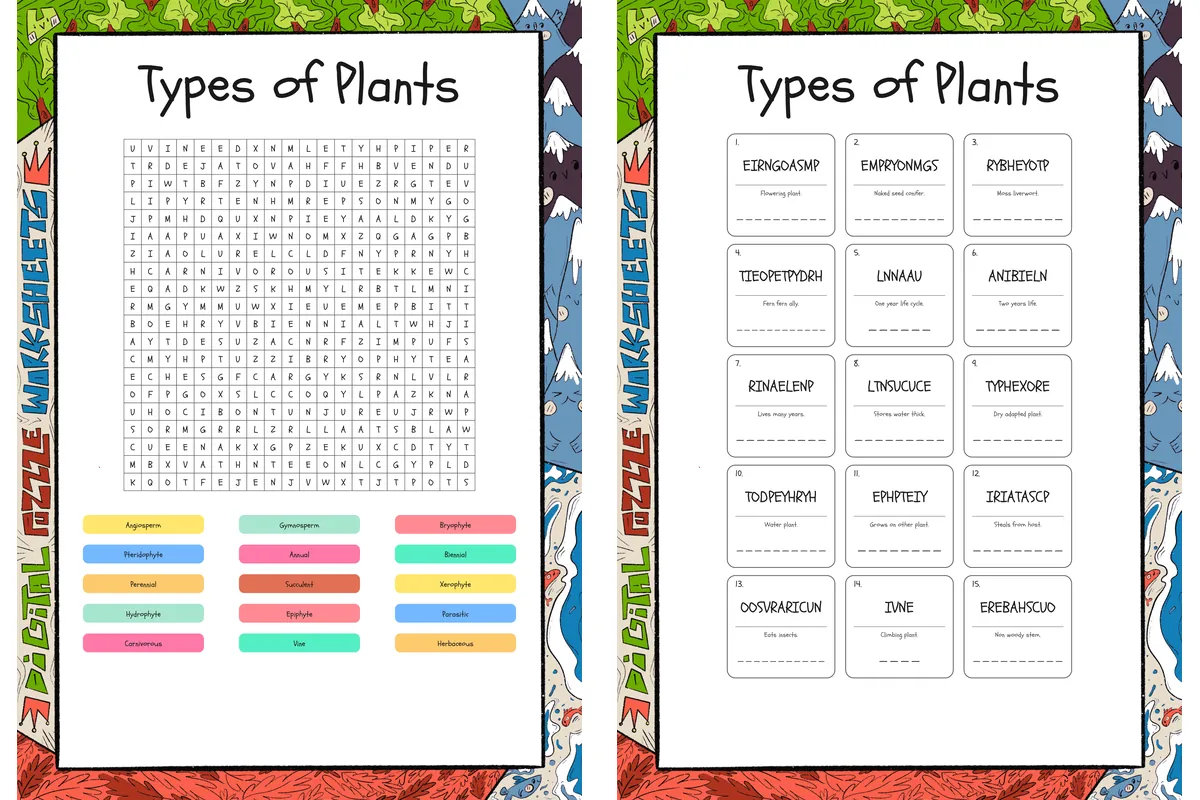
Types of Plants includes a crossword, word scramble and word search using fifteen recurring plant terms, including angiosperm, gymnosperm, annual, biennial, perennial and hydrophyte.
The download contains three two-page PDFs, six pages altogether. The crossword and scramble connect answers with short clues and include completed answers. The word search supplies a word bank and a color-highlighted solution page.
Review unfamiliar plant vocabulary before assigning the puzzles. Use them independently or with a partner, then discuss a selected answer with the class.
Related resources
More resources teachers may find useful
24 related resources were found using this product's title, contributor, categories and tags.


In the classroom
Teaching tips & learning objectives

Learning objectives
Match a compressed definition to its plant-classification term — "Naked seed conifer" to gymnosperm, "Water plant" to hydrophyte, "Grows on other plant" to epiphyte
Separate the three life-cycle terms using their clues: "One year life cycle" for annual, "Two years life" for biennial and "Lives many years" for perennial
Spell multi-syllable botanical terms accurately, since both the crossword grid and the word-search grid depend on exact letter order

Teaching tips
All three puzzles work from the same fifteen terms, so they can be run as a sequence — scramble first with its definitions visible, then the crossword, then the word search for early finishers
The clues are two to four words long and assume the vocabulary has already been taught, so introduce or revise the terms before handing the sheets out
Terms cluster into groups — major plant divisions, life-cycle length, habitat adaptation and feeding strategy — so sorting them into those four groups before the puzzles gives students a way in

Skills covered
Botanical vocabulary recall — students connect fifteen classification terms to short definitions covering plant divisions (angiosperm, gymnosperm, bryophyte, pteridophyte), habitat adaptations (hydrophyte, xerophyte, epiphyte) and feeding strategies (parasitic, carnivorous).
Spelling of multi-syllable science terms — the crossword's interlocking letters and the word-search grid both require exact letter sequences for words such as pteridophyte and herbaceous.
Letter-pattern analysis — the scramble hands students strings such as EIRNGOASMP and TYPHEXORE with only a three-word definition beneath as a clue.
Good to know
Questions teachers ask about this resource
Which plant terms do the puzzles actually use?
The same fifteen across all three sheets: angiosperm, gymnosperm, bryophyte, pteridophyte, annual, biennial, perennial, succulent, xerophyte, hydrophyte, epiphyte, parasitic, carnivorous, vine and herbaceous. The set includes plant groups, life-cycle terms, growth forms and adaptations.
What should students already know before starting these sheets?
The vocabulary itself. Nothing on the sheets teaches or illustrates the categories, so the puzzles work as revision after a unit on plant groups, life cycles and adaptations rather than as an introduction to them.

No reviews yet
Downloaded this resource? Tell other teachers how it went.
Resource details
Concepts & topics
Core concepts
 Core concepts
Plant classification
Science vocabulary
Plant life cycles
Word puzzles
 Topics
Explore more
Categories this resource belongs to
Explore related searches
More to explore
You may also like


