



3,992 products added recently
Page 3 - Centers
Enhance your classroom with a variety of centers designed to support active learning across different subjects. These resources provide engaging activities that promote collaboration, independence, and hands-on experiences. Implementing centers in your classroom can help differentiate instruction and accommodate diverse learning styles, keeping students motivated and involved in their learning process.

 Show filters

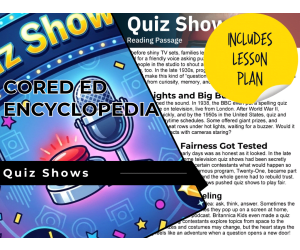
Quiz Shows Reading Comprehension Passage - Cored Ed Encyclopedia
ELA, Language Development, Reading Comprehension, Reading, Pre-Reading, Writing, Strategies, Vocabulary, History, Social Studies, Grade 2, 3, 4, 5, Worksheets & Printables, Worksheets, Teacher Tools, Centers, Activities, Writing Prompts, Assessments, Quizzes and Tests, Quizzes, Lesson Plans
This quiz shows reading comprehension includes: Visualization (on the front cover) Start your lesson by taking a minute to think and share something about the topic. Read the script aloud (slowly), perhaps prepare some music or sound effects. Student close their eyes and let their imaginations wander. Students open their eyes, read the question aloud and give them a few minutes to complete. Ask a few students to share or keep answers until the end to compare with what they learn in the passage. Quick pause—thousands of Cored Education products are included with your TeachSimple membership. Download links and encyclopedia index available here. Pre-Reading Trivia Students will write down one thing they already know about the subject and then read five more facts and discuss. These facts are fun, and the students will enjoy learning about the subject before reading more. Give 1 minute for students to write what they already know (no pressure—best guess is fine). Read the five facts together. After each fact, do ask a student for their opinion, was it surprising? Set a purpose by asking students to highlight/underline one fact they want to learn more about during the reading. Reading Passage The text is a high-interest reading passage with set paragraphs, roughly three to four paragraphs long. It contains a variety of themes about the topic, anywhere from history to technology. The passage is between 250 and 350 words in length. First, ask students to look at the headings and see what they’ll learn about today. What do they know about the topic/heading? First read options: Teacher read-aloud (best for support). Partner reading (paragraph by paragraph). While reading, students underline important details, and vocabulary words they think may come up in the questions section. Mixed Questions The first question page contains four multiple-choice questions, each with a choice of four answers, and three written response questions that require a sentence or two from the student. Students complete the mcqs first independently, then review quickly as a class. For the 3 written responses, try to get students giving the answer with some form of evidence: “I think ___ because the text says ___.” If students get stuck, send them back to check the passage. Vocabulary Questions Practice seven key words from the text in this section across two activities. First section is scrambled words where students will unscramble three words given a clue for each. The second section is a word to meaning matching activity. Before starting, have some students read out words they underlined in the passage. Ask students to say the word and read aloud the sentence(s) around each word. Ask students to do scrambled words and the matching exercise in pairs then go through answers as a class. For the scrambled spelling task, get four pairs to come up to the board and write the words for extra practice with the other student reading out the clue. For the matching task, prompt students to give full sentences: “I matched ___ with ___ because ___.” Creative Writing In this question, the student will be required to write a five to eight sentence paragraph on a question related to the topic. Before starting, ask students write down 3 key ideas they are going to include in their piece. Ask students for ideas to share around the class to help those struggling. Pro writing expectations: 5–8 sentences At least 2 facts or details from the passage At least 2 vocabulary words from the previous page Students read their paragraphs while classmates listen for facts and vocabulary words. Extension Activities This page is optional for fast finishers or to take home. There are several activities, each one requiring a different skill. Do some, do none, do all, completely optional - but you will feel reassured knowing every possibility is planned for. Includes summary writting question. Answer Key There are answers for the multiple-choice questions, written response questions have sample answers, vocabulary answers and if there is a summary question then a sample summary will be provided as well. Lesson Plan Included Customized lesson plan for this lesson is included. Lesson Snapshot Title: Quiz Shows Genre: Nonfiction (informational reading passage) Subject: Reading (Informational Text) / Social Studies (media history) Primary Topic: Quiz shows from radio to TV to podcasts Estimated Guided Reading Level (A–Z): R What This Lesson Teaches Best How quiz shows changed over time, from radio “question games” to television and modern podcasts. Key historical milestones and examples (late 1930s radio programs; 1938 BBC spelling quiz on TV; 1950s U.S. daytime quiz/game shows). Understanding fairness and trust in media (some shows were “rigged,” followed by investigations, hearings, and stronger rules). Text structure practice using section headings to track ideas (early radio → TV era → fairness tested → today). Strong built-in supports that match the passage (questions, vocabulary work, writing prompt, and extensions align to passage details). Learning Goals Students will describe how people participated in quiz shows before TVs were common, using details from the passage. Students will explain how television changed quiz shows, including what it was like for contestants under cameras and lights. Students will explain what “rigged” means in the passage and why quiz shows had to “rebuild trust.” Students will identify ways quiz shows appear today (board, screen at home, or podcast), based on the passage. Students will use the section headings to state the main idea of each section and support it with one detail. Key Vocabulary From the Text contestants — people who compete in a game rigged — secretly fixed so it is not fair producers — people who run and plan a show investigations — careful searches to find out what happened genre — a type or category of show FULL CATALOG OF DOWNLOAD LINKS AND ENCYCLOPEDIA INDEX HERE
Author Cored Education
Rating
Tags Vocabulary, Reading Comprehension, Reading Passages, Reading, Creative Writing, Reading Strategies, Writing Prompts, Lesson Plans, Quiz Shows, History
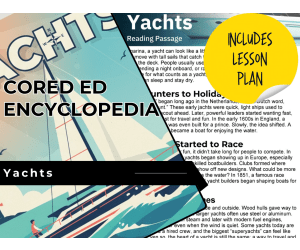
Yachts Reading Comprehension Passage - Cored Ed Encyclopedia
ELA, Language Development, Reading Comprehension, Reading, Science, History, Social Studies, Technology, Engineering, Pre-Reading, Grade 2, 3, 4, 5, Worksheets & Printables, Worksheets, Teacher Tools, Centers, Activities, Writing Prompts, Assessments, Quizzes and Tests, Quizzes, Lesson Plans
This yachts reading comprehension with lesson plan includes: Visualization (on the front cover) Start your lesson by taking a minute to think and share something about the topic. Read the script aloud (slowly), perhaps prepare some music or sound effects. Student close their eyes and let their imaginations wander. Students open their eyes, read the question aloud and give them a few minutes to complete. Ask a few students to share or keep answers until the end to compare with what they learn in the passage. Quick pause—thousands of Cored Education products are included with your TeachSimple membership. Download links and encyclopedia index available here. Pre-Reading Trivia Students will write down one thing they already know about the subject and then read five more facts and discuss. These facts are fun, and the students will enjoy learning about the subject before reading more. Give 1 minute for students to write what they already know (no pressure—best guess is fine). Read the five facts together. After each fact, do ask a student for their opinion, was it surprising? Set a purpose by asking students to highlight/underline one fact they want to learn more about during the reading. Reading Passage The text is a high-interest reading passage with set paragraphs, roughly three to four paragraphs long. It contains a variety of themes about the topic, anywhere from history to technology. The passage is between 250 and 350 words in length. First, ask students to look at the headings and see what they’ll learn about today. What do they know about the topic/heading? First read options: Teacher read-aloud (best for support). Partner reading (paragraph by paragraph). While reading, students underline important details, and vocabulary words they think may come up in the questions section. Mixed Questions The first question page contains four multiple-choice questions, each with a choice of four answers, and three written response questions that require a sentence or two from the student. Students complete the mcqs first independently, then review quickly as a class. For the 3 written responses, try to get students giving the answer with some form of evidence: “I think ___ because the text says ___.” If students get stuck, send them back to check the passage. Vocabulary Questions Practice seven key words from the text in this section across two activities. First section is scrambled words where students will unscramble three words given a clue for each. The second section is a word to meaning matching activity. Before starting, have some students read out words they underlined in the passage. Ask students to say the word and read aloud the sentence(s) around each word. Ask students to do scrambled words and the matching exercise in pairs then go through answers as a class. For the scrambled spelling task, get four pairs to come up to the board and write the words for extra practice with the other student reading out the clue. For the matching task, prompt students to give full sentences: “I matched ___ with ___ because ___.” Creative Writing In this question, the student will be required to write a five to eight sentence paragraph on a question related to the topic. Before starting, ask students write down 3 key ideas they are going to include in their piece. Ask students for ideas to share around the class to help those struggling. Pro writing expectations: 5–8 sentences At least 2 facts or details from the passage At least 2 vocabulary words from the previous page Students read their paragraphs while classmates listen for facts and vocabulary words. Extension Activities This page is optional for fast finishers or to take home. There are several activities, each one requiring a different skill. Do some, do none, do all, completely optional - but you will feel reassured knowing every possibility is planned for. Includes summary writting question. Answer Key There are answers for the multiple-choice questions, written response questions have sample answers, vocabulary answers and if there is a summary question then a sample summary will be provided as well. Lesson Plan Included Customized lesson plan for this lesson is included. Lesson Snapshot Title: Yachts Genre: Nonfiction (informational text) Subject: Social Studies (history of technology) / Informational Reading Primary Topic: What yachts are, their history, and how they changed Estimated Guided Reading Level (A–Z): Q What This Lesson Teaches Best Describes what a yacht can look and sound like at a marina, and explains that yachts may move by sails or by a motor beneath the deck. Explains how people use yachts for pleasure, such as cruising along a coast, spending a night onboard, or racing across open water, and notes that many yachts have a cabin where someone can sleep and stay dry. Traces how the word “yacht” began in Netherlands from a Dutch word meaning “hunt,” and how early yachts were quick ships used to chase pirates and scout ahead before becoming boats for travel and fun. Shows how yacht racing grew in Europe in the 1600s and how a race in 1851 helped launch the America’s Cup, influencing yacht designs for speed and handling. Explains how yachts changed over time (new materials like fiberglass, larger yachts using steel or aluminum, and engines arriving from steam to modern fuel engines), including very large “superyachts” that may need a hired crew. Learning Goals Students will identify two ways yachts can be powered using details from the text. Students will describe what the passage says people do on yachts for pleasure. Students will explain how the meaning and use of “yacht” changed over time in the passage. Students will describe how racing influenced yacht design, using the passage’s examples. Students will describe at least two changes in yacht materials or engines mentioned in the text. Key Vocabulary From the Text marina — a place where boats dock. cabin — a room where someone can sleep and stay dry. hulls — the outer bodies of boats. fiberglass — a newer material used instead of wood. crew — a hired group to run a yacht. FULL CATALOG OF DOWNLOAD LINKS AND ENCYCLOPEDIA INDEX HERE
Author Cored Education
Rating
Tags Vocabulary, Reading Comprehension, Reading Passages, Lesson Plans, Ela Lesson Plans, Reading Comprehension Lesson Plans, Pre-reading, History Lesson Plans, Science Lesson Plans, Engineering

Rectangle Tracing & Coloring Worksheets for Pre-K, Montessori, and KG
Montessori, Math, Shapes, Early Math, Kindergarten, Preschool, Toddler, Centers, Activities, Crafts, Worksheets, Worksheets & Printables
Rectangle Tracing & Coloring Worksheets For Preschool, Kindergarten & Montessori Help young learners explore the rectangle shape with this fun and hands-on worksheet pack. I have designed it for toddlers, preschoolers, and kindergarten students. This resource focuses on shape recognition, fine motor development, and early language skills through simple yet engaging activities that children enjoy. It is perfect for classrooms, homeschooling, Montessori settings, and ESL/EFL classrooms. These worksheets will make learning about rectangles both meaningful and playful. What’s inside? A simple and fun rectangle rhyme featuring a rectangle named “Joy” to introduce shape vocabulary Rectangle tracing worksheets to build hand-eye coordination and pre-writing skills Rectangle coloring pages to support creativity and reinforce shape recognition Easy question prompts on each worksheet to encourage discussion and language development (ESL/EFL friendly) A crown-cutting activity that helps children practice scissor skills in a fun hands-on way Skills covered: Fine motor skills: Tracing and cutting activities will help kids strengthen small hand muscles Shape recognition: This resource will help children identify rectangles and spot them in everyday objects Language development: Simple questions and discussion prompts will help kids build vocabulary and confidence Creativity & focus: Coloring and craft activities support calm and focused learning Ways to use this resource: Read the rectangle rhyme together and talk about rectangles found in the classroom or at home Use the tracing and coloring pages during centers, morning work, or quiet time Turn the crown-cutting page into a fun craft activity Encourage children to draw or talk about rectangle-shaped objects they see around them This resource is perfect for: Teachers: As it is a great tool for shape lessons, math centers, and fine motor practice Homeschoolers will find this resource easy to use at their own pace. Clear and simple activities will help them a lot. Parents will find this resource ideal for at-home learning and screen-free practice that is fun It is best for: Toddlers & preschoolers Kindergarten students ESL / EFL learners Montessori classrooms Early childhood Homeschoolers Rectangle worksheets, shape recognition, fine motor skills, tracing worksheets, coloring pages, scissor skills, early learning, ESL, EFL, Montessori, preschool activities, kindergarten worksheets, mini rectangle booklet
Author FlashKart
Rating
Tags Shape Tracing, Rectangle Coloring Booklet, Math Shapes, Shapes, Worksheets, Math Centers, All About Rectangles, Tracing, Scissor Skills, Fine Motor Skills

Social Studies Reading Passages: Extreme Environment and People (Word)
ELA, Reading, Reading Comprehension, Strategies, Resources for Teachers, Social Studies, Geography, Grade 6, 7, 8, 9, Writing Prompts, Worksheets & Printables, Centers, Activities, Teacher Tools, Assessments, Quizzes and Tests, Quizzes, Tests
Social Studies Reading Comprehension Passages and Questions: Extreme Environment and People (Word) This resource introduces a collection of Social Studies reading comprehension passages with questions about Extreme Environment and People. The passages are carefully designed to bridge the gap between social studies and literacy through strengthening reading comprehension and sparking knowledge curiosity in middle school students. Each passage blends English Language Arts skills with accurate social studies content . Ideal for interdisciplinary learning in ELA and Social Studies. Suitable for Grade 9 review, too! What Is Included in this Collection? There are three informational passages (with full answer keys): Salar de Uyuni: Bolivia’s Shining Salt Flat Above the Alps: The Story of the Eiger’s North Face Sherpas: Guardians of the High Mountains For Each Passage, students will have multiple tasks to complete as follow: 5 multiple-choice questions targeting main idea, key details, inference, vocabulary in context, and use of evidence 5 vocabulary matching items with clear, student-friendly definitions 5 text-based questions that require citing specific lines or facts 1 summary prompt that asks students to condense central ideas accurately Available Formats for this Resource PDF Fillable PDF Google Docs FULL CATALOG OF DOWNLOADING LINKS HERE For more Social Studies Reading Passages, check the following Links: Ancient Civilizations PDF Fillable PDF Word Docs Google Docs Early Empires and Trade Networks PDF Fillable PDF Word Docs Google Docs The Founding of the United States PDF Fillable PDF Word Docs Google Docs Language, Culture, and Meaning PDF Fillable PDF Word Docs Google Docs Psychology and Society PDF Fillable PDF Word Docs Google Docs Global Festivals and Traditions PDF Fillable PDF Word Docs Google Docs Extreme Environments and People PDF Fillable PDF Word Docs Google Docs Food, Culture, and Preservation PDF Fillable PDF Word Docs Google Docs Global Food Customs PDF Fillable PDF Word Docs Google Docs Media, Communication, and Popular Culture PDF Fillable PDF Word Docs Google Docs Human Impact on the Environment PDF Fillable PDF Word Docs Google Docs Civic Action and Social Change PDF Fillable PDF Word Docs Google Docs Fashion, Society, and Power PDF Fillable PDF Word Docs Google Docs People, Places, and Unusual Histories PDF Fillable PDF Word Docs Google Docs Product Details Length: 14 pages total Grades: 6–8, also suitable for Grade 9 review Use cases: close reading, stations, homework, intervention, test prep, and sub plans Why Teachers Choose This Set Authentic social studies content paired with rigorous literacy practice Consistent task structure across all passages for easier planning and smoother student routines Clear, age-appropriate writing that builds confidence without oversimplifying Use this set to reinforce ELA skills in social studies, to add literacy to your lessons, and to support independent work. The passages strengthen main idea, evidence use, vocabulary in context, inference, cause and effect, and summary writing. With ready-to-use assessments and complete answer keys, you can provide focused practice that is simple to run and fast to review.
Author Middle & High School - CORED Education
Rating
Tags Middle School, Reading Comprehension, Reading Strategies, ELA, Centers, Reading Passage, Assessments, Vocabulary, Social Studies, Geography

Animal Habitats Sorting Activity Worksheets| Animal Habitat
Science, Animals, Life Sciences, Kindergarten, Preschool, Grade 1, 2, Worksheets & Printables, Teacher Tools, Classroom Decor, Activities, Centers, Word Walls, Worksheets, Word Problems, Workbooks
Students will find, recognize, recognize, recognize, recognize tAnimal Habitat Activities for Special Education. These Animal Habitat are aligned with the science of reading Animal Habitat Activities for Special Education identity practices worksheet and in fact your prescript and kinderrain needs to master the Animal Habitat Activities for Special Education names, Animal Habitat seem that I have designed these Animal Habitat Activities for Special Education, which have designed these Animal Habitat Activities works, which is a Animal Habitat Activities for Special Education about a paper about the practice of the practice of guide practices, which is a Animal Habitat Activities for Special Education and plants about the practice To create a Animal Habitat Activities to create, which helps find different Animal Habitat , ensures a fun and structured approach to learning the Animal Habitat Activities . This worksheet provides a fun activities to identify the sounds of any pre -PR -LafabetAnimal Habitat Activities for Special Education, the formation of lAnimal Habitat Activities for Special Education, including a series of small activities on each page, including a series of students to involve a series of skills for Animal Habitat Activities for Special Education reviews.
Author LAMO
Rating
Tags Biology, Vocabulary, Environment, General Science, Science, Printables, Activities, Worksheets
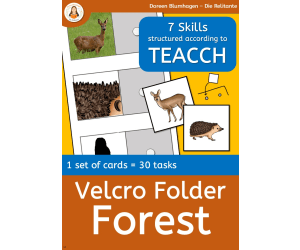
TEACCH Forest – File Folder Tasks for Special Education
Montessori, Special Resources, Special Education Needs (SEN), Speech Therapy, Life Skills, Elementary, Pre-K, Early Learning, Centers, Activities
TEACCH Forest – File Folder Tasks for Special Education This resource includes 30 structured file folder tasks based on the TEACCH approach . It is designed for students who benefit from clear structure, visual support, and predictable routines . The forest theme uses familiar woodland animals to support learning in a calm and structured way. All tasks are low-verbal and focus on independent work . Students complete matching, sorting, and assigning activities using Velcro cards. A key feature of this resource is that all 30 tasks use the same set of cards . This helps reduce preparation time and keeps materials organized. Who this resource is for Students in special education Students with autism spectrum disorder (ASD) Nonverbal or minimally verbal learners Preschool and early elementary students Students working in structured work systems What is included 30 structured file folder tasks (A4 format) One reusable set of Velcro cards Folder cover pages for organization Card storage templates Optional distractor cards for differentiation A teacher guide with setup instructions and usage ideas Skills addressed The tasks are organized into 7 learning areas : Work routine Step-by-step task completion and independent work Visual perception Matching identical images, mirror images, shadows, drawings, and details Image recognition Matching real photos and illustrations Understanding simple picture meaning Language skills Initial sounds Syllables Word to picture matching Simple sentence understanding Auditory perception Listening to words or sentences and matching images Optional use with recordable talking pens or AAC tools Pre-math skills Quantities up to 3 Patterns Size comparison Spatial direction Categorization Sorting forest animals by habitat, food, features, or characteristics How to use Print and laminate the task pages and cards. Add Velcro dots. Place the pages in a folder or binder. The tasks can be used in: Independent work stations One-to-one instruction Structured classroom routines Therapy or support sessions Learning goals Support independent work Strengthen visual perception Practice early language and pre-academic skills Provide clear structure and predictability This resource is intended for structured learning environments .
Author Die Relitante
Rating
Tags Autism, TEACCH, Preschool, Kindergarten, Special Education, File Folder Task, Visual Structure, Independent Work, Matching Activities, Forest

Hansel and Gretel Fairy Tale Foldable Mini Book Grade 1 2 3 ELA
ESL, Language Development, ELA, Children’s Literature, Literature, Reading Comprehension, Reading, Handwriting, Writing, Grade 1, 2, 3, Centers, Activities, Crafts, Projects, Assessments, Teacher Tools
Make learning fun and exciting through this Hansel and Gretel Mini Book Set especially designed for Grades 1, 2 and 3 students, homeschoolers, and ESL/EFL learners. This mini book bundle set is packed with meaningful activities for your reading classes, reading comprehension exercises, ELA project, fairy tale unit, reading centers, literacy center, morning work, exercise for early finishers and so much more! What’s Included: •Colored Hansel and Gretel Story Mini Book– for story retelling, reading and reading comprehension practice •Hansel and Gretel Story Mini BookTrace & Read Pages– handwriting practice and motor skills exercise •Hansel and Gretel Story Mini BookSequencing Booklet– sequencing and sorting exercise, story retelling and reading practice •Hansel and Gretel Story Mini BookRetell & Reflect Pages– retell practice, creativity and imagination development •Hansel and Gretel Story Mini BookBlank Create-a-Story Templates– story telling, supporting creative and imaginative thinking skills •Hansel and Gretel Story Mini BookTeacher Guide + Sample Lesson Plan
Author It's Teacher L
Rating
Tags Mini Books, Reading Comprehension, Fairy Tale, Reading Center, Literacy Centers

Reading Comprehension Passages Fiction Set 2 (Fillable PDF)
ELA, Reading, Reading Comprehension, Common Core, Writing, Vocabulary, Language Development, Spelling, ESL, Creative Writing, Grade 6, 7, Worksheets & Printables, Worksheets, Writing Prompts, Assessments, Teacher Tools, Tests, Quizzes and Tests, Centers, Activities
Reading Comprehension Passages Fiction Set 2 Snapshot Title: Fiction Grade 6-7 Set 2 Genre: Fiction Subject: Reading / SEL Primary Topic: Short fiction about goals, family, fear, and problem-solving Estimated Guided Reading Level (A–Z): X What This Teaches Best Highlights perseverance and goal-setting through stories such as Cooking Camp , where Jason works toward camp money. Develops analysis of realistic character choices in school, family, and community settings, including School Musical , My Key! , and Summer at Gran’s . Encourages discussion of fear and bravery in suspenseful or high-stakes stories such as Creepy Well and Solo Flight . Supports cause-and-effect thinking and problem-solving, especially in stories like Bug Trip and Cooking Camp . Provides broad practice with vocabulary, inference, sequencing, and response writing through matched support pages after each passage. Learning Goals Students will explain how characters work toward a goal or solve a problem. Students will infer character feelings from dialogue, actions, and story events. Students will describe how a challenge changes a character by the end of a story. Students will sequence events and explain cause-and-effect relationships. Students will determine the meaning of important vocabulary from context. Students will compare how different stories present courage, responsibility, or persistence. Passages Include 1.Cooking Camp: Jason tries to make enough money to go to cookery camp. 2.Graduation: Matt helps prepare for his brother's graduation party. 3.No Internet- Sam and Klara discuss life in the past with their gran. 4.School Musical: Maiya and her concerns about the school musical. 5.My Key: Jon has the house to himself for once. Does he enjoy it though? 6.Creepy Well: Jo and some kids from school at a creepy well. 7.Bug Trip: The twins are driving Dad crazy with their science project. 8.Solo Flight: Sid gets his first solo flight in bizarre circumstances. 9.Summer at Gran's: Andrea trying to make the best of her time at Gran's. 10.Wild Wild West: Alec on the ranch with his dad. 11.Danger Mountain: Nath tries a dangerous ride down the mountain. 12.Math Queen: Rhonda doing her best at the Math competition. FILLABLE PDF VERSION Worksheet-style pages, but with type-in answer boxes so students can complete and save their work digitally. Other versions are available in the links list below or in the full catalog. FULL CATALOG OF DOWNLOAD LINKS HERE For similar downloads and other frees, do check out Cored Group on TeachSimple.
Author Cored Education
Rating
Tags Elementary, Reading, Comprehension, Vocabulary, Spelling, Writing, Passages, Reading Centers, Reading Comprehension Assessment
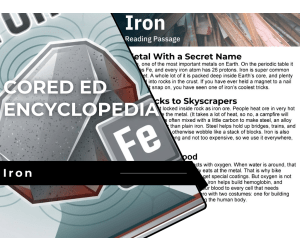
Iron Reading Comprehension Passage - Cored Ed Encyclopedia
ELA, Language Development, Resources for Teachers, Reading Comprehension, Reading, Pre-Reading, Writing, Science, Physics, Chemistry, Grade 2, 3, 4, 5, Worksheets & Printables, Worksheets, Teacher Tools, Centers, Activities, Writing Prompts, Assessments, Tests, Quizzes and Tests, Quizzes
This iron reading comprehension contains the following: Pre-Reading Trivia Students will write down one thing they already know about the subject and then read five more facts and discuss. These facts are fun, and the students will enjoy learning about the subject before reading more. Reading Passage The text is a high-interest reading passage with set paragraphs, roughly three to four paragraphs long. It contains a variety of themes about the topic, anywhere from history to technology. The passage is between 250 and 350 words in length. Mixed Questions The first question page contains four multiple-choice questions, each with a choice of four answers, and three written response questions that require a sentence or two from the student. Vocabulary Questions Practice seven key words from the text in this section across two activities. First section is scrambled words where students will unscramble three words given a clue for each. The second section is a word to meaning matching activity. Creative Writing In this question, the student will be required to write a five to eight sentence paragraph on a question related to the topic. Extension Activities This page is optional for fast finishers or to take home. There are several activities, each one requiring a different skill. Do some, do none, do all, completely optional - but you will feel reassured knowing every possibility is planned for. Answer Key There are answers for the multiple-choice questions, written response questions have sample answers, vocabulary answers and if there is a summary question then a sample summary will be provided as well. FULL CATALOG OF DOWNLOAD LINKS AND ENCYCLOPEDIA INDEX HERE Lesson Snapshot Title: Iron Genre: Nonfiction (informational text with section headings) Subject: Reading (Informational Text) / Physical Science Primary Topic: Iron’s properties, uses, rust, and role in blood Estimated Guided Reading Level (A–Z): P What This Lesson Teaches Best Identifying key facts about an element (iron’s symbol Fe and that an iron atom has 26 protons ). Explaining how people get iron from iron ore by heating it in very hot furnaces to separate the metal. Connecting materials to real-world structures by explaining how iron mixed with carbon makes steel , an alloy used in bridges, trains, and tall buildings. Describing cause and effect with rust: iron reacts with oxygen , and when water is around, rust can form and slowly eat the metal. Building science/health knowledge by explaining iron’s role in making hemoglobin , which carries oxygen through blood to cells. Learning Goals Students can identify iron’s chemical symbol and one atom fact stated in the text. Students can describe where iron is found on Earth (core and crust) using details from the passage. Students can explain how iron is separated from iron ore according to the passage. Students can explain that mixing iron with carbon makes steel and define steel as an alloy from the text. Students can describe what causes rust and why coatings/paint are used outdoors, based on the passage. Students can explain how iron helps the body by supporting hemoglobin’s oxygen-carrying job. Key Vocabulary From the Text periodic — relating to the periodic table of elements. protons — tiny parts inside atoms. ore — rock that contains metal. alloy — metal mixed with another material. hemoglobin — blood protein that carries oxygen. Cored Ed Encyclopedia Overview The Cored Ed Encyclopedia is a weekly series of lessons that you can pick up and use right away. These short readings fit into whatever time you have available. Each one includes a warm-up, a reading, and a set of questions, but it’s flexible — you can do just the reading, the full lesson, or skip the writing section if you need to. Each lesson focuses on a single topic so students don’t get lost. The writing is clear but never childish, making it perfect for grades two through five. Topics range from animals and science to history, inventions, and everyday things. No matter the level of the student, everyone should take away at least one new idea or fact from each lesson. The materials are easy to print, easy to explain, and require no setup. They work well for whole-class teaching, partner work, or independent study.
Author Cored Education
Rating
Tags Vocabulary, Spelling, Reading Comprehension, Reading Passages, Reading, Creative Writing, Reading Strategies, Writing Prompts, Physics, Iron

Animal Skin, Cats, & T. Rex: Reading Comprehension passages (Word)
Science, ELA, Reading, Reading Comprehension, Strategies, Resources for Teachers, Life Sciences, Animals, Insects, Nature & Plants, Grade 6, 7, 8, 9, Writing Prompts, Worksheets & Printables, Centers, Activities, Teacher Tools, Assessments, Quizzes and Tests, Quizzes, Tests
Animal Skin, Cats, & T. Rex: Reading Comprehension Passages (Word) This very engaging collection of life science reading passages about Animal Skin, Cats, & T. Rex is designed to bridge the gap between science and literacy through strengthening reading comprehension and sparking scientific curiosity in middle school students. Each passage blends English Language Arts skills with accurate science content that supports NGSS classroom practice. Ideal for interdisciplinary learning in ELA and Science. Suitable for Grade 9 review, too! What Is Included? There are (3) informational passages: Tyrannosaurus rex: The Tyrant Lizard King Step into the late Cretaceous and see T. rex up close, from its towering build and crushing bite to the clues fossils give about speed and feeding. CT scans, trackways, and healed injuries help scientists piece together how this predator lived. Cats and Sweetness: A Taste They Don’t Have A small change in a taste receptor means cats do not detect sugar. This trait fits a meat-first diet and helps explain why scent, texture, fats, and proteins matter more than sweetness. Animal Skin: A Tool for Survival Skin works as armor, thermostat, camouflage, warning, and display. Examples include the hippo’s natural sunscreen, zebra stripes that confuse attackers, and king snakes that copy coral snake colors to stay safe. Student Tasks for Each Passage: 5 multiple-choice questions targeting main idea, key details, inference, vocabulary in context, and use of evidence 5 vocabulary matching items with clear, student-friendly definitions 5 text-based questions that require citing specific lines or facts 1 summary prompt that asks students to condense central ideas accurately Full answer key for every section Available Formats for this Resource PDF Google Docs FULL CATALOG OF DOWNLOADING LINKS HERE Other Science Reading Collections you May find in the store: 1. Astronomy & Space Science 2. Volcanoes, Rocks, & Mountains 3. Rock Cycle, Soil, & Sinkholes 4. Mars, Glaciers, & Antarctica 5. Water Cycle, Acid Rain, & Wastewater 6. Insects, Animals, & Ecosystems 7. Bioluminescence & Insects 8. Animal Skin, Cats, & T. Rex 9. Human Body and Senses 10. Health & Applied Bioscience 11. Waves, Light, & Imaging 12. Electricity & Energy 13. Motion & Materials 14. Chemistry and Materials Science Product Details Length: 1e pages total Grades: 6–8, also suitable for Grade 9 review Use cases: close reading, stations, homework, intervention, test prep, and sub plans Standards support: reinforces informational-text skills and supports NGSS-style sense making through observation, modeling, and clear use of claim, evidence, and reasoning Why Teachers Choose This Set Authentic science content paired with rigorous literacy practice Consistent task structure across all passages for easier planning and smoother student routines Clear, age-appropriate writing that builds confidence without oversimplifying Use this set to reinforce ELA skills in science, to add literacy to your lessons, or to support independent work. The passages strengthen main idea, evidence use, vocabulary in context, inference, cause and effect, and summary writing. With ready-to-use assessments and complete answer keys, you can provide focused practice that is simple to run and fast to review.
Author Middle & High School - CORED Education
Rating
Tags Middle School, Reading Comprehension, Reading Strategies, ELA, Centers, Reading Passage, Assessments, Vocabulary, Life Science, Dinosaurs
Reading Comprehension Passage: Fast Fashion (Fillable PDF Sample)
ELA, Reading, Reading Comprehension, Strategies, Resources for Teachers, Social Studies, Sociology, Grade 6, 7, 8, 9, Writing Prompts, Worksheets & Printables, Centers, Activities, Teacher Tools, Assessments, Quizzes and Tests, Quizzes, Tests
This is a ONE PASSAGE SAMPLE. The following is the description of the FULL resource and the downloading links: Social Studies Reading Comprehension Passages and Questions: Fashion, Society, and Power (Fillable PDF) This resource introduces a collection of Social Studies reading comprehension passages with questions about Fashion, Society, and Power. The passages are carefully designed to bridge the gap between social studies and literacy through strengthening reading comprehension and sparking knowledge curiosity in middle school students. Each passage blends English Language Arts skills with accurate social studies content . Ideal for interdisciplinary learning in ELA and Social Studies. Suitable for Grade 9 review, too! These worksheets are designed as fillable PDFs , which means students can type their answers directly into the document on any computer or tablet . Each page includes highlighted text fields that show them exactly where to type! What Is Included in this Collection? There are three informational passages (with full answer keys): Beyond the Price Tag: How Fast Fashion Affects the World The Fur Debate: Ethics, Fashion, and Survival Designing Change: Chanel, Dior, and Women’s Lives For Each Passage, students will have multiple tasks to complete as follow: 5 multiple-choice questions targeting main idea, key details, inference, vocabulary in context, and use of evidence 5 vocabulary matching items with clear, student-friendly definitions 5 text-based questions that require citing specific lines or facts 1 summary prompt that asks students to condense central ideas accurately Available Formats for this Resource PDF Word Docs Google Docs FULL CATALOG OF DOWNLOADING LINKS HERE For more Social Studies Reading Passages, check the following Links: Ancient Civilizations PDF Fillable PDF Word Docs Google Docs Early Empires and Trade Networks PDF Fillable PDF Word Docs Google Docs The Founding of the United States PDF Fillable PDF Word Docs Google Docs Language, Culture, and Meaning PDF Fillable PDF Word Docs Google Docs Psychology and Society PDF Fillable PDF Word Docs Google Docs Global Festivals and Traditions PDF Fillable PDF Word Docs Google Docs Extreme Environments and People PDF Fillable PDF Word Docs Google Docs Food, Culture, and Preservation PDF Fillable PDF Word Docs Google Docs Global Food Customs PDF Fillable PDF Word Docs Google Docs Media, Communication, and Popular Culture PDF Fillable PDF Word Docs Google Docs Human Impact on the Environment PDF Fillable PDF Word Docs Google Docs Civic Action and Social Change PDF Fillable PDF Word Docs Google Docs Fashion, Society, and Power PDF Fillable PDF Word Docs Google Docs People, Places, and Unusual Histories PDF Fillable PDF Word Docs Google Docs How to Use These PDFs Click on the highlighted area to start typing your answer. Move to the next question by clicking in the next highlighted box. When you are finished, close the document and select SAVE so your answers stay recorded. If you want to keep a blank copy for later, choose Save As and give your completed version a new name. Product Details Length: 15 pages total Grades: 6–8, also suitable for Grade 9 review Use cases: close reading, stations, homework, intervention, test prep, and sub plans Why Teachers Choose This Set Authentic social studies content paired with rigorous literacy practice Consistent task structure across all passages for easier planning and smoother student routines Clear, age-appropriate writing that builds confidence without oversimplifying Use this set to reinforce ELA skills in social studies, to add literacy to your lessons, and to support independent work. The passages strengthen main idea, evidence use, vocabulary in context, inference, cause and effect, and summary writing. With ready-to-use assessments and complete answer keys, you can provide focused practice that is simple to run and fast to review.
Author Middle & High School - CORED Education
Rating
Tags Middle School, Reading Comprehension, Reading Strategies, ELA, Centers, Reading Passage, Assessments, Vocabulary, Social Studies, Fashion
Social Studies Reading Passages: Language, Culture, Meaning (PDF)
ELA, Reading, Reading Comprehension, Strategies, Resources for Teachers, Social Studies, Geography, Sociology, Grade 6, 7, 8, 9, Writing Prompts, Worksheets & Printables, Centers, Activities, Teacher Tools, Assessments, Quizzes and Tests, Quizzes, Tests
Social Studies Reading Comprehension Passages: Language, Culture, Meaning (PDF) This resource introduces a collection of Social Studies reading comprehension passages about Language, Culture, and Meaning. The passages are carefully designed to bridge the gap between social studies and literacy through strengthening reading comprehension and sparking knowledge curiosity in middle school students. Each passage blends English Language Arts skills with accurate social studies content. Ideal for interdisciplinary learning in ELA and Social Studies. Suitable for Grade 9 review, too! What Is Included in this Collection? There are three informational passages (with full answer keys): Living Words: How Languages Change and Disappear The Language of Color in Chinese Culture Do Our Words Shape Our Minds For Each Passage, students will have multiple tasks to complete as follow: 5 multiple-choice questions targeting main idea, key details, inference, vocabulary in context, and use of evidence 5 vocabulary matching items with clear, student-friendly definitions 5 text-based questions that require citing specific lines or facts 1 summary prompt that asks students to condense central ideas accurately Available Formats for this Resource Fillable PDF Word Docs Google Docs FULL CATALOG OF DOWNLOADING LINKS HERE For more Social Studies Reading Passages, check the following Links: Ancient Civilizations PDF Fillable PDF Word Docs Google Docs Early Empires and Trade Networks PDF Fillable PDF Word Docs Google Docs The Founding of the United States PDF Fillable PDF Word Docs Google Docs Language, Culture, and Meaning PDF Fillable PDF Word Docs Google Docs Psychology and Society PDF Fillable PDF Word Docs Google Docs Global Festivals and Traditions PDF Fillable PDF Word Docs Google Docs Extreme Environments and People PDF Fillable PDF Word Docs Google Docs Food, Culture, and Preservation PDF Fillable PDF Word Docs Google Docs Global Food Customs PDF Fillable PDF Word Docs Google Docs Media, Communication, and Popular Culture PDF Fillable PDF Word Docs Google Docs Human Impact on the Environment PDF Fillable PDF Word Docs Google Docs Civic Action and Social Change PDF Fillable PDF Word Docs Google Docs Fashion, Society, and Power PDF Fillable PDF Word Docs Google Docs People, Places, and Unusual Histories PDF Fillable PDF Word Docs Google Docs Product Details Length: 13 pages total Grades: 6–8, also suitable for Grade 9 review Use cases: close reading, stations, homework, intervention, test prep, and sub plans Why Teachers Choose This Set Authentic social studies content paired with rigorous literacy practice Consistent task structure across all passages for easier planning and smoother student routines Clear, age-appropriate writing that builds confidence without oversimplifying Use this set to reinforce ELA skills in social studies, to add literacy to your lessons, and to support independent work. The passages strengthen main idea, evidence use, vocabulary in context, inference, cause and effect, and summary writing. With ready-to-use assessments and complete answer keys, you can provide focused practice that is simple to run and fast to review.
Author Middle & High School - CORED Education
Rating
Tags Middle School, Reading Comprehension, Reading Strategies, ELA, Centers, Reading Passage, Assessments, Vocabulary, Social Studies

Easy Word Searches (PDF)
ELA, Language Development, Resources for Teachers, Vocabulary, Spelling, Numbers, Early Math, Math, Shapes, ESL, Grade 2, 3, 4, 5, Worksheets & Printables, Worksheets, Teacher Tools, Centers, Activities, Word Searches
Wordsearch Series This wordsearch series is designed for students in grades 2–5. Each set of wordsearches is built around a clear vocabulary theme, helping students develop word recognition, improve spelling, and boost topic-related understanding through engaging visual puzzles. Every wordsearch also includes a fun hidden shape for students to guess—adding an interactive twist to traditional vocabulary practice. These wordsearches are student-friendly, classroom-ready, and perfect for integrating into literacy warmups, seasonal units, fast-finisher tasks, or home learning extensions. Each puzzle reinforces themed vocabulary in a playful, structured format that keeps learners motivated. Easy Word Search Word List 1. Colors Red, Blue, Yellow, Green, Pink, Black, White, Orange 2. Animals Dog, Cat, Cow, Fish, Bird, Frog, Ant, Duck 3. Weather Sun, Rain, Snow, Wind, Cloud, Storm, Cold, Hot 4. Numbers One, Two, Three, Four, Five, Six, Seven, Eight 5. Shapes Circle, Square, Triangle, Heart, Star, Oval, Diamond, Rectangle 6. School Book, Pen, Desk, Bag, Paper, Bell, Glue, Crayon PDF Version Other versions will appear here when available. Follow the store for the lastest on new products. How to Use These Wordsearches These wordsearches are ideal for: Morning work or early finisher bins Vocabulary centers or anchor activities Holiday or seasonal review lessons Independent literacy stations or take-home enrichment Each puzzle includes a themed word list and a shaped grid for students to complete. Word directions may vary (horizontal, vertical, diagonal), and answer keys are included for easy checking. Optional vocabulary challenges or writing tasks can be added to extend the learning experience. Whether you're reviewing key vocabulary, exploring a seasonal topic, or offering fun literacy practice, these wordsearches provide a flexible and engaging tool to support vocabulary growth in grades 2–5. More Easy Themed Products CROSSWORDS FULL CATALOG OF DOWNLOAD LINKS HERE Themed Word Search Links Addition PDF Animals PDF Around the Home PDF Birthday PDF Candy PDF Christmas PDF Cinco de Mayo PDF Clothes PDF Colors PDF Days and Months PDF Division PDF Earth Day PDF Easter PDF Easy Word Searches PDF Fall PDF Father's Day PDF Food PDF Geography (Set 1) PDF Geography (Set 2) PDF Geography (Set 3) PDF Graduation PDF Health PDF History (Set 1) PDF History (Set 2) PDF History (Set 3) PDF Human Body PDF Kindness PDF Life Skills PDF Mother's Day PDF Multiplication PDF Science Word Searches (Set 1) PDF Science Word Searches (Set 2) PDF Science Word Searches (Set 3) PDF Shapes PDF Social Skills PDF Spring PDF Sports PDF St. Patrick's Day PDF Subtraction PDF Summer PDF Thanksgiving PDF Transport PDF Valentine's Day PDF Winter PDF Wordsearches in Depth Structure Each wordsearch is crafted around a focused sub-theme and includes a visual puzzle shaped like a related object (e.g., balloon, gift, snowman). Students complete each puzzle using the provided themed word list, strengthening both content knowledge and spelling skills in a highly engaging format. Each completed set includes: A shaped wordsearch puzzle with 10 vocabulary words A student instruction guide with search directions (horizontal, vertical, diagonal) An answer key for teacher support or student self-checking A Did You Know? fact connected to the theme for enrichment or discussion Themes Included The wordsearches cover a wide range of fun, age-appropriate themes, including: Seasons & Holidays (e.g., Halloween, Easter, Valentine’s Day) Math Concepts (e.g., Addition, Number Words) Everyday Topics (e.g., Animals, Weather, School) Special Units (e.g., Health, Earth Day, Sports, Kindness) Each topic is selected to reflect students’ real-life experiences and interests while reinforcing literacy skills and content understanding in a playful, visual way. For similar downloads and other frees, do check out Cored Group on TeachSimple.
Author Cored Education
Rating
Tags Vocabulary, Spelling, Colors, Animals, Numbers, Weather, Shapes, Easy Activities, Easy Word Searches, Word Searches

Science Reading Passages: Mars, Glaciers, & Antarctica (FILLABLE PDF)
Science, Space, Earth and Environmental Sciences, ELA, Reading, Reading Comprehension, Strategies, Resources for Teachers, Environmental Science, Grade 6, 7, 8, 9, Writing Prompts, Worksheets & Printables, Centers, Activities, Teacher Tools, Assessments, Quizzes and Tests, Quizzes, Tests
Mars, Glaciers, and Antarctica: Reading Comprehension Passages (FILLABLE PDF) This very engaging and fillable collection of science reading passages about Mars, Glaciers, and Antarctica (Earth and Space Environments) is designed to bridge the gap between science and literacy through strengthening reading comprehension and sparking scientific curiosity in middle school students. Each passage blends English Language Arts skills with accurate science content that supports NGSS classroom practice. Ideal for interdisciplinary learning in ELA and Science. Suitable for Grade 9 review, too! These worksheets are designed as fillable PDFs , which means students can type their answers directly into the document on any computer or tablet . Each page includes highlighted text fields that show them exactly where to type! What Is Included? There are (3) informational passages: Antarctica: Science at the End of the Earth From Earth to Mars: What Life Would Require Ice Age Leftovers: From Glaciers to Sea Ice Student Tasks for Each Passage: 5 multiple-choice questions targeting main idea, key details, inference, vocabulary in context, and use of evidence 5 vocabulary matching items with clear, student-friendly definitions 5 text-based questions that require citing specific lines or facts 1 summary prompt that asks students to condense central ideas accurately Full answer key for every section Available Formats for this Resource Word Docs Google Docs FULL CATALOG OF DOWNLOADING LINKS HERE Other Science Reading Collections and Topics You May Find in the Store: 1. Astronomy & Space Science 2. Volcanoes, Rocks, & Mountains 3. Rock Cycle, Soil, & Sinkholes 4. Mars, Glaciers, & Antarctica 5. Water Cycle, Acid Rain, & Wastewater 6. Insects, Animals, & Ecosystems 7. Bioluminescence & Insects 8. Animal Skin, Cats, & T. Rex 9. Human Body and Senses 10. Health & Applied Bioscience 11. Waves, Light, & Imaging 12. Electricity & Energy 13. Motion & Materials 14. Chemistry and Materials Science 15. Electromagnetism 16. Acids and Bases 17. Gas Laws 18. Biotechnology 19. Periodic Trends 20. Protists and Fungi 21. Microevolution 22. Blood 23. Chemical Bonding 24. Magnets 25. Muscles 26. Nuclear Chemistry 27. Electromagnetic Devices 28. Epigenetics 29. The Law of Conservation of Mass 30. Atomic Models 31. Isotopes and Ions 32. Light 33. Human-Environment Interaction 34. Theory of Evolution 35. Photosynthesis 36. Origins of Life and Early Earth 37. Gene Expression and Regulation 38. Thermochemistry 39. Allergies 40. Coevolution 41. Birth to Adulthood 42. Cells 43. Entropy and Free Energy 44. The Human Brain 45. Mixtures and Solutions 46. Invertebrates 47. Zoo Animals 48. Biochemistry 49. Animal Behavior 50. Population Ecology ...and many more engaging science reading passages that cover intriguing and important topics designed to spark curiosity and support student learning. How to Use These PDFs Click on the highlighted area to start typing your answer. Move to the next question by clicking in the next highlighted box. When you are finished, close the document and select SAVE so your answers stay recorded. If you want to keep a blank copy for later, choose Save As and give your completed version a new name. Product Details Length: 15 pages total Grades: 6–8, also suitable for Grade 9 review Use cases: close reading, stations, homework, intervention, test prep, and sub plans Standards support: reinforces informational-text skills and supports NGSS-style sense making through observation, modeling, and clear use of claim, evidence, and reasoning Why Teachers Choose This Set Authentic science content paired with rigorous literacy practice Consistent task structure across all passages for easier planning and smoother student routines Clear, age-appropriate writing that builds confidence without oversimplifying Use this set to reinforce ELA skills in science, to add literacy to your lessons, or to support independent work. The passages strengthen main idea, evidence use, vocabulary in context, inference, cause and effect, and summary writing. With ready-to-use assessments and complete answer keys, you can provide focused practice that is simple to run and fast to review.
Author Middle & High School - CORED Education
Rating
Tags Middle School, Reading Comprehension, Reading Strategies, Reading Passages, ELA, Centers, Reading Passage, Assessments, Vocabulary, Earth Science
Reading Comprehension Passages Fiction Set 4 - School (Google Docs)
ELA, Reading, Common Core, Reading Comprehension, Language Development, Vocabulary, Spelling, Children’s Literature, Literature, Writing, Grade 2, 3, Worksheets & Printables, Worksheets, Writing Prompts, Centers, Activities, Assessments, Teacher Tools, Tests, Quizzes and Tests
Reading Comprehension Passages Fiction Set 4 Overview Fascinating reading comprehension passages, each with an array of activities included. Stories are written for the modern classroom and topics are designed to promote enthusiasm from each student. Each lesson contains a mixed questions section to check understanding, a vocabulary or spelling activity to help remember key language introduced, and a writing exercise. Full answer keys are provided. For a more detailed overview, check the section under the links at the bottom of this description. Passages Include 1.Don't Tell Anyone: Cherie likes to keep secrets, but her friends don't. 2.Roger's Luck: Roger never wins at anything. Will that change today? 3.Starting Third Grade: Mike feels uneasy at starting a new school year. 4.Bridget's New School: Bridget tries (and fails) to fit in at her new school. 5.Changing the Rules: Jenna changes the rules on her first day. 6.My Love of Art: Read about the author's love of art class in this lesson. Google Docs Version This is the Google Docs editable and fillable version. This download is available in GOOGLE Docs, GOOGLE Forms, GOOGLE Slides. PDF, PPT, WORD. FULL CATALOG OF DOWNLOAD LINKS HERE Grade 2/3 Links Fiction Set 1 - Nature Google Docs Google Forms Google Slides PDF PPT Word Guided Reading Materials Fiction Set 2 - Animals Google Docs Google Forms Google Slides PDF PPT Word Guided Reading Materials Fiction Set 3 - Food Google Docs Google Forms Google Slides PDF PPT Word Guided Reading Materials Fiction Set 4 - School Google Docs Google Forms Google Slides PDF PPT Word Guided Reading Materials Fiction Set 5 - Friends Google Docs Google Forms Google Slides PDF PPT Word Guided Reading Materials Fiction Set 6 - Family Google Docs Google Forms Google Slides PDF PPT Word Guided Reading Materials Fiction Set 7 - Sports Google Docs Google Forms Google Slides PDF PPT Word Guided Reading Materials Nonfiction Set 1 - Technology Google Docs Google Forms Google Slides PDF PPT Word Guided Reading Materials Nonfiction Set 2 - Nutrition Google Docs Google Forms Google Slides PDF PPT Word Guided Reading Materials Nonfiction Set 3 - Animals Google Docs Google Forms Google Slides PDF PPT Word Guided Reading Materials Reading Passages Overview Each passage is especially written for Grade 2-3 students, including key vocabulary required for this age group. Topics are varied and are accompanied by colorful graphics. Topics are meant to educate, yet entertain the modern student. These passages are perfect for the modern classroom. Whereas textbooks can become outdated in no time, any changes to technology or the world will result in updates to this product. Mixed Questions The mixed questions section of each lesson includes a variation of fivecomprehension, vocabulary and math questions. In addition, key reading strategies are frequently covered including cause & effect, summarizing, compare & contrast and making conclusions. Three of the questions will be MCQs and two will require a written response of some kind. Full answers and example responses appear at the end of the lesson. Spelling & Vocab Each reading passage contains a variety of words and phrases designed for Grade 2-3 students. Spelling and vocab activities provide the opportunity to build fluency with these words. As it can become quite mundane doing the same activities over and over, each lesson in a set will contain a different spelling and vocab activity . Writing Prompts Writing prompts are designed to continue the theme or lessons learned in the story. Students are persuaded to write in a variety of ways and each prompt includes several cues to help. As with the spelling/vocab section, writing prompts will vary. This includes research pieces, reading responses, poetry and creative writing prompts. Full Answer Keys Full answer keys and sample responses are provided so no matter how busy you are, you know you're covered! Mixed question answers provide evidence from the text, math questions contain the relevant workings. Answers are designed for use by the teacher, but also suitable as a handout to the student. Additional File One lesson will have an additional file. This is something fun to extend the lesson with. For similar downloads and other frees, do check out Cored Group on TeachSimple.
Author Cored Education
Rating
Tags Elementary, Reading, Comprehension, Vocabulary, Answers, Common Core, Spelling, Writing, Digital Centers, Vocabulary Assessments

Motion & Materials: Physical Science Reading Comprehension (PDF)
Science, ELA, Reading, Reading Comprehension, Strategies, Resources for Teachers, Physics, Grade 6, 7, 8, 9, Writing Prompts, Worksheets & Printables, Centers, Activities, Teacher Tools, Assessments, Quizzes and Tests, Quizzes, Tests
Electricity and Energy: Physical Science Reading Comprehension Passages and Questions (PDF) This very engaging collection of physical science reading passages about electricity and energy is designed to bridge the gap between science and literacy through strengthening reading comprehension and sparking scientific curiosity in middle school students. Each passage blends English Language Arts skills with accurate science content that supports NGSS classroom practice. Ideal for interdisciplinary learning in ELA and Science. Suitable for Grade 9 review, too! What Is Included? There are (3) informational passages: Sweet Science: How Heat Shapes Candy: Heating sugar syrup to precise temperatures changes how much water remains and how sugar crystals form, turning one mixture into smooth fudge, chewy caramels, or hard, glassy brittle. Baseball Science: From Bat to Ball: Each pitch and hit shows physics at work, as bat speed, launch angle, air resistance, and spin team up to decide whether the ball curves, drops, or carries toward the fence. Electric vs. Gasoline Cars: The Road Ahead: Both car types move people, but gasoline models burn fuel while electric cars draw power from batteries, leading drivers to compare cost, refueling time, and emissions when choosing what to drive. Student Tasks for Each Passage: 5 multiple-choice questions targeting main idea, key details, inference, vocabulary in context, and use of evidence 5 vocabulary matching items with clear, student-friendly definitions 5 text-based questions that require citing specific lines or facts 1 summary prompt that asks students to condense central ideas accurately Full answer key for every section Available Formats for this Resource Word Docs Google Docs FULL CATALOG OF DOWNLOADING LINKS HERE Other Science Reading Collections and Topics You May Find in the Store: 1. Astronomy & Space Science 2. Volcanoes, Rocks, & Mountains 3. Rock Cycle, Soil, & Sinkholes 4. Mars, Glaciers, & Antarctica 5. Water Cycle, Acid Rain, & Wastewater 6. Insects, Animals, & Ecosystems 7. Bioluminescence & Insects 8. Animal Skin, Cats, & T. Rex 9. Human Body and Senses 10. Health & Applied Bioscience 11. Waves, Light, & Imaging 12. Electricity & Energy 13. Motion & Materials 14. Chemistry and Materials Science 15. Electromagnetism 16. Acids and Bases 17. Gas Laws 18. Biotechnology 19. Periodic Trends 20. Protists and Fungi 21. Microevolution 22. Blood 23. Chemical Bonding 24. Magnets 25. Muscles 26. Nuclear Chemistry 27. Electromagnetic Devices 28. Epigenetics 29. The Law of Conservation of Mass 30. Atomic Models 31. Isotopes and Ions 32. Light 33. Human-Environment Interaction 34. Theory of Evolution 35. Photosynthesis 36. Origins of Life and Early Earth 37. Gene Expression and Regulation 38. Thermochemistry 39. Allergies 40. Coevolution 41. Birth to Adulthood 42. Cells 43. Entropy and Free Energy 44. The Human Brain 45. Mixtures and Solutions 46. Invertebrates 47. Zoo Animals 48. Biochemistry 49. Animal Behavior 50. Population Ecology ...and many more engaging science reading passages that cover intriguing and important topics designed to spark curiosity and support student learning. Product Details Length: 12 pages total Grades: 6–8, also suitable for Grade 9 review Use cases: close reading, stations, homework, intervention, test prep, and sub plans Standards support: reinforces informational-text skills and supports NGSS-style sense making through observation, modeling, and clear use of claim, evidence, and reasoning Why Teachers Choose This Set Authentic science content paired with rigorous literacy practice Consistent task structure across all passages for easier planning and smoother student routines Clear, age-appropriate writing that builds confidence without oversimplifying Use this set to reinforce ELA skills in science, to add literacy to your lessons, or to support independent work. The passages strengthen main idea, evidence use, vocabulary in context, inference, cause and effect, and summary writing. With ready-to-use assessments and complete answer keys, you can provide focused practice that is simple to run and fast to review. Use this electricity effects organizer after a passage about electricity.
Author Middle & High School - CORED Education
Rating
Tags Middle School, Reading Comprehension, Reading Strategies, ELA, Centers, Reading Passage, Assessments, Vocabulary, Physical Science, Physics

2nd Grade Morning Work | 180 Days Review | Math & ELA | 2nd Quarter
ELA, Math, Grade 2, Centers, Activities, Lesson Plans, Teacher Tools, Worksheets & Printables
Grade 2 Morning Work | 2nd Quarter Student Pages + Full-Year Teacher Resources Keep your second grade mornings consistent, purposeful, and easy to manage with 45 days of Grade 2 morning work for Quarter 2 . This resource includes ALL teacher resources for the complete 180-day program , while the student practice pages in this pack are specifically for 2nd Quarter: Days 46–90 . What’s Included ⭐ FULL-YEAR TEACHER RESOURCES You receive the complete teacher toolkit for planning, organizing, differentiating, and assessing the entire 180-day morning work program : Teacher Guide Full 36-week Pacing Guide Skills Checklist for tracking student progress Fully Editable Morning Work Schedule Editable weekly planning and differentiation notes Year-at-a-Glance Planner Complete Answer Key for Days 1–180 Printing and classroom organization guidance 📚 STUDENT PAGES INCLUDED: 2ND QUARTER The student portion of this product includes Days 46–90 , providing 45 days of ready-to-use Grade 2 morning work . Each day includes a two-page set with 20 consistent sections . Page A — Reading & Language Prefixes & suffixes Grammar Reading comprehension with two questions Vocabulary word of the day Writing prompt Reading challenge SEL morning check-in Fun fact Page B — Math & Think Addition Subtraction Money Telling time Measurement Graphs and data Fractions Math challenge Joke of the day Brain teaser Growth mindset Would You Rather Important: The student practice pages included in this product are Days 46–90 only . The teacher resources and complete Answer Key cover all 180 days . How It Works in the Classroom Use this Grade 2 morning work as a daily bell ringer, morning routine, independent practice, homework, or spiral review. The consistent format helps students develop independence while giving you time to greet students, take attendance, confer with learners, or pull a small group. A typical routine moves through: Reading & Language: Sections 1–8 Math & Think: Sections 9–16 Quick community activities: Joke, brain teaser, growth mindset, and Would You Rather You can also use the pages for: Morning work Bell ringers Homework Early finishers Sub plans Small-group warm-ups Spiral review before assessments Print the pages two-sided, flipping on the long edge , for one sheet per student per day. You can print a week at a time or staple a quarter into a student packet. Standards & Learning Goals This Grade 2 morning work resource provides ongoing spiral practice across important second grade ELA and math skills. 📖 ELA Skills Students practice: Prefixes and suffixes Grammar and language Irregular past-tense verbs Adjectives and other grammar skills Reading comprehension Vocabulary Writing Reading response and fluency Quarter 2 builds from foundational skills into more advanced language practice. For example, Day 46 introduces pre- , irregular past tense, reading comprehension, vocabulary, and writing. 🔢 Math Skills Students practice: Addition Subtraction Money Telling time Measurement Graphs and data Fractions Multi-step math challenges Mathematical reasoning Quarter 2 increases the level of challenge as students progress through Days 46–90. Why Teachers Love It ✨ You get ALL the teacher resources for the entire year. The Teacher Guide, pacing guide, Skills Checklist, editable schedule, differentiation tools, and complete 180-day Answer Key are included. ✨ Students get exactly what they need for Quarter 2. Days 46–90 provide a complete 45-day student set for the second quarter. ✨ Save planning time. The daily routine is already organized across reading, language, writing, math, and engaging thinking activities. ✨ Build student independence. The same 20 sections appear every day, helping students quickly learn the routine. ✨ True spiral review. Skills return throughout the program while the difficulty increases each quarter. Content does not repeat across the 180 days. ✨ Differentiate with ease. The teacher materials include support and challenge options. You can highlight selected sections, read prompts aloud, provide math supports, or extend learning for advanced students. ✨ Track progress without extra paperwork. Use the Skills Checklist to identify which skills are introduced, practiced, or mastered. ✨ Real, student-friendly visuals. Coins, clocks, rulers, graphs, and fraction models are built directly into the pages. Students interact with the math instead of simply reading directions. ✨ Have answers for the whole year. The Answer Key covers every section from Days 1–180 , including reading questions and math answers. Looking for Grade 2 morning work for Quarter 2 that saves planning time and keeps students practicing essential skills every day? This pack includes 45 days of student practice (Days 46–90) PLUS ALL teacher resources for the full 180-day program . Give your second graders a predictable, engaging morning routine while keeping your entire year organized and ready to go! 💛
Author Bright Classroom Ideas Marketplace
Rating
Tags Math, Ela, Morning Work, Back To School

Earth Science Reading Comprehension Passage: Ice Age Leftovers (Word)
Science, ELA, Reading, Reading Comprehension, Strategies, Resources for Teachers, Earth and Environmental Sciences, Earth Sciences, Grade 6, 7, 8, 9, Writing Prompts, Worksheets & Printables, Centers, Activities, Teacher Tools, Assessments, Quizzes and Tests, Quizzes, Tests
Science Reading Comprehension Passages and Questions: Ice Age Leftovers (Word) This very engaging earth science reading passage about how ice left from the Ice Age still affects Earth today . It explains the differences between glaciers, ice sheets, ice shelves, icebergs, and sea ice , and shows how each one shapes land, oceans, weather, and climate. This passage is designed to bridge the gap between science and literacy through strengthening reading comprehension and sparking scientific curiosity in middle school students. The passage blends English Language Arts skills with accurate science content that supports NGSS classroom practice. Ideal for interdisciplinary learning in ELA and Science. Suitable for Grade 9 review, too! Student Tasks for The Passage: 5 multiple-choice questions targeting main idea, key details, inference, vocabulary in context, and use of evidence 5 vocabulary matching items with clear, student-friendly definitions 5 text-based questions that require citing specific lines or facts 1 summary prompt that asks students to condense central ideas accurately Full answer key for every section Available Formats for this Resource PDF Fillable PDF Google Docs FULL CATALOG OF DOWNLOADING LINKS HERE Product Details Length: 5 pages total Grades: 6–8, also suitable for Grade 9 review Use cases: close reading, stations, homework, intervention, test prep, and sub plans Standards support: reinforces informational-text skills and supports NGSS-style sense making through observation, modeling, and clear use of claim, evidence, and reasoning Why Teachers Choose This Set Authentic science content paired with rigorous literacy practice Consistent task structure across all passages for easier planning and smoother student routines Clear, age-appropriate writing that builds confidence without oversimplifying Other Science Reading Collections you May find in the store: 1. Astronomy & Space Science 2. Volcanoes, Rocks, & Mountains 3. Rock Cycle, Soil, & Sinkholes 4. Mars, Glaciers, & Antarctica 5. Water Cycle, Acid Rain, & Wastewater 6. Insects, Animals, & Ecosystems 7. Bioluminescence & Insects 8. Animal Skin, Cats, & T. Rex 9. Human Body and Senses 10. Health & Applied Bioscience 11. Waves, Light, & Imaging 12. Electricity & Energy 13. Motion & Materials 14. Chemistry and Materials Science Use this set to reinforce ELA skills in science, to add literacy to your lessons, and to support independent work. The passages strengthen main idea, evidence use, vocabulary in context, inference, cause and effect, and summary writing. With ready-to-use assessments and complete answer keys, you can provide focused practice that is simple to run and fast to review.
Author Middle & High School - CORED Education
Rating
Tags Middle School, Reading Comprehension, Reading Strategies, ELA, Centers, Reading Passage, Assessments, Vocabulary, Environmental Science, Space

Reading Comprehension Passages Fiction Set 3 - Friends Presentable PDF
ELA, Reading, Reading Comprehension, Common Core, ESL, Language Development, Spelling, Vocabulary, Writing, Literature, Grade 4, 5, Worksheets & Printables, Worksheets, Teacher Tools, Assessments, Tests, Quizzes and Tests, Centers, Activities
Reading Comprehension Passages Fiction Set 3 Overview No prep reading comprehension lessons, with enjoyable stories and topics. Each lesson has a blend of post-reading activities. Mixed questions to check overall understanding. Vocabulary activities, plus a writing section. Lessons also contain a bonus extension exercise at the end. Some you may like, some you may not, either way they are there if you wish to use them. Full answer keys are provided. Passages Include 1.A Friend's Promise: Josh's brother makes sure he keeps his promise to a friend. 2.The Rumor: April feels sad that Selena is getting attention from everybodynow. 3.Finishing Together: Fernando helps a teacher by taking part in a fundraiser. 4.Seniors Acting: Brooke is doing shows at the senior center. Will her friend find out? 5.Funland: Not such a fun day at Funland for the author in this story. 6.Back to School: The author hates the first day back. She doesn't know what to wear! PRESENTABLE PDF VERSION Run it like a slide show straight from a PDF, with no PowerPoint or extra software needed, just open, project, and teach. Other versions are available in the links list below or in the full catalog. Browse the Complete Cored Catalog — 2,000+ Resources Included Reading Passages Each reading passage has been written specifically for students in Grades 4–5, using vocabulary and language that match their age and ability level. The collection covers a wide range of engaging topics, supported by colorful visuals that help bring the content to life. Every lesson is designed to build knowledge while keeping students interested and motivated to read. These resources are also designed with flexibility in mind. Unlike traditional textbooks that can quickly become outdated, lessons can be updated over time to reflect changes in technology, discoveries, and the world around us. Mixed Questions Every lesson includes a variety of questions that help students think more deeply about what they have read. The question section combines reading comprehension, vocabulary, and math skills, while also regularly reinforcing important reading strategies such as cause and effect, summarizing, compare and contrast, and drawing conclusions. Most lessons include a mix of multiple-choice and written-response questions, giving students opportunities to explain their thinking as well as select answers. Complete answer keys and sample responses are provided at the end of each lesson for quick and easy reference. Spelling & Vocabulary Each passage introduces students to useful words and phrases appropriate for Grades 4–5. To help build confidence and word knowledge, every lesson includes a spelling or vocabulary activity. Rather than repeating the same task throughout the collection, activities vary from lesson to lesson to keep practice fresh and engaging. Activities may include spelling challenges, sentence matching, decoding activities, mixed-up text exercises, and other vocabulary-building tasks connected directly to the reading. Writing Prompts Each lesson includes a writing activity that extends the ideas, themes, or topics explored in the passage. Students are encouraged to write in a variety of formats, with prompts providing helpful guidance and ideas to get them started. Writing tasks vary throughout the collection and may include creative writing, research activities, personal responses, poetry, opinion writing, and other engaging assignments. Full Answer Keys Complete answer keys and sample responses are included with every lesson, making planning and marking quicker and easier. Reading comprehension answers include evidence and support from the text, while math-based questions show the relevant working where appropriate. The answer keys are designed primarily for teachers but can also be shared with students when needed. Just for Fun Each lesson finishes with an optional extension activity called Just for Fun . These bonus activities provide an enjoyable way to extend learning beyond the main lesson and often encourage creativity, discussion, or independent thinking. They are completely optional, giving you the flexibility to use the activities that best suit your students and classroom needs. For similar downloads and other frees, do check out Cored Group on TeachSimple.
Author Cored Education
Rating
Tags Elementary, Reading, Comprehension, Vocabulary, Answers, Common Core, Spelling, Writing, Passages, Reading Comprehension Assessments

Reading Comprehension Passages Fiction Set 3 - Food Presentable PDF
ELA, Reading, Reading Comprehension, Common Core, Spelling, Language Development, Vocabulary, Writing, Children’s Literature, Literature, Grade 2, 3, Worksheets & Printables, Worksheets, Assessments, Teacher Tools, Quizzes and Tests, Tests, Writing Prompts, Centers, Activities
Reading Comprehension Passages Fiction Set 3 Snapshot Title: Title not stated Genre: Fiction (short story collection) Subject: Reading Primary Topic: Food-themed stories for comprehension practice Estimated Guided Reading Level (A–Z): O What This Teaches Best Trying new things (theme/lesson): A student refuses banana muffins, then tries one and likes it. Sequencing and procedural text in narrative form: One story walks through cookie-baking steps with time and temperature details (measure, mix, roll, cut, bake, cool). Everyday problem/solution: Characters solve small problems (boredom during summer; fitting a garden into a small space; choosing one pizza everyone likes). Character feelings and motivations: Students can track wants and emotions that drive actions (hungry and impatient; confused but excited; bored then creative; busy but valuing family time). Built-in literacy practice pages connected to the stories (with a few check points): Most questions/vocabulary tasks refer directly to story details, but one story ends with “blueberry muffin” after describing banana muffins, and one question asks which language Dad uses even though the story only says he is “translating for the Brazilian government.” Learning Goals Students will recount key events from a story in order using text details. Students will describe a character’s problem and explain how it is solved. Students will describe characters’ feelings or motivations and point to words/actions that show them. Students will identify cause-and-effect relationships (what happened and why) within a story. Students will use context clues to figure out the meaning of unfamiliar words from the stories. Students will explain how a routine or tradition shapes events in a story. Passages Include 1.Happy Birthday Mrs. B: Mrs. Barber has cooked something special for the class. 2.Sophie's Own Garden: Grandma buys Sophie some garden supplies. 3.Lunchtime: Kasey has a surprise for her lunch. 4.Cindy's Tea Party: Cindy invites some special friends to her tea party. 5.My Saturdays: Anything better than baking cookies on a Saturday? 6.Friday Night Pizza: Read about the Webster Family Special in this story. PRESENTABLE PDF VERSION Run it like a slide show straight from a PDF, with no PowerPoint or extra software needed, just open, project, and teach. Other versions are available in the links list below or in the full catalog. FULL CATALOG OF DOWNLOAD LINKS HERE For similar downloads and other frees, do check out Cored Group on TeachSimple.
Author Cored Education
Rating
Tags Elementary, Reading, Comprehension, Vocabulary, Answers, Spelling, Writing, Passages, Reading Centers, Reading Comprehension Assessments
Reading Passages: Our Planet and Human Impact (Fillable PDF)
ELA, Reading, Reading Comprehension, Strategies, Resources for Teachers, Social Studies, Geography, Grade 6, 7, 8, 9, Writing Prompts, Worksheets & Printables, Centers, Activities, Teacher Tools, Assessments, Quizzes and Tests, Quizzes, Tests
Social Studies Reading Comprehension Passages and Questions: Our Planet: Natural Extremes and Human Impact (Fillable PDF) This resource introduces a collection of Social Studies reading comprehension passages with questions about Our Planet: Natural Extremes and Human Impact. The passages are carefully designed to bridge the gap between social studies and literacy through strengthening reading comprehension and sparking knowledge curiosity in middle school students. Each passage blends English Language Arts skills with accurate social studies content . Ideal for interdisciplinary learning in ELA and Social Studies. Suitable for Grade 9 review, too! These worksheets are designed as fillable PDFs , which means students can type their answers directly into the document on any computer or tablet . Each page includes highlighted text fields that show them exactly where to type! What Is Included in this Collection? There are three informational passages (with full answer keys): Remaking Plastic: Turning Waste into Useful Materials Underwater Noise Pollution South America: A Continent of Natural Extremes For Each Passage, students will have multiple tasks to complete as follow: 5 multiple-choice questions targeting main idea, key details, inference, vocabulary in context, and use of evidence 5 vocabulary matching items with clear, student-friendly definitions 5 text-based questions that require citing specific lines or facts 1 summary prompt that asks students to condense central ideas accurately Available Formats for this Resource PDF Word Docs Google Docs FULL CATALOG OF DOWNLOADING LINKS HERE For more Social Studies Reading Passages, check the following Links: Ancient Civilizations PDF Fillable PDF Word Docs Google Docs Early Empires and Trade Networks PDF Fillable PDF Word Docs Google Docs The Founding of the United States PDF Fillable PDF Word Docs Google Docs Language, Culture, and Meaning PDF Fillable PDF Word Docs Google Docs Psychology and Society PDF Fillable PDF Word Docs Google Docs Global Festivals and Traditions PDF Fillable PDF Word Docs Google Docs Extreme Environments and People PDF Fillable PDF Word Docs Google Docs Food, Culture, and Preservation PDF Fillable PDF Word Docs Google Docs Global Food Customs PDF Fillable PDF Word Docs Google Docs Media, Communication, and Popular Culture PDF Fillable PDF Word Docs Google Docs Human Impact on the Environment PDF Fillable PDF Word Docs Google Docs Civic Action and Social Change PDF Fillable PDF Word Docs Google Docs Fashion, Society, and Power PDF Fillable PDF Word Docs Google Docs People, Places, and Unusual Histories PDF Fillable PDF Word Docs Google Docs How to Use These PDFs Click on the highlighted area to start typing your answer. Move to the next question by clicking in the next highlighted box. When you are finished, close the document and select SAVE so your answers stay recorded. If you want to keep a blank copy for later, choose Save As and give your completed version a new name. Product Details Length: 15 pages total Grades: 6–8, also suitable for Grade 9 review Use cases: close reading, stations, homework, intervention, test prep, and sub plans Why Teachers Choose This Set Authentic social studies content paired with rigorous literacy practice Consistent task structure across all passages for easier planning and smoother student routines Clear, age-appropriate writing that builds confidence without oversimplifying Use this set to reinforce ELA skills in social studies, to add literacy to your lessons, and to support independent work. The passages strengthen main idea, evidence use, vocabulary in context, inference, cause and effect, and summary writing. With ready-to-use assessments and complete answer keys, you can provide focused practice that is simple to run and fast to review.
Author Middle & High School - CORED Education
Rating
Tags Middle School, Reading Comprehension, Reading Strategies, ELA, Centers, Reading Passage, Assessments, Vocabulary, Social Studies, Geography

Gondolas Reading Comprehension Passage - Cored Ed Encyclopedia
ELA, Reading Comprehension, Reading, Science, Technology, Pre-Reading, Language Development, History, Social Studies, Geography, Grade 2, 3, 4, 5, Worksheets & Printables, Worksheets, Teacher Tools, Centers, Activities, Writing Prompts, Assessments, Quizzes and Tests, Quizzes, Lesson Plans
This gondolas reading comprehension with lesson plan includes: Visualization (on the front cover) Start your lesson by taking a minute to think and share something about the topic. Read the script aloud (slowly), perhaps prepare some music or sound effects. Student close their eyes and let their imaginations wander. Students open their eyes, read the question aloud and give them a few minutes to complete. Ask a few students to share or keep answers until the end to compare with what they learn in the passage. Quick pause—thousands of Cored Education products are included with your TeachSimple membership. Download links and encyclopedia index available here. Pre-Reading Trivia Students will write down one thing they already know about the subject and then read five more facts and discuss. These facts are fun, and the students will enjoy learning about the subject before reading more. Give 1 minute for students to write what they already know (no pressure—best guess is fine). Read the five facts together. After each fact, do ask a student for their opinion, was it surprising? Set a purpose by asking students to highlight/underline one fact they want to learn more about during the reading. Reading Passage The text is a high-interest reading passage with set paragraphs, roughly three to four paragraphs long. It contains a variety of themes about the topic, anywhere from history to technology. The passage is between 250 and 350 words in length. First, ask students to look at the headings and see what they’ll learn about today. What do they know about the topic/heading? First read options: Teacher read-aloud (best for support). Partner reading (paragraph by paragraph). While reading, students underline important details, and vocabulary words they think may come up in the questions section. Mixed Questions The first question page contains four multiple-choice questions, each with a choice of four answers, and three written response questions that require a sentence or two from the student. Students complete the mcqs first independently, then review quickly as a class. For the 3 written responses, try to get students giving the answer with some form of evidence: “I think ___ because the text says ___.” If students get stuck, send them back to check the passage. Vocabulary Questions Practice seven key words from the text in this section across two activities. First section is scrambled words where students will unscramble three words given a clue for each. The second section is a word to meaning matching activity. Before starting, have some students read out words they underlined in the passage. Ask students to say the word and read aloud the sentence(s) around each word. Ask students to do scrambled words and the matching exercise in pairs then go through answers as a class. For the scrambled spelling task, get four pairs to come up to the board and write the words for extra practice with the other student reading out the clue. For the matching task, prompt students to give full sentences: “I matched ___ with ___ because ___.” Creative Writing In this question, the student will be required to write a five to eight sentence paragraph on a question related to the topic. Before starting, ask students write down 3 key ideas they are going to include in their piece. Ask students for ideas to share around the class to help those struggling. Pro writing expectations: 5–8 sentences At least 2 facts or details from the passage At least 2 vocabulary words from the previous page Students read their paragraphs while classmates listen for facts and vocabulary words. Extension Activities This page is optional for fast finishers or to take home. There are several activities, each one requiring a different skill. Do some, do none, do all, completely optional - but you will feel reassured knowing every possibility is planned for. Includes summary writting question and additional facts. Answer Key There are answers for the multiple-choice questions, written response questions have sample answers, vocabulary answers and if there is a summary question then a sample summary will be provided as well. Lesson Plan Included Customized lesson plan for this lesson is included. Lesson Snapshot Title: Gondolas Genre: Nonfiction (informational text) Subject: Social Studies (places/culture) Primary Topic: Gondolas in Venice: design, history, and use Estimated Guided Reading Level (A–Z): Q What This Lesson Teaches Best How Venice’s canals and bridges shape daily transportation, making boats important for visiting, carrying food, and crossing town. How a gondolier can steer with one oar using a carved wooden holder called a forcola and a smooth sculling motion. How gondola design supports steering, including being slightly asymmetrical to help one oar work better. How gondolas changed over time (older styles; “banana-shaped” modern gondola in the 1800s; laws affecting appearance). How gondolas are still used today (rides for visitors, traghetti ferries across the Grand Canal, and racing in regattas ). Learning Goals Students will describe why boats are important in Venice using details from the passage. Students will explain how a gondolier steers a gondola with one oar and a forcola. Students will identify one design feature that helps the gondola steer straighter (slight asymmetry). Students will describe how gondolas changed in shape and appearance over time, based on the text. Students will explain what traghetti are and what they do in Venice. Students will describe one way gondola traditions continue today (rides or regattas). Key Vocabulary From the Text forcola — carved wooden holder that supports and guides the oar. sculling — smooth rowing motion used to move and steer. asymmetrical — not the same on both sides. traghetti — small ferries that carry people across the Grand Canal. regattas — boat races where gondoliers race with skill and pride. FULL CATALOG OF DOWNLOAD LINKS AND ENCYCLOPEDIA INDEX HERE
Author Cored Education
Rating
Tags Vocabulary, Reading Comprehension, Reading Passages, Lesson Plans, Ela Lesson Plans, Reading Comprehension Lesson Plans, Pre-reading, Science Lesson Plans, Social Studies Lesson Plans, History
Marshmallows Reading Comprehension Passage - Cored Ed Encyclopedia
ELA, Language Development, Resources for Teachers, Reading Comprehension, Reading, Pre-Reading, Writing, Strategies, Physics, Science, Grade 2, 3, 4, 5, Worksheets & Printables, Worksheets, Teacher Tools, Centers, Activities, Writing Prompts, Assessments, Tests, Quizzes and Tests, Quizzes
This marshmallows reading comprehension contains the following: Visualize on the Cover (Teacher Read Aloud Script) Start your lesson by taking a few moments to visualize the topic and share thoughts or feelings about it. Pre-Reading Trivia Students will write down one thing they already know about the subject and then read five more facts and discuss. These facts are fun, and the students will enjoy learning about the subject before reading more. Reading Passage The text is a high-interest reading passage with set paragraphs, roughly three to four paragraphs long. It contains a variety of themes about the topic, anywhere from history to technology. The passage is between 250 and 350 words in length. Mixed Questions The first question page contains four multiple-choice questions, each with a choice of four answers, and three written response questions that require a sentence or two from the student. Vocabulary Questions Practice seven key words from the text in this section across two activities. First section is scrambled words where students will unscramble three words given a clue for each. The second section is a word to meaning matching activity. Creative Writing In this question, the student will be required to write a five to eight sentence paragraph on a question related to the topic. Extension Activities This page is optional for fast finishers or to take home. There are several activities, each one requiring a different skill. Do some, do none, do all, completely optional - but you will feel reassured knowing every possibility is planned for. Includes summary writting question. Answer Key There are answers for the multiple-choice questions, written response questions have sample answers, vocabulary answers and if there is a summary question then a sample summary will be provided as well. FULL CATALOG OF DOWNLOAD LINKS AND ENCYCLOPEDIA INDEX HERE Lesson Snapshot Title: Marshmallows Genre: Nonfiction Subject: Science (informational reading) Primary Topic: How marshmallows become foam; heat and pressure Estimated Guided Reading Level (A–Z): N What This Lesson Teaches Best Explains what a marshmallow is (a sweet foam) and how tiny air bubbles get trapped inside. Describes the process of making marshmallow mixture turn “fluffy” as it is beaten and thickens. Builds word knowledge through the origin of the name “marshmallow” from the marsh mallow plant and its “root sap.” Connects cause-and-effect in simple “food science”: heat toasts the outside and melts the inside; air pressure can make marshmallows puff up or shrink. Provides aligned support pages (trivia, questions, vocabulary tasks, writing, and extensions) that reuse the passage’s key ideas and terms. Learning Goals Explain why a marshmallow is called a “foam” using details from the text. Describe how air gets trapped in marshmallow ingredients while they are whipped or beaten. Tell why marshmallows are dusted with cornstarch. Explain where the word “marshmallow” comes from, based on the passage. Describe what heat does to a marshmallow over a fire or in hot chocolate. Describe how changes in air pressure can make marshmallows change size. Key Vocabulary From the Text Gelatin — ingredient that helps mixture set and hold bubbles. Cornstarch — powder dusted on marshmallows so they don’t stick. Cylinders — tube shapes, like short, round rolls. Sap — sticky liquid from a plant’s root. Pressure — force of air that can make bubbles shrink or grow. Cored Ed Encyclopedia Overview The Cored Ed Encyclopedia is a weekly series of lessons that you can pick up and use right away. These short readings fit into whatever time you have available. Each one includes a warm-up, a reading, and a set of questions, but it’s flexible — you can do just the reading, the full lesson, or skip the writing section if you need to. Each lesson focuses on a single topic so students don’t get lost. The writing is clear but never childish, making it perfect for grades two through five. Topics range from animals and science to history, inventions, and everyday things. No matter the level of the student, everyone should take away at least one new idea or fact from each lesson. The materials are easy to print, easy to explain, and require no setup. They work well for whole-class teaching, partner work, or independent study.
Author Cored Education
Rating
Tags Vocabulary, Spelling, Reading Comprehension, Reading Passages, Reading, Creative Writing, Reading Strategies, Writing Prompts, Physics, Marshmallows
Guided Reading Level H - Hurricane Hunters (with Lesson Plan)
ELA, Resources for Teachers, Reading Comprehension, Reading, Science, Engineering, Technology, Earth and Environmental Sciences, Geography, Social Studies, Grade 1, 2, 3, Worksheets & Printables, Worksheets, Teacher Tools, Centers, Activities, Literacy Readers, Quizzes, Quizzes and Tests, Assessments, Lesson Plans
This Guided Reading Book - Hurricane Hunters (Level H) with lesson plan includes: Guided Reading Color Label (front cover x1) This is a quick way to match the book’s demands to what students can generally handle.. The overall goal is to use the level/color to pick books for several smaller groups. To qualify for a certain level, a student is expected to read a book from that level with about 90–94% accuracy. If a student is consistently accurate and understands, move up a level. If the student is struggling at that level, drop down and add more support. Each student will improve at completely different rates, but it is generally one of the best ways to check progress across the class. DOWNLOAD THE CATALOG TO VIEW ALL GUIDED READING BOOKS AVAILABLE (SORTED LEVELS A-Z) Pre-Reading Question (x1) Teacher asks the prompt aloud, can be while showing the cover or first page. Students share what they already know, or make educated guesses from the cover. Prompt them to use the target vocabulary. Write some of their responses on the board to look back at during the reading. Vocabulary Words (x5) Introduce the five words, best doing it one at a time. Start by saying it, while students repeat and then see if anyone knows what it means before reading further. Read through the meaning and try to briefly connect each word to a picture or gesture so it’s meaningful. Ask students to flip through the book pages and point to where they see each of the vocabulary words. While reading the book pause upon coming across one of the vocab words or read the sentence twice to make sure students understand the word has appeared. Optional: Ask students to raise hands whenever they see/hear one of the new words. Guided Reading Pages (x10) Check the book snapshot (below) for: primary topic - do you need to prep extra reading or intro materials on this? what is taught best - decide on 1-2 bullets to focus on, use the prompt or words provided here for best results. learning goals - what you are checking for students to be able to do after the session, elicit answers using prompts or words provided. key vocabulary (see section above). questions overview - so you know what is coming up and if you need to prep extra materials to assist understanding. Run the lesson You may have already looked at a few of the pages together, but you can show them some of the pictures again first to set meaning. Depending on how much time you have and how familiar your students are with guided reading class, you may want to read the book aloud first with the group first. Students whisper or partner read, while you listen in. If time, do it as a group, one student reading a page each. Use the guided page’s prompts to coach: “Check the picture / does it make sense?” “Point under the words / try the first sound” “Reread the sentence smoothly”. Try to focus more on one student per session (rotating every time), so you can work out if they are ready to move up or need to move down a level. Comprehension Questions (back cover x3) This is your way to check that students didn’t just say the words, but actually understood the text. First, let students answer by pointing to the page/picture and saying a short sentence. After any answer, follow with: “Show me where you found that in the text.” In bigger groups, have partners answer first (10–20 seconds), then call on 2–3 students to share. Differentiation tips: Emerging speakers/struggling readers: oral + pointing On-level: oral in a full sentence Higher: one written sentence or draw + label Book Snapshot Title: Hurricane Hunters Genre: Nonfiction (informational, sequence of events) Subject: Earth Science + Reading (Informational Text) Primary Topic: Airplane missions that study hurricanes Estimated Guided Reading Level (A–Z): H What This Book Teaches Best Defines hurricanes as big storms with lots of wind and rain. Describes how a special airplane flies into a hurricane to learn about the weather. Explains key parts of the storm, including the center called the “eye,” and what it is like. Introduces tools and information-gathering (a “dropsonde,” maps, numbers) used to understand wind and rain. Connects the airplane’s weather information to helping people stay safe on the ground. Learning Goals Students will describe what hurricanes are like using details from the text. Students will explain what the special airplane does to learn about a hurricane’s weather. Students will identify what happens when the plane reaches the center of the storm (the eye). Students will describe how a dropsonde and parachute are used during the flight. Students will explain how the information from the airplane helps people on the ground. Key Vocabulary From the Text hurricanes — very big storms with strong wind and rain. runway — long strip where a plane speeds to take off. dropsonde — small tool that falls from a plane. parachute — cloth that opens to slow something as it falls. eye — the center of the storm. Discussion Prompts Pre-reading question: What do you think a “hurricane hunter” airplane might do during a storm? Comprehension questions: What does the book say hurricanes bring with them? Comprehension questions: What is the eye of the storm like in the text? Comprehension questions: How does the airplane’s information help people on the ground? Printing Tips 1. Best Printing Method (Recommended) “Booklet” Printing (Best if Available) If your printer or PDF viewer supports Booklet Printing , use this. Settings to use: Print mode: Booklet Paper size: Letter or A4 (either works) Orientation: Landscape Print on both sides: Yes Flip on: Short edge Scaling: Fit to printable area Booklet subset: First test: Front sides only Then: Back sides only This will automatically: Pair pages correctly Put the cover on the outside Align everything for folding After printing, fold in half and staple along the spine . 2. If “Booklet” Printing Is NOT Available You can still print this correctly with manual duplex printing . Step-by-step: Open the PDF. Choose Print . Set: Orientation: Landscape Pages per sheet: 1 Print on both sides: Yes Flip on: Short edge Print all pages . Because each PDF page already contains two facing book pages, the result will still fold cleanly into a book. Thousands of Cored Education products are included with your TeachSimple membership. Download links and encyclopedia index available here.
Author Cored Education
Rating
Tags Reading Comprehension, Reading Passages, Reading, Guided Reading, Guided Reading Lesson Plan, Guided Reading Activity, Pre-reading, Science Lesson Plans, Technology, Geography