


9,469 products added recently
Page 49 - Best Teaching Resources

 Show filters

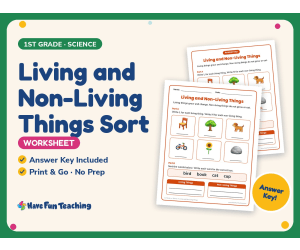
Living and Non-Living Things Sort Worksheet – 1st Grade Science
Science, Life Sciences, Biology, Kindergarten, Grade 1, 2, Worksheets & Printables, Worksheets
Looking for simple, effective living and non-living things practice for first grade? The Living and Non-Living Things Sort Worksheet is a ready-to-print science resource that students can complete on their own after a short introduction. Learning objective: Students will practice living and non-living things and apply the skill independently by completing each task on the page. Why it works: Each page targets one skill, so students get meaningful repetition without feeling overwhelmed. The layout is clean and uncluttered, which helps young learners focus on the task instead of the decorations. What's included: 1 printable worksheet page Clear, student-friendly directions 2 practice sections (Part A to Part B) Answer key (1 page) Cover page How it's organized: The page opens with these directions: "Write L for each living thing. Write N for each non-living thing." The practice is split into 2 parts, so students can work through it in clear steps. Grade level: Designed for first grade students. It also works well for kindergarten and second grade students who need extra practice or a fresh review. How to use it: Use it for whole-group practice, small-group instruction, independent work, centers, morning work, homework, or an emergency sub plan. Answer key: An answer key is included, so you can check work quickly or let students self-correct. Teaching tips and variations: Use it as an exit ticket the day after a living and non-living things lesson to see who needs more support. Model the first item together, then let students finish the rest independently. Slip the page into a sheet protector so students can practice again with dry-erase markers. Skills covered: Living and Non-Living Things, Science File type: PDF, ready to print. Number of pages: 3 (1 worksheet page, 1 answer key page, 1 cover page). Looking for more living and non-living things practice? Visit the Have Fun Teaching shop for related worksheets, reading passages, and activities for first grade. Have Fun Teaching on Teach Simple
Author Have Fun Teaching
Rating
Tags Living And Non-living Things Worksheet, Living And Non-living Things, 1st Grade Science, 1st Grade Worksheet, Answer Key, Science, Printable Worksheet, Living And Non-living Things Practice, Science Worksheet, No Prep

Baseball Time Reading Comprehension Worksheet
ELA, Reading, Grade 4, 5, Worksheets & Printables, Worksheets
This Baseball Time - Reading Comprehension Worksheet is a great way for your students to build their reading comprehension skills. The worksheet includes information on how to play baseball, which will help your students understand the game better.
Author Have Fun Teaching
Tags Reading Comprehension, Sports, Reading Passage

Kentucky: A Micro-Learning Deck | Digital Geography Lesson
Social Studies, Geography, Grade 4, 5, 6, 7, Teacher Tools, Lesson Plans
The Kentucky: A Micro-Learning Deck resource is an informative 14-slide Microsoft PowerPoint presentation that teaches 4th-7th grade students about the state of Kentucky. Through videos, audio clips, text passages, graphic organizers, interactive components, and summarizing activities, this digital lesson exposes students to various learning modalities about Kentucky's geography. Educators can implement this versatile resource in various ways - as a whole group lesson, small group work, independent practice, or a homework supplement. The lesson keeps students engaged as they watch, listen, read, organize, interact with, and reflect on information about The Bluegrass State. Teachers will appreciate the opportunity this resource provides to capture students' interests and enhance their knowledge about Kentucky's landscapes, major cities, economy, history, and culture.
Author Teach Me This
Tags Kentucky Learning Deck, Digital Lesson, Interactive Lesson, Geography Activity, Geography Lesson

Run | Phrasal Verbs Exercises
ELA, Language Development, ESL, Not Grade Specific, Worksheets & Printables, Worksheets
This resource is a set of exercises for the phrasal verb: run. There are 4 exercises, from conversation topics to multiple-choice questions. Answer key included. This resource can be accessed through Google Apps.
Author TEAM TEFL
Tags Language Arts, ESL, Lesson Plan, Grammar Worksheets, Phrasal Verbs, Phrasal Verbs Run

Brown Bear Brown Bear Retelling Cards
ELA, Language Development, Pre-Reading, Kindergarten, Preschool, Grade 1, 2, 3, Activities
Brown Bear Brown Bear Retelling Cards The Brown Bear Brown Bear Retelling Cards are an efficient educational tool for teachers who wish to enhance their students' language comprehension and sequencing abilities. They work excellently with children of all levels, from preschoolers to third graders. This teaching aid makes use of elements from the popular kids tale, "Brown Bear, Brown Bear, What Do You See?". The set is packed with large illustrations that can be attached to popsicle sticks for group lessons during story-time or library hours. These images aid in retelling the tale in a group setting or let kids arrange the plot order independently. Apart from group activities, it also includes an individual worksheet full of characters ready to be cut out allowing each learner build their version of the narrative straight out of the book. A unique feature is the option to create one-of-a-kind Retelling Necklaces. By punching holes in each card and threading yarn or string through them, you can make learning more interactive and fun! This usability makes these cards not just excellent for regular lessons but also ideal during thematic units about animals or authors like Eric Carle; even on subjects such as '5 senses' exploration activities. To make implementation easy for you as instructors/educators/homeschooling parents dealing with various learning strategies, you'll value that these materials simply need printing – they could last longer if laminated – then they're all ready! If preferred colors then have kids color away on their own versions increasing fun while integrating it with function! The product file type being PDF means it's digital hence easily reproducible whenever necessary. This saves you time letting you concentrate more on initiating interactive conversations geared towards enhancing your pupils learning environment thereby amplifying classroom productivity overall. Arrange the story together with this Brown Bear sequencing chart .
Author The Proactive Classroom
Tags Teaching Tools, Story Retelling, Language Comprehension, Sequencing Skills, Interactive Discussion

Alphabetical Order To The Fifth Letter Worksheet
ELA, Language Development, Pre-Reading, Grade 2, 3, 4, Worksheets & Printables, Worksheets
This Alphabetical Order To The Fifth Letter Worksheet is perfect for helping your students learn how to put words that begin with the same first five letters in ABC order. This is a great resource for teachers who want to help their students improve their alphabetical ordering skills.
Author Have Fun Teaching
Tags Alphabetical Order

The Lion, the Witch and the Wardrobe - Literature Kit Gr. 5-6
ELA, Literature, Grade 5, 6, Novel Studies, Worksheets & Printables
The Lion, the Witch and the Wardrobe - Literature Kit Gr. 5-6 This is an interactive and engaging teaching resource designed to enhance students’ comprehension of the classic story by C.S. Lewis. The kit boasts a unique variety of thoughtfully created activity sheets catering to Grade 5-6 students studying Language Arts and Literature. Features: Multiple-choice questions centered around Narnia's history straight from the novel to reinforce critical reading skills. Creative activities such as devising a map of the Witch's fortress or crafting descriptions for various creatures encountered in Narnia. Character exploration activities, including stepping into Peter's shoes as they unravel their feelings about staying at the Professor’s house or predict Lucy’s actions based on her interaction with the wardrobe. A focus on dialogue analysis, helping students dissect Peter and Susan’s strange dialogue with their Professor. Vocabulary-building exercises like crossword puzzles and word searches loosely tied specifically to words from this beloved novel. This literature kit has been primarily designed for classroom use either during group work sessions or solitary practice sessions. However, it can be utilized variably according to teaching approach be it in small breakout clusters for more detailed exploration or given as take-home exercises for continuous learning beyond school hours. Each section culminates in a comprehensive quiz which helps track progress while encouraging independent learning amongst students. With included 'answer keys', the kit is user-friendly while adhering strictly to state standards. Students using this literature kit not only confront difficult subjects but time-travel through pages alongside Narnian rulers Lucy, Edmund, Peter, and Susan towards their victory over the Witch. This product is provided in a convenient PDF format for immediate download and print.
Author Classroom Complete Press
Tags PDF

3rd Grade Georgia Social Studies Standards
, Grade 3,
This resource is a set of 3rd Grade Georgia Social Studies Standards. These posters are perfect for display on your bulletin board. All you have to do is print and go.
Author Sarah Miller Tech
Tags Graphics, Georgia, Social Studies, Bulletin Board, Goods And Services

Data Analysis & Probability - Digital Lesson Plan Gr. PK-2 | MAC Software
Math, Patterns, Kindergarten, Preschool, Grade 1, 2, Teacher Tools, Lesson Plans
Product Description This product is an all-round educational resource for educators teaching data analysis and probability in grades PK-2. Containing over 150 activities across more than 80 interactive screens, it successfully combines task-based activities and drills to cater to various classroom settings. Standards Compliance Aligned with NCTM standards and individual State Curriculum Math Strand of Data Analysis & Probability, this software is specifically cast for math proficiency. Main Features An array of pre-assessment activities for bespoke learning plans. Real-world problem solving exercises aimed at applied skill development. Dual functionality in imperial and metric measurements - useful in diverse geographical contexts. Bilingual text-to-speech ability (English/Spanish), supporting non-native speakers or bilingual classrooms effectively. Aptly balanced drill problems (90+) ensuring practice on accuracy and speediness. Printables available for traditional paper tasks/tests. Incorporated learning games like memory match game, board game & spinner game offering fun ways to learn concepts at a suitable pace. Actionable Evaluations The product comes fitted with assessment quizzes after each chapter acting as key knowledge-check markers providing both, the student performance feedback & teacher evaluations on their mathematical understanding level. Loading Details: - SKU: le-dap02m - Manufacturer: Lakeshore - Format: Downloadable Lessons / .ZIP files - Operating System Compatibility: Macos This state-of-the-art digital lesson plan encourages curiosity while filling knowledge gaps in areas of Data Analysis & Probability for pre-kindergarten to grade 2 students, inclusive, be it at home or school settings.
Author Classroom Complete Press
Tags Data, Analysis, Probability Lesson Plan, Digital Math, Patterns Lesson

Functional Life Skills Reading + Math Curriculum for Teens/Adults
Life Studies, Special Resources, Math, Life Skills, Special Education Needs (SEN), Finance, Adult Education, High School, Worksheets & Printables
After high school, our students are going to read a menu, a grocery ad, an electric bill, a bus schedule, a medicine label, and a lease, usually with nobody standing next to them. This bundle teaches each of those real-life documents, one at a time, with the reading and the math together. I've spent 20+ years in education, and the most common thing I hear from families of graduates is some version of "they can read, but they can't read a bill." Functional reading is its own skill. It has to be taught on documents that look like the real thing. The same routine in every set Every set uses the same layout, so students learn the routine once and then focus on the content: 10 words to know, with pictures Real-looking practice documents from made-up businesses 12 Level A questions with pictures and three answer choices The same 12 questions at Level B with open answers, for students ready for more A real-life task that takes the skill out of the worksheet An answer key that shows where on the document to find each answer Because Level A and Level B use the same questions, you can teach the whole class together and still meet students where they are. That's real differentiation without making two lessons. The 13 sets Reading a Restaurant Menu: prices, sections, and adding up an order Grocery Ads, Coupons + Shopping Lists: comparing prices and planning a trip Reading Utility Bills: electric, water, and phone bills, due dates and amounts Reading Bus + Train Schedules: timetables, routes, and fares Reading Medicine Labels: over-the-counter drug facts, doses, and warnings Tipping + Splitting the Bill: receipts, percent, and money math Visual Recipes: measuring cups, fractions, and following steps Laundry Care Labels + Washer Settings: symbols and choosing settings Phone Skills for Everyday Calls: appointments, voicemail, and phone menus Monthly Budget Worksheets: a pay stub, a budget, and a spending log Bank Basics: deposit slips, a bank app, and checking statements Reading a Simple Lease: rent, deposits, and move-in costs Address Practice: envelopes, mailboxes, and address forms How teachers and families use it A full semester functional reading and money math course: one set every week or so, 13 weeks Community-based instruction prep: teach the menu set before the restaurant trip and the bus set before the ride IEP goals: the Level A and B questions give you clean accuracy data for functional reading and math goals Homeschool: a ready-made life skills course for a teen who needs direct practice before living more independently What a week can look like Day one, go over the 10 words with pictures and look at the practice document together. Ask what students notice before you ask any questions. Day two, work through the Level A or Level B questions, with the answer key showing students exactly where to look on the document. Day three, do the real-life task: order from the menu with a set budget, plan a grocery trip, figure out which bus gets you to work on time. If you have time, bring in a real document from your town and see if students can use the same skills on it. That last step is where the learning sticks. Built to be read Short sentences, pictures for key words, and documents that print clearly in black and white. The answer key shows where each answer lives on the page, so a para or parent can check work and point a student back to the right spot without giving the answer away. Who it's for High school special education and life skills teachers, 18-21 transition program staff, resource teachers looking for real-world reading practice, and homeschool families of teens with disabilities. Everything is printable and low-prep. All businesses, prices, and people in the documents are made up. The medicine label set is reading practice only, not medical advice. Contents Reading a Restaurant Menu; Grocery Ads, Coupons + Shopping Lists; Reading Utility Bills; Reading Bus + Train Schedules; Reading Medicine Labels; Tipping + Splitting the Bill; Visual Recipes; Laundry Care Labels + Washer Settings; Phone Skills for Everyday Calls; Monthly Budget Worksheets; Bank Basics; Reading a Simple Lease; Address Practice.
Author The Transition Cliff
Rating
Tags Functional Reading, Money, Life Skills, Special Education, Transition, Job Skills, High School, Adult Education, Homeschool, Curriculum

Cyclops Activity
Social Studies, History, History: Ancient, History: Europe, History: World, Grade 2, 3, 4, 5, 6, 7, 8, Activities
Activity Introduction An amazing activity designed for the students to learn more about mythological creatures in different cultures. Cyclops Mythical Creatures What do you know about these amazing mythical creatures? What are their strengthens and weaknesses? In which culture did we found them? Do they do good to humans and their environment? Are there any other mythical creatures that share their characteristics? If yes, tell us more about them. Do you like reading about mythology? What is your favorite mythical creature? Tell us more about it. Cyclops Activity The activity is perfect for encouraging the creativity skills for the students, while learning more about this fantastic mythical creature. Cyclops This friendly designed worksheet is suitable for students at school, homeschooling, and as a group activity. Instructions Choose an eye, a mouth, a costume, a horn, and a weapon, then cut them out. Next colour the toilet paper roll a skin tone colour. Now start gluing everything on the roll until you have your Cyclop! Format Available in a PDF format.
Author Educational Voice
Tags Cyclops, Cyclops Activity, Cyclops Facts, Cyclops Facts For Kids, Mythology, Mythology Facts, Mythology Facts For Kids, Mythical Creature, Mythical Creatures
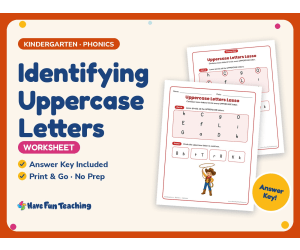
Identifying Uppercase Letters Worksheet – Kindergarten Alphabet
ELA, Language Development, Phonics, Preschool, Kindergarten, Grade 1, Worksheets & Printables, Worksheets
Looking for simple, effective alphabet practice for kindergarten? The Identifying Uppercase Letters Worksheet is a ready-to-print phonics resource that students can complete on their own after a short introduction. Learning objective: Students will practice alphabet and apply the skill independently by completing each task on the page. Why it works: Short, focused practice is one of the best ways to help kindergarten students remember a new skill. Clear directions mean students can get started quickly, and the simple format makes it easy for you to spot who needs more help. What's included: 1 printable worksheet page Clear, student-friendly directions 2 practice sections (Part A to Part B) Answer key (1 page) Cover page How it's organized: The page opens with these directions: "Circle the uppercase letter in each box." The practice is split into 2 parts, so students can work through it in clear steps. Grade level: Designed for kindergarten students. It also works well for preschool and first grade students who need extra practice or a fresh review. How to use it: Use it for whole-group practice, small-group instruction, independent work, centers, morning work, homework, or an emergency sub plan. Answer key: An answer key is included, so you can check work quickly or let students self-correct. Teaching tips and variations: Use it as an exit ticket the day after a alphabet lesson to see who needs more support. Send it home as homework so families can see what their child is learning in phonics. Keep a few copies in your early finisher bin for independent review. Skills covered: Alphabet, Phonics Standards: Supports Common Core RF.K.1d, L.K.1a. File type: PDF, ready to print. Number of pages: 3 (1 worksheet page, 1 answer key page, 1 cover page). Looking for more alphabet practice? Visit the Have Fun Teaching shop for related worksheets, reading passages, and activities for kindergarten. Have Fun Teaching on Teach Simple
Author Have Fun Teaching
Rating
Tags Alphabet Worksheet, Alphabet, Kindergarten Phonics, Kindergarten Worksheet, Answer Key, Phonics, Printable Worksheet, Alphabet Practice, Phonics Worksheet, No Prep

Trade and Voluntary Exchange Reading Packet
Social Studies, Economics, Grade 5, Worksheets & Printables, Worksheets
The Trade and Voluntary Exchange Reading Packet is an informative resource that teaches 5th grade students key economics concepts. Students read passages exploring trade and voluntary exchange then demonstrate understanding through multiple types of questions and graphic organizers. Educators can implement this as individual work, partner work, small group instruction, or homework. The reading packet features an informative article breaking down voluntary exchange and trade, multiple choice questions, fill-in-the blank vocabulary activities, and graphic organizers. Students will reinforce comprehension of economics topics like specialization, voluntary exchange, trade, and opportunity cost. This supplemental resource requires no prep-work and includes answer keys. Use it for social studies or reading lessons in 5th grade.
Author Sarah Miller Tech
Tags Economics, Nonfiction Text, Exchange, Venn Diagram, Vocabulary
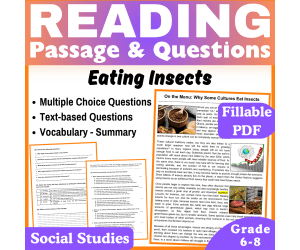
Eating Insects: Social Studies Reading Passage (Fillable PDF)
ELA, Reading, Reading Comprehension, Strategies, Resources for Teachers, Social Studies, Sociology, Grade 6, 7, 8, 9, Writing Prompts, Worksheets & Printables, Centers, Activities, Teacher Tools, Assessments, Quizzes and Tests, Quizzes, Tests
Eating Insects: Social Studies Reading Comprehension Passage (Fillable PDF) This resource introduces a unique Social Studies reading comprehension passage with questions about Eating Insects in some cultures and possible future eating trends. The passage is carefully designed to bridge the gap between social studies and literacy through strengthening reading comprehension and sparking knowledge curiosity in middle school students. Each passage blends English Language Arts skills with accurate social studies content . Ideal for interdisciplinary learning in ELA and Social Studies. Suitable for Grade 9 review, too! These worksheets are designed as fillable PDFs , which means students can type their answers directly into the document on any computer or tablet . Each page includes highlighted text fields that show them exactly where to type! Student Tasks throughout the passage: 5 multiple-choice questions targeting the following skills: main idea, key details, inference, vocabulary in context, and use of evidence 5 vocabulary matching items with clear, student-friendly definitions 5 text-based questions that require citing specific lines or facts 1 summary prompt that asks students to condense central ideas accurately Full answer key for every section Available Formats for this Resource: PDF Word Docs Google Docs Social Studies Reading Comprehension Collection Links: 1. Ancient Civilizations PDF Fillable PDF Word Docs Google Docs 2. Early Empires and Trade Networks PDF Fillable PDF Word Docs Google Docs 3. The Founding of the United States PDF Fillable PDF Word Docs Google Docs 4. Language, Culture, and Meaning PDF Fillable PDF Word Docs Google Docs 5. Psychology and Society PDF Fillable PDF Word Docs Google Docs 6. Global Festivals and Traditions PDF Fillable PDF Word Docs Google Docs 7. Extreme Environments and People PDF Fillable PDF Word Docs Google Docs 8. Food, Culture, and Preservation PDF Fillable PDF Word Docs Google Docs 9. Global Food Customs PDF Fillable PDF Word Docs Google Docs 10. Media, Communication, and Popular Culture PDF Fillable PDF Word Docs Google Docs 11. Human Impact on the Environment PDF Fillable PDF Word Docs Google Docs 12. Civic Action and Social Change PDF Fillable PDF Word Docs Google Docs 13. Fashion, Society, and Power PDF Fillable PDF Word Docs Google Docs 14. People, Places, and Unusual Histories PDF Fillable PDF Word Docs Google Docs Product Details: Length: 4 pages Grades: 6–8, also suitable for Grade 9 review Use cases: close reading, stations, homework, intervention, test prep, and sub plans Why Teachers Choose This Passage: Authentic social studies content paired with rigorous literacy practice Consistent task structure for easier planning and smoother student routines Clear, age-appropriate writing that builds confidence without oversimplifying Use this passage to reinforce ELA skills in social studies, to add literacy to your lessons, and to support independent work. The passage strengthens main idea, evidence use, vocabulary in context, inference, cause and effect, and summary writing. With ready-to-use assessments and complete answer keys, you can provide focused practice that is simple to run and fast to review.
Author EduNation Creative Store
Rating
Tags Middle School, Reading Comprehension, Reading Strategies, ELA, Centers, Reading Passage, Assessments, Vocabulary, Social Studies, Sociology

Email Scams Activity
Life Skills, Special Resources, Social Skills, Computer Science, Technology, Science, Grade 3, 4, 5, 6, 7, 8, 9, 10, 11, 12, Activities
Activity Introduction An amazing activity designed for the students to learn more about social and soft skills in our daily life. Email Scams Have you ever read about soft skills or social skills? If yes, can you tell us more about them? Body language is so important for us to learn about, as it teaches us how to deliver the correct message to the people we are talking to, and get the right message from the people who talk to us, by simply reading their body language. What do you know about etiquette? Do you know that every country has got its unique etiquette? What do you know about online etiquette? What is your strongest soft/social skill? Can you name other social or soft skills? Do you think we should be always nice to our friends and family? Do you think we should be kind with animals? Have you ever read about online etiquette? If yes, tell us more about it. What are the essential skills that we should have while dealing with people online? Email Scams Activity The activity is perfect for encouraging the researching skills for the students, while learning more about these fantastic social and soft skills in our daily life. Email Scams This friendly designed worksheet is suitable for students at school, homeschooling, and as a group activity. Instructions Can you highlight the reasons why these emails are scams? Format Available in a PDF format.
Author Educational Voice
Tags Email Scams Activity, Email Scams, Email Scam, Email Scams Facts, Email Scams Facts For Kids, Email Activity, Email Facts, Email Facts For Kids, Technology, Technology Facts

PLOT: The FIVE Elements of a Story Graphic Organizers
ELA, Reading, Reading Comprehension, Writing, Literary Devices, Not Grade Specific, Graphic Organizers, Templates
This is our PLOT section of our Graphic Organizers Series: The FIVE Elements of a Story. In this set, you can enjoy 10 custom graphic organizers for Plot. These graphic organizers can be used in any classroom, for any grade, and with any student. Use these graphic organizers to help students gain an understanding of Plot in a story. Each graphic organizer comes with instructions on how to use them. Plot Graphic Organizers: Plot Pyramid – Complete this classic Plot Pyramid graphic organizer by writing the Introduction of the story in the bottom left box. Then, describe the Rising Action, followed by the Climax of the story. Finish up with the Falling Action and the Resolution or Conclusion of the story. Sequence – Describe events from the story in sequence. Start off by writing the Initiating Event, or the event that starts off a chain reaction, in the top box. Follow this with the Steps that directly result from this event in order that they occur. Finish up by writing the Final Outcome of this event. Prediction Chart – In the first column, write down what you predicted, or thought would happen in the story. In the second column, write down what actually happened in the story. Continue this format for each event you predict will happen in the story. Storyboard – Illustrate the plot or an event from the story. Draw or describe in detail each stage in the plot or in an event that takes place in the story. Remember, the order of plot development is: Introduction, Rising Action, Climax, Falling Action, and Resolution/Conclusion. Story Structure – Complete the Story Structure by identifying the Introduction, events of the Rising Action, Climax, events of the Falling Action, and the Conflict and Resolution of the story. Then, identify the theme of the story, as well as the setting of the story (where and when the story takes place). Sequence Chain – Describe up to 9 events from the story in the order that they occur. Write the first event in the first box, followed by the second event in the following box, and so on following the chain. It is not necessary to fill in every box with an event. For an extra activity, draw each event in detail. Prediction Tree – In this Prediction Tree graphic organizer, write your question at the base of your tree. On the trunk, write down your prediction to the answer of the question posed. On the branches, write down evidence from the story to support your prediction. Story Cycle – Describe the Introduction of the story in the top right box. Following the cycle, describe the Rising Action next. Then, include the Climax of the story. Follow this with the Falling Action, and finally with the Resolution of the story. Then, describe how the Resolution relates back to the Introduction. Changes in Plot – Identify how the Plot changes throughout the story. In the first column, write down what happened in the beginning of the story. In the second column, write down what happened at the end of the story. Compare the two to show how the plot changed. Do this for every event in the story. Plot Analysis – Describe the Introduction and identify the Point of View. Describe the Rising Action and what’s being Forshadowed if relevant. Identify the Inciting Force and the Climax. Describe the Falling Action and any Suspense that is experienced. Describe the Conclusion and any Symbolism that is present.
Author Ibby Resources
Tags Literary, Device, Graphic Organizer, Plot, Elements

Speaking Language Assessment Worksheet
ELA, Grammar, Language Development, ESL, Preschool, Grade 1, 2, Worksheets, Worksheets & Printables
The Speaking Language Assessment Worksheet is a quick and easy way for teachers to assess their student's speaking commands of the conventions of standard English. This form is simple to use and provides accurate results that will help guide your instruction.
Author Have Fun Teaching
Tags Speaking And Listening

Sight Word Flip Book: a
ELA, Reading, Preschool, Grade 1, Activities
The Sight Word Flip Book for "a" helps kids learn to recognize, spell, write, and read this common sight word through engaging activities. Students start by coloring a fun cover page however they wish. Next, they search for the letter "a" throughout the book, trace and write it, spell it using letter manipulatives, cut and paste it, read and illustrate sentences containing "a", read passages with "a", and write their own sentences with drawings. This versatile resource works for literacy centers, homework, independent practice, and even as a substitute activity. With differentiated pages that allow choice, this book acts as a springboard for sight word mastery. Since early reading skills pave the way for future literacy development, this multi-sensory book breaks down essential concepts for reading success.
Author The Connett Connection
Tags Sight Words, Sight Word Flip Book, Sight Word Recognition, Sight Word A

Tools Number Cards
Math, Early Math, Numbers, Kindergarten, Preschool, Activities, Worksheets & Printables, Flashcards
These tool themed number cards are perfect for students who are learning with a community helper theme. They make the perfect tool for students to learn numbers up to 20. What is Included: This set includes one number card and one number word card for all numbers up to 20. Ideas for Using the Number Cards: Invite students to play a matching activity by pairing each number with its corresponding number word. Turn the cards into a hands on fishing game by attaching paper clips and using a magnetic fishing rod for students to “catch” the numbers. Place the cards in a sand or salt tray so students can trace or write the numbers and number words for tactile practice. Hide the cards around the classroom and have students go on a number scavenger hunt to find and identify each one. Challenge students to arrange the cards in correct numerical order, working independently or as a group. Use a pocket chart to create a guessing game by placing the cards in the chart and hiding a picture behind one number. Students take turns guessing which number is hiding the picture. Add small manipulatives (such as counters, cubes, or pom-poms) and have students count objects to match the number shown on each card. When to Use: Math Centers – Add the number cards to a math center for students to practice matching independently or with a partner. Morning Tubs or Baskets – Place the number cards in a morning bin for students to work on as classmates arrive. Small Group Instruction – Use the number cards during small group time to provide extra support for students who need additional practice recognizing numbers and number words. Make number recognition fun with these tool number cards! This low-prep activity is easy for teachers to prepare. Teachers just simply print, cut, and laminate for durability. The number cards fit perfectly in a task box for effortless setup, cleanup, and storage. Skills Assessed: These cards, depending on the materials added, can assess both number recognition and number word recognition.
Author The Connett Connection
Rating
Tags Number Recognition, Counting, Number Activities, Counting To 20

Watermelon Life Cycle Printable Activity Book
Reading, Kindergarten, Grade 1, 2, 3, Workbooks, Worksheets & Printables
Here's a fun and interactive way to teach your science lesson on the Watermelon Life Cycle! This 8 pages adapted book is cut and paste. It's filled with lots of information about the watermelons as well as vocabulary, wh reading comprehension questions, and a labeling worksheet.
Author My Kind of Crazy
Tags Watermelon, Cut And Paste, Printable, Life Of A Watermelon, Watermelon Activity, Lifecycle Of A Watermelon, Printable Watermelon, Watermelon Printout, Watermelon Printable

How to Write an Essay Gr. 5-8
ELA, Writing, Grade 5, 6, 7, 8, Teacher Tools, Lesson Plans
How to Write an Essay Gr. 5-8 A advantageous teaching resource designed explicitly for teachers in both formal and homeschooling settings. Ideal for those supportive of grades 5 through 8, this guide offers comprehensive instructions and tools necessary to express an articulate point of view. The task of teaching students how to write essays professionally can often be intimidating due to the complex possibilities within content structure. Thankfully, our product simplifies this process by explaining the four distinctive types of essays: Narrative Descriptive Expository (or informative) Persuasive . Prewriting Stage and Drafting This guide begins with a foundation—defining what exactly constitutes an essay—and then progresses towards the prewriting stage using straightforward graphic organizers. The drafting phase follows where your students can exercise creative autonomy while formulating their exhaustive thoughts into a casual outline. Detailed Descriptions for Each Essay Type Further enhancing these skills are detailed descriptions of each essay type such as narratives that bring a story alive or descriptive essays that paint vivid imagery, expository essays that safeguard against convoluted subjects, and persuasive essays that mold minds effectively—an all-round platform for emerging writers! About Revision and High-Quality Work Writing is only half the journey—the other half comprises revision which is equally crucial in producing high-quality work. We have included proofreading exercises along with opportunities for constructive editing practice—all aligned with prevalent State Standards and structured according to Bloom's Taxonomy. About Product Delivery This guide comes as Lesson Plans under the Language Arts/Writing category available in PDF file format. This makes it versatile for both online and offline use: be it group learning scenarios, breaking into smaller study groups or individual homework assignments—the uses are virtually limitless! Additional features include: Reproducible writing tasks Crossword puzzles along with word search games Rigorous comprehension quizzes—for enhanced learning experience assuredly! An answer key appended ensures that no question goes unanswered. Education for Various Learning Styles This resource is aware of various learning styles and is, therefore, beneficial for educators who aspire to provide rounded essay-writing education to their students. This product focuses on the basics, progressing methodically while comprehensively covering each essential topic—setting up your students success in writing.
Author Classroom Complete Press
Tags PDF
4.NBT.5 Fourth Grade Common Core Lesson
Math, Multiplication and Division, Division, Common Core, Grade 4, Teacher Tools
This 4.NBT.5 Fourth Grade Common Core Lesson is designed to help students multiply whole numbers using equations, arrays, or area models. This lesson is a great way to introduce or review the concept with your students.
Author Have Fun Teaching
Tags
I WONDER - What Is Radioactive Decay | Animated Video Lesson
STEM, Physics, Science, Chemistry, Grade 6, 7, 8, 9, 10, 11, 12, Lesson Plans, Teacher Tools
Video Introduction An amazing video designed for the students to learn more about STEM. I WONDER - What Is Radioactive Decay | Animated Video Lesson Do you like STEM subjects? what is your favorite one? Have you ever tried to plant a seed? If yes, tell us more about it. Or have you ever tried to invent something? If yes, tell us more about it. And how do you think it will help us? Have you ever seen a microorganism under a microscope? What was it? And how it looked like? Mathematics is a marvelous subject. Let' sharpen our brains and solve some equations. Do you like timetable tricks? What is your favorite one? Do you know how to code? Have you ever created an app or a game before? If yes, how was it like? I WONDER - What Is Radioactive Decay | Animated Video Lesson The video is perfect for encouraging the researching skills for the students, while learning more about this fantastic topic. I WONDER - What Is Radioactive Decay | Animated Video Lesson This friendly designed video is suitable for students at school, homeschooling, and as a group activity. Format Available in MP4 format.
Author Educational Voice
Tags What Is Radioactive Decay, What Is Radioactive Decay Video, Radioactive Decay, Radioactive Decay Facts, Radioactive Decay Facts For Kids, Radioactive Decay Video, Radioactive Decay Video For Kids
I WONDER - What Is Special About A Peregrine | Animated Video Lesson
STEM, Biology, Life Sciences, Science, Animals, Grade 1, 2, 3, 4, 5, 6, 7, 8, Lesson Plans, Teacher Tools
Video Introduction Animal kingdoms are full of fascinating wonders to learn. This video is designed for the students to learn more about animals in different countries. I WONDER - What Is Special About A Peregrine | Animated Video Lesson Do you like animals? what is your favorite one? Do you own a pet? If yes, tell us more about it, like what its name? And what do you like most about it? What are the animal kingdoms? Can you write down the characteristics of each animal class like mammals, birds, reptiles, amphibian, fish and mollusks. Do you know that some animals can sing, can you name any of them? What is the largest and the smallest mammal in the world? What is the largest and the smallest bird in the world? What is the largest and the smallest fish in the world? I WONDER - What Is Special About A Peregrine | Animated Video Lesson The video is perfect for encouraging the researching skills for the students, while learning more about these fantastic animals. I WONDER - What Is Special About A Peregrine | Animated Video Lesson This friendly designed video is suitable for students at school, homeschooling, and as a group activity. Format Available in MP4 format.
Author Educational Voice
Tags What Is Special About A Peregrine, What Is Special About A Peregrine Video, Peregrine, Peregrine Facts, Peregrine Facts For Kids, Peregrine Video, Peregrine Video For Kids, Animal, Animals