



5,109 products added recently
Page 5 - Newest Teaching Resources

 Show filters

Animal Families Coloring Pages | Kawaii Animals Coloring Book for Kids
Creative Arts, Early Learning, Homeschool Resources, Pre-K, Worksheets & Printables
Make learning about animals fun with this adorable Animal Families Coloring Pages pack! 🐾 This cute kawaii animal coloring book features 10 fun coloring pages showing animal parents and their babies in sweet, kid-friendly scenes. Children will love coloring adorable lion, elephant, panda, bear, giraffe, penguin, bunny, fox, monkey, and turtle families while building creativity, fine motor skills, focus, and pencil control. ✨ What's Included: 🦁 Lion Family 🐘 Elephant Family 🐼 Panda Family 🐻 Bear Family 🦒 Giraffe Family 🐧 Penguin Family 🐰 Bunny Family 🦊 Fox Family 🐵 Monkey Family 🐢 Turtle Family 🎨 Perfect For: Preschool & Kindergarten Early Elementary Animal-Themed Activities Science & Nature Units Animal Families Lessons Kids Coloring Activities Fine Motor Skills Practice Early Finishers Classroom Centers Homeschool Activities Quiet Time & Independent Work Rainy Day Activities These printable animal coloring pages are designed with simple, bold outlines and large coloring spaces, making them easy and enjoyable for young children.
Author Worksheets Center
Rating
Tags Coloring, Coloring Pages , Coloring Book, Coloring Activities, Coloring Sheets

Endangered Animals Coloring Pages - {Coloring Book}
Creative Arts, Early Learning, Homeschool Resources, Pre-K, Worksheets & Printables
Let kids meet some of the world's most amazing endangered animals through this sweet collection of kawaii-style coloring pages! 🐼🐯🐢🐘🦍 This printable set is packed with cute, kid-friendly drawings of endangered and threatened wildlife. Each page has bold outlines, simple shapes, and big open spaces to color — great for preschool, kindergarten, and early elementary kids. 🦁 Animals Included Giant Panda Amur Tiger Black Rhino Hawksbill Sea Turtle Mountain Gorilla Asian Elephant Orangutan Amur Leopard Blue Whale Monarch Butterfly ✨ Perfect For Animal-themed activities Wildlife units Endangered animals lessons Earth Day fun Nature and science centers Early finishers Quiet time Morning work Independent work Preschool and kindergarten activities Homeschooling Classroom coloring time 📚 Skills & Learning Benefits These coloring worksheets help children build: Fine motor skills Pencil and crayon control Creativity and imagination Focus and concentration A love for wildlife and nature 📌 What's Inside ✔ 10 unique endangered animal coloring pages ✔ Cute kawaii-style animal illustrations ✔ Bold, clean black-and-white outlines ✔ Big spaces that are easy for little hands to color ✔ Printer-friendly design ✔ No-prep printable activity ✔ Great for classrooms, homeschool, centers, and early finishers Give your students a fun way to learn about wildlife and endangered animals while practicing creativity and fine motor skills! 🐼🌿
Author Worksheets Center
Rating
Tags Coloring , Coloring Pages , Coloring Book, Coloring Sheets, Coloring Activities, Coloring For Kids
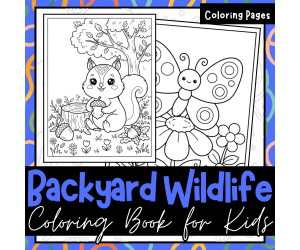
Cute Critters in Your Own Backyard! A Kawaii Animal Coloring Book
Creative Arts, Early Learning, Homeschool Resources, Pre-K, Worksheets & Printables
Backyard Wildlife Coloring Pages – Cute Kawaii Animal Coloring Book for Kids! There's something magical about the little creatures right outside our windows — and now you can bring that magic straight into your classroom! This sweet collection of kawaii backyard wildlife coloring pages is all about the adorable animals kids already love: bushy-tailed squirrels, shy little hedgehogs, buzzing ladybugs, and more. Each page features friendly faces, bold outlines, and simple shapes that are just right for little hands. Whether you're a teacher looking for a calm, no-stress activity or a parent wanting something fun for a rainy afternoon, these printables are here to save the day. Just print and go! ☀️ 🌼 Here's What You'll Get Inside this printable pack, you'll find 10 unique coloring pages, each starring its own backyard buddy: 🐿️ Squirrel and Acorns 🐰 Bunny in the Garden 🦔 Hedgehog Among Flowers 🐦 Little Bird and Birdhouse 🐞 Ladybug on a Leaf 🐸 Frog by the Garden Pond 🦋 Butterfly's Flower Visit 🐌 Snail After the Rain 🪺 Baby Birds in a Nest 🌼 Backyard Wildlife Friends ✨ What Makes These Special 10 adorable kawaii animal coloring pages Black-and-white printable designs — ready to color! Bold outlines and simple spaces, perfect for beginners Sweet backyard wildlife and garden themes A4 printable PDF format Zero prep — just print and hand them out! 🎯 Great For Preschool and kindergarten kiddos Early elementary students Morning work and early finishers Classroom centers and indoor recess Nature and animal-themed lessons Spring and summer activities Homeschooling and at-home learning Quiet time, art centers, and creative play 💡 Why Teachers Love These These coloring pages do more than keep little hands busy — they help kids build fine motor skills, spark creativity, and grow a real curiosity about the natural world around them. And because they're print-and-go, they're ready whenever you need a moment of calm or a fun brain break. 📥 How to Use Purchase and download the digital file. Print the pages you need (print as many as you like!). Hand them out and let the coloring adventures begin! Please Note: This is a digital download — no physical product will be shipped. Print quality may vary depending on your printer and paper settings. Add a little backyard magic to your classroom (or kitchen table!) with these adorable kawaii wildlife coloring pages. 🐾
Author Worksheets Center
Rating
Tags Coloring , Coloring Pages , Coloring Books, Coloring Sheet, Printables, Coloring For Kids
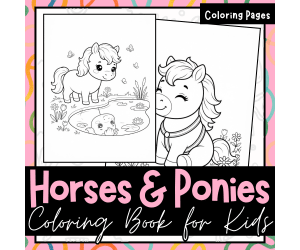
Horses & Ponies Coloring Pages for Kids | Kawaii Horse Coloring Book
Creative Arts, Elementary, Homeschool Resources, Pre-K, Worksheets & Printables
Make coloring time extra adorable with these cute Horses & Ponies Coloring Pages! 🐴✨ This kawaii-themed coloring pack features 10 cute horse and pony coloring pages made for young children who love animals, ponies, and creative activities. Each page has simple, kid-friendly illustrations with bold outlines that are easy and fun to color. ✨ What's Included 🐴 10 unique Horses & Ponies coloring pages 🎨 Cute kawaii-style illustrations ✏️ Bold, easy-to-color outlines 🌸 Fun horse and pony scenes 🖨️ Printer-friendly black-and-white pages 📄 A4 printable format 👧🧒 Great for young learners and animal lovers 💡 Perfect For Classroom coloring activities Early finishers Indoor recess Quiet time Morning work Art centers Homeschool activities Animal-themed lessons Horse and pony lovers 🎯 Skills & Benefits Coloring can encourage creativity, fine motor practice, hand-eye coordination, focus, and self-expression while giving children a fun, relaxing activity. horse coloring pages, pony coloring pages, horses coloring book, horse coloring sheets, cute horse coloring pages, kawaii coloring pages, animal coloring pages, farm animal coloring, printable coloring pages, kids coloring activities, horse activities for kids, pony activities, animal coloring sheets, preschool coloring pages, kindergarten coloring pages A fun and adorable printable coloring activity for kids who love horses, ponies, and cute animals! 🐴💖
Author Worksheets Center
Rating
Tags Coloring , Coloring Book , Coloring Pages , Coloring Sheets , Coloring Printables, Coloring For Kids

Frogs & Reptiles Coloring Pages - {Coloring Book}
Creative Arts, Early Learning, Homeschool Resources, Pre-K, Worksheets & Printables
A Kawaii Animal Coloring Book for Kids Hop into a world of cute and colorful fun! Frogs & Reptiles Coloring Pages is an adorable kawaii animal coloring book made for little learners who can't get enough of frogs, turtles, lizards, snakes, and all their fascinating reptile friends. Each page is packed with cute, kid-friendly illustrations featuring bold, simple outlines — perfect for small hands and big imaginations. Coloring has never been this easy or this much fun! ✨ What's Inside? 🐸 Sweet frogs and tiny baby frogs 🐢 Adorable turtles and tortoises 🦎 Friendly lizards, geckos, and chameleons 🐍 Cute little snakes 🐊 A smiley baby crocodile 🌿 Playful nature and habitat scenes 🎨 Easy black-and-white coloring pages 📄 10 printable pages, ready whenever you are 🌟 Perfect For: Early finishers Classroom activities Animal-themed fun Science and nature lessons Preschool and kindergarten Elementary students Homeschooling Indoor days Quiet time and creative play
Author Worksheets Center
Rating
Tags Coloring , Coloring Activities, Coloring Pages , Coloring Book, Coloring Sheets, Coloring Printables

Teaching Prefixes and Suffixes for Reading Longer Words
Common Core, ELA, Phonics, Language Development, Strategies, Reading, Grade 1, 2, 3, 4, Teacher Tools, Anchor Charts, Lesson Plans
Teaching Prefixes and Suffixes for Reading Longer Words This practical teaching guide shows parents and tutors exactly how to help children decode multisyllabic words using prefixes and suffixes.. Learning to read longer words doesn't have to mean memorising a rulebook. In fact, the more rules you throw at a struggling reader, the more likely they are to freeze. What children need is a simple, reliable decoding strategy they can use every time they meet an unknown multisyllabic word. That's exactly what Beginnings and Endings gives them. This short, practical guide teaches children to chunk longer words by finding the vowel sounds and building chunks around them. Pupils are taught to take each vowel sound and add the consonants next to it, before and/or after — keeping any blends or double letters that belong together. Example: important: we keep OR together → im–por–tant, or imp–or–tant, or im–port–ant. There’s no wrong answer here — the goal is the whole word, not a perfect split. To help them with this process, we teach them common prefixes and suffixes: spotting familiar prefixes and suffixes and using them as stepping stones into the rest of the word. No complicated syllable-splitting rules. No jargon. Just a clear phonics-based method that works — and that children can apply independently once they've seen it modelled a few times. We call them beginnings and endings as the words 'prefix' and 'suffix' are meaningless at first to a child and can put an extra hurdle in the way of success. The guide covers the most useful prefixes — be, de, re, pre and un — alongside a solid set of suffixes: -ful, -less, -ness, -ly, -er and -ment . Each section moves from two-syllable words up to longer ones, so you can start where your child is confident and build from there. There's also a step-by-step worked example showing exactly how to talk a child through the decoding process — because children need to see the thinking, not just be told to "break it into syllables" and left to figure out what that means. This is the Reading Made Simple approach to decoding longer words, and I use it with struggling readers of all ages — from young children just moving beyond single-syllable words to older students who've been stuck for years. The moment a child realises they can tackle a word like reorganise by pulling it apart into manageable chunks is the moment longer words stop being a mystery.
Author Lilibette's Resources
Rating
Tags Prefixes, Suffixes, Phonics, Multisyllabic Words, Reading Intervention, Home Education, Morphology, Reluctant Readers, Word Attack Skills

Phonic Reading Scheme for Older Students: 0-E: Book 25
Special Resources, ELA, Special Education Needs (SEN), Language Development, Phonics, Reading, Kindergarten, Preschool, Grade 1, Literacy Readers, Teacher Tools
This O-E split-digraph decodable reading book + matching PowerPoint + 30 supporting worksheets is in a series that can help children with special needs pupils develop reading fluency. Each book has a matching PowerPoint, making it suitable for various settings. This book is set in Saxon England. The Jack Stories, of which this book is one, introduces one phonic sound at a time, and subsequent books build on the vocabulary of the books before, constantly revising and reviewing learned sounds. Irregular sight words are only slowly and gradually introduced. Science of reading aligned. Based on the most up-to-date phonic research. These books should be read sequentially as they tell one long story, each telling a part. This book contains words with the following sounds: CK: OO, EE and SH and CH, ND & NT Endings, TH, AR, OR, A-E, I-E and O-E. The series of books can also be purchased as a growing bundle with a scope and sequence - one file, less clutter! This series has been written with the aid of one of my pupils, aged 8. He has drawn some of the pictures. What makes this phonic reading programme for special needs different? · It has its own, easy-to-download and print phonic reading books, making it accessible to many children worldwide. · Each book carefully builds on the vocabulary of those that have gone before, providing much repetition, without relying on predictable text. · Pictures aid the storyline without encouraging reading from the pictures – i.e. guessing. · The vocabulary is based on phonic families, which are introduced in a carefully planned way. · True sight words – those that cannot be sounded out - are kept to a minimum. Most words are introduced in their phonic family wherever possible. · It is truly multisensory, using the power of the hand. We not only look at the words, but we write them too. This is powerful and has the bonus of turning the child not only into a reader but into a writer as well. 30 Worksheets to support the development of reading fluency The worksheets take the pupil from hearing the new sound in words, developing phonemic awareness, to reading passages in preparation for reading the book. It includes the following activities: Spelling Reading Tracking phonemic awareness Reading passages Typical signs that this programme can help: Those with dyslexia, or suspected of having dyslexia Difficulty recalling words when seen on flashcards or when reading texts, which results in no or little reading fluency b/d letter reversal of a chronic nature – i.e. the child has not grown out of it Difficulty ordering letters in words: E.g. top becomes pot. Difficulty differentiating between like words: spoon/soon; back/black; sheep/sleep etc… Difficulty tracking words across a page How long is the book? The reading book is 16 pages long. What is included? 1 PDF 16 pp X A5 Print as a booklet Flip on the short edge One 16-slide PowerPoint 11 Worksheets
Author Lilibette's Resources
Rating
Tags Decodable Reading Books, Phonic Reading Scheme, Reading Fluency, Guided Reading, Special Needs, Phonics Intervention, Split Digraphs, Decodable Readers
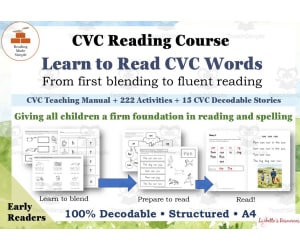
CVC Words Teaching Pack: Activities + 15 Decodable Stories | SOR
Common Core, Phonics, Language Development, ELA, Kindergarten, Grade 1, Literacy Readers, Teacher Tools, Lesson Plans, Worksheets & Printables
CVC Words Teaching Pack: Activities + 15 Decodable Stories | Science of Reading This CVC Words teaching pack forms part of a structured literacy programme for introducing young learners to reading and spelling. It aligns with the Science of Reading and includes a detailed teaching manual, 162 sound and blending activities, 84 story-preparation activities, picture and word cards, and 15 100% decodable stories, all designed to help children build strong foundational reading skills. What is Included The teaching manual offers clear, step-by-step guidance on helping children master blending (reading) and segmenting (spelling) CVC words. The programme’s unique structure ensures that even students with processing difficulties can succeed by introducing concepts systematically and building on previous learning. The 162 sound and blending activities are in six small steps. Children need to know the letter sounds and hear the initial sound in a word before they start, so every step includes sound recognition and instant-recall practice to keep the sounds fresh for as long as a child needs. Blending then begins with only a few letters at a time, and the range of words grows gradually. Every worksheet uses only the sounds the child has already been taught. These simple, engaging activities strengthen both reading and spelling. Picture and word cards go with each step, so children can make the word from a picture, or read a word and find the picture. They are for matching, memory games, sorting and more, and ideas are included. Only use pictures and matching words that the child has already met. The 84 story-preparation activities practise the words and skills needed before each story. The 15 decodable stories feature Farmer Tom, his wife and children Sam and Pam, and their farm animals in adventures that young readers can actually decode independently. Each story includes word practice lists at the beginning, connecting new vocabulary to familiar rhyming patterns. The stories are in one convenient 72-page A4 book, with reader-friendly formatting, a large, clear font and generous spacing. Why This Approach Works Many programmes introduce the sounds and then move straight into blending. This course asks children to know the sounds first, then blends using just a small range of letters at a time. That gives them time to learn to blend and reduces the temptation to learn words by sight before blending is established. Unlike many phonics programmes, these stories maintain strict decodability while telling genuinely engaging narratives, with no phonics drills! Students read only CVC words they can sound out, plus four essential sight words (a, the, is, of). The books have no curveballs to knock the confidence of young readers. Children are always introduced to all the words they need to read each story before they read it, and then meet familiar words in the stories that follow. This planned repetition builds fluency and confidence as readers recognise words they’ve successfully decoded before. The beautiful watercolour illustrations make children want to read the stories again and again, without encouraging picture-guessing, an important element of Science of Reading instruction. Best For This programme suits young learners in kindergarten through early first grade (ages 4–6), including children starting from the very first sounds. It also helps older children who need a fresh start with CVC words. It works well for small group instruction, one-to-one tutoring or homeschool settings, and wherever structured, research-based materials are needed. Who can use it? This resource can be used by teachers, though it is especially written with parents in mind. Having the stories in one book means more affordable printing, and the non-technical vocabulary makes it easy to use even for the least confident parent. The manual helps with assessment and troubleshooting. The programme also suits children who need longer to learn to blend and segment CVC words, ensuring that they do not begin to rely on word recognition before they can truly sound out, a common trap of many programmes.
Author Lilibette's Resources
Rating
Tags Cvc Words, Decodable Readers, Science Of Reading, Beginning Readers, Reading Fluency, Early Literacy, Controlled Vocabulary, CVC Decodable Readers, CVC Decodable Books, Special Needs

SUPER PACK OF ACTIVITIES | THE ALPHABET | 199 PAGES
ELA, Language Development, Literature, Reading, Writing, Special Resources, Resources for Teachers, Early Learning, Elementary, Homeschool Resources, Pre-K, Not Grade Specific, Activities, Teacher Tools, Worksheets & Printables
SUPER PACK OF ACTIVITIES | THE ALPHABET | 199 PAGES We are EDITORIAL LAURA EDUCA, a publishing house passionate about creating educational materials designed for children. Our goal is to make learning a fun and meaningful experience. I invite you to visit my educational store, where you will find a wide variety of resources ready for you. MAIN DESCRIPTION: What is the name of your product and what makes it special? This beautiful product is called “SUPER PACK OF ACTIVITIES | THE ALPHABET | 199 PAGES”, and it is very special because it was carefully designed or compiled. With this educational resource, we want students to learn with enthusiasm and fun, because we believe learning is fun. How many pages are included in this resource? This fabulous document contains the following number of pages: 199 What size is it designed in (A4, letter, etc.)? This resource is designed in A4 format and compiled as a PDF. This makes downloading and printing simple and convenient, and PDFs are also easy to store and carry anywhere. A4 Is the material in color or black and white? This pedagogical document comes in both black and white and color. This makes it more attractive for your learning sessions, but you have the freedom to choose how to print it. COLOR MAIN INFORMATION OF THIS RESOURCE: What subject, skill, or topic does it cover? This resource is designed to cover essential learning areas for children, generally literacy and math. What learning objectives does it achieve? This document fulfills a playful objective—it’s meant to be attractive and engaging for children. At the same time, it ensures that students learn or reinforce their knowledge. Who can use it best (teachers, parents, students, therapists, homeschoolers)? We are all part of education. Whether you are a teacher, parent, student, or therapist, this document can adapt perfectly to your learning goals, depending on your creativity. What additional materials are recommended (printer, scissors, markers, etc.)? The more immersed students are in learning, the greater their results. That’s why it’s ideal to complement this resource with pencils, crayons, markers, and even other art tools. What outcome, benefit, or transformation can the user expect? With this fabulous resource, students will first understand that learning is easy and fun, and second, they will strengthen their knowledge and skills.
Author EDITORIAL LAURA EDUCA
Rating
Tags PACK, BUNDLE, ACTIVITIES, ALPHABET, THE ALPHABET, ABC, ABECEDARY, WORKSHEETS, BOOK, WORKBOOK
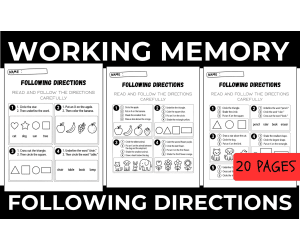
Working Memory, Paying Attention, Listening, and Following Instruction
Reading, ELA, Kindergarten, Grade 1, 2, Worksheets & Printables
These worksheets concentrate on a seemingly simple skill that often leads to children making mistakes: actually following directions. not looking. failing to fill up memory gaps. hearing or reading directions, grasping them, and following them in order. This pack is intended to identify the point at which that sequence breaks down for many students. The format of the exercises varies. Some ask students to mark, circle, color, or draw objects in accordance with written directions. Others display completed work and ask students to identify any errors, such as missing details, skipping steps, or using the incorrect order. Students arrange well-known classroom practices in a sequencing portion, which encourages them to consider the importance of order rather than merely memorizing a list. The Distractor Challenge is the most fascinating feature. Instructions are supplied to students along with an extra, irrelevant detail. The challenge is to identify it, ignore it, and go on. It's a real talent. Classroom instructions can become unorganized; students must learn to filter, and not all of the information in a set of instructions applies to every work. During the teacher-led listening round, a new level of difficulty is introduced; written instructions are replaced with spoken ones, and rereading is not allowed. Lastly, students think on what helped them remember and persevere. This reflection step is brief, but it encourages students to think about how they approach tasks rather than just whether they completed them. Three levels of difficulty are included in the coloring and marking exercises, allowing for distinction without the need to prepare additional materials. Great for older students or early elementary school students who need more structured practice with focus and multi-step projects. Nine answer sheets and eleven worksheet pages make up the total of 20 pages. Format: pictures or PDF
Author life skills learning store
Rating
Tags Working Memory, Following Instruction, Listening, Reading , Printables, Worksheets
Landforms Worksheets Activities | Earth, Geography, and Reading
ELA, Reading, Science, Earth and Environmental Sciences, Grade 3, 4, 5, Worksheets & Printables
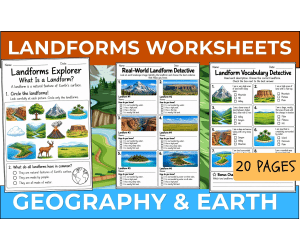
This saves you the hassle if you've ever spent an afternoon attempting to put together a cohesive landforms unit from disparate worksheets. The same subject is covered on ten activity sheets and ten answer keys. They can be used in any order that is appropriate for your class. The exercises cover the major landform principles in a non-repetitive manner. Students classify landforms according to their physical characteristics, recognize and describe landforms, and read a brief instructional chapter about a mountain journey and use textual evidence to answer questions. A map activity and a section on the formation of landforms—erosion, wind, water, ice, and volcanic activity—are included in the geography section. That one usually comes up with interesting questions. If your class is competitive about being the first, a mystery activity that requires students to interpret clues and determine if a landform is an island, peninsula, plateau, or canyon works well. There’s also a Venn diagram comparing mountains and plateaus, and a project where students draw and describe their own landform, including how it might have formed and what lives there. The creative one is genuinely open-ended the answer key gives suggested responses for those sections rather than a single correct answer. Works for Grades 3–5. Printable, no prep. Works for whole-class, small groups, independent work, homework, or sub plans. If you have students who need more support or more challenge, most of the pages adapt without much effort.
Author life skills learning store
Rating
Tags Landforms, Worksheets, Earth, Geography, Reading , Activities , Printables
Beginning Sounds Google Slides Alphabet Phonemic Awareness Activities
ELA, Reading, Phonics, Language Development, Pre-Reading, Early Learning, Elementary, Pre-K, Activities, Worksheets & Printables
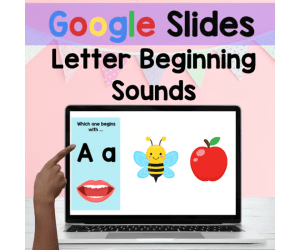
Beginning Sounds Google Slides | Alphabet Phonemic Awareness Activities Help young learners practice identifying beginning sounds with this fun, interactive set of 27 Google Slides ! Each slide features a letter and two picture choices. The teacher says the two words aloud, and students listen carefully to decide which word begins with the target letter sound. For example: A — Bee or Apple? Students listen and identify Apple as the word that begins with /a/. Each slide also includes a mouth formation illustration to help students see how their mouths should be positioned to correctly articulate the target sound. This makes the activity a great way to connect letter recognition, phonemic awareness, listening skills, and speech articulation . What's Included? 27 Interactive Google Slides One slide for each letter/sound Two picture choices on every slide Teacher says the words aloud Students identify which picture begins with the target sound Visual mouth formation guide for articulating the sound correctly Great for whole-group instruction, morning warm-ups, small groups, or literacy centers Printable Recording Sheets Students circle the picture that begins with the target letter sound Recording sheets match the Google Slides exactly Simple black-and-white line art makes them easy to print and use Provides an opportunity for independent practice and accountability Extra X Versions Includes two versions for X X-ray for the /x/ sound at the beginning of a word Fox for the /x/ sound at the end of a word Matching recording sheets are included for both versions Skills Practiced Identifying beginning sounds Phonemic awareness Letter-sound correspondence Listening and discrimination skills Alphabet recognition Oral language Correct sound articulation Connecting spoken words to their beginning sounds Ways to Use Use these slides as: Whole-group phonemic awareness practice Morning warm-ups Literacy centers Small-group instruction Intervention practice Quick daily review Independent practice with the recording sheets No prep required! Simply open the Google Slides, display a slide, say the two words aloud, and have students listen for the beginning sound. Add the matching recording sheet when you want students to record their answers.
Author Messy Beautiful Fun
Rating
Tags Phonics, Science Of Reading, Vowel Valley, Mouth Sounds, Phonetics, Letter Sounds, Google Slides Phonics, Phonics Slides, Phonics Worksheets, Letter Sounds Worksheets

Hospital Support Job Skills Task Cards | Infection Control + Privacy
Life Studies, Special Resources, Career, Life Skills, Special Education Needs (SEN), Adult Education, High School, Worksheets & Printables
Hospitals have many support jobs that are not patient care: cleaning rooms, stocking supplies, delivering meal trays, moving wheelchairs after training. Many hospital internship programs place students in exactly these jobs. The rules are strict: clean hands at every door, read the door sign, keep what you see private, and stop and ask a nurse when you are not sure. This set teaches the words, the steps, and those rules. This set covers hospital support jobs that are not patient care: environmental services, dietary, central supply, and transport. It fits hospital internship programs and work-based learning at a hospital. General soft skills are in my Soft Skills Scenario Cards. What's included: • Teacher page with three support levels and a 2-week plan • Job snapshot: jobs, a typical shift, and what supervisors look for • 16 vocabulary cards and a vocabulary match • 5 task sequence cards (enter a patient room, deliver a meal tray, restock a supply room, clean a room after discharge, push a wheelchair (after training)) plus a blank card • Put-it-in-order worksheets for all 5 tasks • 8 safety rules and a 10-item safe or unsafe sort with "do this instead" • 12 procedure cards (what is the rule here?) and a procedure planner • On-the-job checklist for student and supervisor ratings, with an IEP data note • Answer key and blank cards to write your own How I use it: I start with the job snapshot and the vocabulary cards. Then I model each task card and have students practice while a partner reads the steps. A paper door sign, gloves, and a tray with a printed ticket make the room-entry and tray cards real. The procedure cards work best a few at a time as a warm-up or with role-play. Before an internship rotation or job site visit, students set goals on the checklist, and the supervisor or job coach rates the same skills afterward. How this set is different from my other job skills resources: my Soft Skills Scenario Cards cover general "what would you do" moments that happen at any job, and my Task Analysis Data Sheets break down everyday routines with data sheets. This set is only about one workplace: its words, its tasks, and its rules. None of the scenario cards or routines are repeated here. Part of the Job Site Task Card Series: one set per workplace, all in the same layout, so you can mix sites across your caseload and students already know how the cards work when they move to a new site. Pairs well with: • Soft Skills Scenario Cards (the soft skills side of any job) • Task Analysis Data Sheets (hand-washing and cleaning routines with data sheets) • Self-Advocacy Communication Cards (Hand This Page and an All About Me card for a new job) • Work Schedules + Time Cards (day, evening, and weekend shifts) Who it is for: high school special education, transition programs for ages 18 to 21, vocational and CTE classes, job coaches, and work-based learning teams. Grades 9th to 12th and adult transition. What you download: one printable PDF, 13 pages, US Letter. Answer key included. Job tasks and rules vary by employer. Use this to prepare students, and always follow the training and rules at the actual job site. From the author of The Transition Map (Jeremy D. Gooch), available in paperback and Kindle. Written by Jeremy D. Gooch, a teacher with 20+ years in education. All student names and stories are made up.
Author TransitionCliff
Rating
Tags Job Skills, Task Cards, Special Education, Transition, Life Skills, Vocational, Work Based Learning

FREE Job Site Task Cards Sampler | 12 Workplaces | Job Skills
Life Studies, Special Resources, Career, Life Skills, Special Education Needs (SEN), Adult Education, High School, Worksheets & Printables
This free sampler has one task card and one procedure card from each of the 12 sets in my Job Site Task Card Series: Grocery Store, Fast Food Restaurant, Retail Store, Custodial, Hotel Housekeeping, Warehouse, Hospital Support, Office and Clerical, Childcare Aide, Landscaping, Animal Care, Food Prep. Use it to see how the cards work with your students before you pick the sites that match your community and your caseload. What's included: • 12 task sequence cards with 6 numbered steps each, one per workplace • 12 procedure cards ("what is the rule here?") on site rules like chemical safety, allergies, pick-up lists, and forklifts • Possible answers for every procedure card • A list of every site and the 5 tasks in each full set How I use it: model a task card, then have a student act it out while a partner reads the steps. Read one procedure card a day as a warm-up and ask, "What is the rule here, and who do you tell?" Each full set has 13 pages: a teacher page with three support levels, a job snapshot, 16 vocabulary cards and a match, 5 task cards with put-it-in-order worksheets, safety rules and a safe-or-unsafe sort, 12 procedure cards with a planner, an on-the-job checklist, an answer key, and blank cards. Search "Job Site Task Cards" in my store to find them. Part of the Job Site Task Card Series. Another free job skills item: Am I Job Ready? Student Self-Check + Task Cards What you download: one printable PDF, 5 pages, US Letter. Job tasks and rules vary by employer. Always follow the training and rules at the actual job site. From the author of The Transition Map (Jeremy D. Gooch), available in paperback and Kindle. Written by Jeremy D. Gooch, a teacher with 20+ years in education. All student names and stories are made up.
Author TransitionCliff
Rating
Tags Job Skills, Task Cards, Special Education, Transition, Life Skills, Vocational, Free
Address Practice | Envelopes, Mailboxes + Forms | Life Skills
Special Resources, Life Skills, Special Education Needs (SEN), Adult Education, High School, Worksheets & Printables, Activities
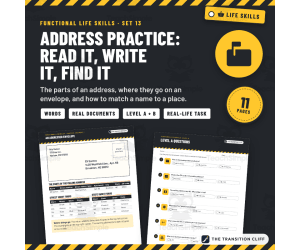
Address Practice: Read It, Write It, Find It: a functional reading and math set for high school life skills, special education, and transition programs. The parts of an address, where they go on an envelope, and how to match a name to a place. Why I made this: Students are asked for an address on job applications, library cards, medical forms, and packages, and a lot of them stall on the second line. An address has the same parts in the same order every time. This set breaks those parts apart, puts them on an envelope, and then has students use them the way adults do: finding a mailbox, a house on a street, or a name on a delivery list. How it is different from my Job Application Practice Pack: that pack covers the whole application. This set is only the address: its parts, the short forms, where it goes on an envelope, and finding a place or a person from it. What's included: • A teacher page: why I made it, how to use both levels, and the skills covered • Words to know: 10 key words, each with a picture • 3 pages of practice documents: an addressed envelope with short-form charts, an apartment mailbox panel and a street map with odd and even numbers, and a delivery list with a library card form that has one mistake. All businesses, names, and numbers are made up. • 12 Level A questions, each with a picture and three answer choices • The same 12 questions at Level B, with open answers and room to show the math • A real-life task: address an envelope from a delivery list and fill in an address form • An answer key that shows where to find each answer How I use it: Read through the practice documents together, then give each student the level that fits. Both levels ask the same questions, so the whole class can check answers together. I use the real-life task as a wrap-up or right before a community outing. Skills covered: naming the parts of an address; reading street and state short forms; placing the return address, stamp, and mailing address on an envelope; finding a unit number on a mailbox panel; using odd and even house numbers; matching a name to an address on a list; checking a form for mistakes and filling one in. Part of the Functional Life Skills series: every set uses the same layout (words, real-looking documents, two levels of the same questions, and a real-life task), so students know the routine when you move to the next set. Pairs well with: • Job Application Practice Pack (the address is the first line on every application) • Community + Workplace Safety Signs Task Cards (more functional reading in the community) Who it is for: high school life skills and special education classes, transition programs for ages 18 to 21, and adult education. Grades 9 to 12 and adult transition. What you download: one printable PDF, 11 pages, US Letter. Answer key included. From the author of The Transition Map (Jeremy D. Gooch), available in paperback and Kindle. Written by Jeremy D. Gooch, a teacher with 20+ years in education. All businesses, names, and numbers are made up.
Author TransitionCliff
Rating
Tags Functional Reading, Special Education, Transition, Life Skills, Addresses, Writing, Community Skills

Reading a Simple Lease | Rent, Deposits + Move-In | Life Skills
Special Resources, Life Studies, Life Skills, Special Education Needs (SEN), Home Economics, Adult Education, High School, Worksheets & Printables, Activities
Reading a Simple Lease: a functional reading and math set for high school life skills, special education, and transition programs. Rent, due dates, deposits, utilities, pets, and repairs. Know what you are signing. Why I made this: Signing a first lease is one of the biggest things a young adult does, and most of them sign without reading it. A simple lease has the same sections every time: rent, the due date and late fee, the deposit, utilities, pets, repairs, and moving out. This set uses a short, plain lease so students can find each part, then add up what it really costs to move in. How it is different from my Reading Utility Bills set: that one is the monthly bills that come after you move in. This set is the lease you sign before you move in, and what it costs on move-in day. What's included: • A teacher page: why I made it, how to use both levels, and the skills covered • Words to know: 10 key words, each with a picture • 3 pages of practice documents: a two-page apartment lease and a move-in cost sheet with a before-you-sign checklist. All businesses, names, and numbers are made up. • 12 Level A questions, each with a picture and three answer choices • The same 12 questions at Level B, with open answers and room to show the math • A real-life task: make a one-page lease summary card for the refrigerator • An answer key that shows where to find each answer How I use it: Read through the practice documents together, then give each student the level that fits. Both levels ask the same questions, so the whole class can check answers together. I use the real-life task as a wrap-up or right before a community outing. Skills covered: finding the rent, due date, grace period, and late fee; reading the lease term (start and end dates); security deposit and how to get it back; which utilities are included and which the tenant pays; pet rules, pet deposit, and pet rent; normal repairs vs. emergencies; adding up move-in costs. Part of the Functional Life Skills series: every set uses the same layout (words, real-looking documents, two levels of the same questions, and a real-life task), so students know the routine when you move to the next set. Pairs well with: • Reading a Pay Stub (checking that the rent fits the paycheck) • Job Application Practice Pack (more practice reading and filling in forms) Who it is for: high school life skills and special education classes, transition programs for ages 18 to 21, and adult education. Grades 9 to 12 and adult transition. What you download: one printable PDF, 11 pages, US Letter. Answer key included. From the author of The Transition Map (Jeremy D. Gooch), available in paperback and Kindle. Written by Jeremy D. Gooch, a teacher with 20+ years in education. All businesses, names, and numbers are made up.
Author TransitionCliff
Rating
Tags Functional Reading, Special Education, Transition, Life Skills, Lease, Independent Living, Housing

Bank Basics | Deposit Slips, Bank App + Statements | Life Skills
Special Resources, Life Studies, Life Skills, Special Education Needs (SEN), Finance, Adult Education, High School, Worksheets & Printables, Activities
Bank Basics: Deposits, Balances + Statements: a functional reading and math set for high school life skills, special education, and transition programs. Fill in a deposit slip, read the bank app, and check a monthly statement. Why I made this: A lot of my students get their first checking account the same week they get their first job, and nobody shows them how to read it. Then the app shows two different balances, a charge says pending, and an ATM fee shows up out of nowhere. This set goes through the three things they will actually see: a deposit slip, the bank app, and a monthly statement. How it is different from my Money Math Task Cards: Money Math is about paying at the register. This set is about the bank account behind the card: deposit slips, available and current balance, pending charges, fees, and a monthly statement. What's included: • A teacher page: why I made it, how to use both levels, and the skills covered • Words to know: 10 key words, each with a picture • 3 pages of practice documents: a filled-in deposit slip with debit card safety tips, a bank app screen with available and current balance, and a checking statement. All businesses, names, and numbers are made up. • 12 Level A questions, each with a picture and three answer choices • The same 12 questions at Level B, with open answers and room to show the math • A real-life task: keep a transaction register and fill in a deposit slip • An answer key that shows where to find each answer How I use it: Read through the practice documents together, then give each student the level that fits. Both levels ask the same questions, so the whole class can check answers together. I use the real-life task as a wrap-up or right before a community outing. Skills covered: reading and filling in a deposit slip; cash back and net deposit; available balance vs. current balance; pending transactions; reading a monthly statement: deposits, withdrawals, fees, balance; keeping a transaction register; debit card and PIN safety. Part of the Functional Life Skills series: every set uses the same layout (words, real-looking documents, two levels of the same questions, and a real-life task), so students know the routine when you move to the next set. Pairs well with: • Reading a Pay Stub (where the direct deposit comes from) • Life Skills Money Math Task Cards (paying at the register) Who it is for: high school life skills and special education classes, transition programs for ages 18 to 21, and adult education. Grades 9 to 12 and adult transition. What you download: one printable PDF, 11 pages, US Letter. Answer key included. From the author of The Transition Map (Jeremy D. Gooch), available in paperback and Kindle. Written by Jeremy D. Gooch, a teacher with 20+ years in education. All businesses, names, and numbers are made up.
Author TransitionCliff
Rating
Tags Functional Reading, Special Education, Transition, Life Skills, Banking, Money Math, Financial Literacy

Monthly Budget Worksheets | Pay Stub, Budget + Log | Life Skills
Special Resources, Life Studies, Life Skills, Special Education Needs (SEN), Finance, Adult Education, High School, Worksheets & Printables, Activities
Monthly Budget: Income, Rent + Bills: a functional reading and math set for high school life skills, special education, and transition programs. Start with take-home pay, plan every dollar, then check what really got spent. Why I made this: Most of my students can tell me what they want to buy with their first paycheck. Far fewer can tell me what is left after rent. A budget is just a list and some subtraction, but it only works if you start from take-home pay and then check it against what you really spent. This set walks through one young adult's month from pay stub to spending log. How it is different from my Reading a Pay Stub resource: that set teaches gross pay, deductions, and net pay in depth. Here the pay stub is only the starting point. Most of this set is the monthly budget and comparing what was planned with what was really spent. What's included: • A teacher page: why I made it, how to use both levels, and the skills covered • Words to know: 10 key words, each with a picture • 3 pages of practice documents: a pay stub, a monthly budget with fixed and flexible expenses, and a spending log with a planned-vs-spent table. All businesses, names, and numbers are made up. • 12 Level A questions, each with a picture and three answer choices • The same 12 questions at Level B, with open answers and room to show the math • A real-life task: pick a place to live and build a monthly budget that does not spend more than you earn • An answer key that shows where to find each answer How I use it: Read through the practice documents together, then give each student the level that fits. Both levels ask the same questions, so the whole class can check answers together. I use the real-life task as a wrap-up or right before a community outing. Skills covered: reading hours, rate, gross pay, deductions, and net pay on a pay stub; finding monthly income from two paychecks; sorting fixed and flexible expenses; adding a budget and finding what is left over; adding up a spending log by category; comparing planned and actual spending; building a budget from take-home pay. Part of the Functional Life Skills series: every set uses the same layout (words, real-looking documents, two levels of the same questions, and a real-life task), so students know the routine when you move to the next set. Pairs well with: • Reading a Pay Stub (a full set on gross pay, deductions, and net pay) • Life Skills Money Math Task Cards (counting money and reading receipts) Who it is for: high school life skills and special education classes, transition programs for ages 18 to 21, and adult education. Grades 9 to 12 and adult transition. What you download: one printable PDF, 11 pages, US Letter. Answer key included. From the author of The Transition Map (Jeremy D. Gooch), available in paperback and Kindle. Written by Jeremy D. Gooch, a teacher with 20+ years in education. All businesses, names, and numbers are made up.
Author TransitionCliff
Rating
Tags Functional Reading, Special Education, Transition, Life Skills, Budgeting, Money Math, Financial Literacy

Phone Skills for Everyday Calls | Appointments, Voicemail + Menus
Special Resources, Life Skills, Special Education Needs (SEN), Adult Education, High School, Worksheets & Printables, Activities
Phone Skills for Everyday Calls: a functional reading and math set for high school life skills, special education, and transition programs. Appointments, phone menus, a late bus, and calling in sick. Plan what to say before you dial. Why I made this: Many young adults would rather text than call, and then a dentist office or an attendance line leaves them no choice. The calls themselves are short and follow a pattern. When students have read a script, gone through a phone menu, and planned their words, picking up the phone gets much easier. This set sticks to everyday personal calls, not calls on the job. How it is different from my Calling In Sick, Texting + Emailing the Boss resource: that one is about work. This set is everyday personal calls: a dentist office, a bus line phone menu, and a school attendance line. No workplace calls are in it. What's included: • A teacher page: why I made it, how to use both levels, and the skills covered • Words to know: 10 key words, each with a picture • 3 pages of practice documents: a dental appointment card with office hours and a call script, a bus line phone menu with a text alert, and a school attendance line with two sample voicemails. All businesses, names, and numbers are made up. • 12 Level A questions, each with a picture and three answer choices • The same 12 questions at Level B, with open answers and room to show the math • A real-life task: write scripts for three everyday calls and practice them with a partner checklist • An answer key that shows where to find each answer How I use it: Read through the practice documents together, then give each student the level that fits. Both levels ask the same questions, so the whole class can check answers together. I use the real-life task as a wrap-up or right before a community outing. Skills covered: reading an appointment card and office hours; figuring a cancel-by time; following a phone menu; reading a text alert and adjusting a time; knowing what to say when calling in sick to school; leaving a clear voicemail; asking someone to repeat information. Part of the Functional Life Skills series: every set uses the same layout (words, real-looking documents, two levels of the same questions, and a real-life task), so students know the routine when you move to the next set. Pairs well with: • Job Skills Communication: Calling In Sick, Texting + Emailing the Boss (the work side of phone calls) • Transition Planning Phone Map: Who Do I Call? (for families planning who to call after high school) Who it is for: high school life skills and special education classes, transition programs for ages 18 to 21, and adult education. Grades 9 to 12 and adult transition. What you download: one printable PDF, 11 pages, US Letter. Answer key included. From the author of The Transition Map (Jeremy D. Gooch), available in paperback and Kindle. Written by Jeremy D. Gooch, a teacher with 20+ years in education. All businesses, names, and numbers are made up.
Author TransitionCliff
Rating
Tags Functional Reading, Special Education, Transition, Life Skills, Phone Skills, Communication, Speaking
Laundry Care Labels + Washer Settings | Functional Reading SPED
Special Resources, Life Studies, Life Skills, Special Education Needs (SEN), Home Economics, Adult Education, High School, Worksheets & Printables, Activities
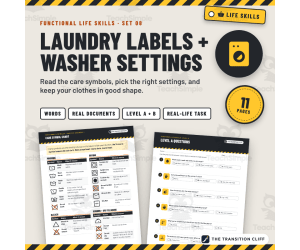
Laundry Labels + Washer Settings: a functional reading and math set for high school life skills, special education, and transition programs. Read the care symbols, pick the right settings, and keep your clothes in good shape. Why I made this: A lot of students leave school without ever reading the tag inside a shirt, and the first shrunken sweater is an expensive way to learn. The symbols are a small picture language with a few simple rules: dots mean heat, and an X means do not. Once students know the rules, the washer knobs make sense too. I added a laundromat sign because many young adults start out without a washer at home. How it is different from my other resources: nothing else in my store covers laundry. It sits next to my Community + Workplace Safety Signs Task Cards as another kind of picture reading, but the symbols, labels, and washer settings here are all new. What's included: • A teacher page: why I made it, how to use both levels, and the skills covered • Words to know: 10 key words, each with a picture • 3 pages of practice documents: a care symbol chart, four clothing labels with fabric and care symbols, and a washer guide with laundromat prices and laundry safety rules. All businesses, names, and numbers are made up. • 12 Level A questions, each with a picture and three answer choices • The same 12 questions at Level B, with open answers and room to show the math • A real-life task: choose wash and dry settings for four labels, then read a label from real clothing • An answer key that shows where to find each answer How I use it: Read through the practice documents together, then give each student the level that fits. Both levels ask the same questions, so the whole class can check answers together. I use the real-life task as a wrap-up or right before a community outing. Skills covered: reading care symbols for washing, bleach, drying, ironing, and dry cleaning; knowing that dots mean heat and an X means do not; reading a clothing label: fabric and care words; matching a label to a washer cycle, water temperature, and dryer setting; reading detergent cap lines; figuring laundromat costs; laundry safety: bleach, detergent, and the lint screen. Part of the Functional Life Skills series: every set uses the same layout (words, real-looking documents, two levels of the same questions, and a real-life task), so students know the routine when you move to the next set. Pairs well with: • Community + Workplace Safety Signs Task Cards (more symbol and sign reading) • Task Analysis Data Sheets (for the laundry routine itself) Who it is for: high school life skills and special education classes, transition programs for ages 18 to 21, and adult education. Grades 9 to 12 and adult transition. What you download: one printable PDF, 11 pages, US Letter. Answer key included. From the author of The Transition Map (Jeremy D. Gooch), available in paperback and Kindle. Written by Jeremy D. Gooch, a teacher with 20+ years in education. All businesses, names, and numbers are made up.
Author TransitionCliff
Rating
Tags Functional Reading, Special Education, Transition, Life Skills, Laundry, Care Labels, Independent Living

Visual Recipes | Measuring Cups, Fractions + Steps | Life Skills
Special Resources, Life Studies, Life Skills, Special Education Needs (SEN), Home Economics, Adult Education, High School, Worksheets & Printables, Activities
Visual Recipes: Measuring + Steps: a functional reading and math set for high school life skills, special education, and transition programs. Read the card, measure the amounts, and follow the steps in order. Why I made this: Cooking is where a lot of students first see fractions do something real. A recipe card asks them to read a short form, pick the right measuring cup, and follow the steps in order, and it shows them right away if something got skipped. I used one stove recipe and one no-bake recipe so the set works in rooms with and without a kitchen. How it is different from my Task Analysis Data Sheets: those are for tracking a routine while a student does it. This set teaches the reading that comes first: the recipe card, the short forms, the measuring cups, and doubling a recipe. What's included: • A teacher page: why I made it, how to use both levels, and the skills covered • Words to know: 10 key words, each with a picture • 3 pages of practice documents: a stove-top breakfast burrito card, a no-bake oat bites card, and a measuring guide with fraction bars and a doubling chart. All businesses, names, and numbers are made up. • 12 Level A questions, each with a picture and three answer choices • The same 12 questions at Level B, with open answers and room to show the math • A real-life task: double a recipe and complete a before-I-cook checklist • An answer key that shows where to find each answer How I use it: Read through the practice documents together, then give each student the level that fits. Both levels ask the same questions, so the whole class can check answers together. I use the real-life task as a wrap-up or right before a community outing. Skills covered: reading a recipe card: makes, prep time, cook time, ingredients, tools, steps; reading short forms: tsp, Tbsp, c., oz; comparing ¼, ⅓, ½, and 1 cup; following steps in order; doubling and halving a recipe; adding prep time and cook time; kitchen and allergy safety. Part of the Functional Life Skills series: every set uses the same layout (words, real-looking documents, two levels of the same questions, and a real-life task), so students know the routine when you move to the next set. Pairs well with: • Task Analysis Data Sheets (to track the cooking routine itself) • Community + Workplace Safety Signs Task Cards (more functional reading) Who it is for: high school life skills and special education classes, transition programs for ages 18 to 21, and adult education. Grades 9 to 12 and adult transition. What you download: one printable PDF, 11 pages, US Letter. Answer key included. From the author of The Transition Map (Jeremy D. Gooch), available in paperback and Kindle. Written by Jeremy D. Gooch, a teacher with 20+ years in education. All businesses, names, and numbers are made up.
Author TransitionCliff
Rating
Tags Functional Reading, Special Education, Transition, Life Skills, Recipes, Fractions, Cooking

Tipping + Splitting the Bill | Receipts, Percent + Money Math
Special Resources, Life Studies, Life Skills, Special Education Needs (SEN), Finance, Adult Education, High School, Worksheets & Printables, Activities
Tipping + Splitting the Bill: a functional reading and math set for high school life skills, special education, and transition programs. Read the receipt, find 10 percent, figure the tip, and split it fairly. Why I made this: Students watch adults pay at restaurants all the time, but nobody explains what happens on that little slip. Tipping and splitting a check come up the first time a group of friends goes out to eat. A couple of simple tricks, like finding 10 percent first, turn it into math students can do at the table without a calculator. How it is different from my Money Math Task Cards: Money Math has no tipping and no percent. This set is only about the restaurant check: subtotal, tax, a printed tip guide, 10, 15, and 20 percent with mental math, and splitting it fairly. What's included: • A teacher page: why I made it, how to use both levels, and the skills covered • Words to know: 10 key words, each with a picture • 2 pages of practice documents: three restaurant receipts (one with a printed tip guide, one for a group of four, one with separate orders), plus a tip tricks card and a tipping guide. All businesses, names, and numbers are made up. • 12 Level A questions, each with a picture and three answer choices • The same 12 questions at Level B, with open answers and room to show the math • A real-life task: figure the tip and split a group receipt four ways, then fill in a card slip • An answer key that shows where to find each answer How I use it: Read through the practice documents together, then give each student the level that fits. Both levels ask the same questions, so the whole class can check answers together. I use the real-life task as a wrap-up or right before a community outing. Skills covered: reading a receipt: subtotal, tax, and total; reading a printed tip guide; finding 10%, 15%, and 20% with mental math; adding the tip to the total; splitting a bill evenly; finding what each person ordered; filling in the tip line on a card slip. Part of the Functional Life Skills series: every set uses the same layout (words, real-looking documents, two levels of the same questions, and a real-life task), so students know the routine when you move to the next set. Pairs well with: • Life Skills Money Math Task Cards (change and receipts) • Reading a Pay Stub (more real-life money reading) Who it is for: high school life skills and special education classes, transition programs for ages 18 to 21, and adult education. Grades 9 to 12 and adult transition. What you download: one printable PDF, 10 pages, US Letter. Answer key included. From the author of The Transition Map (Jeremy D. Gooch), available in paperback and Kindle. Written by Jeremy D. Gooch, a teacher with 20+ years in education. All businesses, names, and numbers are made up.
Author TransitionCliff
Rating
Tags Functional Reading, Special Education, Transition, Life Skills, Money Math, Tipping, Percents

Reading Medicine Labels | OTC Drug Facts | Life Skills SPED
Special Resources, Life Skills, Special Education Needs (SEN), Adult Education, High School, Worksheets & Printables, Activities
Reading Medicine Labels: a functional reading and math set for high school life skills, special education, and transition programs. Find the dose, the timing, the warnings, and the date. Then check with a nurse, doctor, or pharmacist. Why I made this: Most adults I know learned to read a medicine label by guessing. Students deserve better than that. This set does not tell anyone what to take. It teaches students where to find the dose, the timing, the warnings, and the expiration date, and it teaches them to ask a nurse, doctor, or pharmacist when they are not sure. This is the only medicine label set in my store. It teaches reading, not dosing: where the dose, the timing, the warnings, and the date are, and when to ask a nurse, doctor, or pharmacist. The labels are for made-up products and follow the standard Drug Facts layout. What's included: • A teacher page: why I made it, how to use both levels, and the skills covered • Words to know: 10 key words, each with a picture • 3 pages of practice documents: three practice Drug Facts labels with box fronts: a pain reliever, an allergy medicine, and a cough syrup measured in mL. All businesses, names, and numbers are made up. • 12 Level A questions, each with a picture and three answer choices • The same 12 questions at Level B, with open answers and room to show the math • A real-life task: fill in a medicine card from a label and practice questions to ask a pharmacist • An answer key that shows where to find each answer How I use it: Read through the practice documents together, then give each student the level that fits. Both levels ask the same questions, so the whole class can check answers together. I use the real-life task as a wrap-up or right before a community outing. Skills covered: finding the parts of a Drug Facts label; reading the active ingredient and purpose; reading a dose by age group, in tablets or mL; reading how often and the most in 24 hours; finding warnings and when to stop and ask a doctor; reading an expiration date; knowing who to ask: a nurse, doctor, or pharmacist. Please note: this set teaches students to read a label. It is not medical advice and does not tell anyone what to take. The labels are for made-up products, and every label reminds students to check with a nurse, doctor, or pharmacist. Part of the Functional Life Skills series: every set uses the same layout (words, real-looking documents, two levels of the same questions, and a real-life task), so students know the routine when you move to the next set. Pairs well with: • Community + Workplace Safety Signs Task Cards (more functional reading for safety) • Task Analysis Data Sheets (for daily living routines) Who it is for: high school life skills and special education classes, transition programs for ages 18 to 21, and adult education. Grades 9 to 12 and adult transition. What you download: one printable PDF, 11 pages, US Letter. Answer key included. From the author of The Transition Map (Jeremy D. Gooch), available in paperback and Kindle. Written by Jeremy D. Gooch, a teacher with 20+ years in education. All businesses, names, and numbers are made up.
Author TransitionCliff
Rating
Tags Functional Reading, Special Education, Transition, Life Skills, Medicine Labels, Health, Community Skills

Reading Bus + Train Schedules | Timetables + Fares | Life Skills
Special Resources, Life Skills, Special Education Needs (SEN), Adult Education, High School, Worksheets & Printables, Activities
Reading Bus + Train Schedules: a functional reading and math set for high school life skills, special education, and transition programs. Read across the row, read down the column, and get there on time. Why I made this: A bus schedule is a grid of numbers, and for a lot of young adults that grid is what stands between them and a job across town. Reading across a row and down a column is a skill students can practice at a desk before anyone has to stand at a real stop. This set stays on reading the timetable itself, with times, days, and fares. How it is different from my Transportation Planning ride plan: that one is a planning page for families (how will my student get there, who drives, what is the backup). This set teaches the student to read the timetable itself: rows, columns, AM and PM, days, and fares. No pages are shared. What's included: • A teacher page: why I made it, how to use both levels, and the skills covered • Words to know: 10 key words, each with a picture • 3 pages of practice documents: a weekday bus timetable with a route line, the return trip with Saturday service and fares, and a commuter train timetable with zones. All businesses, names, and numbers are made up. • 12 Level A questions, each with a picture and three answer choices • The same 12 questions at Level B, with open answers and room to show the math • A real-life task: use the timetables to plan a bus trip to an appointment and back • An answer key that shows where to find each answer How I use it: Read through the practice documents together, then give each student the level that fits. Both levels ask the same questions, so the whole class can check answers together. I use the real-life task as a wrap-up or right before a community outing. Skills covered: reading a timetable across a row and down a column; telling AM from PM; finding the next bus after a certain time; picking the latest bus that still arrives on time; finding how long a trip takes; reading service days, holidays, and fares; reading train numbers and fare zones. Part of the Functional Life Skills series: every set uses the same layout (words, real-looking documents, two levels of the same questions, and a real-life task), so students know the routine when you move to the next set. Pairs well with: • Transportation Planning: How Do I Get There? Ride Plan (the family planning side of getting around) • Job Skills Math: Work Schedules + Time Cards (more practice reading times and hours) Who it is for: high school life skills and special education classes, transition programs for ages 18 to 21, and adult education. Grades 9 to 12 and adult transition. What you download: one printable PDF, 11 pages, US Letter. Answer key included. From the author of The Transition Map (Jeremy D. Gooch), available in paperback and Kindle. Written by Jeremy D. Gooch, a teacher with 20+ years in education. All businesses, names, and numbers are made up.
Author TransitionCliff
Rating
Tags Functional Reading, Special Education, Transition, Life Skills, Bus Schedule, Community Skills, Transportation