



3,911 products added recently
Page 10 - Science Assessments
Provide comprehensive science assessments covering biology, chemistry, physics, and Earth science. This collection includes lab reports, concept checks, and experimental evaluations. Foster a deeper understanding of scientific principles by using targeted assessments.

 Show filters

Reading Passage: Food Chains and Food Webs (Google Slides)
Science, Life Sciences, Biology, Common Core, ESL, Language Development, ELA, Spelling, Reading Comprehension, Reading, Grade 2, 3, 4, Presentations, Teacher Tools, Tests, Quizzes and Tests, Assessments, Activities
Free Reading Passage on Food Chains and Food Webs for Life Science What's inside this free product? Science Reading Comprehension Passage26 : Food Chains and Food Webs Independent Google Slides Version: This is the independent Google Slides version containingone lesson with full answer keys. Product Info: 27 SLIDES (US English with Answers) Google Slides Version Teaching Duration: Approximately 90 Minutes Science Reading Comprehension Outline: Targeted for students in 3rd and 4th grades, these reading passages are enhanced with illustrations and graphs to elucidate critical points. Each lesson aligns with the Common Core State Standards, allowing you to integrate science reading practice effortlessly, knowing that minimal preparation is needed on your part. Each passage comes with a variety of questions in different formats, including multiple-choice formats, data analysis, and fill-in-the-blanks. The topics covered strike a balance between engaging content and core curriculum-based science subjects. Versatile in application, these lessons are suitable for a variety of settings such as whole-class instruction, morning activities, independent desk work, small group discussions, contingency plans for substitute teachers, homework assignments, or even special holiday-themed tasks. FULL CATALOG OF DOWNLOAD LINKS HERE Grade 3/4 Links: Physical Science Part 1 - Properties of Objects and Materials Google Docs/Slides/Forms PDF PPT Word Free Supplementary Pack Accompanying Videos Physical Science Part 2 - Position and Motion of Objects Google Docs/Slides/Forms PDF PPT Word Free Supplementary Pack Accompanying Videos Physical Science Part 3 - Light, Heat, Electricity, Magnetism Google Docs/Slides/Forms PDF PPT Word Free Supplementary Pack Accompanying Videos Life Science Part 1 - Characteristics of Organisms Google Docs/Slides/Forms PDF PPT Word Free Supplementary Pack Accompanying Videos Life Science Part 2 - Life Cycles of Organisms Google Docs/Slides/Forms PDF PPT Word Free Supplementary Pack Accompanying Videos Life Science Part 3 - Organisms and Environments Google Docs/Slides/Forms PDF PPT Word Free Supplementary Pack Accompanying Videos Earth Science Part 1 - Properties of Earth Materials Google Docs/Slides/Forms PDF PPT Word Free Supplementary Pack Accompanying Videos Earth Science Part 2 - Changes in the Earth and Sky Google Docs/Slides/Forms PDF PPT Word Free Supplementary Pack Accompanying Videos Earth Science Part 3 - Objects in the Sky Google Docs/Slides/Forms PDF PPT Word Free Supplementary Pack Accompanying Videos For similar products and other frees, do check out Cored Group on TeachSimple .
Author Cored Education
Tags Science, Elementary, Reading, Comprehension, Vocabulary, Answers, Physics, Physical Science, Ccss, Common Core
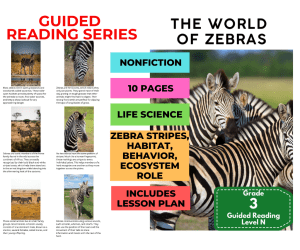
Guided Reading Level N - World of Zebras (with Lesson Plan)
ELA, Resources for Teachers, Reading Comprehension, Reading, Pre-Reading, Language Development, Animals, Life Sciences, Science, Vocabulary, Grade 2, 3, 4, Worksheets & Printables, Worksheets, Teacher Tools, Centers, Activities, Literacy Readers, Quizzes, Quizzes and Tests, Assessments
This Guided Reading Book - World of Zebras (Level N) with lesson plan includes: Guided Reading Color Label (front cover x1) This is a quick way to match the book’s demands to what students can generally handle.. The overall goal is to use the level/color to pick books for several smaller groups. To qualify for a certain level, a student is expected to read a book from that level with about 90–94% accuracy. If a student is consistently accurate and understands, move up a level. If the student is struggling at that level, drop down and add more support. Each student will improve at completely different rates, but it is generally one of the best ways to check progress across the class. DOWNLOAD THE CATALOG TO VIEW ALL GUIDED READING BOOKS AVAILABLE (SORTED LEVELS A-Z) Pre-Reading Question (x1) Teacher asks the prompt aloud, can be while showing the cover or first page. Students share what they already know, or make educated guesses from the cover. Prompt them to use the target vocabulary. Write some of their responses on the board to look back at during the reading. Vocabulary Words (x5) Introduce the five words, best doing it one at a time. Start by saying it, while students repeat and then see if anyone knows what it means before reading further. Read through the meaning and try to briefly connect each word to a picture or gesture so it’s meaningful. Ask students to flip through the book pages and point to where they see each of the vocabulary words. While reading the book pause upon coming across one of the vocab words or read the sentence twice to make sure students understand the word has appeared. Optional: Ask students to raise hands whenever they see/hear one of the new words. Guided Reading Pages (x10) Check the book snapshot (below) for: primary topic - do you need to prep extra reading or intro materials on this? what is taught best - decide on 1-2 bullets to focus on, use the prompt or words provided here for best results. learning goals - what you are checking for students to be able to do after the session, elicit answers using prompts or words provided. key vocabulary (see section above). questions overview - so you know what is coming up and if you need to prep extra materials to assist understanding. Run the lesson You may have already looked at a few of the pages together, but you can show them some of the pictures again first to set meaning. Depending on how much time you have and how familiar your students are with guided reading class, you may want to read the book aloud first with the group first. Students whisper or partner read, while you listen in. If time, do it as a group, one student reading a page each. Use the guided page’s prompts to coach: “Check the picture / does it make sense?” “Point under the words / try the first sound” “Reread the sentence smoothly”. Try to focus more on one student per session (rotating every time), so you can work out if they are ready to move up or need to move down a level. Comprehension Questions (back cover x3) This is your way to check that students didn’t just say the words, but actually understood the text. First, let students answer by pointing to the page/picture and saying a short sentence. After any answer, follow with: “Show me where you found that in the text.” In bigger groups, have partners answer first (10–20 seconds), then call on 2–3 students to share. Differentiation tips: Emerging speakers/struggling readers: oral + pointing On-level: oral in a full sentence Higher: one written sentence or draw + label Book Snapshot Title: The World of Zebras Genre: Nonfiction (informational text) Subject: Life Science / Reading (Informational Text) Primary Topic: Zebra stripes, habitat, behavior, and ecosystem role Estimated Guided Reading Level (A–Z): N What This Book Teaches Best Animal adaptations for survival: Zebras’ black-and-white stripes help them blend into the “shimmering heat” and can create a “visual blur” when predators are near. Animal identification and social behavior: Each zebra’s stripe pattern is unique “like a human fingerprint,” helping herd members recognize one another. Habitats and needs: Zebras live in open grasslands and woodlands called savannas, where they can roam, find water, and watch for danger. Ecosystems and food chains: As plant-eaters, zebras graze tough grasses and help keep grasslands healthy, supporting other species. Life cycles and migration: The text explains foals (baby zebras) and describes the Great Migration in search of water and green pastures. Learning Goals Students will describe where zebras live and what that habitat provides for them. Students will explain how zebra stripes can help zebras in different situations described in the text. Students will identify what zebras eat and describe how their teeth help them graze. Students will describe how zebras live in groups and name the members of a harem listed in the book. Students will retell how zebras respond when a predator is nearby, using details from the text. Students will explain why zebras are important to grasslands, based on the ecosystem details provided. Key Vocabulary From the Text iconic — well-known and easy to recognize. savanna — open grassland with a few trees. herbivores — animals that eat only plants. stallion — an adult male in the zebra family group. ecosystem — living things in a place and how they relate. Discussion Prompts Pre-reading question: How do you think a zebra’s stripes could help it stay safe? Comprehension questions: What does the text say is special about each zebra’s pattern of stripes? Comprehension questions: According to the text, what might zebras do when a predator like a lion or hyena is nearby? Comprehension questions: Why does the text say zebras are important for keeping grasslands healthy? Printing Tips 1. Best Printing Method (Recommended) “Booklet” Printing (Best if Available) If your printer or PDF viewer supports Booklet Printing , use this. Settings to use: Print mode: Booklet Paper size: Letter or A4 (either works) Orientation: Landscape Print on both sides: Yes Flip on: Short edge Scaling: Fit to printable area Booklet subset: First test: Front sides only Then: Back sides only This will automatically: Pair pages correctly Put the cover on the outside Align everything for folding After printing, fold in half and staple along the spine . 2. If “Booklet” Printing Is NOT Available You can still print this correctly with manual duplex printing . Step-by-step: Open the PDF. Choose Print . Set: Orientation: Landscape Pages per sheet: 1 Print on both sides: Yes Flip on: Short edge Print all pages . Because each PDF page already contains two facing book pages, the result will still fold cleanly into a book. Thousands of Cored Education products are included with your TeachSimple membership. Download links and encyclopedia index available here.
Author Cored Education
Rating
Tags Reading Comprehension, Reading Passages, Reading, Guided Reading, Guided Reading Lesson Plan, Guided Reading Activity, Pre-reading, Science Lesson Plans, Life Science, Animals

High School Science The Keystone Paradigm Unit
ELA, Reading, Writing, Reading Comprehension, Research, Resources for Teachers, Science, Earth and Environmental Sciences, Homeschool Resources, High School, Teacher Tools, Assessments, Lesson Plans, Quizzes and Tests, Rubrics, Worksheets & Printables, Writing Prompts, Worksheets
Let’s be real: finding science curriculum for a ninth grader that is not fluff feels like a full-time job. Once we hit the high school years, the "nature study" phase is over, and suddenly we are staring down the barrel of complex theories and massive textbooks. I built this unit because I was tired of "busy work" packets. I wanted my own daughter to see that science isn't just a list of facts to memorize—it is a messy, fascinating debate that is still happening right now. INCLUDED IN THIS RESOURCE: Keystone Paradigm Text 30-Year Population Data MacNulty Science Challenge Complete Grading Suite TOPICS COVERED: Trophic Cascade Mechanics Ecosystem Engineering Abiotic vs. Biotic Factors Scientific Model Critiques I will never forget the morning she finally sat at the table, nose deep in the MacNulty critique, and the "aha!" moment hit. Watching her connect the dots on how a wolf can actually shift the course of a river... that is the spark we’re all chasing, right? I designed this to give your student/homeschooler that same intellectual respect while giving you a breather. It is rigorous, it’s deep, and most importantly, it is ready to go. I hope it brings some incredible "lightbulb moments" and lively debates to your house, too. If you and your students/homeschoolers enjoyed this resource, please leave a review. Thank you for your support! Tina - Big Easy Homeschooling Mom
Author Homeschool with Big Easy Homeschooling Mom
Rating
Tags High School Science, Homeschool Science, Ecology Unit, Trophic Cascades, Yellowstone Wolves, Biology Module, Environmental Science, High School Ecology Curriculum, MacNulty Challenge Science, High School Biology Curriculum
Texas STAAR Practice Tests Bundle for Grade 5
ELA, Math, Science, Grade 5, Assessments, Teacher Tools, Tests, Quizzes and Tests, Worksheets & Printables
Prepare your students for success with this Grade 5 STAAR Practice Tests Bundle . This complete resource includes Math, Reading, and Science practice tests designed to mirror the real STAAR exam. It helps students build confidence and strengthen key skills across all tested subjects. The bundle includes three full practice tests with realistic STAAR-style questions. Students practice math problem solving and multi-step reasoning, reading comprehension and analysis, and science concepts with data interpretation. The format helps students become familiar with test expectations. Each test includes an answer key for quick and easy grading. All materials are printable and ready for classroom use. This bundle can be used by teachers for full exam simulations, small group intervention, review sessions, and test preparation. Additionally, it is effective for subplans, evaluation days, and homework. Students increase their test-taking confidence and endurance while developing abilities in a variety of disciplines. Simply print and utilize. This Grade 5 STAAR bundle helps students feel confident and prepared for success while simplifying test preparation.
Author Bright Classroom Ideas Marketplace
Rating
Tags Texas, Staar, State Test, Math, Science, Reading, Ela
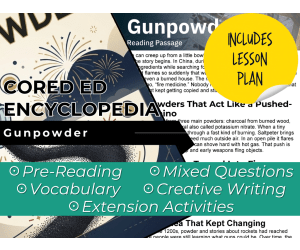
Gunpowder Reading Comprehension Passage - Cored Ed Encyclopedia
ELA, Reading Comprehension, Reading, Science, Technology, Pre-Reading, Language Development, History, Social Studies, Physics, Grade 2, 3, 4, 5, Worksheets & Printables, Worksheets, Teacher Tools, Centers, Activities, Writing Prompts, Assessments, Quizzes and Tests, Quizzes, Lesson Plans
This gunpowder reading comprehension with lesson plan includes: Visualization (on the front cover) Start your lesson by taking a minute to think and share something about the topic. Read the script aloud (slowly), perhaps prepare some music or sound effects. Student close their eyes and let their imaginations wander. Students open their eyes, read the question aloud and give them a few minutes to complete. Ask a few students to share or keep answers until the end to compare with what they learn in the passage. Quick pause—thousands of Cored Education products are included with your TeachSimple membership. Download links and encyclopedia index available here. Pre-Reading Trivia Students will write down one thing they already know about the subject and then read five more facts and discuss. These facts are fun, and the students will enjoy learning about the subject before reading more. Give 1 minute for students to write what they already know (no pressure—best guess is fine). Read the five facts together. After each fact, do ask a student for their opinion, was it surprising? Set a purpose by asking students to highlight/underline one fact they want to learn more about during the reading. Reading Passage The text is a high-interest reading passage with set paragraphs, roughly three to four paragraphs long. It contains a variety of themes about the topic, anywhere from history to technology. The passage is between 250 and 350 words in length. First, ask students to look at the headings and see what they’ll learn about today. What do they know about the topic/heading? First read options: Teacher read-aloud (best for support). Partner reading (paragraph by paragraph). While reading, students underline important details, and vocabulary words they think may come up in the questions section. Mixed Questions The first question page contains four multiple-choice questions, each with a choice of four answers, and three written response questions that require a sentence or two from the student. Students complete the mcqs first independently, then review quickly as a class. For the 3 written responses, try to get students giving the answer with some form of evidence: “I think ___ because the text says ___.” If students get stuck, send them back to check the passage. Vocabulary Questions Practice seven key words from the text in this section across two activities. First section is scrambled words where students will unscramble three words given a clue for each. The second section is a word to meaning matching activity. Before starting, have some students read out words they underlined in the passage. Ask students to say the word and read aloud the sentence(s) around each word. Ask students to do scrambled words and the matching exercise in pairs then go through answers as a class. For the scrambled spelling task, get four pairs to come up to the board and write the words for extra practice with the other student reading out the clue. For the matching task, prompt students to give full sentences: “I matched ___ with ___ because ___.” Creative Writing In this question, the student will be required to write a five to eight sentence paragraph on a question related to the topic. Before starting, ask students write down 3 key ideas they are going to include in their piece. Ask students for ideas to share around the class to help those struggling. Pro writing expectations: 5–8 sentences At least 2 facts or details from the passage At least 2 vocabulary words from the previous page Students read their paragraphs while classmates listen for facts and vocabulary words. Extension Activities This page is optional for fast finishers or to take home. There are several activities, each one requiring a different skill. Do some, do none, do all, completely optional - but you will feel reassured knowing every possibility is planned for. Includes summary writting question and additional facts. Answer Key There are answers for the multiple-choice questions, written response questions have sample answers, vocabulary answers and if there is a summary question then a sample summary will be provided as well. Lesson Plan Included Customized lesson plan for this lesson is included. Lesson Snapshot Title: Gunpowder Genre: Nonfiction (informational text) Subject: Science Primary Topic: How gunpowder was discovered and used over time Estimated Guided Reading Level (A–Z): Q What This Lesson Teaches Best Explains how gunpowder began in China during the Tang dynasty when alchemists mixed ingredients while searching for a life-lasting “elixir.” Identifies the three main powders in gunpowder—charcoal, sulfur, and saltpeter (also called potassium nitrate)—and describes what saltpeter adds to help burning. Describes how gunpowder behaves differently in an open pile versus a tight tube, leading to a strong push of hot gas. Traces how “fire medicine” was used first for celebrations and signals, then developed into fire arrows, bombs, fire lances, and hand cannons by the late 1200s. Shows how ideas travel as gunpowder and stories about rockets reached Europe, and how uses expanded to quarrying rock and digging tunnels, not only fighting. Learning Goals Students will describe how the text says gunpowder was discovered during the Tang dynasty in China. Students will identify the three main powders in gunpowder and explain what saltpeter adds to the burning process. Students will compare what happens when gunpowder burns in an open pile versus in a tight tube. Students will explain how “fire medicine” changed from signals and celebrations to fire arrows and later weapons over time. Students will describe two non-celebration uses of the powder mentioned in the text (quarrying rock and digging tunnels). Students will explain what the author means by “Ideas travel,” using the example of gunpowder reaching Europe. Key Vocabulary From the Text alchemists — people who mixed ingredients while searching for an “elixir.” elixir — a life-lasting drink they searched for. charcoal — powder from burned wood. sulfur — one of the three main powders. saltpeter — a mineral also called potassium nitrate. Discussion Prompts Pre-reading question: What do you think might happen if a powder burns very fast? Comprehension questions: How did the mixture get the name huoyao, or “fire medicine”? Comprehension questions: What role does saltpeter play when a tiny grain is lit? Comprehension questions: How did the uses of “fire medicine” change from celebrations to later tools or weapons? FULL CATALOG OF DOWNLOAD LINKS AND ENCYCLOPEDIA INDEX HERE
Author Cored Education
Rating
Tags Vocabulary, Reading Comprehension, Reading Passages, Lesson Plans, Ela Lesson Plans, Reading Comprehension Lesson Plans, Pre-reading, Science Lesson Plans, Social Studies Lesson Plans, History

Caves Reading Comprehension Passage - Cored Ed Encyclopedia
ELA, Language Development, Resources for Teachers, Reading Comprehension, Reading, Pre-Reading, Writing, Strategies, Earth and Environmental Sciences, Science, Grade 2, 3, 4, 5, Worksheets & Printables, Worksheets, Teacher Tools, Centers, Activities, Writing Prompts, Assessments, Tests, Quizzes and Tests, Quizzes
This caves reading comprehension contains the following: Pre-Reading Trivia Students will write down one thing they already know about the subject and then read five more facts and discuss. These facts are fun, and the students will enjoy learning about the subject before reading more. Reading Passage The text is a high-interest reading passage with set paragraphs, roughly three to four paragraphs long. It contains a variety of themes about the topic, anywhere from history to technology. The passage is between 250 and 350 words in length. Mixed Questions The first question page contains four multiple-choice questions, each with a choice of four answers, and three written response questions that require a sentence or two from the student. Creative Writing In this question, the student will be required to write a five to eight sentence paragraph on a question related to the topic. Extension Activities This page is optional for fast finishers. If there are five to ten minutes left at the end of the lesson, the student can choose one of three activities, each one requiring a different skill. Answer Key There are answers for the multiple-choice questions and three written response questions have sample answers. FULL CATALOG OF DOWNLOAD LINKS AND ENCYCLOPEDIA INDEX HERE Cored Ed Encyclopedia Overview The Cored Ed Encyclopedia is a weekly series of lessons that you can pick up and use right away. These short readings fit into whatever time you have available. Each one includes a warm-up, a reading, and a set of questions, but it’s flexible — you can do just the reading, the full lesson, or skip the writing section if you need to. Each lesson focuses on a single topic so students don’t get lost. The writing is clear but never childish, making it perfect for grades two through five. Topics range from animals and science to history, inventions, and everyday things. No matter the level of the student, everyone should take away at least one new idea or fact from each lesson. The materials are easy to print, easy to explain, and require no setup. They work well for whole-class teaching, partner work, or independent study.
Author Cored Education
Rating
Tags Vocabulary, Spelling, Reading Comprehension, Reading Passages, Cored Encyclopedia, Facts, Reading, Creative Writing, Caves, Earth Science

New York NYS Science Practice Test for Grade 5
Science, Grade 5, Assessments, Teacher Tools, Tests, Quizzes and Tests
🧪 New York State Grade 5 Science Practice Test | NGSS-Aligned Assessment + Answer Key Help your students build confidence and master key science concepts with this Grade 5 science practice test aligned to New York State (NYS) standards ! This comprehensive resource includes multiple-choice and constructed response questions to prepare students for state assessments while reinforcing essential Life, Earth, and Physical Science skills. 📦 What’s Included ✅ Full-length 40-question Grade 5 science practice test ✅ Multiple-choice questions (35) covering key standards ✅ Constructed response questions (3) with real test-style prompts ✅ Detailed answer key with explanations and rationales ✅ Complete teacher guide with administration tips and strategies ✅ Student-friendly test booklet format ✅ Standards-aligned to NYS P-12 Science Learning Standards (NGSS-based) 🏫 How It Works in the Classroom This Grade 5 science test prep resource is flexible and easy to implement: 📝 Use as a full-length practice test before state exams 🔄 Assign sections for spiral review or weekly assessments 👩🏫 Perfect for test prep bootcamps or small group intervention 📊 Use results for data-driven instruction and reteaching 🧠 Great for independent practice or homework review 🎯 Standards & Learning Goals Students will review and apply key Grade 5 science concepts, including: 🌱 Ecosystems & food webs (energy flow, producers/consumers) 🌍 Earth systems & water cycle (weather vs. climate, plate tectonics) ⚗️ Matter & chemical/physical changes ⚡ Forces, motion, and energy transformations 🧬 Adaptations, heredity, and natural selection Aligned with NYS standards such as 5-LS2-1, 5-ESS2-1, 5-PS1-2 , and more 💛 Why Teachers Love It ⭐ Zero prep — print and go! ⭐ Includes detailed answer explanations for easy grading ⭐ Mirrors real NYS test structure and rigor ⭐ Supports CER (Claim-Evidence-Reasoning) writing skills ⭐ Helps identify student misconceptions and gaps quickly ⭐ Perfect for test prep, review, or assessment data collection 📥 Grab This Resource Today! If you're looking for a reliable, standards-aligned Grade 5 science practice test , this resource will save you time and give your students the targeted practice they need to succeed on state exams.
Author Bright Classroom Ideas Marketplace
Rating
Tags Science, New York, Nys, State Test
Bees Reading Comprehension Passage - Cored Ed Encyclopedia
ELA, Language Development, Reading Comprehension, Reading, Writing, Pre-Reading, Science, Insects, Life Sciences, Vocabulary, Grade 2, 3, 4, 5, Worksheets & Printables, Worksheets, Teacher Tools, Centers, Activities, Writing Prompts, Assessments, Quizzes and Tests, Quizzes, Lesson Plans
This bees reading comprehension with lesson plan includes: Visualization (on the front cover) Start your lesson by taking a minute to think and share something about the topic. Read the script aloud (slowly), perhaps prepare some music or sound effects. Student close their eyes and let their imaginations wander. Students open their eyes, read the question aloud and give them a few minutes to complete. Ask a few students to share or keep answers until the end to compare with what they learn in the passage. Quick pause—thousands of Cored Education products are included with your TeachSimple membership. Download links and encyclopedia index available here. Pre-Reading Trivia Students will write down one thing they already know about the subject and then read five more facts and discuss. These facts are fun, and the students will enjoy learning about the subject before reading more. Give 1 minute for students to write what they already know (no pressure—best guess is fine). Read the five facts together. After each fact, do ask a student for their opinion, was it surprising? Set a purpose by asking students to highlight/underline one fact they want to learn more about during the reading. Reading Passage The text is a high-interest reading passage with set paragraphs, roughly three to four paragraphs long. It contains a variety of themes about the topic, anywhere from history to technology. The passage is between 250 and 350 words in length. First, ask students to look at the headings and see what they’ll learn about today. What do they know about the topic/heading? First read options: Teacher read-aloud (best for support). Partner reading (paragraph by paragraph). While reading, students underline important details, and vocabulary words they think may come up in the questions section. Mixed Questions The first question page contains four multiple-choice questions, each with a choice of four answers, and three written response questions that require a sentence or two from the student. Students complete the mcqs first independently, then review quickly as a class. For the 3 written responses, try to get students giving the answer with some form of evidence: “I think ___ because the text says ___.” If students get stuck, send them back to check the passage. Vocabulary Questions Practice seven key words from the text in this section across two activities. First section is scrambled words where students will unscramble three words given a clue for each. The second section is a word to meaning matching activity. Before starting, have some students read out words they underlined in the passage. Ask students to say the word and read aloud the sentence(s) around each word. Ask students to do scrambled words and the matching exercise in pairs then go through answers as a class. For the scrambled spelling task, get four pairs to come up to the board and write the words for extra practice with the other student reading out the clue. For the matching task, prompt students to give full sentences: “I matched ___ with ___ because ___.” Creative Writing In this question, the student will be required to write a five to eight sentence paragraph on a question related to the topic. Before starting, ask students write down 3 key ideas they are going to include in their piece. Ask students for ideas to share around the class to help those struggling. Pro writing expectations: 5–8 sentences At least 2 facts or details from the passage At least 2 vocabulary words from the previous page Students read their paragraphs while classmates listen for facts and vocabulary words. Extension Activities This page is optional for fast finishers or to take home. There are several activities, each one requiring a different skill. Do some, do none, do all, completely optional - but you will feel reassured knowing every possibility is planned for. Includes summary writting question and additional facts. Answer Key There are answers for the multiple-choice questions, written response questions have sample answers, vocabulary answers and if there is a summary question then a sample summary will be provided as well. Lesson Plan Included Customized lesson plan for this lesson is included. Lesson Snapshot Title: Bees Genre: Nonfiction (informational passage) Subject: Life Science Primary Topic: Pollination, hive roles, and waggle-dance communication Estimated Guided Reading Level (A–Z): S What This Lesson Teaches Best Bees as insects with many kinds (more than 20,000) living almost everywhere on Earth except **Antarctica. How bees help plants make seeds by moving pollen from flower to flower while gathering nectar and pollen for baby bees. How honey bees live in organized hives with shared jobs (queen, drones, and worker bees doing specific tasks). How honey bees turn nectar into honey and store it for later as extra food. How the waggle dance can share direction and distance to food, supported by the work of Karl von Frisch. Learning Goals Describe where bees live and how many kinds the passage says there are. Explain how pollen gets from one flower to another in the passage. Identify what pollen and nectar do for growing baby bees. Describe how jobs are shared in a honey bee hive, including the queen, drones, and workers. Explain what the waggle dance communicates and how other bees follow it in a dim hive. Describe how honey is made and stored, using details from the passage. Key Vocabulary From the Text pollen — yellow dust that helps plants make seeds. nectar — sweet liquid inside blossoms. colony — a group of bees living together. larvae — baby insects before they become adults. vibration — shaking that can be felt as movement. FULL CATALOG OF DOWNLOAD LINKS AND ENCYCLOPEDIA INDEX HERE
Author Cored Education
Rating
Tags Vocabulary, Reading Comprehension, Reading Passages, Lesson Plans, Ela Lesson Plans, Reading Comprehension Lesson Plans, Pre-reading, Science Lesson Plans, Life Science, Insects
READING-COMPREHENSION PACK | HISTORY OF COMPUTER | 20 FREE PAGES
Reading, ELA, Writing, Technology, Science, Computer Science, Adult Education, Elementary, High School, Homeschool Resources, Middle School, Not Grade Specific, Anchor Charts, Teacher Tools, Assessments, Charts, Diagrams, Quizzes and Tests
READING-COMPREHENSION PACK | HISTORY OF COMPUTER | 20 FREE PAGES SUMMARY OF THIS PRODUCT: · Document Title: READING-COMPREHENSION PACK | HISTORY OF COMPUTER · Number of Pages: 20 · File Format (PDF, Word, PPT): PDF · Color or Black & White: COLOR MAIN DESCRIPTION OF THIS PACK: What is the full title of the product? This fabulous educational resource is titled: READING-COMPREHENSION PACK | HISTORY OF COMPUTER How many pages or items does it include in total? This educational compilation contains the following number of pages: 20 What format is it in (digital, printable, PDF, A4, letter)? This fun and engaging resource is designed in A4 format and has been converted to PDF, making it easy to use and carry anywhere. PDF A4 Is the design in full color, black and white, or mixed? This document includes both black and white and color versions, making it more creative and appealing. You also have the freedom to print it in whichever style you prefer. COLOR ABOUT THE AUTHOR: Hi there! We are EDITORIAL ARENAS EDUCATIVAS 🎓✨. We love designing educational materials that make children’s learning joyful, dynamic, and motivating. I invite you to visit my educational store, explore the variety of resources available, and find the perfect one for your students. EXTRA INFORMATION OF THIS PRODUCT: What will students learn or practice with it? With this educational resource, children will be able to practice basic skills in math and literacy. Teachers can also adapt it to other learning areas, since learning is multidisciplinary. Who will benefit the most from this resource (teachers, families, students, therapists)? I strongly believe education involves many people—teachers, parents, and even therapists. That’s why this resource is open to anyone involved in the learning process. Is any additional material needed to work with it? Sometimes yes, such as pencils, crayons, markers, and scissors. It all depends on how deeply you want your students to engage with the activities. What is the main value or advantage of this resource compared to others? The main advantage is that it captures children’s attention. It also makes students believe learning is fun. With this worksheet, your students will strengthen their knowledge and skills.
Author EDITORIAL LAURA EDUCA
Rating
Tags FREE, FREE RESOURCES, ANCHOR CHART, READING, READING AND COMPREHENSION, COMPREHENSION, COMPUTER
Guided Reading Level L - Firefighters Keep Us Safe (with Lesson Plan)
ELA, Resources for Teachers, Reading Comprehension, Reading, Pre-Reading, Language Development, Science, Engineering, Technology, Vocabulary, Grade 1, 2, 3, Worksheets & Printables, Worksheets, Teacher Tools, Centers, Activities, Literacy Readers, Quizzes, Quizzes and Tests, Assessments
This Guided Reading Book - Firefighters Keep Us Safe (Level L) with lesson plan includes: Guided Reading Color Label (front cover x1) This is a quick way to match the book’s demands to what students can generally handle.. The overall goal is to use the level/color to pick books for several smaller groups. To qualify for a certain level, a student is expected to read a book from that level with about 90–94% accuracy. If a student is consistently accurate and understands, move up a level. If the student is struggling at that level, drop down and add more support. Each student will improve at completely different rates, but it is generally one of the best ways to check progress across the class. DOWNLOAD THE CATALOG TO VIEW ALL GUIDED READING BOOKS AVAILABLE (SORTED LEVELS A-Z) Pre-Reading Question (x1) Teacher asks the prompt aloud, can be while showing the cover or first page. Students share what they already know, or make educated guesses from the cover. Prompt them to use the target vocabulary. Write some of their responses on the board to look back at during the reading. Vocabulary Words (x5) Introduce the five words, best doing it one at a time. Start by saying it, while students repeat and then see if anyone knows what it means before reading further. Read through the meaning and try to briefly connect each word to a picture or gesture so it’s meaningful. Ask students to flip through the book pages and point to where they see each of the vocabulary words. While reading the book pause upon coming across one of the vocab words or read the sentence twice to make sure students understand the word has appeared. Optional: Ask students to raise hands whenever they see/hear one of the new words. Guided Reading Pages (x10) Check the book snapshot (below) for: primary topic - do you need to prep extra reading or intro materials on this? what is taught best - decide on 1-2 bullets to focus on, use the prompt or words provided here for best results. learning goals - what you are checking for students to be able to do after the session, elicit answers using prompts or words provided. key vocabulary (see section above). questions overview - so you know what is coming up and if you need to prep extra materials to assist understanding. Run the lesson You may have already looked at a few of the pages together, but you can show them some of the pictures again first to set meaning. Depending on how much time you have and how familiar your students are with guided reading class, you may want to read the book aloud first with the group first. Students whisper or partner read, while you listen in. If time, do it as a group, one student reading a page each. Use the guided page’s prompts to coach: “Check the picture / does it make sense?” “Point under the words / try the first sound” “Reread the sentence smoothly”. Try to focus more on one student per session (rotating every time), so you can work out if they are ready to move up or need to move down a level. Comprehension Questions (back cover x3) This is your way to check that students didn’t just say the words, but actually understood the text. First, let students answer by pointing to the page/picture and saying a short sentence. After any answer, follow with: “Show me where you found that in the text.” In bigger groups, have partners answer first (10–20 seconds), then call on 2–3 students to share. Differentiation tips: Emerging speakers/struggling readers: oral + pointing On-level: oral in a full sentence Higher: one written sentence or draw + label Book Snapshot Title: Firefighters Keep Us Safe Genre: Nonfiction (informational) Subject: Social Studies (Community Helpers) / Health & Safety / Reading Primary Topic: Firefighters, tools, and how they keep people safe Estimated Guided Reading Level (A–Z): L What This Book Teaches Best How firefighters are community helpers who work at a fire station and respond to an emergency call. Why firefighters wear turnout gear and how it protects them from heat and smoke (layers resist flames and keep them cool). What a fire engine carries and how sirens and flashing lights help firefighters reach emergencies quickly (drivers move to the side). How key equipment works: hoses connect to a hydrant , nozzles change the water spray, and long ladders help with rescue and spraying from above. Firefighters’ jobs go beyond fires: they help in car accidents and medical emergencies , and training and dedication help keep the community safe. Learning Goals Students will explain how firefighters help keep a community safe using details from the text. Students will describe what turnout gear is and why firefighters wear it. Students will identify what a fire engine carries and how sirens and flashing lights help on the road. Students will describe how hoses, hydrants, and nozzles help firefighters spray water on a fire. Students will explain why firefighters use masks and air tanks in smoky buildings. Students will describe why firefighters train daily and how dedication connects to safety. Key Vocabulary From the Text community — people who live and work in the same place. emergency — a sudden problem that needs help right away. protective — made to help keep someone safe from harm. hydrant — a street pipe where firefighters can get water. dedication — working hard and not giving up. Discussion Prompts Pre-reading question: What do you think firefighters need to do their jobs safely? Comprehension questions: What is turnout gear, and how does it help firefighters around heat and smoke? What do the sirens and flashing lights on a fire engine tell other drivers to do? Why do firefighters wear a special mask and an air tank in a smoky building? Printing Tips 1. Best Printing Method (Recommended) “Booklet” Printing (Best if Available) If your printer or PDF viewer supports Booklet Printing , use this. Settings to use: Print mode: Booklet Paper size: Letter or A4 (either works) Orientation: Landscape Print on both sides: Yes Flip on: Short edge Scaling: Fit to printable area Booklet subset: First test: Front sides only Then: Back sides only This will automatically: Pair pages correctly Put the cover on the outside Align everything for folding After printing, fold in half and staple along the spine . 2. If “Booklet” Printing Is NOT Available You can still print this correctly with manual duplex printing . Step-by-step: Open the PDF. Choose Print . Set: Orientation: Landscape Pages per sheet: 1 Print on both sides: Yes Flip on: Short edge Print all pages . Because each PDF page already contains two facing book pages, the result will still fold cleanly into a book. Thousands of Cored Education products are included with your TeachSimple membership. Download links and encyclopedia index available here.
Author Cored Education
Rating
Tags Reading Comprehension, Reading Passages, Reading, Guided Reading, Guided Reading Lesson Plan, Guided Reading Activity, Pre-reading, Vocabulary, Technology, Engineering
Marshmallows Reading Comprehension Passage - Cored Ed Encyclopedia
ELA, Language Development, Resources for Teachers, Reading Comprehension, Reading, Pre-Reading, Writing, Strategies, Physics, Science, Grade 2, 3, 4, 5, Worksheets & Printables, Worksheets, Teacher Tools, Centers, Activities, Writing Prompts, Assessments, Tests, Quizzes and Tests, Quizzes
This marshmallows reading comprehension contains the following: Visualize on the Cover (Teacher Read Aloud Script) Start your lesson by taking a few moments to visualize the topic and share thoughts or feelings about it. Pre-Reading Trivia Students will write down one thing they already know about the subject and then read five more facts and discuss. These facts are fun, and the students will enjoy learning about the subject before reading more. Reading Passage The text is a high-interest reading passage with set paragraphs, roughly three to four paragraphs long. It contains a variety of themes about the topic, anywhere from history to technology. The passage is between 250 and 350 words in length. Mixed Questions The first question page contains four multiple-choice questions, each with a choice of four answers, and three written response questions that require a sentence or two from the student. Vocabulary Questions Practice seven key words from the text in this section across two activities. First section is scrambled words where students will unscramble three words given a clue for each. The second section is a word to meaning matching activity. Creative Writing In this question, the student will be required to write a five to eight sentence paragraph on a question related to the topic. Extension Activities This page is optional for fast finishers or to take home. There are several activities, each one requiring a different skill. Do some, do none, do all, completely optional - but you will feel reassured knowing every possibility is planned for. Includes summary writting question. Answer Key There are answers for the multiple-choice questions, written response questions have sample answers, vocabulary answers and if there is a summary question then a sample summary will be provided as well. FULL CATALOG OF DOWNLOAD LINKS AND ENCYCLOPEDIA INDEX HERE Lesson Snapshot Title: Marshmallows Genre: Nonfiction Subject: Science (informational reading) Primary Topic: How marshmallows become foam; heat and pressure Estimated Guided Reading Level (A–Z): N What This Lesson Teaches Best Explains what a marshmallow is (a sweet foam) and how tiny air bubbles get trapped inside. Describes the process of making marshmallow mixture turn “fluffy” as it is beaten and thickens. Builds word knowledge through the origin of the name “marshmallow” from the marsh mallow plant and its “root sap.” Connects cause-and-effect in simple “food science”: heat toasts the outside and melts the inside; air pressure can make marshmallows puff up or shrink. Provides aligned support pages (trivia, questions, vocabulary tasks, writing, and extensions) that reuse the passage’s key ideas and terms. Learning Goals Explain why a marshmallow is called a “foam” using details from the text. Describe how air gets trapped in marshmallow ingredients while they are whipped or beaten. Tell why marshmallows are dusted with cornstarch. Explain where the word “marshmallow” comes from, based on the passage. Describe what heat does to a marshmallow over a fire or in hot chocolate. Describe how changes in air pressure can make marshmallows change size. Key Vocabulary From the Text Gelatin — ingredient that helps mixture set and hold bubbles. Cornstarch — powder dusted on marshmallows so they don’t stick. Cylinders — tube shapes, like short, round rolls. Sap — sticky liquid from a plant’s root. Pressure — force of air that can make bubbles shrink or grow. Cored Ed Encyclopedia Overview The Cored Ed Encyclopedia is a weekly series of lessons that you can pick up and use right away. These short readings fit into whatever time you have available. Each one includes a warm-up, a reading, and a set of questions, but it’s flexible — you can do just the reading, the full lesson, or skip the writing section if you need to. Each lesson focuses on a single topic so students don’t get lost. The writing is clear but never childish, making it perfect for grades two through five. Topics range from animals and science to history, inventions, and everyday things. No matter the level of the student, everyone should take away at least one new idea or fact from each lesson. The materials are easy to print, easy to explain, and require no setup. They work well for whole-class teaching, partner work, or independent study.
Author Cored Education
Rating
Tags Vocabulary, Spelling, Reading Comprehension, Reading Passages, Reading, Creative Writing, Reading Strategies, Writing Prompts, Physics, Marshmallows

Chemistry & Materials Science: SAMPLE Reading Passage (Word)
Science, ELA, Reading, Reading Comprehension, Strategies, Resources for Teachers, Chemistry, Grade 6, 7, 8, 9, Writing Prompts, Worksheets & Printables, Centers, Activities, Teacher Tools, Assessments, Quizzes and Tests, Quizzes, Tests
This is a ONE PASSAGE SAMPLE. The following is the description of the FULL resource and the downloading links: Chemistry and Materials Science: Reading Comprehension Passages (Word) This very engaging collection of physical science reading passages about chemistry and material science is designed to bridge the gap between science and literacy through strengthening reading comprehension and sparking scientific curiosity in middle school students. Each passage blends English Language Arts skills with accurate science content that supports NGSS classroom practice. Ideal for interdisciplinary learning in ELA and Science. Suitable for Grade 9 review, too! What Is Included? There are (3) informational passages: Salt: Tiny Crystals, Big Effects The Hidden Science of Clothing Fingerprints: Patterns That Solve Crimes Student Tasks for Each Passage: 5 multiple-choice questions targeting main idea, key details, inference, vocabulary in context, and use of evidence 5 vocabulary matching items with clear, student-friendly definitions 5 text-based questions that require citing specific lines or facts 1 summary prompt that asks students to condense central ideas accurately Full answer key for every section Available Formats for this Resource PDF Google Docs FULL CATALOG OF DOWNLOADING LINKS HERE Other Science Reading Collections and Topics You May Find in the Store: 1. Astronomy & Space Science 2. Volcanoes, Rocks, & Mountains 3. Rock Cycle, Soil, & Sinkholes 4. Mars, Glaciers, & Antarctica 5. Water Cycle, Acid Rain, & Wastewater 6. Insects, Animals, & Ecosystems 7. Bioluminescence & Insects 8. Animal Skin, Cats, & T. Rex 9. Human Body and Senses 10. Health & Applied Bioscience 11. Waves, Light, & Imaging 12. Electricity & Energy 13. Motion & Materials 14. Chemistry and Materials Science 15. Electromagnetism 16. Acids and Bases 17. Gas Laws 18. Biotechnology 19. Periodic Trends 20. Protists and Fungi 21. Microevolution 22. Blood 23. Chemical Bonding 24. Magnets 25. Muscles 26. Nuclear Chemistry 27. Electromagnetic Devices 28. Epigenetics 29. The Law of Conservation of Mass 30. Atomic Models 31. Isotopes and Ions 32. Light 33. Human-Environment Interaction 34. Theory of Evolution 35. Photosynthesis 36. Origins of Life and Early Earth 37. Gene Expression and Regulation 38. Thermochemistry 39. Allergies 40. Coevolution 41. Birth to Adulthood 42. Cells 43. Entropy and Free Energy 44. The Human Brain 45. Mixtures and Solutions 46. Invertebrates 47. Zoo Animals 48. Biochemistry 49. Animal Behavior 50. Population Ecology ...and many more engaging science reading passages that cover intriguing and important topics designed to spark curiosity and support student learning. Product Details Length: 13 pages total Grades: 6–8, also suitable for Grade 9 review Use cases: close reading, stations, homework, intervention, test prep, and sub plans Standards support: reinforces informational-text skills and supports NGSS-style sense making through observation, modeling, and clear use of claim, evidence, and reasoning Why Teachers Choose This Set Authentic science content paired with rigorous literacy practice Consistent task structure across all passages for easier planning and smoother student routines Clear, age-appropriate writing that builds confidence without oversimplifying Use this set to reinforce ELA skills in science, to add literacy to your lessons, or to support independent work. The passages strengthen main idea, evidence use, vocabulary in context, inference, cause and effect, and summary writing. With ready-to-use assessments and complete answer keys, you can provide focused practice that is simple to run and fast to review.
Author Middle & High School - CORED Education
Rating
Tags Middle School, Reading Comprehension, Reading Strategies, ELA, Centers, Reading Passage, Assessments, Vocabulary, Physical Science, Chemistry

Earth Science Reading Comprehension Passage: Soil Types (Word)
Science, ELA, Reading, Reading Comprehension, Strategies, Resources for Teachers, Earth and Environmental Sciences, Earth Sciences, Geology, Grade 6, 7, 8, 9, Writing Prompts, Worksheets & Printables, Centers, Activities, Teacher Tools, Assessments, Quizzes and Tests, Quizzes, Tests
Science Reading Comprehension Passages and Questions: Soil Types (Word) This very engaging earth science reading passage about Soil Types is designed to bridge the gap between science and literacy through strengthening reading comprehension and sparking scientific curiosity in middle school students. The passage blends English Language Arts skills with accurate science content that supports NGSS classroom practice. Ideal for interdisciplinary learning in ELA and Science. Suitable for Grade 9 review, too! Student Tasks for The Passage: 5 multiple-choice questions targeting main idea, key details, inference, vocabulary in context, and use of evidence 5 vocabulary matching items with clear, student-friendly definitions 5 text-based questions that require citing specific lines or facts 1 summary prompt that asks students to condense central ideas accurately Full answer key for every section Available Formats for this Resource PDF Fillable PDF Google Docs FULL CATALOG OF DOWNLOADING LINKS HERE Product Details Length: 5 pages total Grades: 6–8, also suitable for Grade 9 review Use cases: close reading, stations, homework, intervention, test prep, and sub plans Standards support: reinforces informational-text skills and supports NGSS-style sense making through observation, modeling, and clear use of claim, evidence, and reasoning Why Teachers Choose This Set Authentic science content paired with rigorous literacy practice Consistent task structure across all passages for easier planning and smoother student routines Clear, age-appropriate writing that builds confidence without oversimplifying Other Science Reading Collections you May find in the store: 1. Astronomy & Space Science 2. Volcanoes, Rocks, & Mountains 3. Rock Cycle, Soil, & Sinkholes 4. Mars, Glaciers, & Antarctica 5. Water Cycle, Acid Rain, & Wastewater 6. Insects, Animals, & Ecosystems 7. Bioluminescence & Insects 8. Animal Skin, Cats, & T. Rex 9. Human Body and Senses 10. Health & Applied Bioscience 11. Waves, Light, & Imaging 12. Electricity & Energy 13. Motion & Materials 14. Chemistry and Materials Science Use this set to reinforce ELA skills in science, to add literacy to your lessons, and to support independent work. The passages strengthen main idea, evidence use, vocabulary in context, inference, cause and effect, and summary writing. With ready-to-use assessments and complete answer keys, you can provide focused practice that is simple to run and fast to review.
Author Middle & High School - CORED Education
Rating
Tags Middle School, Reading Comprehension, Reading Strategies, ELA, Centers, Reading Passage, Assessments, Vocabulary, Environmental Science, Earth Science
Science Reading Comprehension Passage: Minerals PPT
Science, Earth and Environmental Sciences, Earth Sciences, Common Core, ESL, Language Development, ELA, Reading Comprehension, Reading, Resources for Teachers, Grade 2, 3, 4, Teacher Tools, Presentations, Tests, Quizzes and Tests, Assessments, Activities
Free Reading Passage on Minerals for Earth Science What's inside this free product? Science Reading Comprehension Passage31 : Minerals Independent PPT Version: This is the independent PPT version containingone lesson with full answer keys. Product Info: 28 SLIDES (US English with Answers) PPT Version Teaching Duration: 90 Minutes Science Reading Comprehension Outline: Targeted for students in 3rd and 4th grades, these reading passages are enhanced with illustrations and graphs to elucidate critical points. Each lesson aligns with the Common Core State Standards, allowing you to integrate science reading practice effortlessly, knowing that minimal preparation is needed on your part. Each passage comes with a variety of questions in different formats, including multiple-choice formats, data analysis, and fill-in-the-blanks. The topics covered strike a balance between engaging content and core curriculum-based science subjects. Versatile in application, these lessons are suitable for a variety of settings such as whole-class instruction, morning activities, independent desk work, small group discussions, contingency plans for substitute teachers, homework assignments, or even special holiday-themed tasks. FULL CATALOG OF DOWNLOAD LINKS HERE Grade 3/4 Links: Physical Science Part 1 - Properties of Objects and Materials Google Docs/Slides/Forms PDF PPT Word Free Supplementary Pack Accompanying Videos Physical Science Part 2 - Position and Motion of Objects Google Docs/Slides/Forms PDF PPT Word Free Supplementary Pack Accompanying Videos Physical Science Part 3 - Light, Heat, Electricity, Magnetism Google Docs/Slides/Forms PDF PPT Word Free Supplementary Pack Accompanying Videos Life Science Part 1 - Characteristics of Organisms Google Docs/Slides/Forms PDF PPT Word Free Supplementary Pack Accompanying Videos Life Science Part 2 - Life Cycles of Organisms Google Docs/Slides/Forms PDF PPT Word Free Supplementary Pack Accompanying Videos Life Science Part 3 - Organisms and Environments Google Docs/Slides/Forms PDF PPT Word Free Supplementary Pack Accompanying Videos Earth Science Part 1 - Properties of Earth Materials Google Docs/Slides/Forms PDF PPT Word Free Supplementary Pack Accompanying Videos Earth Science Part 2 - Changes in the Earth and Sky Google Docs/Slides/Forms PDF PPT Word Free Supplementary Pack Accompanying Videos Earth Science Part 3 - Objects in the Sky Google Docs/Slides/Forms PDF PPT Word Free Supplementary Pack Accompanying Videos For similar products and other frees, do check out Cored Group on TeachSimple .
Author Cored Education
Tags Science, Elementary, Reading, Comprehension, Vocabulary, Answers, Physics, Physical Science, Ccss, Common Core
Reading Passage 3: Physical and Chemical Changes in Matter PPT
Science, Physics, Common Core, ESL, Language Development, ELA, Reading Comprehension, Reading, Resources for Teachers, Grade 5, 6, 7, Teacher Tools, Presentations, Activities, Assessments, Tests, Quizzes and Tests
Free Reading Passage on Physical and Chemical Changes in Matter for Physical Science What's inside this free product? Science Reading Comprehension Passage: Physical and Chemical Changes in Matter Independent PPT Version: This is the independent PPT version containingone lesson. Product Info: 38 SLIDES (US English with Answers) PPT Version Teaching Duration: 90 Minutes Science Reading Comprehension Outline: Introducing a comprehensive resource tailored for 5th and 6th graders, this product offers enriching reading passages supplemented with illustrative pictures and graphs to clarify key concepts. Aligned with the Common Core State Standards (CCSS), it offers a hassle-free approach to teaching, given that the bulk of the preparation is already done for you. The passages present a diverse set of questions – from multiple choice to data analysis and fill-in-the-blanks. This ensures a rich blend of high-interest content and fundamental curriculum-based science themes. With its versatility, you can seamlessly integrate these lessons into various classroom settings, whether it's whole class discussions, morning exercises, independent desk tasks, small group engagements, contingency plans for substitute teachers, regular homework assignments, or even themed activities for holidays. FULL CATALOG OF DOWNLOAD LINKS HERE Grade 5/6 Links: Physical Science Part 1 - Physical and Chemical Properties Google Docs/Slides/Forms PDF PPT Word Free Supplementary Pack Accompanying Videos Physical Science Part 2 - Motion and Energy Google Docs/Slides/Forms PDF PPT Word Free Supplementary Pack Accompanying Videos Physical Science Part 3 - Electricity and Magnets Google Docs/Slides/Forms PDF PPT Word Free Supplementary Pack Accompanying Videos Life Science Part 1 - Cells, Reproduction and Genetics Google Docs/Slides/Forms PDF PPT Word Free Supplementary Pack Accompanying Videos Life Science Part 2 - Human Body Systems Google Docs/Slides/Forms PDF PPT Word Free Supplementary Pack Accompanying Videos Life Science Part 3 - Plant Parts and Ecosystems Google Docs/Slides/Forms PDF PPT Word Free Supplementary Pack Accompanying Videos Earth Science Part 1 - Plate Tectonics and Rock Cycle Google Docs/Slides/Forms PDF PPT Word Free Supplementary Pack Accompanying Videos Earth Science Part 2 - Ocean Exploration and Natural Resources Google Docs/Slides/Forms PDF PPT Word Free Supplementary Pack Accompanying Videos Earth Science Part 3 - Weather and Solar System Google Docs/Slides/Forms PDF PPT Word Free Supplementary Pack Accompanying Videos For similar products and other frees, do check out Cored Group on TeachSimple .
Author Cored Education
Tags Science, Elementary, Reading, Comprehension, Vocabulary, Answers, Physics, Physical Science, Ccss, Common Core
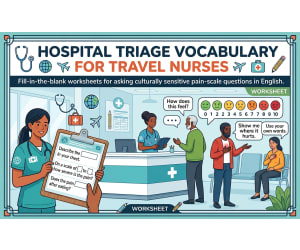
Hospital Triage Vocabulary for Travel Nurses
P.E. & Health, Health, Mental Health, Physical Education, Mindfulness, Research, Resources for Teachers, Classroom Management, Community Building, Science, Homeschool Curriculum, Homeschool Templates, Grade 9, 10, 11, 12, Teacher Tools, Lesson Plans, Quizzes and Tests, Quizzes, Tests, Worksheets & Printables, Workbooks, Worksheets, Word Searches, Assessments
Transform your patient communication and elevate your nursing practice with the ultimate guide to culturally sensitive pain assessment. Are you an ESL travel nurse or a nursing educator seeking to bridge the communication gap in a multicultural healthcare setting? This comprehensive 43-page workbook is meticulously designed to equip international nurses with the nuanced English vocabulary and empathetic communication strategies needed for accurate and compassionate patient triage. Move beyond the limitations of the standard "0-to-10" pain scale. This resource delves into the principles of ethnolinguistics and clinical anthropology, teaching you how to navigate cultural differences in pain expression—from stoic patients who minimize their suffering to expressive patients who use vivid metaphors. Through targeted fill-in-the-blank exercises, real-world case studies, and advanced role-play scenarios, you will master the art of building patient trust and ensuring better health outcomes. What's Inside This 43-Page Digital PDF Resource: In-Depth Theoretical Foundation: Understand the linguistics of pain, cultural variations (Stoic vs. Expressive), and the importance of mitigation and functional anchoring. 10 Comprehensive Student Worksheets: Covering topics like sensory adjectives, addressing stoicism, functional pain assessment, traditional remedies, somatic expressions of pain, and pediatric/geriatric considerations. Real-World Case Studies & Triage Scenarios: Follow nurses like Mariya, Diego, and Fatima as they navigate complex patient interactions in diverse settings. Clinical Visual Aids: Includes a Cultural Pain Expressions Framework mind map, a Linguistic Mapping of the 0-10 Scale chart, and a Triage Interview Navigation Flowchart to anchor learning. Complete Teacher/Instructor Resources: Full Answer Keys for all worksheets. A Thematic Grading Guide for deeper assessment. A Teacher Implementation Guide with pedagogical foundations (CLIL). Advanced Role-Play Mechanics with detailed scenarios for "Nurse," "Patient," and "Observer" roles, complete with checklists and debriefing questions. Who is This For? ESL (English as a Second Language) Nurses & Nursing Students Travel Nurses working in diverse cultural environments Nursing Schools & Continuing Education Programs Clinical Educators & Medical English (ESP) Instructors Healthcare institutions focused on improving cultural competency and patient-centered care. Download today and gain the confidence to provide safe, equitable, and compassionate care, regardless of the cultural borders you cross. Keywords: ESL Nurse, Travel Nurse, Cultural Competence, Pain Assessment, Medical English, Nursing Worksheets, Patient Communication, Cultural Sensitivity, Triage Vocabulary, Fill-in-the-blank, Nursing Scenarios, Role-Play, ESP, CLIL, Medical Terminology, Patient-Centered Care, Nursing Education. Why Nursing Educators & Institutions Love It: Comprehensive & Turnkey Solution: This isn't just a worksheet; it's a complete, self-contained educational module with theory, practice, visual aids, answer keys, and a full instructor's guide for implementation. Promotes Real-World Application: The use of realistic case studies, complex dialogue scenarios, and detailed role-play exercises ensures that learners can immediately apply these linguistic skills in a clinical setting. Fosters Critical Soft Skills: It goes beyond simple medical terminology to teach the crucial soft skills of empathy, cultural humility, and adaptive communication, which are essential for modern patient-centered care. Improves Patient Safety & Outcomes: By equipping nurses to perform more accurate assessments, this resource directly contributes to better diagnoses, more appropriate interventions, and a reduction in medical errors stemming from miscommunication. Designed for Adult Learners: The content respects the existing clinical expertise of professional nurses, focusing specifically on bridging the linguistic and cultural gaps they face. Target Audience (Classes/Students) : Based on the highly specific and advanced content, This is a professional development resource for a niche audience. Primary target learners are: ESL (English as a Second Language) Nursing Professionals: Specifically, registered nurses or advanced practice nurses who are not native English speakers and are working, or plan to work, in an English-speaking country (like the US, UK, Canada, Australia). Travel Nurses: This group is explicitly mentioned. They move frequently between different hospitals, regions, and patient populations, making cultural adaptability a critical skill. Students in Medical English / English for Specific Purposes (ESP) Programs: This is a perfect resource for instructors teaching English to healthcare professionals. Continuing Education & Professional Development for Nurses: Hospitals and healthcare systems can use this for in-house training to improve their staff's cultural competency and patient satisfaction scores. University Nursing Programs: This could be used as a supplementary module in university courses focused on transcultural nursing, patient communication, or clinical assessment. Copyright/Terms of Use: This Book was copyrighted by Syed Hammad Rizvi. This resource is for personal and single classroom use only. You may not alter, redistribute, or sell any part of this resource. In other words, you may not put it on the Internet where it could be publicly found and downloaded. If you want to share this resource with colleagues, please purchase additional licenses from Teachsimple. Thank you for respecting these terms of use. This product is happily brought to you by Syed Hammad Rizvi
Author Creative Book Store
Rating
Tags ESLNurse, TravelNurse, CulturalCompetence, PainAssessment, MedicalEnglish, TransculturalNursing, TriageNurse, NursingVocabulary, PatientCommunication, InternationalNurse
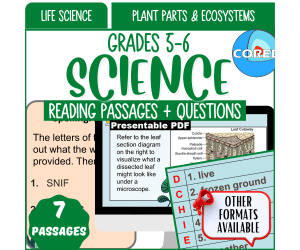
Reading Comprehension: Plant Parts and Ecosystems (Presentable PDF)
ELA, Reading, Reading Comprehension, Science, Life Sciences, Biology, Common Core, Human Body, Animals, Grade 5, 6, 7, Worksheets & Printables, Worksheets, Assessments, Teacher Tools, Tests, Quizzes and Tests, Diagrams
Reading Comprehension: Plant Parts & Ecosystems for Life Science Plant Parts & Ecosystems Reading Passage1: Classification of Organisms Reading Passage2: Function of Plant Parts Reading Passage3: Reproduction in Plants Reading Passage4: Invertebrates Reading Passage 5: Vertebrates Reading Passage6: Earth's Biomes Reading Passage7: Ecosystems PRESENTABLE PDF VERSION Run it like a slide show straight from a PDF, with no PowerPoint or extra software needed, just open, project, and teach. Other versions are available in the links list below or in the full catalog. Snapshot Genre: Nonfiction. Subject: Science / Life Science. Primary Topic: Classifying life, plant systems, animals, biomes, ecosystems. Estimated Guided Reading Level (A–Z): V. What This Teaches Best It teaches classification by kingdoms and by animal-group hierarchy using clear examples. It explains how plant parts work together through roots, stems, leaves, xylem, phloem, photosynthesis, and transpiration. It shows how plants reproduce through pollination, fertilization, seed formation, and dissemination. It compares invertebrates and vertebrates and describes important animal groups and life cycles. It connects organisms to environments by explaining biomes, abiotic and biotic factors, populations, niches, food chains, and food webs. Learning Goals Students will explain how living things can be grouped by shared characteristics. Students will describe the jobs of major plant parts and explain how plants make and move food. Students will explain how plants reproduce through pollination, fertilization, and seed dispersal. Students will compare major characteristics of invertebrates and vertebrates. Students will describe how climate shapes biomes and how organisms interact in ecosystems. FULL CATALOG OF DOWNLOAD LINKS HERE Grade 5/6 Links: Physical Science Part 1 - Physical and Chemical Properties Google Docs/Slides/Forms PDF PPT Word Free Supplementary Pack Accompanying Videos Physical Science Part 2 - Motion and Energy Google Docs/Slides/Forms PDF PPT Word Free Supplementary Pack Accompanying Videos Physical Science Part 3 - Electricity and Magnets Google Docs/Slides/Forms PDF PPT Word Free Supplementary Pack Accompanying Videos Life Science Part 1 - Cells, Reproduction and Genetics Google Docs/Slides/Forms PDF PPT Word Free Supplementary Pack Accompanying Videos Life Science Part 2 - Human Body Systems Google Docs/Slides/Forms PDF PPT Word Free Supplementary Pack Accompanying Videos Life Science Part 3 - Plant Parts and Ecosystems Google Docs/Slides/Forms PDF PPT Word Free Supplementary Pack Accompanying Videos Earth Science Part 1 - Plate Tectonics and Rock Cycle Google Docs/Slides/Forms PDF PPT Word Free Supplementary Pack Accompanying Videos Earth Science Part 2 - Ocean Exploration and Natural Resources Google Docs/Slides/Forms PDF PPT Word Free Supplementary Pack Accompanying Videos Earth Science Part 3 - Weather and Solar System Google Docs/Slides/Forms PDF PPT Word Free Supplementary Pack Accompanying Videos For similar products and other frees, do check out Cored Group on TeachSimple .
Author Cored Education
Rating
Tags Science, Elementary, Reading, Comprehension, Vocabulary, Ccss, Common Core, Science Assessments, Reading Comprehension Assessments

Elephants: Guided Reading Level Q with Lesson Plan
ELA, Resources for Teachers, Reading Comprehension, Reading, Science, Language Development, Life Sciences, Earth and Environmental Sciences, Geography, Social Studies, Grade 3, 4, 5, Worksheets & Printables, Worksheets, Teacher Tools, Centers, Activities, Literacy Readers, Quizzes, Quizzes and Tests, Assessments, Lesson Plans
This Elephants (level q) guided reading book with lesson plan includes: Guided Reading Color Label (front cover x1) This is a quick way to match the book’s demands to what students can generally handle.. The overall goal is to use the level/color to pick books for several smaller groups. To qualify for a certain level, a student is expected to read a book from that level with about 90–94% accuracy. If a student is consistently accurate and understands, move up a level. If the student is struggling at that level, drop down and add more support. Each student will improve at completely different rates, but it is generally one of the best ways to check progress across the class. DOWNLOAD THE CATALOG TO VIEW ALL GUIDED READING BOOKS AVAILABLE (SORTED LEVELS A-Z) Pre-Reading Question (x1) Teacher asks the prompt aloud, can be while showing the cover or first page. Students share what they already know, or make educated guesses from the cover. Prompt them to use the target vocabulary. Write some of their responses on the board to look back at during the reading. Vocabulary Words (x5) Introduce the five words, best doing it one at a time. Start by saying it, while students repeat and then see if anyone knows what it means before reading further. Read through the meaning and try to briefly connect each word to a picture or gesture so it’s meaningful. Ask students to flip through the book pages and point to where they see each of the vocabulary words. While reading the book pause upon coming across one of the vocab words or read the sentence twice to make sure students understand the word has appeared. Optional: Ask students to raise hands whenever they see/hear one of the new words. Guided Reading Pages (x10) Check the book snapshot (below) for: primary topic - do you need to prep extra reading or intro materials on this? what is taught best - decide on 1-2 bullets to focus on, use the prompt or words provided here for best results. learning goals - what you are checking for students to be able to do after the session, elicit answers using prompts or words provided. key vocabulary (see section above). questions overview - so you know what is coming up and if you need to prep extra materials to assist understanding. Run the lesson You may have already looked at a few of the pages together, but you can show them some of the pictures again first to set meaning. Depending on how much time you have and how familiar your students are with guided reading class, you may want to read the book aloud first with the group first. Students whisper or partner read, while you listen in. If time, do it as a group, one student reading a page each. Use the guided page’s prompts to coach: “Check the picture / does it make sense?” “Point under the words / try the first sound” “Reread the sentence smoothly”. Try to focus more on one student per session (rotating every time), so you can work out if they are ready to move up or need to move down a level. Comprehension Questions (back cover x3) This is your way to check that students didn’t just say the words, but actually understood the text. First, let students answer by pointing to the page/picture and saying a short sentence. After any answer, follow with: “Show me where you found that in the text.” In bigger groups, have partners answer first (10–20 seconds), then call on 2–3 students to share. Differentiation tips: Emerging speakers/struggling readers: oral + pointing On-level: oral in a full sentence Higher: one written sentence or draw + label Book Snapshot Title: Elephants Genre: Nonfiction (informational) Subject: Life Science Primary Topic: Elephant species, adaptations, behavior, and threats Estimated Guided Reading Level (A–Z): Q What This Book Teaches Best Explains that scientists recognize three distinct species of elephants and describes physical differences (like ear shape and head shape) that fit their environments. Describes key body structures and functions (trunk muscles and “fingers,” tusks as elongated incisor teeth, sensitive skin). Shows behavioral adaptations for survival , including how elephants protect themselves from heat and insects by using water or mud. Highlights social organization and communication , including matriarchal herds and vocalizations such as trumpets, rumbles, and infrasound. Connects elephants to their ecosystems and conservation by explaining seed dispersal (African Forest elephants) and current threats like habitat loss and poaching for ivory. Learning Goals Describe the three elephant species named in the text and one physical difference mentioned between African and Asian elephants. Explain how elephants use their skin and what they do to protect themselves from heat and insects. Identify how the text describes an elephant’s trunk and list at least three things elephants use it to do. Explain what tusks are and give examples from the text of how tusks help elephants survive. Describe how elephants live in groups and how a matriarch helps keep a herd safe. Explain how African Forest elephants help plant new trees in the forest, according to the text. Key Vocabulary From the Text distinct — clearly different from something else. characteristic — an important feature that helps describe something. matriarchal — led by a female (mother) in the group. vocalizations — animal sounds used to communicate. endangered — in danger of disappearing because there are not many left. Discussion Prompts Pre-reading question: What do you already know about how elephants live and survive in their habitats? Comprehension questions: What are the three species of elephants that scientists recognize in the text? Comprehension questions: What does the text say elephants do to protect themselves from heat and insects? Comprehension questions: How do African Forest elephants help plant the next generation of trees in the forest? Printing Tips 1. Best Printing Method (Recommended) “Booklet” Printing (Best if Available) If your printer or PDF viewer supports Booklet Printing , use this. Settings to use: Print mode: Booklet Paper size: Letter or A4 (either works) Orientation: Landscape Print on both sides: Yes Flip on: Short edge Scaling: Fit to printable area Booklet subset: First test: Front sides only Then: Back sides only This will automatically: Pair pages correctly Put the cover on the outside Align everything for folding After printing, fold in half and staple along the spine . 2. If “Booklet” Printing Is NOT Available You can still print this correctly with manual duplex printing . Step-by-step: Open the PDF. Choose Print . Set: Orientation: Landscape Pages per sheet: 1 Print on both sides: Yes Flip on: Short edge Print all pages . Because each PDF page already contains two facing book pages, the result will still fold cleanly into a book. Thousands of Cored Education products are included with your TeachSimple membership. Download links and encyclopedia index available here.
Author Cored Education
Rating
Tags Reading Comprehension, Reading Passages, Reading, Guided Reading, Guided Reading Lesson Plan, Guided Reading Activity, Pre-reading, Science Lesson Plans, Life Science, Geography

Human Body & Senses: Life Science Reading Comprehension (Word)
Science, ELA, Reading, Reading Comprehension, Strategies, Resources for Teachers, Life Sciences, Human Body, Grade 6, 7, 8, 9, Writing Prompts, Worksheets & Printables, Centers, Activities, Teacher Tools, Assessments, Quizzes and Tests, Quizzes, Tests
Human Body and Senses: Life Science Reading Comprehension Passages (Word) This very engaging collection of life science reading passages about Contact Lenses, Goosebumps, and Skin is designed to bridge the gap between science and literacy through strengthening reading comprehension and sparking scientific curiosity in middle school students. Each passage blends English Language Arts skills with accurate science content that supports NGSS classroom practice. Ideal for interdisciplinary learning in ELA and Science. Suitable for Grade 9 review, too! What Is Included? There are (3) informational passages: Clear Vision: The Story of Contact Lenses: Early lenses were hard, bulky, and uncomfortable, but the idea was simple: correct vision right on the eye. Modern soft lenses let oxygen in, stay in place, and give people clear sight without glasses. Goosebumps: A Chilly Reminder of Our Past: When you get cold or scared, tiny muscles pull on each hair and make bumps. It once helped our hairy ancestors look bigger and hold heat, so today it’s mostly a leftover reflex. Skin: Your Protective Shield: Skin keeps germs out, moisture in, and helps your body stay at a steady temperature. With nerves and blood vessels close to the surface, it also lets you feel and heal. Student Tasks for Each Passage: 5 multiple-choice questions targeting main idea, key details, inference, vocabulary in context, and use of evidence 5 vocabulary matching items with clear, student-friendly definitions 5 text-based questions that require citing specific lines or facts 1 summary prompt that asks students to condense central ideas accurately Full answer key for every section Available Formats for this Resource PDF Google Docs FULL CATALOG OF DOWNLOADING LINKS HERE Other Science Reading Collections you May find in the store: 1. Astronomy & Space Science 2. Volcanoes, Rocks, & Mountains 3. Rock Cycle, Soil, & Sinkholes 4. Mars, Glaciers, & Antarctica 5. Water Cycle, Acid Rain, & Wastewater 6. Insects, Animals, & Ecosystems 7. Bioluminescence & Insects 8. Animal Skin, Cats, & T. Rex 9. Human Body and Senses 10. Health & Applied Bioscience 11. Waves, Light, & Imaging 12. Electricity & Energy 13. Motion & Materials 14. Chemistry and Materials Science Product Details Length: 14 pages total Grades: 6–8, also suitable for Grade 9 review Use cases: close reading, stations, homework, intervention, test prep, and sub plans Standards support: reinforces informational-text skills and supports NGSS-style sense making through observation, modeling, and clear use of claim, evidence, and reasoning Why Teachers Choose This Set Authentic science content paired with rigorous literacy practice Consistent task structure across all passages for easier planning and smoother student routines Clear, age-appropriate writing that builds confidence without oversimplifying Use this set to reinforce ELA skills in science, to add literacy to your lessons, or to support independent work. The passages strengthen main idea, evidence use, vocabulary in context, inference, cause and effect, and summary writing. With ready-to-use assessments and complete answer keys, you can provide focused practice that is simple to run and fast to review.
Author Middle & High School - CORED Education
Rating
Tags Middle School, Reading Comprehension, Reading Strategies, ELA, Centers, Reading Passage, Assessments, Vocabulary, Life Science, Human Body
Germany: The Heart of Europe: Guided Reading Level R with Lesson Plan
ELA, Resources for Teachers, Reading Comprehension, Reading, Science, Geography, Social Studies, History, Earth and Environmental Sciences, Technology, Grade 3, 4, 5, Worksheets & Printables, Worksheets, Teacher Tools, Centers, Activities, Literacy Readers, Quizzes, Quizzes and Tests, Assessments, Lesson Plans
This Germany: The Heart of Europe (level r) guided reading book with lesson plan includes: Guided Reading Color Label (front cover x1) This is a quick way to match the book’s demands to what students can generally handle.. The overall goal is to use the level/color to pick books for several smaller groups. To qualify for a certain level, a student is expected to read a book from that level with about 90–94% accuracy. If a student is consistently accurate and understands, move up a level. If the student is struggling at that level, drop down and add more support. Each student will improve at completely different rates, but it is generally one of the best ways to check progress across the class. DOWNLOAD THE CATALOG TO VIEW ALL GUIDED READING BOOKS AVAILABLE (SORTED LEVELS A-Z) Pre-Reading Question (x1) Teacher asks the prompt aloud, can be while showing the cover or first page. Students share what they already know, or make educated guesses from the cover. Prompt them to use the target vocabulary. Write some of their responses on the board to look back at during the reading. Vocabulary Words (x5) Introduce the five words, best doing it one at a time. Start by saying it, while students repeat and then see if anyone knows what it means before reading further. Read through the meaning and try to briefly connect each word to a picture or gesture so it’s meaningful. Ask students to flip through the book pages and point to where they see each of the vocabulary words. While reading the book pause upon coming across one of the vocab words or read the sentence twice to make sure students understand the word has appeared. Optional: Ask students to raise hands whenever they see/hear one of the new words. Guided Reading Pages (x10) Check the book snapshot (below) for: primary topic - do you need to prep extra reading or intro materials on this? what is taught best - decide on 1-2 bullets to focus on, use the prompt or words provided here for best results. learning goals - what you are checking for students to be able to do after the session, elicit answers using prompts or words provided. key vocabulary (see section above). questions overview - so you know what is coming up and if you need to prep extra materials to assist understanding. Run the lesson You may have already looked at a few of the pages together, but you can show them some of the pictures again first to set meaning. Depending on how much time you have and how familiar your students are with guided reading class, you may want to read the book aloud first with the group first. Students whisper or partner read, while you listen in. If time, do it as a group, one student reading a page each. Use the guided page’s prompts to coach: “Check the picture / does it make sense?” “Point under the words / try the first sound” “Reread the sentence smoothly”. Try to focus more on one student per session (rotating every time), so you can work out if they are ready to move up or need to move down a level. Comprehension Questions (back cover x3) This is your way to check that students didn’t just say the words, but actually understood the text. First, let students answer by pointing to the page/picture and saying a short sentence. After any answer, follow with: “Show me where you found that in the text.” In bigger groups, have partners answer first (10–20 seconds), then call on 2–3 students to share. Differentiation tips: Emerging speakers/struggling readers: oral + pointing On-level: oral in a full sentence Higher: one written sentence or draw + label Book Snapshot Title: Germany: The Heart of Europe Genre: Nonfiction Subject: Social Studies (Geography/Culture/History) Primary Topic: Germany’s geography, history, culture, and modern life Estimated Guided Reading Level (A–Z): R What This Book Teaches Best Germany’s central location in Europe and how that makes it a crossroads for trade, travel, and cultural exchange. Physical geography and waterways , including the Bavarian Alps and the Rhine River’s role in transportation. History meeting modern life through Berlin’s past division (Berlin Wall) and the Brandenburg Gate as a symbol of reunification. Cultural traditions , including long-held festivals, music (Bach and Beethoven), and traditional clothing like lederhosen and dirndls. Modern strengths and priorities , such as engineering/technology, renewable energy, public transportation, and environmental conservation. Learning Goals Students will describe where Germany is located in Europe and explain why its location matters in the text. Students will identify major physical features of Germany (plains, mountains, or the Bavarian Alps) using details from the text. Students will explain why the text says rivers like the Rhine are important for moving goods between cities. Students will describe Berlin as the capital and explain one way the text shows history and modern life together there. Students will describe what the text says about castles from the Middle Ages and what they are used for today. Students will identify examples of Germany today (technology/engineering, renewable energy, conservation, education, or democracy) using text evidence. Key Vocabulary From the Text crossroads — central meeting place where routes and people connect. metropolis — a very large, busy city. reunification — joining back together after being separated. renewable — energy source replaced naturally, like wind or sun. conservation — protecting nature so it stays healthy for the future. Discussion Prompts Pre-reading question: What kinds of facts do you think a book about Germany might teach you? Comprehension questions: Why does the text say Germany is a major crossroads within the European Union? Comprehension questions: What does the text say the Brandenburg Gate represents today? Comprehension questions: What is one way the text says Germany works to protect the climate? Printing Tips 1. Best Printing Method (Recommended) “Booklet” Printing (Best if Available) If your printer or PDF viewer supports Booklet Printing , use this. Settings to use: Print mode: Booklet Paper size: Letter or A4 (either works) Orientation: Landscape Print on both sides: Yes Flip on: Short edge Scaling: Fit to printable area Booklet subset: First test: Front sides only Then: Back sides only This will automatically: Pair pages correctly Put the cover on the outside Align everything for folding After printing, fold in half and staple along the spine . 2. If “Booklet” Printing Is NOT Available You can still print this correctly with manual duplex printing . Step-by-step: Open the PDF. Choose Print . Set: Orientation: Landscape Pages per sheet: 1 Print on both sides: Yes Flip on: Short edge Print all pages . Because each PDF page already contains two facing book pages, the result will still fold cleanly into a book. Thousands of Cored Education products are included with your TeachSimple membership. Download links and encyclopedia index available here.
Author Cored Education
Rating
Tags Reading Comprehension, Reading Passages, Reading, Guided Reading, Guided Reading Lesson Plan, Guided Reading Activity, Pre-reading, Social Studies, Geography, History
Motion & Materials: SAMPLE Physical Science Reading Passage (Google)
Science, ELA, Reading, Reading Comprehension, Strategies, Resources for Teachers, Physics, Grade 6, 7, 8, 9, Writing Prompts, Worksheets & Printables, Centers, Activities, Teacher Tools, Assessments, Quizzes and Tests, Quizzes, Tests
This is a ONE PASSAGE SAMPLE. The following is the description of the FULL resource and the downloading links: Electricity and Energy: Physical Science Reading Comprehension Passages and Questions (Google) This very engaging collection of physical science reading passages about electricity and energy is designed to bridge the gap between science and literacy through strengthening reading comprehension and sparking scientific curiosity in middle school students. Each passage blends English Language Arts skills with accurate science content that supports NGSS classroom practice. Ideal for interdisciplinary learning in ELA and Science. Suitable for Grade 9 review, too! What Is Included? There are (3) informational passages: Sweet Science: How Heat Shapes Candy Baseball Science: From Bat to Ball Electric vs. Gasoline Cars: The Road Ahead Student Tasks for Each Passage: 5 multiple-choice questions targeting main idea, key details, inference, vocabulary in context, and use of evidence 5 vocabulary matching items with clear, student-friendly definitions 5 text-based questions that require citing specific lines or facts 1 summary prompt that asks students to condense central ideas accurately Full answer key for every section Available Formats for this Resource PDF Word Docs FULL CATALOG OF DOWNLOADING LINKS HERE Other Science Reading Collections and Topics You May Find in the Store: 1. Astronomy & Space Science 2. Volcanoes, Rocks, & Mountains 3. Rock Cycle, Soil, & Sinkholes 4. Mars, Glaciers, & Antarctica 5. Water Cycle, Acid Rain, & Wastewater 6. Insects, Animals, & Ecosystems 7. Bioluminescence & Insects 8. Animal Skin, Cats, & T. Rex 9. Human Body and Senses 10. Health & Applied Bioscience 11. Waves, Light, & Imaging 12. Electricity & Energy 13. Motion & Materials 14. Chemistry and Materials Science 15. Electromagnetism 16. Acids and Bases 17. Gas Laws 18. Biotechnology 19. Periodic Trends 20. Protists and Fungi 21. Microevolution 22. Blood 23. Chemical Bonding 24. Magnets 25. Muscles 26. Nuclear Chemistry 27. Electromagnetic Devices 28. Epigenetics 29. The Law of Conservation of Mass 30. Atomic Models 31. Isotopes and Ions 32. Light 33. Human-Environment Interaction 34. Theory of Evolution 35. Photosynthesis 36. Origins of Life and Early Earth 37. Gene Expression and Regulation 38. Thermochemistry 39. Allergies 40. Coevolution 41. Birth to Adulthood 42. Cells 43. Entropy and Free Energy 44. The Human Brain 45. Mixtures and Solutions 46. Invertebrates 47. Zoo Animals 48. Biochemistry 49. Animal Behavior 50. Population Ecology ...and many more engaging science reading passages that cover intriguing and important topics designed to spark curiosity and support student learning. Product Details Length: 12 pages total Grades: 6–8, also suitable for Grade 9 review Use cases: close reading, stations, homework, intervention, test prep, and sub plans Standards support: reinforces informational-text skills and supports NGSS-style sense making through observation, modeling, and clear use of claim, evidence, and reasoning Why Teachers Choose This Set Authentic science content paired with rigorous literacy practice Consistent task structure across all passages for easier planning and smoother student routines Clear, age-appropriate writing that builds confidence without oversimplifying Use this set to reinforce ELA skills in science, to add literacy to your lessons, or to support independent work. The passages strengthen main idea, evidence use, vocabulary in context, inference, cause and effect, and summary writing. With ready-to-use assessments and complete answer keys, you can provide focused practice that is simple to run and fast to review.
Author Middle & High School - CORED Education
Rating
Tags Middle School, Reading Comprehension, Reading Strategies, ELA, Centers, Reading Passage, Assessments, Vocabulary, Physical Science, Physics
Plant Adaptations Interactive Google Slides Unit
Science, Earth and Environmental Sciences, Earth Sciences, Environmental Science, Geology, Space, Life Sciences, Animals, Nature & Plants, Biology, Grade 3, 4, 5, 9, 10, 11, 12, Experiments, Activities, Labs, Projects, Assessments, Teacher Tools, Diagrams, Lesson Plans, Outlines, Presentations
Find the best 4th Grade Plant Adaptations Interactive Google Slides Unit – a complete no-prep digital science resource that is perfectly correlated to NGSS 4-LS1-1! This teacher edition is a game-changer for teaching plant biology as an interactive adventure for students! With this resource, students will enjoy a hands-on approach to learning about plant adaptations as they explore interactive slides featuring desert succulents/cacti, rainforest drip tips/epiphytes, water plants floating leaves/stretching stems, structural vs. behavioral adaptations, roots, stem/leaf adaptations, defense structures, carnivorous plants Venus flytrap/pitcher plant, seed dispersal, mystery plant analysis, and a final knowledge check with answer keys! Students will actively engage in classifying adaptations, creating their own extremophiles, analyzing scenarios using Claim Evidence Reasoning, and connecting science to ELA, math, engineering, and technology using cross-curricular activities. It includes a teacher guide, standard alignment, steps to integrate into Google Classroom, instructional tips, interactive slide ideas, image credits, and ideas for self-grading. It can be used in a variety of learning environments, such as in-class learning, distance learning, homeschooling, etc. It saves automatically in Google Slides. Keywords: plant adaptation 4th grade, NGSS 4-LS1-1, Google Slides, interactive science unit, desert rainforest aquatic plants, carnivorous plants, seed dispersal activities, digital science resource, structure and function NGSS, no prep plant biology. Why Parents/Schools Love It : NGSS-Aligned & Standards-Ready: No planning required – lesson plans, objectives, and assessments are provided and align perfectly with 4th grade requirements. Truly Interactive & Engaging: Drag and drop sorting, CER plant mysteries, and biome builders ensure all students (including reluctant ones) are actively engaged and motivated to learn for hours. Cross-Curricular Powerhouse: Perfectly blends ELA (informative writing, vocabulary), math (data analysis, volume calculation), and engineering (biomimicry design challenges). Google Classroom Perfection: One-click “make a copy for each student,” auto-saving, and self-grading features save teachers 10+ hours per unit. Differentiation Built-In: Visual aids, scaffolding, and differentiation in activity levels and types meet the needs of diverse learners and challenge advanced students. Target Student Classes : This lesson is designed for 4th grade science (ages 9-10), specifically targeting the 4-LS1-1 standard for Structure and Function in plants/animals, as well as the cross cutting concepts of Systems and System Models + the Science and Engineering Practices of Engaging in Argument from Evidence. This lesson is suitable as the main resource for: Standard 4th grade life science curriculum for 4th grade students in public/private schools Homeschool 4th grade science curriculum (allows for fast or slow pacing for gifted or remedial students) Advanced 3rd grade science for 3rd grade students or 5th grade review for 5th grade students Special education or ESL students (visual learning tool of drag and drop CERs) Not recommended as the main resource for middle school students (6th+). Copyright/Terms of Use: This Book is copyrighted by Syed Hammad Rizvi. This is for your personal and single classroom use only. You may not change, reproduce, redistribute, or sell this in any way. This means you may not put it on the Internet in a way that it can be located and downloaded by others. If you wish to share this resource with others, please consider purchasing additional licenses from Teachsimple. Thank you for respecting these copyright laws! This product is happily brought to you by Syed Hammad Rizvi
Author Creative Book Store
Rating
Tags PlantAdaptations, 4thGradeScience, NGSS4LS11, GoogleSlidesScience, InteractiveScience, ScienceTeachers, ElementaryScience, NGSSScience, PlantAdaptationsUnit, DigitalScienceResource
Erosion Reading Comprehension Passage - Cored Ed Encyclopedia
ELA, Reading Comprehension, Reading, Science, Technology, Language Development, Social Studies, Earth and Environmental Sciences, Geography, Life Sciences, Grade 2, 3, 4, 5, Worksheets & Printables, Worksheets, Teacher Tools, Centers, Activities, Writing Prompts, Assessments, Quizzes and Tests, Quizzes, Lesson Plans
This erosion reading comprehension with lesson plan includes: Visualization (on the front cover) Start your lesson by taking a minute to think and share something about the topic. Read the script aloud (slowly), perhaps prepare some music or sound effects. Student close their eyes and let their imaginations wander. Students open their eyes, read the question aloud and give them a few minutes to complete. Ask a few students to share or keep answers until the end to compare with what they learn in the passage. Quick pause—thousands of Cored Education products are included with your TeachSimple membership. Download links and encyclopedia index available here. Pre-Reading Trivia Students will write down one thing they already know about the subject and then read five more facts and discuss. These facts are fun, and the students will enjoy learning about the subject before reading more. Give 1 minute for students to write what they already know (no pressure—best guess is fine). Read the five facts together. After each fact, do ask a student for their opinion, was it surprising? Set a purpose by asking students to highlight/underline one fact they want to learn more about during the reading. Reading Passage The text is a high-interest reading passage with set paragraphs, roughly three to four paragraphs long. It contains a variety of themes about the topic, anywhere from history to technology. The passage is between 250 and 350 words in length. First, ask students to look at the headings and see what they’ll learn about today. What do they know about the topic/heading? First read options: Teacher read-aloud (best for support). Partner reading (paragraph by paragraph). While reading, students underline important details, and vocabulary words they think may come up in the questions section. Mixed Questions The first question page contains four multiple-choice questions, each with a choice of four answers, and three written response questions that require a sentence or two from the student. Students complete the mcqs first independently, then review quickly as a class. For the 3 written responses, try to get students giving the answer with some form of evidence: “I think ___ because the text says ___.” If students get stuck, send them back to check the passage. Vocabulary Questions Practice seven key words from the text in this section across two activities. First section is scrambled words where students will unscramble three words given a clue for each. The second section is a word to meaning matching activity. Before starting, have some students read out words they underlined in the passage. Ask students to say the word and read aloud the sentence(s) around each word. Ask students to do scrambled words and the matching exercise in pairs then go through answers as a class. For the scrambled spelling task, get four pairs to come up to the board and write the words for extra practice with the other student reading out the clue. For the matching task, prompt students to give full sentences: “I matched ___ with ___ because ___.” Creative Writing In this question, the student will be required to write a five to eight sentence paragraph on a question related to the topic. Before starting, ask students write down 3 key ideas they are going to include in their piece. Ask students for ideas to share around the class to help those struggling. Pro writing expectations: 5–8 sentences At least 2 facts or details from the passage At least 2 vocabulary words from the previous page Students read their paragraphs while classmates listen for facts and vocabulary words. Extension Activities This page is optional for fast finishers or to take home. There are several activities, each one requiring a different skill. Do some, do none, do all, completely optional - but you will feel reassured knowing every possibility is planned for. Includes summary writting question and additional facts. Answer Key There are answers for the multiple-choice questions, written response questions have sample answers, vocabulary answers and if there is a summary question then a sample summary will be provided as well. Lesson Plan Included Customized lesson plan for this lesson is included. Lesson Snapshot Title: Erosion Genre: Nonfiction (Informational Text) Subject: Science (Earth Science) / Reading (Informational Text) Primary Topic: How erosion moves Earth materials and changes land Estimated Guided Reading Level (A–Z): N What This Lesson Teaches Best Clearly distinguishes weathering (breaking rock apart in place) from erosion (moving pieces away). (Reading Passage, p. 3) Explains multiple forces that cause erosion— water, wind, waves, ice, and gravity —and what they do to Earth’s surface. (p. 3) Shows how rivers reshape land over time, including how moving water and sediment can help carve deep valleys (Colorado River/Grand Canyon example). (p. 3) Introduces sediment and connects erosion to deposition , explaining how new landforms can build up (beaches, river deltas). (p. 3) Connects science to real-world problem solving by describing ways people can slow soil loss (trees, terraces, keeping plants on soil). (p. 3) Learning Goals Students will explain how erosion is different from weathering using the text’s definitions. Students will identify forces that can cause erosion (water, wind, waves, ice, gravity). Students will describe how rivers move sediment and can change riverbeds and valleys over time. Students will explain what sediment is and how deposition happens when sediment settles. Students will describe at least two ways people can help soil “stay home,” based on the passage. Key Vocabulary From the Text weathering — breaking rock apart where it sits. erosion — moving soil and rock to a new place. sediment — tiny bits of soil and rock that travel. deposition — when sediment settles and builds up land. terraces — steps that slow water on a steep slope. FULL CATALOG OF DOWNLOAD LINKS AND ENCYCLOPEDIA INDEX HERE
Author Cored Education
Rating
Tags Vocabulary, Reading Comprehension, Reading Passages, Lesson Plans, Ela Lesson Plans, Reading Comprehension Lesson Plans, Pre-reading, Geography, Earth Science, Science Lesson Plans
Agile Operations Professional Edition
Research, Community Building, Resources for Teachers, Technology, Science, Computer Science, Special Education Needs (SEN), Special Resources, Life Skills, Social Emotional Learning (SEL), Homeschool Curriculum, Homeschool Templates, Grade 9, 10, 11, 12, Workbooks, Worksheets & Printables, Writing Prompts, Teacher Tools, Assessments, Charts, Graphic Organizers, Diagrams, Lesson Plans, Presentations
Unleash the potential of agile project management with the Agile Operations Notion System Professional Edition PDF – your definitive guide to efficient workflow management, particularly in startup environments and product management. This digital resource, spanning 44 pages, is a comprehensive blueprint on how to create a unified system using the Notion agile system, connecting strategy with execution. From the basics of product backlog, sprint planning, and agile retrospectives, to the integration of OKRs, bug tracking, team directory, knowledge base, and the power of automating with GitHub and Slack, this guide is your ticket to creating a system that encourages transparency, accountability, and productivity. Whether you are a startup founder looking to optimize your resource management or a product manager trying to navigate the complexities of product development, this SEO-friendly Notion agile template guide is your ticket to unlocking the power of agile project management. Keywords: Notion agile system, startup project management, product backlog, sprint velocity tracking, OKR integration with Notion, agile retrospectives, bug tracker, team directory, GitHub Slack automations. Why Parents/Schools Love It : Practical Real-World Skills: Covers agile methodologies that ensure students have the skills needed for high-demand jobs in tech startups and product management, making the connection between academic learning and practical tools like Notion. Engaging & Structured Learning: Uses diagrams, flowcharts, and step-by-step guides that make learning complex concepts easy, encouraging critical thinking for business or engineering courses. Promotes Teamwork & Productivity: Focuses on collaboration, retrospectives, and OKRs, helping students learn important soft skills like accountability that are useful for group projects. Digital & Scalable Learning Resource: As a PDF, the resource is easy to integrate into the curriculum for virtual or hybrid learning, requiring no special software beyond free tools like Notion. Future-Proof Career Readiness: Covers the latest trends in agile operations for tech startups, including automations, velocity, and bug management. Target Classes/Students : Based on the entire analysis of the PDF, which is centered on professional agile methodologies, database architecture, sprint execution, and scaling, it is understood that this resource is not directly applicable to K-12 students, although it could be reframed and positioned as an educational resource targeting higher education levels. Target student types and classes: Business Administration and Management Students : Undergraduate or graduate courses in project management, operations management, or strategic planning, in which agile methodologies are part of the course material in preparation for the corporate world. Entrepreneurship and Startup Students : Undergraduate or graduate courses in entrepreneurship, innovation, or small business management, in which the application of tools in building and scaling tech-based startups is the primary focus. Software Engineering and Computer Science Students : Course work in software development lifecycles, agile methodologies, or dev ops in understanding the practical application of tools like Notion in software development. MBA or Professional Development Students : Advanced course work in MBA programs in product management, agile leadership, or digital transformation, in which case studies or simulations would be appropriate. Copyright/Terms of Use: This Book is copyrighted by Syed Hammad Rizvi. This is for personal and single classroom use only. You cannot modify, redistribute, or sell this resource in any way. This means you cannot put this resource on the Internet where it will be accessible for anyone to find and download. If you want to share this resource with your colleagues, please purchase additional licenses from Teachsimple. Thank you for respecting the terms of use. This product is happily brought to you by Syed Hammad Rizvi
Author Creative Book Store
Rating
Tags AgileOperations, NotionSystem, StartupTools, ProductManagement, AgileWorkflow, NotionTemplates, SprintPlanning, BacklogManagement, ProductBacklog, AgileRetrospectives