



3,890 products added recently
Page 8 - 3rd Grade Lesson Plans
Support your third graders' expanding abilities with lesson plans that encourage exploration and deeper understanding. Covering a range of subjects, these resources offer hands-on activities and discussions. Use them to create a vibrant learning atmosphere that fosters enthusiasm.

 Show filters


Kid Concoctions, Creations & Contraptions
Creative Arts, Art, Preschool, Grade 1, 2, 3, Activities, Crafts, Teacher Tools, Lesson Plans
Kid Concoctions, Creations & Contraptions: An immersive learning resource Kid Concoctions, Creations & Contraptions is a comprehensive and versatile teaching resource that can be integrated in diverse classroom settings or homeschooling curriculum. It is designed to promote scientific inquiry, artistic exploration, mathematics and creativity, aiming at fostering young learners' inherent curiosity and creativity. About the Collection: This activity set brings together 224 pages of engaging activities targeting students from kindergarten through grade 3. The activities span various subjects with a special focus on Art & Music as well as crafts which are instrumental in boosting practical skills like problem-solving competence and motor skill development. Tailor-Made Implementation: The nature of the content allows for broad-based adoption whether it’s whole group instruction, small group projects or individual homework assignments based on student-specific needs. Each section features clear instructions handholding both teachers and students through every activity . Extension Activities: The book also offers an array of extension activities that shore up the primary learning objectives while motivating student-led discovery. Inbuilt mechanism facilitates assessment thus enabling educators to monitor each student's progress effectively. This resource ensures balanced flexibility so educators can align it as per their unique teaching methods making it suitable for personalized education All Rounded Learning Journey Learners will traverse multiple areas from scientific experiments to craft creation cumulating into an enriching knowledge quest that keeps fueling their inventive spirit. Whether its active lessons about physics via crafts or problem-solving maths puzzles this educational treasure caters towards all learning styles. Embarking on the Learning Adventure: With Kid Concoctions, Creations & Contraptions, get ready to ignite your students' imagination and spark their creative spirit today!
Author Classroom Complete Press
Tags Crafts, Kid Crafts, Creations, Frozen Bubbles, Homemade Candle Creation

I WONDER - How Long Is The Nile River | Animated Video Lesson
Geography, Social Studies, Grade 3, 4, 5, 6, 7, 8, 9, Lesson Plans, Teacher Tools
Video Introduction An amazing video designed for the students to learn more about famous places in different countries. I WONDER - How Long Is The Nile River | Animated Video Lesson What do you know about this place? Do you know in which part of the world it is? Have you ever visited this place? If yes, can you tell us more about your adventure, and what do you like the most about this place? Do you like reading about Geography? What is your favorite country in the whole world? If you are going on a trip where it will be? Which country? What you are going to see there? Does this country has a famous place to visit? I WONDER - How Long Is The Nile River | Animated Video Lesson The activity is perfect for encouraging the researching skills for the students, while learning more about this fantastic place. I WONDER - How Long Is The Nile River | Animated Video Lesson This friendly designed video is suitable for students at school, homeschooling, and as a group activity. Format Available in MP4 format.
Author Educational Voice
Tags How Long Is The Nile River, How Long Is The Nile River Video, The Nile River, The Nile River Facts, The Nile River Facts For Kids, The Nile River Video, The Nile River Video For Kids, River, Rivers
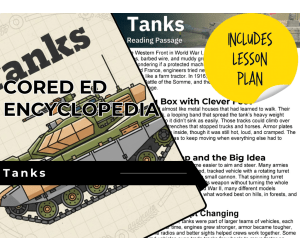
Tanks Reading Comprehension Passage - Cored Ed Encyclopedia
ELA, Language Development, Reading Comprehension, Reading, Pre-Reading, Science, Technology, Engineering, History, Social Studies, Grade 2, 3, 4, 5, Worksheets & Printables, Worksheets, Teacher Tools, Centers, Activities, Writing Prompts, Assessments, Quizzes and Tests, Quizzes, Lesson Plans
This tanks reading comprehension includes: Visualization (on the front cover) Start your lesson by taking a minute to think and share something about the topic. Read the script aloud (slowly), perhaps prepare some music or sound effects. Student close their eyes and let their imaginations wander. Students open their eyes, read the question aloud and give them a few minutes to complete. Ask a few students to share or keep answers until the end to compare with what they learn in the passage. Quick pause—thousands of Cored Education products are included with your TeachSimple membership. Download links and encyclopedia index available here. Pre-Reading Trivia Students will write down one thing they already know about the subject and then read five more facts and discuss. These facts are fun, and the students will enjoy learning about the subject before reading more. Give 1 minute for students to write what they already know (no pressure—best guess is fine). Read the five facts together. After each fact, do ask a student for their opinion, was it surprising? Set a purpose by asking students to highlight/underline one fact they want to learn more about during the reading. Reading Passage The text is a high-interest reading passage with set paragraphs, roughly three to four paragraphs long. It contains a variety of themes about the topic, anywhere from history to technology. The passage is between 250 and 350 words in length. First, ask students to look at the headings and see what they’ll learn about today. What do they know about the topic/heading? First read options: Teacher read-aloud (best for support). Partner reading (paragraph by paragraph). While reading, students underline important details, and vocabulary words they think may come up in the questions section. Mixed Questions The first question page contains four multiple-choice questions, each with a choice of four answers, and three written response questions that require a sentence or two from the student. Students complete the mcqs first independently, then review quickly as a class. For the 3 written responses, try to get students giving the answer with some form of evidence: “I think ___ because the text says ___.” If students get stuck, send them back to check the passage. Vocabulary Questions Practice seven key words from the text in this section across two activities. First section is scrambled words where students will unscramble three words given a clue for each. The second section is a word to meaning matching activity. Before starting, have some students read out words they underlined in the passage. Ask students to say the word and read aloud the sentence(s) around each word. Ask students to do scrambled words and the matching exercise in pairs then go through answers as a class. For the scrambled spelling task, get four pairs to come up to the board and write the words for extra practice with the other student reading out the clue. For the matching task, prompt students to give full sentences: “I matched ___ with ___ because ___.” Creative Writing In this question, the student will be required to write a five to eight sentence paragraph on a question related to the topic. Before starting, ask students write down 3 key ideas they are going to include in their piece. Ask students for ideas to share around the class to help those struggling. Pro writing expectations: 5–8 sentences At least 2 facts or details from the passage At least 2 vocabulary words from the previous page Students read their paragraphs while classmates listen for facts and vocabulary words. Extension Activities This page is optional for fast finishers or to take home. There are several activities, each one requiring a different skill. Do some, do none, do all, completely optional - but you will feel reassured knowing every possibility is planned for. Includes summary writting question. Answer Key There are answers for the multiple-choice questions, written response questions have sample answers, vocabulary answers and if there is a summary question then a sample summary will be provided as well. Lesson Plan Included Customized lesson plan for this lesson is included. Lesson Snapshot Title: Tanks Genre: Nonfiction (informational text) Subject: Social Studies (History & Technology) Primary Topic: Why tanks were created and how they changed Estimated Guided Reading Level (A–Z): R What This Lesson Teaches Best Explains a real-world problem from World War I (trenches, barbed wire, muddy ground) and why a new machine was needed. Describes how tracks work by spreading a tank’s heavy weight so it doesn’t sink as easily and can cross rough land and trenches. Introduces key tank parts and purposes, including armor plates for protection and a rotating turret that helps the tank aim. Shows how designs changed over time (stronger engines, tougher armor, radios, better sights) and how tanks became part of teams with special jobs. Reinforces the idea that inventions are problem-solving —how to protect people inside a moving machine and travel over hard-to-cross land. Learning Goals Students will identify the main problems soldiers faced on the Western Front that led to tanks being developed. Students will explain how tracks helped early tanks move over muddy ground and cross trenches. Students will describe what a rotating turret does and why it was an important design change. Students will summarize how tanks changed from World War I to the end of World War II using key details from the text. Students will use text evidence to explain how new tools (like radios) helped crews work together. Key Vocabulary From the Text trenches — long ditches where soldiers sheltered during war. barbed — having sharp points that make crossing dangerous. tracks — looped bands that help vehicles grip the ground. turret — a rotating top part that carries the main weapon. armored — protected with strong metal on the outside. FULL CATALOG OF DOWNLOAD LINKS AND ENCYCLOPEDIA INDEX HERE
Author Cored Education
Rating
Tags Vocabulary, Reading Comprehension, Reading Passages, Lesson Plans, Ela Lesson Plans, Reading Comprehension Lesson Plans, Pre-reading, History, Social Studies, Social Studies Lesson Plans

Algebra: Equations - Solving for a Variable - Practice the Skill 1 - FLASH-MAC
Math, Algebra, Common Core, Grade 3, 4, 5, Teacher Tools, Lesson Plans
Algebra: Equations - Solving for a Variable - Practice the Skill 1 (FLASH-MAC) This exceptional resource offers curriculum -based content, targetting specifically Algebra's concept of Solving Equations for a Variable. The skill is taught through engaging and timed drill activities designed to hone application skills. Modality: Perfect fit for whole-group lessons Lends well to smaller tutorial groups or individualized teaching, once mastery progresses Doubles as homework assignments accompanied by parental guidance Pedagogical Strategy: All problems set around determining 'x' value in different equations. This regular practice while teaching Algebra sets new knowledge in the context of already acquired foundational knowledge. Tech-Integration: Inbuilt with digital math tools that aid independent and group learning landscapes whilst bridging the gap between abstract concepts and concrete implementation. User Accessibility & Multi-Lingual Support: This product stands apart with its inclusivity – English default voiceover text for content retention supported by Spanish voice over aiding ELL classrooms thereby ensuring no learner is left behind because of possible language barricades. Alignment With Educational Standards: Rigorously synchronized with Common Core State Standards – STEM initiatives alongside NCTM guidelines allowing streamlined curriculum coverage without hassle. Suitability : Designed primarily targeting Grade 3-5 maths curricula—though quite possible its benefit aggressively spans wider academic ranges—the interactive capabilities of this FLASH-MAC package indisputably champion it as a multifaceted, well-rounded teaching resource for Algebra: Equations - Solving for a Variable practice.
Author Classroom Complete Press
Tags Software (Mac)

I WONDER - What Is A Pyramid | Animated Video Lesson
STEM, Geometry, Math, Grade 1, 2, 3, 4, 5, 6, 7, 8, Lesson Plans, Teacher Tools
Video Introduction An amazing video designed for the students to learn more about STEM. I WONDER - What Is A Pyramid | Animated Video Lesson Do you like STEM subjects? what is your favorite one? Have you ever tried to plant a seed? If yes, tell us more about it. Or have you ever tried to invent something? If yes, tell us more about it. And how do you think it will help us? Have you ever seen a microorganism under a microscope? What was it? And how it looked like? Mathematics is a marvelous subject. Let' sharpen our brains and solve some equations. Do you like timetable tricks? What is your favorite one? Do you know how to code? Have you ever created an app or a game before? If yes, how was it like? I WONDER - What Is A Pyramid | Animated Video Lesson The video is perfect for encouraging the researching skills for the students, while learning more about this fantastic topic. I WONDER - What Is A Pyramid | Animated Video Lesson This friendly designed video is suitable for students at school, homeschooling, and as a group activity. Format Available in MP4 format.
Author Educational Voice
Tags What Is A Pyramid, What Is A Pyramid Video, Pyramid, Pyramid Shape, Pyramid Shape Facts, Pyramid Shape Facts For Kids, Pyramid Shape Video, Pyramid Shape Video For Kids, Pyramid Video
I WONDER - What Is Rhythm | Animated Video Lesson
Music, Creative Arts, Grade 3, 4, 5, 6, 7, 8, 9, Lesson Plans, Teacher Tools
Video Introduction An amazing video designed for the students to learn more about music. I WONDER - What Is Rhythm | Animated Video Lesson Rhythm is the pattern of long and short sounds and silences in music, giving it a sense of movement and structure. It's what makes you tap your feet or clap your hands to the beat of the music. Rhythm is organized into units called measures or bars, which usually have a specific number of beats. Different types of notes represent different lengths of sound, such as whole notes (4 beats), half notes (2 beats), quarter notes (1 beat), and eighth notes (1/2 beat). Time signatures, like 4/4 or 3/4, indicate how many beats are in each measure and which note value gets the beat. I WONDER - What Is Rhythm | Animated Video Lesson The video is perfect for encouraging the artistic skills for the students, while learning more about this fantastic topic. I WONDER - What Is Rhythm | Animated Video Lesson This friendly designed video is suitable for students at school, homeschooling, and as a group activity. Format Available in MP4 format.
Author Educational Voice
Rating
Tags What Is Rhythm, What Is Rhythm Video, Rhythm, Rhythm Facts, Rhythm Video, Rhythm Video For Kids, Rhythm Facts For Kids, Music, Music Facts, Music Video
I WONDER - How To Tell If A Storm Is Close | Animated Video Lesson
Earth Sciences, Earth and Environmental Sciences, Science, Grade 3, 4, 5, 6, 7, 8, 9, Lesson Plans, Teacher Tools
Video Introduction An amazing video designed for the students to learn more about famous phenomena in different countries. I WONDER - How To Tell If A Storm Is Close | Animated Video Lesson Weather phenomena can affect our lives, crops and even animals! Can you name any of the weather phenomena that happened in your country? Do you know when hailstorms happen? And what is the most country who has lots of hailstorms happening per year? Do you think the all countries have four seasons? If no, can you name any? Why do some animals sleep at winter? Can you name any of these animals? I WONDER - How To Tell If A Storm Is Close | Animated Video Lesson The video is perfect for encouraging the researching skills for the students, while learning more about this fantastic phenomenon. I WONDER - How To Tell If A Storm Is Close | Animated Video Lesson The video is perfect for encouraging the researching skills for the students, while learning more about this fantastic phenomenon. Format Available in a PDF format.
Author Educational Voice
Rating
Tags How To Tell If A Storm Is Close, Storm, Storm Facts, Storm Video, Storm Facts For Kids, Storm Video For Kids, Weather, Weather Facts, Weather Facts For Kids, Weather Video For Kids
Let's Chat Conversation Cards | "Pride Yourself on Being Courteous"
Special Resources, Social Emotional Learning (SEL), Grade 2, 3, 4, 5, 6, Teacher Tools, Lesson Plans
This resource is a set of Let's Chat Conversation Cards for "Pride Yourself On Being Courteous." The “Let’s Chat Conversation Cards is a wonderful resource to help students build a positive mindset. This resource is part of a whole program that works towards having students believe they can be compassionate, have perseverance, respect, and responsibility and through it all, achieve great things! Let’s Chat Conversation Cards allows for real conversations through which students may learn of different perspectives and strengthen friendships through truly understanding each other. This resource is a set of Let's Chat Conversation Cards for "Pride Yourself On Being Courteous." There are 57 other Let's Chat resources available, along with matching Respectful Signage listed under "graphics". The "Home Connects" for families is available in English and Spanish. Meridian MS Public Schools has been a partner district of Respectful Ways since October of 2020 and they shared this year’s Panorama Data with us. Meridian students who are utilizing Respectful Ways and PBIS showed great improvements in these 3 key areas: 12% higher GPAs 37% attendance improvements 93% less referrals Respectful Ways is a trauma-informed program: Assessment: Take our survey to assess your school climate. Targeted Results: Your survey identifies modules that meet your students' social and emotional needs. Our trauma-informed online curriculum has been vetted by the Attachment & Trauma Network. Custom Professional Development: We offer workshops with subject-matter experts who use your data to address student behavioral needs and educator wellness needs. Blended Education Interventions: Respectful Ways (RW) integrates seamlessly with different instructional frameworks such as PBIS and MTSS, using evidence and research-based practices. For more information email Pam@RespectfulWays.com or call 404-955-8882.
Author Respectful Ways
Tags Conversation Cards, Respectful Ways, Courteous, Compassion, Let's Chat, Social Emotional Learning, Character Education, SEL, Be Courteous

I WONDER - What Are Goose bumps | Animated Video Lesson
Human Body, Life Sciences, Science, Biology, Grade 1, 2, 3, 4, 5, 6, 7, 8, Lesson Plans, Teacher Tools
Video Overview The human body is full of fascinating wonders to learn. This video is created to help the students recognize the anatomy and the job of the human body. I WONDER - What Are Goose bumps | Animated Video Lesson Our brain is a marvelous organ inside our bodies! Can you mention five facts about the brain? Can you mention 5 organs that are controlled by the brain? How do our senses work? Have you ever wondered why the muscles are important for our body? Do you think we can sit down or stand up with using our muscles? I WONDER - What Are Goose bumps | Animated Video Lesson The video is perfect for encouraging the researching skills for the students, while learning more about our fantastic human body. I WONDER - What Are Goose bumps | Animated Video Lesson This friendly designed video is suitable for students at school, homeschooling, and as a group activity. Format Available in MP4 format.
Author Educational Voice
Rating
Tags What Are Goose Bumps, Goose Bumps, Goose Bumps Facts, Goose Bumps Video, Goose Bumps Video For Kids, Goose Bumps Facts For Kids, Skin, Skin Facts, Skin Video, Skin Facts For Kids
I WONDER - How Did Grizzly Bears Get Their Name | Animated Video
STEM, Biology, Life Sciences, Science, Animals, Grade 1, 2, 3, 4, 5, 6, 7, 8, Lesson Plans, Teacher Tools
Video Introduction Animal kingdoms are full of fascinating wonders to learn. This video is designed for the students to learn more about animals in different countries. I WONDER - How Did Grizzly Bears Get Their Name | Animated Video Lesson Do you like animals? what is your favorite one? Do you own a pet? If yes, tell us more about it, like what its name? And what do you like most about it? What are the animal kingdoms? Can you write down the characteristics of each animal class like mammals, birds, reptiles, amphibian, fish and mollusks. Do you know that some animals can sing, can you name any of them? What is the largest and the smallest mammal in the world? What is the largest and the smallest bird in the world? What is the largest and the smallest fish in the world? I WONDER - How Did Grizzly Bears Get Their Name | Animated Video Lesson The video is perfect for encouraging the researching skills for the students, while learning more about these fantastic animals. I WONDER - How Did Grizzly Bears Get Their Name | Animated Video Lesson This friendly designed video is suitable for students at school, homeschooling, and as a group activity. Format Available in MP4 format.
Author Educational Voice
Tags How Did Grizzly Bears Get Their Name, How Did Grizzly Bears Get Their Name Video, Grizzly Bears, Grizzly Bears Facts, Grizzly Bears Facts For Kids, Grizzly Bears Video, Grizzly Bears Video For Kids, Grizzly Bear

I WONDER - What Are The Most Endangered Animals | Animated Video
STEM, Animals, Life Sciences, Science, Biology, Grade 1, 2, 3, 4, 5, 6, 7, 8, Lesson Plans, Teacher Tools
Video Introduction Animal kingdoms are full of fascinating wonders to learn. This video is designed for the students to learn more about animals in different countries. I WONDER - What Are The Most Endangered Animals | Animated Video Lesson Do you like animals? what is your favorite one? Do you own a pet? If yes, tell us more about it, like what its name? And what do you like most about it? What are the animal kingdoms? Can you write down the characteristics of each animal class like mammals, birds, reptiles, amphibian, fish and mollusks. Do you know that some animals can sing, can you name any of them? What is the largest and the smallest mammal in the world? What is the largest and the smallest bird in the world? What is the largest and the smallest fish in the world? I WONDER - What Are The Most Endangered Animals | Animated Video Lesson The video is perfect for encouraging the researching skills for the students, while learning more about these fantastic animals. I WONDER - What Are The Most Endangered Animals | Animated Video Lesson This friendly designed video is suitable for students at school, homeschooling, and as a group activity. Format Available in MP4 format.
Author Educational Voice
Tags What Are The Most Endangered Animals, What Are The Most Endangered Animals Video, Most Endangered Animals, Most Endangered Animals Facts, Most Endangered Animals Video, Most Endangered Animals Video For Kids

Canadian Cities Gr. 2-3
Social Studies, Geography, Grade 2, 3, Teacher Tools, Lesson Plans
Canadian Cities Gr. 2-3: A Comprehensive Teaching Resource The Canadian Cities Gr. 2-3 resource is an excellent addition to any teaching toolbox, designed specifically for Grade 2 and Grade 3 students studying Social Studies with a focus on Geography. This package includes a range of practical activities that foster independent learning, whilst also promoting partner or group work. It aids in identifying and charting Canada's capital cities using map skills discovered during the process. Detailed features of various provinces are explored through engaging activities. For instance, students can learn about unique aspects of Saskatchewan's cities while developing location identification skills. An exciting feature involves generating tourism reports allowing kids to delve deep into the cultural uniqueness and attractions characterizing these cities. These reports could be produced individually or in small groups surging collaborative research abilities while expanding knowledge scopes. Inclusive Material Features: Interactive Task Cards: These cards provide easy references for students during their studies. Reader's theatre examples: This encourages reading aloud dramatically - improving pronunciation literacy - whilst also promoting active learning involvement among children. Educational Games:A variety of games focused on different facets of Canada's capital cities heighten competitive spirits amongst learners during whole classroom game sessions. An answer key comes included with this PDF file lesson plan for the convenience of teachers saving marking hours and very helpful in giving immediate feedback on student understanding during revision time. Also incorporated is a large book pattern desirable for educators keen on drafting creative physical display aids related to Canada’s urban landscapes to aid teaching or homework assignments. In Conclusion, Canadian Cities Gr. 2-3 is a versatile resource suitable for various uses. Be it whole group lessons, small study clusters or homeschooling parents in need of well-structured lesson plans inspired by adept teaching schemes. This master-crafted plan combines theory with engaging practical tasks aimed at fortifying social studies objectives with enjoyable and impactful learning experiences.
Author Classroom Complete Press
Tags PDF
I WONDER - What Made Omnivores Different To Other Dinosaurs
Animals, Life Sciences, Science, History, Social Studies, History: Ancient, History: World, Grade 3, 4, 5, 6, 7, 8, 9, Lesson Plans, Teacher Tools
Video Introduction An amazing video designed for the students to learn more about dinosaurs in different countries. I WONDER - What Made Omnivores Different To Other Dinosaurs | Animated Video Lesson Do you like dinosaurs? what is your favorite one? Do you own a pet? If yes, tell us more about it, like what its name? And what do you like most about it? Do you think that your pet has been evolved from a dinosaur? Can you write down the characteristics of your favourite dinosaur like it's shape, their rivals, where did it use to live and what was their favourite food? What is the largest and the smallest dinosaur that ever found? Why is the T-rex is so famous? Have you ever read any interesting facts about it? Can you name any of the carnivores or herbivores dinosaurs? I WONDER - What Made Omnivores Different To Other Dinosaurs | Animated Video Lesson The video is perfect for encouraging the researching skills for the students, while learning more about dinosaurs. I WONDER - What Made Omnivores Different To Other Dinosaurs | Animated Video Lesson This friendly designed video is suitable for students at school, homeschooling, and as a group activity. Format Available in MP4 format.
Author Educational Voice
Rating
Tags What Made Omnivores Different To Other Dinosaurs, What Made Omnivores Different To Other Dinosaurs Video, Omnivores, Omnivores Facts, Omnivores Video, Omnivores Facts For Kids, Omnivores Video For Kids
I WONDER - Can We Still Hear In Our Sleep | Animated Video Lesson
Biology, Life Sciences, Science, Human Body, Grade 3, 4, 5, 6, 7, 8, 9, Lesson Plans, Teacher Tools
Video Overview The human body is full of fascinating wonders to learn. This video is created to help the students recognize the anatomy and the job of the human body. I WONDER - Can We Still Hear In Our Sleep | Animated Video Lesson Our brain is a marvelous organ inside our bodies! Can you mention five facts about the brain? Can you mention 5 organs that are controlled by the brain? How do our senses work? Have you ever wondered why the muscles are important for our body? Do you think we can sit down or stand up with using our muscles? I WONDER - Can We Still Hear In Our Sleep | Animated Video Lesson The video is perfect for encouraging the researching skills for the students, while learning more about our fantastic human body. I WONDER - Can We Still Hear In Our Sleep | Animated Video Lesson This friendly designed video is suitable for students at school, homeschooling, and as a group activity. Format Available in MP4 format.
Author Educational Voice
Rating
Tags Can We Still Hear In Our Sleep, Ears, Ears Facts, Ears Facts For Kids, Ears Video, Brain, Brain Facts, Brain Video, Brain Video For Kids, Brain Facts For Kids

I WONDER - How Big Is The Siberian Tiger | Animated Video Lesson
Animals, Life Sciences, Science, Grade 3, 4, 5, 6, 7, 8, 9, Lesson Plans, Teacher Tools
Video Introduction Animal kingdoms are full of fascinating wonders to learn. This video is designed for the students to learn more about animals in different countries. I WONDER - How Big Is The Siberian Tiger | Animated Video Lesson Pets are really great companions for humans. Have you ever had a pet at your house? If yes, tell us more about it. Do you know how many types of birds do we have on Earth? Can you name some of these types? Can you think of some characteristics that mammals have and why they are different from the other types of animals? Do you think humans are mammals? I WONDER - How Big Is The Siberian Tiger | Animated Video Lesson The video is perfect for encouraging the researching skills for the students, while learning more about these fantastic animals. I WONDER - How Big Is The Siberian Tiger | Animated Video Lesson This friendly designed video is suitable for students at school, homeschooling, and as a group activity. Format Available in MP4 format.
Author Educational Voice
Rating
Tags How Big Is The Siberian Tiger, Siberian Tiger, Siberian Tiger Facts, Siberian Tiger Video, Siberian Tiger Facts For Kids, Siberian Tiger Video For Kids, Siberian Tigers, Siberian Tigers Facts For Kids

Lesson Plan on The Weather - Grades 1-4
Earth and Environmental Sciences, Science, Earth Sciences, Environmental Science, Grade 1, 2, 3, 4, Activities, Lesson Plans, Teacher Tools, Worksheets & Printables
This fun 90-minute lesson is perfect for Grades 1–4. It helps students learn all about the weather in a simple and engaging way. The lesson starts with a quick observation activity where students look outside and describe what they see. Then, they watch a short, colorful video called Weather | Science for Kids . It explains what weather is, the different elements, and why it matters. After the video, students answer questions, sort weather cards, and work in pairs. The lesson includes a printable worksheet full of matching, drawing, and word games. Students also make their own weather wheels and act as mini meteorologists in class. Everything is hands-on and easy to follow. The lesson builds vocabulary, boosts speaking, and teaches science—all at once. It’s ideal for classroom or remote learning. Best of all, the activities are ready to print and use right away. If you want a weather lesson that’s fun, interactive, and packed with learning, this is it!
Author Bright Classroom Ideas Marketplace
Rating
Tags Weather, Lesson, Plan, Environment, Earth

I WONDER - How Can Bats See At Night | Animated Video Lesson
STEM, Animals, Life Sciences, Science, Biology, Grade 1, 2, 3, 4, 5, 6, 7, 8, Lesson Plans, Teacher Tools
Video Introduction Animal kingdoms are full of fascinating wonders to learn. This video is designed for the students to learn more about animals in different countries. I WONDER - How Can Bats See At Night | Animated Video Lesson Do you like animals? what is your favorite one? Do you own a pet? If yes, tell us more about it, like what its name? And what do you like most about it? What are the animal kingdoms? Can you write down the characteristics of each animal class like mammals, birds, reptiles, amphibian, fish and mollusks. Do you know that some animals can sing, can you name any of them? What is the largest and the smallest mammal in the world? What is the largest and the smallest bird in the world? What is the largest and the smallest fish in the world? I WONDER - How Can Bats See At Night | Animated Video Lesson The video is perfect for encouraging the researching skills for the students, while learning more about these fantastic animals. I WONDER - How Can Bats See At Night | Animated Video Lesson This friendly designed video is suitable for students at school, homeschooling, and as a group activity. Format Available in MP4 format.
Author Educational Voice
Tags How Can Bats See At Night, How Can Bats See At Night Video, Bats, Bat, Bats Facts, Bats Facts For Kids, Bats Video, Bats Video For Kids, Bat Facts, Bat Facts For Kids
Number & Operations: Fractions - Addition & Subtraction - Practice the Skill 2 - FLASH-MAC
Math, Fractions, Common Core, Grade 3, 4, 5, Teacher Tools, Lesson Plans
Number & Operations: Fractions - Addition & Subtraction - Practice the Skill 2 - FLASH-MAC Building strong foundational math skills is crucial for every student, and teachers understand that practice is the key to mastery. This software resource, designed especially for Mac users, provides engaging and effective ways of teaching the concept of number operations with a concentrated focus on fraction addition and subtraction. Features: Gently push your learners to work through timed drills exercises that encourage not only accuracy but also speed. Ideal for third to fifth graders committed to meeting Common Core State Standards in Math. Offers curriculum -based content adhering strictly to National Council for Teachers of Mathematics (NCTM) guidelines. Supports STEM teaching initiatives. Includes a variety of exercises dealing with adding or subtracting provided fractions. Built-in Tools: Fractions can be trouble-shooting using embedded math tools which also help in verifying answers. These tools greatly enhance students' understanding by providing real-time support during practical application. Catering Diversity: This product values diversity within classrooms accommodating both Spanish-speaking students and English speakers alike. It includes voice-overs along with written text in both languages ensuring nobody is left behind due its language inclusivity appeal. The provided resources are versatile enough allowing educators exploring different pedagogical approaches while keeping learners actively engaged across various settings such as whole class learning exercises, small focused group activities or even individualized homework assignments depending on individual instructional strategy . In essence,this Mac-compatible software positions itself not just as another tool but a companion guide aimed at making fraction addition and subtraction learning less daunting yet more enjoyable amongst grade 3-5 pupils.
Author Classroom Complete Press
Tags Software (Mac)

Advanced Reading and Writing Skills
ELA, Language Development, ESL, Grade 3, Teacher Tools, Lesson Plans
Advanced Reading and Writing Skills: A Comprehensive Teaching Resource Advanced Reading and Writing Skills is a curriculum designed to fine-tune language and literacy proficiency for 3rd-grade students. This material comes in a handy PDF format packed with effective lesson plans suitable for use either in traditional classrooms or within homeschooling settings. The focal point of this guide is enhancing editing fluency, helping the young learners grasp essential attributes such as: Capitalization Punctuation rules Wave off spelling inaccuracies. This aids them to confidently master sentence-editing skills while fostering literacy sovereignty. The curriculum pays tribute also the verbal presentation capabilities by ensuring students imbue precision, speed and appropriate expression or intonation when reading texts aloud or narrating stories. You're the Editor! In this section, children get hands-on practice identifying errors in incorrect punctuation usage and spelling mistakes. This interaction serves as an exercise that sharpens their analytical abilities while nurturing top-notch editing skills. Crafting Great Informational Paragraphs This curriculum helps students write well-organized informational paragraphs. They will learn clear-cut information compiling techniques that are integral to effective communication.<\p> Persuasive Writing Techniques:"Understanding Today's Communication Skill Sets" Persuasive writing techniques - Understand Today's Communication Skills Sets - persuasive-writing.html" "With persuasive writing techniques becoming increasingly critical today; it becomes vital for learners to identify when persuasion comes into play.....all covered comprehensively under these materials." Fostering Evaluative Thinking through Rhetorical Structures Under this concept, students get enlightened on deciphering promising rhetorical structures. Evaluating widely spread persuasive techniques like dares, flattery, and glittering generalities within current society all play a significant role in holding a competent practical knowledge.<\p> The Flexibility of the Lesson Plans The lesson plans come with the capability of getting easily integrated into whole group instruction or adapted suitably for small groups or individual sessions if necessary. Components can also be assigned as homework tasks providing parents with insight into what their child is studying while offering the student extra practice to solidify understanding.<\p> A Great Resource for ESL Educators For ESL educators who want to advance beyond elementary language acquisition to more complex reading comprehension and nuanced writing skills; this multi-purpose teaching guide serves as an optimal pick ensuring learners become adept at critical thinking and clear articulation. In Summary If you're scouring for a tool that comprises comprehensive Reading and Writing Skills Coverage - here lies your perfect match.
Author Classroom Complete Press
Tags PDF

Communities Around The World Gr. 2-3
Social Studies, Geography, Grade 2, 3, Teacher Tools, Lesson Plans
Communities Around The World Gr. 2-3: An All-Encompassing Teaching Resource Communities Around The World Gr. 2-3 is a comprehensive teaching resource designed to educate grade 2 and 3 students about the rich cultural diversity of communities worldwide. This detailed unit offers young learners an immersive exploration into Egyptian communities, whilst also encouraging in-depth research about another community of their interest. This open-ended supplement offers versatility, suitable for both group classes and homework assignments alike. It not only broadens the worldview of learners but also fosters understanding about distinctive customs and traditions seen around the globe, including their own. A Multi-faceted Learning Approach Textual knowledge: Comprehensive coverage of textual information concerning various regions worldwide. Interactive learning: Engaging students with insights into different games played by children across diverse regions globally. Cultural familiarity: Familiarization with traditional foods distinctive to various parts in world geography. Skill Development Activities Included Vocabulary match game for critical thinking skill development Jot notes transformation into paragraphs for improved written communication abilities Crossword puzzles and word searches (accompanied by answer keys) for self-study habituation or performance evaluation. The resource also features a "short report" tactic that encourages concise writing - a vital academic skill needed in future studies. Note: This module complements units "Canadian Urban and Rural Communities" along with "Communities: Past, Present & Future", so it integrates splendidly in union to cover geography-focused portions of social studies curriculum. For the ease of its users, this essential teaching aid comes as a PDF, hence ensuring easy compatibility across different digital devices. In conclusion - Communities Around The World Gr. 2-3 is truly an all-encompassing tool to stimulate the curiosity of young students, fostering a global perspective while reinforcing fundamental academic skills.
Author Classroom Complete Press
Tags PDF
I WONDER - How Do Pangolins Protect Themselves | Animated Video
Animals, Life Sciences, Science, Grade 3, 4, 5, 6, 7, 8, 9, Lesson Plans, Teacher Tools
Video Introduction Animal kingdoms are full of fascinating wonders to learn. This video is designed for the students to learn more about animals in different countries. I WONDER - How Do Pangolins Protect Themselves | Animated Video Lesson Pets are really great companions for humans. Have you ever had a pet at your house? If yes, tell us more about it. Do you know how many types of birds do we have on Earth? Can you name some of these types? Can you think of some characteristics that mammals have and why they are different from the other types of animals? Do you think humans are mammals? I WONDER - How Do Pangolins Protect Themselves | Animated Video Lesson The video is perfect for encouraging the researching skills for the students, while learning more about these fantastic animals. I WONDER - How Do Pangolins Protect Themselves | Animated Video Lesson This friendly designed video is suitable for students at school, homeschooling, and as a group activity. Format Available in MP4 format.
Author Educational Voice
Rating
Tags How Do Pangolins Protect Themselves, Pangolins, Pangolin, Pangolins Facts, Pangolins Video, Pangolins Facts For Kids, Pangolins Video For Kids, Pangolins Defense Mechanism , Pangolin Video
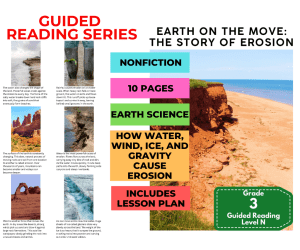
The Story of Erosion: Guided Reading Level N with Lesson Plan
ELA, Resources for Teachers, Reading Comprehension, Reading, Science, Language Development, Pre-Reading, Earth and Environmental Sciences, Geography, Social Studies, Grade 2, 3, 4, Worksheets & Printables, Worksheets, Teacher Tools, Centers, Activities, Literacy Readers, Quizzes, Quizzes and Tests, Assessments, Lesson Plans
This The Story of Erosion (level n) guided reading book with lesson plan includes: Guided Reading Color Label (front cover x1) This is a quick way to match the book’s demands to what students can generally handle.. The overall goal is to use the level/color to pick books for several smaller groups. To qualify for a certain level, a student is expected to read a book from that level with about 90–94% accuracy. If a student is consistently accurate and understands, move up a level. If the student is struggling at that level, drop down and add more support. Each student will improve at completely different rates, but it is generally one of the best ways to check progress across the class. DOWNLOAD THE CATALOG TO VIEW ALL GUIDED READING BOOKS AVAILABLE (SORTED LEVELS A-Z) Pre-Reading Question (x1) Teacher asks the prompt aloud, can be while showing the cover or first page. Students share what they already know, or make educated guesses from the cover. Prompt them to use the target vocabulary. Write some of their responses on the board to look back at during the reading. Vocabulary Words (x5) Introduce the five words, best doing it one at a time. Start by saying it, while students repeat and then see if anyone knows what it means before reading further. Read through the meaning and try to briefly connect each word to a picture or gesture so it’s meaningful. Ask students to flip through the book pages and point to where they see each of the vocabulary words. While reading the book pause upon coming across one of the vocab words or read the sentence twice to make sure students understand the word has appeared. Optional: Ask students to raise hands whenever they see/hear one of the new words. Guided Reading Pages (x10) Check the book snapshot (below) for: primary topic - do you need to prep extra reading or intro materials on this? what is taught best - decide on 1-2 bullets to focus on, use the prompt or words provided here for best results. learning goals - what you are checking for students to be able to do after the session, elicit answers using prompts or words provided. key vocabulary (see section above). questions overview - so you know what is coming up and if you need to prep extra materials to assist understanding. Run the lesson You may have already looked at a few of the pages together, but you can show them some of the pictures again first to set meaning. Depending on how much time you have and how familiar your students are with guided reading class, you may want to read the book aloud first with the group first. Students whisper or partner read, while you listen in. If time, do it as a group, one student reading a page each. Use the guided page’s prompts to coach: “Check the picture / does it make sense?” “Point under the words / try the first sound” “Reread the sentence smoothly”. Try to focus more on one student per session (rotating every time), so you can work out if they are ready to move up or need to move down a level. Comprehension Questions (back cover x3) This is your way to check that students didn’t just say the words, but actually understood the text. First, let students answer by pointing to the page/picture and saying a short sentence. After any answer, follow with: “Show me where you found that in the text.” In bigger groups, have partners answer first (10–20 seconds), then call on 2–3 students to share. Differentiation tips: Emerging speakers/struggling readers: oral + pointing On-level: oral in a full sentence Higher: one written sentence or draw + label Book Snapshot Title: Earth on the Move: The Story of Erosion Genre: Nonfiction (informational text) Subject: Life Science / Earth Science Primary Topic: How water, wind, ice, and gravity cause erosion Estimated Guided Reading Level (A–Z): N What This Book Teaches Best Defines erosion as a slow, natural process that moves rocks and soil from one place to another. Compares different forces of erosion (water, ocean waves, rainfall/runoff, wind, ice/glaciers, gravity) using clear examples. Explains cause and effect in Earth changes , such as rivers cutting deep paths that form canyons and riverbanks over time. Shows that erosion can break down land in one place and build new land in another , including how a river can form a delta where it meets the ocean. Highlights ways nature can slow erosion , including how plant roots hold soil in place. Learning Goals Students can define erosion using details from the text. Students can identify water as the most powerful cause of erosion described in the book. Students can explain how rivers, waves, and rainfall/runoff change land over time. Students can describe how wind, glaciers, and gravity move or reshape rock and soil. Students can explain how plants help prevent erosion from happening too quickly. Students can describe how a delta forms when a river drops sand and soil at the ocean. Key Vocabulary From the Text erosion — moving rock and soil from one place to another. shoreline — where land meets the ocean. runoff — rainwater that flows downhill over the ground. glaciers — huge sheets of ice moving slowly across land. delta — land formed when a river drops sand and soil. Discussion Prompts Pre-reading question: What are some ways land might change over a long time? Comprehension questions: How does the book describe erosion and what it moves? Comprehension questions: What does fast-moving river water do to the earth, according to the text? Comprehension questions: How do the roots of trees and grasses help stop erosion from happening too quickly? Printing Tips 1. Best Printing Method (Recommended) “Booklet” Printing (Best if Available) If your printer or PDF viewer supports Booklet Printing , use this. Settings to use: Print mode: Booklet Paper size: Letter or A4 (either works) Orientation: Landscape Print on both sides: Yes Flip on: Short edge Scaling: Fit to printable area Booklet subset: First test: Front sides only Then: Back sides only This will automatically: Pair pages correctly Put the cover on the outside Align everything for folding After printing, fold in half and staple along the spine . 2. If “Booklet” Printing Is NOT Available You can still print this correctly with manual duplex printing . Step-by-step: Open the PDF. Choose Print . Set: Orientation: Landscape Pages per sheet: 1 Print on both sides: Yes Flip on: Short edge Print all pages . Because each PDF page already contains two facing book pages, the result will still fold cleanly into a book. Thousands of Cored Education products are included with your TeachSimple membership. Download links and encyclopedia index available here.
Author Cored Education
Rating
Tags Reading Comprehension, Reading Passages, Reading, Guided Reading, Guided Reading Lesson Plan, Guided Reading Activity, Pre-reading, Science Lesson Plans, Earth Science, Geography

Qatar Reading Comprehension Passage - Cored Ed Encyclopedia
ELA, Language Development, Resources for Teachers, Reading Comprehension, Reading, Pre-Reading, Writing, Geography, Social Studies, History, Grade 2, 3, 4, 5, Worksheets & Printables, Worksheets, Teacher Tools, Centers, Activities, Writing Prompts, Assessments, Quizzes and Tests, Quizzes, Lesson Plans
This Qatar reading comprehension includes: Visualization (on the front cover) Start your lesson by taking a minute to think and share something about the topic. Read the script aloud (slowly), perhaps prepare some music or sound effects. Student close their eyes and let their imaginations wander. Students open their eyes, read the question aloud and give them a few minutes to complete. Ask a few students to share or keep answers until the end to compare with what they learn in the passage. Quick pause—thousands of Cored Education products are included with your TeachSimple membership. Download links and encyclopedia index available here. Pre-Reading Trivia Students will write down one thing they already know about the subject and then read five more facts and discuss. These facts are fun, and the students will enjoy learning about the subject before reading more. Give 1 minute for students to write what they already know (no pressure—best guess is fine). Read the five facts together. After each fact, do ask a student for their opinion, was it surprising? Set a purpose by asking students to highlight/underline one fact they want to learn more about during the reading. Reading Passage The text is a high-interest reading passage with set paragraphs, roughly three to four paragraphs long. It contains a variety of themes about the topic, anywhere from history to technology. The passage is between 250 and 350 words in length. First, ask students to look at the headings and see what they’ll learn about today. What do they know about the topic/heading? First read options: Teacher read-aloud (best for support). Partner reading (paragraph by paragraph). While reading, students underline important details, and vocabulary words they think may come up in the questions section. Mixed Questions The first question page contains four multiple-choice questions, each with a choice of four answers, and three written response questions that require a sentence or two from the student. Students complete the mcqs first independently, then review quickly as a class. For the 3 written responses, try to get students giving the answer with some form of evidence: “I think ___ because the text says ___.” If students get stuck, send them back to check the passage. Vocabulary Questions Practice seven key words from the text in this section across two activities. First section is scrambled words where students will unscramble three words given a clue for each. The second section is a word to meaning matching activity. Before starting, have some students read out words they underlined in the passage. Ask students to say the word and read aloud the sentence(s) around each word. Ask students to do scrambled words and the matching exercise in pairs then go through answers as a class. For the scrambled spelling task, get four pairs to come up to the board and write the words for extra practice with the other student reading out the clue. For the matching task, prompt students to give full sentences: “I matched ___ with ___ because ___.” Creative Writing In this question, the student will be required to write a five to eight sentence paragraph on a question related to the topic. Before starting, ask students write down 3 key ideas they are going to include in their piece. Ask students for ideas to share around the class to help those struggling. Pro writing expectations: 5–8 sentences At least 2 facts or details from the passage At least 2 vocabulary words from the previous page Students read their paragraphs while classmates listen for facts and vocabulary words. Extension Activities This page is optional for fast finishers or to take home. There are several activities, each one requiring a different skill. Do some, do none, do all, completely optional - but you will feel reassured knowing every possibility is planned for. Includes summary writting question. Answer Key There are answers for the multiple-choice questions, written response questions have sample answers, vocabulary answers and if there is a summary question then a sample summary will be provided as well. Lesson Plan Included Customized lesson plan for this lesson is included. Lesson Snapshot Title: Qatar Genre: Nonfiction (informational reading passage) Subject: Social Studies (Geography/History/Economics) Primary Topic: Qatar’s geography and change over time Estimated Guided Reading Level (A–Z): R What This Lesson Teaches Best How location and landforms shape a place (peninsula in the Persian Gulf; sea on three sides; sand dunes; an inlet called the Inland Sea). How a country’s economy can change over time (from pearling to oil and natural gas). Cause-and-effect in history (cultured pearls spread → pearling trade collapsed; oil/gas money → schools, hospitals, ports, neighborhoods). Connecting past and present in one place (pearl boats and tall towers sharing the same shoreline; Doha’s modern landmarks). Built-in comprehension practice (pre-reading trivia, mixed questions, vocabulary work, writing and extension activities align to passage details). Learning Goals I can describe Qatar’s location and what surrounds it using details from the passage. I can explain how pearl diving worked and why the pearling trade collapsed. I can identify how oil and natural gas changed Qatar and name what was built with that money. I can sequence key changes over time mentioned in the passage (pearling, oil discovery/exporting, independence, World Cup). I can use passage vocabulary (like peninsula, inlet, emirate) when talking about Qatar. Key Vocabulary From the Text peninsula — land with water on most sides inlet — water cutting into land from the sea seafloor — the bottom of the sea cultured — made or grown with human help emirate — a place led by an emir FULL CATALOG OF DOWNLOAD LINKS AND ENCYCLOPEDIA INDEX HERE
Author Cored Education
Rating
Tags Vocabulary, Reading Comprehension, Reading Passages, Reading, Creative Writing, Reading Strategies, Writing Prompts, Lesson Plans, Geography, Qatar
I WONDER - Can A Jellyfish Glow | Animated Video Lesson
STEM, Animals, Life Sciences, Science, Biology, Grade 1, 2, 3, 4, 5, 6, 7, 8, Lesson Plans, Teacher Tools
Video Introduction Animal kingdoms are full of fascinating wonders to learn. This video is designed for the students to learn more about animals in different countries. I WONDER - Can A Jellyfish Glow | Animated Video Lesson Do you like animals? what is your favorite one? Do you own a pet? If yes, tell us more about it, like what its name? And what do you like most about it? What are the animal kingdoms? Can you write down the characteristics of each animal class like mammals, birds, reptiles, amphibian, fish and mollusks. Do you know that some animals can sing, can you name any of them? What is the largest and the smallest mammal in the world? What is the largest and the smallest bird in the world? What is the largest and the smallest fish in the world? I WONDER - Can A Jellyfish Glow | Animated Video Lesson The video is perfect for encouraging the researching skills for the students, while learning more about these fantastic animals. I WONDER - Can A Jellyfish Glow | Animated Video Lesson This friendly designed video is suitable for students at school, homeschooling, and as a group activity. Format Available in MP4 format.
Author Educational Voice
Tags Can A Jellyfish Glow, Can A Jellyfish Glow Video, Jellyfish, Jellyfish Video, Jellyfish Facts, Jellyfish Facts For Kids, Jellyfish Video For Kids, Fishh, Glowing Jellyfish, Glowing Jellyfish Facts