



3,923 products added recently
Page 67 - Science Lesson Plans
Bring science to life with lesson plans that cover biology, chemistry, physics, and more. These resources offer experiments and interactive lessons to stimulate curiosity. Implement them to foster a deep understanding of scientific principles and a passion for discovery.

 Show filters


I WONDER - How Are Chemical Bonds Useful | Animated Video Lesson
Chemistry, Science, STEM, Grade 6, 7, 8, 9, 10, 11, 12, Lesson Plans, Teacher Tools
Video Introduction An amazing video designed for the students to learn more about STEM. I WONDER - How Are Chemical Bonds Useful | Animated Video Lesson Do you like STEM subjects? what is your favorite one? Have you ever tried to plant a seed? If yes, tell us more about it. Or have you ever tried to invent something? If yes, tell us more about it. And how do you think it will help us? Have you ever seen a microorganism under a microscope? What was it? And how it looked like? Mathematics is a marvelous subject. Let' sharpen our brains and solve some equations. Do you like timetable tricks? What is your favorite one? Do you know how to code? Have you ever created an app or a game before? If yes, how was it like? I WONDER - How Are Chemical Bonds Useful | Animated Video Lesson The video is perfect for encouraging the researching skills for the students, while learning more about this fantastic topic. I WONDER - How Are Chemical Bonds Useful | Animated Video Lesson This friendly designed video is suitable for students at school, homeschooling, and as a group activity. Format Available in MP4 format.
Author Educational Voice
Tags How Are Chemical Bonds Useful, How Are Chemical Bonds Useful Video, Chemical Bonds, Chemical Bond, Chemical Bonds Facts, Chemical Bonds Facts For Kids, Chemical Bonds Video, Chemical Bonds Video For Kids

Batteries Reading Comprehension Passage - Cored Ed Encyclopedia
ELA, Language Development, Reading Comprehension, Reading, Social Studies, Writing, History, Pre-Reading, Physics, Science, Grade 2, 3, 4, 5, Worksheets & Printables, Worksheets, Teacher Tools, Centers, Activities, Writing Prompts, Assessments, Quizzes and Tests, Quizzes, Lesson Plans
This batteries reading comprehension with lesson plan includes: Visualization (on the front cover) Start your lesson by taking a minute to think and share something about the topic. Read the script aloud (slowly), perhaps prepare some music or sound effects. Student close their eyes and let their imaginations wander. Students open their eyes, read the question aloud and give them a few minutes to complete. Ask a few students to share or keep answers until the end to compare with what they learn in the passage. COMPANION VIDEO NOW AVAILABLE (EMBEDDED AFTER PREVIEW PICTURES IN PRODUCT DESCRIPTION) Quick pause—thousands of Cored Education products are included with your TeachSimple membership. Download links and encyclopedia index available here. Pre-Reading Trivia Students will write down one thing they already know about the subject and then read five more facts and discuss. These facts are fun, and the students will enjoy learning about the subject before reading more. Give 1 minute for students to write what they already know (no pressure—best guess is fine). Read the five facts together. After each fact, do ask a student for their opinion, was it surprising? Set a purpose by asking students to highlight/underline one fact they want to learn more about during the reading. Reading Passage The text is a high-interest reading passage with set paragraphs, roughly three to four paragraphs long. It contains a variety of themes about the topic, anywhere from history to technology. The passage is between 250 and 350 words in length. First, ask students to look at the headings and see what they’ll learn about today. What do they know about the topic/heading? First read options: Teacher read-aloud (best for support). Partner reading (paragraph by paragraph). While reading, students underline important details, and vocabulary words they think may come up in the questions section. Mixed Questions The first question page contains four multiple-choice questions, each with a choice of four answers, and three written response questions that require a sentence or two from the student. Students complete the mcqs first independently, then review quickly as a class. For the 3 written responses, try to get students giving the answer with some form of evidence: “I think ___ because the text says ___.” If students get stuck, send them back to check the passage. Vocabulary Questions Practice seven key words from the text in this section across two activities. First section is scrambled words where students will unscramble three words given a clue for each. The second section is a word to meaning matching activity. Before starting, have some students read out words they underlined in the passage. Ask students to say the word and read aloud the sentence(s) around each word. Ask students to do scrambled words and the matching exercise in pairs then go through answers as a class. For the scrambled spelling task, get four pairs to come up to the board and write the words for extra practice with the other student reading out the clue. For the matching task, prompt students to give full sentences: “I matched ___ with ___ because ___.” Creative Writing In this question, the student will be required to write a five to eight sentence paragraph on a question related to the topic. Before starting, ask students write down 3 key ideas they are going to include in their piece. Ask students for ideas to share around the class to help those struggling. Pro writing expectations: 5–8 sentences At least 2 facts or details from the passage At least 2 vocabulary words from the previous page Students read their paragraphs while classmates listen for facts and vocabulary words. Extension Activities This page is optional for fast finishers or to take home. There are several activities, each one requiring a different skill. Do some, do none, do all, completely optional - but you will feel reassured knowing every possibility is planned for. Includes summary writting question and additional facts. Answer Key There are answers for the multiple-choice questions, written response questions have sample answers, vocabulary answers and if there is a summary question then a sample summary will be provided as well. Lesson Plan Included Customized lesson plan for this lesson is included. Lesson Snapshot Title: Batteries Genre: Nonfiction (informational passage) Subject: Science (Physical Science / Electricity) Primary Topic: How batteries store energy and changed over time Estimated Guided Reading Level (A–Z): T What This Lesson Teaches Best Explains what a battery does and how it powers devices when connected in a circuit (electrons moving through a wire to light a bulb or spin a motor). Introduces key electricity ideas in context (plus/minus ends guiding the “flow” the right way; current moving for a while). Gives a clear mini-history of batteries, from 1800’s “voltaic pile” to later “wet cells,” “dry cells,” and rechargeable batteries. Connects science to real-world uses, from small watch batteries to lithium-ion packs and room-size battery banks for the power grid. Highlights responsible use: batteries don’t last forever, so careful charging and recycling can help protect people and the planet. Learning Goals Identify what the passage says is stored inside a battery and what makes electricity move in a circuit. Explain, using the text, how electrons help a flashlight make a bright beam. Describe what Alessandro Volta built in 1800 and what materials were stacked. Compare “wet cells” and “dry cells” using details from the passage about carrying and spilling. Explain what makes a rechargeable battery different, based on how the passage describes “pushing” chemical changes backward. Describe how batteries are used today, including small devices and large battery banks on the power grid. Key Vocabulary From the Text electrons — tiny particles that can move through a wire. circuit — a path electricity travels through to do work. current — electricity moving steadily in a path. rechargeable — able to be filled up again with electricity. recycling — using materials again instead of throwing them away. FULL CATALOG OF DOWNLOAD LINKS AND ENCYCLOPEDIA INDEX HERE
Author Cored Education
Rating
Tags Vocabulary, Reading Comprehension, Reading Passages, Lesson Plans, Ela Lesson Plans, Reading Comprehension Lesson Plans, Pre-reading, History, Science Lesson Plans, Physics
I WONDER - Can We Still Hear In Our Sleep | Animated Video Lesson
Biology, Life Sciences, Science, Human Body, Grade 3, 4, 5, 6, 7, 8, 9, Lesson Plans, Teacher Tools
Video Overview The human body is full of fascinating wonders to learn. This video is created to help the students recognize the anatomy and the job of the human body. I WONDER - Can We Still Hear In Our Sleep | Animated Video Lesson Our brain is a marvelous organ inside our bodies! Can you mention five facts about the brain? Can you mention 5 organs that are controlled by the brain? How do our senses work? Have you ever wondered why the muscles are important for our body? Do you think we can sit down or stand up with using our muscles? I WONDER - Can We Still Hear In Our Sleep | Animated Video Lesson The video is perfect for encouraging the researching skills for the students, while learning more about our fantastic human body. I WONDER - Can We Still Hear In Our Sleep | Animated Video Lesson This friendly designed video is suitable for students at school, homeschooling, and as a group activity. Format Available in MP4 format.
Author Educational Voice
Rating
Tags Can We Still Hear In Our Sleep, Ears, Ears Facts, Ears Facts For Kids, Ears Video, Brain, Brain Facts, Brain Video, Brain Video For Kids, Brain Facts For Kids
I WONDER - What Is A Shooting Star | Animated Video Lesson
Space, Earth and Environmental Sciences, Science, Grade 1, 2, 3, 4, 5, 6, 7, 8, Lesson Plans, Teacher Tools
Video Introduction An amazing video designed for the students to learn more about space facts. I WONDER - What Is A Shooting Star | Animated Video Lesson Do you like reading about space? If yes, what is your favorite topic? What do you know about our solar system? What is the smallest planet in our solar system? What is the biggest planet in our solar system? What is the hottest planet in our solar system? And what is the coldest one? Do you think there are aliens? If yes, what do you think they look like? What do they eat and how they speak to each other? Where do they live? What is a galaxy? And what is a milky way? Have you recently saw a shooting star? If yes, tell us more about it, like when did it happen and where? What is a blackhole? Can a blackhole gets bigger by time? Do you like counting the stars? What do you think a star is made of? I WONDER - What Is A Shooting Star | Animated Video Lesson The video is perfect for encouraging the researching skills for the students, while learning more about the fantastic space. I WONDER - What Is A Shooting Star | Animated Video Lesson This friendly designed video is suitable for students at school, homeschooling, and as a group activity. Format Available in MP4 format.
Author Educational Voice
Tags What Is A Shooting Star, What Is A Shooting Star Video, Shooting Star, Shooting Star Facts, Shooting Star Facts For Kids, Shooting Star Video, Shooting Star Video For Kids, Space, Space Video

I WONDER - What Jobs Did Albert Einstein Do | Animated Video Lesson
Biographies, Social Studies, Inventors, Basic Science, Science, Grade 4, 5, 6, 7, 8, 9, 10, Lesson Plans, Teacher Tools
Video Introduction An amazing video designed for the students to learn more about famous people in different countries. I WONDER - What Jobs Did Albert Einstein Do | Animated Video Lesson Do you know this person? How much do you know about him/her? Who is your idol? Why did you choose this person? Tell us more about him/her? Who is your favorite athlete? Or what is your favorite team? Have you recently heard a story about a famous person? Who was this person? Can you tell us more about him/her. Who is your favorite president, king, or queen? Why you chose that person? In your country, who are the most famous people? What did they do? Can you tell us more about them. What is your favorite invention? Who invented it? Who is your favorite artist? What is the most famous thing he/she have done? What is the most enjoyable you have read before? Who wrote it? I WONDER - What Jobs Did Albert Einstein Do | Animated Video Lesson The video is perfect for encouraging the researching skills for the students, while learning more about this fantastic place. I WONDER - What Jobs Did Albert Einstein Do | Animated Video Lesson This friendly designed video is suitable for students at school, homeschooling, and as a group activity. Format Available in MP4 format.
Author Educational Voice
Rating
Tags What Jobs Did Albert Einstein Do, What Jobs Did Albert Einstein Do Video, Albert Einstein Jobs, Albert Einstein Jobs Video, Albert Einstein Jobs Facts, Albert Einstein Jobs Facts For Kids, Albert Einstein Jobs Video For Kids
I WONDER - When Was The First Mobile Phone Invented | Animated Video
Technology, Science, STEM, Grade 6, 7, 8, 9, 10, 11, 12, Lesson Plans, Teacher Tools
Video Introduction An amazing activity designed for the students to learn more about STEM. I WONDER - When Was The First Mobile Phone Invented | Animated Video Lesson Do you like STEM subjects? what is your favorite one? Have you ever tried to plant a seed? If yes, tell us more about it. Or have you ever tried to invent something? If yes, tell us more about it. And how do you think it will help us? Have you ever seen a microorganism under a microscope? What was it? And how it looked like? Mathematics is a marvelous subject. Let' sharpen our brains and solve some equations. Do you like timetable tricks? What is your favorite one? Do you know how to code? Have you ever created an app or a game before? If yes, how was it like? I WONDER - When Was The First Mobile Phone Invented | Animated Video Lesson The video is perfect for encouraging the researching skills for the students, while learning more about this fantastic topic. I WONDER - When Was The First Mobile Phone Invented | Animated Video Lesson This friendly designed video is suitable for students at school, homeschooling, and as a group activity. Format Available in MP4 format.
Author Educational Voice
Tags When Was The First Mobile Phone Invented, When Was The First Mobile Phone Invented Video, Mobile Phone, First Mobile Phone, Mobile Phone Invention, Mobile Phone Facts, Mobile Phone Facts For Kids
I WONDER - What Is Convection | Animated Video Lesson
Physics, Science, Chemistry, STEM, Grade 6, 7, 8, 9, 10, 11, 12, Lesson Plans, Teacher Tools
Video Introduction An amazing video designed for the students to learn more about STEM. I WONDER - What Is Convection | Animated Video Lesson Do you like STEM subjects? what is your favorite one? Have you ever tried to plant a seed? If yes, tell us more about it. Or have you ever tried to invent something? If yes, tell us more about it. And how do you think it will help us? Have you ever seen a microorganism under a microscope? What was it? And how it looked like? Mathematics is a marvelous subject. Let' sharpen our brains and solve some equations. Do you like timetable tricks? What is your favorite one? Do you know how to code? Have you ever created an app or a game before? If yes, how was it like? I WONDER - What Is Convection | Animated Video Lesson The video is perfect for encouraging the researching skills for the students, while learning more about this fantastic topic. I WONDER - What Is Convection | Animated Video Lesson This friendly designed video is suitable for students at school, homeschooling, and as a group activity. Format Available in MP4 format.
Author Educational Voice
Tags What Is Convection, What Is Convection Video, Convection, Convection Facts, Convection Facts For Kids, Convection Video, Convection Video For Kids, Convection Facts Video For Kids, Stem

I WONDER - Is A Plastic A Polymer | Animated Video Lesson
Chemistry, Science, STEM, Grade 6, 7, 8, 9, 10, 11, 12, Lesson Plans, Teacher Tools
Video Introduction An amazing video designed for the students to learn more about STEM. I WONDER - Is A Plastic A Polymer | Animated Video Lesson Do you like STEM subjects? what is your favorite one? Have you ever tried to plant a seed? If yes, tell us more about it. Or have you ever tried to invent something? If yes, tell us more about it. And how do you think it will help us? Have you ever seen a microorganism under a microscope? What was it? And how it looked like? Mathematics is a marvelous subject. Let' sharpen our brains and solve some equations. Do you like timetable tricks? What is your favorite one? Do you know how to code? Have you ever created an app or a game before? If yes, how was it like? I WONDER - Is A Plastic A Polymer | Animated Video Lesson The video is perfect for encouraging the researching skills for the students, while learning more about this fantastic topic. I WONDER - Is A Plastic A Polymer | Animated Video Lesson This friendly designed video is suitable for students at school, homeschooling, and as a group activity. Format Available in MP4 format.
Author Educational Voice
Tags Is A Plastic A Polymer, Is A Plastic A Polymer Video, Polymer, Polymers Facts, Polymers, Polymer Facts For Kids, Polymers Video, Polymers Video For Kids, Science, Science Video

Weather Unit
Science, Earth and Environmental Sciences, Earth Sciences, Research, Grade 3, 4, 5, 6, Lesson Plans, Teacher Tools
The Weather Unit An engaging and comprehensive resource package, the Weather Unit is designed to kindle curiosity and foster learning about weather in students. It's a versatile educational tool suitable for educators in public schools as well as homeschooling parents. CLOSE Reading Nonfiction Passages These passages illuminate various facets of weather- from the basic concept, elements like water cycle and clouds, different types of weather conditions, to meteorology and forecasting. Each passage comes with text-dependent questions that enhance comprehension skills. Vocabulary Cards i>Accompanying each CLOSE reading segment are vocabulary cards with definitions simplifying complex terminologies for students. Weather Research Report Included is a report that motivates students towards independent inquiry into the intricate world of weather. Educational Tools Included: A PowerPoint or handout that explicates the steps involved in CLOSE Reading along with anchor charts for student annotation. 'Text Dependent Questions', Common Core Essential questions ideal for assessments or performance tasks. RAFT ideas (Role-Audience-Format-Topic technique), Cognitive Content Dictionary improving vocabulary retention through visual association. Additional Materials: KWL Chart (Know-Want-Learned) Venn Diagrams promoting comparison analyses among learnt elements Tree Map Graphic Organizers to breakdown grammar components found in passages This bundle is an ideal choice for Grades 3 - 6 teachers teaching Science particularly Earth Sciences; bridging theoretical know-how with fun stimulating activities ensuring student motivation levels remain high throughout their learning journey of Weather. File formats available are Multiple File Types allowing easy access on various platforms to better suit your teaching needs.
Author The Teacher Team
Tags Weather, Close Reading, Nonfiction Passages, Vocabulary Cards, Research Report

Reducing Your Own Carbon Footprint: A Footprint On Your Dinner Plate Gr. 5-8
Science, Earth and Environmental Sciences, Environmental Science, Grade 5, 6, 7, 8, Teacher Tools, Lesson Plans
Reducing Your Own Carbon Footprint: A Footprint On Your Dinner Plate Gr. 5-8 Reducing Your Own Carbon Footprint: A Footprint On Your Dinner Plate Gr. 5-8 is an impactful teaching resource designed for grades 5 to 8. It guides students through the global issue of climate change, illustrating the human influences and their correlated environmental impacts. Main Features: Designed in consideration of Bloom's Taxonomy and STEAM initiatives An integrative blend of scientific theory and practical application A deep dive into the carbon footprints associated with our food consumption patterns The resource primes students with extensive information about the greenhouse effect - a critical background to comprehend how typical human actions can augment global warming. It then explores domestic energy use, specifically in kitchen scenarios. Kitchen to Farm Journey: New insights are explored about each step involved in transporting food from farm fields up to your dinner plates - pointing out every step that broadens carbon footprints along this journey. Sustainable Practices Discussion: Emphasizing contrasting methods used in sustainable agricultural practices versus conventional ones. Travel & Waste Management Components: A travel footprint calculator is included for students to compute their own travel-related carbon emission situations. An elaboration on waste management dynamics post-consumption stage also forms a key part of this resource, instilling an essential sense of responsibility in students beyond just safe disposal ethics. Creative Exercise for Community Eco-friendly Practices: Exploring feasible ways of embedding eco-friendly norms into community life encourages social contract development. This offers engaging group collaboration opportunities or homework assignments. Downloadable Resource: This teaching resource comes in a convenient downloadable PDF format. Loaded with 30 pages of printable material including graphic organizers , crossword puzzles, comprehension quizzes (with answer keys), and word searches, it makes the learning process interactive yet straightforward.
Author Classroom Complete Press
Tags Carbon Footprint, Agriculture, Environment, Graphic Organizers, Electricity
I WONDER - What Is A Circular Economy | Animated Video Lesson
Environmental Science, Earth and Environmental Sciences, Science, Economics, Social Studies, Grade 6, 7, 8, 9, 10, 11, 12, Lesson Plans, Teacher Tools
Video Introduction An amazing video designed for the students to learn more about STEM. I WONDER - What Is A Circular Economy | Animated Video Lesson Do you like STEM subjects? what is your favorite one? Have you ever tried to plant a seed? If yes, tell us more about it. Or have you ever tried to invent something? If yes, tell us more about it. And how do you think it will help us? Have you ever seen a microorganism under a microscope? What was it? And how it looked like? Mathematics is a marvelous subject. Let' sharpen our brains and solve some equations. Do you like timetable tricks? What is your favorite one? Do you know how to code? Have you ever created an app or a game before? If yes, how was it like? I WONDER - What Is A Circular Economy | Animated Video Lesson The video is perfect for encouraging the researching skills for the students, while learning more about this fantastic topic. I WONDER - What Is A Circular Economy | Animated Video Lesson This friendly designed video is suitable for students at school, homeschooling, and as a group activity. Format Available in MP4 format.
Author Educational Voice
Tags What Is A Circular Economy, What Is A Circular Economy Video, Circular Economy, Circular Economy Facts, Circular Economy Facts For Kids, Circular Economy Video, Circular Economy Video For Kids

I WONDER - How Are Sound And Water Waves Different | Animated Video
Physics, Science, STEM, Grade 6, 7, 8, 9, 10, 11, 12, Lesson Plans, Teacher Tools
Video Introduction An amazing video designed for the students to learn more about STEM. I WONDER - How Are Sound And Water Waves Different | Animated Video Lesson Do you like STEM subjects? what is your favorite one? Have you ever tried to plant a seed? If yes, tell us more about it. Or have you ever tried to invent something? If yes, tell us more about it. And how do you think it will help us? Have you ever seen a microorganism under a microscope? What was it? And how it looked like? Mathematics is a marvelous subject. Let' sharpen our brains and solve some equations. Do you like timetable tricks? What is your favorite one? Do you know how to code? Have you ever created an app or a game before? If yes, how was it like? I WONDER - How Are Sound And Water Waves Different | Animated Video Lesson The video is perfect for encouraging the researching skills for the students, while learning more about this fantastic topic. I WONDER - How Are Sound And Water Waves Different | Animated Video Lesson This friendly designed video is suitable for students at school, homeschooling, and as a group activity. Format Available in MP4 format.
Author Educational Voice
Tags How Are Sound And Water Waves Different, How Are Sound And Water Waves Different Video, Water Waves , Water Waves Facts, Water Waves Video, Sound Waves , Sound Waves Facts, Sound Waves Video
I WONDER - Why Is Friction Useful | Animated Video Lesson
Physics, Science, Grade 4, 5, 6, 7, 8, 9, 10, Lesson Plans, Teacher Tools
Video Introduction An amazing activity designed for the students to learn more about STEM. I WONDER - Why Is Friction Useful | Animated Video Lesson Do you like STEM subjects? what is your favorite one? Have you ever tried to plant a seed? If yes, tell us more about it. Or have you ever tried to invent something? If yes, tell us more about it. And how do you think it will help us? Have you ever seen a microorganism under a microscope? What was it? And how it looked like? Mathematics is a marvelous subject. Let' sharpen our brains and solve some equations. Do you like timetable tricks? What is your favorite one? Do you know how to code? Have you ever created an app or a game before? If yes, how was it like? I WONDER - Why Is Friction Useful | Animated Video Lesson The video is perfect for encouraging the researching skills for the students, while learning more about this fantastic topic. I WONDER - Why Is Friction Useful | Animated Video Lesson This friendly designed video is suitable for students at school, homeschooling, and as a group activity. Format Available in MP4 format.
Author Educational Voice
Tags Why Is Friction Useful, Why Is Friction Useful Video, Friction, Friction Facts, Friction Facts For Kids, Friction Facts Video, Physics, Stem, Stem Video, Science Video
I WONDER - What Does Boolean Mean In Coding | Animated Video Lesson
STEM, Computer Science, Technology, Science, Grade 6, 7, 8, 9, 10, 11, 12, Lesson Plans, Teacher Tools
Video Introduction An amazing video designed for the students to learn more about STEM. I WONDER - What Does Boolean Mean In Coding | Animated Video Lesson Do you like STEM subjects? what is your favorite one? Have you ever tried to plant a seed? If yes, tell us more about it. Or have you ever tried to invent something? If yes, tell us more about it. And how do you think it will help us? Have you ever seen a microorganism under a microscope? What was it? And how it looked like? Mathematics is a marvelous subject. Let' sharpen our brains and solve some equations. Do you like timetable tricks? What is your favorite one? Do you know how to code? Have you ever created an app or a game before? If yes, how was it like? I WONDER - What Does Boolean Mean In Coding | Animated Video Lesson The video is perfect for encouraging the researching skills for the students, while learning more about this fantastic topic. I WONDER - What Does Boolean Mean In Coding | Animated Video Lesson This friendly designed video is suitable for students at school, homeschooling, and as a group activity. Format Available in MP4 format.
Author Educational Voice
Tags What Does Boolean Mean In Coding, What Does Boolean Mean In Coding Video, Boolean, Boolean Facts, Boolean Facts For Kids, Boolean Video, Boolean Video For Kids, Boolean In Coding, Boolean In Coding Video

Weathering, Erosion, and Deposition - Senior Earth and Space lesson
Science, Earth and Environmental Sciences, Space, Earth Sciences, Grade 10, 11, 12, Teacher Tools, Lesson Plans
Weathering, Erosion, and Deposition - Engaging Earth Science Lesson Dive into the causes and impacts of earthquakes, volcanoes, and tsunamis with this adaptable Earth and Space science lesson for senior high school students. The informative PowerPoint presentation covers key concepts like tectonic plates, volcanic eruptions, and seismic waves. It includes both teacher and student versions of the slide deck, 7 embedded videos, an auto-graded exit ticket, and a student handout for condensed note-taking. Implement this versatile resource in whole group instruction, small groups, as a homework assignment, or virtual learning. Assessment is made easy with the self-grading exit ticket and answer key. File formats include Office and Google Slides/Docs. Keep students actively engaged throughout the lesson with strategically placed content blanks to fill during discussion. Whether you're in a traditional or remote classroom, this is your go-to for an engaging earth science lesson on natural disasters.
Author Teach With Fergy
Tags Space Science, Earth Science, Rock Cycle, Weathering, Erosion, Sediments, Sediment Transport, Deposition

Bugs Of Summer Gr. 1-2
Science, Life Sciences, Animals, Grade 1, 2, Teacher Tools, Lesson Plans
Bugs Of Summer Gr. 1-2 Bugs Of Summer Gr. 1-2 is a resource that offers an engaging curriculum for both teachers and homeschooling parents. It introduces first and second grade students to the fascinating world of insects, combining elements of science and language arts, thus fostering a deeper appreciation of nature within core academic learning. Species Covered: Ants Butterflies Bees Ladybugs Beetles Dragonflies Grasshoppers Mosquitoes, etc. This unit also includes spiders as part of its study, despite not technically being insects. Reproducible Pages: Prepared for direct student use, they ensure consistency in material presentation. Each page presents questions based on insect fact cards read by students—encouraging attentive reading comprehension habits while reinforcing learned scientific details. Parent Pages: To foster home-school communication or parental involvement in children's education journey where applicable. Possibilities of Use This comprehensive study can be adapted across various contexts such as whole-group instruction within traditional classrooms; small group setups for collaborative learning; independent learning experiences used as homework tasks—all at the teachers' discretion. Product Details The resource comes as a single product file in PDF format—compatible with multiple devices for easy access by both students and educators alike—and is most suitable for those studying subjects under Science (specifically Zoology) within grades one and two categories. In conclusion, with Bugs Of Summer Gr. 1-2 package at hand—an enlightening exploration into the fascinating realm of some summer's smallest inhabitants awaits each young inquisitive learner.
Author Classroom Complete Press
Tags PDF
Prevention, Recycling & Conservation: Recycling Gr. 5-8
Science, Earth and Environmental Sciences, Environmental Science, Grade 5, 6, 7, 8, Teacher Tools, Lesson Plans
Prevention, Recycling & Conservation: Recycling Gr. 5-8 Prevention, Recycling & Conservation: Recycling Gr. 5-8 is an outstanding educational tool that tackles the intricate subjects of prevention, recycling, and conservation in a way comprehendible for students in grades 5 through 8. The resource's intelligently designed layout simplifies these topics by addressing key questions such as: What is conservation? How do natural resources differ from renewable and non-renewable ones? A focus on reducing landfill waste A prominent theme featured in this learning resource addresses minimising landfill waste. Progressive composting techniques are clearly discussed to provide learners with insights into how organic matter decomposes over time. This information fosters their understanding of ecologically sustainable living while encouraging them to become proactive solution-seekers. Navigating the pollution problem The serious issue of pollution is carefully examined, unveiling its profound effects on freshwater sources and atmospheric conditions. Through this interactive exploration, students will gain an awareness of crucial environmental challenges such as smog formation, ozone layer erosion and the typical greenhouse gas emissions resulting from burning fossil fuels. The Unique Selling Proposition of Prevention, Recycling & Conservation: Recycling Gr. 5-8 This resource also stands apart due to its emphasis on inventive responses to existing environmental issues - teaching concepts such as using alternative energy sources or pursuing zero-waste goals whilst inspiring students towards a greener lifestyle. Inclusive Teaching Aid components - User-ready reading passages ideal for group or private study sessions - Pupil activities to further challenge learners - Full-colour pocket-sized information posters providing immediate reference points to struggling learners when necessary All content within this product is aligned perfectly with your State Standards and strictly follows Bloom's Taxonomy recommendations, ensuring quality educational material that supports effective teaching. This resource caters specifically to science-based curriculums, particularly under environmental science. Documents are conveniently packaged in PDF format for hassle-free digital access. Final Thoughts on Prevention, Recycling & Conservation: Recycling Gr. 5-8 Prevention, Recycling & Conservation: Recycling Gr. 5-8 proves itself as an indispensable addition to a teacher's toolkit regardless of their teaching platform (public school or homeschooling). It symbolises the perfect balance between informative substance and careful design; built with the aim of making education engaging and meaningful!
Author Classroom Complete Press
Tags PDF

Reducing Your School's Carbon Footprint: Reduce What You Can and Offset the Rest Gr. 5-8
Science, Earth and Environmental Sciences, Environmental Science, Grade 5, 6, 7, 8, Teacher Tools, Lesson Plans
Introducing the teaching resource, "Reducing Your School's Carbon Footprint: Reduce What You Can and Offset The Rest Gr. 5-8". This valuable tool aims to bring climate awareness right into your classroom by providing a clear perspective on how students can make a positive impact on their environment. From grades 5 to 8, this resource is particularly designed for Science, focusing on environmental science. It emphasizes understanding carbon footprints, specifically the one generated by schools. Students gain comprehensive insights into fossil fuels used at school and discover their benefits in making day-to-day life more convenient. The resource encourages students not only to acknowledge but also act upon the energy conservation challenge: Brainstorm ways to minimize energy usage at school Create sustainable solutions for power efficiency Analyze emission data Craft plans for emission reduction zones around school premises. Calculate potential carbon dioxide removal from tree planting initiatives around schools. The teaching tool further explores various everyday events linked with items like bread which contribute towards greenhouse gas emissions. This user-friendly PDF file is composed of: 29 ready-to-print pages that can slip effortlessly into any class schedule; Easily adaptable content for individual or group sessions; Potential use as homework assignments; . User Engagement Tools: Answer keys; Graphic organizers; Carbon footprint calculator. Focusing on interactivity, puzzles including crossword and word search are merged into the resource content to magnify student involvement. This resource ultimately aims at mobilizing students to play an active role in combating climate change. Foundations are laid for them to understand that their individual efforts can collectively trigger significant advancements in environmental protection.
Author Classroom Complete Press
Tags Science Quiz, Crossword Puzzle, Environmental, Carbon Footprint, Recycling

Kepler's Laws of Planetary Motion - Earth and Space Lesson
Science, Earth and Environmental Sciences, Space, Grade 10, 11, 12, Teacher Tools, Lesson Plans
Kepler's Laws of Planetary Motion - Earth and Space Lesson This delightful teaching resource is specifically designed for science educators instructing students from grades 10 to 12. Kepler's theories about the relationship between planets and their motion serve as the cornerstone of this lesson. The highlights of this lesson include its comprehensive nature, promoting theory-based learning fused with interactive discussions. The course plan unfolds as: A brief history Introduction to Geocentric and Heliocentric models Deep dive into: Kepler’s First Law Kepler’s Second Law Kepler’s Third Law An adaptable structure makes it effective for whole group instruction or smaller groups. Student handouts, education videos, and auto-graded exit tickets round up this robust package. Focusing on accessibility, material compatibility extends to Google applications (Docs & Slides) as well as Microsoft Office applications (Word & PowerPoint), catering conveniently to varying technology preferences among school districts. Sneak peek into student engagement features: This unique presentation keeps students engaged by assigning classroom blanks that prompt them to fill out during discussions—an optimal way towards maintaining active involvement. Following this module on Kepler's Laws of Planetary motion, a further curriculum casts light onto: The Big Bang Theory, Celestial Objects, Astronomical Distances, Electromagnetic Spectrum/ Radiation, Spectroscopy Star Classification, and several fascinating subjects within our Solar System! To sum up, Kepler's Laws of Planetary Motion - Earth and Space Lesson artfully blends technology with traditional teaching methods to create an educational experience that is academically rigorous and highly engaging. It doesn't just teach, but encourages systematic inquiry into our Earth and Space Science.
Author Teach With Fergy
Tags Kepler's Laws, Planetary Motion, Universe, Science Education, Inquiry-based Learning

I WONDER - Is A Skunk's Spray Dangerous | Animated Video Lesson
STEM, Animals, Life Sciences, Science, Biology, Grade 1, 2, 3, 4, 5, 6, 7, 8, Lesson Plans, Teacher Tools
Video Introduction Animal kingdoms are full of fascinating wonders to learn. This video is designed for the students to learn more about animals in different countries. I WONDER - Is A Skunk's Spray Dangerous | Animated Video Lesson Do you like animals? what is your favorite one? Do you own a pet? If yes, tell us more about it, like what its name? And what do you like most about it? What are the animal kingdoms? Can you write down the characteristics of each animal class like mammals, birds, reptiles, amphibian, fish and mollusks. Do you know that some animals can sing, can you name any of them? What is the largest and the smallest mammal in the world? What is the largest and the smallest bird in the world? What is the largest and the smallest fish in the world? I WONDER - Is A Skunk's Spray Dangerous | Animated Video Lesson The video is perfect for encouraging the researching skills for the students, while learning more about these fantastic animals. I WONDER - Is A Skunk's Spray Dangerous | Animated Video Lesson This friendly designed video is suitable for students at school, homeschooling, and as a group activity. Format Available in MP4 format.
Author Educational Voice
Tags Is A Skunk's Spray Dangerous, Is A Skunk's Spray Dangerous Video, Skunk's Spray, Skunk's Spray Facts, Skunk's Spray Facts For Kids, Skunk's Spray Video, Skunk's Spray Video For Kids, Skunk

I WONDER - Can Earthquakes Only Happen On Earth | Animated Video
Earth Sciences, Earth and Environmental Sciences, Science, Geology, Space, Grade 3, 4, 5, 6, 7, 8, 9, Lesson Plans, Teacher Tools
Video Introduction An amazing video designed for the students to learn more about natural disasters in different countries. I WONDER - Can Earthquakes Only Happen On Earth | Animated Video Lesson Do you like summer days where the sun is shinning and you can see beautiful flowers everywhere or winter days where it is raining or snowing and where you can set by the fireplace and enjoy the scene from outside your windows? How to do you thing the blizzards and hurricanes or tornadoes got their names? Can you name a volcanic mountain? Have you ever read about earthquakes? Do you know why earthquakes happen? I WONDER - Can Earthquakes Only Happen On Earth | Animated Video Lesson The video is perfect for encouraging the researching skills for the students, while learning more about this fantastic phenomenon. I WONDER - Can Earthquakes Only Happen On Earth | Animated Video Lesson This friendly designed video is suitable for students at school, homeschooling, and as a group activity. Format Available in MP4 format.
Author Educational Voice
Rating
Tags Can Earthquakes Only Happen On Earth, Earthquakes, Earthquake, Earthquakes Facts, Earthquakes Video, Earthquakes Video For Kids, Earthquakes Facts For Kids, Earthquakes On Planets, Space
I WONDER - Where Are Lasers Used | Animated Video Lesson
Physics, Science, Grade 6, 7, 8, 9, 10, 11, 12, Lesson Plans, Teacher Tools
Video Introduction An amazing activity designed for the students to learn more about STEM. I WONDER - Where Are Lasers Used | Animated Video Lesson Do you like STEM subjects? what is your favorite one? Have you ever tried to plant a seed? If yes, tell us more about it. Or have you ever tried to invent something? If yes, tell us more about it. And how do you think it will help us? Have you ever seen a microorganism under a microscope? What was it? And how it looked like? Mathematics is a marvelous subject. Let' sharpen our brains and solve some equations. Do you like timetable tricks? What is your favorite one? Do you know how to code? Have you ever created an app or a game before? If yes, how was it like? I WONDER - Where Are Lasers Used | Animated Video Lesson The video is perfect for encouraging the researching skills for the students, while learning more about this fantastic topic. I WONDER - Where Are Lasers Used | Animated Video Lesson This friendly designed video is suitable for students at school, homeschooling, and as a group activity. Format Available in MP4 format.
Author Educational Voice
Tags Where Are Lasers Used, Where Are Lasers Used Video, Lasers, Lasers Facts, Lasers Facts For Kids, Lasers Video, Lasers Facts Video, Lasers Video For Kids, Science, Stem

I WONDER - How Do Giraffes Drink | Animated Video Lesson
Animals, Life Sciences, Science, Biology, STEM, Grade 1, 2, 3, 4, 5, 6, 7, 8, Lesson Plans, Teacher Tools
Video Introduction Animal kingdoms are full of fascinating wonders to learn. This video is designed for the students to learn more about animals in different countries. I WONDER - How Do Giraffes Drink | Animated Video Lesson Do you like animals? what is your favorite one? Do you own a pet? If yes, tell us more about it, like what its name? And what do you like most about it? What are the animal kingdoms? Can you write down the characteristics of each animal class like mammals, birds, reptiles, amphibian, fish and mollusks. Do you know that some animals can sing, can you name any of them? What is the largest and the smallest mammal in the world? What is the largest and the smallest bird in the world? What is the largest and the smallest fish in the world? I WONDER - How Do Giraffes Drink | Animated Video Lesson The video is perfect for encouraging the researching skills for the students, while learning more about these fantastic animals. I WONDER - How Do Giraffes Drink | Animated Video Lesson This friendly designed video is suitable for students at school, homeschooling, and as a group activity. Format Available in MP4 format.
Author Educational Voice
Tags How Do Giraffes Drink, How Do Giraffes Drink Video, Giraffes, Giraffe, Giraffes Facts, Giraffes Facts For Kids, Giraffes Video, Giraffes Video For Kids, Animal, Animals
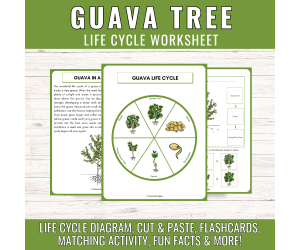
Guava Fruit Life Cycle Tropical Plant Science Unit Study Cut & Paste
Life Sciences, Science, Biology, Nature & Plants, Kindergarten, Preschool, Grade 1, 2, 3, Coloring Pages, Worksheets, Worksheets & Printables, Parts of and Anatomy of, Flashcards, Diagrams, Teacher Tools, Lesson Plans
Help students explore the fascinating life cycle of a guava plant with this engaging tropical plant science activity! Students will learn about the different stages of guava plant growth while practicing sequencing, cutting, pasting, and science vocabulary. I like using this resource during plant life cycle units, tropical plant studies, fruit and plant lessons, science centers, and homeschool learning. It's a hands-on way for students to explore how a guava plant grows and develops from seed to a mature plant that produces flowers and fruit. What You Will Get This printable guava fruit life cycle activity gives students an easy and engaging way to learn about tropical plant growth and development. What's Included in this Resource? • Guava plant life cycle activity • Life cycle sequencing practice • Cut-and-paste activities • Plant growth stages • Guava fruit and plant science vocabulary • Student-friendly printable pages • Hands-on science learning activity This resource is perfect for: • Plant life cycle units • Tropical plant studies • Fruit and plant science • Life science lessons • Science centers • Cut-and-paste activities • Preschool and elementary science • Homeschool learning Why you will love this? • Easy to print and use • Builds sequencing and observation skills • Introduces students to the life cycle of a tropical fruit plant • Provides hands-on cutting and pasting practice • Reinforces plant science vocabulary • Makes science learning interactive and engaging This Guava Fruit Life Cycle Activity is a fun way for students to explore the growth stages of a tropical fruit plant while strengthening sequencing, fine motor, and early science skills through hands-on cut-and-paste learning.
Author Perfect_Printables
Rating
Tags Life Cycle, Plant Life Cycle, Tropical Plants, Plant Science Activity, Plants Worksheet, Fruits Life Cycle, Fruit Plant, Life Cycle Activity, Guava Plant, Guava Plant Body Parts