Force: Balanced & Unbalanced Forces Gr. 5-8
A single-topic 'chapter slice' teaching resource on balanced and unbalanced forces, for grades 5-8 science, published by Classroom Complete Press (author George Graybill, Ph.D.).
2,772 resources
Explore sub-categories
3 sub-categories · 2,772 resources
A single-topic 'chapter slice' teaching resource on balanced and unbalanced forces, for grades 5-8 science, published by Classroom Complete Press (author George Graybill, Ph.D.).
A single-topic 'chapter slice' teaching resource on the relationship between force and mass, for grades 5-8 science, published by Classroom Complete Press (author George Graybill, Ph.D.).
A single-topic 'chapter slice' teaching resource on gravity as a force, for grades 5-8 science, published by Classroom Complete Press (author George Graybill, Ph.D.).
A single-topic 'chapter slice' teaching resource on kinds of force, for grades 5-8 science, published by Classroom Complete Press (author George Graybill, Ph.D.).
A single-topic 'chapter slice' teaching resource on how more than one force can act on an object at once, for grades 5-8 science, published by Classroom Complete Press (author George Graybill, Ph.D.).
A single-topic 'chapter slice' teaching resource on forces that act without touching (e.g. magnetic, electrostatic, gravitational forces), for grades 5-8 science, published by Classroom Complete Press (author George Graybill, Ph.D.).
A single-topic 'chapter slice' teaching resource on the concept of force, covering what force is, for grades 5-8 science, published by Classroom Complete Press (author George Graybill, Ph.D.).
Teaches the Four Square graphic-organizer method for planning and revising informational and narrative writing during a writing assessment, for elementary students.
Teaches the Four Square graphic-organizer method for planning and revising informational and narrative writing during a writing assessment, for secondary students.
The same thirty French sentences appear with and without gender-and-number hints. Begin with the supported version to practice selecting ce, cet, cette or ces, then use the unhinted version to see whether students can make the choice independently. The completed key supports review of each noun context.
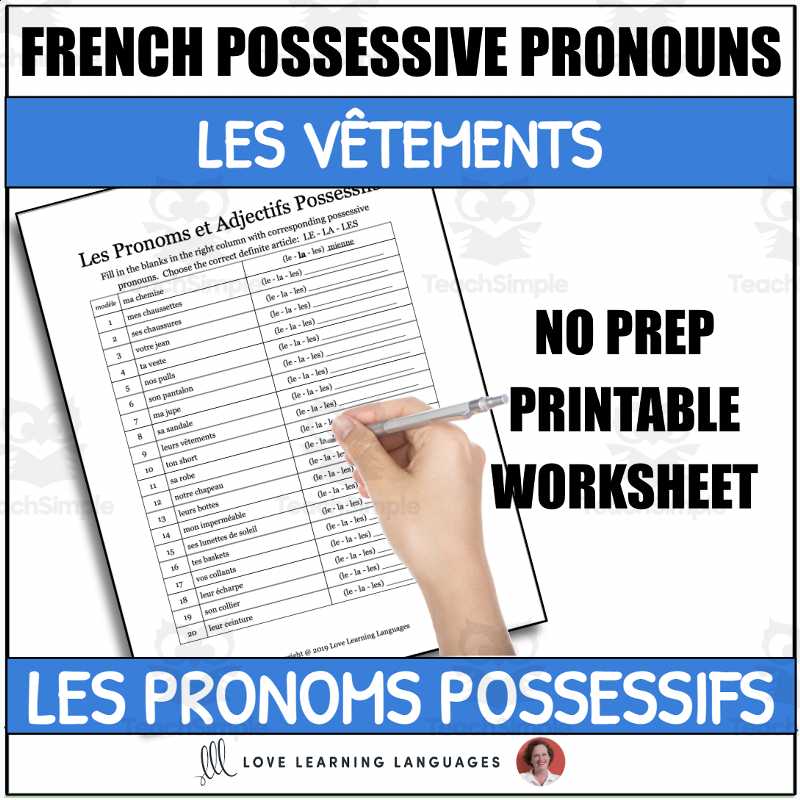
Practice French possessive pronouns (le mien, le tien, le sien, le nôtre, le vôtre, le leur, etc.) through a fill-in-the-blank worksheet or quiz.
Practice/quiz converting French possessive-adjective + clothing-noun phrases into the corresponding possessive pronoun with the correct definite article.
Practice worksheet on French -er stem-changing verbs (e.g., acheter, essayer, repeter, esperer, envoyer, proteger) for classwork, homework or a quiz.
Students use sentence context to decide how to complete the verb in each blank. A reference list groups common expressions to support the mood-choice work, and the answer pages provide completed sentences for review. Use a few items in discussion before assigning more independently. A related Connect-4 game of irregular present-subjunctive conjugations offers another practice format.
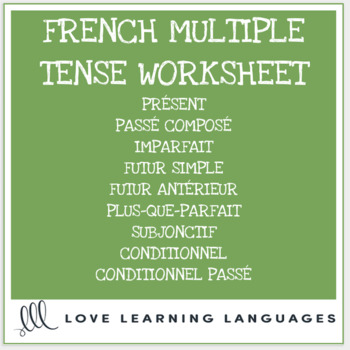
Practice and assess conjugation of French verbs across multiple tenses using a fill-in-the-blank quiz/worksheet.
Let's making learning Fry's sight words more interesting. This resources brings Fry's sight words into the digital age.
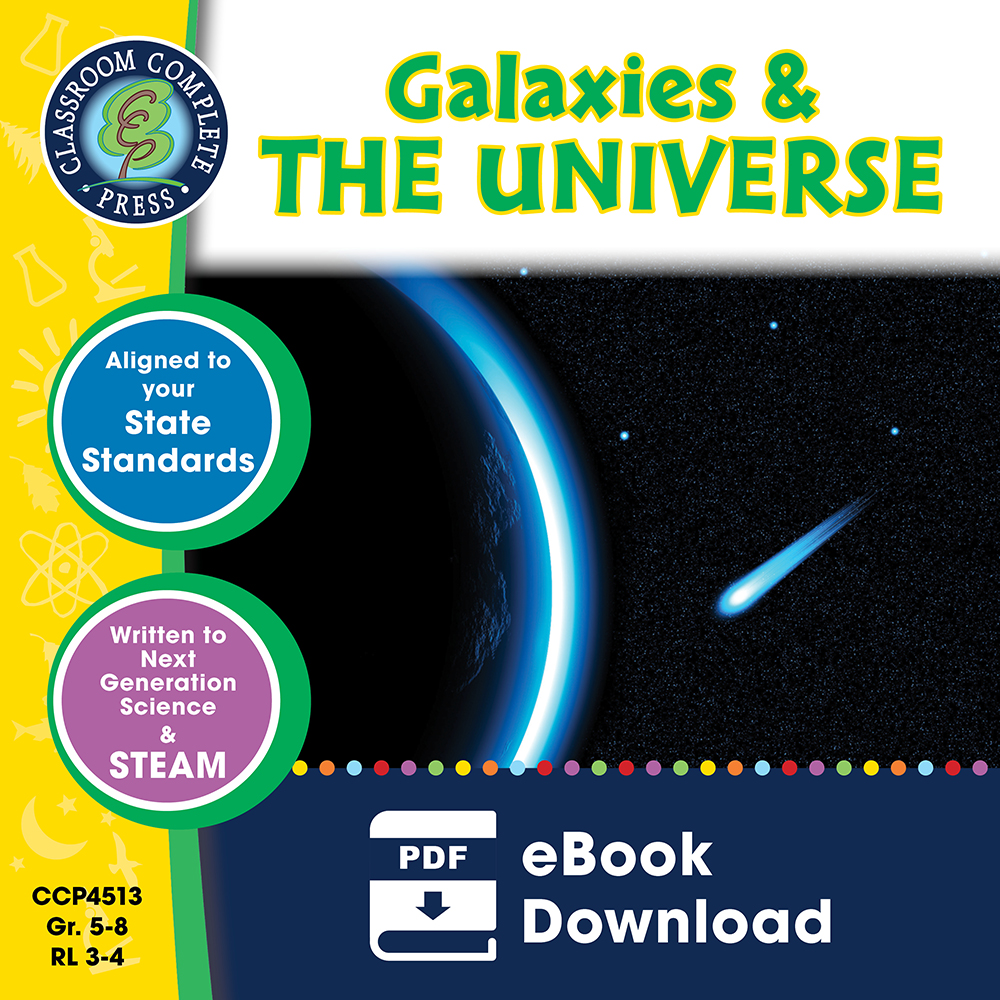
A full astronomy unit teaching Grades 5-8 students about the universe: its scale, distance measurement, nebulae, galaxies, gravity, black holes, and quasars, through leveled reading passages and critical-thinking activities.
A single-topic chapter-slice teaching Grades 5-8 students an introduction to the universe: its scale from smallest particles to star systems, starting with the Milky Way Galaxy.
A single-topic chapter-slice teaching Grades 5-8 students about black holes and their role in the universe.
A single-topic chapter-slice teaching Grades 5-8 students about galaxies as massive star systems within the universe.
A single-topic chapter-slice teaching Grades 5-8 students about gravity as a force shaping galaxies, stars, and the universe.
A single-topic chapter-slice teaching Grades 5-8 students how astronomers measure vast distances in the universe (e.g., light years).
A single-topic chapter-slice teaching Grades 5-8 students about nebulae and light sources/speed in the universe.
A single-topic chapter-slice teaching Grades 5-8 students about quasars, described as the most distant observable objects in space.