



3,984 products added recently
Page 226 - Teacher Tools
Equip yourself with tools that streamline your teaching process and enrich your classroom experience. This collection includes organizational planners, assessment templates, and classroom management strategies. By integrating these resources, you can focus on delivering impactful instruction and fostering student success.

 Show filters

RI.2.4 Second Grade Common Core Lesson
ELA, Reading, Language Development, Vocabulary, Common Core, Grade 2, Teacher Tools
This common core lesson is great for helping second grade students determine the meaning of words and phrases in a text. This is a skill that is essential for students to be successful in school and in life. This lesson will help students learn how to find the meaning of words and phrases in a text, and how to use that information to understand the text as a whole.
Author Have Fun Teaching
Tags Context Clues

A New Pet!: A Cross-Curricular Unit
Life Studies, Special Resources, Life Skills, Kindergarten, Preschool, Teacher Tools, Lesson Plans
A New Pet!: A Cross-Curricular Unit - An Overview The A New Pet!: A Cross-Curricular Unit is an invaluable teaching resource specifically curated for educators working with preschool and kindergarten students. It serves as a detailed lesson plan, engaging learners in the captivating narrative of Jade understanding the responsibilities of pet ownership. This pack is interactive and encourages critical thinking. It cultivates empathy and life skills at an early stage. The unit comprises a single PDF file featuring six printable pages, easing usage for teachers handling large classes or homeschoolers wishing to enrich their kids’ learning experience. Content Integration & Flexibility The story revolves around pet ownership, appealing to young minds. Included are three interactive worksheets providing hands-on opportunities for active student participation. Educators can seamlessly introduce this multi-disciplinary unit during whole-group teaching sessions or split lessons aptly catering small groups or individual homework assignments offering adaptive flexibility benefitting various teaching styles and student learning requirements. Cross-curricular Importance & Application: This pedagogically potent unit allows easy integration within existing curriculum outlines. Simultaneously ensuring developmental progress through relevance propagation via multiple subject touchpoints for preschoolers or kindergartners. Final Thoughts: "The A New Pet!: Cross-Curricular" unit plays a significant role in innovative education methodologies by delivering crucial life-skills concepts using relatable themes while contributing substantially towards cognitive maturity during the formative scholastic years making it genuinely indispensable."
Author Classroom Complete Press
Tags Responsibility Education, Values, Life Skills, A New Pet, Lesson Plan
Number & Operations: Multiplication & Division - Learn the Skill - MAC Software
Math, Algebra, Common Core, Grade 3, 4, 5, Teacher Tools, Lesson Plans
Number & Operations: Multiplication & Division - Learn the Skill - MAC Software This is an educational resource designed for efficient and effective mathematics instruction. This teaching tool is utilized by teachers in public and homeschool settings and its content focuses on Grades 3-5 curriculum in Number and Operations, specifically addressing multiplication and division. Digital Tool Integration The resource, comprising a single zip file with MAC software, allows educators to seamlessly integrate technology into their instructional strategies. The program consists of various learn-the-skill segments that provide real-world examples to reinforce the foundations of multiplication and division. Inclusivity in Education The software features both English voiceover/text as well as a Spanish alternative. This inclusive approach makes it accessible for classrooms with diverse linguistic needs. The content includes not only structured real-world word problems but also assorted math tools to aid comprehension. The product can be used during whole-group instruction or smaller group lessons. This product can also be utilized effectively as part of independent homework assignments due to its user-friendly design. The content aligns perfectly with key education standards meeting Common Core State Standards (CCSSM ) guidelines set forth by STEM initiatives while also addressing NCTM benchmarks directly – providing assurance for teachers about its educational relevance. Versatility across Subjects The subjects catered by this software include general mathematics along with more focused algebra-related themes which makes this a versatile teaching tool across multiple grades within upper elementary school environments. Achieving Teaching Efficiency with Tech-based Fun Learning Incentives Number & Operations: Multiplication & Division - Learn The Skill shows how digital resources can be utilized for effective math instruction at various levels of difficulty, effectively incorporating technology into lesson planning without compromise on the fun factor for students.
Author Classroom Complete Press
Tags Math Lesson Plan, Digital Math, Operations, Division, Math Skills

History of the Domestic Dog: Guided Reading Level R with Lesson Plan
ELA, Resources for Teachers, Reading Comprehension, Reading, Science, Language Development, Life Sciences, Vocabulary, History, Social Studies, Grade 3, 4, 5, Worksheets & Printables, Worksheets, Teacher Tools, Centers, Activities, Literacy Readers, Quizzes, Quizzes and Tests, Assessments, Lesson Plans
This History of the Domestic Dog (level r) guided reading book with lesson plan includes: Guided Reading Color Label (front cover x1) This is a quick way to match the book’s demands to what students can generally handle.. The overall goal is to use the level/color to pick books for several smaller groups. To qualify for a certain level, a student is expected to read a book from that level with about 90–94% accuracy. If a student is consistently accurate and understands, move up a level. If the student is struggling at that level, drop down and add more support. Each student will improve at completely different rates, but it is generally one of the best ways to check progress across the class. DOWNLOAD THE CATALOG TO VIEW ALL GUIDED READING BOOKS AVAILABLE (SORTED LEVELS A-Z) Pre-Reading Question (x1) Teacher asks the prompt aloud, can be while showing the cover or first page. Students share what they already know, or make educated guesses from the cover. Prompt them to use the target vocabulary. Write some of their responses on the board to look back at during the reading. Vocabulary Words (x5) Introduce the five words, best doing it one at a time. Start by saying it, while students repeat and then see if anyone knows what it means before reading further. Read through the meaning and try to briefly connect each word to a picture or gesture so it’s meaningful. Ask students to flip through the book pages and point to where they see each of the vocabulary words. While reading the book pause upon coming across one of the vocab words or read the sentence twice to make sure students understand the word has appeared. Optional: Ask students to raise hands whenever they see/hear one of the new words. Guided Reading Pages (x10) Check the book snapshot (below) for: primary topic - do you need to prep extra reading or intro materials on this? what is taught best - decide on 1-2 bullets to focus on, use the prompt or words provided here for best results. learning goals - what you are checking for students to be able to do after the session, elicit answers using prompts or words provided. key vocabulary (see section above). questions overview - so you know what is coming up and if you need to prep extra materials to assist understanding. Run the lesson You may have already looked at a few of the pages together, but you can show them some of the pictures again first to set meaning. Depending on how much time you have and how familiar your students are with guided reading class, you may want to read the book aloud first with the group first. Students whisper or partner read, while you listen in. If time, do it as a group, one student reading a page each. Use the guided page’s prompts to coach: “Check the picture / does it make sense?” “Point under the words / try the first sound” “Reread the sentence smoothly”. Try to focus more on one student per session (rotating every time), so you can work out if they are ready to move up or need to move down a level. Comprehension Questions (back cover x3) This is your way to check that students didn’t just say the words, but actually understood the text. First, let students answer by pointing to the page/picture and saying a short sentence. After any answer, follow with: “Show me where you found that in the text.” In bigger groups, have partners answer first (10–20 seconds), then call on 2–3 students to share. Differentiation tips: Emerging speakers/struggling readers: oral + pointing On-level: oral in a full sentence Higher: one written sentence or draw + label Book Snapshot Title: The Science and History of the Domestic Dog Genre: Nonfiction (informational) Subject: Life Science Primary Topic: Domestication, traits, and roles of dogs Estimated Guided Reading Level (A–Z): R What This Book Teaches Best Explains dogs’ biological connection to gray wolves , including shared DNA and instincts tied to social behavior and communication. Describes the history of domestication and how human artificial selection led to many distinct dog breeds. Uses specific evidence to show why dogs have exceptional smell and hearing (brain structures, scent receptors, and hearing frequencies). Shows how selective breeding creates specialists for different jobs (speed, herding, cold-weather survival, and service work). Teaches how to read dog communication signals (tail wag speed/height, ear position, facial muscles, back posture). Learning Goals Explain how the text connects domestic dogs to gray wolves using specific evidence (classification and DNA). Describe how domestication began and how humans’ breeding choices created many breeds over time. Identify details that show why dogs can smell better than humans (olfactory bulb and scent receptors). Identify details that show why dogs can hear better than humans (frequencies and ear muscles). Compare at least two breeds in the text by explaining how traits match their work or environment (speed, herding, cold climate, service). Describe what the text says people can look for to understand a dog’s emotional state. Key Vocabulary From the Text subspecies — a smaller group within a kind of animal. domestication — animals becoming used to living with people. olfactory — having to do with smell. frequencies — how high or low a sound is. resilient — able to handle hard conditions and keep going. Discussion Prompts Pre-reading question: What jobs or tasks have you seen dogs do for people? Comprehension questions: According to the text, how are domestic dogs connected to gray wolves? Comprehension questions: What evidence does the text give to show how powerful a dog’s sense of smell is? Comprehension questions: What signs does the text say people can look for to understand a dog’s emotional state? Printing Tips 1. Best Printing Method (Recommended) “Booklet” Printing (Best if Available) If your printer or PDF viewer supports Booklet Printing , use this. Settings to use: Print mode: Booklet Paper size: Letter or A4 (either works) Orientation: Landscape Print on both sides: Yes Flip on: Short edge Scaling: Fit to printable area Booklet subset: First test: Front sides only Then: Back sides only This will automatically: Pair pages correctly Put the cover on the outside Align everything for folding After printing, fold in half and staple along the spine . 2. If “Booklet” Printing Is NOT Available You can still print this correctly with manual duplex printing . Step-by-step: Open the PDF. Choose Print . Set: Orientation: Landscape Pages per sheet: 1 Print on both sides: Yes Flip on: Short edge Print all pages . Because each PDF page already contains two facing book pages, the result will still fold cleanly into a book. Thousands of Cored Education products are included with your TeachSimple membership. Download links and encyclopedia index available here.
Author Cored Education
Rating
Tags Reading Comprehension, Reading Passages, Reading, Guided Reading, Guided Reading Lesson Plan, Guided Reading Activity, Pre-reading, Science Lesson Plans, Life Science, History

Phonic Reading Scheme for Older Students: _NG Endings Book 15
Special Resources, ELA, Special Education Needs (SEN), Language Development, Phonics, Reading, Kindergarten, Preschool, Grade 1, Literacy Readers, Teacher Tools
This NG Endings decodable reading book is the 15th book in a series that can help children with special needs pupils develop reading fluency. Each book comes with a matching PowerPoint making it suitable for use in a range of settings. The Jack Stories, of which this book is one, introduces one phonic sound at a time, and subsequent books build on the vocabulary of the books before, constantly revising and reviewing learned sounds. Irregular sight words are only slowly and gradually introduced. Science of reading aligned. Based on the most up-to-date phonic research. These books should be read sequentially as they tell one long story, each telling a part. This book contains words with the following sounds: CK: OO, EE and SH and CH and ND Endings. The whole series to date can also be purchased as a growing bundle here, with a scope and sequence. This series has been written with the aid of one of my pupils, aged 8. He has drawn some of the pictures. What makes this phonic reading programme for special needs different? · It has its own, easy-to-download and print phonic reading books, making it accessible to many children worldwide. · Each book carefully builds on the vocabulary of those that have gone before, providing much repetition, without relying on predictable text. · Pictures aid the storyline without encouraging reading from the pictures – i.e. guessing. · The vocabulary is based on phonic families, which are introduced in a carefully planned way. · True sight words – those that cannot be sounded out - are kept to the very minimum. Most words are introduced in their phonic family wherever possible. · It is truly multisensory, using the power of the hand. We not only look at the words, but we write them too. This is powerful and has the bonus of turning the child not only into a reader but into a writer as well. Typical signs that this programme can help: Those with dyslexia, or suspected of having dyslexia Difficulty recalling words when seen on flashcards or when reading texts, which results in no or little reading fluency b/d letter reversal of a chronic nature – i.e. the child has not grown out of it Difficulty ordering letters in words: E.g. top becomes pot. Difficulty differentiating between like words: spoon/soon; back/black; sheep/sleep etc… Difficulty tracking words across a page How long is the book? The reading book is 16 pages long. What is included? 1 PDF 16 pp X A5 Print as a booklet Flip on the short edge One 16-slide PowerPoint
Author Lilibette's Resources
Tags Decodable Reading Books, Phonic Reading Scheme, Download And Print Decodable Readers, Reading Fluency, Guided Reading, Special Needs, Phonics Intervention, NG Words

U.S. Representatives from Texas (Districts #1-10) BIO PPT
Social Studies, History, History: USA, Government, Not Grade Specific, Teacher Tools, Presentations
This informative bundle features biography PowerPoint presentations profiling the current U.S. Representatives serving Texas' congressional districts 1 through 10. Learn about the background, accomplishments, and political positions of these legislators through visually engaging slides. Representatives included are Nathaniel Moran (R - 1st), Dan Crenshaw (R - 2nd), Keith Self (R - 3rd), Pat Fallon (R - 4th), Lance Gooden (R - 5th), Jake Ellzey (R - 6th), Lizzie Fletcher (D - 7th), Morgan Luttrell (D - 8th), Al Green (D - 9th), and Michael McCaul (R - 10th). These presentations total 300 pages and can educate students on the politicians representing their districts in an interactive way. Useful for government, civics, and modern history courses, this bundle helps introduce key Texas legislators.
Author Mr. Matthews Teacher Store
Tags Texas, Representatives, Biography, Government, Civics

I WONDER - What Are Proteins | Animated Video Lesson
Human Body, Life Sciences, Science, Biology, STEM, Grade 2, 3, 4, 5, 6, 7, 8, Lesson Plans, Teacher Tools
Video Overview The human body is full of fascinating wonders to learn. This video is created to help the students recognize the anatomy and the job of the human body. I WONDER - What Are Proteins | Animated Video Lesson Every part and organ in our human body is vital so let's see how important they are. Have you ever imagined how we look like if we didn't have a skeleton? Did you know that because we have our amazing muscles we can stand! Do you know how many teeth do we have? Have you ever wondered about the food journey inside our body? Can you name all the glands in our body? Why do we have skin? Our nervous system is really good at sending signals. Can you tell us more about it? Are you really good at Mathematics, painting, or any other thing? You should really thank your brain about it! The famous five senses are really doing a great work? Can you explain how every sense works? I WONDER - What Are Proteins | Animated Video Lesson The video is perfect for encouraging the researching skills for the students, while learning more about our fantastic human body. I WONDER - What Are Proteins | Animated Video Lesson This friendly designed video is suitable for students at school, homeschooling, and as a group activity. Format Available in MP4 format.
Author Educational Voice
Tags What Are Proteins, What Are Proteins Video, Proteins, Proteins Facts, Protein, Proteins Facts For Kids, Proteins Video, Proteins Video For Kids, Protein Facts For Kids, Tips For Eating Healthy

Social Skills: Accountability Gr. 6-12+
Special Resources, Social Skills, Grade 6, 7, 8, 9, 10, 11, 12, Teacher Tools, Lesson Plans
Social Skills: Accountability Gr. 6-12+ A comprehensive teaching resource designed to nurture real-world social skills among students from Grade 6 to Grade 12 or even older. This strategic educational material focuses on the essential skill of Accountiability, which is crucial for personal and professional growth. It provides guidance for learners in understanding both beneficial and detrimental traits, while also encouraging the cultivation of interpersonal relationships. More than Interpersonal Connectedness This resource supports autonomous learning as it guides students towards self-reliance, independence, and responsibility. Tips on assertively yet respectfully declining requests are also included. Growing Personally: A Significant Aspect Learners are guided to chart their own path for progress allowing them to visualize and achieve goals more effectively. The emphasis is put on acquiring and demonstrating accountability—a trait which can resonate profoundly at home or in a workplace setting—promoting prudent conduct after receiving constructive criticism. Towards Successful Collaboration: Incorporated guidance for successful teamwork. Tips to break malpractices over thirty days alongside cultivating polite etiquette skills towards others. The resource combines high interest concepts with easily comprehensible vocabulary ensuring all learners grasp these life-critical skills effectively irrespective of their proficiency level. The materials include reading passages, graphic organizers, real-world activities along with crossword puzzles, word search games,and comprehension quizzes — a combination that ensures learning doesn’t become monotonous.. Fully compliant with State Standards—with roots embedded deep into Blooms Taxonomy, this content has been crafted carefully avoiding oversimplifications ensuring retention becomes relatively easier due to its engaging nature. This comprehensive package comes as a single PDF file, a format known for preserving content rigor ensuring what was designed by teachers makes it to the students just as it is. This has been curated to aid educators in imparting life-altering lessons both for typical classrooms or homeschooling environments, using large group settings or more intimate small group instructions.
Author Classroom Complete Press
Tags PDF
Science Revision for Grade 6
Science, Grade 6, Activities, Worksheets & Printables, Assessments, Teacher Tools
This Science worksheet ebook is perfect for Grade 6 classrooms. It includes 30 fun and varied activities that cover all key science topics. Students will learn about living things, the human body, matter, energy, the Earth, and space. Each activity is designed to be done directly on the worksheet—no extra materials needed. The tasks include matching, fill-in-the-blanks, diagrams, true or false, and more. These activities help students understand science through clear and simple tasks. Teachers will love how easy it is to use. Just print and go! No prep time required. The worksheet also includes an answer key, making checking quick and simple. This resource works well for classwork, homework, or revision. It supports different learning styles and helps build science vocabulary and knowledge. This ebook saves time, engages students, and supports strong learning. It is ideal for busy teachers who want high-quality, ready-to-use materials. Make science fun and easy to teach with this all-in-one Grade 6 worksheet pack!
Author Bright Classroom Ideas Marketplace
Rating
Tags Science, Revision, Grade 6

I WONDER - Can Earthquakes Only Happen On Earth | Animated Video
Earth Sciences, Earth and Environmental Sciences, Science, Geology, Space, Grade 3, 4, 5, 6, 7, 8, 9, Lesson Plans, Teacher Tools
Video Introduction An amazing video designed for the students to learn more about natural disasters in different countries. I WONDER - Can Earthquakes Only Happen On Earth | Animated Video Lesson Do you like summer days where the sun is shinning and you can see beautiful flowers everywhere or winter days where it is raining or snowing and where you can set by the fireplace and enjoy the scene from outside your windows? How to do you thing the blizzards and hurricanes or tornadoes got their names? Can you name a volcanic mountain? Have you ever read about earthquakes? Do you know why earthquakes happen? I WONDER - Can Earthquakes Only Happen On Earth | Animated Video Lesson The video is perfect for encouraging the researching skills for the students, while learning more about this fantastic phenomenon. I WONDER - Can Earthquakes Only Happen On Earth | Animated Video Lesson This friendly designed video is suitable for students at school, homeschooling, and as a group activity. Format Available in MP4 format.
Author Educational Voice
Rating
Tags Can Earthquakes Only Happen On Earth, Earthquakes, Earthquake, Earthquakes Facts, Earthquakes Video, Earthquakes Video For Kids, Earthquakes Facts For Kids, Earthquakes On Planets, Space
I WONDER - Was Julius Caesar Only Good At Fighting | Animated Video
History: Ancient, History, Social Studies, History: Europe, Grade 3, 4, 5, 6, 7, 8, 9, Lesson Plans, Teacher Tools
Video Introduction An amazing video designed for the students to learn more about history. I WONDER - Was Julius Caesar Only Good At Fighting | Animated Video Lesson Let's use our time machine and trave though time till we get to the ancient world where life began! Have you ever thought about how did ancient Greeks, Romans, Egyptians and even the Viking and Celts use to shower? And how did these amazing civilizations build iconic buildings and invented things that we still use till today like toothpaste? Do you know who was the first king and queen in the world? Which countries they ruled? Who is the most fascinating person lived on Earth? Tell us more about him/her. I WONDER - Was Julius Caesar Only Good At Fighting | Animated Video Lesson The video is perfect for encouraging the researching skills for the students, while learning more about history. I WONDER - Was Julius Caesar Only Good At Fighting | Animated Video Lesson This friendly designed video is suitable for students at school, homeschooling, and as a group activity. Format Available in MP4 format.
Author Educational Voice
Rating
Tags Was Julius Caesar Only Good At Fighting, Julius Caesar, Julius Caesar Facts, Julius Caesar Video, Julius Caesar Facts For Kids, Julius Caesar Video For Kids, Julius Caesar History, Roman Emperor

Basic Operations & Word Problems Math Interactive Notebook
Math, Addition and Subtraction, Basic Operations, Early Math, Grade 2, 3, 4, Worksheets & Printables, Word Problems, Teacher Tools, Lesson Plans
Help your students confidently master Virginia Math SOL 3.CE.1 with this complete resource designed to strengthen their skills in addition, subtraction, estimation, and problem solving . This product covers every part of the 2023 VA SOL 3.CE.1 , ensuring your students can estimate, represent, solve, and justify solutions to single-step and multi-step problems with whole numbers up to 1,000. Perfect for classroom instruction, small group review, or independent practice, this resource includes detailed notes pages, hands-on practice sheets, and digital teaching tools that make math meaningful and accessible for every learner. What’s Inside This set includes everything you need to teach and reinforce key 3rd grade math concepts: CUBES Strategy Pages – Teach students how to analyze and break down word problems step-by-step. UPS Check Strategy Pages – Build critical thinking with a structured approach to problem solving. Problem Solving Strategies & Key Word Pages – Help students identify what operation to use and why. Identity and Commutative Properties of Addition – Reinforce essential properties with clear examples. Balancing Equations Activities – Strengthen algebraic thinking skills. Rounding and Estimating Practice – Teach students how to make quick, reasonable estimates. Single and Multi-Step Word Problems – Real-world applications that build confidence and mastery. Subtraction with Regrouping Strategies – Includes traditional and “Minus 1” methods for flexibility in learning. Flexible Notes and Practice Pages Each concept comes with teacher-friendly notes pages and student practice sheets . Notes are available in two sizes : Full-page format – Ideal for projection or binder organization. Notebook format – Perfectly sized for composition notebooks or interactive journals. Save paper by printing two to a page —or go completely digital! Digital Access Included This resource includes two interactive links inside the PDF: A Google Slides version for digital note-taking. A Slide Show version optimized for projectors or interactive boards . Each link prompts you to make your own copy, giving you full flexibility to edit or present through Google Slides, Keynote, or PowerPoint . Why Teachers Love It Teachers appreciate how this resource combines explicit instruction, strategy support, and skill practice aligned directly with the VA SOL 3.CE.1 standard. With both print and digital options, it’s perfect for blended learning, math centers, or test preparation . Give your students the confidence they need to succeed with this VA SOL 3.CE.1 Addition and Subtraction Resource Pack —a must-have for every 3rd grade math classroom!
Author SchoolingSara
Rating
Tags Math, Basic Operations, Word Problems, Addition, Subtraction, Balancing Equations, Contextual Problems
I WONDER - What Is Jupiter Made Of | Animated Video Lesson
Space, Earth and Environmental Sciences, Science, Grade 6, 7, 8, 9, 10, 11, 12, Lesson Plans, Teacher Tools
Video Introduction An amazing video designed for the students to learn more about space facts. I WONDER - What Is Jupiter Made Of | Animated Video Lesson Do you like reading about space? If yes, what is your favorite topic? What do you know about our solar system? What is the smallest planet in our solar system? What is the biggest planet in our solar system? What is the hottest planet in our solar system? And what is the coldest one? Do you think there are aliens? If yes, what do you think they look like? What do they eat and how they speak to each other? Where do they live? What is a galaxy? And what is a milky way? Have you recently saw a shooting star? If yes, tell us more about it, like when did it happen and where? What is a blackhole? Can a blackhole gets bigger by time? Do you like counting the stars? What do you think a star is made of? I WONDER - What Is Jupiter Made Of | Animated Video Lesson The video is perfect for encouraging the researching skills for the students, while learning more about the fantastic space. I WONDER - What Is Jupiter Made Of | Animated Video Lesson This friendly designed video is suitable for students at school, homeschooling, and as a group activity. Format Available in MP4 format.
Author Educational Voice
Tags What Is Jupiter Made Of, What Is Jupiter Made Of Video, Jupiter, Jupiter Facts, Jupiter Facts For Kids, Jupiter Video, Jupiter Video For Kids, Planet, Planets, Planets Video
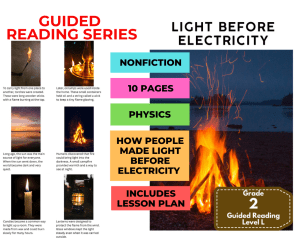
Guided Reading Level L - Light Before Electricity (with Lesson Plan)
ELA, Resources for Teachers, Reading Comprehension, Reading, Science, Engineering, Technology, Physics, History, Social Studies, Grade 1, 2, 3, Worksheets & Printables, Worksheets, Teacher Tools, Centers, Activities, Literacy Readers, Quizzes, Quizzes and Tests, Assessments
This Guided Reading Book - Light Before Electricity (Level L) with lesson plan includes: Guided Reading Color Label (front cover x1) This is a quick way to match the book’s demands to what students can generally handle.. The overall goal is to use the level/color to pick books for several smaller groups. To qualify for a certain level, a student is expected to read a book from that level with about 90–94% accuracy. If a student is consistently accurate and understands, move up a level. If the student is struggling at that level, drop down and add more support. Each student will improve at completely different rates, but it is generally one of the best ways to check progress across the class. DOWNLOAD THE CATALOG TO VIEW ALL GUIDED READING BOOKS AVAILABLE (SORTED LEVELS A-Z) Pre-Reading Question (x1) Teacher asks the prompt aloud, can be while showing the cover or first page. Students share what they already know, or make educated guesses from the cover. Prompt them to use the target vocabulary. Write some of their responses on the board to look back at during the reading. Vocabulary Words (x5) Introduce the five words, best doing it one at a time. Start by saying it, while students repeat and then see if anyone knows what it means before reading further. Read through the meaning and try to briefly connect each word to a picture or gesture so it’s meaningful. Ask students to flip through the book pages and point to where they see each of the vocabulary words. While reading the book pause upon coming across one of the vocab words or read the sentence twice to make sure students understand the word has appeared. Optional: Ask students to raise hands whenever they see/hear one of the new words. Guided Reading Pages (x10) Check the book snapshot (below) for: primary topic - do you need to prep extra reading or intro materials on this? what is taught best - decide on 1-2 bullets to focus on, use the prompt or words provided here for best results. learning goals - what you are checking for students to be able to do after the session, elicit answers using prompts or words provided. key vocabulary (see section above). questions overview - so you know what is coming up and if you need to prep extra materials to assist understanding. Run the lesson You may have already looked at a few of the pages together, but you can show them some of the pictures again first to set meaning. Depending on how much time you have and how familiar your students are with guided reading class, you may want to read the book aloud first with the group first. Students whisper or partner read, while you listen in. If time, do it as a group, one student reading a page each. Use the guided page’s prompts to coach: “Check the picture / does it make sense?” “Point under the words / try the first sound” “Reread the sentence smoothly”. Try to focus more on one student per session (rotating every time), so you can work out if they are ready to move up or need to move down a level. Comprehension Questions (back cover x3) This is your way to check that students didn’t just say the words, but actually understood the text. First, let students answer by pointing to the page/picture and saying a short sentence. After any answer, follow with: “Show me where you found that in the text.” In bigger groups, have partners answer first (10–20 seconds), then call on 2–3 students to share. Differentiation tips: Emerging speakers/struggling readers: oral + pointing On-level: oral in a full sentence Higher: one written sentence or draw + label Book Snapshot Title: Light Before Electricity Genre: Nonfiction (informational) Subject: Science (Technology) / Social Studies (Past and Present) Primary Topic: How people made light before electricity Estimated Guided Reading Level (A–Z): L What This Book Teaches Best The sun was the main source of light long ago, and it got dark when the sun went down. People discovered fire could bring light into darkness and help them see at night. A clear sequence of lighting tools is explained: torches, oil lamps (with a wick), candles, lanterns, gas lamps, electric lightbulbs, and LED bulbs. How inventions solved problems: lanterns protected flames from wind, gas traveled through pipes to power lamps, and electric lightbulbs were safer because they used no real flame. Past-to-present comparison: lighting changed from “flickering fires” to steady electric light you can turn on with a switch. Learning Goals Students will describe why the sun was the main source of light long ago. Students will explain how fire helped people see at night. Students will identify several light sources from the book and describe how each one made light. Students will explain how lanterns kept light steady when carried outside. Students will explain why the electric lightbulb was safer and brighter than candles in the book. Students will describe how LED bulbs are different from older light sources (cool to the touch, little energy). Key Vocabulary From the Text source — where something comes from. torches — long sticks with a flame used for light. wick — a string that helps a lamp or candle burn. invention — something new that someone creates. flickering — shining in a shaky way, like moving firelight. Discussion Prompts Pre-reading question: What kinds of lights do you use when it is dark? Comprehension questions: What was the main source of light for everyone long ago? How did lanterns protect the flame when people carried them outside? Why did the book say the electric lightbulb was safer than candles? Printing Tips 1. Best Printing Method (Recommended) “Booklet” Printing (Best if Available) If your printer or PDF viewer supports Booklet Printing , use this. Settings to use: Print mode: Booklet Paper size: Letter or A4 (either works) Orientation: Landscape Print on both sides: Yes Flip on: Short edge Scaling: Fit to printable area Booklet subset: First test: Front sides only Then: Back sides only This will automatically: Pair pages correctly Put the cover on the outside Align everything for folding After printing, fold in half and staple along the spine . 2. If “Booklet” Printing Is NOT Available You can still print this correctly with manual duplex printing . Step-by-step: Open the PDF. Choose Print . Set: Orientation: Landscape Pages per sheet: 1 Print on both sides: Yes Flip on: Short edge Print all pages . Because each PDF page already contains two facing book pages, the result will still fold cleanly into a book. Thousands of Cored Education products are included with your TeachSimple membership. Download links and encyclopedia index available here.
Author Cored Education
Rating
Tags Reading Comprehension, Reading Passages, Reading, Guided Reading, Guided Reading Lesson Plan, Guided Reading Activity, Pre-reading, Vocabulary, Physics, History
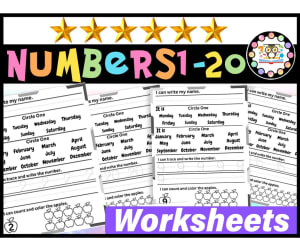
Morning Work Worksheets Math Kindergarten Spiral Review
Math, Pre-K, Elementary, Early Learning, Worksheets & Printables, Activities, Teacher Tools, Worksheets, Workbooks, Word Problems, Centers, Quizzes and Tests, Quizzes, Tests
This interactive and attractive set of number worksheet is designed to help young learners develop their original letters and numbers skills, this set contains 20 pages in this set, each in each, each in a different number of dedicated numbers to ensure a fun and structured approach to using a fun and structured approach can work to use a type of work that can work in a type of work that can work in a type Can do a type of work. A copy house with a student requiring additional practices hopes that you find it useful each card is fun, it is made of edited set of number worksheet in an elegant style that attracts attention this set includes different types of numbers related to worksheet and designs. these printable Worksheets offer useful courses, this provides a useful course-rich practice, it is designed to help using resource grade 2 easily to learn about activities numbers Worksheets in a fun and interactive manner. A collaborative learning activity added students. PDF format-wasted and digital-friendly!
Author LAMO
Rating
Tags Homeschool, Homework, Worksheets, Printables, Math, Numbers
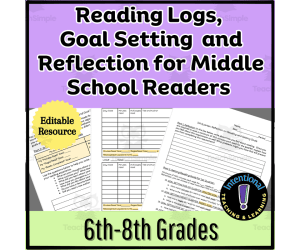
Reading Logs, Goal-Setting, and Reflection for Middle School Readers
ELA, Reading, Reading Comprehension, Grade 6, 7, 8, Teacher Tools, Lesson Plans
This 47-page editable resource, Reading Logs, Goal-Setting, and Reflection for Middle School Readers is a how-to lesson to help teachers center the importance of reading (and independent reading) in their 6th, 7th, and 8th grade Language Arts classrooms by having students be accountable for their reading. Students establish goals for their reading: the number of pages, minutes, and books they would like to read over the course of a grading period (quarter, trimester, or semester). They initially reflect on their feelings about reading, then establish goals for the first marking period. (The resource offers a step-by-step instruction for teachers to help students set reasonable and realistic goals for how much they want to read.) Each grading period, they review their goals to see if they achieved, surpassed, or fell short of achieving them. They reflect on their successes and challenges, and then. establish new goals. This resource offers teachers the following: a hyperlinked Table of Contents About this Resource- a handy guide with everything you need for this resource in one place a detailed lesson plan that includes how students can determine their reading goals Essential and Guiding Questions Standards, Objectives, and Learning Targets a sample Reading Requirements handout for a typical classroom which is easily editable to fit your needs a self-reflection as readers, before they establish goals the first time Reading Goals for each marking period (Quarters and Trimesters are included) which contain self-reflections for students to complete in which they celebrate their successes, identify their challenges, offer solutions for these challenges, and set new goals for the next grading period. Reading Log Template for Quarters or Trimesters for students to complete Reflections for each marking period End-of-Year Reflection with guiding questions for them to think about their goals, their successes, their challenges, what they learned about themselves as readers, favorite books or authors, etc. 6 Sample Student End-of-Year Reflections Most students don't read enough and many of our students read below grade level. As English teachers, we struggle with providing our students enough in-class time for reading, whether it's through SSR (Sustained Silent Reading) or DEAR (Drop Everything and Read) or some other carved out time for reading. Many teachers will tell you that they have tried reading logs, and students often cheat on them or don't turn them in. My experience has been different. By building in student accountability by having them establish reading goals, in addition to giving them 10-15 minutes of silent reading in class twice a week (or however much time you have dedicated to it), and by checking in with them regularly on their reading practice, students turn in their reading logs. Of course there has to be follow-through on the teacher's part by contacting parents, discussing with students how to choose the just-right book, making sure books are available, talking about reading, doing book talks, or having them do book talks, etc. You might be interested in the following resources that pair nicely with Reading Logs, Goal Setting, and Reflection for Middle School Readers. Part 1: What We Do When We Read: Teach or Review Reading Strategies for Middle School, When we read, our brain is engaging in subconscious activities related to what we are reading. In this lesson, students complete a reading survey, write a personal reading history, and through the poem, "The Voice You Hear When You Read Silently," by Thomas Lux, identify reading strategies we use subconsciously. Part 2: Reading Logs and Goal Setting for Middle School Readers, in this how-to lesson, teachers introduce what they expect from their students in terms of their accountability for their reading. Students have handouts to help them establish goals for their reading for each grading period: how many books they want to finish and how many pages they want to read, and a self-reflection on their accomplishments. Part 4: Summary Writing for Short Stories in your Middle School Classroom : A step-by-step lesson to teach students write a summary of a short story by completing a graphic organizer. Includes links to several stories. Also includes an optional group summary project In addition, using Chris Van Allsburg picture books. Part 5: Metacognitive Logs: Reading Response (Strategies to Teach) : Provides teachers with detailed lessons to teach students how to respond to literature by analyzing and interpreting their thoughts while reading. This process trains students to focus on their reading. There are many student examples and opportunities for interactive activities. I also offer a number of book reports that help students stay accountable to their reading. Character Analysis Essay, Gift for a Character Book Report, and Oral Presentation Book into Movie Project: Comparing and Contrasting Poetry Book Report Mini-Reviews Book Report Mystery, Thriller, Horror, and Suspense Book Report Book Jacket Book Report Historical Fiction Book Report Historical Fiction Literature Circle Project
Author Intentional Teaching and Learning
Tags Independent Reading, Middle School Reading, Reading Logs, Goal-setting, Self-reflection, Accountability, Reading Goals, Student Accountability, Middle School Readers

I WONDER - What Are Stem Cells | Animated Video Lesson
Human Body, Life Sciences, Science, Biology, STEM, Grade 6, 7, 8, 9, 10, 11, 12, Lesson Plans, Teacher Tools
Video Overview The human body is full of fascinating wonders to learn. This video is created to help the students recognize the anatomy and the job of the human body. I WONDER - What Are Stem Cells | Animated Video Lesson Every part and organ in our human body is vital so let's see how important they are. Have you ever imagined how we look like if we didn't have a skeleton? Did you know that because we have our amazing muscles we can stand! Do you know how many teeth do we have? Have you ever wondered about the food journey inside our body? Can you name all the glands in our body? Why do we have skin? Our nervous system is really good at sending signals. Can you tell us more about it? Are you really good at Mathematics, painting, or any other thing? You should really thank your brain about it! The famous five senses are really doing a great work? Can you explain how every sense works? I WONDER - What Are Stem Cells | Animated Video Lesson The video is perfect for encouraging the researching skills for the students, while learning more about our fantastic human body. I WONDER - What Are Stem Cells | Animated Video Lesson This friendly designed video is suitable for students at school, homeschooling, and as a group activity. Format Available in MP4 format.
Author Educational Voice
Tags What Are Stem Cells, What Are Stem Cells Video, Stem Cells, Stem Cell, Stem Cells Facts, Stem Cells Facts For Kids, Stem Cells Video, Stem Cells Video For Kids, Cell, Cells

Sentence Structure Practice Questions - Grade 3-4 Grammar (PDF)
ELA, Language Development, ESL, Grammar, Common Core, Resources for Teachers, Grade 3, 4, Worksheets & Printables, Worksheets, Quizzes and Tests, Teacher Tools, Tests, Assessments
Sentence Structure Grammar Practice MCQS ELA MCQS Overview: In this series of lessons, students will embark on an engaging journey to explore the grammar skills that make our language vibrant and expressive. These lessons are crafted to help students identify, comprehend, and effectively apply language arts skills in both writing and speech. Accompanied by free supplementary materials available for all topics, each lesson builds on the previous one, offering a balanced mix of direct instruction, interactive group activities, and independent practice. Through fun and creative tasks, students will learn to recognize grammar within sentences, understand their function, and use them to enrich their own writing and speech. Sentence Structure Overview: Includes: Declarative Sentences lnterroative Sentences Exclamatory Sentences Imperative Sentences Sentence Fragments End Punctuation PDF Version This is the PDF uneditable version. This download is available in GOOGLE Docs, GOOGLE Forms, GOOGLE Slides. PDF, PPT, WORD, check the links below for more details. FULL CATALOG OF DOWNLOAD LINKS HERE Grade 3/4 Links: Adjectives Google Docs Google Forms Google Slides PDF PPT Word Free Supplementary Materials Pack Adverbs Google Docs Google Forms Google Slides PDF PPT Word Free Supplementary Materials Pack Conjunctions Google Docs Google Forms Google Slides PDF PPT Word Free Supplementary Materials Pack Nouns Google Docs Google Forms Google Slides PDF PPT Word Free Supplementary Materials Pack Pronouns Google Docs Google Forms Google Slides PDF PPT Word Free Supplementary Materials Pack Verbs Google Docs Google Forms Google Slides PDF PPT Word Free Supplementary Materials Pack Sentence Structure Google Docs Google Forms Google Slides PDF PPT Word Free Supplementary Materials Pack Present Tense Google Docs Google Forms Google Slides PDF PPT Word Free Supplementary Materials Pack Past Tense Google Docs Google Forms Google Slides PDF PPT Word Free Supplementary Materials Pack Future Tense Google Docs Google Forms Google Slides PDF PPT Word Free Supplementary Materials Pack Context Clues Google Docs Google Forms Google Slides PDF PPT Word Free Supplementary Materials Pack Defining Words Google Docs Google Forms Google Slides PDF PPT Word Free Supplementary Materials Pack Fill the Blanks Google Docs Google Forms Google Slides PDF PPT Word Free Supplementary Materials Pack Homophones Google Docs Google Forms Google Slides PDF PPT Word Free Supplementary Materials Pack Synonyms Google Docs Google Forms Google Slides PDF PPT Word Free Supplementary Materials Pack ELA Review Questions Overview Questions have three answer choices. There are a handful of pictures on each test for aesthetic purposes, as well as a review sheet covering most of the topics covered in the product. Introduction or Example Sheet Each topic will include an introduction or example sheet to go through first with your students. Full Answer Keys Full answer keys and sample responses are provided so no matter how busy you are, you know you're covered! In the Supplementary Pack Interactive Ice Breakers: Fun, hands-on activities that get students thinking about adjectives right from the start. Guided Practice: Teacher-led exercises that reinforce the day’s lesson, ensuring students can confidently identify and use adjectives. Group and Partner Tasks: Collaborative activities that allow students to work together to solve problems, categorize adjectives, and create descriptive sentences. Independent Worksheets: Structured worksheets that provide individual practice and help solidify understanding of key concepts. Exit Tasks: Quick, reflective activities at the end of each lesson that assess understanding and encourage students to apply what they’ve learned. For similar downloads and other frees, do check out Cored Group on TeachSimple.
Author Cored Education
Tags Elementary, Answers, Ccss, Common Core, Grammar, Tests, Test Prep, Assessment, Grade 3, Grade 4

Country Study on Japan - Presentation - Asia
Social Studies, Geography, History, History: Asian, Grade 7, 8, 9, 10, 11, 12, Teacher Tools, Presentations
Country Study on Japan - Presentation - East Asia Try this Digital Teaching Resource on Japan (Introductory Presentation Lesson), designed for Geography, East Asian History, and Social Studies lessons. Perfect for Grades 7–12 (Middle school and High School students), this Introductory PDF Presentation offers a fun, informative, and ready-to-use lesson that requires little to no preparation. Students will explore Japan ’s geography, history, culture, language and economy — making it perfect for classroom instruction, homeschooling, or online learning. 📘 Within this Social Studies and Geograhy Teaching resource, you can find: ✅ Greetings in Japanese – Includes QR codes and YouTube links for pronunciation practice ✅ Geography of Japan – Key facts, borders, and an interactive Google Maps link to its location. ✅ Quick Facts – Population, capital city, currency, flag, and other essential details. ✅ History Overview – A concise summary of Japan ’s most significant historical events. ✅ Geography & Environment – Details about the country’s land area, regions, and climate zones. ✅ Japan's Economy – Insight into Japan ’s industries, exports, and economic strengths. ✅ Tokyo – Explore the capital city, its famous landmarks, and cultural highlights. ✅ Other Major Cities – A map showcasing additional important urban centers. ✅ Japan's Culture & Traditions – A look at the customs and values that define Japan (East Asia) ✅ Farewell in Japanese This Social Studies + Geography Country Study Presentation on Japan (East Asia) PDF Digital Teaching Resource (15 slides) can be ideal for Middle School and High School Students from 7th grade to 12th grade to introduce Japan (East Asia) and its culture, language, society, history and economy. Learning with Alan is a Brand New Teaching Resource/Educational Material Store whose aim is to help Teachers, Educators and Tutors to achieve their teaching objectives while creating a fun and stimulating environment. Never Forget! If you want to browse more of my Teaching Resources, click here Learning with Alan!
Author Learning with Alan
Rating
Tags Japan, Asia, Country Study, Geography, Social Studies, Asian History, Presentation, Teaching Resource, Culture, Asian
Literary Terms Lessons for Writing Strategies
ELA, Language Development, Vocabulary, Grade 9, 10, 11, 12, Teacher Tools, Assessments
Discover the essential writing strategies employed in creative writing through TWO comprehensive literary terms lessons included in this resource. Designed as introductory or supplementary materials, these lessons delve into various concepts related to Creative Writing Strategies. To enable students to grasp the art of literature creation, a solid understanding of the underlying concepts and techniques is vital. L-EA's literary terms lessons empower students to learn and apply these techniques, while equipping teachers with valuable resources for assessing student understanding. Engage students in an enriching exploration of writing strategies, nurturing their ability to comprehend and craft impactful literary works. This resource complements units focused on the creative writing process and literary analysis, fostering students' growth as proficient writers. Teaching this resource is simple! Start it by presenting the included slideshow of literary terms and definitions while students use the accompanying worksheet to take notes. The, handout the accompanying homework assignment. Later in the week or following week, administer the quiz, which is provided as a printable or Google Form quiz (ideal for Google Classroom distribution!) “Literary Terms Lessons: Writing Strategies” includes: - Two presentations of 33 literary terms and definitions connected to writing strategies - Two presentation note-taking activities (w/ answer keys) - Two writing assignments that ask students to use presented terms in a piece of original writing - Two quiz assessments that include definition matching (or drop-down selection) and one essay question, provided in 5 file types (Google Form, Easel assessments , PDF, ExamView test file, and ExamView test bank file) TERMS INCLUDED IN THIS LESSON: Allegory, Allusion, Ambiguity, Apostrophe, Aside, Connotation, Convention, Crisis, Paradox, Paraphrase, Parody, Pun, Satire, Sentimentality, Stock responses, Comedy, High comedy, Low comedy, Romantic comedy, Farce, Tragedy, Tragicomedy, Irony, Verbal irony, Dramatic irony, Tragic irony, Colloquial, Cliché, Hyperbole, Understatement, and Formula literature Although this resource can be fitted for any secondary Language Arts classroom, it has been carefully designed to work best in grades 9, 10, 11, and 12. The included activities and quizzes are subtly but specifically tied to Common Core ELA Standard for Language (6). This resource is provided in a print-ready, bookmarked, and adjustable PDFs, Google Form, and PowerPoint Show files. This resource contains: 14 Pages; 35 Slides; 2 Google Forms; 4 Test Files.
Author The Language of Educational Art, LLC
Tags Vocabulary, Literature, Presentation, Quiz, Assignment

Functional Life Skills - Personal Hygiene
Special Resources, ELA, Special Education Needs (SEN), Life Skills, Reading, Reading Comprehension, Language Development, Vocabulary, Not Grade Specific, Teacher Tools, Lesson Plans
Functional Life Skills - Personal Hygiene UNIT Teaching life skills to children with special educational needs helps to give them knowledge and skills to handle daily tasks, become more independent and know how to take action when an adult is not around to help. The teaching of life skills should be thought of as a crucial part of the curriculum for children with special needs as it prepares them for day to day challenges and helps the become more productive members of their communities. This Functional Life Skills - Personal Hygiene UNIT resource provides planning, teaching slides, vocabulary cards and data tracking sheets as well as a range of different activities perfect for use with a whole class, small group and some of them can be used as independent workstation activities. This Functional Life Skills - Personal Hygiene UNIT was designed for students with special needs, however, it can be used for students in elementary grades as well. It is after all, covering all the needed information for students to develop the skills to maintain their personal hygiene to the maximum! This Functional Life Skills - Personal Hygiene UNIT covers personal hygiene, and teaches children about the importance of keeping a clean body, teeth and hair. It also teaches about the importance of keeping your teeth healthy, brushing twice a day and visiting the dentist. Included in this Functional Life Skills - Personal Hygiene Unit are the following resources which can be used in sequence or as needed: · Ideas for planning · Teaching slides · Vocabulary cards · Data tracking sheets · Social story · Bingo game · Instruction cards with real photos · Labelling activities · Picture to picture matching · Word to picture matching · Differentiated scenario question and answer · Sequencing activities · Sorting activities Clipart images courtesy of Kari Bolt Cliprart For similar or other engaging resources, visit my store here!
Author SEN Resource Source
Tags Life Skills, Hygiene, SEN, Personal Hygiene, Reading Comprehension, Vocabulary
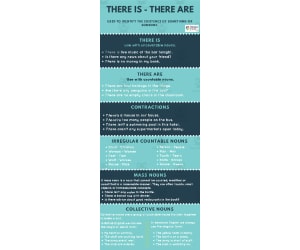
There Is - There Are | Beginner Lesson Plan
ELA, Grammar, Grade 2, 3, 4, Teacher Tools, Lesson Plans
ESL lesson plan for A1 Beginner ELL and ELA learners focusing on There is There are in English. This TEFL resource is ready to use and comprises a range of materials, such as flashcards, activities, conversation topics, and writing drills. Tailored to elevate language proficiency, the lesson plan delves into the basic usage of "there is there are" across different situations. Covering aspects from countable and uncountable nouns to forming questions and using the negative form, it equips ESL students with the knowledge and confidence to employ there is and there are accurately in day-to-day discussions. By integrating interactive activities, practice exercises, and real-life examples, this lesson plan not only enhances language skills but also establishes a robust foundation in English grammar. Components of this lesson plan include: Flash cards A warm-up activity Main usage exploration Construction details Rules, along with any exceptions Illustrative examples Two closed exercises One open exercise Revision exercise Writing exercises Chatterbox, a recurring feature in our course books encouraging conversation Activity , such as a game, quiz, puzzle, etc., to conclude the class The lesson plan is available in PDF with 24 ready to print pages and one digital access file. Answer key included. A part of it is on Google Apps. The answer key is also included for reference.
Author TEAM TEFL
Tags Nouns, Grammar, ESL Lesson, Language Arts, Plural Nouns

Insect Ecology | Animated Insect Video Lesson
Science, Life Sciences, Insects, Grade 3, 4, 5, 6, Lesson Plans, Teacher Tools
Introducing: Animated Insect Video Lesson for Grades 3 to 6 Take your students on a fascinating journey through the world of Insect Ecology with our innovative resource. This animated video lesson is specifically designed to not only capture your students' attention but also broaden their learning experience as they explore science curriculum focusing on insects. A Highly Interactive and Engaging Resource This compelling 10-minute animated video lesson promises maximum engagement, capturing even short attention spans. The interactive nature of this unique tool amplifies student involvement, transforming it into an effective and enjoyable learning experience. Simplified Learning: Unraveling Complex Concepts in Fun Ways! Insect ecology can be a challenging topic. However, our resource simplifies this intricately woven subject effortlessly! With our creative approach, young learners are bound to find joy in understanding important scientific concepts about insects and their ecosystems. Versatile Usage: It's perfect for both whole group instruction and small study groups. You could even use it as an exciting homework assignment! User-friendly Format: Comes packaged as one easy-to-download MP4 file that fits well with many tech applications in classrooms or remote learning setups. Riveting Animations:The high-quality animation ensures clear visuals paired with valuable information, hence making the viewing experience both satisfying and beneficial. . Making Biology Interesting Yet Simple! The Animated Insect Video Lesson is an amalgamation of interesting graphics complemented by concrete knowledge about insect ecology. Teaching complicated biological concepts was perhaps never this convenient or effective before! .
Author Educational Voice
Tags Insect Ecology, Animated Video, Science Curriculum, Interactive Learning, Ecosystem, Insect Video For First Grade, Insect Video For Preschoolers

Measurement: Temperature & Currency - Learn the Skill - FLASH-PC
Math, Measurements, Common Core, Grade 1, 2, Teacher Tools, Lesson Plans
Measurement: Temperature & Currency - Learn the Skill - FLASH-PC Unearth a new realm of practical Mathematics with our innovative software, Measurement: Temperature and Currency - Learn The Skill for PC. Especially tailored for grade 1 and 2 educators committed to integrating life skills into their Math curriculum. The program explores essential components of measurements focusing on aspects like temperature and currency. Using real-world word problems, students can associate complex mathematical principles with daily experiences, thereby enhancing understanding and problem-solving capabilities. Crossing Language Barriers: This inclusive software transcends language barriers seamlessly by incorporating English and Spanish voice overs making it a truly multicultural educational resource. Bridges Theory to Hands-on Experience: An integrated digital math tool allows students to visually understand various outcomes through independent experimentation with changeable inputs while gaining greater insight into measurable nuances. Adherence to Educational Standards: Promotes student-centric learning in line with Common Core State Standards favouring comprehension over memorization techniques. Synchronizes well with STEM (Science, Technology, Engineering, Mathematics) initiatives encouraging tech-integration in education. Meticulously aligns with teaching practices recommended by the NCTM (National Council of Teachers Mathematics). Versatile Applications: Ideal for diverse scenarios including group instructions or homework assignments enables continuity in learning at different paces making it an extensively dynamic resource. In Summary- "Measurement: Temperature & Currency - Learn The Skill", is more than just an educational aid. It's a tool that enhances learner engagement while fostering Math proficiency among Grade 1 & 2 learners. This makes it an indispensable asset in your teaching repository. Experience a radical change in your students' understanding of measurements as complex notions transform into attainable learning objectives.
Author Classroom Complete Press
Tags Software (PC)