



3,888 products added recently
Page 460 - Teacher Tools
Equip yourself with tools that streamline your teaching process and enrich your classroom experience. This collection includes organizational planners, assessment templates, and classroom management strategies. By integrating these resources, you can focus on delivering impactful instruction and fostering student success.

 Show filters


Animals in Winter Curriculum Pack
ELA, Math, Early Math, Language Development, Vocabulary, Science, Basic Science, Kindergarten, Lesson Plans, Teacher Tools
If your students are studying hibernation or are about to begin an animal unit, I have just the resource to provide you with everything you need and more! This is an Animals in Winter Curriculum Pack complete with an abundance of printable resources and engaging activities for students to complete. This curriculum was designed for your preschool students. The curriculum goal is to present the concept of hibernation, and how various animals live and survive during the winter and adapt to seasonal changes. The vocabulary that students will focus on is hibernation, cave, migrate, South, climate, Artic, dormant, mammal, and torpor. This curriculum will come with a letter of the week (B) and a color of the week (gray). This curriculum pack includes: --Sensory Table Ideas --Art Activities --Cooking Experience --Community Time --Math Activities --Home/School Connection Ideas --Science Table Enrichments --Science Concepts/Activities --Prop Box Ideas/Dramatic Play Enrichments --Movement and Motor --Playground/Walk Activities --Transition/Waiting Ideas --Block Area Enrichments --Flannel Board --Teacher Made Enrichment Ideas --Field Trip Ideas --Supplemental Learning Ideas/Activities At the start of this pack, you will receive a list of supplies needed for activities and projects. The worksheets, activities, and tasks included in this pack are intended to be completed in a variety of formats – whole group, small group, and independent work. I hope you enjoy! I can be contacted for questions and concerns at childcarediva@aol.com .
Author Learning Foundations
Tags Animals In Winter, Reading Curriculum, Math Curriculum, Language Arts, Sensory Tables, Field Trip Ideas, Hibernation, Vocabulary, Dramatic Play

I WONDER - What Is Musical Form | Animated Video Lesson
Music, Creative Arts, Grade 4, 5, 6, 7, 8, 9, 10, Lesson Plans, Teacher Tools
Video Introduction An amazing video designed for the students to learn more about music. I WONDER - What Is Musical Form | Animated Video Lesson Musical form is the structure or organization of a piece of music. It describes how different sections or parts of the music are arranged and repeated, creating a sense of unity and variety. Some common musical forms include binary form (AB), which consists of two contrasting sections, ternary form (ABA), which has three sections with the first and last being similar, and rondo form (ABACA or ABACABA), which alternates between a main theme and contrasting episodes. Understanding musical form can help listeners appreciate the balance, coherence, and progression of a piece of music. I WONDER - What Is Musical Form | Animated Video Lesson The video is perfect for encouraging the artistic skills for the students, while learning more about this fantastic topic. I WONDER - What Is Musical Form | Animated Video Lesson This friendly designed video is suitable for students at school, homeschooling, and as a group activity. Format Available in MP4 format.
Author Educational Voice
Rating
Tags What Is Musical Form, What Is Musical Form Video, Musical Form, Musical Form Video, Musical Form Facts, Musical Form Video For Kids, Musical Form Facts For Kids, Music Facts, Music
Learn to Read: Lesson 7: OO
Special Resources, ELA, Special Education Needs (SEN), Language Development, Phonics, Reading, Spelling, Vocabulary, Writing, Grade 1, 2, 3, Lesson Plans, Teacher Tools
About This Product This is a pack of 49 Phonic OO worksheets to teach the OO, specially designed for those with special needs, including those with dyslexia or who may be suspected of being dyslexic, but will work equally well with young learners in Kindergarten/EYFS/Y1. These sheets are LETRS/Science of Reading and UK GOV requirements aligned. These worksheets also align with the most popular phonic programmes, including RWI and Letters and Sounds. Who are these worksheets for? I have written them for pupils who struggle with processing information - especially sounds. This includes children who are DYSLEXIC or have ANY other kind of processing disorder. Such children may have failed with other methods of teaching phonics. Such pupils need activities that: ·are highly structured - one tiny step at a time building on the one before using only a limited number of words to start with and only using words that the child has already learnt to sound out, with no nasty surprises. ·Have only a little on each pageas these pupils tire easily. What makes these worksheets special? I have a powerful three-step process which I use with my special needs pupils, which is worked out throughout the worksheets: 1. See it!where we focus on becoming aware of the new sound in words. This involves first hearing the new sound in words and then seeing it in words (tracking). 2. Sound-it-out!Having learnt to see the new sound in words, we learn to sound out these words to read and write them. We begin by usingsound-it-out boxesfor reading and spelling which help the child to segment the word before blending the sounds. Once the child can read and write individual words, we work on fluency by building familiarity with the common words in the new sound family. Once the child can sound the words out to read and spell confidently, we move on to recognising them/using them in longer reading and dictation passages, as soon as the child is able. I provide 2 reading passages with comprehension exercises and one dictation passage, with a page in the workbook dedicated to it, with room for a picture, which again cements understanding. 3. Write it! Incorporated into the above two steps, we constantly write the new sound. This adds a multi-sensory dimension to our work - we see with our eyes, we sound it with our mouth parts and voice, and then we move by writing. All three steps work together to help the child feel in control of his/her learning and to become a successful, confident learner. We finish each sound with a dictation which culminates our work before we move on to the next sound. I try to give this a week after we finish the book, to act as revision. The dictation: Read this passage to your pupil, who should write it. Have the child read his/her work and check for errors. Make sure the writing is completely accurate before saying the child has finished, including full stops and capital letters correctly used. Flashcards are included. What is included in the pack: 46 Activities 2 Games Flashcards Please note: This pack is in a series: Find the bundle here: https://teachsimple.com/product/phonic-worksheets-for-special-needs-bundle-highly-structured I do hope others find these Special Needs Phonic worksheets helpful for their pupils with ordering and processing difficulties!
Author Lilibette's Resources
Tags Special Needs Phonics, Dyslexia Phonic Worksheets, Phonic Worksheets For Dyslexics, Home Education, Reading Intervention, OO WORKSHEETS, OO Phonic Worksheets, Home-school
Leonardo da Vinci | Reading Comprehension Deck | Interactive Lesson
Social Studies, Biographies, Grade 7, 8, 9, 10, Teacher Tools, Lesson Plans
This reading comprehension deck is the perfect accessory to your Social Studies instruction! This digital slideshow presents Leonardo da Vinci. Within this slideshow, you will receive: -Video Lesson -Reading Passage w/ Audio -Close Reading -Quick Write The informational texts included in this resource alongside the informal assessments will keep your students engaged from beginning to end.
Author Teach Me This
Tags Social Studies, Biographies, Leonardo Da Vinci, Reading, Comprehension

Funky Phonics®: Learn to Read, vol. 4 Gr. 1-2
ELA, Language Development, Phonics, Grade 1, 2, Teacher Tools, Lesson Plans
Funky Phonics®: Learn to Read, vol. 4 Gr. 1-2 As a practical and efficient teaching resource designed for educators, this learning tool offers ready-to-use classroom activities, lessons, reproducible worksheets, and exercises optimal for first and second graded learners. Key Focus The anchor point of Funky Phonics®: Learn to Read series is bolstering children's grasp on phonics with enthralling content attracting their inherent inquisitiveness. Volume 4 specifically gears up for educating about r-controlled vowels, blends, and common word families entrenched in systematically designed essentials. Learing Area Supplementation Working as an enhancement within the Language Arts territory specifically focusing on Phonics sub-topic,this pedagogical tool support educators by alleviating the burdens of lesson planning with an added advantage of tailoring according to distinct student necessities. Differentiating Instruction: This program not only effectively addresses whole group learning scenarios but also adapts well to small groups or single assignments. Educational Flexibility: The learning tool adjusts readily into various educative contexts including public school classrooms as well as homeschooling frameworks thus proving itself an adaptable teaching amenity. User-Friendly Packaging: All these resources are comprehensively packaged into one PDF file enabling easy access and navigation during instruction periods. Making Learning Effective & Enjoyable! In each aspect integrating instruction harmoniously with learner participation—making literacy training effective yet fun. Funky Phonics®: Learn to Read vol. 4 establishes itself as an ideal addition right within the classroom spectrum facilitating Grades 1-2 level Language Arts teaching at its utmost potential.
Author Classroom Complete Press
Tags PDF
I WONDER - Why Do Owls Have Funny Ears | Animated Video Lesson
STEM, Animals, Life Sciences, Science, Grade 1, 2, 3, 4, 5, 6, 7, 8, Lesson Plans, Teacher Tools
Video Introduction Animal kingdoms are full of fascinating wonders to learn. This video is designed for the students to learn more about animals in different countries. I WONDER - Why Do Owls Have Funny Ears | Animated Video Lesson Do you like animals? what is your favorite one? Do you own a pet? If yes, tell us more about it, like what its name? And what do you like most about it? What are the animal kingdoms? Can you write down the characteristics of each animal class like mammals, birds, reptiles, amphibian, fish and mollusks. Do you know that some animals can sing, can you name any of them? What is the largest and the smallest mammal in the world? What is the largest and the smallest bird in the world? What is the largest and the smallest fish in the world? I WONDER - Why Do Owls Have Funny Ears | Animated Video Lesson The video is perfect for encouraging the researching skills for the students, while learning more about these fantastic animals. I WONDER - Why Do Owls Have Funny Ears | Animated Video Lesson This friendly designed video is suitable for students at school, homeschooling, and as a group activity. Format Available in MP4 format.
Author Educational Voice
Tags Why Do Owls Have Funny Ears, Why Do Owls Have Funny Ears Video, Owls Have Funny Ears, Owls Funny Ears, Owls Funny Ears Facts, Owls Funny Ears Facts For Kids, Owls Funny Ears Video For Kids
Data Analysis & Probability: Tally Charts - FLASH-PC
Math, Statistics, Grade 1, 2, Charts, Teacher Tools
Data Analysis & Probability: Tally Charts - FLASH-PC A comprehensive teaching resource for Grade 1 and Grade 2 Math educators, particularly in the field of Statistics. It offers an interactive platform enhancing student understanding and capability within Data Analysis and Probability, specifically tally chart interpretation. Well-rounded Learning Program: Pre- assessment feature: Offers insight into students' pre-existing knowledge base. This allows teachers to tailor their instruction for effective learning. Lesson plan: Provides structured learning environment with room for customization based on student needs. Timed drill activities : Reinforce quick recall and enhance problem-solving speed - essential prerequisites for academic success at these grade levels. Incorporation of Real-world Scenarios: Puts the concepts at hand in a practical context through word problems which facilities hands-on application of the learned skills. Gamified Learning Approach: In addition to traditional teaching methods, features memory match games along with board games and spinner games promoting play-based learning strategies. The product's gamified structures encourages learner participation and makes learning more enjoyable. Multilingual Feature: This product is available with both English and Spanish voice over and text options accommodating varied language capabilities among students or teacher preferences thus endorsing bilingual proficiency where possible. Built-in SMART Response assessments:Lets teachers check progress periodically giving detailed insights on areas requiring more attention thereby reinforcing the learning cycle effectively. >>> Product Format This Software-PC type product comes packed in a single file, rendering it easily accessible and user-friendly. Teachers across the globe can hence make use of this resource to deliver result-driven math instruction.
Author Classroom Complete Press
Tags Software (PC), Spanish, Data Analysis, Statistics Lesson Plan, Tally Charts

I WONDER - What Is A Pangolin | Animated Video Lesson
STEM, Biology, Life Sciences, Science, Animals, Grade 1, 2, 3, 4, 5, 6, 7, 8, Lesson Plans, Teacher Tools
Video Introduction Animal kingdoms are full of fascinating wonders to learn. This video is designed for the students to learn more about animals in different countries. I WONDER - What Is A Pangolin | Animated Video Lesson Do you like animals? what is your favorite one? Do you own a pet? If yes, tell us more about it, like what its name? And what do you like most about it? What are the animal kingdoms? Can you write down the characteristics of each animal class like mammals, birds, reptiles, amphibian, fish and mollusks. Do you know that some animals can sing, can you name any of them? What is the largest and the smallest mammal in the world? What is the largest and the smallest bird in the world? What is the largest and the smallest fish in the world? I WONDER - What Is A Pangolin | Animated Video Lesson The video is perfect for encouraging the researching skills for the students, while learning more about these fantastic animals. I WONDER - What Is A Pangolin | Animated Video Lesson This friendly designed video is suitable for students at school, homeschooling, and as a group activity. Format Available in MP4 format.
Author Educational Voice
Tags What Is A Pangolin, What Is A Pangolin Video, Pangolin, Pangolins, Pangolin Facts, Pangolin Facts For Kids, Pangolin Video, Pangolin Video For Kids, Pangolins Facts, Pangolins Video
I WONDER - How Often Do Heat Waves Occur | Animated Video Lesson
Earth Sciences, Earth and Environmental Sciences, Science, Environmental Science, Grade 6, 7, 8, 9, 10, 11, 12, Lesson Plans, Teacher Tools
Video Introduction An amazing video designed for the students to learn more about STEM. I WONDER - How Often Do Heat Waves Occur | Animated Video Lesson Do you like STEM subjects? what is your favorite one? Have you ever tried to plant a seed? If yes, tell us more about it. Or have you ever tried to invent something? If yes, tell us more about it. And how do you think it will help us? Have you ever seen a microorganism under a microscope? What was it? And how it looked like? Mathematics is a marvelous subject. Let' sharpen our brains and solve some equations. Do you like timetable tricks? What is your favorite one? Do you know how to code? Have you ever created an app or a game before? If yes, how was it like? I WONDER - How Often Do Heat Waves Occur | Animated Video Lesson The video is perfect for encouraging the researching skills for the students, while learning more about this fantastic topic. I WONDER - How Often Do Heat Waves Occur | Animated Video Lesson This friendly designed video is suitable for students at school, homeschooling, and as a group activity. Format Available in MP4 format.
Author Educational Voice
Tags How Often Do Heat Waves Occur, How Often Do Heat Waves Occur Video, Heat Waves, Heat Wave, Heat Waves Facts, Heat Waves Facts For Kids, Heat Waves Video, Heat Waves Video For Kids

Pronouns Practice Questions - Grades 1-2 Grammar (Forms)
ELA, Language Development, ESL, Grammar, Common Core, Resources for Teachers, Grade 1, 2, Assessments, Teacher Tools, Tests, Quizzes and Tests, Centers, Activities
Pronouns Grammar Practice MCQS: 6 lessons, 90 MCQS, 6 forms ELA MCQS Overview: In this series of lessons, students will embark on an engaging exploration of the grammar skills that bring our language to life. These lessons are designed to help students identify, understand, and effectively use language arts skills in their writing and speech. Used with the free supplementary materials available for all topics, each lesson builds on the last, offering a mix of direct instruction, interactive group activities, and independent practice. Through fun and creative tasks, students will learn how to recognize grammar in sentences, understand their role in sentences and use them to enhance their own writing and speech. Pronouns Overview: Includes: Personal Pronouns Possessive Pronouns Indefinite Pronouns Additional Practice Forms Version This is the Forms editable and self grading version. This download is available in GOOGLE Docs, GOOGLE Forms, GOOGLE Slides. PDF, PPT, WORD, check the links below for more details. FULL CATALOG OF DOWNLOAD LINKS HERE Grade 1/2 Links: Capitalization and Punctuation Google Docs Google Forms Google Slides PDF PPT Word Free Supplementary Materials Pack Adjectives Google Docs Google Forms Google Slides PDF PPT Word Free Supplementary Materials Pack Nouns Google Docs Google Forms Google Slides PDF PPT Word Free Supplementary Materials Pack Pronouns Google Docs Google Forms Google Slides PDF PPT Word Free Supplementary Materials Pack Verbs Google Docs Google Forms Google Slides PDF PPT Word Free Supplementary Materials Pack Prefixes & Suffixes Google Docs Google Forms Google Slides PDF PPT Word Free Supplementary Materials Pack Sentence Structure Google Docs Google Forms Google Slides PDF PPT Word Free Supplementary Materials Pack Subject-Verb Agreement Google Docs Google Forms Google Slides PDF PPT Word Free Supplementary Materials Pack ELA Review Questions Overview Questions have three answer choices. There are a handful of pictures on each test for aesthetic purposes, as well as a review sheet covering most of the topics covered in the product. Introduction or Example Sheet Each topic will include an introduction or example sheet to go through first with your students. Full Answer Keys Full answer keys and sample responses are provided so no matter how busy you are, you know you're covered! In the Supplementary Pack Interactive Ice Breakers: Fun, hands-on activities that get students thinking about adjectives right from the start. Guided Practice: Teacher-led exercises that reinforce the day’s lesson, ensuring students can confidently identify and use adjectives. Group and Partner Tasks: Collaborative activities that allow students to work together to solve problems, categorize adjectives, and create descriptive sentences. Independent Worksheets: Structured worksheets that provide individual practice and help solidify understanding of key concepts. Exit Tasks: Quick, reflective activities at the end of each lesson that assess understanding and encourage students to apply what they’ve learned. For similar downloads and other frees, do check out Cored Group on TeachSimple.
Author Cored Education
Tags Elementary, Reading, Comprehension, Vocabulary, Answers, Ccss, Common Core, Spelling, Writing, Passages

Country Study Presentation - Greenland - Arctic Circle
Social Studies, Economics, First Peoples (Native), Geography, History, Grade 7, 8, 9, 10, 11, 12, Presentations, Teacher Tools
Country Study Presentation - Greenland - Arctic Circle - Social Studies + Geography Try this Digital Teaching Resource on Greenland (Introductory Presentation Lesson), designed for Geography, North American History (Arctic Circle), and Social Studies lessons. Perfect for Grades 7–12 (Middle school and High School students), this Introductory PDF Presentation offers a fun, informative, and ready-to-use lesson that requires little to no preparation. Students will explore Greenland ’s geography, history, culture, language and economy — making it perfect for classroom instruction, homeschooling, or online learning. 📘 Within this Social Studies and Geograhy Teaching resource, teachers and educators can find the following topics dealt: ✅ Greetings in Greenlandic ✅ Geography of Greenland (Arctic Circle) – Key facts, borders, and an interactive Google Maps link to its location. ✅ Quick Facts – Population, capital city, currency, flag, and other essential details. ✅ History Overview – A concise summary of Greenland ’s most significant historical events. ✅ Geography & Environment – Details about the country’s land area, regions, and climate zones. ✅ Greenland's Economy – Insight into Greenland industries, exports, and economic strengths. ✅ Nuuk – Explore the capital city, its famous landmarks, and cultural highlights. ✅ Other Major Cities – A map showcasing additional important urban centers. ✅ Greenland's Culture & Traditions – A look at the customs and values that define Greenland (Arctic Circle) ✅ Farewell in Greenlandic This Social Studies + Geography Country Study Presentation on Greenland (Arctic Circle) PDF Digital Teaching Resource (14 slides) can be ideal for Middle School and High School Students from 7th grade to 12th grade to introduce Greenland (Arctic Circle) and its culture, language, society, history and economy. Learning with Alan is a Teaching Resource - Educational Material Store whose aim is to help Teachers, Educators and Tutors to achieve their teaching objectives while creating a fun and stimulating environment. Learning should always be fun. Never Forget! If you want to browse more of my Teaching Resources, click here Learning with Alan!
Author Learning with Alan
Rating
Tags ESL, English Second Language, English, Greenland, Arctic Circle, Country Study, Social Studies, Geography, Presentation, Introduction
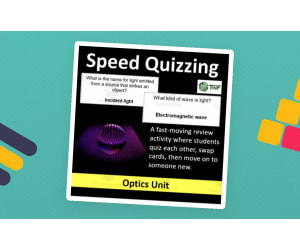
Speed Quizzing – Optics Unit
Science, Physics, Grade 8, 9, 10, Lesson Plans, Teacher Tools
Speed Quizzing - Optics Unit This is a dynamic and editable teaching resource suitable for Grade 8, 9, and 10 students studying Science with an emphasis on Physics. It aims to create a lively learning environment by integrating movement and discussion into the academic framework. About the Product The product mainly entails printing and distributing flashcards among the students It comprises of 32 comprehensive questions, covering various optics-related topics such as: Light, Lasers & Absorption/Transmission, Producing Light, & More unlisted topics. Besides being an engaging classroom exercise; it functions independently as an impressive question bank due to its high-quality question composition. . Detailed Application Process The first step involves dividing your students into groups A and B - these groups would use their flashcards for questioning each other while appreciating or coaching based on responses given. Latterly, roles are switched with partners shuffling after appreciation expressed via thanks noted between them before repeating this process during a predetermined set duration. A variant can be incorporated where group A moves right while group B remains static facilitating different partnerships with swapped positions between rounds for even distribution of partner combinations. . +(ol) The Benefits This resource promotes meaningful student dialogues fostering an interactive environment conducive for knowledge reinforcement especially after freshly concluded units offering room to remediate weak skills along practical applications assisting in solidifying new skills acquisition understanding leading optimally towards higher learning retention rates among pupils efficiently propelling academic success forward. .
Author Teach With Fergy
Tags Optics Unit, Speed Quizzing, Science Education, Physics Activity, Interactive Learning

Benjamin Franklin: Social Studies Reading Comprehension Passage (Word)
ELA, Reading, Reading Comprehension, Strategies, Resources for Teachers, Social Studies, History, History: USA, Grade 6, 7, 8, 9, Writing Prompts, Worksheets & Printables, Centers, Activities, Teacher Tools, Assessments, Quizzes and Tests, Quizzes, Tests
Benjamin Franklin: Social Studies Reading Comprehension Passage (Word) This resource introduces a unique Social Studies reading comprehension passage with questions about Benjamin Franklin and his Ideas. The passage is carefully designed to bridge the gap between social studies and literacy through strengthening reading comprehension and sparking knowledge curiosity in middle school students. Each passage blends English Language Arts skills with accurate social studies content . Ideal for interdisciplinary learning in ELA and Social Studies. Suitable for Grade 9 review, too! Student Tasks throughout the passage: 5 multiple-choice questions targeting the following skills: main idea, key details, inference, vocabulary in context, and use of evidence 5 vocabulary matching items with clear, student-friendly definitions 5 text-based questions that require citing specific lines or facts 1 summary prompt that asks students to condense central ideas accurately Full answer key for every section Available Formats for this Resource: PDF Fillable PDF Google Docs FULL CATALOG OF DOWNLOADING LINKS HERE Social Studies Reading Comprehension Collection Links: 1. Ancient Civilizations PDF Fillable PDF Word Docs Google Docs 2. Early Empires and Trade Networks PDF Fillable PDF Word Docs Google Docs 3. The Founding of the United States PDF Fillable PDF Word Docs Google Docs 4. Language, Culture, and Meaning PDF Fillable PDF Word Docs Google Docs 5. Psychology and Society PDF Fillable PDF Word Docs Google Docs 6. Global Festivals and Traditions PDF Fillable PDF Word Docs Google Docs 7. Extreme Environments and People PDF Fillable PDF Word Docs Google Docs 8. Food, Culture, and Preservation PDF Fillable PDF Word Docs Google Docs 9. Global Food Customs PDF Fillable PDF Word Docs Google Docs 10. Media, Communication, and Popular Culture PDF Fillable PDF Word Docs Google Docs 11. Human Impact on the Environment PDF Fillable PDF Word Docs Google Docs 12. Civic Action and Social Change PDF Fillable PDF Word Docs Google Docs 13. Fashion, Society, and Power PDF Fillable PDF Word Docs Google Docs 14. People, Places, and Unusual Histories PDF Fillable PDF Word Docs Google Docs Product Details: Length: 4 pages Grades: 6–8, also suitable for Grade 9 review Use cases: close reading, stations, homework, intervention, test prep, and sub plans Why Teachers Choose This Passage: Authentic social studies content paired with rigorous literacy practice Consistent task structure for easier planning and smoother student routines Clear, age-appropriate writing that builds confidence without oversimplifying Use this passage to reinforce ELA skills in social studies, to add literacy to your lessons, and to support independent work. The passage strengthens main idea, evidence use, vocabulary in context, inference, cause and effect, and summary writing. With ready-to-use assessments and complete answer keys, you can provide focused practice that is simple to run and fast to review.
Author Middle & High School - CORED Education
Rating
Tags Middle School, Reading Comprehension, Reading Strategies, ELA, Centers, Reading Passage, Assessments, Vocabulary, Social Studies, US HISTORY

California CAASPP Math Practice Test for Grade 6
Math, Grade 6, Assessments, Teacher Tools, Tests, Quizzes and Tests, Worksheets & Printables
6th Grade Math Practice Test | CAASPP Test Prep with Answer Key & Teacher Guide Support your students’ transition into middle school math with this rigorous 6th grade math practice test aligned to CAASPP standards! This resource provides real test-style questions to build confidence while helping you assess key foundational skills. ✅ What’s Included Full-length 6th grade math practice test (30 questions) Complete answer key with explanations and distractor analysis Detailed teacher’s guide with scoring rubrics and instructional strategies Multiple-choice and open-response questions CAASPP-style format and rigor 📚 How It Works in the Classroom This 6th grade math test prep resource is perfect for: CAASPP and state test preparation End-of-unit or benchmark assessments Whole group testing or independent practice Small group intervention and reteaching Sub plans or review days Just print and go for easy implementation! 🎯 Standards & Learning Goals This 6th grade math practice test covers: Ratios & Proportional Relationships (rates, percents, ratios) The Number System (fractions, integers, absolute value) Expressions & Equations (algebraic thinking, inequalities) Geometry (area, surface area, volume) Statistics & Probability (mean, median, variability) Students develop both conceptual understanding and problem-solving skills through a mix of question types. 💛 Why Teachers Love It Mirrors real CAASPP test rigor and expectations Includes detailed answer explanations—not just answers Teacher guide provides scoring support and remediation ideas Covers ALL major Grade 6 math domains Helps identify student gaps for targeted instruction 📥 Ready to make test prep easier? Download this 6th grade math practice test and give your students the practice they need to succeed on state assessments!
Author Bright Classroom Ideas Marketplace
Rating
Tags California, Caaspp, State Test, Math

Dung Beetle | Interactive Science Lesson | Micro-Learning Deck
Science, Life Sciences, Insects, Grade 5, 6, 7, 8, Teacher Tools, Lesson Plans
Dung Beetle | Interactive Science Lesson | Micro-Learning Deck This science resource presents an informative lesson on the dung beetle in an engaging slideshow format. Students will watch a video lesson explaining the unique role of the dung beetle in nature. An informational reading passage that can be listened to builds knowledge, while close reading questions promote critical thinking. A quick write activity allows students to reflect on what they learned about this essential insect. This micro-learning deck incorporates informal assessments alongside the lesson to keep middle school students engaged from start to finish. Educators can easily integrate this versatile resource into whole group instruction, small group remediation, or as an independent homework assignment that combines science content acquisition with reading, writing, listening, and speaking skills practice.
Author Teach Me This
Tags Dung Beetle, Insects Lesson, Reading Passage, Interactive Science, Comprehension
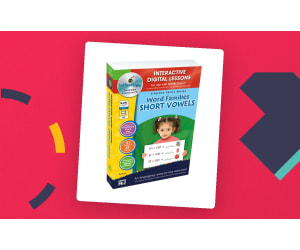
Word Families: Short Vowels - Digital Lesson Plan Gr. PK-2 | MAC Software
ELA, Language Development, Vocabulary, Kindergarten, Preschool, Grade 1, 2, Teacher Tools, Lesson Plans
Word Families: Short Vowels - Digital Lesson Plan Gr. PK-2 This is an innovative teaching resource, expertly designed for MAC Software users. It functions as a vital tool for educators to augment the language arts learning journey of their students. Main Features: A terrific suite of 80 digital screen-pages stimulating student curiosity and promoting engagement. A core purpose of fostering precise Short Vowel phonogram pronunciation using real-life imagery. An interactive format that enhances reading capabilities while improving comprehension skills. Inclusive working with words activities on each page, encouraging practical language application and positive long-term retention. Evaluation Mechanisms: Versatile testing formats including memory match games, crosswords and word searches to keep assessments comprehensive yet enjoyable. Comprehension Quizzes at every level acting as informative markers to evaluate learner understanding and track progress over time. This dynamic tool is perfect for teachers employing diverse instruction strategies across Preschool through Grade 2. Its user-friendly design also makes it suitable for homework assignments extending learning outside the classroom bounds! All content aligns with state standards underlining the widely recognized pedagogical methodology of Blooms Taxonomy ensuring a balance between curriculum mandates and learning goals thus enriching educational experiences profoundly!
Author Classroom Complete Press
Tags Word Families, Short Vowels, Short Vowel Word Family, Digital Lesson Plan, Reading Lesson
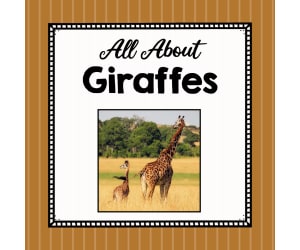
Animal Science Unit | All About Giraffes | Learning about Animals
Science, Life Sciences, Animals, Kindergarten, Preschool, Grade 1, 2, Lesson Plans, Teacher Tools
Dive into learning all about giraffes with this expansive teaching resource on the world's tallest land mammal. Students will discover real photos, reading materials, arts and crafts , worksheets, and writing activities tailored for grade levels from preschool to second grade. Build an engaging animal science unit with differentiated materials like vocabulary flashcards, comprehension articles, labeled diagrams, maps, and memory games. Guide students to explore giraffe adaptations, habitats, life cycles, anatomy, behaviors, and more through projects like articulated paper models, costumes, reports, nature journals, and posters. Whether teaching a whole class or small group, this thorough collection offers high-quality printables, discussions, and activities to foster a love of science and wildlife conservation.
Author Simply Schoolgirl
Tags Zoology, African Animals, Mammal, Mammals, Giraffe Crafts, Giraffe Projects, Giraffe Printables, Giraffe Lesson Plans, Giraffe Worksheets
I WONDER - What Did Greek Gods Represent | Animated Video Lesson
History: Europe, History, Social Studies, History: Ancient, Grade 5, 6, 7, 8, 9, 10, 11, Lesson Plans, Teacher Tools
Video Introduction An amazing video designed for the students to learn more about history. I WONDER - What Did Greek Gods Represent | Animated Video Lesson Do you like history? Which topic do you really enjoy about history? Have you ever read an interesting fact about the Vikings? If yes, can you mention them? What do you like most about the Victorian era? Can you name all the Tudors? Have you ever wondered how people used to live in ancient Japan and ancient China? Do you know any interesting facts about ancient Egyptians and the Pharaohs? Have you ever visited South America? What do you know about Incas and Aztecs? Celtic culture was really one of a kind, can you name any of the places that Celts used to live in? Imagine yourself living during the ancient Roman empire, how your life will look like? Ancient Greece was an amazing place to live in. What do you know about ancient Greek life? I WONDER - What Did Greek Gods Represent | Animated Video Lesson The video is perfect for encouraging the researching skills for the students, while learning more about history. I WONDER - What Did Greek Gods Represent | Animated Video Lesson This friendly designed video is suitable for students at school, homeschooling, and as a group activity. Format Available in MP4 format.
Author Educational Voice
Tags What Did Greek Gods Represent, What Did Greek Gods Represent Vvideo, Greek Gods, Greek Gods Video, Greek Gods Facts, Greek Gods Facts For Kids, Greek Gods Video For Kids, Greek Goddesses
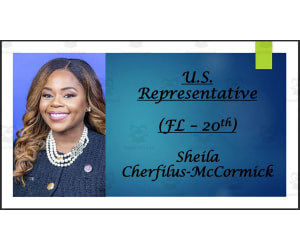
U.S. Representative Sheila Cherfilus-McCormick (FL - 20th) BIO PPT
Social Studies, History, History: USA, Government, Not Grade Specific, Teacher Tools, Presentations
Explore the life and career of U.S. Representative Sheila Cherfilus-McCormick with this informative 26-page biography PowerPoint. Students will learn about Rep. Cherfilus-McCormick's background, education, early careers, and path to becoming the first Haitian American Democrat serving in Congress. The presentation covers key details such as her birthdate, birthplace, high school and college education, professional experience as a healthcare executive, political activism, 2020 and 2022 election campaigns, and notable achievements as an elected official representing Florida's 20th congressional district. With engaging visuals and discussion questions, this resource enables educators to introduce Rep. Sheila Cherfilus-McCormick effectively. It can facilitate learning about modern government, inspire civic participation, and empower student voices.
Author Mr. Matthews Teacher Store
Tags Cherfilus-McCormick, Biography, Government, Congress, Representative, Florida
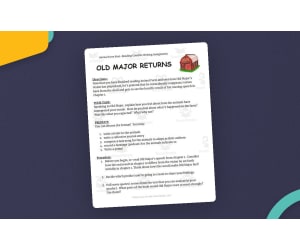
Animal Farm Post-Reading Creative Writing Assignment: What Would Old Major say?
ELA, Writing, Creative Writing, Grade 7, 8, 9, 10, Teacher Tools, Assessments
After reading Animal Farm, challenge your middle or high school students to imagine they are Old Major who returns to see the horrific aftermath of his rousing speech. Old Major Reacts: Animal Farm Creative Writing Assignment asks students to pretend Old Major has come back to life and gets to see the result of his vision for Animal Farm. Students have a choice of 5 creative writing products to compose, including a diary entry, editorial letter, conversation between animals, short story, or poem from Old Major's perspective. A detailed rubric is included to assess if students properly grasp Old Major's original vision and the ultimate corruption of that vision under Napoleon. This creative writing activity, available as an adaptable Google Doc, helps students reflect more deeply on the plot and themes. It can be easily assigned for distance learning or in the classroom. The resource develops critical thinking, creativity, and writing skills.
Author The Red-Haired Reader
Tags Creative Writing, Character Analysis
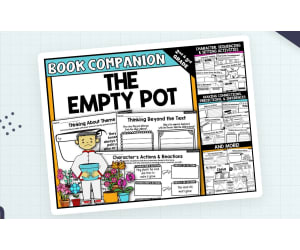
The Empty Pot Interactive Read-Aloud Activities
ELA, Reading, Reading Comprehension, Language Development, Vocabulary, Grade 2, 3, 4, Literacy Readers, Teacher Tools
This picture book companion is a complete supplemental resource for the book The Empty Pot by Demi. With 28 print-and-go reading activities to choose from, this resource is ideal for customizing learning to your student's specific needs and academic abilities. Students will investigate illustrations, identify story elements, determine the theme, analyze characters, compare & contrast, make predictions, inferences, & connections, answer questions that require them to think beyond the text, and much more! Students will love the engaging and fun activities, and you will appreciate the time saved hunting for high-level resources to teach reading concepts that students frequently struggle with. The activities provided are designed to enable students to apply higher-level thinking skills, encourage them to provide text evidence to support their thinking, and challenge them to express their own thoughts and/or perspectives. ⭐️This Resource Includes:⭐️ Making Predictions: Before reading, students will make predictions about the text. Story Elements: Students fill in the boxes with words & pictures to represent the story elements. Sequencing: Students will retell & illustrate the important parts of the story. Recalling events in Chronological Order: Students describe and illustrate four major events in the story in chronological order. Summary: Students complete the Somebody, Wanted, Because, But, So graphic organizer and write a summary of the story. Story Event Sort: Students will describe a scene or event from the story that fits into each of the categories & explain how the event made them feel & how it relates to the category. Making Connections: Students make connections to an event from the story. Making Inferences: Students use clues & schema to make inferences while reading the story. Character Actions & Reactions: Students read different situations that the characters faced in the story and fill in the boxes with the character's missing action, reaction, or both (ANSWER KEY included). Character Inside & Out (Ping): Students include details from the story to describe what the character says, thinks, does, and feels. Character Inside & Out (The Emperor): Students include details from the story to describe what the character says, thinks, does, and feels. Character Feelings: Students describe how the character's feelings change throughout the story & give examples of the events that cause them to feel the way they do. Character Development: Students select character traits that best describe the character at different times throughout the story and give examples from the book to support the traits they choose. Character Summary: Students will choose a character from the story to summarize and fill out the graphic organizer. Sketch a Scene From the Story: Students will illustrate one of the events from the story and explain why this event is important to the plot. Setting the Scene: Students identify three different settings in the story and explain how they know the setting changed. Supporting Evidence: Students fill in the boxes with the provided text evidence that supports each character trait (ANSWER KEY included). 3-2-1: Students will describe three ways in which Ping’s actions show determination and patience, give two likely reasons that the Emperor gives the children seeds that he knows will not grow, and choose one word to describe Ping and explain why. Author's Message: Students describe four important events from the story and put them in chronological order. Then, answer the questions about the author's message. Theme: Students answer the questions to determine which theme best fits the story and provide text evidence to support their choice. Before & After: Students will draw a picture and describe Ping as he’s on his way to the palace to present his pot to the Emperor and draw a picture and describe Ping after. Thinking About the Text: Students will answer the questions about the story & include examples from the text to support their answers. Thinking Beyond the Text: Students will answer the questions about the story & include examples from the text to support their answers. Crossword Puzzle: Students use the definitions and the word bank to fill in the crossword puzzle (ANSWER KEY included). Book Review: Students will rate and review the book. Thinking About Theme: Students will fill in the flower pots with answers to the question prompts regarding the theme of the story, honesty. The Truth About Lying: Students will make a list of the lies that they can remember telling or that have been told to them and organize those lies as unacceptable (harmful) or acceptable (helpful). Then write a response to the question of whether it is ever necessary to tell a lie and explain why or why not. All About China: Students will research to learn more about the country of China. This resource is for extension read-aloud activities only. The book is not included.
Author Creatively Gifted
Tags Fountas And Pinnell, Second Grade, Elementary Ela, Reading Comprehension, Character Traits, Guided Reading, Interactive Read-aloud, Picture Book, Folktales, The Empty Pot

All About P - Letter of the Week Unit
ELA, Language Development, Pre-Reading, Kindergarten, Teacher Tools, Lesson Plans
All About the Letter P - Preschool Letter of the Week Curriculum This comprehensive letter P curriculum resource for preschool makes teaching engaging and easy. With dozens of worksheets, crafts, games, and activities, you can easily create memorable letter P lessons. Students will have fun learning letter recognition, formation, sounds, and words through coloring , tracing, matching, puppets, bingo, and more. Use these materials for whole group, small group, or individual activities. Consistent with other alphabet curriculum packs from this store to facilitate a full year of effective letter learning. Choose printable or digital options to fit diverse budgets and settings. Thoughtfully designed using high-quality real photos and cute clipart suitable for homeschools, co-ops, or classrooms. Simple yet educationally rich activities allow students to fully explore the letter P.
Author Simply Schoolgirl
Tags Letter Tracing, Alphabet Printables, Letter Of The Week, Letter Coloring Page, Letter Word Cards, Preschool, Lesson, Kindergarten, Phonics

Country Study on Ukraine - Geography Presentation
Social Studies, History, History: Europe, History: World, Geography, Grade 7, 8, 9, 10, 11, 12, Teacher Tools, Presentations
Country Study on Ukraine - Eastern Europe - Geography + Social Studies Presentation Bring Ukraine to life in your classroom with this Introductory Teaching Resource on Ukraine , designed for Geography, European History (Eastern Europe), and Social Studies . Ideal for Grades 7–12 (Middle School and High School) , this PDF digital presentation is informative, visually engaging, and requires little to no preparation . Students will explore Ukraine’s geography, history, culture, language, and economy , making this resource perfect for country studies and introductory lessons in Geography and Social Studies. 📘 Within this Social Studies and Geograhy Presentation Lesson, teachers and educators can find the following topics included: ✅ Greetings in Ukrainian Language ✅ Geography of Ukraine (Eastern Europe) Key facts, bordering countries, and an interactive Google Maps link ✅ Quick Facts Population, population density, capital city, currency, government, and more ✅ History Overview A clear and concise summary of Ukraine ’s most important historical events (Eastern Europe) ✅ Geography, Climate & Environment Land area, regions, and climate zones ✅ Ukraine’s Economy Major industries, exports, and economic strengths ✅ Kyiv Ukraine ’s capital city, including famous landmarks and cultural highlights ✅ Other Major Cities A map highlighting key urban centers across Ukraine (Eastern Europe) ✅ Culture & Traditions Customs, values, and traditions that shape Ukraine 's society (Eastern Europe) ✅ Goodbye in Ukrainian Language This Social Studies + Geography Country Study Presentation on Ukraine (Eastern Europe) PDF Digital Teaching Resource (14 slides) can be more than great for Middle School and High School Students from 7th grade to 12th grade to introduce Ukraine (Eastern Europe) and its culture, language, society, history and economy. Learning with Alan is a Teaching Resource - Educational Material Store whose aim is to help Teachers, Educators and Tutors to achieve their teaching objectives while creating a fun and stimulating environment. Learning should always be fun. Never Forget! If you want to browse more of my Teaching Resources, click here Learning with Alan!!
Author Learning with Alan
Rating
Tags Europe, Country Study, Geography, Social Studies, European History, Presentation, Teaching Resource, Culture

Sunglasses Reading Comprehension Passage - Cored Ed Encyclopedia
ELA, Language Development, Reading Comprehension, Reading, Pre-Reading, Writing, Science, Physics, History, Social Studies, Grade 2, 3, 4, 5, Worksheets & Printables, Worksheets, Teacher Tools, Centers, Activities, Writing Prompts, Assessments, Quizzes and Tests, Quizzes, Lesson Plans
This sunglasses reading comprehension includes: Visualization (on the front cover) Start your lesson by taking a minute to think and share something about the topic. Read the script aloud (slowly), perhaps prepare some music or sound effects. Student close their eyes and let their imaginations wander. Students open their eyes, read the question aloud and give them a few minutes to complete. Ask a few students to share or keep answers until the end to compare with what they learn in the passage. Quick pause—thousands of Cored Education products are included with your TeachSimple membership. Download links and encyclopedia index available here. Pre-Reading Trivia Students will write down one thing they already know about the subject and then read five more facts and discuss. These facts are fun, and the students will enjoy learning about the subject before reading more. Give 1 minute for students to write what they already know (no pressure—best guess is fine). Read the five facts together. After each fact, do ask a student for their opinion, was it surprising? Set a purpose by asking students to highlight/underline one fact they want to learn more about during the reading. Reading Passage The text is a high-interest reading passage with set paragraphs, roughly three to four paragraphs long. It contains a variety of themes about the topic, anywhere from history to technology. The passage is between 250 and 350 words in length. First, ask students to look at the headings and see what they’ll learn about today. What do they know about the topic/heading? First read options: Teacher read-aloud (best for support). Partner reading (paragraph by paragraph). While reading, students underline important details, and vocabulary words they think may come up in the questions section. Mixed Questions The first question page contains four multiple-choice questions, each with a choice of four answers, and three written response questions that require a sentence or two from the student. Students complete the mcqs first independently, then review quickly as a class. For the 3 written responses, try to get students giving the answer with some form of evidence: “I think ___ because the text says ___.” If students get stuck, send them back to check the passage. Vocabulary Questions Practice seven key words from the text in this section across two activities. First section is scrambled words where students will unscramble three words given a clue for each. The second section is a word to meaning matching activity. Before starting, have some students read out words they underlined in the passage. Ask students to say the word and read aloud the sentence(s) around each word. Ask students to do scrambled words and the matching exercise in pairs then go through answers as a class. For the scrambled spelling task, get four pairs to come up to the board and write the words for extra practice with the other student reading out the clue. For the matching task, prompt students to give full sentences: “I matched ___ with ___ because ___.” Creative Writing In this question, the student will be required to write a five to eight sentence paragraph on a question related to the topic. Before starting, ask students write down 3 key ideas they are going to include in their piece. Ask students for ideas to share around the class to help those struggling. Pro writing expectations: 5–8 sentences At least 2 facts or details from the passage At least 2 vocabulary words from the previous page Students read their paragraphs while classmates listen for facts and vocabulary words. Extension Activities This page is optional for fast finishers or to take home. There are several activities, each one requiring a different skill. Do some, do none, do all, completely optional - but you will feel reassured knowing every possibility is planned for. Includes summary writting question. Answer Key There are answers for the multiple-choice questions, written response questions have sample answers, vocabulary answers and if there is a summary question then a sample summary will be provided as well. Lesson Plan Included Customized lesson plan for this lesson is included. Lesson Snapshot Title: Sunglasses Genre: Nonfiction (informational text + support pages) Subject: Science (Light) / Health & Safety Primary Topic: Why sunglasses help and how they evolved Estimated Guided Reading Level (A–Z): Q What This Lesson Teaches Best What glare is and how tinted lenses can “calm down” sharp, shiny light bouncing off surfaces like water, sand, snow, or a car hood. A simple history of eye protection: smoky quartz lenses in 12th-century China and Inuit snow goggles with narrow slits to cut glare. How sunglasses became part of everyday life (experiments with tints; boardwalk sales in 1929; polarized lenses arriving in 1936). What UV light is (invisible but harmful over time) and what UV400 labeling means in the passage (filtering nearly all UVA/UVB up to 400 nanometers). How polarized lenses reduce reflected sparkle off flat surfaces like roads and water, making shapes easier to see. Learning Goals Define glare using details from the passage. Explain how tinted lenses help eyes feel more comfortable in bright sunlight. Describe two early ways people protected their eyes from harsh light. Explain how sunglasses became popular for everyday use using the dates and examples given. Describe what UV light is and what UV400 means in the passage. Explain how polarized lenses help with reflections off water and roads. Key Vocabulary From the Text glare — sharp, shiny light that bounces off surfaces. tinted — made darker, like a shaded window for eyes. quartz — a mineral used like simple dark lenses long ago. ultraviolet — invisible light that can harm eyes and skin over time. polarized — lens type that reduces reflections and sparkle. FULL CATALOG OF DOWNLOAD LINKS AND ENCYCLOPEDIA INDEX HERE
Author Cored Education
Rating
Tags Vocabulary, Reading Comprehension, Reading Passages, Lesson Plans, Ela Lesson Plans, Reading Comprehension Lesson Plans, Reading, Pre-reading, Physics, Sunglasses