Adding on a Number Line Worksheet – 3 Levels
- Grades
- Grades 1–4, Elementary
- File type
- Preparation
- Print ready


- Subject
- Math, Number Lines
- Topic
- number lines, math centers
- Resource types
- Worksheets & Printables, Worksheets
- Preparation
- Print ready
About this resource
What's inside this resource
Product description
From the author
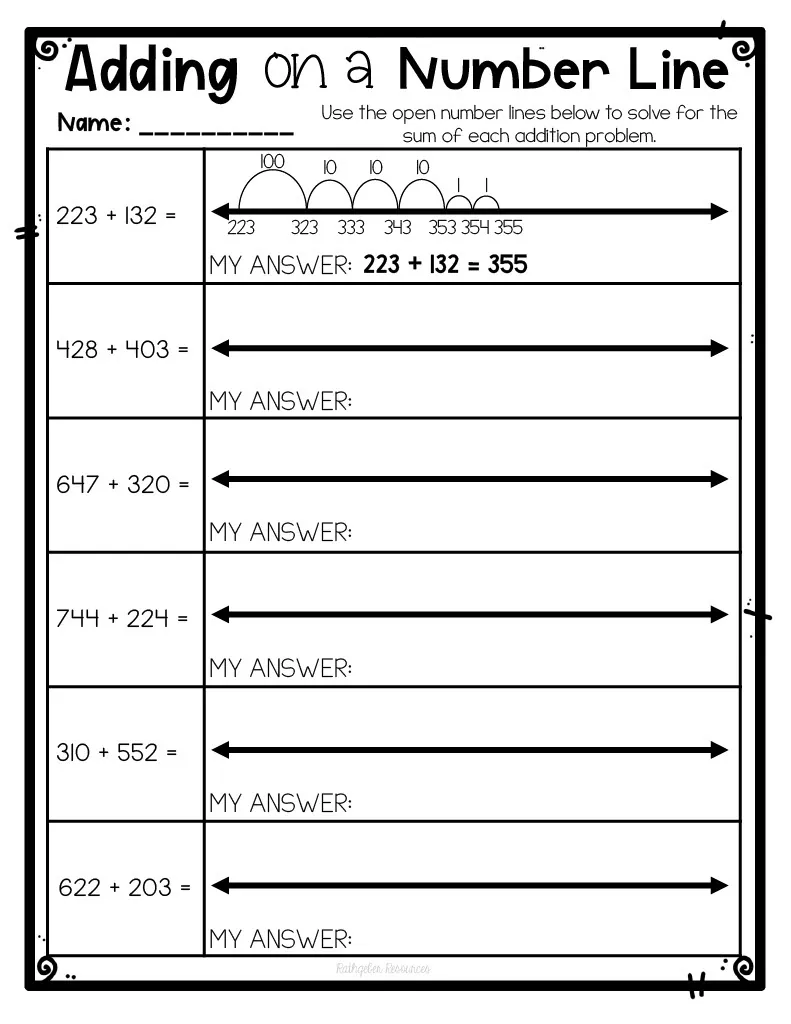
This resource is an Adding on a Number Line Worksheet.
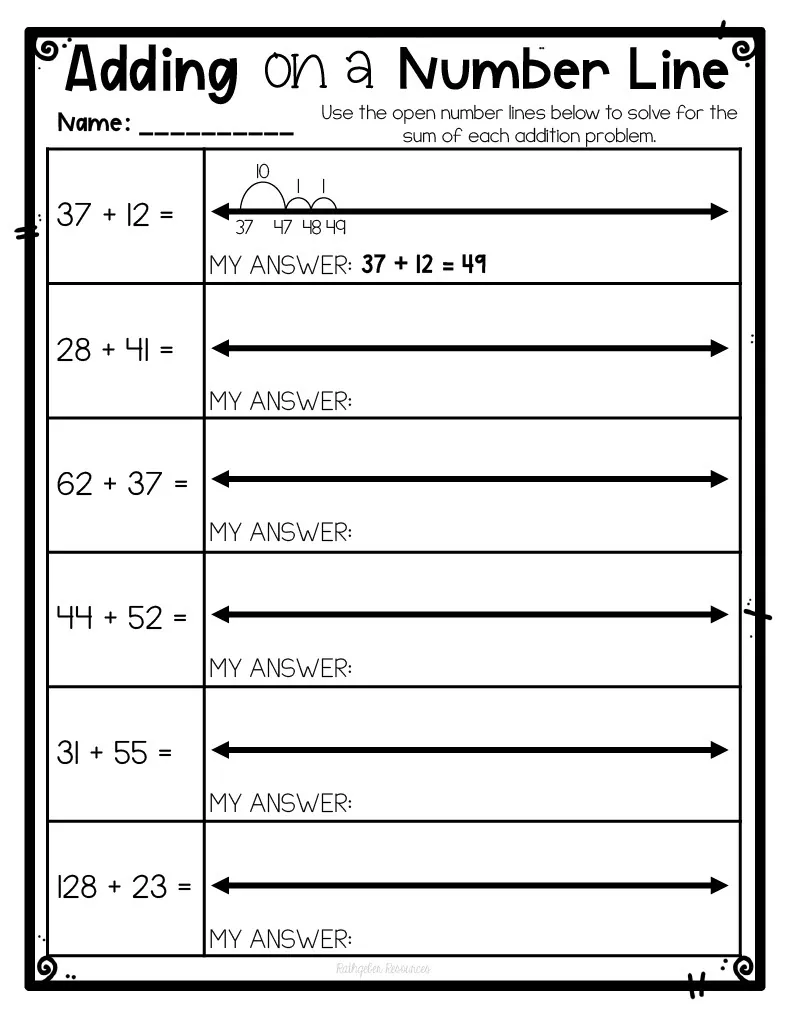
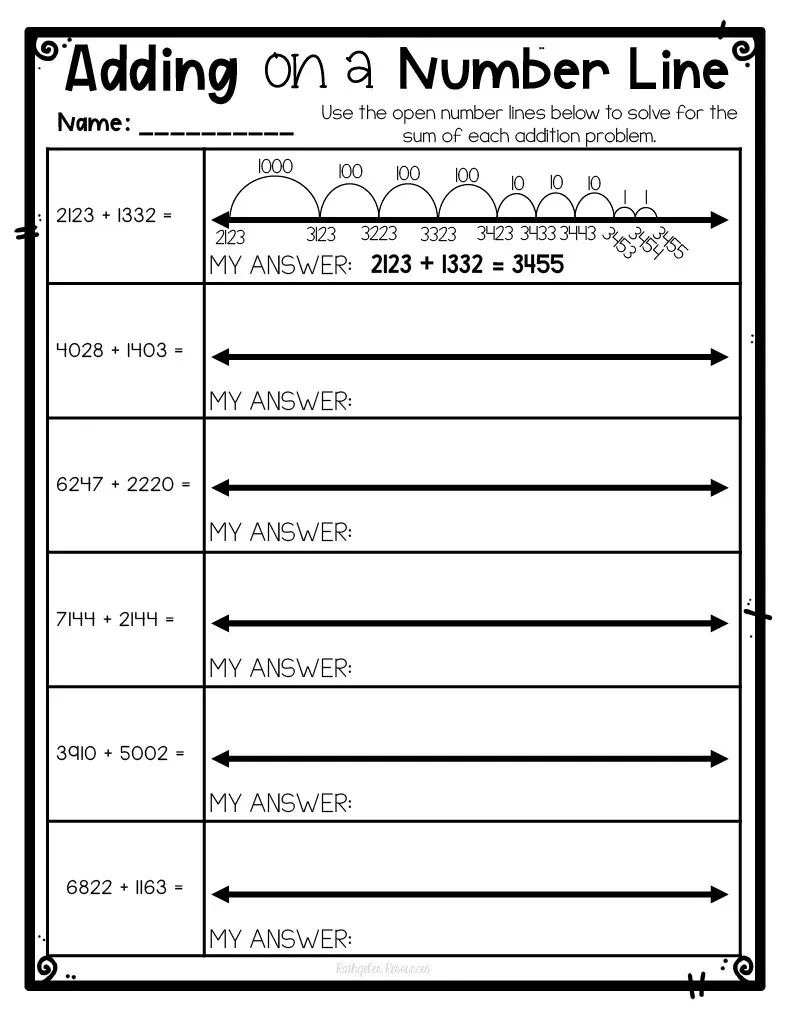
There are 3 worksheets - 2 digit, 3 digit & 4 digit numbers - perfect for differentiation amongst students.
All you have to do is print and go!
Related resources
More resources teachers may find useful
24 related resources were found using this product's title, contributor, categories and tags.
In the classroom
Teaching tips & learning objectives

Learning objectives
Students use the open-number-line jump strategy (adding by place value) to find the sum of two 2-digit numbers.
Students extend the same jump strategy to 3-digit and then 4-digit addends across the worksheet's three levels.
Students record their answer beneath each problem after completing the number-line jumps.

Teaching tips
Assign pages by student readiness rather than all three at once, since page one (2-digit) and page three (4-digit) sit at noticeably different difficulty levels for the same strategy.
Walk through the worked example at the top of each page as a class before releasing students to the six independent problems, since the jump sizes change page to page (tens only on page one; hundreds, tens, and ones on pages two and three).
Use page three's 4-digit problems as an extension or challenge set for students who have mastered the 2- and 3-digit levels.

Skills covered
Number-line addition strategy -- students break an addend into place-value parts (hundreds, tens, ones) and add each part as a separate jump on an open number line.
Place-value reasoning -- the jump sizes shown in each worked example (e.g. +100, then +10 three times, then +1 twice) require identifying how many hundreds, tens, and ones make up the second addend.
Leveled addition practice -- the same jump strategy is applied to 2-digit sums on page one, 3-digit sums on page two, and 4-digit sums on page three.

No reviews yet
Downloaded this resource? Tell other teachers how it went.
Curriculum
Standards, concepts & topics
Standards
 Standards
- 2.MD.A.6 — Represent whole numbers as lengths from 0 on a number line diagram with equally spaced points corresponding to the numbers 0, 1, 2, ..., and represent whole-number sums and differences within 100 on a number line diagram.
- 2.NBT.B.7 — Add and subtract within 1000, using concrete models or drawings and strategies based on place value, properties of operations, and/or the relationship between addition and subtraction; relate the strategy to a written method. Understand that in adding or subtracting three-digit numbers, one adds or subtracts hundreds and hundreds, tens and tens, ones and ones; and sometimes it is necessary to compose or decompose tens or hundreds.
- 3.NBT.A.2 — Fluently add and subtract within 1000 using strategies and algorithms based on place value, properties of operations, and/or the relationship between addition and subtraction.
Core concepts
 Core concepts
open number line
place value
multi-digit addition
Topics
 Topics
Explore more
Categories this resource belongs to
Explore related searches
More to explore
You may also like