


Brain Teasers Part 1 – Hidden Meaning Puzzles



- Grades
- Grades 4–9, Elementary, Middle School, High School
- Pages
- 6
- File type
- Answer key
- Included


- Subject
- ELA, Language Development, Vocabulary
- Topic
- idioms, expressions
- Resource types
- Worksheets & Printables, Worksheets
- Answer key
- Included
- Standards
- CCSS.L.5.5 CCSS.L.4.5
About this resource
What's inside this resource
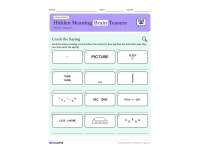
Words in Disguise is a set of 30 hidden meaning brain teasers for grades 4 to 8 that moves students from cracking a puzzle to explaining and using the saying it hides. Each box disguises a common expression using only words, letters, numbers and simple shapes, such as THINK written twice for "think twice."
The pack builds support and challenge page by page:
- Crack the Saying (page 1): 12 boxes to solve on their own, with directions that name what to look for
- Word Bank Round (page 2): 12 more boxes with a bank of 15 sayings, three of which are not used
- What Does It Mean? (page 3): six boxes where students write the saying and then explain it in their own words
- Sayings in Action (page 4): six short stories, each matched to the saying that fits it best, with a worked example
- Make Your Own (page 4): one large design box where students hide a new saying for a classmate to solve
Format: 6 pages, 4 student pages and a 2-page answer key that gives each saying, accepted variations and a plain meaning, along with the story answers and a chart of the trick each box uses. Students can work from the color pages or the black and white print pages.
Related resources
More resources teachers may find useful
24 related resources were found using this product's title, contributor, categories and tags.


In the classroom
Teaching tips & learning objectives

Learning objectives
Solve rebus boxes by reading clues in the size, position and direction of words, letters, numbers and shapes.
Explain the meaning of a common saying, such as "go the extra mile," in their own words.
Choose the saying that fits a short real-life story, like a team losing 0 to 5 with one minute left.

Teaching tips
Let students try page 1 without help first, then hand out page 2 so the word bank feels like support rather than a shortcut.
Remind students that three sayings in the page 2 word bank are decoys; the key lists which ones.
On page 3, ask a few students to read their "It means" answers aloud and compare them with the plain meanings on the key.

Skills covered
Decoding visual clues: students notice when a word is tiny, stacked, split, repeated or turned on its side and connect that to a familiar expression.
Using context clues: the Word Bank Round adds a list of sayings, including three that do not match, so students must check each choice against the box.
Explaining figurative language: page 3 asks for a meaning in the student's own words for six sayings.
Good to know
Questions teachers ask about this resource
How many puzzles are included?
There are 30 rebus boxes: 12 on page 1, 12 on page 2 and 6 on page 3. Page 4 adds six story-matching items and one design box for a student-made puzzle.
Is a word bank provided?
Yes, for page 2 only. It lists 15 sayings in alphabetical order, and three of them are not used, so students still need to solve each box.
Does the answer key explain the sayings?
Yes. The two-page key gives every saying with accepted variations and a plain meaning, model answers for the page 3 explanations and the matching saying for each story.
Which grades is it best for?
It is written for grades 4 to 8. Pages 1 and 2 work as quick warm-ups, while pages 3 and 4 give older students explaining and applying tasks.

No reviews yet
Downloaded this resource? Tell other teachers how it went.
Curriculum
Standards, concepts & topics
Standards
 Standards
- CCSS.L.5.5 — Demonstrate understanding of figurative language, word relationships, and nuances in word meanings. a. Interpret figurative language, including similes and metaphors, in context. b. Recognize and explain the meaning of common idioms, adages, and proverbs. c. Use the relationship between particular words (e.g., synonyms, antonyms, homographs) to better understand each of the words.
- CCSS.L.4.5 — Demonstrate understanding of figurative language, word relationships, and nuances in word meanings. a. Explain the meaning of simple similes and metaphors (e.g., as pretty as a picture) in context. b. Recognize and explain the meaning of common idioms, adages, and proverbs. c. Demonstrate understanding of words by relating them to their opposites (antonyms) and to words with similar but not identical meanings (synonyms).
Core concepts
 Core concepts
rebus puzzles
idioms
figurative language
context clues
word play
Topics
 Topics
Explore more
Categories this resource belongs to
Explore related searches
More to explore
You may also like


