Brain Teasers Part 3 – Hidden Meaning Puzzles



- Grades
- Grades 3–8, Elementary, Middle School
- Pages
- 7
- File type
- Answer key
- Included


- Subject
- ELA, Language Development, Vocabulary
- Topic
- brain teaser, hidden meaning
- Resource types
- Worksheets & Printables, Worksheets
- Answer key
- Included
- Standards
- CCSS.L.4.5 CCSS.L.5.5
About this resource
What's inside this resource
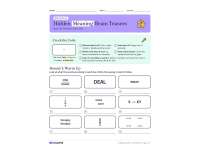
Thirty-three typographic rebus puzzles hide a saying, idiom or compound word in the way letters are placed, sized, turned or repeated. These brain teasers with hidden meaning are written for grades 3 to 8, and they teach the tricks before asking students to use them.
Page 1 opens with a Crack the Code strip: one worked example and five numbered clue questions (where the word sits, how big it is, which way it runs, how many times it appears and whether it sounds like a word). The puzzles then build across three rounds, Warm Up (9), Look Closer (12) and Brain Stretch (9), followed by a three-puzzle Expert row.
Beyond solving
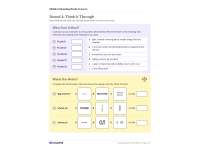
- Round 4, Think It Through: match five solved sayings to their meanings, and pick which of three boxes correctly shows "big brother," "stand up" and "shortcut"
- Round 5, Show What You Know: sort ten puzzles by their main trick, explain how two puzzles work and use one saying in a sentence
- Make Your Own: students design four puzzles in blank boxes, keep their answers on a cut-off strip and trade with a partner
Format: 7 pages (6 student pages and a one-page answer key with a short logic note for each puzzle). Includes full color and print-friendly black and white PDF versions.
Related resources
More resources teachers may find useful
24 related resources were found using this product's title, contributor, categories and tags.


In the classroom
Teaching tips & learning objectives

Learning objectives
Decode rebus puzzles by noticing the position, size, direction, repetition and sound of the words in each box.
Connect common sayings such as "a little late" to their meanings.
Classify puzzles by the main trick they use and explain in writing how a box shows its saying.

Teaching tips
Model the Crack the Code example with the class first; the five clue questions are the same ones students use later in Sort the Tricks and Make Your Own.
Each round is a natural stopping point, so the pack can be spread across several warm-ups or used in one longer word-play lesson.
Save the Expert row for students who finish Round 3 early; its note reminds them to look at size, place and spacing at once.

Skills covered
Visual word play: students read meaning from how letters are arranged, such as a word printed backwards or shrunk to tiny letters.
Idiom knowledge: the What Does It Mean? task links solved sayings to plain-language meanings, with one extra meaning left unused.
Comparing and justifying: Which Box Works? asks students to pick the one box out of three that shows a saying correctly.
Good to know
Questions teachers ask about this resource
How many hidden meaning puzzles are in the pack?
There are 33 rebus puzzles across three rounds and an Expert row, plus nine compare-the-box examples in Round 4 and four blank boxes for students to design their own.
What grades are these brain teasers for?
They are written for grades 3 to 8. Round 1 is a gentle start, and the Expert row and Round 5 writing tasks stretch older students.
Does it include answers?
Yes. The answer key on page 7 lists every puzzle answer with a short note on the trick it uses, plus answers for Rounds 4 and 5 and guidance for checking the Make Your Own page.
Do students need to know the tricks beforehand?
No. The Crack the Code strip on page 1 shows a worked example and names the five tricks to look for before the first puzzle.

No reviews yet
Downloaded this resource? Tell other teachers how it went.
Curriculum
Standards, concepts & topics
Standards
 Standards
- CCSS.L.4.5 — Demonstrate understanding of figurative language, word relationships, and nuances in word meanings. a. Explain the meaning of simple similes and metaphors (e.g., as pretty as a picture) in context. b. Recognize and explain the meaning of common idioms, adages, and proverbs. c. Demonstrate understanding of words by relating them to their opposites (antonyms) and to words with similar but not identical meanings (synonyms).
- CCSS.L.5.5 — Demonstrate understanding of figurative language, word relationships, and nuances in word meanings. a. Interpret figurative language, including similes and metaphors, in context. b. Recognize and explain the meaning of common idioms, adages, and proverbs. c. Use the relationship between particular words (e.g., synonyms, antonyms, homographs) to better understand each of the words.
Core concepts
 Core concepts
rebus puzzles
idioms
figurative language
compound words
word play
 Topics
Explore more
Categories this resource belongs to
Explore related searches
More to explore
You may also like