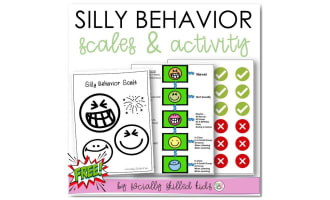
Copying Silly Behavior – Social Story for Kids


- Grades
- Not Grade Specific
- Pages
- 17
- File type
- Preparation
- Print ready


- Subject
- Special Education Needs (SEN), Social Skills
- Topic
- Copying behavior, Classroom choices
- Resource types
- Activities
- Preparation
- Print ready
Product description
From the author
Social stories use a patient and reassuring tone to teach children about social situations in a way that can be easily understood. Social stories are particularly useful for children on the autistic spectrum for whom social cues can be challenging and who often suffer anxiety if they do not know what to expect from a situation however social stories can also be useful for any child who is struggling to understand a situation or concept or needs help to understand a social skill or social cue, expectations, perspectives, common responses or is troubled about an upcoming event.
This social story is designed to encourage children not to copy other children when they do silly things.
These books should be used over and over to reinforce the point so I would suggest either putting the pages into a display book or laminating and binding them.
Clipart images courtesy of Kari Bolt.
Related resources
More resources teachers may find useful
24 related resources were found using this product's title, contributor, categories and tags.



In the classroom
Teaching tips & learning objectives

Learning objectives
Recognize that copying silly classroom behavior can disrupt everyone's learning, even when it first seems funny.
Identify ignoring silly behavior as the default response, and telling a teacher as the response when someone could get hurt or something could get broken.

Teaching tips
Read the story with a child before a situation where silly copying tends to happen, since the story is framed in first person as a rehearsal for that moment rather than a one-time lesson.
Choose the American or British spelling edition to match classroom conventions -- both tell the identical eight-page story.
Point out the story's own distinction between silly behavior to simply ignore and silly behavior serious enough to report to a teacher, since the two responses are given as separate, sequential story beats.

Skills covered
Social behavior recognition -- the child identifies copying silly behavior as a choice with consequences for their own learning and classroom trouble.
Response selection -- the child distinguishes between ignoring minor silly behavior and telling a teacher about behavior that risks harm.

No reviews yet
Downloaded this resource? Tell other teachers how it went.
Resource details
Concepts & topics
Core concepts
 Core concepts
Social story
Self-regulation
Classroom behavior
 Topics
Explore related searches
More to explore