Flash Cards: Physical Science Vocabulary




- Grades
- Grades 4–6, Elementary, Middle School
- Pages
- 81
- File type
- Preparation
- Print ready


- Subject
- ELA, Vocabulary, Language Development, Science, Physics, Chemistry
- Topic
- study, skills
- Resource types
- Worksheets & Printables, Flashcards
- Preparation
- Print ready
About this resource
What's inside this resource
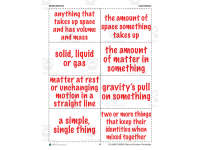
Learn the 125 physical science vocabulary words and their definitions with this resource. Flash Cards introduce concepts and promote comprehension through memorization and repetition. They can be used in a group setting or individually for practice. Additionally, use the flash cards in a matching game. Match the vocabulary word with its definition.
This set includes a teaching guide, 34 chemistry flash cards, 25 physics flash cards, 14 thermodynamics flash cards, 14 optics flash cards, 18 acoustics flash cards, 20 electricity and magnetism flash cards, vocabulary words matching cards, definitions matching cards, and blank flash and matching cards.
These Flash Cards can be used to help students recognize and understand the meaning of key physical science vocabulary words. Other titles included in this series are: LIFE SCIENCE Flash Cards, EARTH SCIENCE Flash Cards, and SPACE SCIENCE Flash Cards. These four titles are also available in a BUNDLE.
About this Resource:
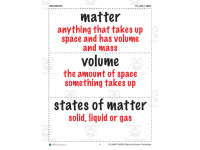
This resource includes all Physical Science vocabulary words and their definitions in a Flash Cards format. Each card shows the vocabulary word and its definition. Teachers can cut out each flash card for easy use with their students. An extra sheet of blank flash cards is also provided. Once students have mastered the flash cards, they can then enjoy a matching game. The vocabulary words and definitions are also included as separate matching cards. Teachers can cut out each card and have their students match the vocabulary word with its definition. The variety of matching activities is endless.
About Flash Cards:
Flash Cards are small cards that have a little amount of information on them. These cards are held up for students to see to help with learning. Flash Cards can be used in groups as drill activities, or alone for private study. Although Flash Cards can contain any form of information, for the purposes of this resource, each Flash Card contains a vocabulary word with its definition. Overall, Flash Cards are used as a learning drill to help with memorization through repetition. Students can quickly and easily learn Physical Science vocabular words and their definitions by using Flash Cards in their everyday study.
Flash Cards exercise the mental processes of students’ brains. With repeated practice, students will learn to associate words with their spelling.
About Physical Science:
Physical Science is a branch of natural science that focuses on non-living natural objects. Branches of Physical Science include: Physics, Chemistry, Acoustics, Optics, Thermodynamics, Electricity and Magnetism.
Related resources
More resources teachers may find useful
24 related resources were found using this product's title, contributor, categories and tags.



In the classroom
Teaching tips & learning objectives

Learning objectives
Recall the definition of a physical science term on sight, using the word-and-definition cards as a drill
Match a term to its definition without the two printed together, using the separate word and definition card sets
Distinguish terms that are easily confused - mass against weight, potential against kinetic, conductor against insulator, compression against expansion

Teaching tips
Use one section at a time rather than the whole deck; the flash cards are already grouped and headed by branch, so Optics or Acoustics can be pulled out as a topic starts
Run the flash cards first and the matching cards second, as the teacher guide suggests - the word and definition are printed together on the flash card and printed apart on the matching cards, which is the step up in difficulty
Pull deliberate near-miss pairs into the same matching round: mass and weight, potential and kinetic, conductor and insulator, compression and expansion all sit in different sections but are the pairs students confuse

Skills covered
Physical science vocabulary recall - 125 terms across chemistry, physics, thermodynamics, optics, acoustics and electricity, each with a one-phrase definition.
Matching a term to its meaning - the same vocabulary is reprinted as word-only and definition-only cards so the pairing has to be made rather than read.
Recognising the branches of physical science - the teacher guide names all six, and every flash card page is headed with the branch it belongs to.
Good to know
Questions teachers ask about this resource
How do the flash cards and the matching cards differ?
On a flash card the term and its definition are printed together, so it drills recall by repetition. The matching cards split them: sixteen pages of word-only cards and sixteen pages of definition-only cards covering the same vocabulary, so the pairing has to be worked out. The teacher guide treats the matching game as the step after the flash cards are mastered.
How is the vocabulary organised?
By branch. The flash cards are grouped under Chemistry, Physics, Thermodynamics, Optics, Acoustics, and Electricity & Magnetism, each with its own contents entry and a running header on every page - so a section can be pulled out on its own as a topic begins.
Can a class add its own terms?
Yes. Two blank sheets are supplied - one of blank flash cards after the six sections and one of blank matching cards at the end - so a term a particular curriculum uses can be written in and cut to the same size as the printed cards.

No reviews yet
Downloaded this resource? Tell other teachers how it went.
Resource details
Concepts & topics
Core concepts
 Core concepts
Physical science vocabulary
Flash cards
Matching cards
Chemistry
Physics
 Topics
Explore more
Categories this resource belongs to
Explore related searches
More to explore
You may also like