Grade 3: Reading Comprehension Volume 1 Printable Workbook


- Grades
- Grade 3, Elementary
- File type
- Preparation
- Print ready


- Subject
- ELA, Reading, Reading Comprehension
- Topic
- sequence of events, poem
- Resource types
- Workbooks, Worksheets & Printables
- Preparation
- Print ready
- Standards
- CCSS.L.3.4 CCSS.RL.3.1 +1
About this resource
What's inside this resource
This Reading Comprehension Grade 3 digital resource focuses on learning essential reading skills. Includes 20 printable worksheets featuring matching, and drawing activities. With the ability to print the pages over and over, your child can complete the activities again and again until the skills have been mastered.
This printable resource introduces:
• Five Short stories (including a poem) with “write your own answer”, “fill in the blank”, multiple-choice, true and false, and open-ended questions about the details of the story to test comprehension
• Story sequence – putting events in order of how they happened
• Recognizing words in a poem that rhyme
• Understanding vocabulary word meanings
Related resources
More resources teachers may find useful
24 related resources were found using this product's title, contributor, categories and tags.
In the classroom
Teaching tips & learning objectives

Learning objectives
Recall specific plot details from a short fiction passage to answer literal comprehension questions.
Sequence the events of a story in the order they occurred.
Determine the meaning of a word from context, including words with multiple meanings (e.g., 'back,' 'sway,' 'smart,' 'offer').

Teaching tips
Read each passage aloud once before students attempt the comprehension questions independently, since several tasks depend on recalling small plot details.
Use the sequencing activities in 'Soar Like an Eagle' and 'Babysitting Workout' as a quick formative check before moving to the next passage.
Pair the word-meaning matching pages with a class discussion of multiple-meaning words, since several questions (e.g., 'back,' 'sway') depend on picking the meaning that fits the story's context. For a school-themed reading choice, try this first-day-of-school comprehension passage.

Skills covered
Literal recall comprehension — students answer short-answer questions about specific plot events, such as what James imagines at the start of 'Soar Like an Eagle.'
Event sequencing — students number story events in the correct order for both 'Soar Like an Eagle' and 'Babysitting Workout.'
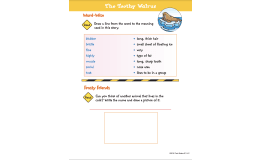
Context-based vocabulary — students select the correct definition of multiple-meaning words like 'sway' and 'smart' as used in 'Babysitting Workout.'
Good to know
Questions teachers ask about this resource
Why does the vocabulary page for 'Babysitting Workout' ask students to pick from multiple listed meanings instead of writing a definition?
The passage's word-meaning task is multiple-choice because several of its target words (back, sway, smart, offer) have more than one common meaning, so students must select the meaning that matches how the word is used in the story rather than supply a definition from memory.

No reviews yet
Downloaded this resource? Tell other teachers how it went.
Curriculum
Standards, concepts & topics
Standards
 Standards
- CCSS.L.3.4 — Determine or clarify the meaning of unknown and multiple-meaning word and phrases based on grade 3 reading and content, choosing flexibly from a range of strategies. a. Use sentence-level context as a clue to the meaning of a word or phrase. b. Determine the meaning of the new word formed when a known affix is added to a known word (e.g., agreeable/disagreeable, comfortable/uncomfortable, care/careless, heat/preheat). c. Use a known root word as a clue to the meaning of an unknown word with the same root (e.g., company, companion). d. Use glossaries or beginning dictionaries, both print and digital, to determine or clarify the precise meaning of key words and phrases.
- CCSS.RL.3.1 — Ask and answer questions to demonstrate understanding of a text, referring explicitly to the text as the basis for the answers.
- CCSS.RI.3.1 — Ask and answer questions to demonstrate understanding of a text, referring explicitly to the text as the basis for the answers.
Core concepts
 Core concepts
Reading comprehension
Sequencing
Context clues
Vocabulary
 Topics
Explore more
Categories this resource belongs to
Explore related searches
More to explore
You may also like