Wonder End of Novel Projects
- Grades
- Grades 3–6
- Pages
- 1
- File type
- Preparation
- Print ready


- Subject
- ELA
- Topic
- Wonder, Novel study
- Resource types
- Novel Studies, Projects
- Preparation
- Print ready
- Standards
- RL.5.2
Product description
From the author
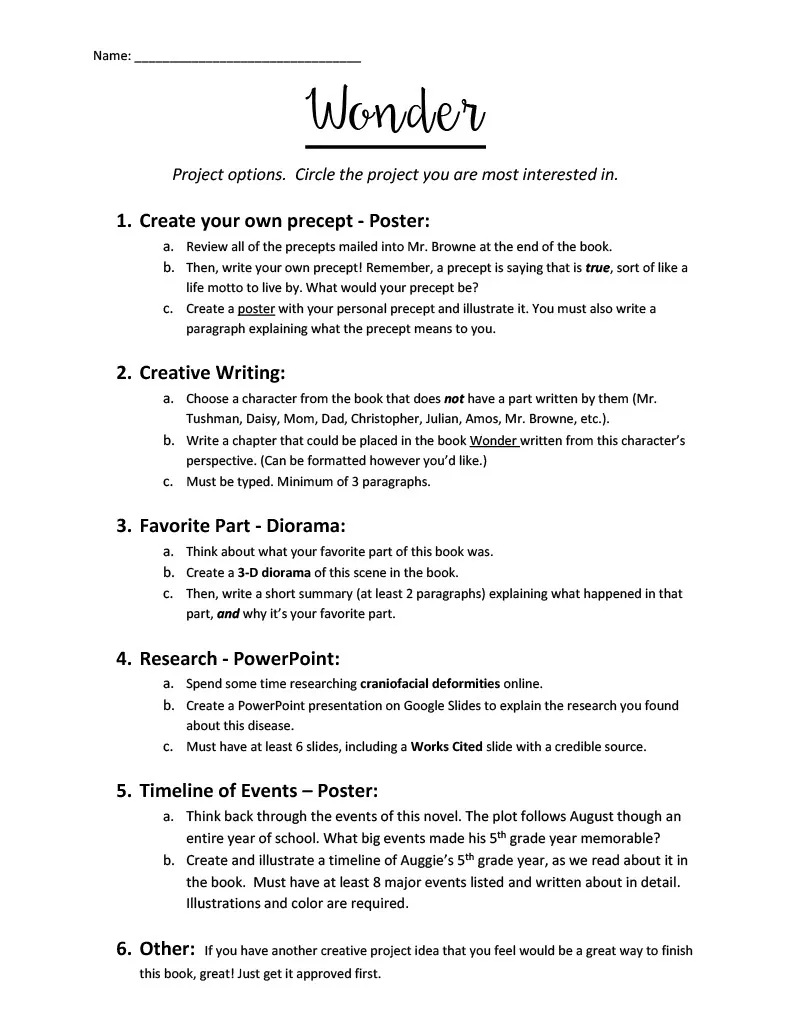
This resource is a Wonder End of Novel Projects.
If your students have just finished reading the Wonder novel, then this list of projects may be perfect for you.
It is a great way to explore creativity and apply their knowledge in a fun way.
There are 5 project options and each comes with a short description.
Related resources
More resources teachers may find useful
24 related resources were found using this product's title, contributor, categories and tags.



In the classroom
Teaching tips & learning objectives

Learning objectives
Write an original precept modelled on the ones collected at the end of the novel and explain in a paragraph what it means personally
Compose a chapter in the voice of a Wonder character who has no narrated section, keeping that character's perspective consistent with events already in the book
Summarise a chosen scene in two or more paragraphs and give reasons for choosing it

Teaching tips
Students circle their choice on the sheet, so collecting the sheets before work begins gives an instant record of who is doing which project
Option 4 is the only one that leaves the novel; agree in advance what counts as a credible source on craniofacial differences and preview the sites students will land on
Review the stated requirements for the five described choices. Agree on requirements for a student-proposed project and prepare assessment criteria suited to each format; no common rubric is supplied

Skills covered
Perspective-taking in writing — students pick a character with no narrated part and write a chapter of at least three paragraphs in that character's voice.
Sequencing a novel's plot — the timeline option requires at least eight major events from Auggie's fifth-grade year, ordered and written about in detail.
Turning a theme into a personal statement — students write their own precept after reviewing the ones collected at the end of the book, then explain its meaning in a paragraph.
Good to know
Questions teachers ask about this resource
How do students settle on one project?
They circle it on the sheet. The page opens with "Project options. Circle the project you are most interested in.", and the last line keeps a route open for a student who wants to propose something else, provided it is approved first.
Which characters does the chapter-writing option point students towards?
Ones with no narrated part of their own. Mr. Tushman, Daisy, Mom, Dad, Christopher, Julian, Amos and Mr. Browne are listed as examples, and the chapter has to be one that could sit inside the book.
What does the research option ask students to produce?
Time spent researching craniofacial deformities online, turned into a Google Slides presentation of at least six slides, one of which must be a Works Cited slide carrying a credible source.

No reviews yet
Downloaded this resource? Tell other teachers how it went.
Curriculum
Standards, concepts & topics
Standards
 Standards
- RL.5.2
Core concepts
 Core concepts
Novel response
Character perspective
Plot sequencing
Research and citation
Theme
 Topics
Explore more
Categories this resource belongs to
Explore related searches
More to explore
You may also like