



3,886 products added recently
Page 33 - 2nd Grade Activities
Boost your second graders' enthusiasm with activities that combine fun and education. These resources cover various subjects and promote critical thinking and collaboration. Use them to enrich your lessons and keep students actively involved in their learning journey.

 Show filters


Adverbs Practice Questions - Grades 3-4 Grammar (Google Docs)
ELA, Language Development, ESL, Grammar, Common Core, Resources for Teachers, Grade 3, 4, Worksheets & Printables, Worksheets, Quizzes and Tests, Teacher Tools, Tests, Assessments, Centers, Activities
Adverbs Grammar Practice MCQS ELA MCQS Overview: In this series of lessons, students will embark on an engaging journey to explore the grammar skills that make our language vibrant and expressive. These lessons are crafted to help students identify, comprehend, and effectively apply language arts skills in both writing and speech. Accompanied by free supplementary materials available for all topics, each lesson builds on the previous one, offering a balanced mix of direct instruction, interactive group activities, and independent practice. Through fun and creative tasks, students will learn to recognize grammar within sentences, understand their function, and use them to enrich their own writing and speech. Adverbs Overview: Includes: When Adverbs Where Adverbs How Adverbs Mistake Finding Google Docs Version This is the Docs editable and fillable version. This download is available in GOOGLE Docs, GOOGLE Forms, GOOGLE Slides. PDF, PPT, WORD, check the links below for more details. FULL CATALOG OF DOWNLOAD LINKS HERE Grade 3/4 Links: Adjectives Google Docs Google Forms Google Slides PDF PPT Word Free Supplementary Materials Pack Adverbs Google Docs Google Forms Google Slides PDF PPT Word Free Supplementary Materials Pack Conjunctions Google Docs Google Forms Google Slides PDF PPT Word Free Supplementary Materials Pack Nouns Google Docs Google Forms Google Slides PDF PPT Word Free Supplementary Materials Pack Pronouns Google Docs Google Forms Google Slides PDF PPT Word Free Supplementary Materials Pack Verbs Google Docs Google Forms Google Slides PDF PPT Word Free Supplementary Materials Pack Sentence Structure Google Docs Google Forms Google Slides PDF PPT Word Free Supplementary Materials Pack Present Tense Google Docs Google Forms Google Slides PDF PPT Word Free Supplementary Materials Pack Past Tense Google Docs Google Forms Google Slides PDF PPT Word Free Supplementary Materials Pack Future Tense Google Docs Google Forms Google Slides PDF PPT Word Free Supplementary Materials Pack Context Clues Google Docs Google Forms Google Slides PDF PPT Word Free Supplementary Materials Pack Defining Words Google Docs Google Forms Google Slides PDF PPT Word Free Supplementary Materials Pack Fill the Blanks Google Docs Google Forms Google Slides PDF PPT Word Free Supplementary Materials Pack Homophones Google Docs Google Forms Google Slides PDF PPT Word Free Supplementary Materials Pack Synonyms Google Docs Google Forms Google Slides PDF PPT Word Free Supplementary Materials Pack ELA Review Questions Overview Questions have three answer choices. There are a handful of pictures on each test for aesthetic purposes, as well as a review sheet covering most of the topics covered in the product. Introduction or Example Sheet Each topic will include an introduction or example sheet to go through first with your students. Full Answer Keys Full answer keys and sample responses are provided so no matter how busy you are, you know you're covered! In the Supplementary Pack Interactive Ice Breakers: Fun, hands-on activities that get students thinking about adjectives right from the start. Guided Practice: Teacher-led exercises that reinforce the day’s lesson, ensuring students can confidently identify and use adjectives. Group and Partner Tasks: Collaborative activities that allow students to work together to solve problems, categorize adjectives, and create descriptive sentences. Independent Worksheets: Structured worksheets that provide individual practice and help solidify understanding of key concepts. Exit Tasks: Quick, reflective activities at the end of each lesson that assess understanding and encourage students to apply what they’ve learned. For similar downloads and other frees, do check out Cored Group on TeachSimple.
Author Cored Education
Tags Elementary, Answers, Ccss, Common Core, Grammar, Tests, Test Prep, Grade 3, Grade 4, Digital Centers

Carnivals Reading Comprehension Passage - Cored Ed Encyclopedia
ELA, Language Development, Reading Comprehension, Reading, Writing, Pre-Reading, Vocabulary, Geography, Social Studies, History, Grade 2, 3, 4, 5, Worksheets & Printables, Worksheets, Teacher Tools, Centers, Activities, Writing Prompts, Assessments, Quizzes and Tests, Quizzes, Lesson Plans
This carnivals reading comprehension with lesson plan includes: Visualization (on the front cover) Start your lesson by taking a minute to think and share something about the topic. Read the script aloud (slowly), perhaps prepare some music or sound effects. Student close their eyes and let their imaginations wander. Students open their eyes, read the question aloud and give them a few minutes to complete. Ask a few students to share or keep answers until the end to compare with what they learn in the passage. Quick pause—thousands of Cored Education products are included with your TeachSimple membership. Download links and encyclopedia index available here. Pre-Reading Trivia Students will write down one thing they already know about the subject and then read five more facts and discuss. These facts are fun, and the students will enjoy learning about the subject before reading more. Give 1 minute for students to write what they already know (no pressure—best guess is fine). Read the five facts together. After each fact, do ask a student for their opinion, was it surprising? Set a purpose by asking students to highlight/underline one fact they want to learn more about during the reading. Reading Passage The text is a high-interest reading passage with set paragraphs, roughly three to four paragraphs long. It contains a variety of themes about the topic, anywhere from history to technology. The passage is between 250 and 350 words in length. First, ask students to look at the headings and see what they’ll learn about today. What do they know about the topic/heading? First read options: Teacher read-aloud (best for support). Partner reading (paragraph by paragraph). While reading, students underline important details, and vocabulary words they think may come up in the questions section. Mixed Questions The first question page contains four multiple-choice questions, each with a choice of four answers, and three written response questions that require a sentence or two from the student. Students complete the mcqs first independently, then review quickly as a class. For the 3 written responses, try to get students giving the answer with some form of evidence: “I think ___ because the text says ___.” If students get stuck, send them back to check the passage. Vocabulary Questions Practice seven key words from the text in this section across two activities. First section is scrambled words where students will unscramble three words given a clue for each. The second section is a word to meaning matching activity. Before starting, have some students read out words they underlined in the passage. Ask students to say the word and read aloud the sentence(s) around each word. Ask students to do scrambled words and the matching exercise in pairs then go through answers as a class. For the scrambled spelling task, get four pairs to come up to the board and write the words for extra practice with the other student reading out the clue. For the matching task, prompt students to give full sentences: “I matched ___ with ___ because ___.” Creative Writing In this question, the student will be required to write a five to eight sentence paragraph on a question related to the topic. Before starting, ask students write down 3 key ideas they are going to include in their piece. Ask students for ideas to share around the class to help those struggling. Pro writing expectations: 5–8 sentences At least 2 facts or details from the passage At least 2 vocabulary words from the previous page Students read their paragraphs while classmates listen for facts and vocabulary words. Extension Activities This page is optional for fast finishers or to take home. There are several activities, each one requiring a different skill. Do some, do none, do all, completely optional - but you will feel reassured knowing every possibility is planned for. Includes summary writting question and additional facts. Answer Key There are answers for the multiple-choice questions, written response questions have sample answers, vocabulary answers and if there is a summary question then a sample summary will be provided as well. Lesson Plan Included Customized lesson plan for this lesson is included. Lesson Snapshot Title: Carnivals Genre: Nonfiction (informational passage with headings) Subject: Reading (Informational Text) / Social Studies Primary Topic: What Carnival is and why it matters Estimated Guided Reading Level (A–Z): P What This Lesson Teaches Best Builds cultural background knowledge by explaining Carnival as a time right before Lent in many Christian communities. Shows how celebrations can look different in different places (Venice, France/Mardi Gras, Rio de Janeiro). Teaches multiple-meaning vocabulary by explaining that “carnival” can also mean a traveling fair with rides and games (especially in the United States). Supports comprehension of informational text structure by using headings to organize ideas (history/background, examples, traveling fairs, reasons people celebrate). Highlights theme/central message: carnivals help people “step out of ordinary life” and remember shared joy. Learning Goals Students will explain what Carnival is and when it happens, using details from the passage. Students will describe how Venice, France (Mardi Gras), and Rio de Janeiro shaped Carnival in different ways. Students will identify two meanings of the word carnival as used in the passage. Students will summarize why people “keep making carnivals,” based on the author’s explanation. Students will use headings to locate information and confirm key details in the text. Key Vocabulary From the Text fasting — not eating for a period of time. reflection — careful thinking about life. mingle — mix with other people in a group. floats — decorated platforms used in parades. routines — the usual things you do regularly. FULL CATALOG OF DOWNLOAD LINKS AND ENCYCLOPEDIA INDEX HERE
Author Cored Education
Rating
Tags Vocabulary, Reading Comprehension, Reading Passages, Lesson Plans, Ela Lesson Plans, Reading Comprehension Lesson Plans, Pre-reading, Social Studies Lesson Plans, Geography, History
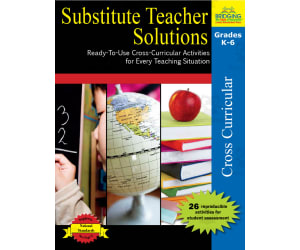
Substitute Teacher Solutions: Ready-To-Use Cross-Curricular Activities for Every Teaching Situation
, Preschool, Grade 1, 2, 3, 4, 5, 6, Activities
Substitute Teacher Solutions: Ready-To-Use Cross-Curricular Activities for Every Teaching Situation An intentionally crafted tool that provides a range of educational materials for every conceivable classroom scenario, this resource is developed with the highest quality. It caters to a variety of teaching situations from Kindergarten up through Grade 6. About This Comprehensive Guide: This guide includes 64 pages – all in an easily accessible PDF format – filled with ready-to-print activities and engaging articles designed specifically for educators who seek sensible, sturdy solutions for their teaching needs. Compiled in it are resources suited not only to regular classroom teachers but also those times when it becomes necessary to have a substitute teacher step in. What You'll Discover: Twelve riveting articles Twenty-six reproducible activities that align harmoniously with the National Education Standards Vast topics including ants and birds to Egypt's Abu Simbel temples and submersibles Rather popular subjects like the Olympics, pandas, pirates - even pizza! The vast selection ensures there will always be something intriguing available for every student, no matter their interests! The Benefit Of Flexibility: This product offers the flexibility of using these ready-to-use materials as fully-fledged complete units or simply used as quick activity breaks interspersed between other lesson plans. A Toolkit Designed By Experienced Educators: Substitute Teacher Solutions is your on-demand toolkit crafted by experienced educators who understand first-hand realities faced by both full-time teachers and substitutes alike. These resources are fit not only for classrooms across public schools nationwide but can also be utilized by homeschooling parents. In Conclusion... Substitute Teacher Solutions: Ready-To-Use Cross-Curricular Activities for Every Teaching Situation offers flexible yet structured learning resources conveniently packed into one efficient guide fit for any teaching situation that might come your way.
Author Classroom Complete Press
Tags Cross-curricular Activities, Substitute Teacher, Teacher Solutions, Sub Plans, Emergency Lesson Plans, Activities For A Substitute Teacher, Substitute Teacher Activities, Substitute Teaching Materials, Activities For Substitute Teachers

Equivalent Fractions Activity - Bingo Game - Fraction Circles - Boards 6-10
Math, Fractions, Grade 2, 3, 4, Activities, Games
Equivalent Fractions Bingo engages students in finding equivalent fractions in a fun, competitive game. This multiplication resource includes 4 sets of calling cards with fractions represented as circles, squares, strips, and symbols. Also included are 5 bingo boards in color and black and white. To play, students match the fractions on their bingo board to the calling card. The first student to cover 3 spaces in a row wins! This whole-group game is perfect for reinforcing equivalent fractions. Students stay engaged as they compete to win. With different card formats and multiple boards, the game can be differentiated. Laminate materials for durability and reuse year after year. Equivalent Fractions Bingo transforms fraction practice into an exciting, multiplayer game!
Author Colleen's Cosmic Collection
Tags Fractions, Fraction Game, Fractions Activity, Fractions Games, Equivalent Fractions, Equivalent Fraction Game, Equivalent Fractions Game, Equivalent Fractions Activity, Math Games, Cccfbec

Melody's Mystery Game-An SEL Cooperative Game for Kids
Special Resources, Social Emotional Learning (SEL), Life Skills, Social Skills, Grade 3, 4, 5, 6, 7, Activities, Games
In this resource, students will work together to solve Melody's Mystery! Melody is an actress and has lost something at the Golden Globe Award ceremony. Students will need to decide what is missing, who took it and where it is. Students will work together cooperatively and problem solve together to solve this mystery. There are 18 clues to be passed around to a group of students (4-5 students works best) and then they will read out loud each clue. As they read the clues, the group will eliminate the suspects one by one and there is one person who will cross off the ones that are incorrect. This is a great game for students to play to practice listening skills, leadership skills, problem-solving skills and deductive skills. For more SEL products, please visit my SEL store here; https://teachsimple.com/contributor/jennifer-moyer-taylor For more SEL products that you may enjoy, try this mystery called Mariah's Mystery! This is a different story to solve! https://teachsimple.com/product/mariahs-mystery-a-fun-sel-cooperative-game-for-kids For other SEL resources, games, presentations, check these out: https://teachsimple.com/product/sel-boom-deck-soda-pop-head-with-audio (These are Boom Cards to teach students to learn about anger management. You can read the book Soda Pop Head by Julia Cook and then have students take turns at the Whiteboard to decide if someone stayed calm under pressure or if they "lost their temper". https://teachsimple.com/product/20-hidden-objects-and-find-the-differences-puzzles-and-games (20 fun hidden picture, find the differences, etc. handouts that are great for brain breaks, transition times, early finishers, and there are many for specific holidays for around the year fun.) https://teachsimple.com/product/intent-versus-impact-sel-presentation (In this SEL presentation, students will learn about the difference between intent and impact. This is an important concepts for students to understand. Even if one person has good intentions, what they say or do may have a completely different impact! There are links to fun videos and a partner/group activity.)
Author Jennifer Moyer Taylor
Tags Sel, Social Emotional Learning Game, Mystery Game, Cooperative Game, School Counseling, Social Skills, Sel Game, Leadership Skills, Cooperation
Pumpkin No Prep Literacy and Math Activity Packet
Science, Earth and Environmental Sciences, Life Sciences, Nature & Plants, Grade 1, 2, 3, Activities
Pumpkin No Prep Literacy and Math Activity Packet The Pumpkin No Prep Literacy and Math Activity Packet is a comprehensive 36-page educational resource devised to provide engaging pumpkin-themed activities for students in Grades 1 to 3. It offers differentiated learning materials, catering to a variety of learning capacities in a classroom environment. The packet includes scientifically inclined activities such as: Pumpkin Life Cycle Dial Craftivity Pumpkin Circumference Measurement Activity A Comprehensive Exploration Journey Filled with colorful tasks and educational material, this pumpkin-themed adventure covers the following aspects: Reading Material: 'Pumpkin Vocabulary', 'Pumpkin Fun Facts'. Interactive Tasks: 'Pumpkin Draw and Write'. Creative Outlets: Writing acrostic poetry or studying symmetry using pumpkins. Math Activities: Utilizing pumpkin seeds or working out word problems related to pumpkins. Literacy & Mathematics The literacy section leverages reading responses for effective comprehension while math practices are livened through innovative methods such as hidden pictures in addition tasks or coloring by numbers exercises, all designed keeping necessary numeracy skills in mind at these grade levels. Diverse Learning Settings This PDF packet can be used effectively across different schooling environments, including public classrooms or homeschooling settings. It can facilitate whole-group lessons, small group discussions prompted by teacher prompts or even serve as an engrossing homework assignment!
Author KP Classroom
Tags Pumpkin Life Cycle, Pumpkin Crafts, Literacy Activities, Math Activities, Differentiated Learning, Literacy Pumpkin, Literacy Pumpkins, Fun Packet
NO PRINT Community Helpers Receptive Expressive Language Activities Pack
Special Resources, Speech Therapy, Preschool, Grade 1, 2, 3, 4, 5, Activities
NO PRINT Community Helpers Receptive Expressive Language Activities Pack The NO PRINT Community Helpers Receptive Expressive Language Activities Pack is an interactive, easy-to-use language learning resource. Focusing on syntax, semantics, and morphology skill development in students, it offers both educational efficiency with a fun theme around community helpers. Best suited for virtual classrooms or in-person teaching sessions requiring ready-to-use stimuli without hardcopies. An added layer of engagement is offered: a bonus game titled "Mail a Package", which allows students to actively participate and maintain focus while they learn. Navigating the activities is straightforward - students can easily return to the home page by clicking 'home' or go forward to subsequent pages using 'next'. Selecting from listed options and returning to visited screens can also be achieved with simple clicks. Educational Activities Pack Components: 15 pages of developing analogies: Using pictured choices for visual aid in understanding word relations. Pronouns (Subjective, Objective, Possessive) over 30 pages: Contributes towards grasping basic grammatical concepts. A prepositions-focused segment encompassing 15 interactive pages: Dedicated section for comparing & contrasting via descriptions spanning another set of 15 interactive pages. Exploring inference skills over its own set of featured resources; that's an additional dedicated subset spanning yet another collection of captivatingly curated informative screens! Bonus Game: Doctor Visit It winds up this linguistic quest! Suitable across all referenced grades. Teachers can adjust this pack's flexible approach to suit their instructional methods - perfect for whole group work, equally effective in small groups or even as homework. With unmatched scope in both content and delivery, this activity pack is a commendable resource for educators invested in language competence and overall skill enhancement.
Author Intrepid Speech Therapy Materials
Tags Interactive Learning, Community Helpers, Language Development, Receptive Skills, Expressive Skills, Expressive Language Activities

All About Bees Book and Activities
ELA, Science, Life Sciences, Nature & Plants, Biology, Earth and Environmental Sciences, Environmental Science, Reading, Grade 2, 3, Activities
All About Bees Book and Activities This resources includes: 6 page bee book "A Bee's Life" Questions for the book Deciphering bee's activity Finding bee related words activity 3 word wall cards relating to bees answer key Your students will enjoy building the cute bee book included as they color, cut, and assemble. After they read their book they will get to go over what they learned about bees by answering 5 questions. The activities included will help students recall vocabulary relating to bee's. The 3 word wall cards include the vocabulary words nectar, pollen, and reproduce. This set is best suited for second/third graders. Enjoy! All About Bees Book and Activities All About Bees Book and Activities All About Bees Book and Activities All About Bees Book and Activities All About Bees Book and Activities All About Bees Book and Activities All About Bees Book and Activities All About Bees Book and Activities All About Bees Book and Activities All About Bees Book and Activities --------------------------------------------------------------------------------------------------- ♡ ♥ Follow me to be notified of NEW resources! All right reserved by author. By purchasing this resource, you have the right to use this resource in your classroom. Duplicating any parts of this resource for commercial use or sharing it with others is forbidden without written permission from the author. No part of this resource may be loaded to the internet, except to password protected sites for your students’ use. Violations are subject to penalties under the Digital Millennium Copyright Act (DMCA).
Author Soumara Siddiqui
Tags All About Bees, Bees Worksheets, Bee Book, Bee Activities
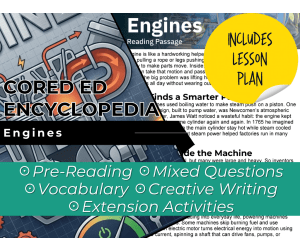
Engines Reading Comprehension Passage - Cored Ed Encyclopedia
ELA, Reading Comprehension, Reading, Science, Technology, Pre-Reading, Language Development, Physics, History, Social Studies, Grade 2, 3, 4, 5, Worksheets & Printables, Worksheets, Teacher Tools, Centers, Activities, Writing Prompts, Assessments, Quizzes and Tests, Quizzes, Lesson Plans
This engines reading comprehension with lesson plan includes: Visualization (on the front cover) Start your lesson by taking a minute to think and share something about the topic. Read the script aloud (slowly), perhaps prepare some music or sound effects. Student close their eyes and let their imaginations wander. Students open their eyes, read the question aloud and give them a few minutes to complete. Ask a few students to share or keep answers until the end to compare with what they learn in the passage. Quick pause—thousands of Cored Education products are included with your TeachSimple membership. Download links and encyclopedia index available here. Pre-Reading Trivia Students will write down one thing they already know about the subject and then read five more facts and discuss. These facts are fun, and the students will enjoy learning about the subject before reading more. Give 1 minute for students to write what they already know (no pressure—best guess is fine). Read the five facts together. After each fact, do ask a student for their opinion, was it surprising? Set a purpose by asking students to highlight/underline one fact they want to learn more about during the reading. Reading Passage The text is a high-interest reading passage with set paragraphs, roughly three to four paragraphs long. It contains a variety of themes about the topic, anywhere from history to technology. The passage is between 250 and 350 words in length. First, ask students to look at the headings and see what they’ll learn about today. What do they know about the topic/heading? First read options: Teacher read-aloud (best for support). Partner reading (paragraph by paragraph). While reading, students underline important details, and vocabulary words they think may come up in the questions section. Mixed Questions The first question page contains four multiple-choice questions, each with a choice of four answers, and three written response questions that require a sentence or two from the student. Students complete the mcqs first independently, then review quickly as a class. For the 3 written responses, try to get students giving the answer with some form of evidence: “I think ___ because the text says ___.” If students get stuck, send them back to check the passage. Vocabulary Questions Practice seven key words from the text in this section across two activities. First section is scrambled words where students will unscramble three words given a clue for each. The second section is a word to meaning matching activity. Before starting, have some students read out words they underlined in the passage. Ask students to say the word and read aloud the sentence(s) around each word. Ask students to do scrambled words and the matching exercise in pairs then go through answers as a class. For the scrambled spelling task, get four pairs to come up to the board and write the words for extra practice with the other student reading out the clue. For the matching task, prompt students to give full sentences: “I matched ___ with ___ because ___.” Creative Writing In this question, the student will be required to write a five to eight sentence paragraph on a question related to the topic. Before starting, ask students write down 3 key ideas they are going to include in their piece. Ask students for ideas to share around the class to help those struggling. Pro writing expectations: 5–8 sentences At least 2 facts or details from the passage At least 2 vocabulary words from the previous page Students read their paragraphs while classmates listen for facts and vocabulary words. Extension Activities This page is optional for fast finishers or to take home. There are several activities, each one requiring a different skill. Do some, do none, do all, completely optional - but you will feel reassured knowing every possibility is planned for. Includes summary writting question and additional facts. Answer Key There are answers for the multiple-choice questions, written response questions have sample answers, vocabulary answers and if there is a summary question then a sample summary will be provided as well. Lesson Plan Included Customized lesson plan for this lesson is included. Lesson Snapshot Title: Engines Genre: Nonfiction (Informational Text) Subject: Science (Physical Science/Technology) / Reading (Informational Text) Primary Topic: How engines turn energy into motion Estimated Guided Reading Level (A–Z): P What This Lesson Teaches Best Explains the core idea that an engine turns energy into motion , using heat, fuel, or electricity to make parts move. Builds understanding of how steam engines work (boiling water makes steam push a piston) and how designs became more efficient (Watt’s separate condenser idea). Describes internal combustion engines and the four-step cycle (take in, squeeze, burn/push, exhaust) that repeats. Connects parts and motion: pistons moving back-and-forth can turn a crankshaft to keep rotation going. Introduces electric motors as another way to change energy into motion using magnetism and current to spin a shaft. Learning Goals Students will explain how an engine changes energy into motion using heat, fuel, or electricity. Students will describe how steam can push a piston in an early steam engine. Students will explain why a separate condenser made a steam engine design more efficient. Students will identify how an internal combustion engine makes motion by burning fuel inside a chamber. Students will list the four repeated steps of a four-stroke engine as stated in the passage. Students will describe how an electric motor uses magnetism and current to spin a shaft. Key Vocabulary From the Text piston — a part pushed by steam or hot gases. condenser — a part that cools steam somewhere else. combustion — burning fuel to make hot gases. crankshaft — a part that keeps turning as pistons move. magnetism — a force used with current to make a shaft spin. FULL CATALOG OF DOWNLOAD LINKS AND ENCYCLOPEDIA INDEX HERE
Author Cored Education
Rating
Tags Vocabulary, Reading Comprehension, Reading Passages, Lesson Plans, Ela Lesson Plans, Reading Comprehension Lesson Plans, Pre-reading, Science Lesson Plans, Technology, Physics

Science Reading Comprehension Passage 4: States of Matter PPT
Science, Physics, Common Core, ESL, Language Development, ELA, Reading Comprehension, Reading, Resources for Teachers, Grade 2, 3, 4, Activities, Assessments, Teacher Tools, Tests, Quizzes and Tests, Presentations
Free Reading Passage on States of Matter for Physical Science What's inside this free product? Science Reading Comprehension Passage4: States of Matter Independent PPT Version: This is the independent PPT version containingone lesson. Product Info: 30 SLIDES (US English with Answers) PPT Version Teaching Duration: 90 Minutes Science Reading Comprehension Outline: Targeted for students in 3rd and 4th grades, these reading passages are enhanced with illustrations and graphs to elucidate critical points. Each lesson aligns with the Common Core State Standards, allowing you to integrate science reading practice effortlessly, knowing that minimal preparation is needed on your part. Each passage comes with a variety of questions in different formats, including multiple-choice formats, data analysis, and fill-in-the-blanks. The topics covered strike a balance between engaging content and core curriculum-based science subjects. Versatile in application, these lessons are suitable for a variety of settings such as whole-class instruction, morning activities, independent desk work, small group discussions, contingency plans for substitute teachers, homework assignments, or even special holiday-themed tasks. FULL CATALOG OF DOWNLOAD LINKS HERE Grade 3/4 Links: Physical Science Part 1 - Properties of Objects and Materials Google Docs/Slides/Forms PDF PPT Word Free Supplementary Pack Accompanying Videos Physical Science Part 2 - Position and Motion of Objects Google Docs/Slides/Forms PDF PPT Word Free Supplementary Pack Accompanying Videos Physical Science Part 3 - Light, Heat, Electricity, Magnetism Google Docs/Slides/Forms PDF PPT Word Free Supplementary Pack Accompanying Videos Life Science Part 1 - Characteristics of Organisms Google Docs/Slides/Forms PDF PPT Word Free Supplementary Pack Accompanying Videos Life Science Part 2 - Life Cycles of Organisms Google Docs/Slides/Forms PDF PPT Word Free Supplementary Pack Accompanying Videos Life Science Part 3 - Organisms and Environments Google Docs/Slides/Forms PDF PPT Word Free Supplementary Pack Accompanying Videos Earth Science Part 1 - Properties of Earth Materials Google Docs/Slides/Forms PDF PPT Word Free Supplementary Pack Accompanying Videos Earth Science Part 2 - Changes in the Earth and Sky Google Docs/Slides/Forms PDF PPT Word Free Supplementary Pack Accompanying Videos Earth Science Part 3 - Objects in the Sky Google Docs/Slides/Forms PDF PPT Word Free Supplementary Pack Accompanying Videos For similar products and other frees, do check out Cored Group on TeachSimple .
Author Cored Education
Tags Science, Elementary, Reading, Comprehension, Vocabulary, Answers, Physics, Physical Science, Ccss, Common Core

CVC Words Activity Packet - Set 2
ELA, Language Development, Phonics, Preschool, Grade 1, 2, 3, Activities
This resource is a CVC Words Activity Packet - Set 2. Filled with worksheets, games and activities, there is so much to implement with this activity packet. Sounds included: b c g h All you have to do is print and go. These activities make great whole group games, homework sheets and so much more. Included: - 2 sets of posters - 10 activities and worksheets - 2 games
Author Top Notch Teaching
Tags CVC Words, Phonics, Spelling, Sounds, Matching

Reading Passage 12: Electricity, Electrical Circuits, and Energy PPT
Science, Physics, Common Core, ESL, Language Development, ELA, Reading Comprehension, Reading, Resources for Teachers, Grade 2, 3, 4, Teacher Tools, Presentations, Tests, Quizzes and Tests, Assessments, Activities
Free Reading Passage on Electricity, Electrical Circuits, and Energy for Physical Science What's inside this free product? Science Reading Comprehension Passage12 : Electricity, Electrical Circuits, and Energy Independent PPT Version: This is the independent PPT version containingone lesson with full answer keys. Product Info: 28 SLIDES (US English with Answers) PPT Version Teaching Duration: 90 Minutes Science Reading Comprehension Outline: Targeted for students in 3rd and 4th grades, these reading passages are enhanced with illustrations and graphs to elucidate critical points. Each lesson aligns with the Common Core State Standards, allowing you to integrate science reading practice effortlessly, knowing that minimal preparation is needed on your part. Each passage comes with a variety of questions in different formats, including multiple-choice formats, data analysis, and fill-in-the-blanks. The topics covered strike a balance between engaging content and core curriculum-based science subjects. Versatile in application, these lessons are suitable for a variety of settings such as whole-class instruction, morning activities, independent desk work, small group discussions, contingency plans for substitute teachers, homework assignments, or even special holiday-themed tasks. FULL CATALOG OF DOWNLOAD LINKS HERE Grade 3/4 Links: Physical Science Part 1 - Properties of Objects and Materials Google Docs/Slides/Forms PDF PPT Word Free Supplementary Pack Accompanying Videos Physical Science Part 2 - Position and Motion of Objects Google Docs/Slides/Forms PDF PPT Word Free Supplementary Pack Accompanying Videos Physical Science Part 3 - Light, Heat, Electricity, Magnetism Google Docs/Slides/Forms PDF PPT Word Free Supplementary Pack Accompanying Videos Life Science Part 1 - Characteristics of Organisms Google Docs/Slides/Forms PDF PPT Word Free Supplementary Pack Accompanying Videos Life Science Part 2 - Life Cycles of Organisms Google Docs/Slides/Forms PDF PPT Word Free Supplementary Pack Accompanying Videos Life Science Part 3 - Organisms and Environments Google Docs/Slides/Forms PDF PPT Word Free Supplementary Pack Accompanying Videos Earth Science Part 1 - Properties of Earth Materials Google Docs/Slides/Forms PDF PPT Word Free Supplementary Pack Accompanying Videos Earth Science Part 2 - Changes in the Earth and Sky Google Docs/Slides/Forms PDF PPT Word Free Supplementary Pack Accompanying Videos Earth Science Part 3 - Objects in the Sky Google Docs/Slides/Forms PDF PPT Word Free Supplementary Pack Accompanying Videos For similar products and other frees, do check out Cored Group on TeachSimple .
Author Cored Education
Tags Science, Elementary, Reading, Comprehension, Vocabulary, Answers, Physics, Physical Science, Ccss, Common Core
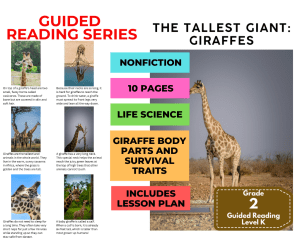
Guided Reading Level K - Tallest Giant Giraffes (with Lesson Plan)
ELA, Resources for Teachers, Reading Comprehension, Reading, Science, Language Development, Life Sciences, Animals, Pre-Reading, Vocabulary, Grade 2, 3, 4, Worksheets & Printables, Worksheets, Teacher Tools, Centers, Activities, Literacy Readers, Quizzes, Quizzes and Tests, Assessments, Lesson Plans
This Guided Reading Book - Tallest Giant Giraffes (Level K) with lesson plan includes: Guided Reading Color Label (front cover x1) This is a quick way to match the book’s demands to what students can generally handle.. The overall goal is to use the level/color to pick books for several smaller groups. To qualify for a certain level, a student is expected to read a book from that level with about 90–94% accuracy. If a student is consistently accurate and understands, move up a level. If the student is struggling at that level, drop down and add more support. Each student will improve at completely different rates, but it is generally one of the best ways to check progress across the class. DOWNLOAD THE CATALOG TO VIEW ALL GUIDED READING BOOKS AVAILABLE (SORTED LEVELS A-Z) Pre-Reading Question (x1) Teacher asks the prompt aloud, can be while showing the cover or first page. Students share what they already know, or make educated guesses from the cover. Prompt them to use the target vocabulary. Write some of their responses on the board to look back at during the reading. Vocabulary Words (x5) Introduce the five words, best doing it one at a time. Start by saying it, while students repeat and then see if anyone knows what it means before reading further. Read through the meaning and try to briefly connect each word to a picture or gesture so it’s meaningful. Ask students to flip through the book pages and point to where they see each of the vocabulary words. While reading the book pause upon coming across one of the vocab words or read the sentence twice to make sure students understand the word has appeared. Optional: Ask students to raise hands whenever they see/hear one of the new words. Guided Reading Pages (x10) Check the book snapshot (below) for: primary topic - do you need to prep extra reading or intro materials on this? what is taught best - decide on 1-2 bullets to focus on, use the prompt or words provided here for best results. learning goals - what you are checking for students to be able to do after the session, elicit answers using prompts or words provided. key vocabulary (see section above). questions overview - so you know what is coming up and if you need to prep extra materials to assist understanding. Run the lesson You may have already looked at a few of the pages together, but you can show them some of the pictures again first to set meaning. Depending on how much time you have and how familiar your students are with guided reading class, you may want to read the book aloud first with the group first. Students whisper or partner read, while you listen in. If time, do it as a group, one student reading a page each. Use the guided page’s prompts to coach: “Check the picture / does it make sense?” “Point under the words / try the first sound” “Reread the sentence smoothly”. Try to focus more on one student per session (rotating every time), so you can work out if they are ready to move up or need to move down a level. Comprehension Questions (back cover x3) This is your way to check that students didn’t just say the words, but actually understood the text. First, let students answer by pointing to the page/picture and saying a short sentence. After any answer, follow with: “Show me where you found that in the text.” In bigger groups, have partners answer first (10–20 seconds), then call on 2–3 students to share. Differentiation tips: Emerging speakers/struggling readers: oral + pointing On-level: oral in a full sentence Higher: one written sentence or draw + label Book Snapshot Title: The Tallest Giant: Giraffes Genre: Nonfiction (informational) Subject: Life Science + Reading (Informational Text) Primary Topic: Giraffe body parts and survival traits Estimated Guided Reading Level (A–Z): K What This Book Teaches Best Giraffes are the tallest land animals and live in the warm, sunny savanna in Africa. A giraffe’s long neck helps it reach “juicy green leaves” on tall trees that other animals cannot touch. Giraffes use a long, strong, dark tongue to wrap around branches and pull off leaves, even with sharp thorns. Each giraffe has a unique pattern of spots; no two have the exact same shapes or colors on their fur. The text highlights survival behaviors and features (drinking stance, short standing naps for safety, fast running, and newborn calf size). Learning Goals Students will describe where giraffes live using details from the text. Students will explain how a giraffe’s long neck helps it get food. Students will describe how a giraffe uses its tongue to pull off leaves, even when there are thorns. Students will explain what is unique about each giraffe’s spots. Students will describe what a giraffe must do to drink water and why it is hard to reach the ground. Students will identify two facts about how giraffes stay safe or move (short naps standing up; running up to thirty-five miles per hour; traveling long distances). Key Vocabulary From the Text savanna — a warm, sunny place with grass and tall trees. juicy — full of liquid; wet and tasty. thorns — sharp points on a plant that can poke you. unique — one of a kind; not the same as others. ossicones — small, fuzzy horns on top of a giraffe’s head. Discussion Prompts Pre-reading question: What body parts might help a giraffe get food and stay safe? Comprehension questions: How does a giraffe’s long neck help it reach food that other animals cannot touch? Comprehension questions: What does the book say a giraffe must do to drink water? Comprehension questions: What is special about each giraffe’s pattern of spots? Printing Tips 1. Best Printing Method (Recommended) “Booklet” Printing (Best if Available) If your printer or PDF viewer supports Booklet Printing , use this. Settings to use: Print mode: Booklet Paper size: Letter or A4 (either works) Orientation: Landscape Print on both sides: Yes Flip on: Short edge Scaling: Fit to printable area Booklet subset: First test: Front sides only Then: Back sides only This will automatically: Pair pages correctly Put the cover on the outside Align everything for folding After printing, fold in half and staple along the spine . 2. If “Booklet” Printing Is NOT Available You can still print this correctly with manual duplex printing . Step-by-step: Open the PDF. Choose Print . Set: Orientation: Landscape Pages per sheet: 1 Print on both sides: Yes Flip on: Short edge Print all pages . Because each PDF page already contains two facing book pages, the result will still fold cleanly into a book. Thousands of Cored Education products are included with your TeachSimple membership. Download links and encyclopedia index available here.
Author Cored Education
Rating
Tags Reading Comprehension, Reading Passages, Reading, Guided Reading, Guided Reading Lesson Plan, Guided Reading Activity, Pre-reading, Science Lesson Plans, Life Science, Animals
Geometry: Board Game for 3rd-5th - MAC Software
Math, Geometry, Common Core, Grade 3, 4, 5, Activities, Games
Geometry: Board Game for 3rd-5th - Mac Software A unique education tool, designed to provide an engaging and interactive platform where students can sharpen their geometry skills while having fun. Specifically serving learners in grades 3-5, this software game reinforces fundamental geometric concepts as framed within the Five Strands of Math. This resource is more than just a game ; it's an educational tool aligning with the Common Core State Standards and the National Council of Teachers of Mathematics (NCTM) standards , guaranteeing its quality and effectiveness. Its questions explore various aspects within geometry such as: Lines Shapes Angles This approach ensures a well-rounded understanding of basic geometry principles. The product is provided as a zip file specifically tailored for MAC operating systems—no additional downloads required—making it incredibly convenient. Friendly Competition Promotes Learning In this interactive environment, students learn better together by forming two teams. This friendly rivalry turns learning from mundane tasks into thrilling challenges keeping kids interested while imparting vital lessons in geometry. Versatile Implementation Options The software application works in various settings: whole-group activities during class time; small group sessions for more personalized attention or even home assignment—an excellent chance at self-paced learning beyond classroom walls. In conclusion, Geometry: Board Game for 3rd-5th - Mac Software stands out from conventional teaching tools because of its captivating way to consistently deliver high-quality educational material, whether at home or school setting making math topics engaging and easily comprehensible while simultaneously encourage kids' intrinsic motivation towards learning math topics joyfully.
Author Classroom Complete Press
Tags Geometry, Board Game, Math Game, Digital Geometry, Shapes Game

Alliteration Poem Template Poetry Writing Activity with Examples
ELA, Poetry, Literature, Homeschool Templates, Grade 2, 3, 4, 5, Centers, Activities, Graphic Organizers, Teacher Tools, Lesson Plans, Rubrics, Worksheets & Printables
Looking for a way to help your students actually understand alliteration without it turning into a bunch of random or overly silly sentences? I’ve found that alliteration can be one of those concepts students either overdo or don’t quite grasp, especially when they’re trying to apply it in their own writing. Having a bit of structure really makes a difference. This activity gives students a starting point, so they’re not guessing what to do. Instead of just identifying alliteration, they’re using it in their own poems, which helps it stick. The examples make it easier for them to see what’s expected, and the templates guide them through the process without taking away their creativity. In my experience, this works well whether you’re introducing alliteration for the first time or revisiting it during a poetry unit. You can model a few examples together, then let students have a go using the templates. Some will need a bit more support, and others will run with it—but the structure is there for both. Once they’ve drafted their poem, they can create a final version to display. It’s one of those activities where students actually enjoy reading each other’s work, which is always a win. There’s also a simple lesson outline included if you want something easy to follow, along with a rubric to make marking more straightforward. It fits nicely into literacy rotations, whole-class lessons, or even as something to leave for early finishers when you need a meaningful task that doesn’t require a lot of extra explanation. Items Included Alliteration poem interactive notebook templates Student-friendly example (color and blackline posters) Step-by-step lesson plan Publishing page for a final copy Assessment rubric
Author Teach2Tell
Rating
Tags Poetry Lesson Plan, Poetry Writing Activity, Alliteration Poem Template, Alliteration Activity, Alliteration Examples, Phonics Alliteration, Literacy Centers Writing, Creative Writing Activity, Figurative Language Activity, Poetry Lesson Elementary
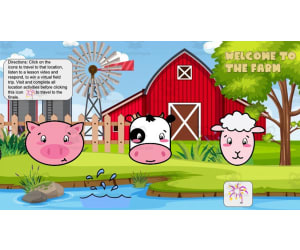
The Musical Farm | Virtual Field Trip
Creative Arts, Art, Music, Preschool, Kindergarten, Grade 1, 2, 3, 4, 5, 6, Songs, Activities
This resource is a musical virtual field trip to the farm for littles to enjoy. They will listen to and learn about different musical techniques while having fun watching farm animals.
Author Joyful Noise Teaching
Tags Music Lesson, Music Activity, Farm Lesson, Field Trip, Virtual Lesson

Prefix Super Sentence Reading Rings
ELA, Language Development, Phonics, Grade 2, 3, 4, Activities, Centers, Worksheets & Printables, Task Cards
Practice reading words with the prefix SUPER- with these sentence reading rings. Students will read words with the prefix super- in the context of sentences. Each card also includes a bold and colorful image to illustrate each sentence and to help students to learn the meanings of each word. What is Included: This resource includes one reading ring activity for the prefix super. There are cards each featuring a different word with the prefix super, with a sentence using the word in context and an image to illustrate that sentence. When to Use Early Finishers - If students finish their work early, they can use these reading rings for extra practice. Small Group Work - Teachers can use these reading rings to target small groups of students who need more practice reading words with prefixes. Independent Practice - Students can work independently at their desks to read this set of prefix cards. Morning Work - Students can read and review this reading ring for morning work as their classmates arrive to class. How to Make: Teachers will print out the pages and cut each card apart. Once cut apart, the teacher can choose to laminate the cards for durability. Then, use a hole punch to punch a hole in the top left corner of the card. Place the cards on a ring to create your reading ring, making sure the cover card is on top. Skills Assessed: These reading rings help with identifying words with prefixes These reading rings help with learning the meaning of prefixes These reading rings help students learn how prefixes change the meaning of words. These affixes reading rings are a low prep activity for teachers to prepare for students to use. Once created, these cards can be used over and over to practice reading words with prefixes in the context of a sentence.
Author The Connett Connection
Tags Affixes, Morphology, Prefixes, Literacy Activities, Reading Words With Prefixes
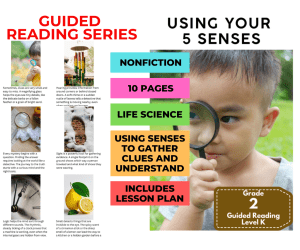
Guided Reading Level K - Using Your 5 Senses (with Lesson Plan)
ELA, Resources for Teachers, Reading Comprehension, Reading, Pre-Reading, Language Development, Human Body, Life Sciences, Science, Vocabulary, Grade 1, 2, 3, Worksheets & Printables, Worksheets, Teacher Tools, Centers, Activities, Literacy Readers, Quizzes, Quizzes and Tests, Assessments
This Guided Reading Book - Using Your 5 Senses (Level K) with lesson plan includes: Guided Reading Color Label (front cover x1) This is a quick way to match the book’s demands to what students can generally handle.. The overall goal is to use the level/color to pick books for several smaller groups. To qualify for a certain level, a student is expected to read a book from that level with about 90–94% accuracy. If a student is consistently accurate and understands, move up a level. If the student is struggling at that level, drop down and add more support. Each student will improve at completely different rates, but it is generally one of the best ways to check progress across the class. DOWNLOAD THE CATALOG TO VIEW ALL GUIDED READING BOOKS AVAILABLE (SORTED LEVELS A-Z) Pre-Reading Question (x1) Teacher asks the prompt aloud, can be while showing the cover or first page. Students share what they already know, or make educated guesses from the cover. Prompt them to use the target vocabulary. Write some of their responses on the board to look back at during the reading. Vocabulary Words (x5) Introduce the five words, best doing it one at a time. Start by saying it, while students repeat and then see if anyone knows what it means before reading further. Read through the meaning and try to briefly connect each word to a picture or gesture so it’s meaningful. Ask students to flip through the book pages and point to where they see each of the vocabulary words. While reading the book pause upon coming across one of the vocab words or read the sentence twice to make sure students understand the word has appeared. Optional: Ask students to raise hands whenever they see/hear one of the new words. Guided Reading Pages (x10) Check the book snapshot (below) for: primary topic - do you need to prep extra reading or intro materials on this? what is taught best - decide on 1-2 bullets to focus on, use the prompt or words provided here for best results. learning goals - what you are checking for students to be able to do after the session, elicit answers using prompts or words provided. key vocabulary (see section above). questions overview - so you know what is coming up and if you need to prep extra materials to assist understanding. Run the lesson You may have already looked at a few of the pages together, but you can show them some of the pictures again first to set meaning. Depending on how much time you have and how familiar your students are with guided reading class, you may want to read the book aloud first with the group first. Students whisper or partner read, while you listen in. If time, do it as a group, one student reading a page each. Use the guided page’s prompts to coach: “Check the picture / does it make sense?” “Point under the words / try the first sound” “Reread the sentence smoothly”. Try to focus more on one student per session (rotating every time), so you can work out if they are ready to move up or need to move down a level. Comprehension Questions (back cover x3) This is your way to check that students didn’t just say the words, but actually understood the text. First, let students answer by pointing to the page/picture and saying a short sentence. After any answer, follow with: “Show me where you found that in the text.” In bigger groups, have partners answer first (10–20 seconds), then call on 2–3 students to share. Differentiation tips: Emerging speakers/struggling readers: oral + pointing On-level: oral in a full sentence Higher: one written sentence or draw + label Book Snapshot Title: Using Your 5 Senses Genre: Nonfiction (informational) Subject: Science (Human Body) / Reading Primary Topic: Using senses to gather clues and understand Estimated Guided Reading Level (A–Z): K What This Book Teaches Best How to observe like a detective by starting with a question and looking for an answer. How sight can gather evidence by noticing details like footprints and tiny clues. How hearing can provide information (like movement nearby) even when you can’t see. How smell, touch, and taste each give different kinds of information about the world. How thinking and logic connect clues “like pieces of a puzzle” to understand what happened. Learning Goals Students will explain how asking questions helps begin solving a mystery. Students will identify what sight, hearing, smell, touch, and taste can tell a person, using details from the text. Students will describe how a magnifying glass helps the eyes see “tiny details.” Students will explain how hearing can give information about something moving nearby. Students will describe how logic helps connect clues to make a clear picture of what happened. Key Vocabulary From the Text detective — a person who looks for clues to solve. evidence — facts or clues that show what happened. magnifying — making something look bigger to see details. rhythmic — having a steady, repeating beat or pattern. observation — watching carefully and noticing details. Discussion Prompts Pre-reading question: How can your senses help you find clues about the world? Comprehension questions: What does the book say sight helps you learn from a single footprint? How can hearing tell a detective something is moving nearby? According to the book, why are the five senses “keys to understanding the world”? Printing Tips 1. Best Printing Method (Recommended) “Booklet” Printing (Best if Available) If your printer or PDF viewer supports Booklet Printing , use this. Settings to use: Print mode: Booklet Paper size: Letter or A4 (either works) Orientation: Landscape Print on both sides: Yes Flip on: Short edge Scaling: Fit to printable area Booklet subset: First test: Front sides only Then: Back sides only This will automatically: Pair pages correctly Put the cover on the outside Align everything for folding After printing, fold in half and staple along the spine . 2. If “Booklet” Printing Is NOT Available You can still print this correctly with manual duplex printing . Step-by-step: Open the PDF. Choose Print . Set: Orientation: Landscape Pages per sheet: 1 Print on both sides: Yes Flip on: Short edge Print all pages . Because each PDF page already contains two facing book pages, the result will still fold cleanly into a book. Thousands of Cored Education products are included with your TeachSimple membership. Download links and encyclopedia index available here.
Author Cored Education
Rating
Tags Reading Comprehension, Reading Passages, Reading, Guided Reading, Guided Reading Lesson Plan, Guided Reading Activity, Pre-reading, Vocabulary, Life Science, Human Body
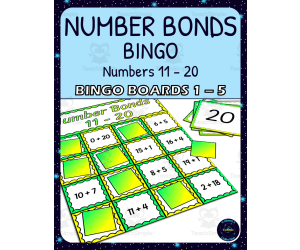
Number Bonds 11-20 Bingo - Boards 1-5
Math, Fact Families, Addition and Subtraction, Addition, Grade 1, 2, 3, Activities, Games
Number Bonds 11-20 Bingo engages students in practicing number bonds for numbers 11-20. This math game includes 5 colorful bingo boards, calling cards, and playing squares. To set up, print, laminate, and cut materials. Give each student a board and 7 playing squares. Shuffle the calling cards and draw one. Students search their boards, cover a matching number bond with a playing square. Continue drawing and covering until someone fills 3 spaces in a row and wins! Extend the game by reshuffling cards. Use bingo pieces or dry erase markers instead of playing squares. Differentiate by making boards self-checking with a removable answer key. This game offers a lively way to build fluency with number bonds. Check out more math bingo games and number bonds activities from this shop!
Author Colleen's Cosmic Collection
Tags Number Bonds, Number Bonds Games, Addition Game, Addition Activity, Math Facts, Addition Facts, Addition Math Facts, Math Fact Practice, Cccnbb1120, Cccnbba

Barack Obama Day Word Search 2nd 3rd 4th 5th Grade Worksheet Activity
Vocabulary, Language Development, ELA, Spelling, Social Studies, Grade 2, 3, 4, 5, Games, Activities, Word Searches, Worksheets, Worksheets & Printables
Make learning fun with a no-prep, printable vocabulary word search that builds vocabulary, reinforces literacy, and sparks curiosity! Students can explore the new vocabulary words while practicing spelling, scanning for letters, and identifying keywords. A word search can be a perfect and easy-to-use activity to liven up a lesson by combining learning with fun! It is an excellent way to reinforce concepts within a lesson and engage students' hands-on learning. Purpose: This activity allows students to learn new vocabulary words and contextualized vocabulary related to a topic ✏️, improve spelling, reading, and attention to detail 📚, increase awareness of concepts and knowledge about the world at large 🌍, and encourage curiosity and engagement about the topic 🐾. Word searches are a hands-on way to make learning memorable and fun for students - it engages them at all vocabulary levels! How to Do It: 1️⃣ Hand out the word search worksheet. 2️⃣ Introduce any important vocabulary or concepts that fit with the topic. 3️⃣ The students search for the words and circle or highlight each one. 4️⃣ Discuss the importance of the topic or the words that the student found. 5️⃣ Review the answers using the answer key that is included for each product ✅ Perfect For: Grades 2-5 🌟, independent practice, partner work, students who finish early, science or social studies centers, or for substitute plans 🤝 Way of Implementation: Great for independent practice early finishers, partner work, or substitute plans 🤝. Answer Keys: (these will be pencils under your three files: Given for simple checking and self-assessing. Fun Variations: Timed Challenge ⏳ - record how many words students can find in a set time. Partner Puzzle 🤝 - work together to find all of the words. Vocabulary Extension ✏️ - write sentences or a few short paragraphs using the words. Create-Your-Own Word Search 🧩 - have students make their own word search puzzles using the vocabulary. Standards Alignment: Supports CCSS/ELA vocabulary development, and can also connect to NGSS or other relevant standards, depending on the topic. File & Print Info: PDF includes both a color and black and white version, and is ink-friendly to make printing easy. Teacher Tip! Have students learn by being hands-on, engaged, and active while helping them build awareness, vocabulary, and literacy skills around any topic! 🌟
Author Classsim
Rating
Tags Barack , Obama , Day , Word Search , 2nd 3rd 4th 5th Grade, Worksheet , Activity, Barack Obama Day , Barack Obama Day Word Search 2nd 3rd 4th 5th Grade , Barack Obama Day Word Search 2nd 3rd 4th 5th Grade Worksheet Activity

Fall And Winter Audio Book
Science, Earth and Environmental Sciences, Environmental Science, Preschool, Kindergarten, Grade 1, 2, 3, Read Alouds, Activities
Fall brings cooler weather and in autumn there are shorter days. The leaves change from green to orange, red, and purple, until they start falling to the ground.
Author Twin Sisters Digital Media
Tags Fall, Winter, Autumn, Seasons, Change

Author, A True Story by Helen Lester Interactive Read-Aloud Activities
ELA, Reading, Reading Comprehension, Language Development, Vocabulary, Grade 2, 3, 4, Read Alouds, Activities
This picture book companion is a complete supplemental resource for the book Author: A True Story by Helen Lester. With 21 print-and-go reading activities to choose from, this resource is ideal for customizing learning to your student's specific needs and academic abilities. Students will investigate illustrations, identify story elements, determine the theme, analyze characters, compare & contrast, make predictions, inferences, & connections, answer questions that require them to think beyond the text, and much more! Students will love the engaging and fun activities, and you will appreciate the time saved hunting for high-level resources to teach reading concepts that students frequently struggle with. The activities provided are designed to enable students to apply higher-level thinking skills, encourage them to provide text evidence to support their thinking, and challenge them to express their own thoughts and/or perspectives. ⭐️This Resource Includes:⭐️ Making Predictions: Before reading the book, students will make predictions about the text. Story Elements: Students fill in the boxes with words & pictures to represent the story elements. Sequencing: Students will retell & illustrate the important parts of the story. Recalling Events in Chronological Order: Students describe and illustrate four major events in the story in chronological order. Summary: Students complete the Somebody, Wanted, Because, But, So graphic organizer and write a summary of the story. Story Event Sort: Students will describe a scene or event from the story that fits into each of the categories & explain how the event made them feel & how it relates to the category. Making Connections: Students make connections to an event from the story. Making Inferences: Students use clues & schema to make inferences while reading the story. Reading Text & Illustrations: Students will use both the text and the illustrations to help you answer the questions. Character Inside & Out: Students include details from the story to describe what the character says, thinks, does, and feels. Character Feelings: Students describe how the character's feelings change throughout the story & give examples of the events that cause them to feel the way they do. Character Development: Students select character traits that best describe the character at different times throughout the story and give examples from the book to support the traits they chose. Character Change: Students will explain how the character changed from the beginning to the end of the story and describe the events that caused the change to happen. Overcoming Obstacles: Students pick two physical, emotional, or mental challenges that Helen Lester faced in the story, describe how she responded to those challenges, and choose a character trait that developed as a result of her experiences. Sketch a Scene From the Story: Students draw a scene from the story & explain why it's important. Setting the Scene: Students identify three different settings in the story and explain how they know the setting changed. Author's Message: Students describe four important events from the story and put them in chronological order. Then, answer the questions about the author's message. Theme: Students answer the questions to determine which theme best fits the story and provide text evidence to support their choice. Thinking About the Text: Students will answer the questions about the story & include examples from the text to support their answers. Book Review: Students will rate and review the book. Biography Brochure: Students conduct research to learn more about the author, Helen Lester’s life, and create a brochure. This resource is for extension read-aloud activities only. The book is not included.
Author Creatively Gifted
Tags Fountas And Pinnell, Second Grade, Elementary Ela, Reading Comprehension, Character Traits, Interactive Read-aloud, Picture Book, Read-aloud Activities, Helen Lester, A True Story By Helen Lester

Self-Injury Awareness Day Word Search 2nd, 3rd, 4th & 5th Grade
Mindfulness, Mental Health, P.E. & Health, Health, Common Core, Grade 2, 3, 4, 5, Activities, Word Searches, Worksheets, Worksheets & Printables
Introduction This Word Search Worksheet Activity is carefully designed to raise awareness, kindness, and emotional intelligence in a safe and developmentally appropriate manner. The worksheet is designed around encouraging positive language and concepts that are ideal for elementary-level students, allowing teachers to introduce awareness topics in a gentle and developmentally appropriate manner. Objective The purpose of this activity is to develop vocabulary, reading fluency, and concentration skills while promoting empathy, kindness, and positive communication. The worksheet is designed to avoid graphic or disturbing information and is suitable for young students. Order, Outline, and Steps Students are to locate the hidden words throughout the puzzle. Words can be located in any direction. Once complete, students can think about, talk about, or color the worksheet based on the version used. Grades or Ages Specifically designed for students in grades 2-5. Implementation Format Ideal for classroom guidance lessons, social-emotional learning activities, independent work, or calming activities that promote reflection. Answer Keys A complete answer key is provided to help teachers and save time on preparation. How to Use and Variations This activity can be used alone or in conjunction with class discussions, writing activities, or classroom talk about kindness and emotional awareness. Standards Designed to meet social-emotional learning standards and literacy standards including vocabulary recognition and reading skills. File Types Printable PDF Number of Pages 3 pages total • 1 colored word search • 1 black-and-white coloring page • 1 answer key
Author Classsim
Rating
Tags Self-Injury , Awareness Day , Self-Injury Awareness Day , Word Search, 2nd, 4th & 5th Grade , Worksheet, Activity, Self-Injury Awareness Day Word Search, 4th & 5th Grade Worksheet Activity

skip counting by 100s bingo - boards 26-30
Math, Patterns, Early Math, Numbers, Grade 1, 2, 3, Activities, Games
Skip Counting by 100s Bingo - Boards 26-30 Description: A beneficial tool designed for educators to impart essential math concepts for Grade 1 to Grade 3 classrooms. It is a bingo game style aid used for practicing skip counting by hundreds in an engaging and successful approach. This product can be used in both small group or whole-class settings, accommodating diverse learning styles and environmental needs. Pack Includes: Five unique bingo boards: Offered in both color and black-and-white variants Printing flexibility: Boards can be printed out as many times as needed Calling Cards & Playing Squares: Provided in both color and black-and-white options Note: To ensure product's longevity over several academic years, lamination of all cards is suggested. Lively Learning Objectives: The game not only assists students to rapidly grasp the concept of number patterns via skip counting by hundreds, it also helps them: Cultivate basic geometry understanding: horizontal, vertical or diagonal coverage of cards are turned into victory conditions! Inspire strategic thinking skills during gameplay: This happens through the recognition that more than one block may match the calling card’s content. Players would therefore have to choose the block best suited keeping their potential victory paths into consideration! A useful resource that can either enhance class activities or bring some weekend fun as homework challenges - 'Skip Counting By 100s Bingo' merges teaching goals with entertaining games among peers!
Author Colleen's Cosmic Collection
Tags Skip Counting, Math Game, Bingo, Number Patterns, Strategic Thinking