



3,904 products added recently
Page 84 - 2nd Grade Activities
Boost your second graders' enthusiasm with activities that combine fun and education. These resources cover various subjects and promote critical thinking and collaboration. Use them to enrich your lessons and keep students actively involved in their learning journey.

 Show filters


Taking Flight Audio Book
Science, Life Sciences, Animals, Preschool, Kindergarten, Grade 1, 2, 3, Read Alouds, Activities
Taking Flight Audio Book : A Teaching Resource The Taking Flight Audio Book , a resource targeted towards Kindergarten, Preschool, and Grades 1 through 3 students, focuses on eagles, hawks, owls, falcons and vultures. A Firm Handle on Fascinating Facts Did you realize that owls have adapted to become nocturnal hunters? How about the remarkable eyesight possessed by hawks that allows them to spot prey in daylight? This audio book stimulates auditory learning while also fostering an interest in zoology within young scholars. Moreover, it equips educators with robust content for teaching science subjects effectively. Versatile Learning Opportunities This tool can be incorporated into various learning scenarios: Dwhole-group instructions: Teachers can pause and discuss key points collectively; Dsmall group sessions: Students express their thoughts; Hhomework assignments:: Kids explore at their own pace at home. Your purchase includes one MP3 file for 'Taking Flight' ensuring easy accessibility across numerous devices. Also included is a fun song to aid with the learning process. An Adventure in Science! The ultimate purpose being getting children excited about exploring more facets of zoology beyond textbooks; turning a simple learning experience into an adventure with captivating narratives backed by scientific facts. Fostering Appreciation for Nature's Wonders Hence, it isn't just about teaching kids to identify these birds but also tapping into curiosity that helps them appreciate nature's myriad marvels.
Author Twin Sisters Digital Media
Tags Birds Of Prey, Zoology, Auditory Learning, Educational Resource, Lifecycles
NO PRINT Candy Heart Compliments Distance Learning
Special Resources, Speech Therapy, Grade 3, 4, 5, 6, Activities
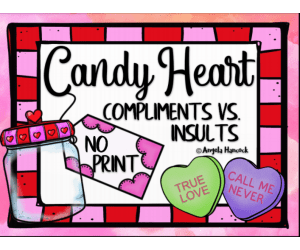
NO PRINT Candy Heart Compliments Distance Learning Designed for grades three through six, the No Print Candy Heart Compliments Distance Learning tool is part of an interactive PDF series focusing on developing social skills. It's a unique and fun way to help young learners differentiate between kind compliments and rude statements, essential as they grow up in a highly connected world. Both physical classrooms and digital environments can benefit from this product, making it easy to integrate into any lesson plan. In cases where face-to-face instruction isn't possible, or you're looking for a quick and meaningful homework assignment, this product provides readily available content. The Program Functionality The program uses imaginative candy heart statements linked to relatable social scenarios. These brainstorming prompts work their magic by challenging students' comprehension skills while teaching them important behavioral nuances. Students can participate individually or in small groups guided by their teacher as they fill up jars with categorized complimenting hearts after reading each scenario - all found on your iPad/Tablet or SmartBoard. They then get to identify whether the candy heart gifts were kind or rude within that particular context. The resource allows students to write their own heartfelt messages using fillable boxes for more engaging moments, promoting both creativity and understanding of emotional intelligence. User-Friendly Features: Navigational arrows simplify moving between sections. 'Back' and 'next' buttons for efficient transitions between pages so you can quickly return where left off without any hassle. Included In The Package: The packaged resource contains: 40 Kind & Rude Candy Hearts 20 social scenarios for Identifying Kind & Rude Candy Heart Gifts 20 Social Scenarios for Writing Your Own Candy Heart Message making every session refreshingly new! In essence, this teaching aid is not just informative but entertaining too which ensures better engagement among children further fostering at-home learning seamlessly alongside classroom activities bringing education wherever it’s needed.
Author Intrepid Speech Therapy Materials
Tags Social Skills, Distance Learning, Interactive PDF, Compliments, Behavior Management

Author, A True Story by Helen Lester Interactive Read-Aloud Activities
ELA, Reading, Reading Comprehension, Language Development, Vocabulary, Grade 2, 3, 4, Read Alouds, Activities
This picture book companion is a complete supplemental resource for the book Author: A True Story by Helen Lester. With 21 print-and-go reading activities to choose from, this resource is ideal for customizing learning to your student's specific needs and academic abilities. Students will investigate illustrations, identify story elements, determine the theme, analyze characters, compare & contrast, make predictions, inferences, & connections, answer questions that require them to think beyond the text, and much more! Students will love the engaging and fun activities, and you will appreciate the time saved hunting for high-level resources to teach reading concepts that students frequently struggle with. The activities provided are designed to enable students to apply higher-level thinking skills, encourage them to provide text evidence to support their thinking, and challenge them to express their own thoughts and/or perspectives. ⭐️This Resource Includes:⭐️ Making Predictions: Before reading the book, students will make predictions about the text. Story Elements: Students fill in the boxes with words & pictures to represent the story elements. Sequencing: Students will retell & illustrate the important parts of the story. Recalling Events in Chronological Order: Students describe and illustrate four major events in the story in chronological order. Summary: Students complete the Somebody, Wanted, Because, But, So graphic organizer and write a summary of the story. Story Event Sort: Students will describe a scene or event from the story that fits into each of the categories & explain how the event made them feel & how it relates to the category. Making Connections: Students make connections to an event from the story. Making Inferences: Students use clues & schema to make inferences while reading the story. Reading Text & Illustrations: Students will use both the text and the illustrations to help you answer the questions. Character Inside & Out: Students include details from the story to describe what the character says, thinks, does, and feels. Character Feelings: Students describe how the character's feelings change throughout the story & give examples of the events that cause them to feel the way they do. Character Development: Students select character traits that best describe the character at different times throughout the story and give examples from the book to support the traits they chose. Character Change: Students will explain how the character changed from the beginning to the end of the story and describe the events that caused the change to happen. Overcoming Obstacles: Students pick two physical, emotional, or mental challenges that Helen Lester faced in the story, describe how she responded to those challenges, and choose a character trait that developed as a result of her experiences. Sketch a Scene From the Story: Students draw a scene from the story & explain why it's important. Setting the Scene: Students identify three different settings in the story and explain how they know the setting changed. Author's Message: Students describe four important events from the story and put them in chronological order. Then, answer the questions about the author's message. Theme: Students answer the questions to determine which theme best fits the story and provide text evidence to support their choice. Thinking About the Text: Students will answer the questions about the story & include examples from the text to support their answers. Book Review: Students will rate and review the book. Biography Brochure: Students conduct research to learn more about the author, Helen Lester’s life, and create a brochure. This resource is for extension read-aloud activities only. The book is not included.
Author Creatively Gifted
Tags Fountas And Pinnell, Second Grade, Elementary Ela, Reading Comprehension, Character Traits, Interactive Read-aloud, Picture Book, Read-aloud Activities, Helen Lester, A True Story By Helen Lester

Amelia's Road, by Linda Jacobs Altma Interactive Read-Aloud Activities
ELA, Reading, Reading Comprehension, Grade 2, 3, 4, Read Alouds, Activities
This picture book companion is a comprehensive supplemental resource for Amelia's Road, by Linda Jacobs Altman. It includes 34 ready-to-use, print-and-go activities designed to meet the needs of all learning levels. Created with teachers in mind, this resource saves you time while providing students with engaging opportunities to demonstrate their understanding and newly acquired knowledge through interactive read-alouds. The activities cover a range of skills, from basic comprehension to critical thinking. INCLUDED IN THIS RESOURCE: Making Predictions Judging by the Cover Story Elements Sequencing Recalling Events in Chronological Order Summary Story Event Sort Making Connections Making Inferences Character Traits Character Feelings Character Inside & Out Character Development Character Change Overcoming Obstacles Acrostic Poem Sketch a Scene From the Story Setting the Scene Compare & Contrast Left Behind Thinking About the Text Thinking Beyond the Text Theme 3-2-1 Author's Message Dear Ms. Ramos Dear Diary Special Places Amelia’s Map Crossword Puzzle Word Search Puzzle Wait... There's More! Treasured Things Book Review This resource is for extension read-aloud activities only. The book is not included.
Author Creatively Gifted
Tags Reading Comprehension, Reading, Upper Elementary Reading, Picture Book , Read-aloud Activities, Interactive Read-aloud Activities, Book Companion, ELAR

Science Action Labs Air Science
, Grade 1, 2, 3, Labs, Experiments, Activities
"Science Action Labs Air Science" An engaging approach to teaching air science for students in grades 1-3. Through hands-on simple experiments , students gain a solid foundation on the key concepts including that: Air is transparent Carries weight Exerts pressure and resistance Is composed of different gases. This learning resource contains various activities within its easy-to-use PDF file: Straightforward experimentation, scientific discourse and relatable poems. The opportunity for whole group discovery sessions, small group collaboration exercises or independent work. Including fun games throughout the program that adds a layer of friendly competition reinforcing kinesthetic learners' comprehension skills. Embedded periodic quizzes to measure student progress and reinforce acquired knowledge about air science. With "Science Action Labs Air Science", teaching about elements like air becomes an optimal practical perspective for primary grade levels. Note: Valuable tools need not be expensive components like extensive laboratory sets; sometimes it could be as simple as print-ready pages filled with creative ways to learn life's fundamental theories!</p+
Author Classroom Complete Press
Tags Science Labs, Air Science, Air Pressure, All About Oxygen, Science Experiments

Color by Sight Word Practice Game, 3rd Grade - SET 8
ELA, Reading, Language Development, Spelling, Vocabulary, Grade 2, 3, 4, Activities, Games
Color by Sight Word Practice Game, 3rd Grade - SET 8 Color by Sight Word Practice Game, 3rd Grade - SET 8 is a unique and dynamic educational resource crafted specifically for educators going through grades 2-4. This engaging PDF game motivates learners to grasp their sight words via captivating coloring activities. As students enrich the shapes with hues on each uniquely constructed page, they parallelly identify and memorize five crucial sight words. This learning technique extends beyond mere word recognition as it nurtures color perception skills and hones hand-eye coordination alongside. Straying away from usual teaching procedures, this interactive practice game perfectly fits into diverse education scenarios like classrooms or homeschooling environments and caters to individual students or groups alike. Focusing on Early Readers Tailored for novice readers in Kindergarten and first grade who are working on improving reading skills while identifying sight words. It offers them an optimal platform necessary for their literary development via hands-on learning approaches. Included Sight Words in Set 8 'About' 'Better' The Color by Sight Word Practice Game – Set 8 revolves around these vibrant coloring pages comprising a variety of essential sight words such as 'about', 'better', 'carry', amongst others to expand the student’s vocabulary base while making the study process pleasurable. The notion of ease-of-use sits at the forefront with this resource eliminating any form of preparation work from teachers or parents' end making it feasible for high-energy atmospheres. Possible Use Cases: Distribute printed copies of these stimulating coloring pages during lessons. Use as morning work material. Add to library corners We ensure this resource’s utility by gearing it towards either individual student use or group participation at any literacy center activities. Set 8 stands as a beneficial tool empowering educators to teach learners the vital aspect of sight word identification packaged innovatively for entertaining engagement while indirectly boosting other essential elementary skills like spelling and vocabulary expansion. The robust Color by Sight Word Practice Game encompasses enhancing classroom interactions guaranteeing children are incessantly motivated towards building their language arts abilities throughout grades two through four!
Author TeacherYouWant
Tags Sight Words, Coloring Activity, Vocabulary Building, Literacy Development, Hand-eye Coordination

WH- Questions: WHERE - Set 2 - BOOM Cards
Special Resources, Speech Therapy, Kindergarten, Preschool, Grade 1, 2, 3, 4, 5, Activities
WH- Questions: WHERE - Set 2 helps students practice answering "where" questions, an important early literacy and communication skill. This Boom Cards deck provides 20 self-checking tasks where students read a short prompt and respond by selecting the image showing the location described. Questions range from basic ("Where is the cat?") to more advanced, promoting higher-order thinking ("Where does the owl live?"). Teachers can use this resource in small groups or independently to reinforce question comprehension, build vocabulary, improve listening skills, and check students' understanding. With immediate feedback, WH- Questions: WHERE allows students to progress at their own pace while teachers monitor their growth. This versatile questioning activity is well-suited for speech therapy or classrooms from preschool through 5th grade.
Author The Tattooed Speechie
Tags Oral Communication, Speech Therapy, Boom Deck

Fun Science Activities
, Grade 2, 3, 4, 5, Activities, Experiments
Here is a set of Fun Science Activities. There are 38 activities to choose from. Each page will tell you what you need and how to implement the activity . Students will love these experiments any time of the year. A cumulative material list is included at the end.
Author DK's Creations
Tags Science Packet, Experiments, Writing, Chemistry, Painting, Fun Science Lessons

Ice Cream Reading Comprehension Passage - Cored Ed Encyclopedia
ELA, Language Development, Resources for Teachers, Reading Comprehension, Reading, Pre-Reading, Writing, Physics, Science, Grade 2, 3, 4, 5, Worksheets & Printables, Worksheets, Teacher Tools, Centers, Activities, Writing Prompts, Assessments, Tests, Quizzes and Tests, Quizzes
This ice cream reading comprehension contains the following: Pre-Reading Trivia Students will write down one thing they already know about the subject and then read five more facts and discuss. These facts are fun, and the students will enjoy learning about the subject before reading more. Reading Passage The text is a high-interest reading passage with set paragraphs, roughly three to four paragraphs long. It contains a variety of themes about the topic, anywhere from history to technology. The passage is between 250 and 350 words in length. Mixed Questions The first question page contains four multiple-choice questions, each with a choice of four answers, and three written response questions that require a sentence or two from the student. Vocabulary Questions Practice seven key words from the text in this section across two activities. First section is scrambled words where students will unscramble three words given a clue for each. The second section is a word to meaning matching activity. Creative Writing In this question, the student will be required to write a five to eight sentence paragraph on a question related to the topic. Extension Activities This page is optional for fast finishers or to take home. There are several activities, each one requiring a different skill. Do some, do none, do all, completely optional - but you will feel reassured knowing every possibility is planned for. Answer Key There are answers for the multiple-choice questions, written response questions have sample answers, vocabulary answers and if there is a summary question then a sample summary will be provided as well. FULL CATALOG OF DOWNLOAD LINKS AND ENCYCLOPEDIA INDEX HERE Lesson Snapshot Title: Ice Cream Genre: Nonfiction (informational text with headings) Subject: Reading (Informational Text) / Science & Food Primary Topic: What ice cream is, why it’s smooth, and its history Estimated Guided Reading Level (A–Z): N What This Lesson Teaches Best Defines ice cream and names common parts: milk or cream, a sweetener, and flavorings. Explains a process (how it gets smooth): chilling/freezing while stirring. Teaches cause and effect about texture: stirring breaks up ice crystals so they stay tiny. Adds another cause and effect idea: stirring mixes in air so ice cream feels lighter and easier to scoop. Builds simple historical understanding with a timeline of examples (1851 factory; 1874 ice cream soda; 1904 cone at the World’s Fair). Learning Goals Students can describe what ice cream is made mostly from, using text details. Students can explain why ice cream is stirred while it freezes, according to the passage. Students can describe how tiny ice crystals affect the way ice cream feels. Students can explain how mixing in air changes ice cream’s texture and scoopability. Students can recount key history facts about ice cream from the passage (1851, 1874, 1904). Key Vocabulary From the Text sweetener — something that makes food taste sweet. flavorings — ingredients that add taste, like vanilla or cocoa. mixture — different ingredients blended together. crystals — tiny frozen pieces that can change texture. commercial — made or sold as part of a business. Cored Ed Encyclopedia Overview The Cored Ed Encyclopedia is a weekly series of lessons that you can pick up and use right away. These short readings fit into whatever time you have available. Each one includes a warm-up, a reading, and a set of questions, but it’s flexible — you can do just the reading, the full lesson, or skip the writing section if you need to. Each lesson focuses on a single topic so students don’t get lost. The writing is clear but never childish, making it perfect for grades two through five. Topics range from animals and science to history, inventions, and everyday things. No matter the level of the student, everyone should take away at least one new idea or fact from each lesson. The materials are easy to print, easy to explain, and require no setup. They work well for whole-class teaching, partner work, or independent study.
Author Cored Education
Rating
Tags Vocabulary, Spelling, Reading Comprehension, Reading Passages, Reading, Creative Writing, Reading Strategies, Writing Prompts, Ice Cream, Physics

Haiku Poem Writing Activity Lesson Plan, Interactive Notebook Template
Writing, ELA, Creative Writing, Poetry, Literature, Homeschool Templates, Grade 3, 4, 5, 6, Centers, Activities, Door Decor, Classroom Decor, Graphic Organizers, Teacher Tools, Lesson Plans, Rubrics, Templates, Worksheets & Printables
This Haiku Poem Writing Activity makes poetry fun, structured, and easy to teach - perfect for helping students understand the classic 5-7-5 syllable pattern while buidling confidence in writing. With a ready-to-use lesson plan and interactive notebook templates, your students will be guided step-by-step through the process of writing their own haiku poems. What's Included Detailed Haiku lesson plan Clear explanation of the 5-7-5 syllable structure Student-friendly haiku poem example Interactive notebook templates for hands-on learning Scaffolded writing templates Assessment rubric for quick and consistent marking Why Teachers Love This Resource Haiku poems are a fantastic way to introduce poetry because of their short, structured format. This resource helps students focus on syllables, word choice, and imagery—without feeling overwhelmed. Especially Effective For Reluctant writers who need clear structure Building syllable awareness Developing descriptive language skills Perfect For 3rd Grade (also suitable for Grades 2-5) Poetry units Writing Lessons Literacy Centers Interactive Notebooks Homeschool Learning How You Can Use It Whole-class poetry lesson Small group instruction Independent writing activity Assessment task Fast-finisher work Skills Covered Poetry writing Syllable counting Descriptive vocabulary Sentence construction Creative expression If your students struggle with “What do I write?”—this resource gives them the structure and support they need to succeed.
Author Teach2Tell
Rating
Tags Haiku Poem, Haiku Lesson Plan, Poetry Writing Activity, Haiku Template, Syllable Counting Activity, National Poetry Month , Writing Activity, April Writing Activity, Poetry Lesson, 3rd Grade Writing
What is Electricity? Guided Notes
Science, Technology, Computer Science, Grade 3, 4, 5, 6, 7, 8, 9, 10, 11, Activities
What is Electricity? Guided Notes What is Electricity? Guided Notes is a digitally accessible PDF file that serves as an educational tool for advancing students' understanding of electricity. It comprises three pages of detailed and engaging guided notes. Suitable for Different Grades and Teaching Methods This learning resource can be used by learners from Grade 3 to Grade 11. Given its versatility, it can accommodate various teaching methods, including traditional in-class teaching or homeschooling. Thus, it serves as a perfect choice for public school teachers and homeschoolers. Aiding Diverse Learners in Understanding Complex Concepts Catering to students with diverse learning abilities, this product uses straightforward language and explanations that make it particularly beneficial for students with ADHD or learning disabilities. Different Ways of Utilizing the Guided Notes In a physical classroom setting, the whole class can study these notes together during a presentation on electricity. This encourages collaborative discussions among peers about the scientific concepts covered. If small group study or individual use best suits the classroom dynamic, educators may choose to adopt these guided notes according to their needs. The material could also be given out as homework to consolidate what was taught during classroom instruction. A Versatile Learning Resource in Various Academic Settings " What Is Electricity? Guided Notes " proves highly effective across broad science curriculum areas- from Computer Science lessons to general Science topics. It is substantive enough to work independently but also complement broader academic instruction skillfully. Whether you wish to support subjects already discussed in class or gradually introduce new material through note-taking exercises - these guided notes offer a practical means of achieving these learning goals. Educators can effectively disseminate knowledge and improve students' understanding of key concepts in electricity by using such resources.
Author WhyMaker
Tags Electricity, Guided Notes, Learning Disabilities, Science Education, Virtual Homeschooling
A Day in The Life of Greek Men Activity
Social Studies, History, History: Europe, History: World, History: Ancient, Grade 3, 4, 5, 6, 7, 8, 9, Activities
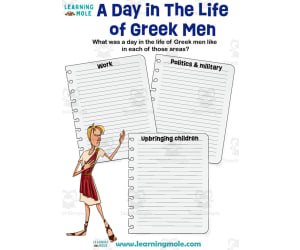
Activity Introduction An amazing activity designed for the students to learn more about history. A Day in The Life of Greek Men Do you like history? Which topic do you really enjoy about history? Have you ever read an interesting facts about the Vikings? If yes, can you mention them? What do you like most about the Victorian era? Can you name all the Tudors? Have you ever wondered how people used to live in ancient Japan and ancient China? Do you know any interesting facts about ancient Egyptians and the Pharaohs? Have you ever visited South America? What do you know about Incas and Aztecs? Celtic culture was really one of a kind, can you name any of the places that Celts used to live in? Imagine yourself living during the ancient Roman empire, how your life will look like? Ancient Greece was an amazing place to live in. What do you know about ancient Greek life? A Day in The Life of Greek Men Activity The activity is perfect for encouraging the researching skills for the students, while learning more about history. A Day in The Life of Greek Men This friendly designed worksheet is suitable for students at school, homeschooling, and as a group activity. Instructions What was a day in the life of Greek men like in each of those areas? Work Politics & military Upbringing children Format Available in a PDF format.
Author Educational Voice
Tags A Day In The Life Of Greek Men Activity, The Life Of Greek Men Activity, Greek Men Activity, Greek Men, Greek Men Facts, Greek Men Facts For Kids, Ancient Greece, Ancient Greece Facts

Nursery Rhyme: One Two Buckle My Shoe
ELA, Reading, Kindergarten, Preschool, Grade 1, 2, 3, Activities
About: One Two Buckle My Shoe Nursery Rhyme is a teaching resource designed to foster early literacy skills among preschoolers and students in kindergarten through to the third grade. This rhyme has been transformed into an instructional unit full of activities focusing on phonemic awareness, vocabulary building, story structure comprehension, retelling skills, and understanding cause and effect relationships. Included Materials: Nursery Rhyme Book with coloring and sequencing activities. Magnet Board Characters for interactive narration. One Page Rhyme Chart for group lessons or independent reading practice. Popsicle Stick Puppet Characters to encourage imaginative narration. Educational Games Included: Buckle My Shoe Letter Match Pick Up Sticks dice game Find the Hen Pocket Chart Game Big Fat Hen Carpet Game; all engaging ways of interacting with language arts concepts. A unique feature is a note for parents stressing the importance of nursery rhymes in children's overall linguistic development. It provides teachers flexibility in its implementation by allowing them to introduce it during various activities such as morning work or creative storytelling workshops. Setting up nursery center activity involves steps of first reading aloud this book multiple times before assigning it as an independent task or center-based activity —ideal for creating familiarity with sequencing events right from reading to retelling portions of these favorite rhymes. The resource-pack comes as an easy-to-use PDF file facilitating multiple prints. It contributes significantly towards developing robust language arts competencies among young learners while also fostering cooperative learning when engaged in group tasks. No doubt, this multi-skilled tool offers versatility at its best! '
Author The Proactive Classroom
Tags Nursery Rhyme, Vocabulary Building, Interactive Learning, Storytelling Training, Language Arts

Football Field Of Feelings-An SEL Boom Cards with SEL Coloring Page
Special Resources, Life Studies, Life Skills, Social Emotional Learning (SEL), Social Skills, Special Education Needs (SEN), Preschool, Grade 1, 2, 3, 4, Activities, Worksheets & Printables, Worksheets, Coloring Pages, Writing Prompts
Football Field Of Feelings-An SEL Self-Regulation Boom Deck Plus SEL Coloring Pages An engaging learning tool your early learners will love! Tailored specifically for Kindergarten to Grade 4 children, this versatile resource focuses on the vital skill of self-regulating emotions. 25-card deck with a football theme: Presenting situations and allowing students to respond positively or negatively towards an emotive scenario. 'Fumble' and 'Touchdown': Each card presents these two options, enabling students to differentiate between positive and negative emotional responses. No reading required!The voice-over on each card adds auditory stimulation and further enhances comprehension levels in children. The first three instruction cards even include exciting football stadium sounds that are sure to enthrall them. Bonus handout: A bonus handout is added in the package where students get the opportunity to write down five techniques they can employ when dealing with strong emotions which solidifies their understanding further. An excellent complementing resource viable for whole class discussions, small group activities or as individual homework assignments. Inclusive Access For All Learners: We have ensured easy access via instant download – just click on the product image provided in the downloadable PDF! This package's benefits extend beyond education sessions into real-life emotional management practices increasing resilience among children while building emotionally intelligent future adults. You may also find our other sports-themed decks useful which are tailor-made for developing life skills in young learners such as; Frendship Homerun (Baseball-Themed). Best Behavior Basketball (BasketBall-Themend). An internet connection is needed for usage as it plays on browsers such as Chrome, Safari, Firefox & Edge along with popular apps such as Android iPad iPhone & Kindle Fire devices.For privacy reasons we recommend adults involved should have a Boom Learning account.The Fast Pins option allows immediate feedback making it popular among self grading students. The Football Field Of Feelings -An SEL Self-Regulation Boom Deck: A resource that brings vitality to learning emotions and levity in classrooms through crisp graphics, dynamic sounds and invigorating activities !
Author Jennifer Moyer Taylor
Tags SEL, Self-regulation, Emotional Intelligence, Football Theme, Interactive Deck, Sel Coloring Pages, Boom Cards, Social Emotional Learning, School Counseling

skip counting by 6s bingo - boards 16-20
Math, Patterns, Early Math, Numbers, Grade 1, 2, 3, Activities, Games
Skip Counting by 6s Bingo Engage students in learning to skip count by 6s with this fun math bingo game! The game includes 5 different bingo boards to allow for whole group or small group play. To prepare, print, laminate, and cut the calling cards and bingo boards. Provide each student with a board and counters to cover called numbers. Shuffle the calling cards and draw one at a time, calling out the number for students to search their boards. The first to cover 3 spaces in a row wins! Extend the learning by creating more boards or trying our skip counting games for other numbers. This game offers an engaging way for students to develop skip counting fluency.
Author Colleen's Cosmic Collection
Tags Skip Counting, Counting, Skip Counting Games, Skip Counting Activities, Skip Counting Bingo, Skip Counting By 6s, Skip Counting By 6, Cccskb6s, Counting In 6s
Shapes Mazes (PDF)
ELA, Language Development, Resources for Teachers, Vocabulary, Spelling, ESL, Shapes, Early Math, Math, Grade 2, 3, 4, 5, Worksheets & Printables, Worksheets, Teacher Tools, Centers, Activities, Mazes
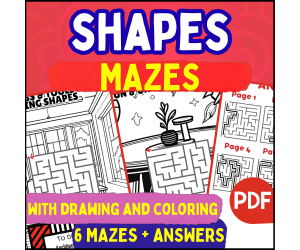
Maze Series This maze series is designed for students in grades 2–5. Each set features a clear, kid-friendly theme with scene-based mazes that students first navigate, then complete by drawing a few target words from a simple word list. Pages come in varied styles and graduated difficulty, with an optional “color it in” step—and some themes invite quick calculations to match the task. These mazes are student-friendly, classroom-ready, and perfect for literacy warmups, seasonal units, fast-finisher bins, centers, sub plans, or home learning extensions. The playful, structured format builds problem-solving, attention to detail, and fine-motor control while reinforcing themed content in a motivating way. Note: Unlike many themed products, not all word-list words appear on the maze pages. To support full vocabulary coverage, we’ve released a companion word list you can find in the links section. Shapes Word List 1. Basic Shapes Circle, Square, Triangle, Rectangle, Oval, Star, Heart, Diamond 2. 3D Shapes Cube, Sphere, Cylinder, Cone, Pyramid, Rectangular prism, Hemisphere, Torus 3. Shapes in Everyday Life Wheel, Window, Stop sign, Ball, Pizza slice, Dice, Ice cream cone, Tabletop 4. Describing Shapes Round, Pointy, Flat, Curved, Straight, Symmetrical, Wide, Narrow 5. Fun & Unique Shapes Hexagon, Pentagon, Octagon, Crescent, Trapezoid, Parallelogram, Spiral, Arrow 6. Jobs & Tools Using Shapes Architect, Artist, Engineer, Designer, Carpenter, Mapmaker, Mathematician, Puzzle maker PDF Version Other versions will appear here when available. Follow the store for the lastest on new products. How to Use These Mazes Perfect for: Morning work or early-finisher bins Literacy or STEM centers Holiday/seasonal review lessons Independent stations, sub plans, or take-home enrichment More Shapes Themed Products CROSSWORDS WORD SEARCHES FULL CATALOG OF DOWNLOAD LINKS HERE Themed Mazes Links Addition PDF Animals PDF Around the Home PDF Birthday PDF Candy PDF Christmas PDF Cinco de Mayo PDF Clothes PDF Colors PDF Days and Months PDF Division PDF Earth Day PDF Easter PDF Easy Mazes PDF Fall PDF Father's Day PDF Food PDF Geography (Set 1) PDF Geography (Set 2) PDF Geography (Set 3) PDF Graduation PDF Health PDF History (Set 1) PDF History (Set 2) PDF History (Set 3) PDF Human Body PDF Kindness PDF Life Skills PDF Mother's Day PDF Multiplication PDF Science (Set 1) PDF Science (Set 2) PDF Science (Set 3) PDF Shapes PDF Social Skills PDF Spring PDF Sports PDF St. Patrick's Day PDF Subtraction PDF Summer PDF Thanksgiving PDF Transport PDF Valentine's Day PDF Winter PDF Mazes in Depth Structure Each maze is crafted around a focused sub-theme. Students navigate the maze, encountering branches and cul-de-sacs that build attention and planning. Most pages include a tiny follow-up box—students draw or label 2–3 target words from a small word box, add a quick count, or color in the scene—so the activity reinforces both content and skills in a highly engaging format. Each completed set includes: A themed maze page. A simple student instruction strip. An answer key showing the solved path for teacher support or self-checking Themes Included These mazes cover a wide range of fun, age-appropriate themes, including: Seasons & Holidays (e.g., Halloween, Easter, Valentine’s Day) Math-Lite Connections (e.g., quick counts, number words) Everyday Topics (e.g., Animals, Weather, School) Special Units (e.g., Health, Earth Day, Sports, Kindness) Each topic reflects students’ real-life experiences and interests while strengthening problem-solving, visual scanning, and fine-motor control in a playful, highly visual way. Easy extensions (optional): Time it: solve once in pencil, then try to beat the time in pen Retell the route using sequence words (first, next, then, finally) Count intersections or turns and graph the results Write a 1–2 sentence mini-story about the scene using the target words Design a tiny maze in the corner for a partner to solve Differentiation tips: Offer a finger-trace pass before pencils for emerging learners Highlight the borders of the correct region on first attempts Use thicker-line versions or simpler pages to build confidence Pair roles: “navigator” gives directions; “driver” traces the path For similar downloads and other frees, do check out Cored Group on TeachSimple.
Author Cored Education
Rating
Tags Vocabulary, Spelling, Basic Shapes, 3D Shapes, Shapes, Math, Describing Shapes, Shape Maze, Mazes, Math Mazes

Following Directions and Riddle Clues: Beginning Links to Logic
Resources for Teachers, Classroom Management, Grade 2, 3, 4, Activities
Following Directions and Riddle Clues: Beginning Links to Logic Overview: This engaging teaching resource is designed for second, third, and fourth-grade students to refine their logical thinking abilities. Offering an exciting merger of amusement and learning, our 12-page pack is all about conscious reasoning - a key life skill. Format:The pack comes in a printable PDF format filled with fun-filled exercises specifically crafted to improve comprehension skills. Activity Breakdown:The activities mainly involve tasks like strict adherence to provided directions and solving mysterious riddles. Spatial Awareness exercise: One segment of these tasks will require students to direct partners across a map using given directions - an effective way of promoting spatial awareness. Analytical Capability Improvement:In another part, they'll need to solve puzzles with clues - an activity that boosts analytical capabilities. In essence, all the exercises not only demonstrate the excitement inherent in logical reasoning but also stress on why its application is substantial in navigating life's course. Add-on Benefits & Flexibility This resource isn't just about stimulating logical thinking- it also serves as a potent classroom management tool. Tailor it across different contexts like whole-group instruction or small group sessions- offering educators remarkable flexibility depending on student needs. You could further use this as homework or supplement material for independent study hours! In conclusion, beginning the journey into logic through Following Directions and Riddle Clues: Beginning Links sets up learners for continued interest in exercising sound judgment—an indeed great venture!
Author Classroom Complete Press
Tags Following Directions, Riddle Clues, Links To Logic, Teaching Resource, Classroom Management
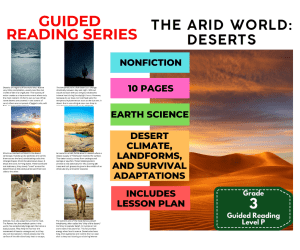
The Arid World - Deserts: Guided Reading Level P with Lesson Plan
ELA, Resources for Teachers, Reading Comprehension, Reading, Science, Language Development, Social Studies, Life Sciences, Geography, Earth and Environmental Sciences, Grade 2, 3, 4, Worksheets & Printables, Worksheets, Teacher Tools, Centers, Activities, Literacy Readers, Quizzes, Quizzes and Tests, Assessments, Lesson Plans
This The Arid World - Deserts (level p) guided reading book with lesson plan includes: Guided Reading Color Label (front cover x1) This is a quick way to match the book’s demands to what students can generally handle.. The overall goal is to use the level/color to pick books for several smaller groups. To qualify for a certain level, a student is expected to read a book from that level with about 90–94% accuracy. If a student is consistently accurate and understands, move up a level. If the student is struggling at that level, drop down and add more support. Each student will improve at completely different rates, but it is generally one of the best ways to check progress across the class. DOWNLOAD THE CATALOG TO VIEW ALL GUIDED READING BOOKS AVAILABLE (SORTED LEVELS A-Z) Pre-Reading Question (x1) Teacher asks the prompt aloud, can be while showing the cover or first page. Students share what they already know, or make educated guesses from the cover. Prompt them to use the target vocabulary. Write some of their responses on the board to look back at during the reading. Vocabulary Words (x5) Introduce the five words, best doing it one at a time. Start by saying it, while students repeat and then see if anyone knows what it means before reading further. Read through the meaning and try to briefly connect each word to a picture or gesture so it’s meaningful. Ask students to flip through the book pages and point to where they see each of the vocabulary words. While reading the book pause upon coming across one of the vocab words or read the sentence twice to make sure students understand the word has appeared. Optional: Ask students to raise hands whenever they see/hear one of the new words. Guided Reading Pages (x10) Check the book snapshot (below) for: primary topic - do you need to prep extra reading or intro materials on this? what is taught best - decide on 1-2 bullets to focus on, use the prompt or words provided here for best results. learning goals - what you are checking for students to be able to do after the session, elicit answers using prompts or words provided. key vocabulary (see section above). questions overview - so you know what is coming up and if you need to prep extra materials to assist understanding. Run the lesson You may have already looked at a few of the pages together, but you can show them some of the pictures again first to set meaning. Depending on how much time you have and how familiar your students are with guided reading class, you may want to read the book aloud first with the group first. Students whisper or partner read, while you listen in. If time, do it as a group, one student reading a page each. Use the guided page’s prompts to coach: “Check the picture / does it make sense?” “Point under the words / try the first sound” “Reread the sentence smoothly”. Try to focus more on one student per session (rotating every time), so you can work out if they are ready to move up or need to move down a level. Comprehension Questions (back cover x3) This is your way to check that students didn’t just say the words, but actually understood the text. First, let students answer by pointing to the page/picture and saying a short sentence. After any answer, follow with: “Show me where you found that in the text.” In bigger groups, have partners answer first (10–20 seconds), then call on 2–3 students to share. Differentiation tips: Emerging speakers/struggling readers: oral + pointing On-level: oral in a full sentence Higher: one written sentence or draw + label Book Snapshot Title: The Arid World: Deserts Genre: Nonfiction (informational) Subject: Earth Science Primary Topic: Desert climate, landforms, and survival adaptations Estimated Guided Reading Level (A–Z): P What This Book Teaches Best Defines deserts by very low precipitation and explains how scarce water shapes the environment. Explains extreme temperature changes in hot deserts from day to night and why they happen. Compares hot deserts and cold deserts , including why icy places can still be deserts. Shows how living things adapt to desert conditions , with examples from plants and animals (cactus, fennec fox, camel, sidewinder snake). Describes how wind shapes desert landforms , including how dunes form and move. Learning Goals Students can define a desert using the book’s description of precipitation and water scarcity. Students can explain why temperatures in a hot desert can drop quickly after sunset, based on the text. Students can describe how a cold desert can exist and name the example given in the book. Students can identify at least three desert adaptations and match them to the plant or animal described. Students can describe how wind forms dunes and what the text says dunes do over time. Students can explain what an oasis is and why it supports life in a desert. Key Vocabulary From the Text precipitation — water that falls from the sky, like rain. evaporation — when water turns to vapor and leaves. nocturnal — active at night and resting in daytime. oasis — a fertile desert area with freshwater reaching the surface. dunes — hills of sand formed when wind drops sand. Discussion Prompts Pre-reading question: What challenges do you think plants and animals face in a very dry place? Comprehension questions: How much rain do deserts usually get in a single year, according to the text? Comprehension questions: What does the book say helps the Saguaro cactus conserve water? Comprehension questions: What is an oasis, and where does its freshwater usually come from? Printing Tips 1. Best Printing Method (Recommended) “Booklet” Printing (Best if Available) If your printer or PDF viewer supports Booklet Printing , use this. Settings to use: Print mode: Booklet Paper size: Letter or A4 (either works) Orientation: Landscape Print on both sides: Yes Flip on: Short edge Scaling: Fit to printable area Booklet subset: First test: Front sides only Then: Back sides only This will automatically: Pair pages correctly Put the cover on the outside Align everything for folding After printing, fold in half and staple along the spine . 2. If “Booklet” Printing Is NOT Available You can still print this correctly with manual duplex printing . Step-by-step: Open the PDF. Choose Print . Set: Orientation: Landscape Pages per sheet: 1 Print on both sides: Yes Flip on: Short edge Print all pages . Because each PDF page already contains two facing book pages, the result will still fold cleanly into a book. Thousands of Cored Education products are included with your TeachSimple membership. Download links and encyclopedia index available here.
Author Cored Education
Rating
Tags Reading Comprehension, Reading Passages, Reading, Guided Reading, Guided Reading Lesson Plan, Guided Reading Activity, Pre-reading, Science Lesson Plans, Social Studies Lesson Plans, Earth Science

Prefix Sub Sentence Reading Rings
ELA, Language Development, Phonics, Grade 2, 3, 4, Activities, Centers, Worksheets & Printables, Task Cards
Practice reading words with the prefix SUB- with these sentence reading rings. Students will read words with the prefix sub- in the context of sentences. Each card also includes a bold and colorful image to illustrate each sentence and to help students to learn the meanings of each word. What is Included: This resource includes one reading ring activity for the prefix sub. There are cards each featuring a different word with the prefix sub, with a sentence using the word in context and an image to illustrate that sentence. When to Use Early Finishers - If students finish their work early, they can use these reading rings for extra practice. Small Group Work - Teachers can use these reading rings to target small groups of students who need more practice reading words with prefixes. Independent Practice - Students can work independently at their desks to read this set of prefix cards. Morning Work - Students can read and review this reading ring for morning work as their classmates arrive to class. How to Make: Teachers will print out the pages and cut each card apart. Once cut apart, the teacher can choose to laminate the cards for durability. Then, use a hole punch to punch a hole in the top left corner of the card. Place the cards on a ring to create your reading ring, making sure the cover card is on top. Skills Assessed: These reading rings help with identifying words with prefixes These reading rings help with learning the meaning of prefixes These reading rings help students learn how prefixes change the meaning of words. These affixes reading rings are a low prep activity for teachers to prepare for students to use. Once created, these cards can be used over and over to practice reading words with prefixes in the context of a sentence.
Author The Connett Connection
Tags Affixes, Morphology, Prefixes, Literacy Activities, Reading Words With Prefixes

Motive and Intent, Perspective Taking Activities Differentiated For 1st-5th Grade
Life Studies, Special Resources, Life Skills, Grade 1, 2, 3, 4, 5, 6, Activities
The Perspective Taking skill of Motive and Intent can be an especially difficult skill for children with social learning challenges. These children may benefit from explicit instruction to understand what Motive and Intent is, in order to better navigate their social world with less misinterpretations. This set is fun, engaging and thought provoking. Two activities are included so that you can differentiate between children of approximate grade ranges 1st-3rd and 3rd-5th using mainly picture cues or mainly text cues. You decide what works best for your population. My students love doing these activities , I hope yours do too!
Author Socially Skilled Kids
Tags Perspective Taking, Motive, Intent, Social Skills, Special Education, Motive And Intention, How To Teach Perspective, How To Teach Perspective Taking, Motive Vs Intent, 1st Perspective
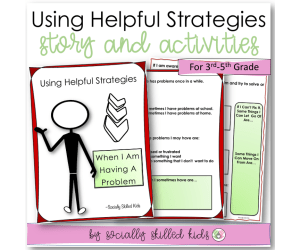
Using Helpful Strategies, Social Skills Story and Activities
Life Studies, Special Resources, Life Skills, Grade 2, 3, 4, 5, Activities
Using Helpful Strategies, Social Skills Story and Activities The resource 'Using Helpful Strategies, Social Skills Story and Activities', has been designed for Grade 2 up to Grade 5 students. It is a beneficial tool focused on problem-solving strategies. Its main objective is to guide students confronting dilemmas or encounters requiring decision-making. Inclusions: A Color-story feature: Designed for classroom learning, it presents everyday problems along with efficient solutions through vivid narratives. A Coloring-book companion: A black-and-white story version that promotes creative engagement while also helping information absorption through fun activities at home or school. An Animated PowerPoint Story & Skill Builders component: An interactive approach towards online instruction making concepts come alive in a digital presentation format- optimal for contemporary classrooms and distance-learning scenarios. Evidence-based Approach: Interactive Exercises This comprises of exercises such as 'Skill Builder Activity 1: Being Aware of Possible Problems,' available in both colorful versions as well as black-and-white options suitable for offline class activities or homework assignments. Another inclusion worth noting is 'Skill Builder Activity 2: Problem-Solving Strategies Brainstorm Poster.' Note: All components fall within PDF file type compatibility parameters paving way for easy usability - online/offline activity feasibility provides flexibility over methods of instruction. This comprehensive resource kit aligns subtly with progressive education approaches targeting life skills learning - preparing today’s youth not just academic brilliance but equipping them with social skills essential beyond school life.
Author Socially Skilled Kids
Tags Helpful Strategies, Social Skills, Problem-solving, Decision-making, Interactive Learning

Musical Journey Across Europe - My European Music Passport & Profiles
Creative Arts, Art, Music, Grade 2, 3, 4, 5, 6, 7, 8, Songs, Activities
Musical European Journey - Passport - Music through Europe This passport accompanies a series of lessons or a year-long project concerning music through Europe. Profiles: Students engage with music, songs, and dances from various countries and record important information, impressions, and thoughts about the music heard in a profile: -Continent -Title/Artist -Music style -Typical instruments -Special features -Star rating (1-5) The flag in the profile can be colored or the colored version can be used. Additionally, there is a blank template without predefined country names and flags. These countries are included: Music in Europe: Norway, Poland, Portugal, Spain, Iceland, Belgium, Scotland, Denmark, Finland, Greece, Netherlands, Switzerland, England, France, Ireland, Italy, Germany, Sweden, Russia Passport stamps: Once a country has been "visited," an appropriate passport stamp in color or black and white can be pasted in. To prevent it from covering the profile, it can be glued to the back or to the left blank side. The passport stamps can also be pasted into the overview "My visited countries. Tip: Print passport stamps on self-adhesive label paper and cut them into individual stamps. Note: The passport stamps are included as a copy template for one country. This can be used, for example, when the music of a country is collectively worked on. In the second variant, all passport stamps of the countries are prepared on a copy template sorted by continents. This copy template is suitable, for example, for independent work, learning stations, or if all passport stamps have been provided to students beforehand and are not to be distributed individually each time. Passport The profiles can be pasted or stapled into the "Musical Passport" in A5 size. Option 1: The profile pages are designed to be glued on top of each other on the right side of the book cover. Option 2: An office file fastener/strip is glued into the passport, and the new pages are stapled there. The cover is also available in color and black and white. Additional pages for the passport: For the passport, additional pages can be stapled in. All pages are also available in color and black and white. Map (p. 9): Continents (included in "Musical World Journey"): Students label the continents and color them in various colors. Alternatively, the colored map template can be used. Europe map (included in "Musical European Journey"): Students mark the position of the country on the map by placing crosses or notes once they have noted music from that country in their passport. My Visited Countries: Various templates are available in color and black and white. Students write the names of the countries for which they have completed a musical profile or paste the passport stamp. Tip: Label profile pages with page numbers and use this overview as a table of contents. My Musical Profiles: On this passport page, the categories of the profile are explained with questions and example answers. The questions can be used to fill out the profiles.
Author Die Relitante
Tags Profiles, Music, Passport, Countries, Europe

Three Little Pigs | Making Words Activity
ELA, Literature, Preschool, Grade 1, 2, 3, Activities
This resource is a Three Little Pigs Making Words Activity. Students will have 2 different worksheets to complete. Each activity page has character names at the top. Students will make new words from the letters.
Author Good Human Project
Tags Word Scramble, Three Little Pigs, Folk Tales, Making Words, Digital Reading

Sight Words Editable Color By Code Worksheet Activity For Morning Work
ELA, Creative Arts, Art, Language Development, Pre-Reading, Grammar, Reading, Spelling, Kindergarten, Preschool, Grade 1, 2, 3, Activities, Worksheets & Printables, Worksheets
Cute Sight Words Coloring pages Worksheet Activities For Morning Work / Digital Resources / Cute Sight Word Practice Coloring Pages / Mice Coloring Sheets: ⭐ Introducing our adorable Cute Sight Words Editable Color by Code activity set, created to attract young learners from Preschool to 3rd grade! This engaging teaching resource makes acquiring crucial sight words a fun adventure. This set's vivid and beautiful design is likely to instill a love of studying in your young children. ⭐ Each worksheet has been carefully designed to promote creativity and skill development. It includes a large number of customizable sight words, allowing you to personalize the activities to each child's specific learning needs. Children will improve their reading abilities while having fun as they color and identify words. Whether you're a parent, teacher, or homeschooler, these Cute Sight Words Color by Code activities are an excellent way to improve early reading skills. ⭐ Prepare to see the pleasure of learning grow in young brains as a result of our instructive and enjoyable resource. Order your collection today and go off on a colorful adventure through the world of sight words. What you Will Get: You will Get A zip File, there are a total of 10 Coloring Worksheets (10 Pages). For similar or other resources, visit my store
Author Lapiiin Art Activities
Tags Color By Sight Words, Sight Words, Color By Number, Color By Math, Sight Words Practice, Sight Words Worksheets, Kindergarten, 1st Grade, Digital Resources, Morning Work