



3,969 products added recently
Page 18 - 4th Grade Activities
Introduce your fourth-grade students to activities that challenge and inspire. These resources encourage analytical thinking, teamwork, and creative expression across subjects. Use them to elevate your teaching and engage students in meaningful learning experiences.

 Show filters


Human Body Mazes (PDF)
ELA, Language Development, Resources for Teachers, Vocabulary, Spelling, ESL, Human Body, Life Sciences, Science, Grade 2, 3, 4, 5, Worksheets & Printables, Worksheets, Teacher Tools, Centers, Activities, Mazes
Maze Series This maze series is designed for students in grades 2–5. Each set features a clear, kid-friendly theme with scene-based mazes that students first navigate, then complete by drawing a few target words from a simple word list. Pages come in varied styles and graduated difficulty, with an optional “color it in” step—and some themes invite quick calculations to match the task. These mazes are student-friendly, classroom-ready, and perfect for literacy warmups, seasonal units, fast-finisher bins, centers, sub plans, or home learning extensions. The playful, structured format builds problem-solving, attention to detail, and fine-motor control while reinforcing themed content in a motivating way. Note: Unlike many themed products, not all word-list words appear on the maze pages. To support full vocabulary coverage, we’ve released a companion word list you can find in the links section. Human Body Word List 1. Head & Face Head, Hair, Eyes, Nose, Mouth, Ears, Teeth, Tongue 2. Arms & Hands Arm, Hand, Fingers, Thumb, Wrist, Elbow, Palm, Nails 3. Legs & Feet Leg, Knee, Foot, Toes, Heel, Ankle, Shin, Thigh 4. Inside the Body Brain, Heart, Lungs, Stomach, Bones, Muscles, Blood, Nerves 5. Senses & Feelings Sight, Hearing, Smell, Taste, Touch, Laugh, Cry, Yawn 6. Moving & Actions Walk, Run, Jump, Clap, Hug, Stretch, Bend, Wiggle PDF Version Other versions will appear here when available. Follow the store for the lastest on new products. How to Use These Mazes Perfect for: Morning work or early-finisher bins Literacy or STEM centers Holiday/seasonal review lessons Independent stations, sub plans, or take-home enrichment More Human Body Themed Products CROSSWORDS WORD SEARCHES FULL CATALOG OF DOWNLOAD LINKS HERE Themed Mazes Links Addition PDF Animals PDF Around the Home PDF Birthday PDF Candy PDF Christmas PDF Cinco de Mayo PDF Clothes PDF Colors PDF Days and Months PDF Division PDF Earth Day PDF Easter PDF Easy Mazes PDF Fall PDF Father's Day PDF Food PDF Geography (Set 1) PDF Geography (Set 2) PDF Geography (Set 3) PDF Graduation PDF Health PDF History (Set 1) PDF History (Set 2) PDF History (Set 3) PDF Human Body PDF Kindness PDF Life Skills PDF Mother's Day PDF Multiplication PDF Science (Set 1) PDF Science (Set 2) PDF Science (Set 3) PDF Shapes PDF Social Skills PDF Spring PDF Sports PDF St. Patrick's Day PDF Subtraction PDF Summer PDF Thanksgiving PDF Transport PDF Valentine's Day PDF Winter PDF Mazes in Depth Structure Each maze is crafted around a focused sub-theme. Students navigate the maze, encountering branches and cul-de-sacs that build attention and planning. Most pages include a tiny follow-up box—students draw or label 2–3 target words from a small word box, add a quick count, or color in the scene—so the activity reinforces both content and skills in a highly engaging format. Each completed set includes: A themed maze page. A simple student instruction strip. An answer key showing the solved path for teacher support or self-checking Themes Included These mazes cover a wide range of fun, age-appropriate themes, including: Seasons & Holidays (e.g., Halloween, Easter, Valentine’s Day) Math-Lite Connections (e.g., quick counts, number words) Everyday Topics (e.g., Animals, Weather, School) Special Units (e.g., Health, Earth Day, Sports, Kindness) Each topic reflects students’ real-life experiences and interests while strengthening problem-solving, visual scanning, and fine-motor control in a playful, highly visual way. Easy extensions (optional): Time it: solve once in pencil, then try to beat the time in pen Retell the route using sequence words (first, next, then, finally) Count intersections or turns and graph the results Write a 1–2 sentence mini-story about the scene using the target words Design a tiny maze in the corner for a partner to solve Differentiation tips: Offer a finger-trace pass before pencils for emerging learners Highlight the borders of the correct region on first attempts Use thicker-line versions or simpler pages to build confidence Pair roles: “navigator” gives directions; “driver” traces the path For similar downloads and other frees, do check out Cored Group on TeachSimple.
Author Cored Education
Rating
Tags Vocabulary, Spelling, Human Body, Body, Head & Face, Arms & Hands, Legs & Feet, Mazes, Human Body Maze, Body Mazes

Kids Yoga Stories: Would you Rather... ? A Choice Game for Kids eBook
P.E. & Health, Yoga, Grade 2, 3, 4, 5, Activities
Kids Yoga Stories: Would you Rather...? A Choice Game for Kids eBook The Kids Yoga Stories: Would you Rather...? A Choice Game for Kids eBook is a tool specially designed for primary school teachers, children's yoga instructors, parents, caregivers and health & recreation staff. It lends an interactive approach to teaching yoga, mindfulness & meditation principles to children. Beyond Traditional Yoga Instruction The eBook incorporates a thought-provoking game inspired by the Yamas and Niyamas of yoga. The game gives students an easy understanding path towards these ancient teachings while promoting critical thinking and nurturing communication skills. Adaptability & Usability This resource can be used in various settings like whole group discussions during class periods or small groups during extracurricular activities. It's also ideal for independent study or homework assignments due to its user-friendly structure. Tailored specifically for grades 2 through 5 but equally enjoyable and useful across almost all age groups. Ideal conversation starter within educational lessons or household environments. 66-page comprehensive guide; making it versatile pedagogical tool. Benefits of Early Age Yoga Learning Increase in strength , flexibility & improved sleep quality. Fosters positive interactions amongst adults & children. Helps kids build self-confidence and improve self-expression. Promotes improved body awareness Nurtures advocacy towards living an active-healthy lifestyle Note:While these questions are primarily designed for third through fifth graders; they could serve as amusing conversation starters for almost any age group. Access your copy today of the Kids Yoga Stories: Would you Rather... ? A Choice Game for Kids eBook, and take the first step in making learning fun with fitness & mindfulness.
Author Kids Yoga Stories
Tags Yoga Instruction, Mindfulness Game, Ethical Principles, Communication Skills, Physical Well-being
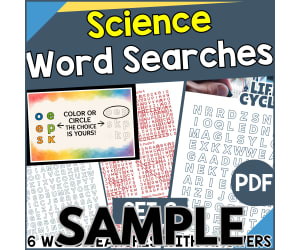
Science Word Search - Set 2: 1 Page Sample (PDF)
ELA, Language Development, Vocabulary, Spelling, ESL, Resources for Teachers, Science, Physics, Earth and Environmental Sciences, Life Sciences, Grade 2, 3, 4, 5, Worksheets & Printables, Worksheets, Teacher Tools, Centers, Activities, Word Searches
THIS IS A ONE PAGE SAMPLE OF A SIX PAGE WORD SEARCH DOWNLOAD FULL SIX PAGE WORD SEARCH DOWNLOAD INFORMATION This wordsearch series is designed for students in grades 2–5. Each set of wordsearches is built around a clear vocabulary theme, helping students develop word recognition, improve spelling, and boost topic-related understanding through engaging visual puzzles. Every wordsearch also includes a fun hidden shape for students to guess—adding an interactive twist to traditional vocabulary practice. These wordsearches are student-friendly, classroom-ready, and perfect for integrating into literacy warmups, seasonal units, fast-finisher tasks, or home learning extensions. Each puzzle reinforces themed vocabulary in a playful, structured format that keeps learners motivated. Science Word Search Set 2 Word List 1. Energy and Electricity Energy, Electricity, Battery, Circuit, Switch, Solar, Light, Heat 2. Rocks and Minerals Rock, Mineral, Fossil, Sand, Crystal, Diamond, Lava, Soil 3. Life Cycles Egg, Larva, Pupa, Adult, Seed, Sprout, Grow, Change 4. The Water Cycle Water, Evaporate, Condense, Cloud, Rain, Puddle, River, Ocean 5. Scientific Inquiry and Tools Observe, Hypothesis, Experiment, Measure, Balance, Ruler, Data, Graph 6. Natural Disasters Earthquake, Tsunami, Hurricane, Tornado, Flood, Drought, Lightning, Volcano PDF Version Other versions will appear here when available. Follow the store for the lastest on new products. How to Use These Wordsearches These wordsearches are ideal for: Morning work or early finisher bins Vocabulary centers or anchor activities Holiday or seasonal review lessons Independent literacy stations or take-home enrichment Each puzzle includes a themed word list and a shaped grid for students to complete. Word directions may vary (horizontal, vertical, diagonal), and answer keys are included for easy checking. Optional vocabulary challenges or writing tasks can be added to extend the learning experience. Whether you're reviewing key vocabulary, exploring a seasonal topic, or offering fun literacy practice, these wordsearches provide a flexible and engaging tool to support vocabulary growth in grades 2–5. More Science Themed Products Science Crosswords (Set 1) PDF Science Crosswords (Set 2) PDF Science Crosswords (Set 3) PDF Science Word Searches (Set 1) PDF Science Word Searches (Set 3) PDF FULL CATALOG OF DOWNLOAD LINKS HERE Themed Word Search Links Addition PDF Animals PDF Around the Home PDF Birthday PDF Candy PDF Christmas PDF Cinco de Mayo PDF Clothes PDF Colors PDF Days and Months PDF Division PDF Earth Day PDF Easter PDF Easy Word Searches PDF Fall PDF Father's Day PDF Food PDF Geography (Set 1) PDF Geography (Set 2) PDF Geography (Set 3) PDF Graduation PDF Health PDF History (Set 1) PDF History (Set 2) PDF History (Set 3) PDF Human Body PDF Kindness PDF Life Skills PDF Mother's Day PDF Multiplication PDF Science Word Searches (Set 1) PDF Science Word Searches (Set 2) PDF Science Word Searches (Set 3) PDF Shapes PDF Social Skills PDF Spring PDF Sports PDF St. Patrick's Day PDF Subtraction PDF Summer PDF Thanksgiving PDF Transport PDF Valentine's Day PDF Winter PDF Wordsearches in Depth Structure Each wordsearch is crafted around a focused sub-theme and includes a visual puzzle shaped like a related object (e.g., balloon, gift, snowman). Students complete each puzzle using the provided themed word list, strengthening both content knowledge and spelling skills in a highly engaging format. Each completed set includes: A shaped wordsearch puzzle with 10 vocabulary words A student instruction guide with search directions (horizontal, vertical, diagonal) An answer key for teacher support or student self-checking A Did You Know? fact connected to the theme for enrichment or discussion Themes Included The wordsearches cover a wide range of fun, age-appropriate themes, including: Seasons & Holidays (e.g., Halloween, Easter, Valentine’s Day) Math Concepts (e.g., Addition, Number Words) Everyday Topics (e.g., Animals, Weather, School) Special Units (e.g., Health, Earth Day, Sports, Kindness) Each topic is selected to reflect students’ real-life experiences and interests while reinforcing literacy skills and content understanding in a playful, visual way. For similar downloads and other frees, do check out Cored Group on TeachSimple.
Author Cored Education
Rating
Tags Vocabulary, Spelling, Science, Energy And Electricity, Rocks And Minerals, Life Cycles, The Water Cycle, Natural Disasters, Science Word Searches, Word Searches

Delicious Farm Recipes
Life Studies, Home Economics, Grade 2, 3, 4, 5, 6, 7, Activities
Have fun in the kitchen with this yummy Farm Recipes! All the illustrations included in my products are lovingly hand-drawn and painted by myself.
Author Fiddleticks Education
Tags Farm, Recipes, Animals, Cooking, Baking
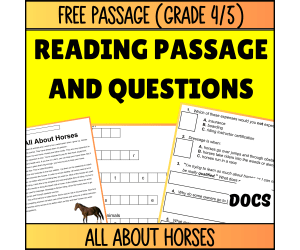
Reading Comprehension Nonfiction Set 3 Sample: All About Horses (Docs)
ELA, Reading, Common Core, Reading Comprehension, ESL, Language Development, Spelling, Creative Writing, Writing, Resources for Teachers, Grade 4, 5, Worksheets & Printables, Worksheets, Writing Prompts, Assessments, Teacher Tools, Tests, Quizzes and Tests, Activities, Centers
Reading Comprehension Passages Nonfiction Set 3 Sample Overview No prep reading comprehension lessons, with enjoyable articles and topics. Each lesson has a blend of post-reading activities. Mixed questions to check overall understanding. Vocabulary activities, plus a writing section. Lessons also contain a bonus extension exercise at the end. Some you may like, some you may not, either way they are there if you wish to use them. Full answer keys are provided. Passage Included 3.All About Horses: How is the author preparing to become a vet when she gets older? Docs Version This is the Docs editable and fillable version. This download is available in GOOGLE Docs, GOOGLE Forms, GOOGLE Slides. PDF, PPT, WORD. FULL CATALOG OF DOWNLOAD LINKS HERE Grade 4/5 Links Fiction Set 1 - Animals Google Docs Google Forms Google Slides PDF PPT Word Guided Reading Materials Fiction Set 2 - Family Google Docs Google Forms Google Slides PDF PPT Word Guided Reading Materials Fiction Set 3 - Friends Google Docs Google Forms Google Slides PDF PPT Word Guided Reading Materials Fiction Set 4 - School Google Docs Google Forms Google Slides PDF PPT Word Guided Reading Materials Fiction Set 5 - Sports Google Docs Google Forms Google Slides PDF PPT Word Guided Reading Materials Nonfiction Set 1 - Birds Google Docs Google Forms Google Slides PDF PPT Word Guided Reading Materials Nonfiction Set 2 - Insects Google Docs Google Forms Google Slides PDF PPT Word Guided Reading Materials Nonfiction Set 3 - Mammals Google Docs Google Forms Google Slides PDF PPT Word Guided Reading Materials Nonfiction Set 4 - Nature Google Docs Google Forms Google Slides PDF PPT Word Guided Reading Materials Nonfiction Set 5 - Sea Animals Google Docs Google Forms Google Slides PDF PPT Word Guided Reading Materials Reading Passages Overview Each passage is especially written for Grade 4-5 students, including key vocabulary required for this age group. Topics are varied and are accompanied by colorful graphics. Topics are meant to educate, yet entertain the modern student. These passages are perfect for the modern classroom. Whereas textbooks can become outdated in no time, any changes to technology or the world will result in updates to this product. Mixed Questions The mixed questions section of each lesson includes a variation of five comprehension, vocabulary and math questions. In addition, key reading strategies are frequently covered including cause & effect, summarizing, compare & contrast and making conclusions. Two or three of the questions will be MCQs and other questions will require a written response of some kind. Full answers and example responses appear at the end of the lesson. Spelling & Vocab Each reading passage contains a variety of words and phrases designed for Grade 4-5 students. Spelling and vocab activities provide the opportunity to build fluency with these words. As it can become quite mundane doing the same activities over and over, each lesson in a set will contain a different spelling and vocab activity . Activities include: spelling games, sentence match-ups, mixed-up text and decoding words from the lesson. Writing Prompts Writing prompts are designed to continue the theme or lessons learned in the story. Students are persuaded to write in a variety of ways and each prompt includes several cues to help. As with the spelling/vocab section, writing prompts will vary. This includes research pieces, reading responses, poetry and creative writing prompts. Full Answer Keys Full answer keys and sample responses are provided so no matter how busy you are, you know you're covered! Mixed question answers provide evidence from the text, math questions contain the relevant workings. Answers are designed for use by the teacher, but also suitable as a handout to the student. Just for Fun Each lesson will have a bonus extension exercise. This is something fun to extend the lesson with. You can find these at the end of each lesson, titled Just for Fun. Just for Funs are optional. Some you may like, some you may not. Either way, they are there to do with as you wish. For similar downloads and other frees, do check out Cored Group on TeachSimple.
Author Cored Education
Tags Elementary, Reading, Comprehension, Vocabulary, Answers, Ccss, Common Core, Spelling, Writing, Digital Centers
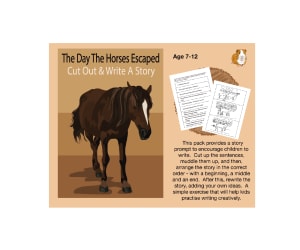
Cut Out And Write A Story Called 'The Day The Horses Escaped' (7-11 years)
ELA, Writing, Creative Writing, Grade 1, 2, 3, 4, Activities
Target Audience This unique teaching resource is created for teachers in public schools as well as homeschoolers. It's designed to fit into the curriculum of students aged between 7 and 11 years. Aim and Scope The product focuses majorly on enhancing language arts skills. Kids are encouraged to interact with stories creatively by organizing various story prompts into sensible narratives. Exciting titles like 'The Day The Horses Escaped', 'Hedgehog In The Garden', and 'Rats Are Scary' aim to light up students' imagination while simultaneously teaching important story planning techniques like creating a beginning, middle, and end. Versatility Our product is not your standard worksheet or lesson plan - it can be flexibly used across whole group instruction, small learning groups or even for individual assignments. It fits just as seamlessly into school settings as it does a smaller homeschool environment. Educational Value Beyond the joy of storytelling, this activity pack also educates on writing techniques: Making sentences from simple to complex using connective words. An emphasis on building strong vocabulary with adjectives alongside verbs and adverbs. Incorporating different types of non-fiction texts such as e-mails, letters, etc. in creative writing. None less important; children who have special needs besides English learners can greatly benefit from its interactive nature which makes learning enjoyable yet content-rich. It’s perfect for kids from Grade 1 up to Grade 4 preparing for exams in language arts subjects – allowing enough practice space to cement their understanding of creative writing strategies coupled with grammar rules.
Author Guinea Pig Education
Tags Creative Writing, Language Arts, Storytelling, Curriculum Resource, Interactive Learning

Addition Mazes (PDF)
ELA, Language Development, Resources for Teachers, Vocabulary, Spelling, Addition and Subtraction, Math, Addition, Early Math, Numbers, Grade 2, 3, 4, 5, Worksheets & Printables, Worksheets, Teacher Tools, Centers, Activities, Mazes
Maze Series This maze series is designed for students in grades 2–5. Each set features a clear, kid-friendly theme with scene-based mazes that students first navigate, then complete by drawing a few target words from a simple word list. Pages come in varied styles and graduated difficulty, with an optional “color it in” step—and some themes invite quick calculations to match the task. These mazes are student-friendly, classroom-ready, and perfect for literacy warmups, seasonal units, fast-finisher bins, centers, sub plans, or home learning extensions. The playful, structured format builds problem-solving, attention to detail, and fine-motor control while reinforcing themed content in a motivating way. Note: Unlike many themed products, not all word-list words appear on the maze pages. To support full vocabulary coverage, we’ve released a companion word list you can find in the links section. Addition Word List 1. Basic Addition Seven, Eight, Nine, Ten, Thirteen, Fourteen, Sixteen, Fifteen 2. Slightly Harder Addition Five, Eleven, Twelve, Seventeen, Nineteen, Twenty, Twenty-Two, Twenty-Five 3. Intermediate Addition Eighteen, Twenty-One, Twenty-Six, Twenty-Seven, Thirty, Thirty-Three, Thirty-Four, Thirty-Five 4. Larger Numbers Forty, Forty-Two, Forty-Five, Forty-Seven, Fifty, Fifty-Four, Fifty-Eight, Sixty 5. Up to Seventy-Five Sixty-Five, Sixty-Nine, Seventy, Seventy-Two, Seventy-Five, Seventy-Nine, Eighty, Eighty-Five 6. Up to One Hundred Eighty-Nine, Ninety, Ninety-Five, Ninety-Seven, Ninety-Nine, One Hundred, One Hundred Five, One Hundred Ten PDF Version Other versions will appear here when available. Follow the store for the lastest on new products. How to Use These Mazes Perfect for: Morning work or early-finisher bins Literacy or STEM centers Holiday/seasonal review lessons Independent stations, sub plans, or take-home enrichment More Addition Themed Products CROSSWORDS WORD SEARCHES FULL CATALOG OF DOWNLOAD LINKS HERE Themed Mazes Links Addition PDF Animals PDF Around the Home PDF Birthday PDF Candy PDF Christmas PDF Cinco de Mayo PDF Clothes PDF Colors PDF Days and Months PDF Division PDF Earth Day PDF Easter PDF Easy Mazes PDF Fall PDF Father's Day PDF Food PDF Geography (Set 1) PDF Geography (Set 2) PDF Geography (Set 3) PDF Graduation PDF Health PDF History (Set 1) PDF History (Set 2) PDF History (Set 3) PDF Human Body PDF Kindness PDF Life Skills PDF Mother's Day PDF Multiplication PDF Science (Set 1) PDF Science (Set 2) PDF Science (Set 3) PDF Shapes PDF Social Skills PDF Spring PDF Sports PDF St. Patrick's Day PDF Subtraction PDF Summer PDF Thanksgiving PDF Transport PDF Valentine's Day PDF Winter PDF Mazes in Depth Structure Each maze is crafted around a focused sub-theme. Students navigate the maze, encountering branches and cul-de-sacs that build attention and planning. Most pages include a tiny follow-up box—students draw or label 2–3 target words from a small word box, add a quick count, or color in the scene—so the activity reinforces both content and skills in a highly engaging format. Each completed set includes: A themed maze page. A simple student instruction strip. An answer key showing the solved path for teacher support or self-checking Themes Included These mazes cover a wide range of fun, age-appropriate themes, including: Seasons & Holidays (e.g., Halloween, Easter, Valentine’s Day) Math-Lite Connections (e.g., quick counts, number words) Everyday Topics (e.g., Animals, Weather, School) Special Units (e.g., Health, Earth Day, Sports, Kindness) Each topic reflects students’ real-life experiences and interests while strengthening problem-solving, visual scanning, and fine-motor control in a playful, highly visual way. Easy extensions (optional): Time it: solve once in pencil, then try to beat the time in pen Retell the route using sequence words (first, next, then, finally) Count intersections or turns and graph the results Write a 1–2 sentence mini-story about the scene using the target words Design a tiny maze in the corner for a partner to solve Differentiation tips: Offer a finger-trace pass before pencils for emerging learners Highlight the borders of the correct region on first attempts Use thicker-line versions or simpler pages to build confidence Pair roles: “navigator” gives directions; “driver” traces the path For similar downloads and other frees, do check out Cored Group on TeachSimple.
Author Cored Education
Rating
Tags Vocabulary, Spelling, Math, Basic Addition, Slightly Harder Addition, Intermediate Addition, Addition Activities, Math Mazes, Addition Mazes, Mazes
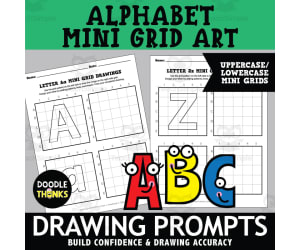
Alphabet Mini Grid Art Prompts | Build Confidence & Drawing Accuracy
ELA, Creative Arts, Art, Language Development, Pre-Reading, Fine Arts, Preschool, Grade 1, 2, 3, 4, Drawing Templates & Outlines, Worksheets & Printables, Activities
Alphabet Mini Grid Art Prompts | Build Confidence & Drawing Accuracy The Alphabet Mini Grid Drawing Prompts is an engaging and educational resource designed for students in kindergarten through 4th grade. This tool, which focuses on Language Arts, Art and Music, enhances skills while making learning fun. For more creative ideas, visit Doodle Thinks website. Incorporating this Resource into Everyday Teaching: Integrating this tool into your standard teaching routine encourages students to broaden their creative minds through art whilst solidifying their knowledge of the alphabet. These simple grid drawing exercises transform complex images into manageable pieces - thereby fostering detail orientation and precision. Included in this download: 52 mini grid drawing prompts An uppercase set A lowercase set This provides plenty of opportunities for students to explore different aspects of art - not just in classrooms but as homework or holiday assignments too. Pedagogical Applications: This resource can be effectively used during whole group instruction. Individual activities or when working in small groups. Your learners will find the prompts easy to understand and they help facilitate interactive peer-learning when utilized within team settings. Plus, you may even use them as a calming brain break activity, homeschool drawing time, sub days, or they could serve as engaging tasks for early finishers! Versatility & Effectiveness: This educational resource creates an engaging blend that aims at nurturing creativity, focus, and confidence in art while ensuring that all learners enjoy each accompanied session with mini grid drawings. The Alphabet Mini Grid Drawing Prompts is an excellent tool suitable for both traditional schooling scenarios and homeschool environments where unique expressive styles are honed. Have fun learning and drawing!
Author Doodle Thinks
Rating
Tags Grid Drawing, Alphabet, Art Education, Fine Motor Skills, Creativity, Drawing, Build Confidence, Learn The Alphabet, Drawing Accuracy, Art Printables
Counting By Sevens Song (MP3)
Math, Numbers, Addition and Subtraction, Addition, Grade 3, 4, 5, 6, Songs, Activities
This song is a great resource for students who are learning to skip count by 7s. The song is fun and engaging, and it helps students practice their counting skills.
Author Have Fun Teaching
Tags Counting, Skip Counting
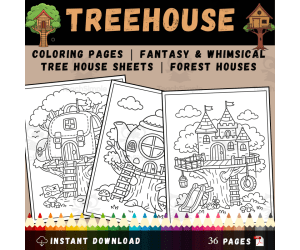
Treehouse Coloring Pages | Fantasy & Whimsical Tree House Sheets
Graphic Arts, Creative Arts, Toddler, Infant, Grade 1, 2, 3, 4, 5, Activities, Centers, Worksheets & Printables, Flashcards, Worksheets, Workbooks, Coloring Pages
Whimsical Treehouses Will Spark the Imagination of Your Students! Are you searching for an exciting way to make your lesson plans more engaging and interactive? With its wide range of imaginative treehouses, this Treehouse Coloring Book is sure to inspire your students' creativity while developing their motor skills. With whimsical images like castles on top of trees and sweet candy branches, the possibilities are endless! What’s Included? This packet includes an assortment of line art drawings in black and white, such as: Tree Castles & Fantasy: Tree houses that resemble medieval castles and old-fashioned cabins amid the treetops. Creative Homes in Objects: Original ideas that include a "Backpack House," a "Boot/Shoe House," and a "Teapot Treehouse"! Theme Ideas: Tree houses based on the themes "Cupcake" and "Candy" to add a sprinkle of enchantment! Explore Outside: Scenes with telescopes, tire swings, slides, and adorable woodland creatures! Test Colors Sheet: An exclusive page where students can test out their markers, crayons, or colored pencils before embarking on their masterpiece. Perfect For: Early Finishers: Keep students engaged and quiet after completing assignments. Art Centers: A great addition to any elementary art curriculum. Fine Motor Practice: Helps younger students develop hand-eye coordination and pencil control. Mindfulness & Relaxation: Use as a calming activity during transition times or "Brain Breaks." Storytelling Prompts: Encourage students to write a story about who lives in these magical homes! Teacher Tips: Print & Go: These are standard letter-sized pages (8.5" x 11") for easy printing. Coloring Portfolio: Have students color the entire set over a month to create their own "Adventure Book."
Author Source Class
Rating
Tags Treehouse Coloring Pages, Treehouse , Coloring Pages, Coloring Sheets, Tree House Sheets, Forest Houses
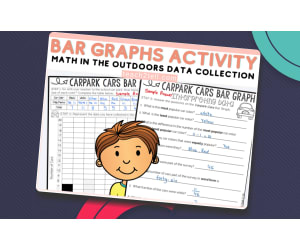
Bar Graphs Worksheets Data and Graphing Column Graphs Tally Marks
Math, Graphing, Measurements, Grade 2, 3, 4, 5, Worksheets & Printables, Worksheets, Activities
Looking for a data and graphing activity that gets your students moving and learning at the same time? These Bar Graphs Worksheets are the perfect mix of hands-on fun and curriculum-aligned skills practice! With a hands-on, real-world approach, your students will head outside to collect data using tally marks—yes, real data from your staff car park ! From Observation to Representation Your students will observe car colors and record their findings using tally marks . Then, they’ll transfer that data into a clear and colorful column (bar) graph . It’s a simple yet powerful way to connect real-life observation with structured math skills. Deepen Thinking with Data Interpretation Once the graphs are complete, students answer a series of questions to analyze and interpret the data. This step encourages them to think critically, make comparisons, and draw conclusions based on evidence—hello, higher-order thinking! What’s Included ✔️ Tally mark data collection sheet ✔️ Column/Bar graph template ✔️ Comprehension questions for data interpretation ✔️ US and British English versions for flexible classroom use Perfect For: Math centers or rotations Early finishers Outdoor learning experiences Grades 2–4 (or adaptable for other levels) Real-life, cross-curricular connections Why Teachers Love It This resource is more than just a worksheet—it's an experience. Students are actively engaged , moving , thinking , and connecting math to the world around them . Real data. Real math. Real fun. Bring graphing to life and turn your next math lesson into a mini adventure!
Author Teach2Tell
Rating
Tags Bar Graphs Worksheets, Data And Graphing Activities, Bar Graph Math Center, Graphing Data For 2nd Grade, Graphing Data For 3rd Grade, Math Worksheets Bar Graphs, Real-world Math Project, Picture And Bar Graph Worksheets, Common Core Graphing Lesson, Math Graphing Printables

Park Lane School Presents The Wonderful Wizard of Oz (6-10 years)
ELA, Reading, Grade 1, 2, 3, 4, Activities
Park Lane School Presents The Wonderful Wizard of Oz A captivating educational resource, primarily designed for children aged between 6 to 10 years. This reading product features the journey of Sam - a hopeful star actor and provides an insightful exploration beyond the text into the eager minds of young readers. About The Book: The narrative encompasses Sam's adventures at Park Lane School, his thrilling engagement with performing arts via their play-spectacle, "The Wonderful Wizard of Oz". It showcases a mixtures of emotions like excitement, disappointment and nervousness which are deftly portrayed through Sam's interactions. Usage: Ideal for either whole group readings or small learning groups. An excellent tool as engaging homework assignment promoting active reading amongst students. Equips students in grades 1 to 4 with comprehensive language arts practice specifically aimed at improving reading skills. Introduces relevant themes drawn from real-life situations that students can relate to. Interactive Elements: The resource available in easy-to-use PDF format, . Beyond textual content it includes: Sets of interactive questions post-reading sessions. Creative writing activities designed thoughtfully post-reading sessions. All these elements allow children not only to reflect on the events developed throughout Sam's journey but importantly connect them with their personal experiences. This makes this resource highly beneficial in fostering meaningful insights while encouraging constructive discussions within classrooms or homeschool environments alike. </p
Author Guinea Pig Education
Tags Journey, Performing Arts, Emotions, Interactive Learning, Reading Skills

Responding To Others BINGO | Positive & Negative Scenarios
Life Studies, Special Resources, Life Skills, Grade 1, 2, 3, 4, 5, Activities, Games
Responding To Others BINGO - An Exciting Educational Tool Responding To Others BINGO paves an innovative path to teaching essential social skills in students. Using a fun approach, it aids students in the art of perspective taking, enabling them to make apt responses during both positive and negative scenarios. Differentiated Instruction Compatible with varying levels of understanding among grades 1 through 5. Caters to readers and non-readers with multiple board designs. Versatile Usage Teachers can use this resource: In whole group instruction or small group activities. To assign engaging homework extending learning beyond classrooms. Hence practically useful for public school educators and homeschoolers alike! Focused Scenarios & Editable Variations This game introduces independent boards for: Positive situations, Negative situations, Combined scenarios, Editorial versions to suit unique classroom needs. . The multiplicity of options fosters emotional intelligence by letting students critically think about their reactions in diverse situations. + Game Features:> Repeatable Use: You could reuse thanks to laminatable black & white boards or use them once which will let children color shielded picture-boards after each use. Adapting towards Reusability Reusability is based on playable creativity, it provides students pleasure of mastering skills useful for interpersonal settings. Testimonials: Multiple endorsements from teachers acknowledge the ability of this game to not just captivate but successfully impart wisdom onto their students in an exciting environment.
Author Socially Skilled Kids
Tags Social Skills, Perspective Taking, Responding Appropriately, Positive Scenarios, Negative Scenarios

Multiplication Word List Posters (PDF)
ELA, Language Development, Resources for Teachers, Vocabulary, Spelling, ESL, Multiplication, Multiplication and Division, Math, Grade 2, 3, 4, 5, Worksheets & Printables, Worksheets, Teacher Tools, Centers, Activities, Posters, Classroom Decor
Word List Poster Series This word list poster series is designed for students in grades 2–5. Each printable focuses on a clear, kid-friendly theme and features 8 target vocabulary words with short, student-friendly meanings or fun facts. The clean layout works as both an anchor chart and a write-in sheet, giving students a quick, visual reference they can revisit during centers and independent work. These posters are student-friendly, classroom-ready, and perfect for warmups, vocabulary walls, sub plans, or take-home reference. Display a single poster to support the day’s lesson, or group several to build a themed wall across your unit. Note: Each poster is a companion piece to its matching themed product in the series—pair it with the corresponding maze, wordsearch, or activity pack for a consistent set of 8 focus words. Multiplication Word List 1. Basic Multiplication Two, Three, Four, Five, Six, Seven, Eight, Nine 2. Multiplying by 4 and 5 Ten, Twelve, Fifteen, Sixteen, Twenty, Twenty-Four, Twenty-Five, Thirty 3. Multiplying by 6 and 7 Thirty-Six, Forty-Two, Forty-Nine, Fifty-Six, Sixty-Three, Seventy, Seventy-Seven, Eighty-Four 4. Multiplying by 8 and 9 Sixty-Four, Seventy-Two, Eighty-One, Ninety, Ninety-Nine, One Hundred Eight, One Hundred Twenty, One Hundred Forty-Four 5. Larger Multiplication Numbers One Hundred Sixty, One Hundred Eighty, Two Hundred Ten, Two Hundred Forty, Two Hundred Seventy, Three Hundred, Three Hundred Thirty, Three Hundred Sixty 6. Extra Large Multiplication Four Hundred, Four Hundred Fifty, Five Hundred, Six Hundred, Seven Hundred Fifty, Eight Hundred, Nine Hundred, One Thousand PDF Version Other versions will appear here when available. Follow the store for the lastest on new products. How to Use These Word List Posters Perfect for: Morning work or early-finisher bins Vocabulary centers or anchor walls Holiday/seasonal review lessons Independent stations, sub plans, or take-home reference More Multiplication Themed Products CROSSWORDS WORD SEARCHES MAZES FULL CATALOG OF DOWNLOAD LINKS HERE Themed Word List Posters Links Addition PDF Animals PDF Around the Home PDF Birthday PDF Candy PDF Christmas PDF Cinco de Mayo PDF Clothes PDF Colors PDF Days and Months PDF Division PDF Earth Day PDF Easter PDF Easy Word List Posters PDF Fall PDF Father's Day PDF Food PDF Geography (Set 1) PDF Geography (Set 2) PDF Geography (Set 3) PDF Graduation PDF Health PDF History (Set 1) PDF History (Set 2) PDF History (Set 3) PDF Human Body PDF Kindness PDF Life Skills PDF Mother's Day PDF Multiplication PDF Science (Set 1) PDF Science (Set 2) PDF Science (Set 3) PDF Shapes PDF Social Skills PDF Spring PDF Sports PDF St. Patrick's Day PDF Subtraction PDF Summer PDF Thanksgiving PDF Transport PDF Valentine's Day PDF Winter PDF Word List Posters in Depth Structure Each poster is built around a focused sub-theme and presents 8 target words with short, student-friendly meanings or fun facts. The clean A4 portrait layout works as an anchor chart on your board or as a student reference at desks. These posters are designed as companion pieces to the matching themed products (mazes, wordsearches, activity packs), so the same vocabulary stays visible across your unit. Each poster set includes: A themed word list poster with 8 words + brief meanings/facts A clean, high-contrast layout for easy printing and display Space that can double as write-in/draw-to-show-meaning during centers Themes Included Seasons & Holidays (e.g., Halloween, Easter, Valentine’s Day) Everyday Topics (e.g., Animals, Weather, School) Math & Science Connections (e.g., Number Words, Simple Machines) Special Units (e.g., Health, Earth Day, Sports, Kindness) Each topic reflects real-life experiences and interests while strengthening vocabulary recognition and content understanding in a clear, visual way. Easy extensions (optional) Sketch it: students draw a quick icon for each word Sort it: group words by category (e.g., actions, objects) Star it: highlight “I already know” vs. “I’m learning” words Match it: point to examples in a reading, video, or picture set Say it: brief oral definition or example sentence during share-out Differentiation tips Pre-teach 2–3 anchor words; add the rest later in the week Offer picture cues or gestures for emerging readers/ELLs Let students choose 4 of 8 to focus on first, then build up Color-code by part of speech or concept family for quick scanning For similar downloads and other frees, do check out Cored Group on TeachSimple.
Author Cored Education
Rating
Tags Vocabulary, Spelling, Multiplication, Math, Word Lists, Posters, Math Word Lists, Math Posters, Math Poster, Multiplication Word List

El carnaval de los animales – Differentiated Leporello (Spanish)
Music, Creative Arts, Grade 1, 2, 3, 4, 5, Crafts, Activities, Projects, Worksheets & Printables, Worksheets
El carnaval de los animales – Differentiated Leporello (Spanish Resource) Language of material: Spanish Grade level: Grades 1–4, inclusive settings Subject areas: Music, literacy, creative arts This Spanish-language resource is based on The Carnival of the Animals by Camille Saint-Saëns. It provides a differentiated printable leporello booklet (accordion-style mini-book) that helps students engage with classical music in a hands-on and meaningful way. The material includes four different formats: A black-and-white version for students to color while listening to the music A version where students cut out image-text strips and paste them in the correct place A cloze version, where students complete missing parts of the text using a word bank All three versions are also provided in color for extra visual support This resource is designed for elementary students and also works well in inclusive or bilingual classrooms . It combines music, reading, and fine motor practice in one engaging activity. No prior knowledge of music theory is required, making it accessible for all learners. Learning goals include: Listening closely to classical music Identifying instruments and matching them with animals Reading and writing in Spanish Improving fine motor coordination (cutting, folding, gluing) Encouraging creativity and structure at the same time Teachers can use this resource after playing the music in class or as part of a cross-curricular unit on animals, instruments, or composers. It can also be used as independent work, pair activity, or for centers. The leporello format offers a creative way to document what students have learned in a personalized way. No preparation is needed. Just print, cut, fold, and use. Idioma del material: Español Nivel educativo: 1.º a 4.º de Primaria, educación inclusiva Áreas temáticas: Música, lectoescritura, artes creativas Este recurso en español está basado en El carnaval de los animales de Camille Saint-Saëns. Ofrece un librito tipo leporello (acordeón) para imprimir, que permite a los alumnos interactuar activamente con la música clásica. El material incluye cuatro versiones: Versión en blanco y negro para colorear mientras se escucha la música Versión con tiras de imagen y texto para recortar y pegar Versión de completar texto con banco de palabras Todas también disponibles en versión a color Objetivos de aprendizaje: Escuchar y comprender música clásica Relacionar instrumentos musicales con animales Leer y escribir en español Desarrollar la motricidad fina Trabajar la creatividad en una estructura clara Ideal tras una actividad auditiva o en proyectos interdisciplinarios. Solo hay que imprimir, recortar y montar. No se requiere preparación adicional. Best Wishes, Doreen Blumhagen - Die Relitante
Author Die Relitante
Rating
Tags Carnival Of The Animals, Composer Study, Camille Saint-Saëns, Elementary Music, Classical Music For Kids, Listening Activity, Music Booklet, Differentiated Learning, Music Worksheets

Terrestrial and Aquatic Biomes Research Project 4th 5th 6th 7th Grade
Research, ELA, Writing, Formal Writing, Science, Earth and Environmental Sciences, Environmental Science, Grade 4, 5, 6, 7, Worksheets & Printables, Worksheets, Writing Prompts, Drawing Templates & Outlines, Teacher Tools, Rubrics, Activities, Projects
Here is a ready-to-go terrestrial and aquatic biomes science research project for your students in 4th, 5th, 6th or 7th grade. Each student will choose a terrestrial or aquatic biome, complete focused research about it, and create an organized project with paragraphs and visuals to share their learning. How to Use: •Print pages 2-13 for each student. •Page 2 has clear instructions for the project including a website students can use to select their biome, places to write due dates, and a checklist to keep students on track. •Page 3 has seven different prompts for students to research. Each student needs to pick at least four prompts to include in their unique project. •Pages 4-6 are graphic organizers for your students to use as they take notes and record their research sources (page 6 is optional). •Pages 7-9 are templates for students to use to write at least four paragraphs about their biome (page 9 is optional). They could also type and print these paragraphs instead. •Page 10 is for students to draw plants that are found in their biome. •Page 11 is for students to draw animals that are found in their biome. •Page 12 is a title page for the project. •Page 13 is a rubric you can use to assess the project. Let students see it at the beginning of the project so they know what the expectations are. Over several weeks, your students can complete research on their biome, write and proofread their paragraphs, and draw the visual components of their project. They can present their projects to each other, and you can use the rubric to assess them. Grades to Use With: This project is designed for middle grades students in 4th, 5th, 6th or 7th grade who are learning about biodiversity and biomes, library research skills and expository writing- specifically expository paragraphs. It could also be used in high school special education classes where appropriate. What's Included: 13-Page PDF: Ready to Print and Use! Complete Teacher Instructions 2 Pages of Student Instructions & Writing Topics 6 Student Graphic Organizers for Note-Taking & Paragraph Writing 2 Student Templates for Biome Plant and Animal Drawings Project Title Page Marking Rubric
Author Grace Under Pressure
Rating
Tags Biomes, Terrestrial Biomes, Aquatic Biomes, Biome Project, Biome Research Project, Terrestrial Biome Research Project, Aquatic Biome Project, 5th Grade Research Project, 6th Grade Project
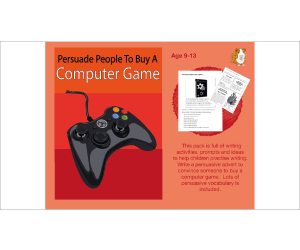
Persuade People To Buy A Computer Game (9-13 years)
ELA, Writing, Grade 4, 5, 6, Games, Activities
Persuade People To Buy A Computer Game (9-13 years) A compelling teaching resource designed to foster the persuasive writing skills of children aged 9-13. This learning tool works to engage students and spark their creativity, providing examples and prompts that instigate practical application of persuasive vocabulary. Key Features: Offers an invaluable guide for facilitating writing practice for students in Grades 4, 5, and 6 with a focus on the subject of Language Arts. Aims to enhance their proficiency in formulating clear arguments, expressive storytelling, crafting engaging letters or scripts. Exceptionally useful for educators seeking diverse approaches to teach writing - it can be manipulated flexibly within whole class instruction, smaller group work or assigned as a productive homework exercise. "Persuade People To Buy A Computer Game" situates learning in a relatable context by requiring students to write convincing advertisements for computer games - an appealing task that capably merges fun with education. As they immerse themselves into creating these persuasive pieces, they dive deeper into understanding how effective language use can sway perspectives. Included in the PDF format: Six pages filled with innovative prompts Rich examples that feature complex vocabulary aimed at more proficient learners; thus serving as an excellent challenge for expanding their lexicon further. All things considered, "Persuade People To Buy A Computer Game" , is an articulate educational resource adept at immersing students into the world of compelling written communication while nudging them step-by-step toward achieving excellence in creative writing pursuits all through strides made within familiar grounds.
Author Guinea Pig Education
Tags Persuasive Writing, Computer Games, Creative Writing, Language Arts, Vocabulary Enhancement

Multiplying and Dividing Positive and Negative Fractions Pixel Art
Math, Fractions, Multiplication and Division, Division, Multiplication, Grade 4, 5, 6, Worksheets & Printables, Activities, Task Cards, Games
Are your 7th-grade students struggling with multiplication and division of positive and negative fractions? This engaging activity is ready to make those slippery ideas stick — with no hours of prep or grading. With printable task cards and digital self-checking pixel art, this activity incorporates flexibility, enjoyment, and independent learning. It motivates students as they solve problems and watch a hidden picture appear — as they build strong fraction skills that are in line with 7th-grade math standards. Why This Resource Works This no-prep digital activity makes practice with fractions fun. As they finish each of the 20 multiplying and dividing fraction problems, correct answers will uncover a pixel-art image. The self-checking design provides instant feedback for students — and less effort for you. You’ll also get printable task cards for small groups, partner work, or stations. Whether your class is working digitally, on paper, or a mix of both, you’ll have everything ready to go in minutes. What’s Included Digital Pixel Art Activity featuring 20 multiplying and dividing fraction problems (including positive and negative numbers) Printable Task Cards for flexible small-group or offline practice Student Handouts to support independent work Answer Key for fast grading or easy self-grading No-Prep Format — perfect for assigning or printing instantly Neutral, Year-Round Theme — suitable with any unit or season Key Benefits Zero Prep – Assign or print and start right away. Self-Checking Format – Immediate feedback saves time grading and increases confidence. Engaging & Interactive – Pixel art holds students' interest from start to finish. Flexible Use – Works digitally, in print, or a mix of both. All-Year Resource – Perfect for any time of the year, from first teaching to review. Perfect For 7th Grade Math Practice or Review In-Class or Distance Learning Centers, Rotations, or Partner Work Homework, Sub Plans, or Early Finishers Offer your students valuable practice without the prep time. With engaging pixel art and print-friendly options, multiplying and dividing fractions have never been so enjoyable — or so easy to teach.
Author Matemaths
Rating
Tags Matemaths, Printable, Worksheets, Task Cards, Pixel Art, Decimals
Guided Reading Level L - All About Horses (with Lesson Plan)
ELA, Resources for Teachers, Reading Comprehension, Reading, Science, Language Development, Life Sciences, Animals, Pre-Reading, Vocabulary, Grade 2, 3, 4, Worksheets & Printables, Worksheets, Teacher Tools, Centers, Activities, Literacy Readers, Quizzes, Quizzes and Tests, Assessments, Lesson Plans
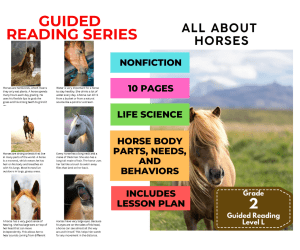
This Guided Reading Book - All About Horses (Level L) with lesson plan includes: Guided Reading Color Label (front cover x1) This is a quick way to match the book’s demands to what students can generally handle.. The overall goal is to use the level/color to pick books for several smaller groups. To qualify for a certain level, a student is expected to read a book from that level with about 90–94% accuracy. If a student is consistently accurate and understands, move up a level. If the student is struggling at that level, drop down and add more support. Each student will improve at completely different rates, but it is generally one of the best ways to check progress across the class. DOWNLOAD THE CATALOG TO VIEW ALL GUIDED READING BOOKS AVAILABLE (SORTED LEVELS A-Z) Pre-Reading Question (x1) Teacher asks the prompt aloud, can be while showing the cover or first page. Students share what they already know, or make educated guesses from the cover. Prompt them to use the target vocabulary. Write some of their responses on the board to look back at during the reading. Vocabulary Words (x5) Introduce the five words, best doing it one at a time. Start by saying it, while students repeat and then see if anyone knows what it means before reading further. Read through the meaning and try to briefly connect each word to a picture or gesture so it’s meaningful. Ask students to flip through the book pages and point to where they see each of the vocabulary words. While reading the book pause upon coming across one of the vocab words or read the sentence twice to make sure students understand the word has appeared. Optional: Ask students to raise hands whenever they see/hear one of the new words. Guided Reading Pages (x10) Check the book snapshot (below) for: primary topic - do you need to prep extra reading or intro materials on this? what is taught best - decide on 1-2 bullets to focus on, use the prompt or words provided here for best results. learning goals - what you are checking for students to be able to do after the session, elicit answers using prompts or words provided. key vocabulary (see section above). questions overview - so you know what is coming up and if you need to prep extra materials to assist understanding. Run the lesson You may have already looked at a few of the pages together, but you can show them some of the pictures again first to set meaning. Depending on how much time you have and how familiar your students are with guided reading class, you may want to read the book aloud first with the group first. Students whisper or partner read, while you listen in. If time, do it as a group, one student reading a page each. Use the guided page’s prompts to coach: “Check the picture / does it make sense?” “Point under the words / try the first sound” “Reread the sentence smoothly”. Try to focus more on one student per session (rotating every time), so you can work out if they are ready to move up or need to move down a level. Comprehension Questions (back cover x3) This is your way to check that students didn’t just say the words, but actually understood the text. First, let students answer by pointing to the page/picture and saying a short sentence. After any answer, follow with: “Show me where you found that in the text.” In bigger groups, have partners answer first (10–20 seconds), then call on 2–3 students to share. Differentiation tips: Emerging speakers/struggling readers: oral + pointing On-level: oral in a full sentence Higher: one written sentence or draw + label Book Snapshot Title: All About Horses Genre: Nonfiction (informational) Subject: Life Science / Reading (Informational Text) Primary Topic: Horse body parts, needs, and behaviors Estimated Guided Reading Level (A–Z): L What This Book Teaches Best Key animal facts about horses (they are strong animals, mammals, and live outdoors in grassy areas). How horse body parts help them (mane and tail; tail swishes away flies). What horses need to stay healthy (they eat plants and drink a lot of water). How horses move (trot with “diagonal pairs,” and gallop as the fastest way to move with hooves off the ground). Special horse behaviors and life stages (sleeping while standing; a baby horse is a foal). Learning Goals Students will identify key facts about horses (habitat, body traits, and needs) from the text. Students will explain how a horse uses its tail based on details in the book. Students will describe what horses eat and how they graze using evidence from the text. Students will compare two horse movements (trot and gallop) using information from the book. Students will explain how a horse can sleep while standing without falling over. Students will describe what a foal is and what it can do soon after being born. Key Vocabulary From the Text mammal — an animal that breathes air with lungs. herbivores — animals that eat only plants. grazing — eating grass little by little over time. diagonal — slanted, from one corner to the opposite corner. hooves — the hard feet of a horse. Discussion Prompts Pre-reading question: What do you think a horse needs to stay healthy outdoors? Comprehension questions: What does the text say a horse uses its tail for? How does the text describe a trot? What is a foal, and what can it do within an hour of being born? Printing Tips 1. Best Printing Method (Recommended) “Booklet” Printing (Best if Available) If your printer or PDF viewer supports Booklet Printing , use this. Settings to use: Print mode: Booklet Paper size: Letter or A4 (either works) Orientation: Landscape Print on both sides: Yes Flip on: Short edge Scaling: Fit to printable area Booklet subset: First test: Front sides only Then: Back sides only This will automatically: Pair pages correctly Put the cover on the outside Align everything for folding After printing, fold in half and staple along the spine . 2. If “Booklet” Printing Is NOT Available You can still print this correctly with manual duplex printing . Step-by-step: Open the PDF. Choose Print . Set: Orientation: Landscape Pages per sheet: 1 Print on both sides: Yes Flip on: Short edge Print all pages . Because each PDF page already contains two facing book pages, the result will still fold cleanly into a book. Thousands of Cored Education products are included with your TeachSimple membership. Download links and encyclopedia index available here.
Author Cored Education
Rating
Tags Reading Comprehension, Reading Passages, Reading, Guided Reading, Guided Reading Lesson Plan, Guided Reading Activity, Pre-reading, Science Lesson Plans, Life Science, Animals

"WH" Question Prompts | Halloween Themed, 20 Differentiated Prompts
Special Resources, Speech Therapy, Preschool, Grade 1, 2, 3, 4, 5, Activities
WH Question Prompts | Halloween Themed, 20 Differentiated Prompts An engaging resource bringing a Halloween twist to teaching 'WH' questions is aimed at boosting the social pragmatic skills in primary grade students. This activity educates while entertaining thanks to its playful theme. The set includes 20 diverse prompt cards focusing on who, what, when, where, why and how questions: The first 10 cards are designed for students ready for a more challenging experience Card numbers 11 through 20 are presented in black and white format suitable for direct or take-home assignments The unique feature of these WH question prompts are one-word hints that can be concealed. This: Forces learners to think creatively about complete 'WH' queries on their own thus sharpening their mental faculties. Reinforces language skills overall and promotes automaticity. Enhances social skills including perspective taking thereby preparing them with vital life skills. A Make Your Own page bundled as bonus content provides creative freedom for teachers or parents alike to inject their personal touch into the learning process driving both repetition and practice. A teacher’s prompt guide is included allowing you to maximize every learning opportunity with precision. Crafted specifically for children requiring speech therapy techniques among other special resources; this tool promotes consistent learning from foundational stages whether implemented during group discussions or assigned as individual homework tasks. This Halloween season prepare with fun, productive learning materials that facilitate teacher-student engagement built around pushing boundaries while celebrating the festive spirit!
Author Socially Skilled Kids
Tags Halloween, WH Questions, Social Skills, Speech Therapy, Differentiated Prompts

UK/Aus Spelling Adverbs Practice Questions - Year 4-5 (PPT)
ELA, Language Development, ESL, Grammar, Common Core, Resources for Teachers, Grade 3, 4, Quizzes and Tests, Teacher Tools, Tests, Assessments, Presentations, Activities
THIS IS THE UK/AUS ENGLISH SPELLING VERSION. CHECK THE CATALOG FOR THE ORIGINAL AMERICAN ENGLISH VERSION. Adverbs Grammar Practice MCQS ELA MCQS Overview: In this series of lessons, students will embark on an engaging journey to explore the grammar skills that make our language vibrant and expressive. These lessons are crafted to help students identify, comprehend, and effectively apply language arts skills in both writing and speech. This UK/Aus English version is especially useful for schools, teachers, and families working with British-based spelling and language conventions. It is a helpful option for classrooms using UK curriculum expectations, international programmes influenced by British English, or any setting where learners need to practise the correct capitalisation and punctuation forms for that version of English. Adverbs Overview: Includes: When Adverbs Where Adverbs How Adverbs Mistake Finding PPT Version This is the PPT editable and interactive version. There is a fillable answer sheet at the end. This download is available in GOOGLE Docs, GOOGLE Forms, GOOGLE Slides. PDF, PPT, WORD, check the links below for more details. FULL CATALOG OF DOWNLOAD LINKS HERE ELA Review Questions Overview Each review test includes three answer choices for every question, which helps keep things simple and manageable for students. The layout is clear and easy to follow, so students can focus on the questions instead of figuring out what to do. A few pictures are included on each test to make the pages feel a little more inviting and less overwhelming. A review sheet is also included, giving students a chance to go back over many of the main skills covered in the resource. Introduction or Example Sheet Each topic comes with an introduction or example sheet to look at before students begin. This gives students a clear starting point and helps them feel more prepared. It also lets them see what to expect before moving into the main work. For many students, it is a helpful way to quickly refresh the key ideas before they start practicing on their own. Full Answer Keys Full answer keys are included to make marking and checking work faster and easier. Sample responses are also provided where needed, especially for open-ended tasks. This can be a real time-saver on busy days and makes the resource more practical to use. Everything is there to help make planning, teaching, and checking student work feel a little more straightforward. For similar downloads and other frees, do check out Cored Group on TeachSimple.
Author Cored Education
Rating
Tags Elementary, Answers, Ccss, Common Core, Grammar, Tests, Test Prep, Assessment, Grade 3, Grade 4
A Guide to Fish: Guided Reading Level Q with Lesson Plan
ELA, Resources for Teachers, Reading Comprehension, Reading, Science, Language Development, Life Sciences, Earth and Environmental Sciences, Pre-Reading, Vocabulary, Grade 3, 4, 5, Worksheets & Printables, Worksheets, Teacher Tools, Centers, Activities, Literacy Readers, Quizzes, Quizzes and Tests, Assessments, Lesson Plans
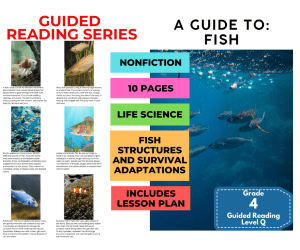
This A Guide to Fish (level q) guided reading book with lesson plan includes: Guided Reading Color Label (front cover x1) This is a quick way to match the book’s demands to what students can generally handle.. The overall goal is to use the level/color to pick books for several smaller groups. To qualify for a certain level, a student is expected to read a book from that level with about 90–94% accuracy. If a student is consistently accurate and understands, move up a level. If the student is struggling at that level, drop down and add more support. Each student will improve at completely different rates, but it is generally one of the best ways to check progress across the class. DOWNLOAD THE CATALOG TO VIEW ALL GUIDED READING BOOKS AVAILABLE (SORTED LEVELS A-Z) Pre-Reading Question (x1) Teacher asks the prompt aloud, can be while showing the cover or first page. Students share what they already know, or make educated guesses from the cover. Prompt them to use the target vocabulary. Write some of their responses on the board to look back at during the reading. Vocabulary Words (x5) Introduce the five words, best doing it one at a time. Start by saying it, while students repeat and then see if anyone knows what it means before reading further. Read through the meaning and try to briefly connect each word to a picture or gesture so it’s meaningful. Ask students to flip through the book pages and point to where they see each of the vocabulary words. While reading the book pause upon coming across one of the vocab words or read the sentence twice to make sure students understand the word has appeared. Optional: Ask students to raise hands whenever they see/hear one of the new words. Guided Reading Pages (x10) Check the book snapshot (below) for: primary topic - do you need to prep extra reading or intro materials on this? what is taught best - decide on 1-2 bullets to focus on, use the prompt or words provided here for best results. learning goals - what you are checking for students to be able to do after the session, elicit answers using prompts or words provided. key vocabulary (see section above). questions overview - so you know what is coming up and if you need to prep extra materials to assist understanding. Run the lesson You may have already looked at a few of the pages together, but you can show them some of the pictures again first to set meaning. Depending on how much time you have and how familiar your students are with guided reading class, you may want to read the book aloud first with the group first. Students whisper or partner read, while you listen in. If time, do it as a group, one student reading a page each. Use the guided page’s prompts to coach: “Check the picture / does it make sense?” “Point under the words / try the first sound” “Reread the sentence smoothly”. Try to focus more on one student per session (rotating every time), so you can work out if they are ready to move up or need to move down a level. Comprehension Questions (back cover x3) This is your way to check that students didn’t just say the words, but actually understood the text. First, let students answer by pointing to the page/picture and saying a short sentence. After any answer, follow with: “Show me where you found that in the text.” In bigger groups, have partners answer first (10–20 seconds), then call on 2–3 students to share. Differentiation tips: Emerging speakers/struggling readers: oral + pointing On-level: oral in a full sentence Higher: one written sentence or draw + label Book Snapshot Title: A Guide to: Fish Genre: Nonfiction (informational) Subject: Life Science Primary Topic: Fish structures and survival adaptations Estimated Guided Reading Level (A–Z): Q What This Book Teaches Best Explains how gills help fish breathe by extracting oxygen from water and releasing carbon dioxide. Describes how a fish’s streamlined shape and fins support efficient movement, stability, steering, and turning. Introduces the lateral line as a sensory system that detects vibrations and pressure changes to help fish navigate and find prey. Compares freshwater and saltwater habitats and explains how fish maintain the right internal balance of salt and water. Shows multiple survival strategies such as bioluminescence, camouflage, cartilaginous skeletons, and schooling (“safety in numbers”). Learning Goals Explain how fish breathe using gills and what happens as water passes over gill filaments. Describe how fins and a streamlined body shape help fish move, steer, and turn in water. Identify what the lateral line does and how it helps fish survive (navigation and finding prey). Compare how freshwater fish and saltwater fish manage water and salt in their bodies. Explain at least two survival adaptations described in the text (camouflage, bioluminescence, schooling). Describe what “cartilaginous fish” are and what the text says cartilage allows them to do. Key Vocabulary From the Text vertebrates — animals that have a backbone. specialized — made for a specific job or purpose. filaments — thin, threadlike parts of the gills. bioluminescence — the ability to make your own light. cartilaginous — having a skeleton made of cartilage, not hard bone. Discussion Prompts Pre-reading question: What body parts or behaviors might help fish survive in different kinds of water? Comprehension questions: What does the text explain that gills do for a fish? Comprehension questions: How does the lateral line help fish, according to the text? Comprehension questions: Why does the text say swimming in a school can help fish survive? Printing Tips 1. Best Printing Method (Recommended) “Booklet” Printing (Best if Available) If your printer or PDF viewer supports Booklet Printing , use this. Settings to use: Print mode: Booklet Paper size: Letter or A4 (either works) Orientation: Landscape Print on both sides: Yes Flip on: Short edge Scaling: Fit to printable area Booklet subset: First test: Front sides only Then: Back sides only This will automatically: Pair pages correctly Put the cover on the outside Align everything for folding After printing, fold in half and staple along the spine . 2. If “Booklet” Printing Is NOT Available You can still print this correctly with manual duplex printing . Step-by-step: Open the PDF. Choose Print . Set: Orientation: Landscape Pages per sheet: 1 Print on both sides: Yes Flip on: Short edge Print all pages . Because each PDF page already contains two facing book pages, the result will still fold cleanly into a book. Thousands of Cored Education products are included with your TeachSimple membership. Download links and encyclopedia index available here.
Author Cored Education
Rating
Tags Reading Comprehension, Reading Passages, Reading, Guided Reading, Guided Reading Lesson Plan, Guided Reading Activity, Pre-reading, Science Lesson Plans, Life Science, Earth Science

Science Revision for Grade 4
Science, Grade 4, Activities, Worksheets & Printables, Assessments, Teacher Tools
This Grade 4 Science Worksheet is perfect for busy teachers. It includes 30 ready-to-use activities that cover key science topics. Students will learn about plants, animals, matter, energy, weather, ecosystems, and more. Each task helps students think, observe, and explain. They match, classify, label, draw, read data, and answer questions. The worksheet builds skills step-by-step. It includes scientific vocabulary, diagrams, and real-world examples. Students practice reading graphs, identifying changes in matter, and describing the water cycle. They also explore conservation, food chains, and the scientific method. All the activities can be done on paper. There is no prep needed. Just print and go! The answer key is included at the end to save time. This worksheet works well for classwork, homework, or revision. It supports science learning in a clear and fun way. Use it to check understanding or as a review before tests. It’s simple, engaging, and effective. Give your students the tools they need to succeed in science!
Author Bright Classroom Ideas Marketplace
Rating
Tags Science, Revision, Grade 4
Flour Reading Comprehension Passage - Cored Ed Encyclopedia
ELA, Reading Comprehension, Reading, Science, Technology, Language Development, Social Studies, History, Pre-Reading, Life Sciences, Grade 2, 3, 4, 5, Worksheets & Printables, Worksheets, Teacher Tools, Centers, Activities, Writing Prompts, Assessments, Quizzes and Tests, Quizzes, Lesson Plans
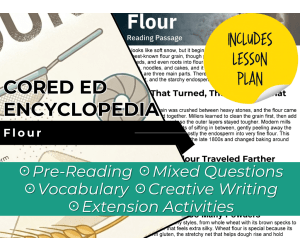
This flour reading comprehension with lesson plan includes: Visualization (on the front cover) Start your lesson by taking a minute to think and share something about the topic. Read the script aloud (slowly), perhaps prepare some music or sound effects. Student close their eyes and let their imaginations wander. Students open their eyes, read the question aloud and give them a few minutes to complete. Ask a few students to share or keep answers until the end to compare with what they learn in the passage. Quick pause—thousands of Cored Education products are included with your TeachSimple membership. Download links and encyclopedia index available here. Pre-Reading Trivia Students will write down one thing they already know about the subject and then read five more facts and discuss. These facts are fun, and the students will enjoy learning about the subject before reading more. Give 1 minute for students to write what they already know (no pressure—best guess is fine). Read the five facts together. After each fact, do ask a student for their opinion, was it surprising? Set a purpose by asking students to highlight/underline one fact they want to learn more about during the reading. Reading Passage The text is a high-interest reading passage with set paragraphs, roughly three to four paragraphs long. It contains a variety of themes about the topic, anywhere from history to technology. The passage is between 250 and 350 words in length. First, ask students to look at the headings and see what they’ll learn about today. What do they know about the topic/heading? First read options: Teacher read-aloud (best for support). Partner reading (paragraph by paragraph). While reading, students underline important details, and vocabulary words they think may come up in the questions section. Mixed Questions The first question page contains four multiple-choice questions, each with a choice of four answers, and three written response questions that require a sentence or two from the student. Students complete the mcqs first independently, then review quickly as a class. For the 3 written responses, try to get students giving the answer with some form of evidence: “I think ___ because the text says ___.” If students get stuck, send them back to check the passage. Vocabulary Questions Practice seven key words from the text in this section across two activities. First section is scrambled words where students will unscramble three words given a clue for each. The second section is a word to meaning matching activity. Before starting, have some students read out words they underlined in the passage. Ask students to say the word and read aloud the sentence(s) around each word. Ask students to do scrambled words and the matching exercise in pairs then go through answers as a class. For the scrambled spelling task, get four pairs to come up to the board and write the words for extra practice with the other student reading out the clue. For the matching task, prompt students to give full sentences: “I matched ___ with ___ because ___.” Creative Writing In this question, the student will be required to write a five to eight sentence paragraph on a question related to the topic. Before starting, ask students write down 3 key ideas they are going to include in their piece. Ask students for ideas to share around the class to help those struggling. Pro writing expectations: 5–8 sentences At least 2 facts or details from the passage At least 2 vocabulary words from the previous page Students read their paragraphs while classmates listen for facts and vocabulary words. Extension Activities This page is optional for fast finishers or to take home. There are several activities, each one requiring a different skill. Do some, do none, do all, completely optional - but you will feel reassured knowing every possibility is planned for. Includes summary writting question and additional facts. Answer Key There are answers for the multiple-choice questions, written response questions have sample answers, vocabulary answers and if there is a summary question then a sample summary will be provided as well. Lesson Plan Included Customized lesson plan for this lesson is included. Lesson Snapshot Title: Flour Genre: Nonfiction (Informational Text) Subject: Science (Food Science) / Reading (Informational Text) Primary Topic: How flour is made from seeds and grains Estimated Guided Reading Level (A–Z): P What This Lesson Teaches Best Explains what flour is made from: flour begins as a seed , and people grind grains (and other plants) into powder used for many foods. Teaches the three main parts inside a grain seed — bran , germ , and endosperm —and what each part is like. Describes how milling changed over time, from heavy stones to steel rollers and lots of sifting to make very fine flour. Builds understanding of why white flour became popular (it kept longer) and what “enriched” flour means in this text. Connects ingredient science to baking by explaining how wheat proteins can form gluten , helping dough rise and hold bubbles of air. Learning Goals Students will explain how flour begins as a seed and becomes powder through grinding. Students will identify the three main parts of a grain seed: bran, germ, and endosperm. Students will describe how modern mills use rollers and sifting to make fine flour. Students will explain why white flour kept longer, based on what the text says about oils. Students will describe what “enriched” flour means in the passage and why it mattered. Students will explain how gluten helps dough rise and hold bubbles of air. Key Vocabulary From the Text bran — the outer part of a grain seed. germ — the tiny part that could sprout. endosperm — the starchy part that feeds the seed. enriched — flour with certain vitamins and iron added back. gluten — stretchy net that helps dough rise and hold air. FULL CATALOG OF DOWNLOAD LINKS AND ENCYCLOPEDIA INDEX HERE
Author Cored Education
Rating
Tags Vocabulary, Reading Comprehension, Reading Passages, Lesson Plans, Ela Lesson Plans, Reading Comprehension Lesson Plans, Pre-reading, Science Lesson Plans, History, Technology