



3,971 products added recently
Page 34 - 8th Grade Activities
Equip your eighth-grade students for the next academic level with activities that challenge and inspire. These resources focus on advanced concepts, critical thinking, and skill refinement. Use them to ensure students are confident and prepared for the transition to high school.

 Show filters

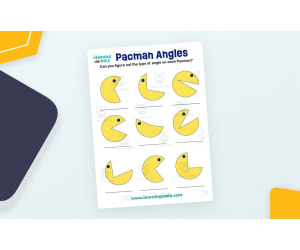
Pacman Angles Activity
Measurements, Math, Grade 2, 3, 4, 5, 6, 7, 8, Activities
Activity Introduction An amazing activity designed for the students to learn more about STEM. Pacman Angles Do you like STEM subjects? what is your favorite one? Have you ever tried to plant a seed? If yes, tell us more about it. Or have you ever tried to invent something? If yes, tell us more about it. And how do you think it will help us? Have you ever seen a microorganism under a microscope? What was it? And how it looked like? Mathematics is a marvelous subject. Let' sharpen our brains and solve some equations. Do you like timetable tricks? What is your favorite one? Do you know how to code? Have you ever created an app or a game before? If yes, how was it like? Pacman Angles Activity The activity is perfect for encouraging the researching skills for the students, while learning more about this fantastic topic. Pacman Angles This friendly designed worksheet is suitable for students at school, homeschooling, and as a group activity. Instructions Can you figure out the type of angle on each Pacman? Format Available in a PDF format.
Author Educational Voice
Tags Pacman Angles Activity, Angles Activity, Pacman Activity, Pacman Angles, Pacman, Angles, Angles Facts, Angles Facts For Kids, Math, Maths

50 Math Puzzles for Grade 8
Math, Grade 8, Activities, Worksheets & Printables
Eighth grade math has three main ideas. First, kids learn about expressions and equations. They use these to show how two things relate and solve number problems. They also learn about lines on a graph. Second, they learn what a function is. A function is like a rule. It says that one thing leads to only one other thing. Functions help show how amounts change together. Third, they study shapes in 2D and 3D. They learn about distance and angles. They see how shapes can be the same or just look the same. They also learn the Pythagorean Theorem. Kids use line equations to show and solve different problems. They understand that a function is a rule. For each thing you put in, you get only one thing out. Functions show how one amount depends on another. Kids use what they know about distance and angles with shapes. They see how shapes move, turn, and flip. They learn when shapes are exactly the same or just the same shape but different sizes. This helps them understand and solve shape problems. This paper has 50 math puzzles. These puzzles help students practice all the things they just learned. The answers are at the end.
Author Bright Classroom Ideas Marketplace
Rating
Tags Math, Grade 8, Puzzle, Worksheet

Elements and Compounds - Smart Board Bingo - Middle School Science
Science, Chemistry, Grade 5, 6, 7, 8, 9, Activities, Games
Smart board bingo includes questions on atoms, molecules, elements, compounds, symbols, formulae and naming compounds. A numbered question is generated randomly and, if that number is on their bingo card, students write in the answer. So much fun students don’t realise they are learning! Smart board bingo includes questions on: atoms and molecules; elements and compounds; chemical symbols; formulae; naming compounds. What is Included Random question generator for smart board (interactive white board) – 54 questions 48 bingo cards Answers PowerPoint Answer sheet Suggested Lesson Plan Play bingo – students write the answers into the square on their bingo card which matches the question number in the smart board. Teacher uses answer sheet to check card of winners of lines and full house Pupils use answer PowerPoint to check their answers at end of game.
Author Elf off the Shelf Resources
Tags Science Bingo, Chemistry Bingo, Smart Board Bingo, Elements Digital Activity, Compounds Digital Activity, Element Bingo

Snowman Genetics Activity
Science, Life Sciences, Biology, Grade 7, 8, 9, 10, Activities
This resource is a Snowman Genetics Activity. Students will flip a coin to determine the traits of the snowman! This is an exciting way to teach students how to follow procedures. Included: - Teacher's guide - Student worksheet - Student data table
Author Maude in the Middle
Tags Winter, Science, Genetics, January, General Science

TinkerCAD step-by-step instructions for Bunny for Easter
Special Resources, Grade 5, 6, 7, 8, 9, 10, 11, 12, Activities, Projects
TinkerCAD step-by-step instructions for Bunny for Easter. Students only need to know the bare basics to complete this. I tested this with a fifth-grade class and most could complete it with no help. Designed to print with no supports for easy printing. Include TinkerCAD tool guide! Has a content page. Great beginners’ tool for learning to make 3D models and learn TinkerCAD. TinkerCAD is a free online program that makes 3D model that work on 3D printers, laser etching machines, water jets, plasma cutters and many more!! Tinkercad is an easy-to-use, browser-based computer-aided design (CAD) software developed by Autodesk. It is primarily used for creating and designing 3D models, particularly in the field of 3D printing. Tinkercad is popular among beginners and hobbyists due to its intuitive interface and simplified tools. Here are some key features and uses of Tinkercad: 1) 3D Modeling: Tinkercad allows users to create 3D models by combining basic shapes and manipulating them using tools such as scaling, rotating, and moving. It provides a wide range of primitive shapes like cubes, spheres, cylinders, and more, which can be customized to create complex designs. 2) Design Customization: Users can apply various modifications to their designs, including resizing, rounding edges, adding text, creating holes, and aligning objects. These tools help in refining the models and making them suitable for specific purposes or fitting them with other components. 3)Import and Export: Tinkercad supports the import of existing 3D models in STL and OBJ formats, allowing users to modify and incorporate them into their designs. It also offers export options to save the designs as STL files, which are widely used in 3D printing. 4) Collaboration and Sharing: Tinkercad provides features for collaboration, allowing multiple users to work on the same project simultaneously. It enables real-time sharing and editing, making it convenient for team projects or educational purposes. 5) Electronics Integration: One notable aspect of Tinkercad is its integration with electronics. It offers a range of electronic components, including resistors, LEDs, motors, and microcontrollers, which can be used to create interactive models and prototypes. Users can simulate circuit connections and test their designs before implementation. 6) Educational Tool: Tinkercad is widely used in educational settings, particularly for teaching students about 3D design, modeling, and prototyping. Its simple interface and beginner-friendly tools make it accessible to users of all ages and skill levels. Overall, Tinkercad is a versatile and user-friendly CAD software that allows individuals to create and customize 3D models. Whether you're a hobbyist, student, or professional, Tinkercad provides a valuable platform for designing, prototyping, and exploring the world of 3D printing and modeling. Total pages: 32 pages Commands to be learned: Group Ungroup Align Mirror Duplicate Holes Solids Rotate Move Drop Subjects: Geometry Engineering Career and technical education Types: Projects Handouts Printables
Author MontyWorks
Tags TinkerCAD, 3D Printing, 3D Printer, Projects

Coding Vocabulary Activity
Computer Science, Technology, Science, Grade 2, 3, 4, 5, 6, 7, 8, 9, 10, Activities
Activity Introduction An amazing activity designed for the students to learn more about STEM. Coding Vocabulary Do you like STEM subjects? what is your favorite one? Have you ever tried to plant a seed? If yes, tell us more about it. Or have you ever tried to invent something? If yes, tell us more about it. And how do you think it will help us? Have you ever seen a microorganism under a microscope? What was it? And how it looked like? Mathematics is a marvelous subject. Let' sharpen our brains and solve some equations. Do you like timetable tricks? What is your favorite one? Do you know how to code? Have you ever created an app or a game before? If yes, how was it like? Coding Vocabulary Activity The activity is perfect for encouraging the researching skills for the students, while learning more about this fantastic topic. Coding Vocabulary This friendly designed worksheet is suitable for students at school, homeschooling, and as a group activity. Instructions Cut everything out and arrange each definition with the word. Format Available in a PDF format.
Author Educational Voice
Tags Coding Vocabulary Activity, Coding Vocabulary, Coding Activity, Coding , Coding Vocabulary Facts, Coding Vocabulary Facts For Kids, Coding Facts, Coding Facts For Kids, Technology, Technology Facts

Papercraft Photoshop Activity
Science, Technology, Grade 7, 8, 9, 10, Activities
Students will work with digital tools in the Papercraft Photoshop Activity . Students will create a cool paper version of themselves. Step by step directions are included.
Author OK Products
Tags Technology, Computer Activity, Art Project, Computer Science, Graphic Designs, Design Concepts, Mobile Applications, Photoshop

Research Organizer & Essay Assignment: Claude Monet
Creative Arts, Art, Art History, Grade 8, 9, 10, 11, Activities, Projects, Worksheets & Printables, Worksheets
Few artists have inspired more of their contemporaries than Claude Monet. This resource provides your students with the opportunity to independently learn about and synthesize the life of the renowned French impressionist artist with this engaging research planner and essay assignment. This carefully scaffolded and easy-to-assign-AND-assess resource has been designed to guide student learning from Claude Monet fact-collection to the careful development of a five-paragraph research essay. Teaching this resource could not be easier! Start by handing out the background research and note-taking worksheet (you could also ONLY hand this out if you want a shorter lesson!). Once students have found their facts and sources, provide them with the essay outline activity, which guides them step-by-step through the requirements of a short research essay. From there, drafting their essay, using the provided peer review checklist, and submitting their final draft will be no problem at all. And then you can assess their work with the provided Common Core rubric! Use this entire resource as a complete research lesson or just part of it as a short research activity or sub plan! This TeachSimple download includes: - A Claude Monet essay writing assignment with directions, requirements, research essay writing tips, a peer review checklist, and Common Core-tied grading rubric - An editable rubric, provided as a link, that lets you make adjustments to the grade values and guidelines. This link is provided as as Google Sheet specifically built for integration into Google Classroom, although you can also modify it for use in other Learning Management Systems (LMSs) - A Claude Monet biography and note-taking worksheet that will guide your students through information gathering. This straightforward two-page handout includes instructions for background research, a fun drawing section, and an area to cite quality sources and organize conducted research - A research essay outlining worksheet, so students build on their Claude Monet notes in a clear and simple manner as they build their work towards a draft and final paper - All 6-pages of this lesson are provided in full-color and B&W versions Although this resource can be fitted for any secondary Language Arts classroom, it has been carefully designed to work best in grades 8 through 11. The included rubric is subtly but specifically tied to Common Core ELA Standards for Language (3) and Writing (2 and 7). This resource is provided as a print-ready, bookmarked, and adjustable PDF file. The rubric is also included as an editable Google Sheet. This resource contains 6 pages and 1 Google Sheet.
Author The Language of Educational Art, LLC
Tags Research, Essay, Rubric, Notetaking, Outlining, Claude Monet
Historical Fiction Genre Study Book Report
Social Studies, ELA, Reading, Reading Comprehension, Literature, Research, Grade 6, 7, 8, 9, Worksheets & Printables, Novel Studies, Teacher Tools, Graphic Organizers, Activities, Projects, Lesson Plans, Assessments, Worksheets
The 34-page Historical Fiction Genre Study Book Report is designed for grades 6th, 7th, 8th, and 9th, but it can easily be modified for lower or higher grades. This book report is an excellent supplement to a unit on a particular historical period. Through reading historical fiction, students can gain a deeper appreciation for historical periods and how they relate to the present day. The goal of this lesson is to introduce students to the genre of historical fiction and to help them understand its importance and significance. By the end of the lesson, students should have a good understanding of what historical fiction is. Students will read a historical fiction novel, analyze its characters, plot, and author's craft , and present their findings to a small group. The book report includes a detailed lesson plan on the historical fiction genre, objectives and learning targets aligned to the Common Core standards, directions for the book report with handouts and worksheets for students, a student self-evaluation, and a grading sheet for teachers. Many students enjoy reading historical fiction, especially if they are learning about the period in their History/Social Studies class. If you do the genre study component of this resource, the book report offers a high-quality culminating project. In addition, if you teach a Language Arts/History Core or plan with a History/Social Studies partner-teacher, this is an excellent resource for both classes and provides students with a different way to engage with history. Historical fiction is an essential genre for students for a variety of reasons because it makes the study of history more engaging and interesting and it brings the past to life. Students gain a deeper appreciation for historical periods and how they relate to the present day, It also improves critical thinking skills by giving students opportunities tothink critically about the events and people from the past, analyze and interpret historical events, understand different perspectives,and it encourages empathy, tolerance, and respect because students learn to see history through the eyes of characters from different time periods and cultures Historical Fiction Genre Study Book Report includes the following: 2 comprehensive and interactive lesson plans: Book Browse lesson plan Historical Fiction Genre lesson plan with common core standards, objectives, and learning targets easy-to-follow student directions Note taking Guide Note taking Guide Chart Spoke Diagram Plot Diagram Character Chart Sensory Description Chart Other Elements in Historical Fiction Chart Storyboard Presentation in Small Groups Directions Self-Evaluation of Historical Fiction Book Report Check-Off and Grading Sheet Other Resources You Might Be Interested In: Book Reports: Autobiography/Biography Genre Study Book Report and Speech Book into Movie Project: Compare and Contrast Book Report and Essay Book Jacket Book Report Character Analysis Essay, Gift for a Character Book Report, and Oral Presentation Historical Fiction Genre Study Book Report Historical Fiction Genre Study Literature Circle Project Poetry Book Report Mini-Reviews Book Report Mystery, Thriller, Horror, and Suspense Genre Study Book Report Narrative Nonfiction Genre Study Book Report Project Poetry Book Report Dystopian. Science Fiction, and Fantasy Genre Study Game Board Project Reading Units: Creating Independent Readers in your Middle School Classroom which is available as 1 unit or as individual resources Part 1: What We Do When We Read: Part 2: Reading Logs, Setting Goals, and Reflection Part 3: Summary Writing for Short Stories Part 4: Metacognitive Logs: Reading Response Bonus: How to Set Up An Amazing Classroom Library (without Spending Much Money): Google Slide Shows: Characterization: What It Is and How to Develop It Writing with Suspense If you have any questions, please email me at gruenwaldy1@gmail.com
Author Intentional Teaching and Learning
Tags Historical Fiction, Book Report, Research, Assessment, Story Elements, Analysis, History, Author's Craft, Critical Thinking, Self-evaluation

Life Science Reading Passages: Human Body & Senses (FILLABLE PDF)
Science, ELA, Reading, Reading Comprehension, Strategies, Resources for Teachers, Life Sciences, Human Body, Grade 6, 7, 8, 9, Writing Prompts, Worksheets & Printables, Centers, Activities, Teacher Tools, Assessments, Quizzes and Tests, Quizzes, Tests
Human Body and Senses: Life Science Reading Comprehension Passages and Questions (FILLABLE PDF) This very engaging and fillable collection of life science reading passages about Contact Lenses, Goosebumps, and Skin is designed to bridge the gap between science and literacy through strengthening reading comprehension and sparking scientific curiosity in middle school students. Each passage blends English Language Arts skills with accurate science content that supports NGSS classroom practice. Ideal for interdisciplinary learning in ELA and Science. Suitable for Grade 9 review, too! These worksheets are designed as fillable PDFs , which means students can type their answers directly into the document on any computer or tablet . Each page includes highlighted text fields that show them exactly where to type! What Is Included? There are (3) informational passages: Clear Vision: The Story of Contact Lenses Goosebumps: A Chilly Reminder of Our Past Skin: Your Protective Shield Student Tasks for Each Passage: 5 multiple-choice questions targeting main idea, key details, inference, vocabulary in context, and use of evidence 5 vocabulary matching items with clear, student-friendly definitions 5 text-based questions that require citing specific lines or facts 1 summary prompt that asks students to condense central ideas accurately Full answer key for every section Available Formats for this Resource Word Docs Google Docs FULL CATALOG OF DOWNLOADING LINKS HERE Other Science Reading Collections and Topics You May Find in the Store: 1. Astronomy & Space Science 2. Volcanoes, Rocks, & Mountains 3. Rock Cycle, Soil, & Sinkholes 4. Mars, Glaciers, & Antarctica 5. Water Cycle, Acid Rain, & Wastewater 6. Insects, Animals, & Ecosystems 7. Bioluminescence & Insects 8. Animal Skin, Cats, & T. Rex 9. Human Body and Senses 10. Health & Applied Bioscience 11. Waves, Light, & Imaging 12. Electricity & Energy 13. Motion & Materials 14. Chemistry and Materials Science 15. Electromagnetism 16. Acids and Bases 17. Gas Laws 18. Biotechnology 19. Periodic Trends 20. Protists and Fungi 21. Microevolution 22. Blood 23. Chemical Bonding 24. Magnets 25. Muscles 26. Nuclear Chemistry 27. Electromagnetic Devices 28. Epigenetics 29. The Law of Conservation of Mass 30. Atomic Models 31. Isotopes and Ions 32. Light 33. Human-Environment Interaction 34. Theory of Evolution 35. Photosynthesis 36. Origins of Life and Early Earth 37. Gene Expression and Regulation 38. Thermochemistry 39. Allergies 40. Coevolution 41. Birth to Adulthood 42. Cells 43. Entropy and Free Energy 44. The Human Brain 45. Mixtures and Solutions 46. Invertebrates 47. Zoo Animals 48. Biochemistry 49. Animal Behavior 50. Population Ecology ...and many more engaging science reading passages that cover intriguing and important topics designed to spark curiosity and support student learning. How to Use These PDFs Click on the highlighted area to start typing your answer. Move to the next question by clicking in the next highlighted box. When you are finished, close the document and select SAVE so your answers stay recorded. If you want to keep a blank copy for later, choose Save As and give your completed version a new name. Product Details Length: 14 pages total Grades: 6–8, also suitable for Grade 9 review Use cases: close reading, stations, homework, intervention, test prep, and sub plans Standards support: reinforces informational-text skills and supports NGSS-style sense making through observation, modeling, and clear use of claim, evidence, and reasoning Why Teachers Choose This Set Authentic science content paired with rigorous literacy practice Consistent task structure across all passages for easier planning and smoother student routines Clear, age-appropriate writing that builds confidence without oversimplifying Use this set to reinforce ELA skills in science, to add literacy to your lessons, or to support independent work. The passages strengthen main idea, evidence use, vocabulary in context, inference, cause and effect, and summary writing. With ready-to-use assessments and complete answer keys, you can provide focused practice that is simple to run and fast to review.
Author Middle & High School - CORED Education
Rating
Tags Middle School, Reading Comprehension, Reading Strategies, ELA, Centers, Reading Passage, Assessments, Vocabulary, Life Science, Human Body
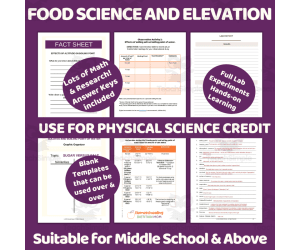
Food Science and Elevation eBook
, Grade 7, 8, 9, 10, Activities, Experiments
Food Science and Elevation eBook This thoughtfully created teaching resource is targeted for educators seeking materials that encourage hands-on learning particularly suitable for grade 7-10 students interested in science and math. Main Features: An exciting avenue to explore food science experiments involving salt, sugar, and boiling water among others. Improve students' research abilities, math skills, and writing competence through practical tasks. The extensive 40-page PDF file introduces learners to various scientific concepts such as atmospheric pressure with real-life examples of how solutes affect the boiling point. Additionally, it covers complex topics including the effects of sugar and salt on freezing points. Navigational Guide: Tailored background information on each scientific phenomenon. A structured guide for experimental work provided by blank lab templates. Data gathering encouraged through the measuring observations via thermometers. A Practical Approach to Learning: Through integral practical exercises within this comprehensive resource, students are enabled to: Determine how elevation changes affect common attributes like pressure or temperatures; This teaching material goes beyond theory by allowing pupils to record methods such converting units used commonly in science like psi into inches Hg or Celsius into Fahrenheit etc., This promotes an active learning environment surrounding mathematical calculations from simple addition/subtraction processes up towards more complex ones such as decimals rounding techniques. This aids overall academic progression effectively across multiple disciplines combined throughout its entirety preparing them for future endeavors irrespective of settings whether it be homeschool public school-based sessions gaining experiences crucial fostering academia holistically.
Author Homeschooling Dietitian Mom
Tags Food Science, Elevation, Atmospheric Pressure, Boiling Point, Freezing Point

Free Science Interactive Hangman Game / Light Waves Vocabulary
Science, Basic Science, Earth and Environmental Sciences, Earth Sciences, Grade 8, Games, Activities
Free Interactive Light Waves Vocabulary Game for 8th Grade Science Engage your 8th grade science students with this interactive hangman game that helps them learn, practice, and review key vocabulary about light waves. This 22-slide PowerPoint includes a fun hangman activity where students guess letters to reveal mystery words related to the unit's vocabulary and definitions. The game format promotes increased focus, memory, and pronunciation as students expand their knowledge. Use it for whole group practice or individual review. Download this ready-to-use supplemental resource to give your 8th graders an entertaining way to reinforce their understanding of light waves. See our ShapeUp-N-Matematicas y Lenguaje shop for more Spanish interactive games covering math, language arts, science, and more for grades K-8.
Author ShapeUp-N-Matematicas y Lenguaje
Tags Light Waves, Science, Light, Small Or Whole Group, Interactive Activity, Ultraviolet, Electromagnetic, Spectrum, Refraction Of Light, Reflection Of Light
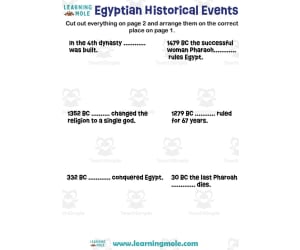
Egyptian Historical Events Activity
Social Studies, History, History: African, History: Ancient, History: World, Grade 3, 4, 5, 6, 7, 8, 9, Activities
Activity Introduction An amazing activity designed for the students to learn more about history. Egyptian Historical Events Do you like history? Which topic do you really enjoy about history? Have you ever read an interesting facts about the Vikings? If yes, can you mention them? What do you like most about the Victorian era? Can you name all the Tudors? Have you ever wondered how people used to live in ancient Japan and ancient China? Do you know any interesting facts about ancient Egyptians and the Pharaohs? Have you ever visited South America? What do you know about Incas and Aztecs? Celtic culture was really one of a kind, can you name any of the places that Celts used to live in? Imagine yourself living during the ancient Roman empire, how your life will look like? Ancient Greece was an amazing place to live in. What do you know about ancient Greek life? Egyptian Historical Events Activity The activity is perfect for encouraging the researching skills for the students, while learning more about history. Egyptian Historical Events This friendly designed worksheet is suitable for students at school, homeschooling, and as a group activity. Instructions Cut out everything on page 2 and arrange them on the correct place on page 1. Format Available in a PDF format.
Author Educational Voice
Tags Egyptian Historical Events, Egyptian Historical Events Activity, Egypt, Ancient Egypt, Ancient Egypt Facts, Ancient Egypt Facts For Kids, History, History Facts, History Facts For Kids
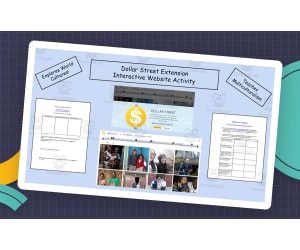
Dollar Street Extension Activities-Fully Editable!
Social Studies, History: World, Grade 6, 7, 8, 9, 10, 11, 12, Activities
These are two social studies, world cultures, separate advisory or homeroom lessons to help students understand the world better. They could be two separate lessons or one long one. The pictures shown are from the videos. In the "If The World Were 100 People" lesson, the engaging video link describes the world's population filtering for income, technology, language, etc. In the editable handout, teachers can tailor the analysis to their city and school. Students will answer questions about the video as well as analyze their own city and school communities. In the Dollar Street lesson, there is a video link to view the explanation of the Dollar Street tool-which examines families in 50 countries. The tool displays the homes as if they all lived on the same street where the richest live on the right and the poorest live on the left and everyone else in between. It is an amazing tool. For both lessons, teachers need internet access, a way to show the videos, and the ability to print off both handouts. Both handouts are FULLY editable to tailor to your school and city communities.
Author Jennifer Moyer Taylor
Tags Social Studies, Diversity, World History, Editable

Vertebrates or Invertebrates Activity
Science, Life Sciences, Biology, Animals, Grade 2, 3, 4, 5, 6, 7, 8, Activities
Activity Introduction An amazing activity designed for the students to learn more about famous places in different countries. Vertebrates or Invertebrates Do you like animals? what is your favorite one? Do you own a pet? If yes, tell us more about it, like what its name? And what do you like most about it? What are the animal kingdoms? Can you write down the characteristics of each animal class like mammals, birds, reptiles, amphibian, fish and mollusks. Do you know that some animals can sing, can you name any of them? What is the largest and the smallest mammal in the world? What is the largest and the smallest bird in the world? What is the largest and the smallest fish in the world? Vertebrates or Invertebrates Activity The activity is perfect for encouraging the researching skills for the students, while learning more about this fantastic place. Vertebrates or Invertebrates This friendly designed worksheet is suitable for students at school, homeschooling, and as a group activity. Instructions Cut the animals out and glue them where they belong. Format Available in a PDF format.
Author Educational Voice
Tags Vertebrates Or Invertebrates Activity, Vertebrate, Vertebrates, Vertebrates Facts, Vertebrates Facts For Kids, Invertebrate, Invertebrates, Invertebrates Facts, Invertebrates Facts For Kids

Underwater Noise Pollution Social Studies Reading Passage Fillable PDF
ELA, Reading, Reading Comprehension, Strategies, Resources for Teachers, Social Studies, Sociology, Grade 6, 7, 8, 9, Writing Prompts, Worksheets & Printables, Centers, Activities, Teacher Tools, Assessments, Quizzes and Tests, Quizzes, Tests
Underwater Noise Pollution: Social Studies Reading Comprehension Passage (Fillable PDF) This resource introduces a unique Social Studies reading comprehension passage with questions about Underwater Noise Pollution. The passage is carefully designed to bridge the gap between social studies and literacy through strengthening reading comprehension and sparking knowledge curiosity in middle school students. Each passage blends English Language Arts skills with accurate social studies content . Ideal for interdisciplinary learning in ELA and Social Studies. Suitable for Grade 9 review, too! These worksheets are designed as fillable PDFs , which means students can type their answers directly into the document on any computer or tablet . Each page includes highlighted text fields that show them exactly where to type! Student Tasks throughout the passage: 5 multiple-choice questions targeting the following skills: main idea, key details, inference, vocabulary in context, and use of evidence 5 vocabulary matching items with clear, student-friendly definitions 5 text-based questions that require citing specific lines or facts 1 summary prompt that asks students to condense central ideas accurately Full answer key for every section Available Formats for this Resource: PDF Word Docs Google Docs FULL CATALOG OF DOWNLOADING LINKS HERE Social Studies Reading Comprehension Collection Links: 1. Ancient Civilizations PDF Fillable PDF Word Docs Google Docs 2. Early Empires and Trade Networks PDF Fillable PDF Word Docs Google Docs 3. The Founding of the United States PDF Fillable PDF Word Docs Google Docs 4. Language, Culture, and Meaning PDF Fillable PDF Word Docs Google Docs 5. Psychology and Society PDF Fillable PDF Word Docs Google Docs 6. Global Festivals and Traditions PDF Fillable PDF Word Docs Google Docs 7. Extreme Environments and People PDF Fillable PDF Word Docs Google Docs 8. Food, Culture, and Preservation PDF Fillable PDF Word Docs Google Docs 9. Global Food Customs PDF Fillable PDF Word Docs Google Docs 10. Media, Communication, and Popular Culture PDF Fillable PDF Word Docs Google Docs 11. Human Impact on the Environment PDF Fillable PDF Word Docs Google Docs 12. Civic Action and Social Change PDF Fillable PDF Word Docs Google Docs 13. Fashion, Society, and Power PDF Fillable PDF Word Docs Google Docs 14. People, Places, and Unusual Histories PDF Fillable PDF Word Docs Google Docs Product Details: Length: 5 pages Grades: 6–8, also suitable for Grade 9 review Use cases: close reading, stations, homework, intervention, test prep, and sub plans Why Teachers Choose This Passage: Authentic social studies content paired with rigorous literacy practice Consistent task structure for easier planning and smoother student routines Clear, age-appropriate writing that builds confidence without oversimplifying Use this passage to reinforce ELA skills in social studies, to add literacy to your lessons, and to support independent work. The passage strengthens main idea, evidence use, vocabulary in context, inference, cause and effect, and summary writing. With ready-to-use assessments and complete answer keys, you can provide focused practice that is simple to run and fast to review.
Author Middle & High School - CORED Education
Rating
Tags Middle School, Reading Comprehension, Reading Strategies, ELA, Centers, Reading Passage, Assessments, Vocabulary, Social Studies, Sociology
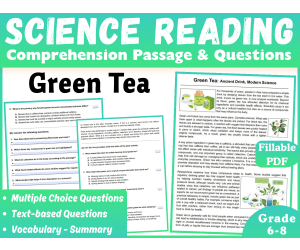
Science Reading Comprehension Passage: Green Tea (Fillable PDF)
Science, ELA, Reading, Reading Comprehension, Strategies, Resources for Teachers, Grade 6, 7, 8, 9, Writing Prompts, Worksheets & Printables, Centers, Activities, Teacher Tools, Assessments, Quizzes and Tests, Quizzes, Tests
Science Reading Comprehension Passage and Questions: Green Tea (Fillable PDF) This very engaging science reading passage about green tea, its ingredients, and how science studies its possible effects on the body. It explains that green tea comes from the same plant as black tea, Camellia sinensis , but green tea leaves are heated quickly to stop oxidation. This helps preserve more of the leaves’ original compounds. The passage focuses on key ingredients such as caffeine , catechins , and L-theanine , and explains how they may affect alertness, relaxation, cell protection, heart health, sleep, and iron absorption. It also makes clear that green tea can be part of healthy habits, but it is not a miracle drink or medical treatment . This passage is designed to bridge the gap between science and literacy through strengthening reading comprehension and sparking scientific curiosity in middle school students. The passage blends English Language Arts skills with accurate science content that supports NGSS classroom practice. Ideal for interdisciplinary learning in ELA and Science. Suitable for Grade 9 review, too! This passage is designed as a fillable PDF , which means students can type their answers directly into the document on any computer or tablet . Each page includes highlighted text fields that show them exactly where to type! Student Tasks for The Passage: 5 multiple-choice questions targeting main idea, key details, inference, vocabulary in context, and use of evidence 5 vocabulary matching items with clear, student-friendly definitions 5 text-based questions that require citing specific lines or facts 1 summary prompt that asks students to condense central ideas accurately Full answer key for every section Available Formats for this Resource PDF Word Docs Google Docs FULL CATALOG OF DOWNLOADING LINKS HERE Product Details Length: 5 pages total Grades: 6–8, also suitable for Grade 9 review Use cases: close reading, stations, homework, intervention, test prep, and sub plans Standards support: reinforces informational-text skills and supports NGSS-style sense making through observation, modeling, and clear use of claim, evidence, and reasoning Why Teachers Choose This Set Authentic science content paired with rigorous literacy practice Consistent task structure across all passages for easier planning and smoother student routines Clear, age-appropriate writing that builds confidence without oversimplifying Other Science Reading Collections you May find in the store: 1. Astronomy & Space Science 2. Volcanoes, Rocks, & Mountains 3. Rock Cycle, Soil, & Sinkholes 4. Mars, Glaciers, & Antarctica 5. Water Cycle, Acid Rain, & Wastewater 6. Insects, Animals, & Ecosystems 7. Bioluminescence & Insects 8. Animal Skin, Cats, & T. Rex 9. Human Body and Senses 10. Health & Applied Bioscience 11. Waves, Light, & Imaging 12. Electricity & Energy 13. Motion & Materials 14. Chemistry and Materials Science Use this set to reinforce ELA skills in science, to add literacy to your lessons, and to support independent work. The passages strengthen main idea, evidence use, vocabulary in context, inference, cause and effect, and summary writing. With ready-to-use assessments and complete answer keys, you can provide focused practice that is simple to run and fast to review.
Author Middle & High School - CORED Education
Rating
Tags Middle School, Reading Comprehension, Reading Strategies, ELA, Centers, Reading Passage, Assessments, Vocabulary, Bioscience, Green Tea

Proportional Relationships (for 8th Grade) NOTES & PRACTICE
Math, Algebra, Grade 8, Activities
This resource was developed to meet the requirements of the 8th Grade Expressions & Equations Standards below: CCSS.MATH.CONTENT.8.EE .B.5 Graph proportional relationships, interpreting the unit rate as the slope of the graph. Compare two different proportional relationships represented in different ways. For example, compare a distance-time graph to a distance-time equation to determine which of two moving objects has greater speed. Pre-Requisites: Students should already have a general understanding of how to write an equation from a verbal description, how to test for proportionality between any two ratios, and how to graph coordinates. PLEASE NOTE: This lesson was made to build off of the extensive work done in 7th grade on proportional relationships and would not be thorough enough for a classroom that is taking the 7th grade state test .
Author The Math Cafe
Tags Proportional Relationships, Notes, Practice
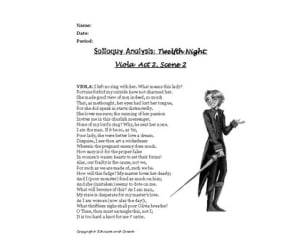
Twelfth Night: Soliloquy Analysis- Viola
ELA, Literature, Grade 7, 8, 9, 10, Activities
A worksheet to help students analyze conflicts and themes in Viola's soliloquy in Act 2, Scene 2 of Shakespeare's play: Twelfth Night. Comes with a graphic organizer and answer key. Great for when reading the play or on it's own
Author Educate and Create
Tags Twelfth Night, Literary Analysis, Shakespeare, Drama, Close Reading, Viola Monologue Twelfth Night

Science Reading Comprehension Passage: Baseball Science (Docs)
Science, ELA, Reading, Reading Comprehension, Strategies, Resources for Teachers, Physics, Grade 6, 7, 8, 9, Writing Prompts, Worksheets & Printables, Centers, Activities, Teacher Tools, Assessments, Quizzes and Tests, Quizzes, Tests
Science Reading Comprehension Passage and Questions: Baseball Science (Docs) This very engaging science reading passage is about the physics of baseball , especially how forces and energy affect the way a baseball moves after it is hit or pitched. It explains how kinetic energy transfers from the bat to the ball, how launch angle affects distance, how air resistance/drag slows the ball, and how spin creates the Magnus effect, which can make pitches curve or make batted balls carry farther. It also explains how weather and location, such as high altitude, warm air, and humidity, can affect how far a ball travels. This passage is designed to bridge the gap between science and literacy through strengthening reading comprehension and sparking scientific curiosity in middle school students. The passage blends English Language Arts skills with accurate science content that supports NGSS classroom practice. Ideal for interdisciplinary learning in ELA and Science. Suitable for Grade 9 review, too! Student Tasks for The Passage: 5 multiple-choice questions targeting main idea, key details, inference, vocabulary in context, and use of evidence 5 vocabulary matching items with clear, student-friendly definitions 5 text-based questions that require citing specific lines or facts 1 summary prompt that asks students to condense central ideas accurately Full answer key for every section Available Formats for this Resource PDF Fillable PDF Word Docs FULL CATALOG OF DOWNLOADING LINKS HERE Product Details Length: 4 pages total Grades: 6–8, also suitable for Grade 9 review Use cases: close reading, stations, homework, intervention, test prep, and sub plans Standards support: reinforces informational-text skills and supports NGSS-style sense making through observation, modeling, and clear use of claim, evidence, and reasoning Why Teachers Choose This Set Authentic science content paired with rigorous literacy practice Consistent task structure across all passages for easier planning and smoother student routines Clear, age-appropriate writing that builds confidence without oversimplifying Other Science Reading Collections you May find in the store: 1. Astronomy & Space Science 2. Volcanoes, Rocks, & Mountains 3. Rock Cycle, Soil, & Sinkholes 4. Mars, Glaciers, & Antarctica 5. Water Cycle, Acid Rain, & Wastewater 6. Insects, Animals, & Ecosystems 7. Bioluminescence & Insects 8. Animal Skin, Cats, & T. Rex 9. Human Body and Senses 10. Health & Applied Bioscience 11. Waves, Light, & Imaging 12. Electricity & Energy 13. Motion & Materials 14. Chemistry and Materials Science Use this set to reinforce ELA skills in science, to add literacy to your lessons, and to support independent work. The passages strengthen main idea, evidence use, vocabulary in context, inference, cause and effect, and summary writing. With ready-to-use assessments and complete answer keys, you can provide focused practice that is simple to run and fast to review.
Author Middle & High School - CORED Education
Rating
Tags Middle School, Reading Comprehension, Reading Strategies, ELA, Centers, Reading Passage, Assessments, Vocabulary, Making Candy, Physics

Hans Krebs – Fact Sheet, Quiz & Interactive PDF incl. H5P
Life Sciences, Science, STEM, History, Social Studies, Biographies, Inventors, Basic Science, Biology, Chemistry, Grade 6, 7, 8, 9, 10, 11, 12, Worksheets, Worksheets & Printables, Quizzes, Quizzes and Tests, Teacher Tools, Projects, Activities
Scientist Hans Krebs - Fact Sheet, Quiz & Interactive Version (PDF & H5P) Hans Krebs – Cellular Respiration and the Discovery of the Krebs Cycle Fact Sheet, Quiz & Interactive Exercises (PDF + H5P) 🔁🧬 This 45-minute resource introduces students in grades 10–12 to Hans Krebs – the scientist who uncovered one of the most important metabolic pathways in our cells: the citric acid cycle, also known as the Krebs cycle. When teaching cellular respiration, many students can follow the basics of glucose breakdown and ATP production – but the details of what happens in the mitochondria often feel abstract. Krebs' discovery in the 1930s helped explain how cells extract energy efficiently from food molecules through a cycle of chemical reactions. It’s a key part of understanding aerobic respiration and metabolism. To make this complex process more accessible, I’ve created a structured lesson that includes a short informational text, a fact sheet, quiz questions with answers, and a creative partner task. All materials are available in color and black-and-white, plus there’s a digital H5P version for interactive learning. What’s included: A student-friendly text about Hans Krebs and the citric acid cycle A fact sheet to help visualize and summarize the steps of the cycle Quiz questions (with answer key) for quick review or comprehension checks A creative task where students develop and exchange their own questions in pairs Formats: Printable PDF and interactive H5P 💻 Answer key included ✅ I’ve used this resource during our unit on cellular respiration, often right after glycolysis and before moving on to the electron transport chain. It’s especially helpful for students who benefit from breaking down complex processes into steps. The partner activity works well for revision or as preparation for assessments. 🚀 Download now and bring the legacy of Hans Krebs into your biology lessons today! 📍 Best wishes, Heike from Lernfitness Did You Know? I teach with a certified therapy dog, and together we create a positive and inspiring learning environment. 🐶✨
Author Lernfitness
Tags Science, Biology, Famous Scientists Lesson, H5P, Interactive Science Exercises, STEM, History, Scientists, Hans Krebs, Citric Acid Cycle
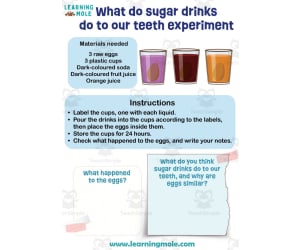
What Do Sugar Drinks Do To Our Teeth Experiment
Human Body, Life Sciences, Science, Grade 2, 3, 4, 5, 6, 7, 8, 9, 10, Activities
Activity Overview The human body is full of fascinating wonders to learn. This activity is created to help the students recognize the anatomy and the job of the human body. What Do Sugar Drinks Do To Our Teeth Every part and organ in our human body is vital so let's see how important they are. Have you ever imagined how we look like if we didn't have a skeleton? Did you know that because we have our amazing muscles we can stand! Do you know how many teeth do we have? Have you ever wondered about the food journey inside our body? Can you name all the glands in our body? Why do we have skin? Our nervous system is really good at sending signals. Can you tell us more about it? Are you really good at Mathematics, painting, or any other thing? You should really thank your brain about it! The famous five senses are really doing a great work? Can you explain how every sense works? What Do Sugar Drinks Do To Our Teeth Activity The activity is perfect for encouraging the researching skills for the students, while learning more about our fantastic human body. What Do Sugar Drinks Do To Our Teeth This friendly designed worksheet is suitable for students at school, homeschooling, and as a group activity. Instruction Label the cups, one with each liquid. Pour the drinks into the cups according to the labels , then place the eggs inside them. Store the cups for 24 hours. Check what happened to the eggs, and write your notes. Format Available in a PDF format.
Author Educational Voice
Tags What Do Sugar Drinks Do To Our Teeth Experiment, Teeth Experiment, Sugar Experiment, Sugar, Teeth, Tooth, Teeth Facts, Teeth Facts For Kids, Fun Experiment, Sugar Facts

Virtual Jersey Patch Photoshop Activity
Science, Technology, Grade 7, 8, 9, 10, Activities
Students will work with digital tools in the Virtual Jersey Patch Photoshop Activity . Students will take an ordinary image and make it look like a patch sewn on a virtual journey. Step by step directions are included.
Author OK Products
Tags Technology, Science, Computer Class, Jersey Patch, Sports, Photoshop, Digital Tools, Mobile Applications, Photopea, Virtual

Science Action Labs Air Science: Active Science with Air
, Grade 4, 5, 6, 7, 8, Labs, Experiments, Activities
Science Action Labs Air Science: Active Science with Air This resource for grade 4 to grade 8 classrooms takes students into the captivating world of air science through hands-on experiments and observations. Exposing learners to the essential yet unseen aspect of air its characteristics, it transforms textbook learning into a more practical and engaging experience. Engaging and Practical Approach "Science Action Labs Air Science: Active Science with Air" is designed with an active learning methodology that extends beyond conventional teaching methods. The hands-on laboratories make learners define what air is, explore wind concepts or delve deeper into Bernoulli’s principle. Accomplishing this allows students to build a deeper understanding and have remarkable learning experiences. Detailed Guidance for Teachers: To facilitate the implementation process, teachers are provided continuous support through detailed explanations, advice notes and regular encouragement reminders found throughout the book. Ready-to-use Material: This PDF contains 64 ready-to-download-and-print pages. Teachers can instantly integrate these fun-filled educational sessions into their lesson plans. Versatile Teaching Resource: The resource can be adapted easily for small group activities or individual tasks in a science classroom setting or as part of home-learning activities. In summary, " "Science Action Labs Air Science: Active Science with Air" " suits public school teachers seeking potent ways to teach complex topics through guided hands-on experience as well as homeschooling parents looking for effective resources that make subjects like 'air' clear enough for young minds to grasp.
Author Classroom Complete Press
Tags Bottled Eggs, Measuring Air Pressure, Smog Lab, Action Labs, Air Science