



3,993 products added recently
Page 3 - Popular Labs
Popular Labs feature tried-and-true experiments that have delighted students across classrooms. These engaging activities cover a range of scientific disciplines and are known for their effectiveness in teaching key concepts. By integrating popular labs into your lessons, you tap into resources that are both educational and enjoyable. These experiments promote curiosity and a hands-on approach to learning, making science accessible and interesting for all students.

 Show filters


Photosynthesis – Lab Station Activity
Science, Chemistry, Grade 9, 10, 11, 12, Labs, Experiments, Activities
Photosynthesis Lab Station Activity Bring photosynthesis to life in your classroom! This interactive lab station activity engages students as they move through 9 stations to explore concepts like photosynthesis, the light reaction and Calvin cycle. At each station, students test their knowledge by answering multiple choice questions, researching, drawing conclusions from a video, and more. The stations work for all ability levels with built-in challenge activities to keep advanced students engaged. With recording sheets and answer keys included for students and teachers, this resource is an engaging way to build key photosynthesis skills with minimal prep work for you. Use it to introduce a tricky topic or as a review to reinforce learning. For grades 9-12.
Author Teach With Fergy
Tags Photosynthesis, Chloroplasts, Pigments, Plants, Lab Station, Photosynthesis Lab Activity

Science Action Labs Earth Science
Science, Earth and Environmental Sciences, Earth Sciences, Grade 1, 2, 3, Labs, Experiments, Activities
Science Action Labs Earth Science A practical teaching resource, Science Action Labs Earth Science, aims to stimulate the natural curiosity of young learners and expose them to the marvels of our planet. It emphasizes exploration and discovery through hands-on activities that deepen 1st to 3rd graders' understanding of Earth science concepts. About The Resource: The material encompasses 64 printable PDF pages. The pages are rich with diverse experiments and activities focusing on key subjects such as continents, earthquakes, Earth's air, water, soil as well as its motion and layers. The flexibility of these activities is extensive. You can either carry out whole group sessions or assign small group tasks each with distinct exercises that foster teamwork and creativity among students. Bonus Feature: The added review quizzes serve as effective tools for progress assessment letting educators evaluate student comprehension levels on newly learnt topics with ease. Versatile Application: This educational tool’s versatility makes it perfect for structured class lessons or homework assignments while also offering potential enhancements to an existing earth science curriculum. Its flexible usage fosters increased engagement levels leading to improved academic performance over time. Ease Of Access: You can readily access this resource kit in PDF format which offers convenient dissemination without compromising quality. In Summation... This pragmatic approach offered by our earth science exploration kit bridges knowledge acquisition with actual hands-on experiences delivering a holistic learning journey. This integrated learning experience could spark potential Geologists or Meteorologists within your class paving the way towards creating scientific explorers one lab activity at a time.
Author Classroom Complete Press
Tags Science Labs, Earth Sciences, Art Challenge, Flying Into Space, Moon Facts

Light Optics and The Production of Light – Lab Station Activity
Science, Physics, Grade 8, 9, 10, 11, Labs, Experiments, Activities
Light Optics and The Production of Light – Lab Station Activity Build student understanding and engagement with light and its properties with this interactive lab station activity . Students move through stations to explore concepts like luminous vs non-luminous objects, the electromagnetic spectrum, color blindness, and light production. Activities range from hands-on drawing to opinion writing and viewing short educational videos. Questions throughout assess comprehension and provide a chance for written explanation. The resource also includes a word scramble and word search for added student engagement between stations. Suitable for whole class or small groups, this versatile physics lab requires almost no prep, just print and go! Learning objectives focus on deepening understanding of light while having fun through a combination of activities, reading, writing and media. Supports grade 8-11 curriculum standards on light, ideal for both review and introductory lessons.
Author Teach With Fergy
Tags Light, Electromagnetic, Lab Station, Ultraviolet, Infrared
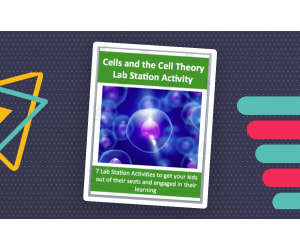
Cells and The Cell Theory – Lab Station Activity
Science, Life Sciences, Biology, Grade 7, 8, 9, 10, Labs, Experiments, Activities
Cells and The Cell Theory – Engaging Lab Station Activity Bring cells and cell theory to life for your middle or high school science students with this interactive lab station activity . Students will rotate through 9 stations, each offering a unique hands-on opportunity to build their understanding of cells, organelles, cell types, diseases, and more. Activities range from drawing cells to answering questions based on videos and readings to creating their own quiz questions. Almost no prep needed - just print the self-contained station cards and guides. Bonus word scramble and word search activities ensure students stay engaged. This versatile resource works for both learning new content or reviewing before a test. With 9 lively stations packed with visual, written and creative interactions, your students will love discovering cells and cell theory!
Author Teach With Fergy
Tags Cells, Plant, Animal, Cell Theory, Lab Station, Cell Structure Lab, Cell Theory For Middle School

Earthworm Dissection Lab
Science, Life Sciences, Biology, Grade 9, 10, 11, 12, Activities, Labs
This lab covers the digestive anatomical structures located in a live earthworm. For any teacher looking for “hands on” enrichment activities that will fully engage the student, this product is for you! This lab requires the use of earthworms which I usually purchase from a local fishing store. This lab is very flexible as it will work for any level student from English Learner - EL - to more advanced students.
Author The Teacher Team
Rating
Tags Biology, Lab, Physiology, Digestive System, Earthworm Lab, Earthworm Dissection Worksheet, Earthworm Dissection Worksheet Answers, Earthworm Anatomy And Dissection, Worm Dissection Diagram, Anatomy, Answer Key, Biology Lesson

Drone Data Detectives:Mastering UAVs for Environmental Mapping
Research, Community Building, Resources for Teachers, Science, Earth and Environmental Sciences, Earth Sciences, Environmental Science, Geology, Space, Life Sciences, Grade 2, 3, 4, 5, 9, 10, 11, 12, Activities, Centers, Experiments, Labs, Assessments, Teacher Tools, Graphic Organizers, Lesson Plans, Outlines, Literacy Readers
Get ready for the ultimate in drones and environmental science with "Drone Data Detectives: Mastering UAVs for Environmental Mapping & Climate Monitoring." The comprehensive high school STEM book on drones deepens the knowledge of teens into the world of Unmanned Aerial Vehicles, making them drone pilots, data analysts, and environmental stewards. This key resource covers everything needed to take raw drone data and develop actional insights in support of climate change monitoring, conservation, agriculture, and disaster response-from the basics in drone piloting and safety regulations to planning flights, and from the advanced sensors that capture aerial data, such as thermal imaging and multispectral cameras, to LiDAR. Packed full of real-world missions, ethical considerations, GIS analysis techniques, machine learning applications, and project-based learning, it is a no-brainer for aspiring scientists interested in remote sensing, photogrammetry, vegetation health metrics, and sustainable technology. This is an ideal textbook for grades 9-12 classrooms, great for homeschooling, or self-study, this book aims to fire up the theoretical teaching with practical skills in order to inspire the next generation of eco-innovators. Keywords: drone education for teens, UAV environmental mapping, climate monitoring drones, STEM books high school, data analysis environmental science, drone piloting guide, remote sensing technology, Why Parents/Schools Love It: Hands-On STEM Activities: Blends theoretical concepts with hands-on drone operations, developing critical thinking and real-world problem-solving capabilities, especially in environmental sectors such as climate change and biodiversity. Future Ready Career Preparation: It delves into areas such as conservation using drones, data science, which matches global career requirements in the field of Green Technology, sustainable development, among others. Encourages Environmental Awareness: Emphasizes responsible use of drones and awareness of global issues that encourage teens to play a role in protecting the planet with technology. Thorough and Readily Available: This text consists of 100 chapters perfectly suited for a classroom setting as it covers topics ranging from fundamental to advanced levels. Safe & Responsible Focus: It is more bent on rules, safety, and risk management, offering reassurance for educational UAV operations. Target Audience : After analyzing the content of the book in entirety—right from the introduction about basic components of drones to aerodynamics, followed by intermediate levels of topics such as sensors and data acquisition, advanced topics of machine learning and analysis of space, to practical implementations in conservation and climate observation—the book has been written for students in grades 9-12 (14-18 years of age), aiming at students expressing interest in the science of tech but gradually increasing in content across: For grade 9 and 10 students, one may focus on the fundamental chapters related to the history of drones, its parts, and the basics of piloting a drone. Grade 11/12 students: Engage with advanced topics such as multi-spectral indices, GIS integration, and photogrammetry. Designed for students who are deeply interested in environment/earth science, technology, and data sciences, and for students of STEM streams such as those in robotics and science clubs. Not designed for middle-school students due to technical complexity such as operations in the electromagnetic spectrum and calculations for NDVI, and nor for college students who would be doing research and hence would require research detail. Copyright/Terms of Use : This book is copied and adapted from Syed Hammad Rizvi. This Work/Way is intended Solely for Private Use. Neither the text nor any part of this Work/Way shall be copied, distributed, or sold. This means that no part of this Work/Way shall be placed on the Internet where it could be publicly accessed. If you want to Share it with your fellow teachers, you can buy additional licenses from Teachsimple. Thank you for Using Responsibly. “This product is happily brought to you by Syed Hammad Rizvi”
Author Creative Book Store
Rating
Tags DroneDataDetectives, MasteringUAVs, EnvironmentalMapping, ClimateMonitoring, UAVTechnology, DroneEducation, STEMBooks, HighSchoolSTEM, EnvironmentalScience, DronePiloting

Pressure, Volume, and Temperature – Lab Station Activity
Science, Chemistry, Grade 8, 9, 10, 11, Labs, Experiments, Activities
Pressure, Volume, and Temperature – Lab Station Activity This dynamic teaching resource designed for middle and high school physical science students brings the classroom to life with interactive activities revolving around pressure-volume-temperature laws. Key Highlights: Station tasks exploring Archimedes' Principle, Avogadro’s Law, Boyle’s Law, Charles's Law and Ideal Gas Law Inclusive lab recording sheets (passports) for documenting observations or answers Activity cards that can be placed around your classroom to turn it into a miniature laboratory Included answer keys for efficient progress tracking and immediate feedback The distinct features of this resource promote an active learning environment. Students are propelled towards collaborative discussions thereby solidifying their understanding of the involved principles. A highlight of added fun: To increase interaction in a less formal setting while ensuring that no learner is left out; two full-time activities—a word scramble and word search are provided. Ready-made answer keys make grading a breeze! Tailored Flexibility: This product fits perfectly into various teaching strategies without straining resources—whether you plan whole-group communal activities or divide students into smaller groups for methodical task completion under your guidance. Towards Promoting Lifelong Learning: The hands-on experience gained from scientific explorations encourages inquiry-based learning. The successful integration in numerous teaching styles aims at fostering engagement which sparks their curiosity paving way for lifelong learners! An essential tool catering not just to public school teachers but homeschooling parents seeking effective teaching aids as well. Digital & Printable Formats: Available in different file types for easy access across digital platforms. It proves proficient for Grade 8-11 science students boosting their comprehension of pressure, volume and temperature thereby enhancing scientific literacy. Experience the joy of teaching with this interactive lab station activity that challenges student understanding and intrigues young minds!
Author Teach With Fergy
Tags Pressure, Volume, Temperature, Lab Station Activity, Active Learning

Science Action Labs Sound & Light
Science, Physics, Grade 4, 5, 6, 7, 8, Labs, Experiments, Activities
Science Action Labs Sound & Light An exceptional educational resource aimed especially at students in Grades 4-8, focusing predominantly on engaging physical science subtopics. This easy-to-use workbook captivates the minds of budding learners, stimulating their imagination and curiosity through hands-on experience with sound and light concepts. Participatory learning is favored over mere observation. Students engage in entertaining experiments using commonplace objects like mirrors and flashlights to unpack complex scientific principles in a digestible manner. By interacting with sound waves and light as reflected or emitted from these objects, young minds gain better comprehension of scientific theories. Sir Isaac Newton's wisdom is celebrated throughout the pages of this book. Simplified explanations grounded in his concepts build understanding while additional nuggets of information further enrich knowledge, fostering a lighthearted yet potent educational environment for the pupils. Encouragement is key — plentiful doses are offered while confidently guiding learners on their journey. Versatile Usage The Science Action Labs Sound & Light primarily serves classroom usage during whole-group instruction, but also can work effectively for smaller group engagement - such as after-school science clubs or other similar activities. It even supports homeschooling parents looking to reinforced their current curriculum effectively. Instructor’s Asset For added convenience, this tool includes a single manageable PDF file containing 64 print-ready pages formatted for standard paper sizes . This becomes ideal when preparing assignments or practical sessions need to be straightforward! Besides serving as worksheets that underpin knowledge gained during teaching sessions, these materials could also support homework assignments; thus linking school-based learning into home-time follow-up tuning perfectly. In Summary: The Science Action Labs Sound & Light translates abstract scientific theories into tangible understanding via active tasks. Because truly, nothing embeds learning quite like doing!
Author Classroom Complete Press
Tags Action Labs, Science Labs, Sound, Light, Science Worksheet

Energy Flow In Ecosystems – Lab Station Activity
Science, Life Sciences, Biology, Grade 8, 9, 10, Labs, Experiments, Activities
Energy Flow In Ecosystems Lab Station Activity Students get hands-on with the flow of energy through ecosystems in this engaging lab station activity. As they rotate through 9 stations, learners strengthen their understanding of topics like photosynthesis, cellular respiration, food chains and webs, ecological pyramids, and more. The activity covers producers, consumers, herbivores, carnivores and omnivores while connecting concepts to real-world applications. With a variety of learning modes including drawing, research, assessment , reading passages, and video, the stations offer something for all types of learners. The activity comes with station description cards, student recording sheets, word scrambles and searches to prevent downtime, and answer keys for the teacher. This versatile resource works for whole group, small group, or independent learning structures.
Author Teach With Fergy
Tags Scavenger, Food Chain, Energy, Flow, Ecosystems
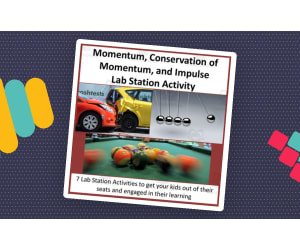
Momentum, Conservation of Momentum, and Impulse – Lab Station Activity
Science, Physics, Grade 9, 10, 11, 12, Labs, Experiments, Activities
Momentum, Conservation of Momentum, and Impulse Lab Station Activity Bring physics concepts to life and get students engaged with this editable high school lab station activity . Students will rotate through 9 stations, each offering a unique hands-on opportunity to demonstrate understanding of momentum, conservation of momentum, and impulse. Activities range from drawing and explaining to answering video questions and completing knowledge checks. Recording sheets provided for students to document conclusions. Addressing key NGSS standards HS-PS2-2 and HS-PS2-3, topics covered include momentum, conservation of momentum, impulse, crumple zones, billiards, and types of collisions. Contains bonus vocabulary puzzles to prevent downtime between stations. This self-directed experience needs almost no teacher prep - simply print, set up, and students are ready to learn. Edit files to fit your specific needs. Check the preview for even more lab station activities spanning science disciplines.
Author Teach With Fergy
Tags Momentum, Conservation, Impulse, Inertia, Lab Station, Impulse Activity, Momentum Labs Physics, Momentum And Conservation Of Momentum Answer Key, Momentum Lab, Conservation Of Momentum Lab, Momentum Physics Labs
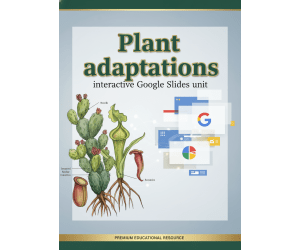
Plant Adaptations Interactive Google Slides Unit
Science, Earth and Environmental Sciences, Earth Sciences, Environmental Science, Geology, Space, Life Sciences, Animals, Nature & Plants, Biology, Grade 3, 4, 5, 9, 10, 11, 12, Experiments, Activities, Labs, Projects, Assessments, Teacher Tools, Diagrams, Lesson Plans, Outlines, Presentations
Find the best 4th Grade Plant Adaptations Interactive Google Slides Unit – a complete no-prep digital science resource that is perfectly correlated to NGSS 4-LS1-1! This teacher edition is a game-changer for teaching plant biology as an interactive adventure for students! With this resource, students will enjoy a hands-on approach to learning about plant adaptations as they explore interactive slides featuring desert succulents/cacti, rainforest drip tips/epiphytes, water plants floating leaves/stretching stems, structural vs. behavioral adaptations, roots, stem/leaf adaptations, defense structures, carnivorous plants Venus flytrap/pitcher plant, seed dispersal, mystery plant analysis, and a final knowledge check with answer keys! Students will actively engage in classifying adaptations, creating their own extremophiles, analyzing scenarios using Claim Evidence Reasoning, and connecting science to ELA, math, engineering, and technology using cross-curricular activities. It includes a teacher guide, standard alignment, steps to integrate into Google Classroom, instructional tips, interactive slide ideas, image credits, and ideas for self-grading. It can be used in a variety of learning environments, such as in-class learning, distance learning, homeschooling, etc. It saves automatically in Google Slides. Keywords: plant adaptation 4th grade, NGSS 4-LS1-1, Google Slides, interactive science unit, desert rainforest aquatic plants, carnivorous plants, seed dispersal activities, digital science resource, structure and function NGSS, no prep plant biology. Why Parents/Schools Love It : NGSS-Aligned & Standards-Ready: No planning required – lesson plans, objectives, and assessments are provided and align perfectly with 4th grade requirements. Truly Interactive & Engaging: Drag and drop sorting, CER plant mysteries, and biome builders ensure all students (including reluctant ones) are actively engaged and motivated to learn for hours. Cross-Curricular Powerhouse: Perfectly blends ELA (informative writing, vocabulary), math (data analysis, volume calculation), and engineering (biomimicry design challenges). Google Classroom Perfection: One-click “make a copy for each student,” auto-saving, and self-grading features save teachers 10+ hours per unit. Differentiation Built-In: Visual aids, scaffolding, and differentiation in activity levels and types meet the needs of diverse learners and challenge advanced students. Target Student Classes : This lesson is designed for 4th grade science (ages 9-10), specifically targeting the 4-LS1-1 standard for Structure and Function in plants/animals, as well as the cross cutting concepts of Systems and System Models + the Science and Engineering Practices of Engaging in Argument from Evidence. This lesson is suitable as the main resource for: Standard 4th grade life science curriculum for 4th grade students in public/private schools Homeschool 4th grade science curriculum (allows for fast or slow pacing for gifted or remedial students) Advanced 3rd grade science for 3rd grade students or 5th grade review for 5th grade students Special education or ESL students (visual learning tool of drag and drop CERs) Not recommended as the main resource for middle school students (6th+). Copyright/Terms of Use: This Book is copyrighted by Syed Hammad Rizvi. This is for your personal and single classroom use only. You may not change, reproduce, redistribute, or sell this in any way. This means you may not put it on the Internet in a way that it can be located and downloaded by others. If you wish to share this resource with others, please consider purchasing additional licenses from Teachsimple. Thank you for respecting these copyright laws! This product is happily brought to you by Syed Hammad Rizvi
Author Creative Book Store
Rating
Tags PlantAdaptations, 4thGradeScience, NGSS4LS11, GoogleSlidesScience, InteractiveScience, ScienceTeachers, ElementaryScience, NGSSScience, PlantAdaptationsUnit, DigitalScienceResource
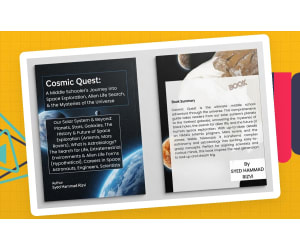
Cosmic Quest A Middle Schooler's Journey into Space Exploration, Alien
Life Skills, Special Resources, Social Emotional Learning (SEL), Science, Research, Space, Earth and Environmental Sciences, Environmental Science, Earth Sciences, Geology, Grade 6, 7, 8, 9, 10, 11, 12, Lesson Plans, Teacher Tools, Assessments, Experiments, Activities, Labs
Embark on an extraordinary travel through the cosmos with `` Cosmic Quest, '' the ultimate middle school guide to space geographic expedition, alien living search, and the universe 's deepest mysteries. Written specifically for class 6-9 ( ages 11-15 ), this thorough 338-page resource transforms composite astronomical concepts into engaging, accessible knowledge. Usually, from our solar system 's fiery planets to distant galaxies, from the Big Bang to the hunting for extraterrestrial life, `` Cosmic Quest '' covers everything a Young space enthusiast needs to know. Frankly, with 90 meticulously organized chapters, students will explore planetary science, astrobiology, NASA 's Artemis program, Mars rover discoveries, exoplanet research, and future space technologies. Perfect for classroom use, homeschool curricula, or independent study, this volume aligns with Next Generation skill Standards ( NGSS ) while sparking genuine curiosity about STEM fields. Now, here's where it gets good: each chapter includes clear explanations, stunning cosmic phenomena, and real-world connections to current infinite mission happening right now. Whether your student dreams of becoming an astronaut, astronomer, or simply gazes at the stars with wonder, `` Cosmic Quest '' provides the foundational noesis and inspiration for their scientific journey. The volume also includes essential career guidance for space-related professions, making it both educational and aspirational. Why Parents/Schools Love It: • detailed & Curriculum-Aligned: Covers 90 essential infinite science topics matching center schoolhouse standards, saving teachers planning time while ensuring complete coverage • Future-Focused & stream: Includes NASA missions ( Artemis, Mars exploration ), James Webb Telescope discoveries, and private space industry developments • Career-Inspiring: Dedicated chapters on space careers ( astronauts, engineers, scientists ) connect learning to real-world opportunities • Accessible Yet Rigorous: Makes complex concepts like dark matter, exoplanet detection, and exobiology understandable without `` dumbing down '' the science • Multi-Platform Ready: Perfect for classroom instruction, independent assess, homeschool curricula, and science fair project brainchild mark Audience Analysis: Primary Target: Grades 6-9 ( Ages 11-15 ) centre school science classrooms Homeschool students Gifted and talented programs for grades 5-7 Science club resources Library collections for young adults Secondary Target: Advanced elementary students ( grades 4-5 ) with strong reading skills High schoolhouse student ( grades 9-10 ) postulate foundational astronomy review Parents seeking educational enrichment materials instructor needing supplemental infinite skill resource Copyright/Terms of Use: This Book was copyrighted by Syed Hammad Rizvi. Often, this resource is for personal and single classroom use only. You may not alter, redistribute, or sell any part of this resource. In other words, you may not put it on, kind of, the Internet where it could be publicly found and downloaded. Also, if you want to share this resource with colleagues, please purchase additional licenses from Teachsimple. Thank you for respecting these terms of use. This product is happily brought to you by Syed Hammad Rizvi
Author Creative Book Store
Rating
Tags CosmicQuest, SpaceScienceBook, MiddleSchoolSTEM, AstronomyForKids, ScienceEducation, HomeschoolResources, NGSS, SpaceExploration, AlienLifeSearch, STEMBooks

Photosynthesis Lesson and Experiment for 3rd and 4th Grade Science
Science, Nature & Plants, Life Sciences, Earth and Environmental Sciences, Earth Sciences, Biology, Grade 3, 4, 5, Centers, Activities, Labs, Experiments, Worksheets, Worksheets & Printables
Photosynthesis Lesson, Worksheets, and Experiment How Plants Make Food - 3rd & 4th Grade Science Lesson I created this resource to give students a clear and enjoyable introduction to photosynthesis. The lesson blends reading, discussion, and a hands-on experiment so students can see how plants make their own food in a way that feels real and meaningful. I put this resource together because photosynthesis is one of those topics that becomes much easier to understand when students can read about it and observe it in action. This set offers a mix of activities that help students explore the idea from different angles. What’s inside? A short reading passage that explains photosynthesis Seven comprehension questions with an answer key A step by step experiment using black gram seeds Follow-up discussion questions to guide class conversation Safety notes and cautions for the experiment Two anchor charts that break the process into small pieces A quick True/False activity with answers A diagram activity where students label the photosynthesis process A story-writing page where students write from the point of view of a plant Complete answer keys to all the questions are included in this resource Resource features: I designed this set with 3rd and 4th graders in my mind. The reading level and activities are approachable for that age group. The experiment inside the resource is simple enough for students to complete in small groups, but still gives them something meaningful to observe. I have written all the instructions clearly. Each activity in this resource builds on the previous one so students can connect ideas as they go. This resource also blends science with literacy, drawing, and creative thinking, which makes it easy to fit into a variety of lesson plans or science centers. Ways to use it: Reading activity: Have students read the passage and answer the questions independently or with partners. Vocabulary work: Create a small word wall or glossary for science terms. Hands-on learning: Set up the seed experiment as a class or rotate it through small groups. Science journals: Encourage students to record their predictions and observations throughout the experiment. Art activity: Students can draw and label the parts of a plant involved in photosynthesis. Writing prompt: Let students write a short story from the perspective of a plant creating its own food. Group talk: Compare observations, discuss results, and talk through what might have caused them. Extensions: Students can look at different types of plants and explore how sunlight and environment affect their growth. Usefulness for teachers, homeschoolers, and parents This resource works well as a mini-unit as it requires very little preparation. The activities give students different ways to understand the process of photosynthesis. This resource is suitable for a wide range of learners. It supports reading comprehension, science vocabulary, and basic scientific inquiry skills, all while keeping instructions simple enough for independent use. The experiment uses easy to find materials, and the activities make it simple to incorporate science into home learning or family projects. photosynthesis, 3rd grade science, 4th grade science, anecdotal activity, photosynthesis story, hands-on learning, plant science, reading comprehension, science experiments, STEM, elementary education, homeschool science, nature study, scientific inquiry, vocabulary building, cross-curricular learning, environmental education, chlorophyll experiment, plant growth, science journaling, critical thinking, observation skills, teaching resource, environmental science, anchor charts, photosynthesis experiment
Author FlashKart
Rating
Tags Science, Photosynthesis, Plants, 3rd Grade Science, 4th Grade Science, Photosynthesis Experiment, Science Reading, Sunlight, Science Process, Earth Science

Science Action Labs Animal Science: Active Science About Animals
Science, Life Sciences, Animals, Grade 4, 5, 6, 7, 8, Labs, Experiments, Activities
Science Action Labs Animal Science: Active Science About Animals This top-notch teaching aid is targeted towards Grades 4 to Grade 8. It focuses on subjects like science and zoology, with intriguing exploration at the core of its approach. The resource comprises a single PDF file featuring 64 ready-to-print pages for expedient preparation by educators. Each page aims to deepen students' understanding of various aspects of animal science making it an ideal part of any curriculum focusing on Zoology. The versatility of the material allows you to adapt it according to your teaching strategy - be it whole-group sessions or small group collaborations, ensuring seamless integration across different pedagogical methods. You can simulate animal habitats within your classrooms using hands-on explorations laid out in this versatile document. There's scope for learners' active engagement with interesting fish experiments that are sure to feed their curiosity and foster scientific temperaments. Create Their Own Creature! Your students can harness their creative power when asked to conceive their very own creature during lessons! Feel free to assign these as homework - individual assignments not only consolidate understanding but also enhance personal problem-solving skills amongst students, moulding them into budding scientists! A Comprehensive Learning Aid: This educational tool comes packed with comprehensive learning concepts, crisply explained across a myriad topics surrounding animals such as habitats, ecosystem balances or characteristics etc. This gives you an effective method for disseminating knowledge about animals' lives and the crucial roles they play in sustaining life on earth. In Conclusion: In essence, the Science Action Labs Animal Science: Active Science About Animals is more than just another academic worksheet set – it ignites learner engagement through Darwinian exploration! Such compelling features make these user-friendly yet rigorous academic worksheets an indispensable resource for any educator who values high-quality educational supplements.
Author Classroom Complete Press
Tags Animal Science, Action Labs, Super Animals, Animal Habitats, Earthworm Lab

Work and Energy – Lab Station Activity
Science, Physics, Grade 8, 9, 10, 11, Labs, Experiments, Activities
Work and Energy - Lab Station Activity An engaging teaching resource designed for high school physics students that focuses primarily on work, energy, forces, and friction. Its main goal is to facilitate active learning through interactive tasks. Activity Overview This resource offers a lab activity comprising multiple stations. Each station presents different testing methods such as: Answering questions drawn from readings or videos. Sharing personal opinions on specific topical issues. Diagram creation activities. The aim is to introduce students to different approaches to understanding and applying key concepts related to work and energy. Included Activities: 'Research tasks': Utilizing devices or classroom computers for data gathering. 'Written expression': Elucidating thoughts on theoretical issues via written communication. 'Connect-the-Dot Readings': Merging theoretical concepts with practical real-life situations. 'Test Your Knowledge': A mixture of multiple-choice questions with requests for written explanations justifying the chosen answers. To maximize class time efficiency, bonus word search or word scramble tasks have also been included which could serve as an additional source of marks when properly utilized. The ultimate objective ensuring every student finds something beneficial during the lesson without idle moments. Ease of Preparation: The resources are ready-to-use – simply print the cards provided in the download pack, place them around the classroom strategically for task initiation. An answer key provided within this package facilitates easy assessment. Value Beyond the Lab: The station cards extend beyond just lab activities – they can also be used as study materials before tests or quizzes to stimulate students' interest and improve retention and overall performance. Summary In a nutshell, for educators seeking versatile resources that focus not only on content, but on delivery methods that cater to all types of learners, Work and Energy - Lab Station Activity is certainly a resource worth considering.
Author Teach With Fergy
Tags Work, Energy, Forces, Friction, Lab Activity, Work Power And Energy Lab

Fats – Lab Station Activity
Science, Life Sciences, Biology, Grade 7, 8, 9, 10, Labs, Experiments, Activities
Fats – Lab Station Activity : An Innovative Learning Experience An immersive and interactive learning product for High School Biology students, Fats – Lab Station Activity offers a unique platform that advocates active learning about fats. This classroom resource stimulates pupil movement around the room fostering informed participation. The All-Inclusive Pedagogic Tool Caters to diverse learning needs: The resource employs varied strategies, posing exercises that require reading or viewing content ('visual/auditory learners'), answering from a thoughtful perspective ('creative thinkers'), etc. End-to-end understanding of fats: Our activity stations challenge pupils while acting as potent teaching instruments. Areas explored include types, uses & health impacts of fats and their properties. User-friendly for educators too: While richly detailed in its construct (hands-on projects at 'Station 1', research tasks at 'Station 2', application-oriented reading activities at 'Station 5', etc.), the product is easy to deploy - needing just printed cards arranged aptly! A practical boon included is an 'answer key', handy for cross-checks and effective student guidance. And yes - this isn't a rigid instrument but an editable one, capable of bespoke adaptations basis class dynamics! Bonus Task & Varied Instructional Scopes A bonus task is provisioned to entertain quick-finishing classes - an interplay with words relevant to the topic (like scramble/word search), aiding in knowledge reinforcement! The comprehensive format makes this material apt not just during whole group instruction but also during small group breakouts or even personalized home assignments! In conclusion: If you are on a lookout for tools linking high schoolers closely with biology fundamentals whilst stirring vibrancy in your classroom, Fats – Lab Station Activity could be your pick! Studying 'fats' needn't be boring - let interaction anchor knowledge!
Author Teach With Fergy
Tags Interactive Learning, Lab Activity, Biology, Fats, Critical Thinking
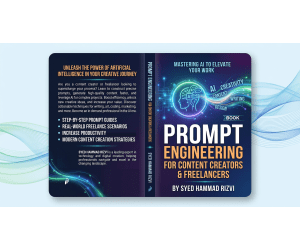
Prompt Engineering for Content Creators & Freelancers Book
Science, Technology, Computer Science, Engineering, Resources for Teachers, Classroom Management, Research, Basic Science, Special Resources, Special Education Needs (SEN), Homeschool Curriculum, Homeschool Templates, Grade 9, 10, 11, 12, Projects, Activities, Experiments, Labs, Teacher Tools, Lesson Plans, Presentations, Assessments, Workbooks, Worksheets & Printables
Utilize AI to its largest extent while becoming a successful content creation business with the Ultimate Guide to Prompt Engineering. This book has been designed specifically for freelancers, digital entrepreneurs, and business service providers aged from twenty-two up through forty. By leveraging AI tools such as ChatGPT, Claude, and Gemini, you will learn how to increase your output by ten times; decrease content creation time by as much as sixty percent; and establish a sustainable, scalable income by creating engaging, informative content that drives traffic to your site. You will learn how to apply the Six-Component Framework for developing flawless prompts, as well as several advanced techniques (attributed to Steve Bidstrup) that allow a creator to express their brand's voice (Chain of Thought and Few-Shot) to produce business-specific content (Twitter/X, YouTube Channel, LinkedIn Page, Instagram Account, Email Newsletter) using case study examples illustrating how content creators such as Sarah and Marcus accomplished their respective businesses by utilizing the techniques contained within this book, while also reducing the total amount of hours worked per week by three. In addition, you will receive a complete thirty-day implementation guide; prompt templates that can be reused; and an ethics guide that will assist in the preservation of your current skill set. If your business model includes selling content services, a newsletter, and managing multiple social channels, then this guide will provide you with an unfair advantage in the modern AI-powered creation economy. You will no longer be required to wrestle with one-size-fits-all AI-generated materials; rather, you will engineer materials that drive commitment, conversion, and cash. Noteworthy Characteristics: The Reliable Six-Component Prompting System To Create Professional Grade AI Results. Site-Specific Prompting Formats and Guidelines for Most Major Platforms such as Twitter, Linked_in, Youtube, Instagram, And Email. Chain Of Thought And Few Shot Methods To Match Your “Real Voice” Exactly. A Full 30 Day Plan For Implementing Once You Have Laid Your Foundations -- To Finally Become Masterful At Using AI. Turnkey Productivity Systems that Will Give You Back 15-20 Hours A Week To Do Core Tasks. Monetization Strategies For Freelancers to Help Scale Their Service Offerings And Prevent From Getting Burned Out. An Ethics System Which Includes A Checklist For Quality Gatekeeping, So You Can Maintain Trust And Credibility As An AI User. Parents/Schools Appreciate It Because: Future-Proofed Career Skills. Students get hands-on experience communicating using AI, an in-demand skill regardless of career path, with a 30-day strategy to turn theoretical knowledge into applicable real-world knowledge through practical experience. Promoting the Ethical Use of AI. This book teaches the ethical and transparent use of AI via its dedicated chapter to ethics and quality gate systems, which enable students to avoid absences and misinformation, eliminate diluted voices, and understand how to leverage AI responsibly. Saving Time for Educators. This book contains pre-prompted library & system tools for educational institutions to utilize as time-savings in lesson plan creation while also modeling how to use AI to create an efficient workflow. Supporting Multidisciplinary & Cross-Curricular Learning. The content relates to English, business, technology, and media classes, representing an adaptable resource to support project-based learning and cross-curricular integration opportunities. Enhancing School Program Engagement and Revenue. It includes a strong emphasis on monetization and scaling of freelance businesses, resulting in veritable economic impact on career-tech programs, providing attractiveness for parents and school districts concerned with job placement readiness. Determine Which Students/Classrooms Are Targeted : This book is written with a professional audience in mind (22-40 yrs old), so your focus should be on post-secondary and professional development settings. Ideal audiences would be: Corporations and Universities Offering Courses in Digital Marketing, Media Creation, Journalism, Communications, Entrepreneurship and Business– Can be Contributed To As Either Textbook Or Suggested Reading For Any Course Of Study Related to Digital Strategy, Applications of AI in Business and/or Online Monetization Of Content. Vocational Training Certificates in Freelance Writing, Social Media Management, Digital Entrepreneurship and AI Literacy. Professional Development Workshops For Freelancers, Marketing Teams, Business Owners Who Want To Improve Their Skill Sets. High School Electives (Grades 11-12) Involved with Media Studies, Tech, Business or Career Readiness –Content Is Constructed Accessible With An Older Teenager Mindset(Preparing For The Digital Workforce). Use This Resource As An Add-On To Your Career Readiness Curriculums Provided By Business/Tech Teachers To High Schools Or As A PD Tool To Educators Who Want To Leverage AI In Their Content Creation. This book is written and published by Syed Hammad Rizvi, with exclusive copyright. This book can only be used individually (by one person) and in a class (by one class), and you cannot make any changes or distribute this book; that is, you cannot put the book on the internet or make it accessible. In order for you to share this book with your coworkers means you need to buy additional licenses to be able to share or give your coworkers. I want to express my sincere thanks to you for adhering to these guidelines of use as I truly appreciate you doing so. This product is made available to you through Syed Hammad Rizvi.
Author Creative Book Store
Rating
Tags PromptEngineering, AIContentCreation, ContentCreator, FreelancerLife, AItools, ChatGPT, ClaudeAI, DigitalProduct, CreatorEconomy, ContentMarketing
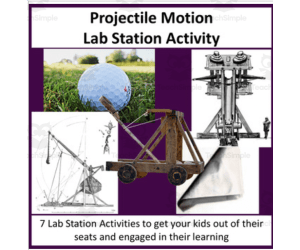
Projectile Motion – Lab Station Activity
Science, Physics, Grade 9, 10, 11, 12, Labs, Experiments, Activities
This fully editable Lab Station Activity on Projectile Motion is meant to get your students out of their seats and engaged in the content. This activity was designed for high school physical science students. Each station not only offers a unique opportunity to test your students' knowledge (offer an opinion, answer questions based on a video or reading, draw, etc.) but also provides a fantastic learning opportunity where your kids are learning through assessment. Each station comes with a description card while some also contain more detailed instructions, a reading, questions to answer, etc. Students are equipped with a recording sheet (passport) to write their answers. There is almost no prep for you. Simply print the cards, lay them out around the room and you're all set. An answer key is also provided where applicable. No prep, no formatting, no issues. Simply download, print (or upload to your class site) and you're all set. This resource is fully editable for your convenience This resource covers the following topics: - Launch angle - Kinematics equations - Solving projectile motion problems - Golf balls - Catapults Bonus Activities: To ensure your students don't have any downtime between stations, your lab also includes a 10-word word scramble and word search, both with an answer key. You can use them as part of their mark, as a bonus so it's not mandatory, etc. However you choose to use it, it will ensure that your students are always busy and never idle. Note: For stronger classes, I give the word scramble and for weaker ones, the word search. This activity covers the following NGSS: - HS-PS2-1 - HS-PS3-3 How do the Lab Stations work? Each station is specially designed to be a unique complement to the material while at the same time, provide a valuable learning experience. Below is an overview of how each station works. In your activity , each will be tailored to the specific content. Station 1: Get Hands-On – using their creative skills, students are required to draw or build. Station 2: Research – using a classroom computer or their own device, students must research a specific question/issue surrounding the topic. Station 3: Explain yourself – students write down an opinion to a question in paragraph form. Station 4: Rest Station - students can use this time to catch up on work they didn't have time to complete at a previous station or prepare themselves for an upcoming one. Station 5 - Applicability reading – students read a short passage from an article, website, etc. which directly connects the classroom content to a real-life application. Station 6: Test your knowledge – students answer 5 multiple choice questions than provide a written explanation for how/why they came to their conclusions. Station 7: Learn from the expert – using a classroom computer or their own device, students must watch a short video clip and answer the associated questions. They may stop, rewind and restart as often as they like during the time frame. Station 8 - Rest Station. Station 9: Become the question master – Students must create 2 multiple-choice questions, 2 true/false questions and 1 short answer question. Students must also supply the answers. ------------------------------- You might also be interested in my other lab station activities Physics: • Newton's Three Laws of Motion • Kinetic and Gravitational Potential Energy • Current Electricity and Circuit Diagrams • Static Electricity • Light Optics and the Production of Light • Sound, Sound Energy and Speed • One and Two-Dimensional Motion • Uniform Acceleration • How Planes Fly • Refraction • Friction • Energy and Its Forms • Density and Buoyancy • Electricity Production • Calculating Average Speed, Velocity, and Displacement • Mass, Volume, Density, & Buoyancy • Work and Energy • Renewable Energy • Plate Tectonics • The Rock Cycle • Natural Disasters • Pressure, Volume, and Temperature • Forces • Power • Liquids and Gases • Fossils and Geologic Time • Earthquakes and Volcanoes • Watersheds • Momentum, Conservation of Momentum, and Impulse • Nonrenewable Energy Sources • Projectile Motion Coming Soon: - Work = F x d - The Doppler Effect and Supersonic Travel Biology: • Cell and the Cell Theory • The Human Digestive System • The Circulatory System • The Human Respiratory System • Mitosis and the Cell Cycle • Cellular Respiration and Photosynthesis • Photosynthesis • Cancer: Cell Division Gone Wrong - Volume I • Cancer: Cell Division Gone Wrong - Volume II • Cell Membrane and Transport • Hearing and the Human Ear • The Human Eye • Genetic Material: DNA and RNA • The Nervous System • Energy Flow In Ecosystems • DNA Manipulation and GMOs • Transcription and Translation • Cellular Respiration • Thermoregulation • Proteins and Nucleic Acids • Mutations • Meiosis • DNA, Genes, Chromosomes, and Alleles • Genetic Disorders • Fats • Reproductive Technologies • Muscular and Skeletal System • Integumentary System • Carbohydrates and Lipids Coming Soon: - Excretory system - Endocrine system General Science: • The Scientific Method and Science Skills • The Different Types of Clouds • Meteorology Chemistry: • Atomic Model, Notation and Atoms • Chemical Reactions and Balancing Equations • Molecular and Ionic Compounds • Physical and Chemical Properties & Changes • Acids, Bases, and Neutralization Reactions • The Periodic Table • Single and Double Displacement Reactions • Balancing Chemical Equations • Synthesis, Decomposition and Combustion Reactions • Atomic Theory, Atomic Structure and Isotopes • Types of Bonds and Intermolecular Forces • The Mole/Avogadro's Number • Density and Buoyancy • The Particle Theory and the Classification of Matter • Pure Substances and Mixtures • Solutions and Mechanical Mixtures Coming Soon: - Periodic table group properties Ecology and the Environment: • Ecosystems • The Classification of Living Things • Biodiversity and Invasive Species • The Carbon and Water Cycle • Climate Change • Photosynthesis • Cellular Respiration and Photosynthesis • Ecological Succession • Plant Sexual and Asexual Reproduction • Earth's Seasons • Interactions Within Ecosystems • Physical and Behavioral Adaptations Space Science: • The Life and Death of Stars • The Moon and its Phases • Life In Space • Our Solar System • Solar and Lunar Eclipse • Earth's Seasons • Asteroids, Comets and Meteors These station cards are meant to be used as a lab activity but can also be utilized in a review task before a test or a quiz. Used either way, your students will love it! I know mine do and I'm telling you from first-hand experience as I've used this activity in my own class. ***************************** For free resources, useful teaching tips, and tools, please visit my blog - TeachScienceWithFergy.com If you have any questions please feel free to send me an email - devon@teachwithfergy.com
Author Teach With Fergy
Tags Projectile, Motion, Physics, Gravity, Projectiles, Projectile Motion Labs, Projectile Motion Experiments, Projectile Motion Physics Lab, Projectile Motion Lab Physics, Projectile Lab, Projectile Motion Lab, Physics Lab Projectile Motion Answers, Physics Projectile Motion Lab Answers

Genotype and Phenotype – Lab Station Activity
Science, Life Sciences, Biology, Grade 8, 9, 10, 11, Labs, Experiments, Activities
Genotype and Phenotype Lab Station Activity This fully editable teaching resource for high school biology students focuses on concepts related to Genotypes and Phenotypes. These include: Dominance Co-dominance Incomplete dominance Single gene inheritance Punnett squares Sex linkage. The lab station activity comprises engaging reading assignments and questions that stimulate critical thinking. These can be performed individually or in small groups. The real-world relevance of the hands-on stations enhances the understanding of these biological concepts. The Eight Unique Stations: The teaching resource includes eight distinct stations that involve various tasks aimed at promoting independent thinking over mere memorization. To give an example, "The Get Hands-On station" requires students to draw or build something based on their knowledge, while "The Research" station has them using digital tools for further study. Other stations entail articulating opinions in writing on subject-related issues or developing multiple-choice and short-answer questions. Bonus Activities: Apart from the main tasks, we also provide two bonus activities: a word scramble and a word search. These serve as fillers during downtime between station transitions. Ease of Preparation for Instructors: All it takes is printing out cards and arranging them around your classroom. Where necessary, an answer key is provided making it easy for educators to assess student's performance. In Summary, The Genotype and Phenotype Lab Station Activity promotes immersive exploration of essential biological concepts. It nurtures skills such as critical thinking and creativity while promoting active student participation. This resource is aptly designed for grades 8 through 11 biology lessons.
Author Teach With Fergy
Tags Genotype, Phenotype, Lab Activity, Biology, Genetics

Electricity Generation – Lab Station Activity
Science, Technology, Engineering, Grade 7, 8, 9, 10, Labs, Experiments, Activities
Educators seeking an engaging, hands-on resource to teach the principles of electricity generation will find the Electricity Generation - Lab Station Activity to be an invaluable teaching tool. This product is a fully editable lab station activity designed to actively engage students in learning about electricity production. This robust product offers seven distinct lab stations with unique and engaging activities. Students have opportunities at each station to test their understanding of different methods of electricity production—such as renewable and non-renewable sources, fossil fuels, nuclear power, wind energy, hydroelectric power and future technologies in interactive ways. The resource includes practically no-prep for educators - just print the cards and lay them out around the classroom! Bonus activities: An added advantage is bonus activities such as word scrambles and word searches related to the topic. These orchestrated interjections ensure there is no idle time between transitioning from one action-packed station activity to another! The toolkit can be used during laboratory sessions or serves well for review tasks prior tests or quizzes. This resource also promotes independent thinking skills by requiring students to research specific aspects relating to electricity generation on their own devices or a classroom computer at 'research' stations. It encourages expression as students write down opinions on questions surrounding how electricity gets produced. Designed for multi-modal learners from 7th-10th grade studying science with subtopics in engineering; this package can also be sent home as extensions/homework tasks after lessons end. Overall teachers will appreciate how effortlessly it blends learning assessment while ensuring student engagement! Note: An answer key is provided where applicable so educators can quickly and accurately grade student work and offer feedback on their learning progress. In summary, this unique collection of station activities facilitates a complete immersion into understanding electricity generation while ensuring students remain stimulated and engaged throughout their exploration. As they navigate through each station activity – either in small groups or individually – students strengthen their grasp over the subject matter.
Author Teach With Fergy
Tags Electricity Generation, Lab Station, Hands-on Learning, Renewable Energy, STEM Education

Biodiversity and Invasive Species – Lab Station Activity
Science, Life Sciences, Biology, Grade 7, 8, 9, 10, Labs, Experiments, Activities
Biodiversity and Invasive Species Lab Station Activity Students will be engaged with this editable lab station activity on biodiversity and invasive species. The hands-on stations allow students to test their knowledge through drawing, researching, explaining their viewpoint, reading applicability passages, answering questions, watching videos, and creating their own questions. Recording sheets are provided for students to document their learning. This activity covers topics like biodiversity and invasive species. Bonus activities like word scrambles and word searches are also included to reinforce learning and keep students productive. This lab station activity can be used alongside instruction on biodiversity and invasive species or as a review before assessments. With minimal prep work for teachers and engaging, student-driven activities, this resource offers a valuable learning experience for middle school life science classrooms.
Author Teach With Fergy
Tags Biology, Biodiversity, Invasive, Species, Lab Station, Invasive Species Activity
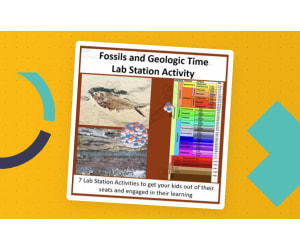
Fossils and Geologic Time – Lab Station Activity
Science, Earth and Environmental Sciences, Grade 8, 9, 10, 11, 12, Labs, Experiments, Activities
Fossils and the Geologic Time Scale - Lab Station Activity Bring the fossil record to life in your middle or high school science classroom with this engaging lab activity. Students will rotate through 9 stations to analyze fossils, date rocks, explore timescales, and more. The self-guided format allows them to work at their own pace while answering questions, watching videos, doing research, and getting creative. Topics span fossilization, radiometric dating, rock strata, the La Brea Tar Pits, and major boundaries in Earth's history. This customizable resource includes reading passages, comprehension questions, creative prompts, and bonus vocabulary builders to maximize the learning potential. Students will love moving freely around the classroom as they dive into hands-on archaeology.
Author Teach With Fergy
Tags Fossils, Fossilization, Rock, Strata, Lab Station, Photosynthesis And Cellular Respiration Word Search Answer Key, Geological Timeline Activity Answer Key, Geologic Time Word Search Answer Key, Geologic Time Activity, Geologic Time Scale Activity Middle School, Geologic Time Scale Activity High School, Geologic Time Line Activity

Circulatory System – Lab Station Activity
Science, Life Sciences, Human Body, Grade 8, 9, 10, 11, Labs, Experiments, Activities
This fully editable Lab Station Activity on the Circulatory System is meant to get your kids out of their seats and engaged in the content. Each station not only offers a unique opportunity to test your students knowledge (offer an opinion, answer questions based on a video or reading, draw, etc.), but also provides a fantastic learning opportunity where your kids are learning through assessment. Each station comes with a description card while some also contain more detailed instructions, a reading, questions to answer, etc. Students are equipped with a recording sheet (passport) to write their answers. There is almost no prep for you. Simply print the cards, lay them out around the room and you're all set. An answer key is also provided where applicable. These station cards are meant to be used as a lab activity but can also be utilized in a review task before a test or a quiz. Used either way, your students will love it! I know mine do and I'm telling you from first-hand experience as I've used this activity in my own class, This lab activity covers: - Circulatory System - Circulatory System Disorders - Prevention of Cardiac Disorders ---------------------------------------------- Bonus Activities: To ensure your students don't have any downtime between stations, your lab also includes a 10-word word scramble and word search, both with an answer key. You can use them as part of their mark, as a bonus so it's not mandatory, etc. However you choose to use it, it will ensure that your students are always busy and never idle. Note: For stronger classes I give the word scramble and for weaker ones, the word search. ---------------------------------------------- How do the Lab Stations work? Each station is specially designed to be a unique complement to the material while at the same time, provide a valuable learning experience. Below is an overview of how each station works. In your activity , each will be tailored to the specific content. Station 1: Get Hands-On – using their creative skills, students are required to draw or build. Station 2: Research – using a classroom computer or their own device, students must research a specific question/issue surrounding the topic. Station 3: Explain yourself – students write down an opinion to a question in paragraph form. Station 4: Rest Station - students can use this time to catch up on work they didn't have time to complete at a previous station or prepare themselves for an upcoming one. Station 5 - Applicability reading – students read a short passage from an article, website, etc. which directly connects the classroom content to a real life application. Station 6: Test your knowledge – students answer 5 multiple choice questions then provide a written explanation for how/why they came to their conclusions. Station 7: Learn from the expert – using a classroom computer or their own device, students must watch a short video clip and answer the associated questions. They may stop, rewind and restart as often as they like during the time frame. Station 8 - Rest Station. Station 9: Become the question master – Students must create 2 multiple-choice questions, 2 true/false questions and 1 short answer question. Students must also supply the answers. ------------------------------- You might also be interested in my other lab station activities Physics: • Newton's Three Laws of Motion • Kinetic and Gravitational Potential Energy • Current Electricity and Circuit Diagrams • Static Electricity • Light Optics and the Production of Light • Sound, Sound Energy and Speed • One and Two-Dimensional Motion • Uniform Acceleration • How Planes Fly • Refraction • Friction • Energy and Its Forms • Density and Buoyancy • Electricity Production • Calculating Average Speed, Velocity, and Displacement • Mass, Volume, Density, & Buoyancy • Work and Energy • Renewable Energy • Plate Tectonics • The Rock Cycle • Natural Disasters • Pressure, Volume, and Temperature • Forces • Power • Liquids and Gases • Fossils and Geologic Time • Earthquakes and Volcanoes Coming Soon: - Work = F x d - Nonrenewable energy sources - Projectile Motion - Momentum, Conservation of Momentum and Impulse - The Doppler Effect and Supersonic Travel General Science: • The Scientific Method and Science Skills • The Different Types of Clouds • Meteorology Biology: • Cell and the Cell Theory • The Human Digestive System • The Circulatory System • The Human Respiratory System • Mitosis and the Cell Cycle • Cellular Respiration and Photosynthesis • Photosynthesis • Cancer: Cell Division Gone Wrong - Volume I • Cancer: Cell Division Gone Wrong - Volume II • Cell Membrane and Transport • Hearing and the Human Ear • The Human Eye • Genetic Material: DNA and RNA • The Nervous System • Energy Flow In Ecosystems • DNA Manipulation and GMOs • Transcription and Translation • Cellular Respiration • Thermoregulation • Proteins and Nucleic Acids • Mutations • Meiosis • DNA, Genes, Chromosomes, and Alleles • Genetic Disorders • Fats • Reproductive Technologies • Muscular and Skeletal System • Integumentary System Coming Soon: - Excretory system - Endocrine system - Carbohydrates and Lipids Chemistry: • Atomic Model, Notation and Atoms • Chemical Reactions and Balancing Equations • Molecular and Ionic Compounds • Physical and Chemical Properties & Changes • Acids, Bases, and Neutralization Reactions • The Periodic Table • Single and Double Displacement Reactions • Balancing Chemical Equations • Synthesis, Decomposition and Combustion Reactions • Atomic Theory, Atomic Structure and Isotopes • Types of Bonds and Intermolecular Forces • The Mole/Avogadro's Number • Density and Buoyancy • The Particle Theory and the Classification of Matter • Pure Substances and Mixtures • Solutions and Mechanical Mixtures Coming Soon: - Periodic table group properties Ecology and the Environment: • Ecosystems • The Classification of Living Things • Biodiversity and Invasive Species • The Carbon and Water Cycle • Climate Change • Photosynthesis • Cellular Respiration and Photosynthesis • Ecological Succession • Plant Sexual and Asexual Reproduction • Earth's Seasons • Interactions Within Ecosystems • Physical and Behavioral Adaptations Space Science: • The Life and Death of Stars • The Moon and its Phases • Life In Space • Our Solar System • Solar and Lunar Eclipse • Earth's Seasons • Asteroids, Comets and Meteors These station cards are meant to be used as a lab activity but can also be utilized in a review task before a test or a quiz. Used either way, your students will love it! I know mine do and I'm telling you from first-hand experience as I've used this activity in my own class. Thank you for your interest in my products. If you have any questions, please send me an email - devon@teachwithfergy.com
Author Teach With Fergy
Tags Circulatory, System, Body, Health, Lab Stations, Lab 11 The Circulatory System, Circulatory System Lesson Plans High School, Circulatory System Word Search Answer Key, Circulatory System Activities For Middle School
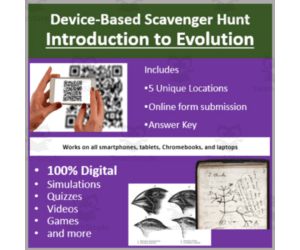
Introduction to Evolution – Lab Station Activity
Science, Life Sciences, Biology, Grade 7, 8, 9, 10, Labs, Experiments, Activities
Introduction to Evolution - A digital, device-based resource that will get your kids out of their seats, engaged, utilizing technology, and collaborating to solve real problems and test their knowledge. This activity works well across grades as a means of assessment , review, and/or instruction. This hunt was designed for middle/high school biological science students. This activity is the coolest thing I've created and your kids are going to love it; mine do. Think of a scavenger hunt, then add devices (Smartphones, Chromebooks, Laptops, or Tablets), engaged students, and learning through assessment and you have this resource. Quick Disclaimer. In order to use this activity, your classroom must have at least 1 device per 3 students. Smartphones, Chromebooks, Laptops, and Tablets will all work perfectly. The wording and delivery make this resource perfect for a wide range of grade levels. If for some reason you feel this hunt isn't perfect for your classroom, I'm happy to refund your purchase no questions asked. The Content Includes: • Evidence for evolution • Vestigial traits • Biogeography • Comparative anatomy • Scientific theory • Natural selection • Microevolution and Macroevolution • Diversity • Darwin's finches • Adaptation ********************************* I've created a video that walks you through the entire activity. I did it using screen capture software on my phone so you can see exactly what your students will see. CLICK HERE to have a look . ******************************** Here's how you implement them: • Print the QR codes and place them around the room • Place your students into groups • Let them loose! They move from Location to Location as they complete their tasks. Each Task is assigned by scanning the QR code and there are 5 Tasks per Scavenger Hunt Activity. • Have them submit their answers directly to your email via a form on my website. This activity: • Lets your students utilize their devices • Cuts down on wasted paper • Combines learning with assessment • Is a lot of fun • Comes in both Word and PDF formats Each Hunt is different and offers a unique way for your students to explore the topic. From Hunt-to-Hunt, possible tasks your students will face include: • Video analysis • Simulations • Fully automated and marked Quiz • Finish the story • Start the story • Calculations • News article • Opinion • Word Scramble • Short answer • Web research --------------------------------------------------------------------------------------------- There are other Hunts as well and I'm continually adding more. Currently, the Hunts I have available include: Biology: • Cell Organelles • The Digestive System • The Circulatory System • Biochemistry - Macromolecules • Photosynthesis and Cellular Respiration • Mitosis and Cell Division • Cells and the Cell Theory • Cancer • Plant Reproduction • Cell Membrane and Transport • Genetic Material - DNA and RNA • Hearing and the Human Ear • Genotype and Phenotype • Genetic Disorders • Classification of Living Things • Reproductive Technologies • Muscular and Skeletal System • Introduction to Evolution Coming Soon: - Cell Membrane and Transport - The Nervous System - Excretory system - Endocrine system Physics: • Friction • Energy Transfer • Average Speed, Velocity, and Displacement • Mass, Volume, Density, and Buoyancy • Work and Energy • How Planes Fly • Refraction • Acceleration • Power Coming Soon: - Sound, Sound Energy, and the Speed of Sound - Newton's Three Laws of Motion - Kinetic and Gravitation Potential Energy - Light and the EM Spectrum - One and Two-Dimensional Motion Space and Earth Science: • The Seasons • Our Solar System • The Moon • The International Space Station - Meeting Our Needs • Climate Change • Eclipse - Solar and Lunar • The Rock Cycle Coming Soon: - Stars - Asteroids, Comets, and Meteors - Exoplanets Chemistry: • Atoms: Atomic Theory and Structure • Physical and Chemical Changes • Elements and the Periodic Table • Chemical Reactions • Types of Chemical Reactions and Balancing • Acids, Bases and pH • Isotopes • The Particle Theory • Types of Chemical Bonds • Solutions and Mechanical Mixtures Coming Soon: - The Mole - Molecular and Ionic Compounds Electricity: • Static Electricity • Electricity Generation • Fossil Fuel and Nuclear Energy Production • Renewable Electricity Production Ecology: • Energy Flow in Ecosystems • Invasive Species • Photosynthesis and Cellular Respiration • Cycling of Matter in Ecosystems • Ecosystems and Ecological Succession • Interactions within Ecosystems • Plant Reproduction • Biodiversity --------------------------------------------------------------------------------------------- Also, please visit my website Teach With Fergy for my thoughts on teaching, learning and everything in between.
Author Teach With Fergy
Tags Evolution, Adaptations, Charles Darwin, Natural Selection, Lab Station, Fun Evolution Activities, Evolution Activity High School, Evolution Activity For High School, Evolution Lab Biology In Motion