resources by type
resources by grade
resources by subject
other resources

3,932 products added recently

Page 2 - Math Projects

Support mathematical understanding with projects that apply concepts to real-life scenarios. This collection includes statistical studies, geometry in design, and budget planning exercises. By integrating these math projects into your teaching, you can make math relevant and engaging.

Relevant
alt down
Any Time
alt down
filter by
alt down
All File Types
alt down
filter nav Show filters
Sort by: Relevant
CLEAR
resources by type
Activities
up arrow
Centers
Crafts
Escape Room
Experiments
down arrow
Games
Projects
Read Alouds
Songs
Classroom Decor
down arrow
Teacher Tools
down arrow
Worksheets & Printables
down arrow
resources by grade
Early Learning
down arrow
Pre-K
down arrow
Elementary
down arrow
Middle School
down arrow
High School
down arrow
Adult Education
Not Grade Specific
resources by subject
Creative Arts
down arrow
ELA
down arrow
Holiday & Seasonal
down arrow
Life Studies
down arrow
Math
up arrow
Addition and Subtraction
down arrow
Algebra
down arrow
Calculus
down arrow
Trigonometry
Decimals
Early Math
down arrow
Fractions
Geometry
Graphing
Measurements
Money
Multiplication and Division
down arrow
Number Lines
Order of Operations
Percentages
Statistics
Time
P.E. & Health
down arrow
Social Studies
down arrow
Special Resources
down arrow
Science
down arrow
Foreign Languages
down arrow
Resources for Teachers
down arrow
other resources
Common Core
Homeschool Resources
down arrow
Montessori
Research
STEM
Room Renovation Project

Room Renovation Project
Life Studies, Finance, Home Economics, Math, Money, Geometry, Grade 5, 6, 7, 8, 9, 10, 11, 12, Activities, Projects

The Room Renovation Project The Room Renovation Project is a teaching resource uniquely designed to help students appreciate and utilize basic math concepts in practical, real-world situations. Targeted towards grade 5-12 educators in the spheres of Math and Life Studies, this resource presents an interactive way to teach important subjects such as finance, home economics, geometry and more. An engaging scenario: The project sparks interest by presenting a creative scenario - winning the lottery and remodeling their bedroom. However, students must prove they can plan smartly and make informed decisions about expenses during this renovation journey.This hands-on project notably turns mathematical learning into an intriguing venture that keeps learners engrossed from start to finish. Diverse steps: Blueprint creation for room layout design; Color selection & flooring choices requiring careful calculations for budget considerations; Furniture selection within allowed expenditure limits; 3D room modeling giving life to 2D plans through virtual reality. In each step students grasp important arithmetic skills while handling budgets and measuring; geometric principles which help them contemplate room dimensions or decide where to place what furniture item; comprehension of budgeting concepts introducing them consumer mathematics realities at an early age. Beyond Mathematics: This Room Renovation Project breaks disciplinary boundaries by introducing the integration of technology into everyday tasks - Google Slides forms a major part of project execution. It is highly likely that organizational skills taught via tracking expenses or ensuring feasible design plans will become lifelong habits for many. In Summary - A Versatile Teaching Tool: Above all else stands its adaptability feature making the Room Renovation Project appealing on different fronts – variations according to teaching environments possible due to accompanying editable files combined with traditional paper tasks or digital execution on Google Slides if needed. Not just a task of turning around bedrooms using given lottery winnings intelligently. This ingenious educational tool helps underscore students the omnipresence of mathematics even where least expected making it an indispensable part of life.

Author Mister G's Teacher Shop

Tags Room Renovation, Math Education, Practical Application, Budgeting Skills, Geometry Principles

Pumpkin Patch Project with Social Studies and Math for Elementary

Pumpkin Patch Project with Social Studies and Math for Elementary
Social Studies, Economics, Math, Addition and Subtraction, Addition, Subtraction, Multiplication and Division, Division, Multiplication, Grade 1, 2, 3, 4, 5, Activities, Projects, Worksheets & Printables, Worksheets

Embark on an exciting autumn adventure as you step into the shoes of a pumpkin patch owner this fall season! Construct your very own immersive 3D pumpkin patch, delve into the intricacies of growing seasons, meticulously document your findings on an informative chart, and even engage in the rewarding experience of selling your bountiful pumpkins at a bustling market. This comprehensive project comprises six engaging steps that seamlessly blend various academic disciplines. As students partake in this hands-on endeavor, they'll explore the realms of economics, delve into the rich tapestry of social studies, hone practical life skills, and sharpen their basic math proficiency—all while having a blast. Upon project completion, students will proudly possess a portfolio filled with valuable information. This includes thoughtfully crafted charts, region-specific research findings about pumpkin growth, and a stunning 3D pumpkin patch they can showcase with pride. So what’s included? 1 hands-on project 3 corresponding worksheets 2 reading/learning pages How to Use and Supplies List Student Guide for independent use Answer Keys Bonus Pumpkin Freebie How to use in your classroom For Pumpkin Week - Easily set up your elementary classroom around this project. With 6 unique steps that lead the student to "growing" their own pumpkin patch, you'll have plenty to do! As a Cumulative Assessment - This is the easiest way to teach basic economics to elementary students. Use all 6 steps to assess what they've learned and give a grade. Independent Project - Because of the included Student Guide, older elementary students can complete this project with minimal adult supervision. Group Project - With separate steps and activities, students could easily split this up into different parts and create their own group pumpkin patch. Science Fair Project - Looking for an economics-focused fair project? Try this one this fall! Tags pumpkin math, pumpkin math worksheets, pumpkin math activities, elementary math, elementary math worksheets, easy math worksheets, printable math worksheets, print and go math worksheets, pumpkin-themed worksheets, pumpkin project, project-based learning, elementary economics, pumpkin economics, pumpkin economics project Grab the full Pumpkin Life Cycle Art & Crafts Bundle here! Please enjoy! -Abbey Allen ARTventurous Animals

Author ARTventurousanimals

Rating

Tags Pumpkin Math, Pumpkin Math Worksheets, Pumpkin Project, Project Based Learning, Pumpkin Project Based Learning, Steam, Stem, Pumpkin Social Studies, Pumpkin Economics

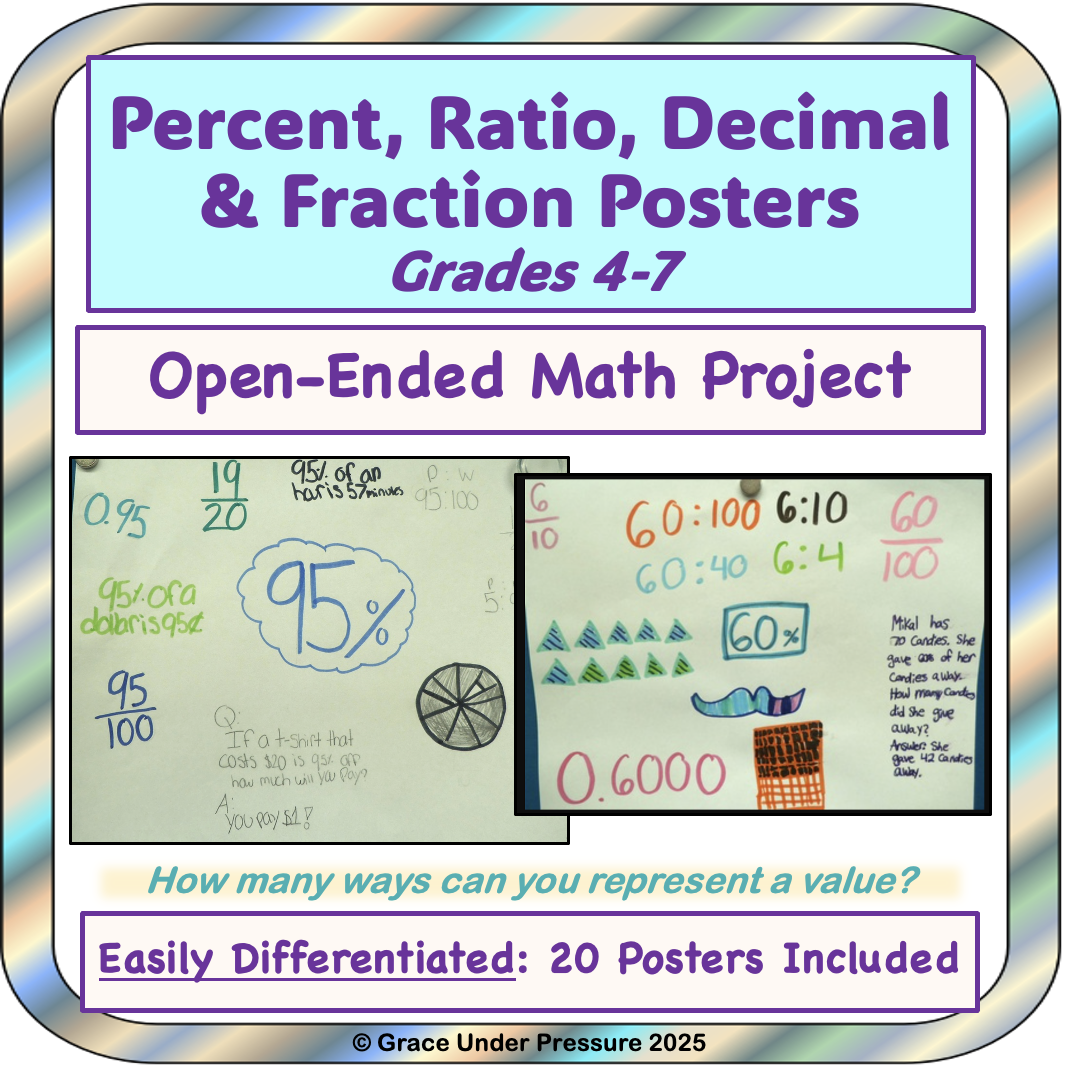
Financial Literacy: My Party Budget- Decimals and Percentages Application

Financial Literacy: My Party Budget- Decimals and Percentages Application
Life Studies, Finance, Home Economics, Math, Percentages, Decimals, Grade 5, 6, 7, 8, Worksheets & Printables, Word Problems, Activities, Projects

Financial Literacy: My Party Budget- Decimals and Percentages Application Unlock mathematics’ real-world influence with this practical math project for students in grades 5-8. This tool allows students to sharpen their intermediate math skills, particularly applying percentage calculations and decimal operations to manage a budget consciously - a vital lesson in financial literacy. This versatile resource is ideal for grades 5 to 8 classrooms as well as high school special education environments where budgeting practice complements life skills training. How to Use: Give each student a party budget. You can choose to give everyone the same budget, OR this is a great way to differentiate. Give students with emerging understanding a budget of $100 (which is easy to work with) and give students who need a challenge a budget such as $240, which will result in more complex calculations. This will also stimulate discussions about budgeting in general and the challenge of planning with less money. Students need to partition their hypothetical party budget across varied cost categories like food, decorations and entertainment by employing basic percent in decimal form and understanding addition and multiplication of decimals. For example, they might decide to spend 50% of their budget on food because that is their favourite part of a party. They will calculate 50% of their total budget. This skill application brings relevance to numbers through experiential learning. You can decide if students should complete calculations by hand or if using a calculator is allowed. Also, a complete sample answer key is included that you can show to your students to demonstrate the task. Finally, students complete shopping research and choose items online or in store flyers. This fosters strategic thinking when managing limited resources. You can have a discussion about making tradeoffs (for example, choosing frozen pizza instead of fresh to have extra money for a party activity OR inviting fewer guests to have more money for party favours per person). What's Included: A total of 8 pages in PDF Format Title Page Teacher Instructions 3 Page Student Worksheets 3 Page Sample Answer Key

Author Grace Under Pressure

Tags Financial Literacy, Decimals, Percentages, Budgeting, Math Application, Budget, Real World Math, Math Project, Applied Math, Party Project

Human Body and Golden Ratio PowerPoint and Study Guide

Human Body and Golden Ratio PowerPoint and Study Guide
Math, Grade 4, 5, 6, 7, 8, Projects, Activities, Presentations, Teacher Tools, Quizzes and Tests, Rubrics, Workbooks, Worksheets & Printables

Introduction to the Golden Ratio and the Human Body PowerPoint and Study Guide Lesson The Golden Ratio, or Phi, and the Human Body is a unique math PowerPoint exploration of the human body and Leonardo da Vinci's famous Vitruvian Man drawing. Academic connections are made with math, art and history. Another famous name for the Golden Ratio is the divine proportion, a proportion of beauty found throughout nature, science, art, and architecture. This lesson can be completed in one or two classes depending on how long teachers want to spend on projects. Learners will become enthralled by the idea of how math can be beautiful and learn to treat it like a treasure hunt by looking for the golden ration everywhere around them in art, nature and even their own bodies! Go down as many learning rabbit holes with NatureGlo's MathArt Library Golden Ratio and Human Body page. On this page you'll get videos, project ideas and curated website links. Enjoy the exploration! Student Objectives Students will: Complete the PowerPoint lesson Complete the study guide for the lesson. Watch the curated educational videos from the MathArt Virtual Library Website. Complete the journal in the study guide including a drawing with written descriptions. Complete the quiz. Choose and do a chosen project. Order, Outline and Steps Read the Quick Start guide that comes with the curriculum. Go through the PowerPoint lesson with the students. Students complete the study guide during or after the PowerPoint lesson. Students select and complete a chosen projects about the topic. Grades & Ages Grades 4 - 8 Ages 10 - 14 Implementation Format PowerPoint Study guide Use of Internet Activities Projects Answer Key - INCLUDED Number of Pages - 33 File Types - PowerPoint and PDF files Length of Lesson - At least one lesson, or, optionally two or more lessons

Author NatureGlo's eScience

Rating

Tags Golden Ratio, Human Body, Divine Proportion, Math Activities, Math Projects, Leonardo Da Vinci

Project Based Learning Math Activity Standard, Expanded, Word Form & Comparing

Project Based Learning Math Activity Standard, Expanded, Word Form & Comparing
Math, Place Value, Grade 4, Projects, Activities

Place Value Forms - Project Based Learning Activities for 4th Grade Looking for an authentic way to teach place value forms 4.NBT.2 to your fourth-grade students? This project-based learning math activity covers place value number forms. The PBL activities have a fun video to introduce the unit after which students will convert standard form, word form and number expanded form and compare these using inequalities all in the context of the Summer Games in Paris 2024. These PBL activities are printable, digital, and differentiated to make them easy to use as a whole class lesson, extension work, or as homework. This no-prep differentiated video response and fun math timeline activities are sure to have high engagement and make teaching place value easy as students make real-world connections. PLUS it will save YOU time as everything is done for you! Teaching Tips Teaching place value will never feel boring again! Dim the lights, set the scene with this intriguing introductory video and you have the perfect way to make the teaching about place value forms memorable. Students become Sports commentators for the Summer Games in Paris 2024. After watching the project-based learning introductory video, students discuss what the video is about and complete a video response activity to create an infographic, ordering numbers chronologically. Students use the numerical data from the video to create a timeline of the information related to previous and future Summer games. They will translate the numbers into different number forms. Using this information they compare the data over the years, draw mathematical inferences using inequalities, and predict the data for the Paris 2024 Games. This no prep interdisciplinary lesson includes a full lesson plan to make teaching place value forms easy and in an authentic context. . It meets standards in math, reading, social studies, and technology and is super fun! Your students will hardly feel like they are learning! Everything is done for you! 5 easy to use features 1) Video hook to start your place value unit off in style. 2) Teacher Powerpoint to share objectives 3) Save time! Full Lesson plan with pacing guide and ideas 4)Meet your students' needs. Differentiated by form and content ( approaching grade level, at grade level, and extension 5)Multiple versions to fit your classroom needs ( black and white, colored, digital, and answer keys including student rubric The digital version allows students to work independently and is created in Google slides. The print version can be used to work in grade level groups to complete the timeline activity and then as a class make a collaborative poster to display. Standards 21st Century skills Problem-solving, critical thinking, digital literacy Math CC 4.NBT.2 -Read and write multi-digit whole numbers using base-ten numerals, number names, and expanded form. Compare two multi-digit numbers based on the meanings of the digits in each place, using >, =, and < symbols to record the results of comparisons. Social Studies TEKS 4.21 E Uses appropriate mathematical skills to interpret social studies information such as maps and graphs. ELA CCSS.ELA-LITERACY.SL .4.2 Paraphrase portions of a text read aloud or information presented in diverse media and formats, including visually, quantitatively, and orally. Technology ISTE 1.3d Studentsbuild knowledgeby activelyexploringreal-world issues and problems, developing ideas and theories, and pursuing answers and solutions. CCSS W 6, RL 7, SBAC testing skills Watch online videos and use play, pause, rewind, and forward buttons while taking notes

Author Fantastic Mrs Primary

Tags Project Based Learning , Activities , Place Value Forms , Print And Digital, Projects , Word Form Math 4th Grade, Standard Expanded And Word Form

Fall Number Flashcards – 0–30 Memory and Sequencing Games

Fall Number Flashcards – 0–30 Memory and Sequencing Games
Holiday & Seasonal, ELA, Special Resources, Special Education Needs (SEN), Seasons, Fall, Math, Early Math, Numbers, Counting, Preschool, Grade 1, 2, 3, 4, Activities, Games, Worksheets & Printables, Quizzes and Tests, Teacher Tools, Quizzes, Projects, Flashcards, Word Problems, Centers

Fall Numbers Memory Game Bring autumn fun into your math lessons! This set of fall-themed flashcards gives students repeated practice with numbers from 0 to 30 in a playful and flexible format. I first made these for my kindergarten class, when many of my students still needed support with recognizing numbers and putting them in the right order. The cards worked well because they could be used in so many different ways without having to prepare something new each time. There are 228 cards in total, divided into six full sets with different colored borders. The colors make it easy to keep groups organized, since each table can use a separate set without mixing the cards together. Each card shows a single number in a large, clear font, which helps beginning learners and also supports students who struggle with visual distractions. The cards can be used for memory or matching games, where students flip over two at a time and try to find pairs. Another favorite activity in my class has been sequencing: students work together to lay the cards out from 0 to 30. For more active lessons, we sometimes spread the cards on the floor and have students “walk” the numbers in order, which adds movement to the practice. I also use the cards as simple flashcards, holding them up for quick recognition drills, or handing one card to each student and asking the group to line up in numerical order. With partners, students have created their own math problems using the numbers they draw, which adds a layer of challenge for more advanced learners. Differentiation is built in, since you can choose how many numbers to include. With beginners, I usually work with 0–10. As students grow more confident, I extend to 0–20 and eventually the full 0–30. Adding a timer or encouraging students to say each number out loud when they play can make the activity even more engaging. Preparation is straightforward: print the set you want, cut the cards, and laminate if you plan to reuse them. I keep each set in small envelopes or bags so they are ready for math centers, group games, or quick warm-ups. The fall design adds a seasonal touch, but the number practice is useful all year long. Warm regards, Lernfitness Did You Know? I teach with a certified therapy dog, and together we focus on creating a positive and inspiring learning environment.

Author Lernfitness

Rating

Tags Foreign Languages, Game, Educational Card Games, Elementary, Fall, Memory, Numbers, Counting, Autumn, Math

Famous Mathematician: Math Research Project 5th 6th 7th 8th Grade

Famous Mathematician: Math Research Project 5th 6th 7th 8th Grade
Research, ELA, Writing, Formal Writing, Social Studies, Biographies, Math, Grade 5, 6, 7, 8, Worksheets & Printables, Worksheets, Writing Prompts, Drawing Templates & Outlines, Teacher Tools, Rubrics, Activities, Projects

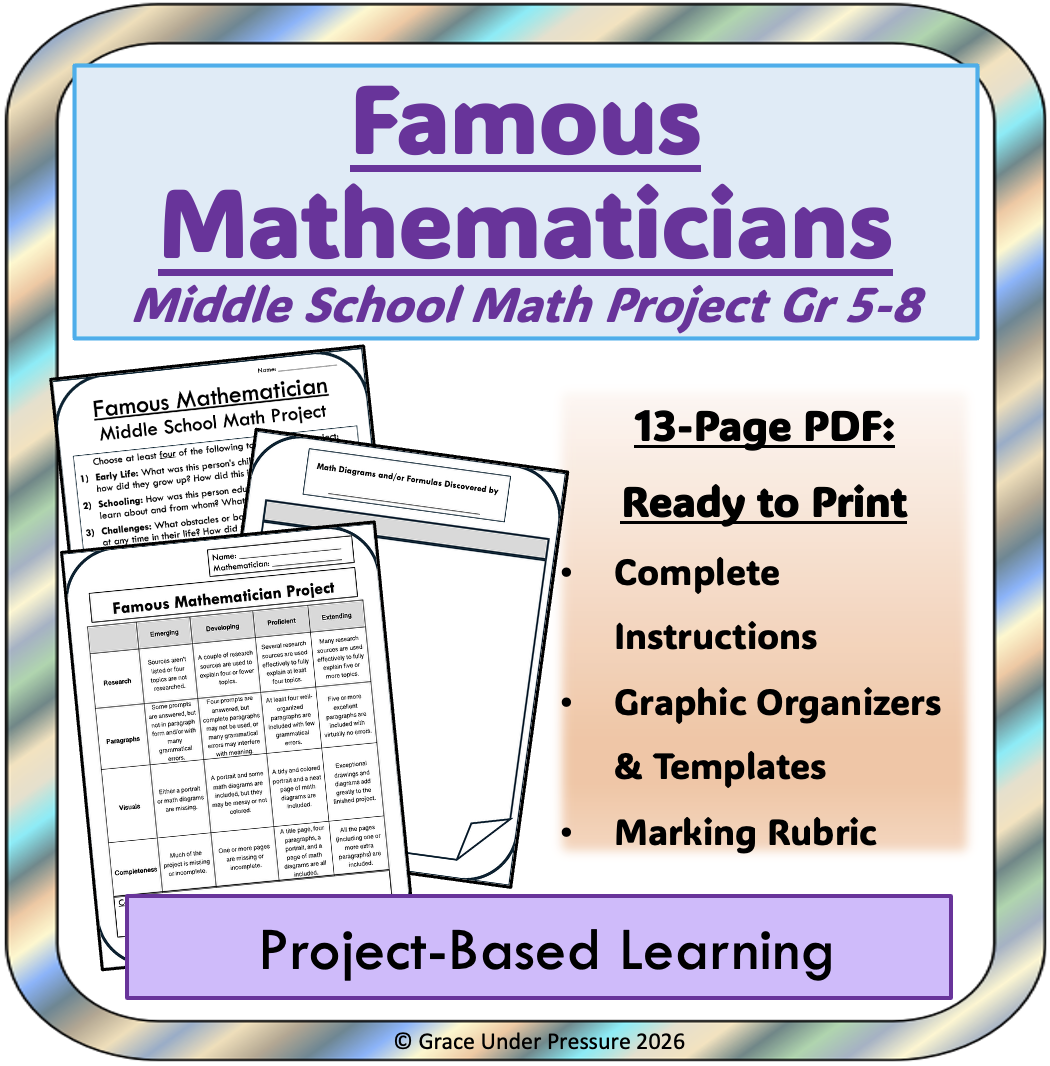
Here is a ready-to-print middle school math research project about famous mathematicians for your students in 5th through 8th grade. Each student will pick a famous mathematician, complete research about their life and mathematical discoveries, and create an organized project with paragraphs & visuals to share their learning. How to Use: • Print a 12-page project booklet for each pupil. • Page 2 has instructions for the project including a website for selecting famous mathematicians, places to write due dates, and a checklist to keep students organized. • Page 3 has seven different paragraph prompts for students to research. Each student must pick at least four prompts to have in their unique project. • Pages 4-6 are graphic organizers for your students to use for research notes. • Pages 7-9 are templates for students to use for writing their paragraphs. • Page 10 is for students to draw a portrait of their mathematician. • Page 11 is for students to show diagrams and formulas of the math that their mathematician discovered. • Page 12 is a title page for the project. • Page 13 is a rubric to use to assess the completed project. During several weeks of classes, your students will complete research, write & proofread paragraphs, and draw the visual pieces of their project. They can present their projects to each other, and you can use the rubric to assess them. Grades to Use With: This project is designed for middle school students in 5th, 6th 7th, or 8th grade who are learning about mathematicians, biography writing, library research skills, and writing expository paragraphs. It could also be used in high school special education classes where appropriate. What's Included: 13-Page PDF: Ready to Print and Use! Complete Teacher Instructions 2 Pages of Student Instructions & Writing Topics 6 Student Graphic Organizers for Note-Taking & Paragraph Writing 2 Student Templates for a Mathematician Portrait and Math Sketches Project Title Page Marking Rubric

Author Grace Under Pressure

Rating

Tags Math Project, Math Research Project, Famous Mathematicians, Mathematicians, Famous Mathematicians Project, Biography Project, Middle School Math Project, Math Research

Entrepreneur Fair Mini-Unit – Grades 4–6 Business

Entrepreneur Fair Mini-Unit – Grades 4–6 Business
Life Studies, Math, Money, Finance, Business, Career, Grade 4, 5, 6, Teacher Tools, Lesson Plans, Activities, Projects

This Entrepreneur Fair Mini Unit is completely ready-to-go for your intermediate or middle school classroom. It walks students through the entire process of starting a small business step-by-step. Use it over several weeks, culminating with an Entrepreneur Fair in your classroom where students can buy each other's products and services. This will be the kind of hands-on, applicable learning students don't soon forget! How to Use: Print a booklet (double-sided) for each student with pages 2-7. Print a single page 8 for each student. o What is an Entrepreneur?: Read through as a class and give students time to research entrepreneurs. Decide if students will work independently or in pairs or small groups. o Brainstorming a Product or Service: Support your students as they complete the mind-map to think of a product or service they could sell. Ask questions to get them thinking of ideas. Once they have decided, they complete the page to draw and describe their idea. o Costs to Start a Business: Model a sample product and its costs, then let your students complete this task for their business idea. Encourage them to recycle and reuse items whenever possible: the less they spend, the more profit they can make! o Making the Product: Remind your students about writing instructions. They can include temporal words like first, next, and finally. Then give them class time to make products (some can also be done at home). Decide how much money your students will bring to the fair (and if you will use real money or pretend). I recommend $5. Students need to know this before they can price their item. o Pricing: Give students time to price their product and explain their rationale. o Advertising: Students will create advertisements for their products. You could bring in magazines or show online ads to notice key features: bright, happy, aspirational images with short, catchy phrases and features. You can post the ads around the classroom before the fair. Give students the pretend money (or they bring real money from home) and let them shop for each other’s items. They can make change and keep a tally of sales. o Calculating Profit: Walk students through the profit calculation step-by-step. o Reflection: Finally, give students time to reflect on the entire process.

Author Grace Under Pressure

Rating

Tags Entrepreneur, Entrepreneur Fair, Business, Sale, Money Math, Small Business, Economics, Profit, Mini Unit, Genius Hour

Single vs Dual Income Budget: High School Financial Literacy Budgeting

Single vs Dual Income Budget: High School Financial Literacy Budgeting
Life Studies, Finance, Home Economics, Math, Addition and Subtraction, Money, Special Resources, Life Skills, Grade 9, 10, 11, 12, Worksheets & Printables, Word Problems, Worksheets, Projects, Activities

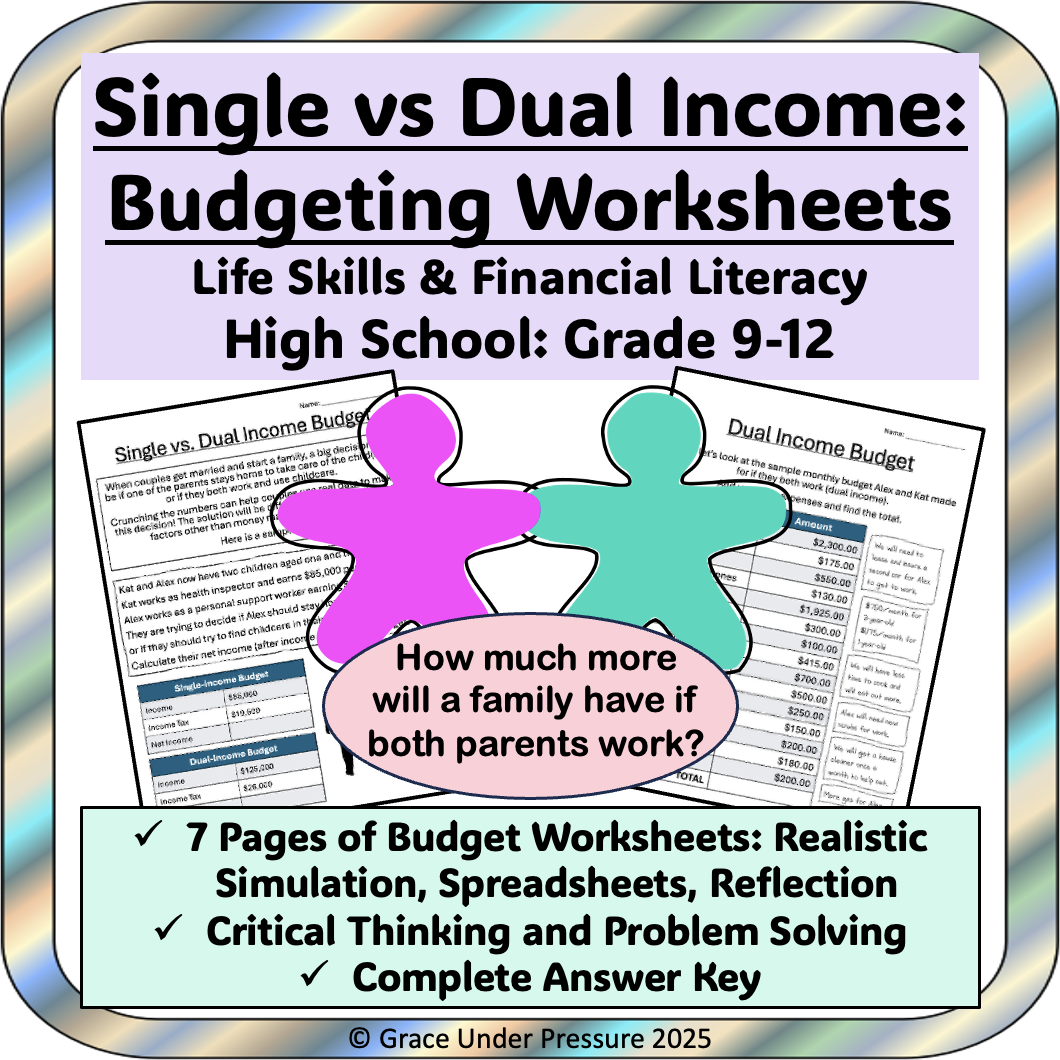
This high school financial literacy project lets your students tackle a real-world budgeting decision families make: should both parents work, or should one stay home to do childcare? Students will use critical-thinking and problem-solving skills as they work with these realistic budgets (single income budget vs dual income budget). This task can show your students in 9th, 10th, 11th, or 12th grade how financial literacy and math skills can be incredibly useful in everyday life! How to Use: Print five pages for each student. Go through the first page together and introduce the family in the simulation. Students use the income and income tax information to calculate the net income. Give students time to add up the monthly expenses in each budget (single-income vs dual-income). Discuss what expenses change when both parents work and if those seem reasonable or not. Have students complete the calculations to compare the two budgets on the fourth page. NOTE: In this simulation, there is almost no difference in money left over if both parents work since the extra income is used to pay for childcare, a second car, a cleaner, etc. That does not mean this is always the case! Use the prompts on the fifth page to have a class discussion about this topic. Then, students write their final opinion in a paragraph to sum up their learning. They may have ideas for how to change this budget or scenario to make having both parents work be more financially beneficial. I have included blank spreadsheets as well if you want your students to create their own budgets using salaries and expenses from your geographical area. What’s Included: 9-Page PDF: Ready to Print and Use! Teacher Instructions Introduction to Kat and Alex and their family Single-Income Budget Spreadsheet (with expenses included) Dual-Income Budget Spreadsheet (with expenses included) Comparison of the Budgets Worksheet Reflection (with discussion prompts) Two Blank Budget Spreadsheets (single and dual income) Complete Answer Key Grades to Use With: Grades 9-12 General Studies or Grades 11-12 Special Ed Family and Consumer Sciences/Family Studies Life Skills Applied Math or Consumer Math Career and Personal Planning Financial Literacy Math Skills Required: Only intermediate math skills are required to complete this project: Adding & subtracting money amounts to the hundred thousands (salaries) Dividing by 12 to find monthly amounts (with decimals) An understanding of integers

Author Grace Under Pressure

Rating

Tags Financial Literacy, High School Financial Literacy, Budget, Budgeting, Financial Literacy Project, High School Financial Literacy Project, Two Income, Single Income, Comparing Budgets

Online Lemonade Stand Project

Online Lemonade Stand Project
Life Studies, Finance, Home Economics, Business, Math, Money, Grade 5, 6, 7, 8, 9, 10, 11, 12, Activities, Projects, Games

The Online Lemonade Stand Project Whether you're a public school teacher or a homeschooler, the Online Lemonade Stand Project is a resource that brings practical business principles into your classroom. Designed to simulate an engaging and realistic lemonade stand experience, this project provides an innovative educational approach for students from grade 5 up to grade 12. Nurturing Financial Literacy and Entrepreneurship The Online Lemonade Stand Project takes on the challenges of presenting financial literacy and economic insights to students in a way that is both age-appropriate and dynamic. At its core, it's about giving your pupils practical application of entrepreneurship knowledge within the confines of their learning environment; their very own virtual lemonade stand! An Interactive Experience In this interactive activity , students are tasked with managing every aspect of running a profitable lemonade stand online. From calculating production costs to creating effective pricing strategies, they will experience first-hand how supply and demand dynamics can impact business success. Data trackers: Included in the project materials are data trackers specifically designed for student use. Analyzing outcomes: These help learners analyze outcomes from different strategies. Making adjustments: Identifying areas for potential enhancement and making necessary adjustments as if they were running real-life businesses. Curriculum Alignment Aligned with life studies and math curricula including focus areas such as finance, home economics, business and money management; this learning project isn't just about teaching entrepreneurship concepts but also reinforcing math skills in real-world contexts. Greatest Benefit? The great thing about The Online Lemonade Stand Project? It's highly adaptable! Whether used during whole group lessons or small group activities - even as homework assignments - it accommodates diverse educational needs across multiple grade levels. Yet despite its versatility,the unifying goal remains consistent: To equip students with critical thinking skills essential in today's global economy whilst offering them unique opportunities to learn beyond textbooks through active exploration in digital spaces. If you're looking for versatile yet substantive teaching resources that bring education closer to life experiences – consider integrating The Online Lemonade Stand Project into your curriculum!

Author Mister G's Teacher Shop

Tags Interactive Activity, Financial Literacy, Entrepreneurship, Math Skills, Practical Application, Project Lemonade, Online Lemonade Stand, Lemonade Stand Online, Lemonade Stand Lesson Plans, Lemonade Stand Online Games

Halloween Critical Thinking Task Cards (Math, Science, Language)

Halloween Critical Thinking Task Cards (Math, Science, Language)
ELA, Math, Science, Grade 3, 4, 5, Activities, Projects, Worksheets & Printables, Task Cards

Challenge your students with Halloween Critical Thinking Task Cards . This set is perfect for enrichment, gifted learners, fast finishers, or class challenges! Seasonal fun meets rigorous creative thinking for grades 3–6. These Halloween Critical Thinking Task Cards were designed with gifted and advanced learners in mind , each card combines seasonal fun with higher-order thinking skills! Skills Covered: Logic puzzles Problem-solving Math reasoning & multi-step word problems Debate, analogy, and open-ended writing prompts STEM connections and real-world application What’s Included: 12 print and cut Halloween Critical Thinking Task Cards Answer Key: solutions and discussion prompts Teacher Talk Page : tips for setup and classroom use Student Directions Page : independent or small-group work Ways to Use These Task Cards: Morning work Enrichment for gifted and advanced students Early finisher activities Math/ Literacy centers Socratic seminar discussion starters Journal prompts Halloween centers or stations Why Teachers Love These: Low-prep : print, cut, and use immediately Flexible for independent, partner, or whole-class use Encourages multiple solutions and deeper thinking Easy differentiation in mixed-ability classrooms Typically used in grades 3rd, 4th, 5th, and 6th , these task cards bring Halloween fun + academic rigor to your classroom. Use them year after year to compare the creativity as your classes change! Keywords: halloween critical thinking task cards, fall enrichment activities, gifted student halloween activities, upper elementary fall logic puzzles, fall early finisher activities, fall STEM and critical thinking, halloween classroom activities upper elementary

Author Kel's Klass

Rating

Tags Gifted Enrichment, Autumn Critical Thinking Task Cards, Fall Classroom Activities, Upper Elementary Logic Puzzles, Early Finishers, Critical Thinking, Enrichment For Gifted Students, Halloween Critical Thinking Task Cards, Halloween Gifted Enrichment, Halloween Classroom Activities

Geometry Project: Park Design- Area, Perimeter, Volume, and Budgeting

Geometry Project: Park Design- Area, Perimeter, Volume, and Budgeting
Math, Decimals, Multiplication and Division, Division, Money, Geometry, Measurements, Grade 5, 6, 7, 8, Worksheets & Printables, Word Problems, Activities, Projects

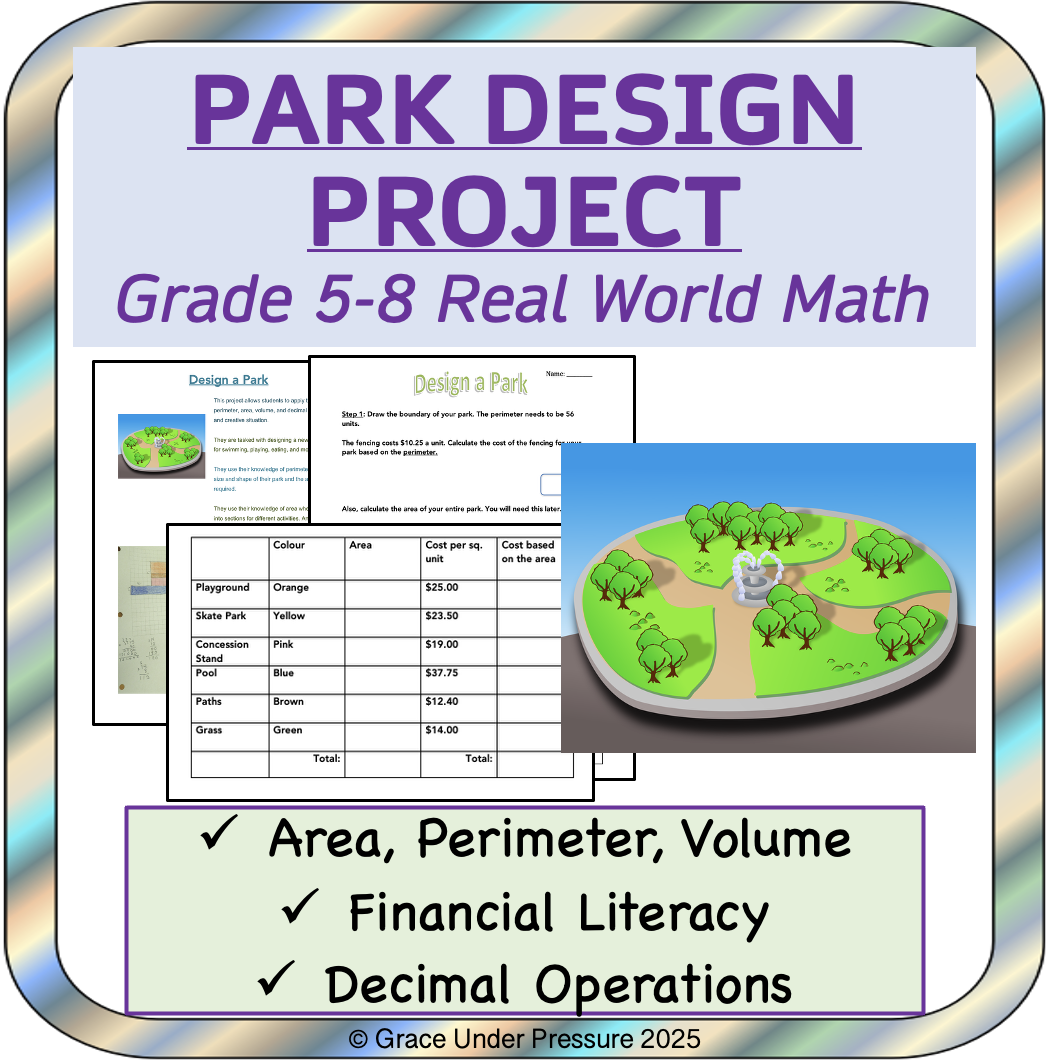
This math project allows students in 5th, 6th, 7th, or 8th grade to apply their knowledge of perimeter, area, volume, financial literacy, and decimal calculations to a realistic & creative situation: planning a fun new park! They will design a new park that includes different areas for swimming, playing, eating, resting, walking, and even skating! Students will use their knowledge of perimeter of right-angled shapes when planning the size and shape of the park & the amount of fencing required use their knowledge of area when splitting the park up into different sections for activities use their knowledge of volume when considering filling the pool in their park use their knowledge of money math/decimal calculations when determining the grand total price of the entire park project. Each section has a different cost- a great introduction to unit rate. For example, paths are much less expensive than a playground, while grassy areas cost less than the swimming pool does. I ask my students to calculate by hand, but you can allow yours to use a calculator as well. This project gets students using their creative and logical problem solving skills, organizational skills, careful calculating methods, and neat drawing and colouring. It is a great project to use for a summative assessment at the end of a unit or to show parents at parent-teacher conferences. What's Included: A total of 4 pages in PDF format: Ready to print and use! Title Page, 2 Page Worksheet, 1 Page Grid Grades to Use With: This math project could work in grades 4-8 in regular math classes. It could also be used in high school special education classes. If you enjoy this math project, check out some others in my store: Transformation Design with Rubric Math Mini Unit: Converting Scores into Percentages Math Project: Create Your Dream Store

Author Grace Under Pressure

Rating

Tags Math Project, Budget, Decimals, Applied Math, Geometry Project, Perimeter Area Volume Worksheets, Geometry Projects, Area Perimeter And Volume, Middle School Geometry Project

Plan a Sleepover: Real World Math Project for Enrichment or Early Finishers

Plan a Sleepover: Real World Math Project for Enrichment or Early Finishers
Math, Order Of Operations, Grade 3, 4, 5, Worksheets & Printables, Word Problems, Activities, Projects

Give your fast-finishing math students an engaging project with this 22-page sleepover planning performance task. Students will practice critical thinking and problem-solving as they plan a fun sleepover event. The multi-step project integrates reading, writing, money math, timetelling, measurement, and more into 11 open-ended problems. As students choose party themes, create invitations, plan menus, schedule activities, calculate costs, and determine sleeping arrangements, they will use addition, multiplication, area models, and other skills. This enrichment resource is perfect for gift3ed students or whole-class projects. The real-world scenario encourages creativity and perseverance through authentic tasks. Use it to engage early finishers or for test prep with its integrated Standards for Mathematical Practice. The detailed project can extend over multiple lessons with the included scoring rubric.

Author Beyond Traditional Math

Tags Enrichment, Project, Performance Task, Math, Money, Time, Measurement

Movie Theater Multiplication: Real World Project Using Arrays, Rows and Columns

Movie Theater Multiplication: Real World Project Using Arrays, Rows and Columns
Math, Order Of Operations, Grade 2, 3, 4, Worksheets & Printables, Word Problems, Activities, Projects

Bring math concepts to life for students with Movie Theater Multiplication, a hands-on real-world project using arrays, rows, and columns. Students become builders and designers as they construct model movie theaters with seats represented by counters. This progressive activity takes learners through the concrete, representational, and abstract stages, building conceptual understanding of multiplication along the way. With 20 total tasks across 4 stages, students start by building arrays and connecting them to number sentences. Then they assign "moviegoers" to seats and write multiplication expressions to represent the seating. Finally, students find the total number of seats in mega-theaters and calculate potential ticket revenue. This differentiated project integrates math, reading, and writing for 2nd-4th graders. Use it for small groups, fast finishers, or a whole class. Includes an answer key.

Author Beyond Traditional Math

Tags Real-world, Arrays, Multiplication, Conceptual, Hands-on

Credit Card Project

Credit Card Project
Life Studies, Finance, Home Economics, Math, Money, Grade 6, 7, 8, 9, 10, 11, 12, Activities, Teacher Tools, Lesson Plans, Projects

Diving into the world of consumer math and understanding how credit cards work can be quite a challenge, especially for younger students who might not have any firsthand experience. This teaching resource simplifies the complexity surrounding credit cards, giving students an informed perspective on their usage, advantages, and potential pitfalls: Credit Card Project Geared towards middle and high school students, this Credit Card Project resource offers a straightforward view of several key aspects: The mechanics of how credit cards operate. Insight into how credit card companies generate revenue. The processes of making payments and understanding the billing cycle . Tips and guidance on using credit cards responsibly. To make the learning process engaging, this package is designed as a project containing a series of worksheets. These worksheets are complemented by informative videos about credit cards, and a sample credit card statement to help students visualize real-world applications. Additionally, to assist educators in assessing the students' understanding and engagement with the project, a rubric is provided. Whether you wish to integrate this resource into your classroom activities or assign it as a home-based project, its flexible structure allows for both. It serves as an invaluable introduction to credit cards, equipping students with knowledge that is crucial as they step into adulthood. For educators who want to ensure that the content aligns with their teaching methods or specific classroom requirements, the entire project is editable. This customization feature ensures that the material remains relevant and adaptable to diverse student needs and academic levels. If you're an educator aiming to impart practical knowledge about credit cards to your students in a concise and clear manner, this resource will certainly serve as a robust tool in achieving that objective. By the end of the project, students will not only have a foundational understanding of credit cards but also be better prepared for the financial choices they'll make in the real world.

Author Mister G's Teacher Shop

Tags Credit Cards, Consumer Math, Finances, Financial Literacy, Project, Small Group, Quiz, Reflection, Google Slides

Data Science Fundamentals for Kids - Statistics book

Data Science Fundamentals for Kids - Statistics book
Statistics, Math, Time, Money, Measurements, Fractions, STEM, Homeschool Curriculum, Grade 4, 5, 9, 10, 11, 12, Projects, Activities, Lesson Plans, Teacher Tools, Outlines, Quizzes and Tests, Tests, Worksheets & Printables, Workbooks, Word Problems

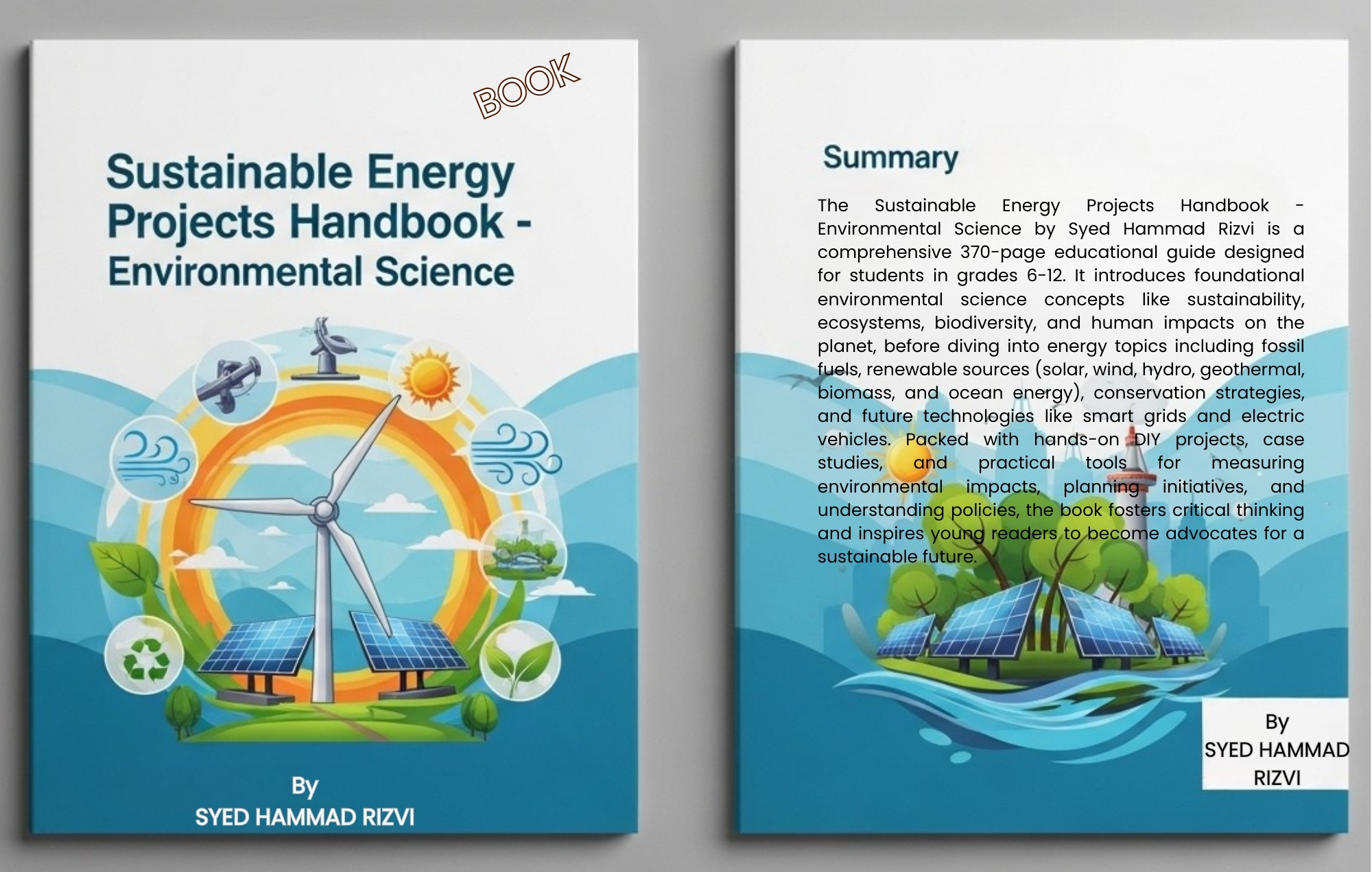
Unleash the fascinating world of data science and statistics for children with "Data Science Fundamentals for Kids - Statistics" by Syed Hammad Rizvi. Featuring a detailed 370-page course manual tailored specifically for students from grades 5-12, this invaluable resource simplifies complicated concepts into a series of fun and easy-to-master tutorials. Starting with introductory elements of data types and sources and progressing all the way from advanced concepts of probability studies to visual representation techniques of pictographs, bar graphs, line graphs, pie charts, histograms, and box plots, measures of central tendency of mean, median, and mode statistics, dispersion of range, quartiles, and interquartile range, sampling techniques with simple and stratified sampling methods, concepts of correlation and causality, responsible uses of statistics and ethics in statistics studies, and applied examples of AI and big data statistics analysis, this statistics guide for kids helps instill crucial STEM knowledge for their. Perfect for homeschooling students, this statistics guide for kids also makes for a stellar choice for teachers and scholars seeking resources for statistics learning for children, guidebooks for beginner-level analysis of statistics and frequency analysis for students, books for kids related to STEM information, and resources for probability tutorials for middle school Why Parents/Schools Love It: Engaging and Age-Appropriate Content: Makes use of interesting stories and engaging examples to ease kids into otherwise frightening subject matter involving statistics, thereby giving kids a confidence boost in STEM fields. Comprehensive Skill Building: Encompasses all aspects of analysis from data acquisition to ethical analysis. Aiding students for future AI/data science employment purposes as well as for test preparation. Hands-On Tools/Projects: Includes guides with specific steps for creating illustrations for graphs, calculations for measures of variation, and completion of mini-projects. Encourages Critical Thinking: Teaching the importance of being unbiased, the difference between correlation and causation, and responsible data use helps prepare individuals for the data-intensive world that is the future of business and society. Flexible for Any Learning Style: Can be used for individual study, teaching groups, or supplementing a curriculum, with examples that show statistical principles in sports, games, and real life. Target Grades : Based on the complete analysis of the content, structure, and progression of the book-from very foundational concepts such as "What is Data?" and some simple tally marks in early chapters to more advanced ones like interquartile range, probability laws, sampling bias, correlation scatter plots, and ethical AI implications in later chapters-I believe the book addresses students from grades 5 through 12 most appropriately. The material progresses from simple, kid-friendly explanations using real-life analogies-such as recipes for data organization-to more sophisticated ideas, such as data skewness and mini data projects. As such, it is well-suited for middle schoolers, grades 5-8, who need to study visualization and averages, while high schoolers, grades 9-12, will appreciate the subjects of inference, causation, and what the future of technology holds based on these subjects. It is neither too simplistic for older children nor too advanced for younger ones, and the logic of progression allows for progressive learning. Copyright/Terms of Use This Book is copyrighted to Syed Hammad Rizvi. This resource is intended for home/personal use only. There shall be no changes, modifications, redistributions, or sales of this resource. In other words, it shall not be placed on the Internet where it might be accessible for downloading. “If you’d like to share this resource with fellow teachers, you are able to do so through purchasing additional licenses from Teachsimple.” Este producto llega felices a ofreceros por Syed Hammad Rizvi

Author Creative Book Store

Rating

Tags StatisticsForKids, DataScienceForChildren, STEMEducation, KidsStatisticsBook, DataFundamentals, ProbabilityForKids, DataVisualizationForBeginners, MeanMedianMode, EducationalBooksForKids, Grades5to12

FREE FLAP BOOK OF MULTIPLICATION | 1 - 10
Free Download

FREE FLAP BOOK OF MULTIPLICATION | 1 - 10
Division, Multiplication and Division, Math, Multiplication, Early Learning, Elementary, Homeschool Resources, Not Grade Specific, Pre-K, Games, Activities, Projects, Worksheets, Worksheets & Printables

FREE FLAP BOOK OF MULTIPLICATION | 1 - 10 SUMMARY OF THIS PRODUCT: What is the name of the document?: FLAP BOOK 1-10 How many pages does it include?: 10 In what format is it available (PDF, Word, PPT)?: PDF Is it in color or black and white?: BLACK AND WHITE TAGS: Multiplication, Flap Book, Math, Math resources. MAIN DESCRIPTION OF THIS PRODUCT: What is the name of your product and what makes it special? This beautiful product is called “FLAP BOOK OF THE MULTPLICATION”, and it is very special because it was carefully designed or compiled. With this educational resource, we want students to learn with enthusiasm and fun, because we believe learning is fun. How many pages are included in this resource? This fabulous document contains the following number of pages: 10 What size is it designed in (A4, letter, etc.)? This resource is designed in A4 format and compiled as a PDF. This makes downloading and printing simple and convenient, and PDFs are also easy to store and carry anywhere. PDF A4 ABOUT THE AUTHOR: At EDITORIAL ARENAS EDUCATIVAS, we work every day to create educational materials that turn learning into a fun game. Our mission is for every child to enjoy the process of learning. Visit my educational store and discover all the resources we have ready for you. SECONDARY AND COMPLEMENTARY INFORMATION: Who can use it best (teachers, parents, students, therapists, homeschoolers)? We are all part of education. Whether you are a teacher, parent, student, or therapist, this document can adapt perfectly to your learning goals, depending on your creativity. What additional materials are recommended (printer, scissors, markers, etc.)? The more immersed students are in learning, the greater their results. That’s why it’s ideal to complement this resource with pencils, crayons, markers, and even other art tools. What outcome, benefit, or transformation can the user expect? With this fabulous resource, students will first understand that learning is easy and fun, and second, they will strengthen their knowledge and skills.

Author EDITORIAL LAURA EDUCA

Rating

Tags FREE, FREE RESOURCES, MATH, MATH RESOURCES, MULTIPLICATION, FLAP BOOK

Algebra 2 End of Year Project | Exponential Growth: Coronavirus

Algebra 2 End of Year Project | Exponential Growth: Coronavirus
Math, Algebra, Grade 9, 10, 11, 12, Activities, Projects

This resource is a Coronavirus Exponential Growth Project . This project was designed with your Algebra 2 students in mind - deemed appropriate for an end of the year math project . Instructions for completing this project are included. There is a grading rubric and a student sample for students to see.

Author Teachers R Us Homeschool

Tags Algebra 2, End Of Year Project, May Project, Summer Project, Coronavirus

Credit Score and Credit Report Financial Literacy Project

Credit Score and Credit Report Financial Literacy Project
Life Studies, Finance, Home Economics, Career, Math, Money, Grade 6, 7, 8, 9, 10, 11, 12, Activities, Projects

Title: Credit Score and Credit Report Financial Literacy Project For teachers seeking to equip students with practical understanding about the financial world, this Credit Score and Credit Report Project is a compelling resource. Specifically designed to instill beneficial knowledge about credit scores, credit reports, and score improvement tactics in middle school through high school-aged children, this pragmatic unit can have lasting implications for their fiscal health. Educators setting the foundations for financially savvy citizens will find its real-world application deeply appealing. Enabling students as informed consumers at an early age not only enhances their understanding of life studies and math subjects but can alter the trajectory of their financial future. The Benefits: The engaging elements interwoven within this project help keep students attentive while learning critical information. Videos complemented by interactive activities allow educators to present complex topics in digestible pieces that also cater to different learning styles. This resource can be used in structured class periods or spread into mini-lessons depending on educator preference without losing its potency. A significant benefit of using this project is the clear articulation it provides relating to credit scores' importance – it helps learners directly see why maintaining high scores matter at a personal level by focusing on the choices that affect these scores directly. To maximize its efficiency within any educational environment - whether public schooling or homeschooling - all content within this project is editable. It presents educators an opportunity to mould it expertly according to student needs or classroom specifics, thus enhancing its relevance and effectiveness. Versatility: This versatile resource caters conveniently both as a group exercise in-class or as homework material depending on your teaching approach strategy at that time. Above all else, it could serve excellently when incorporated into math sessions wherein theoretical concepts are juxtaposed against practical life situations endowing learners with essential tools needed confidently maneuver adulthood's financial terrain. Supplied across multiple file types for easy accessibility using Google Classroom, activities conceived under career education subheading blend harmoniously into home economics lessons too given finance's cross-disciplinary nature .

Author Mister G's Teacher Shop

Tags Credit Score, Credit Report, Financial Literacy, Practical Knowledge, Interactive Activities

Mathematics Binder Covers – Templates for Classroom Use

Mathematics Binder Covers – Templates for Classroom Use
Science, STEM, Basic Science, Special Resources, Montessori, Classroom Management, Resources for Teachers, Math, Physics, Technology, Homeschool Templates, Grade 6, 7, 8, 9, Worksheets, Worksheets & Printables, Teacher Tools, Projects, Activities, Workbooks, Drawing Templates & Outlines, Templates, Graphic Organizers, Classroom Decor

Mathematics Binder Covers – Templates for Classroom Use Organize your Math handouts, notes, and units with visual clarity Simple and flexible templates to help organize your Mathematics materials In my math classes, it can be a challenge to keep things organized - especially when it comes to multiple units, lab notes, worksheets and review materials. To make it easier for my students and myself, I designed these simple binder sleeves. There are 12 different pages. The covers have a clean, colorful blob layout that is friendly but not distracting. I usually print them out and use them as cover sheets or as dividers in folders for students or teachers. They also work well for digital learning environments, e.g. as section covers in PDF files or on classroom platforms. I like that the color scheme allows students to quickly find what they are looking for, and it brings a little more structure to a subject that is often riddled with formulas and technical terms. When used as cover sheets, students can choose their favorite color for their cover sheet. This resource is handy - and has saved me a lot of time in lesson preparation and follow-up. What’s included: 12 math-themed cover pages different colors zu choose as a cover sheet as a divider between the individual Mathematics topics I've printed these on colored paper for my own binder and also used them digitally in student notebooks. Works well for both teacher organization and student-facing materials. 📍 Best wishes, Heike from Lernfitness Math teacher (Chemistry teacher, Biology teacher) in Germany Did You Know? I teach with a certified therapy dog, and together we create a positive and inspiring learning environment. 🐶✨

Author Lernfitness

Rating

Tags Science, STEM, Binder, Cover Sheet, Template, Organizer, Organize, GoodNotes, Mathematics, Math

Equivalent Fractions in the Real World - Fun Enrichment Activity for Students

Equivalent Fractions in the Real World - Fun Enrichment Activity for Students
Math, Fractions, Not Grade Specific, Activities, Projects

Equivalent Fractions in the Real World provides educators with 5 engaging math problems that connect abstract fraction concepts to real-world cooking scenarios. Students read detailed recipes and information pages, then solve unique fraction word problems related to modifying the ingredients or batch size of each recipe. For example, one recipe explores doubling a recipe to make enough healthy power bars for an entire class. Another looks at dividing up s'more ingredients evenly between 5 family members. The multi-step word problems strengthen critical thinking skills and benchmark fraction knowledge. Teachers can implement the printable 19-page resource in small groups, as a center activity, or as an independent homework assignment. The problems align to Common Core grade 3-4 standards on equivalent fractions. Rather than remaining a vague notion, equivalent fractions become a concrete tool for problem solving through the context of kid-friendly, enticing recipes.

Author Beyond Traditional Math

Tags Fractions, Equivalent Fractions, Word Problems, Real World, Cooking, Recipes

My Budget Project – Financial Literacy Grades 3–6

My Budget Project – Financial Literacy Grades 3–6
Special Resources, Life Studies, Life Skills, Finance, Home Economics, Math, Money, Addition and Subtraction, Addition, Multiplication and Division, Division, Subtraction, Grade 3, 4, 5, 6, Worksheets & Printables, Word Problems, Activities, Projects

Here’s a realistic and engaging way to teach upper elementary pupils in grades 3-6 about budgeting while introducing some basic financial literacy too! How to Use: 1) Each student will be assigned a monthly budget (from $1,700 all the way to $5,000). 2) They select one of three options (low, medium, pricey) for each spending category: housing, eating, transportation, technology, & clothing. They might find that they have to change their choices as they move through the process. Making sacrifices is part of budgeting in real life too! 3) Students add up the amounts they spend and calculate how much they can save per month (and throughout the entire year). 4) They pick what luxury option they would save for over time: a car, a video game system, a vacation, or a house. This lesson is full of fun and bright visuals and charts that are well-organized to ensure that this math learning is accessible to all the students in your class! Math skills needed: Addition - up to 1,000 Subtraction - 4-digit numbers Multiplication - 4-digit numbers by 12 Grades to Use With: This lessons is designed to be accessible to younger students in the elementary years (grades 3-6) because it uses simple math skills and bright and engaging visuals. It could also be an excellent resource for a high school special education classroom! What's Included: A total of 10 pages: Title Page Different Student Budgets to Assign Student Title Page Budget Spreadsheet 5 pages of options (housing, eating, transportation, technology, and clothing) Savings Spreadsheet If you enjoy this project, please check out other math and financial literacy activities in my store: Grace Under Pressure ! I strive to help students see how the math skills they learn in the classroom are super helpful in everyday life! Back to School Budget Activity Halloween Budget Activity My Party Budget: Decimals and Percentages Practice

Author Grace Under Pressure

Rating

Tags Financial Literacy, Budget Project, Spending, Saving, Budget, Rent, Groceries, Shopping, Transportation, Banking

Checking Account Project

Checking Account Project
Life Studies, Finance, Math, Money, Grade 6, 7, 8, 9, 10, Activities, Projects

I'm thrilled to introduce you to the Checking Account Project, a tailored resource aimed at middle school and high school students. As educators, we know the value of imparting essential life skills, and that's exactly what this project is designed to do—equip students with a foundational understanding of checking accounts and their benefits. Here's what you can expect: Real-World Insight: We all know consumer math can be a bit perplexing, especially for students navigating it for the first time. This product is packed with activities that delve into the workings of checking accounts and how they can be responsibly integrated into daily life. Flexible Learning: Whether your students prefer working from home or in the classroom, this project accommodates both settings. It's adaptable to different preferences, ensuring a seamless learning experience. Empowering Students: By offering various activities, from understanding the anatomy of a check to simulating ATM usage, this project empowers students to become savvy consumers with a firm grasp of checking account essentials. Tailored Adaptation: Education isn't one-size-fits-all, and neither is this project. Feel free to tweak and customize it to align with your students' needs and learning objectives. Included in the package: Glossary of Key Terms: A handy reference for students to familiarize themselves with checking account terminology. Real-World Insight: An activity that encourages students to interview adults with checking accounts, promoting practical understanding. Hands-On Learning: Engaging exercises that teach students how to write checks, endorse and void them, and comprehend the role of debit cards. Practical Application: Utilizing an online ATM simulator, students gain firsthand experience in using ATMs. Financial Literacy: Learning how to balance a checkbook ledger—an invaluable skill for personal finance management. Comprehension Matters: Demystifying checking account statements, equipping students to read and understand them effectively. The Checking Account Project serves as a stepping stone toward financial literacy, ensuring that your students are well-prepared for the responsibilities of the adult world. Feel free to make it your own, tailoring it to resonate with your students' learning journey. Let's empower our students to navigate their financial future with confidence. The Checking Account Project lays down the groundwork for responsible and informed financial choices—a skill they'll carry with them for life.

Author Mister G's Teacher Shop

Tags Finances, Financial Literacy, Checking Account Project, Middle School, High School, Interview, Debit Cards, Math Project, Consumer Math, Project

Estimating Crowd Sizes using Jacob's Method

Estimating Crowd Sizes using Jacob's Method
Math, Statistics, Grade 7, Activities, Projects

This investigation focuses on estimating the size crowds or even large collections of objects using some very basic mathematics. Jacob's Method of counting large crowds involves creating a grid that divides a given area into equal size squares. An estimate is made by counting the number of people in a few squares, then multiply the average obtained by the number of squares in the grid. What would happen if you use different size grids ? How do the estimates compare between pupils ? Could you get a more accurate estimate if you took all the estimates in the class and calculated th average? These and many more questions are presented on the worksheet provided along with a number of pictures of multiple objects and crowds with & without prepared grids for printing or viewing on a computer screen. This activity encourages sharing and comparing of data, refining methods of collection of the data and discussion about the accuracy and limitations of the method used. The package includes: Teachers Guidance Notes An introduction into Jacob's Method and a guide to the Worksheets Estimation Worksheet A Worksheet for the students on how to use Jacob's Method and record the data. A list of questions for discussion. Estimation Crowds To be used as a starter with the student's Estimation Worksheet containing 2 crowds of different densities. Pupils begin by guessing the size of each crowd, then estimate with a 6 square grid & 24 square grid using Jacob's Method. Estimation Samples 1 and 2 14 pictures to choose from all of which have a fairly even distribution: crowds of people, tomatoes,stars, trees, bricks, flowers, balloons, birds and more. Pupils estimate with no grid, a 6 square grid & 24 square grid, and are encouraged to experiment further with other grid sizes of their own. Estimation Sample 3 7 more pictures to choose from, but this time the distribution of the populations are not so even or regular, so its more challenging and opens up more questions. They include a football crowd, bubbles, two other crowds, a shoal of fish and a herd of wildebeast. There is lots to practice with & an excellent topic for critical thinking without the need for advanced math and can be extended into investigating bias in crowd counting. Note: All the documents are printable. To view the sample populations with the grids on a computer you will need the Adobe Acrobat Reader on a PC or Mac. Common Core Links at 7th Grade CCSS7.SP.A.1 Understand that statistics can be used to gain information about a population by examining a sample of the population; generalizations about a population from a sample are valid only if the sample is representative of that population. Understand that random sampling tends to produce representative samples and support valid inferences. CCSS7.SP.A.2 Use data from a random sample to draw inferences about a population with an unknown characteristic of interest. Generate multiple samples (or simulated samples) of the same size to gauge the variation in estimates or predictions. For example, estimate the mean word length in a book by randomly sampling words from the book; predict the winner of a school election based on randomly sampled survey data. Gauge how far off the estimate or prediction might be.

Author Jeff's Notebooks

Tags Math, Statistic, Data Collection, Estimating, Estimating Crowds, Jacob's Method, Estimating Population Size, Math Investigation, Jeff's Notebooks, Data Handling, Estimating Crowd Size, Crowd Size Estimation