3,915 products added recently
Page 2 - Social Studies Graphic Organizers
Support your social studies curriculum with graphic organizers designed to help students process historical events, cultural practices, and societal structures. These resources facilitate critical thinking and make connections clearer. Use them to enrich discussions and deepen comprehension in your social studies classes.
Sacagawea Interactive Notebook | SS1H1a, SS1H1b, SS1G1a, SS1CG1
Social Studies, Biographies, Preschool, Grade 1, 2, Teacher Tools, Graphic Organizers
Sacagawea Interactive Notebook covers biographical details and contributions of the Shoshone guide and interpreter who assisted the historic Lewis and Clark expedition. This printable 17-page packet allows students to journey alongside Sacagawea while learning social studies standards SS1H1a, SS1H1b, SS1G1a, and SS1CG1. Young learners will enjoy engaging cross-curricular activities like timelines, maps, flip books, diagrams , and graphic organizers. Teachers can utilize these materials during their early American history units for individual assignments or collaborative group projects. With complete teacher prep included, this interactive Sacagawea notebook easily integrates into lesson plans for kindergarten, first grade, and second grade classrooms seeking an inquiry-based approach connecting past to present.
Author Sarah Miller Tech
Tags Graphic Organizers, Sacagawea, Interactive Notebook, Comparing, Biographies
Family Tree Template – Editable Graphic Organizer
Social Studies, Not Grade Specific, Templates, Graphic Organizers
Students can use this template with Google Slides and enter their information into the editable text boxes in the family tree. If students have access to a webcam or other digital camera device, they may be able to insert a picture of themselves into the page of the family tree.
Author Roombop
Tags Family Tree, Graphic Organizer, Template, Family Tree Google Slide Template, Family Tree Graphic Organizer, Google Slides Graphic Organizer, Editable Graphic Organizers, Family, Google, Google Slides, Relationships, Editable
A Life Among Whales (2007): Complete Video Guide & Activities
Social Studies, Science, Earth and Environmental Sciences, Earth Sciences, History, Law, Grade 10, 11, 12, Activities, Teacher Tools, Graphic Organizers, Worksheets & Printables, Worksheets
This documentary brings to life the stories of a scientist and his research into the life of whales. "A Life of Whales" documentary is produced by Uncommon Productions and brings the story of Dr. Payne, who has made it his life's mission to understand and protect whales. This documentary weaves together history with biographical information to bring to life the unique and enduring bond between humans and whales. This product offers a complete viewing guide and tiered activities aligned to Bloom's Taxonomy. This product is made for grades 8-12 and can be used in any earth science, biology, or economics class. The answer key is included and this product can be printed or assigned digitally. This product includes various pages and it is up to the teacher to decide which pages to use. The film is about 56-75 minutes and was released in 2005. The film is captivating and will hold the attention of students. This product will help hold them accountable for key information in the film. The film does a great job showing how one person can make a tremendous impact. Dr. Payne's research and advocacy has saved millions of whales from being hunted into extinction. His work to improve legislation and to limit the whaling industry will help students understand how they can make an impact in their communities. Its message is hopeful but urgent and important, framing whale protection as an essential entry point into to rethinking humanity’s role as stewards of the environment and other ecosystems. Can an individual change the world - this film provides a resounding answer to that question with an unequivocal "yes." This is a beautiful film and these resources are amazingly adaptable and easy to use in the classroom. Bring this film to life for your students and engage in discussions.
Author EduPal Learning
Rating
Tags A Life Among Whales, Whales, Ocean Life, Cetaceans, Whaling Industry, UN Goals, Movie Guide, Video Guide, Documentary
Capitalism v. Socialism Notes
Social Studies, Economics, Grade 9, 10, 11, 12, Teacher Tools, Graphic Organizers
These are Capitalism v. Socialism Notes. Students will review these topics as they consider the main ideas, advantages and so much more. Answer key included.
Author History with DeLong
Tags Capitalism, Socialism, Economics, Study Guide, Government
Thomas Jefferson Interactive Notebook | SS1H1a, SS1H1b, SS1G1a, SS1CG1
Social Studies, Biographies, Preschool, Grade 1, 2, Teacher Tools, Graphic Organizers
Thomas Jefferson Interactive Notebook Bring Thomas Jefferson and early American history to life for students with this engaging social studies resource. This interactive notebook invites kids to immerse themselves in Jefferson's world through 17 skill-building activities. Learners will create timelines, map Jefferson's travels, analyze famous speeches and documents he authored, and more. The notebook covers key first grade social studies topics like basic economics and American symbols and holidays. Use it to teach standards SS1H1a, SS1H1b, SS1G1a, and SS1CG1. This printable packet allows students to actively process new information on Jefferson. Pair these materials with a biography and primary sources on America's third president. Differentiate instruction by using the notebook for whole-class learning, small groups, or independent practice. Get creative - the possibilities are endless!
Author Sarah Miller Tech
Tags Social Studies, Thomas Jefferson, Graphic Organizers, Venn Diagram, Presidents
Peoples of the Fertile Crescent Sort
Social Studies, History, History: Ancient, Grade 9, 10, 11, 12, Teacher Tools, Graphic Organizers
If your history students are studying ancient civilizations, this is a great resource that will help students organize their thoughts, take notes, and review their learning in engaging ways. This is aPeoples of the Fertile Crescents Sort. This was designed for your high school history students. It is a 1-page resource that is composed of a graphic organizer for students to complete. This is a digital resource that can easily be accessed in Google Slides or Microsoft PowerPoint. If you access it through Google Slides , you can assign it to students’ classrooms for them to complete on their devices. You may also choose to project it onto your smartboard and have it completed as a whole group. Another alternative would be to project it onto your smartboard and have students write their answers on notebook paper independently. Then you could go over the answers as a whole group and students can check their work. There are 6 different early civilizations included: --Assyrians --Lydians --Hittites --Babylonians --Sumerians --Phoenicians Students will write the correct fact in the correct empire. A word bank is included at the bottom. I hope you enjoy! Take A Look at My Best Sellers: Reformation Book Cover World History II Remediation Packet Modern World People Foldable The World in 1500 AD Cheat Sheet Explorer Project Genocide Worksheet You can find more resources at my storefront here: https://teachsimple.com/contributor/history-with-delong
Author History with DeLong
Tags Ancient History, Ancient Civilizations, Early Civilizations, World History, Babylonians, Social Studies Graphic Organizer, Whole Group Work, Assessment
Cause and Effect Graphic Organizer Worksheet
ELA, Social Studies, Reading, Grade 3, 4, 5, 6, Teacher Tools, Graphic Organizers, Worksheets & Printables, Worksheets
This graphic organizer will help your students locate the cause and effect of an event. It's a great way to get them thinking critically about what they read.
Author Have Fun Teaching
Tags Cause And Effect
Timeline Graphic Organizer Worksheet
Social Studies, Grade 3, 4, 5, Teacher Tools, Graphic Organizers, Worksheets & Printables, Worksheets
This Timeline Graphic Organizer Worksheet is a great way for your students to summarize four significant events from a text. It's a simple and effective way to help your students comprehend what they read.
Author Have Fun Teaching
Tags Have Fun Teaching, Timeline Graphic Organizer Template
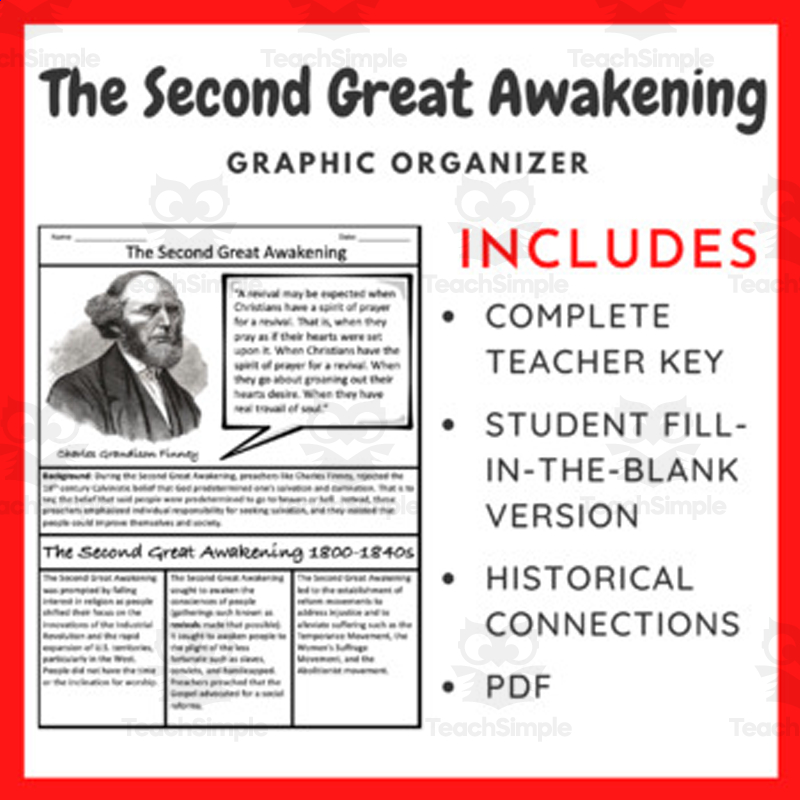
Second Great Awakening: Graphic Organizer
Social Studies, History, History: USA, Grade 9, 10, 11, Teacher Tools, Graphic Organizers
The Second Great Awakening: Graphic Organizer This essential educational tool targets Grade 9-11 students engaging in Social Studies, notably USA History. The organizer elucidates nuanced elements of The Second Great Awakening, a salient religious movement from the early 19th century that dramatically influenced American life. Presents an overview of features such as large-scale camp meetings marked by orations, hymn singing and personal testimonies stimulating conversions. Delves into the onset of new religious denomination like Methodists and Baptists birthed through this awakening. Serves as teacher-guided notes emphasizing on implying connections between ideas for efficient student note-taking (Marzano et al., 2001). Analyzes its influence on aspects from temperance movement to African Americans’ rights movement and abolitionism. Bonus:Selective questions which not only stimulate discussions among learners but enhance student participation guiding them towards advancer grasping of concepts. Evidently based on effective pedagogical methodologies (Marzano et al., 2001), using cues along with advance organizers yield a remarkable percentile gain in student achievement making it especially useful for reviewing AP U.S History curriculum content. Available in pdf format specifically designed for teacher’s use. However, a version dedicated towards students is included catering to distinct learning styles effectively whether delivered via whole group or small group exercises or even assigned as homework thereby further improving their comprehension about pivotal Chapters from America's historic past..
Author EduPal Learning
Tags Second Great Awakening, Religious Movement, United States History, Social Studies, USA History
KWL About a Topic Graphic Organizer Worksheet
ELA, Social Studies, Reading, Grade 2, 3, 4, Teacher Tools, Graphic Organizers, Worksheets & Printables, Worksheets
This KWL About a Topic Graphic Organizer Worksheet is a great way for students to organize the information they have heard, discussed, and read. It's a great way to encourage critical thinking and help students develop research skills.
Author Have Fun Teaching
Tags KWL And KWHL, Topic Graphic Organizer
J. Robert Oppenheimer: Graphic Organizer
Social Studies, History, History: USA, History: World, Grade 6, 7, 8, Teacher Tools, Graphic Organizers
This J. Robert Oppenheimer: Graphic Organizer resource is focused on J. Robert Oppenheimer, a pivotal figure in 20th-century science and the development of the atomic bomb. Julius Robert Oppenheimer was not only an exceptional physicist but also a key player in shaping the course of history during World War II through his involvement with the Manhattan Project. Born in New York City in 1904, Oppenheimer's early years were marked by outstanding academic achievements. He pursued studies at esteemed institutions such as Harvard University and later secured his Ph.D. in theoretical physics from the University of Göttingen, Germany. His contributions spanned various facets of quantum mechanics and quantum field theory. However, his paramount influence emerged during the turbulent years of World War II. In 1942, Oppenheimer assumed the role of scientific director for the Manhattan Project, an initiative that bore heavy consequences with the bombings of Hiroshima and Nagasaki. His expertise and leadership were invaluable to the project's culmination. Post-war, Oppenheimer's journey continued in both academic circles and governmental sectors. He chaired the General Advisory Committee of the United States Atomic Energy Commission, advocating for judicious control over atomic energy. Regrettably, the McCarthy-era cast shadows over his accomplishments, leading to the revocation of his security clearance in 1954, a decision that was later revised, albeit not entirely overturned. Oppenheimer's passing in 1967 left behind a legacy characterized by brilliance, innovation, and moments of controversy. To aid in bringing this influential figure's narrative to our students, I've prepared a comprehensive overview of Oppenheimer's life, both preceding and following the Manhattan Project. This resource is complemented by 10 reading comprehension questions, alongside a detailed teacher key, ensuring a holistic teaching experience. It's formatted to be effortlessly integrated into our curriculum. Product Clipart: Prince Padania
Author EduPal Learning
Tags J. Robert Oppenheimer, Graphic Organizer, Manhattan Project, Oppenheimer, World War II, Atomic Bombs
September 11th, 2001: Graphic Organizer
Social Studies, History, History: USA, Grade 6, 7, 8, 9, 10, Teacher Tools, Graphic Organizers
Teaching about the monumental moments in history isn't just part of our job—it's a calling. One of those watershed moments, without a doubt, is the 9/11 attacks of 2001. Orchestrated by al-Qaeda, this day didn't just change the skyline of New York; it changed the fabric of the United States and shifted its trajectory on the global front. While many of us can still feel the weight of the smoke-filled air as we watched the World Trade Center towers fall, or the heartbreak hearing the tales of heroism from Flight 93, we must recognize that for a good number of our students, this day is a story from before their time. Our challenge—and indeed, our responsibility—is to bridge that gap, making the stories of that day both tangible and understandable. One way to navigate this is with clear, structured notes. Think of it as connecting the dots: breaking down complex events and pairing them with firsthand accounts, like President George W. Bush's immediate reactions, helps paint a fuller picture for our students. In our shared goal to enlighten and inform, I've put together a resource that walks through 9/11. For us educators, there's a comprehensive version, and for our students, an interactive one designed to pique their curiosity and encourage active participation. Ready to use, these tools are designed to make our task a tad easier while ensuring our students gain a thorough understanding. By weaving this resource into our lessons, we're taking our students by the hand and guiding them through one of the most consequential days in recent history. It's so vital they grasp the magnitude and nuances of such events, and I truly think this tool will be a cornerstone in that effort. This product comes with a completed teacher version and a fill-in-the-blanks version. Ready to print and ready to use. Great format to help students learn.
Author EduPal Learning
Tags September 11, Terrorist Attack, Trade Center, Twin Towers, World Trade Center, George W. Bush, Graphic Organizer
Brown v. Board of Education – 1954 Case Brief
Social Studies, Government, History, History: USA, Grade 8, 9, 10, 11, Graphic Organizers
Brown v. Board of Education is a landmark United States Supreme Court case that was decided in 1954. The case involved the issue of racial segregation in public schools and had a profound impact on the civil rights movement. The case originated from several lawsuits filed by African American families challenging the segregation of public schools based on race. At the time, racial segregation was widespread in many areas of the United States, and public schools were often segregated, with African American students attending separate schools that were unequal in terms of resources and quality of education. In Brown v. Board of Education, the Supreme Court unanimously ruled that segregation in public schools violated the Fourteenth Amendment's Equal Protection Clause, which guarantees equal treatment under the law. The Court concluded that separate educational facilities for white and African American students were inherently unequal and that racial segregation in public education had a detrimental impact on African American children, damaging their self-esteem and denying them equal educational opportunities. The decision in Brown v. Board of Education overturned the "separate but equal" doctrine established in the 1896 case Plessy v. Ferguson, which had allowed for racial segregation as long as the separate facilities were equal in quality. The Brown decision declared that separate educational facilities were inherently unequal and ordered the desegregation of public schools. However, the implementation of the Brown decision faced significant resistance in many printables/parts-of-and-anatomy-of">parts of the country. Some states and localities resisted desegregation efforts, leading to years of legal battles and social upheaval. It wasn't until years later, through further court rulings, federal legislation, and the efforts of civil rights activists, that significant progress was made in desegregating schools and advancing equal educational opportunities for all students. Overall, Brown v. Board of Education was a pivotal case in the civil rights movement, challenging the legal foundation of segregation and setting the stage for subsequent efforts to end racial discrimination in various aspects of American society. Teacher-prepared notes show students what is important and how ideas relate, and offer a model for how students should take notes themselves (Marzano et al., 2001). These teacher-created notes will help your students grasp the major impact of the Brown v. Board of Education 1954 case. These notes come with a student version and a completed teacher version. These notes work well as a supplement to class readings! Product clipart credit: by Clip Art Emporium
Author EduPal Learning
Rating
Tags Brown V. Board Of Education, Civil Rights Movement, Supreme Court, 1954, Case Brief, Education
Introduction to FDR's New Deal: Reading & Processing Activity
Social Studies, History, History: USA, Grade 7, 8, 9, 10, 11, Teacher Tools, Graphic Organizers
During the 1930s, the United States was facing a lot of problems. Many people were out of work and didn't have enough money to take care of their families. The country was in a very difficult time called the Great Depression. To help the country recover, President Franklin D. Roosevelt came up with a plan called the New Deal. The New Deal had a lot of different parts, but the main idea was to create jobs and help people who were struggling. One of the ways the New Deal created jobs was by starting programs that hired people to do important work, like building roads and bridges. The New Deal also helped farmers by giving them money and tools to improve their farms. The New Deal also created programs to help people who were having a hard time. One program was called Social Security, which gave money to people who were retired or couldn't work because of an injury or disability. Another program was called the Civilian Conservation Corps, which helped young men get jobs and learn new skills. Overall, the New Deal was a plan to help the country recover from a very difficult time. It created jobs, helped people who were struggling, and set up programs that are still helping Americans today. Teacher-prepared notes show students what is important and how ideas relate, and offer a model for how students should take notes themselves (Marzano et al., 2001). This product comes with an introductory reading into FDR's New Deal. The product then has students process the three R's: Relief, Recovery, and Reform (comes with an example). Ready to use. Excellent for review. Product clipart credit: By PrincePadania and By Clip Guy Graphics
Author EduPal Learning
Tags New Deal, FDR, US History, Great Depression, Franklin D. Roosevelt
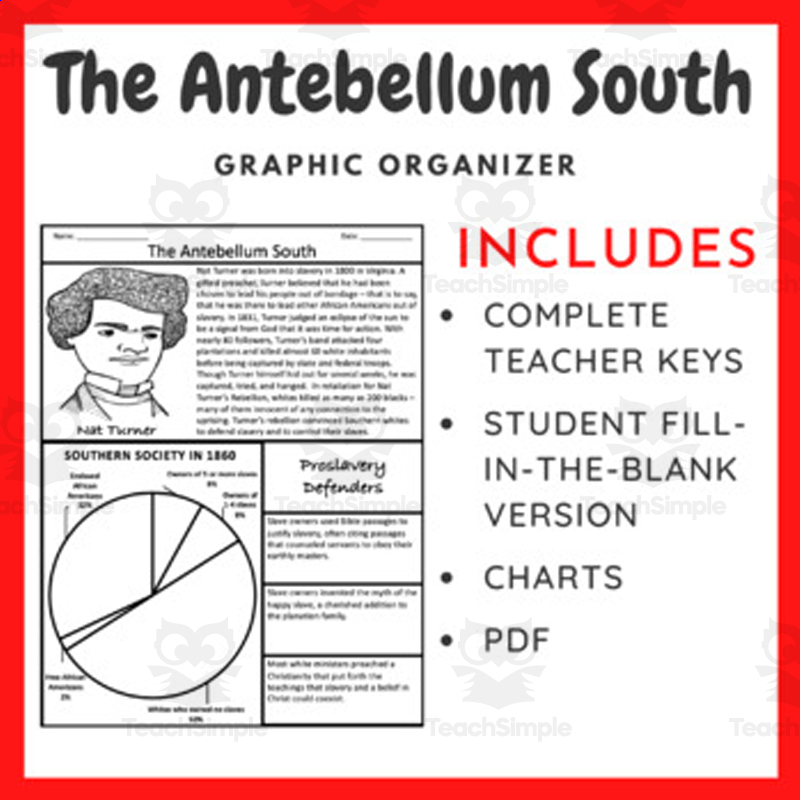
The Antebellum South: Graphic Organizer
Social Studies, History, History: USA, Grade 7, 8, 9, 10, Teacher Tools, Graphic Organizers
The Antebellum South: Graphic Organizer The Antebellum South: Graphic Organizer is a vital teaching resource designed to aid educators in imparting students with an intuitive understanding of the complex societal, economic, and cultural facets of the pre-Civil War era in the Southern United States. This tool proves particularly beneficial for Grade 7 to Grade 10 educators dealing with social studies. Key Features: Insightful Understanding: Alongside explaining topics like slavery and socio-economic division prevalent in the antebellum south, this resource also provides insights into cotton and tobacco - cash crops extensively farmed on plantation farms using enslaved Africans. All-encompassing narrative: This graphic organizer weaves together crucial events such as Nat Turner's rebellion while tracing debates sparked by southern leaders justifying slavery based on economic compulsions which simultaneously raised discussions around racial hierarchy and states' rights.(Refer to appended teacher notes) Versatility: Suitable for whole-class discussions, group activities or assigned as individual research work due to its self-explanatory design. Tailored Resources: Presented in PDF format, The Antebellum South: Graphic Organizer includes both a teacher-prepared notes variant complete with comprehensive explanations and a student variant that promotes self-learning. Note:The uniqueness lies in this tool's succinct yet informative approach – allowing grades 7-10 students to effectively grasp historical contexts without compromising on factual integrity solely aimed at enhancing their educational pursuits. As an added bonus, thumbnail clipart supplied by Clip Art Emporium makes it visually engaging. Not requiring additional software or resources adds icing on the cake – just print it out and you're all set! Encoded with rich education values, this ready-to-use tool indisputably becomes a wonderful addition to any classroom.
Author EduPal Learning
Tags Antebellum South, Graphic Organizer, Social Studies, Slavery, Plantation Farms
West African Historic Rulers Graphic Organizer
Social Studies, History, History: African, Grade 8, 9, 10, 11, Teacher Tools, Graphic Organizers
This is a West African Historic Rulers Graphic Organizer . This chart includes 4 different rulers for students to complete. They will notate their empire, when they rules and their accomplishments. A completed chart and a set of important vocabulary terms are included.
Author Cogjogger
Tags West African, Historic Rulers, Graphic Organizers, Empires
Ronald Reagan and the Conservative Tide of the 1980s - Graphic Organizer
Social Studies, Economics, History, History: USA, Grade 8, 9, 10, 11, Teacher Tools, Graphic Organizers
"The conservative tide" is a term used to describe the increase in conservative political and social ideologies and policies that have been seen in many countries in recent years. The conservative tide can be seen as a reaction to the liberal or progressive movements that have made gains in areas such as civil rights, social justice, and environmental protection. The conservative tide has been evident in many countries, including the United States, the United Kingdom, and Australia. Some examples of the conservative policies that have been implemented include tax cuts for the wealthy, reductions in public services, and a push towards more traditional values and social norms. The conservative tide has been fueled by various factors, such as economic insecurity, cultural anxiety, and a desire for a return to what some see as "traditional" values. Conservative politicians have been successful in mobilizing support by tapping into these concerns and promising to address them through policies that emphasize personal responsibility and free market solutions. However, the conservative tide has also been met with resistance from those who see it as a threat to progress and social justice. The tension between these opposing forces has become a defining feature of modern politics, with debates over issues such as immigration, climate change, and social inequality often at the center of the discourse. Teacher-prepared notes show students what is important and how ideas relate, and offer a model for how students should take notes themselves (Marzano et al., 2001). These notes begin by looking at the four major goals of the conservative movement during the 1980s. Then, this graphic organizer looks at the causes and effects of the conservative tide that occurred during the 1980s. Comes with a student fill-in-the-blanks sheet. Ready to use! Thumbnail clipart credit: By PrincePadania
Author EduPal Learning
Tags Ronald Reagan, Conservatism , Conservative, Moral Majority, Graphic Organizer, APUSH, US History
Truman and the Dropping of the Atomic Bomb: Graphic Organizer
Social Studies, History, History: USA, Grade 8, 9, 10, 11, Teacher Tools, Graphic Organizers
Harry S. Truman, the 33rd President of the United States, played a pivotal role in the development and use of atomic bombs during World War II. Truman assumed the presidency on April 12, 1945, following the death of President Franklin D. Roosevelt. At that time, the Manhattan Project , a secret research program focused on developing atomic weapons, was already underway. As President, Truman was faced with a difficult decision regarding the use of atomic bombs against Japan. The Manhattan Project had successfully created two atomic bombs, and Truman had to decide whether to deploy them as a means to end the war. After the war, Truman focused on preventing the spread of nuclear weapons. He supported the creation of the United Nations and played a key role in establishing the Baruch Plan, which proposed international control of atomic energy to prevent further proliferation. Truman's decision to use atomic bombs on Hiroshima and Nagasaki remains one of the most consequential actions of his presidency. It ushered in the nuclear age, shaped the course of history, and sparked ongoing discussions about the use and ethics of atomic weapons. Teacher-prepared notes show students what is important and how ideas relate, and offer a model for how students should take notes themselves (Marzano et al., 2001). This graphic organizer gives students two primary source quotes regarding Truman's use of the bomb. The notes then explain some pro/con arguments about the use of the bomb. Lastly, the notes give students a chance to look at the six immediate effects of the bomb. Comes with a fill-in-the-blank version. Clipart Credit: By PrincePadania
Author EduPal Learning
Tags World War II, Truman, Atomic Bomb, Manhattan Project, Japan, Cold War, Graphic Organizer, Pro Con Graphic Organizer
Tips on Taking Effective Notes
Social Studies, Not Grade Specific, Teacher Tools, Graphic Organizers
This resource is a set of Tips on Taking Effective Notes. This works for students from 5th grade and up - even higher and adult education. There is no age limit on learning to take effective notes. This presentation will tell your audience why note taking is useful and why it is critical to take GOOD notes. There are slides that show different and creative ways to take notes. With the various options, your students are bound to try at least one, if not all of them!
Author Creating History
Tags Graphic Organizers, Test Prep, Note Taking, Lectures, Study Tips
Worldle Country of the Day – Geography Routine
Social Studies, Geography, Grade 4, 5, 6, 7, 8, 9, Teacher Tools, Graphic Organizers
Here's an easy way to incorporate world geography into your classroom routine! How to Use: Play WORLDLE with your class: https://worldle.teuteuf.fr/ It's a game inspired by WORDLE but using images of countries instead. It's a great way to also practice, percentages, compass directions and distances, as incorrect guesses are given information about how far they are from the actual country, in what direction, and what percentage accuracy your guess had. After you have determined the country of the day, students can spend a few minutes learning about it and recording basic facts on the handout (you can print it double-sided, so 12 countries fit on a sheet). Students need to identify which continent the country is part of, find its current population, the capital city, countries that are neighbours, the official language or languages, and two fun facts. This website is a great resource for learning about each country: https://www.kids-world-travel-guide.com/ If you play for a whole school year, you should have time to learn about most of the countries in the world! You could also let students choose different countries from the game to research more in depth and present to one another. Grades to Use With: This is an easy routine to use in your grades 4-9 classrooms. It could be a morning homeroom activity as kids arrive each day or something to help the class settle after lunch. You could also use it during social studies or geography lessons as a quick break or reward. If you enjoy this social studies product, check out others in my store: United Nations Declaration on the Rights of Indigenous Peoples Political Spectrum: Handout, Sorting Task, Local Research and Reflection Critical Thinking: Income Inequality: An Integrated Math and Social Studies Lesson
Author Grace Under Pressure
Rating
Tags Worldle, World Geography, Daily, Routine, Countries, Map, Earth, Social Studies, Homeroom, Morning Routine, What Is Today's Worldle Country, Worldle Country Today, Worldle Geography Today, World.teuteuf.fr, Worldle Geography Website, Worldle Today Country, What Is The Worldle Country Today, What Is Todays Worldle Country, Worldle Countey, Worldle World Map Game, Worldle Countrie, Worldle Country Wordle, World Teuf Teuf, Worldel Country, Worldle County, Worldle World Map, World. Teuteuf. Fr, Wordle Geography Website, Worldle World Wordle, World Teuteuf Fr
The Columbian Exchange: Graphic Organizer
Social Studies, History, History: World, Grade 6, 7, 8, 9, Teacher Tools, Graphic Organizers
The Columbian Exchange: Graphic Organizer This teaching resource is designed to engage and interact students into the world of history. Being perfect for educators in public schools and homeschooling contexts, it primarily focuses on students from grades 6 through 9. Concept Understanding The Columbian Exchange concept discusses the exchange of plants, animals, diseases, and cultural practices between the Old World (Europe, Asia and Africa) and New World (The Americas) following Christopher Columbus's voyages in 1492. This exchange significantly shaped social, cultural and economic aspects of both hemispheres. Educational Design The organizer facilitates knowledge absorption by visually depicting a interconnected overview- especially useful for visual learners or students with learning disabilities. Tailored teacher-prepared notes guide how ideas interrelate while highlighting what is important. Mindful narration thread provided as a negative repercussion such as devastating epidemics that affected indigenous populations are discussed along with positives like enhanced agricultural productivity. A fill-in-the-blank student version enables holistic assimilation within group settings or assigned as homework reinforcing what was learned during class hours. Digital Format Recognition - PDF Friendly! This resource comes ready to use - digitally available in PDF format enabling utility across varied platforms including both projections used during class discussions or digital distribution to students easily. The aim is triggering curiosity within young minds about our past setting sail towards unforeseen futures- all aboard facilitating immersive lessons through 'The Columbian Exchange: Graphic Organizer '!
Author EduPal Learning
Tags Columbian Exchange, Graphic Organizer, History, Social Studies, New World
Progressive Era Muckrakers Reading & Graphic Organizer
Social Studies, History, History: USA, Grade 6, 7, 8, 9, 10, 11, 12, Teacher Tools, Graphic Organizers
This is a set of readings on the leading "muckrakers" of the Progressive Era. This resource includes a corresponding graphic organizer . I suggest to finish the lesson with an excerpt from Upton Sinclair’s The Jungle—a big hit with the high school set.
Author Exa's Excellent Social Studies Lessons
Tags Progressive Era, Muckrakers, The Jungle, Ida Tarbell, Theodore Roosevelt, Progressive Era Muckrakers Answer Key, Progressive Era Muckrakers Worksheet Answers, Modern Day Muckrakers
Jackie Robinson Reading Packet – 2nd Grade
Social Studies, History, History: USA, ELA, Reading Comprehension, Grade 2, Worksheets & Printables, Worksheets, Graphic Organizers
Introduce second grade students to baseball legend Jackie Robinson with this engaging reading packet. Students will read an informative passage about Robinson's life and groundbreaking career. Then they will demonstrate comprehension by defining vocabulary words and completing multiple choice questions and graphic organizers . With print-and-go convenience, this packet allows flexible implementation for whole group, small group, independent work or homework. The passage, questions and answer keys provide focused reading instruction and historical learning without preparation needed. This resource works nicely for reading lessons, social studies units on 20th century United States history, Black History Month studies or for motivated students looking to extend their knowledge. Created specifically for second grade, both teachers and homeschooling parents will appreciate the grade-appropriate content that helps build literacy skills.
Author Sarah Miller Tech
Rating
Tags Nonfiction, Graphic Organizers, Reading Packet, Comprehension, Biography, Vocabulary
History Vertical Timeline of Events Graphic Organizer
Social Studies, History, History: World, Not Grade Specific, Graphic Organizers, Teacher Tools
This graphic organizer is perfect for helping students build their sequencing skills. With space to record three events, it's a great tool for any history lesson.
Author Have Fun Teaching
Tags Note Taking, Summarizing, History, A Timeline Is Not A Graphic Organizer., Graphic Organizer Timeline