



3,923 products added recently
Page 64 - Science Lesson Plans
Bring science to life with lesson plans that cover biology, chemistry, physics, and more. These resources offer experiments and interactive lessons to stimulate curiosity. Implement them to foster a deep understanding of scientific principles and a passion for discovery.

 Show filters

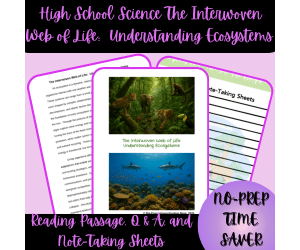
High School Science: Understanding Ecosystems Reading Passage
ELA, Reading, Writing, Resources for Teachers, Science, Life Sciences, Biology, High School, Homeschool Resources, Teacher Tools, Assessments, Lesson Plans, Quizzes and Tests, Worksheets & Printables, Writing Prompts
Teaching ecosystems can feel overwhelming with so many moving parts—living organisms, energy flow, nutrient cycles, and human impacts. That is why I designed this High School Science The Interwoven Web of Life: Understanding Ecosystems resource to make complex ecological concepts approachable without sacrificing depth. It combines a detailed reading passage, thought-provoking Q & A, and flexible note-taking sheets so students/homeschoolers can absorb, process, and engage with the content meaningfully. Whether you are guiding a full lesson or supplementing science and writing practice, this pack provides both structure and freedom for deeper exploration. INCLUDED IN THIS RESOURCE: 1 engaging, advanced reading passage 20 thought-provoking, high-order questions A guided answer key with in-depth explanations 5 versatile note-taking sheets for student use TOPICS COVEREDL Energy flow vs. matter cycling in ecosystems Roles of producers, consumers, and decomposers Keystone species and biodiversity impacts Human activities and conservation efforts This High School Science The Interwoven Web of Life: Understanding Ecosystems resource offers a comprehensive way to explore ecosystems while balancing structure, independence, and creativity. If you have ever wanted your teen to dig deeper into science concepts while strengthening writing and reasoning skills, this is the perfect fit. I hope it helps make your homeschool days just a little smoother and your student’s learning even more meaningful. If you and your students/homeschoolers enjoyed this resource, please leave a review. Thank you for your support! Tina - Big Easy Homeschooling Mom
Author Homeschool with Big Easy Homeschooling Mom
Rating
Tags Homeschool Ecosystems Resource With Answer Key, Ecosystem Reading Passage, Biodiversity Lessons, High School Ecosystems, Ecosystems Cross-curricular Resource, Ecosystem Study Guide, Ecosystems Science Passage, Ecosystems Homeschool Resource, Ecosystems Enrichment Resource, Ecosystem Lesson Resource

Waste: At the Source: Waste and the Ocean Gr. 5-8
Science, Earth and Environmental Sciences, Environmental Science, Grade 5, 6, 7, 8, Teacher Tools, Lesson Plans
Waste and the Ocean: An Education Resource for Grades 5-8 Waste and the Ocean is a premium educational resource created minutely to simplify complex theories about waste management for a younger audience. As an extension of the comprehensive lesson plan titled "Waste: At the Source," it addresses multiple crucial subjects concerning waste production and its relationship with Earth's water bodies. Product Use: Teachers can adapt this digital resource for collective instruction, divide it into portions for group activities, or give individual tasks. It adeptly handles topics such as pre-consumer waste, raw materials, natural resources, differentiating between consumable products and durable goods in post-consumer waste circumstances. Furthermore, there is an in-depth analysis of product packaging. Critical Thinking & Interactive Learning: Incorporates interactive reading passages accompanied by engaging student activities. Includes mini posters, crossword puzzles, word searches among many others. Presents quizzes and test prep materials that align with State Standards based on Bloom's Taxonomy guidelines. Solid & Toxic Waste Management: Learners are given insights into landfill operations while educating them to manage solid and toxic wastes posing danger to humans and wildlife – promoting environmental responsibility amongst them. Convenient planning lessons are made readily available within this digital file; suitable not just in traditional classrooms but also beneficial for homeschoolers. Ease-of-use: The product comes as a single PDF file format; geared towards educators who prefer intuitive learning experiences within Environmental Science curriculum targeted at middle school students (Grade 5 – Grade 8). The module navigates through critical understanding of principles associated with today’s global environment concerns centered on unsustainable practices without any complications.
Author Classroom Complete Press
Tags PDF
Global Warming EFFECTS: Climate and the Economy - FLASH-PC
Science, Earth and Environmental Sciences, Environmental Science, Common Core, Grade 5, 6, 7, 8, Teacher Tools, Lesson Plans
Global Warming EFFECTS: Climate and the Economy - FLASH-PC An essential educational tool devised primarily for teachers educating students from Grade 5 to Grade 8. It offers an extensive dive into climate science alongside an analysis of economic impacts caused by global warming, making it a key resource for imparting knowledgeable insights on environmental science topics. Teaching Resource Serving as a concise lesson plan, this teaching aid presents a wealth of instructional content effortlessly adaptable to diverse teaching scenarios. Whether orchestrating group debates, moderating small group discussions or assigning individual homework tasks, this resource caters to all learning styles and environments. Inclusions Reading passages with pre-and-post reading questions Vocabulary flashcards Interactive activities Printable materials Video clips Educational Standards Alignment The content within is aptly aligned with Environmental Science curriculums tailored for middle school (Grade 5-8). Purposefully designed incorporating Bloom's Taxonomy principles while maintaining compatibility with Common Core State Standards demonstrates the high academic standards achieved in crafting this product. In Summary: About Product: This software serves as an encompassing tool allowing teachers to effectively teach intricate issues like global warming effects on our ecology and its interlinkage with economics. Educational Value: Fosters engagement and enrichment while aligning lesson plans with current education standards.
Author Classroom Complete Press
Tags Software (PC)
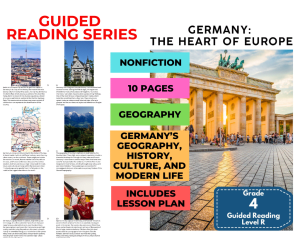
Germany: The Heart of Europe: Guided Reading Level R with Lesson Plan
ELA, Resources for Teachers, Reading Comprehension, Reading, Science, Geography, Social Studies, History, Earth and Environmental Sciences, Technology, Grade 3, 4, 5, Worksheets & Printables, Worksheets, Teacher Tools, Centers, Activities, Literacy Readers, Quizzes, Quizzes and Tests, Assessments, Lesson Plans
This Germany: The Heart of Europe (level r) guided reading book with lesson plan includes: Guided Reading Color Label (front cover x1) This is a quick way to match the book’s demands to what students can generally handle.. The overall goal is to use the level/color to pick books for several smaller groups. To qualify for a certain level, a student is expected to read a book from that level with about 90–94% accuracy. If a student is consistently accurate and understands, move up a level. If the student is struggling at that level, drop down and add more support. Each student will improve at completely different rates, but it is generally one of the best ways to check progress across the class. DOWNLOAD THE CATALOG TO VIEW ALL GUIDED READING BOOKS AVAILABLE (SORTED LEVELS A-Z) Pre-Reading Question (x1) Teacher asks the prompt aloud, can be while showing the cover or first page. Students share what they already know, or make educated guesses from the cover. Prompt them to use the target vocabulary. Write some of their responses on the board to look back at during the reading. Vocabulary Words (x5) Introduce the five words, best doing it one at a time. Start by saying it, while students repeat and then see if anyone knows what it means before reading further. Read through the meaning and try to briefly connect each word to a picture or gesture so it’s meaningful. Ask students to flip through the book pages and point to where they see each of the vocabulary words. While reading the book pause upon coming across one of the vocab words or read the sentence twice to make sure students understand the word has appeared. Optional: Ask students to raise hands whenever they see/hear one of the new words. Guided Reading Pages (x10) Check the book snapshot (below) for: primary topic - do you need to prep extra reading or intro materials on this? what is taught best - decide on 1-2 bullets to focus on, use the prompt or words provided here for best results. learning goals - what you are checking for students to be able to do after the session, elicit answers using prompts or words provided. key vocabulary (see section above). questions overview - so you know what is coming up and if you need to prep extra materials to assist understanding. Run the lesson You may have already looked at a few of the pages together, but you can show them some of the pictures again first to set meaning. Depending on how much time you have and how familiar your students are with guided reading class, you may want to read the book aloud first with the group first. Students whisper or partner read, while you listen in. If time, do it as a group, one student reading a page each. Use the guided page’s prompts to coach: “Check the picture / does it make sense?” “Point under the words / try the first sound” “Reread the sentence smoothly”. Try to focus more on one student per session (rotating every time), so you can work out if they are ready to move up or need to move down a level. Comprehension Questions (back cover x3) This is your way to check that students didn’t just say the words, but actually understood the text. First, let students answer by pointing to the page/picture and saying a short sentence. After any answer, follow with: “Show me where you found that in the text.” In bigger groups, have partners answer first (10–20 seconds), then call on 2–3 students to share. Differentiation tips: Emerging speakers/struggling readers: oral + pointing On-level: oral in a full sentence Higher: one written sentence or draw + label Book Snapshot Title: Germany: The Heart of Europe Genre: Nonfiction Subject: Social Studies (Geography/Culture/History) Primary Topic: Germany’s geography, history, culture, and modern life Estimated Guided Reading Level (A–Z): R What This Book Teaches Best Germany’s central location in Europe and how that makes it a crossroads for trade, travel, and cultural exchange. Physical geography and waterways , including the Bavarian Alps and the Rhine River’s role in transportation. History meeting modern life through Berlin’s past division (Berlin Wall) and the Brandenburg Gate as a symbol of reunification. Cultural traditions , including long-held festivals, music (Bach and Beethoven), and traditional clothing like lederhosen and dirndls. Modern strengths and priorities , such as engineering/technology, renewable energy, public transportation, and environmental conservation. Learning Goals Students will describe where Germany is located in Europe and explain why its location matters in the text. Students will identify major physical features of Germany (plains, mountains, or the Bavarian Alps) using details from the text. Students will explain why the text says rivers like the Rhine are important for moving goods between cities. Students will describe Berlin as the capital and explain one way the text shows history and modern life together there. Students will describe what the text says about castles from the Middle Ages and what they are used for today. Students will identify examples of Germany today (technology/engineering, renewable energy, conservation, education, or democracy) using text evidence. Key Vocabulary From the Text crossroads — central meeting place where routes and people connect. metropolis — a very large, busy city. reunification — joining back together after being separated. renewable — energy source replaced naturally, like wind or sun. conservation — protecting nature so it stays healthy for the future. Discussion Prompts Pre-reading question: What kinds of facts do you think a book about Germany might teach you? Comprehension questions: Why does the text say Germany is a major crossroads within the European Union? Comprehension questions: What does the text say the Brandenburg Gate represents today? Comprehension questions: What is one way the text says Germany works to protect the climate? Printing Tips 1. Best Printing Method (Recommended) “Booklet” Printing (Best if Available) If your printer or PDF viewer supports Booklet Printing , use this. Settings to use: Print mode: Booklet Paper size: Letter or A4 (either works) Orientation: Landscape Print on both sides: Yes Flip on: Short edge Scaling: Fit to printable area Booklet subset: First test: Front sides only Then: Back sides only This will automatically: Pair pages correctly Put the cover on the outside Align everything for folding After printing, fold in half and staple along the spine . 2. If “Booklet” Printing Is NOT Available You can still print this correctly with manual duplex printing . Step-by-step: Open the PDF. Choose Print . Set: Orientation: Landscape Pages per sheet: 1 Print on both sides: Yes Flip on: Short edge Print all pages . Because each PDF page already contains two facing book pages, the result will still fold cleanly into a book. Thousands of Cored Education products are included with your TeachSimple membership. Download links and encyclopedia index available here.
Author Cored Education
Rating
Tags Reading Comprehension, Reading Passages, Reading, Guided Reading, Guided Reading Lesson Plan, Guided Reading Activity, Pre-reading, Social Studies, Geography, History

Creatures of the Deep Mini Unit
Science, Life Sciences, Animals, Grade 6, 7, 8, 9, Teacher Tools, Lesson Plans
Creatures of the Deep Mini Unit This is a Creatures of the Deep Mini Unit that will provide students with resources from the beginning to end of a unit. This unit will leave students feeling more knowledgeable about this animal species and equipped to tackle any and all comprehensive activities related to deep sea creatures. This unit is great for middle school students. What You Get: You will receive a zip file that includes: 1. A Zip Folder with Google Classroom Versions 2. Preview Sheets as PDF, PowerPoints, and JPEG files 3. A Zip Folder with Separated Materials for each animal (PDFs) How to Use the Creatures of the Deep Mini Unit: This is a comprehensive unit of study that will have many components to make learning come to life. The first lesson introduces students to the history of deep sea exploration as well as providing some background information on the adaptions that deep sea creatures have made. Reading sheets are provided for eight different deep sea creatures with information on their habitats, feeding, reproduction and interaction with humans. Instructions and sheets are included for students to create their own presentation about deep sea creatures. All materials in the file are also included in a Google Classroom format for teachers to easily upload to their own websites. I hope you enjoy!! Take A Look At My Best Sellers: The History of Piracy The History of Space Exploration – Complete Unit Navajo Code Talkers Mini Unit Women in World War Two – Complete Unit The Forbidden City Mini Unit Natural Disasters – Complete Unit You Can Find More Resources At My Store Front Here: Mr. Gray History
Author Mr Gray History
Tags Creatures Of The Deep, Sea Animals, Sea Animal Reading Passage, Animal Posters, Animal Booklets, Animal Adaptations, Deep-Sea Explorations

I WONDER - Why Are Hamsters Lazy | Animated Video Lesson
STEM, Biology, Life Sciences, Science, Animals, Grade 1, 2, 3, 4, 5, 6, 7, 8, Lesson Plans, Teacher Tools
Video Introduction Animal kingdoms are full of fascinating wonders to learn. This video is designed for the students to learn more about animals in different countries. I WONDER - Why Are Hamsters Lazy | Animated Video Lesson Do you like animals? what is your favorite one? Do you own a pet? If yes, tell us more about it, like what its name? And what do you like most about it? What are the animal kingdoms? Can you write down the characteristics of each animal class like mammals, birds, reptiles, amphibian, fish and mollusks. Do you know that some animals can sing, can you name any of them? What is the largest and the smallest mammal in the world? What is the largest and the smallest bird in the world? What is the largest and the smallest fish in the world? I WONDER - Why Are Hamsters Lazy | Animated Video Lesson The video is perfect for encouraging the researching skills for the students, while learning more about these fantastic animals. I WONDER - Why Are Hamsters Lazy | Animated Video Lesson This friendly designed video is suitable for students at school, homeschooling, and as a group activity. Format Available in MP4 format.
Author Educational Voice
Tags Why Are Hamsters Lazy, Why Are Hamsters Lazy Video, Hamsters, Hamster, Hamsters Facts, Hamsters Facts For Kids, Hamsters Video, Hamsters Video For Kids, Hamster Facts, Hamster Facts For Kids
Quit Copying Me! Mimicry in Nature: A Cross-Curricular Unit
Science, Life Sciences, Animals, Grade 5, 6, Teacher Tools, Lesson Plans
Quit Copying Me! Mimicry in Nature: A Cross-Curricular Unit This highly engaging teaching resource, designed specifically for 5th and 6th-grade educators, sheds light on the fascinating science of zoology. It especially focuses on how animals utilize incredible mimicry techniques and camouflage to trick other animals. An Informative Nonfiction Article The unit revolves around a factual nonfiction article that unveils the intricate details about these fascinating survival tactics. This content is perfect for whole group learning, projected onto a screen or printed out for smaller groups or individual study. Worksheets that Enhance Learning The package includes well-structured worksheets that not only reinforce subject knowledge but also enhance problem-solving skills. These can be assimilated into classroom exercises or given as homework assignments, providing the necessary flexibility for different instructional settings. Addition Activity Ideas To maintain student engagement throughout the study period, the unit has supplementary activities laid out. These serve to further enrich classroom discussions and forge a strong connection between new concepts learned about animal behaviour with previously studied topics in zoology. A Versatile Educational Resource "Quit Copying Me! Mimicry in Nature: A Cross-Curricular Unit", is ideal whether you are a public school teacher looking for innovative lesson plans or a homeschooler creating an immersive educational experience. It embodies theory aided by practical exercises creating an excellent approach to teach scientific concepts from various perspectives. Moreover, being an accessible seven-page PDF makes it exceptionally user-friendly regardless of your education environment. In Conclusion... This resource isn't limited to delivering lessons; it's designed to foster a learning atmosphere where learning naturally evolves out of the curiosity and intrigue sparked by nature's brilliant mimicry and camouflage. Embrace this unit into your curriculum plan and witness the transformation in your students' understanding of zoology.
Author Classroom Complete Press
Tags Science Lesson, Informational Text, Reading Passage, Graphic Organizer, Comprehension Questions

I WONDER - How Big Was The Quetzalcoatlus | Animated Video Lesson
History: Ancient, History, Social Studies, History: World, Animals, Life Sciences, Science, Grade 4, 5, 6, 7, 8, 9, 10, Lesson Plans, Teacher Tools
Video Introduction An amazing video designed for the students to learn more about dinosaurs in different countries. I WONDER - How Big Was The Quetzalcoatlus | Animated Video Lesson Do you like dinosaurs? what is your favorite one? Do you own a pet? If yes, tell us more about it, like what its name? And what do you like most about it? Do you think that your pet has been evolved from a dinosaur? Can you write down the characteristics of your favourite dinosaur like it's shape, their rivals, where did it use to live and what was their favourite food? What is the largest and the smallest dinosaur that ever found? Why is the T-rex is so famous? Have you ever read any interesting facts about it? Can you name any of the carnivores or herbivores dinosaurs? I WONDER - How Big Was The Quetzalcoatlus | Animated Video Lesson The video is perfect for encouraging the researching skills for the students, while learning more about dinosaurs. I WONDER - How Big Was The Quetzalcoatlus | Animated Video Lesson This friendly designed video is suitable for students at school, homeschooling, and as a group activity. Format Available in MP4 format.
Author Educational Voice
Rating
Tags How Big Was The Quetzalcoatlus, How Big Was The Quetzalcoatlus Video, Quetzalcoatlus, Quetzalcoatlus Facts, Quetzalcoatlus Video, Quetzalcoatlus Facts For Kids, Quetzalcoatlus Video For Kids

I WONDER - Where Can I See Bubbles In Nature | Animated Video Lesson
Chemistry, Science, STEM, Grade 5, 6, 7, 8, 9, 10, 11, Lesson Plans, Teacher Tools
Video Introduction An amazing video designed for the students to learn more about STEM. I WONDER - Where Can I See Bubbles In Nature | Animated Video Lesson Do you like STEM subjects? what is your favorite one? Have you ever tried to plant a seed? If yes, tell us more about it. Or have you ever tried to invent something? If yes, tell us more about it. And how do you think it will help us? Have you ever seen a microorganism under a microscope? What was it? And how it looked like? Mathematics is a marvelous subject. Let' sharpen our brains and solve some equations. Do you like timetable tricks? What is your favorite one? Do you know how to code? Have you ever created an app or a game before? If yes, how was it like? I WONDER - Where Can I See Bubbles In Nature | Animated Video Lesson The video is perfect for encouraging the researching skills for the students, while learning more about this fantastic topic. I WONDER - Where Can I See Bubbles In Nature | Animated Video Lesson This friendly designed video is suitable for students at school, homeschooling, and as a group activity. Format Available in MP4 format.
Author Educational Voice
Tags Where Can I See Bubbles In Nature, Where Can I See Bubbles In Nature Video, See Bubbles In Nature, See Bubbles In Nature Facts, See Bubbles In Nature Video, See Bubbles In Nature Video For Kids

Solar System - Digital Lesson Plan Gr. 5-8 - FLASH-MAC
Science, Earth and Environmental Sciences, Space, Grade 5, 6, 7, 8, Teacher Tools, Lesson Plans
Solar System - Digital Lesson Plan Gr. 5-8 - FLASH-MAC This instructional digital lesson guide invites Grade 5 to 8 learners on a captivating expedition of our Solar System. The content-filled and interactive layout spans over an impressive 80 screen-pages, carefully-designed to ignite curiosity and foster love for astronomy. Content Overview Students will virtually voyage through two significant divisions: Inner Planets and Outer Planets. They'll uncover facts about the celestial bodies that orbit our Sun while also acquiring knowledge on the Moon, Stars, Constellations, Asteroids, Meteors, as well as Comets with kid-friendly language. Main Features Interactivity:The digital software seamlessly links reading materials with pre-and-post reading activities. Educational Games:To amplify interest levels and enhance learning results; memory match games along structures like crossword puzzles are integrated into the software itself. Multilingual Engagement:The resource supports English or Spanish comprehension through not just word searches but educational videos too for optimal understanding experience. Evaluation Tools In order to measure progress while enabling students or teachers to keep track of their comprehension milestones regarding each section covered; this digital lesson plan includes an evaluation quiz that mirrors State Standards & Bloom's Taxonomy frameworks. In Conclusion, The Solar System - Digital Lesson Plan Gr. 5-8 - FLASH-MAC is a first-rate tool crafted uniquely to stir young minds' enthusiasm for astronomy while striking balance between academic objectives and joyous engagement simultaneously in a public or homeschooling setting.
Author Classroom Complete Press
Tags Software (Mac)
I WONDER - What Is The Most Expensive Fruit In The World
Nature & Plants, Life Sciences, Science, Grade 4, 5, 6, 7, 8, 9, 10, Lesson Plans, Teacher Tools
Video Introduction An amazing activity designed for the students to learn more about STEM. I WONDER - What Is The Most Expensive Fruit In The World | Animated Video Lesson Do you like STEM subjects? what is your favorite one? Have you ever tried to plant a seed? If yes, tell us more about it. Or have you ever tried to invent something? If yes, tell us more about it. And how do you think it will help us? Have you ever seen a microorganism under a microscope? What was it? And how it looked like? Mathematics is a marvelous subject. Let' sharpen our brains and solve some equations. Do you like timetable tricks? What is your favorite one? Do you know how to code? Have you ever created an app or a game before? If yes, how was it like? I WONDER - What Is The Most Expensive Fruit In The World | Animated Video Lesson The video is perfect for encouraging the researching skills for the students, while learning more about this fantastic topic. I WONDER - What Is The Most Expensive Fruit In The World | Animated Video Lesson This friendly designed video is suitable for students at school, homeschooling, and as a group activity. Format Available in MP4 format.
Author Educational Voice
Tags What Is The Most Expensive Fruit In The World, What Is The Most Expensive Fruit In The World Video, The Most Expensive Fruit, The Most Expensive Fruit Video, The Most Expensive Fruit Video For Kids, The Most Expensive Fruit Facts

I WONDER - How Does Pollution Affect Health | Animated Video Lesson
Environmental Science, Earth and Environmental Sciences, Science, Earth Sciences, Human Body, Life Sciences, Biology, STEM, Grade 4, 5, 6, 7, 8, 9, 10, Lesson Plans, Teacher Tools
Video Introduction An amazing video designed for the students to learn more about STEM. I WONDER - How Does Pollution Affect Health | Animated Video Lesson Do you like STEM subjects? what is your favorite one? Have you ever tried to plant a seed? If yes, tell us more about it. Or have you ever tried to invent something? If yes, tell us more about it. And how do you think it will help us? Have you ever seen a microorganism under a microscope? What was it? And how it looked like? Mathematics is a marvelous subject. Let' sharpen our brains and solve some equations. Do you like timetable tricks? What is your favorite one? Do you know how to code? Have you ever created an app or a game before? If yes, how was it like? I WONDER - How Does Pollution Affect Health | Animated Video Lesson The video is perfect for encouraging the researching skills for the students, while learning more about this fantastic topic. I WONDER - How Does Pollution Affect Health | Animated Video Lesson This friendly designed video is suitable for students at school, homeschooling, and as a group activity. Format Available in MP4 format.
Author Educational Voice
Tags How Does Pollution Affect Health, How Does Pollution Affect Health Video, Pollution Affect Health, Pollution, Pollution Facts, Pollution Video, Pollution Video For Kids, Pollution Facts For Kids

The Frog Life Cycle Unit
Science, Life Sciences, Animals, Preschool, Grade 1, 2, Lesson Plans, Teacher Tools
The Frog Life Cycle Unit resource will give you everything your students need to apply their knowledge about frogs and complete engaging activities. This unit includes: 1. Something Mysterious writing 2. My Frog Life Cycle Journal w/ cover page and 8 writing activities 3. Frog Life Cycle chart 4. Tadpole Growth cut and paste 5. The Egg Grows cut and paste 6. Label the Frog 7. Label the Tadpole 8. What I Learned writing
Author Kindergarten Cafe
Tags Frogs, Life Cycle, Frog Unit, Tadpoles, Frog Journal

I WONDER - Are All Metals Conductors | Animated Video Lesson
Basic Science, Science, Chemistry, Physics, Grade 4, 5, 6, 7, 8, 9, 10, Lesson Plans, Teacher Tools
Video Introduction An amazing activity designed for the students to learn more about STEM. I WONDER - Are All Metals Conductors | Animated Video Lesson Do you like STEM subjects? what is your favorite one? Have you ever tried to plant a seed? If yes, tell us more about it. Or have you ever tried to invent something? If yes, tell us more about it. And how do you think it will help us? Have you ever seen a microorganism under a microscope? What was it? And how it looked like? Mathematics is a marvelous subject. Let' sharpen our brains and solve some equations. Do you like timetable tricks? What is your favorite one? Do you know how to code? Have you ever created an app or a game before? If yes, how was it like? I WONDER - Are All Metals Conductors | Animated Video Lesson The video is perfect for encouraging the researching skills for the students, while learning more about this fantastic topic. I WONDER - Are All Metals Conductors | Animated Video Lesson This friendly designed video is suitable for students at school, homeschooling, and as a group activity. Format Available in MP4 format.
Author Educational Voice
Tags Are All Metals Conductors, Are All Metals Conductors Video, Conductors, Conductors Facts, Conductors Facts For Kids, Conductors Video, Conductors Video For Kids, Metals, Metals Facts

I WONDER - Why Do Crystals Change Colour | Animated Video Lesson
Earth Sciences, Earth and Environmental Sciences, Science, Grade 6, 7, 8, 9, 10, 11, 12, Lesson Plans, Teacher Tools
Video Introduction An amazing activity designed for the students to learn more about STEM. I WONDER - Why Do Crystals Change Colour | Animated Video Lesson Do you like STEM subjects? what is your favorite one? Have you ever tried to plant a seed? If yes, tell us more about it. Or have you ever tried to invent something? If yes, tell us more about it. And how do you think it will help us? Have you ever seen a microorganism under a microscope? What was it? And how it looked like? Mathematics is a marvelous subject. Let' sharpen our brains and solve some equations. Do you like timetable tricks? What is your favorite one? Do you know how to code? Have you ever created an app or a game before? If yes, how was it like? I WONDER - Why Do Crystals Change Colour | Animated Video Lesson The video is perfect for encouraging the researching skills for the students, while learning more about this fantastic topic. I WONDER - Why Do Crystals Change Colour | Animated Video Lesson This friendly designed video is suitable for students at school, homeschooling, and as a group activity. Format Available in MP4 format.
Author Educational Voice
Tags Why Do Crystals Change Colour, Why Do Crystals Change Colour Video, Crystals, Crystal, Crystals Facts, Crystals Facts For Kids, Crystals Video, Crystals Video For Kids, Science, Science Video

I WONDER - Who Discovered Coffee | Animated Video Lesson
Nature & Plants, Life Sciences, Science, Grade 4, 5, 6, 7, 8, 9, 10, Teacher Tools, Lesson Plans
Video Introduction An amazing activity designed for the students to learn more about STEM. I WONDER - Who Discovered Coffee | Animated Video Lesson Do you like STEM subjects? what is your favorite one? Have you ever tried to plant a seed? If yes, tell us more about it. Or have you ever tried to invent something? If yes, tell us more about it. And how do you think it will help us? Have you ever seen a microorganism under a microscope? What was it? And how it looked like? Mathematics is a marvelous subject. Let' sharpen our brains and solve some equations. Do you like timetable tricks? What is your favorite one? Do you know how to code? Have you ever created an app or a game before? If yes, how was it like? I WONDER - Who Discovered Coffee | Animated Video Lesson The video is perfect for encouraging the researching skills for the students, while learning more about this fantastic topic. I WONDER - Who Discovered Coffee | Animated Video Lesson This friendly designed video is suitable for students at school, homeschooling, and as a group activity. Format Available in MP4 format.
Author Educational Voice
Tags Who Discovered Coffee, Who Discovered Coffee Video, Coffee, Coffee Facts, Coffee Facts For Kids, Coffee Video, Coffee Video For Kids, Coffee Facts Video, Science , Science Facts
I WONDER - Does The Skull Grow | Animated Video Lesson
Human Body, Life Sciences, Science, Biology, STEM, Grade 4, 5, 6, 7, 8, 9, Lesson Plans, Teacher Tools
Video Overview The human body is full of fascinating wonders to learn. This video is created to help the students recognize the anatomy and the job of the human body. I WONDER - Does The Skull Grow | Animated Video Lesson Every part and organ in our human body is vital so let's see how important they are. Have you ever imagined how we look like if we didn't have a skeleton? Did you know that because we have our amazing muscles we can stand! Do you know how many teeth do we have? Have you ever wondered about the food journey inside our body? Can you name all the glands in our body? Why do we have skin? Our nervous system is really good at sending signals. Can you tell us more about it? Are you really good at Mathematics, painting, or any other thing? You should really thank your brain about it! The famous five senses are really doing a great work? Can you explain how every sense works? I WONDER - Does The Skull Grow | Animated Video Lesson The video is perfect for encouraging the researching skills for the students, while learning more about our fantastic human body. I WONDER - Does The Skull Grow | Animated Video Lesson This friendly designed video is suitable for students at school, homeschooling, and as a group activity. Format Available in MP4 format.
Author Educational Voice
Tags Does The Skull Grow, Does The Skull Grow Video, The Skull, The Skull Facts, The Skull Facts For Kids, The Skull Video, The Skull Video For Kids, Skeleton, The Skeleton Facts For Kids, Skeletal System

I WONDER - What Did The Brontosaurus Eat | Animated Video Lesson
History: Ancient, History, Social Studies, History: World, Animals, Life Sciences, Science, Grade 4, 5, 6, 7, 8, 9, 10, Lesson Plans, Teacher Tools
Video Introduction An amazing video designed for the students to learn more about dinosaurs in different countries. I WONDER - What Did The Brontosaurus Eat | Animated Video Lesson Do you like dinosaurs? what is your favorite one? Do you own a pet? If yes, tell us more about it, like what its name? And what do you like most about it? Do you think that your pet has been evolved from a dinosaur? Can you write down the characteristics of your favourite dinosaur like it's shape, their rivals, where did it use to live and what was their favourite food? What is the largest and the smallest dinosaur that ever found? Why is the T-rex is so famous? Have you ever read any interesting facts about it? Can you name any of the carnivores or herbivores dinosaurs? I WONDER - What Did The Brontosaurus Eat | Animated Video Lesson The video is perfect for encouraging the researching skills for the students, while learning more about dinosaurs. I WONDER - What Did The Brontosaurus Eat | Animated Video Lesson This friendly designed video is suitable for students at school, homeschooling, and as a group activity. Format Available in MP4 format.
Author Educational Voice
Rating
Tags What Did The Brontosaurus Eat, What Did The Brontosaurus Eat Video, Brontosaurus, Brontosaurus Facts, Brontosaurus Video, Brontosaurus Video For Kids, Brontosaurus Facts For Kids, Dinosaur

French Sea Animals Vocabulary Unit with Boom Cards
Science, Life Sciences, Animals, Grade 1, 2, 3, 4, 5, 6, 7, 8, 9, Lesson Plans, Teacher Tools
The French Sea Animals Vocabulary Unit with Boom Cards Regarded as a valuable educational asset for public school teachers and homeschooling educators. The program's main focus is to facilitate the enhancement of students' French language skills. Vocabulary and Unit Structure Covers a unit on sea animals Incorporates 15 specific vocabulary words centered around marine creatures. Allows integration with units focused on wild and farm animal vocabularies. Variety of Games and Activities Included: The resource includes ten assorted games and activities intended to keep students engaged, promoting an active interest in zoology-related topics within science studies. Ease of Access The teaching aid promotes effortless access, available as .m4a and PDF files in one zip file that can be accessed across various devices such as laptops, tablets or smartphones. Suitable for Both Primary and Secondary Levels: Ideal for core French lessons or French immersion programs at both primary and secondary education levels. Aims towards comprehensive yet stimulating training sessions centered around developing fluency while incorporating essential aspects like pronunciation alongside written skills. A Fun Twist: Integrates game -based learning to maintain student engagement levels.
Author Love Learning Languages
Tags French Language, Sea Animals, Vocabulary, Zoology Education, Interactive Activities
Global Warming EFFECTS: Climate and Human Civilizations - FLASH-PC
Science, Earth and Environmental Sciences, Environmental Science, Common Core, Grade 5, 6, 7, 8, Teacher Tools, Lesson Plans
The Global Warming EFFECTS: Climate and Human Civilizations - FLASH-PC This valuable teaching resource is designed for grades 5 to 8. It primarily focuses on the expasive field of environmental science, with a special emphasis on understanding the effects of global warming over climate and human civilizations. Designed for effective use in classrooms or homeschooling environments, this comprehensive resource uses a multifaceted approach to deliver curriculum -based content. The key feature of this product are its insightful reading passages which introduce learners to important concepts in an easly understandable manner. Comprehension Elements 'Before you read' questions 'After you read' questions In addition to these comprehension techniques, educators will find practical printables adaptable for diverse learning styles. These materials can be utilized during: Whole group instruction sessions, Individual assignments, Promoting conducive small group activities for peer learning. } {} {} {} The product's contents also align with Common Core State Standards – offering teachers confidence that they are providing their students quality education that stands up nationally. Emphasizing Bloom's Taxonomy—widely recognized as an effective tool in crafting successful learning objectives—in its development process ensures teachers ignite various cognitive domains among students optimizing retention and application of knowledge beyond mere recitation. This lesson planning tool is available as software compatible with personal computers (PC). This innovation provides users comfort by assuring easy access anytime amidst our rapidly changing world. This rare combination of technology-based resources with comprehensive subject matter promotes high-level student engagement while enriching educator tools ensuring effective delivery of lessons across various classroom contexts.
Author Classroom Complete Press
Tags Software (PC)

Moose | Interactive Science Lesson | Micro-Learning Deck
Science, Life Sciences, Animals, Grade 5, 6, 7, Teacher Tools, Lesson Plans
Introducing an engaging moose science lesson for upper elementary and middle school students. This interactive micro-learning deck efficiently integrates video, reading, assessment, and writing into one moose-themed package. Students will watch an informative video about the physical characteristics, habitat, diet, and life cycle of moose. Next, they will read a passage with audio support to deepen comprehension. The lesson concludes by analyzing a text through close reading questions and synthesizing learning in a quick write. This versatile resource can be used for whole group instruction, small group differentiation, or independent practice. The multimedia format and informal assessments keep students focused while building science content knowledge and literacy skills.
Author Teach Me This
Tags Moose Lesson, Interactive Science, Quick Write, Exit Ticket, Reading Passage

Lesson 7.2 - The Periodic Table
Science, Chemistry, Physics, Grade 6, 7, 8, 9, 10, 11, 12, Lesson Plans, Teacher Tools
Unit 7: The Atom & the Nucleus - Whole Unit Description This resource provides educators with comprehensive materials for teaching atomic and nuclear concepts. Ideal for middle and high school science teachers handling chemistry and physics topics, these resources encourage fun, student-oriented instruction. Subatomic Particles Lessons The unit begins with lessons on three subatomic particles: proton, neutron, and electron. Included are '7.1 Atomic Structure Notes' which contain details about their properties and location within the atom. A version complete with blanks for in-class participation A filled-out version for reference Interactive Practice Session '7.1 Subatomic Particle Matching Practice' features printable cards with facts about each subatomic particle that students can group accordingly—perfect for group or paired activities. Offline Learning Experience 'World's Smallest Movie Reading' assignment promotes independent exploration outside class hours through an IBM mini-movie created using stop-motion photography of individual atoms. Brief summary writing exercise to improve recall plan attached. PowerPoint Presentations: Filled with Starter Questions The Periodic Table notes touch briefly on history Data from including an exciting scavenger hunt activity Nuclear Energy Lessons & Computer Simulations Sensational computer simulations bring construction of atoms or nuclear fission principles to life while promoting classroom collaboration. Various exercises foster: Critical thinking skills via assorted readings on nuclear energy pros/cons Navigating the various debates surrounding its use Mastery Test The comprehensive test with differing question types ensures understanding of all concepts discussed in this unit: True/False and matching questions Short essay questions A recovery quiz helps boost any underwhelming scores whilst also acting as an additional review process. All materials meet essential Integrated Chemistry & Physics State Standards beyond Indiana’s curricular requirements and are editable in .docx or.pptx formats for easy customization. *You should have a word processor that supports .docx file type and similar presentation software to support the .pptx format for accessing these files.
Author Integrated Chemistry and Physics
Tags Subatomic Particles, Atomic Structure, Periodic Table, Nuclear Energy, Interactive Simulations

I WONDER - Are There Different Types Of Solids | Animated Video Lesso
Chemistry, Science, Grade 4, 5, 6, 7, 8, 9, 10, Lesson Plans, Teacher Tools
Video Introduction An amazing activity designed for the students to learn more about STEM. I WONDER - Are There Different Types Of Solids | Animated Video Lesson Do you like STEM subjects? what is your favorite one? Have you ever tried to plant a seed? If yes, tell us more about it. Or have you ever tried to invent something? If yes, tell us more about it. And how do you think it will help us? Have you ever seen a microorganism under a microscope? What was it? And how it looked like? Mathematics is a marvelous subject. Let' sharpen our brains and solve some equations. Do you like timetable tricks? What is your favorite one? Do you know how to code? Have you ever created an app or a game before? If yes, how was it like? I WONDER - Are There Different Types Of Solids | Animated Video Lesson The video is perfect for encouraging the researching skills for the students, while learning more about this fantastic topic. I WONDER - Are There Different Types Of Solids | Animated Video Lesson This friendly designed video is suitable for students at school, homeschooling, and as a group activity. Format Available in MP4 format.
Author Educational Voice
Tags Are There Different Types Of Solids, Are There Different Types Of Solids Video, Types Of Solids, Types Of Solids Facts, Types Of Solids Facts For Kids, Types Of Solids Video, Materials, State Of Matter

I WONDER - Where Did The Apatosaurus Live | Animated Video Lesson
History: Ancient, History, Social Studies, History: World, Animals, Life Sciences, Science, Grade 3, 4, 5, 6, 7, 8, 9, Lesson Plans, Teacher Tools
Video Introduction An amazing video designed for the students to learn more about dinosaurs in different countries. I WONDER - Where Did The Apatosaurus Live | Animated Video Lesson Do you like dinosaurs? what is your favorite one? Do you own a pet? If yes, tell us more about it, like what its name? And what do you like most about it? Do you think that your pet has been evolved from a dinosaur? Can you write down the characteristics of your favourite dinosaur like it's shape, their rivals, where did it use to live and what was their favourite food? What is the largest and the smallest dinosaur that ever found? Why is the T-rex is so famous? Have you ever read any interesting facts about it? Can you name any of the carnivores or herbivores dinosaurs? I WONDER - Where Did The Apatosaurus Live | Animated Video Lesson The video is perfect for encouraging the researching skills for the students, while learning more about dinosaurs. I WONDER - Where Did The Apatosaurus Live | Animated Video Lesson This friendly designed video is suitable for students at school, homeschooling, and as a group activity. Format Available in MP4 format.
Author Educational Voice
Rating
Tags Where Did The Apatosaurus Live, Where Did The Apatosaurus Live Video, Apatosaurus, Apatosaurus Video, Apatosaurus Facts, Apatosaurus Facts For Kids, Apatosaurus Video For Kids, Dinosaur