






3,923 products added recently
Page 11 - Science Quizzes
Basic Science Quizzes focus on fundamental scientific ideas, such as the scientific method, basic laboratory safety, and introductory concepts in biology, chemistry, and physics. These quizzes help establish a strong foundation for students beginning their exploration of science. They emphasize critical thinking and observation skills, which are essential for success in all scientific endeavors.

 Show filters

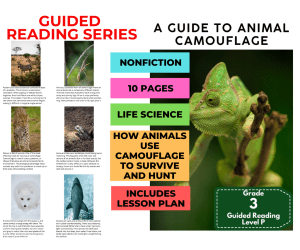
Guided Reading Level P - Animal Camouflage (with Lesson Plan)
ELA, Resources for Teachers, Reading Comprehension, Reading, Pre-Reading, Language Development, Animals, Life Sciences, Science, Vocabulary, Grade 2, 3, 4, Worksheets & Printables, Worksheets, Teacher Tools, Centers, Activities, Literacy Readers, Quizzes, Quizzes and Tests, Assessments
This Guided Reading Book - Animal Camouflage (Level P) with lesson plan includes: Guided Reading Color Label (front cover x1) This is a quick way to match the book’s demands to what students can generally handle.. The overall goal is to use the level/color to pick books for several smaller groups. To qualify for a certain level, a student is expected to read a book from that level with about 90–94% accuracy. If a student is consistently accurate and understands, move up a level. If the student is struggling at that level, drop down and add more support. Each student will improve at completely different rates, but it is generally one of the best ways to check progress across the class. DOWNLOAD THE CATALOG TO VIEW ALL GUIDED READING BOOKS AVAILABLE (SORTED LEVELS A-Z) Pre-Reading Question (x1) Teacher asks the prompt aloud, can be while showing the cover or first page. Students share what they already know, or make educated guesses from the cover. Prompt them to use the target vocabulary. Write some of their responses on the board to look back at during the reading. Vocabulary Words (x5) Introduce the five words, best doing it one at a time. Start by saying it, while students repeat and then see if anyone knows what it means before reading further. Read through the meaning and try to briefly connect each word to a picture or gesture so it’s meaningful. Ask students to flip through the book pages and point to where they see each of the vocabulary words. While reading the book pause upon coming across one of the vocab words or read the sentence twice to make sure students understand the word has appeared. Optional: Ask students to raise hands whenever they see/hear one of the new words. Guided Reading Pages (x10) Check the book snapshot (below) for: primary topic - do you need to prep extra reading or intro materials on this? what is taught best - decide on 1-2 bullets to focus on, use the prompt or words provided here for best results. learning goals - what you are checking for students to be able to do after the session, elicit answers using prompts or words provided. key vocabulary (see section above). questions overview - so you know what is coming up and if you need to prep extra materials to assist understanding. Run the lesson You may have already looked at a few of the pages together, but you can show them some of the pictures again first to set meaning. Depending on how much time you have and how familiar your students are with guided reading class, you may want to read the book aloud first with the group first. Students whisper or partner read, while you listen in. If time, do it as a group, one student reading a page each. Use the guided page’s prompts to coach: “Check the picture / does it make sense?” “Point under the words / try the first sound” “Reread the sentence smoothly”. Try to focus more on one student per session (rotating every time), so you can work out if they are ready to move up or need to move down a level. Comprehension Questions (back cover x3) This is your way to check that students didn’t just say the words, but actually understood the text. First, let students answer by pointing to the page/picture and saying a short sentence. After any answer, follow with: “Show me where you found that in the text.” In bigger groups, have partners answer first (10–20 seconds), then call on 2–3 students to share. Differentiation tips: Emerging speakers/struggling readers: oral + pointing On-level: oral in a full sentence Higher: one written sentence or draw + label Book Snapshot Title: A Guide to Animal Camouflage Genre: Nonfiction (informational text) Subject: Life Science / Reading (Informational Text) Primary Topic: How animals use camouflage to survive and hunt Estimated Guided Reading Level (A–Z): P What This Book Teaches Best What camouflage is and why it matters: Camouflage helps animals blend into their environment to stay safe from predators or sneak up on prey. Types of camouflage with clear examples: Background matching (toad), disruptive coloration (zebras), mimicry (stick insect), countershading (sea animals), and active camouflage (octopus). How animals change to match conditions: Seasonal changes in the Arctic fox’s coat and rapid changes in the octopus’s appearance. Camouflage for defense and hunting: The text shows camouflage protecting animals and helping hunters like the orchid mantis. Adaptations and survival: Camouflage is presented as an adaptation that helps animals survive and thrive in their homes. Learning Goals Students will explain what camouflage is and how it helps animals survive. Students will describe background matching and use the toad example from the text. Students will explain how disruptive coloration in zebra stripes can confuse a predator. Students will describe mimicry using details about the stick insect. Students will compare seasonal camouflage in the Arctic fox with countershading in sea animals. Students will describe how active camouflage works in the octopus and how the chameleon’s color-changing can help it stay hidden. Key Vocabulary From the Text camouflage — colors, patterns, or shapes that help an animal blend in. predators — animals that hunt other animals for food. texture — how a surface feels or looks. mimicry — when an animal looks like a different object. countershading — dark top and light belly that help hide in water. Discussion Prompts Pre-reading question: Why might an animal need to blend into its environment to survive? Comprehension questions: What does the text say camouflage helps animals do? Comprehension questions: How do zebra stripes make it difficult for a hunting lion to target one zebra? Comprehension questions: How does countershading help sea animals blend in from above and from below? Printing Tips 1. Best Printing Method (Recommended) “Booklet” Printing (Best if Available) If your printer or PDF viewer supports Booklet Printing , use this. Settings to use: Print mode: Booklet Paper size: Letter or A4 (either works) Orientation: Landscape Print on both sides: Yes Flip on: Short edge Scaling: Fit to printable area Booklet subset: First test: Front sides only Then: Back sides only This will automatically: Pair pages correctly Put the cover on the outside Align everything for folding After printing, fold in half and staple along the spine . 2. If “Booklet” Printing Is NOT Available You can still print this correctly with manual duplex printing . Step-by-step: Open the PDF. Choose Print . Set: Orientation: Landscape Pages per sheet: 1 Print on both sides: Yes Flip on: Short edge Print all pages . Because each PDF page already contains two facing book pages, the result will still fold cleanly into a book. Thousands of Cored Education products are included with your TeachSimple membership. Download links and encyclopedia index available here.
Author Cored Education
Rating
Tags Reading Comprehension, Reading Passages, Reading, Guided Reading, Guided Reading Lesson Plan, Guided Reading Activity, Pre-reading, Science Lesson Plans, Life Science, Animals
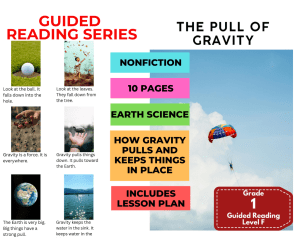
The Pull of Gravity: Guided Reading Level F with Lesson Plan
ELA, Resources for Teachers, Reading Comprehension, Reading, Science, Language Development, Vocabulary, Physics, Earth and Environmental Sciences, Pre-Reading, Kindergarten, Grade 1, 2, Worksheets & Printables, Worksheets, Teacher Tools, Centers, Activities, Literacy Readers, Quizzes, Quizzes and Tests, Assessments, Lesson Plans
This The Pull of Gravity (level f) guided reading book with lesson plan includes: Guided Reading Color Label (front cover x1) This is a quick way to match the book’s demands to what students can generally handle.. The overall goal is to use the level/color to pick books for several smaller groups. To qualify for a certain level, a student is expected to read a book from that level with about 90–94% accuracy. If a student is consistently accurate and understands, move up a level. If the student is struggling at that level, drop down and add more support. Each student will improve at completely different rates, but it is generally one of the best ways to check progress across the class. DOWNLOAD THE CATALOG TO VIEW ALL GUIDED READING BOOKS AVAILABLE (SORTED LEVELS A-Z) COMPANION VIDEO NOW AVAILABLE (EMBEDDED AFTER PREVIEW PICTURES IN PRODUCT DESCRIPTION) Pre-Reading Question (x1) The teacher says the question aloud, either while showing the cover or the first page. Students share what they already know or make sensible guesses based on the cover. Encourage them to use the target vocabulary where possible. Write a few of their ideas on the board so you can return to them during or after the reading. Vocabulary Words (x5) Introduce the five words one at a time. Say each word aloud, have students repeat it, and then ask if anyone already knows what it means. Read the meaning together and briefly connect each word to a picture, action, or gesture so it feels more memorable. Ask students to flip through the book and point to any pages where they spot the vocabulary words. While reading, pause when one of the words appears, or reread the sentence so students clearly notice and understand it in context. Optional: Ask students to raise their hands whenever they see or hear one of the new words. Guided Reading Pages (x10) Check the book snapshot below for: Primary topic — decide whether students need a quick introduction or extra background first. What this lesson teaches best — choose 1–2 key points to focus on during the session. Learning goals — keep in mind what students should be able to understand or say by the end. Key vocabulary — review and reinforce these throughout the lesson. Questions overview — look ahead so you know what students will be asked and whether any extra support is needed. Run the lesson You may already have looked at a few pages together, but it can help to revisit some of the pictures first to build meaning. Depending on your time and how confident the group is with guided reading, you may want to read the whole book aloud to them first. Students can then whisper-read or partner-read while you listen in. If time allows, you can also read as a group, with each student taking a page. Use the guided reading prompts to support them, such as: “Check the picture—does it make sense?” “Point under the words.” “Try the first sound.” “Reread the sentence smoothly.” It can be helpful to focus more closely on one student each session, rotating over time, so you can better judge whether they are ready to move up or may need more support at their current level. Comprehension Questions (back cover x3) This is where you check that students understood the text, not just the words on the page. Start by letting students answer by pointing to a page or picture and saying a short sentence. After they respond, follow up with: “Show me where you found that in the text.” In larger groups, let partners discuss their answer first for 10–20 seconds, then invite 2–3 students to share. Differentiation tips Emerging speakers / struggling readers: oral response + pointing On-level: oral response in a full sentence Higher: one written sentence or a drawing with labels Lesson Snapshot Title: The Pull of Gravity Genre: Nonfiction (informational) Subject: Science (Physical Science) Primary Topic: How gravity pulls things and helps keep them in place Estimated Guided Reading Level (A–Z): F What This Lesson Teaches Best Explains that gravity is a force and that it is all around us. Shows that gravity pulls things down and toward the Earth. Uses simple, everyday examples like a ball, leaves, water, rocks, sand, and air to show gravity in action. Helps students understand that larger objects, like Earth, have a stronger pull. Introduces the idea that gravity is also in space and helps pull the moon. Learning Goals Students will identify that gravity is a force found everywhere. Students will describe how gravity pulls things down and toward the Earth. Students will give examples from the text of things gravity pulls or keeps in place. Students will explain what the text says about Earth’s strong pull. Students will answer questions about gravity using details from the book. Key Vocabulary From the Text gravity — a pull that makes things go down force — a push or a pull toward — moving closer to something space — the place above Earth mountain — a very high hill of land Discussion Prompts Pre-reading question: What do you think makes things fall down to the ground? Comprehension question: What does the book say gravity is? Comprehension question: What does gravity pull things toward? Comprehension question: Name one thing the book says gravity keeps in place. 1. Best Printing Method (Recommended) Booklet printing is the best option if your printer or PDF viewer supports it. This method usually places the pages in the correct order automatically and makes folding much easier. Settings to use: Print mode: Booklet Paper size: Letter or A4 Orientation: Landscape Print on both sides: Yes Flip on: Short edge Scaling: Fit to printable area Booklet subset: First, print front sides only Then, print back sides only This will automatically: Pair the pages correctly Place the cover on the outside Help everything line up properly for folding After printing, fold the pages in half and staple along the spine. 2. If “Booklet” Printing Is Not Available You can still print the book correctly by using manual duplex printing . Step-by-step: Open the PDF. Click Print . Use these settings: Orientation: Landscape Pages per sheet: 1 Print on both sides: Yes Flip on: Short edge Print all pages. Since each PDF page already contains two facing book pages, the pages should still fold neatly into a book. Thousands of Cored Education products are included with your TeachSimple membership. Download links and encyclopedia index available here.
Author Cored Education
Rating
Tags Reading Comprehension, Reading Passages, Reading, Guided Reading, Guided Reading Lesson Plan, Guided Reading Activity, Pre-reading, Science Lesson Plans, Earth Science, Physics
Scientist: Theophrastos – Fact Sheet, Quiz, and Interactive Exercises
Life Sciences, Science, Biology, STEM, History: World, History, Social Studies, Nature & Plants, Grade 8, 9, 10, 11, Worksheets, Worksheets & Printables, Quizzes, Quizzes and Tests, Teacher Tools, Projects, Activities
Discover Theophrastos – The Botanist and Scientist Behind the Philosopher Theophrastos is often recognized as a philosopher, but did you know he is also considered the "Father of Botany" and one of the most influential natural scientists in history? With this resource, your students in grades 7–10 will explore Theophrastos’s groundbreaking contributions to biology, particularly his pioneering work in plant science. Designed for a 45-minute lesson, this material blends engaging content with interactive and creative activities to bring his achievements to life. What’s Included: Concise Informational Text: A clear and engaging overview of Theophrastos’ role in science. Fact Sheet Activity: Encourages students to organize knowledge and work creatively. Quiz with Solutions: Promotes fun, interactive learning and self-assessment. Additional Exercises: Students can create their own questions and collaborate in pairs to deepen their understanding. Flexible Formats: Includes a color and black-and-white printable PDF, as well as interactive H5P tasks for digital learning. Why You’ll Love This Resource: Time-Saving: Perfect for teachers who need a ready-to-go, well-structured lesson. Versatile Use: Ideal for biology, history of science, or cross-curricular lessons in English and science classes. Promotes Independence: Solutions are included, allowing students to check their work and explore the topic at their own pace. Interactive and Engaging: Tasks are designed to keep students actively involved while learning about Theophrastos’ legacy. Whether you use it for a regular lesson, substitute teaching, or as part of a digital learning activity, this resource will make Theophrastos’ contributions come alive for your students. Bring Theophrastos’ fascinating world of science and philosophy into your classroom and inspire your students to see history and science in a whole new light! Have fun exploring the world of science with your students! Warmly, Lernfitness Did You Know? I teach with a certified therapy dog, and together we focus on creating a positive and inspiring learning environment.
Author Lernfitness
Tags Science, Biology, Famous Scientists Lesson, H5P, Interactive Science Exercises, STEM, Theophrastos, History, Scientists, Botanic

Henry Louis Le Chatelier – Understanding Chemical Equilibrium
Life Sciences, Science, STEM, Social Studies, Biographies, Inventors, Basic Science, Physics, Chemistry, Biology, Grade 6, 7, 8, 9, 10, 11, Worksheets, Worksheets & Printables, Quizzes, Quizzes and Tests, Teacher Tools, Projects, Activities
Henry Louis Le Chatelier – Understanding Chemical Equilibrium A short reading and worksheet resource for grades 8–10 science classes (PDF + H5P) ⚖️🧪 A printable and digital resource for grades 8–10 science and cross-curricular teaching 🧪🧠 This resource introduces students to Henry Louis Le Chatelier, the French chemist best known for his work on chemical equilibrium. His principle – describing how systems respond to changes in concentration, temperature, or pressure – is a key concept in chemistry classrooms around the world. With this material, students not only learn about Le Chatelier’s scientific contribution but also get a glimpse of the person behind the theory. The tasks are structured clearly and can be used in regular chemistry lessons or as part of a non-specialist substitute plan. No prior knowledge is required to get started, and the layout supports both independent and pair work. Included in this resource: Informational text about Henry Le Chatelier’s life and research A worksheet for creating a scientist profile based on the reading Quiz questions with solutions for quick review Two optional follow-up tasks: – Students create their own questions about the text – Exchange and answer questions in pairs File formats: – PDF (printable and digital) – Editable DOCX (text only) – H5P version (interactive and image-free, suitable for LMS use) How to use it in class: I’ve used this material as part of an introduction to equilibrium in chemistry or to wrap up a unit on reaction rates and reversible processes. The reading offers students some historical context, which helps them see that the science they’re learning is connected to real people and ideas. The H5P format supports digital work and allows for self-checking. It’s also helpful for remote learning or homework. With little to no prep required, this resource makes it easy to enrich your science curriculum. Have fun exploring the world of science with your students! Warmly, Lernfitness Did You Know? I teach with a certified therapy dog, and together we focus on creating a positive and inspiring learning environment.
Author Lernfitness
Rating
Tags Science, Famous Scientists Lesson, H5P, Interactive Science Exercises, STEM, Scientists, Chemistry, Henry Louis Le Chatelier, Chemical Equilibrium, Le Chatelier
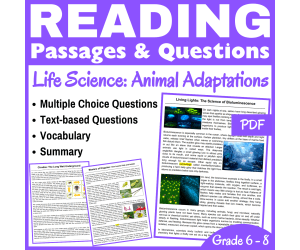
Bioluminescence & Insects : Reading Comprehension passages (PDF)
Science, ELA, Reading, Reading Comprehension, Strategies, Resources for Teachers, Life Sciences, Animals, Insects, Nature & Plants, Grade 6, 7, 8, 9, Writing Prompts, Worksheets & Printables, Centers, Activities, Teacher Tools, Assessments, Quizzes and Tests, Quizzes, Tests
Bioluminescence & Insects: Reading Comprehension Passages (PDF) This very engaging collection of life science reading passages about Bioluminescence & Insects is designed to bridge the gap between science and literacy through strengthening reading comprehension and sparking scientific curiosity in middle school students. Each passage blends English Language Arts skills with accurate science content that supports NGSS classroom practice. Ideal for interdisciplinary learning in ELA and Science. Suitable for Grade 9 review, too! What Is Included? There are (3) informational passages: Living Lights: The Science of Bioluminescence Explains how organisms produce “cold light” with luciferin and luciferase, and shows why they glow for signaling, hunting, and protection. Cicadas: The Long Wait Underground Covers the long underground nymph stage, synchronized emergence, molting, loud calls, and how this life cycle supports survival and reproduction. Masters of Disguise: How Insects Hide and Imitate Distinguishes camouflage from mimicry with clear examples, highlighting how color, shape, and behavior help insects avoid predators and capture prey. Student Tasks for Each Passage: 5 multiple-choice questions targeting main idea, key details, inference, vocabulary in context, and use of evidence 5 vocabulary matching items with clear, student-friendly definitions 5 text-based questions that require citing specific lines or facts 1 summary prompt that asks students to condense central ideas accurately Full answer key for every section Available Formats for this Resource Word Docs Google Docs FULL CATALOG OF DOWNLOADING LINKS HERE Other Science Reading Collections and Topics You May Find in the Store: 1. Astronomy & Space Science 2. Volcanoes, Rocks, & Mountains 3. Rock Cycle, Soil, & Sinkholes 4. Mars, Glaciers, & Antarctica 5. Water Cycle, Acid Rain, & Wastewater 6. Insects, Animals, & Ecosystems 7. Bioluminescence & Insects 8. Animal Skin, Cats, & T. Rex 9. Human Body and Senses 10. Health & Applied Bioscience 11. Waves, Light, & Imaging 12. Electricity & Energy 13. Motion & Materials 14. Chemistry and Materials Science 15. Electromagnetism 16. Acids and Bases 17. Gas Laws 18. Biotechnology 19. Periodic Trends 20. Protists and Fungi 21. Microevolution 22. Blood 23. Chemical Bonding 24. Magnets 25. Muscles 26. Nuclear Chemistry 27. Electromagnetic Devices 28. Epigenetics 29. The Law of Conservation of Mass 30. Atomic Models 31. Isotopes and Ions 32. Light 33. Human-Environment Interaction 34. Theory of Evolution 35. Photosynthesis 36. Origins of Life and Early Earth 37. Gene Expression and Regulation 38. Thermochemistry 39. Allergies 40. Coevolution 41. Birth to Adulthood 42. Cells 43. Entropy and Free Energy 44. The Human Brain 45. Mixtures and Solutions 46. Invertebrates 47. Zoo Animals 48. Biochemistry 49. Animal Behavior 50. Population Ecology ...and many more engaging science reading passages that cover intriguing and important topics designed to spark curiosity and support student learning. Product Details Length: 14 pages total Grades: 6–8, also suitable for Grade 9 review Use cases: close reading, stations, homework, intervention, test prep, and sub plans Standards support: reinforces informational-text skills and supports NGSS-style sense making through observation, modeling, and clear use of claim, evidence, and reasoning Why Teachers Choose This Set Authentic science content paired with rigorous literacy practice Consistent task structure across all passages for easier planning and smoother student routines Clear, age-appropriate writing that builds confidence without oversimplifying Use this set to reinforce ELA skills in science, to add literacy to your lessons, or to support independent work. The passages strengthen main idea, evidence use, vocabulary in context, inference, cause and effect, and summary writing. With ready-to-use assessments and complete answer keys, you can provide focused practice that is simple to run and fast to review.
Author Middle & High School - CORED Education
Rating
Tags Middle School, Reading Comprehension, Reading Strategies, ELA, Centers, Reading Passage, Assessments, Vocabulary, Life Science, Insects

Science Reading Passages: Astronomy and Space (FILLABLE PDF)
Science, Space, Earth and Environmental Sciences, ELA, Reading, Reading Comprehension, Strategies, Resources for Teachers, Grade 6, 7, 8, 9, Writing Prompts, Worksheets & Printables, Centers, Activities, Teacher Tools, Assessments, Quizzes and Tests, Quizzes, Tests
Astronomy and Space Science: Reading Comprehension Passages and Questions (FILLABLE PDF) This engaging and fillable collection of science reading passages about Astronomy and Space Science is designed to bridge the gap between science and literacy through strengthening reading comprehension and sparking scientific curiosity in middle school students. Each passage blends English Language Arts skills with accurate science content that supports NGSS classroom practice. Ideal for interdisciplinary learning in ELA and Science. Suitable for Grade 9 review, too! These worksheets are designed as fillable PDFs , which means students can type their answers directly into the document on any computer or tablet . Each page includes highlighted text fields that show them exactly where to type! What Is Included? There are (3) informational passages: The Solar System: A Neighborhood in Motion The Story of Space Science Stars of Many Sizes: Dwarfs, Giants, and Neutrons Student Tasks for Each Passage 5 multiple-choice questions targeting main idea, key details, inference, vocabulary in context, and use of evidence 5 vocabulary matching items with clear, student-friendly definitions 5 text-based questions that require citing specific lines or facts 1 summary prompt that asks students to condense central ideas accurately Full answer key for every section Available Formats for this Resource: Word Docs Google Docs Other Science Reading Collections and Topics You May Find in the Store: 1. Astronomy & Space Science 2. Volcanoes, Rocks, & Mountains 3. Rock Cycle, Soil, & Sinkholes 4. Mars, Glaciers, & Antarctica 5. Water Cycle, Acid Rain, & Wastewater 6. Insects, Animals, & Ecosystems 7. Bioluminescence & Insects 8. Animal Skin, Cats, & T. Rex 9. Human Body and Senses 10. Health & Applied Bioscience 11. Waves, Light, & Imaging 12. Electricity & Energy 13. Motion & Materials 14. Chemistry and Materials Science 15. Electromagnetism 16. Acids and Bases 17. Gas Laws 18. Biotechnology 19. Periodic Trends 20. Protists and Fungi 21. Microevolution 22. Blood 23. Chemical Bonding 24. Magnets 25. Muscles 26. Nuclear Chemistry 27. Electromagnetic Devices 28. Epigenetics 29. The Law of Conservation of Mass 30. Atomic Models 31. Isotopes and Ions 32. Light 33. Human-Environment Interaction 34. Theory of Evolution 35. Photosynthesis 36. Origins of Life and Early Earth 37. Gene Expression and Regulation 38. Thermochemistry 39. Allergies 40. Coevolution 41. Birth to Adulthood 42. Cells 43. Entropy and Free Energy 44. The Human Brain 45. Mixtures and Solutions 46. Invertebrates 47. Zoo Animals 48. Biochemistry 49. Animal Behavior 50. Population Ecology ...and many more engaging science reading passages that cover intriguing and important topics designed to spark curiosity and support student learning. How to Use These PDFs Click on the highlighted area to start typing your answer. Move to the next question by clicking in the next highlighted box. When you are finished, close the document and select SAVE so your answers stay recorded. If you want to keep a blank copy for later, choose Save As and give your completed version a new name. Product Details Length: 14 pages total Grades: 6–8, also suitable for Grade 9 review Use cases: close reading, stations, homework, intervention, test prep, and sub plans Standards support: reinforces informational-text skills and supports NGSS-style sense making through observation, modeling, and clear use of claim, evidence, and reasoning Why Teachers Choose This Set Authentic science content paired with rigorous literacy practice Consistent task structure across all passages for easier planning and smoother student routines Clear, age-appropriate writing that builds confidence without oversimplifying Use this set to reinforce ELA skills in science, to add literacy to your lessons, or to support independent work. The passages strengthen main idea, evidence use, vocabulary in context, inference, cause and effect, and summary writing. With ready-to-use assessments and complete answer keys, you can provide focused practice that is simple to run and fast to review.
Author Middle & High School - CORED Education
Rating
Tags Middle School, Reading Comprehension, Reading Strategies, Reading Passages, ELA, Centers, Reading Passage, Assessments, Vocabulary, Earth Science
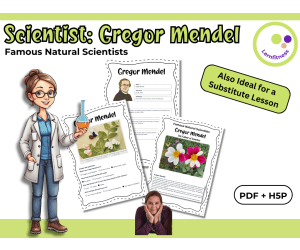
Scientist Gregor Mendel Fact Sheet, Quiz + Exercises | PDF + H5P
Life Sciences, Science, Biology, STEM, History: World, History, Social Studies, Biographies, Inventors, Basic Science, Grade 6, 7, 8, 9, Worksheets, Worksheets & Printables, Quizzes, Quizzes and Tests, Teacher Tools, Projects, Activities
Discover Gregor Mendel – The Father of Genetics Did you know that Gregor Mendel, a humble monk with a passion for science, laid the foundation for modern genetics? Through his famous pea plant experiments, he uncovered the basic principles of heredity, showing how traits are passed from one generation to the next. His discoveries were ahead of their time and only fully appreciated years later, but today they are essential to biology and genetics. This teaching resource is designed to introduce your grades 7–10 students to Mendel’s groundbreaking work in a fun and engaging way. Perfect for a 45-minute lesson, it combines clear explanations with interactive and creative activities that make learning about genetics both accessible and exciting. What’s Included: Concise Informational Text: A clear and engaging overview of Gregor Mendel’s role in science. Fact Sheet Activity: Encourages students to organize knowledge and work creatively. Quiz with Solutions: Promotes fun, interactive learning and self-assessment. Additional Exercises: Students can create their own questions and collaborate in pairs to deepen their understanding. Flexible Formats: Includes a color and black-and-white printable PDF, as well as interactive H5P tasks for digital learning. Why You’ll Love This Resource: Time-Saving: Perfect for teachers who need a ready-to-go, well-structured lesson. Versatile Use: Ideal for biology, history of science, or cross-curricular lessons in English and science classes. Promotes Independence: Solutions are included, allowing students to check their work and explore the topic at their own pace. Interactive and Engaging: Tasks are designed to keep students actively involved while learning about Gregor Mendel’s legacy. Whether you use it for a regular lesson, substitute teaching, or as part of a digital learning activity, this resource will make Gregor Mendel’s contributions come alive for your students. Bring Gregor Mendel’s fascinating world of science into your classroom and inspire your students to see history and science in a whole new light! Have fun exploring the world of science with your students! Warmly, Lernfitness Did You Know? I teach with a certified therapy dog, and together we focus on creating a positive and inspiring learning environment.
Author Lernfitness
Tags Science, Biology, Famous Scientists Lesson, H5P, Interactive Science Exercises, STEM, History, Scientists, Gregor Mendel, Genetics
Helicopters Reading Comprehension Passage - Cored Ed Encyclopedia
ELA, Language Development, Resources for Teachers, Reading Comprehension, Reading, Pre-Reading, Writing, Strategies, Technology, Science, Grade 2, 3, 4, 5, Worksheets & Printables, Worksheets, Teacher Tools, Centers, Activities, Writing Prompts, Assessments, Tests, Quizzes and Tests, Quizzes
This helicopters reading comprehension contains the following: Pre-Reading Trivia Students will write down one thing they already know about the subject and then read five more facts and discuss. These facts are fun, and the students will enjoy learning about the subject before reading more. Reading Passage The text is a high-interest reading passage with set paragraphs, roughly three to four paragraphs long. It contains a variety of themes about the topic, anywhere from history to technology. The passage is between 250 and 350 words in length. Mixed Questions The first question page contains four multiple-choice questions, each with a choice of four answers, and three written response questions that require a sentence or two from the student. Creative Writing In this question, the student will be required to write a five to eight sentence paragraph on a question related to the topic. Extension Activities This page is optional for fast finishers. If there are five to ten minutes left at the end of the lesson, the student can choose one of three activities, each one requiring a different skill. Answer Key There are answers for the multiple-choice questions and three written response questions have sample answers. FULL CATALOG OF DOWNLOAD LINKS AND ENCYCLOPEDIA INDEX HERE Lesson Snapshot Title: Helicopters Genre: Nonfiction (informational text with headings) Subject: Reading (Informational Text) / Science & Technology Primary Topic: How helicopters fly and what they do Estimated Guided Reading Level (A–Z): O Support pages present: Pre-reading trivia, mixed questions, creative writing, extension activities, answer key (plus a QR/index page). What This Lesson Teaches Best Explains how helicopters can move differently than most airplanes (rise straight up, drop straight down, hover, slide sideways, scoot backward). Teaches the basic idea of lift in a helicopter by describing spinning rotors/blades and how pilots change blade tilt to move. Describes a problem caused by the main rotor spinning and how a tail rotor (or two opposite-spinning rotors) helps stop unwanted spinning. Connects early ideas about vertical flight (a Chinese bamboo spinning toy; Leonardo da Vinci’s “air screw” sketch) to modern helicopter uses. Builds knowledge of real-world purposes for helicopters (rescue, carrying injured patients to hospitals, fighting fires with water buckets, lifting equipment with cables). Learning Goals Students can describe at least three ways a helicopter can move, based on the text. Students can explain that helicopters use spinning rotors/blades to make lift and move through the air. Students can describe why many helicopters use a tail rotor, using details from the passage. Students can identify two examples of early clues/ideas about vertical flight mentioned in the text. Students can name and describe at least two jobs helicopters do today that the passage lists. Key Vocabulary From the Text rotorcraft — an aircraft that uses spinning rotors. hover — stay in one place in the air. blades — long parts that spin on top. vertical — straight up and down. cables — strong lines used to lift equipment. Cored Ed Encyclopedia Overview The Cored Ed Encyclopedia is a weekly series of lessons that you can pick up and use right away. These short readings fit into whatever time you have available. Each one includes a warm-up, a reading, and a set of questions, but it’s flexible — you can do just the reading, the full lesson, or skip the writing section if you need to. Each lesson focuses on a single topic so students don’t get lost. The writing is clear but never childish, making it perfect for grades two through five. Topics range from animals and science to history, inventions, and everyday things. No matter the level of the student, everyone should take away at least one new idea or fact from each lesson. The materials are easy to print, easy to explain, and require no setup. They work well for whole-class teaching, partner work, or independent study.
Author Cored Education
Rating
Tags Vocabulary, Spelling, Reading Comprehension, Reading Passages, Reading, Creative Writing, Reading Strategies, Writing Prompts, Technology, Helicopters

Mars, Glaciers, & Antarctica: SAMPLE Reading Passage (PDF)
Science, Space, Earth and Environmental Sciences, ELA, Reading, Reading Comprehension, Strategies, Resources for Teachers, Environmental Science, Grade 6, 7, 8, 9, Writing Prompts, Worksheets & Printables, Centers, Activities, Teacher Tools, Assessments, Quizzes and Tests, Quizzes, Tests
This is a ONE PASSAGE SAMPLE. The following is the description of the FULL resource and the downloading links: Mars, Glaciers, and Antarctica: Reading Comprehension Passages (PDF) This very engaging collection of science reading passages about Mars, Glaciers, and Antarctica (Earth and Space Environments) is designed to bridge the gap between science and literacy through strengthening reading comprehension and sparking scientific curiosity in middle school students. Each passage blends English Language Arts skills with accurate science content that supports NGSS classroom practice. Ideal for interdisciplinary learning in ELA and Science. Suitable for Grade 9 review, too! What Is Included? There are (3) informational passages: Antarctica: Science at the End of the Earth Explore a protected polar laboratory where clear air, ancient ice, and unique wildlife let scientists study climate change, ocean circulation, and even space signals with high precision. From Earth to Mars: What Life Would Require Contrast Earth and Mars, then outline what settlers would need: breathable air, liquid water, radiation shielding, steady energy, food production, and closed-loop systems for waste and resources. Ice Age Leftovers: From Glaciers to Sea Ice Differentiate glaciers, ice shelves, sea ice, and icebergs, and see how they shape coasts, reflect sunlight, steer ocean temperatures, and preserve clues to past climates. Student Tasks for Each Passage: 5 multiple-choice questions targeting main idea, key details, inference, vocabulary in context, and use of evidence 5 vocabulary matching items with clear, student-friendly definitions 5 text-based questions that require citing specific lines or facts 1 summary prompt that asks students to condense central ideas accurately Full answer key for every section Available Formats for this Resource Word Docs Google Docs FULL CATALOG OF DOWNLOADING LINKS HERE Other Science Reading Collections and Topics You May Find in the Store: 1. Astronomy & Space Science 2. Volcanoes, Rocks, & Mountains 3. Rock Cycle, Soil, & Sinkholes 4. Mars, Glaciers, & Antarctica 5. Water Cycle, Acid Rain, & Wastewater 6. Insects, Animals, & Ecosystems 7. Bioluminescence & Insects 8. Animal Skin, Cats, & T. Rex 9. Human Body and Senses 10. Health & Applied Bioscience 11. Waves, Light, & Imaging 12. Electricity & Energy 13. Motion & Materials 14. Chemistry and Materials Science 15. Electromagnetism 16. Acids and Bases 17. Gas Laws 18. Biotechnology 19. Periodic Trends 20. Protists and Fungi 21. Microevolution 22. Blood 23. Chemical Bonding 24. Magnets 25. Muscles 26. Nuclear Chemistry 27. Electromagnetic Devices 28. Epigenetics 29. The Law of Conservation of Mass 30. Atomic Models 31. Isotopes and Ions 32. Light 33. Human-Environment Interaction 34. Theory of Evolution 35. Photosynthesis 36. Origins of Life and Early Earth 37. Gene Expression and Regulation 38. Thermochemistry 39. Allergies 40. Coevolution 41. Birth to Adulthood 42. Cells 43. Entropy and Free Energy 44. The Human Brain 45. Mixtures and Solutions 46. Invertebrates 47. Zoo Animals 48. Biochemistry 49. Animal Behavior 50. Population Ecology ...and many more engaging science reading passages that cover intriguing and important topics designed to spark curiosity and support student learning. Product Details Length: 15 pages total Grades: 6–8, also suitable for Grade 9 review Use cases: close reading, stations, homework, intervention, test prep, and sub plans Standards support: reinforces informational-text skills and supports NGSS-style sense making through observation, modeling, and clear use of claim, evidence, and reasoning Why Teachers Choose This Set Authentic science content paired with rigorous literacy practice Consistent task structure across all passages for easier planning and smoother student routines Clear, age-appropriate writing that builds confidence without oversimplifying Use this set to reinforce ELA skills in science, to add literacy to your lessons, or to support independent work. The passages strengthen main idea, evidence use, vocabulary in context, inference, cause and effect, and summary writing. With ready-to-use assessments and complete answer keys, you can provide focused practice that is simple to run and fast to review.
Author Middle & High School - CORED Education
Rating
Tags Middle School, Reading Comprehension, Reading Strategies, Reading Passages, ELA, Centers, Reading Passage, Assessments, Vocabulary, Earth Science
Espresso Reading Comprehension Passage - Cored Ed Encyclopedia
ELA, Language Development, Resources for Teachers, Reading Comprehension, Reading, Pre-Reading, Writing, Strategies, Physics, Science, Grade 2, 3, 4, 5, Worksheets & Printables, Worksheets, Teacher Tools, Centers, Activities, Writing Prompts, Assessments, Tests, Quizzes and Tests, Quizzes
This espresso reading comprehension contains the following: Pre-Reading Trivia Students will write down one thing they already know about the subject and then read five more facts and discuss. These facts are fun, and the students will enjoy learning about the subject before reading more. Reading Passage The text is a high-interest reading passage with set paragraphs, roughly three to four paragraphs long. It contains a variety of themes about the topic, anywhere from history to technology. The passage is between 250 and 350 words in length. Mixed Questions The first question page contains four multiple-choice questions, each with a choice of four answers, and three written response questions that require a sentence or two from the student. Creative Writing In this question, the student will be required to write a five to eight sentence paragraph on a question related to the topic. Extension Activities This page is optional for fast finishers. If there are five to ten minutes left at the end of the lesson, the student can choose one of three activities, each one requiring a different skill. Answer Key There are answers for the multiple-choice questions and three written response questions have sample answers. FULL CATALOG OF DOWNLOAD LINKS AND ENCYCLOPEDIA INDEX HERE Cored Ed Encyclopedia Overview The Cored Ed Encyclopedia is a weekly series of lessons that you can pick up and use right away. These short readings fit into whatever time you have available. Each one includes a warm-up, a reading, and a set of questions, but it’s flexible — you can do just the reading, the full lesson, or skip the writing section if you need to. Each lesson focuses on a single topic so students don’t get lost. The writing is clear but never childish, making it perfect for grades two through five. Topics range from animals and science to history, inventions, and everyday things. No matter the level of the student, everyone should take away at least one new idea or fact from each lesson. The materials are easy to print, easy to explain, and require no setup. They work well for whole-class teaching, partner work, or independent study.
Author Cored Education
Rating
Tags Vocabulary, Spelling, Reading Comprehension, Reading Passages, Cored Encyclopedia, Facts, Reading, Creative Writing, Espresso, Physics

Life Science Reading Comprehension Passage: Biotechnology (PDF)
Science, ELA, Reading, Reading Comprehension, Strategies, Resources for Teachers, Life Sciences, Biology, Grade 6, 7, 8, 9, 10, Writing Prompts, Worksheets & Printables, Centers, Activities, Teacher Tools, Assessments, Quizzes and Tests, Quizzes, Tests
Life Science Reading Comprehension Passage and Questions: Biotechnology (PDF) This very engaging science reading passage is about biotechnology and how living things can be used as tools to solve real-world problems . It explains how people use cells, bacteria, genes, plants, and other biological processes to create useful products and improve everyday life. The passage connects biotechnology to familiar examples such as bread, yogurt, vaccines, insulin, genetically modified crops, bioremediation, lab-grown meat, and biofuels. It also shows students how biotechnology can support medicine, agriculture, environmental cleanup, and a more sustainable future. This passage is designed to bridge the gap between science and literacy by strengthening reading comprehension while sparking scientific curiosity in middle school students. It blends English Language Arts skills with accurate science content, helping students build background knowledge, understand key concepts, use evidence from the text, and explain scientific ideas clearly. This resource supports science classroom practice while also reinforcing important literacy skills such as main idea, vocabulary, comprehension, and summarizing. Ideal for interdisciplinary learning in ELA and Science. Suitable for Grade 9 review, too! Student Tasks for The Passage: 10 multiple-choice questions targeting main idea, key details, science concepts, comparison, and real-world applications 10 True/False statements to check understanding and address common misconceptions 5 text-based short-answer questions that require students to explain important ideas from the passage 5 vocabulary matching items with clear, student-friendly definitions 1 summary prompt that asks students to condense the central ideas accurately Full answer key for every section Available Formats for this Resource Fillable PDF Word Docs Google Docs FULL CATALOG OF DOWNLOADING LINKS HERE Product Details Length: 7 pages total Grades: 6–8, also suitable for Grade 9 review Use cases: close reading, stations, homework, intervention, test prep, and sub plans Standards support: Reinforces informational-text skills and supports NGSS-style sense-making by helping students read scientific explanations, connect evidence to key concepts, interpret real-world examples, and explain cause-and-effect relationships in science. Why Teachers Choose This Set Authentic science content paired with rigorous literacy practice Consistent task structure across all passages for easier planning and smoother student routines Clear, age-appropriate writing that builds confidence without oversimplifying Other Science Reading Collections and Topics You May Find in the Store: 1. Astronomy & Space Science 2. Volcanoes, Rocks, & Mountains 3. Rock Cycle, Soil, & Sinkholes 4. Mars, Glaciers, & Antarctica 5. Water Cycle, Acid Rain, & Wastewater 6. Insects, Animals, & Ecosystems 7. Bioluminescence & Insects 8. Animal Skin, Cats, & T. Rex 9. Human Body and Senses 10. Health & Applied Bioscience 11. Waves, Light, & Imaging 12. Electricity & Energy 13. Motion & Materials 14. Chemistry and Materials Science 15. Electromagnetism 16. Acids and Bases 17. Gas Laws 18. Biotechnology 19. Periodic Trends 20. Protists and Fungi 21. Microevolution 22. Blood 23. Chemical Bonding 24. Magnets 25. Muscles 26. Nuclear Chemistry 27. Electromagnetic Devices 28. Epigenetics 29. The Law of Conservation of Mass 30. Atomic Models 31. Isotopes and Ions 32. Light 33. Human-Environment Interaction 34. Theory of Evolution 35. Photosynthesis 36. Origins of Life and Early Earth 37. Gene Expression and Regulation 38. Thermochemistry 39. Allergies 40. Coevolution 41. Birth to Adulthood 42. Cells 43. Entropy and Free Energy 44. The Human Brain 45. Mixtures and Solutions 46. Invertebrates 47. Zoo Animals 48. Biochemistry 49. Animal Behavior 50. Population Ecology ...and many more engaging science reading passages that cover intriguing and important topics designed to spark curiosity and support student learning. Use this passage to reinforce ELA skills in science, to add literacy to your lessons, and to support independent work. The passages strengthen main idea, evidence use, vocabulary in context, inference, cause and effect, and summary writing. With ready-to-use assessments and complete answer keys, you can provide focused practice that is simple to run and fast to review.
Author Middle & High School - CORED Education
Rating
Tags Middle School, Reading Comprehension, Reading Strategies, ELA, Centers, Reading Passage, Assessments, Vocabulary, Biology, Life Science

Interactive Chemistry Quiz: GHS Symbols – Genially + PDF Version
Science, STEM, Chemistry, Physics, Life Sciences, Earth and Environmental Sciences, Technology, Basic Science, Biology, P.E. & Health, Homeschool Templates, Grade 6, 7, 8, 9, 10, 11, Teacher Tools, Experiments, Activities, Labs, Worksheets & Printables, Escape Room, Games, Presentations, Quizzes and Tests, Quizzes
Interactive Chemistry Quiz: GHS Symbols – Genially (+ PDF Version) Bring lab safety to life with this interactive quiz on the GHS (Globally Harmonized System) hazard symbols – perfect for middle and high school chemistry lessons. Whether you're starting the unit or wrapping up a safety review, this quiz adds variety, visual appeal, and a bit of fun to your lesson plan. You’ll get two versions of the quiz: – A PDF version that can be used digitally or printed (but it works not well) – A Genially link that leads to an animated, interactive version (includes sound – which can be muted) Both versions test students on the meanings of the various GHS symbols – from corrosive substances to environmental hazards. The quiz includes original clipart and my own glitter-animated GHS symbols to make the content more visually appealing without distracting from the important safety message. I usually use the Genially quiz for individual work in the computer lab or on tablets, so each student can go at their own pace. But it also works well as a station activity , a class-wide quiz , or even as homework , depending on your classroom setup. At the end of the PDF, you’ll find: A QR code to scan directly to the Genially A clickable link for browser access An iframe embed code , if you want to use it on your (non-commercial) learning platform Attention: The interactive PDF does not contain the full scope of the material. The quiz works. Unfortunately, the additional tasks do not. Using Genially is therefore recommended and much more motivating for the pupils. For the interactive quiz you need an internet connection and a terminal device. The quiz can be carried out with the whole class or as partner or individual work. I prefer individual work at each student's own pace. To get to the Genially link, either scan the QR code at the end of the document or click on the link button available there. You can also copy the iframe code and embed the Genially on a learning platform or other... The Genially can be used either at the beginning of the topic or as a backup. It is also worth using as a station in station work. The interactive version includes motivating sound effects , a self-paced structure , and a clear, age-appropriate design for grades 7–10. 📌 Important note : The Genially quiz is protected by copyright. It’s for your own classroom use only . Please don’t share the link or embed it outside a private, secure learning environment. Sharing with colleagues, online platforms, or social media is not permitted. I hope your students enjoy reviewing GHS symbols as much as mine do! – Heike from @Lernfitness Did You Know? I teach with a certified therapy dog, and together we create a positive and welcoming learning environment. 🐶
Author Lernfitness
Rating
Tags GHS, Science, Lab, Chemistry, Pictograms, Genially, Interactive, Lab Safety, Hazard Symbols, Individual Work

Life Science Reading Comprehension Passage: Muscular System (Word)
Science, ELA, Reading, Reading Comprehension, Strategies, Resources for Teachers, Life Sciences, Biology, Human Body, Grade 6, 7, 8, 9, 10, Writing Prompts, Worksheets & Printables, Centers, Activities, Teacher Tools, Assessments, Quizzes and Tests, Quizzes, Tests
Life Science Reading Comprehension Passage and Questions: Muscular System (Word) This very engaging science reading passage is about the muscular system and how different types of muscles help the body move and function . It explains how skeletal muscles move bones, how smooth muscles work automatically inside organs and blood vessels, and how cardiac muscle pumps blood through the body. Students also learn how muscles work in pairs, how the nervous system sends signals that control contraction, and why exercise, protein, and rest are important for muscle strength and recovery. This passage is designed to bridge the gap between science and literacy by strengthening reading comprehension while sparking scientific curiosity in middle school students. It blends English Language Arts skills with accurate science content, helping students build background knowledge, understand key concepts, use evidence from the text, and explain scientific ideas clearly. This resource supports science classroom practice while also reinforcing important literacy skills such as main idea, vocabulary, comprehension, and summarizing. Ideal for interdisciplinary learning in ELA and Science. Suitable for Grade 9 review, too! Student Tasks for The Passage: 10 multiple-choice questions targeting main idea, key details, science concepts, comparison, and real-world applications 10 True/False statements to check understanding and address common misconceptions 5 text-based short-answer questions that require students to explain important ideas from the passage 5 vocabulary matching items with clear, student-friendly definitions 1 summary prompt that asks students to condense the central ideas accurately Full answer key for every section Available Formats for this Resource PDF Fillable PDF Google Docs FULL CATALOG OF DOWNLOADING LINKS HERE Product Details Length: 7 pages total Grades: 6–8, also suitable for Grade 9 review Use cases: close reading, stations, homework, intervention, test prep, and sub plans Standards support: Reinforces informational-text skills and supports NGSS-style sense-making by helping students read scientific explanations, connect evidence to key concepts, interpret real-world examples, and explain cause-and-effect relationships in science. Why Teachers Choose This Set Authentic science content paired with rigorous literacy practice Consistent task structure across all passages for easier planning and smoother student routines Clear, age-appropriate writing that builds confidence without oversimplifying Other Science Reading Collections and Topics You May Find in the Store: 1. Astronomy & Space Science 2. Volcanoes, Rocks, & Mountains 3. Rock Cycle, Soil, & Sinkholes 4. Mars, Glaciers, & Antarctica 5. Water Cycle, Acid Rain, & Wastewater 6. Insects, Animals, & Ecosystems 7. Bioluminescence & Insects 8. Animal Skin, Cats, & T. Rex 9. Human Body and Senses 10. Health & Applied Bioscience 11. Waves, Light, & Imaging 12. Electricity & Energy 13. Motion & Materials 14. Chemistry and Materials Science 15. Electromagnetism 16. Acids and Bases 17. Gas Laws 18. Biotechnology 19. Periodic Trends 20. Protists and Fungi 21. Microevolution 22. Blood 23. Chemical Bonding 24. Magnets 25. Muscles 26. Nuclear Chemistry 27. Electromagnetic Devices 28. Epigenetics 29. The Law of Conservation of Mass 30. Atomic Models 31. Isotopes and Ions 32. Light 33. Human-Environment Interaction 34. Theory of Evolution 35. Photosynthesis 36. Origins of Life and Early Earth 37. Gene Expression and Regulation 38. Thermochemistry 39. Allergies 40. Coevolution 41. Birth to Adulthood 42. Cells 43. Entropy and Free Energy 44. The Human Brain 45. Mixtures and Solutions 46. Invertebrates 47. Zoo Animals 48. Biochemistry 49. Animal Behavior 50. Population Ecology ...and many more engaging science reading passages that cover intriguing and important topics designed to spark curiosity and support student learning. Use this passage to reinforce ELA skills in science, to add literacy to your lessons, and to support independent work. The passages strengthen main idea, evidence use, vocabulary in context, inference, cause and effect, and summary writing. With ready-to-use assessments and complete answer keys, you can provide focused practice that is simple to run and fast to review.
Author Middle & High School - CORED Education
Rating
Tags Middle School, Reading Comprehension, Reading Strategies, ELA, Centers, Reading Passage, Assessments, Vocabulary, Muscular System, Life Science

"Farm to Table" Supply Chain Mazes
Science, Earth and Environmental Sciences, Earth Sciences, Environmental Science, Life Sciences, Nature & Plants, Human Body, Resources for Teachers, Classroom Management, Community Building, Kindergarten, Homeschool Curriculum, Homeschool Templates, Grade 1, 2, 3, 4, Worksheets & Printables, Workbooks, Worksheets, Word Searches, Teacher Tools, Lesson Plans, Quizzes and Tests, Quizzes, Tests, Assessments
Transform how your students see their world with this engaging, no-prep "Farm to Table" activity pack! Ever struggle to explain where food really comes from? This comprehensive resource demystifies the food supply chain in a way that early elementary students can understand and enjoy. Through a series of 10 captivating mazes and corresponding activities, students will follow the incredible journey of a single tomato—from a tiny seed in the soil to the grocery store shelf. This isn't just a set of mazes; it's a foundational lesson in systems thinking, economics, and community roles, perfectly tailored for 1st-grade learners (and adaptable for K-2). Students will develop critical thinking, sequencing, and fine motor skills as they navigate each step of the tomato's path. What's Included in this 42-Page Resource: Comprehensive Educator's Guide: A deep dive into the pedagogy, explaining the "why" behind using mazes to teach complex logistics to young learners. 10 Themed Maze Worksheets: Each maze is beautifully illustrated and represents a specific stage of the supply chain: Planting the Seed Cultivating the Crop (Growing) Harvesting (Picking) Washing & Sorting Packing the Crates Navigating the Delivery Route Receiving at the Market Designing the Produce Display The Shopper's Selection Master Review Maze (Seed to Salad!) 10 Comprehension & Vocabulary Worksheets: Each maze is paired with 10 fill-in-the-blank and true/false questions to reinforce key vocabulary and concepts. Complete Teacher Resources (Part 3): Pedagogical diagrams to visualize the learning framework. A full Answer Key for all worksheets and maze solutions. An Implementation Guide with strategies for differentiation (for developing fine motor skills and advanced thinkers) and cross-curricular extensions. Perfect for Integrating Multiple Subjects: Social Studies: Community helpers, local economics, goods and services, jobs. Science: Plant life cycles, agriculture, basic botany. ELA: Vocabulary building, reading comprehension. Fine Motor Skills: Pencil control, pathfinding, and spatial reasoning. Problem-Solving: Navigating obstacles and making choices within the mazes. Make abstract concepts tangible and fun. Download today and empower your students to become informed, systems-thinking citizens, one tomato at a time! Keywords for Tags: Farm to Table, Supply Chain, Community Helpers, Economics for Kids, Mazes, Worksheets, 1st Grade, 2nd Grade, Kindergarten, Social Studies, Science, No Prep, Printable, Digital Activity, Food and Farming, Agriculture, Sequencing, Life Cycle of a Plant. Why Parents/Schools Love It: Makes Big Ideas Simple: Brilliantly breaks down complex topics like supply chains and economics into a fun, visual, and easy-to-digest story that kids can follow and understand. Truly Cross-Curricular: Seamlessly blends Social Studies (community helpers), Science (plant life cycles), ELA (vocabulary), and fine motor skills into one engaging activity, saving valuable planning time. Builds Essential 21st-Century Skills: Goes beyond simple memorization to develop critical thinking, problem-solving, sequencing, and spatial reasoning as students navigate the mazes and answer contextual questions. Comprehensive & Teacher-Friendly: This is a "print-and-go" resource. With a full educator's guide, differentiation strategies, and a complete answer key, teachers have everything they need to teach the lesson with confidence. Target Audience : Based on the language, concepts, and skill level of the activities, primarily target: 1st Grade Students: The document explicitly mentions "first-grade student" and "six- and seven-year-olds" multiple times. The complexity of the mazes and the sentence structure of the questions are perfectly aligned with this age group. You can also market this to adjacent grades: Advanced Kindergarten Students: For enrichment or gifted programs. 2nd Grade Students: As a review activity or for students needing support in reading comprehension and sequencing. Homeschool Parents: This is an ideal, self-contained unit study for parents teaching early elementary grades. Copyright/Terms of Use: This Book was copyrighted by Syed Hammad Rizvi. This resource is for personal and single classroom use only. You may not alter, redistribute, or sell any part of this resource. In other words, you may not put it on the Internet where it could be publicly found and downloaded. If you want to share this resource with colleagues, please purchase additional licenses from Teachsimple. Thank you for respecting these terms of use. This product is happily brought to you by Syed Hammad Rizvi
Author Creative Book Store
Rating
Tags SocialStudies, ElementarySocialStudies, EconomicsForKids, ElementaryScience, PlantLifeCycle, LifeCycles, Worksheets, TeacherResources, EducationalResources, FarmToTable

Science Reading Comprehension Passage: Eel Power. SAMPLE
Science, ELA, Reading, Reading Comprehension, Strategies, Resources for Teachers, Physics, Grade 6, 7, 8, 9, Writing Prompts, Worksheets & Printables, Centers, Activities, Teacher Tools, Assessments, Quizzes and Tests, Quizzes, Tests
This is a free passage sample from the complete resource. The full version includes everything needed for a complete reading comprehension activity: the passage, multiple-choice questions, short-answer questions, vocabulary matching, a summary-writing task, and a detailed answer key. Download the complete passage resource by clicking on the following links: PDF Fillable PDF Word Docs Google Docs Science Reading Comprehension Passage and Questions: Eal Power (PDF) This very engaging science reading passage is about electric eels and how their natural electrical pulses can make holiday lights flicker . More specifically, it explains how electric eels use special cells called electrocytes to produce electricity for sensing, communication, hunting, and defense. It then describes how aquariums in Japan and Utah use safe equipment, such as aluminum panels and wires, to collect the eel’s brief pulses and make Christmas tree lights flicker. The passage also introduces the broader idea of bioelectricity , or electricity made by living things. This passage is designed to bridge the gap between science and literacy through strengthening reading comprehension and sparking scientific curiosity in middle school students. The passage blends English Language Arts skills with accurate science content that supports NGSS classroom practice. Ideal for interdisciplinary learning in ELA and Science. Suitable for Grade 9 review, too! Student Tasks for The Passage: 5 multiple-choice questions targeting main idea, key details, inference, vocabulary in context, and use of evidence 5 vocabulary matching items with clear, student-friendly definitions 5 text-based questions that require citing specific lines or facts 1 summary prompt that asks students to condense central ideas accurately Full answer key for every section FULL CATALOG OF DOWNLOADING LINKS HERE Product Details Length: 5 pages total Grades: 6–8, also suitable for Grade 9 review Use cases: close reading, stations, homework, intervention, test prep, and sub plans Standards support: reinforces informational-text skills and supports NGSS-style sense making through observation, modeling, and clear use of claim, evidence, and reasoning Why Teachers Choose This Set Authentic science content paired with rigorous literacy practice Consistent task structure across all passages for easier planning and smoother student routines Clear, age-appropriate writing that builds confidence without oversimplifying Other Science Reading Collections you May find in the store: 1. Astronomy & Space Science 2. Volcanoes, Rocks, & Mountains 3. Rock Cycle, Soil, & Sinkholes 4. Mars, Glaciers, & Antarctica 5. Water Cycle, Acid Rain, & Wastewater 6. Insects, Animals, & Ecosystems 7. Bioluminescence & Insects 8. Animal Skin, Cats, & T. Rex 9. Human Body and Senses 10. Health & Applied Bioscience 11. Waves, Light, & Imaging 12. Electricity & Energy 13. Motion & Materials 14. Chemistry and Materials Science Use this set to reinforce ELA skills in science, to add literacy to your lessons, and to support independent work. The passages strengthen main idea, evidence use, vocabulary in context, inference, cause and effect, and summary writing. With ready-to-use assessments and complete answer keys, you can provide focused practice that is simple to run and fast to review.
Author Middle & High School - CORED Education
Rating
Tags Middle School, Reading Comprehension, Reading Strategies, ELA, Centers, Reading Passage, Assessments, Vocabulary, Physics, Electricity

Composting Ratio & Soil Chemistry Trackers
Science, Earth and Environmental Sciences, Earth Sciences, Environmental Science, Geology, STEM, Chemistry, Biology, Life Sciences, Nature & Plants, Grade 6, 7, 8, 9, 10, 11, 12, Worksheets & Printables, Workbooks, Worksheets, Word Searches, Writing Prompts, Teacher Tools, Lesson Plans, Quizzes and Tests, Quizzes, Tests
Transform your science class into a buzzing hub of discovery with this comprehensive, hands-on composting unit! This is not just a set of worksheets; it's a complete, multi-week STEM project that guides students through the fascinating "soil alchemy" of decomposition. Watch them go from passive learners to active scientists as they track, measure, and manage their very own compost ecosystem. Perfect for Earth Day, an environmental science unit, or a life science module, this resource makes complex chemistry and biology tangible and exciting. Students will master the critical Carbon-to-Nitrogen (C:N) ratio, learn to diagnose problems using sensory data (smell, temperature, texture), and witness the incredible transformation of waste into "black gold." This resource is fully aligned with Next Generation Science Standards (NGSS 5-LS2-1: Ecosystems) and seamlessly integrates science, math, and critical thinking. ► What's Included in this 40-Page Resource? Part 1: The Science of Soil Alchemy (11-Page Guide): A detailed, student-friendly reading guide that explains the core science behind composting, including: The roles of Carbon ("Browns") and Nitrogen ("Greens"). The "Microscopic Workforce" of bacteria, fungi, and microbes. The perfect C:N ratio and the practical "Rule of Thumb." Real-world case studies for problem-solving. Part 2: The Student Workbook (10 Differentiated Worksheets): Engaging activities that reinforce key concepts. Categorizing Organic Matter Mathematical Modeling of the 30:1 Ratio Thermodynamics of the Compost Pile Hydration and Aeration Dynamics Odor Diagnostics & Troubleshooting ...and 5 more in-depth worksheets! Part 3: Teacher Resources (Complete Support): Everything you need to implement this project with confidence. Instructional Visuals: Clear, printable diagrams explaining the C:N balance, the biological engine, and a diagnostic matrix. Teacher Implementation Guide: A step-by-step guide covering pedagogical hurdles, material sourcing, classroom safety, and scaffolding the lessons. Differentiation Strategies: Tips for supporting both tactile learners and analytically advanced students. Comprehensive Answer Key: Definitive answers for all 10 worksheets and observation scenarios. ► Ideal For: 4th, 5th, and 6th Grade Science Classes Middle School Environmental Science Electives Homeschool Co-ops and STEM Clubs Fulfilling NGSS 5-LS2-1 Requirements Empower your students with the knowledge to make a real-world environmental impact. Download now and start your composting adventure! Keywords: Composting, Soil Science, STEM Project, Environmental Science, Earth Day, NGSS Aligned, 5-LS2-1, Decomposition, Carbon Nitrogen Ratio, Biology, Chemistry, Life Science, Student Workbook, Hands-On Science, 4th Grade, 5th Grade, 6th Grade, Middle School Science. Why Parents/Schools Love It: Truly Hands-On, Real-World Science: This unit moves beyond textbook theory and allows students to engage in a long-term, tangible scientific experiment. They learn by doing, problem-solving, and seeing the direct results of their actions. Integrates Multiple Subjects (Cross-Curricular): It masterfully blends Science (biology, chemistry), Math (ratios, measurement, data analysis), and Language Arts (descriptive writing in observation logs), reinforcing learning across the curriculum. Teaches Sustainability and Environmental Stewardship: Students don't just learn about the environment; they learn a practical skill that reduces waste and benefits the planet. It fosters a sense of responsibility and empowerment. Comprehensive & Low-Prep for Teachers: This is a complete, "print-and-go" unit. The detailed teacher guide, visual aids, and full answer key mean educators can implement a high-quality, rigorous project with minimal preparation time. Aligned with Academic Standards: Its direct alignment with NGSS standards (specifically 5-LS2-1) is a huge selling point for schools and teachers who need to ensure their curriculum meets state and national requirements. Target Student Audience : Based on the content's language, the specific mention of a "5th-grade science class" in a case study, and the direct reference to NGSS Standard 5-LS2-1 , primary target audience is: 4th to 6th Grade Students. The material is perfectly scaffolded for this age range. It can also be easily adapted for 7th and 8th-grade middle school science, especially for students needing a more hands-on approach to chemistry and biology. Copyright/Terms of Use: This Book was copyrighted by Syed Hammad Rizvi. This resource is for personal and single classroom use only. You may not alter, redistribute, or sell any part of this resource. In other words, you may not put it on the Internet where it could be publicly found and downloaded. If you want to share this resource with colleagues, please purchase additional licenses from Teachsimple. Thank you for respecting these terms of use. This product is happily brought to you by Syed Hammad Rizvi
Author Creative Book Store
Rating
Tags Composting, SoilScience, Decomposition, EnvironmentalScience, STEM, ScienceEducation, Ecology, LifeScience, Biology, ChemistryForKids

Earth Science Reading Comprehension Passage: Soil Types (Word)
Science, ELA, Reading, Reading Comprehension, Strategies, Resources for Teachers, Earth and Environmental Sciences, Earth Sciences, Geology, Grade 6, 7, 8, 9, Writing Prompts, Worksheets & Printables, Centers, Activities, Teacher Tools, Assessments, Quizzes and Tests, Quizzes, Tests
Science Reading Comprehension Passages and Questions: Soil Types (Word) This very engaging earth science reading passage about Soil Types is designed to bridge the gap between science and literacy through strengthening reading comprehension and sparking scientific curiosity in middle school students. The passage blends English Language Arts skills with accurate science content that supports NGSS classroom practice. Ideal for interdisciplinary learning in ELA and Science. Suitable for Grade 9 review, too! Student Tasks for The Passage: 5 multiple-choice questions targeting main idea, key details, inference, vocabulary in context, and use of evidence 5 vocabulary matching items with clear, student-friendly definitions 5 text-based questions that require citing specific lines or facts 1 summary prompt that asks students to condense central ideas accurately Full answer key for every section Available Formats for this Resource PDF Fillable PDF Google Docs FULL CATALOG OF DOWNLOADING LINKS HERE Product Details Length: 5 pages total Grades: 6–8, also suitable for Grade 9 review Use cases: close reading, stations, homework, intervention, test prep, and sub plans Standards support: reinforces informational-text skills and supports NGSS-style sense making through observation, modeling, and clear use of claim, evidence, and reasoning Why Teachers Choose This Set Authentic science content paired with rigorous literacy practice Consistent task structure across all passages for easier planning and smoother student routines Clear, age-appropriate writing that builds confidence without oversimplifying Other Science Reading Collections you May find in the store: 1. Astronomy & Space Science 2. Volcanoes, Rocks, & Mountains 3. Rock Cycle, Soil, & Sinkholes 4. Mars, Glaciers, & Antarctica 5. Water Cycle, Acid Rain, & Wastewater 6. Insects, Animals, & Ecosystems 7. Bioluminescence & Insects 8. Animal Skin, Cats, & T. Rex 9. Human Body and Senses 10. Health & Applied Bioscience 11. Waves, Light, & Imaging 12. Electricity & Energy 13. Motion & Materials 14. Chemistry and Materials Science Use this set to reinforce ELA skills in science, to add literacy to your lessons, and to support independent work. The passages strengthen main idea, evidence use, vocabulary in context, inference, cause and effect, and summary writing. With ready-to-use assessments and complete answer keys, you can provide focused practice that is simple to run and fast to review.
Author Middle & High School - CORED Education
Rating
Tags Middle School, Reading Comprehension, Reading Strategies, ELA, Centers, Reading Passage, Assessments, Vocabulary, Environmental Science, Earth Science

History of the Domestic Dog: Guided Reading Level R with Lesson Plan
ELA, Resources for Teachers, Reading Comprehension, Reading, Science, Language Development, Life Sciences, Vocabulary, History, Social Studies, Grade 3, 4, 5, Worksheets & Printables, Worksheets, Teacher Tools, Centers, Activities, Literacy Readers, Quizzes, Quizzes and Tests, Assessments, Lesson Plans
This History of the Domestic Dog (level r) guided reading book with lesson plan includes: Guided Reading Color Label (front cover x1) This is a quick way to match the book’s demands to what students can generally handle.. The overall goal is to use the level/color to pick books for several smaller groups. To qualify for a certain level, a student is expected to read a book from that level with about 90–94% accuracy. If a student is consistently accurate and understands, move up a level. If the student is struggling at that level, drop down and add more support. Each student will improve at completely different rates, but it is generally one of the best ways to check progress across the class. DOWNLOAD THE CATALOG TO VIEW ALL GUIDED READING BOOKS AVAILABLE (SORTED LEVELS A-Z) Pre-Reading Question (x1) Teacher asks the prompt aloud, can be while showing the cover or first page. Students share what they already know, or make educated guesses from the cover. Prompt them to use the target vocabulary. Write some of their responses on the board to look back at during the reading. Vocabulary Words (x5) Introduce the five words, best doing it one at a time. Start by saying it, while students repeat and then see if anyone knows what it means before reading further. Read through the meaning and try to briefly connect each word to a picture or gesture so it’s meaningful. Ask students to flip through the book pages and point to where they see each of the vocabulary words. While reading the book pause upon coming across one of the vocab words or read the sentence twice to make sure students understand the word has appeared. Optional: Ask students to raise hands whenever they see/hear one of the new words. Guided Reading Pages (x10) Check the book snapshot (below) for: primary topic - do you need to prep extra reading or intro materials on this? what is taught best - decide on 1-2 bullets to focus on, use the prompt or words provided here for best results. learning goals - what you are checking for students to be able to do after the session, elicit answers using prompts or words provided. key vocabulary (see section above). questions overview - so you know what is coming up and if you need to prep extra materials to assist understanding. Run the lesson You may have already looked at a few of the pages together, but you can show them some of the pictures again first to set meaning. Depending on how much time you have and how familiar your students are with guided reading class, you may want to read the book aloud first with the group first. Students whisper or partner read, while you listen in. If time, do it as a group, one student reading a page each. Use the guided page’s prompts to coach: “Check the picture / does it make sense?” “Point under the words / try the first sound” “Reread the sentence smoothly”. Try to focus more on one student per session (rotating every time), so you can work out if they are ready to move up or need to move down a level. Comprehension Questions (back cover x3) This is your way to check that students didn’t just say the words, but actually understood the text. First, let students answer by pointing to the page/picture and saying a short sentence. After any answer, follow with: “Show me where you found that in the text.” In bigger groups, have partners answer first (10–20 seconds), then call on 2–3 students to share. Differentiation tips: Emerging speakers/struggling readers: oral + pointing On-level: oral in a full sentence Higher: one written sentence or draw + label Book Snapshot Title: The Science and History of the Domestic Dog Genre: Nonfiction (informational) Subject: Life Science Primary Topic: Domestication, traits, and roles of dogs Estimated Guided Reading Level (A–Z): R What This Book Teaches Best Explains dogs’ biological connection to gray wolves , including shared DNA and instincts tied to social behavior and communication. Describes the history of domestication and how human artificial selection led to many distinct dog breeds. Uses specific evidence to show why dogs have exceptional smell and hearing (brain structures, scent receptors, and hearing frequencies). Shows how selective breeding creates specialists for different jobs (speed, herding, cold-weather survival, and service work). Teaches how to read dog communication signals (tail wag speed/height, ear position, facial muscles, back posture). Learning Goals Explain how the text connects domestic dogs to gray wolves using specific evidence (classification and DNA). Describe how domestication began and how humans’ breeding choices created many breeds over time. Identify details that show why dogs can smell better than humans (olfactory bulb and scent receptors). Identify details that show why dogs can hear better than humans (frequencies and ear muscles). Compare at least two breeds in the text by explaining how traits match their work or environment (speed, herding, cold climate, service). Describe what the text says people can look for to understand a dog’s emotional state. Key Vocabulary From the Text subspecies — a smaller group within a kind of animal. domestication — animals becoming used to living with people. olfactory — having to do with smell. frequencies — how high or low a sound is. resilient — able to handle hard conditions and keep going. Discussion Prompts Pre-reading question: What jobs or tasks have you seen dogs do for people? Comprehension questions: According to the text, how are domestic dogs connected to gray wolves? Comprehension questions: What evidence does the text give to show how powerful a dog’s sense of smell is? Comprehension questions: What signs does the text say people can look for to understand a dog’s emotional state? Printing Tips 1. Best Printing Method (Recommended) “Booklet” Printing (Best if Available) If your printer or PDF viewer supports Booklet Printing , use this. Settings to use: Print mode: Booklet Paper size: Letter or A4 (either works) Orientation: Landscape Print on both sides: Yes Flip on: Short edge Scaling: Fit to printable area Booklet subset: First test: Front sides only Then: Back sides only This will automatically: Pair pages correctly Put the cover on the outside Align everything for folding After printing, fold in half and staple along the spine . 2. If “Booklet” Printing Is NOT Available You can still print this correctly with manual duplex printing . Step-by-step: Open the PDF. Choose Print . Set: Orientation: Landscape Pages per sheet: 1 Print on both sides: Yes Flip on: Short edge Print all pages . Because each PDF page already contains two facing book pages, the result will still fold cleanly into a book. Thousands of Cored Education products are included with your TeachSimple membership. Download links and encyclopedia index available here.
Author Cored Education
Rating
Tags Reading Comprehension, Reading Passages, Reading, Guided Reading, Guided Reading Lesson Plan, Guided Reading Activity, Pre-reading, Science Lesson Plans, Life Science, History

Physical Science Reading Comprehension Passage: Acids and Bases (PDF)
Science, ELA, Reading, Reading Comprehension, Strategies, Resources for Teachers, Chemistry, Grade 6, 7, 8, 9, Writing Prompts, Worksheets & Printables, Centers, Activities, Teacher Tools, Assessments, Quizzes and Tests, Quizzes, Tests
Physical Science Reading Comprehension Passage and Questions: Acids and Bases (PDF) This very engaging science reading passage is about acids and bases and how they appear in everyday materials. It explains that acids release hydrogen ions in water and are found in substances such as lemon juice, vinegar, citrus fruits, and stomach acid. It also describes bases, including soap, baking soda, ammonia, and cleaners, and explains how scientists use the pH scale to compare how acidic or basic a substance is. The passage introduces neutralization reactions , showing how acids and bases can react to form water and a salt, and connects the topic to real-life uses in farming, medicine, cooking, and cleaning. This passage is designed to bridge the gap between science and literacy by strengthening reading comprehension while sparking scientific curiosity in middle school students. It blends English Language Arts skills with accurate science content, helping students build background knowledge, understand key concepts, use evidence from the text, and explain scientific ideas clearly. This resource supports science classroom practice while also reinforcing important literacy skills such as main idea, vocabulary, comprehension, and summarizing. Ideal for interdisciplinary learning in ELA and Science. Suitable for Grade 9 review, too! Student Tasks for The Passage: 10 multiple-choice questions targeting main idea, key details, science concepts, comparison, and real-world applications 10 True/False statements to check understanding and address common misconceptions 5 text-based short-answer questions that require students to explain important ideas from the passage 5 vocabulary matching items with clear, student-friendly definitions 1 summary prompt that asks students to condense the central ideas accurately Full answer key for every section Available Formats for this Resource Fillable PDF Word Docs Google Docs FULL CATALOG OF DOWNLOADING LINKS HERE Product Details Length: 6 pages total Grades: 6–8, also suitable for Grade 9 review Use cases: close reading, stations, homework, intervention, test prep, and sub plans Standards support: Reinforces informational-text skills and supports NGSS-style sense-making by helping students read scientific explanations, connect evidence to key concepts, interpret real-world examples, and explain cause-and-effect relationships in science. Why Teachers Choose This Set Authentic science content paired with rigorous literacy practice Consistent task structure across all passages for easier planning and smoother student routines Clear, age-appropriate writing that builds confidence without oversimplifying Other Science Reading Collections and Topics You May Find in the Store: 1. Astronomy & Space Science 2. Volcanoes, Rocks, & Mountains 3. Rock Cycle, Soil, & Sinkholes 4. Mars, Glaciers, & Antarctica 5. Water Cycle, Acid Rain, & Wastewater 6. Insects, Animals, & Ecosystems 7. Bioluminescence & Insects 8. Animal Skin, Cats, & T. Rex 9. Human Body and Senses 10. Health & Applied Bioscience 11. Waves, Light, & Imaging 12. Electricity & Energy 13. Motion & Materials 14. Chemistry and Materials Science 15. Electromagnetism 16. Acids and Bases 17. Gas Laws 18. Biotechnology 19. Periodic Trends 20. Protists and Fungi 21. Microevolution 22. Blood 23. Chemical Bonding 24. Magnets 25. Muscles 26. Nuclear Chemistry 27. Electromagnetic Devices 28. Epigenetics 29. The Law of Conservation of Mass 30. Atomic Models 31. Isotopes and Ions 32. Light 33. Human-Environment Interaction 34. Theory of Evolution 35. Photosynthesis 36. Origins of Life and Early Earth 37. Gene Expression and Regulation 38. Thermochemistry 39. Allergies 40. Coevolution 41. Birth to Adulthood 42. Cells 43. Entropy and Free Energy 44. The Human Brain 45. Mixtures and Solutions 46. Invertebrates 47. Zoo Animals 48. Biochemistry 49. Animal Behavior 50. Population Ecology ...and many more engaging science reading passages that cover intriguing and important topics designed to spark curiosity and support student learning. Use this passage to reinforce ELA skills in science, to add literacy to your lessons, and to support independent work. The passages strengthen main idea, evidence use, vocabulary in context, inference, cause and effect, and summary writing. With ready-to-use assessments and complete answer keys, you can provide focused practice that is simple to run and fast to review.
Author Middle & High School - CORED Education
Rating
Tags Middle School, Reading Comprehension, Reading Strategies, ELA, Centers, Reading Passage, Assessments, Vocabulary, Chemistry, Physical Science
Science Reading Comprehension Passage: The Lightning Rod (Docs)
Science, ELA, Reading, Reading Comprehension, Strategies, Resources for Teachers, Physics, Grade 6, 7, 8, 9, Writing Prompts, Worksheets & Printables, Centers, Activities, Teacher Tools, Assessments, Quizzes and Tests, Quizzes, Tests
Physical Science Reading Comprehension Passage and Questions: The Lightning Rod (Docs) This very engaging science reading passage is about Benjamin Franklin’s lightning rod and how scientific understanding turned lightning from something people feared into a danger that could be managed. It explains that Franklin suspected lightning was a form of electricity, tested the idea with his kite experiment, and then developed the lightning rod as a practical way to protect buildings. The passage shows how a metal rod and grounding wire give lightning a low-resistance path into the ground , helping prevent fires in houses, barns, churches, ships, and modern buildings. This passage is designed to bridge the gap between science and literacy through strengthening reading comprehension and sparking scientific curiosity in middle school students. The passage blends English Language Arts skills with accurate science content that supports NGSS classroom practice. Ideal for interdisciplinary learning in ELA and Science. Suitable for Grade 9 review, too! Student Tasks for The Passage: 5 multiple-choice questions targeting main idea, key details, inference, vocabulary in context, and use of evidence 5 vocabulary matching items with clear, student-friendly definitions 5 text-based questions that require citing specific lines or facts 1 summary prompt that asks students to condense central ideas accurately Full answer key for every section Available Formats for this Resource PDF Fillable PDF Word Docs FULL CATALOG OF DOWNLOADING LINKS HERE Product Details Length: 4 pages total Grades: 6–8, also suitable for Grade 9 review Use cases: close reading, stations, homework, intervention, test prep, and sub plans Standards support: reinforces informational-text skills and supports NGSS-style sense making through observation, modeling, and clear use of claim, evidence, and reasoning Why Teachers Choose This Set Authentic science content paired with rigorous literacy practice Consistent task structure across all passages for easier planning and smoother student routines Clear, age-appropriate writing that builds confidence without oversimplifying Other Science Reading Collections you May find in the store: 1. Astronomy & Space Science 2. Volcanoes, Rocks, & Mountains 3. Rock Cycle, Soil, & Sinkholes 4. Mars, Glaciers, & Antarctica 5. Water Cycle, Acid Rain, & Wastewater 6. Insects, Animals, & Ecosystems 7. Bioluminescence & Insects 8. Animal Skin, Cats, & T. Rex 9. Human Body and Senses 10. Health & Applied Bioscience 11. Waves, Light, & Imaging 12. Electricity & Energy 13. Motion & Materials 14. Chemistry and Materials Science Use this set to reinforce ELA skills in science, to add literacy to your lessons, and to support independent work. The passages strengthen main idea, evidence use, vocabulary in context, inference, cause and effect, and summary writing. With ready-to-use assessments and complete answer keys, you can provide focused practice that is simple to run and fast to review.
Author Middle & High School - CORED Education
Rating
Tags Middle School, Reading Comprehension, Reading Strategies, ELA, Centers, Reading Passage, Assessments, Vocabulary, Physics, Physical Science And Electricity

Cellular Hydration & Electrolyte Balances
Math, Money, Measurements, Science, Physics, Life Sciences, Biology, Human Body, Statistics, Percentages, Grade 6, 7, 8, 9, 10, 11, 12, Worksheets & Printables, Workbooks, Worksheets, Word Searches, Teacher Tools, Quizzes and Tests, Quizzes, Tests, Assessments, Lesson Plans
Transform your math and science classroom into a high-stakes sports science lab! Ever have students ask, "When will I ever use this in real life?" This comprehensive, cross-curricular unit is the definitive answer, bridging the gap between abstract mathematical concepts and the tangible, high-interest world of athletic performance. This no-prep resource, "The Mathematics of Athletic Recovery," challenges students to step into the role of a sports scientist. They will learn the critical biology behind hydration and electrolyte balance and then apply mathematical skills to solve real-world problems for student-athletes. This isn't just another worksheet; it's a deep dive into the practical application of math and science. WHAT'S INCLUDED (45 Pages): Phase 1: The Foundational Text (11 pages): An engaging, textbook-style introduction to the science of sweat, electrolytes (Sodium, Potassium, Magnesium), and the dangers of improper hydration. It introduces the core formulas and the "Golden Ratio" of recovery. Phase 2: Student Workbook (21 pages): Ten progressively challenging math worksheets that guide students from basic conversions to complex, multi-step word problems. Students will calculate sweat rates, electrolyte deficits, replenishment ratios, and formulate custom recovery plans for various athletes and scenarios. Phase 3: Visuals & Teacher Resources (13 pages): High-Quality Visual Aids: Three professional SVG diagrams perfect for projection or as anchor charts, illustrating electrolyte depletion, the 40:8:1 recovery ratio, and the Sodium-Potassium pump. Comprehensive Answer Key: Complete solutions for all 10 worksheets. Full Teacher Implementation Guide: Includes core objectives, a suggested 3-day pacing guide, discussion points, differentiation strategies (for scaffolding and rigor), and guidance on addressing common student misconceptions. KEY MATH & SCIENCE CONCEPTS COVERED: Mathematics: Ratios, Proportions, Unit Conversions (Metric & Customary), Percentages, Multi-step Word Problems, Basic Algebra, Data Analysis. Health & Science: Cellular Hydration, Homeostasis, Osmosis, Key Electrolytes (Na+, K+, Mg2+), Muscular Function, and the science of athletic recovery. PERFECT FOR: Middle School Math Classes (Grades 7-9) High School Health, Biology, or Physical Education Classes Applied Mathematics Courses Homeschooling Curriculum Engaging Project for Student-Athletes Emergency Sub Plans Empower your students to see math and science in action! This unit not only builds critical thinking and calculation skills but also teaches valuable lessons about health and physiology. Download now and show your students how math powers champions! Why Parents/Schools Love It: Real-World Application: It directly answers the age-old student question, "Why do we need to learn this?" by connecting math to the high-interest topic of sports, making learning relevant and memorable. Promotes Critical Thinking: Instead of simple plug-and-chug problems, this unit requires students to analyze complex scenarios, select the correct formulas, and execute multi-step calculations, just like a real scientist. Truly Cross-Curricular: It seamlessly integrates core Math standards with essential Health and Life Science concepts (biology, physiology), reinforcing learning across multiple subjects. Comprehensive and Teacher-Friendly: This is a complete, "no-prep" unit. With a detailed lesson, 10 worksheets, professional visuals, an answer key, and a full implementation guide, it saves teachers valuable planning time. Engages All Learners: The theme of athletic performance is highly motivating for student-athletes and sports fans, providing a powerful hook to capture the interest of students who might otherwise be disengaged from math. Target Student Classes : Based on the content and the explicit mention in the Teacher's Guide, target: Primary Target: Middle School (Grades 7, 8, and 9) . The mathematical concepts (ratios, percentages, multi-step problems) are a perfect fit for the 8th-grade curriculum and are excellent for enrichment in 7th grade or review in 9th grade. Secondary Target: High School (Grades 9-11) . This resource is exceptionally well-suited for: General or Applied Math courses. Biology classes studying homeostasis and cellular transport. Health and Physical Education (PE) classes. Introductory Sports Medicine or Kinesiology electives. Copyright/Terms of Use: This Book was copyrighted by Syed Hammad Rizvi. This resource is for personal and single classroom use only. You may not alter, redistribute, or sell any part of this resource. In other words, you may not put it on the Internet where it could be publicly found and downloaded. If you want to share this resource with colleagues, please purchase additional licenses from Teachsimple. Thank you for respecting these terms of use. This product is happily brought to you by Syed Hammad Rizvi
Author Creative Book Store
Rating
Tags Math, Science, Health, Biology, STEM, STEAM, PhysicalEducation, RealWorldMath, AppliedMath, SportsScience

Guided Reading Level M - Acid Rain (with Lesson Plan)
ELA, Resources for Teachers, Reading Comprehension, Reading, Science, Technology, Physics, Life Sciences, Earth and Environmental Sciences, Environmental Science, Grade 2, 3, 4, Worksheets & Printables, Worksheets, Teacher Tools, Centers, Activities, Literacy Readers, Quizzes, Quizzes and Tests, Assessments, Lesson Plans
This Guided Reading Book - Acid Rain (Level M) with lesson plan includes: Guided Reading Color Label (front cover x1) This is a quick way to match the book’s demands to what students can generally handle.. The overall goal is to use the level/color to pick books for several smaller groups. To qualify for a certain level, a student is expected to read a book from that level with about 90–94% accuracy. If a student is consistently accurate and understands, move up a level. If the student is struggling at that level, drop down and add more support. Each student will improve at completely different rates, but it is generally one of the best ways to check progress across the class. DOWNLOAD THE CATALOG TO VIEW ALL GUIDED READING BOOKS AVAILABLE (SORTED LEVELS A-Z) Pre-Reading Question (x1) Teacher asks the prompt aloud, can be while showing the cover or first page. Students share what they already know, or make educated guesses from the cover. Prompt them to use the target vocabulary. Write some of their responses on the board to look back at during the reading. Vocabulary Words (x5) Introduce the five words, best doing it one at a time. Start by saying it, while students repeat and then see if anyone knows what it means before reading further. Read through the meaning and try to briefly connect each word to a picture or gesture so it’s meaningful. Ask students to flip through the book pages and point to where they see each of the vocabulary words. While reading the book pause upon coming across one of the vocab words or read the sentence twice to make sure students understand the word has appeared. Optional: Ask students to raise hands whenever they see/hear one of the new words. Guided Reading Pages (x10) Check the book snapshot (below) for: primary topic - do you need to prep extra reading or intro materials on this? what is taught best - decide on 1-2 bullets to focus on, use the prompt or words provided here for best results. learning goals - what you are checking for students to be able to do after the session, elicit answers using prompts or words provided. key vocabulary (see section above). questions overview - so you know what is coming up and if you need to prep extra materials to assist understanding. Run the lesson You may have already looked at a few of the pages together, but you can show them some of the pictures again first to set meaning. Depending on how much time you have and how familiar your students are with guided reading class, you may want to read the book aloud first with the group first. Students whisper or partner read, while you listen in. If time, do it as a group, one student reading a page each. Use the guided page’s prompts to coach: “Check the picture / does it make sense?” “Point under the words / try the first sound” “Reread the sentence smoothly”. Try to focus more on one student per session (rotating every time), so you can work out if they are ready to move up or need to move down a level. Comprehension Questions (back cover x3) This is your way to check that students didn’t just say the words, but actually understood the text. First, let students answer by pointing to the page/picture and saying a short sentence. After any answer, follow with: “Show me where you found that in the text.” In bigger groups, have partners answer first (10–20 seconds), then call on 2–3 students to share. Differentiation tips: Emerging speakers/struggling readers: oral + pointing On-level: oral in a full sentence Higher: one written sentence or draw + label Book Snapshot Title: Acid Rain Genre: Nonfiction (informational science text) Subject: Science (Earth & Environmental Science) Primary Topic: Causes, effects, and solutions for acid rain Estimated Guided Reading Level (A–Z): M What This Book Teaches Best Explains how human activities (factories, power plants, and vehicles) change the chemistry of the air by releasing gases into the sky. Describes a chemical reaction in the clouds where gases mix with water vapor and oxygen to form acids that stay suspended in the air. Defines acid rain as acids falling to the ground as rain or snow, and notes it can also fall as fog or as dry dust during a drought. Uses the pH scale to compare normal rain (about 5.6) to acid rain (often between 4.2 and 4.4). Shows environmental impacts on forests (nutrients dissolving; difficulty taking up water) and on lakes/streams (changes to water chemistry that affect fish and other animals). Learning Goals Describe how rain is part of the water cycle and helps plants and animals survive. Identify gases released by factories, power plants, and vehicles that contribute to acid rain. Explain how gases high in the clouds can react and form acids that stay in the air. Use details from the text to compare normal rain and acid rain using pH numbers. Describe how acid rain can affect forests, lakes, streams, fish, birds, and other animals. Explain one way people can help reduce acid rain by using cleaner energy sources. Key Vocabulary From the Text chemistry — how materials can change when they mix. atmosphere — the air that surrounds Earth. reaction — a change that happens when substances mix. drought — a long time with little or no rain. nutrients — substances living things need to grow healthy. Discussion Prompts Pre-reading question: What do you think might happen when gases from cars and factories mix with water in the air? Comprehension questions: What gases do factories and power plants release when they burn fuels like coal? Comprehension questions: What happens to these gases high in the clouds, according to the text? Comprehension questions: What is one way people can help reduce acid rain in this book? Printing Tips 1. Best Printing Method (Recommended) “Booklet” Printing (Best if Available) If your printer or PDF viewer supports Booklet Printing , use this. Settings to use: Print mode: Booklet Paper size: Letter or A4 (either works) Orientation: Landscape Print on both sides: Yes Flip on: Short edge Scaling: Fit to printable area Booklet subset: First test: Front sides only Then: Back sides only This will automatically: Pair pages correctly Put the cover on the outside Align everything for folding After printing, fold in half and staple along the spine . 2. If “Booklet” Printing Is NOT Available You can still print this correctly with manual duplex printing . Step-by-step: Open the PDF. Choose Print . Set: Orientation: Landscape Pages per sheet: 1 Print on both sides: Yes Flip on: Short edge Print all pages . Because each PDF page already contains two facing book pages, the result will still fold cleanly into a book. Thousands of Cored Education products are included with your TeachSimple membership. Download links and encyclopedia index available here.
Author Cored Education
Rating
Tags Reading Comprehension, Reading Passages, Reading, Guided Reading, Guided Reading Lesson Plan, Guided Reading Activity, Pre-reading, Science Lesson Plans, Earth Science, Physics
Spot It! – Laboratory Equipment 1 Fun & Engaging Game for Science Lab
STEM, Science, Chemistry, Physics, Life Sciences, Special Education Needs (SEN), Special Resources, Research, Biology, Homeschool Templates, Grade 6, 7, 8, 9, 10, Activities, Games, Worksheets & Printables, Task Cards, Quizzes and Tests, Teacher Tools, Quizzes, Word Problems, Word Searches, Worksheets
Spot It! Laboratory Equipment A Fun & Engaging Game for Science Classrooms 🔬 Make Learning Lab Equipment Fun and Interactive! Teaching students about laboratory equipment doesn’t have to be dull or overwhelming. With Spot It! – Laboratory Equipment, you can turn learning into a fun and engaging experience! This fast-paced matching game is perfect for chemistry, physics, and biology teachers who want to reinforce lab tool recognition in a way that students will love. 🎲 Why This Game Works for Science Teachers ✅ Boosts Visual Memory – Matching images of lab equipment helps students quickly recognize and remember key tools used in science labs. ✅ Encourages Active Participation – Gets students involved instead of passively memorizing lists. ✅ Improves Classroom Engagement – The fast-paced nature of the game keeps students motivated and focused. ✅ Perfect for Any Science Class – Whether you're teaching chemistry, physics, or biology, this game makes learning lab equipment easy and fun. ✅ Promotes Social Interaction – Encourages teamwork, communication, and collaborative learning. 🧪 What’s Included? 🃏 93 Total Cards – You’ll receive three different versions of the game, each with 31 cards: ✔ Round cards – Traditional Spot It! design. ✔ Square cards – Easy to cut and prepare. ✔ Hexagonal cards – Unique design for an extra challenge. 📖 Game Instructions: 1️⃣ Print the cards. 2️⃣ Laminate them for durability (optional). 3️⃣ Cut out the cards in your preferred shape: round, square, or hexagonal. 🎯 How to Play 🃏 Each player receives one card. 🔬 Turn over a card from the stack in the middle. 👀 Find a matching image between your card and the revealed card as quickly as possible. 🏆 If you find a match first, you win the revealed card. 🎉 The player with the most cards at the end wins! This game turns science learning into a competitive, fast-paced, and enjoyable classroom activity that will keep students engaged while reinforcing important lab vocabulary. 📌 Why Teachers Love It ✔ Saves Prep Time – Ready-to-print, simple setup, and no extra materials required. ✔ Great for Small Groups & Whole Class – Use it in science centers, team challenges, or as a warm-up activity. ✔ Adaptable for Different Learning Levels – Suitable for middle school, high school, and even introductory university-level science classes. 🔬 Make Science Learning More Engaging! If you’re looking for a fun, effective, and interactive way to help students learn and remember laboratory equipment, this Spot It! game is the perfect addition to your science classroom. 🚀 Download now and bring hands-on science learning into your classroom today! 📍 Best wishes, Heike from Lernfitness Did You Know? I teach with a certified therapy dog, and together we focus on creating a positive and inspiring learning environment. 🐶✨
Author Lernfitness
Tags Game, Spot It, Educational Card Games, Picture Match, Chemistry, Lab, Biology, Laboratory Equipment, Lab Tools, Physics
Life Science Reading Comprehension Passage: Insects' Disguises (Docs)
Science, ELA, Reading, Reading Comprehension, Strategies, Resources for Teachers, Life Sciences, Animals, Grade 6, 7, 8, 9, Writing Prompts, Worksheets & Printables, Centers, Activities, Teacher Tools, Assessments, Quizzes and Tests, Quizzes, Tests
Life Science Reading Comprehension Passage and Questions: Insects' Disguises (Docs) This very engaging life science reading passage about Insects' Disguises: how insects use camouflage and mimicry to survive . It explains the difference between the two strategies: Camouflage helps insects blend into their surroundings so predators do not notice them. Examples include stick insects, leaf insects, and katydids. Mimicry helps insects look like something else, either something dangerous or something tempting. Examples include hoverflies that look like bees or wasps, and mantises that imitate flowers or dead leaves. The passage also explains how these disguises work because predators make quick decisions based on color, shape, motion, and patterns. This passage is designed to bridge the gap between science and literacy through strengthening reading comprehension and sparking scientific curiosity in middle school students. The passage blends English Language Arts skills with accurate science content that supports NGSS classroom practice. Ideal for interdisciplinary learning in ELA and Science. Suitable for Grade 9 review, too! Student Tasks for The Passage: 5 multiple-choice questions targeting main idea, key details, inference, vocabulary in context, and use of evidence 5 vocabulary matching items with clear, student-friendly definitions 5 text-based questions that require citing specific lines or facts 1 summary prompt that asks students to condense central ideas accurately Full answer key for every section Available Formats for this Resource PDF Fillable PDF Word Docs FULL CATALOG OF DOWNLOADING LINKS HERE Product Details Length: 5 pages total Grades: 6–8, also suitable for Grade 9 review Use cases: close reading, stations, homework, intervention, test prep, and sub plans Standards support: reinforces informational-text skills and supports NGSS-style sense making through observation, modeling, and clear use of claim, evidence, and reasoning Why Teachers Choose This Set Authentic science content paired with rigorous literacy practice Consistent task structure across all passages for easier planning and smoother student routines Clear, age-appropriate writing that builds confidence without oversimplifying Other Science Reading Collections you May find in the store: 1. Astronomy & Space Science 2. Volcanoes, Rocks, & Mountains 3. Rock Cycle, Soil, & Sinkholes 4. Mars, Glaciers, & Antarctica 5. Water Cycle, Acid Rain, & Wastewater 6. Insects, Animals, & Ecosystems 7. Bioluminescence & Insects 8. Animal Skin, Cats, & T. Rex 9. Human Body and Senses 10. Health & Applied Bioscience 11. Waves, Light, & Imaging 12. Electricity & Energy 13. Motion & Materials 14. Chemistry and Materials Science Use this set to reinforce ELA skills in science, to add literacy to your lessons, and to support independent work. The passages strengthen main idea, evidence use, vocabulary in context, inference, cause and effect, and summary writing. With ready-to-use assessments and complete answer keys, you can provide focused practice that is simple to run and fast to review.
Author Middle & High School - CORED Education
Rating
Tags Middle School, Reading Comprehension, Reading Strategies, ELA, Centers, Reading Passage, Assessments, Vocabulary, Life Science, Insects