resources by type
resources by grade
resources by subject
other resources

2,868 products added recently

Page 4 - Worksheets by Subject

Streamline your lesson planning with worksheets sorted by subject area. Whether you need resources for math, science, language arts, or more, these collections make it simple to find what you're looking for. Use them to provide focused practice and reinforce key concepts.

Relevant
alt down
Any Time
alt down
filter by
alt down
All File Types
alt down
filter nav Show filters
Sort by: Relevant
CLEAR
resources by type
Activities
down arrow
Classroom Decor
down arrow
Teacher Tools
down arrow
Worksheets & Printables
up arrow
Drawing Templates & Outlines
Flashcards
Novel Studies
Parts of and Anatomy of
Task Cards
Word Problems
Writing Prompts
Worksheets
up arrow
Coloring Pages
Crosswords Puzzles
Dot To Dots
Mazes
Word Searches
Workbooks
resources by grade
Early Learning
down arrow
Pre-K
down arrow
Elementary
down arrow
Middle School
down arrow
High School
down arrow
Adult Education
Not Grade Specific
resources by subject
Creative Arts
down arrow
ELA
down arrow
Holiday & Seasonal
down arrow
Life Studies
down arrow
Math
down arrow
P.E. & Health
down arrow
Social Studies
down arrow
Special Resources
down arrow
Science
down arrow
Foreign Languages
down arrow
Resources for Teachers
down arrow
other resources
Common Core
Homeschool Resources
down arrow
Montessori
Research
STEM
Envision Math 5 Topic 9 Adding and Subtracting Fractions  (Notes Quiz)

Envision Math 5 Topic 9 Adding and Subtracting Fractions (Notes Quiz)
Math, Fractions, Addition and Subtraction, Grade 5, Worksheets & Printables, Worksheets, Workbooks, Word Problems

Envision Math Grade 5 – Topic 9: Adding and Subtracting Fractions is a complete, teacher-created resource that makes teaching fractions clear, organized, and approachable. This packet includes student notes, teacher notes, a quiz, and answer keys —all designed to align with Envision Math standards. This resource also works as a stand-alone unit for any classroom. You don’t need any of the Envision textbooks to make this unit work. Topic 9 Lessons include: Equivalent fractions Fractions in simplest form Common multiples and least common multiples Finding common denominators Adding fractions with unlike denominators Subtracting fractions with unlike denominators Fractions are one of the biggest hurdles for 5th graders, and this packet provides clear step-by-step support. Ways to use this packet in your classroom: Guided math notes and examples during lessons Math journal or interactive notebook inserts Small group reteaching and intervention activities Catch-up notes and practice for absent students Reteaching and test corrections after assessments Extra practice before unit or state testing Sub plans with ready-to-go student work As of 2025, all Envision Math Grade 5 topics have been updated with refreshed formatting, removed page numbers (so they work with several editions of Envision), and improved readability for ADA compliance and screen readers . Please note: Problem-solving lessons are not included in this packet, since we teach problem solving strategies with a different curriculum. This product is aligned to, but not affiliated with, Envision Math Grade 5. It was created for use with my own students and has been refined to support teachers who need ready-to-go, classroom-tested resources. Tags / SEO keywords: 5th grade math, Envision Math Topic 9, adding fractions with unlike denominators, subtracting fractions, equivalent fractions, least common multiple, finding common denominators, simplifying fractions, fraction guided notes, teacher-created quiz, fraction practice for 5th grade, fraction notes, fraction answer keys

Author Kel's Klass

Rating

Tags Envision Math, Grade 5 Math, Mental Math, Equivalent Fractions, Simplest Form, Common Multiples, Least Common Multiples, Common Denominators, Adding Fractions With Unlike Denominators, Subtracting Fractions With Unlike Denominators

Future Tense Supplementary Materials Grades 3-4 (PDF)
Free Download

Future Tense Supplementary Materials Grades 3-4 (PDF)
ELA, Language Development, ESL, Grammar, Common Core, Resources for Teachers, Grade 3, 4, Worksheets & Printables, Worksheets, Quizzes and Tests, Teacher Tools, Tests, Assessments, Lesson Plans, Activities

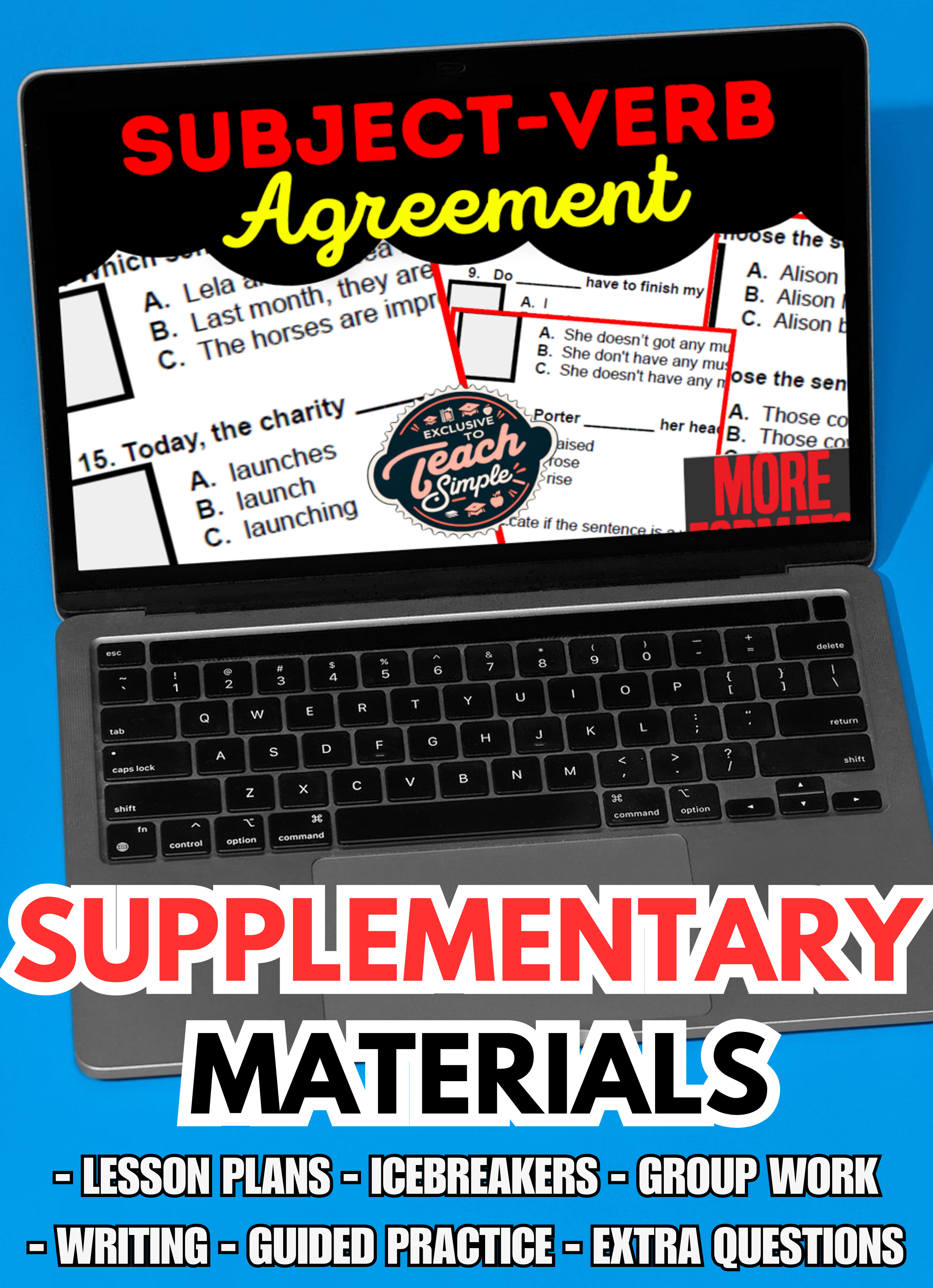
Future Tense Supplementary Materials Note: This download DOES NOT include the tests themselves. You can still make use of these materials without them but they are recommended. Download in a format of your choice in the "Links" section below. Outline Ice Breaker (5-10 minutes) Engaging, interactive activity to introduce the lesson’s theme. Examples: Matching games, sentence races, charades, or storytelling challenges. Guided Practice (10-15 minutes) Teacher-led exercises to reinforce the concept. Examples: Sorting sentences by tense, sentence transformations, or fill-in-the-gap exercises. Group or Partner Task (15 minutes) Collaborative activity to practice the lesson’s focus in a fun and engaging way. Examples: Role-play, storytelling, sentence-building games, or small-group discussions. Independent Worksheet (15 minutes) Individual written activity to solidify understanding. Examples: Sentence corrections, verb conjugation drills, or tense identification exercises. Exit Task (5 minutes) Quick reflective activity to assess understanding before students leave. Examples: Writing a sentence using the target concept, identifying a tense, or explaining a rule. Links: Includes: Future Simple Future Continuous Future Perfect Mistake Finding Google Docs Google Forms Google Slides PDF PPT Word FULL CATALOG OF DOWNLOAD LINKS HERE Grade 3/4 Links: Adjectives Google Docs Google Forms Google Slides PDF PPT Word Free Supplementary Materials Pack Adverbs Google Docs Google Forms Google Slides PDF PPT Word Free Supplementary Materials Pack Conjunctions Google Docs Google Forms Google Slides PDF PPT Word Free Supplementary Materials Pack Nouns Google Docs Google Forms Google Slides PDF PPT Word Free Supplementary Materials Pack Pronouns Google Docs Google Forms Google Slides PDF PPT Word Free Supplementary Materials Pack Verbs Google Docs Google Forms Google Slides PDF PPT Word Free Supplementary Materials Pack Sentence Structure Google Docs Google Forms Google Slides PDF PPT Word Free Supplementary Materials Pack Present Tense Google Docs Google Forms Google Slides PDF PPT Word Free Supplementary Materials Pack Past Tense Google Docs Google Forms Google Slides PDF PPT Word Free Supplementary Materials Pack Future Tense Google Docs Google Forms Google Slides PDF PPT Word Free Supplementary Materials Pack Context Clues Google Docs Google Forms Google Slides PDF PPT Word Free Supplementary Materials Pack Defining Words Google Docs Google Forms Google Slides PDF PPT Word Free Supplementary Materials Pack Fill the Blanks Google Docs Google Forms Google Slides PDF PPT Word Free Supplementary Materials Pack Homophones Google Docs Google Forms Google Slides PDF PPT Word Free Supplementary Materials Pack Synonyms Google Docs Google Forms Google Slides PDF PPT Word Free Supplementary Materials Pack ELA Review Questions Overview Questions have three answer choices. There are a handful of pictures on each test for aesthetic purposes, as well as a review sheet covering most of the topics covered in the product. Introduction or Example Sheet Each topic will include an introduction or example sheet to go through first with your students. Full Answer Keys Full answer keys and sample responses are provided so no matter how busy you are, you know you're covered! In the Supplementary Pack Interactive Ice Breakers: Fun, hands-on activities that get students thinking about adjectives right from the start. Guided Practice: Teacher-led exercises that reinforce the day’s lesson, ensuring students can confidently identify and use adjectives. Group and Partner Tasks: Collaborative activities that allow students to work together to solve problems, categorize adjectives, and create descriptive sentences. Independent Worksheets: Structured worksheets that provide individual practice and help solidify understanding of key concepts. Exit Tasks: Quick, reflective activities at the end of each lesson that assess understanding and encourage students to apply what they’ve learned. For similar downloads and other frees, do check out Cored Group on TeachSimple.

Author Cored Education

Tags Elementary, Answers, Ccss, Common Core, Grammar, Tests, Test Prep, Grade 3, Grade 4, Lesson Plan

Reading Comprehension Nonfiction Set 2 - Insects (Docs)

Reading Comprehension Nonfiction Set 2 - Insects (Docs)
ELA, Reading, Common Core, Reading Comprehension, ESL, Language Development, Spelling, Vocabulary, Creative Writing, Writing, Grade 4, 5, Worksheets & Printables, Worksheets, Assessments, Teacher Tools, Tests, Quizzes and Tests, Centers, Activities

Reading Comprehension Passages Nonfiction Set 2 Overview No prep reading comprehension lessons, with enjoyable articles and topics. Each lesson has a blend of post-reading activities. Mixed questions to check overall understanding. Vocabulary activities, plus a writing section. Lessons also contain a bonus extension exercise at the end. Some you may like, some you may not, either way they are there if you wish to use them. Full answer keys are provided. Passages Include 1.We Are Not Insects: Spiders ARE NOT insects! Read more in this article. 2.What a Smell: How does the stink bug protect its children? Find out in this lesson. 3.Queen: The ant queen. Sounds elegant. In fact, it isn't! It's a tough job. 4.Summer Singer: How do grasshoppers make noise and why? Read this passage to find out. 5.Fireflies: Why do fireflies flash? Read to learn about this, and more. 6.Bees: Worker bees, house bees. Collecting nectar, storing nectar. What exactly goes on in a bee hive? Docs Version This is the Docs editable and fillable version. This download is available in GOOGLE Docs, GOOGLE Forms, GOOGLE Slides. PDF, PPT, WORD. FULL CATALOG OF DOWNLOAD LINKS HERE Grade 4/5 Links Fiction Set 1 - Animals Google Docs Google Forms Google Slides PDF PPT Word Guided Reading Materials Fiction Set 2 - Family Google Docs Google Forms Google Slides PDF PPT Word Guided Reading Materials Fiction Set 3 - Friends Google Docs Google Forms Google Slides PDF PPT Word Guided Reading Materials Fiction Set 4 - School Google Docs Google Forms Google Slides PDF PPT Word Guided Reading Materials Fiction Set 5 - Sports Google Docs Google Forms Google Slides PDF PPT Word Guided Reading Materials Nonfiction Set 1 - Birds Google Docs Google Forms Google Slides PDF PPT Word Guided Reading Materials Nonfiction Set 2 - Insects Google Docs Google Forms Google Slides PDF PPT Word Guided Reading Materials Nonfiction Set 3 - Mammals Google Docs Google Forms Google Slides PDF PPT Word Guided Reading Materials Nonfiction Set 4 - Nature Google Docs Google Forms Google Slides PDF PPT Word Guided Reading Materials Nonfiction Set 5 - Sea Animals Google Docs Google Forms Google Slides PDF PPT Word Guided Reading Materials Reading Passages Overview Each passage is especially written for Grade 4-5 students, including key vocabulary required for this age group. Topics are varied and are accompanied by colorful graphics. Topics are meant to educate, yet entertain the modern student. These passages are perfect for the modern classroom. Whereas textbooks can become outdated in no time, any changes to technology or the world will result in updates to this product. Mixed Questions The mixed questions section of each lesson includes a variation of five comprehension, vocabulary and math questions. In addition, key reading strategies are frequently covered including cause & effect, summarizing, compare & contrast and making conclusions. Two or three of the questions will be MCQs and other questions will require a written response of some kind. Full answers and example responses appear at the end of the lesson. Spelling & Vocab Each reading passage contains a variety of words and phrases designed for Grade 4-5 students. Spelling and vocab activities provide the opportunity to build fluency with these words. As it can become quite mundane doing the same activities over and over, each lesson in a set will contain a different spelling and vocab activity . Activities include: spelling games, sentence match-ups, mixed-up text and decoding words from the lesson. Writing Prompts Writing prompts are designed to continue the theme or lessons learned in the story. Students are persuaded to write in a variety of ways and each prompt includes several cues to help. As with the spelling/vocab section, writing prompts will vary. This includes research pieces, reading responses, poetry and creative writing prompts. Full Answer Keys Full answer keys and sample responses are provided so no matter how busy you are, you know you're covered! Mixed question answers provide evidence from the text, math questions contain the relevant workings. Answers are designed for use by the teacher, but also suitable as a handout to the student. Just for Fun Each lesson will have a bonus extension exercise. This is something fun to extend the lesson with. You can find these at the end of each lesson, titled Just for Fun. Just for Funs are optional. Some you may like, some you may not. Either way, they are there to do with as you wish. For similar downloads and other frees, do check out Cored Group on TeachSimple.

Author Cored Education

Rating

Tags Elementary, Reading, Comprehension, Vocabulary, Answers, Common Core, Spelling, Writing, Passages, Vocabulary Assessments

2nd Grade Health – Unit 1 Personal Health

2nd Grade Health – Unit 1 Personal Health
P.E. & Health, Health, Physical Education, Common Core, Special Resources, Life Skills, Social Emotional Learning (SEL), Social Skills, Grade 2, Lesson Plans, Teacher Tools, Worksheets & Printables, Worksheets

For 2nd Grade Health there are seven standards that need to be taught. Unit 1 Personal Health Unit 2 Growth and Development Unit 3 Nutrition and Physical Activity Unit 4 Substance Use and Abuse Unit 5 Injury/ Violence Prevention Control and Safety Unit 6 Prevention/Control of Disease Unit 7 Environmental Consumer Health These units can be taught out of order. They are only numbered for your convenience. At the end of each unit, there is an assessment to test students’ understanding. Through using this Health 2nd Grade Unit 1: Personal Health students will explore and learn to identify daily healthy habits by knowing what foods are best to eat and how to set goals for physical activity. Habits included are: * Students will learn about healthy and unhealthy activities. These activities will include what is the difference between physical activities and sedimentary activities. * Students will learn how to make healthy choices that will benefit their nutritional goals. * They will learn about goals. Along with knowing the difference between long-term and short-term goals. And how to set both. * Students will come to understand their emotions and how to they can express those emotions as they learn to deal with their feelings. * Lastly, students will learn when and who they can rely on and who to talk to an adult about how they are feeling and how to get help when needed. At the end of the unit, there is an assessment to check for understanding. A total of 11 pages for this 2nd Grade Health Unit 1 on Personal Health There are seven units that cover all the health requirements for second grade. Here are the links to other health units: Health 2nd Grade Unit 1: Personal Health Health 2nd Grade Unit 2: Growth and Development Health 1st Grade Unit 3: Nutrition and Physical Activity Health 2nd Grade Unit 4: Substance Use and Abuse Health 2nd Grade Unit 5: Injury / Violence Prevention and Safety Health 2nd Grade Unit 6: Prevention / Control of Disease Health 2nd Grade Unit 7: Environmental / Consumer Health 2nd grade Coronavirus / Covid-19 Facts This unit meets Common Core Standards.

Author K-5 Treasures

Rating

Tags Health Unit, Personal Health, Healthy Goals, Unhealthy Choices, Health Activities, Physical Goals, Health Goals, Health And Wellness, 2nd Grade Health, Second Grade Health

Math Mini Unit: Real World Percentages: Converting Test Scores

Math Mini Unit: Real World Percentages: Converting Test Scores
Math, Percentages, Decimals, Fractions, Grade 5, 6, 7, 8, Lesson Plans, Teacher Tools, Worksheets & Printables, Worksheets

Math Mini Unit: Converting Scores into Percentages This ready-to-print booklet is a real world math tool for teachers of grades 5-8. The activities inside let students practice and apply their knowledge of percentages, decimals, and fractions practically: to convert their test and assignment scores to a common denominator of 100 so that they can easily compare their learning and growth across several tasks. I find that my students love learning this skill: it makes them feel mature and gives them ownership over their learning. How to Use: This 8-page booklet guides students to calculate their scores as percentages, offering them an interesting hands-on experience in crunching numbers. The mini-unit features various problem-solving methods supported by detailed visuals, explanatory notes, practice questions, and partner-focused activities. The content ranges from dealing with equivalent fractions with easily convertible denominators (10, 20, 25) to complex conversions involving more than one-step. Dividing the numerator by the denominator is also explored as a strategy to use with ANY test score. I go through the pages of the booklet with my students over several classes. We complete some practice problems together as a class, I allow some partner or small group work, and I also assign some questions for students to complete independently. Grades to Use With: This math mini-unit is particularly designed for middle school grades (5-8) or high school special education classes who are learning about the relationship between fractions, decimals, and percentages and real world applications of these skills. What's Included: This PDF includes an engaging and easy-to-follow 8-page student booklet, along with an instructional page exclusively for teachers—making it ready to use without any additional prep-work needed. If you enjoy this applied math task, check out more in my store: Integers and Plotting to Make Pictures on 4 Quadrant Cartesian Planes Transformation Design Project with an Assessment Rubric Geometry Project: Park Design with Area, Perimeter, and Volume (with Budgeting!)

Author Grace Under Pressure

Rating

Tags Percentages, Problem-solving, Fractions, Real World Math, Applied Math, Percentage Worksheets, Fraction Worksheets, Decimal Worksheets, Decimals, Percent

Guided Reading Level M - Science of Vaccines (with Lesson Plan)

Guided Reading Level M - Science of Vaccines (with Lesson Plan)
ELA, Resources for Teachers, Reading Comprehension, Reading, Science, Life Sciences, Health, P.E. & Health, Pre-Reading, Language Development, Grade 1, 2, 3, Worksheets & Printables, Worksheets, Teacher Tools, Centers, Activities, Literacy Readers, Quizzes, Quizzes and Tests, Assessments

This Guided Reading Book - Science of Vaccines (Level M) with lesson plan includes: Guided Reading Color Label (front cover x1) This is a quick way to match the book’s demands to what students can generally handle.. The overall goal is to use the level/color to pick books for several smaller groups. To qualify for a certain level, a student is expected to read a book from that level with about 90–94% accuracy. If a student is consistently accurate and understands, move up a level. If the student is struggling at that level, drop down and add more support. Each student will improve at completely different rates, but it is generally one of the best ways to check progress across the class. DOWNLOAD THE CATALOG TO VIEW ALL GUIDED READING BOOKS AVAILABLE (SORTED LEVELS A-Z) Pre-Reading Question (x1) Teacher asks the prompt aloud, can be while showing the cover or first page. Students share what they already know, or make educated guesses from the cover. Prompt them to use the target vocabulary. Write some of their responses on the board to look back at during the reading. Vocabulary Words (x5) Introduce the five words, best doing it one at a time. Start by saying it, while students repeat and then see if anyone knows what it means before reading further. Read through the meaning and try to briefly connect each word to a picture or gesture so it’s meaningful. Ask students to flip through the book pages and point to where they see each of the vocabulary words. While reading the book pause upon coming across one of the vocab words or read the sentence twice to make sure students understand the word has appeared. Optional: Ask students to raise hands whenever they see/hear one of the new words. Guided Reading Pages (x10) Check the book snapshot (below) for: primary topic - do you need to prep extra reading or intro materials on this? what is taught best - decide on 1-2 bullets to focus on, use the prompt or words provided here for best results. learning goals - what you are checking for students to be able to do after the session, elicit answers using prompts or words provided. key vocabulary (see section above). questions overview - so you know what is coming up and if you need to prep extra materials to assist understanding. Run the lesson You may have already looked at a few of the pages together, but you can show them some of the pictures again first to set meaning. Depending on how much time you have and how familiar your students are with guided reading class, you may want to read the book aloud first with the group first. Students whisper or partner read, while you listen in. If time, do it as a group, one student reading a page each. Use the guided page’s prompts to coach: “Check the picture / does it make sense?” “Point under the words / try the first sound” “Reread the sentence smoothly”. Try to focus more on one student per session (rotating every time), so you can work out if they are ready to move up or need to move down a level. Comprehension Questions (back cover x3) This is your way to check that students didn’t just say the words, but actually understood the text. First, let students answer by pointing to the page/picture and saying a short sentence. After any answer, follow with: “Show me where you found that in the text.” In bigger groups, have partners answer first (10–20 seconds), then call on 2–3 students to share. Differentiation tips: Emerging speakers/struggling readers: oral + pointing On-level: oral in a full sentence Higher: one written sentence or draw + label Book Snapshot Title: The Science of Vaccines Genre: Nonfiction (informational) Subject: Life Science (human body/health) Primary Topic: How vaccines help the immune system Estimated Guided Reading Level (A–Z): M What This Book Teaches Best What a vaccine is and how it “teaches” the immune system to recognize and fight dangerous germs. What germs are, why many are too small to see without a microscope, and that microscopic invaders are found in nature. The immune system’s job as a protective “security team” that identifies and removes germs that do not belong. How scientists make vaccines using a very small, harmless part of a germ, and why it is not strong enough to cause real sickness. How antibodies and memory cells help the body respond now and later, and how vaccines can help protect communities when most people are vaccinated. Learning Goals Students will explain how the text describes a vaccine helping the body stay healthy. Students will describe what germs are like and why a microscope is needed to see many of them. Students will describe the immune system’s main job as explained in the book. Students will explain what scientists use to create a vaccine and why it does not cause real sickness. Students will describe how the immune system makes antibodies and what antibodies do to the germ. Students will explain what memory cells do and how vaccines can help protect communities. Key Vocabulary From the Text immune — related to the body’s system for fighting germs. microscopic — so small it can’t be seen without a microscope. antibodies — special proteins that latch onto germs and mark them. injection — a quick shot using a small needle. bloodstream — the blood moving through the body. Discussion Prompts Pre-reading question: What do you think your body does to protect you from germs? Comprehension questions: How does the text say a vaccine helps the immune system recognize and fight germs? Comprehension questions: What do scientists use to create a vaccine, according to the book? Comprehension questions: What do “memory cells” do if a strong germ tries to enter the body later? Printing Tips 1. Best Printing Method (Recommended) “Booklet” Printing (Best if Available) If your printer or PDF viewer supports Booklet Printing , use this. Settings to use: Print mode: Booklet Paper size: Letter or A4 (either works) Orientation: Landscape Print on both sides: Yes Flip on: Short edge Scaling: Fit to printable area Booklet subset: First test: Front sides only Then: Back sides only This will automatically: Pair pages correctly Put the cover on the outside Align everything for folding After printing, fold in half and staple along the spine . 2. If “Booklet” Printing Is NOT Available You can still print this correctly with manual duplex printing . Step-by-step: Open the PDF. Choose Print . Set: Orientation: Landscape Pages per sheet: 1 Print on both sides: Yes Flip on: Short edge Print all pages . Because each PDF page already contains two facing book pages, the result will still fold cleanly into a book. Thousands of Cored Education products are included with your TeachSimple membership. Download links and encyclopedia index available here.

Author Cored Education

Rating

Tags Reading Comprehension, Reading Passages, Reading, Guided Reading, Guided Reading Lesson Plan, Guided Reading Activity, Pre-reading, Vocabulary, Science Lesson Plans, Life Science

The Biophilic Blueprint A Gamified Technical Literacy & Engineering

The Biophilic Blueprint A Gamified Technical Literacy & Engineering
Science, Life Sciences, Earth and Environmental Sciences, Earth Sciences, Environmental Science, Geology, Space, Basic Science, Human Body, Nature & Plants, Grade 2, 3, 4, 5, 6, 7, 8, Worksheets & Printables, Parts of and Anatomy of, Worksheets, Word Searches, Writing Prompts, Crosswords Puzzles, Dot To Dots, Mazes, Word Problems, Workbooks

Gamified STEM-based Reading Comprehension Activities for Valentine's & Groundhog Day Willeng Activity Packet Your elementary classroom will be transformed with our exciting new gamified reading comprehension activity pack that combines science, engineering and seasonal fun into a single resource! The Biophilic Blueprint is a total of 41 pages in a PDF format designed as both a complete teacher's guide and a student workbook. This packet utilizes biophilic design concepts to convert traditional Groundhog Day and Valentine's Day celebrations into a rigorous STEM based reading comprehension and education program. By using concepts such as how groundhogs build burrows, the science of hibernation, the shape of hearts, and how species in the environment coexist (symbiosis), students will develop skills such as identifying main ideas, finding supporting details/inferences/cause and effect relationships, vocabulary, sequencing, and text analysis. This educational resource packet provides a thorough theoretical framework for teachers (included in Chapters 1-4 and Appendix) along with items such as 10 fun and engaging student worksheets that incorporate real-world passages related to topics including groundhog engineering; the history of Valentine’s Day; folklore based on meteorology; and examples of how two different species can work together during winter months. There are also diagrams, answer keys, and procedures for implementing the activities. The activities focus on winter-themed concepts and are designed to promote higher-order thinking through the use of analogies (for example, “Taproot Main Idea” or “Burrow Blueprinting”) to help students connect abstract concepts in literacy to concrete knowledge. This packet is appropriate for use by home-schoolers, as a part of a classroom's learning centers, or as a holiday unit for teachers. It is a printable PDF with no preparation required prior to printing and will conform to Reading Informational Text-WO Common Core Standards for third and fourth grades (RI.3.1 and RI.4.2). Using these resources will also promote the love of bio-literacy among children. Groundhog Day Reading Comprehension Worksheets, Valentine’s Day Main Idea Worksheets, Winter STEM Activities for Kids, Resources for Biophilic Education, Elementary Engineering Simulation, 3rd Grade Literacy Packet, 4th Grade Inference Worksheet, Seasonal Holiday Printables, February-Themed Teacher Resources. Why Parents/Schools Appreciate It: - Involving the STEM Literacy Fusion: Exposure to STEM information from a fun angle, such as celebrating Groundhogs Day or Valentine's Day, makes reading lessons an interactive simulation, sparking students curiosity, engaging them in critical thinking, and not feeling as traditional drill type exercise. - No Additional Preparation, Differentiated Resources: Provides teachers with materials written in ready-to-print format, with answer keys, diagrams, and tiered instruction; saving them time while allowing both homeschool and classroom teachers to tailor these resources according to individual student needs (from struggling to gifted). - Facilitates Higher-Order Thinking: Structures reading as a form of "Narrative Engineering", which includes tapping into analogy resources, logic mapping, and building out main idea/s, inference/s, and synthesis, while providing Common Core compliant alignment; exposing students to a gamified assessment process for test preparation. - Biophilia and Thematic Connection: Utilizes nature-based thematic units (ex: burrow as blueprints, hearts as systems of circulation) to promote environmental awareness and emotional connection between students and the unit content, making the unit lessons memorable. - Proven Retention Strategies: Incorporates Kinesthetic exercises (ex. developing a tracing image of leaf's venous structure) and visualization techniques (ex. red/blue annotation) that support retention of comprehension from the information being presented, as will be supported by the research-based material as referenced in the PDF. Target Audience/Students: The target audience/students based on careful re-evaluation of the PDF (entire document), in terms of defined target audience, print complexity, differentiated method of instructing the content contained within, and activity level as follows: Primary Audience: Third and Fourth Grade Students – The PDF is specifically geared toward Third and Fourth Grade students. Both grades focus on "Technical Literacy Threshold," where students transition from "Learning to Read" to "Reading to Learn." Worksheets are designed to focus on extracting a main idea; use of inferences; determining vocabulary from context; mapping cause and effect; and synthesizing information, including examples of using biology from the hibernation of a groundhog to exploring the symbiosis of Valentine's Day To promote engagement with these activities in the above context utilizes graphic organizers, logic puzzles, and text related questions within the reading level of Third and Fourth Grade (Example: Non-fiction passages regarding burrows or honey bee hives.) Expanded Audience: Second Grade (Lower Level/On-Level Readers) and Fifth Grade (Higher Level/Gifted Students) – Use of a simplified "Tier 1" strategy with second graders in terms of visual anchor via diagrams and color codes. To utilize advanced applications with Fifth graders, such as "Compare/Contrast Winter Matrix" and "synthesis writing" (Example: Debate isolation vs. co-operation) in a survival situation. Overall targeted audience is Grades 2-5, however, the depth of content is most appropriate for level two elementary cohorts at classroom, home-schools or after school programs, related to STEM seasonal integration with Literacy. Copyright and Terms of Use Copyright is owned by Syed Hammad Rizvi. This material is for personal use and/or use in a single classroom only. You are not permitted to change, share or sell any parts of this material. This also includes uploading the material online so it is available to the general public for download. If you want to share this resource with others, you must purchase an additional license through Teachsimple. Thank you for your understanding of this copyright policy. This product is proudly provided by Syed Hammad Rizvi

Author Creative Book Store

Rating

Tags BiophilicBlueprint, GamifiedLearning, TechnicalLiteracy, EngineeringSimulation, ReadingComprehension, GroundhogDayActivities, ValentinesDayWorksheets, MainIdeaPassage, WinterActivityPacket, ElementarySTEM

6th Grade Multiply and Divide Rational Numbers Guided Notes & Practice

6th Grade Multiply and Divide Rational Numbers Guided Notes & Practice
Math, Decimals, Grade 5, 6, 7, Worksheets, Worksheets & Printables, Teacher Tools, Presentations

This set of guided notes covers how to multiply and divide rational numbers (integers, decimals, and fractions) and is aligned to Common Core standard 6.NS.3. Students will be able to multiply and divide positive and negative decimals and fractions. Each section includes guided notes (including models, sample problems, and explanations), tips and tricks, and practice problems. This resource will help you keep your instruction focused on multiply and divide rational numbers. multiply and divide Rational Numbers is no prep – just print and teach! No fluff – just clear, direct instruction! What’s Included 2 Pages of Guided Notes Clear explanations with worked examples that show students how to: multiply and divide integers with the same and different signs Interpret results in real-world contexts (temperature, money, elevation) Perfect for whole-class instruction, small groups, or interactive notebooks. Guided Practice (10 Problems) Students practice each concept in a structured way before moving on. Problems are intentionally sequenced so students build confidence as they go. Independent Practice (20 Problems) Students apply their understanding to: multiply and divide integers Operations with fractions and decimals Multi-step rational number expressions Real-world word problems Absolute value within operations Problems gradually increase in complexity, helping students strengthen both skill and confidence. Complete Answer Key Makes grading quick and simple, or allows students to self-check and reflect on mistakes. Pro Tips Included Helpful reminders and teacher notes address common misconceptions. Skills Covered Students will practice: multiply and divide integers multiply and divide fractions and decimals (positive and negative) Understanding absolute value in the context of operations CCSS Aligned: 6.NS.C.5, 6.NS.C.6, 6.NS.C.7 Why Teachers Love This Resource No Prep | Print & Go Clear, student-friendly layout. Step-by-step instructions that supports struggling learners Ideal for classwork, homework, intervention, or review Works beautifully for guided instruction and interactive notebooks This resource is perfect for introducing operations with rational numbers, reinforcing the concept after initial instruction, or reviewing before assessments. If you want your students to stop guessing with signs and start understanding what they’re doing, this lesson will make a real difference.

Author Matemaths

Rating

Tags Matemaths, Guided Notes, Worksheet, Decimals, Rational Numbers

Neuro-Inclusive Vocational Mastery: Executive Functioning Micro-Creden

Neuro-Inclusive Vocational Mastery: Executive Functioning Micro-Creden
Career, Life Studies, P.E. & Health, Mental Health, Health, Mindfulness, Physical Education, Research, Resources for Teachers, Classroom Management, Grade 6, 7, 8, 9, 10, 11, 12, Worksheets & Printables, Worksheets, Workbooks, Teacher Tools, Assessments, Lesson Plans, Presentations, Literacy Readers, Quizzes and Tests, Tests

Neuro- inclusive Educational Curriculum and Credentialing System for Executive Functioning Micro- credentials 35-Page Curriculum for Neurodivergent Teens (Autism, ADHD and More) in PDF Format Transforming the way neurodiverse students will leave school and move to the workforce and this is accomplished through a cutting-edge micro-credentialing program that recognizes the worth of everyone, regardless if they have a disability or not. Currently available through a digital PDF, this current tool replaces the old way of doing things based on a deficit model of transitioning out of high school to working. It provides a very powerful evidence-based structure for turning executive function challenges into work-related credentials. Includes: •Phase 1-Curriculum Theory Basics (Hidden Curriculum, Cognitive Load, Sensory Schema, and Ambiguity Traps) • Phase 2-Student Workbook & 10 Worksheets (Task Initiation, Working Memory, Cognitive Flexibility, Emotional Regulation, Time Blur, Sustained Attention, Organisation, Long Term Goals, Self-Monitoring, and Self-Advocacy) • Phase 3-Visual Structures, Flow Charts, Cognitive Load to Environmental Friction Mapping plus Teacher Implementation guide with complete Notion integration. Students will earn micro-badges that stacks up to create a portfolio for employers to easily understand—no longer any need for vague transcript! Ideal for special education teachers, transition coordinators, vocational rehabilitation specialists and parents building toward sustainable career pathways for autistic/ADHD teens. Instantly downloadable PDF • Print (cut) one copy or use digitally • Hybrid digital + analog/workbook based • Designed for students aged 14-22/9-12 grade. SEO Keyword: Neurodivergent Vocational Curriculum, Executive Function Worksheets for Autism, Micro-Credentialing for Special Education, Transition Programs for Autism into Work, ADHD Workplace Skills Curricula, Neuro-Inclusive Transition Planning, Executive Function Micro-Credentials, Sensory Regulation Training for Work. Reasons Parents & Educators Appreciate It: • Transforms labels of “unmotivated” or “distracted” students into real, visible, employer-ready micro-credentials that significantly increase retention rate after employment (example: retention rates went from 60% to 88% in a single year). • Comes with teacher keys; student worksheets; and pre-made templates to make implementation take only minutes instead of months (no longer create resources from scratch). • Uses affirming language that respects students' neurodiversity; allows schools to have an established, professional portfolio to provide to employers and IEP teams. • Uses a hybrid model of digital and printable content - all learning styles and budgets are accommodated; schools love the built-in assessment rubrics and portfolio defense scripts. • Quickly bridges the gap between school and the workplace; parents know that real-world skills (i.e. self-advocacy script; sensory anchors; Plan B matrix) will continue to be used even after high school graduation. Target Student Populations (Identification by PDF Analyses): These curricula were specifically designed for neurodivergent youth between 14 to 22 years of age (IDEA transition services) and are intended to be used in the following educational settings: • Special Education/Inclusion Classrooms, Grades 9-12 • Post-Secondary Transition Vocational Rehabilitation, 18 to 22 • Autism Spectrum Disorder Support and Transition Programming • ADHD/Executive Dysfunction focused Life Skills/Work-Study Programming • Community Based Adult Transition Programs, ages 18 to 22 Not for elementary/middle school; does NOT include general education environments without a neurodivergent focus. Designed for students experiencing difficulties with initiating tasks, time-blindness, sensory overload, or navigating the "hidden curriculum" within an employment environment. Copyright terms of use. This book belongs to Syed Hammad Rizvi. This resource can be used as a personal or classroom resource (one classroom only). You cannot change, distribute or sell any part of this resource. This means you are not allowed to make it available on the internet for public access or download. If you would like to share this resource with colleagues, please purchase additional licenses from Teachsimple. Thank you for following these terms of use. This product has been created by Syed Hammad Rizvi with joy.

Author Creative Book Store

Rating

Tags SpecialEducation, Neurodivergent, Autism, ADHD, ExecutiveFunctioning, TransitionPlanning, Neurodiversity, SpecialEd, NeuroInclusiveEducation, NeurodivergentCurriculum

Guided Reading Activities and Lesson Plans Nonfiction Set 2 - Insects
Free Download

Guided Reading Activities and Lesson Plans Nonfiction Set 2 - Insects
ELA, Reading, Reading Comprehension, Common Core, ESL, Language Development, Pre-Reading, Vocabulary, Resources for Teachers, Grade 4, 5, Worksheets & Printables, Worksheets, Lesson Plans, Teacher Tools, Activities

Guided Reading Activities with Lesson Plans Nonfiction Set 2 Note: This download DOES NOT include the passages themselves. If you have not already done so, download in a format of your choice in the "reading links" section below. Overview The perfect companion materials for Cored Education reading comprehension downloads. This collection provides structured lessons designed to enhance students' reading, comprehension, vocabulary, and creative thinking. Each lesson follows a consistent format that includes pre-reading activities to engage students, vocabulary-building exercises, comprehension checks, creative writing prompts, and discussion topics that promote critical thinking. The lessons are designed to foster active participation, encourage reflection, and develop key literacy skills through interactive and immersive learning experiences. The series is ideal for guided reading sessions, providing teachers with a comprehensive toolkit to engage students in both individual and group activities, enhancing their understanding of text and expanding their language skills. Includes Guided Reading Materials For: 1.We Are Not Insects 2.What a Smell 3.Queen 4.Summer Singer 5.Fireflies 6.Bees Reading Links: This is the guided reading materials version and DOES NOT include the passages themselves. The passages related to this download are available here in GOOGLE Docs, GOOGLE Forms, GOOGLE Slides. PDF, PPT, WORD. Google Docs Google Forms Google Slides PDF PPT Word Key Features: Engaging Lesson Structure: Each lesson follows a clear and predictable format, which includes pre-reading discussions, vocabulary exercises, reading activities, and creative tasks to maintain student engagement. Vocabulary Development: Focus on introducing and applying new vocabulary in context, helping students internalize new words and use them effectively. Comprehension and Reflection: The lessons include comprehension questions and reflective prompts that encourage students to think critically about the text and its themes. Creative Writing and Discussion: Opportunities for students to express themselves through writing and group discussions, reinforcing their understanding while fostering creativity. Interactive and Student-Centered: The activities are designed to be interactive, allowing students to engage directly with the content and each other, promoting active learning. FULL CATALOG OF DOWNLOAD LINKS HERE Grade 4/5 Links Fiction Set 1 - Animals Google Docs Google Forms Google Slides PDF PPT Word Guided Reading Materials Fiction Set 2 - Family Google Docs Google Forms Google Slides PDF PPT Word Guided Reading Materials Fiction Set 3 - Friends Google Docs Google Forms Google Slides PDF PPT Word Guided Reading Materials Fiction Set 4 - School Google Docs Google Forms Google Slides PDF PPT Word Guided Reading Materials Fiction Set 5 - Sports Google Docs Google Forms Google Slides PDF PPT Word Guided Reading Materials Nonfiction Set 1 - Birds Google Docs Google Forms Google Slides PDF PPT Word Guided Reading Materials Nonfiction Set 2 - Insects Google Docs Google Forms Google Slides PDF PPT Word Guided Reading Materials Nonfiction Set 3 - Mammals Google Docs Google Forms Google Slides PDF PPT Word Guided Reading Materials Nonfiction Set 4 - Nature Google Docs Google Forms Google Slides PDF PPT Word Guided Reading Materials Nonfiction Set 5 - Sea Animals Google Docs Google Forms Google Slides PDF PPT Word Guided Reading Materials Reading Passages Overview Each passage is especially written for Grade 4-5 students, including key vocabulary required for this age group. Topics are varied and are accompanied by colorful graphics. Topics are meant to educate, yet entertain the modern student. These passages are perfect for the modern classroom. Whereas textbooks can become outdated in no time, any changes to technology or the world will result in updates to this product. Mixed Questions The mixed questions section of each lesson includes a variation of five comprehension, vocabulary and math questions. In addition, key reading strategies are frequently covered including cause & effect, summarizing, compare & contrast and making conclusions. Two or three of the questions will be MCQs and other questions will require a written response of some kind. Full answers and example responses appear at the end of the lesson. Spelling & Vocab Each reading passage contains a variety of words and phrases designed for Grade 4-5 students. Spelling and vocab activities provide the opportunity to build fluency with these words. As it can become quite mundane doing the same activities over and over, each lesson in a set will contain a different spelling and vocab activity . Activities include: spelling games, sentence match-ups, mixed-up text and decoding words from the lesson. Writing Prompts Writing prompts are designed to continue the theme or lessons learned in the story. Students are persuaded to write in a variety of ways and each prompt includes several cues to help. As with the spelling/vocab section, writing prompts will vary. This includes research pieces, reading responses, poetry and creative writing prompts. Full Answer Keys Full answer keys and sample responses are provided so no matter how busy you are, you know you're covered! Mixed question answers provide evidence from the text, math questions contain the relevant workings. Answers are designed for use by the teacher, but also suitable as a handout to the student. Just for Fun Each lesson will have a bonus extension exercise. This is something fun to extend the lesson with. You can find these at the end of each lesson, titled Just for Fun. Just for Funs are optional. Some you may like, some you may not. Either way, they are there to do with as you wish. For similar downloads and other frees, do check out Cored Group on TeachSimple.

Author Cored Education

Tags Elementary, Reading, Comprehension, Vocabulary, Answers, Ccss, Guided Reading, Guided Reading Activity, Guided Reading Lesson Plans, Guided Reading Lesson Plan

Dinosaur Measuring Printable Activity | Watercolour Dinosaurs to Scale

Dinosaur Measuring Printable Activity | Watercolour Dinosaurs to Scale
, Not Grade Specific, Worksheets, Worksheets & Printables

Beautifully illustrated watercolor learning activity for young children. The dinosaurs are drawn to scale with 1cm equaling 1 meter, with an added scale bar to ensure accuracy as there may be slight variations in the final size depending on the settings of your printer. Can be used as a learning activity or starting point to investigate dinosaurs, or as a maths activity for measuring or comparing sizes. Set includes 12 dinosaurs from the giant brachiosaurus and diplodocus to the tiny archaeopteryx. This pack is an ideal small activity for a nature table, quiet time, or morning basket. It can be printed onto magnetic paper to be used on a fridge or whiteboard. To create a lasting and tactile item I highly recommend printing the file onto watercolor paper, it creates a beautiful finish and really looks like you are handling original paintings. Alternatively, you can laminate the pieces for durability, or perhaps print out a version for children to use to cut and stick their own food chains into a nature journal.

Author Fiddleticks Education

Tags Dinosaur Measuring , Dinosaurs

Marshmallows Reading Comprehension Passage - Cored Ed Encyclopedia

Marshmallows Reading Comprehension Passage - Cored Ed Encyclopedia
ELA, Language Development, Resources for Teachers, Reading Comprehension, Reading, Pre-Reading, Writing, Strategies, Physics, Science, Grade 2, 3, 4, 5, Worksheets & Printables, Worksheets, Teacher Tools, Centers, Activities, Writing Prompts, Assessments, Tests, Quizzes and Tests, Quizzes

This marshmallows reading comprehension contains the following: Visualize on the Cover (Teacher Read Aloud Script) Start your lesson by taking a few moments to visualize the topic and share thoughts or feelings about it. Pre-Reading Trivia Students will write down one thing they already know about the subject and then read five more facts and discuss. These facts are fun, and the students will enjoy learning about the subject before reading more. Reading Passage The text is a high-interest reading passage with set paragraphs, roughly three to four paragraphs long. It contains a variety of themes about the topic, anywhere from history to technology. The passage is between 250 and 350 words in length. Mixed Questions The first question page contains four multiple-choice questions, each with a choice of four answers, and three written response questions that require a sentence or two from the student. Vocabulary Questions Practice seven key words from the text in this section across two activities. First section is scrambled words where students will unscramble three words given a clue for each. The second section is a word to meaning matching activity. Creative Writing In this question, the student will be required to write a five to eight sentence paragraph on a question related to the topic. Extension Activities This page is optional for fast finishers or to take home. There are several activities, each one requiring a different skill. Do some, do none, do all, completely optional - but you will feel reassured knowing every possibility is planned for. Includes summary writting question. Answer Key There are answers for the multiple-choice questions, written response questions have sample answers, vocabulary answers and if there is a summary question then a sample summary will be provided as well. FULL CATALOG OF DOWNLOAD LINKS AND ENCYCLOPEDIA INDEX HERE Lesson Snapshot Title: Marshmallows Genre: Nonfiction Subject: Science (informational reading) Primary Topic: How marshmallows become foam; heat and pressure Estimated Guided Reading Level (A–Z): N What This Lesson Teaches Best Explains what a marshmallow is (a sweet foam) and how tiny air bubbles get trapped inside. Describes the process of making marshmallow mixture turn “fluffy” as it is beaten and thickens. Builds word knowledge through the origin of the name “marshmallow” from the marsh mallow plant and its “root sap.” Connects cause-and-effect in simple “food science”: heat toasts the outside and melts the inside; air pressure can make marshmallows puff up or shrink. Provides aligned support pages (trivia, questions, vocabulary tasks, writing, and extensions) that reuse the passage’s key ideas and terms. Learning Goals Explain why a marshmallow is called a “foam” using details from the text. Describe how air gets trapped in marshmallow ingredients while they are whipped or beaten. Tell why marshmallows are dusted with cornstarch. Explain where the word “marshmallow” comes from, based on the passage. Describe what heat does to a marshmallow over a fire or in hot chocolate. Describe how changes in air pressure can make marshmallows change size. Key Vocabulary From the Text Gelatin — ingredient that helps mixture set and hold bubbles. Cornstarch — powder dusted on marshmallows so they don’t stick. Cylinders — tube shapes, like short, round rolls. Sap — sticky liquid from a plant’s root. Pressure — force of air that can make bubbles shrink or grow. Cored Ed Encyclopedia Overview The Cored Ed Encyclopedia is a weekly series of lessons that you can pick up and use right away. These short readings fit into whatever time you have available. Each one includes a warm-up, a reading, and a set of questions, but it’s flexible — you can do just the reading, the full lesson, or skip the writing section if you need to. Each lesson focuses on a single topic so students don’t get lost. The writing is clear but never childish, making it perfect for grades two through five. Topics range from animals and science to history, inventions, and everyday things. No matter the level of the student, everyone should take away at least one new idea or fact from each lesson. The materials are easy to print, easy to explain, and require no setup. They work well for whole-class teaching, partner work, or independent study.

Author Cored Education

Rating

Tags Vocabulary, Spelling, Reading Comprehension, Reading Passages, Reading, Creative Writing, Reading Strategies, Writing Prompts, Physics, Marshmallows

Letter P Activities Alphabet Worksheets & Kindergarten Phonics Pack

Letter P Activities Alphabet Worksheets & Kindergarten Phonics Pack
Common Core, ELA, Phonics, Language Development, Pre-Reading, Kindergarten, Preschool, Grade 1, Centers, Activities, Crafts, Coloring Pages, Worksheets, Worksheets & Printables, Crosswords Puzzles, Mazes, Dot To Dots, Word Searches

Looking for a playful and effective way to introduce the Letter P to your students? This Letter P Alphabet Pack is bursting with engaging, no-prep activities that help young learners master both uppercase and lowercase P through phonics-based practice and hands-on fun. With 92 printable activity pages and 32 interactive Boom Cards , this resource is perfect for your Letter of the Week program, morning work, literacy centers, small groups, or take-home practice. What’s Included: 📄 Printable Worksheets Letter P Poster + 6 Visual Vocabulary Cards Tracing and Writing Uppercase and Lowercase P Letter P Sorting, Spinning (includes review of N, S, T), and Finding Activities Coloring, Drawing, and Dab-the-Dot Practice Mazes, Puzzles, Dot-to-Dot, and Geoboard Fun Color by Code + Glitter Letter Craft Visual Cutouts and First Sound Identification (a, s, t, n, p) Nursery Rhyme Link: Polly Put the Kettle On Booklet Cover, ‘About Me’ Page & Summary Sheet 🧠 Extra Crafts & Literacy Printables “I’m a Letter P Champ” Crown & Bracelet Mini Flipbook with Letter P Words and Visuals Letter P Word Wheel (6 Vocabulary Sections) Pig-Themed Finger Puppets (6 per page) Pig Stick Puppet Templates (4 per page) Mini Sight Word Flipbook (with touch-phonics font) One-Page Mini Booklet for Independent Review 💻 Boom Cards – 32 Digital Activities Formation and Recognition of Uppercase and Lowercase P Letter P Sound Matching Puzzle Matching and Visual Sorting Drag-and-Drop Uppercase/Lowercase Sort Visual Reveal Game for Letter P Pictures Capitalization Practice: Uppercase P vs Lowercase P in Sentences Fun Culminating Task: Build a Pizza with Letter P Items! 🎯 Perfect For: Letter of the Week Phonics Lessons Morning Literacy Work Kindergarten & Pre-K Centers Small Group Instruction Homework Packets or Distance Learning ⭐ Bonus: Includes both US and British English spelling versions to suit global classrooms! Make learning the Letter P purposeful and fun with this easy-to-use pack that’s full of alphabet adventures your students will love!

Author Teach2Tell

Rating

Tags Letter P Activities, Alphabet Worksheets Letter P, Uppercase Letter P, Lowercase Letters Alphabet, Preschool Letter P Printables, Kindergarten Letter P Activities, Letter Of The Week Letter P, Phonics Letter P Practice, Letter P Crafts For Kids, Build A Pizza Letter P Activityletter P Activities

Radios Reading Comprehension Passage - Cored Ed Encyclopedia

Radios Reading Comprehension Passage - Cored Ed Encyclopedia
ELA, Language Development, Reading Comprehension, Reading, Pre-Reading, History, Social Studies, Technology, Science, Physics, Grade 2, 3, 4, 5, Worksheets & Printables, Worksheets, Teacher Tools, Centers, Activities, Writing Prompts, Assessments, Quizzes and Tests, Quizzes, Lesson Plans

This radios reading comprehension includes: Visualization (on the front cover) Start your lesson by taking a minute to think and share something about the topic. Read the script aloud (slowly), perhaps prepare some music or sound effects. Student close their eyes and let their imaginations wander. Students open their eyes, read the question aloud and give them a few minutes to complete. Ask a few students to share or keep answers until the end to compare with what they learn in the passage. Quick pause—thousands of Cored Education products are included with your TeachSimple membership. Download links and encyclopedia index available here. Pre-Reading Trivia Students will write down one thing they already know about the subject and then read five more facts and discuss. These facts are fun, and the students will enjoy learning about the subject before reading more. Give 1 minute for students to write what they already know (no pressure—best guess is fine). Read the five facts together. After each fact, do ask a student for their opinion, was it surprising? Set a purpose by asking students to highlight/underline one fact they want to learn more about during the reading. Reading Passage The text is a high-interest reading passage with set paragraphs, roughly three to four paragraphs long. It contains a variety of themes about the topic, anywhere from history to technology. The passage is between 250 and 350 words in length. First, ask students to look at the headings and see what they’ll learn about today. What do they know about the topic/heading? First read options: Teacher read-aloud (best for support). Partner reading (paragraph by paragraph). While reading, students underline important details, and vocabulary words they think may come up in the questions section. Mixed Questions The first question page contains four multiple-choice questions, each with a choice of four answers, and three written response questions that require a sentence or two from the student. Students complete the mcqs first independently, then review quickly as a class. For the 3 written responses, try to get students giving the answer with some form of evidence: “I think ___ because the text says ___.” If students get stuck, send them back to check the passage. Vocabulary Questions Practice seven key words from the text in this section across two activities. First section is scrambled words where students will unscramble three words given a clue for each. The second section is a word to meaning matching activity. Before starting, have some students read out words they underlined in the passage. Ask students to say the word and read aloud the sentence(s) around each word. Ask students to do scrambled words and the matching exercise in pairs then go through answers as a class. For the scrambled spelling task, get four pairs to come up to the board and write the words for extra practice with the other student reading out the clue. For the matching task, prompt students to give full sentences: “I matched ___ with ___ because ___.” Creative Writing In this question, the student will be required to write a five to eight sentence paragraph on a question related to the topic. Before starting, ask students write down 3 key ideas they are going to include in their piece. Ask students for ideas to share around the class to help those struggling. Pro writing expectations: 5–8 sentences At least 2 facts or details from the passage At least 2 vocabulary words from the previous page Students read their paragraphs while classmates listen for facts and vocabulary words. Extension Activities This page is optional for fast finishers or to take home. There are several activities, each one requiring a different skill. Do some, do none, do all, completely optional - but you will feel reassured knowing every possibility is planned for. Includes summary writting question. Answer Key There are answers for the multiple-choice questions, written response questions have sample answers, vocabulary answers and if there is a summary question then a sample summary will be provided as well. Lesson Plan Included Customized lesson plan for this lesson is included. Lesson Snapshot Title: Radios Genre: Nonfiction (informational text) Subject: Science (Waves/Technology) / Social Studies (history of inventions) Primary Topic: How radio waves enabled communication over time Estimated Guided Reading Level (A–Z): R What This Lesson Teaches Best How scientists discovered and tested invisible waves (Maxwell’s prediction; Hertz’s spark machine and metal loop “reply”). What radio waves are described as (the longest waves in the electromagnetic family). How wireless communication developed from Morse-like code to sound and music (Marconi’s wireless telegraph; later broadcasting and family listening). How radios are used today for communication over long distances (emergency crews, airplanes and towers, spacecraft communication via NASA’s Deep Space Network). Understanding informational text structure with engaging section headings (“When Dots and Dashes Learned to Fly,” etc.). Learning Goals Students can explain how the text describes Maxwell’s and Hertz’s roles in understanding radio waves. Students can describe how Marconi’s wireless telegraph worked in the passage (wires, ground connection, detector clicking). Students can explain how radio changed from code to carrying voices and music, using details from the text. Students can identify at least two modern uses of radios named in the passage and why they matter. Students can use the section headings to state the main idea of each part of the passage. Key Vocabulary From the Text electromagnetic — related to electricity, magnetism, and waves. detector — a tool that clicks when a signal arrives. telegraph — a system for sending coded messages over distance. broadcasting — sending sounds to many listeners at once. antennas — parts that help send or receive radio signals. FULL CATALOG OF DOWNLOAD LINKS AND ENCYCLOPEDIA INDEX HERE

Author Cored Education

Rating

Tags Vocabulary, Reading Comprehension, Reading Passages, Reading, Creative Writing, Reading Strategies, Writing Prompts, Lesson Plans, Radios, Physics

Nutrition and Physical Activity Health: 4th and 5th Grade Unit 3

Nutrition and Physical Activity Health: 4th and 5th Grade Unit 3
P.E. & Health, Life Studies, Physical Education, Health, Special Resources, Life Skills, Social Emotional Learning (SEL), Social Skills, Grade 4, 5, Teacher Tools, Lesson Plans, Worksheets & Printables, Worksheets

Nutrition and Physical Activity Health: 4th and 5th Grade Unit 3 For 4th and 5th Grade Health, there are seven standards that students will practice and learn. Through using this 4th and 5th Grade Health Unit 3: Nutrition and Physical Activity, students will explore and learn to identify daily healthy habits. This unit is the perfect way to help 4th and 5th graders learn the importance of their personal health! This Unit 3: Nutrition and Physical Activity contains many activities that include teaching the six basic nutrients the body needs and how students can maintain a healthy lifestyle. Students will also learn the importance of portion sizes, and they will be able to learn and understand the new food labels that was recently recreated on all food containers. Furthermore, students will get to plan 3 meals that are healthy and create an ethnic recipe of their own.. Plus, they'll get to learn about physical and moderate exercises to keep their bodies healthy. At the end of this unit, there is an assessment and answer key to check for understanding. This 4th and 5th Grade Unit 3: Nutrition and Physical Activity meets Common Core standards and will make learning about nutrition and physical activity fun and exciting! Included in this 4th and 5th Grade Health unit are the following: Students will learn about the body's nutrients that are needed for a healthy lifestyle which include: Water, Protein, Carbohydrates, Fat, Vitamins, Minerals. They will learn about portion sizes and the basic food groups. They will create and plan three healthy meals. Students will decipher what food labels mean on food packages and how to apply that to their life. They will learn a new ethnic recipe and make their own meal. Students will learn about physical and moderate exercises and come up with their own ways to stay healthy with exercise. Lastly, there is an assessment to check for understanding. Included is an answer key. There are 26 pages included! There are seven units that cover all the health requirements for 4th and 5th grade. Here are the links to other health units: Health | 4th and 5th Grade Unit 1: Personal Health Health | 4th and 5th Grade Unit 2: Growth and Development Health | 4th and 5th Grade Unit 3: Nutrition and Physical Activity Health | 4th and 5th Grade Unit 4: Substance Use and Abuse Health |4th and 5th Grade Unit 5: Injury and Violence Prevention Health | 4th and 5th Grade Unit 6: Prevention and Control of Disease Health |4th and 5th Grade Unit 7: Environmental Consumer Health

Author K-5 Treasures

Tags Personal Health, Healthy Goals, Health Activities, Physical Goals, Health Goals, Health And Wellness, 4th Grade Health, 5th Grade Heath, Heath Units, Nutrition Goals

The Tudors - Grades 6-8

The Tudors - Grades 6-8
History: British, History, Social Studies, History: Europe, History: World, Grade 6, 7, 8, Worksheets, Worksheets & Printables, Lesson Plans, Teacher Tools, Presentations

The Tudors: An Intriguing Historical Adventure An Interesting History E-Book for Students in Grades 6–8 Explore the fascinating world of the Tudors, one of the most significant and dramatic eras in British history, by traveling back in time! Rich historical content, interesting facts, captivating visuals, and student-friendly language are all combined in this exquisitely illustrated and educational e-book, which is specifically made for middle school students. Students will investigate: - How the Tudors took control of England 🏰 - The lifetimes of strong monarchs such as Elizabeth I and Henry VIII 👑 - How culture, religion, and exploration permanently altered the nation ✝️🌍🎭 - How both wealthy nobility and impoverished peasants lived their daily lives 🧺🍗♔️ From thrilling jousting tournaments to dangerous sea voyages , from Shakespeare’s plays to Tudor fashion , this ebook brings history to life and helps students understand how the Tudors shaped the world we live in today. Includes: Detailed chapters with illustrations and photos A printable student worksheet packed with fun and educational activities A complete answer key for easy marking or self-checking Whether used in class, at home, or for projects, this ebook is the perfect companion for any young historian exploring the world of the Tudors.

Author Bright Classroom Ideas Marketplace

Rating

Tags Tudors, England, History, Grade 6, British, Europe

Envision Math Grade 5 Topic 13 Units of Measure

Envision Math Grade 5 Topic 13 Units of Measure
Math, Measurements, Grade 5, Worksheets & Printables, Worksheets, Workbooks, Word Problems

Envision Math Grade 5 – Topic 13: Units of Measure helps students master both customary and metric systems through guided lessons and practice. This packet includes student notes, teacher notes, a teacher-created quiz, and answer keys so you have everything needed for instruction, review, and assessment. While aligned with Envision Math, this resource is not taken directly from the textbook and works as a stand-alone unit for any 5th grade math classroom. Topic 13 Lessons include: Converting Customary Units of Length Converting Customary Units of Capacity Converting Customary Units of Weight Comparing Metric System and Customary System Converting Metric Units of Length Converting Metric Units of Capacity Converting Metric Units of Mass Ways to Use This Packet in Your Classroom: Daily math notes to guide instruction and provide structure Math journal inserts for interactive notebooks Independent practice or small group review Catch-up work for absent students Testing re-dos and reteaching opportunities Homework assignments for extra practice As of 2025, this resource has been updated with improved formatting, removed page numbers (making it adaptable for different Envision editions), and enhanced readability for ADA compliance and screen readers. Please note: Problem-solving lessons are not included in this packet, as problem solving is taught separately in our curriculum. This product is aligned to, but not affiliated with, Envision Math for Grade 5. It was originally created for my own students and refined to support teachers in delivering clear, organized, and flexible math instruction. Tags / SEO Keywords: 5th grade math, Envision Math Topic 13, units of measure 5th grade, converting customary units, converting metric units, metric vs customary, math notes and quizzes, Envision aligned math resources, grade 5 measurement conversions, length, capacity, weight, mass, customary units, metric units

Author Kel's Klass

Rating

Tags Envision Math, Grade 5 Math, Customary Units Of Length, Customary Units Of Capacity, Customary Units Of Weight, Metric Vs. Customary System, Metric Units Of Length, Metric Untis Of Capacity, Metric Units Of Mass

Money Management – Budgeting & Saving Worksheets

Money Management – Budgeting & Saving Worksheets
Math, Money, Statistics, Early Math, Numbers, Addition and Subtraction, Addition, Subtraction, Measurements, STEM, Homeschool Curriculum, Homeschool Templates, Grade 4, 5, 6, 7, 8, Worksheets & Printables, Workbooks, Worksheets, Word Searches, Teacher Tools, Assessments, Lesson Plans, Quizzes and Tests, Quizzes, Tests

Are you ready to go further than just a simple "piggy" bank lesson and actually give your students the skills they need for the real world? This complete, integrated Money Management Unit is filled with lots of tools to develop your students into well-rounded, professional "Young Scholars" by learning how to use the basic concepts of applied microeconomics in creative ways that meet the unique developmental abilities of both upper elementary and middle school students. The Money Management Unit is not a pack of worksheets; it is a full set of easy-preparation teaching materials that will help you develop a lasting understanding of financial literacy within your students. By using a structured, three-phase approach, this resource will help students gain a better understanding of the more complicated topics related to making good choices when it comes to spending or saving money through the use of opportunity cost; and will give them all the tools they need to manage the way they spend or save their money, from using an allowance to saving up for something they want to buy (zero‐based budget). WHAT'S AVAILABLE IN THIS SET OF 33 PAGES OF MATERIAL: PHASE 1: The Textbook: Applied Microeconomics for Young Scholars: A comprehensive but user-friendly resource for learning about many topics related to economics. The textbook covers the following topics: Income and Outflow: What is an allowance? What is entrepreneurship (using the example of a lemonade stand)? What's the difference between Needs and Wants? Budgeting Strategies: How do you use a "Zero-Based Budget" and the Spend, Save, and Share Approach? The Psychology of Saving: Delayed gratification, SMART goal setting, and the math of compound interest. The Economics of Choice: Understanding opportunity cost and consumer traps (e.g., Gamified Value in in-app purchases). PHASE 2: Student Workbook (10 Rigorous Worksheets): Worksheets which reinforce the concepts presented in the Textbook. Students are provided an opportunity to practice through hands-on activities in the areas of: Analyzing Revenue and Expenditures Making Decisions about Needs versus Wants Creating and Balancing a Ledger Calculating Savings Goals and Timelines Evaluating Opportunity Cost Recording Daily Transactions Understanding Emergency Funds and Unit Pricing Final Project: Create a Budget from Scratch! Phase 3: Teacher Resources (Visual Aids & Answer Key) 3 Visual Aids That Are Clear & Easy To Use! Perfect on a smart board or printed poster style (or printed out as handouts), these three docs provide simple visuals of how to create a budget, set goals and make impulse purchases so that students can see their financial decisions. An Answer Key Containing All Calculations & Rationale Is Ready For Use! A full key has been created for each of the ten worksheets so grading each student work will be easy. These two items can be used by any classroom and a great teaching resource to provide math centres, economics unit, life skills classes or by parents who want to give their child an early advantage through financial literacy. Why do Parents/Schools love: - The unit not only gives students the mechanics of counting money but explores how to think about money by teaching about core economic principles (opportunity cost, behavioral economics). - The entire unit is in one PDF file and provides a full resource package (textbook, 10 worksheets, various visual aids and full answer key). All materials are ready to print and teach - no planning time is wasted! - Students will have exposure to real-world experiences that will help them to connect abstract concepts to their everyday life through relatable case studies and scenarios such as saving for sneakers, managing their allowance & avoiding getting trapped in the arcade. - The psychology behind financial decisions is addressed and students are provided with tools for delayed gratification, goal setting (S.M.A.R.T.) and impulse control which will serve them throughout their lives. - The unit provides a wide range of options that can be tailored for any type of student. The rigor of the lesson is appropriate for gifted programs while the clear structure and answer key provides a high level of support for whole-group lessons or independent learning. Target Market (Student Classes): Based on the content's terminology ("applied microeconomics", "cognitive architecture") and concepts addressed, the following target audiences should be: Primary Target Market: Students in 5th and 6th Grade. The material is abstract in nature and at the appropriate developmental stage of maturation for these grades, as addressed in the Introductory Section provided in the PDF. Secondary Target Market: Gifted students in 4th Grade who are capable of handling advanced concepts and vocabulary. The material will provide them with a challenge while stimulating their interest. Tertiary Target Market: Students in 7th and 8th Grade that have never received an introduction to or have already been remediated in Financial Literacy concepts. The unit provides excellent foundational material for students enrolled in Life Skills and/or Economics courses. Niche Target Market: Families who homeschool their children and desire to use an academic, complete, and structured Financial Literacy Curriculum. Copyright / Terms of Use: This Book is the intellectual property of Syed Hammad Rizvi and all rights are reserved. This resource is intended for private use and only in single classroom settings. You may not create any modifications to this resource, redistribute it or sell any part of it. Additionally, you may not make this resource available on a publicly accessible internet website. If you are interested in sharing this resource with your colleagues please be sure to purchase additional licenses from Teachsimple . Thank you for helping to protect the terms of use stated above. This resource has been produced by Syed Hammad Rizvi, who takes great pleasure in providing this resource to teachers!

Author Creative Book Store

Rating

Tags FinancialLiteracy, MoneyManagement, PersonalFinance, Budgeting, SavingMoney, Economics, TeachingMoney, MoneySkills, FinanceForKids, BudgetingForKids

Pentagon, Hexagon, and Octagon Tracing & Coloring For Kindergarten

Pentagon, Hexagon, and Octagon Tracing & Coloring For Kindergarten
Montessori, Math, Shapes, Early Math, Toddler, Kindergarten, Preschool, Centers, Activities, Crafts, Worksheets & Printables, Workbooks, Worksheets

2D Shapes Tracing & Coloring Worksheets Pentagon, Hexagon, and Octagon Activities for Preschool, Montessori, & Kindergarten I have designed this hands-on shapes resource for toddlers, preschoolers, and kindergarten students who are learning to recognize and work with 2D shapes - especially pentagon, hexagon, and octagon. With tracing, coloring, rhymes, and simple cutting activities children can practice fine motor skills while building early shape and language awareness. All the activities inside are easy to use, engaging, and suitable for classrooms, homeschool settings, and independent practice. What’s inside? A fun rhyme about a pentagon named “Peppy” to introduce shape vocabulary Short, child-friendly rhymes for the hexagon and octagon Tracing worksheets for pentagons, hexagons, and octagons to support pencil control and hand-eye coordination Coloring pages to reinforce shape recognition and creativity Additional tracing and coloring pages for star, crescent, heart, diamond (rhombus), plus, and semicircle shape recognition Simple question prompts related to each shape are included to encourage discussion and language development (ESL/EFL friendly) Scissor skills activities : Crown cutting activity Bookmark cutting activity Medal cutting activity Skills Covered Fine motor development through tracing, coloring, and cutting activities Shape recognition and early geometry skills Scissor skills and line-following practice Vocabulary building and oral language development Focus, creativity, and hands-on learning Ways to use this resource Read the rhymes aloud and talk about where children see shapes in everyday life Use tracing and coloring pages during centers, morning work, or quiet time Add cutting pages as simple craft activities Encourage children to draw or talk about objects that match each shape Use question prompts to support ESL/EFL learners and class discussions This resource is useful for: Teachers: As it is perfect for shape-themed lessons, learning centers, early finisher work, or substitute plans. Everything is just print and go with clear instructions. For Homeschoolers: This booklet is an easy to follow resource that allows children to learn shapes at their own pace through hands-on activities. Parents: This set is also a great tool for at-home practice. It will help kids strengthen fine motor skills, shape knowledge, and early vocabulary in a fun and engaging way. Resource details: Answer key included No prep - print and use Black-and-white / grayscale (printer friendly) Step by step teacher instructions included Substitute friendly and time-saving Suitable for toddlers, preschoolers, and kindergartners Montessori-friendly approach ESL/EFL friendly

Author FlashKart

Rating

Tags Pentagon, Hexagon, Octagon, 2D Shapes, Tracing, Coloring, Crown Cutting, Kindergarten, Fine Motor Skills, Heart Shape

Letter of the Week Letter C Printables Activity Pack Phonics

Letter of the Week Letter C Printables Activity Pack Phonics
ELA, Phonics, Language Development, Pre-Reading, Kindergarten, Preschool, Homeschool Curriculum, Homeschool Templates, Grade 1, Centers, Activities, Crafts, Coloring Pages, Worksheets, Worksheets & Printables, Crosswords Puzzles, Dot To Dots, Mazes, Word Searches

Looking for a fun and effective way to teach the Letter C ? This Letter of the Week Letter C Activity Pack is loaded with interactive, no-prep printables and engaging Boom Cards that make alphabet learning hands-on and exciting for preschool and kindergarten students. With 86 printable activity pages and 32 digital Boom Cards , your students will gain confidence recognizing, forming, and sounding out both uppercase and lowercase C through a mix of tracing, puzzles, dabbing, coloring, and creative crafts. ✏️ What’s Included: 📄 Printable Worksheets Letter C Poster + 6 Visual Vocabulary Cards Tracing & Writing Uppercase and Lowercase C Spinning, Sorting, Finding, and Coloring Letter C (plus review: A, S, I) Drawing Letter C Pictures & Identifying Initial Sounds (a, s, t, n, p, i, c) Mazes, Dot-to-Dots, Geoboard, and Color by Code Dab the Dots & Visual Cutouts Booklet Cover, 'About Me' Page, & Summary Sheet Fairytale Connection: Cinderella Reading Practice: Word Families – an, ap, at, it, in, ip 🎨 Crafts & Literacy Extras “I’m a Letter C Champ” Crown & Bracelet Mini Flipbook of Letter C Words & Visuals Letter C Word Wheel (6 Visual Vocabulary Sections) One-Page Mini Booklet + Sight Word Flipbook (Touch Phonics Font) Cat -Themed Finger Puppets (6 per page) Stick Puppet Templates (4 per page) 💻 Boom Cards – 32 Digital Activities Formation & Recognition of Uppercase and Lowercase C Letter C Sound & Name Practice Puzzle Matching and Visual Recognition Drag-and-Drop Uppercase/Lowercase Sorting Visual Reveal Game (Letter C Objects) Sentence Use: Capital C vs Lowercase c Culminating Task: Build a Cat Activity 🎯 Perfect For: Letter of the Week Programs Literacy Centers & Phonics Stations Morning Tubs or Early Finishers Homework or At-Home Practice Small Group or 1:1 Instruction ⭐ Bonus: Includes both US and British English spelling to suit all classrooms. Help your students confidently master the Letter C through this engaging mix of print and digital tools—perfect for early literacy growth and alphabet fun!

Author Teach2Tell

Rating

Tags Letter C Activities, Letter Of The Week Letter C, Alphabet Worksheets Letter C, Preschool Letter C Worksheets, Kindergarten Letter C Activities, Letter C Crafts For Kids, Uppercase And Lowercase Letter C, Letter C Phonics Practice, Build A Cat Letter C Activity, Interactive Letter C Phonics Activities

Reading Passages on Weather and Solar System (PDF)

Reading Passages on Weather and Solar System (PDF)
ELA, Reading, Reading Comprehension, Science, Earth and Environmental Sciences, Earth Sciences, Common Core, ESL, Language Development, Space, Grade 5, 6, 7, Worksheets, Worksheets & Printables, Assessments, Teacher Tools, Tests, Quizzes and Tests, Diagrams, Centers, Activities

Reading Passages on Weather and Solar System for Earth Science Weather and Solar System: Reading Passages Earth Science - Elevate your teaching approach with these well-crafted reading comprehension worksheets, tailored to enhance your students' grasp of scientific concepts. Boasting diverse question formats and engaging articles, these resources allow for a seamless integration into your curriculum , providing peace of mind that the majority of the prep work has been expertly handled on your behalf. Dive deep into captivating subjects such as the sun, the enigmatic moon, and the ever-changing dynamics of weather, offering students a comprehensive and intriguing learning experience. What's inside? Part 3 - Weather & Solar System Reading Passage 1: Earth Moon and Sun Reading Passage 2: Weather Measurement Causes and Changes Reading Passage 3: Classification of the Sun and Other Stars Reading Passage 4: Inner and Outer Solar System Product Info: 33 PAGES (PDF Version: US English with Answers) Teaching Duration: 2 Weeks Science Reading Comprehension Outline: Introducing a comprehensive resource tailored for 5th and 6th graders, this product offers enriching reading passages supplemented with illustrative pictures and graphs to clarify key concepts. Aligned with the Common Core State Standards (CCSS), it offers a hassle-free approach to teaching, given that the bulk of the preparation is already done for you. The passages present a diverse set of questions – from multiple choice to data analysis and fill-in-the-blanks. This ensures a rich blend of high-interest content and fundamental curriculum-based science themes. With its versatility, you can seamlessly integrate these lessons into various classroom settings, whether it's whole class discussions, morning exercises, independent desk tasks, small group engagements, contingency plans for substitute teachers, regular homework assignments, or even themed activities for holidays. FULL CATALOG OF DOWNLOAD LINKS HERE Grade 5/6 Links: Physical Science Part 1 - Physical and Chemical Properties Google Docs/Slides/Forms PDF PPT Word Free Supplementary Pack Accompanying Videos Physical Science Part 2 - Motion and Energy Google Docs/Slides/Forms PDF PPT Word Free Supplementary Pack Accompanying Videos Physical Science Part 3 - Electricity and Magnets Google Docs/Slides/Forms PDF PPT Word Free Supplementary Pack Accompanying Videos Life Science Part 1 - Cells, Reproduction and Genetics Google Docs/Slides/Forms PDF PPT Word Free Supplementary Pack Accompanying Videos Life Science Part 2 - Human Body Systems Google Docs/Slides/Forms PDF PPT Word Free Supplementary Pack Accompanying Videos Life Science Part 3 - Plant Parts and Ecosystems Google Docs/Slides/Forms PDF PPT Word Free Supplementary Pack Accompanying Videos Earth Science Part 1 - Plate Tectonics and Rock Cycle Google Docs/Slides/Forms PDF PPT Word Free Supplementary Pack Accompanying Videos Earth Science Part 2 - Ocean Exploration and Natural Resources Google Docs/Slides/Forms PDF PPT Word Free Supplementary Pack Accompanying Videos Earth Science Part 3 - Weather and Solar System Google Docs/Slides/Forms PDF PPT Word Free Supplementary Pack Accompanying Videos For similar products and other frees, do check out Cored Group on TeachSimple .

Author Cored Education

Rating

Tags Science, Elementary, Reading, Comprehension, Vocabulary, Reading Centers, Science Assessments, Reading Comprehension Assessments, Vocabulary Assessments, Earth Science

Multiplying and Dividing Fractions Guided Notes with Practice & Answer

Multiplying and Dividing Fractions Guided Notes with Practice & Answer
Math, Fractions, Grade 5, 6, 7, Worksheets, Worksheets & Printables, Teacher Tools, Presentations

Get your students to master fraction multiplication and division finally with these handy, easy-to-follow guided notes and practice exercises. Designed for 6th grade math, this item breaks up fraction operations into brief, comprehensible steps — perfect for direct instruction, intervention, or independent practice. These notes do more than show how to multiply and divide fractions — they get students to see why every step works. With built-in scaffolding, worked examples, and 30+ practice exercises, your students will gain the fluency and confidence they need to master this fundamental skill. What's Included 2 Pages of Guided Notes – Student-friendly explanations for multiplying and dividing fractions and mixed numbers. Worked Examples – Clear, step-by-step models for each operation. Guided Practice (10 Problems) – Scaffolded exercises to aid in reinforcing understanding. Independent Practice (20 Problems) – A mixture of computational and real-world word problems. Complete Answer Key – Makes for easy grading or self-checking. Pro Tips Section – Handy reminders like "simplify before multiplying" and "keep-change-flip" to aid students in recalling key strategies. Skills Covered ✔ Multiplying fractions and mixed numbers ✔ Dividing fractions and mixed numbers using reciprocals ✔ Simplifying fractions and mixed numbers ✔ Applying operations to real-world word problems ✔ Building fluency through repetition and proportional reasoning Teachers Love It Because No Prep Required – Simply print and teach. Perfect for classwork, homework, sub plans, or review packets. Student-Friendly Format – Step-by-step directions and examples make challenging concepts student-friendly. CCSS Aligned (6.NS.A.1, 6.NS.B.3) – Offers quality, standards-based instruction. Versatile Use – May be used as guided notes, independent practice, small-group support, or intervention review. Presenting fraction operations for the first time or reviewing before a test, these guided notes and practice activities make teaching and learning fractions clear, structured, and stress-free. Prep time saved and students learning fraction multiplication and division — one clear step at a time. Centers, Rotations, or Partner Work Homework, Sub Plans, or Early Finishers Give your students ample practice without the prep time. With interactive pixel art and flexible printing options, fraction multiplication and division have never been this engaging — or this easy to teach.

Author Matemaths

Rating

Tags Matemaths, Guided Notes, Worksheet, Word Problems, Fractions

Reading Comprehension Nonfiction Set 1 - Technology (Google Docs)

Reading Comprehension Nonfiction Set 1 - Technology (Google Docs)
ELA, Reading, Common Core, Reading Comprehension, ESL, Language Development, Spelling, Vocabulary, Writing, Creative Writing, Grade 2, 3, Worksheets & Printables, Worksheets, Writing Prompts, Assessments, Teacher Tools, Tests, Quizzes and Tests, Centers, Activities

Reading Comprehension Passages Nonfiction Set 1 Overview Engaging nonfiction articles, each with a collection of different activities included. Articles are written for the modern classroom and topics are designed to promote enthusiasm from each student. Each lesson contains a mixed questions section to check understanding, a vocabulary or spelling activity to help remember key language introduced, and a writing exercise. Full answer keys are provided. Passages Include 1.Talking in Code: How the Navajo code talkers helped during WWII. 2.Power From the Sun: How does solar power work? 3.Roller Coasters: The science behind roller coasters. 4.The History of Cars: Who invented the car? Find out in this article. 5.The History of Ferries: Where is the oldest ferry service in the world? 6.The History of Helicopters: The advantages and disadvantages of helicopters. Additional File: History of Cars: Design a Car Printable Docs Version This is the Google Docs editable and fillable version. This download is available in GOOGLE Docs, GOOGLE Forms, GOOGLE Slides. PDF, PPT, WORD. FULL CATALOG OF DOWNLOAD LINKS HERE Grade 2/3 Links Fiction Set 1 - Nature Google Docs Google Forms Google Slides PDF PPT Word Guided Reading Materials Fiction Set 2 - Animals Google Docs Google Forms Google Slides PDF PPT Word Guided Reading Materials Fiction Set 3 - Food Google Docs Google Forms Google Slides PDF PPT Word Guided Reading Materials Fiction Set 4 - School Google Docs Google Forms Google Slides PDF PPT Word Guided Reading Materials Fiction Set 5 - Friends Google Docs Google Forms Google Slides PDF PPT Word Guided Reading Materials Fiction Set 6 - Family Google Docs Google Forms Google Slides PDF PPT Word Guided Reading Materials Fiction Set 7 - Sports Google Docs Google Forms Google Slides PDF PPT Word Guided Reading Materials Nonfiction Set 1 - Technology Google Docs Google Forms Google Slides PDF PPT Word Guided Reading Materials Nonfiction Set 2 - Nutrition Google Docs Google Forms Google Slides PDF PPT Word Guided Reading Materials Nonfiction Set 3 - Animals Google Docs Google Forms Google Slides PDF PPT Word Guided Reading Materials Reading Passages Overview Each passage is especially written for Grade 2-3 students, including key vocabulary required for this age group. Topics are varied and are accompanied by colorful graphics. Topics are meant to educate, yet entertain the modern student. These passages are perfect for the modern classroom. Whereas textbooks can become outdated in no time, any changes to technology or the world will result in updates to this product. Mixed Questions The mixed questions section of each lesson includes a variation of fivecomprehension, vocabulary and math questions. In addition, key reading strategies are frequently covered including cause & effect, summarizing, compare & contrast and making conclusions. Three of the questions will be MCQs and two will require a written response of some kind. Full answers and example responses appear at the end of the lesson. Spelling & Vocab Each reading passage contains a variety of words and phrases designed for Grade 2-3 students. Spelling and vocab activities provide the opportunity to build fluency with these words. As it can become quite mundane doing the same activities over and over, each lesson in a set will contain a different spelling and vocab activity . Writing Prompts Writing prompts are designed to continue the theme or lessons learned in the story. Students are persuaded to write in a variety of ways and each prompt includes several cues to help. As with the spelling/vocab section, writing prompts will vary. This includes research pieces, reading responses, poetry and creative writing prompts. Full Answer Keys Full answer keys and sample responses are provided so no matter how busy you are, you know you're covered! Mixed question answers provide evidence from the text, math questions contain the relevant workings. Answers are designed for use by the teacher, but also suitable as a handout to the student. Additional File One lesson will have an additional file. This is something fun to extend the lesson with. For similar downloads and other frees, do check out Cored Group on TeachSimple.

Author Cored Education

Rating

Tags Elementary, Reading, Comprehension, Vocabulary, Answers, Common Core, Spelling, Writing, Digital Centers, Vocabulary Assessments

Kindergarten Health: Unit 1

Kindergarten Health: Unit 1
P.E. & Health, Life Studies, Health, Physical Education, Special Resources, Life Skills, Social Emotional Learning (SEL), Social Skills, Kindergarten, Teacher Tools, Lesson Plans, Worksheets & Printables, Worksheets

For Kindergarten Health there are seven standards that need to be taught to achieve healthy habits! Unit 1 Personal Health Unit 2 Growth and Development Unit 3 Nutrition and Physical Activity Unit 4 Substance Use and Abuse Unit 5 Injury/ Violence Prevention Control and Safety Unit 6 Prevention/Control of Disease Unit 7 Environmental Consumer Health These units can be taught out of order. They are only numbered for your convenience. This is a great health unit to help your students achieve healthy habits! Through using this Kindergarten Health: Unit 1, students will explore and learn to identify daily healthy habits. Included in this unit : * Students will understand the order of brushing their teeth as a daily habit. * Students will understand the importance of going to bed on time is a healthy habit. * Identifying healthy eating habits. * Understand what it means to be physically active. * Students will write a goal to brush teeth daily. * Understand that being clean and washing hands is a part of being healthy. There is a total of 14 pages included in this Unit 1 for Kindergarten Health. There are seven units that cover all the health requirements for Kindergarten. Here are the links to other health units: Kindergarten Health: Unit 1 Personal Health Kindergarten Health: Unit 2 Growth and Development Kindergarten Health: Unit 3 Nutrition and Physical Activity Kindergarten Health: Unit 4 Substance Use and Abuse Kindergarten Health: Unit 5 Injury / Violence Prevention Control and Safety Kindergarten Health: Unit 6 Prevention / Control of Disease Kindergarten Health: Unit 7 Enviromental Consumer Health You can also teach your students about keeping yourself safe by studying about the Coronavirus, where and when it started and facts that plagued our world with this virus. Kindergarten Health: Covid 19 / Coronavirus Facts This unit meets Common Core Standards.

Author K-5 Treasures

Tags Health, Health Units, Personal Health, Kindergarten Health, Health For Kindergarten, Healthy Foods, Healthy Habits, Personal Development For Kids, Elementary Health