



3,930 products added recently
Page 57 - ELA Activities
Explore a variety of ELA activities designed to enrich your students' learning experience. From reading comprehension exercises to creative writing prompts, these resources support the development of essential literacy skills. Engage your class with interactive lessons that foster a love for language and literature. These activities are suitable for various grade levels and can be seamlessly integrated into your curriculum, helping you create dynamic and effective English Language Arts lessons.

 Show filters


Letter M Alphabet Craft: M is for Mushroom
ELA, Language Development, Phonics, Kindergarten, Preschool, Crafts, Activities
Enhance the teaching and learning of the beginning sound of letter M with our unique and interactive mushroom craftivity. This educational tool is designed to facilitate the understanding and recognition of the letter M sound with common, easy to recognize images. This craft also works on handwriting and letter formation for the letter M. Our resource contains three different letter P flower templates to practice both beginning sounds as well as letter recognition. What's Included: There is a one page craft template for M is for Mushroom. There is one activity page where students will color images that begin with the letter M as well as trace the corresponding words. There is one activity page where students will trace and write the letter M. There is one activity page where students will trace the letter M and color images that begin with the letter M. Utilizing this Resource: Simply print the craft template, and then allow the students to color, cut out, and assemble into a mushroom. The activity pages are optional and can be utilized as shown in the preview images. The activity pages are differentiated so different students can focus on different skills. Possible Applications: Literacy Centers Classroom decorations or bulletin board displays Creative or Craft Sessions Individual Work Group-based Activities Supplementary Homework This craft template is a perfect fit for educators seeking no-prep resources. All that is required is to print the craft page and distribute it to the students. Basic craft materials such as coloring tools, scissors, glue, and a base paper for the flower craft are needed. Each craft prints on a single page, promoting paper conservation, which aligns with an eco-friendly classroom. Skills Addressed: Identification of the beginning sound of the letter M Recognizing the capital and lowercase letter M Handwriting Skills Development of Scissors Skills Improvement of Direction Following abilities
Author The Connett Connection
Tags Flower Craft, Preschool Craft, Kindergarten Craft, Beginning Sounds, Letter Recognition, Letter M, Letter M Craft, M Is For Mushroom
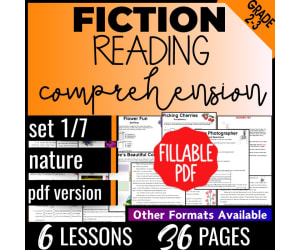
Reading Comprehension Passages Fiction Set 1 - Nature (Fillable PDF)
ELA, Reading, Reading Comprehension, Common Core, ESL, Language Development, Spelling, Vocabulary, Writing, Resources for Teachers, Grade 2, 3, Worksheets & Printables, Worksheets, Writing Prompts, Assessments, Teacher Tools, Quizzes, Quizzes and Tests, Centers, Activities
Reading Comprehension Passages Fiction Set 1 Snapshot Genre: Fiction (collection of short nature-themed stories) Subject: Reading (Comprehension) Primary Topic: Nature-themed fiction passages and comprehension practice Estimated Guided Reading Level (A–Z): O What This Teaches Best Character feelings and motivations: Characters want or value something strongly (e.g., Kellie wants snow to use her new sled; Rusty wants to finish his color task; Ross would rather play but ends up enjoying his work). Observation and using the environment for answers: Rusty finds blue and purple by looking more carefully at what’s around him (sky, stream, leaf backs). Cause and effect in everyday situations: Weather and choices affect what happens next (snow finally comes; a thunderstorm ends cherry picking; a volcano eruption changes the climbers’ plans). Nature vocabulary in meaningful contexts: Words connected to seasons, plants, animals, and outdoor features appear across the stories (snow “accumulation,” “canopy,” “eruption,” “perennials,” “marmalade”). Built-in practice pages that match the passages: Each story is followed by questions and skill pages (mixed questions, spelling/vocabulary, short writing prompts) that directly reference details from the story text. Learning Goals Students will recount key events from a selected story in a logical order using details from the text. Students will describe characters’ wants, feelings, and choices and connect them to what happens in the story. Students will identify the setting/season and name text evidence that supports it. Students will explain cause-and-effect relationships shown in the stories (problem → response → outcome). Students will use context clues to determine the meaning of unfamiliar words from the passages. Students will compare information presented in the story (for example, annuals vs. perennials) by stating how they are different using the text’s wording. Passages Include 1.Bring on the Snow: Kellie wants to make it snow. How does she try? 2.Walk through the Woods: A walk in the woods turns into a huge adventure. 3.Nature Photographer: Donna get some amazing snaps in this story. 4.Nature's Beautiful Colors: Rusty enjoys finding out about the colors in nature. 5.Flower Fun: Learn about flower names and colors in this fun lesson. 6.Picking Cherries: Ross spends his day picking cherries but is it worth it? Additional File: Nature Photographer: Drawing Nature Printable FILLABLE PDF VERSION Worksheet-style pages, but with type-in answer boxes so students can complete and save their work digitally. Other versions are available in the links list below or in the full catalog. FULL CATALOG OF DOWNLOAD LINKS HERE For similar downloads and other frees, do check out Cored Group on TeachSimple.
Author Cored Education
Rating
Tags Elementary, Reading, Comprehension, Vocabulary, Common Core, Speling, Writing, Passages, Reading Centers, Reading Comprehension Assessments

Tenses Practice Questions - Grammar Grade 5-6 (Forms)
ELA, Language Development, ESL, Grammar, Common Core, Resources for Teachers, Grade 5, 6, 7, Worksheets & Printables, Worksheets, Quizzes and Tests, Teacher Tools, Tests, Assessments, Centers, Activities
Tenses Grammar Practice MCQS ELA MCQS Overview: In this series of lessons, students will embark on an engaging journey to master the language arts skills that make communication effective and expressive. These lessons are designed to help students recognize, understand, and apply key grammar, vocabulary, and writing conventions in both their writing and speech. Each lesson builds upon the previous one, providing a structured blend of direct instruction, interactive group activities, and independent practice. With engaging tasks and thought-provoking questions, students will explore sentence structure, word choice, punctuation, and grammar rules to strengthen their understanding of English language conventions. Accompanied by free supplementary materials covering all topics, this series ensures a well-rounded and enjoyable learning experience. Through practice and exploration, students will develop the skills needed to analyze language, construct clear sentences, and express themselves with confidence. Tenses Overview: Present Tense Practice Past Tense Practice Future Tense Practice Further Tense Practice Forms Version This is the Forms editable and self grading version. This download is available in GOOGLE Docs, GOOGLE Forms, GOOGLE Slides. PDF, PPT, WORD, check the links below for more details. FULL CATALOG OF DOWNLOAD LINKS HERE Grade 5/6 Links: Capitalization & Punctuation Google Docs Google Forms Google Slides PDF PPT Word Free Supplementary Materials Pack Adjectives Google Docs Google Forms Google Slides PDF PPT Word Free Supplementary Materials Pack Nouns Google Docs Google Forms Google Slides PDF PPT Word Free Supplementary Materials Pack Pronouns Google Docs Google Forms Google Slides PDF PPT Word Free Supplementary Materials Pack Verbs Google Docs Google Forms Google Slides PDF PPT Word Free Supplementary Materials Pack Prefixes & Suffixes Google Docs Google Forms Google Slides PDF PPT Word Free Supplementary Materials Pack Sentence Structure Google Docs Google Forms Google Slides PDF PPT Word Free Supplementary Materials Pack Subject Verb Agreement Google Docs Google Forms Google Slides PDF PPT Word Free Supplementary Materials Pack Tenses Google Docs Google Forms Google Slides PDF PPT Word Free Supplementary Materials Pack Context Clues Google Docs Google Forms Google Slides PDF PPT Word Free Supplementary Materials Pack Defining Words Google Docs Google Forms Google Slides PDF PPT Word Free Supplementary Materials Pack Fill in the Blanks Google Docs Google Forms Google Slides PDF PPT Word Free Supplementary Materials Pack Homophones Google Docs Google Forms Google Slides PDF PPT Word Free Supplementary Materials Pack Synonyms Google Docs Google Forms Google Slides PDF PPT Word Free Supplementary Materials Pack ELA Review Questions Overview Questions have three answer choices. There are a handful of pictures on each test for aesthetic purposes, as well as a review sheet covering most of the topics covered in the product. Introduction or Example Sheet Each topic will include an introduction or example sheet to go through first with your students. Full Answer Keys Full answer keys and sample responses are provided so no matter how busy you are, you know you're covered! In the Supplementary Pack Interactive Ice Breakers: Engaging warm-up activities that introduce students to key ELA concepts, such as quick capitalization corrections and punctuation challenges. Guided Practice: Structured teacher-led exercises that reinforce grammar and punctuation rules, helping students identify and apply them correctly in sentences. Group and Partner Tasks: Collaborative activities where students work together to edit sentences, correct capitalization, and improve punctuation through peer discussion and teamwork. Independent Worksheets: Carefully designed worksheets that provide focused practice, allowing students to apply learned concepts and refine their skills independently. Exit Tasks: Quick assessments at the end of each lesson, prompting students to reflect on what they’ve learned and apply their knowledge in writing and editing tasks. For More Like This For similar downloads and other frees, do check out Cored Group on TeachSimple.
Author Cored Education
Tags Elementary, Answers, Ccss, Common Core, Grammar, Tests, Assessment, Grade 5, Grade 6, Digital Centers
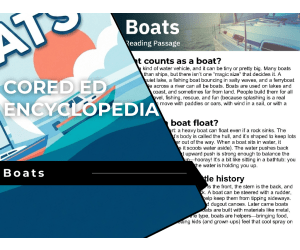
Boats Reading Comprehension Passage - Cored Ed Encyclopedia
ELA, Language Development, Resources for Teachers, Reading Comprehension, Reading, Pre-Reading, Creative Writing, Writing, Physics, Science, Grade 2, 3, 4, 5, Worksheets & Printables, Worksheets, Teacher Tools, Centers, Activities, Writing Prompts, Assessments, Tests, Quizzes and Tests, Quizzes
This boats reading comprehension contains the following: Pre-Reading Trivia Students will write down one thing they already know about the subject and then read five more facts and discuss. These facts are fun, and the students will enjoy learning about the subject before reading more. COMPANION VIDEO NOW AVAILABLE (EMBEDDED AFTER PREVIEW PICTURES IN PRODUCT DESCRIPTION) Reading Passage The text is a high-interest reading passage with set paragraphs, roughly three to four paragraphs long. It contains a variety of themes about the topic, anywhere from history to technology. The passage is between 250 and 350 words in length. Mixed Questions The first question page contains four multiple-choice questions, each with a choice of four answers, and three written response questions that require a sentence or two from the student. Creative Writing In this question, the student will be required to write a five to eight sentence paragraph on a question related to the topic. Extension Activities This page is optional for fast finishers. If there are five to ten minutes left at the end of the lesson, the student can choose one of three activities, each one requiring a different skill. Answer Key There are answers for the multiple-choice questions and three written response questions have sample answers. FULL CATALOG OF DOWNLOAD LINKS AND ENCYCLOPEDIA INDEX HERE Cored Ed Encyclopedia Overview The Cored Ed Encyclopedia is a weekly series of lessons that you can pick up and use right away. These short readings fit into whatever time you have available. Each one includes a warm-up, a reading, and a set of questions, but it’s flexible — you can do just the reading, the full lesson, or skip the writing section if you need to. Each lesson focuses on a single topic so students don’t get lost. The writing is clear but never childish, making it perfect for grades two through five. Topics range from animals and science to history, inventions, and everyday things. No matter the level of the student, everyone should take away at least one new idea or fact from each lesson. The materials are easy to print, easy to explain, and require no setup. They work well for whole-class teaching, partner work, or independent study.
Author Cored Education
Rating
Tags Vocabulary, Spelling, Reading Comprehension, Reading Passages, Cored Encyclopedia, Facts, Reading, Creative Writing, Physics, Boats

Fall Number Flashcards – 0–30 Memory and Sequencing Games
Holiday & Seasonal, ELA, Special Resources, Special Education Needs (SEN), Seasons, Fall, Math, Early Math, Numbers, Counting, Preschool, Grade 1, 2, 3, 4, Activities, Games, Worksheets & Printables, Quizzes and Tests, Teacher Tools, Quizzes, Projects, Flashcards, Word Problems, Centers
Fall Numbers Memory Game Bring autumn fun into your math lessons! This set of fall-themed flashcards gives students repeated practice with numbers from 0 to 30 in a playful and flexible format. I first made these for my kindergarten class, when many of my students still needed support with recognizing numbers and putting them in the right order. The cards worked well because they could be used in so many different ways without having to prepare something new each time. There are 228 cards in total, divided into six full sets with different colored borders. The colors make it easy to keep groups organized, since each table can use a separate set without mixing the cards together. Each card shows a single number in a large, clear font, which helps beginning learners and also supports students who struggle with visual distractions. The cards can be used for memory or matching games, where students flip over two at a time and try to find pairs. Another favorite activity in my class has been sequencing: students work together to lay the cards out from 0 to 30. For more active lessons, we sometimes spread the cards on the floor and have students “walk” the numbers in order, which adds movement to the practice. I also use the cards as simple flashcards, holding them up for quick recognition drills, or handing one card to each student and asking the group to line up in numerical order. With partners, students have created their own math problems using the numbers they draw, which adds a layer of challenge for more advanced learners. Differentiation is built in, since you can choose how many numbers to include. With beginners, I usually work with 0–10. As students grow more confident, I extend to 0–20 and eventually the full 0–30. Adding a timer or encouraging students to say each number out loud when they play can make the activity even more engaging. Preparation is straightforward: print the set you want, cut the cards, and laminate if you plan to reuse them. I keep each set in small envelopes or bags so they are ready for math centers, group games, or quick warm-ups. The fall design adds a seasonal touch, but the number practice is useful all year long. Warm regards, Lernfitness Did You Know? I teach with a certified therapy dog, and together we focus on creating a positive and inspiring learning environment.
Author Lernfitness
Rating
Tags Foreign Languages, Game, Educational Card Games, Elementary, Fall, Memory, Numbers, Counting, Autumn, Math

Alphabet Puzzles with Real Photographs
ELA, Language Development, Phonics, Kindergarten, Preschool, Activities
Practice learning beginning sounds and matching capital and lowercase letters with these alphabet puzzles. What is Included: Each letter of the alphabet includes on puzzle for matching the capital and lowercase letter of the alphabet. Each letter is on a puzzle card that has a real photographic image of something that begins with that letter. There are two puzzle formats, one where the puzzles form a rectangular shaped puzzle and one where the puzzle is the shape of the object itself. The real life photographs will give students something they see in real life that they can associate each letter sound with. This will allow them to stay engaged in this learning activity. How to Use Students will match the two halves of the puzzles by matching the capital letter to its corresponding lowercase letter. When to Use: Literacy Center - The puzzles can be placed in a literacy center for students to compete alone or with a partner. Morning Activity - The puzzles can be placed in a morning tub or bin for students to complete as their classmates arrive to class. Quiet Time Activity - These puzzles are a perfect addition to any quiet time activity. Students who do not nap during rest time can use these puzzles quietly while their classmates sleep. Small Group Activity - Students needing help with matching capital and lowercase letters can work in a small group setting to complete these alphabet puzzles. These puzzles will fit perfectly inside a task box for easy set up, clean up, and storage. The alphabet puzzles are low prep, providing a quick activity for teachers to create for their students. The puzzles simply need to be printed on card stock, cut apart, and laminated for durability. From there the students can complete the puzzles as many times as they want.
Author The Connett Connection
Tags Alphabet Puzzles, Preschool Literacy, Preschool Puzzles
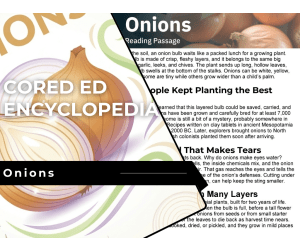
Onions Reading Comprehension Passage - Cored Ed Encyclopedia
ELA, Language Development, Resources for Teachers, Reading Comprehension, Reading, Pre-Reading, Writing, Life Sciences, Science, Nature & Plants, Grade 2, 3, 4, 5, Worksheets & Printables, Worksheets, Teacher Tools, Centers, Activities, Writing Prompts, Assessments, Tests, Quizzes and Tests, Quizzes
This onions reading comprehension contains the following: Visualize on the Cover (Teacher Read Aloud Script) Start your lesson by taking a few moments to visualize the topic and share thoughts or feelings about it. Pre-Reading Trivia Students will write down one thing they already know about the subject and then read five more facts and discuss. These facts are fun, and the students will enjoy learning about the subject before reading more. Reading Passage The text is a high-interest reading passage with set paragraphs, roughly three to four paragraphs long. It contains a variety of themes about the topic, anywhere from history to technology. The passage is between 250 and 350 words in length. Mixed Questions The first question page contains four multiple-choice questions, each with a choice of four answers, and three written response questions that require a sentence or two from the student. Vocabulary Questions Practice seven key words from the text in this section across two activities. First section is scrambled words where students will unscramble three words given a clue for each. The second section is a word to meaning matching activity. Creative Writing In this question, the student will be required to write a five to eight sentence paragraph on a question related to the topic. Extension Activities This page is optional for fast finishers or to take home. There are several activities, each one requiring a different skill. Do some, do none, do all, completely optional - but you will feel reassured knowing every possibility is planned for. Includes summary writting question. Answer Key There are answers for the multiple-choice questions, written response questions have sample answers, vocabulary answers and if there is a summary question then a sample summary will be provided as well. FULL CATALOG OF DOWNLOAD LINKS AND ENCYCLOPEDIA INDEX HERE Lesson Snapshot Title: Onions Genre: Nonfiction (informational text) Subject: Life Science (plants) / Reading Informational Text Primary Topic: Onion bulbs, history, tears, and growing Estimated Guided Reading Level (A–Z): Q What This Lesson Teaches Best How an onion bulb is made of layers and helps the plant grow. Key plant facts: onions send up hollow leaves , and the bulb swells at the bottom of the stalks. A clear cause-and-effect explanation for why cutting onions can make eyes water (chemicals mix → gas → tears). A brief history of onions, including early recipes on clay tablets in ancient Mesopotamia and later planting in North America. How onions are grown/harvested, including that onions are biennial plants and can be started from sets . Learning Goals Students will identify details that describe what an onion bulb is like and what it does for the plant. Students will explain why cutting an onion can make eyes water using information from the text. Students will describe one way people long ago saved and replanted onions. Students will describe how onions can be grown (from seeds or sets) and when they are often harvested. Students will use section headings to locate key information in the passage. Key Vocabulary From the Text biennial — a plant built for a two-year life cycle. chemicals — substances that can mix and cause changes. Mesopotamia — an ancient place where people wrote on clay tablets. colonists — people who settled in a new place long ago. sets — small starter onion bulbs used for planting. Cored Ed Encyclopedia Overview The Cored Ed Encyclopedia is a weekly series of lessons that you can pick up and use right away. These short readings fit into whatever time you have available. Each one includes a warm-up, a reading, and a set of questions, but it’s flexible — you can do just the reading, the full lesson, or skip the writing section if you need to. Each lesson focuses on a single topic so students don’t get lost. The writing is clear but never childish, making it perfect for grades two through five. Topics range from animals and science to history, inventions, and everyday things. No matter the level of the student, everyone should take away at least one new idea or fact from each lesson. The materials are easy to print, easy to explain, and require no setup. They work well for whole-class teaching, partner work, or independent study.
Author Cored Education
Rating
Tags Vocabulary, Spelling, Reading Comprehension, Reading Passages, Reading, Creative Writing, Reading Strategies, Writing Prompts, Onions, Life Science

Fairy Tales Audio Book
ELA, Reading, Preschool, Grade 1, 2, Read Alouds, Activities
Fairy Tales Audio Book This teaching resource provides a wonderfully immersive and engaging way for young learners to engage with classic fairy tales. Aimed at children in kindergarten, grade 1, and grade 2, the Fairy Tales Audio Book is an excellent tool for educators both in public schools and homeschooling alike. The audio book introduces three famous tales: The Three Little Pigs Little Red Riding Hood Sleeping Beauty Each story is designed to capture the imagination of young listeners while offering positive takeaways. The Three Little Pigs: In this tale, children learn a profound lesson about hard work and preparation when they follow the adventure of these endearing siblings building their homes away from danger. The narrative emphasizes not only familial bonds but also a sense of understanding regarding safety measures as they face a cunning antagonist - an eager wolf looking for supper! Little Red Riding Hood: This beloved story adds essences of compassion as well fear in its climax when faced with another tricky wolf character - elements sure to delight your students' storytelling experience Finally, we meet our classic princess named Briar Rose embroiled under an evil spell cast by a jealous fairy that sends her kingdom into deep slumber emphasizing lessons on overcoming adversity. Sleeping Beauty (Briar Rose): Beneath an oppressive sleeping enchantment set by envy-laden wicked witch awaits this timeless fairy-tale's showdown illuminating message surrounding defying difficulties triumphantly.. Potential Ways For Engagement: An educator could plan whole group activities where learners imagine alternative endings or compose their own characters influenced by what they heard; Small group activities where they can discuss themes emerging from stories can be created; Individuals could draw scenes inspired by narration making this multipurpose resource fit into curricula seamlessly across Language Arts focusing on reading skills. Having a technological device capable of playing audio files is necessary to use this resource. Encourage your learners' imagination with the enchanting power of storytelling brought alive by the Fairy Tales Audio Book .</p
Author Twin Sisters Digital Media
Tags Fairy Tales, Audio Book, Storytelling, Immersive Learning, Character Development

EA Phonic Worksheets for Early Years/Intervention/Special Needs
Special Resources, ELA, Language Development, Phonics, Reading, Spelling, Kindergarten, Preschool, Grade 1, 2, Activities, Games, Worksheets & Printables, Worksheets
This is a pack of 30 phonic worksheets for the Long Vowel EA (as in eat) specially designed for those with special needs, including those with dyslexia or who may be suspected of being dyslexic but will work equally well with young learners in Kindergarten/EYFS/Y1. A pack of 30 worksheets with a variety of exercises to help build phonemic awareness and reading fluency. These sheets are LETRS and UK GOV requirements aligned. These worksheets also align with the most popular phonic programmes, including RWI and Letters and Sounds. What is included? 30 worksheets for the sound EA taking pupils from hearing the sounds in words to reading and spelling them at word and sentence level. all following my special method devised as I privately tutor children of all ages with profound special needs. Your phonics lessons covered! Tracking, fluency triangles, spelling, reading, games, comprehension exercises....and more! 2 PDF games to send home for extra practice included! Who are these worksheets for? I have written them for pupils who struggle with processing information - especially sounds. This includes children who are DYSLEXIC or have ANY other kind of processing disorder. Such children may have failed with other methods of teaching phonics. Such pupils need activities that: ·are highly structured - one tiny step at a time building on the one before using only a limited number of words to start with and only using words that the child has already learnt to sound out, with no nasty surprises. ·Have only a little on each pageas these pupils tire easily. What makes these worksheets special? I have a powerful three-step process which I use with my special needs pupils, which is worked out over the course of the 30 worksheets: 1. See it!where we focus on becoming aware of the new sound in words. This involves first hearing the new sound in words and then seeing it in words (tracking). 2. Sound-it-out!Having learnt to see the new sound in words, we learn to sound out these words to read and write them. We begin by usingsound-it-out boxesfor reading and spelling which help the child to segment the word prior to blending the sounds together. Once the child can read and write individual words, we work on fluency by building familiarity with the common words in the new sound family. Once the child can sound the words out to read and spell confidently, we move on to recognising them/using them in longer reading and dictation passages, as soon as the child is able. I provide 2 reading passages with comprehension exercises and one dictation passage, with a page in the workbook dedicated to it, with room for a picture, which again cements understanding. 3. Write it! Incorporated into the above two steps, we constantly write the new sound. This adds a multi-sensory dimension to our work - we see with our eyes, we sound it with our mouth parts and voice, and then we move by writing. All three steps work together to help the child feel in control of his/her learning and to become a successful, confident learner. We finish each sound with a dictation which culminates our work before we move on to the next sound. I try to give the dictation a week after we finish the work on the EA sound to act as revision. The dictation: Read this passage to your pupil, who should write it. Have the child read his/her work and check for errors. Make sure the writing is completely accurate before saying the child has finished, including full stops and capital letters correctly used. Flashcards are included of some common EA words. What is included? 1 PDF with flashcards, 2 easy-prep games and 30 worksheets
Author Lilibette's Resources
Tags Phonic Worksheets, Special Needs, Phonic Games, Print N Play Phonic Game, Ea Worksheets, Dyslexia, Spelling EA Words, Learn To Read EA Words, Long E, Vowel Teams

Pre-Primer Sight Words, Color by Sight Words Practice Game - SET 9 (a)
ELA, Reading, Language Development, Spelling, Vocabulary, Kindergarten, Preschool, Activities
Pre-Primer Sight Words This set is designed to make sight words practice more fun and engaging for young learners. It is perfect for children in kindergarten, first grade, or anyone who is learning to read. The Color By Sight Words activity is an excellent resource for improving sight word recognition and comprehension. Each worksheet features a collection of boxes and a list of sight words at the top. The sight words are written in different colors, which correspond to the colors of the boxes in the worksheet. To complete the activity, students need to color each box with the color that matches the sight word written on the top of the page. This is an effective way to practice sight words, as it helps students recognize words in context and reinforces the relationship between words and their meanings. The Color By Sight Words activity is perfect for students who are visual learners, as it provides a visual cue for each sight word. The color-coding helps students remember the sight words more easily and associate them with the appropriate color. The Color By Sight Words activity is a great resource for teachers and parents who are looking for ways to make sight words practice more engaging and effective. It is also an excellent tool for homeschoolers and tutors who want to help children develop their reading skills at home. In addition to improving sight word recognition, the Color By Sight Words activity can also help students develop their fine motor skills. Coloring is a great way to improve hand-eye coordination, fine motor control, and concentration. It can also be a relaxing and enjoyable activity for students, which can help them stay engaged and focused on their learning. Overall, Set 9a of Sight Words Worksheets is an excellent resource for anyone who wants to help young learners develop their reading skills. Words Included: a, and, away, big, blue, can, come, down, find, for, funny, go, help, here, I, in, is, it, jump, little, look, make, me, my, not, one, play, red, run, said, see, the, three, to, two, up, we, where, yellow, you
Author TeacherYouWant
Tags Pre-k, Color By Sight Words, Sight Words Coloring, Fun Activity, 1st Grade, Game, Color, Coloring, Rainbow

Reading Comprehension on Cells, Reproduction and Genetics (Videos)
ELA, Reading, Reading Comprehension, Language Development, Common Core, ESL, Pre-Reading, Science, Biology, Life Sciences, Grade 5, 6, 7, Activities, Teacher Tools
Accompanying Videos Based on Reading Passages on Cells, Reproduction and Genetics for Life Science (Biology) These accompanying videos contain scripts extracted from the Science Reading Passages series. With stock footage, subtitles, voiceovers, animation and diagrams, they will help students understand the topic more. Ideal for starting or ending a lesson, each video runs at less than 5 minutes and is at least 95% identical to the passage itself. What's inside? Part 1 Videos - Cells, Reproduction, Genetics Reading Passage 1: Cells Reading Passage 2: Cell Parts & Functions Reading Passage 3: Reproduction & Growth of Cells Reading Passage 4: Genetics Reading Passage 5: DNA Reading Passage 6: Uses of Genetics Science Reading Comprehension Outline: Introducing a comprehensive resource tailored for 5th and 6th graders, this product offers enriching reading passages supplemented with illustrative pictures and graphs to clarify key concepts. Aligned with the Common Core State Standards (CCSS), it offers a hassle-free approach to teaching, given that the bulk of the preparation is already done for you. The passages present a diverse set of questions – from multiple choice to data analysis and fill-in-the-blanks. This ensures a rich blend of high-interest content and fundamental curriculum-based science themes. With its versatility, you can seamlessly integrate these lessons into various classroom settings, whether it's whole class discussions, morning exercises, independent desk tasks, small group engagements, contingency plans for substitute teachers, regular homework assignments, or even themed activities for holidays. FULL CATALOG OF DOWNLOAD LINKS HERE Grade 5/6 Links: Physical Science Part 1 - Physical and Chemical Properties Google Docs/Slides/Forms PDF PPT Word Free Supplementary Pack Accompanying Videos Physical Science Part 2 - Motion and Energy Google Docs/Slides/Forms PDF PPT Word Free Supplementary Pack Accompanying Videos Physical Science Part 3 - Electricity and Magnets Google Docs/Slides/Forms PDF PPT Word Free Supplementary Pack Accompanying Videos Life Science Part 1 - Cells, Reproduction and Genetics Google Docs/Slides/Forms PDF PPT Word Free Supplementary Pack Accompanying Videos Life Science Part 2 - Human Body Systems Google Docs/Slides/Forms PDF PPT Word Free Supplementary Pack Accompanying Videos Life Science Part 3 - Plant Parts and Ecosystems Google Docs/Slides/Forms PDF PPT Word Free Supplementary Pack Accompanying Videos Earth Science Part 1 - Plate Tectonics and Rock Cycle Google Docs/Slides/Forms PDF PPT Word Free Supplementary Pack Accompanying Videos Earth Science Part 2 - Ocean Exploration and Natural Resources Google Docs/Slides/Forms PDF PPT Word Free Supplementary Pack Accompanying Videos Earth Science Part 3 - Weather and Solar System Google Docs/Slides/Forms PDF PPT Word Free Supplementary Pack Accompanying Videos For similar products and other frees, do check out Cored Group on TeachSimple .
Author Cored Education
Rating
Tags Science, Elementary, Reading, Comprehension, Vocabulary, Answers, Ccss, Common Core, Life Science, Biology
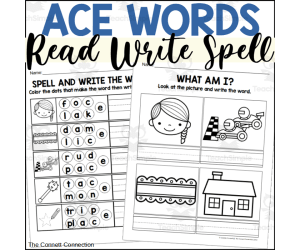
ACE Words Worksheets Read Write and Spell
ELA, Writing, Handwriting, Language Development, Phonics, Reading, Spelling, Preschool, Grade 1, Activities, Worksheets & Printables, Worksheets
Practice reading, writing and spelling ACE words with these CVCe worksheets for practicing the magic E or silent E spelling rule. This phonics worksheet packet provides a variety of ways to practice this phonics skill. This product is suitable for kindergartners and first graders who are learning about how to read and spell CVCe words. There are a number of different worksheets included for students to work on this spelling rule as well as alphabetical order, matching and reading comprehension. Worksheets included: * Write the Word - write the correct ACE word under each picture * Spell and Write - color each dot to spell each word then write the word on the line provided * Match the Picture - read the word then circle the correct picture * Match the Word - look at the picture and circle the correct word * CVCe Sentences - read the sentences and write the correct word to fill in the blanks * CVCe Stamp It - use stamps to spell each word * CVCe Cut and Paste - use magazine letter cut outs to spell each word * What am I? - write the word under each picture * CVCe Story - read each story and write each ACE word that you find in the story With these worksheets, students will practice reading ACE words in isolation and in context of sentences and stories. Students will spell ACE words using picture cues and letter prompts. Students will be engaged in learning with the variety of activities included in this worksheet set. When to Use * Early Finishers * CVCe Word Work Center * Literacy Center * Independent Work Packet * Homework * Sub Plans * Small Group Activities Each worksheets is no prep. They just need to print out the worksheets and give to students to complete. Some sheets will require extra materials like scissors and glue, or stamps. These worksheets will keep student engaged as they read, write, spell and recognize words that use the magic E or silent E spellings. Skills Assessed * Reading, Writing, Spelling CVCe Words
Author The Connett Connection
Tags ACE Words, CVCe Worksheets, Magic E Worksheets, Silent E Worksheets, Phonics Worksheets, Kindergarten Phonics, Literacy Centers, Writing Center, Spelling CVCe Words, How Do You Spell Ace

Letter W Flower Craft
ELA, Language Development, Phonics, Pre-Reading, Kindergarten, Preschool, Crafts, Activities
Enhance the teaching and learning of the beginning sound of letter W with our unique and interactive flower craftivity. This educational tool is designed to facilitate the understanding and recognition of the letter W sound with common, easy to recognize images. Our resource contains three different letter W flower templates to practice both beginning sounds as well as letter recognition. What's Included: There are two different templates that allow students to create a flower focused on recognizing the beginning sound of the letter W. There is one template that allows students to create a flower focused on letter recognition of both capital and lowercase forms of the letter W. Utilizing this Resource: Simply print the flower templates, and then allow the students to color, cut out, and assemble into a flower on colored construction paper. You can also print the flower design onto colored card stock to create a sorting activity . The flower will need to be cut and laminated. This can function as interactive materials in a literacy center, where students can match pictures to the correct letter W flower. Mix and match these with flowers of other letter flower crafts to encourage sorting and classification exercises. Possible Applications: Literacy Centers Classroom decorations or bulletin board displays Creative or Craft Sessions Individual Work Group-based Activities Supplementary Homework These flower craft templates are a perfect fit for educators seeking no-prep resources. All that is required is to print the craft page and distribute it to the students. Basic craft materials such as coloring tools, scissors, glue, and a base paper for the flower craft are needed. Each craft prints on a single page, promoting paper conservation, which aligns with an eco-friendly classroom. Skills Addressed: Identification of the beginning sound of the letter W Recognizing the capital and lowercase letter W Development of Scissors Skills Improvement of Direction Following abilities
Author The Connett Connection
Rating
Tags Flower Craft, Preschool Craft, Kindergarten Craft, Beginning Sounds, Letter Recognition, Letter W, Letter W Activity
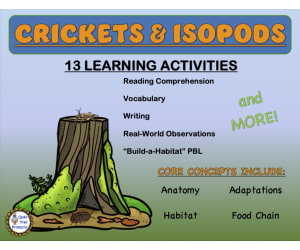
Crickets and Isopods Life Science Learning Activities
ELA, Writing, Science, Life Sciences, Biology, Grade 5, 6, 7, Activities
Here is a great addition to your life science curriculum! If your upper elementary or middle schoolers are delving into the world of crickets and isopods, then this is the product for you. The pages of this packet have everything you need for your learners to gain a deeper understanding of habitats, adaptations, and food chains. As a bonus, there is also a money budgeting activity where learners will work within the given parameters to create a suitable habitat for crickets or isopods. This product has something for all types of learners, and it will give you the peace of mind knowing that they are strengthening skills in nearly all academic domains. As they work their way through each page, learners will be given the opportunity to read, watch educational videos, write, draw, and use critical thinking skills. The best part is, they will also have the opportunity to create real-world connections by observing cricket and isopods in their natural habitats and finding the pros and cons of purchasing new items versus repurposing/upcycling. With the amount of information provided and the variety of activities included, you can use this as a stand-alone product or in conjunction with your science curriculum. The activities can be done individually or in a group setting. Below are the details of each page within this product. PAGES 1-2: Eight vocabulary terms found throughout the pages of the product. (color and b&w versions) PAGE 3: learners will identify a synonym for each vocabulary term. PAGE 4: learners will read about the various physical and behavioral adaptations of a cricket. PAGE 5: learners will read about the various physical and behavioral adaptations of an isopod. PAGE 6: learners will watch an educational video and list facts about a cricket’s appearance, behavior, and habitat. PAGE 7: learners will watch an educational video and list facts about an isopod’s appearance, behavior, and habitat. PAGE 8: learners will label the diagram of a cricket with the given physical adaptations/body parts. PAGE 9: learners will label the diagram of an isopod with the given physical adaptations/body parts. PAGE 10: learners will read clues and identify if the adaptations belong to the cricket or isopod. PAGE 11: learners will complete an observation of a cricket or isopod in their natural habitats. PAGE 12: learners will read two passages about the habitats and adaptations of crickets and isopods. PAGE 13: learners will read the instructions for the “Build-a-Habitat” PBL activity . PAGE 14: learners will list the items they’ll use to build a habitat and complete the corresponding budgetingform. PAGE 15: learners will use the purchasing guide in their PBL activity . PAGE 16: learners will use the upcycling guide in their PBL activity . PAGE 17: learners will use the guidelines to draw a complete habitat for a cricket. PAGE 18: learners will use the guidelines to draw a complete habitat for an isopod. PAGE 19: learners will answer questions as reflection of their PBL activity . PAGE 20: learners will use a Venn diagram to compare and contrast crickets and isopods. PAGE 21: learners will write a paragraph explaining whether or not crickets and isopods can co-exist in the same habitat. PAGE 22: learners will complete a search-and-find activity of animals found in the woodlands habitat. PAGE 23: learners will classify the woodland animals based on three different criteria. PAGE 24: learners will create three food chains (cricket, isopod, learner’s choice) ANSWER KEY
Author Quail Trail Products
Tags Crickets, Isopods, Adaptations, Habitat, Food Chains, PBL, Reading, Writing, Science, Vocabulary
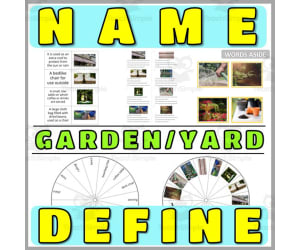
Concept Nouns Naming and Definitions 19
Special Resources, ELA, Language Development, Vocabulary, ESL, Special Education Needs (SEN), Grade 2, 3, 4, 5, Activities, Games
This series of PDF BUNDLE resources focuses on identifying noun concepts, with engaging visualizations ( pictures and graphic arrangements ) of vocabulary by topic. The activity materials in this assignment are designed to help students develop their vocabulary and reading comprehension skills through interactive activities and real-life examples. It includes clear names and definitions of words from common noun categories and can also serve as discussion prompts to encourage critical and analytical thinking, deepen your understanding of the language, and improve your communication skills . This resource is designed to be accessible and engaging to all students . Ideal for teaching English as a Second Language and intervention sessions on learning difficulties. Clear and concise language, visual aids and interactive activities help students easily understand and remember information, integrating visual and kinesthetic elements. You can choose from a variety of worksheets that suit your student's level, interests, and printing preferences. Each category topic includes : 2 sets of Flash cards ( definition sentence / image, image / definition sentence ) 2 sets of Flash cards ( definition word / phrase, definition phrase / word ) 3 anagram strings ( mixed letters of single words or in definition text ) 1 Crossword ( word definition ) 2 sets of linked activities Draw a Line ( definition / image, image / definition ) 2 sets of matching activities Draw a line ( word / definition, definition / word ) 2 series of Quizzes ( definition / image, image / definition ) 2 series of quizzes ( word / definition, definition / word ) 3 Wheels of Fortune ( words, definitions, images ) Search page for 1 word ( word definition ) 2 writing boards ( words, definitions ) 2 blank boards/artboards ( words, definitions ) Various puzzles and word games for naming noun concepts as well . * Use as-is or create your own board games, like Snap, Memory, Match to Sample, and Knowledge Races . Distribute it as morning exercises, quiet time and focus activities, independent workbooks, or fun homework . 65 PDF Pages
Author WORDS ASIDE
Tags Esl, Word Defining, Semantics, Word Search, Anagram, Flash Cards, Centers, Crossword, Definitions, Writing Expository
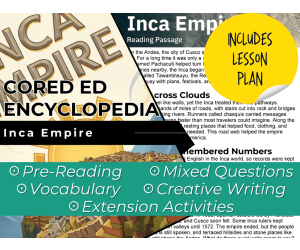
Inca Empire Reading Comprehension Passage - Cored Ed Encyclopedia
ELA, Reading Comprehension, Reading, History, Social Studies, Science, Geography, Technology, Pre-Reading, Language Development, Grade 2, 3, 4, 5, Worksheets & Printables, Worksheets, Teacher Tools, Centers, Activities, Writing Prompts, Assessments, Quizzes and Tests, Quizzes, Lesson Plans
This Inca Empire reading comprehension with lesson plan includes: Visualization (on the front cover) Start your lesson by taking a minute to think and share something about the topic. Read the script aloud (slowly), perhaps prepare some music or sound effects. Student close their eyes and let their imaginations wander. Students open their eyes, read the question aloud and give them a few minutes to complete. Ask a few students to share or keep answers until the end to compare with what they learn in the passage. Quick pause—thousands of Cored Education products are included with your TeachSimple membership. Download links and encyclopedia index available here. Pre-Reading Trivia Students will write down one thing they already know about the subject and then read five more facts and discuss. These facts are fun, and the students will enjoy learning about the subject before reading more. Give 1 minute for students to write what they already know (no pressure—best guess is fine). Read the five facts together. After each fact, do ask a student for their opinion, was it surprising? Set a purpose by asking students to highlight/underline one fact they want to learn more about during the reading. Reading Passage The text is a high-interest reading passage with set paragraphs, roughly three to four paragraphs long. It contains a variety of themes about the topic, anywhere from history to technology. The passage is between 250 and 350 words in length. First, ask students to look at the headings and see what they’ll learn about today. What do they know about the topic/heading? First read options: Teacher read-aloud (best for support). Partner reading (paragraph by paragraph). While reading, students underline important details, and vocabulary words they think may come up in the questions section. Mixed Questions The first question page contains four multiple-choice questions, each with a choice of four answers, and three written response questions that require a sentence or two from the student. Students complete the mcqs first independently, then review quickly as a class. For the 3 written responses, try to get students giving the answer with some form of evidence: “I think ___ because the text says ___.” If students get stuck, send them back to check the passage. Vocabulary Questions Practice seven key words from the text in this section across two activities. First section is scrambled words where students will unscramble three words given a clue for each. The second section is a word to meaning matching activity. Before starting, have some students read out words they underlined in the passage. Ask students to say the word and read aloud the sentence(s) around each word. Ask students to do scrambled words and the matching exercise in pairs then go through answers as a class. For the scrambled spelling task, get four pairs to come up to the board and write the words for extra practice with the other student reading out the clue. For the matching task, prompt students to give full sentences: “I matched ___ with ___ because ___.” Creative Writing In this question, the student will be required to write a five to eight sentence paragraph on a question related to the topic. Before starting, ask students write down 3 key ideas they are going to include in their piece. Ask students for ideas to share around the class to help those struggling. Pro writing expectations: 5–8 sentences At least 2 facts or details from the passage At least 2 vocabulary words from the previous page Students read their paragraphs while classmates listen for facts and vocabulary words. Extension Activities This page is optional for fast finishers or to take home. There are several activities, each one requiring a different skill. Do some, do none, do all, completely optional - but you will feel reassured knowing every possibility is planned for. Includes summary writting question and additional facts. Answer Key There are answers for the multiple-choice questions, written response questions have sample answers, vocabulary answers and if there is a summary question then a sample summary will be provided as well. Lesson Plan Included Customized lesson plan for this lesson is included. Lesson Snapshot Title: Inca Empire Genre: Nonfiction (informational passage) Subject: Social Studies (History) / Reading (Informational Text) Primary Topic: Cusco, roads, quipu records, terraces, legacy Estimated Guided Reading Level (A–Z): S What This Lesson Teaches Best How Cusco grew from a small kingdom into a larger Inca state in the 1400s under a leader named Pachacuti, and how the state was called Tawantinsuyu (the Realm of the Four Parts). How Inca engineers built a wide road system with stairs cut into rock and bridges, plus storehouses and resting places that helped the empire spread across western South America. How the Inca kept records without an English-like alphabet by using a quipu (cords with knots and colors for counts and notes). How terraces were used on hillsides to hold soil and water for crops like potatoes and corn, and how work was organized by the state as a kind of tax. How the empire ended after conflict and Spanish conquest, while people and culture continued (Quechua still spoken; terraces and stone places remain). Learning Goals Describe how Cusco changed in the 1400s and name the Inca state described in the passage. Explain how roads, bridges, and storehouses helped the Inca move messages, supplies, and armies. Explain what a quipu is and what it could record, based on the text. Describe what terraces are used for and how they helped farming on hillsides. Identify what happened in the 1500s that led to the end of the empire and one way Inca life continued afterward. Key Vocabulary From the Text Tawantinsuyu — the Inca state called the Realm of the Four Parts. chasquis — runners who carried messages from stop to stop. quipu — cords with knots and colors for records. terraces — flat steps that hold soil and water. storehouses — places along routes that kept needed supplies. FULL CATALOG OF DOWNLOAD LINKS AND ENCYCLOPEDIA INDEX HERE
Author Cored Education
Rating
Tags Vocabulary, Reading Comprehension, Reading Passages, Lesson Plans, Ela Lesson Plans, Reading Comprehension Lesson Plans, Pre-reading, History, Social Studies Lesson Plans, Geography

Enrichment Activities
ELA, Reading, Grade 3, 4, 5, Activities
155 Pages of Great Enrichment Activities Many times students complete work and we may be working at the small group table, talking with a principal, or handling a situation with another student. Students are told to sit quietly, read silently, or wait until given further instructions. We also have those fast-finishers that are done before some children write their name and date. These Enrichment Activities help engage students, creates a flawless system of purpose in your classroom, and help students feel proud and successful in their work. I have poured my heart and soul into these activities because I know how much we need this and how much our students need this!
Author Hillary’s Teaching Adventures
Tags Enrichment, Reading, Centers, Gifted And Talented, Writing, Enrichment Activities Middle School, Kindergarten Enrichment Activities, Reading Enrichment Activities For 3rd Graders, Free Enrichment Activities For Middle School, Enrichment Activities For Kindergarten
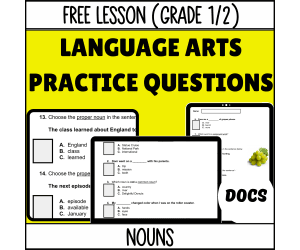
Nouns Sample - Grades 1-2 Grammar (Docs)
ELA, Language Development, ESL, Grammar, Common Core, Resources for Teachers, Grade 1, 2, Lesson Plans, Teacher Tools, Tests, Quizzes and Tests, Assessments, Worksheets & Printables, Centers, Activities
Nouns - 1 Sample Lesson ELA MCQS Overview: In this series of lessons, students will embark on an engaging exploration of the grammar skills that bring our language to life. These lessons are designed to help students identify, understand, and effectively use language arts skills in their writing and speech. Used with the free supplementary materials available for all topics, each lesson builds on the last, offering a mix of direct instruction, interactive group activities, and independent practice. Through fun and creative tasks, students will learn how to recognize grammar in sentences, understand their role in sentences and use them to enhance their own writing and speech. Nouns Overview: Includes: Common Nouns Proper Nouns Irregular Plurals Possessive Nouns Collective Nouns Docs Version This is the Docs editable and fillable version. This download is available in GOOGLE Docs, GOOGLE Forms, GOOGLE Slides. PDF, PPT, WORD, check the links below for more details. FULL CATALOG OF DOWNLOAD LINKS HERE Grade 1/2 Links: Capitalization and Punctuation Google Docs Google Forms Google Slides PDF PPT Word Free Supplementary Materials Pack Adjectives Google Docs Google Forms Google Slides PDF PPT Word Free Supplementary Materials Pack Nouns Google Docs Google Forms Google Slides PDF PPT Word Free Supplementary Materials Pack Pronouns Google Docs Google Forms Google Slides PDF PPT Word Free Supplementary Materials Pack Verbs Google Docs Google Forms Google Slides PDF PPT Word Free Supplementary Materials Pack Prefixes & Suffixes Google Docs Google Forms Google Slides PDF PPT Word Free Supplementary Materials Pack Sentence Structure Google Docs Google Forms Google Slides PDF PPT Word Free Supplementary Materials Pack Subject-Verb Agreement Google Docs Google Forms Google Slides PDF PPT Word Free Supplementary Materials Pack ELA Review Questions Overview Questions have three answer choices. There are a handful of pictures on each test for aesthetic purposes, as well as a review sheet covering most of the topics covered in the product. Introduction or Example Sheet Each topic will include an introduction or example sheet to go through first with your students. Full Answer Keys Full answer keys and sample responses are provided so no matter how busy you are, you know you're covered! In the Supplementary Pack Interactive Ice Breakers: Fun, hands-on activities that get students thinking about adjectives right from the start. Guided Practice: Teacher-led exercises that reinforce the day’s lesson, ensuring students can confidently identify and use adjectives. Group and Partner Tasks: Collaborative activities that allow students to work together to solve problems, categorize adjectives, and create descriptive sentences. Independent Worksheets: Structured worksheets that provide individual practice and help solidify understanding of key concepts. Exit Tasks: Quick, reflective activities at the end of each lesson that assess understanding and encourage students to apply what they’ve learned. For similar downloads and other frees, do check out Cored Group on TeachSimple.
Author Cored Education
Tags Elementary, Reading, Comprehension, Vocabulary, Answers, Ccss, Common Core, Spelling, Writing, Digital Centers
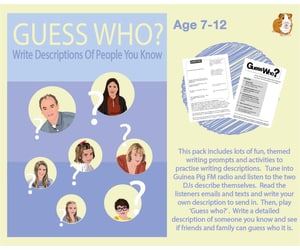
Guess Who? Write Descriptions Of People (7-11 years)
ELA, Writing, Grade 2, 3, 4, 5, 6, Activities
Guess Who? Write Descriptions Of People (7-11 years) 'Guess Who? Write Descriptions Of People' presents an exciting method for children aged 7 to 11 years to boost their language arts and writing skills. This teaching resource connects imagination with practical writing assignments, assisting learners in enhancing their ability to write thoughtful descriptions of people they're familiar with. The process begins with tuning into a fictitious 'Guinea Pig FM radio'. This station features a vibrant radio script where DJ George and co-presenter Christabelle offer descriptions of themselves. Learners are then tasked at mirroring this level of detailing when describing someone they know. Potential extension activities can include turning the assignment into an interactive game of Guess Who?, prompting others identify who the student described based on the stated characteristics. The Structure for Descriptions Physical Appearance Character Traits Hobbies or Activities The writer's feelings about them This structure helps organise students' thoughts and improve their understanding of paragraph building. Fundamental Writing Techniques Integration In addition to content creation guidance and nurturing creativity, this unique resource provides hands-on experience in fundamental writing techniques like utilizing simple compound and complex sentences usefully. It covers basics such as connectives along with grammar punctuation tips designed solely for ages between 7-11 years. Vocabulary Expansion Integration Learners get exposed to better word choices including more descriptive categories - powerful verbs, adjectives that add depth and meaningful adverbs; all intended at significantly enriching students vocabulary banks. This teaching resource comes in a flexible PDF suitable across diverse educational settings from Grade 2 through to Grade 6. It can be utilized for a full-class activity , small group work, or assigned as individualized homework tasks aimed at reinforcing robust language arts skills, with a prime focus on writing.
Author Guinea Pig Education
Tags Descriptive Writing, Character Descriptions, Language Arts, Vocabulary Expansion, Paragraph Building
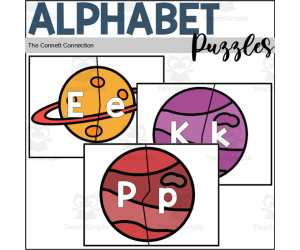
Space Alphabet Puzzles
ELA, Language Development, Phonics, Kindergarten, Preschool, Activities, Centers
Teach your preschool and kindergarten students the letters of the alphabet with a wonderful space themed activity with these letter puzzles. Designed to reinforce letter identification skills, these puzzles provide a fun and interactive way for students to practice recognizing and matching capital and lowercase letters. As students piece together the two halves of each space object, they will develop their letter recognition abilities. These alphabet puzzles are a great educational tool to enhance early literacy and also make learning the alphabet an enjoyable experience for young learners. What is Included: This resource contains 26 two-piece alphabet puzzles for matching capital and lowercase letters for each letter of the alphabet. The hands-on nature of these puzzles gives students a tactile way to practice matching uppercase and lowercase letters of the alphabet. Students can complete these puzzles independently or with a partner. When to Use Early Finishers - If students finish their work early, they can use these puzzles for extra practice. Small Group Work - Teachers can use these puzzles to target small groups of students who need more practice. Literacy Center - Students can practice building words individually or with a partner in a literacy center . Morning Tub or Basket - Students can work independently or with a partner to complete the puzzles while waiting on classmates to arrive at class. Tasks Boxes - These puzzles fit well in tasks boxes making literacy centers easy to set up and put away. Skills Assessed: Letter Recognition and Identification for Capital and Lowercase Letters Matching Capital Letters with their Corresponding Lowercase Letters Ability to place single letters in alphabetical order These space alphabet puzzles are a low prep option for teachers. They just need to be printed out and cut apart before being added to the desired activity location. The puzzles can be laminated for durability if desired.
Author The Connett Connection
Rating
Tags Alphabet Puzzles, Letter Recognition, Alphabet Activities

UN Word Family Flower Craft
ELA, Language Development, Phonics, Preschool, Grade 1, Crafts, Activities
Get those creative juices flowing with these UN words flower craftivity. Students will practice reading and identifying UN words while creating a fun spring flower. What is Included: There is 1 flower template for reading UN family words There is 1 flower template for identifying and matching UN words and pictures. This resource contains two CVC words flower template. When finished, each flower will have 6 different petals with words and pictures. They can be used to introduce or review CVC words, especially words with the UN spelling. With easy to identify images, students will not have difficulty knowing which picture matches which word. There are two ways to use this product: One way to use this resource is to simply print, and allow students to color, cut out and glue the flower onto colored paper. Another way to use this resource is to print the flower onto colored card stock paper. The teacher then can cut and laminate the pieces. The flower can make a great matching activity for a literacy center, or be combined with other word flowers to sort. Ways to Use: Independent Work - Students can complete books on their own. Small Group Activity - The teacher can target students who need more practice with word families in a small group setting. Early Finishers - Students who finish other work early can make these books for extra practice. Homework - These foldable books can be sent home for students to work on with parents. Sub Plans - The no-prep nature makes these books great for subs to give to students to complete. Create a hallway, wall, door or bulletin board display Skills Assessed This activity has students practice scissor skills and following directions. This activity tests students' ability to read CVC words and match UN words with pictures. These flower craft templates are a single paged craft that supply a no prep option for teachers. One the page is printed, the teacher just needs to provide students with scissors, glue, crayons, and colored paper.
Author The Connett Connection
Rating
Tags Phonics Craft, Craftivity, CVC Words, Flower Craft, Literacy Center, Spring Craft, Kindergarten Phonics, Kindergarten Literacy, Un Words
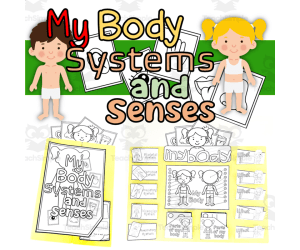
My Body Systems And Senses Lapbook
ELA, Language Development, ESL, Science, Life Sciences, Human Body, Grade 1, 2, 3, Activities, Projects
My Body Systems And Senses Lapbook Integrating visuals and hands-on activities, the My Body Systems And Senses Lapbook offers an intricate guide to human anatomy. This resource provides a distinct learning opportunity for students in grades 1 through 3, making it also suitable for home education or English language learners. Multi-Subject & Inclusive Design This instructional lapbook is designed to cover multiple subject areas - Language Arts, Science, and specifically caters to ESL learners by reinforcing vocabulary in English relating to body systems. Two versions are available for male or female bodies which further ensures inclusive learning as all genders are represented. In-depth & Interactive Content on Body Systems and Senses Covers five primary body systems - skeletal, respiratory, circulatory, nervous and muscular. Detailed content on five principal senses. In-depth information on twenty main parts of the body – front and back- included in pocket folds for a practical approach. Vibrant & Engaging Visual Aids In each lapbook folder are organized inserts that showcase each system with black-and-white images that can be colored by students. This feature not only increases the visual appeal but also prompts engagement of diverse age groups. Pedagogically Aligned Resource With Infinite Re-usability The My Body Systems And Senses Lapbook makes teaching about human anatomy effective during group lessons or small-sized sessions tailored as per class dynamics as well as utilize it as independent study material given student-to-student preference. It matches educational standards outlined within Common Core Standards for both English Language Arts (ELA)and Science syllabus hence promoting consistency across curriculum elements. Furthermore, this PDF-file interactive project type resource can be repurposed repeatedly thanks to its durable file format causing no hindrances in printability making it a flexible long term solution. Overall My Body Systems And Senses is a dynamic learning resource for teachers and home educators looking for diversified, standard compliant, practical yet low cost solutions to teach about human body systems and senses.
Author It's Teacher L
Tags Body Systems, Senses, Human Anatomy, Lapbook, Interactive Project
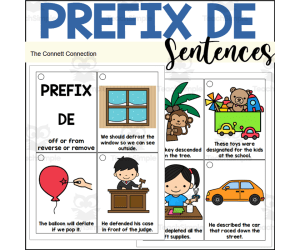
Prefix DE Sentence Reading Rings
ELA, Language Development, Phonics, Grade 2, 3, 4, Activities, Centers, Worksheets & Printables, Task Cards
Practice reading words with the prefix DE- with these sentence reading rings. Students will read words with the prefix de- in the context of sentences. Each card also includes a bold and colorful image to illustrate each sentence and to help students to learn the meanings of each word. What is Included: This resource includes one reading ring for the prefix de. There are seven cards each featuring a different word with the prefix de. The words included in this set are: defrost, depleted, deciduous, decision, deflate, defended, descended, designated, depend, deconstructed, and described. When to Use Early Finishers - If students finish their work early, they can use these reading rings for extra practice. Small Group Work - Teachers can use these reading rings to target small groups of students who need more practice reading words with prefixes. Independent Practice - Students can work independently at their desks to read this set of prefix cards. Morning Work - Students can read and review this reading ring for morning work as their classmates arrive to class. How to Make: Teachers will print out the pages and cut each card apart. Once cut apart, the teacher can choose to laminate the cards for durability. Then, use a hole punch to punch a hole in the top left corner of the card. Place the cards on a ring to create your reading ring, making sure the cover card is on top. Skills Assessed: These reading rings help with identifying words with prefixes These reading rings help with learning the meaning of prefixes These reading rings help students learn how prefixes change the meaning of words. These affixes reading rings are a low prep activity for teachers to prepare for students to use. Once created, these cards can be used over and over to practice reading words with prefixes in the context of a sentence.
Author The Connett Connection
Tags Affixes, Morphology, Prefixes, Literacy Activities, Reading Words With Prefixes
Again Song (MP3)
ELA, Reading, Preschool, Kindergarten, Grade 1, Songs, Activities
Presenting the AGAIN Song (MP3) - a delightful and creative digital resource specifically designed for educators who want to effectively teach sight words in a fun way! This charming musical tool helps students in mastering the recognition of the word AGAIN, which will enhance their reading fluency and comprehension. Our tune is lively and engaging, ensuring your students will enjoy listening to it and singing along as they learn. In this melodic lesson, you'll find that the word AGAIN appears multiple times in various contexts, spelled out rhythmically, and smoothly incorporated into different sentences. This well-rounded approach provides an exciting platform for understanding and memorizing this important sight word. The downloadable MP3 format is user-friendly, allowing easy integration into any teaching plan or device. The delightful combination of music makes this digital educational resource invaluable for teaching sight words. So why wait? Bring joy to your learning environment with a fresh approach that turns sight words recognition into an exciting adventure using the power of music! Head over to TeachSimple.com right now for an effective solution that can help your students succeed!
Author Have Fun Teaching
Tags Counting