resources by type
resources by grade
resources by subject
other resources

3,950 products added recently

Page 2 - Money Activities

Prepare your middle school students for real-world financial decisions with money activities that teach essential concepts. This collection includes budgeting simulations, currency identification games, and lessons on saving and investing. By integrating these activities into your curriculum, you can equip students with important financial literacy skills.

Relevant
alt down
Any Time
alt down
filter by
alt down
All File Types
alt down
filter nav Show filters
Sort by: Relevant
CLEAR
resources by type
Activities
up arrow
Centers
Crafts
Escape Room
Experiments
down arrow
Games
Projects
Read Alouds
Songs
Classroom Decor
down arrow
Teacher Tools
down arrow
Worksheets & Printables
down arrow
resources by grade
Early Learning
down arrow
Pre-K
down arrow
Elementary
down arrow
Middle School
up arrow
Grade 6
Grade 7
Grade 8
High School
down arrow
Adult Education
Not Grade Specific
resources by subject
Creative Arts
down arrow
ELA
down arrow
Holiday & Seasonal
down arrow
Life Studies
down arrow
Math
up arrow
Addition and Subtraction
down arrow
Algebra
down arrow
Calculus
down arrow
Trigonometry
Decimals
Early Math
down arrow
Fractions
Geometry
Graphing
Measurements
Money
Multiplication and Division
down arrow
Number Lines
Order of Operations
Percentages
Statistics
Time
P.E. & Health
down arrow
Social Studies
down arrow
Special Resources
down arrow
Science
down arrow
Foreign Languages
down arrow
Resources for Teachers
down arrow
other resources
Common Core
Homeschool Resources
down arrow
Montessori
Research
STEM
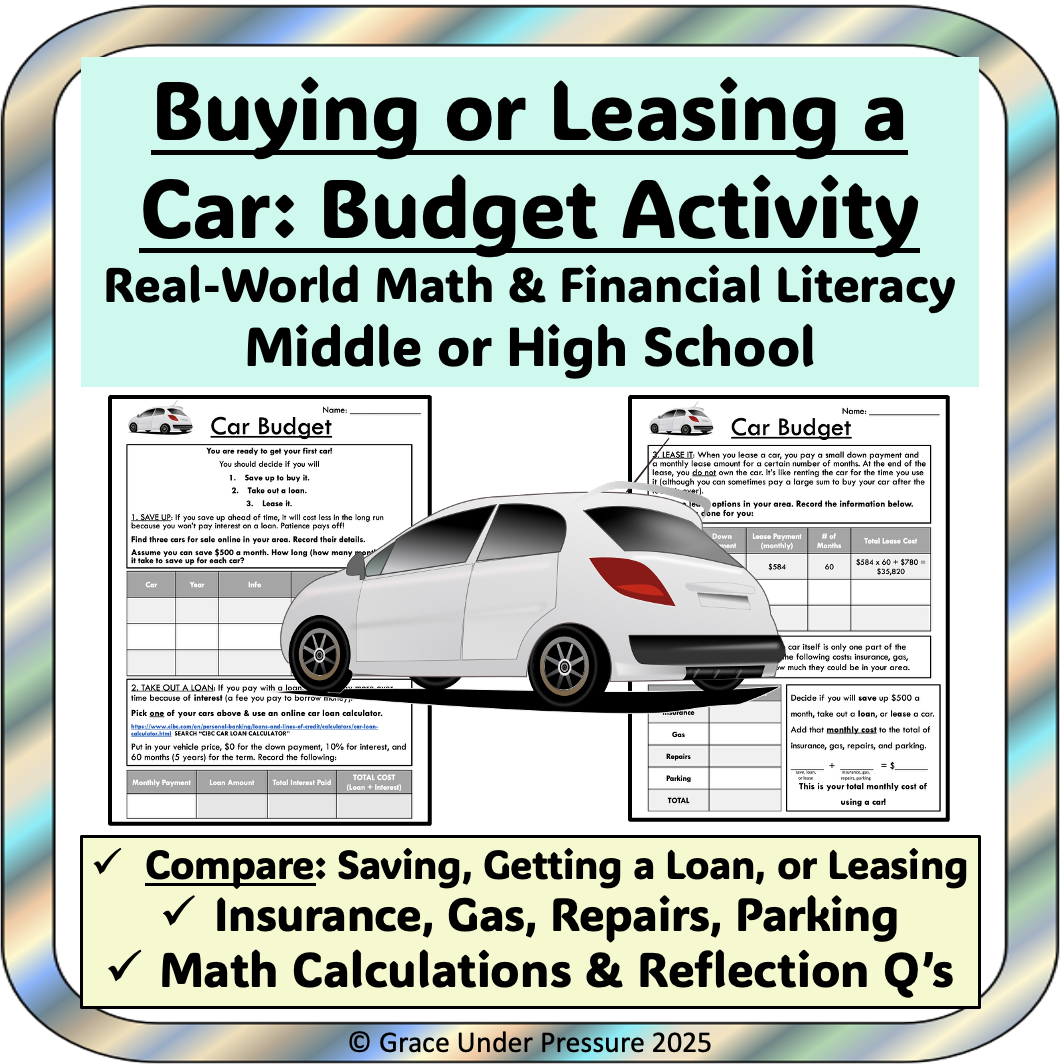
My Budget Project – Financial Literacy Grades 3–6

My Budget Project – Financial Literacy Grades 3–6
Special Resources, Life Studies, Life Skills, Finance, Home Economics, Math, Money, Addition and Subtraction, Addition, Multiplication and Division, Division, Subtraction, Grade 3, 4, 5, 6, Worksheets & Printables, Word Problems, Activities, Projects

Here’s a realistic and engaging way to teach upper elementary pupils in grades 3-6 about budgeting while introducing some basic financial literacy too! How to Use: 1) Each student will be assigned a monthly budget (from $1,700 all the way to $5,000). 2) They select one of three options (low, medium, pricey) for each spending category: housing, eating, transportation, technology, & clothing. They might find that they have to change their choices as they move through the process. Making sacrifices is part of budgeting in real life too! 3) Students add up the amounts they spend and calculate how much they can save per month (and throughout the entire year). 4) They pick what luxury option they would save for over time: a car, a video game system, a vacation, or a house. This lesson is full of fun and bright visuals and charts that are well-organized to ensure that this math learning is accessible to all the students in your class! Math skills needed: Addition - up to 1,000 Subtraction - 4-digit numbers Multiplication - 4-digit numbers by 12 Grades to Use With: This lessons is designed to be accessible to younger students in the elementary years (grades 3-6) because it uses simple math skills and bright and engaging visuals. It could also be an excellent resource for a high school special education classroom! What's Included: A total of 10 pages: Title Page Different Student Budgets to Assign Student Title Page Budget Spreadsheet 5 pages of options (housing, eating, transportation, technology, and clothing) Savings Spreadsheet If you enjoy this project, please check out other math and financial literacy activities in my store: Grace Under Pressure ! I strive to help students see how the math skills they learn in the classroom are super helpful in everyday life! Back to School Budget Activity Halloween Budget Activity My Party Budget: Decimals and Percentages Practice

Author Grace Under Pressure

Rating

Tags Financial Literacy, Budget Project, Spending, Saving, Budget, Rent, Groceries, Shopping, Transportation, Banking

Money Math Life Skills Worksheet: Clothes Shopping Level 2

Money Math Life Skills Worksheet: Clothes Shopping Level 2
Special Resources, Creative Arts, Art, Social Emotional Learning (SEL), Special Education Needs (SEN), Life Skills, Math, Money, Grade 7, 8, 9, Activities, Worksheets & Printables, Worksheets

The Money Math Life Skills Worksheet : Clothes Shopping Level 2 is an interactive teaching tool ideal for middle school students in the Special Education space. This educational resource is designed to help students understand and calculate sales tax prices relative to various clothing items, such as pants, shirts, shoes, dresses, skirts and accessories. Objective The aim of this worksheet is to develop crucial life skills that enable young learners to be more independent. It starts with finding the cost of two clothing items and understanding how sales tax affects the final price. Progression of Activities Finding the cost of three different clothing items including their tax charge. A step-by-step guide helping students calculate sales tax and total price for multiple clothing goods. This worksheet contains 60 questions presented in word problem format coupled with options for correct answers, divided into 6 sets tailored around each type of attire mentioned earlier. Suitable Audience & Applications This tool could be used in a variety of settings: mainly within middle school Special Education classes or one-on-one settings but also in regular classrooms or small groups. The idea being it can also double up as homework assignments making learning continuous even at homes. Inclusions & Delivery Method This printable resource includes step-by-step instructions on taxes calculation nuances besides real-world examples along with suggestions on applications making it highly espousing from pedagogical point-of-view. It's delivered via an easy-to-consume PDF file comprising color & black-and-white pages versions each loaded uniquely catering both inclusivity besides accommodating visual preferences providing educators flexibility during dissemination process. In summary, if you're seeking to engage your students actively with an eye on cultivating pragmatic money math skills, then the Money Math Life Skills Worksheet : Clothes Shopping Level 2 is worth considering.

Author Adulting Life Skills Resources

Tags Money Math, Life Skills, Clothes Shopping, Sales Tax, Special Education, Math Clothes

6th Grade Math: Ratio & Proportional Relationship Bundle: 6 Activities

6th Grade Math: Ratio & Proportional Relationship Bundle: 6 Activities
Math, Money, Percentages, Fractions, Common Core, Grade 5, 6, 7, Worksheets & Printables, Word Problems, Activities

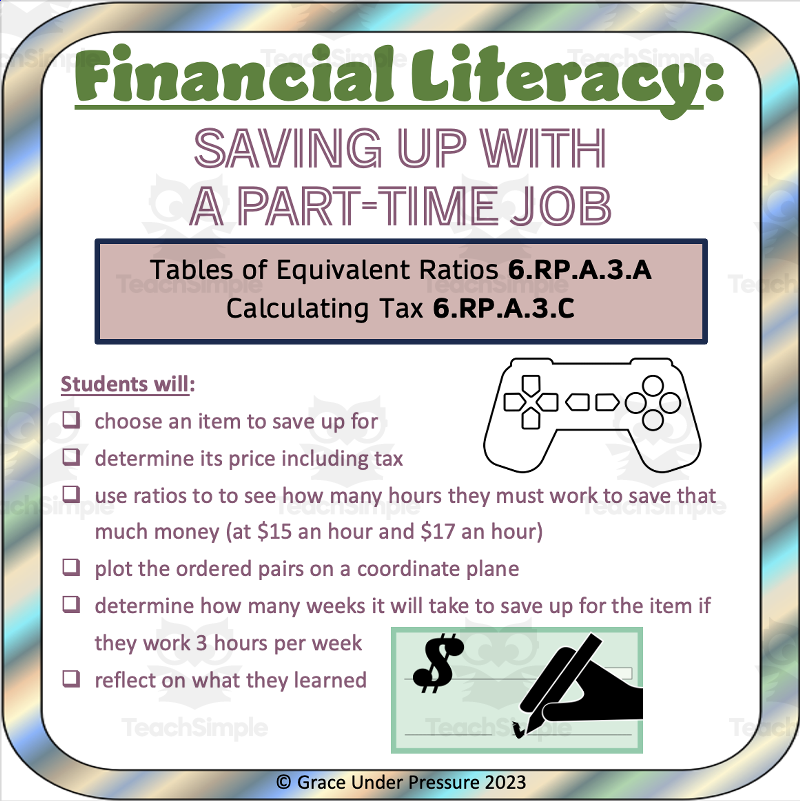
Do you need some new ideas for your 6th grade math unit to meet the Common Core State Standards for Ratios and Proportional Relationships? Here is a ready-to-go bundle with six fun real-life activities to incorporate into your unit plan. 1) Ratio Exit Slip: Here is a quick assessment to check your students' understanding midway through a ratio unit. It assesses part to part and part to whole ratios and uses visuals. 2) Math Stations: Ratios and Proportional Relationships: These 5 stations are filled with problem solving, equivalent ratios, visual tasks, finding the ratios on road trips and more! 3) Income Inequality: Use a real world (and simple!) ratio called the Palma Ratio to talk about income inequality around the world and what kind of society your students want to live in. 4) Saving Up With a Part Time Job: Fill in ratio tables and graph them as well as your students choose an item to save up for, determine the tax, figure out how many hours they would have to work at two different hourly wages, and determine how many weeks it would take to save for their item. 5) Grocery Shopping Price Comparisons: Students use ratio and rates to figure out the best deal when sale prices are written in different a confusing ways. 6) Calculating Taxes, Tips, and Sale Prices: Students are taught three methods for calculating percentages: using benchmarks, using fractions, or using decimals. Then they apply these strategies to six real world examples. Grades to Use With: This bundle is designed for students in Grade 6, but can be used for Grade 5 enrichment, Grade 7 or 8 review, or high school special education classes. What's Included: 22 Page PDF with 6 Activities If you like this product, check out my 6th Grade Math Statistics and Probability Bundle as well!

Author Grace Under Pressure

Tags 6th Grade Math, Financial Literacy, Ratios, Proportional Relationships, Rates, Ratios And Rates, Percent, Ratio Tables, Grade 6 Math

5th grade 6th grade Christmas Math Activity: Digital and Print

5th grade 6th grade Christmas Math Activity: Digital and Print
Common Core, Math, Addition and Subtraction, Decimals, Fractions, Graphing, Measurements, Money, Multiplication and Division, Grade 5, 6, Word Problems, Worksheets & Printables, Centers, Activities, Escape Room, Games

The time before the holidays can get a little crazy in the classroom. Students are ready for a break and teachers are too! Keep your class engaged with EIGHT Days of math review! The ACTIVITIES are suitable for 5th grade and 6th grade. They are great for easy and fast sub plans. I use them as an 'end of the day carrot' that my students look forward to. They can't leave for the day without getting a step closer to finding Santa so it helps them to stay focused throughout the day so that we have time for the fun activity at the end of the day. One of the best parts: NO PREP required! This is not only great for distance learning but also great if you have run out of copies for the month and need a digital version fast... or if you just forget to make your copies for the week. (It's happened to me! - too. many things to keep track of) The pages do print beautiful in color and black and white if you have the time, but don't fret if you don't. Just assign it on Google Classroom - directions included. If you haven't taught the topic yet, it is a great mini lesson and if you have taught it, it can act as a review. (There are also some fun logic puzzles sprinkled in.) dividing decimals multiplying decimals dividing whole numbers multiplying whole numbers adding decimals subtracting decimals deducing information measurement conversions practicing with money problem solving graphing predicting and having fun! Each task builds off the next. Students will get clues as to where Santa might be hiding AFTER they correctly solve each math task. And don't worry, there is an ANSWER KEY. This resource lends itself to independent work but students can also work in groups of pairs to solve. Don't forget about the other holidays! There is a themed math activity in my store for each of the following: St. Patrick's Day: Find the Leprechaun Easter: Find the Easter Bunny Cinco de Mayo: Find the Piñata

Author Big Apple Teaching

Tags Math Challenge, Find Santa, Decimals, Division, Multiplication, Word Problems, Logic Puzzle, Graphing, Money

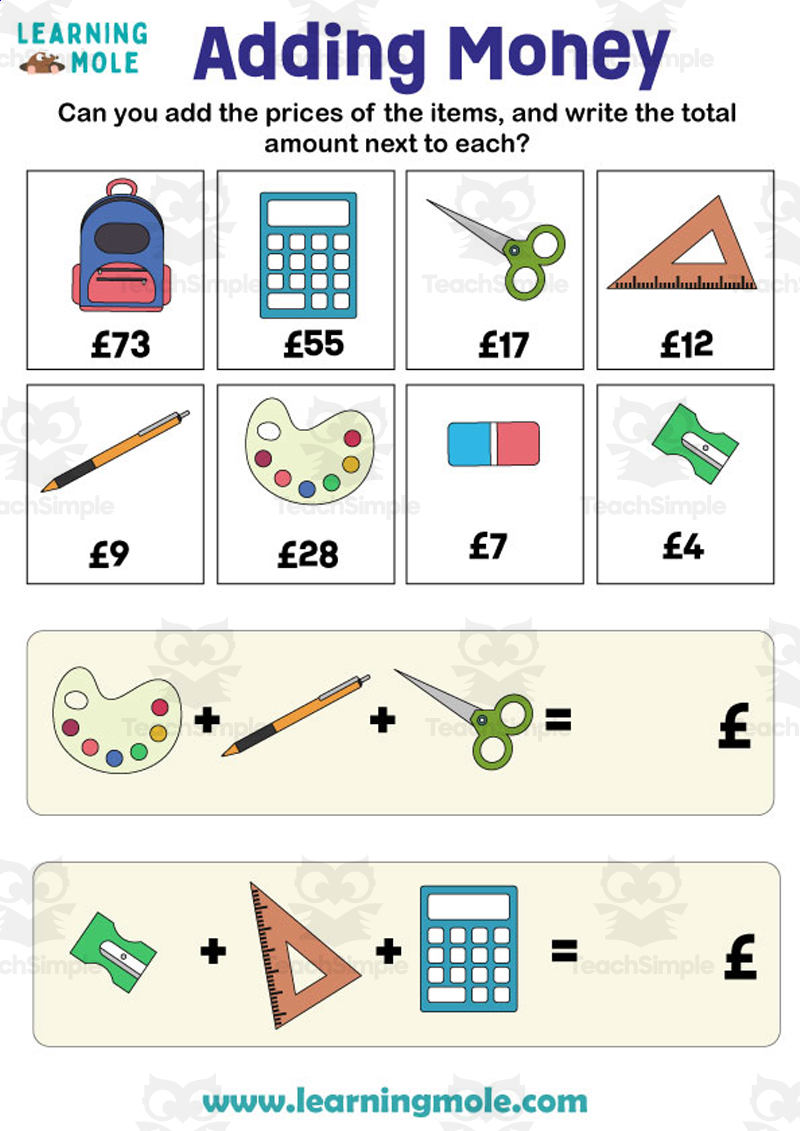
Adding Money Euro Activity

Adding Money Euro Activity
Money, Math, Addition, Addition and Subtraction, Grade 2, 3, 4, 5, 6, 7, 8, 9, 10, Activities

Activity Introduction An amazing activity designed for the students to learn more about STEM. Adding Money Euro Do you like STEM subjects? what is your favorite one? Have you ever tried to plant a seed? If yes, tell us more about it. Or have you ever tried to invent something? If yes, tell us more about it. And how do you think it will help us? Have you ever seen a microorganism under a microscope? What was it? And how it looked like? Mathematics is a marvelous subject. Let' sharpen our brains and solve some equations. Do you like timetable tricks? What is your favorite one? Do you know how to code? Have you ever created an app or a game before? If yes, how was it like? Adding Money Euro Activity The activity is perfect for encouraging the researching skills for the students, while learning more about this fantastic topic. Adding Money Euro This friendly designed worksheet is suitable for students at school, homeschooling, and as a group activity. Instructions Can you add the prices of the items, and write the total amount next to each? Format Available in a PDF format.

Author Educational Voice

Tags Adding Money Euro Activity, Adding Money Activity, Money Activity, Addition, Addition Activity, Money , Euro, Euros, Addition Facts, Money Facts

Math in the Real World: Personal Math Research Project for STEM, Enrichment, or Early-Finishers

Math in the Real World: Personal Math Research Project for STEM, Enrichment, or Early-Finishers
Math, Percentages, Decimals, Money, Fractions, Geometry, Measurements, STEM, Research, Grade 5, 6, 7, 8, Activities

Personal STEM Research Project: Each student chooses a topic of interest and answers a challenging math question about it after step-by-step mini lessons teach them how. This research project can be used in many ways: - As a whole class STEM unit with 7 mini-lessons (a great idea for Friday afternoons) - As a year/term-long project for early finishers (no more copying extra math worksheets for every single lesson!) - As an enrichment activity for a small group (for those students who are ready for an extra challenge) The unit takes students through the step-by-step process using an example (how much water is needed to fill an ice rink for the NHL). The 7 steps are: o Topic: Help your students choose a topic and then narrow it down. This way your students will be invested in this project because it is about something that interests them! o Question: Brainstorm questions about that topic that need math to be solved. Help guided your students to a question that will have more than one step to solve. o Skills: Practice/learn skills needed to answer the question. Your students can use math websites like IXL, youtube videos, or their textbook to learn/review skills. o Research: Complete research to find necessary information. Students will need to find science and technology information to answer many of their questions. o Math: Put the skills and research together to find the answer! o Present: Think of a creative way to present the solution to the class. o Reflect: Take time to think back on the process. Grades: This project works well for intermediate/middle school aged students in grades 5-8. It could also be used in a high school special education classroom with extra support.

Author Grace Under Pressure

Tags Math Project, Real Life Math, Math Research, STEM, Enrichment, Inquiry, Question, Problem Solving, Word Problems, Applied Math

Money Math Life Skills Worksheet: Clothes Shopping Level 1

Money Math Life Skills Worksheet: Clothes Shopping Level 1
Special Resources, Life Studies, Creative Arts, Art, Social Emotional Learning (SEL), Special Education Needs (SEN), Life Skills, Finance, Math, Money, Grade 7, 8, 9, Activities, Worksheets & Printables, Worksheets

Clothes Shopping Money Math Level 1 teaches middle school students with special needs how to budget for buying clothes. This 60-question worksheet covers calculating costs of pants, shirts, dresses, shoes, skirts, and accessories. Use this independent living skills activity one-on-one or in special education classes. It reinforces money math abilities needed for the community and features step-by-step instructions, real-world examples, and ideas for personalized implementation based on your student's needs and IEP goals. The interactive format engages students through word problems, answer options, and provided solutions. Print this activity for an easy-to-use resource that aids in developing essential life skills for increased independence at home and school. Pair it with our full series of practical money math worksheets on reading menus, grocery shopping, and more.

Author Adulting Life Skills Resources

Tags Life Skills Money Math, Interactive Math Problems, Independent Living Skills, IEP Goal-Oriented Skills, Autism Resource For Parent , Adulting On The Spectrum, Social And Emotional Learning, Life Skills For Teens, Life Skills For Adults, Autism And Money Skills, Basic Math Clothing Shop

Understanding a Paycheck

Understanding a Paycheck
Life Studies, Finance, Home Economics, Math, Money, Grade 6, 7, 8, 9, 10, 11, 12, Activities

This activity is all about Understanding a Paycheck. The product includes a sample of a realistic earnings statement along with 18 questions regarding the understanding of how to read one and an answer key. This is a great way to help students understand taxes, social security, income, retirement, etc. It is a great component of any consumer math or financial literacy unit! Comprehending how to read an earnings statement, commonly included with paychecks, is vital for middle and high school students. It cultivates essential financial literacy and practical life skills. These statements outline earnings, deductions, and net income, enabling students to grasp the relationship between work and pay. This knowledge is invaluable for budgeting, taxation awareness, and setting financial goals. Additionally, it lays the foundation for responsible financial management and career decisions. Teaching students to decipher these statements equips them with indispensable tools for personal financial success, promoting financial independence and informed choices as they transition into adulthood. Students will engage in consumer math as they see samples of earning statements and answer comprehension questions. It includes a PDF that you can utilize as a printed worksheet, but also includes a Google Slides version in order for you to be able to utilize it online.

Author Mister G's Teacher Shop

Tags Paychecks, Earning Statements, Careers, Finances, Writing A Check, Writing, Comprehension Questions, Google Slides, Consumer Math

Financial Literacy: Household Budget Project

Financial Literacy: Household Budget Project
Life Studies, Math, Decimals, Money, Finance, Home Economics, Grade 8, 9, 10, 11, 12, Activities, Projects

Financial Literacy: Household Budget Project - Taxes, Insurance, Loans, Rent, Groceries and More! This resource is a ready-to-print and engaging project designed to teach high school students about personal finance and budgeting.. Each student is assigned a fictional career with a specific salary and student loan debt- which makes the budgeting process as realistic as possible! You could be a doctor with a high salary and a huge debt, a cashier with no debt but a very low salary, or something in between. Tasks: Income tax calculations using percentages written as decimals Rent options research and saving up for a house down payment in the future Loan repayment (if you have one) Transportation options: bus, leasing a car with no money down, saving up for a car Budget allocations for food and clothing Making monthly payments such as health insurance, electricity bills, and subscription services The flexibility of this project allows students to work at their own pace following the step-by-step instructions. If they encounter a shortfall in funds, they will need to re-evaluate their spending habits which offers an invaluable lesson in financial prioritization. Sometimes you can't have it all! Grades to Use With: This lesson is primarily designed for high school students in grades 8-12. It could be used in math class, career and personal planning, or family studies course. It could also be used for enrichment in grade 7 or in a life skills class with enough support and the use of calculators. Flexible Application This project can be used for whole-group instruction, small-group work, or an independent project. All of the instructions are clearly included, so students should be able to work at their own pace. At the end, a reflection is included so students can discuss what they have learned about the budgeting process. This is the kind of learning that stays with students long after math class ends! What's Included: A total of 7 pages in PDF format including 15 unique career cards to assign to students. If you like this personal finance lesson, check out others in my store: Taxes, Tips, Sales Inflation Renting vs Buying a Home Income Tax

Author Grace Under Pressure

Tags Financial Planning, Budgeting, Personal Finance, Math Skills, Taxes, Loans, Rent, Groceries, Financial Literacy, Real World Math

Financial Literacy: Compound Interest with Percent and Formula

Financial Literacy: Compound Interest with Percent and Formula
Life Studies, Math, Decimals, Money, Finance, Home Economics, Business, Grade 8, 9, 10, 11, 12, Worksheets & Printables, Word Problems, Activities

These high school financial literacy worksheets will show your students why compound interest is helpful for investors while also letting them practice math skills using percentages and a simple mathematic formula! How to Use: Print 4 pages for each student. Page 1 teaches students how to calculate compound interest step by step. Students need to have a basic understanding of writing percentages in decimal form and multiplying to find the percent of a number. Next, students will be given their initial investment amount & a yearly interest rate. Each student in your class can be given different values so they have to do their own unique calculations, and to allow comparisons to be made. This provides for easy differentiation as well- you can choose what percentage interest rate each student gets based on their ability. Students will calculate the amount of compound interest they earn over ten years. They can then check their calculations using the compound interest formula that is included. Next, they can use the formula to calculate compound interest over longer periods of time. Your class can compare their results- leading to an interesting class discussion (prompt questions are included). Make sure to point out how compound interest is helpful for investing and saving and detrimental for borrowing money. Finally, students reflect on their learning by writing a paragraph after the lesson. Hopefully they will leave class wanting to start a saving account! Grades to Use With: This compound interest lesson with worksheets is designed for high school students in grades 8 through 12. It could be used in math, applied math, financial literacy, or consumer math classes. What's Included: 6 pages in PDF format: Ready to Print and Use! Title Page Instructions for Calculating Compound Interest 2-Page Worksheet Reflection Paragraph Sample Answer Key Also check out my Financial Literacy Interest Rates: Lending and Borrowing Money Lesson!

Author Grace Under Pressure

Rating

Tags Financial Literacy, Compound Interest, Investment, Yearly Interest, Money, Personal Finance, Interest, Loans, Percent, Compound Interest Lesson

Entrepreneur Fair Mini-Unit – Grades 4–6 Business

Entrepreneur Fair Mini-Unit – Grades 4–6 Business
Life Studies, Math, Money, Finance, Business, Career, Grade 4, 5, 6, Teacher Tools, Lesson Plans, Activities, Projects

This Entrepreneur Fair Mini Unit is completely ready-to-go for your intermediate or middle school classroom. It walks students through the entire process of starting a small business step-by-step. Use it over several weeks, culminating with an Entrepreneur Fair in your classroom where students can buy each other's products and services. This will be the kind of hands-on, applicable learning students don't soon forget! How to Use: Print a booklet (double-sided) for each student with pages 2-7. Print a single page 8 for each student. o What is an Entrepreneur?: Read through as a class and give students time to research entrepreneurs. Decide if students will work independently or in pairs or small groups. o Brainstorming a Product or Service: Support your students as they complete the mind-map to think of a product or service they could sell. Ask questions to get them thinking of ideas. Once they have decided, they complete the page to draw and describe their idea. o Costs to Start a Business: Model a sample product and its costs, then let your students complete this task for their business idea. Encourage them to recycle and reuse items whenever possible: the less they spend, the more profit they can make! o Making the Product: Remind your students about writing instructions. They can include temporal words like first, next, and finally. Then give them class time to make products (some can also be done at home). Decide how much money your students will bring to the fair (and if you will use real money or pretend). I recommend $5. Students need to know this before they can price their item. o Pricing: Give students time to price their product and explain their rationale. o Advertising: Students will create advertisements for their products. You could bring in magazines or show online ads to notice key features: bright, happy, aspirational images with short, catchy phrases and features. You can post the ads around the classroom before the fair. Give students the pretend money (or they bring real money from home) and let them shop for each other’s items. They can make change and keep a tally of sales. o Calculating Profit: Walk students through the profit calculation step-by-step. o Reflection: Finally, give students time to reflect on the entire process.

Author Grace Under Pressure

Rating

Tags Entrepreneur, Entrepreneur Fair, Business, Sale, Money Math, Small Business, Economics, Profit, Mini Unit, Genius Hour

Credit Card Project

Credit Card Project
Life Studies, Finance, Home Economics, Math, Money, Grade 6, 7, 8, 9, 10, 11, 12, Activities, Teacher Tools, Lesson Plans, Projects

Diving into the world of consumer math and understanding how credit cards work can be quite a challenge, especially for younger students who might not have any firsthand experience. This teaching resource simplifies the complexity surrounding credit cards, giving students an informed perspective on their usage, advantages, and potential pitfalls: Credit Card Project Geared towards middle and high school students, this Credit Card Project resource offers a straightforward view of several key aspects: The mechanics of how credit cards operate. Insight into how credit card companies generate revenue. The processes of making payments and understanding the billing cycle . Tips and guidance on using credit cards responsibly. To make the learning process engaging, this package is designed as a project containing a series of worksheets. These worksheets are complemented by informative videos about credit cards, and a sample credit card statement to help students visualize real-world applications. Additionally, to assist educators in assessing the students' understanding and engagement with the project, a rubric is provided. Whether you wish to integrate this resource into your classroom activities or assign it as a home-based project, its flexible structure allows for both. It serves as an invaluable introduction to credit cards, equipping students with knowledge that is crucial as they step into adulthood. For educators who want to ensure that the content aligns with their teaching methods or specific classroom requirements, the entire project is editable. This customization feature ensures that the material remains relevant and adaptable to diverse student needs and academic levels. If you're an educator aiming to impart practical knowledge about credit cards to your students in a concise and clear manner, this resource will certainly serve as a robust tool in achieving that objective. By the end of the project, students will not only have a foundational understanding of credit cards but also be better prepared for the financial choices they'll make in the real world.

Author Mister G's Teacher Shop

Tags Credit Cards, Consumer Math, Finances, Financial Literacy, Project, Small Group, Quiz, Reflection, Google Slides

Financial Literacy: Financial Trade-offs

Financial Literacy: Financial Trade-offs
Special Resources, Life Studies, Life Skills, Finance, Home Economics, Math, Money, Grade 7, 8, 9, 10, 11, 12, Worksheets & Printables, Word Problems, Activities

Financial Literacy: Financial Trade-offs Here’s a quick and simple way to include some easy financial literacy learning into your middle, high school, or special education class. These 8 prompts describe realistic financial scenarios about work, housing expenses, post-secondary education, cars, retirement planning, and wedding costs. Use them as debate topics, research prompts, or a simple whole class discussion (ideal for those extra few minutes you often end up with before the end of class). Only simple math skills and basic financial vocabulary are needed to understand these topics. How to Use: Start by explaining the basic premise to your students: Often people can feel stuck in their life due to a financial issue. However, by making a few financial trade-offs, there is usually a different way to deal with issues. Here are eight real life scenarios that many people deal with. Discuss them with your peers, have a debate, make a list of pros and cons! Realize that you always have more options if you can think critically and creatively. Main Goal: The main goal of these prompts is to drive home the importance of understanding trade-offs in goal setting and financial planning. Each topic presents itself as a relatable real-life scenario offering two distinctive choices involving critical thinking and decision-making. There is no "right" answer: just the right answer for your situation. Grades to Use With: These prompts could work in a middle or high school math class, a personal planning or career and education class, or a high school special education classroom. They could even be used in adult education scenarios. What's Included: A total of 10 pages in PDF: Title Page, Instruction Page and 8 trade-off situations If you enjoy this financial literacy product, please check out some of my other options in my store: FIRE: Financial Independence Retire Early Compound Interest: Hook Students on Financial Literacy Net Worth: Assets - Liabilities = Equity

Author Grace Under Pressure

Tags Financial Literacy, Trade-offs, Critical Thinking, Budget, Money, Life Skills, Real World Math, Finance, Planning, Personal Finance

Checking Account Project

Checking Account Project
Life Studies, Finance, Math, Money, Grade 6, 7, 8, 9, 10, Activities, Projects

I'm thrilled to introduce you to the Checking Account Project, a tailored resource aimed at middle school and high school students. As educators, we know the value of imparting essential life skills, and that's exactly what this project is designed to do—equip students with a foundational understanding of checking accounts and their benefits. Here's what you can expect: Real-World Insight: We all know consumer math can be a bit perplexing, especially for students navigating it for the first time. This product is packed with activities that delve into the workings of checking accounts and how they can be responsibly integrated into daily life. Flexible Learning: Whether your students prefer working from home or in the classroom, this project accommodates both settings. It's adaptable to different preferences, ensuring a seamless learning experience. Empowering Students: By offering various activities, from understanding the anatomy of a check to simulating ATM usage, this project empowers students to become savvy consumers with a firm grasp of checking account essentials. Tailored Adaptation: Education isn't one-size-fits-all, and neither is this project. Feel free to tweak and customize it to align with your students' needs and learning objectives. Included in the package: Glossary of Key Terms: A handy reference for students to familiarize themselves with checking account terminology. Real-World Insight: An activity that encourages students to interview adults with checking accounts, promoting practical understanding. Hands-On Learning: Engaging exercises that teach students how to write checks, endorse and void them, and comprehend the role of debit cards. Practical Application: Utilizing an online ATM simulator, students gain firsthand experience in using ATMs. Financial Literacy: Learning how to balance a checkbook ledger—an invaluable skill for personal finance management. Comprehension Matters: Demystifying checking account statements, equipping students to read and understand them effectively. The Checking Account Project serves as a stepping stone toward financial literacy, ensuring that your students are well-prepared for the responsibilities of the adult world. Feel free to make it your own, tailoring it to resonate with your students' learning journey. Let's empower our students to navigate their financial future with confidence. The Checking Account Project lays down the groundwork for responsible and informed financial choices—a skill they'll carry with them for life.

Author Mister G's Teacher Shop

Tags Finances, Financial Literacy, Checking Account Project, Middle School, High School, Interview, Debit Cards, Math Project, Consumer Math, Project

Adding Money Dollars Activity

Adding Money Dollars Activity
Money, Math, Addition, Addition and Subtraction, Grade 2, 3, 4, 5, 6, 7, 8, 9, 10, Activities

Activity Introduction An amazing activity designed for the students to learn more about STEM. Adding Money Dollars Do you like STEM subjects? what is your favorite one? Have you ever tried to plant a seed? If yes, tell us more about it. Or have you ever tried to invent something? If yes, tell us more about it. And how do you think it will help us? Have you ever seen a microorganism under a microscope? What was it? And how it looked like? Mathematics is a marvelous subject. Let' sharpen our brains and solve some equations. Do you like timetable tricks? What is your favorite one? Do you know how to code? Have you ever created an app or a game before? If yes, how was it like? Adding Money Dollars Activity The activity is perfect for encouraging the researching skills for the students, while learning more about this fantastic topic. Adding Money Dollars This friendly designed worksheet is suitable for students at school, homeschooling, and as a group activity. Instructions Can you add the prices of the items, and write the total amount next to each? Format Available in a PDF format.

Author Educational Voice

Tags Adding Money Dollars Activity, Adding Money Activity, Money Activity, Addition Activity, Money, Money Facts , Money Facts For Kids, Addition, Addition Facts, Dollar

Adding Money GBP Activity

Adding Money GBP Activity
Addition, Addition and Subtraction, Math, Money, Grade 2, 3, 4, 5, 6, 7, 8, 9, 10, Activities

Activity Introduction An amazing activity designed for the students to learn more about STEM. Adding Money GBP Do you like STEM subjects? what is your favorite one? Have you ever tried to plant a seed? If yes, tell us more about it. Or have you ever tried to invent something? If yes, tell us more about it. And how do you think it will help us? Have you ever seen a microorganism under a microscope? What was it? And how it looked like? Mathematics is a marvelous subject. Let' sharpen our brains and solve some equations. Do you like timetable tricks? What is your favorite one? Do you know how to code? Have you ever created an app or a game before? If yes, how was it like? Adding Money GBP Activity The activity is perfect for encouraging the researching skills for the students, while learning more about this fantastic topic. Adding Money GBP This friendly designed worksheet is suitable for students at school, homeschooling, and as a group activity. Instructions Can you add the prices of the items, and write the total amount next to each? Format Available in a PDF format.

Author Educational Voice

Tags Adding Money GBP Activity, Adding Money Activity, Money Activity, Money, Money Facts, Addition, Additions Facts, Addition Activity, Pound Sterling, Pound Sterling Activity

Pension Activity

Pension Activity
Math, Money, Grade 3, 4, 5, 6, 7, 8, 9, 10, 11, 12, Activities

Activity Introduction An amazing activity designed for the students to learn more about STEM subjects. Pension Do you like Mathematics? what is your favorite subject? Do you like to be an entrepreneur someday? If yes, who is your favourite entrepreneur? What your business will be about? Have you ever tried to calculate your monthly spendings? If yes, tell us more about it. Have you ever seen a grownup using a credit card to making a money transaction online? If yes, do you think it is safe? Mathematics is a marvelous subject. Let' sharpen our brains and solve some equations in our daily life. Do you like timetable tricks? What is your favorite one? Using credit cards online is a little bit tricky. What do you think? Pension Activity The activity is perfect for encouraging the researching skills for the students, while learning more about this topic. Pension This friendly designed worksheet is suitable for students at school, homeschooling, and as a group activity. Instructions Plan your needs and wants for each week based on your weekly pension. The first week is an example. Format Available in a PDF format.

Author Educational Voice

Tags Pension Activity, Pension, Pension Facts, Pension Facts For Kids, Money, Mathematics, Financial Literacy, Financial Literacy Facts, Financial Literacy Facts For Kids