



3,993 products added recently
Page 81 - Science Activities
Ignite your students' interest in science with activities that make learning interactive and exciting. This collection offers experiments, demonstrations, and inquiry-based projects covering various scientific fields. By integrating these science activities into your lessons, you can encourage critical thinking, foster curiosity, and deepen understanding of scientific concepts.

 Show filters

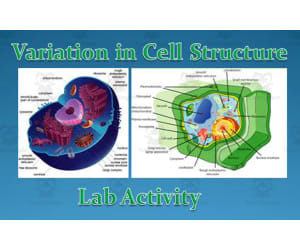
Cell Lab Activity
Science, Life Sciences, Human Body, Grade 9, 10, 11, 12, Labs, Experiments, Activities
Cell Lab Activity: An Engaging Teaching Resource for Science Educators Enhance your science curriculum with the interactive Cell Lab Activity focused on differentiating between animal and plant cells. This adaptable lab suits a wide demographic of students, emphasizing a hands-on learning approach. The Activity Process In this hands-on experiment, students: Observe cells from sources such as tomato pulp and skin, potato, and human cheek cells. Analyze biological material under scientific scrutiny. Gain insightful knowledge about the functions of various cell parts. Depending upon your classroom's pace, this activity spans approximately 1½ to 2 days—optimizing time towards understanding complex concepts. What Else is Included? The kit includes: A Variation in Cell Structure Lab worksheet with an answer key for students to verify their findings- reinforcing self-evaluation techniques. A helpful materials list and general guidelines that assist educators in organizing resources smoothly. Inclusive sample pictures which support descriptions of cellular concepts accessible to all learners—including visual-learners—for better comprehension! The inclusion of practical thinking into teaching methodologies widens horizons: Leveraging education beyond textbooks boundaries preparing our future scientific pioneers—to drive societal goals—from just simple thinkers to thought leaders! Note: It’s important teachers know that every lab activity must always be performed under supervision!
Author The Teacher Team
Tags Cell Structure, Lab Activity, Plant Cells, Animal Cells, Hands-on Learning
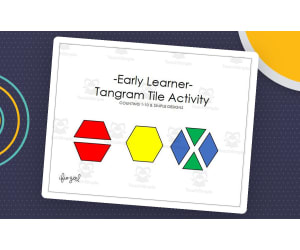
Tangram Tile Activity
Special Resources, Special Education Needs (SEN), Math, Patterns, Early Math, Geometry, Science, Basic Science, Kindergarten, Preschool, Grade 2, 3, 4, 5, 6, Activities
The Tangram Tile Activity : An Effective Teaching Resource The Tangram Tile Activity is a robust educational tool aimed at learners from Preschool to Grade 6. Designed for both public school and homeschooling environments, this activity uses tangram puzzles to engage learners in interactive learning. Main Objectives Spatial reasoning: By working with various shapes, students gain an understanding of the interplay between spaces and shapes. Problem-solving: Assembling the tiles into specified designs challenges learner's logical thinking and creativity. Creativity: Tiles arrange into unique patterns enhancing students' imaginative thinking and self-expression skills. Critical Thinking Skills: Understanding each shape's relationship with other pieces requires analytical skills and promotes critical thought process. Add-on Benefits Tangram activities help improve hand-eye coordination as they require precise motor skills for arranging them correctly. They are valuable aids when teaching geometry, basic science, and promoting creativity within learning groups. Specially Designed for Early Learners This particular set escalates from simple compositions to more complex ones introducing beginner-level participants smoothly into these creations’ engaging world. Tiles are well-spaced making it easier for students facing challenges related to motor functions or visual interpretation issues. Besides having a counting exercise which allows enumeration practice from one through ten, there also 19 patterned-design cards ranging levels catering perfectly across different abilities ensuring progress at every step. These printable activities in PDF format can be used flexibly as individual homework assignments, small group workshops or as a comprehensive classroom resource.
Author IFIO girl - I'll Figure It Out
Tags Tangram Puzzles, Spatial Reasoning, Problem-solving, Creativity, Critical Thinking

Magnets and Electromagnets 42 Question Board Game
Science, Physics, Grade 5, 6, 7, 8, 9, Activities, Games
With 42 question cards on permanent magnets and electromagnets this is an enjoyable and challenging board game for up to six players per set. It is suitable for all abilities. It can be played at the end of a module on electricity and electromagnets but is also a very useful test prep tool. This game is so much fun, pupils will forget they are learning! What You Get Game board (color and black and white) 42 question cards with questions of varying degrees of difficulty Answer sheet Instruction sheet. Rules for Play The player who throws the highest score starts and play proceeds in a clockwise direction. Students take turns and work their way around the board following the instructions in the squares. Some squares tell the student totake a question card from the face down pile. If correct they move on 2 spaces. If a player thinks an answer given by an opponent is incorrect they can challenge. If the challenge is correct the challenger moves forward 2 spaces. If the challenge is wrong the challenger moves back two spaces. In the event of a challenge, pupils are encouraged to consult their books but the teacher has a quick-check answer sheet. Prior Knowledge Required Composition of Magnets: Magnets are constructed using magnetic materials. Common materials include Iron, Cobalt, Nickel, and their corresponding alloys. Pole Interactions: Magnets have two types of poles - North and South. When two like poles (e.g., North and North) come close to each other, they repel. Conversely, when opposite poles (e.g., North and South) are brought together, they attract each other. Magnetic Fields: Surrounding every magnet is an invisible force field known as the magnetic field. This field can be visualized through field lines. Field Line Density: The density of these field lines determines the strength of the magnetic field. A region with closely spaced field lines indicates a stronger magnetic field than a region where they're spread out. Visualization of Field Lines: It's essential to understand and recognize the pattern of field lines around two bar magnets, especially when they have the same or opposite poles facing each other. Field Strength at Poles: The magnetic field is strongest at the poles of a magnet due to a higher concentration of field lines. Distance and Field Strength: The strength of the magnetic field diminishes as one moves farther from the magnet. Direction of Field Lines: Field lines emanate outward from the magnet's south pole and point inward toward the north pole. Magnetization Process: When a non-magnetized magnetic material becomes a magnet, the tiny regions within it called domains, which were initially oriented in random directions, align themselves to point uniformly in the same direction. Earth's Magnetic Properties: The Earth behaves like a large magnet. Interestingly, there appears to be a south-type magnetic pole near the Earth's geographic North Pole and a north-type magnetic pole near the Earth's geographic South Pole. Application in Devices: It would be beneficial to have a basic understanding of how magnets and magnetic fields operate within certain devices. Familiarize yourself with the structure and functioning of electric bells, relays, and circuit breakers, as they use these principles. See more Elf Off the Shelf resources on this topic and many others. Revisit attraction and repulsion with this magnetic poles investigation .
Author Elf off the Shelf Resources
Tags Magnets, Electromagnets, Magnetic Materials, Magnetic Fields, Earths Magnetism , Electric Bell, Electric Relay, North And South Poles, Magnetic Fileld Lines, Magnetism Game

Make Your Own Pendulum Activity
Science, Physics, Grade 3, 4, 5, 6, Activities
This is a Make Your Own Pendulum Activity. This printable will give students information about pendulums and then provide instructions for how they can make their own.
Author Elementary Resources 4 U
Tags Physical Science, Pendulum, Science Project, Science Activity, Physics, Gravity, Force, Motion, Vocabulary, Time, Can You Make Your Own Pendulum, Making Pendulums, How To Make Your Own Pendulum, Make Your Own Pendulum

Human Body Montessori 3 Part Cards | Internal Organs of the Human Body
Montessori, Science, Biology, Life Sciences, Human Body, Kindergarten, Preschool, Grade 1, 2, 3, Activities, Classroom Decor, Worksheets & Printables, Teacher Tools
This interactive and attractive set Human Body Montessori 3 Part Cards 5 Pages learners develop their original Human Body Montessori 3 Part Cards this set contains 5 pages in this set, each in each a different Digraphs Human Body Montessori 3 Part Cards to ensure a fun and structured approach to using a fun and type of work that useful; Each card is fun this edited set of Human Body Montessori 3 Part Cards is built in an elegant style that attracts attention this interactive and attractive set of Human Body Montessori 3 Part Cards designed to help young learners develop their original Human Body Montessori 3 Part Cards skills through Human Body Montessori 3 Part Cards This set contains. these printable offer useful courses, this provides a useful course-rich practice, it is designed to help using resource grade 2 easily to learn about Human Body Montessori 3 Part Cards fun and interactive manner. A collaborative learning activity added students. PDF format
Author LAMO
Rating
Tags Anatomy, Physical Science, Science, Montessori, Homeschool

Safety Alarm System Design Challenge
Science, Earth and Environmental Sciences, Earth Sciences, Not Grade Specific, Activities
Safety Alarm System Design Challenge Teachers and homeschooling parents alike understand the struggle to keep students engaged in lessons, but the solution might be easier than you think. The Safety Alarm System Design Challenge offers a unique way for educators to make learning interactive and fun. This easy-to-implement resource is an all-in-one teaching aide that educators can hand-out to their students, allowing the learners themselves to work independently. It creatively combines different areas of study such as: Makerspace Genius Hour Independent Time STEM Choice Time, Technology Class along with more unconventional options like Library Time or afterschool programs. The materials required for each challenge come packed with clarity. A Context setting section - giving meaning behind each challenge A Design Challenge - indicating what needs completion A Specifications section - outlining non-negotiables during the task Few other pointers are mentioned below: - The Constraints- which establish boundaries within each activity ; The Materials - outlining resources needed for tasks; Tools needed for completion of tasks; Additionally there are helpful Tips provided - making it convenient even for novice educators! This resource does not follow standard traditional grade limitation – allowing it to adapt easily across multiple grades without difficulty ensuring all students receive an education that encourages creativity and imagination in every step they take.” Consider integrating this into your teaching strategy – whether it’s used in whole group sessions where collaborative dialogue enhances the discussion quality or small group dynamics ideal for honing teamwork skills or even individual assignments promoting self-sufficiency – hence proving useful during SEL (Social Emotional Learning) time. The Safety Alarm System Design Challenge is a flexible tool that adds texture and depth to the learning experience while stimulating minds in ways textbooks alone struggle to achieve
Author WhyMaker
Tags Interactive Learning, Design Challenges, STEM Integration, Problem-solving, Student Engagement

3D Space Battle Photoshop Activity
Science, Technology, Grade 7, 8, 9, 10, Activities
Students will work with digital tools in the 3D Space Battle Photoshop Activity . Students will learn how to create a space background, add spaceships in the 3D model and more. Step by step directions are included.
Author OK Products
Tags Space Battle, Astronomy, Technology, 3D Crafts, Science, Computer Class, Technology Lesson

Weather Do A Dot Art Packet
Science, Earth and Environmental Sciences, Earth Sciences, Kindergarten, Preschool, Activities
Weather Do A Dot Art Packet: An exceptional teaching resource Weather Do A Dot Art Packet is a comprehensive set of 18 printable worksheets (9 color; 9 b&w) deemed perfect for early learners, preschoolers, and kindergartners. This packet can be seamlessly integrated in various teaching scenarios such as morning work, substitute teacher plans or fast finisher tasks. Fine motor and visual perceptual skills development: This resource is structured to engage children in creative problem-solving while using do-a-dot markers. The activities foster skills like independent twisting (opening & closing the marker), applying the right amount of pressure to prevent ink leakage through paper, bilateral hand coordination, motor planning among others. Versatility: This art packet works wonderfully not only in traditional classroom settings or homeschooling but also shines in special education settings, therapy sessions or ABA environments. The activities encourage movement into learning as they can be carried out sitting at a desk or prone on the floor. Focused Learning: The design of these materials focuses on diverse elements related to weather such as rain boots, clouds, thunderstorms lightning bolts rains drops snowfalls etc making earth science an engaging subject! An innovative anxiety-free approach No technical setup required! . All files are available in easy-to-use PDF format - Simple just print get started class today using Weather Do Dot Art Packet catering learner curiosity about wonderful world weathers their very fingertips
Author mnorganizingmom
Tags Weather, Do-a-dot, Art Packet, Fine Motor Skills, Visual Perceptual Skills
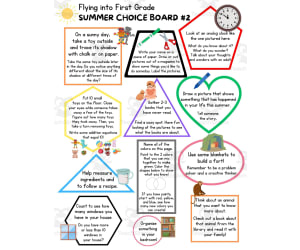
Low-Prep Summer Activities: Flying into First Grade Choice Boards
Creative Arts, ELA, Life Studies, Math, Montessori, P.E. & Health, Resources for Teachers, Science, STEM, Kindergarten, Grade 1, Activities, Task Cards, Worksheets & Printables
Low-Prep Summer Activities: Flying into First Grade Choice Boards Help young learners stay engaged and excited about learning with these Low-Prep Summer Activities: Flying into First Grade Choice Boards ! Designed for children completing kindergarten and getting ready for first grade , these engaging summer bridge choice boards provide fun, hands-on learning experiences that build confidence and reinforce important academic and life skills throughout the summer. About This Product This resource includes three printable Flying into First Grade Choice Boards filled with cross-curricular activities that encourage creativity, critical thinking, independence, and school readiness. After completing an activity, children color in a matching shape to celebrate their progress and create a visual record of their summer learning. Families can revisit favorite activities throughout the season for even more practice and fun. Don't forget to explore the companion choice boards designed for family members of all ages! Learning Objectives These choice boards help students: Build confidence and independence. Strengthen skills learned in kindergarten. Prepare for a successful transition into first grade. Encourage creativity, problem-solving, and communication. Foster meaningful family engagement. Keep learning fun with low-prep summer activities. What's Included 3 printable Flying into First Grade Choice Boards Student-friendly completion tracker Cross-curricular learning activities Low-prep, family-friendly summer experiences Grades/Ages Kindergarten First Grade (summer bridge and back-to-school readiness) Subject Cross-Curricular Skills Perfect For Summer learning at home Summer bridge programs Family engagement Kindergarten take-home packets First grade readiness Homeschool enrichment Independent summer practice Estimated Time Activities vary in length. Some can be completed in under 10 minutes , while others can be extended into projects that last multiple days. Supplies Needed Most activities use simple household or classroom materials and require very little preparation, making this resource perfect for busy families and teachers. Answer Key Answer key not provided. Activities are open-ended and designed to promote exploration, creativity, and real-world learning. File Information File Type: PDF Pages: 3 Make summer learning meaningful with these engaging summer activities that help children transition confidently from kindergarten to first grade . Whether you're looking for a summer bridge , low-prep learning resource, or a fun way to get ready for first grade , these choice boards provide flexible, hands-on learning opportunities the whole family can enjoy.
Author Sprout & Inspire
Rating
Tags First Grade, Summer Activities, Bridge Activities, Kindergarten, Summer Fun, Activity Choice Board
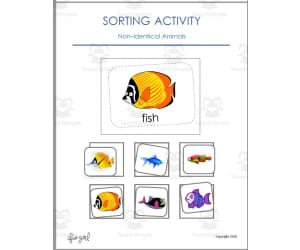
Sorting Activity: Animals - Non-identicals
Special Resources, Special Education Needs (SEN), Math, Early Math, Science, Basic Science, Preschool, Grade 1, 2, 3, 4, 5, 6, Activities
This downloadable PDF is an educational activity that involves sorting non-identical animals. Why we teach sorting and grouping - Sorting and grouping are important skills for young children to learn because they lay the foundation for many other important academic and life skills. Sorting and grouping involve categorizing objects based on common attributes such as color, shape, size, and function. These skills help children to understand and make sense of the world around them. This activity begins by presenting the learner with two large cards, one depicting a dog and the other a cat, to introduce the two animal categories. Then, the learner is given 12 smaller cards, 6 with different pictures of a dog and 6 with different pictures of a cat. The task is to sort the smaller cards into two piles, one for dogs and the other for cats, based on the animal depicted in the picture. The learner is encouraged to observe and compare the pictures to identify the distinguishing features of each animal and group them accordingly. As the learner progresses, the activity can be made more challenging by introducing pictures of animals that are similar such as a horse and a cow, to test their ability to differentiate between similar but unrelated objects. This activity can be used to promote several learning outcomes- visual discrimination classification critical thinking skills It is also a fun and engaging way for learners to explore and learn about different types of animals while practicing essential cognitive skills. This activity was created to be an activity book. However, feel free to print and create to fit your needs. This is a ten-page book with twenty different animals to sort. The different animals can be switched out and rearranged on the different pages to fit the individual learner. Enjoy IFIO girl I'll Figure It Out Extend animal matching to other familiar groups with this picture categories worksheet . Begin with identical animal picture matching before moving to pictures that look different.
Author IFIO girl - I'll Figure It Out
Tags Animals, Non-identicals, Sorting, Visual Discrimination, Problem Solving, Ablls-r, Tasked Based Teaching, Classification, Critical Thinking Skills, Catagorization

Cloud Cut Outs
Science, Earth and Environmental Sciences, Earth Sciences, Creative Arts, Art, Preschool, Kindergarten, Grade 1, 2, 3, 4, 5, 6, Activities
These Cloud Cut Outs are perfect for classroom decoration or student activities . They are quick and easy to use, and will help your students learn and have fun at the same time.
Author Have Fun Teaching
Tags Water, Weather

Pure Substances and Mixtures – Lab Station Activity
Science, Chemistry, Grade 7, 8, 9, 10, Labs, Experiments, Activities
Pure Substances and Mixtures – Lab Station Activity A comprehensive, flexible teaching resource brimming with educational benefits for educators in middle schools and high schools. A definitive tool that sparks creativity while teaching students about key chemistry concepts of pure substances and mixtures. Key Topics Covered: Homogeneous mixtures Heterogeneous mixtures Centrifuge functions Solutions - Unsaturated, Saturated, Supersaturated Intriguing fact-checking multiple-choice questions have been included to assess student's proficiency in these topics. Main Features: Diverse Set of Activities: Each station provides a unique learning experience for the students from hands-on activities to research tasks. Variety of Learning Modes: A composition enabling independent work or collaborative group projects. Digital Integration: Incorporated are digital stations where learners research specific subject areas or view informative video clips. The Accessibility Advantage: All required materials have been made available online making this tool readily accessible for teachers. Add-ons: Fun word games like scramble and other activities are also included as bonus features. Can be used as part grade assessments or optional supplemental material that helps maintain student engagement during transitions between lab activities. A Comprehensive Solution: The Pure Substances and Mixtures – Lab Station Activity presents an innovative approach to chemistry education appropriate for grades 7-10. Easy-to-use, fully editable and adaptable based on teacher preferences, it seamlessly fits any learning environment.
Author Teach With Fergy
Tags Pure Substances, Mixtures, Lab Stations, Chemistry Education, Hands-on Activities, Pure Substances And Mixtures Worksheets
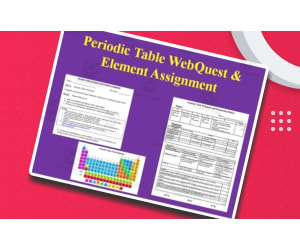
Periodic Table WebQuest
Science, Chemistry, Grade 6, 7, 8, 9, Activities
Periodic Table WebQuest and Element Assignment. This assignment is in two parts, a WebQuest where students go to specific websites to find answers to the 22 questions. The second part is an element research assignment where they are assigned an element, research it and create a summary presentation. The WebQuest comes with a complete answer key and the Element Assignment a detailed rubric which looks at the students presentation skills as well as content, layout and more. The tasks will take from 2-4 days depending on how long you allocate for student presentations . What's included: - Student WebQuest (22 Questions) with Answer Key - Element Research Assignment Questions include: - Periodic table overview - Periods - Groups - Valence electrons I have other resources as well as a range of assignments and lessons/units from other grade levels at my store. Please come, have a look around and don’t forget to follow if you like what you see. For my thoughts on teaching, learning, and everything in between, please visit my blog Teach With Fergy Thanks. Teach With Fergy
Author Teach With Fergy
Tags Chemistry, Periodic Table, Webquest, The Periodic Table Webquest Answers Key, Periodic Table Webquest Answer Key, Periodic Table Webquest, Atoms And Elements Webquest
Tree Design Challenge
Science, Physics, Not Grade Specific, Activities
Sure! Here is the formatted text: ` The Tree Design Challenge: Robot Biomimicry An innovative teaching tool designed to refine critical thinking skills in students. This resource enables students to design and build their own robots that mimic animals or phenomena found in nature. Interdisciplinary Approach Suitable for All Grade Levels The Robot Biomimicry Design Challenge bridges subjects like science, technology, engineering, arts (STEAM), design thinking classes etc. allowing for its application in Makerspaces, Afterschool programs or Technology Classes. Ready-made Challenges Suitable for Individual & Group Sessions It provides an assembly of context provision with set tasks (Design Challenges). Specifies materials needed & steps on how to navigate through the challenge. Fits seamlessly into whole-group instruction scenarios but also supports small group activities or individual assignments. Tips are included for a seamless learning experience fostering ingenuity-rich learning across camps or independent sessions enhancing creative connection between curriculum standards & real-life situations. `
Author WhyMaker
Tags Robot Biomimicry, Critical Thinking, STEAM Education, Design Challenge, Hands-on Learning

STEM Project: Climate Change Solutions with Assessment Rubric
Science, Technology, Earth and Environmental Sciences, Earth Sciences, Engineering, Environmental Science, STEM, Research, Grade 6, 7, 8, 9, Projects, Activities
STEM Project: Climate Change Solutions with Assessment Rubric is designed for middle school students from Grades 6 to 9. It's a real-world resource designed to deepen student understanding of climate change and stimulate critical thinking skills while brainstorming and researching viable solutions based on current and future technologies. This resource can be used in subjects such as Science, Environmental Science, Technology, Engineering and Earth Sciences classes. The hands-on approach in this project fosters active participation among students. They'll start by learning about the root cause of climate change and carbon cycles through online resources before proceeding towards a brainstorming session in order to think of solutions that could help rebalance our planet's atmospheric CO2 levels. Their ideas for technologies or inventions can fall into several categories like reducing greenhouse gases produced by human activities; enhancing photosynthesis to absorb more CO2; reflecting the sun's rays away from Earth; storing excess carbon emissions; or using chemistry principles to transform surplus CO2 into other forms. After choosing their solution concept within their groups or pairs, students delve deep into researching their unique idea. They will attempt to explain how their idea works, what materials are needed, and the optimal locations of implementation. For presentation purposes, students have creative control over whether to choose a poster layout or digital methods like PowerPoint slideshows and video compilations. To help keep things organized throughout the project, there’s an inclusive graphic organizer for note-taking. Additionally, an assessment rubric is provided for grading purposes and to guide the students throughout. Grades to Use With: This project is designed for middle grades students in grades 6-9 or high school special education students. What's Included: A total of 6 pages in PDF Format: Title Page Teacher Instructions 3 Page Graphic Organizer for Students Rubric If you enjoy this project, check out other climate change items in my store. Climate Change Handout: Simple Explanation with Visuals Personal Carbon Emissions: Integrated Math and Science
Author Grace Under Pressure
Tags Climate Change, STEM Project, Solutions, Assessment Rubric, Research, Global Warming, STEM, Earth Science, Technology, Science Project, Rubric For Stem Projects

Scratch: Game Mechanics Bundle
Science, Technology, Computer Science, Grade 3, 4, 5, 6, 7, 8, 9, 10, Games, Activities
Introducing the Scratch: Game Mechanics Bundle This comprehensive teaching tool is well-suited for grades 3 through 10. Designed to guide students in creating their own games using Scratch, this platform is ideal for exploring Computer Science subjects. Understanding Game Mechanics Built around understanding game mechanics, students start with basic elements like Sprites scrolling, running, walking and jumping. As they further hone their skills, they master more advanced techniques fundamental to designing video games. This includes the logic that powers complex features in 3D games and platformers. Flexible for Both Students and Educators Independent Study: Suitable for students with some understanding of Scratch already under their belts; Educator-driven Instruction:Able to be used as an engaging component in whole-group instruction or computer-science driven small-group exercises; Setting Assignments:Makes homework much more exciting by encouraging students to create pieces they are proud of while deepening understanding of game development. Diverse File Types & Platforms Supported The bundle provides multiple file types making it adaptable across various platforms ensuring its reach no matter what your digital classroom setup may look like. It's specifically developed towards enriching science curriculum standards which simplifies teaching coding principles and modern IT literacy goals through hands-on engagement cleverly disguised as fun game creation sessions! In Summation... This resource encourages progress at individual pace offering plenty chances for trial and error before mastering a skill set eventually. Note though that the joyfulness weaved into learning process via creative gaming undertakings doesn't discard the value instilled during traditional teachings, but supplements them resulting in well-rounded education fostering the next generation's digital minds!
Author Roombop
Tags Scratch, Game Mechanics, Computer Science, Video Games, Educational Resource

Light - Reflection and Refraction Find the Pair Game for Middle School
Science, Physics, Grade 5, 6, 7, 8, 9, Games, Activities
This is an engaging and enjoyable memory game on reflection in plane mirrors and refraction. Pupils work in teams of three or four. Each team lays out their 42 cards face down in a square and take it in turn to turn over two cards. If the cards are a question and its correct answer, the pupil keeps the pair. If they are not a match they are turned face down and the next pupil gets a turn. This process continues until all cards are matched and the winner is the pupil with the most pairs. If a team member thinks that the selectors pair is not a correct match, they can challenge. Pupils are encouraged to check their books for the correct answer but the teacher also has a quick-check answer sheet. If the challenge is correct, the challenger keeps the pair. Included in this Pack. > 42 question and answer cards > Teacher’s answer sheet. > Instruction sheet Preparation > Use double-sided printing to copy 1 set per group of 4 pupils. > Sheets could be laminated to enable year-on-year use. > Cut sheets into cards. Prior Knowledge Required > The more dense the medium the slower the speed of light. > When light travels from a less dense medium to a more dense medium it is bent towards the normal. > When light travels from a more dense medium to a less dense medium it is bent away from the normal. > Light hitting a boundary at 900 is not refracted. > Light is not refracted at a curved boundary. > Complete ray diagrams showing refraction. > Design an experiment and results table to investigate refraction through a semi - circular glass block > Why lightning is seen before thunder is heard when a cloud discharges. > Real and apparent depth. > Transparent, translucent and opaque materials > Luminous and non-luminous objects > Labelling the incident and reflected rays, the angles of incidence and reflection, the normal and the point of incidence > Virtual experiment to prove i = r > Ray diagram showing how the eye sees an image in a plane mirror > The image formed in a plane mirror is upright, virtual (appears to be formed behind the mirror) laterally inverted, the same size as the object and as far behind the mirror as the object is in front. > Ray diagram showing how the eye sees an image in a periscope > Specular and diffuse images See more Elf Off the Shelf resources on this topic and many others
Author Elf off the Shelf Resources
Tags Refraction, Reflection, Angle Of Incidence, Angle Of Reflection
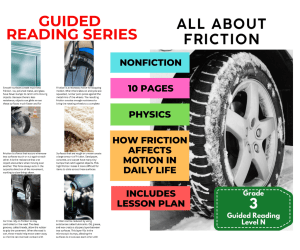
Guided Reading Level N - All About Friction (with Lesson Plan)
ELA, Resources for Teachers, Reading Comprehension, Reading, Language Development, Science, Physics, Engineering, Technology, Pre-Reading, Grade 2, 3, 4, Worksheets & Printables, Worksheets, Teacher Tools, Centers, Activities, Literacy Readers, Quizzes, Quizzes and Tests, Assessments
This Guided Reading Book - All About Friction (Level N) with lesson plan includes: Guided Reading Color Label (front cover x1) This is a quick way to match the book’s demands to what students can generally handle.. The overall goal is to use the level/color to pick books for several smaller groups. To qualify for a certain level, a student is expected to read a book from that level with about 90–94% accuracy. If a student is consistently accurate and understands, move up a level. If the student is struggling at that level, drop down and add more support. Each student will improve at completely different rates, but it is generally one of the best ways to check progress across the class. DOWNLOAD THE CATALOG TO VIEW ALL GUIDED READING BOOKS AVAILABLE (SORTED LEVELS A-Z) Pre-Reading Question (x1) Teacher asks the prompt aloud, can be while showing the cover or first page. Students share what they already know, or make educated guesses from the cover. Prompt them to use the target vocabulary. Write some of their responses on the board to look back at during the reading. Vocabulary Words (x5) Introduce the five words, best doing it one at a time. Start by saying it, while students repeat and then see if anyone knows what it means before reading further. Read through the meaning and try to briefly connect each word to a picture or gesture so it’s meaningful. Ask students to flip through the book pages and point to where they see each of the vocabulary words. While reading the book pause upon coming across one of the vocab words or read the sentence twice to make sure students understand the word has appeared. Optional: Ask students to raise hands whenever they see/hear one of the new words. Guided Reading Pages (x10) Check the book snapshot (below) for: primary topic - do you need to prep extra reading or intro materials on this? what is taught best - decide on 1-2 bullets to focus on, use the prompt or words provided here for best results. learning goals - what you are checking for students to be able to do after the session, elicit answers using prompts or words provided. key vocabulary (see section above). questions overview - so you know what is coming up and if you need to prep extra materials to assist understanding. Run the lesson You may have already looked at a few of the pages together, but you can show them some of the pictures again first to set meaning. Depending on how much time you have and how familiar your students are with guided reading class, you may want to read the book aloud first with the group first. Students whisper or partner read, while you listen in. If time, do it as a group, one student reading a page each. Use the guided page’s prompts to coach: “Check the picture / does it make sense?” “Point under the words / try the first sound” “Reread the sentence smoothly”. Try to focus more on one student per session (rotating every time), so you can work out if they are ready to move up or need to move down a level. Comprehension Questions (back cover x3) This is your way to check that students didn’t just say the words, but actually understood the text. First, let students answer by pointing to the page/picture and saying a short sentence. After any answer, follow with: “Show me where you found that in the text.” In bigger groups, have partners answer first (10–20 seconds), then call on 2–3 students to share. Differentiation tips: Emerging speakers/struggling readers: oral + pointing On-level: oral in a full sentence Higher: one written sentence or draw + label Book Snapshot Title: All About Friction Genre: Nonfiction (informational) Subject: Physical Science Primary Topic: How friction affects motion in daily life Estimated Guided Reading Level (A–Z): N What This Book Teaches Best Defines friction as a force that happens when surfaces touch or rub, and explains it acts against motion to slow things down. Compares rough/uneven surfaces (more friction) and smooth surfaces (less friction), using examples like sandpaper, carpet, ice, metal, and glass. Shows real-world uses of friction for safety, including bicycle brakes, soccer cleats gripping grass, and car tire treads gripping wet roads. Explains how friction can create heat energy and how lubricants reduce friction by forming a slippery layer between surfaces. Extends the idea of friction to air and water as drag/air resistance , and explains why friction makes movement controlled and “predictable.” Learning Goals Students can explain what friction is, using details from the text. Students can compare how rough/uneven surfaces and smooth surfaces affect sliding and distance. Students can describe how friction helps stop motion in the bicycle brake example. Students can explain one way friction is increased for safety or performance (cleats, tire treads). Students can explain how lubricants change what happens when two surfaces touch. Students can describe friction in air or water (drag/air resistance) using the parachute example. Key Vocabulary From the Text resistance — a push-back that makes movement harder. uneven — not smooth; bumpy. treads — deep grooves that help tires grip the road. lubricants — slippery substances that help things slide more easily. microscopic — so tiny you need a microscope to see it. Discussion Prompts Pre-reading question: When have you noticed something slow down because two surfaces rubbed together? Comprehension questions: What does the text say friction is? How does friction help a bicycle come to a complete stop? What do lubricants do between two surfaces to reduce friction? Printing Tips 1. Best Printing Method (Recommended) “Booklet” Printing (Best if Available) If your printer or PDF viewer supports Booklet Printing , use this. Settings to use: Print mode: Booklet Paper size: Letter or A4 (either works) Orientation: Landscape Print on both sides: Yes Flip on: Short edge Scaling: Fit to printable area Booklet subset: First test: Front sides only Then: Back sides only This will automatically: Pair pages correctly Put the cover on the outside Align everything for folding After printing, fold in half and staple along the spine . 2. If “Booklet” Printing Is NOT Available You can still print this correctly with manual duplex printing . Step-by-step: Open the PDF. Choose Print . Set: Orientation: Landscape Pages per sheet: 1 Print on both sides: Yes Flip on: Short edge Print all pages . Because each PDF page already contains two facing book pages, the result will still fold cleanly into a book. Thousands of Cored Education products are included with your TeachSimple membership. Download links and encyclopedia index available here.
Author Cored Education
Rating
Tags Reading Comprehension, Reading Passages, Reading, Guided Reading, Guided Reading Lesson Plan, Guided Reading Activity, Pre-reading, Vocabulary, Science Lesson Plans, Physics
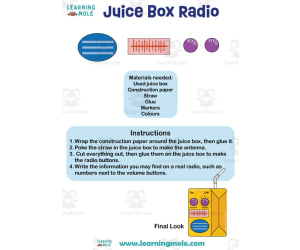
Juice Box Radio Activity
Science, Technology, Basic Science, Physics, Grade 2, 3, 4, 5, 6, 7, 8, Activities
Activity Introduction An amazing activity designed for the students to learn more about famous places in different countries. The Juice Box Radio Do you like STEM subjects? what is your favorite one? Have you ever tried to plant a seed? If yes, tell us more about it. Or have you ever tried to invent something? If yes, tell us more about it. And how do you think it will help us? Have you ever seen a microorganism under a microscope? What was it? And how it looked like? Mathematics is a marvelous subject. Let' sharpen our brains and solve some equations. Do you like timetable tricks? What is your favorite one? Do you know how to code? Have you ever created an app or a game before? If yes, how was it like? Juice Box Radio Activity The activity is perfect for encouraging the researching skills for the students, while learning more about this fantastic place. Radio This friendly designed worksheet is suitable for students at school, homeschooling, and as a group activity. Instructions Wrap the construction paper around the juice box, then glue it. Poke the straw in the juice box to make the antenna. Cut everything out, then glue them on the juice box to make the radio buttons. Write the information you may find on a real radio, such as numbers next to the volume buttons. Materials Needed Used juice box Construction paper Straw Glue Markers Colors Format Available in a PDF format.
Author Educational Voice
Tags Juice Box Radio Activity, Radio, Radio Facts, Radio Facts For Kids, Stem, Stem Facts, Stem Facts For Kids, Activities For Kids

Animal Discover Design Challenge
Science, Physics, Not Grade Specific, Activities
Amusement Park Ride Design Challenge Brainstorm and design a brand new amusement park ride. WhyMakers Design Challenges come READY to use. All you have to do is hand them out to students and they can begin to work independently on them! These design challenges can be used in so many different ways. You can use these for your Makerspace, Genius Hour, Independent Time, STEM, Choice Time, Technology Class, Library Time, Afterschool programs, Camps, STEAM classes, Design Thinking Classes, SEL time and more! These design challenges focus on real life scenarios that you can connect to content standards. These are sure to keep your students engaged and will encourage them to think deeply about the content being taught while being innovative and crafting their solutions.
Author WhyMaker
Tags Physical Science, Animal Discover Design Challenge, Design Challenge, Student Design Brief, STEM

Florence Nightingale Solutions Activity
Science, Inventors, Grade 3, 4, 5, 6, 7, 8, 9, 10, Activities
Activity Introduction An amazing activity designed for the students to learn more about famous people in different countries. Florence Nightingale Do you know this person? How much do you know about him/her? Who is your idol? Why did you choose this person? Tell us more about him/her? Who is your favorite athlete? Or what is your favorite team? Have you recently heard a story about a famous person? Who was this person? Can you tell us more about him/her. Who is your favorite president, king, or queen? Why you chose that person? In your country, who are the most famous people? What did they do? Can you tell us more about them. What is your favorite invention? Who invented it? Who is your favorite artist? What is the most famous thing he/she have done? What is the most enjoyable you have read before? Who wrote it? Florence Nightingale Activity The activity is perfect for encouraging the researching skills for the students, while learning more about this fantastic place. Florence Nightingale This friendly designed worksheet is suitable for students at school, homeschooling, and as a group activity. Instructions What solutions did Florence Nightingale find for each of the following problems at the hospital? Format Available in a PDF format.
Author Educational Voice
Tags Florence Nightingale Solutions Activity, Florence Nightingale Solutions, Florence Nightingale, Florence Nightingale Facts, Florence Nightingale Facts For Kids, Inventor, Inventors, Invention
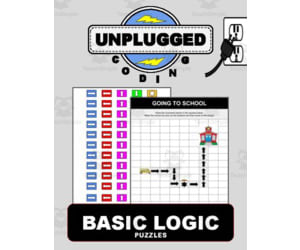
Basic Logic Puzzles (Unplugged Coding #3)
Science, Technology, Computer Science, Grade 1, 2, 3, 4, 5, 6, 7, 8, Activities
Basic Logic Puzzles (Unplugged Coding #3) - Teaching Resource A unique teaching resource targeted towards initiating coders in grades 1 to 8, Basic Logic Puzzles (Unplugged Coding #3) ensures that learning about programming doesn't always necessitate a computer. It comprises printable activities aimed at fostering analogous logic and strategies your students would employ when using coding websites or apps. Features The core focus of this teaching resource is basic logic puzzles, offered as printable and interactive puzzles with cuttable commands. The puzzles can be used for group instruction, small group sessions, or even as homework assignments. Incorporates a diverse range of topics including food, school-related concepts and special holidays like Christmas and Halloween! In these interactive challenges, there's more than one solution — students can find multiple correct paths to solve a challenge if each coding command is correctly used. Add-ons Included in the package: 'Commands Info Page': A page offering an explanation about the function of each command and how they can be utilised within the puzzles. A Commands grid:: This grid furnishes both color and black-and-white versions adding convenience based on individual printing preferences. Towards Strong Foundational Programming Skills Suitable for educators handling computer science classes in schools as well as parents homeschooling their children - Basic Logic Puzzles (Unplugged Coding #3) aids in nurturing essential programming skills without the constant need for digital access. Note:This educational resource document comes in an easily downloadable PDF format for ready use!
Author Roombop
Tags Logic Puzzles, Unplugged Coding, Interactive Activities, Problem Solving, Commands, Coding Riddle, Simple Logic Problems, Coding Puzzle, Simple Logic Puzzle, Coding Puzzles
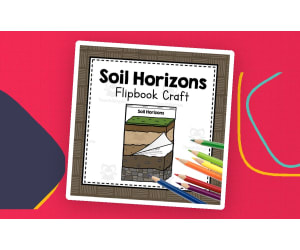
Soil Horizons Flipbook Craft | Lithosphere Layers | Earth Science
Science, Earth and Environmental Sciences, Grade 1, 2, 3, 4, Activities
A fun paper craft to add to your soil science lessons! As you learn about the layers we find in the crust of Earth, students can engage with this hands-on project by cutting, coloring, and stapling each layer of the flipbook together. This interactive approach helps students visualize the different soil horizons, making abstract concepts easier to understand. As they turn the pages, they’ll review basic information about each layer, from the organic-rich topsoil to the bedrock beneath, reinforcing key details in a fun and memorable way. This is a perfect supplementary project to enhance your study of geology and soil, promoting both creativity and comprehension. You can also have students label each layer and write additional facts, encouraging them to dive deeper into the importance of soil in ecosystems. The flipbook can serve as a reference tool during classroom discussion. This project can spark discussions about soil conservation, erosion, and the role of soil in agriculture. It’s an engaging and educational craft that brings soil science to life! What You Get: 1 anchor charts illustrating and describing soil layers. Cut-out templates for 6 horizons of soil
Author Simply Schoolgirl
Tags Soil Horizons, Soil Flip Book, Soil Activity, Soil Craft
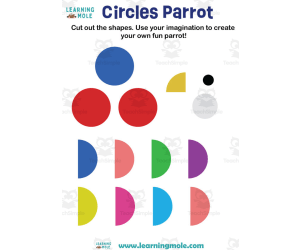
Parrot Activity
Science, Life Sciences, Biology, Animals, Grade 1, 2, 3, 4, 5, 6, Activities
Activity Introduction An amazing activity designed for the students to learn more about famous places in different countries. The Parrots Do you like animals? what is your favorite one? Do you own a pet? If yes, tell us more about it, like what its name? And what do you like most about it? What are the animal kingdoms? Can you write down the characteristics of each animal class like mammals, birds, reptiles, amphibian, fish and mollusks. Do you know that some animals can sing, can you name any of them? What is the largest and the smallest mammal in the world? What is the largest and the smallest bird in the world? What is the largest and the smallest fish in the world? Parrots Activity The activity is perfect for encouraging the researching skills for the students, while learning more about this fantastic place. Parrots This friendly designed worksheet is suitable for students at school, homeschooling, and as a group activity. Instructions Cut out the shapes. Use your imagination to create your own fun parrot! Format Available in a PDF format.
Author Educational Voice
Tags Parrot Activity, Parrot, Parrots, Parrots Facts, Parrots Facts Activity, Parrots Facts For Kids, Bird, Birds, Birds Facts, Birds Facts For Kids