



3,991 products added recently
Page 8 - Science Games
Bring excitement to your science lessons with games that cover various scientific fields. This collection includes trivia challenges, experiment simulations, and exploration quests. By integrating these science games into your teaching, you can stimulate curiosity and deepen comprehension.

 Show filters


Mixtures - Solutions, Suspensions, Dissolving and Saturated Solutions - Dominoes Game for Middle School
Science, Chemistry, Grade 5, 6, 7, 8, 9, Activities, Games
A dominoes game for middle school with questions and statements on mixtures including solutions, suspensions, solubility and saturated solutions. Prior Knowledge > Elements and compounds are pure substance and mixtures are not. > Meaning of the terms solute, solvent, solution, soluble and insoluble. > Particle theory to explain why stirring, temperature and particle size affect the rate of dissolving. > Particle theory to explain dissolving, suspensions and saturated solutions. > Extracting information from solubility curves What You Get > 80 dominos > Animated PowerPoint explaining the rules and how to play. Rules of the Game > Each player selects seven dominos from the top of the face-down pile and holds them in their hand like playing cards. > The player whose surname begins with a letter closest to the letter A starts and play proceed in a clockwise direction. > Dominos can be matched exactly, or a name can be matched with a symbol or descriptions, sketches and circuit diagrams can be matched. > If a player thinks a match is wrong, they can challenge. If the challenger is correct, they give a card from their own hand to the challenged player. If the challenged player is correct, they give a card from their hand to the challenger. Pupils are encouraged to check their books for the correct answer and consult their teacher if a consensus is not reached. > If a player cannot play a domino, they pick up from the face down pile and can play if possible or add it to their hand. See more Elf Off the Shelf resources on this topic and many others
Author Elf off the Shelf Resources
Tags Mixtures, Saturated Solution, Dissolving, Solvent, Solute, Saturated Mixtures

Elements and Compounds - Find the Pair - Team Game
Science, Chemistry, Grade 6, 7, 8, 9, Activities, Games
This is an engaging and enjoyable memory game on atoms, molecules, elements, compounds, chemical symbols, chemical formulae and naming compounds. Pupils work in teams of three or four. Each team lays out their 42 cards face down in a square and take it in turn to turn over two cards. If the cards are a question and its correct answer, the pupil keeps the pair. If they are not a match they are turned face down and the next pupil gets a turn. This process continues until all cards are matched and the winner is the pupil with the most pairs. If a team member thinks that the selectors pair is not a correct match, they can challenge. Pupils are encouraged to check their books for the correct answer but the teacher also has a quick-check answer sheet. If the challenge is correct, the challenger keeps the pair. Included in this Pack. 42 question and answer cards Teacher’s answer sheet. Instruction sheet Preparation Use double-sided printing to copy 1 set per group of 4 pupils. Sheets could be laminated to enable year-on-year use. Cut sheets into cards. Prior Knowledge Required Atoms combine to form molecules. If combining atoms are from the same element, a molecule of an element is formed but if they are from different elements, a molecule of a compound is formed. An element contains only one type of atom. A compound contains two or more different types of atom combined together chemically. Each element has its own symbol. Some symbols are the capitalized first letter of the name of the element . Some symbols have two letters from the name with only the first capitalized. Some symbols are taken from the Latin name of the element. Know that a chemical formula tells you how many atoms of each element are in a compound. Know that if there is no letter after a symbol in a formula, there is only one atom of that element in the compound. Know that if a formula contains brackets, every element inside the bracket is multiplied by that number. Know that compounds ending in ide contain only two elements. Know that compounds containing CO3 are carbonates, SO4 are sulphates and NO3 are nitrates. Know that mono is one, di is two and tri is three. Be able to name and work out the number of atoms of each element in a compound without brackets in its formula. See more resources from Elf Off the Shelf
Author Elf off the Shelf Resources
Tags Science Team Game, Chemistry Team Game, Elements Pairing, Compounds Pairing, Elements Team Game

Light - Reflection Find the Pair Game for - Middle School
Science, Physics, Grade 5, 6, 7, 8, 9, Activities, Games
The Light - Reflection Find the Pair Game for Middle School A captivating educational tool designed to facilitate understanding of light reflection in plane mirrors. This resource utilizes a memory game format, fostering active participation among students from grades 5 to 9. Participation and Format: Students engage in small groups of three or four. The interactive nature of the Middle School Light Reflection game provides a way to encourage teamwork and independent critical thinking skills. Each group works together to match 42 question-and-answer cards. Individuals take turns at revealing and pairing the cards. Challenging Element: This unique teaching resource features a challenging element that further encourages learning — if one team member believes that the selected pair does not match correctly, they can raise a challenge. Pupils may refer back to their study materials during these instances. An included quick-check answer sheet is available for teachers' guidance. If correct in their challenge, participants have the opportunity to earn points for their group. Simplicity In Use: Edge educators: Just print sets double-sided (potentially laminating them for increased durability) and distribute among groups fledge easy task generation set-ups. This reflective game addresses several key concepts about light transmission including: Tags: Images seen through periscope usage Luminous/non-luminous objects; , Opaque/transparent/translucent materials; Labeling incident rays and reflected rays; The normal point implementation. Potential Usage Spots: Classes handling science subjects like physics or during homeschooling sessions focusing broad-based scientific education around middle school level grades like grade 5 up till grade 9 constitute prime usage spots. Versatility In Use: The Light - Reflection Find the Pair Game doesn't restrict learning just within classroom boundaries and can also be implemented as an engaging homework assignment, thus offering versatility and ample opportunities for meaningful learning outside school walls.
Author Elf off the Shelf Resources
Tags Light Reflection, Plane Mirrors, Memory Game, Educational Tool, Science Education
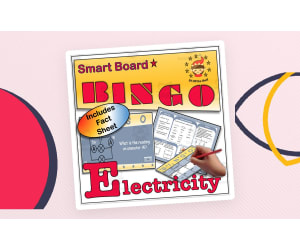
Current Electricity Smart Board Bingo
Science, Physics, Grade 6, 7, 8, 9, Activities, Games
Current Electricity Smart Board Bingo An innovative and interactive teaching resource for students of grade 6 to 9, focusing on the fundamentals of current electricity. In addition to boosting understanding, it fosters engagement through interactive gameplay on a smart board. How does it Work? Each round poses questions onto the smart board that correspond with numbers on individual bingo cards. The questions cover essential aspects as detailed below: Voltage and Resistance. Conductors and Insulators. Different types of circuits - series and parallel - including their symbols. The function of lamps in such circuits. The relationship between number of batteries and current or voltage. Inclusion of lamps in a circuitry configuration. Switches in series and parallel circuits. An interesting angle is introduced through Ohm's law providing a well-rounded learning experience for those enthusiastic about electricity! Included Resources: A set of 48 unique bingo cards along with a randomized question generator containing over 50 interactions designed for your smart board (interactive whiteboard ). , .
Author Elf off the Shelf Resources
Tags Electricity Fundamentals, Current Electricity, Circuits, Smart Board, Interactive Learning
Scratch Thanksgiving: Turkey Game
Science, Technology, Computer Science, Grade 3, 4, 5, 6, 7, 8, 9, 10, Games, Activities
In this project , you will create a simple line following game in Scratch. Guide the turkey to safety, and don’t let it fall through the gaps! This Scratch game guide is perfect for Thanksgiving or really anytime during the year. It includes all the directions from start to finish as well as suggestions as to how they can change there game to be different then their peers. This package is a great resource to have your students follow.
Author Roombop
Tags Scratch, Scratch Coding, Coding, Thanksgiving Flash Games, Thanksgiving Computer Games

Kinetic Theory, Mixtures, Separating Mixtures - Smart Board Bingo for Middle School
Science, Chemistry, Grade 5, 6, 7, 8, 9, Activities, Games
Kinetic Theory, Mixtures, Separating Mixtures - Smart Board Bingo for Middle School This interactive teaching resources offers a refreshing approach to instruct middle school students on key chemistry concepts, such as the kinetic theory of matter and mixtures properties and compositions. Core Concepts Covered: Kinetic theory of matter Properties and composition of mixtures Methods of separating mixtures This resource reinforces understanding in: Particle arrangement in various states of matter (solids, liquids, gases) Dynamics associated with state changes In-depth topics include: - Solubility definitions - Factors affecting solubility (e.g. temperature or stirring effects) - Characteristics & behaviours of suspensions & saturated solutions - Methods for isolating components (evaporation to dryness or distillation types) - Distinctions between compounds vs elements relative to mixture purity The primary teaching tool is presented through an engaging interactive bingo game accessed on a smart board. Fifty questions are generated randomly by software. If the number called out aligns with their bingo card number, students must not only cross off that number but also provide written answers on their card. This promotes active engagement and makes learning fun! Note: This package contains an answer PowerPoint and answer sheets that can be used for verification after games. Listed amongst included resources are: An Answer Powerpoint A set accommodating up-to-48 bingo cards ensuring every student's inclusion regardless of class size Breakaway sheets for the verification of student responses and topic discussions A variety of supportive supplementary materials to bolster revision at a student’s personal pace may it be as homework task or collaboratively in classroom setting In conclusion: The Kinetic Theory, Mixtures, Separating Mixtures - Smart Board Bingo for Middle School teaching resource changes the landscape of standard lessons into dynamic, interactive learning sessions. It seamlessly combines theories with fun activities that make students grasp and remember these essential chemistry concepts effectively while alluringly building their problem-solving skills. An absolutely joyous learning journey inviting middle schoolers towards charming world encapsulated within molecules leading them to have strong foundation prepping up for higher-grade studies.
Author Elf off the Shelf Resources
Tags Kinetic Theory, Mixtures, Separating Mixtures, Smart Board Bingo, Middle School
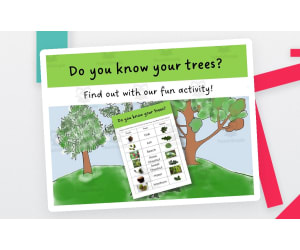
Tree ID Activity – Identify Common Trees Game
Science, Life Sciences, Nature & Plants, Biology, Grade 1, 2, 3, Activities, Games
Test your pupil's knowledge of common trees with this simple, fun Tree ID Activity. Introduction and objectives This simple puzzle, helps children to learn to recognize a tree by its leaf and fruit. The trees included on the more advanced puzzle are: Oak Ash Beech Horse Chestnut Sweet Chestnut Hazel Hawthorn And on the easier one: Oak Horse Chestnut Beech Hawthorn How to use this activity The tree activity can be used as part of a science lesson on comparing trees, or as an assessment after studying different trees and their fruits, possibly in autumn time. It can be successfully used alongside our Leaf Sorting Activity. It can follow a walk where the fruits of different trees are collected along with their leaves, in autumn, and the children can use books or other sources to help them to identify the leaves and fruit - as such it can be a learning activity rather than a puzzle. Children can either draw lines from each fruit to ots tree and then its leaf, or the sections can but cut out and stuck onto another sheet (provided). There are two levels of difficulty, one activity with seven trees and one with four. Choose the one most suitable for each child. Who can use the Tree ID Puzzle? It can be used in the home, by teachers and in the home-school. It can be blown up large and completed together by a class/group. It can be made into a centre activity by cutting out the individual words and pictures and allowing children to put the ones that go together next to each other. I suggest laminating the pieces to make them more durable. Answers provided.
Author Lilibette's Resources
Rating
Tags Tree Id, Tree Identification, Tree Leaves And Fruit ID, Tree Leaves And Fruit Puzzle, Tree Leaves And Fruit, Identifying Trees By Their Leaves, Identifying Trees By Their Fruit

French: The Environment and Pollution - Sudoko Games
Science, Earth and Environmental Sciences, Environmental Science, Grade 6, 7, 8, 9, 10, 11, 12, Games, Activities
The French: The Environment and Pollution - Sudoko Games This versatile teaching resource creatively blends scientific learning with a focus on strengthening French language skills. Designed primarily for students from Grade 6 to Grade 12, it utilizes an engaging sudoko puzzle format to familiarize learners with important environmental science terms. The resource features three uniquely crafted sudoku games aimed at stimulating learners' minds while introducing new terminologies related to environment and pollution. This worksheet type resource allows educators flexibility in their approach; they can: Conduct whole group sessions fostering collective problem-solving, Adopt a targeted small group approach for in-depth discussions, or Assign these puzzles as homework tasks promoting educational continuity. Included Answer Keys Bolstering the usability of this single PDF file are included answer keys that pave the way for swift checking and corrections. This allows teachers more time to concentrate on ensuring conceptual understanding and fostering student interaction than tedious evaluation tasks. The integration of subjects like Science, particularly subtopics of Environmental Science, with elements of the French language makes this tool multi-faceted promoting interdisciplinary learning; a refreshing diversion from routine lessons. A valuable tool for both public school and homeschool environments , incorporating these fun-filled gaming resources into existing lesson plans can pique curiosity around topics like environment preservation and pollution control while boosting non-native linguistic abilities through engaging instructional methods.
Author Love Learning Languages
Tags French, Environment, Pollution, Sudoko Games, Teaching Resource

Separating Mixtures and Solutions - Wildcard and Snap Card Games for Middle School
Science, Chemistry, Grade 5, 6, 7, 8, 9, Activities, Games
Separating Mixtures and Solutions - Wildcard and Snap Card Games for Middle School: An Exciting Academic Resource This teaching resource aims to help students in grades 5 through 9 master crucial scientific concepts interactively. Spanning topics such as mixtures, solutions, suspensions, solubility, and saturated solutions. The Card Game Package The package features 84 playing cards, ingeniously blending academics with fun gameplay. The main aim of this approach is to reinforce the learned concepts while fostering their joy for learning. Suitable For Whom? Ideal for middle school learners specializing in science, specifically chemistry. Before implementing this resource effectively as part of your teaching strategy, students should have basic knowledge in subjects such as: Composition and physical properties of mixtures, Evaporation to dryness and crystallisation, Fractional distillation along with distillation, Filtration tactics together with Chromatography. Versatility of the Resource This multi-faceted tool can be used during whole group review sessions or assigned as homework tasks after covering thematic units-instructional flexibility is key here. Included Materials: The package includes an Animated PowerPoint providing comprehensive instructions on how-to-play both wildcard and snap games included within. This easy-to-follow instruction guide ensures that both teachers and students find the learning process pleasing; not a chore! Downloading should be seamless due to its adaptability across various devices – PCs or tablets. This encourages flexible mobility during game time. Why Should You Choose This Resource? Turn education into an engaging experience with the Separating Mixtures and Solutions - Wildcard and Snap Card Games for Middle School. Embed fun into your teaching approach while retaining the academic essence. Remember, learning should always be exciting!
Author Elf off the Shelf Resources
Tags Mixtures, Solutions, Suspensions, Solubility, Card Games

Magnets and Electromagnets 42 Question Board Game
Science, Physics, Grade 5, 6, 7, 8, 9, Activities, Games
With 42 question cards on permanent magnets and electromagnets this is an enjoyable and challenging board game for up to six players per set. It is suitable for all abilities. It can be played at the end of a module on electricity and electromagnets but is also a very useful test prep tool. This game is so much fun, pupils will forget they are learning! What You Get Game board (color and black and white) 42 question cards with questions of varying degrees of difficulty Answer sheet Instruction sheet. Rules for Play The player who throws the highest score starts and play proceeds in a clockwise direction. Students take turns and work their way around the board following the instructions in the squares. Some squares tell the student totake a question card from the face down pile. If correct they move on 2 spaces. If a player thinks an answer given by an opponent is incorrect they can challenge. If the challenge is correct the challenger moves forward 2 spaces. If the challenge is wrong the challenger moves back two spaces. In the event of a challenge, pupils are encouraged to consult their books but the teacher has a quick-check answer sheet. Prior Knowledge Required Composition of Magnets: Magnets are constructed using magnetic materials. Common materials include Iron, Cobalt, Nickel, and their corresponding alloys. Pole Interactions: Magnets have two types of poles - North and South. When two like poles (e.g., North and North) come close to each other, they repel. Conversely, when opposite poles (e.g., North and South) are brought together, they attract each other. Magnetic Fields: Surrounding every magnet is an invisible force field known as the magnetic field. This field can be visualized through field lines. Field Line Density: The density of these field lines determines the strength of the magnetic field. A region with closely spaced field lines indicates a stronger magnetic field than a region where they're spread out. Visualization of Field Lines: It's essential to understand and recognize the pattern of field lines around two bar magnets, especially when they have the same or opposite poles facing each other. Field Strength at Poles: The magnetic field is strongest at the poles of a magnet due to a higher concentration of field lines. Distance and Field Strength: The strength of the magnetic field diminishes as one moves farther from the magnet. Direction of Field Lines: Field lines emanate outward from the magnet's south pole and point inward toward the north pole. Magnetization Process: When a non-magnetized magnetic material becomes a magnet, the tiny regions within it called domains, which were initially oriented in random directions, align themselves to point uniformly in the same direction. Earth's Magnetic Properties: The Earth behaves like a large magnet. Interestingly, there appears to be a south-type magnetic pole near the Earth's geographic North Pole and a north-type magnetic pole near the Earth's geographic South Pole. Application in Devices: It would be beneficial to have a basic understanding of how magnets and magnetic fields operate within certain devices. Familiarize yourself with the structure and functioning of electric bells, relays, and circuit breakers, as they use these principles. See more Elf Off the Shelf resources on this topic and many others. Revisit attraction and repulsion with this magnetic poles investigation .
Author Elf off the Shelf Resources
Tags Magnets, Electromagnets, Magnetic Materials, Magnetic Fields, Earths Magnetism , Electric Bell, Electric Relay, North And South Poles, Magnetic Fileld Lines, Magnetism Game

Scratch: Game Mechanics Bundle
Science, Technology, Computer Science, Grade 3, 4, 5, 6, 7, 8, 9, 10, Games, Activities
Introducing the Scratch: Game Mechanics Bundle This comprehensive teaching tool is well-suited for grades 3 through 10. Designed to guide students in creating their own games using Scratch, this platform is ideal for exploring Computer Science subjects. Understanding Game Mechanics Built around understanding game mechanics, students start with basic elements like Sprites scrolling, running, walking and jumping. As they further hone their skills, they master more advanced techniques fundamental to designing video games. This includes the logic that powers complex features in 3D games and platformers. Flexible for Both Students and Educators Independent Study: Suitable for students with some understanding of Scratch already under their belts; Educator-driven Instruction:Able to be used as an engaging component in whole-group instruction or computer-science driven small-group exercises; Setting Assignments:Makes homework much more exciting by encouraging students to create pieces they are proud of while deepening understanding of game development. Diverse File Types & Platforms Supported The bundle provides multiple file types making it adaptable across various platforms ensuring its reach no matter what your digital classroom setup may look like. It's specifically developed towards enriching science curriculum standards which simplifies teaching coding principles and modern IT literacy goals through hands-on engagement cleverly disguised as fun game creation sessions! In Summation... This resource encourages progress at individual pace offering plenty chances for trial and error before mastering a skill set eventually. Note though that the joyfulness weaved into learning process via creative gaming undertakings doesn't discard the value instilled during traditional teachings, but supplements them resulting in well-rounded education fostering the next generation's digital minds!
Author Roombop
Tags Scratch, Game Mechanics, Computer Science, Video Games, Educational Resource

Light - Reflection and Refraction Find the Pair Game for Middle School
Science, Physics, Grade 5, 6, 7, 8, 9, Games, Activities
This is an engaging and enjoyable memory game on reflection in plane mirrors and refraction. Pupils work in teams of three or four. Each team lays out their 42 cards face down in a square and take it in turn to turn over two cards. If the cards are a question and its correct answer, the pupil keeps the pair. If they are not a match they are turned face down and the next pupil gets a turn. This process continues until all cards are matched and the winner is the pupil with the most pairs. If a team member thinks that the selectors pair is not a correct match, they can challenge. Pupils are encouraged to check their books for the correct answer but the teacher also has a quick-check answer sheet. If the challenge is correct, the challenger keeps the pair. Included in this Pack. > 42 question and answer cards > Teacher’s answer sheet. > Instruction sheet Preparation > Use double-sided printing to copy 1 set per group of 4 pupils. > Sheets could be laminated to enable year-on-year use. > Cut sheets into cards. Prior Knowledge Required > The more dense the medium the slower the speed of light. > When light travels from a less dense medium to a more dense medium it is bent towards the normal. > When light travels from a more dense medium to a less dense medium it is bent away from the normal. > Light hitting a boundary at 900 is not refracted. > Light is not refracted at a curved boundary. > Complete ray diagrams showing refraction. > Design an experiment and results table to investigate refraction through a semi - circular glass block > Why lightning is seen before thunder is heard when a cloud discharges. > Real and apparent depth. > Transparent, translucent and opaque materials > Luminous and non-luminous objects > Labelling the incident and reflected rays, the angles of incidence and reflection, the normal and the point of incidence > Virtual experiment to prove i = r > Ray diagram showing how the eye sees an image in a plane mirror > The image formed in a plane mirror is upright, virtual (appears to be formed behind the mirror) laterally inverted, the same size as the object and as far behind the mirror as the object is in front. > Ray diagram showing how the eye sees an image in a periscope > Specular and diffuse images See more Elf Off the Shelf resources on this topic and many others
Author Elf off the Shelf Resources
Tags Refraction, Reflection, Angle Of Incidence, Angle Of Reflection
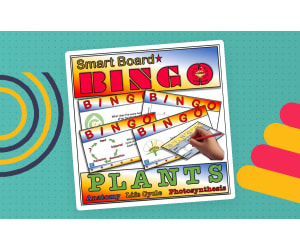
Plants - Smart Board Bingo for Middle school Science
Science, Life Sciences, Biology, Nature & Plants, Grade 6, 7, 8, 9, Activities, Games, Worksheets
Smart board bingo includes questions on the anatomy and life cycle of the flowering plant and photosynthesis. What is Included Random question generator for smart board (interactive white board) – 54 questions 48 bingo cards Answers PowerPoint Answer sheet Suggested Lesson Plan Play bingo – students write the answers into the square on their bingo card which matches the question number in the smart board. Teacher uses answer sheet to check card of winners of lines and full house Pupils use answer PowerPoint to check their answers at end of game. Prior Knowledge Root, stem, leaf and flower are plant organs. Function of root, stem and leaf. Transpiration. Labelling parts of a flower. Carpel and stamen are the female and male reproductive organs. Role of played by xylem, phloem, guard cells, stomata and chloroplasts in photosynthesis. Graphing rate of photosynthesis against, carbon dioxide concentration, light intensity and temperature. Word equations for photosynthesis and respiration. Comparison of photosynthesis and respiration. Paraffin heaters as sources of carbon dioxide in greenhouses. Use of glucose in plants. Gas exchange in plants at different times of day. Testing a leaf for starch – investigation. Effect of light intensity on rate of photosynthesis – investigation. Pollination, self-pollination and cross-pollination explained. How some plants prevent self-pollination and why. Comparing the features of flowers pollinated by insects and wind. See more Elf Off the Shelf resources on this topic and many others
Author Elf off the Shelf Resources
Tags Bingo Game, Science Bingo, Biology Bingo, Plant Photosynthesis, Plant Anatomy
Kinetic Theory of Matter, States of Matter, Change of State - Find the Pair Game for Middle School
Science, Physics, Grade 5, 6, 7, 8, 9, Activities, Games
This is an engaging and enjoyable memory game on the kinetic theory of matter which uses the particle model to explain change of state, gas pressure and diffusion. Pupils work in teams of three or four. Each team lays out their 42 cards face down in a square and take it in turn to turn over two cards. If the cards are a question and its correct answer, the pupil keeps the pair. If they are not a match they are turned face down and the next pupil gets a turn. This process continues until all cards are matched and the winner is the pupil with the most pairs. If a team member thinks that the selectors pair is not a correct match, they can challenge. Pupils are encouraged to check their books for the correct answer but the teacher also has a quick-check answer sheet. If the challenge is correct, the challenger keeps the pair. Included in this Pack. > 42 question and answer cards > Teacher’s answer sheet. > Instruction sheet Preparation > Use double-sided printing to copy 1 set per group of 4 pupils. > Sheets could be laminated to enable year-on-year use. > Cut sheets into cards. Prior Knowledge Required > Three states of matter are solid, liquid and gas. > Arrangement of particles in solids, liquids and gases. > Properties of solids, liquids and gases in terms of the arrangement of their particles. > Change of state including sublimation. > Pressure in gases and the effect of increasing the number of particles and temperature and decreasing volume. > Diffusion. See more Elf Off the Shelf resources on this topic and many others
Author Elf off the Shelf Resources
Tags Solids Liquids And Gases, Melting, Boiling, Condensing, Freezing, States Of Matter Interactive Game, Kinetic Energy Games

Paleozoic Creatures Memory Game
Science, Life Sciences, Animals, Earth and Environmental Sciences, Grade 2, 3, 4, 5, Activities, Games
How To Use This: Play this memory game to work on learning and memorizing the names of creatures that lived during the Paleozoic Era. They’ll love learning about these 12 animals! This game works as a great review or supplementary resource to a larger paleontology unit . What You Get · - 24 double-sided cards with detailed computer-generated images or photos of creatures from the Paleozoic Era. Cut apart all the cards. Then lightly glue each back to a front. Run through a laminator and then cut apart each piece. Lay pieces flat and upside down. Take turns with your students to turn over 2 at a time. When you find a match, you get to keep the match. When all the cards have been turned over and matched up, then the game is over. The winner is the one who has found the most matches. Take a Look At Some Of My Best Sellers: · - All About Sea Lions: Sea Lion Animal Science Unit · - Write a Friendly Letter: Writing Life Skills · - How To Fill Out Forms: Writing Life Skills · - Feelings and Emotions Photo Cards: Visual Practice · - Alphabet Dot Painting: Preschool Letter of the Week · - Early Reader Nonfiction Animal Articles: Animal Research · - All About Letter B: Preschool Letter of the Week Check out other resources from my store: Simply Schoolgirl! I can be contacted for questions and concerns at simplyschoolgirl1@gmail.com
Author Simply Schoolgirl
Tags Task Cards, Memory Game, Paleozoic Creatures, Small Group, Whole Group Games, Science Games, Paleozoic Era, Paleontology Unit, Matching Cards
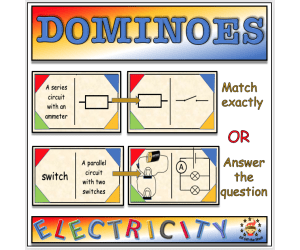
Current Electricity - Circuit and Symbols Dominoes for Middle School Science
Science, Physics, Grade 5, 6, 7, 8, Activities, Games
A dominoes game with circuit symbols and descriptions, sketches and circuit diagrams of series and parallel circuits instead of numbers. Prior Knowledge · Be able to recognise the symbols for a lamp, switch, voltmeter, ammeter, buzzer, motor and resistor. · Be able to match the description, sketch or circuit diagram for the same series circuit. · Be able to match the description, sketch or circuit diagram for the same parallel circuit. Rules of the Game · Each player selects seven dominos from the top of the face-down pile and holds them in their hand like playing cards. · The player whose surname begins with a letter closest to the letter A starts and play proceed in a clockwise direction. · Dominos can be matched exactly, or a name can be matched with a symbol or descriptions, sketches and circuit diagrams can be matched. · If a player thinks a match is wrong they can challenge. If the challenger is correct, they give a card from their own hand to the challenged player. If the challenged player is correct, they give a card from their hand to the challenger. · If a player cannot play a domino, they pick up from the face down pile and can play if possible or add it to their hand. See more Elf Off the Shelf resources on this topic and many others
Author Elf off the Shelf Resources
Tags Science Games, Science Activities, Current Electricity, Circuits Printable, Dominoes Game

Sharecropping and Tenant Farm Game
Science, Earth and Environmental Sciences, Life Sciences, Nature & Plants, Grade 9, 10, Activities, Games
This is a Sharecropping and Tenant Farming Game. National Curriculum Standards: Learners will understand how scarcity and uneven distribution of resources result in economic decisions, and foster consequences that may support cooperation or conflict Specific Objective: Students will be able to evaluate the systems of sharecropping and tenant farming, to see whether they were fair and equitable systems by which freedmen and women could have a sustainable life. Materials: Budget worksheets provided Lesson: After you have covered the bulk of Reconstruction, you can then touch on how the land was distributed among freedmen and women. There were basically two ways in which it was done. Since the vast majority of freedmen and women had practically nothing, they had to somehow rent the land and tools in order to farm. Those that did not have neither, would be sharecroppers. The owner of the land would allow them to use the land and also lend them tools but they would typically have to pay half the profits to the landlord. For those fortunate enough to have their own tools, they could rent the land for a fixed price. They were typically known as tenant farmers. After this has been explained, tell your students that they will experience firsthand how the system worked or (not worked). Divide the class into two groups: tenant farmers and sharecroppers. Also, divide them into pairs within each group. Tell them that they are a married couple trying to make ends meet. Then to half the class give the sharecropper budget worksheet and to the other half, the tenant farmer budget worksheet. Tell them that for each year, they will have to fill out the budget sheet. At the beginning of each year, they will have to select a crop to plant on their little parcel of land. They will have three choices: corn, wheat and cotton. (They may not choose a combination, but they can change their selection each year). Each year, each crop will perform differently depending on the weather and market forces. But they don’t know how each crop will do until the round starts. They’ll just have to guess and try to make it through. Also, for each year, make sure they understand to deduct payments to the landlord, and a fixed living expense.
Author Creative Educator
Tags Sharecropping, Farming, Farm Game, Tenants, Sharecroppers, Farmers, Economic Decisions, U.S. History, Small Group Games, Social Studies, Sharecropping Vs Tenant Farming, Tenant Farming Vs Sharecropping, What Are Tenant Farmers And Sharecroppers, What Were Tenant Farmers And Sharecroppers, Sharecropping And Tenant Farming, Sharecroppers Or Tenant Farmers
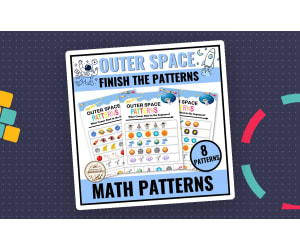
Outer Space Worksheets Finish the Pattern Puzzle for Pre-K, Kindergart
Basic Science, Science, Earth and Environmental Sciences, Patterns, Early Math, Math, Kindergarten, Preschool, Grade 1, Games, Activities
Blast Off Into Math Mastery! Do you want an Outer Space Math Activity for your Preschool, Kindergarten or 1st-grade students? This Fine Motor Skills Patterning Pack comes in handy. Executive function, sequencing, and hand-eye coordination are targeted at once. You can choose between a worksheet or a reusable math center; There are images of rocket ships, stars, planets, and astronauts in this pack, which children will enjoy. Reasons why you need this; It helps in learning math patterns like AB, ABB, AAB and ABC. It also aids motor skills with its cutting and pasting element. It can be used in ways. Math Centers, morning work or Occupational Therapy. Who can use this pack; It’s good for English language learners or children with special needs. The pictures and instructions are simple enough to understand. You can play in two ways: Print and go worksheets: Cutting pictures and gluing them in order. Laminated task boxes: Set up a math station with Velcro dots and pattern strips. So here is the information about what the inner well is. PDF to send home with students More levels of patterns for kids to try! Sequencing tasks with planets, stars and rockets. This pack is, for; Kids who are interested in space and science. Homeschooling children who enjoy space. Students who need assistance with patterns. Teachers who need a fun activity. Identification: For PreK, Kindergarten, 1st Grade and 2nd Grade. For math, geometry, patterns and fine motor skills. You can download it away (PDF). Get this patterning pack today! Help your students get better at math!
Author Bambolina55
Rating
Tags Outer Space Patterns, Outer Space Finish The Pattern, Outer Space, Outer Space Kindergarten, Outer Space Kindergarten Activities, Outer Space Preschool Game, Ouer Space Preschool Activities, Outer Space Kindergarten Game

White Light, Dispersion and Colour Filters Dominoes Game for Middle School
Science, Physics, Grade 5, 6, 7, 8, 9, Games, Activities
The White Light, Dispersion and Colour Filters Dominoes Game for Middle School The White Light, Dispersion and Colour Filters Dominoes Game for Middle School is an innovative teaching resource designed to enhance student understanding of complex scientific concepts. This enjoyable and engaging tool focuses on aiding middle school students (Grade 5, Grade 6, Grade 7, Grade 8, and Grade 9) in mastering the foundational concepts related to the dispersion of light. Instead of traditional numbers or dots, these dominoes feature statements and questions on key topics such as white light dispersion, the order of colours in the spectrum and how colour filters operate. Prior knowledge needed to grasp this game includes awareness about primary (red, green, blue ) and secondary colours (magenta cyan & yellow )of light. Likewise knowing that any two primary colours when mixed give a secondary colour strengthens the comprehension further. If all three primaries are mixed it gives white light. Cleverly integrating symbols or descriptions within sketches or circuit diagrams prompts playful matches during domino play sessions; thereby ushering in visual learning. The game also trains learners' observational skills by instilling that any object only reflects its own collinear while absorbing all other types. About Resource Content: The resource contains ninety dominos along with an animated PowerPoint presentation detailing gameplay rules ensuring teachers can quickly grasp this new pedagogical concept for their science classes. In gameplay, if players spot a wrong match, they have the opportunity to challenge it promoting critical thinking. This product creatively bridges learning gaps by turning typical class assignments into interactive group activities thereby making physics more approachable. Versatility: One could use this versatile tool individually for homework assignments as well as collectively within small specific learning groups inside classrooms catalyzing collaborative learning. They come in multiple file types providing ease across different digital formats ensuring convenience at every step. In conclusion, educators seeking fresh perspectives towards theoretical physics teachings would appreciate the White Light, Dispersion and Colour Filters Dominoes Game as it leads the way through scientific exploration in a non-traditional yet profoundly impactful manner.
Author Elf off the Shelf Resources
Tags White Light, Dispersion, Colour Filters, Dominoes Game, Middle School

Building Brick Creative Building Game (Lego Brick S.T.E.M. Game)
Science, Technology, Engineering, Grade 1, 2, 3, 4, 5, Activities, Games
Overview of This Activity: This printable game is designed to encourage children to use their creativity and apply S.T.E.M. skills! During the game , players collect different Lego elements (pieces). At the end of the game , players create anything they can imagine with the pieces they collected during the game . Then, they can informally practice presentation skills as they tell each other about their creation. How to Play: Place a box or pile of Lego elements (different pieces) where all players can reach them. Gather a die and this game board. Each player should choose 1 mini-figure or Lego element to be their game piece Note: Players can use their piece in their creative build at the end of the game if they would like to! Directions: Players take turns rolling one die on their turn. They move the number of spaces represented on the die and follow instructions on the game square they land on. Based on where they land, they will either choose a set number of elements from the pile, return a set number of elements from their collection to the pile, or move backward a certain number of spaces. The game ends when one person reaches the finish. At that point, all players build creatively with the pieces they have collected during the game . Then, they share what they have built. For game play variations and presentation tips visit: Beyond the Activity. Tips: Be sure to check out the section of this document titled Beyond the Activity to access: a brief video to encourage builders to be creative with a small amount of bricks and suggested ways that this game can be used as a tool for reviewing math skills. You will also find: suggested books, videos, and lessons to help your child learn more about and engage with Lego Bricks. This includes both full color and black and white options. Subject: Science Grades: 1st - 5th Learning Objective: I can apply S.T.E.M. skills such as: problem solving, creativity, inquiry skills, engineering-design thinking... Estimated Time: Under an Hour Supplies Needed: Building bricks and a die
Author Sprout & Inspire
Tags Lego, Game, Math Game, S.t.e.m., S.T.E.M. Center
Light - Reflection Wildcard and Snap Card Games for Middle School
Science, Physics, Grade 5, 6, 7, 8, 9, Activities, Games
Light - Reflection Wildcard and Snap Card Games for Middle School An essential teaching tool designed to consolidate knowledge on light reflection amongst middle school students. This pack of 78 cards caters to three different games, providing an interactive approach for effective learning. Focus area: The game resources contribute towards building a strong foundation on the topic of reflection in a plane mirror, one that is cardinal in understanding basic physics principles. Detailed instructions are easy to understand thanks to the provided animated PowerPoint presentation. Prior Understanding Required: Interpreting transparent, translucent and opaque materials; Distinguishing between luminous and non-luminous objects; Familiarisation with terms such as incident rays, reflected rays along with angles of incidence and reflection. Versatility of Use: Suitable for various classroom scenarios - from group activities promoting collective learning or smaller clusters permitting concentrated instruction. These games could also be part of homework assignments for individual practice. "An instructive route towards science education mixed with fun!" Coupled with scientific content like how our eyes perceive images in a plane mirror or why images are formed behind it; these card games provide an inventive way to absorb these scientific teachings effectively. Further discussions incorporating topics like periscope imaging & diffused/specular image effects enrich the play & learn experience! Suited For: Educators – within public schools or homeschooling groups – who teach grade 5-9 Physics-related subjects find this resource beneficial. It intentionally imparts key concepts without being overly academic. Complexities tied up with traditional chalk-and-talk methodologies become increasingly evident given student’s proven receptiveness towards active learning environments. Enhance the understanding of such technical topics which elucidate light’s properties & it's interactions proficiently through " Light - Reflection Wildcard & Snap Card Games " package that guarantees engagement & a valued learning experience.
Author Elf off the Shelf Resources
Tags Light Reflection, Interactive Resource, Hands-on Learning, Card Games, Physics Education

MEMORY GAME IN SPANISH - "AQUATIC ANIMALS" Animales Acuáticos
Science, Life Sciences, Animals, Grade 1, 2, 3, 4, Worksheets & Printables, Flashcards, Activities, Games
MEMORY GAME "AQUATIC ANIMALS" This document is easy to use because it can be quickly downloaded and printed. - This document is attractive and colorful for children. - This document is not editable. - This document comes in A4 size, you can print it without making any adjustments or adaptations. - This document is in color, you must have ink in your printer. 1. INTRODUCTION: Make your math class more amazing thanks to this fabulous resource, which will help your students learn their first words about aquatic animals, guided by reference images. 2. NAME AND OBJECTIVE(S): To reinforce the learning of their first basic words in Spanish. 3. ORGANIZATION: This product is organized in a simple way. Contains 2 simple pages 4. GRADES/AGES: K-3 5. APPLICATION FORMAT: You can use this product individually or in a group. 6. ANSWERS: This product does require answers. They are attached. 7. LABELS IN PHRASES: Spanish, learn Spanish 8. HOW TO USE AND VARIATIONS: Print this product, cut it out and laminate it to make it last longer. Then apply it in the classroom as reinforcement at the end or as a game. 9. STANDARDS: Not based on guidelines. 10. LINKS TO SIMILAR RESOURCES OR TO YOUR TS STORE: Follow us on our social networks! FACEBOOK: https://www.facebook.com/profile.php?id=100091145220279&mibextid=ZbWKwL INSTAGRAM: https://www.instagram.com/editorialarenaseducativas1/ TEACH SIMPLE: https://teachsimple.com/contributor/arenas-educativas YOUTUBE: https://www.youtube.com/@editorialarenaseducativas 11. CONTACT EMAIL ADDRESS: editorialarenaseducativas@gmail.com 12. FILE TYPE: PDF Format 13. # NUMBER OF PAGES: 2 pages
Author EDITORIAL LAURA EDUCA
Tags Animals, Flash Cards, Games, Memory Game
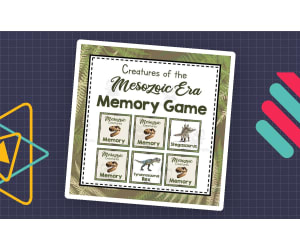
Mesozoic Creatures Memory Game
Science, Earth and Environmental Sciences, Preschool, Grade 1, 2, Activities, Games
This Mesozoic creatures memory game is the perfect complement to a Dinosaur or Paleontology Unit Study. It will help your students memorize and review a few dinosaurs in a fun way. How to Use This Resource: Cut apart all the cards. Then lightly glue each back to a front. Run through a laminator and then cut apart each pieces. Lay pieces flat and upside down. Take turns with your students to turn over 2 at a time. When you find a match, you get to keep the match. When all the cards have been turned over and matched up, then the game is over. The winner is the one who has found the most matches. Not only do these cards feature pictures of Mesozoic creatures, but they also have the corresponding word printed underneath each picture. They will get to work their brains to try and remember where they saw a certain image, but they will also be able to retrieve where they saw a certain word. This is great differentiation for young learners. They will love playing this memory game and ramping up the competition along the way. What You Get: · 12 pairs of Mesozoic creatures memory cards (24 cards total) I hope you enjoy! Here are other similar resources for you to enjoy: Design a Bakery Project Based Activity All About Fossils Number Coloring Pages All About Weathering and Erosion Number of the Week: All About 3 3rd Grade Spelling Curriculum You can find more resources at my storefront here: https://teachsimple.com/contributor/simply-schoolgirl
Author Simply Schoolgirl
Tags Mesozoic Creatures, Memory Game, Concentraction, Vocabulary, Paleontology, Archeology, Picture Matching, Matching Cards

Scratch Halloween: Ghost Game
Science, Technology, Computer Science, Grade 3, 4, 5, 6, 7, 8, 9, 10, Games, Activities
Scratch Halloween: Ghost Game is a programming activity that teaches students how to code a spooky video game using Scratch. Students create an interactive game where they catch ghosts with their mouse cursor. The step-by-step tutorial guides learners of all abilities through building core coding concepts like variables, conditionals, events, and more. Educators can implement this resource in many ways - assign it to individuals or small groups for self-paced learning, use it for whole class computer lab instruction, or even flip the classroom by assigning it as pre-learning before a programming lesson. This engaging and seasonal activity is adaptable for elementary through high school students learning coding fundamentals or looking to advance their Scratch skills by designing their own creative variations after completing the tutorial.
Author Roombop
Tags Scratch, Scratch Programming, Coding, Ghost Scratch, Halloween Scratch, Google Halloween Ghost Game