



3,953 products added recently
Page 5 - 5th Grade Assessments
Support your fifth-grade students as they prepare for the next stage of their education with assessments that cover advanced concepts. This collection includes comprehensive tests in math, language arts, and science. By utilizing these tools, you can address learning gaps and reinforce strengths.

 Show filters


Reading Comprehension Passages Fiction Set 2 (Fillable PDF)
ELA, Reading, Reading Comprehension, Common Core, Writing, Vocabulary, Language Development, Spelling, ESL, Creative Writing, Grade 6, 7, Worksheets & Printables, Worksheets, Writing Prompts, Assessments, Teacher Tools, Tests, Quizzes and Tests, Centers, Activities
Reading Comprehension Passages Fiction Set 2 Snapshot Title: Fiction Grade 6-7 Set 2 Genre: Fiction Subject: Reading / SEL Primary Topic: Short fiction about goals, family, fear, and problem-solving Estimated Guided Reading Level (A–Z): X What This Teaches Best Highlights perseverance and goal-setting through stories such as Cooking Camp , where Jason works toward camp money. Develops analysis of realistic character choices in school, family, and community settings, including School Musical , My Key! , and Summer at Gran’s . Encourages discussion of fear and bravery in suspenseful or high-stakes stories such as Creepy Well and Solo Flight . Supports cause-and-effect thinking and problem-solving, especially in stories like Bug Trip and Cooking Camp . Provides broad practice with vocabulary, inference, sequencing, and response writing through matched support pages after each passage. Learning Goals Students will explain how characters work toward a goal or solve a problem. Students will infer character feelings from dialogue, actions, and story events. Students will describe how a challenge changes a character by the end of a story. Students will sequence events and explain cause-and-effect relationships. Students will determine the meaning of important vocabulary from context. Students will compare how different stories present courage, responsibility, or persistence. Passages Include 1.Cooking Camp: Jason tries to make enough money to go to cookery camp. 2.Graduation: Matt helps prepare for his brother's graduation party. 3.No Internet- Sam and Klara discuss life in the past with their gran. 4.School Musical: Maiya and her concerns about the school musical. 5.My Key: Jon has the house to himself for once. Does he enjoy it though? 6.Creepy Well: Jo and some kids from school at a creepy well. 7.Bug Trip: The twins are driving Dad crazy with their science project. 8.Solo Flight: Sid gets his first solo flight in bizarre circumstances. 9.Summer at Gran's: Andrea trying to make the best of her time at Gran's. 10.Wild Wild West: Alec on the ranch with his dad. 11.Danger Mountain: Nath tries a dangerous ride down the mountain. 12.Math Queen: Rhonda doing her best at the Math competition. FILLABLE PDF VERSION Worksheet-style pages, but with type-in answer boxes so students can complete and save their work digitally. Other versions are available in the links list below or in the full catalog. FULL CATALOG OF DOWNLOAD LINKS HERE For similar downloads and other frees, do check out Cored Group on TeachSimple.
Author Cored Education
Rating
Tags Elementary, Reading, Comprehension, Vocabulary, Spelling, Writing, Passages, Reading Centers, Reading Comprehension Assessment
Synonyms Supplementary Materials Grades 3-4 (PDF)
ELA, Language Development, ESL, Common Core, Resources for Teachers, Vocabulary, Grade 3, 4, Worksheets & Printables, Worksheets, Quizzes and Tests, Teacher Tools, Tests, Assessments, Activities, Lesson Plans
Synonyms Supplementary Materials Note: This download DOES NOT include the tests themselves. You can still make use of these materials without them but they are recommended. Download in a format of your choice in the "Links" section below. Outline Ice Breaker (5-10 minutes) Engaging, interactive activity to introduce the lesson’s theme. Examples: Matching games, sentence races, charades, or storytelling challenges. Guided Practice (10-15 minutes) Teacher-led exercises to reinforce the concept. Examples: Sorting sentences by tense, sentence transformations, or fill-in-the-gap exercises. Group or Partner Task (15 minutes) Collaborative activity to practice the lesson’s focus in a fun and engaging way. Examples: Role-play, storytelling, sentence-building games, or small-group discussions. Independent Worksheet (15 minutes) Individual written activity to solidify understanding. Examples: Sentence corrections, verb conjugation drills, or tense identification exercises. Exit Task (5 minutes) Quick reflective activity to assess understanding before students leave. Examples: Writing a sentence using the target concept, identifying a tense, or explaining a rule. Links: Includes: Nouns Synonyms Verbs Synonyms Adjectives Synonyms Synonyms in a Sentence Google Docs Google Forms Google Slides PDF PPT Word FULL CATALOG OF DOWNLOAD LINKS HERE Grade 3/4 Links: Adjectives Google Docs Google Forms Google Slides PDF PPT Word Free Supplementary Materials Pack Adverbs Google Docs Google Forms Google Slides PDF PPT Word Free Supplementary Materials Pack Conjunctions Google Docs Google Forms Google Slides PDF PPT Word Free Supplementary Materials Pack Nouns Google Docs Google Forms Google Slides PDF PPT Word Free Supplementary Materials Pack Pronouns Google Docs Google Forms Google Slides PDF PPT Word Free Supplementary Materials Pack Verbs Google Docs Google Forms Google Slides PDF PPT Word Free Supplementary Materials Pack Sentence Structure Google Docs Google Forms Google Slides PDF PPT Word Free Supplementary Materials Pack Present Tense Google Docs Google Forms Google Slides PDF PPT Word Free Supplementary Materials Pack Past Tense Google Docs Google Forms Google Slides PDF PPT Word Free Supplementary Materials Pack Future Tense Google Docs Google Forms Google Slides PDF PPT Word Free Supplementary Materials Pack Context Clues Google Docs Google Forms Google Slides PDF PPT Word Free Supplementary Materials Pack Defining Words Google Docs Google Forms Google Slides PDF PPT Word Free Supplementary Materials Pack Fill the Blanks Google Docs Google Forms Google Slides PDF PPT Word Free Supplementary Materials Pack Homophones Google Docs Google Forms Google Slides PDF PPT Word Free Supplementary Materials Pack Synonyms Google Docs Google Forms Google Slides PDF PPT Word Free Supplementary Materials Pack ELA Review Questions Overview Questions have three answer choices. There are a handful of pictures on each test for aesthetic purposes, as well as a review sheet covering most of the topics covered in the product. Introduction or Example Sheet Each topic will include an introduction or example sheet to go through first with your students. Full Answer Keys Full answer keys and sample responses are provided so no matter how busy you are, you know you're covered! In the Supplementary Pack Interactive Ice Breakers: Fun, hands-on activities that get students thinking about adjectives right from the start. Guided Practice: Teacher-led exercises that reinforce the day’s lesson, ensuring students can confidently identify and use adjectives. Group and Partner Tasks: Collaborative activities that allow students to work together to solve problems, categorize adjectives, and create descriptive sentences. Independent Worksheets: Structured worksheets that provide individual practice and help solidify understanding of key concepts. Exit Tasks: Quick, reflective activities at the end of each lesson that assess understanding and encourage students to apply what they’ve learned. For similar downloads and other frees, do check out Cored Group on TeachSimple.
Author Cored Education
Tags Elementary, Answers, Ccss, Common Core, Tests, Test Prep, Grade 3, Grade 4, Vocabulary, Lesson Plan

Science Reading Passages on Human Body Systems (Google Drive)
Science, Life Sciences, Human Body, Biology, Common Core, Reading Comprehension, Reading, ELA, ESL, Language Development, Grade 5, 6, 7, Assessments, Teacher Tools, Presentations, Tests, Quizzes and Tests, Worksheets, Worksheets & Printables, Centers, Activities
Reading Passages on Human Body Systems for Life Science (Biology) Human Body Systems: Reading Passages Life Science - Stimulate renewed enthusiasm and curiosity in the realm of science with these vibrant science reading comprehension lessons. Bursting with vivid colors and engaging topics, these resources are designed to captivate and motivate your students, urging them to delve deeper into their scientific explorations. And the best part? As an educator, you can be at ease and confident in the effectiveness of these lessons, knowing that a significant portion of the groundwork and preparation has been meticulously taken care of for you, making the teaching process smoother and more enjoyable. What's inside? Part 2 - Human Body Systems Reading Passage 1: Skeletal & Muscular Systems Reading Passage 2: Circulatory & Respiratory Systems Reading Passage 3: Nervous System Reading Passage 4: Digestive System Reading Passage 5: Reproductive System Product Info: 35 PAGES (Docs Version: US English with Answers) 5 FORMS (Self-Grading) 196 Slides Teaching Duration: 2 Weeks Science Reading Comprehension Outline: Introducing a comprehensive resource tailored for 5th and 6th graders, this product offers enriching reading passages supplemented with illustrative pictures and graphs to clarify key concepts. Aligned with the Common Core State Standards (CCSS), it offers a hassle-free approach to teaching, given that the bulk of the preparation is already done for you. The passages present a diverse set of questions – from multiple choice to data analysis and fill-in-the-blanks. This ensures a rich blend of high-interest content and fundamental curriculum-based science themes. With its versatility, you can seamlessly integrate these lessons into various classroom settings, whether it's whole class discussions, morning exercises, independent desk tasks, small group engagements, contingency plans for substitute teachers, regular homework assignments, or even themed activities for holidays. FULL CATALOG OF DOWNLOAD LINKS HERE Grade 5/6 Links: Physical Science Part 1 - Physical and Chemical Properties Google Docs/Slides/Forms PDF PPT Word Free Supplementary Pack Accompanying Videos Physical Science Part 2 - Motion and Energy Google Docs/Slides/Forms PDF PPT Word Free Supplementary Pack Accompanying Videos Physical Science Part 3 - Electricity and Magnets Google Docs/Slides/Forms PDF PPT Word Free Supplementary Pack Accompanying Videos Life Science Part 1 - Cells, Reproduction and Genetics Google Docs/Slides/Forms PDF PPT Word Free Supplementary Pack Accompanying Videos Life Science Part 2 - Human Body Systems Google Docs/Slides/Forms PDF PPT Word Free Supplementary Pack Accompanying Videos Life Science Part 3 - Plant Parts and Ecosystems Google Docs/Slides/Forms PDF PPT Word Free Supplementary Pack Accompanying Videos Earth Science Part 1 - Plate Tectonics and Rock Cycle Google Docs/Slides/Forms PDF PPT Word Free Supplementary Pack Accompanying Videos Earth Science Part 2 - Ocean Exploration and Natural Resources Google Docs/Slides/Forms PDF PPT Word Free Supplementary Pack Accompanying Videos Earth Science Part 3 - Weather and Solar System Google Docs/Slides/Forms PDF PPT Word Free Supplementary Pack Accompanying Videos For similar products and other frees, do check out Cored Group on TeachSimple .
Author Cored Education
Rating
Tags Science, Elementary, Reading, Comprehension, Vocabulary, Answers, Digital Centers, Biology, Life Science, Reading Comprehension Assessments
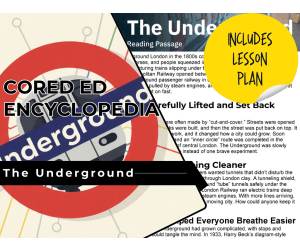
The Underground Reading Comprehension Passage - Cored Ed Encyclopedia
ELA, Language Development, Reading Comprehension, Reading, Science, Technology, Engineering, History, Social Studies, Geography, Grade 2, 3, 4, 5, Worksheets & Printables, Worksheets, Teacher Tools, Centers, Activities, Writing Prompts, Assessments, Quizzes and Tests, Quizzes, Lesson Plans
This Underground reading comprehension with lesson plan includes: Visualization (on the front cover) Start your lesson by taking a minute to think and share something about the topic. Read the script aloud (slowly), perhaps prepare some music or sound effects. Student close their eyes and let their imaginations wander. Students open their eyes, read the question aloud and give them a few minutes to complete. Ask a few students to share or keep answers until the end to compare with what they learn in the passage. Quick pause—thousands of Cored Education products are included with your TeachSimple membership. Download links and encyclopedia index available here. Pre-Reading Trivia Students will write down one thing they already know about the subject and then read five more facts and discuss. These facts are fun, and the students will enjoy learning about the subject before reading more. Give 1 minute for students to write what they already know (no pressure—best guess is fine). Read the five facts together. After each fact, do ask a student for their opinion, was it surprising? Set a purpose by asking students to highlight/underline one fact they want to learn more about during the reading. Reading Passage The text is a high-interest reading passage with set paragraphs, roughly three to four paragraphs long. It contains a variety of themes about the topic, anywhere from history to technology. The passage is between 250 and 350 words in length. First, ask students to look at the headings and see what they’ll learn about today. What do they know about the topic/heading? First read options: Teacher read-aloud (best for support). Partner reading (paragraph by paragraph). While reading, students underline important details, and vocabulary words they think may come up in the questions section. Mixed Questions The first question page contains four multiple-choice questions, each with a choice of four answers, and three written response questions that require a sentence or two from the student. Students complete the mcqs first independently, then review quickly as a class. For the 3 written responses, try to get students giving the answer with some form of evidence: “I think ___ because the text says ___.” If students get stuck, send them back to check the passage. Vocabulary Questions Practice seven key words from the text in this section across two activities. First section is scrambled words where students will unscramble three words given a clue for each. The second section is a word to meaning matching activity. Before starting, have some students read out words they underlined in the passage. Ask students to say the word and read aloud the sentence(s) around each word. Ask students to do scrambled words and the matching exercise in pairs then go through answers as a class. For the scrambled spelling task, get four pairs to come up to the board and write the words for extra practice with the other student reading out the clue. For the matching task, prompt students to give full sentences: “I matched ___ with ___ because ___.” Creative Writing In this question, the student will be required to write a five to eight sentence paragraph on a question related to the topic. Before starting, ask students write down 3 key ideas they are going to include in their piece. Ask students for ideas to share around the class to help those struggling. Pro writing expectations: 5–8 sentences At least 2 facts or details from the passage At least 2 vocabulary words from the previous page Students read their paragraphs while classmates listen for facts and vocabulary words. Extension Activities This page is optional for fast finishers or to take home. There are several activities, each one requiring a different skill. Do some, do none, do all, completely optional - but you will feel reassured knowing every possibility is planned for. Includes summary writting question. Answer Key There are answers for the multiple-choice questions, written response questions have sample answers, vocabulary answers and if there is a summary question then a sample summary will be provided as well. Lesson Plan Included Customized lesson plan for this lesson is included. Lesson Snapshot Title: The Underground Genre: Nonfiction (informational text) Subject: Social Studies (History) Primary Topic: How London built and improved the Underground Estimated Guided Reading Level (A–Z): R What This Lesson Teaches Best Explains why planners wanted trains under crowded London streets in the 1800s. Teaches key early-history facts, including the Metropolitan Railway opening on January 10, 1863, between Paddington and Farringdon. Describes the “cut-and-cover” method (opening streets like a trench, building tracks, then putting the street back). Shows how deeper “tube” tunnels and electric trains reduced street disruption and avoided steam smoke. Demonstrates how a clearer diagram-style map (Harry Beck, 1933) helped riders understand a complicated system. Learning Goals Students will explain why some planners imagined trains going under London in the 1800s. Students will identify what opened on January 10, 1863, and name the two stations connected in the text. Students will describe the steps of “cut-and-cover” tunnel building using details from the passage. Students will explain how digging deeper “tube” tunnels changed building the Underground and affected smoke underground. Students will explain how Harry Beck’s 1933 diagram-style map made the system easier to follow. Key Vocabulary From the Text Metropolitan — the name of an early London railway line. cut-and-cover — open a street, build tracks, rebuild street on top. tunneling — digging a passage underground. shield — a strong ring that helps bore tunnels safely. complicated — hard to understand because there are many parts. FULL CATALOG OF DOWNLOAD LINKS AND ENCYCLOPEDIA INDEX HERE
Author Cored Education
Rating
Tags Vocabulary, Reading Comprehension, Reading Passages, Lesson Plans, Ela Lesson Plans, Reading Comprehension Lesson Plans, Pre-reading, History, History Lesson Plans, Geography
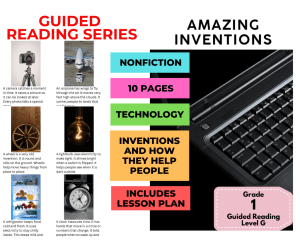
Guided Reading Level G - Amazing Inventions (with Lesson Plan)
ELA, Resources for Teachers, Reading Comprehension, Reading, Science, Engineering, Technology, Language Development, Pre-Reading, Vocabulary, Grade 1, 2, 3, Worksheets & Printables, Worksheets, Teacher Tools, Centers, Activities, Literacy Readers, Quizzes, Quizzes and Tests, Assessments, Lesson Plans
This Guided Reading Book - Amazing Inventions (Level G) with lesson plan includes: Guided Reading Color Label (front cover x1) This is a quick way to match the book’s demands to what students can generally handle.. The overall goal is to use the level/color to pick books for several smaller groups. To qualify for a certain level, a student is expected to read a book from that level with about 90–94% accuracy. If a student is consistently accurate and understands, move up a level. If the student is struggling at that level, drop down and add more support. Each student will improve at completely different rates, but it is generally one of the best ways to check progress across the class. DOWNLOAD THE CATALOG TO VIEW ALL GUIDED READING BOOKS AVAILABLE (SORTED LEVELS A-Z) Pre-Reading Question (x1) Teacher asks the prompt aloud, can be while showing the cover or first page. Students share what they already know, or make educated guesses from the cover. Prompt them to use the target vocabulary. Write some of their responses on the board to look back at during the reading. Vocabulary Words (x5) Introduce the five words, best doing it one at a time. Start by saying it, while students repeat and then see if anyone knows what it means before reading further. Read through the meaning and try to briefly connect each word to a picture or gesture so it’s meaningful. Ask students to flip through the book pages and point to where they see each of the vocabulary words. While reading the book pause upon coming across one of the vocab words or read the sentence twice to make sure students understand the word has appeared. Optional: Ask students to raise hands whenever they see/hear one of the new words. Guided Reading Pages (x10) Check the book snapshot (below) for: primary topic - do you need to prep extra reading or intro materials on this? what is taught best - decide on 1-2 bullets to focus on, use the prompt or words provided here for best results. learning goals - what you are checking for students to be able to do after the session, elicit answers using prompts or words provided. key vocabulary (see section above). questions overview - so you know what is coming up and if you need to prep extra materials to assist understanding. Run the lesson You may have already looked at a few of the pages together, but you can show them some of the pictures again first to set meaning. Depending on how much time you have and how familiar your students are with guided reading class, you may want to read the book aloud first with the group first. Students whisper or partner read, while you listen in. If time, do it as a group, one student reading a page each. Use the guided page’s prompts to coach: “Check the picture / does it make sense?” “Point under the words / try the first sound” “Reread the sentence smoothly”. Try to focus more on one student per session (rotating every time), so you can work out if they are ready to move up or need to move down a level. Comprehension Questions (back cover x3) This is your way to check that students didn’t just say the words, but actually understood the text. First, let students answer by pointing to the page/picture and saying a short sentence. After any answer, follow with: “Show me where you found that in the text.” In bigger groups, have partners answer first (10–20 seconds), then call on 2–3 students to share. Differentiation tips: Emerging speakers/struggling readers: oral + pointing On-level: oral in a full sentence Higher: one written sentence or draw + label Book Snapshot Title: Amazing Inventions Genre: Nonfiction (informational text) Subject: Science/Technology + Reading (Informational Text) Primary Topic: Inventions and how they help people Estimated Guided Reading Level (A–Z): G What This Book Teaches Best Introduces common inventions (wheel, lightbulb, telephone, computer, camera, airplane, refrigerator, clock, robot) and what each one does. Explains how inventions help people in everyday life (moving heavy things, seeing in the dark, connecting over distances, doing work quickly, keeping food cold, telling time, doing chores). Builds understanding of technology as something that changes, with “new things… invented every day to help people.” Supports describing key details from short informational passages paired with clear photos. Learning Goals Identify several inventions named in the book and tell what each helps people do. Describe how a wheel helps move heavy things from place to place. Explain how a lightbulb helps people see when it is dark outside. Tell how a telephone connects people who are far apart. Describe one way computers help people work quickly and what they can do. Explain what the book says about technology changing and new inventions helping people. Key Vocabulary From the Text invention — something made for the first time to help people. electricity — power that runs lights and machines. distances — how far apart places are. refrigerator — a machine that keeps food cold. sensors — parts that help a machine notice what is around it. Discussion Prompts Pre-reading question: What inventions do you use, and how do they help you? Comprehension questions: How do wheels help move heavy things from place to place? Comprehension questions: What does a lightbulb help people do when it is dark outside? Comprehension questions: What does the book say about new technology and how it helps people? Printing Tips 1. Best Printing Method (Recommended) “Booklet” Printing (Best if Available) If your printer or PDF viewer supports Booklet Printing , use this. Settings to use: Print mode: Booklet Paper size: Letter or A4 (either works) Orientation: Landscape Print on both sides: Yes Flip on: Short edge Scaling: Fit to printable area Booklet subset: First test: Front sides only Then: Back sides only This will automatically: Pair pages correctly Put the cover on the outside Align everything for folding After printing, fold in half and staple along the spine . 2. If “Booklet” Printing Is NOT Available You can still print this correctly with manual duplex printing . Step-by-step: Open the PDF. Choose Print . Set: Orientation: Landscape Pages per sheet: 1 Print on both sides: Yes Flip on: Short edge Print all pages . Because each PDF page already contains two facing book pages, the result will still fold cleanly into a book. Thousands of Cored Education products are included with your TeachSimple membership. Download links and encyclopedia index available here.
Author Cored Education
Rating
Tags Reading Comprehension, Reading Passages, Reading, Guided Reading, Guided Reading Lesson Plan, Guided Reading Activity, Pre-reading, Science Lesson Plans, Technology, Engineering

Guided Reading Level M - The Sport of Fencing (with Lesson Plan)
ELA, Resources for Teachers, Reading Comprehension, Reading, Science, Engineering, Technology, Sports, P.E. & Health, Physical Education, Grade 2, 3, 4, Worksheets & Printables, Worksheets, Teacher Tools, Centers, Activities, Literacy Readers, Quizzes, Quizzes and Tests, Assessments, Lesson Plans
This Guided Reading Book - The Sport of Fencing (Level M) with lesson plan includes: Guided Reading Color Label (front cover x1) This is a quick way to match the book’s demands to what students can generally handle.. The overall goal is to use the level/color to pick books for several smaller groups. To qualify for a certain level, a student is expected to read a book from that level with about 90–94% accuracy. If a student is consistently accurate and understands, move up a level. If the student is struggling at that level, drop down and add more support. Each student will improve at completely different rates, but it is generally one of the best ways to check progress across the class. DOWNLOAD THE CATALOG TO VIEW ALL GUIDED READING BOOKS AVAILABLE (SORTED LEVELS A-Z) Pre-Reading Question (x1) Teacher asks the prompt aloud, can be while showing the cover or first page. Students share what they already know, or make educated guesses from the cover. Prompt them to use the target vocabulary. Write some of their responses on the board to look back at during the reading. Vocabulary Words (x5) Introduce the five words, best doing it one at a time. Start by saying it, while students repeat and then see if anyone knows what it means before reading further. Read through the meaning and try to briefly connect each word to a picture or gesture so it’s meaningful. Ask students to flip through the book pages and point to where they see each of the vocabulary words. While reading the book pause upon coming across one of the vocab words or read the sentence twice to make sure students understand the word has appeared. Optional: Ask students to raise hands whenever they see/hear one of the new words. Guided Reading Pages (x10) Check the book snapshot (below) for: primary topic - do you need to prep extra reading or intro materials on this? what is taught best - decide on 1-2 bullets to focus on, use the prompt or words provided here for best results. learning goals - what you are checking for students to be able to do after the session, elicit answers using prompts or words provided. key vocabulary (see section above). questions overview - so you know what is coming up and if you need to prep extra materials to assist understanding. Run the lesson You may have already looked at a few of the pages together, but you can show them some of the pictures again first to set meaning. Depending on how much time you have and how familiar your students are with guided reading class, you may want to read the book aloud first with the group first. Students whisper or partner read, while you listen in. If time, do it as a group, one student reading a page each. Use the guided page’s prompts to coach: “Check the picture / does it make sense?” “Point under the words / try the first sound” “Reread the sentence smoothly”. Try to focus more on one student per session (rotating every time), so you can work out if they are ready to move up or need to move down a level. Comprehension Questions (back cover x3) This is your way to check that students didn’t just say the words, but actually understood the text. First, let students answer by pointing to the page/picture and saying a short sentence. After any answer, follow with: “Show me where you found that in the text.” In bigger groups, have partners answer first (10–20 seconds), then call on 2–3 students to share. Differentiation tips: Emerging speakers/struggling readers: oral + pointing On-level: oral in a full sentence Higher: one written sentence or draw + label Book Snapshot Title: The Sport of Fencing Genre: Nonfiction (informational) Subject: Physical Education / Reading (Informational Text) Primary Topic: Fencing gear, swords, and how matches work Estimated Guided Reading Level (A–Z): M What This Book Teaches Best Basic overview of fencing as a sport, including where it takes place (a long, narrow mat called a “strip”). Safety equipment and how it protects fencers (mask, jacket, glove, cuff). Differences among the three fencing swords and how points are scored with each (foil, épée, sabre). Key fencing moves and positions used in a match (“En Garde” stance, lunge). How modern fencing tracks points and how respect is shown before and after matches. Learning Goals Students will describe what fencing looks like and where it takes place using details from the text. Students will explain how fencing safety gear protects a fencer during a match. Students will compare foil, épée, and sabre by describing how targets and scoring work. Students will identify and describe the “En Garde” stance and why it helps movement. Students will explain how a lunge helps a fencer reach an opponent to score a point. Students will describe how fencing shows respect before and after a match. Key Vocabulary From the Text strip — the long, narrow mat where fencers move. foil — a light, flexible sword used in fencing. épée — the heaviest fencing sword with the whole body as target. sabre — a fast sword that can score with tip or edge. lunge — a move stepping forward to reach an opponent. Discussion Prompts Pre-reading question: What safety gear do you think someone would need to fence safely? Comprehension questions: Why do fencers wear a fencing mask? In a foil match, what part of the opponent is the target for scoring points? What do fencers do before and after a match to show respect? Printing Tips 1. Best Printing Method (Recommended) “Booklet” Printing (Best if Available) If your printer or PDF viewer supports Booklet Printing , use this. Settings to use: Print mode: Booklet Paper size: Letter or A4 (either works) Orientation: Landscape Print on both sides: Yes Flip on: Short edge Scaling: Fit to printable area Booklet subset: First test: Front sides only Then: Back sides only This will automatically: Pair pages correctly Put the cover on the outside Align everything for folding After printing, fold in half and staple along the spine . 2. If “Booklet” Printing Is NOT Available You can still print this correctly with manual duplex printing . Step-by-step: Open the PDF. Choose Print . Set: Orientation: Landscape Pages per sheet: 1 Print on both sides: Yes Flip on: Short edge Print all pages . Because each PDF page already contains two facing book pages, the result will still fold cleanly into a book. Thousands of Cored Education products are included with your TeachSimple membership. Download links and encyclopedia index available here.
Author Cored Education
Rating
Tags Reading Comprehension, Reading Passages, Reading, Guided Reading, Guided Reading Lesson Plan, Guided Reading Activity, Pre-reading, Health Lesson Plans, P.e., Sports
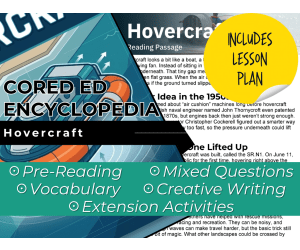
Hovercraft Reading Comprehension Passage - Cored Ed Encyclopedia
ELA, Reading Comprehension, Reading, Pre-Reading, Language Development, History, Social Studies, Science, Physics, Technology, Grade 2, 3, 4, 5, Worksheets & Printables, Worksheets, Teacher Tools, Centers, Activities, Writing Prompts, Assessments, Quizzes and Tests, Quizzes, Lesson Plans
This hovercraft reading comprehension with lesson plan includes: Visualization (on the front cover) Start your lesson by taking a minute to think and share something about the topic. Read the script aloud (slowly), perhaps prepare some music or sound effects. Student close their eyes and let their imaginations wander. Students open their eyes, read the question aloud and give them a few minutes to complete. Ask a few students to share or keep answers until the end to compare with what they learn in the passage. Quick pause—thousands of Cored Education products are included with your TeachSimple membership. Download links and encyclopedia index available here. Pre-Reading Trivia Students will write down one thing they already know about the subject and then read five more facts and discuss. These facts are fun, and the students will enjoy learning about the subject before reading more. Give 1 minute for students to write what they already know (no pressure—best guess is fine). Read the five facts together. After each fact, do ask a student for their opinion, was it surprising? Set a purpose by asking students to highlight/underline one fact they want to learn more about during the reading. Reading Passage The text is a high-interest reading passage with set paragraphs, roughly three to four paragraphs long. It contains a variety of themes about the topic, anywhere from history to technology. The passage is between 250 and 350 words in length. First, ask students to look at the headings and see what they’ll learn about today. What do they know about the topic/heading? First read options: Teacher read-aloud (best for support). Partner reading (paragraph by paragraph). While reading, students underline important details, and vocabulary words they think may come up in the questions section. Mixed Questions The first question page contains four multiple-choice questions, each with a choice of four answers, and three written response questions that require a sentence or two from the student. Students complete the mcqs first independently, then review quickly as a class. For the 3 written responses, try to get students giving the answer with some form of evidence: “I think ___ because the text says ___.” If students get stuck, send them back to check the passage. Vocabulary Questions Practice seven key words from the text in this section across two activities. First section is scrambled words where students will unscramble three words given a clue for each. The second section is a word to meaning matching activity. Before starting, have some students read out words they underlined in the passage. Ask students to say the word and read aloud the sentence(s) around each word. Ask students to do scrambled words and the matching exercise in pairs then go through answers as a class. For the scrambled spelling task, get four pairs to come up to the board and write the words for extra practice with the other student reading out the clue. For the matching task, prompt students to give full sentences: “I matched ___ with ___ because ___.” Creative Writing In this question, the student will be required to write a five to eight sentence paragraph on a question related to the topic. Before starting, ask students write down 3 key ideas they are going to include in their piece. Ask students for ideas to share around the class to help those struggling. Pro writing expectations: 5–8 sentences At least 2 facts or details from the passage At least 2 vocabulary words from the previous page Students read their paragraphs while classmates listen for facts and vocabulary words. Extension Activities This page is optional for fast finishers or to take home. There are several activities, each one requiring a different skill. Do some, do none, do all, completely optional - but you will feel reassured knowing every possibility is planned for. Includes summary writting question and additional facts. Answer Key There are answers for the multiple-choice questions, written response questions have sample answers, vocabulary answers and if there is a summary question then a sample summary will be provided as well. Lesson Plan Included Customized lesson plan for this lesson is included. Lesson Snapshot Title: Hovercraft Genre: Nonfiction (informational text) Subject: Science / Engineering (transportation) Primary Topic: How hovercraft ride on air and where they’re used Estimated Guided Reading Level (A–Z): Q What This Lesson Teaches Best Explains how a hovercraft rides on a “cushion of air trapped underneath,” instead of sitting in water. Describes why the air cushion reduces rubbing so the craft can slide over water, sand, or flat grass. Gives a brief invention history (an 1870s patented idea, then a smarter 1950s improvement to stop air leaking). Shows how design changes improved performance, including the flexible “skirt” for obstacles and choppy water. Connects hovercraft to real-world uses today (ferries, rescue missions, military landings, racing/recreation) and notes challenges like wind and waves. Learning Goals Students will describe how a hovercraft is like a boat, a small airplane, and a moving fan. Students will explain how an air cushion helps a hovercraft slide with very little rubbing. Students will describe how Christopher Cockerell improved hovercraft by reducing air leaking in the 1950s. Students will identify the SR.N1 and tell what happened when it was shown to the public on June 11, 1959. Students will explain how the flexible “skirt” helped hovercraft handle obstacles and choppy water. Students will list at least two places or jobs hovercraft can do today, using text evidence. Key Vocabulary From the Text patented — legally protected an invention idea. pressure — pushing force of trapped air underneath. flexible — able to bend without breaking. obstacles — things in the way that block movement. ferries — boats that carry people across a route. FULL CATALOG OF DOWNLOAD LINKS AND ENCYCLOPEDIA INDEX HERE
Author Cored Education
Rating
Tags Vocabulary, Reading Comprehension, Reading Passages, Lesson Plans, Ela Lesson Plans, Reading Comprehension Lesson Plans, Pre-reading, Science Lesson Plans, Physics, Technology

The Bio-Design Blueprint A Gamified MicroLearning Series in Biomimicry
Basic Science, Science, Inventors, Theories, Biology, Life Sciences, Engineering, Technology, Life Skills, Special Resources, Grade 6, 7, 8, 9, 10, 11, 12, Worksheets & Printables, Parts of and Anatomy of, Drawing Templates & Outlines, Worksheets, Word Searches, Workbooks, Teacher Tools, Assessments, Lesson Plans, Quizzes and Tests
Introducing The Bio-Design Blueprint! This gamified micro-learning curriculum is an entirely online series of adventures that will give students an interactive experience using the 3.8 billion-year-old R&D of nature to design solutions to today’s biggest STEM problems! Not only does it include 35 pages of engaging theory (with topics such as the kingfisher bullet train, the Namib Desert beetle, spider silk vs. Kevlar, the slime mold Tokyo subway system, coral concrete, mycelium packaging and other examples), but it also has ten student worksheets where students use the theory studied in class to create their own designs, complete with data analysis, application to real-world scenarios and creative design challenges. The Bio-Design Blueprint can be used to teach students about biomimicry, fluid dynamics, structural integrity, swarm intelligence, thermal regulation, the lotus effect, gecko adhesion, structural coloration, photosynthesis technology, impact resistance and closed-loop ecosystems. The curriculum also includes the Eco-City Capstone Project, teacher visual anchors, cognitive maps, and iteration spirals to ensure easy implementation of the curriculum in the classroom. Keywords: biomimicry curriculum, sustainable engineering worksheets, STEM activities, middle school, high school, biology and engineering, gamified science lessons, nature-inspired design, environmental science resources, NGSS biomimicry unit, zero waste engineering, project-based STEM. Digital download available instantly. Ready for Google Classroom! Homeschool-friendly; NO prep required for teachers! Students will fall in love with science as they use the blueprints of our planet to design solutions that will save our planet from sustainability issues! Reasons Schools and Parents Appreciate the Curriculum: Experiential Learning – Real-world examples of biomimicry, gamified worksheets, and hands-on experiences create excitement around STEM–students eagerly anticipate science class. Zero Prep Time for Educators - The complete theory of biomimicry, the ten worksheets, visuals for the capstone projects are fully created for the educator - thus they are ready to go electronically and/or printed. This saves educators hours of planning. Prepares Students for the Future – Students develop their critical thinking skills, creativity, and commitment to a sustainable world. The curriculum is aligned perfectly to the NGSS engineering and life science standards. Curriculum is Differentiated and Inclusive – The curriculum incorporates a variety of activities, including fill-ins, math problems, written responses, and creative design challenges, allowing all students to succeed (ELL, gifted, and neurodiverse). Eco-Friendly and Impactful – Students learn how to turn abstract concepts into solutions for real-world issues (i.e., climate change, waste, energy conservation) - parents appreciate having their children participate in meaningful environmental education. *Target Audience by Grade & Subject (Based on Full Content Analysis, Rigor of Program, Worksheet Use) : Middle School (6-8): Life Science, Environmental Science, Integrated STEM, Project-Based Learning, & Gifted/Talented. High School (9-12): Biology, Physics, Engineering Design, Environmental Science, Sustainability, & STEM/STEAM Electives. *Level (data analysis; calculations; open-ended design challenge; NGSS Cross-Cutting Concepts) allows for Grades 7-10 to be primary users of the program (Core Use); and Grade 6 and 11-12 to fit as differentiated use. Copyright / Terms of Use This book, authored by Syed Hammad Rizvi, is a copyright protected, personal use resource that should only be used in the classroom (for one student) and is NOT authorized for alteration, resale or distribution. More simply stated, you cannot post this resource on the Internet at all, because it would become public access and, therefore, can be downloaded by others. If you wish to share this with other teachers, please purchase additional licenses from Teachsimple. Thank you for following these terms of use. Brought to you by Syed Hammad Rizvi with joy.
Author Creative Book Store
Rating
Tags BiomimicryCurriculum, SustainableEngineering, STEMWorksheets, GamifiedSTEM, BiomimicryLessons, NatureInspiredDesign, NGSSAligned, ProjectBasedLearning, EcoEngineering, BioDesignBlueprint
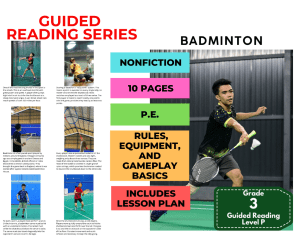
Guided Reading Level P - Badminton (with Lesson Plan)
ELA, Resources for Teachers, Reading Comprehension, Reading, Pre-Reading, Language Development, Health, P.E. & Health, Sports, Physical Education, Grade 2, 3, 4, Worksheets & Printables, Worksheets, Teacher Tools, Centers, Activities, Literacy Readers, Quizzes, Quizzes and Tests, Assessments
This Guided Reading Book - Badminton (Level P) with lesson plan includes: Guided Reading Color Label (front cover x1) This is a quick way to match the book’s demands to what students can generally handle.. The overall goal is to use the level/color to pick books for several smaller groups. To qualify for a certain level, a student is expected to read a book from that level with about 90–94% accuracy. If a student is consistently accurate and understands, move up a level. If the student is struggling at that level, drop down and add more support. Each student will improve at completely different rates, but it is generally one of the best ways to check progress across the class. DOWNLOAD THE CATALOG TO VIEW ALL GUIDED READING BOOKS AVAILABLE (SORTED LEVELS A-Z) Pre-Reading Question (x1) Teacher asks the prompt aloud, can be while showing the cover or first page. Students share what they already know, or make educated guesses from the cover. Prompt them to use the target vocabulary. Write some of their responses on the board to look back at during the reading. Vocabulary Words (x5) Introduce the five words, best doing it one at a time. Start by saying it, while students repeat and then see if anyone knows what it means before reading further. Read through the meaning and try to briefly connect each word to a picture or gesture so it’s meaningful. Ask students to flip through the book pages and point to where they see each of the vocabulary words. While reading the book pause upon coming across one of the vocab words or read the sentence twice to make sure students understand the word has appeared. Optional: Ask students to raise hands whenever they see/hear one of the new words. Guided Reading Pages (x10) Check the book snapshot (below) for: primary topic - do you need to prep extra reading or intro materials on this? what is taught best - decide on 1-2 bullets to focus on, use the prompt or words provided here for best results. learning goals - what you are checking for students to be able to do after the session, elicit answers using prompts or words provided. key vocabulary (see section above). questions overview - so you know what is coming up and if you need to prep extra materials to assist understanding. Run the lesson You may have already looked at a few of the pages together, but you can show them some of the pictures again first to set meaning. Depending on how much time you have and how familiar your students are with guided reading class, you may want to read the book aloud first with the group first. Students whisper or partner read, while you listen in. If time, do it as a group, one student reading a page each. Use the guided page’s prompts to coach: “Check the picture / does it make sense?” “Point under the words / try the first sound” “Reread the sentence smoothly”. Try to focus more on one student per session (rotating every time), so you can work out if they are ready to move up or need to move down a level. Comprehension Questions (back cover x3) This is your way to check that students didn’t just say the words, but actually understood the text. First, let students answer by pointing to the page/picture and saying a short sentence. After any answer, follow with: “Show me where you found that in the text.” In bigger groups, have partners answer first (10–20 seconds), then call on 2–3 students to share. Differentiation tips: Emerging speakers/struggling readers: oral + pointing On-level: oral in a full sentence Higher: one written sentence or draw + label Book Snapshot Title: Badminton Genre: Nonfiction (informational text) Subject: Reading (Informational Text) / Physical Education Primary Topic: Badminton rules, equipment, and gameplay basics Estimated Guided Reading Level (A–Z): P What This Book Teaches Best Sport history and naming: Explains where badminton came from and how it got its name (including “poona” and “Badminton House”). Equipment features and purpose: Describes the racket (materials, strings, tension) and the shuttlecock’s special design. Court setup and “in” rules: Teaches the court shape, net height, boundary lines, and what it means when the shuttlecock lands on a line. How play works: Breaks down serves, rallies, goals of a rally, and key skills like reflexes and constant movement. Scoring and match format: Defines the “rally point” system and explains best-of-three games to 21 (win by 2). Learning Goals Students will explain how badminton got its name using details from the text. Students will describe the main pieces of equipment (racket and shuttlecock) and what makes the shuttlecock unique. Students will identify key court features (net, lines, boundaries) and state what “in” means when the shuttlecock lands on a line. Students will describe the rules of a legal serve (underhand, below the waist, diagonally to the service court). Students will explain what a rally is and what players try to do during a rally. Students will explain the “rally point” scoring system and how a game is won. Key Vocabulary From the Text specialized — made for one special job or purpose. shuttlecock — the “birdie” hit back and forth. tension — tight pulling strength in the racket strings. diagonally — moving at a slant, not straight across. endurance — being able to keep going a long time. Discussion Prompts Pre-reading question: What rules or equipment might make badminton different from other sports? Comprehension questions: How did badminton get its name, according to the text? Comprehension questions: What makes a badminton serve legal in the text? Comprehension questions: What does the text mean by a “rally point” scoring system? Printing Tips 1. Best Printing Method (Recommended) “Booklet” Printing (Best if Available) If your printer or PDF viewer supports Booklet Printing , use this. Settings to use: Print mode: Booklet Paper size: Letter or A4 (either works) Orientation: Landscape Print on both sides: Yes Flip on: Short edge Scaling: Fit to printable area Booklet subset: First test: Front sides only Then: Back sides only This will automatically: Pair pages correctly Put the cover on the outside Align everything for folding After printing, fold in half and staple along the spine . 2. If “Booklet” Printing Is NOT Available You can still print this correctly with manual duplex printing . Step-by-step: Open the PDF. Choose Print . Set: Orientation: Landscape Pages per sheet: 1 Print on both sides: Yes Flip on: Short edge Print all pages . Because each PDF page already contains two facing book pages, the result will still fold cleanly into a book. Thousands of Cored Education products are included with your TeachSimple membership. Download links and encyclopedia index available here.
Author Cored Education
Rating
Tags Reading Comprehension, Reading Passages, Reading, Guided Reading, Guided Reading Lesson Plan, Guided Reading Activity, Pre-reading, Health Lesson Plans, Sports, P.e.
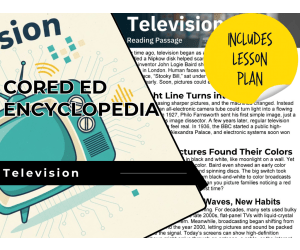
Television Reading Comprehension Passage - Cored Ed Encyclopedia
ELA, Language Development, Reading Comprehension, Reading, Pre-Reading, Science, Technology, Engineering, History, Social Studies, Grade 2, 3, 4, 5, Worksheets & Printables, Worksheets, Teacher Tools, Centers, Activities, Writing Prompts, Assessments, Quizzes and Tests, Quizzes, Lesson Plans
This television reading comprehension includes: Visualization (on the front cover) Start your lesson by taking a minute to think and share something about the topic. Read the script aloud (slowly), perhaps prepare some music or sound effects. Student close their eyes and let their imaginations wander. Students open their eyes, read the question aloud and give them a few minutes to complete. Ask a few students to share or keep answers until the end to compare with what they learn in the passage. Quick pause—thousands of Cored Education products are included with your TeachSimple membership. Download links and encyclopedia index available here. Pre-Reading Trivia Students will write down one thing they already know about the subject and then read five more facts and discuss. These facts are fun, and the students will enjoy learning about the subject before reading more. Give 1 minute for students to write what they already know (no pressure—best guess is fine). Read the five facts together. After each fact, do ask a student for their opinion, was it surprising? Set a purpose by asking students to highlight/underline one fact they want to learn more about during the reading. Reading Passage The text is a high-interest reading passage with set paragraphs, roughly three to four paragraphs long. It contains a variety of themes about the topic, anywhere from history to technology. The passage is between 250 and 350 words in length. First, ask students to look at the headings and see what they’ll learn about today. What do they know about the topic/heading? First read options: Teacher read-aloud (best for support). Partner reading (paragraph by paragraph). While reading, students underline important details, and vocabulary words they think may come up in the questions section. Mixed Questions The first question page contains four multiple-choice questions, each with a choice of four answers, and three written response questions that require a sentence or two from the student. Students complete the mcqs first independently, then review quickly as a class. For the 3 written responses, try to get students giving the answer with some form of evidence: “I think ___ because the text says ___.” If students get stuck, send them back to check the passage. Vocabulary Questions Practice seven key words from the text in this section across two activities. First section is scrambled words where students will unscramble three words given a clue for each. The second section is a word to meaning matching activity. Before starting, have some students read out words they underlined in the passage. Ask students to say the word and read aloud the sentence(s) around each word. Ask students to do scrambled words and the matching exercise in pairs then go through answers as a class. For the scrambled spelling task, get four pairs to come up to the board and write the words for extra practice with the other student reading out the clue. For the matching task, prompt students to give full sentences: “I matched ___ with ___ because ___.” Creative Writing In this question, the student will be required to write a five to eight sentence paragraph on a question related to the topic. Before starting, ask students write down 3 key ideas they are going to include in their piece. Ask students for ideas to share around the class to help those struggling. Pro writing expectations: 5–8 sentences At least 2 facts or details from the passage At least 2 vocabulary words from the previous page Students read their paragraphs while classmates listen for facts and vocabulary words. Extension Activities This page is optional for fast finishers or to take home. There are several activities, each one requiring a different skill. Do some, do none, do all, completely optional - but you will feel reassured knowing every possibility is planned for. Includes summary writting question. Answer Key There are answers for the multiple-choice questions, written response questions have sample answers, vocabulary answers and if there is a summary question then a sample summary will be provided as well. Lesson Plan Included Customized lesson plan for this lesson is included. Lesson Snapshot Title: Television Genre: Nonfiction (informational text) Subject: Science (Technology) Primary Topic: How television changed from mechanical to digital Estimated Guided Reading Level (A–Z): S What This Lesson Teaches Best How an invention changed over time, from a “spinning disk” experiment to modern screens and signals. Key milestones in television’s development (1925 Selfridges demo, 1927 Farnsworth, 1936 BBC service, late 2000s flat-panels). How pictures can be broken into lines/signals and sent by wire, radio, antenna, cable, or internet. The shift from black-and-white to color broadcasts and how viewers experienced that change over decades. Comparing analog and digital signals as two different ways information travels. Learning Goals Students will describe how early television used a spinning Nipkow disk to scan pictures into lines. Students will identify key people, places, and dates from the passage (Baird, Farnsworth, Selfridges, Alexandra Palace). Students will explain how television changed from mechanical parts to all-electronic systems that made clearer pictures. Students will summarize how TV viewing changed from bulky cathode-ray tubes to flat-panel screens and high-definition images. Students will compare analog and digital signals using details from the text. Key Vocabulary From the Text scan — break a picture into lines to send it. signals — messages that carry picture or sound information. broadcasting — sending TV so many people can receive it. analog — a smooth, continuous wave way of sending. digital — coded bits that travel more cleanly. FULL CATALOG OF DOWNLOAD LINKS AND ENCYCLOPEDIA INDEX HERE
Author Cored Education
Rating
Tags Vocabulary, Reading Comprehension, Reading Passages, Lesson Plans, Ela Lesson Plans, Reading Comprehension Lesson Plans, Pre-reading, History, Social Studies, Social Studies Lesson Plans
Coding Logic & Algorithm Design (No-Code) Practice Sheets
Science, Technology, Computer Science, Engineering, STEM, Special Resources, Life Skills, Research, Resources for Teachers, Classroom Management, Grade 3, 4, 5, 6, 7, 8, 9, Worksheets & Printables, Workbooks, Worksheets, Word Searches, Teacher Tools, Assessments, Lesson Plans, Quizzes and Tests, Quizzes, Tests
By teaching the logic of code, you'll be able to unlock the true power of programming!!! This comprehensive curriculum has been created specifically for students in grades four through seven and will provide them with a strong foundation in Computational Thinking using a completely screen-free method—all without writing a single line of code. Are you interested in teaching Computer Science fundamentals but unable to cross the barrier of Syntax and software? Introducing Computer Science’s Fundamentals with an „Unplugged Coding” unit is the perfect solution. Students will learn to think about problems and create solutions like Engineers, Problem Solvers, and Innovators through real-world examples and well-designed worksheets. Instead of just providing another set of puzzles, this four-week, ready to go, complete unit will teach your students to convert abstract concepts into concrete skills. Once students have mastered this Architecture of Thought, they will be ready for any programming languages they may encounter in the future. THIS RESOURCE CONTAINS 40 PAGES OF MATERIAL, INCLUDING: 1) A comprehensive guide & theoretical framework that will help teachers (or older students) get a basic understanding of each of the four pillars of computer science: 1) Sequencing and Precision (anatomy of an algorithm) 2) Conditionals and Branching (logic at the crossroads) 3) Loops and Iteration (how to use repetition effectively) 4) Debugging and Optimization (the art of fixing things) 2) A fun, hands-on workbook that contains 10 different worksheets, each based on using the theoretical concepts in real-world situations. | Worksheet #1 = The Architecture of Sequence (Deep-Sea Drone Mission) Worksheet #2 = Conditional Pathways (Mars Rover Logic) Worksheet #3 = The Power of Iteration (Automated Greenhouse) Worksheet #4 = Variables and State (Retro Arcade Game) Worksheet #5 = Boolean Logic Gates (High-Tech Security Vault) Worksheet #6 = Function Design (Drone Light Show) Worksheet #7 = Debugging and Logical Errors (Theme Parks Ride) Worksheet #8 = Pattern Recognition and Abstraction (Alien Puzzle Box) Worksheet #9 = Algorithm Optimization (Robotic Postal Service) Worksheet #10 = System Design (Intelligent Vending Machine) Teacher Resources and Visuals: Everything You Need to Implement This Unit With Confidence - 3 High-Resolution Visual Anchor Charts to Display in the Classroom (Algorithm Design Process, Control Structures, Debugging Protocol). - Detailed Teacher Implementation Guide: pedagogical philosophy, 4-week pacing/deployment strategy, and differentiation tips. - "Logic E.D.G.E." Evaluation Rubric: One-of-a-Kind Methodology Assessment Tool As An Assessment Tool For Methodologies Not Only Right or Wrong Answers. - Comprehensive Answer Key: Easily Check Student Work. This resource is ideal for middle school computer science, STEM or STEAM electives, coding clubs, homeschool co-ops and/or gifted & talented upper elementary programs. Student empowerment = Master Problem Solvers! Download today to build the foundation for a lifetime of logical thinkers! Keywords: Unplugged Coding, Coding Without a Computer, Computational Thinking, Algorithm Design, Logic Puzzles, STEM, STEAM, Middle School Computer Science, Hour of Code, Screen-Free Activities, 4th Grade, Fifth Grade, Sixth Grade, Seventh Grade, Homeschool, Digital Resource Reasons Why Educators/Parents Appreciate The Program: Develops Real Skills at the Fundamental Level: It does not only have educational value as a game, but allows learners to see the logic of computer programming - students begin to see how computers function in the digital world. Completely Hand-Emphasis On Learning: In this modern world where we have become over-reliant on technology, the unplugged curriculum offers an hands-on means to integrate computer science into the lives of children while promoting critical thinking skills as well as reducing screen times. Everything Needed for Teachers to Implement Unit: All of the components required for teacher/educator to successfully implement the 28-day unit are included - Teacher’s Guide - Worksheets - Visuals - Answer Key with all included One-Time Prep for Teacher, however is Minimal. Fun, Imagination Driven Learning Through Unplugging: This unit assists educators in the "math" of coding and programming by allowing them to eliminate the frustration of syntax errors and develop understanding without the use of device and apparatus. Interesting but simple scenarios (Example - Program a Mars rover) keep students engaged and excited about learning. Development of Resilience and Problem Solving: The incredible focus and emphasis on NEAT Debugging Concepts, allow students to experience and understand that errors are both normal and will continue to happen during the learning journey while building analytic skills and resiliency. Intended Audience for Student: According to the PDF's recommendations and its degree of complexity, the target audiences are: Primary Target: Grades 4 through 7 (Aged 9 through 13) Secondary Target: 3rd grade: Gifted and Talented Program 8th grade: Introduction or remedial courses Families that are home-schooled with a structured STEM curriculum After-school coding clubs that would like an introduction to the fundamentals. Copyright/Terms of Use This book has been published by Syed Hammad Rizvi and is intended for personal use only. Any alteration, redistribution or sale of this resource is strictly prohibited. For example, you cannot place this resource on the internet in any way that someone might find it and download it. If you would like to share this resource with others you work with, please go to Teachsimple and purchase the appropriate number of licenses. Thank you for your consideration of these terms of use. This product is proudly produced by Syed Hammad Rizvi
Author Creative Book Store
Rating
Tags STEM, Coding, ComputerScience, EdTech, Education, CriticalThinking, ProblemSolving, TeachersOfInstagram, TechForKids, Coding Worksheets
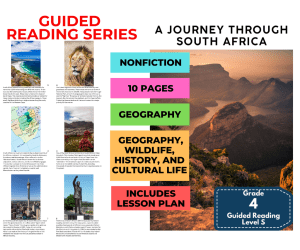
Journey Through South Africa: Guided Reading Level S with Lesson Plan
ELA, Resources for Teachers, Reading Comprehension, Reading, Science, Geography, Social Studies, History, Life Sciences, Government, Grade 3, 4, 5, Worksheets & Printables, Worksheets, Teacher Tools, Centers, Activities, Literacy Readers, Quizzes, Quizzes and Tests, Assessments, Lesson Plans
This A Journey Through South Africa (level s) guided reading book with lesson plan includes: Guided Reading Color Label (front cover x1) This is a quick way to match the book’s demands to what students can generally handle.. The overall goal is to use the level/color to pick books for several smaller groups. To qualify for a certain level, a student is expected to read a book from that level with about 90–94% accuracy. If a student is consistently accurate and understands, move up a level. If the student is struggling at that level, drop down and add more support. Each student will improve at completely different rates, but it is generally one of the best ways to check progress across the class. DOWNLOAD THE CATALOG TO VIEW ALL GUIDED READING BOOKS AVAILABLE (SORTED LEVELS A-Z) Pre-Reading Question (x1) Teacher asks the prompt aloud, can be while showing the cover or first page. Students share what they already know, or make educated guesses from the cover. Prompt them to use the target vocabulary. Write some of their responses on the board to look back at during the reading. Vocabulary Words (x5) Introduce the five words, best doing it one at a time. Start by saying it, while students repeat and then see if anyone knows what it means before reading further. Read through the meaning and try to briefly connect each word to a picture or gesture so it’s meaningful. Ask students to flip through the book pages and point to where they see each of the vocabulary words. While reading the book pause upon coming across one of the vocab words or read the sentence twice to make sure students understand the word has appeared. Optional: Ask students to raise hands whenever they see/hear one of the new words. Guided Reading Pages (x10) Check the book snapshot (below) for: primary topic - do you need to prep extra reading or intro materials on this? what is taught best - decide on 1-2 bullets to focus on, use the prompt or words provided here for best results. learning goals - what you are checking for students to be able to do after the session, elicit answers using prompts or words provided. key vocabulary (see section above). questions overview - so you know what is coming up and if you need to prep extra materials to assist understanding. Run the lesson You may have already looked at a few of the pages together, but you can show them some of the pictures again first to set meaning. Depending on how much time you have and how familiar your students are with guided reading class, you may want to read the book aloud first with the group first. Students whisper or partner read, while you listen in. If time, do it as a group, one student reading a page each. Use the guided page’s prompts to coach: “Check the picture / does it make sense?” “Point under the words / try the first sound” “Reread the sentence smoothly”. Try to focus more on one student per session (rotating every time), so you can work out if they are ready to move up or need to move down a level. Comprehension Questions (back cover x3) This is your way to check that students didn’t just say the words, but actually understood the text. First, let students answer by pointing to the page/picture and saying a short sentence. After any answer, follow with: “Show me where you found that in the text.” In bigger groups, have partners answer first (10–20 seconds), then call on 2–3 students to share. Differentiation tips: Emerging speakers/struggling readers: oral + pointing On-level: oral in a full sentence Higher: one written sentence or draw + label Book Snapshot Title: A Journey Through South Africa Genre: Nonfiction Subject: Social Studies (Geography/Culture/History) Primary Topic: South Africa’s geography, wildlife, history, and cultural life Estimated Guided Reading Level (A–Z): S What This Book Teaches Best Country overview and civics detail: South Africa’s location at Africa’s southernmost tip and its unusual system of three capital cities (Pretoria, Cape Town, Bloemfontein). Landforms and unique plant life: Table Mountain as a major landmark and part of a national park with many plant species found nowhere else. Habitats, wildlife, and conservation: Coastal habitats (including African penguins) and inland grasslands/savannas connected to the “Big Five” and protection of animals and environments. Modern cities and historical change: Johannesburg’s growth after gold discovery and South Africa’s journey from apartheid toward equality and democracy through Nelson Mandela’s leadership. Culture and identity through arts and community life: Traditions, music, and dance (Zulu and Xhosa) plus artistic expression like Ndebele painting and beadwork with special meanings. Learning Goals Students will identify South Africa’s three capital cities and explain each city’s role as described in the text. Students will describe two natural features or habitats in South Africa (for example, Table Mountain or the coastline) using details from the text. Students will explain how the text describes South Africa’s coastline and name the oceans it includes. Students will describe the inland grasslands and savannas and identify animals included in the text’s “Big Five.” Students will explain what apartheid was and describe how the text says South Africa moved toward equality and democracy. Students will describe at least two examples of South African culture or identity from the text (music/dance, art/beadwork, sports, or national symbols). Key Vocabulary From the Text southernmost — farthest to the south. administrative — related to running a government or system. savannas — wide grassy areas with some trees. apartheid — unfair system that separated people by race. resilience — strength to recover and keep going. Discussion Prompts Pre-reading question: What do you think you will learn about South Africa’s people, places, and animals? Comprehension questions: What are the three capital cities of South Africa named in the text? Comprehension questions: Which two oceans does the text say border South Africa’s coastline? Comprehension questions: What is the name of the system that separated people by race in South Africa? Printing Tips 1. Best Printing Method (Recommended) “Booklet” Printing (Best if Available) If your printer or PDF viewer supports Booklet Printing , use this. Settings to use: Print mode: Booklet Paper size: Letter or A4 (either works) Orientation: Landscape Print on both sides: Yes Flip on: Short edge Scaling: Fit to printable area Booklet subset: First test: Front sides only Then: Back sides only This will automatically: Pair pages correctly Put the cover on the outside Align everything for folding After printing, fold in half and staple along the spine . 2. If “Booklet” Printing Is NOT Available You can still print this correctly with manual duplex printing . Step-by-step: Open the PDF. Choose Print . Set: Orientation: Landscape Pages per sheet: 1 Print on both sides: Yes Flip on: Short edge Print all pages . Because each PDF page already contains two facing book pages, the result will still fold cleanly into a book. Thousands of Cored Education products are included with your TeachSimple membership. Download links and encyclopedia index available here.
Author Cored Education
Rating
Tags Reading Comprehension, Reading Passages, Reading, Guided Reading, Guided Reading Lesson Plan, Guided Reading Activity, Pre-reading, Social Studies, Geography, History
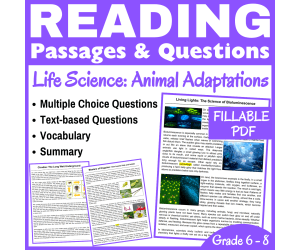
Bioluminescence and Insects : Science Reading passages (FILLABLE PDF)
Science, ELA, Reading, Reading Comprehension, Strategies, Resources for Teachers, Life Sciences, Animals, Insects, Nature & Plants, Grade 6, 7, 8, 9, Writing Prompts, Worksheets & Printables, Centers, Activities, Teacher Tools, Assessments, Quizzes and Tests, Quizzes, Tests
Bioluminescence and Insects: Reading Comprehension Passages and Questions (FILLABLE PDF) This very engaging and fillable collection of life science reading passages about Bioluminescence and Insects is designed to bridge the gap between science and literacy through strengthening reading comprehension and sparking scientific curiosity in middle school students. Each passage blends English Language Arts skills with accurate science content that supports NGSS classroom practice. Ideal for interdisciplinary learning in ELA and Science. Suitable for Grade 9 review, too! These worksheets are designed as fillable PDFs , which means students can type their answers directly into the document on any computer or tablet . Each page includes highlighted text fields that show them exactly where to type! What Is Included? There are (3) informational passages: Living Lights: The Science of Bioluminescence Cicadas: The Long Wait Underground Masters of Disguise: How Insects Hide and Imitate Student Tasks for Each Passage: 5 multiple-choice questions targeting main idea, key details, inference, vocabulary in context, and use of evidence 5 vocabulary matching items with clear, student-friendly definitions 5 text-based questions that require citing specific lines or facts 1 summary prompt that asks students to condense central ideas accurately Full answer key for every section Available Formats for this Resource Word Docs Google Docs FULL CATALOG OF DOWNLOADING LINKS HERE Other Science Reading Collections and Topics You May Find in the Store: 1. Astronomy & Space Science 2. Volcanoes, Rocks, & Mountains 3. Rock Cycle, Soil, & Sinkholes 4. Mars, Glaciers, & Antarctica 5. Water Cycle, Acid Rain, & Wastewater 6. Insects, Animals, & Ecosystems 7. Bioluminescence & Insects 8. Animal Skin, Cats, & T. Rex 9. Human Body and Senses 10. Health & Applied Bioscience 11. Waves, Light, & Imaging 12. Electricity & Energy 13. Motion & Materials 14. Chemistry and Materials Science 15. Electromagnetism 16. Acids and Bases 17. Gas Laws 18. Biotechnology 19. Periodic Trends 20. Protists and Fungi 21. Microevolution 22. Blood 23. Chemical Bonding 24. Magnets 25. Muscles 26. Nuclear Chemistry 27. Electromagnetic Devices 28. Epigenetics 29. The Law of Conservation of Mass 30. Atomic Models 31. Isotopes and Ions 32. Light 33. Human-Environment Interaction 34. Theory of Evolution 35. Photosynthesis 36. Origins of Life and Early Earth 37. Gene Expression and Regulation 38. Thermochemistry 39. Allergies 40. Coevolution 41. Birth to Adulthood 42. Cells 43. Entropy and Free Energy 44. The Human Brain 45. Mixtures and Solutions 46. Invertebrates 47. Zoo Animals 48. Biochemistry 49. Animal Behavior 50. Population Ecology ...and many more engaging science reading passages that cover intriguing and important topics designed to spark curiosity and support student learning. How to Use These PDFs Click on the highlighted area to start typing your answer. Move to the next question by clicking in the next highlighted box. When you are finished, close the document and select SAVE so your answers stay recorded. If you want to keep a blank copy for later, choose Save As and give your completed version a new name. Product Details Length: 14 pages total Grades: 6–8, also suitable for Grade 9 review Use cases: close reading, stations, homework, intervention, test prep, and sub plans Standards support: reinforces informational-text skills and supports NGSS-style sense making through observation, modeling, and clear use of claim, evidence, and reasoning Why Teachers Choose This Set Authentic science content paired with rigorous literacy practice Consistent task structure across all passages for easier planning and smoother student routines Clear, age-appropriate writing that builds confidence without oversimplifying Use this set to reinforce ELA skills in science, to add literacy to your lessons, or to support independent work. The passages strengthen main idea, evidence use, vocabulary in context, inference, cause and effect, and summary writing. With ready-to-use assessments and complete answer keys, you can provide focused practice that is simple to run and fast to review.
Author Middle & High School - CORED Education
Rating
Tags Middle School, Reading Comprehension, Reading Strategies, ELA, Centers, Reading Passage, Assessments, Vocabulary, Life Science, Insects
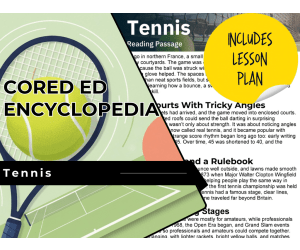
Tennis Reading Comprehension Passage - Cored Ed Encyclopedia
ELA, Language Development, Reading Comprehension, Reading, Pre-Reading, Science, Technology, Engineering, History, Social Studies, Grade 2, 3, 4, 5, Worksheets & Printables, Worksheets, Teacher Tools, Centers, Activities, Writing Prompts, Assessments, Quizzes and Tests, Quizzes, Lesson Plans
This tennis reading comprehension includes: Visualization (on the front cover) Start your lesson by taking a minute to think and share something about the topic. Read the script aloud (slowly), perhaps prepare some music or sound effects. Student close their eyes and let their imaginations wander. Students open their eyes, read the question aloud and give them a few minutes to complete. Ask a few students to share or keep answers until the end to compare with what they learn in the passage. Quick pause—thousands of Cored Education products are included with your TeachSimple membership. Download links and encyclopedia index available here. Pre-Reading Trivia Students will write down one thing they already know about the subject and then read five more facts and discuss. These facts are fun, and the students will enjoy learning about the subject before reading more. Give 1 minute for students to write what they already know (no pressure—best guess is fine). Read the five facts together. After each fact, do ask a student for their opinion, was it surprising? Set a purpose by asking students to highlight/underline one fact they want to learn more about during the reading. Reading Passage The text is a high-interest reading passage with set paragraphs, roughly three to four paragraphs long. It contains a variety of themes about the topic, anywhere from history to technology. The passage is between 250 and 350 words in length. First, ask students to look at the headings and see what they’ll learn about today. What do they know about the topic/heading? First read options: Teacher read-aloud (best for support). Partner reading (paragraph by paragraph). While reading, students underline important details, and vocabulary words they think may come up in the questions section. Mixed Questions The first question page contains four multiple-choice questions, each with a choice of four answers, and three written response questions that require a sentence or two from the student. Students complete the mcqs first independently, then review quickly as a class. For the 3 written responses, try to get students giving the answer with some form of evidence: “I think ___ because the text says ___.” If students get stuck, send them back to check the passage. Vocabulary Questions Practice seven key words from the text in this section across two activities. First section is scrambled words where students will unscramble three words given a clue for each. The second section is a word to meaning matching activity. Before starting, have some students read out words they underlined in the passage. Ask students to say the word and read aloud the sentence(s) around each word. Ask students to do scrambled words and the matching exercise in pairs then go through answers as a class. For the scrambled spelling task, get four pairs to come up to the board and write the words for extra practice with the other student reading out the clue. For the matching task, prompt students to give full sentences: “I matched ___ with ___ because ___.” Creative Writing In this question, the student will be required to write a five to eight sentence paragraph on a question related to the topic. Before starting, ask students write down 3 key ideas they are going to include in their piece. Ask students for ideas to share around the class to help those struggling. Pro writing expectations: 5–8 sentences At least 2 facts or details from the passage At least 2 vocabulary words from the previous page Students read their paragraphs while classmates listen for facts and vocabulary words. Extension Activities This page is optional for fast finishers or to take home. There are several activities, each one requiring a different skill. Do some, do none, do all, completely optional - but you will feel reassured knowing every possibility is planned for. Includes summary writting question. Answer Key There are answers for the multiple-choice questions, written response questions have sample answers, vocabulary answers and if there is a summary question then a sample summary will be provided as well. Lesson Plan Included Customized lesson plan for this lesson is included. Lesson Snapshot Title: Tennis Genre: Nonfiction (informational text) Subject: Social Studies (History of Sports) Primary Topic: How tennis changed over time Estimated Guided Reading Level (A–Z): Q What This Lesson Teaches Best How tennis began as jeu de paume (“game of the palm”) and shifted from hands to gloves and then rackets. How indoor courts with hard walls and slanted roofs changed play by creating surprising angles. How tennis moved outdoors in the 1800s when rubber balls bounced well outside and lawns made smooth courts. Key moments that helped standardize and spread the sport (1873 rules book, 1877 Wimbledon). How tournaments changed when the Open Era began in 1968, allowing professionals and amateurs to compete together. Learning Goals Students will explain why the early game was called jeu de paume using details from the text. Students will describe how playing spaces changed from courtyards to enclosed indoor courts. Students will identify how walls and slanted roofs affected play in real tennis. Students will summarize two changes in the 1800s that helped tennis move outdoors. Students will describe why the 1873 rulebook and the 1877 Wimbledon championship mattered for tennis. Students will explain what changed in 1968 when the Open Era began. Key Vocabulary From the Text monastery — a place where monks live and work. cloisters — covered walkways around a courtyard. boundary — a line that shows where play must stay. enclosed — closed in by walls; not open outside. amateurs — people who play for fun, not as paid work. FULL CATALOG OF DOWNLOAD LINKS AND ENCYCLOPEDIA INDEX HERE
Author Cored Education
Rating
Tags Vocabulary, Reading Comprehension, Reading Passages, Lesson Plans, Ela Lesson Plans, Reading Comprehension Lesson Plans, Pre-reading, History, History Lesson Plans, Sports

Human Body & Senses: Life Science Reading Comprehension (PDF)
Science, ELA, Reading, Reading Comprehension, Strategies, Resources for Teachers, Life Sciences, Human Body, Grade 6, 7, 8, 9, Writing Prompts, Worksheets & Printables, Centers, Activities, Teacher Tools, Assessments, Quizzes and Tests, Quizzes, Tests
Human Body and Senses: Life Science Reading Comprehension Passages (PDF) This very engaging collection of life science reading passages about Contact Lenses, Goosebumps, and Skin is designed to bridge the gap between science and literacy through strengthening reading comprehension and sparking scientific curiosity in middle school students. Each passage blends English Language Arts skills with accurate science content that supports NGSS classroom practice. Ideal for interdisciplinary learning in ELA and Science. Suitable for Grade 9 review, too! What Is Included? There are (3) informational passages: Clear Vision: The Story of Contact Lenses: Early lenses were hard, bulky, and uncomfortable, but the idea was simple: correct vision right on the eye. Modern soft lenses let oxygen in, stay in place, and give people clear sight without glasses. Goosebumps: A Chilly Reminder of Our Past: When you get cold or scared, tiny muscles pull on each hair and make bumps. It once helped our hairy ancestors look bigger and hold heat, so today it’s mostly a leftover reflex. Skin: Your Protective Shield: Skin keeps germs out, moisture in, and helps your body stay at a steady temperature. With nerves and blood vessels close to the surface, it also lets you feel and heal. Student Tasks for Each Passage: 5 multiple-choice questions targeting main idea, key details, inference, vocabulary in context, and use of evidence 5 vocabulary matching items with clear, student-friendly definitions 5 text-based questions that require citing specific lines or facts 1 summary prompt that asks students to condense central ideas accurately Full answer key for every section Available Formats for this Resource Word Docs Google Docs FULL CATALOG OF DOWNLOADING LINKS HERE Other Science Reading Collections and Topics You May Find in the Store: 1. Astronomy & Space Science 2. Volcanoes, Rocks, & Mountains 3. Rock Cycle, Soil, & Sinkholes 4. Mars, Glaciers, & Antarctica 5. Water Cycle, Acid Rain, & Wastewater 6. Insects, Animals, & Ecosystems 7. Bioluminescence & Insects 8. Animal Skin, Cats, & T. Rex 9. Human Body and Senses 10. Health & Applied Bioscience 11. Waves, Light, & Imaging 12. Electricity & Energy 13. Motion & Materials 14. Chemistry and Materials Science 15. Electromagnetism 16. Acids and Bases 17. Gas Laws 18. Biotechnology 19. Periodic Trends 20. Protists and Fungi 21. Microevolution 22. Blood 23. Chemical Bonding 24. Magnets 25. Muscles 26. Nuclear Chemistry 27. Electromagnetic Devices 28. Epigenetics 29. The Law of Conservation of Mass 30. Atomic Models 31. Isotopes and Ions 32. Light 33. Human-Environment Interaction 34. Theory of Evolution 35. Photosynthesis 36. Origins of Life and Early Earth 37. Gene Expression and Regulation 38. Thermochemistry 39. Allergies 40. Coevolution 41. Birth to Adulthood 42. Cells 43. Entropy and Free Energy 44. The Human Brain 45. Mixtures and Solutions 46. Invertebrates 47. Zoo Animals 48. Biochemistry 49. Animal Behavior 50. Population Ecology ...and many more engaging science reading passages that cover intriguing and important topics designed to spark curiosity and support student learning. Product Details Length: 14 pages total Grades: 6–8, also suitable for Grade 9 review Use cases: close reading, stations, homework, intervention, test prep, and sub plans Standards support: reinforces informational-text skills and supports NGSS-style sense making through observation, modeling, and clear use of claim, evidence, and reasoning Why Teachers Choose This Set Authentic science content paired with rigorous literacy practice Consistent task structure across all passages for easier planning and smoother student routines Clear, age-appropriate writing that builds confidence without oversimplifying Use this set to reinforce ELA skills in science, to add literacy to your lessons, or to support independent work. The passages strengthen main idea, evidence use, vocabulary in context, inference, cause and effect, and summary writing. With ready-to-use assessments and complete answer keys, you can provide focused practice that is simple to run and fast to review.
Author Middle & High School - CORED Education
Rating
Tags Middle School, Reading Comprehension, Reading Strategies, ELA, Centers, Reading Passage, Assessments, Vocabulary, Life Science, Human Body
Executive Leadership & EQ Workbook
Life Studies, Business, Career, Coaching, Finance, Leadership, Home Economics, Resources for Teachers, Classroom Management, Special Resources, Homeschool Curriculum, Homeschool Templates, Grade 9, 10, 11, 12, Projects, Activities, Teacher Tools, Assessments, Lesson Plans, Literacy Readers, Presentations, Graphic Organizers, Worksheets & Printables, Workbooks
Elevate your executive leadership performance through the Executive Leadership & EQ Workbook – Professional Edition (55-page PDF). This powerful and comprehensive workbook was created for the mid-level manager and the C-Suite executive looking to develop their emotional intelligence (EQ) to give them an advantage in today's fast-paced business environment. In this workbook you will find five pillars of Executive EQ: Self-Awareness, Self-Regulation, Internal Motivation, Empathy and Social Skill, translated into extremely practical and easy-to-use frameworks, real world cases, reflection prompts, and visual tools (iceberg model, trust-building pyramid, emotional regulation flowchart, SBI-R feedback model, etc.). You will learn how to read the room in an instant, use tactical empathy to have difficult conversations, build unbreakable trust, influence without authority, make empathetic high-stakes decisions, and create a high-performance feedback culture that drives retention, innovation and bottom line results. This workbook is the perfect resource for busy professionals that need actionable strategies instead of just theory. Download it instantly to begin to transform your executive leadership presence today! Ideal for individual executives, corporate training programs, HR development or leadership coaches. Keywords for SEO: C-Suite Leadership PDF, EQ Emotional Intelligence Training, Executive Leadership Workbook, Mid-Level Manager Development, Influencing Without Authority, Professional EQ Workbook, Leadership Skills Workbook, Difficult Conversations Framework, Feedback Culture Leadership. Why Schools / Parents Appreciate It (Positioned for Educational Leadership): Provides principals and school administrators access to best practice, research-based emotionally intelligent tools for establishing an emotionally safe educational environment and lessening teacher burnout. Helps educational leaders enhance their ability to engage in difficult conversations, provide feedback, and influence others, all of which contribute to improved teacher retention and student success. Offers a variety of ready-to-use frameworks for busy educational leaders that can be used immediately at board meetings, parent conferences, and staff development days. Provides leadership development support for department leaders and aspiring principals by identifying the “soft skills” that translate into measurable school-wide productivity improvements. Allows schools to save both time and money by using one downloadable book instead of having to hire outside leadership consultants or attend multiple workshops. Target Audience For This Workbook The workbook is an adult-oriented workbook that is specifically designed for a corporate environment, and not on a K-12 level. It contains corporate leadership terminology, C-Suite case studies, applications of board room dynamics and high level business case studies. Best Student/Learner Target (adult learners/higher education/professional development): 1. MBA and Executive MBA Programs(Leadership - core / Optional course in Leadership / Organizational Behavior / Emotional Intelligence) 2. Senior Undergraduate Business Administration / Management Majors (Senior elective Capstone Course in Leadership) 3. Graduate students - Organizational Psychology, Human Resource Management, Executive Coaching programs 4. Adult learners / working professionals enrolled in corporate training, leadership academies or continuing education certificate programs 5. University Professional Development / Executive Education Short Courses. Copyrights/Use Restrictions: This book has been copyrighted by Syed Hammad Rizvi and can only be used by you or in your classroom as an individual user. You cannot alter, redistribute, or sell any part of this book. Thus, you cannot place it on the web where it can be freely found or downloaded. If you would like to share this book with others, please purchase multiple licenses from Teachsimple. Thank you for your adherence to these use restrictions. This product was created with great joy by Syed Hammad Rizvi.
Author Creative Book Store
Rating
Tags Leadership Skills, Leadership Training, Executive Coaching, Professional Development, Management Skills, Business Leadership, Leadership Mindset, Executive Presence, High Performance Leadership
Science Reading Passage 20: Genetics (Google Slides)
ELA, Reading, Reading Comprehension, Common Core, ESL, Language Development, Vocabulary, Life Sciences, Science, Resources for Teachers, Grade 5, 6, 7, Presentations, Teacher Tools, Assessments, Tests, Quizzes and Tests, Activities
Free Reading Passage on Genetics for Life Science What's inside this free product? Science Reading Comprehension Passage: Genetics Independent Google Slides Version: This is the independent Google Slides version containingone lesson. Product Info: 41 SLIDES (US English with Answers) Google Slides Version Teaching Duration: 90 Minutes Science Reading Comprehension Outline: Introducing a comprehensive resource tailored for 5th and 6th graders, this product offers enriching reading passages supplemented with illustrative pictures and graphs to clarify key concepts. Aligned with the Common Core State Standards (CCSS), it offers a hassle-free approach to teaching, given that the bulk of the preparation is already done for you. The passages present a diverse set of questions – from multiple choice to data analysis and fill-in-the-blanks. This ensures a rich blend of high-interest content and fundamental curriculum-based science themes. With its versatility, you can seamlessly integrate these lessons into various classroom settings, whether it's whole class discussions, morning exercises, independent desk tasks, small group engagements, contingency plans for substitute teachers, regular homework assignments, or even themed activities for holidays. FULL CATALOG OF DOWNLOAD LINKS HERE Grade 5/6 Links: Physical Science Part 1 - Physical and Chemical Properties Google Docs/Slides/Forms PDF PPT Word Free Supplementary Pack Accompanying Videos Physical Science Part 2 - Motion and Energy Google Docs/Slides/Forms PDF PPT Word Free Supplementary Pack Accompanying Videos Physical Science Part 3 - Electricity and Magnets Google Docs/Slides/Forms PDF PPT Word Free Supplementary Pack Accompanying Videos Life Science Part 1 - Cells, Reproduction and Genetics Google Docs/Slides/Forms PDF PPT Word Free Supplementary Pack Accompanying Videos Life Science Part 2 - Human Body Systems Google Docs/Slides/Forms PDF PPT Word Free Supplementary Pack Accompanying Videos Life Science Part 3 - Plant Parts and Ecosystems Google Docs/Slides/Forms PDF PPT Word Free Supplementary Pack Accompanying Videos Earth Science Part 1 - Plate Tectonics and Rock Cycle Google Docs/Slides/Forms PDF PPT Word Free Supplementary Pack Accompanying Videos Earth Science Part 2 - Ocean Exploration and Natural Resources Google Docs/Slides/Forms PDF PPT Word Free Supplementary Pack Accompanying Videos Earth Science Part 3 - Weather and Solar System Google Docs/Slides/Forms PDF PPT Word Free Supplementary Pack Accompanying Videos For similar products and other frees, do check out Cored Group on TeachSimple .
Author Cored Education
Tags Science, Elementary, Reading, Comprehension, Vocabulary, Answers, Physics, Physical Science, Ccss, Common Core
Data Literacy & Statistics Interpretation Worksheets
Math, Addition and Subtraction, Addition, Subtraction, Algebra, Decimals, Early Math, Basic Operations, Fractions, Money, Homeschool Curriculum, Homeschool Templates, Grade 9, 10, 11, 12, Worksheets & Printables, Workbooks, Worksheets, Word Searches, Teacher Tools, Assessments, Lesson Plans, Quizzes and Tests, Quizzes, Tests
Would you like to help your students change from passive number crunchers into well-reasoned and critical thinkers? Move beyond rote memorization of the formulae and do it with this comprehensive curriculum on Data Literacy and Statistics for the 21st century designed to develop true analytical abilities. In an age of information overload, misinformation and distorted graphs, being statistically literate is no longer just a luxury; it is now an important life skill. This resource, designed as an all-in-one digital resource for high school and beginning college courses will give you everything needed to assist you in taking your students on a journey beginning with core theory and continuing on through to real-life application. This curriculum is not just another packet of math problems; it is a model for thoughtful analysis. Through engaging and relevant examples (from e-sports to medical research) and very rigorous examples, students will go beyond "what" to "why" by learning to ask the right questions about data, being aware of bias, breaking down faulty or misleading visuals and understanding the key differences between “correlation” and “causation.” Overall, this unit will help to develop and solidify the most abstract ideas into something tangible and recognizable. WHAT'S IN THE PACKAGE (A 45 PAGE PDF Document): The Basic Content/Information/Theory through the First Phase of the Course consists of: A 14-page "textbook" style document outlining the theoretical basis for the terms used to describe data. The Anatomic Scale of Data: Qualitative, Quantitative, Discrete, Continuous) includes Levels of Measurement The Descriptive Norm: Mean, Median, Mode, Variance, Standard Deviation, Interquartile Range Data visualisation and misrepresentation (Example of Anscombes Quartrant Analysing the Measurement by Each Year) Uses of Truncated Axes, The Bubble Fallacy, Probability Correlation (and Causation) Spurious Correlations Confounding Variables Phase 2: Student Workbook: Contains 10 interactive/interactive-question workbooks, 20 pages total, allows for students to apply theory Includes: Categorical vs Quantitative Data Contextualising Mean/Median/Mode Variance/Spread/Dispersion Histograms/Boxplots Correlation vs. Causation Probability/Expected Value Sampling Methodology/Bias Normal Curve (68-95-99.7 Rule)/Z Scores Margins of Error/Confidence Interval Ethics of Metrics/Misleading Statistics Visuals and Resources for the Teacher Phase 3: - Three high quality conceptual images (SVG) [of the PPDAC cycle, shapes of distributions, confounding variables]. Ideal for displaying in the classroom or giving to students as handouts. - A seven (7) page teacher answer key that not only provides the answers, but also includes pedagogical rationales for each answer to facilitate effective classroom discussions and increase comprehension of all students. This product is applicable for use in conjunction with a full unit of study for a statistics course; supplement for an Algebra 2 or Pre-Calculus class; an AP statistics review; or a homeschool curriculum. Support your students’ development of statistical literacy as a defence against data manipulation! With this product, you can help to increase the statistical literacy of your students, contributing to a data savvy world! Order now to begin creating a data savvy generation! Key Words: Data Literacy, Statistics Worksheets, AP Statistics, High School Math, Mean Median Mode, Correlation Causation, Normal Distribution, Z-Scores, Data Visualization, Critical Thinking, Real World Data, Statistics Project, Answer Key Included, Digital Resource, Printable PDF, Descriptive Statistics and Sampling Bias. Parents/Schools appreciate this product for: Real-World Critical Thinking: The curriculum helps students become good consumers of information. Students learn how to recognize deceptive story lines in reporting, flawed research, or deceptive advertising, which is critical to success in the 21st century. Everything in One Product: All of the material has been provided in one package, including theory, student worksheets, visual aids, and a teacher answer key. The result is significant time savings for teaching (by providing everything you need), while still allowing student use of all materials during class time. Making the Connection between Math and Real Life: This product uses relevant, current examples (i.e., E-Sports, crime rates, and medical research) to answer the age-old question of students, "When will I ever use this?" Promoting Deep Levels of Understanding: The curriculum pushes students to think beyond simple math calculations and instead challenges them to interpret, analyze, and justify their work. By focusing on the "why," students have a deeper understanding of the concepts, which is longer lasting. Intended Audience as Related to Statistical Concepts: Statistical Concepts such as (Z Score, Confidence Interval, Simpson's Paradox), Target Grades: Grades 10-12 - Target Grades (AP Statistics, Pre Calc, Advanced Algebra II with a Statistics Unit), would also be an excellent choice for standalone Honors Statistics Course Intro College Students - Target College Students for a STAT 101 or another introductory Statistic Courses for non-Math Majors in the social science, Business or Health Science fields Advanced Home School Students - Parent Home Schooling their High School Children would find this curriculum complete & thorough. Copyright / Terms of Use for Content : The copyrighted licensing for this book is owned by Syed Hammad Rizvi, for singular and non-commercial use only. No alterations or sales of this item or use of any part of the content on the internet is allowed. If it is necessary, then you can purchase multiple licenses from TpT to provide to your members and colleagues who are working with you as an employee, but you cannot place anything on the internet and allow it to become publicly accessible for downloading and/or use. If you would like to share this resource with other teachers, please go to Teachsimple to purchase additional licenses. Thank you for your respect of the copyright and for supporting the above terms of use. This product and resources are provided to you by Syed Hammad Rizvi.
Author Creative Book Store
Rating
Tags Statistics, DataLiteracy, APStatistics, Stats, HighSchoolMath, DataAnalysis, StatisticalAnalysis, DataScienceForStudents, Math, MeanMedianMode
Camping Reading Comprehension Passage - Cored Ed Encyclopedia
ELA, Language Development, Reading Comprehension, Reading, Writing, Pre-Reading, Vocabulary, Geography, Social Studies, History, Grade 2, 3, 4, 5, Worksheets & Printables, Worksheets, Teacher Tools, Centers, Activities, Writing Prompts, Assessments, Quizzes and Tests, Quizzes, Lesson Plans
This camping reading comprehension with lesson plan includes: Visualization (on the front cover) Start your lesson by taking a minute to think and share something about the topic. Read the script aloud (slowly), perhaps prepare some music or sound effects. Student close their eyes and let their imaginations wander. Students open their eyes, read the question aloud and give them a few minutes to complete. Ask a few students to share or keep answers until the end to compare with what they learn in the passage. COMPANION VIDEO NOW AVAILABLE (EMBEDDED AFTER PREVIEW PICTURES IN PRODUCT DESCRIPTION) Quick pause—thousands of Cored Education products are included with your TeachSimple membership. Download links and encyclopedia index available here. Pre-Reading Trivia Students will write down one thing they already know about the subject and then read five more facts and discuss. These facts are fun, and the students will enjoy learning about the subject before reading more. Give 1 minute for students to write what they already know (no pressure—best guess is fine). Read the five facts together. After each fact, do ask a student for their opinion, was it surprising? Set a purpose by asking students to highlight/underline one fact they want to learn more about during the reading. Reading Passage The text is a high-interest reading passage with set paragraphs, roughly three to four paragraphs long. It contains a variety of themes about the topic, anywhere from history to technology. The passage is between 250 and 350 words in length. First, ask students to look at the headings and see what they’ll learn about today. What do they know about the topic/heading? First read options: Teacher read-aloud (best for support). Partner reading (paragraph by paragraph). While reading, students underline important details, and vocabulary words they think may come up in the questions section. Mixed Questions The first question page contains four multiple-choice questions, each with a choice of four answers, and three written response questions that require a sentence or two from the student. Students complete the mcqs first independently, then review quickly as a class. For the 3 written responses, try to get students giving the answer with some form of evidence: “I think ___ because the text says ___.” If students get stuck, send them back to check the passage. Vocabulary Questions Practice seven key words from the text in this section across two activities. First section is scrambled words where students will unscramble three words given a clue for each. The second section is a word to meaning matching activity. Before starting, have some students read out words they underlined in the passage. Ask students to say the word and read aloud the sentence(s) around each word. Ask students to do scrambled words and the matching exercise in pairs then go through answers as a class. For the scrambled spelling task, get four pairs to come up to the board and write the words for extra practice with the other student reading out the clue. For the matching task, prompt students to give full sentences: “I matched ___ with ___ because ___.” Creative Writing In this question, the student will be required to write a five to eight sentence paragraph on a question related to the topic. Before starting, ask students write down 3 key ideas they are going to include in their piece. Ask students for ideas to share around the class to help those struggling. Pro writing expectations: 5–8 sentences At least 2 facts or details from the passage At least 2 vocabulary words from the previous page Students read their paragraphs while classmates listen for facts and vocabulary words. Extension Activities This page is optional for fast finishers or to take home. There are several activities, each one requiring a different skill. Do some, do none, do all, completely optional - but you will feel reassured knowing every possibility is planned for. Includes summary writting question and additional facts. Answer Key There are answers for the multiple-choice questions, written response questions have sample answers, vocabulary answers and if there is a summary question then a sample summary will be provided as well. Lesson Plan Included Customized lesson plan for this lesson is included. Lesson Snapshot Title: Camping Genre: Nonfiction (informational text with headings) Subject: Reading (Informational Text) / Social Studies Primary Topic: How camping began, changed, and stays respectful Estimated Guided Reading Level (A–Z): N What This Lesson Teaches Best Explains what camping is and what campers might notice at night (lantern glow, smell of pine, owls, cooler air). Builds background knowledge about how camping shifted from travel/work to a fun hobby in the late 1800s. Uses a chronological structure with time markers (late 1800s, 1894, 1901, 1908, after World War I, 1960s) to show change over time. Introduces environmental responsibility through a “leave-no-trace approach,” including keeping camps small and taking trash home. Gives practice with text features (section headings) to locate information efficiently. Learning Goals Students will describe what camping is using details from the passage. Students will explain why people slept outside long ago and how camping later became a hobby. Students will identify key events and dates from the passage (1894, 1901, 1908, after World War I, 1960s). Students will use headings to find information about camping’s history, campgrounds, and “leave-no-trace.” Students will compare different ways people camp (backpacks vs. car/RV) based on the passage. Students will explain what the passage says a leave-no-trace approach means. Key Vocabulary From the Text shelter — a place that protects you. lantern — a light you can carry. demanded — needed or required. commercial — run as a business. approach — a way of doing something. FULL CATALOG OF DOWNLOAD LINKS AND ENCYCLOPEDIA INDEX HERE
Author Cored Education
Rating
Tags Vocabulary, Reading Comprehension, Reading Passages, Lesson Plans, Ela Lesson Plans, Reading Comprehension Lesson Plans, Pre-reading, Social Studies Lesson Plans, Geography, History
UK/Aus Spelling Pronouns Practice Questions - Year 4-5 (PPT)
ELA, Language Development, ESL, Grammar, Common Core, Resources for Teachers, Grade 3, 4, Quizzes and Tests, Teacher Tools, Tests, Assessments, Presentations, Activities
THIS IS THE UK/AUS ENGLISH SPELLING VERSION. CHECK THE CATALOG FOR THE ORIGINAL AMERICAN ENGLISH VERSION. Pronouns Grammar Practice MCQS ELA MCQS Overview: In this series of lessons, students will embark on an engaging journey to explore the grammar skills that make our language vibrant and expressive. These lessons are crafted to help students identify, comprehend, and effectively apply language arts skills in both writing and speech. This UK/Aus English version is especially useful for schools, teachers, and families working with British-based spelling and language conventions. It is a helpful option for classrooms using UK curriculum expectations, international programmes influenced by British English, or any setting where learners need to practise the correct capitalisation and punctuation forms for that version of English. Pronouns Overview: Includes: Subject Pronouns Possessive Pronouns Object Pronouns Reflexive Pronouns PPT Version This is the PPT editable and interactive version. There is a fillable answer sheet at the end. This download is available in GOOGLE Docs, GOOGLE Forms, GOOGLE Slides. PDF, PPT, WORD, check the links below for more details. FULL CATALOG OF DOWNLOAD LINKS HERE ELA Review Questions Overview Each review test includes three answer choices for every question, which helps keep things simple and manageable for students. The layout is clear and easy to follow, so students can focus on the questions instead of figuring out what to do. A few pictures are included on each test to make the pages feel a little more inviting and less overwhelming. A review sheet is also included, giving students a chance to go back over many of the main skills covered in the resource. Introduction or Example Sheet Each topic comes with an introduction or example sheet to look at before students begin. This gives students a clear starting point and helps them feel more prepared. It also lets them see what to expect before moving into the main work. For many students, it is a helpful way to quickly refresh the key ideas before they start practicing on their own. Full Answer Keys Full answer keys are included to make marking and checking work faster and easier. Sample responses are also provided where needed, especially for open-ended tasks. This can be a real time-saver on busy days and makes the resource more practical to use. Everything is there to help make planning, teaching, and checking student work feel a little more straightforward. For similar downloads and other frees, do check out Cored Group on TeachSimple.
Author Cored Education
Rating
Tags Elementary, Answers, Ccss, Common Core, Grammar, Tests, Test Prep, Assessment, Grade 3, Grade 4

Reading Comprehension Passages Fiction Set 1 - Nature Presentable PDF
ELA, Reading, Reading Comprehension, Common Core, ESL, Language Development, Spelling, Vocabulary, Writing, Resources for Teachers, Grade 2, 3, Worksheets & Printables, Worksheets, Writing Prompts, Assessments, Teacher Tools, Quizzes, Quizzes and Tests, Centers, Activities
Reading Comprehension Passages Fiction Set 1 Snapshot Genre: Fiction (collection of short nature-themed stories) Subject: Reading (Comprehension) Primary Topic: Nature-themed fiction passages and comprehension practice Estimated Guided Reading Level (A–Z): O What This Teaches Best Character feelings and motivations: Characters want or value something strongly (e.g., Kellie wants snow to use her new sled; Rusty wants to finish his color task; Ross would rather play but ends up enjoying his work). Observation and using the environment for answers: Rusty finds blue and purple by looking more carefully at what’s around him (sky, stream, leaf backs). Cause and effect in everyday situations: Weather and choices affect what happens next (snow finally comes; a thunderstorm ends cherry picking; a volcano eruption changes the climbers’ plans). Nature vocabulary in meaningful contexts: Words connected to seasons, plants, animals, and outdoor features appear across the stories (snow “accumulation,” “canopy,” “eruption,” “perennials,” “marmalade”). Built-in practice pages that match the passages: Each story is followed by questions and skill pages (mixed questions, spelling/vocabulary, short writing prompts) that directly reference details from the story text. Learning Goals Students will recount key events from a selected story in a logical order using details from the text. Students will describe characters’ wants, feelings, and choices and connect them to what happens in the story. Students will identify the setting/season and name text evidence that supports it. Students will explain cause-and-effect relationships shown in the stories (problem → response → outcome). Students will use context clues to determine the meaning of unfamiliar words from the passages. Students will compare information presented in the story (for example, annuals vs. perennials) by stating how they are different using the text’s wording. Passages Include 1.Bring on the Snow: Kellie wants to make it snow. How does she try? 2.Walk through the Woods: A walk in the woods turns into a huge adventure. 3.Nature Photographer: Donna get some amazing snaps in this story. 4.Nature's Beautiful Colors: Rusty enjoys finding out about the colors in nature. 5.Flower Fun: Learn about flower names and colors in this fun lesson. 6.Picking Cherries: Ross spends his day picking cherries but is it worth it? Additional File: Nature Photographer: Drawing Nature Printable PRESENTABLE PDF VERSION Run it like a slide show straight from a PDF, with no PowerPoint or extra software needed, just open, project, and teach. Other versions are available in the links list below or in the full catalog. FULL CATALOG OF DOWNLOAD LINKS HERE For similar downloads and other frees, do check out Cored Group on TeachSimple.
Author Cored Education
Rating
Tags Elementary, Reading, Comprehension, Vocabulary, Common Core, Speling, Writing, Passages, Reading Centers, Reading Comprehension Assessments
Reading Comprehension Passages Fiction Set 1 - Animals (Google Docs)
ELA, Reading, Common Core, Reading Comprehension, Children’s Literature, Literature, Spelling, Language Development, Vocabulary, Writing, Grade 4, 5, Worksheets & Printables, Worksheets, Writing Prompts, Assessments, Teacher Tools, Tests, Quizzes and Tests, Centers, Activities, Quizzes
Reading Comprehension Passages Fiction Set 1 Overview No prep reading comprehension lessons, with enjoyable stories and topics. Each lesson has a blend of post-reading activities. Mixed questions to check overall understanding. Vocabulary activities, plus a writing section. Lessons also contain a bonus extension exercise at the end. Some you may like, some you may not, either way they are there if you wish to use them. Full answer keys are provided. Passages Include 1.Donny's Glasses: Donny is being chased by a monster. Or so he thinks! 2.Hare & Bear: Hare & Bear have a cup of tea together in the warmth. 3.Maggie's Turtle: Maggie is desperate to win the fishing competition. 4.New Pup: Hugh finds out a new puppy isn't as fun as he hoped. 5.Naughty Cat: Lizzie can't find any of her stuff. Read this story to find outwhere it is. 6.Ella's Baseball Bat: Ella's dad is scared of bats, and now there is one in the house! 7.Ola the Rabbit: Read about Darla's newest pet in this lesson. 8.Ethan and the Puppies: Ethan gets ready for the puppies to arrive. 9.Endangered Animals: Sam learns all about endangered animals in this passage. 10.Chinese New Year: Jessie and Sally talk about the upcoming Chinese New Year. Docs Version This is the Docs editable and fillable version. This download is available in GOOGLE Docs, GOOGLE Forms, GOOGLE Slides. PDF, PPT, WORD. FULL CATALOG OF DOWNLOAD LINKS HERE Reading Passages Each reading passage has been written specifically for students in Grades 4–5, using vocabulary and language that match their age and ability level. The collection covers a wide range of engaging topics, supported by colorful visuals that help bring the content to life. Every lesson is designed to build knowledge while keeping students interested and motivated to read. These resources are also designed with flexibility in mind. Unlike traditional textbooks that can quickly become outdated, lessons can be updated over time to reflect changes in technology, discoveries, and the world around us. Mixed Questions Every lesson includes a variety of questions that help students think more deeply about what they have read. The question section combines reading comprehension, vocabulary, and math skills, while also regularly reinforcing important reading strategies such as cause and effect, summarizing, compare and contrast, and drawing conclusions. Most lessons include a mix of multiple-choice and written-response questions, giving students opportunities to explain their thinking as well as select answers. Complete answer keys and sample responses are provided at the end of each lesson for quick and easy reference. Spelling & Vocabulary Each passage introduces students to useful words and phrases appropriate for Grades 4–5. To help build confidence and word knowledge, every lesson includes a spelling or vocabulary activity. Rather than repeating the same task throughout the collection, activities vary from lesson to lesson to keep practice fresh and engaging. Activities may include spelling challenges, sentence matching, decoding activities, mixed-up text exercises, and other vocabulary-building tasks connected directly to the reading. Writing Prompts Each lesson includes a writing activity that extends the ideas, themes, or topics explored in the passage. Students are encouraged to write in a variety of formats, with prompts providing helpful guidance and ideas to get them started. Writing tasks vary throughout the collection and may include creative writing, research activities, personal responses, poetry, opinion writing, and other engaging assignments. Full Answer Keys Complete answer keys and sample responses are included with every lesson, making planning and marking quicker and easier. Reading comprehension answers include evidence and support from the text, while math-based questions show the relevant working where appropriate. The answer keys are designed primarily for teachers but can also be shared with students when needed. Just for Fun Each lesson finishes with an optional extension activity called Just for Fun . These bonus activities provide an enjoyable way to extend learning beyond the main lesson and often encourage creativity, discussion, or independent thinking. They are completely optional, giving you the flexibility to use the activities that best suit your students and classroom needs. For similar downloads and other frees, do check out Cored Group on TeachSimple.
Author Cored Education
Rating
Tags Elementary, Reading, Comprehension, Vocabulary, Answers, Ccss, Spelling, Writing, Digital Centers, Vocabulary Assessments

Power Skills (Collaboration/Problem-Solving) Project Worksheets
Life Studies, Business, Career, Leadership, Finance, Physical Education, P.E. & Health, Mental Health, Mindfulness, Coaching, Grade 6, 7, 8, 9, 10, 11, 12, Worksheets & Printables, Workbooks, Worksheets, Word Searches, Teacher Tools, Assessments, Lesson Plans, Quizzes and Tests, Quizzes, Tests
Discover Your Students' Full Potential with Power Skills: The Complete Guide To Collaboration And Problem Solving! Are you fed up with group projects creating chaos where only a couple of students actually do any real work while others simply sit back and relax? Do you wish to prepare your students with the essential skills needed to thrive in higher education, employment and life? Revolutionise your classroom and develop your students with Power Skills: The Framework for Collaboration And Problem Solving. This well-developed curriculum has a 35 page learning resource which provides a robust, actionable plan for successfully mastering collaboration and innovation rather than simply relying on making vague references to “soft” skills. This programme is based on best practices found in the areas of agile software development, professional engineering and high-pressure crisis management, as well as many others and not only demonstrates to students what type of thinking is required, but also encourages how they think collaboratively with their colleagues. Through in-depth case studies including the rescue of the Thai soccer team from the cave and an F1 team at Ferrari, students will witness the application of these skills and be motivated to implement them into their own lives. What Can You Find Inside THIS Game Changing Resource? The phenomenal game-changing resource is fully developed, print-and-go on 3 levels/phases: #1 - Core Content/Theory (10 Pages) = A comprehensive look at the elements of high performance team development - These frameworks include: Psychological Safety = Creating a trusting and safe environment promotes a willingness to take risks First Principles & Divergent/Convergent Thinking = Deconstruct issues to create creative solutions Cognitive and Affective Conflict = Disagreeing constructively without taking it personally Agile Methodology & Iterative Design = Failure is a data point for improvement #2 - Student Workbook (10 Challenging & Rigorous Worksheets) = Worksheets that use real world scenarios that allow students to apply theory from Phase 1. Examples of scenarios include: Leading a Model UN Conference Managing an AP Computer Science Project Resolving Conflict on Yearbook Committee Launching a new school initiative using Design Thinking Providing & Receiving Constructive Feedback #3 - Visuals/Comprehensive Teacher Key (11 Pages): Conceptual Visuals (3 clean, powerful diagrams for direct instruction and/or student reference) Comprehensive Answer Key (Not just a list of answers - It is a pedagogical guide of the criteria for mastery for each worksheet, guidance for specific questions, and how to assess student comprehension accurately.) The ideal use of this resource is within: • High School English, Business or Leadership Class settings • Project-Based Learning (PBL) units • AP and IB programs • Gifted and Talented or Enrichment courses • Advisory and Social-Emotional Learning (SEL) Programs • Preparing students to collaborate in the "real-world" and for 21st century careers. Care for groups of students? Start developing true leaders instead with the knowledge and skills they need to navigate through complex issues, create innovative ideas, and work together collaboratively to fulfill their role as Responsible Adults. Become a catalyst for every student by downloading their Power Skills today! Keywords: Project Based Learning, Group Project, Collaborative Skills, Teamwork, Critical Thinking, Problem Solving, High School, Leadership, Social- Emotional Learning, 21st Century Skills, Agile Methodologies, Design Thinking, Student Workbook, Digital Resource, High School English, Business Class, STEM, STEAM. What Schools and Parents Appreciate About It: This program develops "real-world" experiences for students, because it teaches students the most sought-after skills for top universities/employers — collaboration, problem-solving and leadership skills. This program can take the chaos of group projects and create effective teamwork, as it teaches students how to manage conflict, delegate and hold each other accountable, thereby decreasing frustration for both students and their teachers. Students will learn to develop critical thinking and resilience through in-depth analysis of complicated situations through case studies, and by analysing barriers to success, they learn to anticipate future barriers, and the learning experiences enhance their ability to develop and implement strategic plans. This program contains a complete, ready-to-use unit with all elements for no prep for teaching educators — including detailed theories, worksheets, visual resources and comprehensive teacher guides to support educators in teaching these essential skills with confidence. Target Classes of Attendees (Students): The target audience for the worksheets can be classified as follows: 1. Primary Target: High School Students (Grades 10-12). The worksheets contain advanced vocabulary and concepts presented in detailed scenarios appropriate for Grade 10-12 students who are preparing for or currently enrolled in AP, IB, Honors, or Gifted/Talented programs. The content, therefore, would be too complex for younger students (Grades 9 and below) or students in Special Education; whereas, the content is sufficiently challenging for 8+, 12+ grade-level of students but the activities/situations are not directly related to those students. 2. Secondary Target: First-Year College/University Students. The worksheets could be used as supplemental materials for freshman seminar courses, introductory business/engineering courses, and any program that emphasizes group projects. 3. Niche Target: Teacher Professional Development. The frameworks included in this document are designed specifically for teachers who want to improve their own collaborative working practices with their own departments or other collaborative groups via Professional Learning Communities (PLC). Use of this Resource/Terms and Copyright: Syed Hammad Rizvi has copyrighted this book. This is available for individual or one (1) classroom use only. You may not share, resell, or redistribute this resource in any way. In other words, you may not post this resource on the internet in a public location that would allow anyone to download it. If you would like to provide this resource to your colleagues, please purchase additional licenses from Teachsimple. Thank you for your understanding and for respecting the terms of use. This product was produced with great pride by Syed Hammad Rizvi
Author Creative Book Store
Rating
Tags CollaborationSkills, ProblemSolvingSkills, GroupProjects, TeamworkSkills, StudentCollaboration, PowerSkills, CriticalThinkingSkills, GroupWork, HighSchoolTeacher, SecondaryELA

Farms and Food: Guided Reading Level N with Lesson Plan
ELA, Resources for Teachers, Reading Comprehension, Reading, Science, Language Development, Geography, Social Studies, Life Sciences, Technology, Grade 2, 3, 4, Worksheets & Printables, Worksheets, Teacher Tools, Centers, Activities, Literacy Readers, Quizzes, Quizzes and Tests, Assessments, Lesson Plans
This Farms and Food (level n) guided reading book with lesson plan includes: Guided Reading Color Label (front cover x1) This is a quick way to match the book’s demands to what students can generally handle.. The overall goal is to use the level/color to pick books for several smaller groups. To qualify for a certain level, a student is expected to read a book from that level with about 90–94% accuracy. If a student is consistently accurate and understands, move up a level. If the student is struggling at that level, drop down and add more support. Each student will improve at completely different rates, but it is generally one of the best ways to check progress across the class. DOWNLOAD THE CATALOG TO VIEW ALL GUIDED READING BOOKS AVAILABLE (SORTED LEVELS A-Z) Pre-Reading Question (x1) Teacher asks the prompt aloud, can be while showing the cover or first page. Students share what they already know, or make educated guesses from the cover. Prompt them to use the target vocabulary. Write some of their responses on the board to look back at during the reading. Vocabulary Words (x5) Introduce the five words, best doing it one at a time. Start by saying it, while students repeat and then see if anyone knows what it means before reading further. Read through the meaning and try to briefly connect each word to a picture or gesture so it’s meaningful. Ask students to flip through the book pages and point to where they see each of the vocabulary words. While reading the book pause upon coming across one of the vocab words or read the sentence twice to make sure students understand the word has appeared. Optional: Ask students to raise hands whenever they see/hear one of the new words. Guided Reading Pages (x10) Check the book snapshot (below) for: primary topic - do you need to prep extra reading or intro materials on this? what is taught best - decide on 1-2 bullets to focus on, use the prompt or words provided here for best results. learning goals - what you are checking for students to be able to do after the session, elicit answers using prompts or words provided. key vocabulary (see section above). questions overview - so you know what is coming up and if you need to prep extra materials to assist understanding. Run the lesson You may have already looked at a few of the pages together, but you can show them some of the pictures again first to set meaning. Depending on how much time you have and how familiar your students are with guided reading class, you may want to read the book aloud first with the group first. Students whisper or partner read, while you listen in. If time, do it as a group, one student reading a page each. Use the guided page’s prompts to coach: “Check the picture / does it make sense?” “Point under the words / try the first sound” “Reread the sentence smoothly”. Try to focus more on one student per session (rotating every time), so you can work out if they are ready to move up or need to move down a level. Comprehension Questions (back cover x3) This is your way to check that students didn’t just say the words, but actually understood the text. First, let students answer by pointing to the page/picture and saying a short sentence. After any answer, follow with: “Show me where you found that in the text.” In bigger groups, have partners answer first (10–20 seconds), then call on 2–3 students to share. Differentiation tips: Emerging speakers/struggling readers: oral + pointing On-level: oral in a full sentence Higher: one written sentence or draw + label Book Snapshot Title: Farms and Food Genre: Nonfiction (informational) Subject: Life Science / Agriculture Primary Topic: How food is grown and gets to consumers Estimated Guided Reading Level (A–Z): N What This Book Teaches Best Explains how healthy soil supports plant growth and why the earth is tested before planting begins. Describes how farms use sunlight, water, and irrigation systems to give crops the moisture they need. Shows how machinery (like tractors and plows) helps farmers prepare land and work large areas efficiently. Introduces major farm products (grains, root vegetables, fruit from orchards, milk, eggs, chicken) and how they are produced or collected. Traces the farm-to-table pathway through harvest (including a combine harvester for grains) and transport , including keeping food at the correct temperature to stay fresh and safe. Learning Goals Students can describe how the book says soil helps plants grow and why soil is tested before planting. Students can explain how irrigation helps crops get the correct amount of moisture. Students can identify ways farm machinery is used during the growing season, including pulling a plow to prepare ground for seeds. Students can describe at least three kinds of foods the book names and how each comes from farms. Students can explain what a combine harvester does during harvest, based on the text. Students can describe why the text says food is kept at the correct temperature during travel. Key Vocabulary From the Text consumed — eaten by people. irrigation — bringing water to crops using systems. machinery — large machines used to do farm work. orchards — places where fruit trees are grown. distribution — delivering goods to different places. Discussion Prompts Pre-reading question: What steps do you think food goes through before it reaches your dinner table? Comprehension questions: Why does the book say the earth is tested before planting begins? Comprehension questions: What does the text say a combine harvester does during harvest? Comprehension questions: According to the text, why is food kept at the correct temperature during travel? Printing Tips 1. Best Printing Method (Recommended) “Booklet” Printing (Best if Available) If your printer or PDF viewer supports Booklet Printing , use this. Settings to use: Print mode: Booklet Paper size: Letter or A4 (either works) Orientation: Landscape Print on both sides: Yes Flip on: Short edge Scaling: Fit to printable area Booklet subset: First test: Front sides only Then: Back sides only This will automatically: Pair pages correctly Put the cover on the outside Align everything for folding After printing, fold in half and staple along the spine . 2. If “Booklet” Printing Is NOT Available You can still print this correctly with manual duplex printing . Step-by-step: Open the PDF. Choose Print . Set: Orientation: Landscape Pages per sheet: 1 Print on both sides: Yes Flip on: Short edge Print all pages . Because each PDF page already contains two facing book pages, the result will still fold cleanly into a book. Thousands of Cored Education products are included with your TeachSimple membership. Download links and encyclopedia index available here.
Author Cored Education
Rating
Tags Reading Comprehension, Reading Passages, Reading, Guided Reading, Guided Reading Lesson Plan, Guided Reading Activity, Pre-reading, Science Lesson Plans, Geography, Life Science