



3,899 products added recently
Page 41 - Elementary Lesson Plans
Support your elementary students with lesson plans that cover a broad range of subjects and skills. These resources are designed to promote cognitive, social, and emotional growth. Incorporate them into your teaching to provide a well-rounded education that meets the needs of all your students.

 Show filters


Life Cycle of Lima Bean Worksheet | Plants Unit Study With Fun Facts!
Life Sciences, Science, Biology, Nature & Plants, Kindergarten, Preschool, Grade 1, 2, 3, 4, 5, Coloring Pages, Worksheets, Worksheets & Printables, Parts of and Anatomy of, Flashcards, Diagrams, Teacher Tools, Lesson Plans
Make learning about the life cycle of a lima bean plant fun and engaging with this printable science worksheet! Students will explore the different stages of a lima bean plant's growth while learning plant science vocabulary and interesting facts. I like using this resource during plant science units, botany lessons, seed studies, gardening activities, classroom centers, independent work, and homeschool learning. It's a simple, low-prep resource that combines science learning with reading, observation, and hands-on practice. What You Will Get This printable Lima Bean Life Cycle Worksheet helps students learn about plant growth and organize what they know about the stages of a lima bean plant's life cycle. What's Included in this Resource? • Lima bean life cycle activity • Plant science facts • Life cycle vocabulary • Plant growth and development activities • Fun facts about lima beans • Student-friendly printable pages • Easy-to-use classroom format This resource is perfect for: • Plant life cycle lessons • Botany and plant science units • Seed and germination studies • Gardening activities • Science centers • Homeschool learning • Independent work and early finishers Why you will love this? • Easy to print and use • Reinforces plant life cycle concepts • Introduces important science vocabulary • Encourages observation and scientific thinking • Makes plant science engaging and accessible • Great for classroom review and independent learning This Lima Bean Life Cycle Worksheet is a fun way for students to explore how a seed develops into a mature plant while building plant science knowledge through simple, engaging activities and interesting facts.
Author Perfect_Printables
Rating
Tags Plant Science, Life Cycle, Science Activities, Botany Activities, Lima Bean, Lima Bean Life Cycle, Lima Bean Plant Study, Plant Life Cycle, Plant Fun Facts, Plants Diagram

Measurement: Temperature & Time - Practice the Skill 2 - FLASH-MAC
Math, Measurements, Common Core, Grade 3, 4, 5, Teacher Tools, Lesson Plans
Introducing Measurement: Temperature & Time - Practice the Skill 2 - FLASH-MAC Measurement: Temperature & Time - Practice the Skill 2 - FLASH-MAC is a digitally designed resource that aims to support teachers and homeschoolers in delivering key mathematical concepts more effectively. Educational Features: Highlights understanding time and measuring temperature. Presents interactive, timed drills for identifying times on analog clocks. Flexible math tools made to aid children's comprehension of temperature measurement. National Educational Standards Adherence: The product consistently adheres to Common Core State Standards, aligns with NCTM guidelines, syncs well with STEM initiatives, thus continually being up-to-date with national teaching standards. Inclusive Design: The software comes equipped with English and Spanish voice-over and text versions, accommodating versatilities like bilingual students or English language learners efficiently. Versatility In Use: Tailored for both whole group or small group instruction, it can also be assigned as homework practice—adapting efficiently according to classroom requirements. With an efficient download process, you'll have the entire product file ready for easy integration into your existing lesson plans at your fingertips. * Applicable Grades: Grade 3-5 Math , Aimed exclusively at Grade 3-5 Math students but can be applied efficiently across multiple grades thanks to its graded approach towards lessons about measurements—making learning about time concept and temperature less intimidating yet engaging for young minds. Concluding Note: Incorporating Measurement: Temperature & Time - Practice the Skill 2 into any learning environment will enhance your teaching resources suite, also fostering lifelong learners along their academic path.
Author Classroom Complete Press
Tags Software (Mac)

Global Warming CAUSES: Greenhouse Gases: Nitrous Oxide - FLASH-MAC
Science, Earth and Environmental Sciences, Environmental Science, Common Core, Grade 5, 6, 7, 8, Teacher Tools, Lesson Plans
Global Warming CAUSES: Greenhouse Gases: Nitrous Oxide - FLASH-MAC The Global Warming CAUSES teaching resource, focusing on Greenhouse Gases and specifically Nitrous Oxide, offers enriching and engaging educational material for students in grades 5 through 8. This comprehensive resource delivers insights into environmental science within the framework of science subjects. Taking a deep dive into the root causes behind global warming, it centres around one of the pivotal greenhouse gases - nitrous oxide. It aids in fostering a fundamental understanding of this critical subject among young minds as part of their essential science curriculum . Educational Resources: This informative chapter mini equips educators with curriculum -based content in diverse formats like reading passages that have questions for students to ponder before and after they read. These reading tasks can create lively group discussions or serve as comprehension exercises for individual learners. To boost learning retention and allow learners to interact with concepts more dynamically, various interactive activities are incorporated into this package. The provided material encourages users discover new concepts at their own pace either individually or collaboratively thereby enhancing their knowledge retention capacity multiple folds. For vocabulary development regarding this key topic, flash cards are also made available helping visualize complex terms easily making them perfect for classroom study or homework assignment alike. In addition to printables that provide tactile reinforcement of lessons learned digitally; multimedia resources such as video content and audio undertones further make it more comprehensive by bringing auditory learners onboard ensuring learning is holistic yet easy & fun-filled! Educational Standards: Upholding the highest education standards, all content aligns seamlessly with the Common Core State Standards equipping educators with quality educational tools ensuring no compromises on student's learning outcomes. The depth level has been carefully curated according to Bloom’s Taxonomy thus creating an integrated learning resource that supports deep pan-curricular connections. A must-have tool designed meticulously considering how today's digital native students learn best – a tool where conventional academic rigour meets modern delivery methods! Be it science classes in traditional classrooms, virtual classrooms, or homeschooling setups, the FLASH-MAC resources equips educators with quality content enabling them to nurture next-generation leaders. Please note that this teaching resource requires a Mac software file type for efficient operation. Note: Only one product file is contained within this purchase.
Author Classroom Complete Press
Tags Software (Mac)

Weather Topic Resources Bumper BUNDLE!
Science, Earth and Environmental Sciences, Earth Sciences, Preschool, Grade 1, 2, Teacher Tools, Lesson Plans, Presentations, Activities, Projects, Worksheets & Printables, Worksheets
Here is a bumper collection of resources to help you to teach WEATHER to ages 5 to 8. The bumper weather pack includes: 1. Over 50 pages of weather resources and lesson ideas plus supporting worksheets and puzzles to aid learning, covering: General weather activities It is suitable for single or mixed-age group classes. These are ideas that I have used to teach about weather with my KS1 classes over many years. It is a topic I always love to teach and about which I get excited! The ideas in this pack are * Tried and tested in KS1 classrooms * Provide all the resources you need in one place for a super project on Weather! Objectives: The ideas in this pack can be used to teach the Weather element of the Science and Geography UK National Curriculum but can be used with any curriculum. Contents: The activities are listed under these headings: Introduction to the Topic Weather Activities (General Intro) Cross-curricula Weather Activities Rain Activities Wind Activities Ice and Snow Activities The Sun Activities Weather and Nature Activities Weather Charts- with differentiated charts and symbols if needed Design Symbols Weather Diarytemplate Weather Sayings Weather Word Mat Draw the Weather Beaufort Scale Weather Puzzles What is the weather like today Hot and Cold What shall I wear today? It’s Windy It’s Raining General Puzzles January Brings the Snow Poem Plentiful cross-curricular links are suggested to help planning. The pack includes puzzle sheets to reinforce learning and make learning fun. 2. Mini Clouds Project including Activity ideas linked to Science, Geography, English and Art 3. Clouds PowerPoint A 29-slide presentation helping pupils to learn about clouds. 4. 25 Weather vocabulary flashcards, phonetically coded Use for: Writing tasks Science activities (groups weather by season/kind - e.g. heat/cold/wind etc...) Word Walls Literacy Centers Pocket Charts Dictionary work Seasons and Weather PowerPoint This 57-slide PowerPoint takes KS1 children through the seasons, starting with summer. They will: Learn what changes to look out for across the four seasons Learn that days get shorter and longer throughout the year How this affects the weather How the seasons affect us: what we wear/what we do How the seasons affect plants and animals Bright photos and simple explanation makes it accessible to all abilities in the class and will engage even reluctant learners. Simple text for children to read on each slide. More information is provided for the teacher to read, if desired, in PDF form or under each slide. Simply click when ready to progress to the next slide. All animations occur automatically. Make your weather topic come alive with this bumper pack! What is included? 1 50-page PDF of weather activities and puzzles 1 PDF of 25 flashcards 1 PDF of lesson ideas to learn about clouds 1 PowerPoint about clouds 1 PowerPoint about the seasons and weather 1 PDF with narration notes fo the above PowerPoint
Author Lilibette's Resources
Tags Weather, Science, Geography, Clouds, Seasons And Weather, Seasons, Weather Topic, Weather Project, Weather Worksheets, Weather Lesson Ideas

The Fun They Had: Full Lesson Plan w/ PowerPoints & Graphic Organizers
ELA, Literature, Grade 5, 6, 7, 8, Lesson Plans, Teacher Tools
The Fun They Had Full ELA Lesson Bundle This comprehensive reading lesson bundle for the short story "The Fun They Had" by Isaac Asimov provides educators everything they need to immerse students in literary analysis. The bundle includes a complete lesson plan, worksheets, answer keys, graphic organizers, and PowerPoint presentations. Teachers can engage learners with activities to analyze plot, setting, theme, characterization, figurative language, narrator's voice, historical connections, and more using the ample resources. Implementation ideas include whole-group instruction, small-group discussion, independent practice, homework, and assessment . With multiple file types offered, this adaptable ELA lesson plan allows flexible use of quality materials to foster students' critical thinking and writing skills.
Author Quality Teaching Products
Tags Reading Lesson Plan, Graphic Organizers, Reading Powerpoint, Short Story, Fiction Text, The Fun They Had Theme

All About Number Patterns | Animated Math Video Lesson
Math, Percentages, Preschool, Grade 1, 2, Lesson Plans, Teacher Tools
All About Number Patterns | Animated Math Video Lesson This dynamic teaching tool serves as an excellent resource for educators keen on introducing mathematical concepts in a fun and engaging manner. It is specifically designed for Kindergarten, Grade 1, and Grade 2 students. Detailed Description: This video lesson captivates kids by presenting intriguing math riddles and pattern recognition problems. With accessible grade-level language, it ensures comprehension even among young learners who are just starting their numerical education journey. Promoting Critical Thinking: The goal of this 10-minute animated math video is to foster critical thinking by encouraging children to identify patterns in numbers themselves. A holistic learning atmosphere where the tool can serve as both an introductory concept revealer or a review reminder is promoted. Versatile Implementation: With its multimedia nature, this animated lesson offers plenty of opportunities for flexible implementation based on specific teaching needs such as: Whole-group presentations during core teaching time enabling direct interactions and group discussions around the content shown Integration into smaller study circles where individual engagement requirement is high. Serve as `homework assignments` allowing exploration at leisure without time pressure inhibiting comprehension. Delivered in MP4 file format to enhance digital adaptability while retaining theoretical richness pertinent to its subject matter - `Math Percentage Patterns` . This perfect fusion of traditional learning elements with modern-day techniques makes 'All About Number Patterns | Animated Math Video Lesson' not just another addition but brings mathematics off textbook pages fostering effective concept grasp.
Author Educational Voice
Tags Animated Math Lesson, Number Patterns, Hands-on Learning, Critical Thinking, Multimedia Education
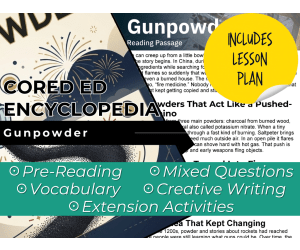
Gunpowder Reading Comprehension Passage - Cored Ed Encyclopedia
ELA, Reading Comprehension, Reading, Science, Technology, Pre-Reading, Language Development, History, Social Studies, Physics, Grade 2, 3, 4, 5, Worksheets & Printables, Worksheets, Teacher Tools, Centers, Activities, Writing Prompts, Assessments, Quizzes and Tests, Quizzes, Lesson Plans
This gunpowder reading comprehension with lesson plan includes: Visualization (on the front cover) Start your lesson by taking a minute to think and share something about the topic. Read the script aloud (slowly), perhaps prepare some music or sound effects. Student close their eyes and let their imaginations wander. Students open their eyes, read the question aloud and give them a few minutes to complete. Ask a few students to share or keep answers until the end to compare with what they learn in the passage. Quick pause—thousands of Cored Education products are included with your TeachSimple membership. Download links and encyclopedia index available here. Pre-Reading Trivia Students will write down one thing they already know about the subject and then read five more facts and discuss. These facts are fun, and the students will enjoy learning about the subject before reading more. Give 1 minute for students to write what they already know (no pressure—best guess is fine). Read the five facts together. After each fact, do ask a student for their opinion, was it surprising? Set a purpose by asking students to highlight/underline one fact they want to learn more about during the reading. Reading Passage The text is a high-interest reading passage with set paragraphs, roughly three to four paragraphs long. It contains a variety of themes about the topic, anywhere from history to technology. The passage is between 250 and 350 words in length. First, ask students to look at the headings and see what they’ll learn about today. What do they know about the topic/heading? First read options: Teacher read-aloud (best for support). Partner reading (paragraph by paragraph). While reading, students underline important details, and vocabulary words they think may come up in the questions section. Mixed Questions The first question page contains four multiple-choice questions, each with a choice of four answers, and three written response questions that require a sentence or two from the student. Students complete the mcqs first independently, then review quickly as a class. For the 3 written responses, try to get students giving the answer with some form of evidence: “I think ___ because the text says ___.” If students get stuck, send them back to check the passage. Vocabulary Questions Practice seven key words from the text in this section across two activities. First section is scrambled words where students will unscramble three words given a clue for each. The second section is a word to meaning matching activity. Before starting, have some students read out words they underlined in the passage. Ask students to say the word and read aloud the sentence(s) around each word. Ask students to do scrambled words and the matching exercise in pairs then go through answers as a class. For the scrambled spelling task, get four pairs to come up to the board and write the words for extra practice with the other student reading out the clue. For the matching task, prompt students to give full sentences: “I matched ___ with ___ because ___.” Creative Writing In this question, the student will be required to write a five to eight sentence paragraph on a question related to the topic. Before starting, ask students write down 3 key ideas they are going to include in their piece. Ask students for ideas to share around the class to help those struggling. Pro writing expectations: 5–8 sentences At least 2 facts or details from the passage At least 2 vocabulary words from the previous page Students read their paragraphs while classmates listen for facts and vocabulary words. Extension Activities This page is optional for fast finishers or to take home. There are several activities, each one requiring a different skill. Do some, do none, do all, completely optional - but you will feel reassured knowing every possibility is planned for. Includes summary writting question and additional facts. Answer Key There are answers for the multiple-choice questions, written response questions have sample answers, vocabulary answers and if there is a summary question then a sample summary will be provided as well. Lesson Plan Included Customized lesson plan for this lesson is included. Lesson Snapshot Title: Gunpowder Genre: Nonfiction (informational text) Subject: Science Primary Topic: How gunpowder was discovered and used over time Estimated Guided Reading Level (A–Z): Q What This Lesson Teaches Best Explains how gunpowder began in China during the Tang dynasty when alchemists mixed ingredients while searching for a life-lasting “elixir.” Identifies the three main powders in gunpowder—charcoal, sulfur, and saltpeter (also called potassium nitrate)—and describes what saltpeter adds to help burning. Describes how gunpowder behaves differently in an open pile versus a tight tube, leading to a strong push of hot gas. Traces how “fire medicine” was used first for celebrations and signals, then developed into fire arrows, bombs, fire lances, and hand cannons by the late 1200s. Shows how ideas travel as gunpowder and stories about rockets reached Europe, and how uses expanded to quarrying rock and digging tunnels, not only fighting. Learning Goals Students will describe how the text says gunpowder was discovered during the Tang dynasty in China. Students will identify the three main powders in gunpowder and explain what saltpeter adds to the burning process. Students will compare what happens when gunpowder burns in an open pile versus in a tight tube. Students will explain how “fire medicine” changed from signals and celebrations to fire arrows and later weapons over time. Students will describe two non-celebration uses of the powder mentioned in the text (quarrying rock and digging tunnels). Students will explain what the author means by “Ideas travel,” using the example of gunpowder reaching Europe. Key Vocabulary From the Text alchemists — people who mixed ingredients while searching for an “elixir.” elixir — a life-lasting drink they searched for. charcoal — powder from burned wood. sulfur — one of the three main powders. saltpeter — a mineral also called potassium nitrate. Discussion Prompts Pre-reading question: What do you think might happen if a powder burns very fast? Comprehension questions: How did the mixture get the name huoyao, or “fire medicine”? Comprehension questions: What role does saltpeter play when a tiny grain is lit? Comprehension questions: How did the uses of “fire medicine” change from celebrations to later tools or weapons? FULL CATALOG OF DOWNLOAD LINKS AND ENCYCLOPEDIA INDEX HERE
Author Cored Education
Rating
Tags Vocabulary, Reading Comprehension, Reading Passages, Lesson Plans, Ela Lesson Plans, Reading Comprehension Lesson Plans, Pre-reading, Science Lesson Plans, Social Studies Lesson Plans, History

I WONDER - Why Did The Microraptor Have Feathers | Animated Video
Animals, Life Sciences, Science, History: Ancient, History, Social Studies, History: World, Grade 4, 5, 6, 7, 8, 9, 10, Lesson Plans, Teacher Tools
Video Introduction An amazing video designed for the students to learn more about dinosaurs in different countries. I WONDER - Why Did The Microraptor Have Feathers | Animated Video Lesson Do you like dinosaurs? what is your favorite one? Do you own a pet? If yes, tell us more about it, like what its name? And what do you like most about it? Do you think that your pet has been evolved from a dinosaur? Can you write down the characteristics of your favourite dinosaur like it's shape, their rivals, where did it use to live and what was their favourite food? What is the largest and the smallest dinosaur that ever found? Why is the T-rex is so famous? Have you ever read any interesting facts about it? Can you name any of the carnivores or herbivores dinosaurs? I WONDER - Why Did The Microraptor Have Feathers | Animated Video Lesson The video is perfect for encouraging the researching skills for the students, while learning more about dinosaurs. I WONDER - Why Did The Microraptor Have Feathers | Animated Video Lesson This friendly designed video is suitable for students at school, homeschooling, and as a group activity. Format Available in MP4 format.
Author Educational Voice
Rating
Tags Why Did The Microraptor Have Feathers, Why Did The Microraptor Have Feathers Video, Microraptor, Microraptor Facts, Microraptor Video, Microraptor Video For Kids, Microraptor Facts For Kids

Number & Operations: Grouping Objects & Number Lines - MAC Software
Math, Number Lines, Kindergarten, Preschool, Grade 1, 2, Teacher Tools, Lesson Plans
The Number & Operations: Grouping Objects & Number Lines - MAC Software An indispensable tool for educators, this software is designed to streamline and innovate the teaching of essential math skills. The key focuses here are the concepts of grouping objects and understanding number lines. It serves as a mini curriculum unit for Preschool, Kindergarten, Grade 1 and Grade 2 students. Main Features: Pre- assessment tools to gauge current knowledge levels before embarking on new lessons. Grouping objects lesson plan frameworks. Real-world word problems focused on number lines. Timed drill activities for effective instruction. This package also includes an exciting assortment of interactive games such as memory matches and spinner games intended to both reinforce taught concepts and stimulate further interest in numbers and operations. Packaging Overview:The product comes within one zip file ready for installation on any MAC system. Notably present in this software is default English voice over and text. To meet educational diversity needs there’s additionally Spanish voice over available with a text option. A teacher guide plus printables are included as additional support materials especially crucial for teachers struggling with workload. The embedded SMART Response assessments serve to evaluate student progress throughout teaching effectively. Lastly, aspects of this software can be assigned as homework assignments – bringing learning right into students' homes! Achieve math education objectives seamlessly today with The Number & Operations: Grouping Objects & Number Lines – MAC Software!
Author Classroom Complete Press
Tags Operations, Number Lines, Digital Math, Grouping Objects, Number Practice

Algebra: Expressions - Multiplication & Division - FLASH-PC
Math, Algebra, Grade 3, 4, 5, Teacher Tools, Lesson Plans
Algebra: Expressions - Multiplication & Division - FLASH-PC An innovative teaching resource focusing on algebraic expressions, particularly multiplication and division. This robust curriculum-based tool is designed to support educators in both public schools and homeschooling environments. Perfect for Grades 3 to 5 Specifically developed for students of grades 3 to 5, this tool marries theoretical learning with practical application by emphasizing real-world word problems. Hence, it allows learners to visualize how abstract algebra concepts apply in everyday life scenarios. Interactive Learning & Assessment Features Promotes interactive learning through group instructions, small group activities using printables and engaging games such as memory match game, board game, spinner game. Incorporates timed drill exercises post-lecture or activities for reinforcement of learned concepts. A SMART Response assessment feature facilitates effective evaluation of each learner's performance. Dual Language Feature Demonstrating utmost inclusivity by catering linguistic diversity within classrooms or homeschool settings; English default voice-over with Spanish alternatives available too! A Comprehensive Guide for Teachers To make the integration process smoother into their teaching scheme – a included guide translates complex algebraic lessons into more digestible bytes especially targeted at intermediate grade level Math students. Cutting-edge Educational Approach: Digital Delivery Takes advantage modern educational approaches marrying Algebra with tech-driven methodologies; Delivered in Software (PC) format effortlessly integrating within existing WIL system setups smoothly; traditional subjects like Algebra enjoy propagation leveraging technology. Note: : Its primary focus on multiplying and dividing algebraic expressions makes Algebra: Expressions – Multiplication & Division - FLASH-PC, an invaluable Math teaching addendum. It ensures educators can adapt to diverse learning needs seamlessly while rendering an engaging, all-inclusive learning experience to students.
Author Classroom Complete Press
Tags Software (PC)

Growing Minds in Social Studies #1: Lessons for Stimulating Thinking
Social Studies, Grade 4, 5, 6, 7, 8, Teacher Tools, Lesson Plans
Growing Minds in Social Studies #1: Lessons for Stimulating Thinking A comprehensive teaching resource designed to cater for students from grade 4 through to grade 8. This resource empowers educators with the tools to cultivate knowledge and stimulate critical thinking within their students. The primary focus of this material is social studies, promoting a vibrant educational environment. What's Included: Activities that provoke mindful consideration of social gestures, An analysis of fear's effects, The exploration of methods towards improving public offering. These activities engage students in a manner that encourages them not just to amass information but also cultivate cognitive skills, likened here as tending to a garden full of potential. Distinguishing Features: Unique about this material is the variety it offers in student involvement levels across each activity . Teachers are given flexibility with which they can customize classes according to different ages and varying skill levels—making Growing Minds a versatile tool across multiple grades. Ease Of Use: An important aspect making this textbook an essential tool, is that each lesson comes with teacher guides. These guides ensure efficient planning and execution while significantly reducing preparation times! Digital Convenience: The textbook comes in PDF format composed of 13 print-ready pages making it highly accessible wherever you may be—classroom or homeschooling setting! Looking for an instructional aid carrying vibrancy yet simplicity? The Growing Minds in Social Studies #1: Lessons for Stimulating Thinking fits right into your teaching plan - suitable for whole group instruction, small focused groups or assigned homework—a surefire mechanism towards sparking curiosity ignited by an inquiry-driven learning approach.
Author Classroom Complete Press
Tags Growing Minds, Critical Thinking, Thinking Skills, Social Studies, Lesson Plan

Guided Reading Activities and Lesson Plan Fiction Set 4 - School
ELA, Reading, Reading Comprehension, Common Core, ESL, Language Development, Pre-Reading, Vocabulary, Resources for Teachers, Grade 4, 5, Worksheets & Printables, Worksheets, Lesson Plans, Teacher Tools
Guided Reading Activities with Lesson Plans Fiction Set 4 Note: This download DOES NOT include the passages themselves. If you have not already done so, download in a format of your choice in the "reading links" section below. Overview The perfect companion materials for Cored Education reading comprehension downloads. This collection provides structured lessons designed to enhance students' reading, comprehension, vocabulary, and creative thinking. Each lesson follows a consistent format that includes pre-reading activities to engage students, vocabulary-building exercises, comprehension checks, creative writing prompts, and discussion topics that promote critical thinking. The lessons are designed to foster active participation, encourage reflection, and develop key literacy skills through interactive and immersive learning experiences. The series is ideal for guided reading sessions, providing teachers with a comprehensive toolkit to engage students in both individual and group activities, enhancing their understanding of text and expanding their language skills. Includes Guided Reading Materials For: 1.The Principal 2.Fear 3.Warm Welcome 4.Funny Photos 5.Gold Star 6.Sub Teacher 7.President Lina 8.Devon's Science Project 9.On the Stage 10.Eve's Amazing Day Reading Links: This is the guided reading materials version and DOES NOT include the passages themselves. The passages related to this download are available here in GOOGLE Docs, GOOGLE Forms, GOOGLE Slides. PDF, PPT, WORD. Google Docs Google Forms Google Slides PDF PPT Word Key Features: Engaging Lesson Structure: Each lesson follows a clear and predictable format, which includes pre-reading discussions, vocabulary exercises, reading activities, and creative tasks to maintain student engagement. Vocabulary Development: Focus on introducing and applying new vocabulary in context, helping students internalize new words and use them effectively. Comprehension and Reflection: The lessons include comprehension questions and reflective prompts that encourage students to think critically about the text and its themes. Creative Writing and Discussion: Opportunities for students to express themselves through writing and group discussions, reinforcing their understanding while fostering creativity. Interactive and Student-Centered: The activities are designed to be interactive, allowing students to engage directly with the content and each other, promoting active learning. Browse the Complete Cored Catalog — 2,000+ Resources Included Reading Passages Each reading passage has been written specifically for students in Grades 4–5, using vocabulary and language that match their age and ability level. The collection covers a wide range of engaging topics, supported by colorful visuals that help bring the content to life. Every lesson is designed to build knowledge while keeping students interested and motivated to read. These resources are also designed with flexibility in mind. Unlike traditional textbooks that can quickly become outdated, lessons can be updated over time to reflect changes in technology, discoveries, and the world around us. Mixed Questions Every lesson includes a variety of questions that help students think more deeply about what they have read. The question section combines reading comprehension, vocabulary, and math skills, while also regularly reinforcing important reading strategies such as cause and effect, summarizing, compare and contrast, and drawing conclusions. Most lessons include a mix of multiple-choice and written-response questions, giving students opportunities to explain their thinking as well as select answers. Complete answer keys and sample responses are provided at the end of each lesson for quick and easy reference. Spelling & Vocabulary Each passage introduces students to useful words and phrases appropriate for Grades 4–5. To help build confidence and word knowledge, every lesson includes a spelling or vocabulary activity. Rather than repeating the same task throughout the collection, activities vary from lesson to lesson to keep practice fresh and engaging. Activities may include spelling challenges, sentence matching, decoding activities, mixed-up text exercises, and other vocabulary-building tasks connected directly to the reading. Writing Prompts Each lesson includes a writing activity that extends the ideas, themes, or topics explored in the passage. Students are encouraged to write in a variety of formats, with prompts providing helpful guidance and ideas to get them started. Writing tasks vary throughout the collection and may include creative writing, research activities, personal responses, poetry, opinion writing, and other engaging assignments. Full Answer Keys Complete answer keys and sample responses are included with every lesson, making planning and marking quicker and easier. Reading comprehension answers include evidence and support from the text, while math-based questions show the relevant working where appropriate. The answer keys are designed primarily for teachers but can also be shared with students when needed. Just for Fun Each lesson finishes with an optional extension activity called Just for Fun . These bonus activities provide an enjoyable way to extend learning beyond the main lesson and often encourage creativity, discussion, or independent thinking. They are completely optional, giving you the flexibility to use the activities that best suit your students and classroom needs. For similar downloads and other frees, do check out Cored Group on TeachSimple.
Author Cored Education
Rating
Tags Elementary, Reading, Comprehension, Vocabulary, Answers, Ccss, Guided Reading, Guided Reading Activity, Guided Reading Lesson Plans, Guided Reading Lesson Plan

Phonics & Early Literacy with Themed Story Builders
STEM, Classroom Management, Resources for Teachers, Community Building, Science, Basic Science, Inventors, Theories, Special Resources, Social Emotional Learning (SEL), Kindergarten, Preschool, Homeschool Curriculum, Homeschool Templates, Grade 1, 2, 3, Teacher Tools, Assessments, Lesson Plans, Literacy Readers, Quizzes and Tests, Quizzes, Tests, Worksheets & Printables, Workbooks, Worksheets
Do your students get bored by phonics drills? Do you have beginning readers who sound out words well, but do not understand what they read? Phonics & Early Literacy With Themed Story Builders will connect the dots between mechanical decoding and creating a love for books and reading! 39 pages of the most complete literacy program curriculum for Kindergarten through 1st and 2nd grade. The program is rooted in the Science of Reading offers a unique method for teaching phonics skills through a new way of creating stories. This program also provides the student opportunities to develop vocabulary, syntax and comprehension while expressing his/her own creativity and imagination. Constrained Narrative Architecture (CNA) Method not only moves students beyond rote memorization when learning how to decode word lists, but also teaches students how to build themed stories using the newly-acquired phonics skills. Once students have created a complete themed story, they will have an understanding of the phonics rules used in the story, plus vocabulary, syntax and comprehension. What You're Getting with This Resource Without Preparation That Has An Immediate Impact on Teaching!? PHASE ONE: Theoretical Foundations & Core Content for the Teacher- This guide provides an educator with an understanding of the neuroscience behind our methodology. The educator will learn the "why" of Orthographic Mapping, Cognitive Load Theory, Narrative Scaffolding, and other elements to become a more experienced and knowledgeable teacher. PHASE TWO: Student Workbook- The student workbook consists of 10 fun thematic worksheets and each worksheet will provide the student with a story background that aligns to the specific sequential skill provided on the worksheet, and offers the student an adventure in phonics. PHASE THREE: Teacher Resource Package- The teacher resource package consists of pedagogical diagrams, full comprehensive answer key, and a teacher implementation guide with pacing suggestions. The 10 Themed Adventure Worksheets Cover the Following Skills in a Sequence: 1. The Alpine Forest (Short Vowels & CVC Words) 2. Deep Sea Discovery (Consonant Digraphs; sh, ch, th, wh) 3. The Clockwork City (Initial Consonant Blends: L, R, S) 4. Dino-Valley Dig (CVCe Words- “Magic e”) 5. Starlight Space Station (Long Vowel Teams- ai, ee, ea, oa, ue) 6. The Whispering Willow Farm (R-Controlled Vowels- ar, er, ir, or, ur) 7. The Weather Wizards (Diphthongs; ou, ow, oi, oy) 8. The Great Mountain Train (Hard/Soft 'c'/ 'g') 9. The Midnight Toy Shop (Syllable Segmentation) 10. The Enchanted Castle (Cumulative Review/Creative Story Building) This is ideal for large group instruction, small group intervention, structured literacy centers, or an effective homeschool phonics program. It will stop the continual slaughter of expected reading enjoyment and create skilled independent readers now! Search for: phonics programs, science of reading, early literacy, kindergarten reading programs, first grade phonics programs, second grade literacy programs, decodable activities, reading intervention programs, story building worksheets, fill-in-the-blank worksheets, structured literacy center materials, homeschool phonics programs, constant vowel, constant e, constant combination sounds, and constant blends of vowel sounds. The reason why parents and schools are happy is because the curriculum is based on scientific principles, known as the "Science of Reading." This means that the curriculum teaches children to read the right way and progresses from the recognition of the individual sounds to being able to read smoothly and understand what they are reading. Phonics becomes fun instead of boring since this curriculum substitutes the traditional rote phonics drills with engaging themed activities. Children become so involved in creating an imaginative story with dinosaurs or by creating a real-life story about a space station that they do not even realize they are really learning important phonics skills. True comprehension of what to read is developed because this resource requires students to select the word that completes a sentence so that it will make sense. This develops the child’s ability to read for meaning as opposed to simply reading out loud. This resource is designed to be easily differentiated as the teacher’s guide contains suggestions for helping struggling readers (such as those with dyslexia) and those working at an advanced level, making it suitable for all students in a diverse classroom or homeschool environment. This resource is comprehensive and ready to be implemented right away, as it includes not only the worksheets that are used in the program, but also has a complete teacher’s guide, student activities to use with the worksheets, and an answer key. Everything you need! Target Audience Review: According to the explicit scope and sequencing outlined on pages 7 & 8 that outline students working through CVC words all the way to multisyllabic words, the following summarizes how this PDF has been developed for: - Primary Target Students: Kindergarten (approx. age 5) - 1st Grade (approx. age 6) and 2nd grade (approx. age 7). - Primary Buyers: K-2 Classroom Teachers, Home School Parents, Literacy Specialists, Reading Interventionists and Tutors. Phase 1 of the theoretical component of the PDF is especially beneficial to these users as it will allow them to show the product's educational merit by demonstrating that the research supports the Science of Reading. Copyright & Terms of Use: This Author's work is licensed to Syed Hammad Rizvi. This product has been created for personal use/by you and one other teacher in the same place. You cannot alter, redistribute or make this product available for sale. You may not upload this product onto any website unless you would like to lose your copyright ownership of the work. Again, please respect the above license agreement and do not share this product with your colleagues, if they would like access, please help them out by purchasing a license from Teachsimple. Thank you very much for your understanding, I appreciate it! As usual this product is provided as a free service, thanks for being apart of my business!
Author Creative Book Store
Rating
Tags Phonics, Scienceofreading, Earlyliteracy, Structuredliteracy, Reading, Literacy, Teachertiptuesday, Kindergarten, Firstgrade, Secondgrade
I WONDER - Are There Different Types Of Waterfalls | Animated Video
Geography, Social Studies, Grade 4, 5, 6, 7, 8, 9, 10, Lesson Plans, Teacher Tools
Video Introduction An amazing video designed for the students to learn more about famous places in different countries. I WONDER - Are There Different Types Of Waterfalls | Animated Video Lesson What do you know about this place? Do you know in which part of the world it is? Have you ever visited this place? If yes, can you tell us more about your adventure, and what do you like the most about this place? Do you like reading about Geography? What is your favorite country in the whole world? If you are going on a trip where it will be? Which country? What you are going to see there? Does this country has a famous place to visit? I WONDER - Are There Different Types Of Waterfalls | Animated Video Lesson The activity is perfect for encouraging the researching skills for the students, while learning more about this fantastic place. I WONDER - Are There Different Types Of Waterfalls | Animated Video Lesson This friendly designed video is suitable for students at school, homeschooling, and as a group activity. Format Available in MP4 format.
Author Educational Voice
Tags Are There Different Types Of Waterfalls, Are There Different Types Of Waterfalls Video, Different Types Of Waterfalls, Different Types Of Waterfalls Facts, Different Types Of Waterfalls Video, Different Types Of Waterfalls Video For Kids
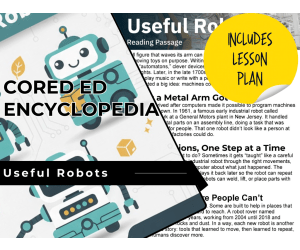
Useful Robots Reading Comprehension Passage - Cored Ed Encyclopedia
ELA, Language Development, Reading Comprehension, Reading, Pre-Reading, History, Social Studies, Technology, Science, Earth and Environmental Sciences, Grade 2, 3, 4, 5, Worksheets & Printables, Worksheets, Teacher Tools, Centers, Activities, Writing Prompts, Assessments, Quizzes and Tests, Quizzes, Lesson Plans
This useful robots reading comprehension with lesson plan includes: Visualization (on the front cover) Start your lesson by taking a minute to think and share something about the topic. Read the script aloud (slowly), perhaps prepare some music or sound effects. Student close their eyes and let their imaginations wander. Students open their eyes, read the question aloud and give them a few minutes to complete. Ask a few students to share or keep answers until the end to compare with what they learn in the passage. Quick pause—thousands of Cored Education products are included with your TeachSimple membership. Download links and encyclopedia index available here. Pre-Reading Trivia Students will write down one thing they already know about the subject and then read five more facts and discuss. These facts are fun, and the students will enjoy learning about the subject before reading more. Give 1 minute for students to write what they already know (no pressure—best guess is fine). Read the five facts together. After each fact, do ask a student for their opinion, was it surprising? Set a purpose by asking students to highlight/underline one fact they want to learn more about during the reading. Reading Passage The text is a high-interest reading passage with set paragraphs, roughly three to four paragraphs long. It contains a variety of themes about the topic, anywhere from history to technology. The passage is between 250 and 350 words in length. First, ask students to look at the headings and see what they’ll learn about today. What do they know about the topic/heading? First read options: Teacher read-aloud (best for support). Partner reading (paragraph by paragraph). While reading, students underline important details, and vocabulary words they think may come up in the questions section. Mixed Questions The first question page contains four multiple-choice questions, each with a choice of four answers, and three written response questions that require a sentence or two from the student. Students complete the mcqs first independently, then review quickly as a class. For the 3 written responses, try to get students giving the answer with some form of evidence: “I think ___ because the text says ___.” If students get stuck, send them back to check the passage. Vocabulary Questions Practice seven key words from the text in this section across two activities. First section is scrambled words where students will unscramble three words given a clue for each. The second section is a word to meaning matching activity. Before starting, have some students read out words they underlined in the passage. Ask students to say the word and read aloud the sentence(s) around each word. Ask students to do scrambled words and the matching exercise in pairs then go through answers as a class. For the scrambled spelling task, get four pairs to come up to the board and write the words for extra practice with the other student reading out the clue. For the matching task, prompt students to give full sentences: “I matched ___ with ___ because ___.” Creative Writing In this question, the student will be required to write a five to eight sentence paragraph on a question related to the topic. Before starting, ask students write down 3 key ideas they are going to include in their piece. Ask students for ideas to share around the class to help those struggling. Pro writing expectations: 5–8 sentences At least 2 facts or details from the passage At least 2 vocabulary words from the previous page Students read their paragraphs while classmates listen for facts and vocabulary words. Extension Activities This page is optional for fast finishers or to take home. There are several activities, each one requiring a different skill. Do some, do none, do all, completely optional - but you will feel reassured knowing every possibility is planned for. Includes summary writting question. Answer Key There are answers for the multiple-choice questions, written response questions have sample answers, vocabulary answers and if there is a summary question then a sample summary will be provided as well. Lesson Plan Included Customized lesson plan for this lesson is included. Lesson Snapshot Title: Useful Robots Genre: Nonfiction (Informational passage) Subject: Science & Technology (Engineering/Robotics) Primary Topic: How robots developed and help people Estimated Guided Reading Level (A–Z): P Support pages included: Pre-reading trivia, mixed questions, vocabulary activities, creative writing prompt, extension activities, and an answer key. QA notes on support pages: Support content generally matches the passage; however, the support pages use “automaton” (singular) while the passage uses “automata” (plural), and an extension prompt suggests “hills,” which is not stated in the passage (the passage names rocks and dust). What This Lesson Teaches Best Robots have a history: Explains that long ago people created “automata” that moved using steam, air, water, or falling weights. Modern robots and factory work: Describes an early industrial robot, Unimate, working in 1961 at a General Motors plant handling hot metal parts that were tough and dangerous for people. How robots learn repeatable motions: Shows how a person can guide a robot’s movements while sensors send signals to a computer that stores a pattern to repeat the job. Robots go where people can’t: Highlights the rover Opportunity exploring Mars for years (2004–2018) and sending back clues from rocks and dust. Big idea across time: Connects early moving devices to today’s robots as tools that learned to move, repeat, and help humans discover more. Learning Goals Students will explain what “automata” were and what powered them. Students will describe why Unimate’s factory job mattered for people. Students will identify how a robot can be “taught” motions and then repeat them. Students will summarize how robots can help in places that are risky, far away, or hard to reach. Students will use details from the text to tell what Opportunity did on Mars and what it sent back. Key Vocabulary From the Text automata — moving devices from long ago; not thinking machines. program — give a machine instructions to do a job. industrial — related to factories and making things. sensors — parts that notice and send signals to a computer. rover — a robot vehicle that travels to explore places. FULL CATALOG OF DOWNLOAD LINKS AND ENCYCLOPEDIA INDEX HERE
Author Cored Education
Rating
Tags Vocabulary, Reading Comprehension, Reading Passages, Lesson Plans, Ela Lesson Plans, Reading Comprehension Lesson Plans, Pre-reading, Science Lesson Plans, Technology, History

Equator Reading Comprehension Passage - Cored Ed Encyclopedia
ELA, Reading Comprehension, Reading, Science, Technology, Language Development, History, Social Studies, Earth and Environmental Sciences, Geography, Grade 2, 3, 4, 5, Worksheets & Printables, Worksheets, Teacher Tools, Centers, Activities, Writing Prompts, Assessments, Quizzes and Tests, Quizzes, Lesson Plans
This Equator reading comprehension with lesson plan includes: Visualization (on the front cover) Start your lesson by taking a minute to think and share something about the topic. Read the script aloud (slowly), perhaps prepare some music or sound effects. Student close their eyes and let their imaginations wander. Students open their eyes, read the question aloud and give them a few minutes to complete. Ask a few students to share or keep answers until the end to compare with what they learn in the passage. Quick pause—thousands of Cored Education products are included with your TeachSimple membership. Download links and encyclopedia index available here. Pre-Reading Trivia Students will write down one thing they already know about the subject and then read five more facts and discuss. These facts are fun, and the students will enjoy learning about the subject before reading more. Give 1 minute for students to write what they already know (no pressure—best guess is fine). Read the five facts together. After each fact, do ask a student for their opinion, was it surprising? Set a purpose by asking students to highlight/underline one fact they want to learn more about during the reading. Reading Passage The text is a high-interest reading passage with set paragraphs, roughly three to four paragraphs long. It contains a variety of themes about the topic, anywhere from history to technology. The passage is between 250 and 350 words in length. First, ask students to look at the headings and see what they’ll learn about today. What do they know about the topic/heading? First read options: Teacher read-aloud (best for support). Partner reading (paragraph by paragraph). While reading, students underline important details, and vocabulary words they think may come up in the questions section. Mixed Questions The first question page contains four multiple-choice questions, each with a choice of four answers, and three written response questions that require a sentence or two from the student. Students complete the mcqs first independently, then review quickly as a class. For the 3 written responses, try to get students giving the answer with some form of evidence: “I think ___ because the text says ___.” If students get stuck, send them back to check the passage. Vocabulary Questions Practice seven key words from the text in this section across two activities. First section is scrambled words where students will unscramble three words given a clue for each. The second section is a word to meaning matching activity. Before starting, have some students read out words they underlined in the passage. Ask students to say the word and read aloud the sentence(s) around each word. Ask students to do scrambled words and the matching exercise in pairs then go through answers as a class. For the scrambled spelling task, get four pairs to come up to the board and write the words for extra practice with the other student reading out the clue. For the matching task, prompt students to give full sentences: “I matched ___ with ___ because ___.” Creative Writing In this question, the student will be required to write a five to eight sentence paragraph on a question related to the topic. Before starting, ask students write down 3 key ideas they are going to include in their piece. Ask students for ideas to share around the class to help those struggling. Pro writing expectations: 5–8 sentences At least 2 facts or details from the passage At least 2 vocabulary words from the previous page Students read their paragraphs while classmates listen for facts and vocabulary words. Extension Activities This page is optional for fast finishers or to take home. There are several activities, each one requiring a different skill. Do some, do none, do all, completely optional - but you will feel reassured knowing every possibility is planned for. Includes summary writting question and additional facts. Answer Key There are answers for the multiple-choice questions, written response questions have sample answers, vocabulary answers and if there is a summary question then a sample summary will be provided as well. Lesson Plan Included Customized lesson plan for this lesson is included. Lesson Snapshot Title: Equator Genre: Nonfiction (Informational Text) Subject: Social Studies (Geography) / Science (Earth Science) / Reading (Informational Text) Primary Topic: Equator, latitude, hemispheres, sunlight, and navigation Estimated Guided Reading Level (A–Z): N What This Lesson Teaches Best Explains the equator as an imaginary line at 0 degrees latitude that circles Earth’s widest part. Shows how the equator splits Earth into the Northern and Southern Hemispheres and acts as a starting line for measuring north and south . Connects observation to science by telling how Eratosthenes compared shadow angles to help estimate Earth’s size long ago. Describes how sunlight near the equator is more direct , helping many equator regions stay warm and keeping day and night close in length. Links geography to modern tools by noting GPS and satellites still begin with the 0-degree equator circle. Learning Goals Students will identify the equator as an imaginary line at 0 degrees latitude . Students will explain how the equator divides Earth into the Northern Hemisphere and Southern Hemisphere . Students will describe how latitude is measured north or south of the equator. Students will explain how shadow angles helped Eratosthenes estimate Earth’s size. Students will describe why sunlight near the equator can feel more direct and how that affects warmth and day/night length. Students will describe how the equator is used as a reference point in GPS and satellites . Key Vocabulary From the Text latitude — degrees north or south of the equator. hemispheres — the two halves of Earth. shadows — dark shapes made when light is blocked. solstice — a day when the Sun’s position is special. satellites — objects in space used to help find locations. FULL CATALOG OF DOWNLOAD LINKS AND ENCYCLOPEDIA INDEX HERE
Author Cored Education
Rating
Tags Vocabulary, Reading Comprehension, Reading Passages, Lesson Plans, Ela Lesson Plans, Reading Comprehension Lesson Plans, Pre-reading, Geography, Earth Science, Science Lesson Plans

I WONDER - Is It Better To Take A Bath Or A Shower | Animated Video
Environmental Science, Earth and Environmental Sciences, Science, Grade 4, 5, 6, 7, 8, 9, 10, Lesson Plans, Teacher Tools
Video Introduction An amazing video designed for the students to learn more about STEM. I WONDER - Is It Better To Take A Bath Or A Shower | Animated Video Lesson Do you like STEM subjects? what is your favorite one? Have you ever tried to plant a seed? If yes, tell us more about it. Or have you ever tried to invent something? If yes, tell us more about it. And how do you think it will help us? Have you ever seen a microorganism under a microscope? What was it? And how it looked like? Mathematics is a marvelous subject. Let' sharpen our brains and solve some equations. Do you like timetable tricks? What is your favorite one? Do you know how to code? Have you ever created an app or a game before? If yes, how was it like? I WONDER - Is It Better To Take A Bath Or A Shower | Animated Video Lesson The video is perfect for encouraging the researching skills for the students, while learning more about this fantastic topic. I WONDER - Is It Better To Take A Bath Or A Shower | Animated Video Lesson This friendly designed video is suitable for students at school, homeschooling, and as a group activity. Format Available in MP4 format.
Author Educational Voice
Tags Is It Better To Take A Bath Or A Shower, Is It Better To Take A Bath Or A Shower Video, Environment, Environment Facts, Environment Facts For Kids, Environment Video, Helping The Environment, Helping The Environment Tips For Kids

Data Analysis & Probability: Pictographs - Practice the Skill 2 - MAC Software
Math, Graphing, Common Core, Kindergarten, Preschool, Grade 1, 2, Teacher Tools, Lesson Plans
Data Analysis & Probability: Pictographs - Practice the Skill 2 - MAC Software: An Innovative Teaching Resource This easy-to-use software is a specialized teaching tool focused on enhancing student comprehension and interpretation of data analysis and pictographs in probability. Ideal for educators in various settings—including classrooms, homeschooling, and more—it's specifically aimed at young learners from preschool up to second grade. Key Features: Curriculum -Based Content: The program provides students with timed drill activities that come straight from the curriculum . These tasks are based solely on information provided by given pictographs. Multilingual Options: For accessibility, the software includes both English and Spanish voice-over versions along with text versions to cater to a wider range of students. In-Software Mathematical Tools: Additional tools integrated into the system enhance usability for individual studies, group assignments or homework exercises. The software helps transition mathematical concepts from abstract ideas into tangible problems solvable through interaction with realistic diagrams (pictographs). By aligning with education standards like Common Core State Standards as well as NCTM guidelines, it aids learning towards standardized achievement goals including STEM initiatives. Purchase & Accessibility: You will receive a zip file containing all necessary elements for operation making it user-friendly even for those not especially tech-savvy. In conclusion, Data Analysis & Probability: Pictographs - Practice the Skill 2 - MAC Software is an invaluable asset in early education. This practical approach makes challenging topics like probability become fascinating rather than daunting — ultimately nurturing well-rounded future leaders.
Author Classroom Complete Press
Tags Digital Math, Math Lesson Plans, Data, Probability, Math Skills

I WONDER - Are There Different Types Of Exoplanets | Animated Video
Space, Earth and Environmental Sciences, Science, Grade 4, 5, 6, 7, 8, 9, 10, Lesson Plans, Teacher Tools
Video Introduction An amazing video designed for the students to learn more about space facts. I WONDER - Are There Different Types Of Exoplanets | Animated Video Lesson Do you like reading about space? If yes, what is your favorite topic? What do you know about our solar system? What is the smallest planet in our solar system? What is the biggest planet in our solar system? What is the hottest planet in our solar system? And what is the coldest one? Do you think there are aliens? If yes, what do you think they look like? What do they eat and how they speak to each other? Where do they live? What is a galaxy? And what is a milky way? Have you recently saw a shooting star? If yes, tell us more about it, like when did it happen and where? What is a blackhole? Can a blackhole gets bigger by time? Do you like counting the stars? What do you think a star is made of? I WONDER - Are There Different Types Of Exoplanets | Animated Video Lesson The video is perfect for encouraging the researching skills for the students, while learning more about the fantastic space. I WONDER - Are There Different Types Of Exoplanets | Animated Video Lesson This friendly designed video is suitable for students at school, homeschooling, and as a group activity. Format Available in MP4 format.
Author Educational Voice
Tags Are There Different Types Of Exoplanets, Are There Different Types Of Exoplanets Video, Different Types Of Exoplanets, Different Types Of Exoplanets Facts, Different Types Of Exoplanets Facts For Kids, Different Types Of Exoplanets Video
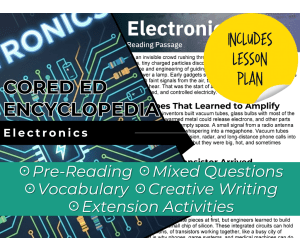
Electronics Reading Comprehension Passage - Cored Ed Encyclopedia
ELA, Reading Comprehension, Reading, Science, Technology, Pre-Reading, Language Development, Physics, Writing, Vocabulary, Grade 2, 3, 4, 5, Worksheets & Printables, Worksheets, Teacher Tools, Centers, Activities, Writing Prompts, Assessments, Quizzes and Tests, Quizzes, Lesson Plans
This electronics reading comprehension with lesson plan includes: Visualization (on the front cover) Start your lesson by taking a minute to think and share something about the topic. Read the script aloud (slowly), perhaps prepare some music or sound effects. Student close their eyes and let their imaginations wander. Students open their eyes, read the question aloud and give them a few minutes to complete. Ask a few students to share or keep answers until the end to compare with what they learn in the passage. Quick pause—thousands of Cored Education products are included with your TeachSimple membership. Download links and encyclopedia index available here. Pre-Reading Trivia Students will write down one thing they already know about the subject and then read five more facts and discuss. These facts are fun, and the students will enjoy learning about the subject before reading more. Give 1 minute for students to write what they already know (no pressure—best guess is fine). Read the five facts together. After each fact, do ask a student for their opinion, was it surprising? Set a purpose by asking students to highlight/underline one fact they want to learn more about during the reading. Reading Passage The text is a high-interest reading passage with set paragraphs, roughly three to four paragraphs long. It contains a variety of themes about the topic, anywhere from history to technology. The passage is between 250 and 350 words in length. First, ask students to look at the headings and see what they’ll learn about today. What do they know about the topic/heading? First read options: Teacher read-aloud (best for support). Partner reading (paragraph by paragraph). While reading, students underline important details, and vocabulary words they think may come up in the questions section. Mixed Questions The first question page contains four multiple-choice questions, each with a choice of four answers, and three written response questions that require a sentence or two from the student. Students complete the mcqs first independently, then review quickly as a class. For the 3 written responses, try to get students giving the answer with some form of evidence: “I think ___ because the text says ___.” If students get stuck, send them back to check the passage. Vocabulary Questions Practice seven key words from the text in this section across two activities. First section is scrambled words where students will unscramble three words given a clue for each. The second section is a word to meaning matching activity. Before starting, have some students read out words they underlined in the passage. Ask students to say the word and read aloud the sentence(s) around each word. Ask students to do scrambled words and the matching exercise in pairs then go through answers as a class. For the scrambled spelling task, get four pairs to come up to the board and write the words for extra practice with the other student reading out the clue. For the matching task, prompt students to give full sentences: “I matched ___ with ___ because ___.” Creative Writing In this question, the student will be required to write a five to eight sentence paragraph on a question related to the topic. Before starting, ask students write down 3 key ideas they are going to include in their piece. Ask students for ideas to share around the class to help those struggling. Pro writing expectations: 5–8 sentences At least 2 facts or details from the passage At least 2 vocabulary words from the previous page Students read their paragraphs while classmates listen for facts and vocabulary words. Extension Activities This page is optional for fast finishers or to take home. There are several activities, each one requiring a different skill. Do some, do none, do all, completely optional - but you will feel reassured knowing every possibility is planned for. Includes summary writting question and additional facts. Answer Key There are answers for the multiple-choice questions, written response questions have sample answers, vocabulary answers and if there is a summary question then a sample summary will be provided as well. Lesson Plan Included Customized lesson plan for this lesson is included. Lesson Snapshot Title: Electronics Genre: Nonfiction (Informational Text) Subject: Science (Technology/Physical Science) / Reading (Informational Text) Primary Topic: How electronics evolved to carry signals Estimated Guided Reading Level (A–Z): Q What This Lesson Teaches Best Defines electrons as tiny charged particles and explains that electronics guides them to carry a message (a “signal”), not just power devices. Traces a clear timeline of inventions : early radio parts → vacuum tubes → transistor (1947) → integrated circuits on silicon chips. Explains how devices can amplify signals (making a small signal stronger), using the vacuum tube and transistor examples. Shows how engineering changes over time led to smaller, more powerful technology , with chips holding millions (even billions) of transistors. Learning Goals Students will describe how electrons moving through wires can carry a message. Students will explain how vacuum tubes helped make radio signals stronger. Students will identify how the transistor differed from vacuum tubes (material used, size, and power use). Students will describe what integrated circuits are and why they allow devices to stay small. Students will summarize how electronics changed from early inventions to modern chips. Key Vocabulary From the Text electrons — tiny charged particles that move through wires. signal — a message carried through a device. vacuum — space with most air removed. transistor — a smaller part that can switch and amplify signals. semiconductor — a material used instead of a vacuum for a transistor. FULL CATALOG OF DOWNLOAD LINKS AND ENCYCLOPEDIA INDEX HERE
Author Cored Education
Rating
Tags Vocabulary, Reading Comprehension, Reading Passages, Lesson Plans, Ela Lesson Plans, Reading Comprehension Lesson Plans, Pre-reading, Science Lesson Plans, Technology, Physics
I WONDER - What Is Machu Picchu Famous For | Animated Video Lesson
Geography, Social Studies, History: Ancient, History, History: World, Grade 4, 5, 6, 7, 8, 9, 10, Lesson Plans, Teacher Tools
Video Introduction An amazing video designed for the students to learn more about famous places in different countries. I WONDER - What Is Machu Picchu Famous For | Animated Video Lesson What do you know about this place? Do you know in which part of the world it is? Have you ever visited this place? If yes, can you tell us more about your adventure, and what do you like the most about this place? Do you like reading about Geography? What is your favorite country in the whole world? If you are going on a trip where it will be? Which country? What you are going to see there? Does this country has a famous place to visit? I WONDER - What Is Machu Picchu Famous For | Animated Video Lesson The activity is perfect for encouraging the researching skills for the students, while learning more about this fantastic place. I WONDER - What Is Machu Picchu Famous For | Animated Video Lesson This friendly designed video is suitable for students at school, homeschooling, and as a group activity. Format Available in MP4 format.
Author Educational Voice
Rating
Tags What Is Machu Picchu Famous For, What Is Machu Picchu Famous For Video, Machu Picchu, Machu Picchu Video, Machu Picchu Facts, Machu Picchu Facts For Kids, Machu Picchu Video For Kids

I WONDER - Can Any Bones In The Skull Move | Animated Video Lesson
Human Body, Life Sciences, Science, Biology, STEM, Grade 3, 4, 5, 6, 7, 8, 9, Lesson Plans, Teacher Tools
Video Overview The human body is full of fascinating wonders to learn. This video is created to help the students recognize the anatomy and the job of the human body. I WONDER - Can Any Bones In The Skull Move | Animated Video Lesson Every part and organ in our human body is vital so let's see how important they are. Have you ever imagined how we look like if we didn't have a skeleton? Did you know that because we have our amazing muscles we can stand! Do you know how many teeth do we have? Have you ever wondered about the food journey inside our body? Can you name all the glands in our body? Why do we have skin? Our nervous system is really good at sending signals. Can you tell us more about it? Are you really good at Mathematics, painting, or any other thing? You should really thank your brain about it! The famous five senses are really doing a great work? Can you explain how every sense works? I WONDER - Can Any Bones In The Skull Move | Animated Video Lesson The video is perfect for encouraging the researching skills for the students, while learning more about our fantastic human body. I WONDER - Can Any Bones In The Skull Move | Animated Video Lesson This friendly designed video is suitable for students at school, homeschooling, and as a group activity. Format Available in MP4 format.
Author Educational Voice
Tags Can Any Bones In The Skull Move, Can Any Bones In The Skull Move Video, The Skull, The Skull Facts, The Skull Facts For Kids, The Skull Video, The Skull Video For Kids, The Skull Bones, The Skull Bones Facts For Kids

Energy: What Is Energy?
Science, Physics, Common Core, Grade 5, 6, 7, 8, Teacher Tools, Lesson Plans
Energy: What Is Energy? A comprehensive teaching resource specially designed to demystify the concept of energy for middle school students. This reliable supplemental material is closely aligned with Common Core State Standards, Bloom's Taxonomy, and STEM initiatives. Diverse Forms of Energy This resource provides a deep dive into various forms of energy such as: Mechanical Thermal Sound waves Light energy. Potential Energy Types - Simplified! In addition, the text offers insights into potential energy types, often found challenging by students. The versatility allows for both whole-group instruction and small group discussions or individual learning activities. Crafted using highly readable language aimed at grade level 5 through 8 students, even complex ideas are distilled down in an accessible format. The module is uniformly welcoming to all students regardless of prior knowledge or ability. A Thoughtfully Constructed Teaching Resource An informative module complete with a collection of reading passages further elaborated with student-oriented activities aimed at sustaining engagement while reinforcing concepts learned. Included within this unique package are mini posters that bridge verbal and visual learning mediums providing an interactive mode aiding in better retention and understanding. "Energy: What Is Energy?" explains 'the ability to do work' in easily digestible chunks that encourages interactive learning while staying true to curriculum goals." Finally, "Energy: What Is Energy?" is available as a PDF-formatted teaching resource suited perfectly for technology-driven classrooms. Consequently serving as a potent tool for homework assignments or learning adventures embarked upon solo, fostering independent thinking among young minds.
Author Classroom Complete Press
Tags PDF
I WONDER - Why Is It Important To Recycle Glass | Animated Video
Environmental Science, Earth and Environmental Sciences, Science, Grade 4, 5, 6, 7, 8, 9, 10, Lesson Plans, Teacher Tools
Video Introduction An amazing video designed for the students to learn more about STEM. I WONDER - Why Is It Important To Recycle Glass | Animated Video Lesson Do you like STEM subjects? what is your favorite one? Have you ever tried to plant a seed? If yes, tell us more about it. Or have you ever tried to invent something? If yes, tell us more about it. And how do you think it will help us? Have you ever seen a microorganism under a microscope? What was it? And how it looked like? Mathematics is a marvelous subject. Let' sharpen our brains and solve some equations. Do you like timetable tricks? What is your favorite one? Do you know how to code? Have you ever created an app or a game before? If yes, how was it like? I WONDER - Why Is It Important To Recycle Glass | Animated Video Lesson The video is perfect for encouraging the researching skills for the students, while learning more about this fantastic topic. I WONDER - Why Is It Important To Recycle Glass | Animated Video Lesson This friendly designed video is suitable for students at school, homeschooling, and as a group activity. Format Available in MP4 format.
Author Educational Voice
Tags Why Is It Important To Recycle Glass, Why Is It Important To Recycle Glass Video, Glass Recycling, Glass Recycling Facts, Glass Recycling Facts For Kids, Glass Recycling Video, Glass Recycling Video For Kids