



3,942 products added recently
Page 3 - Space Lesson Plans
Ignite your students' imagination with lesson plans that delve into astronomy and space exploration. Covering topics from the solar system to deep space phenomena, these resources include engaging activities and multimedia elements. Use them to inspire awe and curiosity about the cosmos.

 Show filters


Biodiversity & Ecosystem Protection Activity Sheets
Science, Earth and Environmental Sciences, Earth Sciences, Environmental Science, Geology, Space, Life Sciences, Nature & Plants, STEM, Basic Science, Homeschool Curriculum, Grade 3, 4, 5, 6, 7, 8, Teacher Tools, Lesson Plans, Presentations, Quizzes and Tests, Quizzes, Tests, Worksheets & Printables, Workbooks, Worksheets, Word Searches
This teaching resource is a 35-page Biodiversity & Ecosystem Protection bundle for upper elementary (3rd-5th grade) and for home school settings. It is professional and formatted for classroom distribution as well as for printing (and testing) in your classroom. Three Phases of Learning: PHASE 1 - The Educator's Guide (Chapters 1-4) contains in-depth information about the three levels of biodiversity, ecosystem architecture, the "wood wide web," keystone species, trophic cascades, habitat fragmentation, invasive species, wildlife corridors and the "Miyawaki Method," with many real-world examples. See the Tepuis in Guiana, the Brazil Nut tree, the Silent Forests of Guam, and Banff wildlife corridors. PHASE 2 - Student Workbook contains 10 worksheets of fill-in-the-blank questions, critical thinking prompts, scenario analyses, and design challenges for Ecosystem Vocabulary, Food Webs, World Biomes, Keystone Species, Habitat Fragmentation, Invasive Species, Marine Biodiversity, Pollinators, Conservation Legislation, and Citizen Science. PHASE 3 - Visual and Teacher Resources, including three classroom-ready diagrams (the Trophic Interdependence diagram, H.I.P.P.O. Threats Matrix, and Conservation Action Mind Map), an answer key for all worksheets, a guide for implementing all 14 NGSS Standards (3-LS4-3 & 5-LS2-1), differentiation strategies (ELL, SLD, gifted), and a formative assessment grading rubric. Best Suited For: Science educators, home-schoolers, nature and ecology groups, Earth Day project preparation, STEM course planning, substitute billing preparation and one-to-one tuition sessions. Type Of Item Available To Download: An easy-to-fit digital record making it possible for you to create your teaching resource as soon as you make your purchase, using copies of the files or printing directly from the completed files themselves as needed as teacher copying materials. Search Terms: biodiversity worksheets, ecosystems worksheets, NGSS aligned Science 3rd-5th grade, food web activities, keystone species lesson plan, environmental science prints, conservation worksheets, Earth Day Activities, life science curriculum, habitat Lesson plans. Overview of NGSS and Related Benefits: NGSS-aligned and Standards-based will directly meet Performance Expectations: 3 LS4-3 & 5 LS2-1, thus these resources will save teachers several hours of planning. All-in-One Resource: 3-in-1 Bundle will include: “Teacher Theory”, “Student Workbook” and “Answer Keys” including visuals. No need to purchase supplemental material. Fosters Critical Thinking Instead of Memorization: Real-life Case Studies, (Guam, Amazon, Banff) and “Constructivist Systems Thinking” approach to develop “analytical” minds. Includes Built-in Differentiation: A complete range of instructional strategies will be provided for ELL, Special Education (SLD & ADD), and Gifted & Talented students; one resource will serve all learners. Ready to Print and Use: Black and White "Ink on Paper" design saves ink; ready to print and teach in minutes with no preparation work. Solution-oriented approach: Combats "Eco-Anxiety" by providing students with clearly defined solutions to every cause/problem and offering students the ability to take: Action-Based Steps to Reduce Classroom Eco-Anxiety. The document clearly specifies that it has multiple intended uses, as follows: Primary Audience: Grades (ages) 8 to 11 (i.e., 3, 4, and 5). Secondary Audience: Grade 6 with introductory or review materials. Curriculum for students in these grades who are homeschooled. Curriculum for middle school English Language Learner (ELL) or English as a Second Language (ESL) students using simplified science concepts. Curriculum for students with special needs using the differentiation strategies provided in this document. Copyright and Terms of Use: Syed Hammad Rizvi owns the copyright to this book. It is provided for personal use and in a singular classroom. You cannot change it, sell any part of it, or redistribute any of it. In short, it cannot be provided over the Internet in such a way that others can access it and download it without your permission. If you wish to share this resource with your coworkers, you can purchase additional licenses for it through Teachsimple. Thank you for following the terms of agreement for this resource. This is a gift from Syed Hammad Rizvi.
Author Creative Book Store
Rating
Tags Biodiversity, EcosystemWorksheets, NGSSScience, ScienceWorksheets, ElementaryScience, ScienceTeachers, HomeschoolPrintables, BiodiversityWorksheets, BiodiversityActivities, EcosystemActivities

I WONDER - How Long Is A Day On Venus | Animated Video Lesson
Space, Earth and Environmental Sciences, Science, Grade 5, 6, 7, 8, 9, 10, 11, Lesson Plans, Teacher Tools
Video Introduction An amazing video designed for the students to learn more about space facts. I WONDER - How Long Is A Day On Venus | Animated Video Lesson Do you like reading about space? If yes, what is your favorite topic? What do you know about our solar system? What is the smallest planet in our solar system? What is the biggest planet in our solar system? What is the hottest planet in our solar system? And what is the coldest one? Do you think there are aliens? If yes, what do you think they look like? What do they eat and how they speak to each other? Where do they live? What is a galaxy? And what is a milky way? Have you recently saw a shooting star? If yes, tell us more about it, like when did it happen and where? What is a blackhole? Can a blackhole gets bigger by time? Do you like counting the stars? What do you think a star is made of? I WONDER - How Long Is A Day On Venus | Animated Video Lesson The video is perfect for encouraging the researching skills for the students, while learning more about the fantastic space. I WONDER - How Long Is A Day On Venus | Animated Video Lesson This friendly designed video is suitable for students at school, homeschooling, and as a group activity. Format Available in MP4 format.
Author Educational Voice
Tags How Long Is A Day On Venus, How Long Is A Day On Venus Video, A Day On Venus, A Day On Venus Video, A Day On Venus Video For Kids, Venus, Venus Video, Venus Video For Kids, Venus Facts
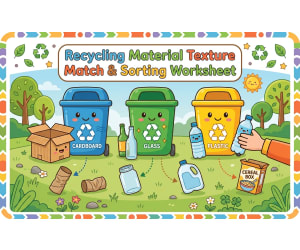
Recycling Material Texture Match & Sorting
Science, Life Sciences, Earth and Environmental Sciences, Earth Sciences, Environmental Science, Geology, Space, Nature & Plants, Human Body, Basic Science, Preschool, Grade 1, 2, 3, 4, 5, 6, Worksheets & Printables, Workbooks, Worksheets, Word Searches, Teacher Tools, Lesson Plans, Quizzes and Tests, Quizzes, Tests, Assessments
Transform your recycling lesson from a flat, boring worksheet into an unforgettable, hands-on sensory adventure! This comprehensive, research-based curriculum is designed to teach toddlers and preschoolers about recycling through the way they learn best: by touching, feeling, and doing. Grounded in the principles of Embodied Cognition, Montessori, and Vygotskian scaffolding , this resource moves beyond simple picture matching. It guides children to understand the fundamental properties of materials like cardboard, plastic, and glass (using safe proxies) through their distinct textures, temperatures, weights, and sounds. It’s the perfect, developmentally appropriate resource for your Earth Day unit, sensory tables, fine motor centers, or at-home learning. This isn't just a set of printables; it's a complete pedagogical system designed for early childhood educators, occupational therapists, and dedicated parents. ► What's Included in this 33-Page PDF? Phase 1: Core Content & Theory: A professional, in-depth guide for the educator. It explains the neuroscience behind tactile learning in early childhood, the design of the sensory materials, and the cognitive mapping process that helps toddlers connect a physical object to a symbolic icon. Phase 2: Facilitator's Workbook: 10 detailed, scaffolded worksheets that serve as lesson plans and observation guides. Each worksheet focuses on a different sensory attribute (e.g., Thermal Conductivity, Auditory Feedback, Material Elasticity) and provides step-by-step instructions and prompts for recording the child's progress. Phase 3: Visuals & Teacher Resources: Everything you need for seamless implementation! Professional Diagrams: Visual models of the learning process and ideal classroom setup. Developmental Milestones Matrix: Track a child's progress from exploration to mastery. Teacher Implementation Guide: Detailed instructions on material preparation, safety protocols, and a step-by-step guide to executing the lessons. Comprehensive Answer Key & Observation Rubric: Understand the "why" behind a child's actions and identify emerging, developing, and mastering skills. ► Skills Developed: Sensory Processing: Tactile, thermal, auditory, and kinesthetic discrimination. Fine Motor Skills: Pincer grasp, grip-force modulation, object manipulation. Cognitive Skills: Sorting and categorizing, problem-solving, working memory, cognitive flexibility. Early Science/Environmental Concepts: Understanding material properties, introduction to recycling and ecological stewardship. Language Development: Builds vocabulary for textures and properties ("bumpy," "smooth," "cold," "crinkly"). ► Perfect For: Preschool, Pre-K, and Toddler Teachers Occupational Therapists (A fantastic tool for sensory integration and fine motor goals!) Homeschooling Parents Special Education Professionals Montessori & Reggio Emilia inspired classrooms Stop the "laminate and lecture" cycle. Download this curriculum today and empower your little learners to become true "somatic ecologists" who understand their world through meaningful interaction! Keywords: Recycling, Earth Day, Sensory Bin, Toddler Activities, Preschool Curriculum, Montessori, Occupational Therapy, Fine Motor Skills, Sorting Activities, Tactile Learning, Hands-On Learning, Special Education, SPED, Sensory Integration, Early Childhood, Teacher Resource, Case Study Why Parents/Schools Love It: Goes Beyond Worksheets: It’s a multi-sensory, hands-on experience that turns abstract concepts like recycling into concrete, memorable play. It aligns perfectly with how young children naturally learn. Builds Real-World Skills: This curriculum masterfully combines critical developmental goals (fine motor, sensory discrimination) with an essential real-world lesson on environmental responsibility. Research-Backed & Professional: Unlike many resources, this curriculum is grounded in solid educational theory (Montessori, Vygotsky) and neuroscience, giving educators and therapists confidence in its effectiveness. Incredibly Versatile & Adaptable: It can be used for one-on-one therapy, a home learning activity, or a classroom sensory station. The detailed rubrics help track individual progress in any setting. Target Student Classes : Based on the content, case studies (ages 28-48 months), and developmental focus, target facilitators (the adults) working with: Toddlers (18 months - 3 years) Preschool / Pre-K (3 - 4 years) This resource is also exceptionally well-suited for Early Intervention and Special Education classrooms focusing on sensory processing and fine motor development, as well as for Occupational Therapy (OT) sessions. Copyright/Terms of Use: This Book was copyrighted by Syed Hammad Rizvi. This resource is for personal and single classroom use only. You may not alter, redistribute, or sell any part of this resource. In other words, you may not put it on the Internet where it could be publicly found and downloaded. If you want to share this resource with colleagues, please purchase additional licenses from Teachsimple. Thank you for respecting these terms of use. This product is happily brought to you by Syed Hammad Rizvi
Author Creative Book Store
Rating
Tags Recycling, Sorting, Earthday, Environment, Sustainability, Recyclingactivities, Sortingactivities, Earthdayactivities, Learningtorecycle, Environmentalscience
I WONDER - How Can You Look At An Eclipse Safely | Animated Video
Space, Earth and Environmental Sciences, Science, Grade 4, 5, 6, 7, 8, 9, 10, Lesson Plans, Teacher Tools
Video Introduction An amazing video designed for the students to learn more about space facts. I WONDER - How Can You Look At An Eclipse Safely | Animated Video Lesson Do you like reading about space? If yes, what is your favorite topic? What do you know about our solar system? What is the smallest planet in our solar system? What is the biggest planet in our solar system? What is the hottest planet in our solar system? And what is the coldest one? Do you think there are aliens? If yes, what do you think they look like? What do they eat and how they speak to each other? Where do they live? What is a galaxy? And what is a milky way? Have you recently saw a shooting star? If yes, tell us more about it, like when did it happen and where? What is a blackhole? Can a blackhole gets bigger by time? Do you like counting the stars? What do you think a star is made of? I WONDER - How Can You Look At An Eclipse Safely | Animated Video Lesson The video is perfect for encouraging the researching skills for the students, while learning more about the fantastic space. I WONDER - How Can You Look At An Eclipse Safely | Animated Video Lesson This friendly designed video is suitable for students at school, homeschooling, and as a group activity. Format Available in MP4 format.
Author Educational Voice
Tags How Can You Look At An Eclipse Safely, How Can You Look At An Eclipse Safely Video, Look At An Eclipse Safely, Look At An Eclipse Safely Video, Look At An Eclipse Safely Facts, Look At An Eclipse Safely Facts For Kids

I WONDER - What Types Of Planets Are In The Solar System
Space, Earth and Environmental Sciences, Science, Grade 2, 3, 4, 5, 6, 7, 8, Lesson Plans, Teacher Tools
Video Introduction An amazing video designed for the students to learn more about space facts. I WONDER - What Types Of Planets Are In The Solar System | Animated Video Lesson Have you ever thought about travelling to space?! Join us with this amazing video about Saturn. Do you think we can visit Mars or Saturn someday? How amazing is space! Let's discover some amazing facts about planets, asteroids, our solar system and the milky way! Do you know that we have two kinds of planets in our solar system? Can you name the planets based upon their core type? I WONDER - What Types Of Planets Are In The Solar System | Animated Video Lesson The video is perfect for encouraging the researching skills for the students, while learning more about the fantastic space. I WONDER - What Types Of Planets Are In The Solar System | Animated Video Lesson This friendly designed video is suitable for students at school, homeschooling, and as a group activity. Format Available in MP4 format.
Author Educational Voice
Rating
Tags What Types Of Planets Are In The Solar System, Planets, Planets Facts, Planets Video, Planets Facts For Kids, Planets Video For Kids, Solar System, Solar System Facts, Solar System Video
I WONDER - What Are The Phases Of The Moon | Animated Video Lesson
Space, Earth and Environmental Sciences, Science, Grade 5, 6, 7, 8, 9, 10, 11, Lesson Plans, Teacher Tools
Video Introduction An amazing video designed for the students to learn more about space facts. I WONDER - What Are The Phases Of The Moon | Animated Video Lesson Do you like reading about space? If yes, what is your favorite topic? What do you know about our solar system? What is the smallest planet in our solar system? What is the biggest planet in our solar system? What is the hottest planet in our solar system? And what is the coldest one? Do you think there are aliens? If yes, what do you think they look like? What do they eat and how they speak to each other? Where do they live? What is a galaxy? And what is a milky way? Have you recently saw a shooting star? If yes, tell us more about it, like when did it happen and where? What is a blackhole? Can a blackhole gets bigger by time? Do you like counting the stars? What do you think a star is made of? I WONDER - What Are The Phases Of The Moon | Animated Video Lesson The video is perfect for encouraging the researching skills for the students, while learning more about the fantastic space. I WONDER - What Are The Phases Of The Moon | Animated Video Lesson This friendly designed video is suitable for students at school, homeschooling, and as a group activity. Format Available in MP4 format.
Author Educational Voice
Tags What Are The Phases Of The Moon, What Are The Phases Of The Moon Video, The Moon Phases, The Moon Phases Facts, The Moon Phases Facts For Kids, The Moon Phases Video, The Moon Phases Video For Kids

Free Science Sun, Moon & Earth Vocabulary Interactive Review
Science, Earth and Environmental Sciences, Space, Earth Sciences, Environmental Science, Grade 8, Teacher Tools, Lesson Plans
Sun, Moon N Earth Vocabulary Words to Review and Reinforce Definitions of the 8TH Grade Science Curriculum . Students will learn and practice terms through definitions and characteristics. The engaging activity promotes collaboration and class discussion as students review terms definitions, and more with multiple visuals and learning formats like multiple choice questions, memory games, hang-man, and others. This versatile resource can be used for whole-group instruction, small-group practice, or independent work, just practice the words and then review them by choosing the correct one, it will self-correct you until you choose the correct answer Practice your Vocabulary with this Free Interactive Game Introduce young learners to a variety of visuals with this entertaining digital game. Students will see the names and images of different words and definitions; exercising visual memory and concentration. This self-checking activity can be played independently or as a whole class game projected on a smartboard. The vibrant slideshow stimulates engagement while building construction classification skills. students will build their knowledge of important terms and definitions while having fun playing games. This activity stimulates intelligence, builds concentration, reinforces letter recognition, improves spelling and pronunciation, and engagingly expands vocabulary. It's a perfect supplement for your lesson. Check our shop, material, and products for more interactive construction vocabulary reviews covering other topics like human microbiome, metabolism, and more grade levels in science and Spanish language arts. Download this versatile 28-slide PowerPoint today!
Author ShapeUp-N-Matematicas y Lenguaje
Tags SCIENCE, Scientific Argument, Sun Moon Earrth, Moon, Sun, Earth, Solar System, Yeat, Orbit, Terminator
I WONDER - What Jobs Do Space Probes Do | Animated Video Lesson
Space, Earth and Environmental Sciences, Science, Grade 6, 7, 8, 9, 10, 11, 12, Lesson Plans, Teacher Tools
Video Introduction An amazing video designed for the students to learn more about space facts. I WONDER - What Jobs Do Space Probes Do | Animated Video Lesson Do you like reading about space? If yes, what is your favorite topic? What do you know about our solar system? What is the smallest planet in our solar system? What is the biggest planet in our solar system? What is the hottest planet in our solar system? And what is the coldest one? Do you think there are aliens? If yes, what do you think they look like? What do they eat and how they speak to each other? Where do they live? What is a galaxy? And what is a milky way? Have you recently saw a shooting star? If yes, tell us more about it, like when did it happen and where? What is a blackhole? Can a blackhole gets bigger by time? Do you like counting the stars? What do you think a star is made of? I WONDER - What Jobs Do Space Probes Do | Animated Video Lesson The video is perfect for encouraging the researching skills for the students, while learning more about the fantastic space. I WONDER - What Jobs Do Space Probes Do | Animated Video Lesson This friendly designed video is suitable for students at school, homeschooling, and as a group activity. Format Available in MP4 format.
Author Educational Voice
Tags Space Probes, Space Probe, Space Probes Facts, Space Probes Facts For Kids, Space Probes Video, Space Probes Video For Kids, What Jobs Do Space Probes Do, What Jobs Do Space Probes Do Video

Space Travel & Technology - Digital Lesson Plan Gr. 5-8 | PC Software
Science, Earth and Environmental Sciences, Space, Grade 5, 6, 7, 8, Teacher Tools, Lesson Plans
Space Travel & Technology - Digital Lesson Plan Gr. 5-8 | PC Software An innovative learning tool intended for Grade 5 to 8 educators, this dynamic and user-friendly lesson plan focuses on space travel and technology. It propels students to imagine joining a shuttle mission bound for the International Space Station. This interactive digital program spans across 80 screen-pages, making learners the scientists, engineers, astronauts or leaders guiding humanity in unearthing more of our universe's mysteries. Teachers play an absolutely crucial role as they help shape tomorrow's visionaries using this fantastic resource. Key Features: Interactive activities both before and after lessons promote learner engagement while stimulating critical thinking skills. Inclusion of English and Spanish Text-to-Speech capability catering to diverse classroom learning needs. The content within is structured upon Bloom's Taxonomy framework and adheres strictly with state standards. A variety of supporting materials—like a memory match game, crossword puzzles and word searches—are included herein providing additional opportunities for concept reinforcement while keeping the lessons enjoyable! The software also houses practice quizzes acting as an excellent way to gauge student comprehension—very valuable in assessing understanding before transitioning into other thrilling astronomy themes or beyond! Your One-Stop Teaching Aid... The 'Space Travel & Technology - Digital Lesson Plan Gr. 5-8 | PC Software' isn't just another teaching aid—it’s an efficient launching pad readying young minds for cosmic explorations! Use it during group instruction sessions; assign it as an interesting homework task; incorporate it into your class center activities—the sky (or rather space!) is the only limit! Note:Please be aware that delivery comes in the form of one zip file intended only for compatible PC software.
Author Classroom Complete Press
Tags Astronomy Lesson Plan, Digital Science Lesson, Space Travel, Technology Lesson, Astronomy Reading
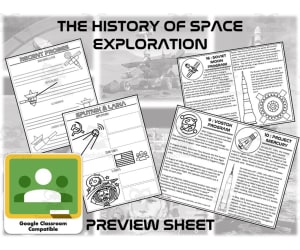
The History of Space Exploration - Complete Unit
Social Studies, Science, Technology, Engineering, Earth and Environmental Sciences, Space, Not Grade Specific, Lesson Plans, Teacher Tools
The History of Space Exploration - Complete Unit A comprehensive teaching resource designed to immerse students in the world of space exploration. This course traces the roots of rocket science and space travel from early stages to future plans for the 21st century, making it an ideal tool for educators planning semester-long courses or even year-round elective studies. This complete unit comprises: 27 carefully planned lessons that cover a range of themes Exploration into basic physics principles behind rockets and spaceflight Detailed biographies on key figures like Robert H. Goddard and Wernher Von Braun An analysis on leaps made by USSR and USA in launching their first satellites Case studies about significant milestones like Sergei Korolev's efforts with the R-7 Rocket, Sputnik's historic launch, Laika’s journey etc, An insight into more recent achievements such as Space Shuttles history or Mars rovers discoveries etc, Each lesson is thoughtfully arranged; along with reading material, question sheets to reinforce understanding. It also guides on how PowerPoint can be used effectively are provided making teaching tech-savvy. Suitable across varied grades, this package could be used in subjects such as Social Studies & Science focusing on Technology Engineering & Astronomy as well..It could be applied in whole group exercises, one-on-one sessions or even homework assignments to cater all educational needs In conclusion The History of Space Exploration - Complete Unit promotes:/p In-depth learning while keeping students engaged, Adventure through cosmos' mysteries, Alliances & rivalries created during this exploration, Strides we as humankind have made towards mapping the stars.
Author Mr Gray History
Tags Space Exploration, Rockets, History, Astronauts, Future Plans
Carbon Footprint Calculator & Personal Sustainability Plans
Science, Basic Science, Earth and Environmental Sciences, Life Sciences, Earth Sciences, Environmental Science, Geology, Space, Nature & Plants, Biology, Homeschool Curriculum, Homeschool Templates, Grade 4, 5, 6, 7, 8, Worksheets & Printables, Workbooks, Worksheets, Word Searches, Teacher Tools, Assessments, Lesson Plans, Quizzes and Tests, Quizzes, Tests
This fully planned out unit, straying away from Climate Anxiety and allowing students to build agency related to climate action, can be printed right out of this document and used in the classroom immediately. Designed for use in Grades 5–7 (ages 10–14), students will progress through this unit comprehensively by learning about the Carbon Cycle, measuring their actual CO₂e emissions, and creating their own personal plan for sustainability. The unit provides scientific text, real-world case studies (i.e. The Life of a White Cotton T-shirt), 10 individual audit worksheets related to home energy, transportation, diet, consumption, and water use. There is a Carbon Calculator provided which translates students' daily habits into actual data as well as templates for SMART Goal Setting and Advocacy Letters to promote action from students after completing the project. The materials align with NGSS (Earth and Human Activity Standard) and are ideal for Earth Day, STEM, or to promote Environmental Literacy throughout the rest of the school year. Not only does this package come with an extensive Teacher's Guide complete with answer keys, grading rubrics, visual aids, and a flexible 5-day pacing guide; the materials have been scaffolded to help mitigate eco-anxiety with both kindness and evidence-based science. The highlights include: 4 engaging chapters on greenhouse gases, CO₂e, and Life Cycle Assessment 10 student audit worksheets and a Carbon Calculator to synthesize student audit results SMART Goals Workshop for setting student action plans and evaluating systemic actions Professional writing activity related to Advocacy Letters A comprehensive Teacher Key, including Answer Keys, Grading Rubrics, and 5-Day Unit Plan All materials have been classroom-tested and proved to be effective. Appreciated by Parents and Educators: Empowerment Versus Fear – Empowers children and youth to make positive changes by turning their fear of climate change into tangible steps they can take themselves. Real-World Math/Data Skills – Develops mathematics and data-based skills through the calculation of CO₂e from current activities, reinforcing applied math and unit conversion skills and improving critical thinking. Systems Thinking – Students develop a deeper understanding of system relationships and the ripple effects of human activity on the ecological system through Life Cycle Assessment (T-shirts) and permafrost feedback loops. Teacher-friendly, Minimal Prep/Materials Needed – All materials required for implementation are provided (e.g., rubrics, answer keys, visuals, and 5-day pacing guides), so even non-science specialists can implement without difficulty. Opens Up Conversation at Home/School/Community – The advocacy letter and family audit provide an avenue for discussion beyond the classroom, resulting in actual changes to household sustainability. Targeted Grade Levels: The statement in the introduction clearly states that targeted grade levels are ‘5th, 6th, and 7th Grade.’ Therefore, because the math being introduced in this program involves multiplication, metric/unit conversions, basic percentage reasoning and cognitive complexity, I believe students in grades 5 through 7 will best use this resource as follows: Primary Group: 5th – 7th Grade (10-13 year olds) Secondary/Extension Group: (4th Grade) Advanced; 8th – 9th Grade as a basic review of what they learned in grades 5 and/or 6. Copyright/Terms of Use : The copyright for this book is owned by Syed Hammad Rizvi. This resource is intended for personal use and to be used in a single classroom. This means that you may not repurpose, sell, or give away any part of this resource. In essence, you cannot upload this resource to any public place on the internet and make it available to the world. If you wish to distribute this resource to other teachers, please purchase additional licenses through Teachsimple. Thank you for respecting these terms of use. This product is brought to you proudly by Syed Hammad Rizvi.
Author Creative Book Store
Rating
Tags ClimateChangeEducation, EcoLiteracy, SustainableClassroom, GlobalWarming, ClimateAction, GoGreen, ZeroWasteClassroom, EnvironmentalEducation, GreenSTEM, EarthWarriors

Solar System: The Stars - FLASH-PC
Science, Earth and Environmental Sciences, Space, Common Core, Grade 5, 6, 7, 8, Teacher Tools, Lesson Plans
The Solar System: The Stars - FLASH-PC This educational resource provides an in-depth understanding of the stars within our solar system. It's specifically designed to cater for Grade 5 through Grade 8 curriculum and perfectly lines up with Common Core State Standards. Comprehensive Teaching Resource A blend of instructional strategies that sparks student interest and deepens comprehension. Inclusion of reading passages, pre-read and post-read questions introduces cognitive reinforcement techniques. Promotes critical thinking validated by Bloom's Taxonomy. Vocabulary Flashcards - Additional Learning Tools Useful for revamping literacy skills. They can seamlessly fit into multiple teaching formats – whole group lessons, small group guidance or even as homework tasks. Multisensory Learning Experiences Advancement Features: 'Interactive activities': Cultivation of active participation fostering better engagement levels while emphasizing on astronomy-related complex concepts internalization. 'Audio and video aids': Ensures diversified instructional methods use while promoting multisensory encounters. _Printable Resources : Hand-on Experience Tool_: All materials incorporated are easy to print, granting hands-on exploration experience about the finer details nested within the solar system, contextualizing learning around stars. In Conclusion....... Solar System: The Stars - FLASH-PC aims at being an exceptional planning tool for teachers interested in efficiently escalating their students' astronomy knowledge levels while encouraging a broader grasp on celestial bodies existing within our universe! It Spears heads multi-dimensional approach adoption during everyday classroom teachings or informal homeschooling sessions.
Author Classroom Complete Press
Tags Software (PC)

I WONDER - How Big Is The Biggest Rocket | Animated Video Lesson
Space, Earth and Environmental Sciences, Science, Grade 6, 7, 8, 9, 10, 11, 12, Lesson Plans, Teacher Tools
Video Introduction An amazing video designed for the students to learn more about space facts. I WONDER - How Big Is The Biggest Rocket | Animated Video Lesson Do you like reading about space? If yes, what is your favorite topic? What do you know about our solar system? What is the smallest planet in our solar system? What is the biggest planet in our solar system? What is the hottest planet in our solar system? And what is the coldest one? Do you think there are aliens? If yes, what do you think they look like? What do they eat and how they speak to each other? Where do they live? What is a galaxy? And what is a milky way? Have you recently saw a shooting star? If yes, tell us more about it, like when did it happen and where? What is a blackhole? Can a blackhole gets bigger by time? Do you like counting the stars? What do you think a star is made of? I WONDER - How Big Is The Biggest Rocket | Animated Video Lesson The video is perfect for encouraging the researching skills for the students, while learning more about the fantastic space. I WONDER - How Big Is The Biggest Rocket | Animated Video Lesson This friendly designed video is suitable for students at school, homeschooling, and as a group activity. Format Available in MP4 format.
Author Educational Voice
Tags How Big Is The Biggest Rocket, How Big Is The Biggest Rocket Video, The Biggest Rocket, The Biggest Rocket Facts, The Biggest Rocket Facts For Kids, The Biggest Rocket Video, The Biggest Rocket Video For Kids

I WONDER - What Is A Geomagnetic Storm | Animated Video Lesson
Space, Earth and Environmental Sciences, Science, Grade 6, 7, 8, 9, 10, 11, 12, Lesson Plans, Teacher Tools
Video Introduction An amazing video designed for the students to learn more about space facts. I WONDER - What Is A Geomagnetic Storm | Animated Video Lesson Do you like reading about space? If yes, what is your favorite topic? What do you know about our solar system? What is the smallest planet in our solar system? What is the biggest planet in our solar system? What is the hottest planet in our solar system? And what is the coldest one? Do you think there are aliens? If yes, what do you think they look like? What do they eat and how they speak to each other? Where do they live? What is a galaxy? And what is a milky way? Have you recently saw a shooting star? If yes, tell us more about it, like when did it happen and where? What is a blackhole? Can a blackhole gets bigger by time? Do you like counting the stars? What do you think a star is made of? I WONDER - What Is A Geomagnetic Storm | Animated Video Lesson The video is perfect for encouraging the researching skills for the students, while learning more about the fantastic space. I WONDER - What Is A Geomagnetic Storm | Animated Video Lesson This friendly designed video is suitable for students at school, homeschooling, and as a group activity. Format Available in MP4 format.
Author Educational Voice
Tags What Is A Geomagnetic Storm, Geomagnetic Storm, Geomagnetic Storms, Geomagnetic Storm Facts, Geomagnetic Storm Facts For Kids, Geomagnetic Storm Video, Geomagnetic Storm Video For Kids
I WONDER - Are There Different Types Of Satellites | Animated Video
Space, Earth and Environmental Sciences, Science, Grade 6, 7, 8, 9, 10, 11, 12, Lesson Plans, Teacher Tools
Video Introduction An amazing video designed for the students to learn more about space facts. I WONDER - Are There Different Types Of Satellites | Animated Video Lesson Do you like reading about space? If yes, what is your favorite topic? What do you know about our solar system? What is the smallest planet in our solar system? What is the biggest planet in our solar system? What is the hottest planet in our solar system? And what is the coldest one? Do you think there are aliens? If yes, what do you think they look like? What do they eat and how they speak to each other? Where do they live? What is a galaxy? And what is a milky way? Have you recently saw a shooting star? If yes, tell us more about it, like when did it happen and where? What is a blackhole? Can a blackhole gets bigger by time? Do you like counting the stars? What do you think a star is made of? I WONDER - Are There Different Types Of Satellites | Animated Video Lesson The video is perfect for encouraging the researching skills for the students, while learning more about the fantastic space. I WONDER - Are There Different Types Of Satellites | Animated Video Lesson This friendly designed video is suitable for students at school, homeschooling, and as a group activity. Format Available in MP4 format.
Author Educational Voice
Tags Are There Different Types Of Satellites, Are There Different Types Of Satellites Video, Different Types Of Satellites, Different Types Of Satellites Video, Different Types Of Satellites Video For Kids, Satellites

The Solar System: Constellations
Science, Earth and Environmental Sciences, Space, Common Core, Grade 5, 6, 7, 8, Teacher Tools, Lesson Plans
The Solar System: Constellations The Solar System: Constellations is an informative teaching resource primarily designed for grades five to eight. Ideally crafted for educators desiring to ignite an interest in astronomy among their students, this product delves into the fascinating realm of our solar system with a special focus on constellations. Having simplified language use and vocabulary, it makes complex science concepts such as planetary orbits, the asteroid belt, lunar cycles and phases of the moon accessible for young learners. Moreover, it does not shirk from exploring intriguing topics like shooting stars or meteors and comets. The student-friendly diction helps render these concepts more understandable to them. Inclusive Learning Material Enriched with reading passages tackled in digestible chunks alongside comprehension questions promoting higher-level thinking skills. Incorporates hands-on activities that encourage practical application of theoretical knowledge learned thereby reinforcing their understanding. The Solar System: Constellations can be used flexibly according to classroom needs – whether facilitated whole group for collective learning or used small group to cater learning diversities within your class; or even assigned as homework tasks for students independent work on it at home. Vibrant Learning Aids Included Vibrant color mini posters serving as visual aids utmost aiding comprehension - from planetary orbits to lunar cycles and beyond! A rubric is provided making grading easier along with crossword puzzles and word searches enhancing learner's vocabulary around astronomy making learning fun yet meaningful! This packet is aligned with Common Core State Standards while mindful of Bloom's Taxonomy guidelines and Science Technology Engineering Mathematics (STEM) initiatives – marking it as an effective learning resource. Encased in a single user-friendly PDF product file you will find enrichment seamlessly merged with curriculum standards all directed towards understanding ‘The Solar System: Constellations’. This resource is ideal involving Science, primarily Astronomy – a perfect blend for facilitating effective and enjoyable learning.
Author Classroom Complete Press
Tags PDF

I WONDER - What Is An Eclipse | Animated Video Lesson
Space, Earth and Environmental Sciences, Science, Grade 4, 5, 6, 7, 8, 9, 10, Lesson Plans, Teacher Tools
Video Introduction An amazing video designed for the students to learn more about space facts. I WONDER - What Is An Eclipse | Animated Video Lesson Do you like reading about space? If yes, what is your favorite topic? What do you know about our solar system? What is the smallest planet in our solar system? What is the biggest planet in our solar system? What is the hottest planet in our solar system? And what is the coldest one? Do you think there are aliens? If yes, what do you think they look like? What do they eat and how they speak to each other? Where do they live? What is a galaxy? And what is a milky way? Have you recently saw a shooting star? If yes, tell us more about it, like when did it happen and where? What is a blackhole? Can a blackhole gets bigger by time? Do you like counting the stars? What do you think a star is made of? I WONDER - What Is An Eclipse | Animated Video Lesson The video is perfect for encouraging the researching skills for the students, while learning more about the fantastic space. I WONDER - What Is An Eclipse | Animated Video Lesson This friendly designed video is suitable for students at school, homeschooling, and as a group activity. Format Available in MP4 format.
Author Educational Voice
Tags What Is An Eclipse, What Is An Eclipse Video, Eclipse, Eclipse Facts, Eclipse Facts For Kids, Eclipse Video, Eclipse Video For Kids, Lunar Eclipse, Solar Eclipse, Lunar Eclipse Video
I WONDER - What Do Scientists Think Is On Uranus | Animated Video
Space, Earth and Environmental Sciences, Science, Grade 3, 4, 5, 6, 7, 8, 9, Lesson Plans, Teacher Tools
Video Introduction An amazing video designed for the students to learn more about space facts. I WONDER - What Do Scientists Think Is On Uranus | Animated Video Lesson Have you ever thought about travelling to space?! Join us with this amazing video about The Moon Ganymede. Can you name any three facts about The Moon Ganymede? How amazing is space! Let's discover some amazing facts about planets and moons! Do you know that we have two kinds of planets in our solar system? Can you name the planets based upon their core type? I WONDER - What Do Scientists Think Is On Uranus | Animated Video Lesson The video is perfect for encouraging the researching skills for the students, while learning more about the fantastic space. I WONDER - What Do Scientists Think Is On Uranus | Animated Video Lesson This friendly designed video is suitable for students at school, homeschooling, and as a group activity. Format Available in MP4 format.
Author Educational Voice
Rating
Tags What Do Scientists Think Is On Uranus, Uranus, Uranus Facts, Uranus Video, Uranus Facts For Kids, Uranus Video For Kids, Planet, Planets, Solar System, Solar System Facts
I WONDER - How Many Moons Does Pluto Have | Animated Video Lesson
Space, Earth and Environmental Sciences, Science, Grade 4, 5, 6, 7, 8, 9, 10, Lesson Plans, Teacher Tools
Video Introduction An amazing video designed for the students to learn more about space facts. I WONDER - How Many Moons Does Pluto Have | Animated Video Lesson Do you like reading about space? If yes, what is your favorite topic? What do you know about our solar system? What is the smallest planet in our solar system? What is the biggest planet in our solar system? What is the hottest planet in our solar system? And what is the coldest one? Do you think there are aliens? If yes, what do you think they look like? What do they eat and how they speak to each other? Where do they live? What is a galaxy? And what is a milky way? Have you recently saw a shooting star? If yes, tell us more about it, like when did it happen and where? What is a blackhole? Can a blackhole gets bigger by time? Do you like counting the stars? What do you think a star is made of? I WONDER - How Many Moons Does Pluto Have | Animated Video Lesson The video is perfect for encouraging the researching skills for the students, while learning more about the fantastic space. I WONDER - How Many Moons Does Pluto Have | Animated Video Lesson This friendly designed video is suitable for students at school, homeschooling, and as a group activity. Format Available in MP4 format.
Author Educational Voice
Tags How Many Moons Does Pluto Have, How Many Moons Does Pluto Have Video, Pluto, Pluto Facts, Pluto Facts For Kids, Pluto Video, Pluto Moon, Pluto Moon Facts, Pluto Moon Video
I WONDER - Why Is Venus Hotter Than Mercury | Animated Video Lesson
Science, Space, Earth and Environmental Sciences, Grade 4, 5, 6, 7, 8, 9, 10, Lesson Plans, Teacher Tools
Video Introduction An amazing video designed for the students to learn more about space facts. I WONDER - Why Is Venus Hotter Than Mercury | Animated Video Lesson Do you like reading about space? If yes, what is your favorite topic? What do you know about our solar system? What is the smallest planet in our solar system? What is the biggest planet in our solar system? What is the hottest planet in our solar system? And what is the coldest one? Do you think there are aliens? If yes, what do you think they look like? What do they eat and how they speak to each other? Where do they live? What is a galaxy? And what is a milky way? Have you recently saw a shooting star? If yes, tell us more about it, like when did it happen and where? What is a blackhole? Can a blackhole gets bigger by time? Do you like counting the stars? What do you think a star is made of? I WONDER - Why Is Venus Hotter Than Mercury | Animated Video Lesson The video is perfect for encouraging the researching skills for the students, while learning more about the fantastic space. I WONDER - Why Is Venus Hotter Than Mercury | Animated Video Lesson This friendly designed video is suitable for students at school, homeschooling, and as a group activity. Format Available in MP4 format.
Author Educational Voice
Tags Why Is Venus Hotter Than Mercury, Why Is Venus Hotter Than Mercury Video, Venus, Venus Facts, Venus Video, Venus Facts For Kids, Mercury, Mercury Video, Mercury Facts, Mercury Facts For Kids
Space Travel & Technology: Looking Into Space Gr. 5-8
Science, Earth and Environmental Sciences, Space, Grade 5, 6, 7, 8, Teacher Tools, Lesson Plans
Space Travel & Technology: Looking Into Space Gr. 5-8 Take your students on a stimulating journey to the stars with our teaching resource, 'Space Travel & Technology: Looking Into Space.' This product is specially designed for Grade 5 to 8 students who harbor interest towards science and space exploration. Relevant to public school teachers as well as those involved in homeschooling, this teaching tool encourages learners to visualize and plan for a future where they play an active role in pursuing the wonders of our universe. Our Approach Understanding: Our resource focuses on facilitating understanding through simplified language and vocabulary, making complex scientific concepts more comprehensible for remedial students. Inquisitive Learning: It includes reading passages that spark curiosity. Fostering Problem-solving skills: The material has student activities fostering problem-solving skills Evaluation preparation: Contains test preparation materials Vivid Teaching Aids: Also includes colorful mini posters intended to enhance knowledge retention. We explore potential shuttle missions to the International Space Station (ISS) as part of this teaching resource entitled "Looking into Space". Teachers become essential guides that nurture these space exploration ambitions while transforming students into scientists, engineers or astronauts leading humanity's quest onto the Moon or Mars. Fits Within Your Instructional Methodology! This educational material can be utilized efficiently across varying instructional methodologies like whole-class instruction or small group activities. Additionally, it may serve as a supplementary assignment at home reinforcing what has been learnt during classroom sessions or upcoming examinations. Meticulously Aligned with Educational Standards Carefully aligned with your State Standards, these learning sectors written cater not only for Bloom's Taxonomy but cover STEM initiatives too—a comprehensive coverage harnessing fundamental principles of science. What Do You Get? Upon availing this lesson plan, you will receive one PDF type product file readily accessible across multiple digital platforms—compact yet rich content right at your fingertips! With 'Space Travel & Technology: Looking Into Space' we aim to make astronomy lessons riveting experiences worth remembering for Grade 5 through Grade 8 classrooms.
Author Classroom Complete Press
Tags PDF
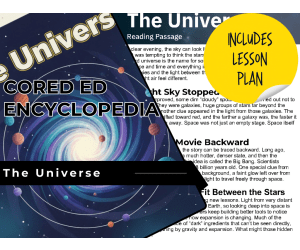
The Universe Reading Comprehension Passage - Cored Ed Encyclopedia
ELA, Language Development, Reading Comprehension, Reading, Science, Earth and Environmental Sciences, Space, Pre-Reading, Vocabulary, Physics, Grade 2, 3, 4, 5, Worksheets & Printables, Worksheets, Teacher Tools, Centers, Activities, Writing Prompts, Assessments, Quizzes and Tests, Quizzes, Lesson Plans
This universe reading comprehension with lesson plan includes: Visualization (on the front cover) Start your lesson by taking a minute to think and share something about the topic. Read the script aloud (slowly), perhaps prepare some music or sound effects. Student close their eyes and let their imaginations wander. Students open their eyes, read the question aloud and give them a few minutes to complete. Ask a few students to share or keep answers until the end to compare with what they learn in the passage. Quick pause—thousands of Cored Education products are included with your TeachSimple membership. Download links and encyclopedia index available here. Pre-Reading Trivia Students will write down one thing they already know about the subject and then read five more facts and discuss. These facts are fun, and the students will enjoy learning about the subject before reading more. Give 1 minute for students to write what they already know (no pressure—best guess is fine). Read the five facts together. After each fact, do ask a student for their opinion, was it surprising? Set a purpose by asking students to highlight/underline one fact they want to learn more about during the reading. Reading Passage The text is a high-interest reading passage with set paragraphs, roughly three to four paragraphs long. It contains a variety of themes about the topic, anywhere from history to technology. The passage is between 250 and 350 words in length. First, ask students to look at the headings and see what they’ll learn about today. What do they know about the topic/heading? First read options: Teacher read-aloud (best for support). Partner reading (paragraph by paragraph). While reading, students underline important details, and vocabulary words they think may come up in the questions section. Mixed Questions The first question page contains four multiple-choice questions, each with a choice of four answers, and three written response questions that require a sentence or two from the student. Students complete the mcqs first independently, then review quickly as a class. For the 3 written responses, try to get students giving the answer with some form of evidence: “I think ___ because the text says ___.” If students get stuck, send them back to check the passage. Vocabulary Questions Practice seven key words from the text in this section across two activities. First section is scrambled words where students will unscramble three words given a clue for each. The second section is a word to meaning matching activity. Before starting, have some students read out words they underlined in the passage. Ask students to say the word and read aloud the sentence(s) around each word. Ask students to do scrambled words and the matching exercise in pairs then go through answers as a class. For the scrambled spelling task, get four pairs to come up to the board and write the words for extra practice with the other student reading out the clue. For the matching task, prompt students to give full sentences: “I matched ___ with ___ because ___.” Creative Writing In this question, the student will be required to write a five to eight sentence paragraph on a question related to the topic. Before starting, ask students write down 3 key ideas they are going to include in their piece. Ask students for ideas to share around the class to help those struggling. Pro writing expectations: 5–8 sentences At least 2 facts or details from the passage At least 2 vocabulary words from the previous page Students read their paragraphs while classmates listen for facts and vocabulary words. Extension Activities This page is optional for fast finishers or to take home. There are several activities, each one requiring a different skill. Do some, do none, do all, completely optional - but you will feel reassured knowing every possibility is planned for. Includes summary writting question. Answer Key There are answers for the multiple-choice questions, written response questions have sample answers, vocabulary answers and if there is a summary question then a sample summary will be provided as well. Lesson Plan Included Customized lesson plan for this lesson is included. Lesson Snapshot Title: The Universe Genre: Nonfiction (informational text) Subject: Science (Earth & Space Science) Primary Topic: Evidence the universe is expanding over time Estimated Guided Reading Level (A–Z): S What This Lesson Teaches Best Defines universe as “all of space and time and everything inside them,” expanding beyond the idea of stars as a “roof” above Earth. Explains how improved telescopes helped people realize some “cloudy” spots were actually faraway galaxies beyond the Milky Way. Uses the idea of galaxy light “shifted toward red” to show galaxies moving away and that space itself is stretching. Introduces the Big Bang as an explanation for expansion from a hotter, denser beginning, including the estimated age of the universe (about 13.8 billion years). Builds scientific curiosity by highlighting unanswered questions about “dark” ingredients that can’t be seen directly but affect the universe through gravity and expansion. Learning Goals Students will explain what the word universe means using details from the passage. Students will describe how better telescopes changed what people understood about “cloudy” spots in the sky. Students will explain what “shifted toward red” light suggests about galaxies and space stretching. Students will summarize the Big Bang idea as the universe expanding from a hotter, denser state. Students will describe why looking deep into space can also mean looking back in time. Students will identify one mystery scientists still study about the universe mentioned in the text. Key Vocabulary From the Text universe — all space, time, and everything inside them. galaxies — huge groups of stars far beyond the Milky Way. stretching — space expanding so distances grow larger. expanding — growing bigger as space spreads out. gravity — a force that affects everything by pulling. FULL CATALOG OF DOWNLOAD LINKS AND ENCYCLOPEDIA INDEX HERE
Author Cored Education
Rating
Tags Vocabulary, Reading Comprehension, Reading Passages, Lesson Plans, Ela Lesson Plans, Reading Comprehension Lesson Plans, Pre-reading, Science Lesson Plans, Earth Science, Space

I WONDER - Is Pluto A Dwarf Planet | Animated Video Lesson
Space, Earth and Environmental Sciences, Science, Grade 6, 7, 8, 9, 10, 11, 12, Lesson Plans, Teacher Tools
Video Introduction An amazing video designed for the students to learn more about space facts. I WONDER - Is Pluto A Dwarf Planet | Animated Video Lesson Do you like reading about space? If yes, what is your favorite topic? What do you know about our solar system? What is the smallest planet in our solar system? What is the biggest planet in our solar system? What is the hottest planet in our solar system? And what is the coldest one? Do you think there are aliens? If yes, what do you think they look like? What do they eat and how they speak to each other? Where do they live? What is a galaxy? And what is a milky way? Have you recently saw a shooting star? If yes, tell us more about it, like when did it happen and where? What is a blackhole? Can a blackhole gets bigger by time? Do you like counting the stars? What do you think a star is made of? I WONDER - Is Pluto A Dwarf Planet | Animated Video Lesson The video is perfect for encouraging the researching skills for the students, while learning more about the fantastic space. I WONDER - Is Pluto A Dwarf Planet | Animated Video Lesson This friendly designed video is suitable for students at school, homeschooling, and as a group activity. Format Available in MP4 format.
Author Educational Voice
Tags Is Pluto A Dwarf Planet, Is Pluto A Dwarf Planet Video, Pluto, Pluto Facts, Pluto Facts For Kids, Pluto Video, Pluto Video For Kids, Dwarf Planet, Dwarf Planet Video, Dwarf Planet Facts

I WONDER - How Does Gravity Affect Astronauts | Animated Video Lesson
Space, Earth and Environmental Sciences, Science, Grade 6, 7, 8, 9, 10, 11, 12, Lesson Plans, Teacher Tools
Video Introduction An amazing video designed for the students to learn more about space facts. I WONDER - How Does Gravity Affect Astronauts | Animated Video Lesson Do you like reading about space? If yes, what is your favorite topic? What do you know about our solar system? What is the smallest planet in our solar system? What is the biggest planet in our solar system? What is the hottest planet in our solar system? And what is the coldest one? Do you think there are aliens? If yes, what do you think they look like? What do they eat and how they speak to each other? Where do they live? What is a galaxy? And what is a milky way? Have you recently saw a shooting star? If yes, tell us more about it, like when did it happen and where? What is a blackhole? Can a blackhole gets bigger by time? Do you like counting the stars? What do you think a star is made of? I WONDER - How Does Gravity Affect Astronauts | Animated Video Lesson The video is perfect for encouraging the researching skills for the students, while learning more about the fantastic space. I WONDER - How Does Gravity Affect Astronauts | Animated Video Lesson This friendly designed video is suitable for students at school, homeschooling, and as a group activity. Format Available in MP4 format.
Author Educational Voice
Tags How Does Gravity Affect Astronauts, How Does Gravity Affect Astronauts Video, Gravity, Gravity Facts, Gravity Facts For Kids, Gravity Video, Astronauts, Astronauts Facts, Astronauts Video