Higher order derivatives
A 12-slide PowerPoint presentation teaching high school calculus students how to find second, third, and higher-order derivatives, including notation and worked examples.
Classroom resources
Browse by lesson focus
Choose the topic or kind of practice you need.
A 12-slide PowerPoint presentation teaching high school calculus students how to find second, third, and higher-order derivatives, including notation and worked examples.
This resource will give you everything you need to complete a full, comprehensive reading lesson plan for The Story of An Hour text by Kate Chopin. Files are offered as PDFs and Word documents.
A chronological slideshow biography of Alaska Governor Mike Dunleavy, covering his career as an educator and school administrator, his Alaska Senate service, and his 2018 election and the subsequent recall effort against him.
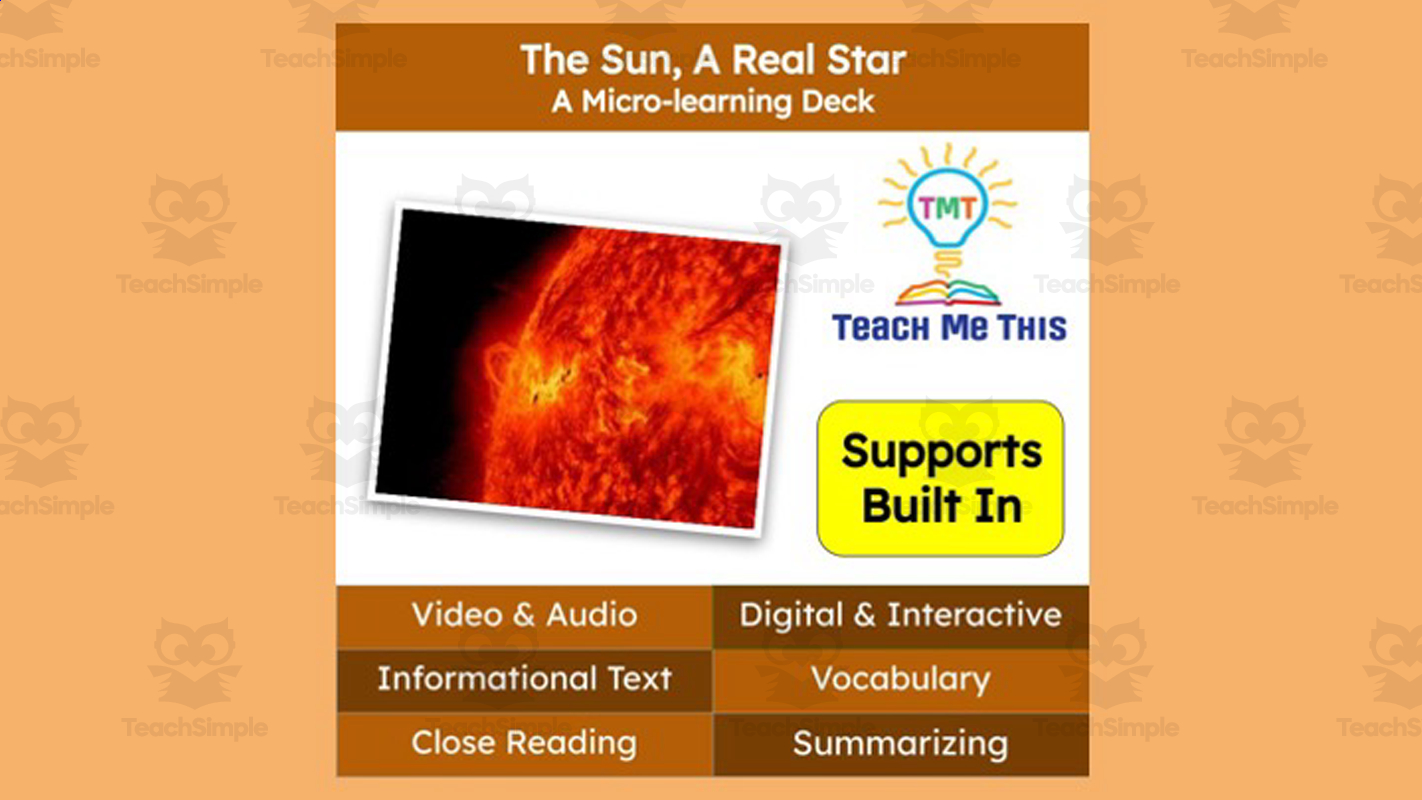
An interactive digital micro-learning deck (PowerPoint) that teaches middle/high school Earth and Space Science content about the Sun as a star: its layers, energy production, and how space weather (solar wind, solar flares, radiation) affects Earth, via an informational close-reading passage paired with vocabulary and comprehension activities.
A distance-learning/homeschool pack for middle school teaching the kinetic theory of matter and the three states of matter (solid, liquid, gas) via an animated PowerPoint, worksheets, and printable activities.
High-school social studies unit covering pre-Civil-War American history (Antebellum period through related mid-1800s topics), delivered via lectures, activities, a virtual museum, a mock trial, a movie critique, and creative writing, with optional online quiz support via ClassFlow. NOTE: this description is built primarily from scan_meta component FILE…
U.A. Fanthorpe's poem "Half-Past Two," about a child kept after school who does not yet understand clock time, is unpacked slide by slide in a GCSE-level English literature lesson built around close reading and analytical writing. The slideshow opens with learning intentions and a glossary of critical terms (narrator, third person, repetition, portmanteau, emotive language, personification, contraction, oxymoron), then supplies biographical context on Fanthorpe before presenting the full poem text twice for annotation. Stanza-by-stanza question sets walk students through content, language, and structure analysis, including the poem's invented compound words like "Gettinguptime" and "timeyouwereofftime," before a PETAL (Point, Evidence, Technique, Analysis, Link) paragraph frame and an extended-response homework task close out the lesson. A model "possible answer" in three bullet points on the poem's tone is included so students can compare their own analysis against a worked example. For another GCSE poem taught with the same PETAL paragraph framework, Vernon Scannell’s ‘Nettles’ offers stanza-by-stanza analysis practice on a different poem.
A high school World History II exam-review presentation covering major topics from the Renaissance through the modern era, for use as a study guide before a unit or final exam.
An editable 14-slide presentation teaching high-school students to distinguish fact from opinion, covering clue words/verbs for each, misinformation, the scientific method/expertise, the historical evolution of how knowledge has been validated, and media-literacy/critical-thinking implications.
A multi-week (2-3 week) middle/high-school unit teaching climate change and global warming, combining a multi-day slideshow lesson, bell-ringer, video-response activities, a research quest, a reading with test, and a solution-proposal project.
A multi-week high-school research-paper workshop covering topic selection, source evaluation, structured research using assigned team roles, and MLA-style academic writing, delivered through daily lesson plans plus supporting worksheets, presentations, and a Google Forms/Sheets workflow.
An interactive digital micro-learning deck (slides) teaching middle-school students about causes and events of the American Revolution (Boston Massacre, Boston Tea Party, Intolerable Acts), with close reading, vocabulary, and summarizing practice.
Teach a morning 'getting ready for school' routine (waking up, dressing, breakfast, brushing teeth, travel to school) for SEN learners via bingo, vocabulary cards, scenario Q&A, sequencing activities, and teaching slides, with parallel UK/US-spelling versions.
A multi-day high-school anatomy/physiology unit teaching anatomical position, body planes (sagittal, midsagittal, frontal, transverse), directional terms (medial, lateral, superior, inferior, proximal, distal, anterior, posterior), body cavities, and organ systems, designed to accompany a separate anatomy textbook.
Teach senior high school biology students the structure and function of proteins and nucleic acids (amino acids, polypeptides, protein structure levels, denaturing, DNA vs RNA).
A two-day middle school Earth science lesson teaching weathering (physical and chemical), erosion, and deposition processes.
Teaches how shadows form (umbra/penumbra) and how lunar and solar eclipses (total, partial, penumbral, annular) occur, as a self-directed distance-learning middle-school physics pack.
A high-school/middle-school U.S. history/government role-play simulation teaching students about labor unions, strikes, and industrialization-era labor conflict through a slide-guided lesson and small-group negotiation activity.
An interactive notebook workbook to guide middle/high school students through the process of completing a National History Day (NHD) 2022 project on the theme "Debate and Diplomacy in History."
Interactive Smart Board (IWB) bingo game reviewing middle/high school physics concepts of light: reflection, refraction, and lenses
A full cardiovascular/circulatory system teaching unit for a high school Anatomy & Physiology or Biology class, combining lecture notes, labs (including a coronary heart disease risk lab and a sheep heart dissection), review activities, and a unit test, designed to be used alongside an anatomy textbook.
Daily short warm-up (bell ringer) activities for high school ELA class time, one per school day in May.
Daily short warm-up (bell ringer) activities for high school ELA class, one per school day in January 2026, focused on higher-order critical/rhetorical thinking prompts.
Deliver a complete, NGSS-aligned Grade 3 science curriculum for a full 36-week school year across 10 units (Forces & Motion, Weather & Climate, Life Cycles, Ecosystems, Traits & Inheritance, Engineering Design, Earth Systems, Habitats, Natural Hazards, and Review & Capstone Projects), built on the 5E instructional model (Engage,…