



3,931 products added recently
Page 17 - 2nd Grade Activities
Boost your second graders' enthusiasm with activities that combine fun and education. These resources cover various subjects and promote critical thinking and collaboration. Use them to enrich your lessons and keep students actively involved in their learning journey.

 Show filters


Imagine You Can Travel Through Space: Write A Story (9-13 years)
ELA, Writing, Creative Writing, Grade 3, 4, 5, 6, 7, 8, Activities
Imagine You Can Travel Through Space: Write A Story (9-13 years) Imagine You Can Travel Through Space: Write A Story (9-13 years) is an innovative teaching resource designed with the needs of educators in mind. This learning material emphasizes the use of creative writing skills for children aged 9-13 years, presenting students with an authentic opportunity to dive into fantasy and science fiction narratives. Emphasizing on cross-curricular learning, it is more than just a creative writing tool suitable for grades 3 through 8. Integrated under language arts curricula, this resource seamlessly integrates subject areas such as Creative Writing and Language Arts. Its prime focus aids learners in developing their ability to write captivating stories or diary entries revolving around imaginary spacescapes. Ideal for whole group instruction or tailored to small group projects, each instructional guideline encourages students to explore their individual ideas while enhancing collaborative efforts with peers—an essential skill set within today’s fast-paced educational setting. Inherent flexibility also makes this material suitable as supplemental homework activity , allowing independent exploration beyond classroom boundaries. Included Unit Structure In total Imagine You Can Travel Through Space: Write A Story comprises five comprehensive pages that work together as a cohesive unit but may also stand alone depending on the desired lesson outcome. This resource includes detailed outlines helping students plan their narratives effectively under proper guidance—ideal balance between independent creativity and structured guidance. This PDF-type activity has been carefully designed to cater to more able pupils as well, incorporating challenging vocabulary words that encourage academic expansion necessary within higher-grade learners’ context—unearthing unexploited potentials effectively while nurturing young authors' developmental pathways bit by bit progressively. In essence, these activities do more than teach; they ignite imaginations through fantasy genre exploration catering specifically towards fostering mid-grade writers' formative years—a testament that every educator's tool kit can benefit from having Imagine You Can Travel Through Space: Write A Story (9-13 years).
Author Guinea Pig Education
Tags Creative Writing, Space Exploration, Fantasy Narratives, Language Arts, Cross-curricular Learning
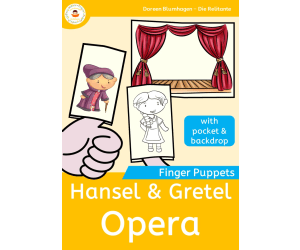
Hansel and Gretel Opera - Engelbert Humperdinck - Finger Puppets Music
Creative Arts, Art, Music, Grade 2, 3, 4, 5, 6, Activities
Hansel and Gretel Opera – Finger Puppets for Music Lessons This resource helps students explore the opera Hansel and Gretel in a fun and creative way. It includes finger puppet templates in two versions: A color version for quick use. A black-and-white version for students to color themselves. There are also backdrop templates and a pocket for storing the puppets. Preparation Print the puppets and backdrops on sturdy paper. Let students color the black-and-white puppets if desired. Cut out the puppets and fold along the lines. Glue the parts together, leaving an opening for fingers. Fold and glue the backdrops so they can stand. Attach the pocket to a notebook for storage. Who Can Use It? Elementary and middle school students. Music, drama, or arts classes. Teachers introducing opera in a hands-on way. Classroom Ideas Act out scenes while listening to the opera. Show emotions in the music using the puppets. Tell the story in their own words. Create short performances in small groups. Discuss the themes of the opera, like family and bravery. This activity helps students learn about opera in an interactive and engaging way. Best regards, Die Relitante – Doreen Blumhagen
Author Die Relitante
Tags Finger Puppets, Music Lessons, Primary School, Opera, Hansel And Gretel, Engelbert Humperdinck, Music
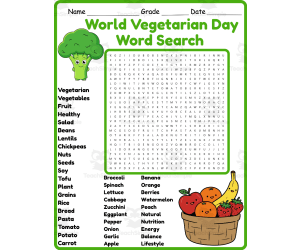
World Vegetarian Day Word Search 2rd 3th 4th 5th Grade worksheet activ
Vocabulary, Language Development, ELA, Spelling, Science, Grade 2, 3, 4, 5, Games, Activities, Word Searches, Worksheets, Worksheets & Printables
Celebrate healthy lifestyles and plant-forward eating with this World Vegetarian Day Word Search! 🥕 Students will engage in food and nutrition vocabulary relating to fruits, vegetables, grains, and beans while also strengthening efforts while spelling, scanning for answers, and practicing word recognition. This engaging, no-prep printable worksheet is a great way to create a fun and active for nutrition knowledge. Purpose: This activity helps students to… Learn and practice new food vocabulary related to vegetarian-friendly foods 🥦 Improve literacy, spelling, and scanning skills ✏️ Enhance awareness about healthy eating and nutrition 🍎 Show respect for varying food choices and lifestyles 🌍 Order of Events / Steps: 1️⃣ Hand out the World Vegetarian Day Word Search worksheet. 2️⃣ Introduce the vocabulary and discuss students' favorite fruits/veggies. 3️⃣ Students circle or highlight the hidden words located within the puzzle. 4️⃣ Close on a whole class discussion regarding healthy food choices. 5️⃣ Grab the answer key to quickly review ✅ Grade or Age: Great for 2nd–5th graders 🌟 Way of Implementation: For independent seatwork, science or health centers, early finishers, partner puzzles, absence plans, morning warm-up activities, etc. 🤝 Resouces: ✅ Yes, included for teacher convenience. Ideas for usage and variations: Timed challenge ⏳ - see who can finish the fastest Partner puzzle 🤝 - solve with a partner Vocabulary extension ✏️ - use the words from the puzzle to write a recipe for a healthy snack Create-your-own 🧩 - challenge your student to create their own food word search Standards: Supports CCSS/ELA vocabulary development and aligned to health education standards for nutrition and wellness 🌿. File Types & Pages: PDF 🖨️ Color + black & white version Ink-friendly option included Answer key : included Teachers - Bring healthy living into your classroom with this World Vegetarian Day Word Search - an engaging way to promote literacy and wellness! 🥕🌎✨
Author Classsim
Rating
Tags World , Vegetarian , Day, Word Search, 2rd 3th 4th 5th Grade , Worksheet, Activity, World Vegetarian Day , World Vegetarian Day Word Search , World Vegetarian Day Word Search 2rd 3th 4th 5th Grade Worksheet Activity

Heroes Of Our Time Audio Book
Science, Earth and Environmental Sciences, Space, Preschool, Kindergarten, Grade 1, 2, 3, Read Alouds, Activities
On January 28, 1886 the space shuttle Challenger exploded just 73 seconds after lift-off. This unexpected disaster took the lives of seven people.
Author Twin Sisters Digital Media
Tags Hero, Dedication, Challenger, Scientists, Research
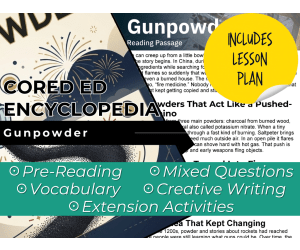
Gunpowder Reading Comprehension Passage - Cored Ed Encyclopedia
ELA, Reading Comprehension, Reading, Science, Technology, Pre-Reading, Language Development, History, Social Studies, Physics, Grade 2, 3, 4, 5, Worksheets & Printables, Worksheets, Teacher Tools, Centers, Activities, Writing Prompts, Assessments, Quizzes and Tests, Quizzes, Lesson Plans
This gunpowder reading comprehension with lesson plan includes: Visualization (on the front cover) Start your lesson by taking a minute to think and share something about the topic. Read the script aloud (slowly), perhaps prepare some music or sound effects. Student close their eyes and let their imaginations wander. Students open their eyes, read the question aloud and give them a few minutes to complete. Ask a few students to share or keep answers until the end to compare with what they learn in the passage. Quick pause—thousands of Cored Education products are included with your TeachSimple membership. Download links and encyclopedia index available here. Pre-Reading Trivia Students will write down one thing they already know about the subject and then read five more facts and discuss. These facts are fun, and the students will enjoy learning about the subject before reading more. Give 1 minute for students to write what they already know (no pressure—best guess is fine). Read the five facts together. After each fact, do ask a student for their opinion, was it surprising? Set a purpose by asking students to highlight/underline one fact they want to learn more about during the reading. Reading Passage The text is a high-interest reading passage with set paragraphs, roughly three to four paragraphs long. It contains a variety of themes about the topic, anywhere from history to technology. The passage is between 250 and 350 words in length. First, ask students to look at the headings and see what they’ll learn about today. What do they know about the topic/heading? First read options: Teacher read-aloud (best for support). Partner reading (paragraph by paragraph). While reading, students underline important details, and vocabulary words they think may come up in the questions section. Mixed Questions The first question page contains four multiple-choice questions, each with a choice of four answers, and three written response questions that require a sentence or two from the student. Students complete the mcqs first independently, then review quickly as a class. For the 3 written responses, try to get students giving the answer with some form of evidence: “I think ___ because the text says ___.” If students get stuck, send them back to check the passage. Vocabulary Questions Practice seven key words from the text in this section across two activities. First section is scrambled words where students will unscramble three words given a clue for each. The second section is a word to meaning matching activity. Before starting, have some students read out words they underlined in the passage. Ask students to say the word and read aloud the sentence(s) around each word. Ask students to do scrambled words and the matching exercise in pairs then go through answers as a class. For the scrambled spelling task, get four pairs to come up to the board and write the words for extra practice with the other student reading out the clue. For the matching task, prompt students to give full sentences: “I matched ___ with ___ because ___.” Creative Writing In this question, the student will be required to write a five to eight sentence paragraph on a question related to the topic. Before starting, ask students write down 3 key ideas they are going to include in their piece. Ask students for ideas to share around the class to help those struggling. Pro writing expectations: 5–8 sentences At least 2 facts or details from the passage At least 2 vocabulary words from the previous page Students read their paragraphs while classmates listen for facts and vocabulary words. Extension Activities This page is optional for fast finishers or to take home. There are several activities, each one requiring a different skill. Do some, do none, do all, completely optional - but you will feel reassured knowing every possibility is planned for. Includes summary writting question and additional facts. Answer Key There are answers for the multiple-choice questions, written response questions have sample answers, vocabulary answers and if there is a summary question then a sample summary will be provided as well. Lesson Plan Included Customized lesson plan for this lesson is included. Lesson Snapshot Title: Gunpowder Genre: Nonfiction (informational text) Subject: Science Primary Topic: How gunpowder was discovered and used over time Estimated Guided Reading Level (A–Z): Q What This Lesson Teaches Best Explains how gunpowder began in China during the Tang dynasty when alchemists mixed ingredients while searching for a life-lasting “elixir.” Identifies the three main powders in gunpowder—charcoal, sulfur, and saltpeter (also called potassium nitrate)—and describes what saltpeter adds to help burning. Describes how gunpowder behaves differently in an open pile versus a tight tube, leading to a strong push of hot gas. Traces how “fire medicine” was used first for celebrations and signals, then developed into fire arrows, bombs, fire lances, and hand cannons by the late 1200s. Shows how ideas travel as gunpowder and stories about rockets reached Europe, and how uses expanded to quarrying rock and digging tunnels, not only fighting. Learning Goals Students will describe how the text says gunpowder was discovered during the Tang dynasty in China. Students will identify the three main powders in gunpowder and explain what saltpeter adds to the burning process. Students will compare what happens when gunpowder burns in an open pile versus in a tight tube. Students will explain how “fire medicine” changed from signals and celebrations to fire arrows and later weapons over time. Students will describe two non-celebration uses of the powder mentioned in the text (quarrying rock and digging tunnels). Students will explain what the author means by “Ideas travel,” using the example of gunpowder reaching Europe. Key Vocabulary From the Text alchemists — people who mixed ingredients while searching for an “elixir.” elixir — a life-lasting drink they searched for. charcoal — powder from burned wood. sulfur — one of the three main powders. saltpeter — a mineral also called potassium nitrate. Discussion Prompts Pre-reading question: What do you think might happen if a powder burns very fast? Comprehension questions: How did the mixture get the name huoyao, or “fire medicine”? Comprehension questions: What role does saltpeter play when a tiny grain is lit? Comprehension questions: How did the uses of “fire medicine” change from celebrations to later tools or weapons? FULL CATALOG OF DOWNLOAD LINKS AND ENCYCLOPEDIA INDEX HERE
Author Cored Education
Rating
Tags Vocabulary, Reading Comprehension, Reading Passages, Lesson Plans, Ela Lesson Plans, Reading Comprehension Lesson Plans, Pre-reading, Science Lesson Plans, Social Studies Lesson Plans, History

Multiplication Picture Word Problems for Primary Students Gr 1 2 3
Math, Early Math, Multiplication and Division, Division, Grade 1, 2, 3, Worksheets & Printables, Word Problems, Activities
Multiplication Picture Problems for Primary Students (Grade 1-3) Here's a ready-to-print 8 page booklet for your primary students. It introduces the concept of multiplication with simple word problems that can all be solved by drawing pictures! It is made to be easily differentiated: some students may simply draw the pictures and count the answer, while others may try repeated addition, or even start to write multiplication equations. This product helps young students instinctively grasp the concepts integral to the more complex math skills of multiplication and repeated addition, but at at a developmentally appropriate level. It helps student practice the skill of visualizing mathematical situations. Sample Questions: One alien has 4 eyes. How many eyes do 4 aliens have? One cookie has 5 sprinkles. How many sprinkles do 4 cookies have? Each problem has 5 levels of differentiation: Drawing a picture Counting to complete a final answer: "4 aliens have ____ eyes" Completing a groups of sentence: " ____ groups of _____ equals ______ Writing a repeated addition equation: 4 + 4 + 4 + 4 = 16 Writing a multiplication equation: 4 x 4 = 16 You can assign all five levels or differentiate based on your individual students' needs (for example, the fox math group might do parts A through E and the butterfly math group might do parts A through C). Use this resource during whole group instruction or implement it during small group tutorials or even independent work from home. What's Included: A total of 9 pages. in PDF format: Teacher Instructions Student Booklet Title Page 7 Pages of Word Problems Grades to Use With: Because this lesson is designed to be accessible to even the youngest students, it could be used in grades one through grade three. It could also be used in the middle grades in special education settings or for homeschooling.
Author Grace Under Pressure
Rating
Tags Multiplication, Word Problems, Primary Students, Visualizing Math Problems, Kindergarten Math, Grade 1 Math, Grade 2 Math, Early Multiplication, Grade 1 Word Problems
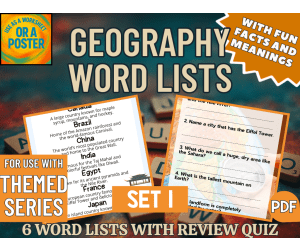
Geography Word List Posters - Set 1 (PDF)
ELA, Language Development, Vocabulary, Spelling, ESL, Resources for Teachers, Geography, Social Studies, Grade 2, 3, 4, 5, Worksheets & Printables, Worksheets, Teacher Tools, Centers, Activities, Posters, Classroom Decor
Word List Poster Series This word list poster series is designed for students in grades 2–5. Each printable focuses on a clear, kid-friendly theme and features 8 target vocabulary words with short, student-friendly meanings or fun facts. The clean layout works as both an anchor chart and a write-in sheet, giving students a quick, visual reference they can revisit during centers and independent work. These posters are student-friendly, classroom-ready, and perfect for warmups, vocabulary walls, sub plans, or take-home reference. Display a single poster to support the day’s lesson, or group several to build a themed wall across your unit. Note: Each poster is a companion piece to its matching themed product in the series—pair it with the corresponding maze, wordsearch, or activity pack for a consistent set of 8 focus words. Geography Set 1 Word List 1. Countries of the World Canada, Brazil, China, India, Egypt, France, Japan, Mexico 2. Famous Cities New York, Paris, London, Tokyo, Sydney, Cairo, Rome, Rio 3. Famous Landmarks Eiffel Tower, Great Wall, Statue of Liberty, Colosseum, Taj Mahal, Mount Everest, Amazon River, Grand Canyon 4. Continents and Oceans Asia, Africa, Europe, Australia, Antarctica, Pacific, Atlantic, Indian 5. Natural Wonders Niagara Falls, Grand Canyon, Mount Everest, Amazon Rainforest, Sahara Desert, Great Barrier Reef, Victoria Falls, Northern Lights 6. Landforms and Geography Terms Mountain, River, Desert, Island, Peninsula, Volcano, Valley, Glacier PDF Version Other versions will appear here when available. Follow the store for the lastest on new products. How to Use These Word List Posters Perfect for: Morning work or early-finisher bins Vocabulary centers or anchor walls Holiday/seasonal review lessons Independent stations, sub plans, or take-home reference More Geography Themed Products Geography Crosswords (Set 1) PDF Geography Crosswords (Set 2) PDF Geography Crosswords (Set 3) PDF Geography Word Searches (Set 1) PDF Geography Word Searches (Set 2) PDF Geography Word Searches (Set 3) PDF Geography Mazes (Set 1) PDF Geography Mazes (Set 2) PDF Geography Mazes (Set 3) PDF FULL CATALOG OF DOWNLOAD LINKS HERE Themed Word List Posters Links Addition PDF Animals PDF Around the Home PDF Birthday PDF Candy PDF Christmas PDF Cinco de Mayo PDF Clothes PDF Colors PDF Days and Months PDF Division PDF Earth Day PDF Easter PDF Easy Word List Posters PDF Fall PDF Father's Day PDF Food PDF Geography (Set 1) PDF Geography (Set 2) PDF Geography (Set 3) PDF Graduation PDF Health PDF History (Set 1) PDF History (Set 2) PDF History (Set 3) PDF Human Body PDF Kindness PDF Life Skills PDF Mother's Day PDF Multiplication PDF Science (Set 1) PDF Science (Set 2) PDF Science (Set 3) PDF Shapes PDF Social Skills PDF Spring PDF Sports PDF St. Patrick's Day PDF Subtraction PDF Summer PDF Thanksgiving PDF Transport PDF Valentine's Day PDF Winter PDF Word List Posters in Depth Structure Each poster is built around a focused sub-theme and presents 8 target words with short, student-friendly meanings or fun facts. The clean A4 portrait layout works as an anchor chart on your board or as a student reference at desks. These posters are designed as companion pieces to the matching themed products (mazes, wordsearches, activity packs), so the same vocabulary stays visible across your unit. Each poster set includes: A themed word list poster with 8 words + brief meanings/facts A clean, high-contrast layout for easy printing and display Space that can double as write-in/draw-to-show-meaning during centers Themes Included Seasons & Holidays (e.g., Halloween, Easter, Valentine’s Day) Everyday Topics (e.g., Animals, Weather, School) Math & Science Connections (e.g., Number Words, Simple Machines) Special Units (e.g., Health, Earth Day, Sports, Kindness) Each topic reflects real-life experiences and interests while strengthening vocabulary recognition and content understanding in a clear, visual way. Easy extensions (optional) Sketch it: students draw a quick icon for each word Sort it: group words by category (e.g., actions, objects) Star it: highlight “I already know” vs. “I’m learning” words Match it: point to examples in a reading, video, or picture set Say it: brief oral definition or example sentence during share-out Differentiation tips Pre-teach 2–3 anchor words; add the rest later in the week Offer picture cues or gestures for emerging readers/ELLs Let students choose 4 of 8 to focus on first, then build up Color-code by part of speech or concept family for quick scanning For similar downloads and other frees, do check out Cored Group on TeachSimple.
Author Cored Education
Rating
Tags Vocabulary, Spelling, Geography, Countries Of The World, Famous Cities, Famous Landmarks, Natural Wonders, Continents And Oceans, Word Lists, Geography Word Lists

My Green World Word Find Activities
ELA, Reading, Preschool, Grade 1, 2, 3, Activities
My Green World Word Find Activities The My Green World Word Find Activities includes a vibrant selection of 18 activity pages. Promising an engaging and informative approach to central themes based on children's daily life, this resource focuses predominantly on language arts. Young minds are stimulated with challenging word search puzzles combined with fascinating facts linked directly to each puzzle’s topic. Appropriate Grade Levels Catering primarily to students from Kindergarten through Grade 3, these captivating activities present topics such as school environments, living spaces, dietary foods, the human body, and more in an intriguing manner. School Environments Living Spaces Dietary Foods The Human Body ...etc In each exercise, child-friendly facts about the subject interweave with puzzlers that not only spike curiosity but deepen comprehension about the world they reside in. The Advantage of Reusability A unique aspect of The My Green World Word Find Activities is reusability. Educators may revisit these exercises by printing these pages once again for continued use; providing ample opportunities for practice and revision. This flexibility enhances teaching methodologies while offering learners multiple chances for reinforcement. Versatile Integration into Learning Scenarios This resource adapts effortlessly into various learning scenarios - home-based individual study or classroom group sessions. It can be incorporated into small-group learning centers where students collectively enhance their word-finding skills or distributed as intriguing yet educational leisure tasks during breaks. These alluring activities come packaged as a handy digital PDF file format ready to be integrated immediately into any lesson plans. Note: With its well-sequenced content structure that aids easy classroom mediation, this potent teaching resource stands as an invaluable aid to facilitate reading skills while fostering awareness and understanding about real-world elements amongst fledgling learners.
Author Twin Sisters Digital Media
Tags Language Arts, Word Search, Educational Activities, Elementary Education, Environmental Awareness

Addition to 10 Worksheets - Mental Math
Math, Addition and Subtraction, Addition, Early Math, Basic Operations, Numbers, Grade 1, 2, 3, 4, Teacher Tools, Assessments, Lesson Plans, Activities, Centers, Worksheets & Printables, Quizzes and Tests, Tests, Workbooks
Turn your classroom into a mental math gym with these Addition to 10 Math Worksheets! Packed with 30 no-fuss, fun-to-solve worksheets, this resource is designed to help your students flex their brain muscles while mastering addition up to 10. Whether they’re mathletes-in-training or just warming up, these sheets make mental math less intimidating and more engaging. Ways to Use Daily Warm-Ups: Kick off your math lesson with these quick, brain-boosting exercises. Homework Hero: Send these home to keep the practice going (and parents cheering). Fast Finisher Fun: Got early finishers? These worksheets will keep them happily occupied. Math Centers: Add to your rotation for an independent or small-group activity. Review and Assess: Use as a quick way to gauge progress or prep for a quiz. Advantages Builds Fluency: Helps students add quickly and confidently without counting fingers! Engaging Layouts: Designed to keep young learners focused and motivated. Time-Saving: Ready-to-print and stress-free for teachers. Scalable Difficulty: Great for beginners or as reinforcement for more experienced learners. These worksheets bring the “add it up” fun to math class. Perfect for building foundational skills while keeping students smiling—because math really can be that awesome!
Author Ponder Palette Plazza
Tags Addition, Addition To 10, Addition Worksheets, Mental Math, Math Test, Addition Test, Math Exam, Numbers, Mental Math Worksheets

Gondolas Reading Comprehension Passage - Cored Ed Encyclopedia
ELA, Reading Comprehension, Reading, Science, Technology, Pre-Reading, Language Development, History, Social Studies, Geography, Grade 2, 3, 4, 5, Worksheets & Printables, Worksheets, Teacher Tools, Centers, Activities, Writing Prompts, Assessments, Quizzes and Tests, Quizzes, Lesson Plans
This gondolas reading comprehension with lesson plan includes: Visualization (on the front cover) Start your lesson by taking a minute to think and share something about the topic. Read the script aloud (slowly), perhaps prepare some music or sound effects. Student close their eyes and let their imaginations wander. Students open their eyes, read the question aloud and give them a few minutes to complete. Ask a few students to share or keep answers until the end to compare with what they learn in the passage. Quick pause—thousands of Cored Education products are included with your TeachSimple membership. Download links and encyclopedia index available here. Pre-Reading Trivia Students will write down one thing they already know about the subject and then read five more facts and discuss. These facts are fun, and the students will enjoy learning about the subject before reading more. Give 1 minute for students to write what they already know (no pressure—best guess is fine). Read the five facts together. After each fact, do ask a student for their opinion, was it surprising? Set a purpose by asking students to highlight/underline one fact they want to learn more about during the reading. Reading Passage The text is a high-interest reading passage with set paragraphs, roughly three to four paragraphs long. It contains a variety of themes about the topic, anywhere from history to technology. The passage is between 250 and 350 words in length. First, ask students to look at the headings and see what they’ll learn about today. What do they know about the topic/heading? First read options: Teacher read-aloud (best for support). Partner reading (paragraph by paragraph). While reading, students underline important details, and vocabulary words they think may come up in the questions section. Mixed Questions The first question page contains four multiple-choice questions, each with a choice of four answers, and three written response questions that require a sentence or two from the student. Students complete the mcqs first independently, then review quickly as a class. For the 3 written responses, try to get students giving the answer with some form of evidence: “I think ___ because the text says ___.” If students get stuck, send them back to check the passage. Vocabulary Questions Practice seven key words from the text in this section across two activities. First section is scrambled words where students will unscramble three words given a clue for each. The second section is a word to meaning matching activity. Before starting, have some students read out words they underlined in the passage. Ask students to say the word and read aloud the sentence(s) around each word. Ask students to do scrambled words and the matching exercise in pairs then go through answers as a class. For the scrambled spelling task, get four pairs to come up to the board and write the words for extra practice with the other student reading out the clue. For the matching task, prompt students to give full sentences: “I matched ___ with ___ because ___.” Creative Writing In this question, the student will be required to write a five to eight sentence paragraph on a question related to the topic. Before starting, ask students write down 3 key ideas they are going to include in their piece. Ask students for ideas to share around the class to help those struggling. Pro writing expectations: 5–8 sentences At least 2 facts or details from the passage At least 2 vocabulary words from the previous page Students read their paragraphs while classmates listen for facts and vocabulary words. Extension Activities This page is optional for fast finishers or to take home. There are several activities, each one requiring a different skill. Do some, do none, do all, completely optional - but you will feel reassured knowing every possibility is planned for. Includes summary writting question and additional facts. Answer Key There are answers for the multiple-choice questions, written response questions have sample answers, vocabulary answers and if there is a summary question then a sample summary will be provided as well. Lesson Plan Included Customized lesson plan for this lesson is included. Lesson Snapshot Title: Gondolas Genre: Nonfiction (informational text) Subject: Social Studies (places/culture) Primary Topic: Gondolas in Venice: design, history, and use Estimated Guided Reading Level (A–Z): Q What This Lesson Teaches Best How Venice’s canals and bridges shape daily transportation, making boats important for visiting, carrying food, and crossing town. How a gondolier can steer with one oar using a carved wooden holder called a forcola and a smooth sculling motion. How gondola design supports steering, including being slightly asymmetrical to help one oar work better. How gondolas changed over time (older styles; “banana-shaped” modern gondola in the 1800s; laws affecting appearance). How gondolas are still used today (rides for visitors, traghetti ferries across the Grand Canal, and racing in regattas ). Learning Goals Students will describe why boats are important in Venice using details from the passage. Students will explain how a gondolier steers a gondola with one oar and a forcola. Students will identify one design feature that helps the gondola steer straighter (slight asymmetry). Students will describe how gondolas changed in shape and appearance over time, based on the text. Students will explain what traghetti are and what they do in Venice. Students will describe one way gondola traditions continue today (rides or regattas). Key Vocabulary From the Text forcola — carved wooden holder that supports and guides the oar. sculling — smooth rowing motion used to move and steer. asymmetrical — not the same on both sides. traghetti — small ferries that carry people across the Grand Canal. regattas — boat races where gondoliers race with skill and pride. FULL CATALOG OF DOWNLOAD LINKS AND ENCYCLOPEDIA INDEX HERE
Author Cored Education
Rating
Tags Vocabulary, Reading Comprehension, Reading Passages, Lesson Plans, Ela Lesson Plans, Reading Comprehension Lesson Plans, Pre-reading, Science Lesson Plans, Social Studies Lesson Plans, History

Let's Investigate! Hands-On Science - Grades 3-4
, Grade 3, 4, Activities, Experiments, Teacher Tools, Lesson Plans
Let's Investigate! Hands-On Science - Grades 3-4 An engaging teaching resource designed to help students delve into the fascinating world of science, "Let's Investigate! Hands-On Science - Grades 3-4" comes as a handy PDF with 64 ready-to-print pages, fulfilling your needs for accessible and easily implemented lesson plans. This compelling resource aims at igniting curiosity in third and fourth-grade students as they explore key concepts across: Physical science Earth science Life science. The activities provided are not merely informative; they also ensure that learning is fun and exciting for every student involved. Meticulously Prepared Activities - Learning Made Fun Each activity within the book has been meticulously prepared to stretch young minds beyond standard classroom discussions. With clear, step-by-step instructions paired with guided questions, students can comfortably engage in independent learning while their critical thinking skills are honed. A Treasure Trove of Knowledge To enrich every nugget of scientific knowledge gained from these activities, our book also contains intriguing facts paired with smart extension activities– all aimed at keeping curiosity at its peak among learners. Aids Educators Too The Activity Guide situated at the back of this product furnishes necessary background details on each activity along with essential teaching tips which are crucial instruments in maximizing a student’s understanding. This softcopy resource proves beneficial both to learners but also educators because: The flexibility it provides makes it dynamic for group-based learning or even individual homework assignments catering varied student dynamics. Works effortlessly with existing curriculum structures, augmenting the overall class sessions. Conclusion An invaluable tool teaming with knowledge; Let's Investigate! Hands-On Science - Grades 3-4 emerges as a potent resource towards understanding nature via observational experiments and interactive assignments. It aids in developing observation skills along with promoting critical thinking abilities among Grade 3 & Grade 4 pupils.
Author Classroom Complete Press
Tags Hands-on Science, Let's Investigate, Science Experiments, Watch An Eruption, Catch A Rainbow

Journey Through South Korea: Guided Reading Level R with Lesson Plan
ELA, Resources for Teachers, Reading Comprehension, Reading, Science, Geography, Social Studies, History, Earth and Environmental Sciences, Technology, Grade 3, 4, 5, Worksheets & Printables, Worksheets, Teacher Tools, Centers, Activities, Literacy Readers, Quizzes, Quizzes and Tests, Assessments, Lesson Plans
This Journey Through South Korea (level r) guided reading book with lesson plan includes: Guided Reading Color Label (front cover x1) This is a quick way to match the book’s demands to what students can generally handle.. The overall goal is to use the level/color to pick books for several smaller groups. To qualify for a certain level, a student is expected to read a book from that level with about 90–94% accuracy. If a student is consistently accurate and understands, move up a level. If the student is struggling at that level, drop down and add more support. Each student will improve at completely different rates, but it is generally one of the best ways to check progress across the class. DOWNLOAD THE CATALOG TO VIEW ALL GUIDED READING BOOKS AVAILABLE (SORTED LEVELS A-Z) Pre-Reading Question (x1) Teacher asks the prompt aloud, can be while showing the cover or first page. Students share what they already know, or make educated guesses from the cover. Prompt them to use the target vocabulary. Write some of their responses on the board to look back at during the reading. Vocabulary Words (x5) Introduce the five words, best doing it one at a time. Start by saying it, while students repeat and then see if anyone knows what it means before reading further. Read through the meaning and try to briefly connect each word to a picture or gesture so it’s meaningful. Ask students to flip through the book pages and point to where they see each of the vocabulary words. While reading the book pause upon coming across one of the vocab words or read the sentence twice to make sure students understand the word has appeared. Optional: Ask students to raise hands whenever they see/hear one of the new words. Guided Reading Pages (x10) Check the book snapshot (below) for: primary topic - do you need to prep extra reading or intro materials on this? what is taught best - decide on 1-2 bullets to focus on, use the prompt or words provided here for best results. learning goals - what you are checking for students to be able to do after the session, elicit answers using prompts or words provided. key vocabulary (see section above). questions overview - so you know what is coming up and if you need to prep extra materials to assist understanding. Run the lesson You may have already looked at a few of the pages together, but you can show them some of the pictures again first to set meaning. Depending on how much time you have and how familiar your students are with guided reading class, you may want to read the book aloud first with the group first. Students whisper or partner read, while you listen in. If time, do it as a group, one student reading a page each. Use the guided page’s prompts to coach: “Check the picture / does it make sense?” “Point under the words / try the first sound” “Reread the sentence smoothly”. Try to focus more on one student per session (rotating every time), so you can work out if they are ready to move up or need to move down a level. Comprehension Questions (back cover x3) This is your way to check that students didn’t just say the words, but actually understood the text. First, let students answer by pointing to the page/picture and saying a short sentence. After any answer, follow with: “Show me where you found that in the text.” In bigger groups, have partners answer first (10–20 seconds), then call on 2–3 students to share. Differentiation tips: Emerging speakers/struggling readers: oral + pointing On-level: oral in a full sentence Higher: one written sentence or draw + label Book Snapshot Title: A Journey Through South Korea Genre: Nonfiction Subject: Social Studies (Geography/Culture) Primary Topic: South Korea’s geography, traditions, and modern innovation Estimated Guided Reading Level (A–Z): R What This Book Teaches Best How geography shapes a country , describing South Korea as a peninsula with seas on three sides and mountains across much of the land. City life and infrastructure , using Seoul to show population size, public transportation, and the mix of historic areas with modern skyscrapers. Cultural traditions and identity , including palaces and Joseon Dynasty heritage, traditional clothing (Hanbok), and national martial arts (Taekwondo). Food culture and processes , highlighting fermentation through kimchi and naming other dishes and ingredients. Modern technology and global influence , explaining South Korea’s role in electronics (including semiconductors) and daily-life innovation. Learning Goals Students will explain how South Korea’s location as a peninsula and its mountains are described in the text. Students will describe Seoul’s role in the nation and cite details about its transportation and city features. Students will identify examples of South Korea’s history and heritage from the text, including details about palaces and architecture. Students will describe how fermentation is connected to Korean food by using the text’s description of kimchi and storage. Students will explain how the text shows South Korea as a leader in technology and innovation. Students will describe one natural environment featured in the text (Jeju Island) using key details provided. Key Vocabulary From the Text peninsula — land with water on most sides, still connected. metropolis — a very large city with many people. fermentation — a process that changes food over time. semiconductors — tiny electronic parts that help devices work. aesthetic — the look and style that feels pleasing. Discussion Prompts Pre-reading question: How can a country honor its past while also building new technology for the future? Comprehension questions: What does the text say about South Korea being a peninsula and the seas around it? Comprehension questions: What details does the text give about Gyeongbokgung Palace and its architecture? Comprehension questions: How does the text describe the Haenyeo and what they do? Printing Tips 1. Best Printing Method (Recommended) “Booklet” Printing (Best if Available) If your printer or PDF viewer supports Booklet Printing , use this. Settings to use: Print mode: Booklet Paper size: Letter or A4 (either works) Orientation: Landscape Print on both sides: Yes Flip on: Short edge Scaling: Fit to printable area Booklet subset: First test: Front sides only Then: Back sides only This will automatically: Pair pages correctly Put the cover on the outside Align everything for folding After printing, fold in half and staple along the spine . 2. If “Booklet” Printing Is NOT Available You can still print this correctly with manual duplex printing . Step-by-step: Open the PDF. Choose Print . Set: Orientation: Landscape Pages per sheet: 1 Print on both sides: Yes Flip on: Short edge Print all pages . Because each PDF page already contains two facing book pages, the result will still fold cleanly into a book. Thousands of Cored Education products are included with your TeachSimple membership. Download links and encyclopedia index available here.
Author Cored Education
Rating
Tags Reading Comprehension, Reading Passages, Reading, Guided Reading, Guided Reading Lesson Plan, Guided Reading Activity, Pre-reading, Social Studies, Geography, History

Homophones Practice Questions - Vocabulary Grade 3-4 (PPT)
ELA, Language Development, ESL, Common Core, Resources for Teachers, Vocabulary, Grade 3, 4, Quizzes and Tests, Teacher Tools, Tests, Assessments, Presentations, Activities
Homophones Vocabulary Practice MCQS ELA MCQS Overview: In this series of lessons, students will embark on an engaging journey to explore the grammar skills that make our language vibrant and expressive. These lessons are crafted to help students identify, comprehend, and effectively apply language arts skills in both writing and speech. Accompanied by free supplementary materials available for all topics, each lesson builds on the previous one, offering a balanced mix of direct instruction, interactive group activities, and independent practice. Through fun and creative tasks, students will learn to recognize grammar within sentences, understand their function, and use them to enrich their own writing and speech. Homophones Overview: Homophones include: sent, scent, cent for, four, fore wear, where, were raise, rays, raze vane, vein, vain they're, their, there two, too, to, than, then, van PPT Version This is the PPT editable and interactive version. There is a fillable answer sheet at the end. This download is available in GOOGLE Docs, GOOGLE Forms, GOOGLE Slides. PDF, PPT, WORD, check the links below for more details. FULL CATALOG OF DOWNLOAD LINKS HERE Grade 3/4 Links: Adjectives Google Docs Google Forms Google Slides PDF PPT Word Free Supplementary Materials Pack Adverbs Google Docs Google Forms Google Slides PDF PPT Word Free Supplementary Materials Pack Conjunctions Google Docs Google Forms Google Slides PDF PPT Word Free Supplementary Materials Pack Nouns Google Docs Google Forms Google Slides PDF PPT Word Free Supplementary Materials Pack Pronouns Google Docs Google Forms Google Slides PDF PPT Word Free Supplementary Materials Pack Verbs Google Docs Google Forms Google Slides PDF PPT Word Free Supplementary Materials Pack Sentence Structure Google Docs Google Forms Google Slides PDF PPT Word Free Supplementary Materials Pack Present Tense Google Docs Google Forms Google Slides PDF PPT Word Free Supplementary Materials Pack Past Tense Google Docs Google Forms Google Slides PDF PPT Word Free Supplementary Materials Pack Future Tense Google Docs Google Forms Google Slides PDF PPT Word Free Supplementary Materials Pack Context Clues Google Docs Google Forms Google Slides PDF PPT Word Free Supplementary Materials Pack Defining Words Google Docs Google Forms Google Slides PDF PPT Word Free Supplementary Materials Pack Fill the Blanks Google Docs Google Forms Google Slides PDF PPT Word Free Supplementary Materials Pack Homophones Google Docs Google Forms Google Slides PDF PPT Word Free Supplementary Materials Pack Synonyms Google Docs Google Forms Google Slides PDF PPT Word Free Supplementary Materials Pack ELA Review Questions Overview Questions have three answer choices. There are a handful of pictures on each test for aesthetic purposes, as well as a review sheet covering most of the topics covered in the product. Introduction or Example Sheet Each topic will include an introduction or example sheet to go through first with your students. Full Answer Keys Full answer keys and sample responses are provided so no matter how busy you are, you know you're covered! In the Supplementary Pack Interactive Ice Breakers: Fun, hands-on activities that get students thinking about adjectives right from the start. Guided Practice: Teacher-led exercises that reinforce the day’s lesson, ensuring students can confidently identify and use adjectives. Group and Partner Tasks: Collaborative activities that allow students to work together to solve problems, categorize adjectives, and create descriptive sentences. Independent Worksheets: Structured worksheets that provide individual practice and help solidify understanding of key concepts. Exit Tasks: Quick, reflective activities at the end of each lesson that assess understanding and encourage students to apply what they’ve learned. For similar downloads and other frees, do check out Cored Group on TeachSimple.
Author Cored Education
Tags Elementary, Answers, Ccss, Common Core, Tests, Test Prep, Assessment, Grade 3, Grade 4, Vocabulary
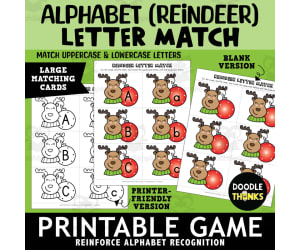
Alphabet Reindeer Letter Match Uppercase and Lowercase Matching Game
Creative Arts, Art, Fine Arts, Grade 1, 2, 3, 4, 5, Activities, Games, Centers
Alphabet Reindeer Letter Match Uppercase and Lowercase Winter Matching Game Letter Recognition This Reindeer-Themed ABC Matching Game is an engaging and hands-on way for young students to practice uppercase and lowercase letter recognition. Use it as a matching game, center activity, or early finisher task! Included are blank cards for differentiated learning or for students to create their very own cards, while practicing handwriting. Use the black and white version as a coloring activity as well. This letter match game is perfect for letter of the week activities, alphabet practice and review, literacy centers, letter recognition practice, and animal-themed activities. Just print, cut, and play! As a suggestion, print on cardstock (thicker paper) and laminate for durability. Great for individual, small group, or center use. Benefits of playing letter matching games: Boosts letter recognition Enhances phonemic awareness Improves focus and attention Builds fine motor skills Strengthens memory Develops problem-solving skills Encourages independent learning Promotes social skills Supports early literacy Makes learning fun. Included in this download: 9 Pages of Large Matching Cards (Uppercase & Lowercase Letters) 3 Pages of Blank Large Matching Cards (Uppercase & Lowercase Letters) 5 Pages of Small Matching Cards 3 Pages of Blank Small Matching Cards Printer-Friendly Black/White Versions Thank you for supporting Doodle Thinks and have fun learning!
Author Doodle Thinks
Rating
Tags Alphabet, Letter Match, Matching Games, Early Literacy, Letter Recognition, Learning Centers, Letter Of The Week, Independent Learning, Fine Motor Skills, Reindeer

Decimal Campout Activity
Math, Decimals, Fractions, Grade 3, 4, 5, Activities
If you want to give your math students extra practice with decimals, I have just the resource for you! What You Get: This is aDecimal Campout Activitythat was designed for upper elementary students who have learned or are reviewing this skill. This resource is a 6-page printable . There are 12 decimal cards and 12 fraction cards - each set printed 6 per page. There is a 1-page worksheet and an answer key included. How To Implement This Resource: You will print all the decimal and fraction cards. You can print them on card stock or heavy duty paper and laminate them for durability, so you can use this activity over and over again! Print enough copies of the worksheet for all students to complete or print just enough for each small group if they are working together. Students will use decimal notation for fractions with denominators 10 or 100. They will match the fraction cards to the decimal cards. Then, complete the practice worksheet to check for understanding. I hope you enjoy! Here are more of my resources for you to enjoy: Total Solar Eclipse Worksheet Recognizing Fractions Worksheet Long U Matching Puzzle 1.OA.5 Common Core Math Lesson Point of View Activity Rounding to the Nearest Hundred Thousandth Worksheet You can find more resources at my storefront here: Have Fun Teaching
Author Have Fun Teaching
Tags Math Task Cards, Math Activity, Math Cards, Decimals Review, Math Review, Decimals Task Cards, Decimals Campout, Notations, Fractions
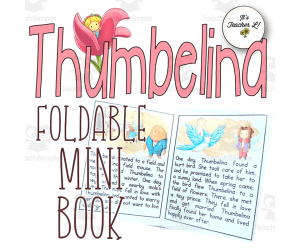
Thumbelina Fairytale Foldable Mini Book Grade 1 2 3 ELA READING
ELA, Reading, Reading Comprehension, Writing, Grade 1, 2, 3, Activities
Encourage the love for reading through the classic story of Thumbelina now made even more fun and meaningful with this Thumbelina Foldable Mini Book Set! Made for Grade 1, Grade 2, Grade 3 students, homeschoolers, and EFL / ESL learners, this resource is packed with different sets of activities that promote reading comprehension skills, sequencing exercises, re-telling activities, and even support fine motor skills through handwriting practice and creative interpretation of the story and so much more! What’s Included: 1. Colored Mini-Book for story telling time and reading comprehension exercises 2. Black and White Mini-Book with Story Tracing Activities 3. Picture-Fill Mini-Book for Sequencing Test or Exercise 4. Black and White Mini-Book for Story Re-Tell and Writing Exercise 5. Blank Mini-Book Pages for Story Re-Tell, Writing, and Drawing Exercises This Thumbelina Foldable Mini Book Set is perfect for supplemental ELA activities, reading classes, teacher-emergencies, sub-plans, assessment tool and a lot more!
Author It's Teacher L
Tags Thumbelina, Reading Comprehension , Mini Book, Foldable , Thumbelina Reading
Practical Science: Working Scientifically - Activities for 6-8 year olds
Science, Basic Science, Grade 1, 2, 3, Activities
The Practical Science: Working Scientifically Activities resource is a 24-page download. It is filled with very explicit lessons for 6-8 year olds. There are a total of 8 lessons. Each lesson begins with teacher notes for the teacher to gather necessary materials and consider lesson ideas and integration ideas.
Author Ready-Ed Publications
Tags Making Colors, Investigating Light, Floating Activities, Water Activity, Science Experiments
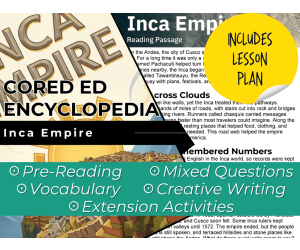
Inca Empire Reading Comprehension Passage - Cored Ed Encyclopedia
ELA, Reading Comprehension, Reading, History, Social Studies, Science, Geography, Technology, Pre-Reading, Language Development, Grade 2, 3, 4, 5, Worksheets & Printables, Worksheets, Teacher Tools, Centers, Activities, Writing Prompts, Assessments, Quizzes and Tests, Quizzes, Lesson Plans
This Inca Empire reading comprehension with lesson plan includes: Visualization (on the front cover) Start your lesson by taking a minute to think and share something about the topic. Read the script aloud (slowly), perhaps prepare some music or sound effects. Student close their eyes and let their imaginations wander. Students open their eyes, read the question aloud and give them a few minutes to complete. Ask a few students to share or keep answers until the end to compare with what they learn in the passage. Quick pause—thousands of Cored Education products are included with your TeachSimple membership. Download links and encyclopedia index available here. Pre-Reading Trivia Students will write down one thing they already know about the subject and then read five more facts and discuss. These facts are fun, and the students will enjoy learning about the subject before reading more. Give 1 minute for students to write what they already know (no pressure—best guess is fine). Read the five facts together. After each fact, do ask a student for their opinion, was it surprising? Set a purpose by asking students to highlight/underline one fact they want to learn more about during the reading. Reading Passage The text is a high-interest reading passage with set paragraphs, roughly three to four paragraphs long. It contains a variety of themes about the topic, anywhere from history to technology. The passage is between 250 and 350 words in length. First, ask students to look at the headings and see what they’ll learn about today. What do they know about the topic/heading? First read options: Teacher read-aloud (best for support). Partner reading (paragraph by paragraph). While reading, students underline important details, and vocabulary words they think may come up in the questions section. Mixed Questions The first question page contains four multiple-choice questions, each with a choice of four answers, and three written response questions that require a sentence or two from the student. Students complete the mcqs first independently, then review quickly as a class. For the 3 written responses, try to get students giving the answer with some form of evidence: “I think ___ because the text says ___.” If students get stuck, send them back to check the passage. Vocabulary Questions Practice seven key words from the text in this section across two activities. First section is scrambled words where students will unscramble three words given a clue for each. The second section is a word to meaning matching activity. Before starting, have some students read out words they underlined in the passage. Ask students to say the word and read aloud the sentence(s) around each word. Ask students to do scrambled words and the matching exercise in pairs then go through answers as a class. For the scrambled spelling task, get four pairs to come up to the board and write the words for extra practice with the other student reading out the clue. For the matching task, prompt students to give full sentences: “I matched ___ with ___ because ___.” Creative Writing In this question, the student will be required to write a five to eight sentence paragraph on a question related to the topic. Before starting, ask students write down 3 key ideas they are going to include in their piece. Ask students for ideas to share around the class to help those struggling. Pro writing expectations: 5–8 sentences At least 2 facts or details from the passage At least 2 vocabulary words from the previous page Students read their paragraphs while classmates listen for facts and vocabulary words. Extension Activities This page is optional for fast finishers or to take home. There are several activities, each one requiring a different skill. Do some, do none, do all, completely optional - but you will feel reassured knowing every possibility is planned for. Includes summary writting question and additional facts. Answer Key There are answers for the multiple-choice questions, written response questions have sample answers, vocabulary answers and if there is a summary question then a sample summary will be provided as well. Lesson Plan Included Customized lesson plan for this lesson is included. Lesson Snapshot Title: Inca Empire Genre: Nonfiction (informational passage) Subject: Social Studies (History) / Reading (Informational Text) Primary Topic: Cusco, roads, quipu records, terraces, legacy Estimated Guided Reading Level (A–Z): S What This Lesson Teaches Best How Cusco grew from a small kingdom into a larger Inca state in the 1400s under a leader named Pachacuti, and how the state was called Tawantinsuyu (the Realm of the Four Parts). How Inca engineers built a wide road system with stairs cut into rock and bridges, plus storehouses and resting places that helped the empire spread across western South America. How the Inca kept records without an English-like alphabet by using a quipu (cords with knots and colors for counts and notes). How terraces were used on hillsides to hold soil and water for crops like potatoes and corn, and how work was organized by the state as a kind of tax. How the empire ended after conflict and Spanish conquest, while people and culture continued (Quechua still spoken; terraces and stone places remain). Learning Goals Describe how Cusco changed in the 1400s and name the Inca state described in the passage. Explain how roads, bridges, and storehouses helped the Inca move messages, supplies, and armies. Explain what a quipu is and what it could record, based on the text. Describe what terraces are used for and how they helped farming on hillsides. Identify what happened in the 1500s that led to the end of the empire and one way Inca life continued afterward. Key Vocabulary From the Text Tawantinsuyu — the Inca state called the Realm of the Four Parts. chasquis — runners who carried messages from stop to stop. quipu — cords with knots and colors for records. terraces — flat steps that hold soil and water. storehouses — places along routes that kept needed supplies. FULL CATALOG OF DOWNLOAD LINKS AND ENCYCLOPEDIA INDEX HERE
Author Cored Education
Rating
Tags Vocabulary, Reading Comprehension, Reading Passages, Lesson Plans, Ela Lesson Plans, Reading Comprehension Lesson Plans, Pre-reading, History, Social Studies Lesson Plans, Geography

Reading Comprehension Fiction Set 5 Free Best at Being a Friend Forms
ELA, Reading, Language Development, Vocabulary, Common Core, ESL, Reading Comprehension, Creative Writing, Writing, Literature, Grade 2, 3, Centers, Activities, Assessments, Teacher Tools, Tests, Quizzes and Tests
Reading Comprehension Passages Fiction Set 5 Sample Overview Fascinating reading comprehension passages, each with an array of activities included. Stories are written for the modern classroom and topics are designed to promote enthusiasm from each student. Each lesson contains a mixed questions section to check understanding, a vocabulary or spelling activity to help remember key language introduced, and a writing exercise. Full answer keys are provided. For a more detailed overview, check the section under the links at the bottom of this description. Passage Included 5.Best at Being a Friend: Second place again, but there is one thing Tara is best at. Forms Version This is the Forms editable and fillable/self grading version. This download is available in GOOGLE Docs, GOOGLE Forms, GOOGLE Slides. PDF, PPT, WORD. FULL CATALOG OF DOWNLOAD LINKS HERE Grade 2/3 Links Fiction Set 1 - Nature Google Docs Google Forms Google Slides PDF PPT Word Guided Reading Materials Fiction Set 2 - Animals Google Docs Google Forms Google Slides PDF PPT Word Guided Reading Materials Fiction Set 3 - Food Google Docs Google Forms Google Slides PDF PPT Word Guided Reading Materials Fiction Set 4 - School Google Docs Google Forms Google Slides PDF PPT Word Guided Reading Materials Fiction Set 5 - Friends Google Docs Google Forms Google Slides PDF PPT Word Guided Reading Materials Fiction Set 6 - Family Google Docs Google Forms Google Slides PDF PPT Word Guided Reading Materials Fiction Set 7 - Sports Google Docs Google Forms Google Slides PDF PPT Word Guided Reading Materials Nonfiction Set 1 - Technology Google Docs Google Forms Google Slides PDF PPT Word Guided Reading Materials Nonfiction Set 2 - Nutrition Google Docs Google Forms Google Slides PDF PPT Word Guided Reading Materials Nonfiction Set 3 - Animals Google Docs Google Forms Google Slides PDF PPT Word Guided Reading Materials Reading Passages Overview Each passage is especially written for Grade 2-3 students, including key vocabulary required for this age group. Topics are varied and are accompanied by colorful graphics. Topics are meant to educate, yet entertain the modern student. These passages are perfect for the modern classroom. Whereas textbooks can become outdated in no time, any changes to technology or the world will result in updates to this product. Mixed Questions The mixed questions section of each lesson includes a variation of fivecomprehension, vocabulary and math questions. In addition, key reading strategies are frequently covered including cause & effect, summarizing, compare & contrast and making conclusions. Three of the questions will be MCQs and two will require a written response of some kind. Full answers and example responses appear at the end of the lesson. Spelling & Vocab Each reading passage contains a variety of words and phrases designed for Grade 2-3 students. Spelling and vocab activities provide the opportunity to build fluency with these words. As it can become quite mundane doing the same activities over and over, each lesson in a set will contain a different spelling and vocab activity . Writing Prompts Writing prompts are designed to continue the theme or lessons learned in the story. Students are persuaded to write in a variety of ways and each prompt includes several cues to help. As with the spelling/vocab section, writing prompts will vary. This includes research pieces, reading responses, poetry and creative writing prompts. Full Answer Keys Full answer keys and sample responses are provided so no matter how busy you are, you know you're covered! Mixed question answers provide evidence from the text, math questions contain the relevant workings. Answers are designed for use by the teacher, but also suitable as a handout to the student. Additional File One lesson will have an additional file. This is something fun to extend the lesson with. For similar downloads and other frees, do check out Cored Group on TeachSimple.
Author Cored Education
Tags Elementary, Reading, Comprehension, Vocabulary, Answers, Ccss, Common Core, Spelling, Writing, Digital Centers
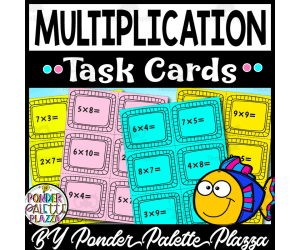
Multiplication Task Cards - 102 Cards
Math, Multiplication and Division, Multiplication, Numbers, Early Math, Grade 1, 2, 3, 4, 5, Worksheets & Printables, Task Cards, Lesson Plans, Teacher Tools, Assessments, Activities, Centers
Get ready to tackle multiplication like never before with this set of 102 Multiplication Task Cards! Covering facts from 1 to 10, these cards make math engaging, interactive, and (dare we say) fun. Paired with 17 worksheets for extra practice, this resource is a one-stop shop for multiplying mastery. Whether your students are newbies to the times tables or seasoned number ninjas, there’s something here for everyone. Ways to Use Math Centers: Let students rotate through engaging tasks at their own pace. Partner Work: Pair up for a multiplication duel—friendly competition encouraged! Independent Practice: Perfect for students who need extra reinforcement. Homework or Sub Plans: Easy to assign and guaranteed to keep learning on track. Games and Challenges: Use the cards for timed quizzes or scavenger hunts. Advantages Comprehensive Coverage: Every fact from 1x1 to 10x10, so no number feels left out. Interactive Learning: Keeps students engaged and motivated. Flexible Use: Cards and worksheets can adapt to individual or group settings. Boosts Confidence: Helps students master multiplication without the math drama. With this resource, your students won’t just learn multiplication—they’ll multiply their confidence, speed, and accuracy. Math class just got an upgrade!
Author Ponder Palette Plazza
Tags Math Worksheets, Task Card, Task Cards, Multiplication, Multiplication Task Cards, Multiplication Worksheets, Multiplication Activities, Math Task Cards

Monster Math Addition Multiplication BUNDLE
Special Resources, Special Education Needs (SEN), Math, Early Math, Addition and Subtraction, Addition, Multiplication and Division, Division, Grade 1, 2, 3, 4, Worksheets & Printables, Flashcards, Activities
Monster Math Addition Multiplication BUNDLE . The Monster Math Addition Multiplication BUNDLE is an engaging, informative resource especially created for educators to teach early math basics. Targeted towards Grade 1 up to Grade 4, this bundle focuses on fundamental mathematical concepts such as addition and multiplication . About the Bundle Comprised of four different books with a whopping total of 284 pages, the bundle features enticing monster graphics that make learning an enjoyable experience . The first book operates as a platform for developing mental math strategies by fostering the practice of addition doubles facts through various worksheets. These resources are well-situated for morning routines, homework assignments or even added tasks for early finishers . The second book provides over 100 pages dedicated solely to monstrously good repetition and multiplication exercises where math facts involving numbers from one to ten are broken down into easy-to-digest forms . The remaining two books include innovative resources like color coordination cards and custom cards—all contributing to multiplying fun while studying multiplication ! You can choose to craft unique books from them or erect as classroom posters; assign them as interesting homework material or utilize task cards during group study activities—there's a wealth of possibilities here ! Last but importantly too: black & white formatting allows learners space for creativity–kids can add their personal touch by coloring those cute monsters themselves while brushing up math essentials ! Using this bundle facilitates not only academic learning; it also encourages independent thinking and creative expression within young minds— a valuable asset in their journey towards lifelong knowledge acquisition . Unleash the power of enjoyable yet educational resources using Monster Math Addition Multiplication BUNDLE today! Let’s make learning fun again . 4 math books with monster graphics, 284 pages total for repeated addition, doubles facts and multiplication .
Author WORDS ASIDE
Tags Math Basics, Addition Facts, Multiplication Practice, Mental Math Strategies, Monster, Fun, Centers, Math Stations, Pictorial Math, Words Aside, Math Monster Addition

Fridges Reading Comprehension Passage - Cored Ed Encyclopedia
ELA, Language Development, Resources for Teachers, Reading Comprehension, Reading, Pre-Reading, Writing, Science, Technology, Physics, Grade 2, 3, 4, 5, Worksheets & Printables, Worksheets, Teacher Tools, Centers, Activities, Writing Prompts, Assessments, Tests, Quizzes and Tests, Quizzes
This fridges reading comprehension contains the following: Pre-Reading Trivia Students will write down one thing they already know about the subject and then read five more facts and discuss. These facts are fun, and the students will enjoy learning about the subject before reading more. Reading Passage The text is a high-interest reading passage with set paragraphs, roughly three to four paragraphs long. It contains a variety of themes about the topic, anywhere from history to technology. The passage is between 250 and 350 words in length. Mixed Questions The first question page contains four multiple-choice questions, each with a choice of four answers, and three written response questions that require a sentence or two from the student. Creative Writing In this question, the student will be required to write a five to eight sentence paragraph on a question related to the topic. Extension Activities This page is optional for fast finishers. If there are five to ten minutes left at the end of the lesson, the student can choose one of three activities, each one requiring a different skill. Answer Key There are answers for the multiple-choice questions and three written response questions have sample answers. FULL CATALOG OF DOWNLOAD LINKS AND ENCYCLOPEDIA INDEX HERE Cored Ed Encyclopedia Overview The Cored Ed Encyclopedia is a weekly series of lessons that you can pick up and use right away. These short readings fit into whatever time you have available. Each one includes a warm-up, a reading, and a set of questions, but it’s flexible — you can do just the reading, the full lesson, or skip the writing section if you need to. Each lesson focuses on a single topic so students don’t get lost. The writing is clear but never childish, making it perfect for grades two through five. Topics range from animals and science to history, inventions, and everyday things. No matter the level of the student, everyone should take away at least one new idea or fact from each lesson. The materials are easy to print, easy to explain, and require no setup. They work well for whole-class teaching, partner work, or independent study.
Author Cored Education
Rating
Tags Vocabulary, Spelling, Reading Comprehension, Reading Passages, Reading, Creative Writing, Reading Strategies, Writing Prompts, Technology, Physics

SEL Boom Deck-Flower, Weed and Cactus Friendship Behaviors & Handout
Special Resources, Social Emotional Learning (SEL), Social Skills, Special Education Needs (SEN), Grade 3, 4, 5, 6, Activities
In this SEL Boom Deck, students will learn about flower (healthy), weed (bothersome) and cactus (unhealthy) friendship behaviors. It is important for students to learn some of the behaviors that are bothersome and frustrating and to learn that they do need to address these sooner rather than later. Just like a weed ignored or not wanting to be dealt with, it can get worse and impact the friendship in a negative way. Some examples of flower (healthy) behaviors are; letting your friends have other friends, being there to help, standing up for them (being an upstander), and many more. Some of the weed (bothersome) examples are; bragging, copying a friend, not paying a friend back for borrowing money, and more. Some examples of cactus (unhealthy) behaviors are; being mad if something good happens to a friend, putting a friend down, gossiping, not letting a friend join their other friends, and many more. There are 24 task playing cards and 5 instructional cards so this can be played as a whole classroom lesson, a small group lesson, with partners or assigned to individuals to do as homework. There is a handout that matches the concepts for students to fill out to remember the different friendship behaviors and a question about what they can do if there friend is exhibiting either a weed or cactus type friendship behavior. This is a Boom Deck that is great for 3rd grade, 4th grade, 5th grade, and sixth grade. If there are strong readers or the classroom teacher or school counselor can read each slide, this could be something 2nd grader also do. You know your students best and can judge whether the examples are relevant to your students. Please review the Boom Deck Terms Of Use as because of AI, it does not allow me to post them here due to it is the same verbiage as each product. If you want to know about other friendship Boom Decks or other friendship lessons, please visit my store at: https://teachsimple.com/contributor/jennifer-moyer-taylor
Author Jennifer Moyer Taylor
Tags Sel, Social-emotional Learning, Friendship Skills, Social Skills, Special Education, Boom Cards, Handout, Relationship Skills, Social Awareness, School Counseling

Everglades Reading Comprehension Passage - Cored Ed Encyclopedia
ELA, Language Development, Resources for Teachers, Reading Comprehension, Reading, Pre-Reading, Writing, Strategies, Geography, Social Studies, Grade 2, 3, 4, 5, Worksheets & Printables, Worksheets, Teacher Tools, Centers, Activities, Writing Prompts, Assessments, Tests, Quizzes and Tests, Quizzes
This Everglades reading comprehension contains the following: Pre-Reading Trivia Students will write down one thing they already know about the subject and then read five more facts and discuss. These facts are fun, and the students will enjoy learning about the subject before reading more. Reading Passage The text is a high-interest reading passage with set paragraphs, roughly three to four paragraphs long. It contains a variety of themes about the topic, anywhere from history to technology. The passage is between 250 and 350 words in length. Mixed Questions The first question page contains four multiple-choice questions, each with a choice of four answers, and three written response questions that require a sentence or two from the student. Creative Writing In this question, the student will be required to write a five to eight sentence paragraph on a question related to the topic. Extension Activities This page is optional for fast finishers. If there are five to ten minutes left at the end of the lesson, the student can choose one of three activities, each one requiring a different skill. Answer Key There are answers for the multiple-choice questions and three written response questions have sample answers. FULL CATALOG OF DOWNLOAD LINKS AND ENCYCLOPEDIA INDEX HERE Cored Ed Encyclopedia Overview The Cored Ed Encyclopedia is a weekly series of lessons that you can pick up and use right away. These short readings fit into whatever time you have available. Each one includes a warm-up, a reading, and a set of questions, but it’s flexible — you can do just the reading, the full lesson, or skip the writing section if you need to. Each lesson focuses on a single topic so students don’t get lost. The writing is clear but never childish, making it perfect for grades two through five. Topics range from animals and science to history, inventions, and everyday things. No matter the level of the student, everyone should take away at least one new idea or fact from each lesson. The materials are easy to print, easy to explain, and require no setup. They work well for whole-class teaching, partner work, or independent study.
Author Cored Education
Rating
Tags Vocabulary, Spelling, Reading Comprehension, Reading Passages, Cored Encyclopedia, Facts, Reading, Creative Writing, Geography, Everglades