



3,969 products added recently
Page 22 - 4th Grade Activities
Introduce your fourth-grade students to activities that challenge and inspire. These resources encourage analytical thinking, teamwork, and creative expression across subjects. Use them to elevate your teaching and engage students in meaningful learning experiences.

 Show filters


Walkie-Talkies Reading Comprehension Passage - Cored Ed Encyclopedia
ELA, Language Development, Reading Comprehension, Reading, Pre-Reading, Science, Social Studies, History, Technology, Physics, Grade 2, 3, 4, 5, Worksheets & Printables, Worksheets, Teacher Tools, Centers, Activities, Writing Prompts, Assessments, Quizzes and Tests, Quizzes, Lesson Plans
This walkie-talkies reading comprehension with lesson plan includes: Visualization (on the front cover) Start your lesson by taking a minute to think and share something about the topic. Read the script aloud (slowly), perhaps prepare some music or sound effects. Student close their eyes and let their imaginations wander. Students open their eyes, read the question aloud and give them a few minutes to complete. Ask a few students to share or keep answers until the end to compare with what they learn in the passage. Quick pause—thousands of Cored Education products are included with your TeachSimple membership. Download links and encyclopedia index available here. Pre-Reading Trivia Students will write down one thing they already know about the subject and then read five more facts and discuss. These facts are fun, and the students will enjoy learning about the subject before reading more. Give 1 minute for students to write what they already know (no pressure—best guess is fine). Read the five facts together. After each fact, do ask a student for their opinion, was it surprising? Set a purpose by asking students to highlight/underline one fact they want to learn more about during the reading. Reading Passage The text is a high-interest reading passage with set paragraphs, roughly three to four paragraphs long. It contains a variety of themes about the topic, anywhere from history to technology. The passage is between 250 and 350 words in length. First, ask students to look at the headings and see what they’ll learn about today. What do they know about the topic/heading? First read options: Teacher read-aloud (best for support). Partner reading (paragraph by paragraph). While reading, students underline important details, and vocabulary words they think may come up in the questions section. Mixed Questions The first question page contains four multiple-choice questions, each with a choice of four answers, and three written response questions that require a sentence or two from the student. Students complete the mcqs first independently, then review quickly as a class. For the 3 written responses, try to get students giving the answer with some form of evidence: “I think ___ because the text says ___.” If students get stuck, send them back to check the passage. Vocabulary Questions Practice seven key words from the text in this section across two activities. First section is scrambled words where students will unscramble three words given a clue for each. The second section is a word to meaning matching activity. Before starting, have some students read out words they underlined in the passage. Ask students to say the word and read aloud the sentence(s) around each word. Ask students to do scrambled words and the matching exercise in pairs then go through answers as a class. For the scrambled spelling task, get four pairs to come up to the board and write the words for extra practice with the other student reading out the clue. For the matching task, prompt students to give full sentences: “I matched ___ with ___ because ___.” Creative Writing In this question, the student will be required to write a five to eight sentence paragraph on a question related to the topic. Before starting, ask students write down 3 key ideas they are going to include in their piece. Ask students for ideas to share around the class to help those struggling. Pro writing expectations: 5–8 sentences At least 2 facts or details from the passage At least 2 vocabulary words from the previous page Students read their paragraphs while classmates listen for facts and vocabulary words. Extension Activities This page is optional for fast finishers or to take home. There are several activities, each one requiring a different skill. Do some, do none, do all, completely optional - but you will feel reassured knowing every possibility is planned for. Includes summary writting question. Answer Key There are answers for the multiple-choice questions, written response questions have sample answers, vocabulary answers and if there is a summary question then a sample summary will be provided as well. Lesson Plan Included Customized lesson plan for this lesson is included. Lesson Snapshot Title: Walkie-Talkies Genre: Nonfiction (informational text) Subject: Science & Technology (Informational Reading) Primary Topic: How walkie-talkies work, history, and clear communication Estimated Guided Reading Level (A–Z): P What This Lesson Teaches Best Explains how a walkie-talkie works as a handheld two-way radio that switches from listening to sending when the talk button is pressed. Builds understanding of shared communication rules , including that only one radio can transmit at a time and messages stay “short and clear.” Introduces a simple history of portable radios , from early military use (including a “packset” and the Motorola SCR-300) to later helpers on job sites. Highlights how word choice matters when people share the air, connecting clear/kind words to teamwork and getting things done. Uses comparisons and descriptive language (e.g., “scratchy,” “like a distant whisper,” “lighter than a deck of cards”) to help readers picture sound and size. Learning Goals Students will describe what a walkie-talkie is and what it can do (send and receive messages). Students will explain what happens when the talk button is pressed and why the radio listens most of the time. Students will identify at least two ways early walkie-talkies differed from many walkie-talkies today. Students will describe why teams keep messages short and clear when using walkie-talkies. Students will use evidence from the text to explain what “over” means in walkie-talkie talk. Key Vocabulary From the Text antenna — the part that sticks up to help signals travel. channel — a shared path where people hear the same messages. portable — easy to carry from place to place. transmit — send a message through the air. rugged — strong and built to last. FULL CATALOG OF DOWNLOAD LINKS AND ENCYCLOPEDIA INDEX HERE
Author Cored Education
Rating
Tags Vocabulary, Reading Comprehension, Reading Passages, Lesson Plans, Ela Lesson Plans, Reading Comprehension Lesson Plans, Pre-reading, Science Lesson Plans, History Lesson Plans, Technology
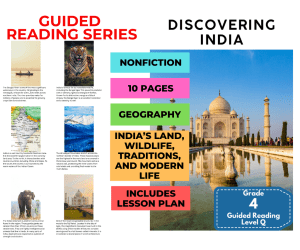
Discovering India: Guided Reading Level Q with Lesson Plan
ELA, Resources for Teachers, Reading Comprehension, Reading, Science, Geography, Social Studies, Technology, History, Life Sciences, Grade 3, 4, 5, Worksheets & Printables, Worksheets, Teacher Tools, Centers, Activities, Literacy Readers, Quizzes, Quizzes and Tests, Assessments, Lesson Plans
This Discovering India (level q) guided reading book with lesson plan includes: Guided Reading Color Label (front cover x1) This is a quick way to match the book’s demands to what students can generally handle.. The overall goal is to use the level/color to pick books for several smaller groups. To qualify for a certain level, a student is expected to read a book from that level with about 90–94% accuracy. If a student is consistently accurate and understands, move up a level. If the student is struggling at that level, drop down and add more support. Each student will improve at completely different rates, but it is generally one of the best ways to check progress across the class. DOWNLOAD THE CATALOG TO VIEW ALL GUIDED READING BOOKS AVAILABLE (SORTED LEVELS A-Z) Pre-Reading Question (x1) Teacher asks the prompt aloud, can be while showing the cover or first page. Students share what they already know, or make educated guesses from the cover. Prompt them to use the target vocabulary. Write some of their responses on the board to look back at during the reading. Vocabulary Words (x5) Introduce the five words, best doing it one at a time. Start by saying it, while students repeat and then see if anyone knows what it means before reading further. Read through the meaning and try to briefly connect each word to a picture or gesture so it’s meaningful. Ask students to flip through the book pages and point to where they see each of the vocabulary words. While reading the book pause upon coming across one of the vocab words or read the sentence twice to make sure students understand the word has appeared. Optional: Ask students to raise hands whenever they see/hear one of the new words. Guided Reading Pages (x10) Check the book snapshot (below) for: primary topic - do you need to prep extra reading or intro materials on this? what is taught best - decide on 1-2 bullets to focus on, use the prompt or words provided here for best results. learning goals - what you are checking for students to be able to do after the session, elicit answers using prompts or words provided. key vocabulary (see section above). questions overview - so you know what is coming up and if you need to prep extra materials to assist understanding. Run the lesson You may have already looked at a few of the pages together, but you can show them some of the pictures again first to set meaning. Depending on how much time you have and how familiar your students are with guided reading class, you may want to read the book aloud first with the group first. Students whisper or partner read, while you listen in. If time, do it as a group, one student reading a page each. Use the guided page’s prompts to coach: “Check the picture / does it make sense?” “Point under the words / try the first sound” “Reread the sentence smoothly”. Try to focus more on one student per session (rotating every time), so you can work out if they are ready to move up or need to move down a level. Comprehension Questions (back cover x3) This is your way to check that students didn’t just say the words, but actually understood the text. First, let students answer by pointing to the page/picture and saying a short sentence. After any answer, follow with: “Show me where you found that in the text.” In bigger groups, have partners answer first (10–20 seconds), then call on 2–3 students to share. Differentiation tips: Emerging speakers/struggling readers: oral + pointing On-level: oral in a full sentence Higher: one written sentence or draw + label Book Snapshot Title: Discovering India Genre: Nonfiction Subject: Social Studies (Geography/Culture) Primary Topic: India’s land, wildlife, traditions, and modern life Estimated Guided Reading Level (A–Z): Q What This Book Teaches Best Key geography facts about India’s location in Southern Asia, nearby borders, and surrounding waters. How landforms shape life in India, including the Himalayan Mountains and the Ganges River. Notable wildlife of India through examples like the Bengal tiger and the Indian elephant. Cultural traditions and everyday life, including spices used in meals and the celebration of Diwali. Modern India today, including transportation (auto-rickshaws) and major cities connected to technology and innovation. Learning Goals Students will describe where India is located and name details about its borders and southern waters. Students will explain how the Himalayan Mountains are described as protecting the inner plains. Students will explain why the Ganges River is important to people and farming in northern India. Students will describe key traits of the Bengal tiger and the Indian elephant using details from the text. Students will identify facts about the Taj Mahal, including where it is and features described in the book. Students will describe examples of Indian culture and modern life mentioned in the text (foods/spices, Diwali, transportation, cities). Key Vocabulary From the Text vast — very large in size. significant — very important. distinctive — easy to notice because it looks different. minarets — tall towers on a monument. diyas — small clay lamps used during Diwali. Discussion Prompts Pre-reading question: What are you hoping to learn about India as you read? Comprehension questions: What warm waters does the text say surround India to the south? Comprehension questions: According to the text, why is the Ganges River essential? Comprehension questions: What does the text say diyas symbolize during Diwali? Printing Tips 1. Best Printing Method (Recommended) “Booklet” Printing (Best if Available) If your printer or PDF viewer supports Booklet Printing , use this. Settings to use: Print mode: Booklet Paper size: Letter or A4 (either works) Orientation: Landscape Print on both sides: Yes Flip on: Short edge Scaling: Fit to printable area Booklet subset: First test: Front sides only Then: Back sides only This will automatically: Pair pages correctly Put the cover on the outside Align everything for folding After printing, fold in half and staple along the spine . 2. If “Booklet” Printing Is NOT Available You can still print this correctly with manual duplex printing . Step-by-step: Open the PDF. Choose Print . Set: Orientation: Landscape Pages per sheet: 1 Print on both sides: Yes Flip on: Short edge Print all pages . Because each PDF page already contains two facing book pages, the result will still fold cleanly into a book. Thousands of Cored Education products are included with your TeachSimple membership. Download links and encyclopedia index available here.
Author Cored Education
Rating
Tags Reading Comprehension, Reading Passages, Reading, Guided Reading, Guided Reading Lesson Plan, Guided Reading Activity, Pre-reading, Social Studies, Geography, History

My Papi Has a Motorcycle Read-Aloud Activities and Book Companion
ELA, Reading, Reading Comprehension, Grade 3, 4, 5, Read Alouds, Activities
Looking for a captivating read-aloud for Hispanic Heritage Month? My Papi Has a Motorcycle by Isabel Quintero is an excellent choice! This charming story celebrates family, community, and the rich cultural heritage of a Latino neighborhood through the eyes of a young girl and her father. This resource includes 41 print-and-go reading activities, perfect for tailoring learning to your students' needs. Activities cover story elements, theme analysis, character exploration, predictions, inferences, connections, and critical thinking questions. ⭐️This Resource Includes:⭐️ Judging by the Cover: Students examine the cover and answer related questions. Making Predictions: Students predict the text's content before reading. Story Elements: Students fill in boxes with words and pictures representing story elements. Sequencing: Students illustrate and retell the important parts of the story. Retell the Story: Students summarize the beginning, middle, and end with text and illustrations. Recalling Events in Chronological Order: Students describe and illustrate four major events in chronological order. Summary: Students complete a graphic organizer to write a summary of the story. Story Event Sort: Students describe events from the story, explain feelings, and categorize them. Making Connections: Students connect personal experiences to events in the story. Making Inferences: Students use clues to make inferences while reading. Notice & Note: Students document inferences, cause-and-effect examples, and instances of descriptive language. Character Feelings: Students describe how characters' feelings change throughout the story. Character Traits (Daisy; Papi): Students choose two traits for each character and support them with examples. Character Inside & Out (Daisy; Papi): Students detail what each character says, thinks, does, and feels. Character Development: Students select and support traits that describe character growth throughout the story. Character Change: Students explain how the characters change from beginning to end and the events that cause these changes. Character Perspective: Students compare Daisy’s and Papi’s perspectives of the motorcycle ride. Sketch a Scene From the Story: Students draw a significant scene and describe its importance to the plot. Setting the Scene: Students identify and explain three different settings in the story. Before & After: Students describe Daisy's feelings before and after the motorcycle ride and illustrate both. Thinking About the Text: Students answer story-related questions and include text evidence (ANSWER KEY INCLUDED). Thinking Beyond the Text: Students respond to deeper questions about the story with text examples (ANSWER KEY INCLUDED). Figuring Out Figurative Language: Students identify comparisons in phrases and explain their significance (ANSWER KEY INCLUDED). Theme: Students determine the story's theme and support it with text evidence. Author's Message: Students outline four key events in chronological order and discuss the author's message. 3-2-1: Students describe three memories Daisy shares, identify two places she and Papi pass, and share one lesson Daisy learns (ANSWER KEY INCLUDED). Compare and Contrast: Students compare Daisy’s community to their own. Identifying Imagery: Students identify sensory imagery in the text (ANSWER KEY INCLUDED). Brag Board: Students create a collage showcasing their family's skills and talents. Diary Entry: Students write a diary entry from the perspective of a character in the story. Community Map: Students create a community map using provided questions to identify important places. Design a Helmet: Students design a helmet representing something unique about their family or community and explain their choices. Community Mural: Students create a mural highlighting key aspects of their community. Cruising My Community: Students draw and number the places they would visit while riding around their community. Caught on Social Media: Students create a social media post as a character from the story, including a caption and hashtag. Wait... There's More!: Students write about what happens next in the story. Design a Book Cover: Students design a new book cover and explain their design choices. Crossword Puzzle: Students fill in a crossword puzzle using given clues (ANSWER KEY INCLUDED). Word Search Puzzle: Students find hidden words in a word search puzzle using clues (ANSWER KEY INCLUDED). Book Review: Students rate and review the book. This resource is for extension read-aloud activities only. The book is not included.
Author Creatively Gifted
Tags Hispanic Culture, Father-daughter Bond, Immigrant Communities, Critical Thinking, Character Analysis, Reading Comprehension, Book Companion, Picture Book Activities, Hispanic Heritage

Human Body Word List Posters (PDF)
ELA, Language Development, Resources for Teachers, Vocabulary, Spelling, ESL, Human Body, Life Sciences, Science, Grade 2, 3, 4, 5, Worksheets & Printables, Worksheets, Teacher Tools, Centers, Activities, Posters, Classroom Decor
Word List Poster Series This word list poster series is designed for students in grades 2–5. Each printable focuses on a clear, kid-friendly theme and features 8 target vocabulary words with short, student-friendly meanings or fun facts. The clean layout works as both an anchor chart and a write-in sheet, giving students a quick, visual reference they can revisit during centers and independent work. These posters are student-friendly, classroom-ready, and perfect for warmups, vocabulary walls, sub plans, or take-home reference. Display a single poster to support the day’s lesson, or group several to build a themed wall across your unit. Note: Each poster is a companion piece to its matching themed product in the series—pair it with the corresponding maze, wordsearch, or activity pack for a consistent set of 8 focus words. Human Body Word List 1. Head & Face Head, Hair, Eyes, Nose, Mouth, Ears, Teeth, Tongue 2. Arms & Hands Arm, Hand, Fingers, Thumb, Wrist, Elbow, Palm, Nails 3. Legs & Feet Leg, Knee, Foot, Toes, Heel, Ankle, Shin, Thigh 4. Inside the Body Brain, Heart, Lungs, Stomach, Bones, Muscles, Blood, Nerves 5. Senses & Feelings Sight, Hearing, Smell, Taste, Touch, Laugh, Cry, Yawn 6. Moving & Actions Walk, Run, Jump, Clap, Hug, Stretch, Bend, Wiggle PDF Version Other versions will appear here when available. Follow the store for the lastest on new products. How to Use These Word List Posters Perfect for: Morning work or early-finisher bins Vocabulary centers or anchor walls Holiday/seasonal review lessons Independent stations, sub plans, or take-home reference More Human Body Themed Products CROSSWORDS WORD SEARCHES MAZES FULL CATALOG OF DOWNLOAD LINKS HERE Themed Word List Posters Links Addition PDF Animals PDF Around the Home PDF Birthday PDF Candy PDF Christmas PDF Cinco de Mayo PDF Clothes PDF Colors PDF Days and Months PDF Division PDF Earth Day PDF Easter PDF Easy Word List Posters PDF Fall PDF Father's Day PDF Food PDF Geography (Set 1) PDF Geography (Set 2) PDF Geography (Set 3) PDF Graduation PDF Health PDF History (Set 1) PDF History (Set 2) PDF History (Set 3) PDF Human Body PDF Kindness PDF Life Skills PDF Mother's Day PDF Multiplication PDF Science (Set 1) PDF Science (Set 2) PDF Science (Set 3) PDF Shapes PDF Social Skills PDF Spring PDF Sports PDF St. Patrick's Day PDF Subtraction PDF Summer PDF Thanksgiving PDF Transport PDF Valentine's Day PDF Winter PDF Word List Posters in Depth Structure Each poster is built around a focused sub-theme and presents 8 target words with short, student-friendly meanings or fun facts. The clean A4 portrait layout works as an anchor chart on your board or as a student reference at desks. These posters are designed as companion pieces to the matching themed products (mazes, wordsearches, activity packs), so the same vocabulary stays visible across your unit. Each poster set includes: A themed word list poster with 8 words + brief meanings/facts A clean, high-contrast layout for easy printing and display Space that can double as write-in/draw-to-show-meaning during centers Themes Included Seasons & Holidays (e.g., Halloween, Easter, Valentine’s Day) Everyday Topics (e.g., Animals, Weather, School) Math & Science Connections (e.g., Number Words, Simple Machines) Special Units (e.g., Health, Earth Day, Sports, Kindness) Each topic reflects real-life experiences and interests while strengthening vocabulary recognition and content understanding in a clear, visual way. Easy extensions (optional) Sketch it: students draw a quick icon for each word Sort it: group words by category (e.g., actions, objects) Star it: highlight “I already know” vs. “I’m learning” words Match it: point to examples in a reading, video, or picture set Say it: brief oral definition or example sentence during share-out Differentiation tips Pre-teach 2–3 anchor words; add the rest later in the week Offer picture cues or gestures for emerging readers/ELLs Let students choose 4 of 8 to focus on first, then build up Color-code by part of speech or concept family for quick scanning For similar downloads and other frees, do check out Cored Group on TeachSimple.
Author Cored Education
Rating
Tags Vocabulary, Spelling, Human Body, Body, Head & Face, Arms & Hands, Legs & Feet, Posters, Body Word Lists, Human Body Word List
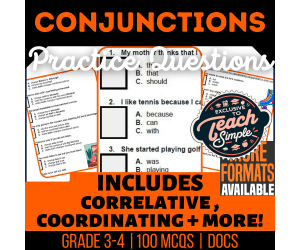
Conjunctions Practice Questions - Grade 3-4 Grammar (Google Docs)
ELA, Language Development, ESL, Grammar, Common Core, Resources for Teachers, Grade 3, 4, Worksheets & Printables, Worksheets, Quizzes and Tests, Teacher Tools, Tests, Assessments, Centers, Activities
Conjunctions Grammar Practice MCQS ELA MCQS Overview: In this series of lessons, students will embark on an engaging journey to explore the grammar skills that make our language vibrant and expressive. These lessons are crafted to help students identify, comprehend, and effectively apply language arts skills in both writing and speech. Accompanied by free supplementary materials available for all topics, each lesson builds on the previous one, offering a balanced mix of direct instruction, interactive group activities, and independent practice. Through fun and creative tasks, students will learn to recognize grammar within sentences, understand their function, and use them to enrich their own writing and speech. Conjunctions Overview: Includes: Correlative Conjunctions Coordinating Conjunctions Subordinating Conjunctions Mistake Finding Google Docs Version This is the Docs editable and fillable version. This download is available in GOOGLE Docs, GOOGLE Forms, GOOGLE Slides. PDF, PPT, WORD, check the links below for more details. FULL CATALOG OF DOWNLOAD LINKS HERE Grade 3/4 Links: Adjectives Google Docs Google Forms Google Slides PDF PPT Word Free Supplementary Materials Pack Adverbs Google Docs Google Forms Google Slides PDF PPT Word Free Supplementary Materials Pack Conjunctions Google Docs Google Forms Google Slides PDF PPT Word Free Supplementary Materials Pack Nouns Google Docs Google Forms Google Slides PDF PPT Word Free Supplementary Materials Pack Pronouns Google Docs Google Forms Google Slides PDF PPT Word Free Supplementary Materials Pack Verbs Google Docs Google Forms Google Slides PDF PPT Word Free Supplementary Materials Pack Sentence Structure Google Docs Google Forms Google Slides PDF PPT Word Free Supplementary Materials Pack Present Tense Google Docs Google Forms Google Slides PDF PPT Word Free Supplementary Materials Pack Past Tense Google Docs Google Forms Google Slides PDF PPT Word Free Supplementary Materials Pack Future Tense Google Docs Google Forms Google Slides PDF PPT Word Free Supplementary Materials Pack Context Clues Google Docs Google Forms Google Slides PDF PPT Word Free Supplementary Materials Pack Defining Words Google Docs Google Forms Google Slides PDF PPT Word Free Supplementary Materials Pack Fill the Blanks Google Docs Google Forms Google Slides PDF PPT Word Free Supplementary Materials Pack Homophones Google Docs Google Forms Google Slides PDF PPT Word Free Supplementary Materials Pack Synonyms Google Docs Google Forms Google Slides PDF PPT Word Free Supplementary Materials Pack ELA Review Questions Overview Questions have three answer choices. There are a handful of pictures on each test for aesthetic purposes, as well as a review sheet covering most of the topics covered in the product. Introduction or Example Sheet Each topic will include an introduction or example sheet to go through first with your students. Full Answer Keys Full answer keys and sample responses are provided so no matter how busy you are, you know you're covered! In the Supplementary Pack Interactive Ice Breakers: Fun, hands-on activities that get students thinking about adjectives right from the start. Guided Practice: Teacher-led exercises that reinforce the day’s lesson, ensuring students can confidently identify and use adjectives. Group and Partner Tasks: Collaborative activities that allow students to work together to solve problems, categorize adjectives, and create descriptive sentences. Independent Worksheets: Structured worksheets that provide individual practice and help solidify understanding of key concepts. Exit Tasks: Quick, reflective activities at the end of each lesson that assess understanding and encourage students to apply what they’ve learned. For similar downloads and other frees, do check out Cored Group on TeachSimple.
Author Cored Education
Tags Elementary, Answers, Ccss, Common Core, Grammar, Tests, Test Prep, Grade 3, Grade 4, Digital Centers
Kids Yoga Stories: Paris Yoga Cards for Kids
P.E. & Health, Yoga, Kindergarten, Preschool, Grade 1, 2, 3, 4, Activities
Use yoga poses to teach about Paris! This set of Paris Yoga Cards for Kids will help your students learn through movement either at home, in the classroom, or in a studio. Included in this deck of Paris Yoga Cards for Kids - A card with an index - Tips to teach yoga -20 cards illustrating the yoga poses -20 matching cards with Paris keywords - Instructions for all the poses The index indicates the order in which the yoga poses are to be used to flow from one pose to the next. There is multicultural representation featured in yoga kids! Recommended for ages 3+ Ways in which you can use these cards as homeschoolers or in the classroom include: -For transition times -Morning routines or circle times -Brain breaks to calm their minds and bodies -Physical education -Occupational and/or physical therapy -With one child, small, or large groups Benefits of Yoga for kids include: -Increased strength -Increased flexibility -Improves sleep -Promotes positive interactions amongst adults and children -Develops self-confidence -Improves self-expression -Improves body awareness -Promotes a lifestyle that is active and healthy.
Author Kids Yoga Stories
Tags Kids Yoga Stories, Paris Yoga, Yoga Cards, Kids Yoga, Yoga Poses
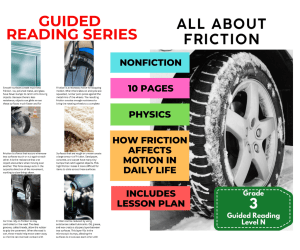
Guided Reading Level N - All About Friction (with Lesson Plan)
ELA, Resources for Teachers, Reading Comprehension, Reading, Language Development, Science, Physics, Engineering, Technology, Pre-Reading, Grade 2, 3, 4, Worksheets & Printables, Worksheets, Teacher Tools, Centers, Activities, Literacy Readers, Quizzes, Quizzes and Tests, Assessments
This Guided Reading Book - All About Friction (Level N) with lesson plan includes: Guided Reading Color Label (front cover x1) This is a quick way to match the book’s demands to what students can generally handle.. The overall goal is to use the level/color to pick books for several smaller groups. To qualify for a certain level, a student is expected to read a book from that level with about 90–94% accuracy. If a student is consistently accurate and understands, move up a level. If the student is struggling at that level, drop down and add more support. Each student will improve at completely different rates, but it is generally one of the best ways to check progress across the class. DOWNLOAD THE CATALOG TO VIEW ALL GUIDED READING BOOKS AVAILABLE (SORTED LEVELS A-Z) Pre-Reading Question (x1) Teacher asks the prompt aloud, can be while showing the cover or first page. Students share what they already know, or make educated guesses from the cover. Prompt them to use the target vocabulary. Write some of their responses on the board to look back at during the reading. Vocabulary Words (x5) Introduce the five words, best doing it one at a time. Start by saying it, while students repeat and then see if anyone knows what it means before reading further. Read through the meaning and try to briefly connect each word to a picture or gesture so it’s meaningful. Ask students to flip through the book pages and point to where they see each of the vocabulary words. While reading the book pause upon coming across one of the vocab words or read the sentence twice to make sure students understand the word has appeared. Optional: Ask students to raise hands whenever they see/hear one of the new words. Guided Reading Pages (x10) Check the book snapshot (below) for: primary topic - do you need to prep extra reading or intro materials on this? what is taught best - decide on 1-2 bullets to focus on, use the prompt or words provided here for best results. learning goals - what you are checking for students to be able to do after the session, elicit answers using prompts or words provided. key vocabulary (see section above). questions overview - so you know what is coming up and if you need to prep extra materials to assist understanding. Run the lesson You may have already looked at a few of the pages together, but you can show them some of the pictures again first to set meaning. Depending on how much time you have and how familiar your students are with guided reading class, you may want to read the book aloud first with the group first. Students whisper or partner read, while you listen in. If time, do it as a group, one student reading a page each. Use the guided page’s prompts to coach: “Check the picture / does it make sense?” “Point under the words / try the first sound” “Reread the sentence smoothly”. Try to focus more on one student per session (rotating every time), so you can work out if they are ready to move up or need to move down a level. Comprehension Questions (back cover x3) This is your way to check that students didn’t just say the words, but actually understood the text. First, let students answer by pointing to the page/picture and saying a short sentence. After any answer, follow with: “Show me where you found that in the text.” In bigger groups, have partners answer first (10–20 seconds), then call on 2–3 students to share. Differentiation tips: Emerging speakers/struggling readers: oral + pointing On-level: oral in a full sentence Higher: one written sentence or draw + label Book Snapshot Title: All About Friction Genre: Nonfiction (informational) Subject: Physical Science Primary Topic: How friction affects motion in daily life Estimated Guided Reading Level (A–Z): N What This Book Teaches Best Defines friction as a force that happens when surfaces touch or rub, and explains it acts against motion to slow things down. Compares rough/uneven surfaces (more friction) and smooth surfaces (less friction), using examples like sandpaper, carpet, ice, metal, and glass. Shows real-world uses of friction for safety, including bicycle brakes, soccer cleats gripping grass, and car tire treads gripping wet roads. Explains how friction can create heat energy and how lubricants reduce friction by forming a slippery layer between surfaces. Extends the idea of friction to air and water as drag/air resistance , and explains why friction makes movement controlled and “predictable.” Learning Goals Students can explain what friction is, using details from the text. Students can compare how rough/uneven surfaces and smooth surfaces affect sliding and distance. Students can describe how friction helps stop motion in the bicycle brake example. Students can explain one way friction is increased for safety or performance (cleats, tire treads). Students can explain how lubricants change what happens when two surfaces touch. Students can describe friction in air or water (drag/air resistance) using the parachute example. Key Vocabulary From the Text resistance — a push-back that makes movement harder. uneven — not smooth; bumpy. treads — deep grooves that help tires grip the road. lubricants — slippery substances that help things slide more easily. microscopic — so tiny you need a microscope to see it. Discussion Prompts Pre-reading question: When have you noticed something slow down because two surfaces rubbed together? Comprehension questions: What does the text say friction is? How does friction help a bicycle come to a complete stop? What do lubricants do between two surfaces to reduce friction? Printing Tips 1. Best Printing Method (Recommended) “Booklet” Printing (Best if Available) If your printer or PDF viewer supports Booklet Printing , use this. Settings to use: Print mode: Booklet Paper size: Letter or A4 (either works) Orientation: Landscape Print on both sides: Yes Flip on: Short edge Scaling: Fit to printable area Booklet subset: First test: Front sides only Then: Back sides only This will automatically: Pair pages correctly Put the cover on the outside Align everything for folding After printing, fold in half and staple along the spine . 2. If “Booklet” Printing Is NOT Available You can still print this correctly with manual duplex printing . Step-by-step: Open the PDF. Choose Print . Set: Orientation: Landscape Pages per sheet: 1 Print on both sides: Yes Flip on: Short edge Print all pages . Because each PDF page already contains two facing book pages, the result will still fold cleanly into a book. Thousands of Cored Education products are included with your TeachSimple membership. Download links and encyclopedia index available here.
Author Cored Education
Rating
Tags Reading Comprehension, Reading Passages, Reading, Guided Reading, Guided Reading Lesson Plan, Guided Reading Activity, Pre-reading, Vocabulary, Science Lesson Plans, Physics

My Body, It's Private Parts Social Skills Story and Activities For Girls
Special Resources, Life Skills, Grade 1, 2, 3, 4, 5, Activities
The Teaching Resource: 'My Body, It's Private Parts Social Skills Story and Activities For Girls' This extremely valuable tool is designed for young females ranging from grades one to five. Educating children on significant life skills, it helps create a clear understanding around the crucial topic of body safety in an age-appropriate manner. Using Stories for Teaching Complex Concepts With explicit language, this resource breaks down complex ideas into manageable steps. It focuses on distinguishing between private and not-so-private areas of a girl's body and explaining when these can be touched and by whom – creating awareness about personal boundaries. Included Components: A color story with 2 cover options: Allows teachers to personalize content as per student’s needs. Skill Builder Activity 1: Who and Why?: Explores scenarios where certain individuals may need access like doctors during check-ups. Skill Builder Activity 2: Comprehension Check : Ensures comprehension through effective recall exercises. A Coloring Book Companion: A black-and-white version for illustrating the story, great as homework to further strengthen understanding at home environment. An Animated PowerPoint Story: Adds depth in digital classrooms or online learning scenarios. Versatility of the Resource This resource can be used collectively in large groups within class lessons, within smaller groups or individually as take-home assignments allowing parents involvement too. The Ultimate Goal:Safeguarding Children's Rights& Safety Familiarizing children early on basic life-safety protocols empowers them to develop a positive attitude towards their bodies. This confidence allows them to stand up against any unwelcome advances, fostering a safer classroom and community. The My Body, It's Private Parts Social Skills Story and Activities For Girls is not just a resource, it's an investment towards prevention that yields profound long-term benefits.
Author Socially Skilled Kids
Tags Body Safety, Personal Boundaries, Social Skills, Prevention, Empowerment, Parts Of The Body Activities, Private Body Parts, Body Parts Activities

Prefix BI Sentence Reading Rings
ELA, Language Development, Phonics, Grade 2, 3, 4, Activities, Centers, Worksheets & Printables, Task Cards
Practice reading words with the prefix BI- with these sentence reading rings. Students will read words with the prefix bi- in the context of sentences. Each card also includes a bold and colorful image to illustrate each sentence and to help students to learn the meanings of each word. What is Included: This resource includes one reading ring for the prefix bi. There are seven cards each featuring a different word with the prefix bi. The words included in this set are: bicycle, bisects, binoculars, bilingual, bifocals, bipedal, and biannual. When to Use Early Finishers - If students finish their work early, they can use these reading rings for extra practice. Small Group Work - Teachers can use these reading rings to target small groups of students who need more practice reading words with prefixes. Independent Practice - Students can work independently at their desks to read this set of prefix cards. Morning Work - Students can read and review this reading ring for morning work as their classmates arrive to class. How to Make: Teachers will print out the pages and cut each card apart. Once cut apart, the teacher can choose to laminate the cards for durability. Then, use a hole punch to punch a hole in the top left corner of the card. Place the cards on a ring to create your reading ring, making sure the cover card is on top. Skills Assessed: These reading rings help with identifying words with prefixes These reading rings help with learning the meaning of prefixes These reading rings help students learn how prefixes change the meaning of words. These affixes reading rings are a low prep activity for teachers to prepare for students to use. Once created, these cards can be used over and over to practice reading words with prefixes in the context of a sentence.
Author The Connett Connection
Tags Affixes, Morphology, Prefixes, Literacy Activities, Reading Words With Prefixes
Geometry: Spinner Game for 3rd-5th - PC Software
Math, Geometry, Common Core, Grade 3, 4, 5, Activities, Games
Geometry: Spinner Game for 3rd-5th - PC Software A distinctive math-teaching resource tailored specifically to engage students in Grades 3-5. This software brings together interactive learning with a fun, spinner game. Main Features: Introduces and reinforces key geometry concepts vital for math education at these grade levels. Packed with 10 well-formulated questions aimed at testing knowledge and reinforcing understanding of basic mathematical principles. This game fits seamlessly into current teaching programs as it aligns firmly with the Five Strands of Math for grades 3-5. Furthermore, it has been created in light of universally recognized educational standards: Common Core State Standards (CCSS): pushing student achievements by setting the bar high STEM Education initiatives (Science, Technology, Engineering and Math): geared towards fostering innovation and critical thinking skills Also, all content within the game closely follows NCTM (National Council of Teachers of Mathematics) guidelines advocating rich context maetrial The software can be easily downloaded as a zip file. Once installed on your computer system or network: Can be used freely during whole-group instruction methods or smaller subsets during station rotation learning periods—endless possibilities without losing its value or appeal. Serves as an assignable piece of homework intended for extra home practice on student personal computers—parent-friendly design makes studying geometry easier than ever! Note: All efforts have been employed not only to achieve academic benefits but also to ensure easy usability across Grades three through five from a technological perspective. This isn't just a cosmetic tool—its mission is to make math more enticing, breaking down barriers around students' involvement in mathematics while improving their comprehension of geometry—a practical skill, whether in the classroom or beyond!
Author Classroom Complete Press
Tags Spinner Game, Shapes Spinner Game, Geoemtry Game, Math Activity, Digital Games
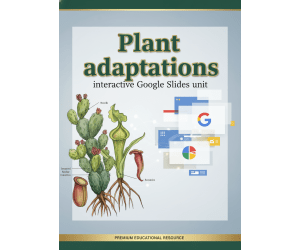
Plant Adaptations Interactive Google Slides Unit
Science, Earth and Environmental Sciences, Earth Sciences, Environmental Science, Geology, Space, Life Sciences, Animals, Nature & Plants, Biology, Grade 3, 4, 5, 9, 10, 11, 12, Experiments, Activities, Labs, Projects, Assessments, Teacher Tools, Diagrams, Lesson Plans, Outlines, Presentations
Find the best 4th Grade Plant Adaptations Interactive Google Slides Unit – a complete no-prep digital science resource that is perfectly correlated to NGSS 4-LS1-1! This teacher edition is a game-changer for teaching plant biology as an interactive adventure for students! With this resource, students will enjoy a hands-on approach to learning about plant adaptations as they explore interactive slides featuring desert succulents/cacti, rainforest drip tips/epiphytes, water plants floating leaves/stretching stems, structural vs. behavioral adaptations, roots, stem/leaf adaptations, defense structures, carnivorous plants Venus flytrap/pitcher plant, seed dispersal, mystery plant analysis, and a final knowledge check with answer keys! Students will actively engage in classifying adaptations, creating their own extremophiles, analyzing scenarios using Claim Evidence Reasoning, and connecting science to ELA, math, engineering, and technology using cross-curricular activities. It includes a teacher guide, standard alignment, steps to integrate into Google Classroom, instructional tips, interactive slide ideas, image credits, and ideas for self-grading. It can be used in a variety of learning environments, such as in-class learning, distance learning, homeschooling, etc. It saves automatically in Google Slides. Keywords: plant adaptation 4th grade, NGSS 4-LS1-1, Google Slides, interactive science unit, desert rainforest aquatic plants, carnivorous plants, seed dispersal activities, digital science resource, structure and function NGSS, no prep plant biology. Why Parents/Schools Love It : NGSS-Aligned & Standards-Ready: No planning required – lesson plans, objectives, and assessments are provided and align perfectly with 4th grade requirements. Truly Interactive & Engaging: Drag and drop sorting, CER plant mysteries, and biome builders ensure all students (including reluctant ones) are actively engaged and motivated to learn for hours. Cross-Curricular Powerhouse: Perfectly blends ELA (informative writing, vocabulary), math (data analysis, volume calculation), and engineering (biomimicry design challenges). Google Classroom Perfection: One-click “make a copy for each student,” auto-saving, and self-grading features save teachers 10+ hours per unit. Differentiation Built-In: Visual aids, scaffolding, and differentiation in activity levels and types meet the needs of diverse learners and challenge advanced students. Target Student Classes : This lesson is designed for 4th grade science (ages 9-10), specifically targeting the 4-LS1-1 standard for Structure and Function in plants/animals, as well as the cross cutting concepts of Systems and System Models + the Science and Engineering Practices of Engaging in Argument from Evidence. This lesson is suitable as the main resource for: Standard 4th grade life science curriculum for 4th grade students in public/private schools Homeschool 4th grade science curriculum (allows for fast or slow pacing for gifted or remedial students) Advanced 3rd grade science for 3rd grade students or 5th grade review for 5th grade students Special education or ESL students (visual learning tool of drag and drop CERs) Not recommended as the main resource for middle school students (6th+). Copyright/Terms of Use: This Book is copyrighted by Syed Hammad Rizvi. This is for your personal and single classroom use only. You may not change, reproduce, redistribute, or sell this in any way. This means you may not put it on the Internet in a way that it can be located and downloaded by others. If you wish to share this resource with others, please consider purchasing additional licenses from Teachsimple. Thank you for respecting these copyright laws! This product is happily brought to you by Syed Hammad Rizvi
Author Creative Book Store
Rating
Tags PlantAdaptations, 4thGradeScience, NGSS4LS11, GoogleSlidesScience, InteractiveScience, ScienceTeachers, ElementaryScience, NGSSScience, PlantAdaptationsUnit, DigitalScienceResource

More Music Activities for the Whole Class: A Collection of Music Games and Activities
Creative Arts, Art, Music, Preschool, Grade 1, 2, 3, 4, 5, 6, Games, Activities
More Music Activities for the Whole Class: A Collection of Music Games and Activities An exquisite educational tool dedicated to enhancing music education, specifically designed for Kindergarten to Grade 6 educators. This resource bridges the knowledge gap, enabling teachers of all musical backgrounds to provide high-quality music education in the classroom. Main Features: Simplicity and versatility encased in a portable digital PDF format. Includes 14 printable pages chocked full of diverse games and activities focusing on key elements of music education. A brilliantly inclusive approach suitable for various learning environments: whole class instruction, small group work sessions or individual homework assignments. Educational Benefits: Sharpens auditory recall and memory skills through an array of focused listening exercises. Rhythm creating tasks offer hands-on experience while comparison exercises amplify understanding & appreciation for different musical instruments. Crafted ultimately to foster passion for melody while widening learners’ horizons.. The extraordinary cross-curricular elements blend together Art & Music reinforcing learning from disparate subjects—an exemplary method when integrating new study content. Crafted beyond just lesson plans—this teaching resource is built with adaptability; it can be customized based on varying needs across differing grade levels making it an indispensable addition to any educator’s toolkit—all aimed at fueling learners' creative capacities alongside vital introduction about general music theory. Enthrall your students with captivating explorations that transform ‘learning by doing’ into an exhilarating adventure instead of a tedious chore; upgrade your teaching game right now with More Music Activities For The Whole Class: A Collection Of Music Games And Activities.ready-to-download at TeachSimple.com!
Author Classroom Complete Press
Tags Art, Music, Music Games, Whole Class Games, Music Notes
Gravy Reading Comprehension Passage - Cored Ed Encyclopedia
ELA, Language Development, Resources for Teachers, Reading Comprehension, Reading, Pre-Reading, Writing, Strategies, Common Core, ESL, Grade 2, 3, 4, 5, Worksheets & Printables, Worksheets, Teacher Tools, Centers, Activities, Writing Prompts, Assessments, Tests, Quizzes and Tests, Quizzes
This gravy reading comprehension contains the following: Pre-Reading Trivia Students will write down one thing they already know about the subject and then read five more facts and discuss. These facts are fun, and the students will enjoy learning about the subject before reading more. Reading Passage The text is a high-interest reading passage with set paragraphs, roughly three to four paragraphs long. It contains a variety of themes about the topic, anywhere from history to technology. The passage is between 250 and 350 words in length. Mixed Questions The first question page contains four multiple-choice questions, each with a choice of four answers, and three written response questions that require a sentence or two from the student. Creative Writing In this question, the student will be required to write a five to eight sentence paragraph on a question related to the topic. Extension Activities This page is optional for fast finishers. If there are five to ten minutes left at the end of the lesson, the student can choose one of three activities, each one requiring a different skill. Answer Key There are answers for the multiple-choice questions and three written response questions have sample answers. FULL CATALOG OF DOWNLOAD LINKS AND ENCYCLOPEDIA INDEX HERE Cored Ed Encyclopedia Overview The Cored Ed Encyclopedia is a weekly series of lessons that you can pick up and use right away. These short readings fit into whatever time you have available. Each one includes a warm-up, a reading, and a set of questions, but it’s flexible — you can do just the reading, the full lesson, or skip the writing section if you need to. Each lesson focuses on a single topic so students don’t get lost. The writing is clear but never childish, making it perfect for grades two through five. Topics range from animals and science to history, inventions, and everyday things. No matter the level of the student, everyone should take away at least one new idea or fact from each lesson. The materials are easy to print, easy to explain, and require no setup. They work well for whole-class teaching, partner work, or independent study.
Author Cored Education
Rating
Tags Vocabulary, Spelling, Reading Comprehension, Reading Passages, Cored Encyclopedia, Facts, Reading, Creative Writing, Gravy, Food

Viking-Themed Door Tags – Discover and Visualize Strengths
Montessori, Special Education Needs (SEN), Special Resources, Social Emotional Learning (SEL), Social Skills, Classroom Management, Resources for Teachers, Community Building, Graphic Arts, Creative Arts, Grade 1, 2, 3, 4, 5, 6, Activities, Worksheets & Printables, Teacher Tools, Projects, Templates, Classroom Decor, Door Decor, Posters, Bulletin Boards, Banners
Viking-Themed Door Tags – Discover and Visualize Strengths A creative resource to support self-awareness and classroom community (grades 2–6) 🛡️✏️ This set of printable Viking-themed door tags helps students reflect on their personal strengths in a fun and low-pressure way. Whether you're working on self-esteem, social-emotional learning, or simply want to add a motivating activity to your classroom routine – these templates give you plenty of flexibility. The material includes 96 hand-drawn door hangers in three differentiated formats: – Pre-filled with strengths (ready to color and hang) – With gaps for students to add their own words – Completely blank for free design and writing All versions are included in both color and black-and-white, making them perfect for creative work, quiet time, or even as a thoughtful take-home project. Fonts are provided in print, tracing, and decorative styles – so you can adapt the activity to your students' level and needs. What makes it practical for teachers: I’ve used these door hangers when starting a new school year, during transition phases, or when I wanted to quietly support students’ confidence. They also work well in substitute lessons or as a calming station activity. The Viking theme adds just the right amount of playfulness without feeling too childish. Easy prep, lots of uses: Print, cut, and let students decorate their door hangers with drawings or personal messages. You can hang them on lockers, desks, or classroom walls. Some teachers also use them for class community projects or parent nights. This activity encourages self-reflection in a gentle and creative way – and reminds students that recognizing their own strengths is part of learning too. This is more than just a decoration – it’s a tool for early math learning wrapped in a bit of adventure. 📍 Best wishes, Heike from @Lernfitness Did You Know? I teach with a certified therapy dog, and together we create a positive and welcoming learning environment. 🐶
Author Lernfitness
Rating
Tags Vikings, Handdrawn, Banners, Viking Classroom Decor, Door Tags For Students, Character Building, Growth Mindset, SEL Resource, Personal Strengths Reflection, Student Self-esteem

Science Reading Passage: Objects in the Sky (Google Slides)
ELA, Reading, Common Core, ESL, Language Development, Resources for Teachers, Earth Sciences, Earth and Environmental Sciences, Science, Space, Grade 2, 3, 4, Presentations, Teacher Tools, Tests, Quizzes and Tests, Assessments, Centers, Activities
Free Reading Passage on Objects in the Sky for Earth Science What's inside this free product? Science Reading Comprehension Passage40 : Objects in the Sky Independent Google Slides Version: This is the independent Google Slides version containingone lesson with full answer keys. Product Info: 17 PAGES (US English with Answers) Google Slides Version Teaching Duration: Approximately 90 Minutes Science Reading Comprehension Outline: Targeted for students in 3rd and 4th grades, these reading passages are enhanced with illustrations and graphs to elucidate critical points. Each lesson aligns with the Common Core State Standards, allowing you to integrate science reading practice effortlessly, knowing that minimal preparation is needed on your part. Each passage comes with a variety of questions in different formats, including multiple-choice formats, data analysis, and fill-in-the-blanks. The topics covered strike a balance between engaging content and core curriculum-based science subjects. Versatile in application, these lessons are suitable for a variety of settings such as whole-class instruction, morning activities, independent desk work, small group discussions, contingency plans for substitute teachers, homework assignments, or even special holiday-themed tasks. FULL CATALOG OF DOWNLOAD LINKS HERE Grade 3/4 Links: Physical Science Part 1 - Properties of Objects and Materials Google Docs/Slides/Forms PDF PPT Word Free Supplementary Pack Accompanying Videos Physical Science Part 2 - Position and Motion of Objects Google Docs/Slides/Forms PDF PPT Word Free Supplementary Pack Accompanying Videos Physical Science Part 3 - Light, Heat, Electricity, Magnetism Google Docs/Slides/Forms PDF PPT Word Free Supplementary Pack Accompanying Videos Life Science Part 1 - Characteristics of Organisms Google Docs/Slides/Forms PDF PPT Word Free Supplementary Pack Accompanying Videos Life Science Part 2 - Life Cycles of Organisms Google Docs/Slides/Forms PDF PPT Word Free Supplementary Pack Accompanying Videos Life Science Part 3 - Organisms and Environments Google Docs/Slides/Forms PDF PPT Word Free Supplementary Pack Accompanying Videos Earth Science Part 1 - Properties of Earth Materials Google Docs/Slides/Forms PDF PPT Word Free Supplementary Pack Accompanying Videos Earth Science Part 2 - Changes in the Earth and Sky Google Docs/Slides/Forms PDF PPT Word Free Supplementary Pack Accompanying Videos Earth Science Part 3 - Objects in the Sky Google Docs/Slides/Forms PDF PPT Word Free Supplementary Pack Accompanying Videos For similar products and other frees, do check out Cored Group on TeachSimple .
Author Cored Education
Tags Science, Elementary, Reading, Comprehension, Vocabulary, Answers, Physics, Physical Science, Ccss, Common Core
Measurement: Board Game for 3rd-5th - PC Software
Math, Measurements, Common Core, Grade 3, 4, 5, Activities, Games
Measurement Board Game for 3rd-5th - PC Software Boost your teaching approach with the Measurement Board Game, a state-of-the-art educational tool crafted for Grade 3 - 5 students aimed at making learning measurements stimulating and rewarding. This isn't your run-of-the-mill board game, but an innovatively designed interactive software developed specifically for PCs. The game features include: An interesting layout merging measurement problems into the realm of fun, enhancing core math concepts understanding. Sixteen calm multiple-choice questions divided equally between two competing teams. A dynamic approach to learning measurements that aligns well with Five Strands of Math topics common to Grades 3-5 curriculum . There's significant potential in integrating this digital resource into your lesson plans as it offers flexibility not found in traditional pedagogies. It can be employed as part of collaborative activities marking healthy competition and stimulating individual growth by encouraging students' problem-solving abilities within a group setting. Alternatively, it can be incorporated into classwork or homework assignments promoting autonomous thought development. Fulfilling Common Core State Standards isn't always straightforward, but this digital resource significantly simplifies that. Besides being compatible with STEM initiatives including applications-based learning approaches, its content is verified by NCTM (National Council of Teachers Mathematics), ensuring its credibility and wide applicability. The software is encased within a user-friendly zip file specifically designed for PCs assuring you an easy-to-use experience whether at school or home. If you're seeking an engaging tool to rev up those measurement lessons without compromising on educational value, this Measurement Board Game ticks all the right boxes! Note: This product is suitable for Grades 3–5 students and tackles sub-subject measurements under Math. It falls under the "Games" category with its software specifically designed for PC compatibility.
Author Classroom Complete Press
Tags Board Game, Math Game, Measurement Game, Measurement Board Game, Measurement Printable

Division Word Searches (PDF)
ELA, Language Development, Resources for Teachers, Vocabulary, Spelling, Numbers, Early Math, Math, Division, Multiplication and Division, Grade 2, 3, 4, 5, Worksheets & Printables, Worksheets, Teacher Tools, Centers, Activities, Word Searches
Wordsearch Series This wordsearch series is designed for students in grades 2–5. Each set of wordsearches is built around a clear vocabulary theme, helping students develop word recognition, improve spelling, and boost topic-related understanding through engaging visual puzzles. Every wordsearch also includes a fun hidden shape for students to guess—adding an interactive twist to traditional vocabulary practice. These wordsearches are student-friendly, classroom-ready, and perfect for integrating into literacy warmups, seasonal units, fast-finisher tasks, or home learning extensions. Each puzzle reinforces themed vocabulary in a playful, structured format that keeps learners motivated. Division Word Search Word List 1. Basic Division Two, Three, Four, Five, Six, Seven, Eight, Nine 2. Dividing by 3 and 4 One, Three, Five, Six, Seven, Eight, Nine, Ten 3. Dividing by 5 and 6 Two, Three, Four, Six, Seven, Eight, Nine, Ten 4. Dividing by 7 and 8 One, Two, Four, Five, Six, Seven, Eight, Nine 5. Dividing by 9 and 10 Two, Three, Four, Five, Six, Seven, Eight, Nine 6. Larger Division Numbers Eleven, Twelve, Thirteen, Fourteen, Fifteen, Sixteen, Seventeen, Eighteen PDF Version Other versions will appear here when available. Follow the store for the lastest on new products. How to Use These Wordsearches These wordsearches are ideal for: Morning work or early finisher bins Vocabulary centers or anchor activities Holiday or seasonal review lessons Independent literacy stations or take-home enrichment Each puzzle includes a themed word list and a shaped grid for students to complete. Word directions may vary (horizontal, vertical, diagonal), and answer keys are included for easy checking. Optional vocabulary challenges or writing tasks can be added to extend the learning experience. Whether you're reviewing key vocabulary, exploring a seasonal topic, or offering fun literacy practice, these wordsearches provide a flexible and engaging tool to support vocabulary growth in grades 2–5. More Division Themed Products CROSSWORDS FULL CATALOG OF DOWNLOAD LINKS HERE Themed Word Search Links Addition PDF Animals PDF Around the Home PDF Birthday PDF Candy PDF Christmas PDF Cinco de Mayo PDF Clothes PDF Colors PDF Days and Months PDF Division PDF Earth Day PDF Easter PDF Easy Word Searches PDF Fall PDF Father's Day PDF Food PDF Geography (Set 1) PDF Geography (Set 2) PDF Geography (Set 3) PDF Graduation PDF Health PDF History (Set 1) PDF History (Set 2) PDF History (Set 3) PDF Human Body PDF Kindness PDF Life Skills PDF Mother's Day PDF Multiplication PDF Science Word Searches (Set 1) PDF Science Word Searches (Set 2) PDF Science Word Searches (Set 3) PDF Shapes PDF Social Skills PDF Spring PDF Sports PDF St. Patrick's Day PDF Subtraction PDF Summer PDF Thanksgiving PDF Transport PDF Valentine's Day PDF Winter PDF Wordsearches in Depth Structure Each wordsearch is crafted around a focused sub-theme and includes a visual puzzle shaped like a related object (e.g., balloon, gift, snowman). Students complete each puzzle using the provided themed word list, strengthening both content knowledge and spelling skills in a highly engaging format. Each completed set includes: A shaped wordsearch puzzle with 10 vocabulary words A student instruction guide with search directions (horizontal, vertical, diagonal) An answer key for teacher support or student self-checking A Did You Know? fact connected to the theme for enrichment or discussion Themes Included The wordsearches cover a wide range of fun, age-appropriate themes, including: Seasons & Holidays (e.g., Halloween, Easter, Valentine’s Day) Math Concepts (e.g., Addition, Number Words) Everyday Topics (e.g., Animals, Weather, School) Special Units (e.g., Health, Earth Day, Sports, Kindness) Each topic is selected to reflect students’ real-life experiences and interests while reinforcing literacy skills and content understanding in a playful, visual way. For similar downloads and other frees, do check out Cored Group on TeachSimple.
Author Cored Education
Rating
Tags Vocabulary, Spelling, Division, Math, Division Activities, Word Searches, Division Word Searches, Word Search, Math Word Searches, Math Word Search
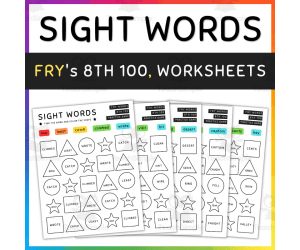
Color by Sight Word Game, High Frequency FRY Words, 8th 100 - SET 8
ELA, Reading, Language Development, Spelling, Vocabulary, Grade 2, 3, 4, Activities, Games
8th 100 Fry Sight Words, COLOR BY SIGHT WORDS WORKSHEETS, COLORING PAGES Looking for a fun and engaging way to reinforce Sight Words in your students? What can be a better way than fun Color By Sight Words Activity? This resource includes engaging Coloring sheets for 8th 100 Fry Sight Words. The words are in order of frequency. This NO PREP Easy to Use Worksheet Packet includes 20 pages in total with 100 sight words. Each page contains five different sight words written in different vibrant colors. There are different shapes like square, triangle, circles and stars on the sheet with sight words written inside of them. Students have to Color every shape with the color of Sight Word written in it. These worksheets are not only perfect for enhanced recognition of Sight Words but are also perfect for developing Fine motor skills while learning their sight words. Teachers can use these worksheets in different ways. Teachers can create fun ways to use these worksheets more efficiently like, ask the kid to pick their favorite shape on the worksheet and the ask them to read the sight word aloud, along with spelling it out. This will not only help in enhanced recognition but also will help to build vocabulary and spelling mastery. Then after that ask the student to look for that sight word on the top of the sheet and tell the name of the color that sight word is written in. Then ask the student to color that shape with the color of the sight word. This will motivate students to recognize and remember their High Frequency Words in more effective way and also have fun while coloring the worksheet. These worksheets are perfect for morning work, individual work, group work, working with partners, home work or class work. These Worksheets can also be used for Assessment . When children have already learnt their sight words, use these sheets to assess their knowledge with these engaging activity. These are also perfect to include in Sight Words Book, and teaching collection. These are perfect for End of the year and also Back To School Season. These are also perfect for Home Schoolers. These are very easy to use. Just Download, Print, Enjoy and save your time with these high quality Sight Word resource. Download your copy today to give your kids some fun activity with learning. You Will Receive: 1 PDF 20 Pages US Letter Size ( 8.5 x 11 )
Author TeacherYouWant
Tags Sight Words Practice, Color By Code, Coloring Game, Morning Work, Fry Sight Words, Eighth 100
No-Prep Substitute Teacher P.E. Pack – Professional Edition
P.E. & Health, Health, Mental Health, Mindfulness, Physical Education, Sports, Yoga, Life Studies, Coaching, Career, Grade 1, 2, 3, 4, 5, 10, 11, 12, Activities, Games, Projects, Teacher Tools, Charts, Assessments, Diagrams, Lesson Plans, Presentations, Graphic Organizers
Unlock the Ultimate No-Prep Substitute Teacher P.E. Pack – Professional Edition – Your Complete 46-Page Lifesaver for Emergency PE Lessons! Created especially for substitute teachers and school administrators, this instant-download digital PDF is your complete solution for no-equipment, high-energy PE lessons in any gym, PE classroom, or outdoor space! From the Substitute Survival Guide and Universal Warm-Up Protocol to Classic Tag Varieties, Relay Races for Large Groups, Simon Says Fitness Edition, Indoor Desk-Side Challenges, Rock-Paper-Scissors Tournaments, Cooperative Team Games, Red Light Green Light Remixes, and a complete Discipline & Behavior Cheat Sheet – it’s all included! Ideal for elementary PE sub plans, rainy-day indoor activities, or last-minute coverage, this pack will keep 20 to 100+ students engaged, safe, and moving while developing teamwork, focus, and sportsmanship. No printing needed, no equipment required – just open, read, and play! Perfect for K-8 physical education teachers in search of professional resources that will make you the hero sub every school needs. Instant access – chaos to confident, active learning in an instant! Why Parents/Schools Love It: Zero Prep, Maximum Impact: Subs walk in and start instantly – no prep work needed. Safety First & Inclusive: Built-in safety bubbles, freeze signals, cool-down zones, and adaptations for all abilities ensure every child is safe, active, and included. High Engagement, Low Chaos: Proven games + attention getters + behavior cheat sheet transform high-energy kids into focused, cooperative learners – school administrators rave about the calm transitions back into class. Standards-Aligned & Professional: Motor skills, teamwork, mindfulness – all while leaving detailed notes for the regular teacher. Versatile for Any Day: Indoors/outdoors, rain or shine – parents appreciate knowing their kids stay happy and healthy even when a substitute is needed! Target Student Classes : This content appears to be best suited for elementary- to early middle-school-aged students, specifically in the Grade K-8 range, with the best fit in the K-6 range. Primary focus: K-5 (Blob Tag, Hospital Tag, Simon Says Fitness, Remixes of Red Light/Green Light, Desk-Intervals, Imaginative Locomotor themes specifically mentioned as "primary" focus, K-3). Adaptable extensions: 4-8 (World Champ RPS, Strategic Relays, Human Knot, Competitive Cheering - these work well in the middle school setting). Not suited for high school students - no sports skills, no athletics, focus on fun, inclusive, low-cost, low-tech movement and classroom management techniques. Large group-friendly - 20 to 100+ students, gym or classroom setting. Copyright/Terms of Use: This Book was copyrighted by Syed Hammad Rizvi. This resource is for personal and single classroom use only. You cannot modify, redistribute, and sell this resource. In other words, do not place this resource on the Internet where it can be publicly found and downloaded. If you want to share this resource with your colleagues, please purchase the license from Teachsimple. Thanks for respecting the Terms of Use. This product is happily brought to you by Syed Hammad Rizvi
Author Creative Book Store
Rating
Tags SubstituteTeacher, NoPrepPE, PEGames, ElementaryPE, SubPlans, SubstitutePE, PhysicalEducation, NoPrepActivities, SubstituteTeacherPEPack, NoPrepSubstituteTeacher
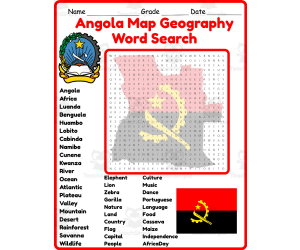
Angola Map Geography Word Search 2rd 3th 4th 5th Grade worksheet
Vocabulary, Language Development, ELA, Spelling, Geography, Social Studies, Grade 2, 3, 4, 5, Games, Activities, Word Searches, Worksheets, Worksheets & Printables
Make learning fun with a no-prep, printable vocabulary word search that builds vocabulary, reinforces literacy, and sparks curiosity! Students can explore the new vocabulary words while practicing spelling, scanning for letters, and identifying keywords. A word search can be a perfect and easy-to-use activity to liven up a lesson by combining learning with fun! It is an excellent way to reinforce concepts within a lesson and engage students' hands-on learning. Purpose: This activity allows students to learn new vocabulary words and contextualized vocabulary related to a topic ✏️, improve spelling, reading, and attention to detail 📚, increase awareness of concepts and knowledge about the world at large 🌍, and encourage curiosity and engagement about the topic 🐾. Word searches are a hands-on way to make learning memorable and fun for students - it engages them at all vocabulary levels! How to Do It: 1️⃣ Hand out the word search worksheet. 2️⃣ Introduce any important vocabulary or concepts that fit with the topic. 3️⃣ The students search for the words and circle or highlight each one. 4️⃣ Discuss the importance of the topic or the words that the student found. 5️⃣ Review the answers using the answer key that is included for each product ✅ Perfect For: Grades 2-5 🌟, independent practice, partner work, students who finish early, science or social studies centers, or for substitute plans 🤝 Way of Implementation: Great for independent practice early finishers, partner work, or substitute plans 🤝. Answer Keys: (these will be pencils under your three files: Given for simple checking and self-assessing. Fun Variations: Timed Challenge ⏳ - record how many words students can find in a set time. Partner Puzzle 🤝 - work together to find all of the words. Vocabulary Extension ✏️ - write sentences or a few short paragraphs using the words. Create-Your-Own Word Search 🧩 - have students make their own word search puzzles using the vocabulary. Standards Alignment: Supports CCSS/ELA vocabulary development, and can also connect to NGSS or other relevant standards, depending on the topic. File & Print Info: PDF includes both a color and black and white version, and is ink-friendly to make printing easy. Teacher Tip! Have students learn by being hands-on, engaged, and active while helping them build awareness, vocabulary, and literacy skills around any topic! 🌟
Author Classsim
Rating
Tags Angola, Map , Geography, Word Search, Word Search 2rd 3th 4th 5th Grade, Worksheet , Activity, Angola Map Geography Word Search , Angola Map Geography Word Search 2rd 3th 4th 5th Grade , Angola Map Geography Word Search 2rd 3th 4th 5th Grade Worksheet Activity
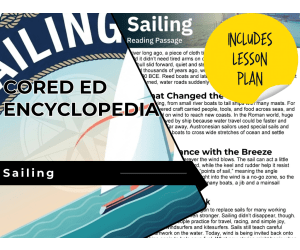
Sailing Reading Comprehension Passage - Cored Ed Encyclopedia
ELA, Language Development, Reading Comprehension, Reading, Pre-Reading, Science, Writing, Engineering, Technology, Physics, Grade 2, 3, 4, 5, Worksheets & Printables, Worksheets, Teacher Tools, Centers, Activities, Writing Prompts, Assessments, Quizzes and Tests, Quizzes, Lesson Plans
This sailing reading comprehension includes: Visualization (on the front cover) Start your lesson by taking a minute to think and share something about the topic. Read the script aloud (slowly), perhaps prepare some music or sound effects. Student close their eyes and let their imaginations wander. Students open their eyes, read the question aloud and give them a few minutes to complete. Ask a few students to share or keep answers until the end to compare with what they learn in the passage. Quick pause—thousands of Cored Education products are included with your TeachSimple membership. Download links and encyclopedia index available here. Pre-Reading Trivia Students will write down one thing they already know about the subject and then read five more facts and discuss. These facts are fun, and the students will enjoy learning about the subject before reading more. Give 1 minute for students to write what they already know (no pressure—best guess is fine). Read the five facts together. After each fact, do ask a student for their opinion, was it surprising? Set a purpose by asking students to highlight/underline one fact they want to learn more about during the reading. Reading Passage The text is a high-interest reading passage with set paragraphs, roughly three to four paragraphs long. It contains a variety of themes about the topic, anywhere from history to technology. The passage is between 250 and 350 words in length. First, ask students to look at the headings and see what they’ll learn about today. What do they know about the topic/heading? First read options: Teacher read-aloud (best for support). Partner reading (paragraph by paragraph). While reading, students underline important details, and vocabulary words they think may come up in the questions section. Mixed Questions The first question page contains four multiple-choice questions, each with a choice of four answers, and three written response questions that require a sentence or two from the student. Students complete the mcqs first independently, then review quickly as a class. For the 3 written responses, try to get students giving the answer with some form of evidence: “I think ___ because the text says ___.” If students get stuck, send them back to check the passage. Vocabulary Questions Practice seven key words from the text in this section across two activities. First section is scrambled words where students will unscramble three words given a clue for each. The second section is a word to meaning matching activity. Before starting, have some students read out words they underlined in the passage. Ask students to say the word and read aloud the sentence(s) around each word. Ask students to do scrambled words and the matching exercise in pairs then go through answers as a class. For the scrambled spelling task, get four pairs to come up to the board and write the words for extra practice with the other student reading out the clue. For the matching task, prompt students to give full sentences: “I matched ___ with ___ because ___.” Creative Writing In this question, the student will be required to write a five to eight sentence paragraph on a question related to the topic. Before starting, ask students write down 3 key ideas they are going to include in their piece. Ask students for ideas to share around the class to help those struggling. Pro writing expectations: 5–8 sentences At least 2 facts or details from the passage At least 2 vocabulary words from the previous page Students read their paragraphs while classmates listen for facts and vocabulary words. Extension Activities This page is optional for fast finishers or to take home. There are several activities, each one requiring a different skill. Do some, do none, do all, completely optional - but you will feel reassured knowing every possibility is planned for. Includes summary writting question. Answer Key There are answers for the multiple-choice questions, written response questions have sample answers, vocabulary answers and if there is a summary question then a sample summary will be provided as well. Lesson Plan Included Customized lesson plan for this lesson is included. Lesson Snapshot Title: Sailing Genre: Nonfiction (informational passage) Subject: Science (Forces & motion) / Social Studies (history of travel) Primary Topic: How wind powers boats and changed travel Estimated Guided Reading Level (A–Z): R What This Lesson Teaches Best How wind pushing on a sail can move a boat without rowing (sail as a “wind catcher” and cloth billowing). How sailing helped people travel farther and move supplies, from early boats to tall ships, including examples from Egypt, the Roman world, and Austronesian sailors. Key sailing concepts that affect movement and direction, including “points of sail,” the “no-go zone,” and zigzagging turns called tacks. How boat parts help sailing work: the sail pulling forward and the keel and rudder helping resist sliding sideways. How technology changed sailing’s role (steam engines replacing sails for many working ships) and how wind is being used again on some cargo ships to save fuel. Learning Goals Explain how wind pressing on a sail can move a boat forward. Describe how sailing grew from river boats to ships that carried people, tools, and food across seas. Identify why sailors use tacks and what the “no-go zone” means in the passage. Describe how the keel and rudder help a sailboat resist sliding sideways. Explain how sailing changed in the late 1800s and how wind is being used again today. Key Vocabulary From the Text hull — the main body of a boat. keel — a strong part that helps stop sliding sideways. rudder — a part that helps steer the boat. tacks — zigzag turns used to move into wind. cargo — goods carried on a ship. FULL CATALOG OF DOWNLOAD LINKS AND ENCYCLOPEDIA INDEX HERE
Author Cored Education
Rating
Tags Vocabulary, Reading Comprehension, Reading Passages, Reading, Creative Writing, Reading Strategies, Writing Prompts, Lesson Plans, Sailing, Engineering

Amelia's Road, by Linda Jacobs Altma Interactive Read-Aloud Activities
ELA, Reading, Reading Comprehension, Grade 2, 3, 4, Read Alouds, Activities
This picture book companion is a comprehensive supplemental resource for Amelia's Road, by Linda Jacobs Altman. It includes 34 ready-to-use, print-and-go activities designed to meet the needs of all learning levels. Created with teachers in mind, this resource saves you time while providing students with engaging opportunities to demonstrate their understanding and newly acquired knowledge through interactive read-alouds. The activities cover a range of skills, from basic comprehension to critical thinking. INCLUDED IN THIS RESOURCE: Making Predictions Judging by the Cover Story Elements Sequencing Recalling Events in Chronological Order Summary Story Event Sort Making Connections Making Inferences Character Traits Character Feelings Character Inside & Out Character Development Character Change Overcoming Obstacles Acrostic Poem Sketch a Scene From the Story Setting the Scene Compare & Contrast Left Behind Thinking About the Text Thinking Beyond the Text Theme 3-2-1 Author's Message Dear Ms. Ramos Dear Diary Special Places Amelia’s Map Crossword Puzzle Word Search Puzzle Wait... There's More! Treasured Things Book Review This resource is for extension read-aloud activities only. The book is not included.
Author Creatively Gifted
Tags Reading Comprehension, Reading, Upper Elementary Reading, Picture Book , Read-aloud Activities, Interactive Read-aloud Activities, Book Companion, ELAR
Judo Reading Comprehension Passage - Cored Ed Encyclopedia
ELA, Language Development, Resources for Teachers, Reading Comprehension, Reading, Pre-Reading, Writing, Strategies, Sports, P.E. & Health, Grade 2, 3, 4, 5, Worksheets & Printables, Worksheets, Teacher Tools, Centers, Activities, Writing Prompts, Assessments, Tests, Quizzes and Tests, Quizzes
This judo reading comprehension contains the following: Visualize on the Cover (Teacher Read Aloud Script) Start your lesson by taking a few moments to visualize the topic and share thoughts or feelings about it. Pre-Reading Trivia Students will write down one thing they already know about the subject and then read five more facts and discuss. These facts are fun, and the students will enjoy learning about the subject before reading more. Reading Passage The text is a high-interest reading passage with set paragraphs, roughly three to four paragraphs long. It contains a variety of themes about the topic, anywhere from history to technology. The passage is between 250 and 350 words in length. Mixed Questions The first question page contains four multiple-choice questions, each with a choice of four answers, and three written response questions that require a sentence or two from the student. Vocabulary Questions Practice seven key words from the text in this section across two activities. First section is scrambled words where students will unscramble three words given a clue for each. The second section is a word to meaning matching activity. Creative Writing In this question, the student will be required to write a five to eight sentence paragraph on a question related to the topic. Extension Activities This page is optional for fast finishers or to take home. There are several activities, each one requiring a different skill. Do some, do none, do all, completely optional - but you will feel reassured knowing every possibility is planned for. Answer Key There are answers for the multiple-choice questions, written response questions have sample answers, vocabulary answers and if there is a summary question then a sample summary will be provided as well. FULL CATALOG OF DOWNLOAD LINKS AND ENCYCLOPEDIA INDEX HERE Lesson Snapshot Title: Judo Genre: Nonfiction (Informational Text) Subject: Life Skills / PE & Health / Reading (Informational Text) Primary Topic: Judo’s origins, practices, values, and global sport Estimated Guided Reading Level (A–Z): P Learning Goals Explain how the book describes judo as the “gentle way,” using text details. Describe the main goals of a judo match and what actions are not the focus. Identify routines and behaviors in judo that show respect and help keep people safe. Describe how belts and the uniform connect to skill growth in judo. Summarize key milestones in judo’s history and spread around the world. Key Vocabulary From the Text jujutsu — older fighting styles Jigoro Kano studied. judogi — uniform worn in judo class. dojo — place where people train judo. pin — hold someone still on the mat. judoka — a person who practices judo. Cored Ed Encyclopedia Overview The Cored Ed Encyclopedia is a weekly series of lessons that you can pick up and use right away. These short readings fit into whatever time you have available. Each one includes a warm-up, a reading, and a set of questions, but it’s flexible — you can do just the reading, the full lesson, or skip the writing section if you need to. Each lesson focuses on a single topic so students don’t get lost. The writing is clear but never childish, making it perfect for grades two through five. Topics range from animals and science to history, inventions, and everyday things. No matter the level of the student, everyone should take away at least one new idea or fact from each lesson. The materials are easy to print, easy to explain, and require no setup. They work well for whole-class teaching, partner work, or independent study.
Author Cored Education
Rating
Tags Vocabulary, Spelling, Reading Comprehension, Reading Passages, Reading, Creative Writing, Reading Strategies, Writing Prompts, Judo, Sports

The Nightingale Fairy Tale Foldable Mini Book Grade 1 2 3 ELA ELL
Common Core, ELA, Literature, Reading, Writing, Grade 3, 4, 5, Centers, Activities, Worksheets & Printables, Worksheets, Projects
Encourage devotion through this purposeful learning tool The Nightingale Foldable Mini Book Set! Crafted for Grade 1, 2, 3 and 4 students, homeschoolers, and EFL / ESL learners, this resource is a sure winner to your reading class and reading centers. This pack contains the following: 1. The Nightingale Colored mini-book 2. The Nightingale Black and white mini-book with story tracing activities 3. The Nightingale Picture-fill mini-book for sequencing test or exercise 4. The Nightingale Black and white mini-book for story re-tell and writing exercise 5. The Nightingale Blank mini-book pages for story re-tell, writing and drawing exercises 6. The Nightingale Mini Books Sample lesson plan Each mini book is presented in 3 paper sizes to give more freedom to choose what suites your needs. With the five different mini-books to choose from, the possibilities for learning and exploration is endless! This activity can be used to supplement reading lessons, writing exercises, and a perfect assessment tool that can easily be a perfect addition to your students’ portfolio.
Author It's Teacher L
Rating
Tags Fairy Tale, Reading Comprehension, Sequencing, ELA, ELL, Reading Centers