



3,931 products added recently
Page 115 - 7th Grade Activities
Enhance your seventh-grade curriculum with activities that stimulate curiosity and intellectual growth. These resources cover diverse subjects and include projects that promote inquiry and analysis. Incorporate them to keep students motivated and invested in their learning.

 Show filters

MUSIC ESCAPE ROOM MEGAPack! (Instruments, Rhythm, Notes of Staff)
Creative Arts, Art, Music, Grade 4, 5, 6, 7, 8, 9, 10, 11, 12, Escape Room, Activities
Product: MUSIC ESCAPE ROOM MEGAPack! This comprehensive teaching resource will inject excitement and the spirit of teamwork into your upper elementary or lower middle school music classes. The key concepts include instruments, rhythm, and notes on the staff. Main Features Five Distinct Rooms: Comprising several engaging tasks. These tasks can be adapted for individual or group challenges. Versatile Game-play: Four different methods are available; timed completion, competition against other groups/classes, striving for personal bests across sessions, and gender-based challenges. Musical Adventure Progression In this unique escape room style activity, completing these tasks will earn students keys which they use to progressively unlock subsequent rooms. The ultimate achievement comes when students accomplish all tasks successfully; not only do they enter all five rooms but they also experience an exhilarating sense of accomplishment. Simplicity in Navigation The resource kit is neatly contained within one zip file with three PDFs and PowerPoints making navigation effortless. Teachers control progression through slides containing correct answers once a task has been concluded. Aimed at Music Educators Suitable for Music teachers dealing with Grade 4 through Grade 12 pupils! This product is sure to create rich learning environments focusing on music education by offering hands-on experiences in a relaxed setting while making abstract concepts much more tangible.
Author Mr Litts Music Room
Tags Escape Room, Music Education, Teamwork, Interactive Learning, Hands-on Activities

Create Your Galaxy Activity
Science, Earth and Environmental Sciences, Space, Grade 2, 3, 4, 5, 6, 7, 8, 9, 10, 11, Activities
Activity Introduction An amazing activity designed for the students to learn more about space facts. Create Your Galaxy Do you like reading about space? If yes, what is your favorite topic? What do you know about our solar system? What is the smallest planet in our solar system? What is the biggest plant in our solar system? What is the hottest plant in our solar system? And what is the coldest one? Do you think there are aliens? If yes, what do you think they look like? What do they eat and how they speak to each other? Where do they live? What is a galaxy? And what is a milky way? Have you recently saw a shooting star? If yes, tell us more about it, like when did it happen and where? What is a blackhole? Can a blackhole gets bigger by time? Do you like counting the stars? What do you think a star is made of? Create Your Galaxy Activity The activity is perfect for encouraging the researching skills for the students, while learning more about the fantastic space. Create Your Galaxy This friendly designed worksheet is suitable for students at school, homeschooling, and as a group activity. Instructions Cut each planet, asteroid, and comet you wan to include in your galaxy. Colour your spaceship, and crate a new planet if you want. Arrange the planets as you wish. The don't have to be in the correct order from the sun. Glue them to the first sheet. And how you have created your own galaxy! Format Available in a PDF format.
Author Educational Voice
Tags Create Your Galaxy Activity, Create Your Galaxy, Galaxy Activity, Galaxy, Galaxies, Galaxy Facts, Galaxy Facts For Kids, Planets, Planets Facts, Sun

Canada Fact Sheet Activity
Social Studies, Geography, Grade 3, 4, 5, 6, 7, 8, 9, Activities
Activity Introduction An amazing activity designed for the students to learn more about famous places in different countries. Canada What do you know about this place? Do you know in which part of the world it is? Have you ever visited this place? If yes, can you tell us more about your adventure, and what do you like the most about this place? Do you like reading about Geography? What is your favorite country in the whole world? If you are going on a trip where it will be? Which country? What you are going to see there? Does this country has a famous place to visit? Canada Activity The activity is perfect for encouraging the researching skills for the students, while learning more about this fantastic place. Canada Fact Sheet This friendly designed worksheet is suitable for students at school, homeschooling, and as a group activity. Instructions Find something interesting in Canada that starts with these letters: A G F M L W Y S H S H O Format Available in a PDF format.
Author Educational Voice
Tags Canada Fact Sheet Activity, Canada, Canada Facts, Canada Fats For Kids, Country, Countries, North America, Geography, Geography For Kids
NO PRINT How to Emoji Conversation Skills
Special Resources, Speech Therapy, Grade 6, 7, 8, 9, 10, Activities
NO PRINT How To Emoji Conversation Skills An interactive teaching tool apt for middle to high school students focused on improving social communication skills and achieving mastery over chatbox etiquette and emojis. Emoji Interpretation Digs into the intricacies of 31 different emojis, explaining the nuances in their expressions and emotions. Emphasis is placed on distinguishing between similar-looking emojis that convey different messages, such as a teardrop and a sweat drop. Tests & Quizzes Practical tests associated with every emoji-marker for better understanding Inclusion of quizzes to assess students' ability to identify varying emojis within simple captions. Practice Scenarios The product includes an engaging component of 60 mock text scenarios perfect for harnessing conversational skills while handling subtleties such as sarcasm in textual dialogues. User Interaction Beyond reading messages, learners also cultivate response crafting by choosing suitable reactions from a set list of six emojis per conversation round. User-friendly Interface Maintains easy navigation with functional arrows allowing seamless transitions between sections alongside offering versions in interactive PDFs and BOOM CARDS™. Note: Suited under Special Resources category specifically catering to the Speech Therapy section suitable from Grade 6 through Grade 10 making it indispensable not only for public teachers but homeschooling parents too! Last line: Experience meaningful education meeting advanced technology with NO PRINT How To Emoji Conversation Skills – innovation tailored directly towards today's digital generation.
Author Intrepid Speech Therapy Materials
Tags Interactive Learning, Social Communication Skills, Chatbox Etiquette, Emoji Symbols, Emotional Understanding, Skills Emoji, Emoji Conversation

Old World Globe Photoshop Activity 2
Science, Technology, Grade 7, 8, 9, 10, Activities
Students will work with digital tools in the Old World Globe Photoshop Activity . Students will use elements to create an old world map and then transform it into a globe. Step by step directions are included.
Author OK Products
Tags Old World Globe, Map, Mapping Skills, Clip Art, Graphics, Technology, Computer Science, Computer Project, Small Group, Photoshop

Elements and Compounds - Smart Board Bingo - Middle School Science
Science, Chemistry, Grade 5, 6, 7, 8, 9, Activities, Games
Smart board bingo includes questions on atoms, molecules, elements, compounds, symbols, formulae and naming compounds. A numbered question is generated randomly and, if that number is on their bingo card, students write in the answer. So much fun students don’t realise they are learning! Smart board bingo includes questions on: atoms and molecules; elements and compounds; chemical symbols; formulae; naming compounds. What is Included Random question generator for smart board (interactive white board) – 54 questions 48 bingo cards Answers PowerPoint Answer sheet Suggested Lesson Plan Play bingo – students write the answers into the square on their bingo card which matches the question number in the smart board. Teacher uses answer sheet to check card of winners of lines and full house Pupils use answer PowerPoint to check their answers at end of game.
Author Elf off the Shelf Resources
Tags Science Bingo, Chemistry Bingo, Smart Board Bingo, Elements Digital Activity, Compounds Digital Activity, Element Bingo

TinkerCAD step-by-step instructions for Bird Whistle
Special Resources, Grade 5, 6, 7, 8, 9, 10, 11, 12, Activities, Projects
TinkerCAD step-by-step instructions for Bird Whistle. Students only need to know the bare basics to complete this. I tested this with a fifth-grade class and most could complete it with no help. Designed to print with no supports for easy printing. Include TinkerCAD tool guide! Has a content page. Great beginners’ tool for learning to make 3D models and learn TinkerCAD. TinkerCAD is a free online program that makes 3D model that work on 3D printers, laser etching machines, water jets, plasma cutters and many more!! Tinkercad is an easy-to-use, browser-based computer-aided design (CAD) software developed by Autodesk. It is primarily used for creating and designing 3D models, particularly in the field of 3D printing. Tinkercad is popular among beginners and hobbyists due to its intuitive interface and simplified tools. Here are some key features and uses of Tinkercad: 1) 3D Modeling: Tinkercad allows users to create 3D models by combining basic shapes and manipulating them using tools such as scaling, rotating, and moving. It provides a wide range of primitive shapes like cubes, spheres, cylinders, and more, which can be customized to create complex designs. 2) Design Customization: Users can apply various modifications to their designs, including resizing, rounding edges, adding text, creating holes, and aligning objects. These tools help in refining the models and making them suitable for specific purposes or fitting them with other components. 3)Import and Export: Tinkercad supports the import of existing 3D models in STL and OBJ formats, allowing users to modify and incorporate them into their designs. It also offers export options to save the designs as STL files, which are widely used in 3D printing. 4) Collaboration and Sharing: Tinkercad provides features for collaboration, allowing multiple users to work on the same project simultaneously. It enables real-time sharing and editing, making it convenient for team projects or educational purposes. 5) Electronics Integration: One notable aspect of Tinkercad is its integration with electronics. It offers a range of electronic components, including resistors, LEDs, motors, and microcontrollers, which can be used to create interactive models and prototypes. Users can simulate circuit connections and test their designs before implementation. 6) Educational Tool: Tinkercad is widely used in educational settings, particularly for teaching students about 3D design, modeling, and prototyping. Its simple interface and beginner-friendly tools make it accessible to users of all ages and skill levels. Overall, Tinkercad is a versatile and user-friendly CAD software that allows individuals to create and customize 3D models. Whether you're a hobbyist, student, or professional, Tinkercad provides a valuable platform for designing, prototyping, and exploring the world of 3D printing and modeling. Total pages: 32 pages Commands to be learned: Group Ungroup Align Mirror Duplicate Holes Solids Rotate Move Drop Subjects: Geometry Engineering Career and technical education Types: Projects Handouts Printables
Author MontyWorks
Tags TinkerCAD, 3D Printing, 3D Printer, Projects

Middle School Math Stations or Centers: Statistics and Probability
Math, Percentages, Fractions, Graphing, Statistics, Grade 5, 6, 7, 8, Centers, Activities
Math stations are a great way to get students engaged as they move about the room and work collaboratively with their peers. But they are a lot of work to prepare! This ready-to-go set of 5 stations will supplement a unit about statistics and probability including probability using dice, spinners, and coins; calculating measures of central tendency- mean, median, and mode; and converting theoretical and experimental probability into percentages. Ways to Use: You can break your class into 5 groups and have them rotate one at a time through the centres, giving them 10-20 minutes at each one. Or, start students at certain centres and then allow them to move around at their own pace as long as no one centre gets too full. I find these are a great resource as you are finishing your unit and preparing for the unit test. Station 1: Students solve four word problems using probability and statistics. Students need to know how to calculate an average. (optional: set out white boards for students to use) Station 2: Students explore the probabilities involved when rolling two dice. (supplies needed: several 6-sided dice) Station 3: Students graph data in a dot plot and calculate measures of central tendency. Students need to know the difference between mean, median, and mode and how to make a dot plot. Station 4: Students play a probability game and compare theoretical and experimental probability (and fairness). (supplies needed: paper clips for spinners) Station 5: Students apply what they have learned to a real-life situation (flipping coins), and practice writing and drawing about their mathematical thinking. (optional: set out laptops or tablets for the online game extension) ***Answer Key Included*** Grades to Use With: These stations will work well in grades 5-8 or high school special education classrooms. Standards: CCSS5.MD.B.2 Make a line plot to display a data set of measurements in fractions of a unit (1/2, 1/4, 1/8). Use operations on fractions for this grade to solve problems involving information presented in line plots. For example, given different measurements of liquid in identical beakers, find the amount of liquid each beaker would contain if the total amount in all the beakers were redistributed equally. CCSS6.SP.A.2 Understand that a set of data collected to answer a statistical question has a distribution which can be described by its center, spread, and overall shape. CCSS6.SP.B.4 Display numerical data in plots on a number line, including dot plots, histograms, and box plots. CCSS6.SP.B.5c Giving quantitative measures of center (median and/or mean) and variability (interquartile range and/or mean absolute deviation), as well as describing any overall pattern and any striking deviations from the overall pattern with reference to the context in which the data were gathered. CCSS7.SP.A.1 Understand that statistics can be used to gain information about a population by examining a sample of the population; generalizations about a population from a sample are valid only if the sample is representative of that population. Understand that random sampling tends to produce representative samples and support valid inferences. CCSS7.SP.C.5 Understand that the probability of a chance event is a number between 0 and 1 that expresses the likelihood of the event occurring. Larger numbers indicate greater likelihood. A probability near 0 indicates an unlikely event, a probability around 1/2 indicates an event that is neither unlikely nor likely, and a probability near 1 indicates a likely event. CCSS7.SP.C.6 Approximate the probability of a chance event by collecting data on the chance process that produces it and observing its long-run relative frequency, and predict the approximate relative frequency given the probability. For example, when rolling a number cube 600 times, predict that a 3 or 6 would be rolled roughly 200 times, but probably not exactly 200 times. If you enjoy these math stations, check out my other packs of 5 stations each for intermediate and middle school math classrooms: 5 Math Stations for Factors, Multiples, Prime and Composite 5 Math Stations for Decimals and Percent 5 Math Stations for Early Algebra
Author Grace Under Pressure
Tags Math Stations, Middle School Math, Statistics, Probability, Experimental Probability, Mean, Median, Mode, Math Game, Dice, Probability Activities Middle School, Probability Projects Middle School

Thermal Camera Activity
Science, Technology, Grade 3, 4, 5, 6, 7, 8, 9, Activities
Activity Introduction An amazing activity designed for the students to learn more about STEM subjects. Thermal Camera Do you like STEM subjects? what is your favorite one? Have you ever tried to plant a seed? If yes, tell us more about it. Or have you ever tried to invent something? If yes, tell us more about it. And how do you think it will help us? Have you ever seen a microorganism under a microscope? What was it? And how it looked like? Mathematics is a marvelous subject. Let' sharpen our brains and solve some equations. Do you like timetable tricks? What is your favorite one? Do you know how to code? Have you ever created an app or a game before? If yes, how was it like? Thermal Camera Activity The activity is perfect for encouraging the researching skills for the students, while learning more about this topic. Thermal Camera This friendly designed worksheet is suitable for students at school, homeschooling, and as a group activity. Instructions Draw what a thermal camera might show under the cloak. Can you describe how thermal cameras work? Format Available in a PDF format.
Author Educational Voice
Tags Thermal Camera Activity, Thermal Camera, Thermal Camera Facts, Thermal Camera Facts For Kids, STEM, STEM Facts, Stem Facts For Kids, Technology
Reading Comprehension on Motion and Energy (Videos)
ELA, Reading, Reading Comprehension, Common Core, ESL, Language Development, Pre-Reading, Resources for Teachers, Physics, Science, Grade 5, 6, 7, Teacher Tools, Activities
Accompanying Videos Based on Reading Passages on Motion and Energy for Physical Science These accompanying videos contain scripts extracted from the Science Reading Passages series. With stock footage, subtitles, voiceovers, animation and diagrams, they will help students understand the topic more. Ideal for starting or ending a lesson, each video runs at less than 5 minutes and is at least 95% identical to the passage itself. What's inside this Motion and Energy product? Part 2 Videos - Motion & Energy Reading Passage 1: Kinetic & Potential Energy Reading Passage 2: Force & Motion Reading Passage 3: Simple Machines Reading Passage 4: Simple Machines 2 Reading Passage 5: Thermal Energy Reading Passage 6: Sound & Light Energy Science Reading Comprehension Outline: Introducing a comprehensive resource tailored for 5th and 6th graders, this product offers enriching reading passages supplemented with illustrative pictures and graphs to clarify key concepts. Aligned with the Common Core State Standards (CCSS), it offers a hassle-free approach to teaching, given that the bulk of the preparation is already done for you. The passages present a diverse set of questions – from multiple choice to data analysis and fill-in-the-blanks. This ensures a rich blend of high-interest content and fundamental curriculum -based science themes. With its versatility, you can seamlessly integrate these lessons into various classroom settings, whether it's whole class discussions, morning exercises, independent desk tasks, small group engagements, contingency plans for substitute teachers, regular homework assignments, or even themed activities for holidays. FULL CATALOG OF DOWNLOAD LINKS HERE Grade 5/6 Links: Physical Science Part 1 - Physical and Chemical Properties Google Docs/Slides/Forms PDF PPT Word Free Supplementary Pack Accompanying Videos Physical Science Part 2 - Motion and Energy Google Docs/Slides/Forms PDF PPT Word Free Supplementary Pack Accompanying Videos Physical Science Part 3 - Electricity and Magnets Google Docs/Slides/Forms PDF PPT Word Free Supplementary Pack Accompanying Videos Life Science Part 1 - Cells, Reproduction and Genetics Google Docs/Slides/Forms PDF PPT Word Free Supplementary Pack Accompanying Videos Life Science Part 2 - Human Body Systems Google Docs/Slides/Forms PDF PPT Word Free Supplementary Pack Accompanying Videos Life Science Part 3 - Plant Parts and Ecosystems Google Docs/Slides/Forms PDF PPT Word Free Supplementary Pack Accompanying Videos Earth Science Part 1 - Plate Tectonics and Rock Cycle Google Docs/Slides/Forms PDF PPT Word Free Supplementary Pack Accompanying Videos Earth Science Part 2 - Ocean Exploration and Natural Resources Google Docs/Slides/Forms PDF PPT Word Free Supplementary Pack Accompanying Videos Earth Science Part 3 - Weather and Solar System Google Docs/Slides/Forms PDF PPT Word Free Supplementary Pack Accompanying Videos For similar products and other frees, do check out Cored Group on TeachSimple .
Author Cored Education
Tags Science, Elementary, Reading, Comprehension, Vocabulary, Answers, Physics, Physical Science, Ccss, Common Core

Cool Runnings (1993): Complete Movie Guide
P.E. & Health, Sports, Grade 6, 7, 8, Activities
Cool Runnings (1993): Complete Movie Guide Designed to engage middle-grade students, from grade 6 to 8, particularly those with interest in Physical Education and Health, this comprehensive teaching resource provides an excellent way for educators to teach significant life values and knowledge about various sports. Developed around the popular 1993 comedy Cool Runnings, based on the true account of the Jamaican National bobsleigh team's journey to the Calgary Winter Olympics in 1988; this resource provides both insight and inspiration. The film showcases how four determined athletes represent their country on a global platform while dealing with obstacles including discrimination and ridicule. Comprehensive learning approach: Cool Runnings (1993): Complete Movie guide's standout feature is its comprehensive approach towards learning through entertainment. The package includes thought-provoking questions devised to keep learners engaged throughout the film screening — suitable for either whole group discussions or small group activities. Fact vs Fiction Powerpoint presentation: A detailed comparison between real events versus movie fiction revolving around Jamaican bobsled team - great supplement for post-movie analysis. Teacher version: Aids in focusing better on individual student needs – ideal for diverse classroom environments or homeschooling scenarios. Ready-to-use making it highly time-effective too! Editablse student version: Adds room for personalization as per unique requirements – can be used as homework assignment or extra challenges designed per capability levels of each student. Easily manageable & Comprehensive: The 'Cool Runnings' teaching resource supports multiple file types hence easily manageable digital addition. It efficiently encompasses education and entertainment making learning about sports, values and the world truly engaging.
Author EduPal Learning
Tags Sportsmanship, Perseverance, Teamwork, Discrimination, Underdog Story

WWII Hero Activity
Social Studies, History: World, History, Grade 4, 5, 6, 7, 8, 9, 10, Activities
Activity Introduction An amazing activity designed for the students to learn more about history. WWII Hero Do you like history? Which topic do you really enjoy about history? Have you ever read an interesting fact about the Vikings? If yes, can you mention them? What do you like most about the Victorian era? Can you name all the Tudors? Have you ever wondered how people used to live in ancient Japan and ancient China? Do you know any interesting facts about ancient Egyptians and the Pharaohs? Have you ever visited South America? What do you know about Incas and Aztecs? Celtic culture was really one of a kind, can you name any of the places that Celts used to live in? Imagine yourself living during the ancient Roman empire, how your life will look like? Ancient Greece was an amazing place to live in. What do you know about ancient Greek life? WWII Hero Activity The activity is perfect for encouraging the researching skills for the students, while learning more about history. WWII Hero This friendly designed worksheet is suitable for students at school, homeschooling, and as a group activity. Instructions Look for one of the most celebrated World War II soldiers and write a short biography about them. Format Available in a PDF format.
Author Educational Voice
Tags WWII Hero Activity, WWII Hero, WWII Heros, WWII Activity, WWII Activity For Kids, WWII , WWII Facts, WWII Facts For Kids, History, History Fcats
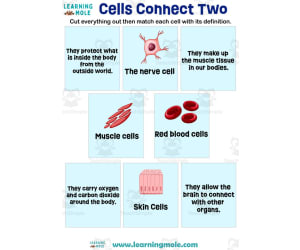
Cells Connect Two Activity
Science, Life Sciences, Human Body, Biology, Grade 3, 4, 5, 6, 7, 8, 9, 10, Activities
Activity Introduction The human body is full of fascinating wonders to learn. This activity is created to help the students recognize the anatomy and the job of the human body. Cells Connect Two Every part and organ in our human body is vital so let's see how important they are. Have you ever imagined how we look like if we didn't have a skeleton? Did you know that because we have our amazing muscles we can stand! Do you know how many teeth do we have? Have you ever wondered about the food journey inside our body? Can you name all the glands in our body? Why do we have skin? Our nervous system is really good at sending signals. Can you tell us more about it? Are you really good at Mathematics, painting, or any other thing? You should really thank your brain about it! The famous five senses are really doing a great work? Can you explain how every sense works? Cells Connect Two Activity The activity is perfect for encouraging the researching skills for the students, while learning more about our fantastic human body. Cells Connect Two This friendly designed worksheet is suitable for students at school, homeschooling, and as a group activity. Instructions Cut everything out then match each cell with its definition. Format Available in a PDF format.
Author Educational Voice
Tags Cells Connect Two Activity, Cells Connect Two, Cells, Cells Facts, Cells Facts For Kids, Human Body, Human Body For Kids, Human Body Facts, Human Body Facts For Kids
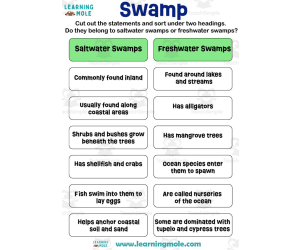
Swamp Activity
Science, Earth and Environmental Sciences, Earth Sciences, Environmental Science, Grade 3, 4, 5, 6, 7, 8, 9, Activities
Activity Introduction An amazing activity designed for the students to learn more about STEM. Swamp Do you like STEM subjects? what is your favorite one? Have you ever tried to plant a seed? If yes, tell us more about it. Or have you ever tried to invent something? If yes, tell us more about it. And how do you think it will help us? Have you ever seen a microorganism under a microscope? What was it? And how it looked like? Mathematics is a marvelous subject. Let' sharpen our brains and solve some equations. Do you like timetable tricks? What is your favorite one? Do you know how to code? Have you ever created an app or a game before? If yes, how was it like? Swamp Activity The activity is perfect for encouraging the researching skills for the students, while learning more about this fantastic topic. Swamp This friendly designed worksheet is suitable for students at school, homeschooling, and as a group activity. Instructions Cut out the statements and sort under two headings. Do they belong to saltwater swamps or freshwater swamps? Format Available in a PDF format.
Author Educational Voice
Tags Swamp Activity, Swamp, Swamps, Swamps Facts, Swamps Facts For Kids, Swamps Activity, STEM, STEM Facts, STEM Facts For Kids, Environment

Finding Percent of a Decimal Digital Self-Checking Activity
Math, Percentages, Decimals, Grade 7, Activities
Finding Percent of a Decimal Digital Self-Checking Activity This teaching tool has been specially designed for teachers who are looking to enhance the understanding of their students about percentages and decimals. This instructional guide is titled 'Finding Percent of a Decimal Digital Self-Checking Activity'. Primarily for Grade 7 math learners, it focuses on operations involving percentages and decimals. The activity aims to provide an alternative to regular worksheets with a digital interface hosted on Google Sheets. As students solve each problem, an integrated self-checking system lights up green or red based on the correctness of their solution. Teachers can use this as a classroom exercise or assign it as homework or morning work. All-in-one resource: The package includes 12 problems dealing with finding the percent of a decimal in Google Sheets format. Educational value: The accompanying student recording sheet encourages learners to understand and learn through their mistakes systematically. Ease for teachers : An included teacher's answer key significantly reduces prep-time allowing educators more time for interactive teaching techniques! No Extra Preparation Needed! With no extra preparation necessary beforehand, this tool is particularly user-friendly for teachers working towards lesson planning while dealing with online classes. You can integrate this into your Google Drive and effortlessly share among your students via Learning Management Systems like Google Classroom!
Author Digitally Yours Shop
Tags Percentages, Decimals, Digital Activity, Self-checking, Google Sheets

Magnetism Dominoes Game for Middle School
Science, Physics, Grade 5, 6, 7, 8, Activities, Games
No numbers on these dominoes, just questions and answers. The game is suitable for all abilities as it can be played by matching two of the same question or a question with its answer. An animated PowerPoint explains how the game is played. This game is so much fun, pupils will forget they are learning! Prior Knowledge Composition of Magnets: Magnets are constructed using magnetic materials. Common materials include Iron, Cobalt, Nickel, and their corresponding alloys. Pole Interactions: Magnets have two types of poles - North and South. When two like poles (e.g., North and North) come close to each other, they repel. Conversely, when opposite poles (e.g., North and South) are brought together, they attract each other. Magnetic Fields: Surrounding every magnet is an invisible force field known as the magnetic field. This field can be visualized through field lines. Field Line Density: The density of these field lines determines the strength of the magnetic field. A region with closely spaced field lines indicates a stronger magnetic field than a region where they're spread out. Visualization of Field Lines: It's essential to understand and recognize the pattern of field lines around two bar magnets, especially when they have the same or opposite poles facing each other. Field Strength at Poles: The magnetic field is strongest at the poles of a magnet due to a higher concentration of field lines. Distance and Field Strength: The strength of the magnetic field diminishes as one moves farther from the magnet. Direction of Field Lines: Field lines emanate outward from the magnet's south pole and point inward toward the north pole. Magnetization Process: When a non-magnetized magnetic material becomes a magnet, the tiny regions within it called domains, which were initially oriented in random directions, align themselves to point uniformly in the same direction. Earth's Magnetic Properties: The Earth behaves like a large magnet. Interestingly, there appears to be a south-type magnetic pole near the Earth's geographic North Pole and a north-type magnetic pole near the Earth's geographic South Pole. Application in Devices: It would be beneficial to have a basic understanding of how magnets and magnetic fields operate within certain devices. Familiarize yourself with the structure and functioning of electric bells, relays, and circuit breakers, as they use these principles. What You Get 90 dominos Animated PowerPoint explaining the rules and how to play. How to Play Each player chooses seven dominos from the top of the face-down pile and holds them in their hand like playing cards. The player who has the longest full name starts and play proceed in a clockwise direction. Players match a question exactly or a question with its answer with the answer. A player can challenge a match if they think it is wrong. Pupils are encouraged to check their books for the correct answer and consult their teacher if a consensus is not reached. If the challenge is correct, the challenger gives one of their cards to the other player. If the challenge is wrong, the challenged player gives one of their cards to the challenger. If a player cannot play a domino, they pick up from the face down pile and can play if possible or add it to their hand. See more Elf Off the Shelf resources on this topic and many others.
Author Elf off the Shelf Resources
Tags Magnets, Electromagnets, Magnetic Materials, Magnetic Fields, Earths Magnetism, Electricbell, Electric Relay, Circuit Breakers, North And South Poles, Magnetic Field Lines

Barriers or Bridges to Friendship Boom Cards
Life Studies, Special Resources, Life Skills, Grade 4, 5, 6, 7, 8, Activities
The Barriers or Bridges to Friendship Boom Cards This is an educational resource designed for students in grades 4-8, consisting of 25 playing cards. It provides learners with the opportunity to understand the differences between barriers and bridges when resolving friendship conflicts. Features Includes various scenarios featuring both constructive and destructive behavioral patterns. Highlights aggressive and passive-aggressive responses as unhealthy ways of conflict resolution. Promotes assertive problem-solving methods as healthier alternatives. Adaptability This resource can be used flexibly, ranging from traditional classroom settings to homeschooling arrangements. It supports interactive group discussions and independent self-learning opportunities for each individual student. Requirements The Boom Cards require an internet connection and are compatible across Chrome, Safari, Firefox, Edge browsers as well as android devices,iPads,iPhones,and Kindle Fires.Accesibility requires a registered account with Boom Learning platform due to security reasons. 'Fast Pins', which allows immediate student feedback and facilitates self-grading procedures complementing real time tracking of student activity is also a feature worth mentioning here. However,to access advanced assignment options including reporting back important learner consumption data,a premium account would be needed.New users can assess these benefits freely during trial period. <Linking theory with practical life situations,this all-inclusive teaching resource aims at helping young minds constructively decipher complex social dynamics leading towards nurturinga healthier,happier interpersonal relationships.
Author Jennifer Moyer Taylor
Tags Friendship Conflicts, Life Skills, Constructive Problem-solving, Social Dynamics, Student Engagement
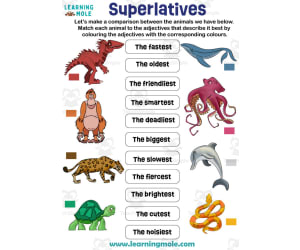
Superlatives Activity
ELA, Grammar, Grade 1, 2, 3, 4, 5, 6, 7, Activities
Activity Introduction An amazing activity designed for the students to learn more about languages. Superlatives Do you enjoy learning English? Which topic do you like the most Grammar, writing, reading, spelling, comprehension, vocabulary or phonics? Have you ever tried to learn any other language? If yes, tell us more about it? How many languages are spoken in the world? What do you think the most interesting one? Can you say Hello in Spanish, French or even Japanese? You can give it a try! Can you name the countries that speaks Portuguese? How many countries speaks Dutch? What is the less spoken language in the whole world? Would you like to learn a new language someday? If yes, which language will you choose? Superlatives Activity The activity is perfect for encouraging the researching skills for the students, while learning more about world languages. Superlatives This friendly designed worksheet is suitable for students at school, homeschooling, and as a group activity. Instructions Let's make a comparison between the animals we have below. Match each animal to the adjectives that describe it best by colouring the adjectives with the corresponding colours. Format Available in a PDF format.
Author Educational Voice
Tags Superlatives Activity, Superlative, Superlatives, Superlatives Facts For Kids, Superlative Facts, English, English Facts, English Facts For Kids, Grammar, Grammar Activity
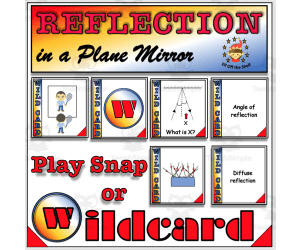
Light - Reflection Wildcard and Snap Card Games for Middle School
Science, Physics, Grade 5, 6, 7, 8, 9, Activities, Games
Light - Reflection Wildcard and Snap Card Games for Middle School An essential teaching tool designed to consolidate knowledge on light reflection amongst middle school students. This pack of 78 cards caters to three different games, providing an interactive approach for effective learning. Focus area: The game resources contribute towards building a strong foundation on the topic of reflection in a plane mirror, one that is cardinal in understanding basic physics principles. Detailed instructions are easy to understand thanks to the provided animated PowerPoint presentation. Prior Understanding Required: Interpreting transparent, translucent and opaque materials; Distinguishing between luminous and non-luminous objects; Familiarisation with terms such as incident rays, reflected rays along with angles of incidence and reflection. Versatility of Use: Suitable for various classroom scenarios - from group activities promoting collective learning or smaller clusters permitting concentrated instruction. These games could also be part of homework assignments for individual practice. "An instructive route towards science education mixed with fun!" Coupled with scientific content like how our eyes perceive images in a plane mirror or why images are formed behind it; these card games provide an inventive way to absorb these scientific teachings effectively. Further discussions incorporating topics like periscope imaging & diffused/specular image effects enrich the play & learn experience! Suited For: Educators – within public schools or homeschooling groups – who teach grade 5-9 Physics-related subjects find this resource beneficial. It intentionally imparts key concepts without being overly academic. Complexities tied up with traditional chalk-and-talk methodologies become increasingly evident given student’s proven receptiveness towards active learning environments. Enhance the understanding of such technical topics which elucidate light’s properties & it's interactions proficiently through " Light - Reflection Wildcard & Snap Card Games " package that guarantees engagement & a valued learning experience.
Author Elf off the Shelf Resources
Tags Light Reflection, Interactive Resource, Hands-on Learning, Card Games, Physics Education

Horse Facts Activity
Science, Life Sciences, Biology, Animals, Grade 2, 3, 4, 5, 6, 7, Activities
Activity Introduction An amazing activity designed for the students to learn more about famous places in different countries. The Horses Do you like animals? what is your favorite one? Do you own a pet? If yes, tell us more about it, like what its name? And what do you like most about it? What are the animal kingdoms? Can you write down the characteristics of each animal class like mammals, birds, reptiles, amphibian, fish and mollusks. Do you know that some animals can sing, can you name any of them? What is the largest and the smallest mammal in the world? What is the largest and the smallest bird in the world? What is the largest and the smallest fish in the world? Horse Facts Activity The activity is perfect for encouraging the researching skills for the students, while learning more about this fantastic place. Horse Facts This friendly designed worksheet is suitable for students at school, homeschooling, and as a group activity. Instructions Can you label these body parts of the horse? What's the horse's diet? What are some interesting facts about horses? Format Available in a PDF format.
Author Educational Voice
Tags Horse Facts Activity, Horse, Horses, Horses Facts, Horses Facts For Kids, Animal, Animals, Animals Facts, Animals Facts For Kids
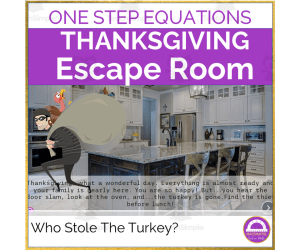
Thanksgiving Digital Escape Room One Step Equations | Who Stole the Turkey?
Math, Algebra, Grade 6, 7, 8, Escape Room, Activities
What if you could have a fun Thanksgiving activity that reinforced your students' one-step equation skills? "Who Stole the Turkey" is a fun, interactive way for your students to practice algebra concepts. With the premise that someone has stolen the Thanksgiving turkey, your students will explore an interactive kitchen filled with activities, and hidden messages. Upon completing all 22 one-step equations, Thanksgiving dinner will be ready and the thief will be revealed!
Author Matemaths
Tags Math, Equations, One Step, Thanksgiving, Escape Room, Thanksgiving Escape Games

Brain Teasers in English
ELA, Grade 4, 5, 6, 7, Activities, Games
Brain Teasers in English is an engaging small group activity that strengthens students' critical thinking, collaboration, and language skills. Students work in teams of 2-3 to solve a variety of brain teasers. Each team is given question cards to review and has 2 minutes to write down 3 possible answers per question. Teams earn points for correct answers. An answer sheet follows each question. Educators can facilitate this 15-30 minute activity whole class or during stations. They can also turn it into a friendly competition, offering homework passes, bonus points, or small prizes to the winning team. This versatile resource allows students to think creatively, problem-solve collectively, and have fun with language. The brain teasers range in difficulty, getting learners to analyze words and phrases from new perspectives. Implement Brain Teasers in English to energize your middle school Language Arts lesson.
Author Golden Promise
Tags Brain Teasers, Language Arts, Language Activities, Listening, Comprehension
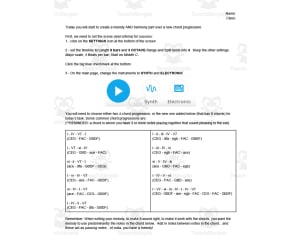
Chrome Music Lab 1-5: Major Scale Melody and Harmony
Creative Arts, Art, Music, Grade 6, 7, 8, Activities
This is a Chrome Music Lab 1-5: Major Scale Melody and Harmony. This music lab will provide step by step directions for students to follow along with. This is a great interactive lesson for your music students.
Author Adam Brox Music Store
Tags Music Lesson, Chrome Music Lab, Major Scale Melody, Harmony, Interactive Lesson, Chrome Music Lab Melody Maker

Lava Activity
Science, Earth and Environmental Sciences, Earth Sciences, Environmental Science, Grade 3, 4, 5, 6, 7, 8, 9, 10, Activities
Activity Introduction An amazing activity designed for the students to learn more about natural disasters in different countries. Lava What do you know about this natural disaster? Do you know in which part of the world this could happen? Have you ever read about the safety misusers that we could have to protect ourselves from this natural disaster? If yes, can you tell us more about them? Can you name other natural disasters? If yes, tell us more about where they are likely to happen? And how frequently? Do you like reading about Geography? What is your favorite country in the whole world? If you are going on a trip where it will be? Which country? What you are going to see there? Does this country has a famous place to visit? Do you like reading about Geology? If yes, what is your favourite topic? Lava Activity The activity is perfect for encouraging the researching skills for the students, while learning more about this fantastic place. Lava This friendly designed worksheet is suitable for students at school, homeschooling, and as a group activity. Instructions Where does lava come from? Colour the parts where it comes from the Earth's layers, then write down how lava is formed. Format Available in a PDF format.
Author Educational Voice
Tags Lava Activity, Lava, Lava Facts, Lava Facts For Kids, Natural Disaster, Natural Disasters, Natural Disaster Facts, Natural Disasters Facts For Kids, Volcano , Volcano Facts