



3,923 products added recently
Page 73 - 7th Grade Activities
Enhance your seventh-grade curriculum with activities that stimulate curiosity and intellectual growth. These resources cover diverse subjects and include projects that promote inquiry and analysis. Incorporate them to keep students motivated and invested in their learning.

 Show filters


Independent, Dependent & Controlled Variables Lesson
Science, Basic Science, Grade 4, 5, 6, 7, 8, Activities, Experiments
This fun science lesson is a great introduction for a science fair unit or a beginning of the year scientific method unit when you need to teach your students how to carry out a true experiment . It teaches students about independent, dependent and controlled variables using humour and real-life situations. The first page has fill-in-the blank notes about a pretend experiment I completed that had some mistakes in the design. Students should stay engaged and focused throughout the lesson component as they have to fill in the blanks. They should start to think about why controlling variables matters, and they learn the relevant vocabulary. The second page gives students a chance to start brainstorming some basic experimental design ideas on their own or in pairs. They are given three situations and need to think of independent variables they could alter, what dependent variable that would affect, and all of the other variables they would need to carefully control. At the end, there is a quick review to reinforce the relevant vocabulary. Grades to Use With: This lesson can easily work in a variety of grades in the middle years, from grades 4-8 and possibly beyond! Standards: NGSS3-5-ETS1-3 Plan and carry out fair tests in which variables are controlled and failure points are considered to identify aspects of a model or prototype that can be improved. If you enjoy this science activity, check out some other options in my store: Personal Carbon Emissions /Footprint: Integrated Math and Earth Sciences Lesson: Ways to Slow Climate Change Periodic Table: Element Baseball Cards STEM Project: Extreme Environment Technology Design and "Shark Tank" Presentation STEM Project: Climate Change Solutions 8 Low-Prep STEM Tasks for Elementary and Middle School Students: Simple Handouts for Each Experiment
Author Grace Under Pressure
Rating
Tags Science Experiments, Independent Variable, Dependent Variable, Science Fair, Scientific Method, Control Variable, Experiment, STEM, Science, Elementary Science, Variables In Science Experiments, Independent And Controlled Variables, Controlled Scientific Experiment, Examples Of Independent Dependent And Controlled Variables, Controlled Variables In Science, Independent Dependent And Control Variables, What Are Independent Dependent And Controlled Variables, Science Experiment Control, Variables For Science Projects, Worksheet, Lesson, Science Worksheet, Science Lesson

Mars, Glaciers, & Antarctica: Reading Comprehension Passages (PDF)
Science, Space, Earth and Environmental Sciences, ELA, Reading, Reading Comprehension, Strategies, Resources for Teachers, Environmental Science, Grade 6, 7, 8, 9, Writing Prompts, Worksheets & Printables, Centers, Activities, Teacher Tools, Assessments, Quizzes and Tests, Quizzes, Tests
Mars, Glaciers, and Antarctica: Reading Comprehension Passages (PDF) This engaging collection of science reading passages about Mars, Glaciers, and Antarctica (Earth and Space Environments) is designed to bridge the gap between science and literacy through strengthening reading comprehension and sparking scientific curiosity in middle school students. Each passage blends English Language Arts skills with accurate science content that supports NGSS classroom practice. Ideal for interdisciplinary learning in ELA and Science. Suitable for Grade 9 review, too! What Is Included? There are (3) informational passages: Antarctica: Science at the End of the Earth Explore a protected polar laboratory where clear air, ancient ice, and unique wildlife let scientists study climate change, ocean circulation, and even space signals with high precision. From Earth to Mars: What Life Would Require Contrast Earth and Mars, then outline what settlers would need: breathable air, liquid water, radiation shielding, steady energy, food production, and closed-loop systems for waste and resources. Ice Age Leftovers: From Glaciers to Sea Ice Differentiate glaciers, ice shelves, sea ice, and icebergs, and see how they shape coasts, reflect sunlight, steer ocean temperatures, and preserve clues to past climates. Student Tasks for Each Passage: 5 multiple-choice questions targeting main idea, key details, inference, vocabulary in context, and use of evidence 5 vocabulary matching items with clear, student-friendly definitions 5 text-based questions that require citing specific lines or facts 1 summary prompt that asks students to condense central ideas accurately Full answer key for every section Available Formats for this Resource Word Docs Google Docs FULL CATALOG OF DOWNLOADING LINKS HERE Other Science Reading Collections and Topics You May Find in the Store: 1. Astronomy & Space Science 2. Volcanoes, Rocks, & Mountains 3. Rock Cycle, Soil, & Sinkholes 4. Mars, Glaciers, & Antarctica 5. Water Cycle, Acid Rain, & Wastewater 6. Insects, Animals, & Ecosystems 7. Bioluminescence & Insects 8. Animal Skin, Cats, & T. Rex 9. Human Body and Senses 10. Health & Applied Bioscience 11. Waves, Light, & Imaging 12. Electricity & Energy 13. Motion & Materials 14. Chemistry and Materials Science 15. Electromagnetism 16. Acids and Bases 17. Gas Laws 18. Biotechnology 19. Periodic Trends 20. Protists and Fungi 21. Microevolution 22. Blood 23. Chemical Bonding 24. Magnets 25. Muscles 26. Nuclear Chemistry 27. Electromagnetic Devices 28. Epigenetics 29. The Law of Conservation of Mass 30. Atomic Models 31. Isotopes and Ions 32. Light 33. Human-Environment Interaction 34. Theory of Evolution 35. Photosynthesis 36. Origins of Life and Early Earth 37. Gene Expression and Regulation 38. Thermochemistry 39. Allergies 40. Coevolution 41. Birth to Adulthood 42. Cells 43. Entropy and Free Energy 44. The Human Brain 45. Mixtures and Solutions 46. Invertebrates 47. Zoo Animals 48. Biochemistry 49. Animal Behavior 50. Population Ecology ...and many more engaging science reading passages that cover intriguing and important topics designed to spark curiosity and support student learning. Product Details Length: 15 pages total Grades: 6–8, also suitable for Grade 9 review Use cases: close reading, stations, homework, intervention, test prep, and sub plans Standards support: reinforces informational-text skills and supports NGSS-style sense making through observation, modeling, and clear use of claim, evidence, and reasoning Why Teachers Choose This Set Authentic science content paired with rigorous literacy practice Consistent task structure across all passages for easier planning and smoother student routines Clear, age-appropriate writing that builds confidence without oversimplifying Use this set to reinforce ELA skills in science, to add literacy to your lessons, or to support independent work. The passages strengthen main idea, evidence use, vocabulary in context, inference, cause and effect, and summary writing. With ready-to-use assessments and complete answer keys, you can provide focused practice that is simple to run and fast to review.
Author Middle & High School - CORED Education
Rating
Tags Middle School, Reading Comprehension, Reading Strategies, Reading Passages, ELA, Centers, Reading Passage, Assessments, Vocabulary, Earth Science
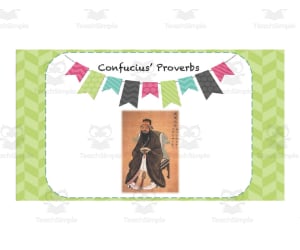
Confucius’ Proverbs Activity
Social Studies, History, History: Asian, Grade 5, 6, 7, 8, Activities
This resource is a Confucius’ Proverbs Activity. You will print out the proverb and opinion cards. Then you will draw a T chart on the blackboard with two categories, Personal Life and Education. Pair up students in groups of 2 or 3. Have each group choose a proverb and an opinion card. The students should write their thoughts about the proverb on their opinion card. Each group should attach their proverb card to the board under the correct category for its content. The students of each group should take turns to present their original proverb and their thoughts about it to the class. They may split up the responsibilities as they wish, but all students must speak.
Author Golden Promise
Tags Confucius Proverbs, Philosopher, Asian Culture, Opinion Writing, Proverbs, Confusious Proverbs, Confucius Proverbs

Money Math Life Skills Worksheet: Reading Restaurant Menus Level 1
Special Resources, Creative Arts, Art, Social Emotional Learning (SEL), Life Skills, Math, Money, Grade 7, 8, 9, Activities, Worksheets & Printables, Worksheets
Money Math Life Skills Worksheet : Reading Restaurant Menus Level 1 This interactive 192-question math worksheet aids middle school students in developing essential life skills for independence. Students will calculate complete breakfast and lunch meal costs using six standard restaurant menus. Questions progress in difficulty from computing costs of two menu items to four. Interactive practice strengthens skills in money management. All questions include detailed solutions. Educators can implement this printable resource in special education classes, speech therapy, ABA therapy, or one-on-one intervention. It also helps define, set, and measure IEP goals related to functional math and independent living. The worksheet provides real-world money math practice for grades 7-9. The step-by-step structure with visual supports is ideal for middle schoolers with autism and other special needs. Students will build confidence ordering meals and managing money. Skills developed with this resource help middle schoolers gain independence at school, home and in the community.
Author Adulting Life Skills Resources
Tags Life Skills Money Math, Special Education Money Math, Independent Living Skills, IEP Goal-Oriented Skills, Autism Resource For Parent, Adulting On The Spectrum, Social And Emotional Learning, Autism And Money Skills, Life Skills For Teens, Life Skills For Adults, Math Menu Activities, Life Skills Worksheets Kids, Restaurant Menu Math Word Problems, Literacy Menus, Menu Math Printable, Menu Engineering Worksheet, Life Skills Math, Menu Worksheet
The Columbian Exchange : Interactive Notebook
Social Studies, History, History: Europe, History: USA, History: World, Grade 5, 6, 7, 8, Activities, Projects
Included in the file are reading sections on the following topics of the Columbian Exchange : - Old and New World Crops - Old and New World Animals - Diseases - Technologies - Religion Students can then have access to materials to complete either a guided notebook or booklet activity and all resources are provided for them to complete these assignments. Different graphic elements are provided for each topic. The elements are included as PDFs and also as image files so they can be resized to suit your own specific needs. Elements come in two versions with and without added images. There are also specially formatted pages for standalone booklets rather than interactive notebooks.
Author Mr Gray History
Tags Columbian, Columbian Exchange, Age Of Exploration

Construction Interactive Vocabulary Review Activity
Special Resources, Life Studies, Life Skills, Career, Grade 7, 8, 9, 10, 11, 12, Activities
Construction Vocabulary Words to Review and Reinforce Definitions of the CTE curriculum . Students will learn and practice Construction terms through definitions and characteristics. The engaging activity promotes collaboration and class discussion as students review terms of Construction tools, machinery, and more with multiple visuals and learning formats like multiple choice questions, memory games, hang-man, and others. This versatile resource can be used for whole-group instruction, small-group practice, or independent work, just practice the words and then review them by choosing the correct one, it will self-correct you until you choose the correct answer Practice Construction Vocabulary with this Free Interactive Game Introduce young learners to a variety of tools and machinery with this entertaining digital game. Students will see the names and images of different tools; exercising visual memory and concentration. This self-checking activity can be played independently or as a whole class game projected on a smartboard. The vibrant slideshow stimulates engagement while building construction classification skills. students will build their knowledge of important terms and definitions while having fun playing games. This activity stimulates intelligence, builds concentration, reinforces letter recognition, improves spelling and pronunciation, and engagingly expands vocabulary. It's a perfect supplement for any Construction lesson. Download this versatile 32-slide PowerPoint today! Check our shop, material, and products for more interactive construction vocabulary reviews covering other topics like human microbiome, metabolism, and more grade levels in science and Spanish language arts. Download this versatile 32-slide PowerPoint today!
Author ShapeUp-N-Matematicas y Lenguaje
Tags Construction, Contruction Material, Construction Equipment, Construction Tools, Contruction Vehicles, Construction Safety Gear, Safety Gear

"The Giver" Reading Comprehension Games
ELA, Reading, Reading Comprehension, Grade 6, 7, 8, Activities, Games
This "The Giver" Reading Comprehension Games is a Jeopardy style review game. This game can be played in whole group, small group, in person and distance learning. Implementation tips are included for best use.
Author Mrs. Spangler in the Middle
Tags Jeopardy, Reading, Comprehension, Whole Group, The Giver

Verbs Practice Questions - Grammar Grade 5-6 (PPT)
ELA, Language Development, ESL, Grammar, Common Core, Resources for Teachers, Grade 5, 6, 7, Quizzes and Tests, Teacher Tools, Tests, Assessments, Activities
Verbs Grammar Practice MCQS ELA MCQS Overview: In this series of lessons, students will embark on an engaging journey to master the language arts skills that make communication effective and expressive. These lessons are designed to help students recognize, understand, and apply key grammar, vocabulary, and writing conventions in both their writing and speech. Each lesson builds upon the previous one, providing a structured blend of direct instruction, interactive group activities, and independent practice. With engaging tasks and thought-provoking questions, students will explore sentence structure, word choice, punctuation, and grammar rules to strengthen their understanding of English language conventions. Accompanied by free supplementary materials covering all topics, this series ensures a well-rounded and enjoyable learning experience. Through practice and exploration, students will develop the skills needed to analyze language, construct clear sentences, and express themselves with confidence. Verbs Overview: Action Verbs Helping Verbs Linking Verbs Additional Verbs Practice PPT Version This is the PPT editable and interactive version. There is a fillable answer sheet at the end. This download is available in GOOGLE Docs, GOOGLE Forms, GOOGLE Slides. PDF, PPT, WORD, check the links below for more details. FULL CATALOG OF DOWNLOAD LINKS HERE Grade 5/6 Links: Capitalization & Punctuation Google Docs Google Forms Google Slides PDF PPT Word Free Supplementary Materials Pack Adjectives Google Docs Google Forms Google Slides PDF PPT Word Free Supplementary Materials Pack Nouns Google Docs Google Forms Google Slides PDF PPT Word Free Supplementary Materials Pack Pronouns Google Docs Google Forms Google Slides PDF PPT Word Free Supplementary Materials Pack Verbs Google Docs Google Forms Google Slides PDF PPT Word Free Supplementary Materials Pack Prefixes & Suffixes Google Docs Google Forms Google Slides PDF PPT Word Free Supplementary Materials Pack Sentence Structure Google Docs Google Forms Google Slides PDF PPT Word Free Supplementary Materials Pack Subject Verb Agreement Google Docs Google Forms Google Slides PDF PPT Word Free Supplementary Materials Pack Tenses Google Docs Google Forms Google Slides PDF PPT Word Free Supplementary Materials Pack Context Clues Google Docs Google Forms Google Slides PDF PPT Word Free Supplementary Materials Pack Defining Words Google Docs Google Forms Google Slides PDF PPT Word Free Supplementary Materials Pack Fill in the Blanks Google Docs Google Forms Google Slides PDF PPT Word Free Supplementary Materials Pack Homophones Google Docs Google Forms Google Slides PDF PPT Word Free Supplementary Materials Pack Synonyms Google Docs Google Forms Google Slides PDF PPT Word Free Supplementary Materials Pack ELA Review Questions Overview Questions have three answer choices. There are a handful of pictures on each test for aesthetic purposes, as well as a review sheet covering most of the topics covered in the product. Introduction or Example Sheet Each topic will include an introduction or example sheet to go through first with your students. Full Answer Keys Full answer keys and sample responses are provided so no matter how busy you are, you know you're covered! In the Supplementary Pack Interactive Ice Breakers: Engaging warm-up activities that introduce students to key ELA concepts, such as quick capitalization corrections and punctuation challenges. Guided Practice: Structured teacher-led exercises that reinforce grammar and punctuation rules, helping students identify and apply them correctly in sentences. Group and Partner Tasks: Collaborative activities where students work together to edit sentences, correct capitalization, and improve punctuation through peer discussion and teamwork. Independent Worksheets: Carefully designed worksheets that provide focused practice, allowing students to apply learned concepts and refine their skills independently. Exit Tasks: Quick assessments at the end of each lesson, prompting students to reflect on what they’ve learned and apply their knowledge in writing and editing tasks. For More Like This For similar downloads and other frees, do check out Cored Group on TeachSimple.
Author Cored Education
Tags Elementary, Answers, Ccss, Common Core, Grammar, Tests, Test Prep, Assessment, Grade 5, Grade 6

Middle School Ratios & Rates Math Stations
Math, Percentages, Decimals, Fractions, Grade 5, 6, 7, 8, Centers, Activities
Do you need some new ideas for your grade 6 or 7 units on ratios and rates and proportional relationships? Here's a printer-ready set of 5 math centers for your intermediate students. These activities include questions about part-to-part and part-to-whole rations, real-life rates, and the relationships between ratios, fractions, and percentages. I have included many real world examples such as planning a road trip, calculating unit prices at the store, and creating a visual design. Even students in the middle grades benefit from a wide variety of instructional strategies. Why not incorporate some math stations and centers into your teaching practice to give your class a new way to learn! Station 1: Students solve 4 word problems using ratios and rates. Station 2: Students explore ratios in designs and draw and describe their own design. Station 3: Students match equivalent ratios and rates of different kinds to solve a riddle (optional: set out tablets for an online game extension). Station 4: Students plan a summer road trip and think about all the ratios and rates they need to use for that task! Station 5: Students create a visual representation of a given percentage using ratios, fractions, decimals, diagrams, and equivalence (supplies needed: six-sided dice). An answer key is included for easy assessment . Grades to Use With: These stations are designed with middle grades classes in mind (grades 5-8). They could also work in high school special education classrooms. What's Included: 7 Page PDF Teacher Instructions 5 Stations Answer Key If you enjoy these math stations, check out the others in my store for your middle school math class: Factors and Multiples Adding and Subtracting Integers Statistics and Probability Area, Perimeter, and Volume (right-angle shapes) Place Value Early Algebra Concepts Percent, Decimals. Fractions Geometry: Triangles, Area, Angles
Author Grace Under Pressure
Rating
Tags Math Stations, Ratios, Rates, Word Problems, Math Centers, Middle School Math, Proportions, Proportional Relationships, Fractions, 6th Grade Math

Escalators Activity
Science, Technology, Engineering, Grade 3, 4, 5, 6, 7, 8, 9, 10, 11, Activities
Activity Introduction An amazing activity designed for the students to learn more about STEM subjects. Escalators Do you like STEM subjects? what is your favorite one? Have you ever tried to plant a seed? If yes, tell us more about it. Or have you ever tried to invent something? If yes, tell us more about it. And how do you think it will help us? Have you ever seen a microorganism under a microscope? What was it? And how it looked like? Mathematics is a marvelous subject. Let' sharpen our brains and solve some equations. Do you like timetable tricks? What is your favorite one? Do you know how to code? Have you ever created an app or a game before? If yes, how was it like? Escalators Activity The activity is perfect for encouraging the researching skills for the students, while learning more about this topic. Escalators This friendly designed worksheet is suitable for students at school, homeschooling, and as a group activity. Instructions Write down the steps of how escalators work. Format Available in a PDF format.
Author Educational Voice
Tags Escalators Activity, Escalators, Escalators Facts, Escalators Facts For Kids, Engineering , Engineering Facts, Engineering Facts For Kids, STEM, STEM Facts, STEM Facts For Kids
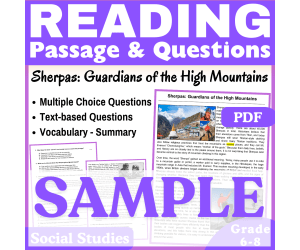
SAMPLE Social Studies Reading Comprehension Passage: Sherpas in Nepal
ELA, Reading, Reading Comprehension, Strategies, Resources for Teachers, Social Studies, Sociology, Geography, Grade 6, 7, 8, 9, Writing Prompts, Worksheets & Printables, Centers, Activities, Teacher Tools, Assessments, Quizzes and Tests, Quizzes, Tests
This is a free passage sample from the complete resource. The full version includes everything needed for a complete reading comprehension activity: the passage, multiple-choice questions, short-answer questions, vocabulary matching, a summary-writing task, and a detailed answer key. Download the complete passage resource by clicking on the following links: PDF Fillable PDF Word Docs Google Docs Sherpas in Nepal: Social Studies Reading Comprehension Passage (PDF) This resource introduces a unique Social Studies reading comprehension passage with questions about The Sherpas in Nepal. The passage is carefully designed to bridge the gap between social studies and literacy through strengthening reading comprehension and sparking knowledge curiosity in middle school students. Each passage blends English Language Arts skills with accurate social studies content . Ideal for interdisciplinary learning in ELA and Social Studies. Suitable for Grade 9 review, too! Student Tasks throughout the passage: 5 multiple-choice questions targeting the following skills: main idea, key details, inference, vocabulary in context, and use of evidence 5 vocabulary matching items with clear, student-friendly definitions 5 text-based questions that require citing specific lines or facts 1 summary prompt that asks students to condense central ideas accurately Full answer key for every section FULL CATALOG OF DOWNLOADING LINKS HERE Other Social Studies Reading Comprehension Collections You May Find in the Store: 1. Ancient Civilizations 2. Early Empires and Trade Networks 3. The Founding of the United States 4. Language, Culture, and Meaning 5. Psychology and Society 6. Global Festivals and Traditions 7. Extreme Environments and People 8. Food, Culture, and Preservation 9. Global Food Customs 10. Media, Communication, and Popular Culture 11. Human Impact on the Environment 12. Civic Action and Social Change 13. Fashion, Society, and Power 14. People, Places, and Unusual Histories Product Details: Length: 5 pages Grades: 6–8, also suitable for Grade 9 review Use cases: close reading, stations, homework, intervention, test prep, and sub plans Why Teachers Choose This Passage: Authentic social studies content paired with rigorous literacy practice Consistent task structure for easier planning and smoother student routines Clear, age-appropriate writing that builds confidence without oversimplifying Use this passage to reinforce ELA skills in social studies, to add literacy to your lessons, and to support independent work. The passage strengthens main idea, evidence use, vocabulary in context, inference, cause and effect, and summary writing. With ready-to-use assessments and complete answer keys, you can provide focused practice that is simple to run and fast to review.
Author Middle & High School - CORED Education
Rating
Tags Middle School, Reading Comprehension, Reading Strategies, ELA, Centers, Reading Passage, Assessments, Vocabulary, Social Studies, Sociology

Reading Comprehension Fiction Set 2 Sample: Graduation (PPT)
ELA, Reading, Writing, Common Core, Reading Comprehension, ESL, Language Development, Vocabulary, Creative Writing, Resources for Teachers, Grade 6, 7, Teacher Tools, Presentations, Assessments, Tests, Quizzes and Tests, Activities
Reading Comprehension Passages Fiction Set 2 Overview Reading comprehension lessons, especially written for Grade 6-7, providing the chance to read interesting and engaging passages. Each lesson has a mix of questions to check understanding, a vocabulary or spelling activity to help remember key language introduced, and a writing exercise. Full answer keys are provided. Passage Included 2.Graduation: Matt helps prepare for his brother's graduation party. PPT Version This is the PPT editable and fillable (when not in presentation mode) version. This download is available in GOOGLE Docs, GOOGLE Forms, GOOGLE Slides. PDF, PPT, WORD. FULL CATALOG OF DOWNLOAD LINKS HERE Grade 6/7 Links Fiction Set 1 Google Docs Google Forms Google Slides PDF PPT Word Guided Reading Materials Fiction Set 2 Google Docs Google Forms Google Slides PDF PPT Word Guided Reading Materials Nonfiction Set 1 Google Docs Google Forms Google Slides PDF PPT Word Guided Reading Materials Nonfiction Set 2 Google Docs Google Forms Google Slides PDF PPT Word Guided Reading Materials Reading Passages Overview Each passage is especially written for Grade 6/7 students, including key vocabulary required for this age group. Topics are varied and are accompanied by colorful graphics. Topics are meant to educate, yet entertain the modern student. The majority of these short stories contain an important message - a way of developing these young learners further. Mixed Questions The mixed questions section of each lesson includes a variation of five to six comprehension, vocabulary and Math questions. In addition, key reading strategies are frequently covered including cause & effect, summarizing, compare & contrast and making conclusions. Mixed questions require a written response (no MCQ's), full answers and example responses appear at the end of the lesson. Spelling & Vocab Each reading passage contains a variety of words and phrases designed for Grade 6/7 students. Spelling and vocab activities provide the opportunity to build fluency with these words. Activities provide clues to help assist students. Vocabulary activities include extra questions where students must write a synonym, an antonym or a sentence using a certain word. Writing Prompts Writing prompts are designed to continue the theme or lessons learned in the story. Students are persuaded to write in a variety of ways and each prompt includes several cues to help. The main focus in this product, is the student. Prompts will require the student to relate to past experiences and encourage them to discuss feelings and ways to improve. Full Answer Keys Full answer keys and sample responses are provided so no matter how busy you are, you know you're covered! Mixed question answers provide evidence from the text, Math questions contain the relevant workings. Answers are designed for use by the teacher, but also suitable as a handout to the student. For similar downloads and other frees, do check out Cored Group on TeachSimple.
Author Cored Education
Tags Elementary, Reading, Comprehension, Vocabulary, Answers, Ccss, Common Core, Spelling, Writing, Passages
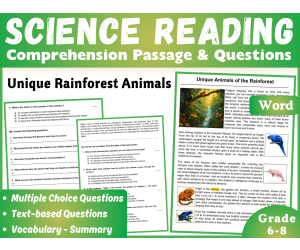
Life Science Reading Comprehension Passage: Rainforest Animals (Word)
Science, ELA, Reading, Reading Comprehension, Strategies, Resources for Teachers, Life Sciences, Animals, Grade 6, 7, 8, 9, Writing Prompts, Worksheets & Printables, Centers, Activities, Teacher Tools, Assessments, Quizzes and Tests, Quizzes, Tests
Life Science Reading Comprehension Passage and Questions: Unique Rainforest Animals (Word) This very engaging life science reading passage about Unique Rainforest Animals . It describes several rainforest animals, including the Hyacinth Macaw , Amazon river dolphin , golden lion tamarin , and poison dart frog . The passage explains each animal’s special traits, such as strong beaks, pink coloring, intelligence, climbing ability, warning colors, and toxins. It also explains that many of these animals are threatened by deforestation and hunting , so protecting the Amazon means protecting their habitats. This passage is designed to bridge the gap between science and literacy through strengthening reading comprehension and sparking scientific curiosity in middle school students. The passage blends English Language Arts skills with accurate science content that supports NGSS classroom practice. Ideal for interdisciplinary learning in ELA and Science. Suitable for Grade 9 review, too! Student Tasks for The Passage: 5 multiple-choice questions targeting main idea, key details, inference, vocabulary in context, and use of evidence 5 vocabulary matching items with clear, student-friendly definitions 5 text-based questions that require citing specific lines or facts 1 summary prompt that asks students to condense central ideas accurately Full answer key for every section Available Formats for this Resource PDF Fillable PDF Google Docs FULL CATALOG OF DOWNLOADING LINKS HERE Product Details Length: 5 pages total Grades: 6–8, also suitable for Grade 9 review Use cases: close reading, stations, homework, intervention, test prep, and sub plans Standards support: reinforces informational-text skills and supports NGSS-style sense making through observation, modeling, and clear use of claim, evidence, and reasoning Why Teachers Choose This Set Authentic science content paired with rigorous literacy practice Consistent task structure across all passages for easier planning and smoother student routines Clear, age-appropriate writing that builds confidence without oversimplifying Other Science Reading Collections you May find in the store: 1. Astronomy & Space Science 2. Volcanoes, Rocks, & Mountains 3. Rock Cycle, Soil, & Sinkholes 4. Mars, Glaciers, & Antarctica 5. Water Cycle, Acid Rain, & Wastewater 6. Insects, Animals, & Ecosystems 7. Bioluminescence & Insects 8. Animal Skin, Cats, & T. Rex 9. Human Body and Senses 10. Health & Applied Bioscience 11. Waves, Light, & Imaging 12. Electricity & Energy 13. Motion & Materials 14. Chemistry and Materials Science Use this set to reinforce ELA skills in science, to add literacy to your lessons, and to support independent work. The passages strengthen main idea, evidence use, vocabulary in context, inference, cause and effect, and summary writing. With ready-to-use assessments and complete answer keys, you can provide focused practice that is simple to run and fast to review.
Author Middle & High School - CORED Education
Rating
Tags Middle School, Reading Comprehension, Reading Strategies, ELA, Centers, Reading Passage, Assessments, Vocabulary, Life Science, Rainforest Animals

Valid Samples & Inferences SCAVENGER HUNT
Math, Statistics, Grade 7, Activities
The Valid Samples & Inferences Scavenger Hunt is a powerful and interactive teaching resource designed for Grade 7 educators teaching statistics. It meets the demands of the 7th Grade Statistics and Probability Standards, providing students an enriching learning experience through its engaging scavenger hunt format. Main concepts: The resource focuses on understanding that statistics can be used to garner information about larger populations by carefully examining a representative sample of it. It emphasizes on the concept that random sampling often leads to producing samples that best represent a population, thereby aiding valid inferences. This activity further facilitates deeper comprehension by educating students on how data from a random sample can be effectively utilized to draw inferences about an entire population with an unknown characteristic of interest. In practical terms, The Valid Samples & Inferences Scavenger Hunt contains: A set of 20 printable scavenger hunt cards ready for immediate use within your classroom setting. A student answer sheet which ensures active participation during each stage of the activity . To aid teachers in assessing student growth and understanding effectively, there is also an included answer key—perfect for efficiently checking work or even sparking class discussions afterwards about discoveries made along their statistical exploration adventure! This resource is incredibly versatile—it's suitable not only for whole-classroom activities but also it's perfectly adaptable to small group sessions or even homework assignments as part of ongoing statistics coursework. Specifically designed around math-based subjects precisely targeting statistics subtopics within grade-7 curriculum context - 'Valid Samples & Inferences Scavenger Hunt' comes as PDF file type ready-to-print-and-use tool making stats fun!
Author The Math Cafe
Tags Statistics, Sample Representation, Random Sampling, Data Analysis, Inference
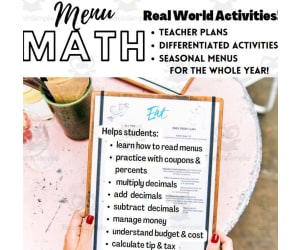
Math: Money Activities
Math, Decimals, Grade 5, 7, 8, Activities
Math: Money Activities Resource Pack This comprehensive teaching tool is perfect for solidifying understanding of key mathematical principles like decimal and percentage operations in real-world contexts. The Menu Math Section Student interaction with menu items prices teaches them about spending and calculating costs. Tasks range from matching menu items to prices to adding up a restaurant bill, providing an exciting practical learning experience. Versatility in Teaching Settings The resource pack can be used creatively across different teaching settings. These include math centers, group activities around several stations in the classroom or additional material when introducing certain topics. The Math activities are also suitable for homework practice or independent enrichment. Alignment with Common Core standards Fully Developed Lesson Write-ups: Inclusive of objectives through assessments ensuring easy compatibility within existing curriculum plans. Differentiated tasks catering to different levels among students, promoting individualized instruction strategies. .Extra-curricular Themed Exercises - Used for engaging assignments during holidays and events involving calculations related to sales tax, tip estimations and job offerings. The spirit of classroom engagement is captured through providing effective real-world scenarios thereby upgrading learning dynamics significantly at upper elementary grades (5-8). Presentation: All content compactly formatted into a PDF file configuration allows smooth download and printing processes. A total of 25 carefully detailed pages cover multiple grade school level assignment topics A set of latest worksheets delves deep down into the realm of numerical encounters that every student should master.
Author Big Apple Teaching
Tags Math, Money, Real-world Contexts, Decimals, Percentages
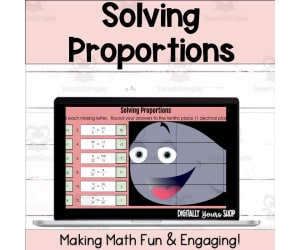
Solving Proportions Self-Checking Digital Activity
Math, Fractions, Grade 6, 7, Activities
Solving Proportions Self-Checking Mystery Puzzle Picture Digital Activity Are your students tired of completing boring math problems from their text or workbook? Do they struggle with solving proportions? Math is fun again with this self-checking ratios and proportions puzzle picture reveal! This how-to solve proportions digital math activity is perfect for engaging your students in proportional relationships and how to solve ratios and proportions. I hope your students have as much fun with this activity as mine did! In the self-checking activity , students answer questions in order to reveal part of the mystery puzzle picture. As students correctly answer questions, more of the picture is revealed. Students also receive immediate feedback on their answers. Correct answers turn green, and incorrect answers turn red. Students can correct any errors and easily analyze mistakes before moving on. You can quickly assign each student a copy of the paperless math activity using Google Classroom. ➡️What You Need to Know: This resource was created using Google Sheets. You need a Google email to use with Google Classroom. ➡️Standards & Learning Goals 6.RP.A (Ratio and Proportions) and 7.RP.A (Ratios and Proportions) I can find proportions. ➡️ Ways to Use this Paperless Resource: Morning Work Homework Bell Ringer Exit Ticket Lesson Check for Understanding Math Warm-Up Review Reteach ➡️This is a no-prep resource! Once added to your Google Drive, you can immediately assign to students using Google Classroom or other Learning Management System! ➡️Who should purchase this resource? Teachers looking for resources that can be used in the classroom Teachers looking for resources that review solving proportions Teachers looking for digital activities for ratios and proportions math review, math test prep, or math practice. Teachers looking for READY TO GO proportional relationships math activities.
Author Digitally Yours Shop
Tags Proportions Activity, Proportions, Solve Proportions, Solving Proportions, Self-checking, Google Sheets, Pixel Art, Ratios, Simple Proportions, Finding Proportions, Proportion Activities For Middle School, Solving Proportions Answer Key
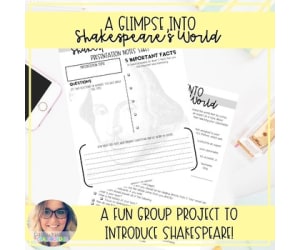
Introducing Shakespeare's World - Group Project
ELA, Literature, Grade 7, 8, 9, 10, 11, 12, Activities, Projects
Introducing Shakespeare's World - Group Project, a Teaching Resource The teaching resource, Introducing Shakespeare's World - Group Project, is a comprehensive tool that allows students to delve deep into the numerous elements of Shakespeare's world. It targets students from grade levels 7 through 12 and is particularly suitable for the subject of Language Arts. It channels its primary focus towards the subsubject of Literature. This resource creates an engaging environment for students to learn about Shakespeare’s influences by isolating different aspects such as social and political issues, fashion, arts and entertainment, Queen Elizabeth I, social classes and more. The structure of this approach culminates in a class presentation where they can showcase their work visually (subject to teacher approval), further enabling them to understand and appreciate Shakespeare’s world contextually. Potential Uses in Classroom Settings Whole classroom activities. Group work based on smaller segments of students divided according to learning styles or strengths. Hallmark homework assignments due to its flexibility in application methods. Included Materials In This Kit A student handout designed with sections denoting various topics for group interaction. \ A 'notes sheet' promoting active listening among peers during presentations contributing toward collective knowledge development. An inclusive rubric available which provides clear guidelines on various parameters being graded simplifying assessment process both from participant performance assessment and teacher grading perspective. An addition worthy mention for educators utilizing this resource would be its user-friendly layout available in PDF file format thereby making it an ideal tool while introducing learners into the vast world that greatly influenced one of history's most famous literary figures - William Shakespeare.
Author Fairways and Chalkboards
Tags Shakespeare, World Context, Group Project, Literature Study, Classroom Resource
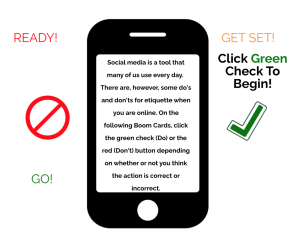
Social Media Dos and Don'ts Boom Cards
Special Resources, Life Skills, Grade 5, 6, 7, 8, 9, 10, Activities
Social Media Dos and Don'ts Boom Cards Social Media Dos and Don'ts Boom Cards is a meticulously designed teaching tool for educators desiring to enlighten students of grades 5 through 10 about the judicious usage of technology. Utilizing a web-based platform, it offers an impressive array of 30 task BOOM card deck focusing on social media topics. Flexibility and Accessibility The resource is entirely web-based offering substantial flexibility. It effortlessly integrates into classroom lessons or can be assigned as individual homework tasks with no need for additional student login. Students access content through modern browsers like Chrome, Safari, Firefox or Edge while there are separate apps available for Android devices, iPads, iPhones or Kindle Fires. Educational Content The BOOM cards instill key life skills among students about responsible technology use. The lesson summarizes the major do's and don’ts regarding safe and effective navigation in the ever-changing world of social media. Hence aiding in building their understanding towards robust digital citizenship expected in today’s interconnected world. Add-ons Alongside BOOM cards is a printable Google Doc featuring reinforcing questions related to social media consumption thereby further enhancing comprehension of concepts learned from BOOM cards. Incorporated within Google Docs are segments assigning spots for students' names beside their respective Boom scores simplifying tracking performance. Note: Product Requirements This resource needs internet connection along with an adult-established account on Boom Learning. For self-grading assignments (Fast Pins) which deliver instant feedback on student performance is feasible under free account; however premium account (free trial available upon registering) would be vital if detailed progress reports are to be obtained. Access Acquiring this resource is made easy by a simple click on an illustration within an included PDF – directing you to your new deck! Venturing into this technological advancement of teaching promulgates engaging and relevant learning experiences patching up with the sophisticated digital needs of students today.
Author Jennifer Moyer Taylor
Tags Social Media, Digital Citizenship, Responsible Technology Use, Online Learning Resource, Boom Cards

Understanding Phobias: Social Studies Reading Passage (Fillable PDF)
ELA, Reading, Reading Comprehension, Strategies, Resources for Teachers, Social Studies, Psychology, Grade 6, 7, 8, 9, Writing Prompts, Worksheets & Printables, Centers, Activities, Teacher Tools, Assessments, Quizzes and Tests, Quizzes, Tests
Understanding Phobias: Social Studies Reading Comprehension Passage (PDF) This resource introduces a unique Social Studies reading comprehension passage with questions about Facing fears and Understanding Phobias. The passage is carefully designed to bridge the gap between social studies and literacy through strengthening reading comprehension and sparking knowledge curiosity in middle school students. Each passage blends English Language Arts skills with accurate social studies content . Ideal for interdisciplinary learning in ELA and Social Studies. Suitable for Grade 9 review, too! This resource is designed as a fillable PDF , which means students can type their answers directly into the document on any computer or tablet . Each page includes highlighted text fields that show them exactly where to type! Student Tasks throughout the passage: 5 multiple-choice questions targeting the following skills: main idea, key details, inference, vocabulary in context, and use of evidence 5 vocabulary matching items with clear, student-friendly definitions 5 text-based questions that require citing specific lines or facts 1 summary prompt that asks students to condense central ideas accurately Full answer key for every section Available Formats for this Resource: PDF Word Docs Google Docs FULL CATALOG OF DOWNLOADING LINKS HERE Social Studies Reading Comprehension Collection Links: 1. Ancient Civilizations PDF Fillable PDF Word Docs Google Docs 2. Early Empires and Trade Networks PDF Fillable PDF Word Docs Google Docs 3. The Founding of the United States PDF Fillable PDF Word Docs Google Docs 4. Language, Culture, and Meaning PDF Fillable PDF Word Docs Google Docs 5. Psychology and Society PDF Fillable PDF Word Docs Google Docs 6. Global Festivals and Traditions PDF Fillable PDF Word Docs Google Docs 7. Extreme Environments and People PDF Fillable PDF Word Docs Google Docs 8. Food, Culture, and Preservation PDF Fillable PDF Word Docs Google Docs 9. Global Food Customs PDF Fillable PDF Word Docs Google Docs 10. Media, Communication, and Popular Culture PDF Fillable PDF Word Docs Google Docs 11. Human Impact on the Environment PDF Fillable PDF Word Docs Google Docs 12. Civic Action and Social Change PDF Fillable PDF Word Docs Google Docs 13. Fashion, Society, and Power PDF Fillable PDF Word Docs Google Docs 14. People, Places, and Unusual Histories PDF Fillable PDF Word Docs Google Docs Product Details: Length: 5 pages Grades: 6–8, also suitable for Grade 9 review Use cases: close reading, stations, homework, intervention, test prep, and sub plans Why Teachers Choose This Passage: Authentic social studies content paired with rigorous literacy practice Consistent task structure for easier planning and smoother student routines Clear, age-appropriate writing that builds confidence without oversimplifying Use this passage to reinforce ELA skills in social studies, to add literacy to your lessons, and to support independent work. The passage strengthens main idea, evidence use, vocabulary in context, inference, cause and effect, and summary writing. With ready-to-use assessments and complete answer keys, you can provide focused practice that is simple to run and fast to review.
Author Middle & High School - CORED Education
Rating
Tags Middle School, Reading Comprehension, Reading Strategies, ELA, Centers, Reading Passage, Assessments, Vocabulary, Social Studies, Pschology

Earth Science Reading Comprehension Passage: From Earth to Mars SAMPLE
Science, ELA, Reading, Reading Comprehension, Strategies, Resources for Teachers, Earth and Environmental Sciences, Space, Grade 6, 7, 8, 9, Writing Prompts, Worksheets & Printables, Centers, Activities, Teacher Tools, Assessments, Quizzes and Tests, Quizzes, Tests
This is a free passage sample from the complete resource. The full version includes everything needed for a complete reading comprehension activity: the passage, multiple-choice questions, short-answer questions, vocabulary matching, a summary-writing task, and a detailed answer key. Download the complete passage resource by clicking on the following links: PDF Fillable PDF Word Docs Google Docs Science Reading Comprehension Passages and Questions: From Earth to Mars (PDF) This very engaging earth science reading passage about Mars is designed to bridge the gap between science and literacy through strengthening reading comprehension and sparking scientific curiosity in middle school students. The passage blends English Language Arts skills with accurate science content that supports NGSS classroom practice. Ideal for interdisciplinary learning in ELA and Science. Suitable for Grade 9 review, too! Student Tasks for The Passage: 5 multiple-choice questions targeting main idea, key details, inference, vocabulary in context, and use of evidence 5 vocabulary matching items with clear, student-friendly definitions 5 text-based questions that require citing specific lines or facts 1 summary prompt that asks students to condense central ideas accurately Full answer key for every section FULL CATALOG OF DOWNLOADING LINKS HERE Product Details Length: 5 pages total Grades: 6–8, also suitable for Grade 9 review Use cases: close reading, stations, homework, intervention, test prep, and sub plans Standards support: reinforces informational-text skills and supports NGSS-style sense making through observation, modeling, and clear use of claim, evidence, and reasoning Why Teachers Choose This Set Authentic science content paired with rigorous literacy practice Consistent task structure across all passages for easier planning and smoother student routines Clear, age-appropriate writing that builds confidence without oversimplifying Other Science Reading Collections you May find in the store: 1. Astronomy & Space Science 2. Volcanoes, Rocks, & Mountains 3. Rock Cycle, Soil, & Sinkholes 4. Mars, Glaciers, & Antarctica 5. Water Cycle, Acid Rain, & Wastewater 6. Insects, Animals, & Ecosystems 7. Bioluminescence & Insects 8. Animal Skin, Cats, & T. Rex 9. Human Body and Senses 10. Health & Applied Bioscience 11. Waves, Light, & Imaging 12. Electricity & Energy 13. Motion & Materials 14. Chemistry and Materials Science Use this set to reinforce ELA skills in science, to add literacy to your lessons, and to support independent work. The passages strengthen main idea, evidence use, vocabulary in context, inference, cause and effect, and summary writing. With ready-to-use assessments and complete answer keys, you can provide focused practice that is simple to run and fast to review.
Author Middle & High School - CORED Education
Rating
Tags Middle School, Reading Comprehension, Reading Strategies, ELA, Centers, Reading Passage, Assessments, Vocabulary, Environmental Science, Space

Group Project Student Role Sheets: Everything You Need for Successful Group Research Projects . . .
Research, Grade 4, 5, 6, 7, 8, Activities
The Group Project Student Role Sheets: An Essential Teaching Resource Streamline your classroom group research projects with this practical teaching tool designed for students from Grades 4 through 8. This resource empowers learners with clear instructions and guideposts for their research tasks. A Novel Approach to Group Investigation This unique resource works as an effective model of group investigation, providing educators a way to offer unambiguous direction throughout numerous phases of group projects . It is not merely a guide but also an impressive pedagogical implement that keeps pupils on track with their investigational tasks. Applications of The Group Project Student Role Sheets Use it during whole-group instruction to provide coherence and unity, ensuring every scholar is well-aware about their role and the overall project timeline. The sheets fit naturally in small groups during cooperative learning time, emphasizing specific roles that correspond based on the type of project being undertaken. These can also be used effectively as homework assignments. The distinct division of tasks enables students outside class to understand exactly what they should focus on, reducing the chances of confusion or overlap among members handling separate aspects at home. Redefining Accessibility & Convenience This comprehensive plan comes consolidated into one easy-to-access PDF file. As a result, it is conveniently accessible across different electronic devices like desktops, tablets, or even smartphones! This feature allows teachers to plan lessons smoothly or share them directly with students digitally without any hassle! Add The Group Project Student Role Sheets To Your Educational Toolbox Today Improve upon your conventional teaching methods by integrating these role sheets – everything you need for constructively guiding team behavior and creating effective learning outcomes in group research projects handled by your young learners.
Author Classroom Complete Press
Tags PDF

Social Studies Comprehension Passages: Global Food Customs (Docs)
ELA, Reading, Reading Comprehension, Strategies, Resources for Teachers, Social Studies, Sociology, Grade 6, 7, 8, 9, Writing Prompts, Worksheets & Printables, Centers, Activities, Teacher Tools, Assessments, Quizzes and Tests, Quizzes, Tests
Social Studies Reading Comprehension Passages and Questions: Global Food Customs (Docs) This resource introduces a collection of Social Studies reading comprehension passages with questions about Global Food Customs. The passages are carefully designed to bridge the gap between social studies and literacy through strengthening reading comprehension and sparking knowledge curiosity in middle school students. Each passage blends English Language Arts skills with accurate social studies content . Ideal for interdisciplinary learning in ELA and Social Studies. Suitable for Grade 9 review, too! What Is Included in this Collection? There are three informational passages (with full answer keys): On the Menu: Why Some Cultures Eat Insects More Than a Drink: Tea Customs Sweet Cravings: Understanding Sugar “Addiction” For Each Passage, students will have multiple tasks to complete as follow: 5 multiple-choice questions targeting main idea, key details, inference, vocabulary in context, and use of evidence 5 vocabulary matching items with clear, student-friendly definitions 5 text-based questions that require citing specific lines or facts 1 summary prompt that asks students to condense central ideas accurately Available Formats for this Resource PDF Fillable PDF Word Docs FULL CATALOG OF DOWNLOADING LINKS HERE For more Social Studies Reading Passages, check the following Links: Ancient Civilizations PDF Fillable PDF Word Docs Google Docs Early Empires and Trade Networks PDF Fillable PDF Word Docs Google Docs The Founding of the United States PDF Fillable PDF Word Docs Google Docs Language, Culture, and Meaning PDF Fillable PDF Word Docs Google Docs Psychology and Society PDF Fillable PDF Word Docs Google Docs Global Festivals and Traditions PDF Fillable PDF Word Docs Google Docs Extreme Environments and People PDF Fillable PDF Word Docs Google Docs Food, Culture, and Preservation PDF Fillable PDF Word Docs Google Docs Global Food Customs PDF Fillable PDF Word Docs Google Docs Media, Communication, and Popular Culture PDF Fillable PDF Word Docs Google Docs Human Impact on the Environment PDF Fillable PDF Word Docs Google Docs Civic Action and Social Change PDF Fillable PDF Word Docs Google Docs Fashion, Society, and Power PDF Fillable PDF Word Docs Google Docs People, Places, and Unusual Histories PDF Fillable PDF Word Docs Google Docs Product Details Length: 14 pages total Grades: 6–8, also suitable for Grade 9 review Use cases: close reading, stations, homework, intervention, test prep, and sub plans Why Teachers Choose This Set Authentic social studies content paired with rigorous literacy practice Consistent task structure across all passages for easier planning and smoother student routines Clear, age-appropriate writing that builds confidence without oversimplifying Use this set to reinforce ELA skills in social studies, to add literacy to your lessons, and to support independent work. The passages strengthen main idea, evidence use, vocabulary in context, inference, cause and effect, and summary writing. With ready-to-use assessments and complete answer keys, you can provide focused practice that is simple to run and fast to review.
Author Middle & High School - CORED Education
Rating
Tags Middle School, Reading Comprehension, Reading Strategies, ELA, Centers, Reading Passage, Assessments, Vocabulary, Social Studies, Food And Culture

6th Grade Math Spiral Review Escape Room Week 2 Day 5
Math, Grade 5, 6, 7, Worksheets, Worksheets & Printables, Teacher Tools, Activities, Escape Room
Are you searching for a way to keep previous skills fresh in 6th grade math, but don’t have the time to prep activities for your class? Looking for a dependable daily spiral warm up to incorporate in your routine? Then look no further, Mini Math Escape Room - Mission 5. This digital review activity is self checking and intended to be a spiral review or warm up that can last approximately 10 minutes. Students will be held accountable for showing their understanding of previously learned skills while completing a small goal. Instead of finishing a regular worksheet, they are completing a mini escape room! The structure in each mission is the same, but with different problems to solve and a different code to unlock. Here is how it works, students must solve 5 math problems on one interactive page. They must use the first digit of each answer to create a 5 digit code. If the correct code is entered, the mission is complete and they will be congratulated. If an incorrect code is entered, nothing happens and students are encouraged to go back and analyze their work to try to improve. This escape room is self-checking but doesn't require teacher feedback! Skills covered in this review include 6th grade level concepts that are important to expose students to repeatedly: Greatest Common Factor (GCF) Adding fractions with unlike denominators Finding percent of a number Solving one-step equations Unit conversions These skills are repeated and spiraled throughout missions, as to help students continue to remember them instead of forgetting after a test at the end of the unit! Included in your purchase: 1 mini digital math escape room (Mission 5) 5 math problems on one interactive page A printable worksheet version Answer key and final code This mini escape room activity works perfectly as a daily warm up or bell ringer, end of the day review, for early finishers, or as a sub plan in a pinch! Since it is no prep and self checking, you can easily assign it without notice. If you're searching for a simple and effective way to incorporate daily math practice and review in your classroom without overwhelming students, assign Mission 5 in your classroom!
Author Matemaths
Rating
Tags Matemaths, Guided Notes, Worksheet, Word Problems, Decimals
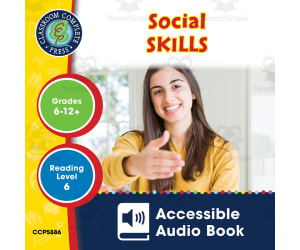
Real World Life Skills - Social Skills - Accessible Audio Book Gr. 6-12+
Life Studies, Special Resources, Life Skills, Grade 6, 7, 8, 9, 10, 11, 12, Read Alouds, Activities
Real World Life Skills - Social Skills - Accessible Audio Book Gr. 6-12+ A comprehensive teaching resource equipping learners with practical life skills necessary for successful social interactions in the real world. This resource, ideal for educators teaching Grades 6 through 12+, emphasizes crucial areas of social development and provides students with the tools they need to competently navigate both personal and professional environments. Focus of Guide: Teaches learners how to identify positive and negative traits; fostering relationships leading towards lifelong friendships. Promotes self-reliance; sharing tips ensuring independence and taking responsibility, including gracefully declining offers. Towards Personal Development: An element focusing on personal development is contained in this guide. It contributes towards setting a clear path towards achieving student goals including strategies to improve their ability for collaboration, helping them break free from destructive habits using a structured 30-day challenge outline provided in our audio book . Cultivating Normative Courtesies:> A special section caters to etiquette essentials – nurturing good manners within daily interactions which aids the development of considerate behavior as part of normative interaction protocols. The Convenience of Audio Accessibility:>> Inclusion is our top priority thus we have opted for an audio book format which caters specifically to visually impaired learners or those who struggle with physical content manipulation capabilities. Added features such as adjustable text size capacity and embedded text-to-speech functionalities allow use customization based on individual's needs preference. Furthermore, vivid contrasting images illustrate textual information promoting better visibility while also catering not only to auditory but visual learners too! Package Overview: The resource: Comes conveniently packaged in a ready to print PDF file, containing 130 pages. Offers versatility; can be utilized as part of whole-class instruction, within small group sessions, or assigned for individual study or homework. In conclusion, Real World Life Skills - Social Skills - Accessible Audio Book Gr. 6-12+ serves as teachers' ally fostering educational excellence while vitally contributing to comprehensive learner development in mastering essential life skills.
Author Classroom Complete Press
Tags Real World, Life Skills, Audio Book, Social Skills, Collaboration