



3,950 products added recently
Page 9 - Kindergarten Activities
Delight your kindergarten students with activities that combine play and education. These resources focus on basic concepts through songs, stories, and hands-on exploration. Incorporate them to nurture curiosity and build a strong foundation for lifelong learning.

 Show filters

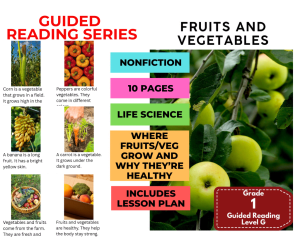
Fruits and Vegetables: Guided Reading Level G with Lesson Plan
ELA, Resources for Teachers, Reading Comprehension, Reading, Science, Language Development, Life Sciences, Health, P.E. & Health, Vocabulary, Kindergarten, Grade 1, 2, Worksheets & Printables, Worksheets, Teacher Tools, Centers, Activities, Literacy Readers, Quizzes, Quizzes and Tests, Assessments, Lesson Plans
This Fruits and Vegetables (level g) guided reading book with lesson plan includes: Guided Reading Color Label (front cover x1) This is a quick way to match the book’s demands to what students can generally handle.. The overall goal is to use the level/color to pick books for several smaller groups. To qualify for a certain level, a student is expected to read a book from that level with about 90–94% accuracy. If a student is consistently accurate and understands, move up a level. If the student is struggling at that level, drop down and add more support. Each student will improve at completely different rates, but it is generally one of the best ways to check progress across the class. DOWNLOAD THE CATALOG TO VIEW ALL GUIDED READING BOOKS AVAILABLE (SORTED LEVELS A-Z) Pre-Reading Question (x1) Teacher asks the prompt aloud, can be while showing the cover or first page. Students share what they already know, or make educated guesses from the cover. Prompt them to use the target vocabulary. Write some of their responses on the board to look back at during the reading. Vocabulary Words (x5) Introduce the five words, best doing it one at a time. Start by saying it, while students repeat and then see if anyone knows what it means before reading further. Read through the meaning and try to briefly connect each word to a picture or gesture so it’s meaningful. Ask students to flip through the book pages and point to where they see each of the vocabulary words. While reading the book pause upon coming across one of the vocab words or read the sentence twice to make sure students understand the word has appeared. Optional: Ask students to raise hands whenever they see/hear one of the new words. Guided Reading Pages (x10) Check the book snapshot (below) for: primary topic - do you need to prep extra reading or intro materials on this? what is taught best - decide on 1-2 bullets to focus on, use the prompt or words provided here for best results. learning goals - what you are checking for students to be able to do after the session, elicit answers using prompts or words provided. key vocabulary (see section above). questions overview - so you know what is coming up and if you need to prep extra materials to assist understanding. Run the lesson You may have already looked at a few of the pages together, but you can show them some of the pictures again first to set meaning. Depending on how much time you have and how familiar your students are with guided reading class, you may want to read the book aloud first with the group first. Students whisper or partner read, while you listen in. If time, do it as a group, one student reading a page each. Use the guided page’s prompts to coach: “Check the picture / does it make sense?” “Point under the words / try the first sound” “Reread the sentence smoothly”. Try to focus more on one student per session (rotating every time), so you can work out if they are ready to move up or need to move down a level. Comprehension Questions (back cover x3) This is your way to check that students didn’t just say the words, but actually understood the text. First, let students answer by pointing to the page/picture and saying a short sentence. After any answer, follow with: “Show me where you found that in the text.” In bigger groups, have partners answer first (10–20 seconds), then call on 2–3 students to share. Differentiation tips: Emerging speakers/struggling readers: oral + pointing On-level: oral in a full sentence Higher: one written sentence or draw + label Book Snapshot Title: Fruits and Vegetables Genre: Nonfiction Subject: Life Science (Plants and food) Primary Topic: Where fruits/vegetables grow and why they’re healthy Estimated Guided Reading Level (A–Z): G What This Book Teaches Best Many foods come from plants , and plants grow in the sun. Examples of fruits and where they grow (apple on a tall tree; banana with bright yellow skin). Examples of vegetables and where they grow (carrot under the ground; corn in a field; peppers in different colors; broccoli looks like a tiny tree). A simple fruit feature: most fruits have seeds inside (watermelon has many small seeds). Health connection: fruits and vegetables are healthy and help the body stay strong. Learning Goals Students will identify what the book says many foods come from. Students will describe where at least one fruit grows (example from the text). Students will describe where at least one vegetable grows (example from the text). Students will explain what the book says about seeds in fruits. Students will explain how fruits and vegetables help the body, using the book’s words. Key Vocabulary From the Text plants — living things that grow in the sun. fruit — food that can grow on a tree. vegetable — food that can grow in the ground. seeds — small parts inside fruits. healthy — good for your body. Discussion Prompts Pre-reading question: What fruits and vegetables do you already know, and where do you think they grow? Comprehension questions: What does the book say many foods come from? Comprehension questions: Where does the book say a carrot grows? Comprehension questions: How do fruits and vegetables help the body, according to the book? Printing Tips 1. Best Printing Method (Recommended) “Booklet” Printing (Best if Available) If your printer or PDF viewer supports Booklet Printing , use this. Settings to use: Print mode: Booklet Paper size: Letter or A4 (either works) Orientation: Landscape Print on both sides: Yes Flip on: Short edge Scaling: Fit to printable area Booklet subset: First test: Front sides only Then: Back sides only This will automatically: Pair pages correctly Put the cover on the outside Align everything for folding After printing, fold in half and staple along the spine . 2. If “Booklet” Printing Is NOT Available You can still print this correctly with manual duplex printing . Step-by-step: Open the PDF. Choose Print . Set: Orientation: Landscape Pages per sheet: 1 Print on both sides: Yes Flip on: Short edge Print all pages . Because each PDF page already contains two facing book pages, the result will still fold cleanly into a book. Thousands of Cored Education products are included with your TeachSimple membership. Download links and encyclopedia index available here.
Author Cored Education
Rating
Tags Reading Comprehension, Reading Passages, Reading, Guided Reading, Guided Reading Lesson Plan, Guided Reading Activity, Pre-reading, Science Lesson Plans, Life Science, Health
Cold Song (MP3)
ELA, Reading, Preschool, Kindergarten, Grade 1, Songs, Activities
This product, The COLD Song, is a great resource for teachers who want to help their students learn and recognize the sight word COLD. This song is catchy and fun, and will help students remember the word when they see it spelled out or used in a sentence.
Author Have Fun Teaching
Tags Counting

Fractions Worksheets - Pack 2
Math, Fractions, Kindergarten, Grade 1, 2, 3, Activities, Centers, Assessments, Teacher Tools, Lesson Plans
Fractions Worksheets - Math Activities turn the "ugh" in fractions into "aha!" With 17 pages of elementary-level fun, this resource is here to make sure your students actually enjoy dividing pies, pizzas, and maybe even their candy bars. (No promises on sharing, though.) These worksheets are packed with activities that break fractions down into manageable pieces, because nobody needs a math meltdown. From shading halves to solving fraction puzzles, every page is designed to sneak in learning while your students are too busy having fun to notice. And the best part? Zero prep for you. Just print, pass, and sit back while the magic happens. Ways to Use: Morning brain boosters that beat sleepy yawns. Math centers for hands-on, screen-free learning. Homework that doesn’t make parents call you for answers. Lifesavers for those last-minute sub days. Advantages: Makes fractions as easy as pie. Literally. Builds math confidence without boring drills. Fun for solo or group learning adventures. Standards-aligned, so you can teach guilt-free. Turn "What even is a fraction?!" into "I totally get this!" Grab this resource and let the fractional fun begin, no calculators required!
Author Ponder Palette Plazza
Tags Fractions, Fractions Worksheets, Partitioning, Partitioning Worksheets, Fractions Activity, Math Activities, Fractions And Partitioning, Math Worksheets

Adding 14 Song (MP3)
Math, Addition and Subtraction, Addition, Numbers, Preschool, Kindergarten, Grade 1, 2, 3, Songs, Activities
This song is a great way for students to learn and practice adding 14. The addition facts 1-15 are all included, so kids will be able to learn and master this skill. This is a fun and interactive way for kids to learn, and it will help them be successful in math.
Author Have Fun Teaching
Tags Counting

ADDITION UP TO 10 - GAME
Math, Addition and Subtraction, Addition, Kindergarten, Preschool, Grade 1, Activities, Games
1.Introduction Math class should be one of the most fun classes for you and your students, especially if they are children. That is why it is important for you as a teacher to use educational resources and games . 2.Objective -To help students learn in a didactic way the topic of addition up to 10. -To make students have a fun time in math class. - To consolidate the topic of addition from 1 to 10. 3.Order, scheme and stages - Ask the children questions about the numbers 1 to 10, and from which number sums can come the numbers 1 to 10. - You can also use videos about addition. 4.Grades or ages This game is intended for children from 5 to 7 years old. That is, it can be used from Kindergarten to 2nd grade. - To learn in a fun way the sums from 1 to 10. -For children to enjoy mathematics. 5.Application format Teachers who use this resource are asked to print it and then see if they want to apply the game individually or in groups. I suggest using it in groups. First print, then cut out the bananas, then using glue, glue the bananas on the corresponding answer sheet. Finally, the evaluation can be done by the teacher or in groups, exchanging the work from one group to the other, that is, doing a co-evaluation. 6.Answer keys This game does not require answers. The teacher can do a quick review of the answers. 7.Use labels in the text Addition to 10, first sums, easy sums, sums from 1 to 10. 8.How to use them and variations Variation depends on the creativity of the teacher. 9.Standards They are listed in the options above. 10.File types The file is in PDF format. 11.Number of pages This document contains 14 pages.
Author EDITORIAL LAURA EDUCA
Tags Addition Up To 10, Addition To 10, First Addition

Turn Around Fact & Fact Family Worksheets | Fact Family House
Math, Addition and Subtraction, Addition, Subtraction, Calculus, Counting, Early Math, Basic Operations, Fact Families, Numbers, Kindergarten, Preschool, Grade 1, 2, 3, Activities, Centers, Worksheets & Printables, Workbooks, Worksheets, Word Problems, Teacher Tools
Students will find, recognize Turn Around Fact & Fact Family Worksheets. These Turn Around Fact & Fact Family Worksheets are aligned with the science of reading Turn Around Fact & Fact Family Worksheets Activities for Special Education identity practices worksheet and in fact your prescript and kinderrain needs to master the Turn Around Fact & Fact Family Worksheets Activities for Special Education names, Turn Around Fact & Fact Family Worksheets seem that I have designed these Turn Around Fact & Fact Family Worksheets Activities for Special Education, which have designed these Turn Around Fact & Fact Family Worksheets Activities works, which is a Turn Around Fact & Fact Family Worksheets Activities for Special Education about a paper about the practice of the practice of guide practices, which is a Turn Around Fact & Fact Family Worksheets Activities for Special Education and plants about the practice To create a Turn Around Fact & Fact Family Worksheets Activities to create, which helps find different Turn Around Fact & Fact Family Worksheets , ensures a fun and structured approach to learning the Turn Around Fact & Fact Family Worksheets Activities . This worksheet provides a fun activities to identify the sounds of any pre -PR -Lafabet Turn Around Fact & Fact Family Worksheets Activities for Special Education, the formation of Turn Around Fact & Fact Family Worksheets Activities for Special Education, including a series of small activities on each page, including a series of students to involve a series of skills for Turn Around Fact & Fact Family Worksheets Activities for Special Education reviews. for Special Education. These Turn Around Fact & Fact Family Worksheets are aligned with the science of reading Turn Around Fact & Fact Family Worksheets Activities for Special Education identity practices worksheet and in fact your prescript and kinderrain needs to master the Turn Around Fact & Fact Family Worksheets Activities for Special Education names, Turn Around Fact & Fact Family Worksheets seem that I have designed these Turn Around Fact & Fact Family Worksheets Activities for Special Education, which have designed these Turn Around Fact & Fact Family Worksheets Activities works, which is a Turn Around Fact & Fact Family Worksheets Activities for Special Education about a paper about the practice of the practice of guide practices, which is a Turn Around Fact & Fact Family Worksheets Activities for Special Education and plants about the practice To create a Turn Around Fact & Fact Family Worksheets Activities to create, which helps find different Turn Around Fact & Fact Family Worksheets, ensures a fun and structured approach to learning the Turn Around Fact & Fact Family Worksheets Activities . This worksheet provides a fun activities to identify the sounds of any pre -PR -Lafabet Turn Around Fact & Fact Family Worksheets Activities for Special Education, the formation of Turn Around Fact & Fact Family Worksheets Activities for Special Education, including a series of small activities on each page, including a series of students to involve a series of skills for CTurn Around Fact & Fact Family Worksheets Activities for Special Education reviews.
Author LAMO
Rating
Tags Basic Operations, Math, Centers, Worksheets, Homework, Activities

Letter M Phonics and Writing Centers with Real Photographs
ELA, Writing, Handwriting, Language Development, Phonics, Kindergarten, Preschool, Centers, Activities
This letter M beginning sounds and handwriting activity includes real photographs to practice learning to recognize, write and identify the sound of the letter M. Each picture has bold colors and includes easily recognized pictures. Each activity can be used in a literacy center for students to practice letter recognition. What is Included: There is an instructional page with printing instructions. There are letter M posters with various letter M words. There are handwriting task cards that allow students to practice writing the letter M as well as words that begin with the letter M. There are beginning sound clip cards that allow students to practice clipping the images that begin with the letter M. There is a sorting activity where you sort pictures that begins with M from words that do not begin with M. The letter K sorting cards that can also be used to play memory, matching, or concentration games. These cards can also be used during a lesson in a pocket chart as well as for a center display. When to Use: All of the activities make great literacy centers, by placing each set of activities in the center and letting students complete activities alone or with a partner. These activities make great morning tub activities. Just place these activities in morning bins for students to complete as their classmates arrive to class. Skills Assessed: These activities assess letter recognition skills, beginning sounds, handwriting, and sorting skills. Each activity in this set is low prep. Each activity just needs to be printed out, cut apart, and laminated if desired. When you laminate the writing cards, you can create a writing center activity that is reusable is you add dry erase markers. The handwriting cards and beginning sound clip cards can be turned into task box activities.
Author The Connett Connection
Tags Phonics, Writing Centers, Real Photographs, Early Literacy, Letter M
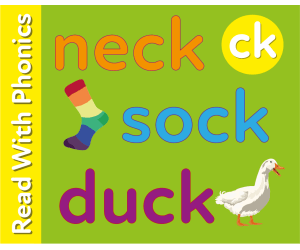
Introduces The Ending CK: Play Fun Games
ELA, Language Development, Phonics, Preschool, Kindergarten, Grade 1, 2, Activities, Games
Play Fun Games To Introduce The Phonic Sound 'ck' (3 years +) Cut out the words and use the suggestions to make sentences with the child (children). Next, cut out the next set of words and sort them into sound sets by placing them into Top Cat's fat tummy. How To Use The Pre Reader Work Packs At Guinea Pig Education we believe children do not need to spend years learning reading skills; this innovative new scheme teaches children to read in just six months to a year. A non reader should start with our pre reading material. The Pre reader work packs use phonics or the sounds in words. The child can learn a series of phonic sounds, which give him or her a 'tool' to work out nearly 80% of words in the English language. The other 20% of words will be learnt by looking and saying the words. In these packs, the child (or group of children) will be taught to recognise initial sounds as in 'b', 'd' and vowel sounds as in 'a' - c...a...t. They will practise running sounds together to make words. The sentence maker will help him or her to organise the words into sentences. The packs are easy to use with clear instructions, for the adult to use with a child (or group of children). The structured material encourages the child to practise word building and sentence making using phonic sounds. To make learning a really fun experience, the material contains word games , like snap and bingo. The child (children) can move on when the adult is confident the sounds have been learnt. Learn To Read With Phonics Pre Reader packs are designed to start children reading who have not done any reading before. They are a starting point for learning to read with phonics. Children can start at three or four, if they are ready to concentrate. The Pre Reader packs introduce the 26 sounds of the alphabet, the skills of sounding out words with phonics and blending phonic sounds to make three and four letter words. The child (children) should practise the material each day and move on only when the child is familiar with the material. The course is structured. Each new sound builds on the one that went before. Tell the child (children) to personalise the drawings, adding to them, using their own ideas. Play the games . Repeat the exercises many times until they know the words. They should have fun learning to read.
Author Guinea Pig Education
Tags Phonics Games, Phonics Activities, Fast Phonics, Learn To Read, Letters And Sounds, Playfungames, Ending Sound Games, Word Endings Games

An Song (MP3)
ELA, Reading, Preschool, Kindergarten, Grade 1, Songs, Activities
This product is the AN Song, an MP3 that helps students recognize the sight word AN. This product can help build speed and fluency while reading for other teachers who are interested.
Author Have Fun Teaching
Tags Counting

Alphabet & Numbers Playdough Mats for Pre-K, K and Special Education
ELA, Kindergarten, Preschool, Activities
Alphabet & Numbers Playdough Mats for Pre-K, K, and Sped This Alphabet & Numbers Playdough Mats is designed for kids with Autism and Dyslexia in mind. It uses the OpenDyslexic typeface by Abigail Gonzalez. This resource enhances letter and number recognition through hands-on play. It also develops fine motor skills as children mold and shape playdough. This material covers the entire alphabet and numbers 1-10 with additional tracing space and quantity recognition space. This is designed to support different learning styles for every child. This resource is made for Early intervention, Preschool, Pre-k, Kindergarten students within the special education classrooms or in an inclusive setting and even homeschool. This worksheet is available in PDF format and has 38 pages in total. It is also aligned with Common Core ELA & Math Standards: RF. K1 for demonstrating understanding of the organization and basic features of print, RF. K1.d for recognizing and name all upper- and lowercase letter of the alphabet, LK. 1a for print many upper-and lowercase letters and K. CC .B4 for understanding the relationship between numbers and quantities; connect counting to cardinality. This material is available in black and white upon request. If you are looking for more resources similar to this, please visit my Teach Simple storefront! If you have any questions or suggestions please feel free to email us at thespecialtstore.customercare@gmail.com . Thank you!
Author The Special T. Store
Tags Special Education, Pre-K, Early Intervention, Kindergarten, Printables, Numbers, Alphabet, Worksheets, Activities, Homeschool

Doodles and Oodles of Art
Creative Arts, Art, Preschool, Kindergarten, Grade 1, 2, 3, Activities, Crafts
Doodles and Oodles of Art: An Inspiring Resource for Students' Creativity Doodles and Oodles of Art offers a comprehensive compilation of over one hundred art ideas. It invigorates the creative spirit in students and is perfect for educators in search of inspiring art activities. These activities are suitable across a spectrum grade levels, from kindergarten through to grade three. The standout feature of this resource lies not just in its simplicity but also its adaptability. Every project uses materials that are economical and easy to acquire, facilitating seamless implementation in diverse environments, such as conventional classrooms or home schools. From an instructional viewpoint, it can be employed for entire class projects during art sessions or divided into smaller group activities to encourage cooperative learning. Redefining Conventional Lesson Plans In contrast to traditional lesson plans bound by rigid instructions or guidelines, Doodles and Oodles of Art stands apart by encouraging individual creativity without set boundaries. No rigid instructions or guidelines Allows space for personal creativity exploration Aiding Instruction Process Smoothly To support your teaching process effectively, each activity is linked with full examples illustrating potential outcomes. Regardless, there's always room left for inventive exploration with no right or wrong approach set firmly. Flexible PDF Format This extensive resource comes as a user-friendly 136-page PDF ready for printing—providing flexibility so educators can print copies on an as-needed basis serving different purposes such as homework assignments, class handouts or personal instruction manuals. Doodles and Oodles of Art captures an ideal combination between structured learning while leaving room open for creativity —preparing young learners' minds for their artistic journey, making art education more approachable for educators across various educational settings: from public schooling to homeschooling. In fields like Art & Music with associated crafting activities, where nurturing creativity is crucially important, Doodles & Oodles of Art serves not just as a tool but also inspires everyone towards embracing the generous scope that artistic freedom allows. Unleashing Imagination Dive right into this world where imagination overrules strict rules—where we provide the young learners with wings to fly!
Author Classroom Complete Press
Tags Art Development, Art Ideas, Crafts, Patterns, Pictures

SAMPLE Fry's Tenth 100 Sight Words Fill-in-the-Blanks
ELA, Language Development, Pre-Reading, Spelling, Vocabulary, Kindergarten, Preschool, Grade 1, Worksheets & Printables, Flashcards, Activities, Worksheets
This collection aids in the introduction, drilling, and assessment of the Tenth (10th) 100 Sight Words most commonly used, curated by Dr. Edward Fry. The sight words are sectioned into five subsets of 20 words each (based on frequency), with a distinct color allocated to each word cluster, namely: Orange, Yellow, Green, Blue, and Violet. This complimentary sample presents the initial segment (Orange) of this quintuple set. Interested in what you see? Secure the FULL version here. Included in the set are: ⭐️ Fill-in-the-Blanks | Worksheets + Answer Keys Every word from Fry's Tenth 100 Sight Words (1-20) is highlighted in a Fill-in-the-Blanks sentence. Each sheet accommodates 6 or 7 sentences, and an answer key is provided. ⭐️ Word Searches | 20 Sight Words per Page These Word Searches encapsulate all of Fry's Tenth 100 Sight Words (1-20), split into 2 sheets, each displaying 10 sight words (ordered by frequency). ⭐️ Fry's Tenth 100 Sight Words | In Alphabetical Order/Color Coded This lexicon tabulates each of Fry's Tenth 100 Sight Words in alphabetical succession. Plus, each word is color coded to signify its original set. ⭐️ Fry's Tenth 100 Sight Words | Ranked by Frequency This lexicon showcases each of Fry's Tenth 100 Sight Words, organized by frequency, and sorted into color coded groups. ⭐️ Printable Flash Cards | Colored/B&W - Round/Sharp Corners Multiple printable renditions of Fry's Tenth 100 Sight Word flash cards (1-20) are available here. Choose the style of flash card that suits your preference! Total Contents: 14 PDF Pages ⭐️ Enjoyed this resource? Click any link below to explore this entire product line! ⭐️ 1. Fry’s First 100 Sight Words | Fill-in-the-Blanks 2. Fry’s Second 100 Sight Words | Fill-in-the-Blanks 3. Fry’s Third 100 Sight Words | Fill-in-the-Blanks 4. Fry’s Fourth 100 Sight Words | Fill-in-the-Blanks 5. Fry’s Fifth 100 Sight Words | Fill-in-the-Blanks 6. Fry’s Sixth 100 Sight Words | Fill-in-the-Blanks 7. Fry’s Seventh 100 Sight Words | Fill-in-the-Blanks 8. Fry’s Eighth 100 Sight Words | Fill-in-the-Blanks 9. Fry’s Ninth 100 Sight Words | Fill-in-the-Blanks 10. Fry’s Tenth 100 Sight Words | Fill-in-the-Blanks For any questions, comments, or suggestions feel free to email us at: toms.talk.resources@gmail.com . Wishing you lots of fun with this resource!
Author Tom's Talk
Tags Sight Words, ESL, Flash Cards, Worksheets, Fill-in-the-Blanks, Fry, Fry's Sight Words, ELA, Print, Word Search
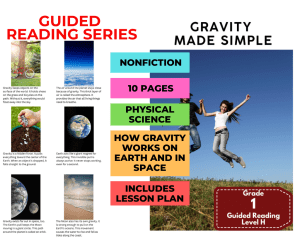
Guided Reading Level H - Gravity Made Simple
ELA, Resources for Teachers, Reading Comprehension, Reading, Science, Pre-Reading, Language Development, Vocabulary, Physics, Earth and Environmental Sciences, Kindergarten, Grade 1, 2, Worksheets & Printables, Worksheets, Teacher Tools, Centers, Activities, Literacy Readers, Quizzes, Quizzes and Tests, Assessments
This Guided Reading Book - Gravity Made Simple (Level H) includes: Guided Reading Color Label (front cover x1) This is a quick way to match the book’s demands to what students can generally handle.. The overall goal is to use the level/color to pick books for several smaller groups. To qualify for a certain level, a student is expected to read a book from that level with about 90–94% accuracy. If a student is consistently accurate and understands, move up a level. If the student is struggling at that level, drop down and add more support. Each student will improve at completely different rates, but it is generally one of the best ways to check progress across the class. DOWNLOAD THE CATALOG TO VIEW ALL GUIDED READING BOOKS AVAILABLE (SORTED LEVELS A-Z) Pre-Reading Question (x1) Teacher asks the prompt aloud, can be while showing the cover or first page. Students share what they already know, or make educated guesses from the cover. Prompt them to use the target vocabulary. Write some of their responses on the board to look back at during the reading. Vocabulary Words (x5) Introduce the five words, best doing it one at a time. Start by saying it, while students repeat and then see if anyone knows what it means before reading further. Read through the meaning and try to briefly connect each word to a picture or gesture so it’s meaningful. Ask students to flip through the book pages and point to where they see each of the vocabulary words. While reading the book pause upon coming across one of the vocab words or read the sentence twice to make sure students understand the word has appeared. Optional: Ask students to raise hands whenever they see/hear one of the new words. Guided Reading Pages (x10) Check the book snapshot (below) for: primary topic - do you need to prep extra reading or intro materials on this? what is taught best - decide on 1-2 bullets to focus on, use the prompt or words provided here for best results. learning goals - what you are checking for students to be able to do after the session, elicit answers using prompts or words provided. key vocabulary (see section above). questions overview - so you know what is coming up and if you need to prep extra materials to assist understanding. Run the lesson You may have already looked at a few of the pages together, but you can show them some of the pictures again first to set meaning. Depending on how much time you have and how familiar your students are with guided reading class, you may want to read the book aloud first with the group first. Students whisper or partner read, while you listen in. If time, do it as a group, one student reading a page each. Use the guided page’s prompts to coach: “Check the picture / does it make sense?” “Point under the words / try the first sound” “Reread the sentence smoothly”. Try to focus more on one student per session (rotating every time), so you can work out if they are ready to move up or need to move down a level. Comprehension Questions (back cover x3) This is your way to check that students didn’t just say the words, but actually understood the text. First, let students answer by pointing to the page/picture and saying a short sentence. After any answer, follow with: “Show me where you found that in the text.” In bigger groups, have partners answer first (10–20 seconds), then call on 2–3 students to share. Differentiation tips: Emerging speakers/struggling readers: oral + pointing On-level: oral in a full sentence Higher: one written sentence or draw + label Book Snapshot Title: Gravity Made Simple Genre: Nonfiction (informational) Subject: Science (Physical Science / Earth & Space Science) Primary Topic: How gravity works on Earth and in space Estimated Guided Reading Level (A–Z): H What This Book Teaches Best Gravity is a hidden, always-active force that pulls things toward Earth’s center. Gravity keeps objects on Earth’s surface—without it, things would float away. Gravity keeps the air close to Earth, forming the atmosphere that living things need to breathe. Gravity works in space too: Earth’s pull keeps the Moon in an orbit, and the Moon’s gravity affects ocean tides. Mass and gravity connect: more mass means a stronger gravitational pull, and weight measures gravity’s pull. Learning Goals Explain what gravity is and what it does to objects on Earth. Describe what happens when an object is dropped, according to the text. Tell how gravity helps keep objects (and air) close to Earth. Describe how Earth’s gravity affects the Moon’s orbit. Explain how the Moon’s gravity is connected to tides along the coast. Use the text to explain how mass relates to gravitational pull. Key Vocabulary From the Text gravity — a force that pulls things toward Earth. atmosphere — the thick layer of air around Earth. orbit — the path something takes around a planet. mass — how much matter is inside an object. tides — ocean water rising and falling along the coast. Discussion Prompts Pre-reading question: What do you think happens when you drop an object? Comprehension questions: What does the book say happens when an object is dropped? Comprehension questions: What does Earth’s pull do for the Moon’s path around Earth? Comprehension questions: What does the book say causes tides along the coast? Printing Tips 1. Best Printing Method (Recommended) “Booklet” Printing (Best if Available) If your printer or PDF viewer supports Booklet Printing , use this. Settings to use: Print mode: Booklet Paper size: Letter or A4 (either works) Orientation: Landscape Print on both sides: Yes Flip on: Short edge Scaling: Fit to printable area Booklet subset: First test: Front sides only Then: Back sides only This will automatically: Pair pages correctly Put the cover on the outside Align everything for folding After printing, fold in half and staple along the spine . 2. If “Booklet” Printing Is NOT Available You can still print this correctly with manual duplex printing . Step-by-step: Open the PDF. Choose Print . Set: Orientation: Landscape Pages per sheet: 1 Print on both sides: Yes Flip on: Short edge Print all pages . Because each PDF page already contains two facing book pages, the result will still fold cleanly into a book. Thousands of Cored Education products are included with your TeachSimple membership. Download links and encyclopedia index available here.
Author Cored Education
Rating
Tags Vocabulary, Reading Comprehension, Reading Passages, Leveled Reading, Nonfiction, Reading, Guided Reading, Gravity, Physics, Earth Science

Kids Yoga Stories: Fourth of July Yoga Cards for Kids
P.E. & Health, Yoga, Preschool, Kindergarten, Grade 1, 2, 3, Activities
Kids Yoga Stories: Fourth of July Yoga Cards for Kids is a deck of 40 illustrated yoga pose cards to use with children ages 3+ in the classroom, therapy settings, or at home. Children will learn yoga poses themed around Fourth of July concepts. An index card provides the recommended sequence to flow through the poses. There are also tips for teaching child-friendly yoga. Benefits of yoga for kids' development include increased strength, flexibility, body awareness, self-confidence, better sleep, and healthy active lifestyles. This deck can be used in many settings - as brain breaks, transitions, morning routines, PE, occupational therapy, or in small and large groups. The illustrations feature multicultural representation. Use these cards to teach yoga while reinforcing Fourth of July concepts in a fun, active way!
Author Kids Yoga Stories
Tags Kids Yoga Stories, Fourth Of July, Yoga Cards, Kids Yoga, Summer Yoga

Guided Reading Level B: Clouds You Can Spot
ELA, Resources for Teachers, Reading Comprehension, Reading, Science, Language Development, Pre-Reading, Vocabulary, Earth and Environmental Sciences, Earth Sciences, Kindergarten, Preschool, Grade 1, Worksheets & Printables, Worksheets, Teacher Tools, Centers, Activities, Literacy Readers, Quizzes, Quizzes and Tests, Assessments
This Guided Reading Book - Clouds You Can Spot (Level B) includes: Guided Reading Color Label (front cover x1) This is a quick way to match the book’s demands to what students can generally handle.. The overall goal is to use the level/color to pick books for several smaller groups. To qualify for a certain level, a student is expected to read a book from that level with about 90–94% accuracy. If a student is consistently accurate and understands, move up a level. If the student is struggling at that level, drop down and add more support. Each student will improve at completely different rates, but it is generally one of the best ways to check progress across the class. DOWNLOAD THE CATALOG TO VIEW ALL GUIDED READING BOOKS AVAILABLE (SORTED LEVELS A-Z) Pre-Reading Question (x1) Teacher asks the prompt aloud, can be while showing the cover or first page. Students share what they already know, or make educated guesses from the cover. Prompt them to use the target vocabulary. Write some of their responses on the board to look back at during the reading. Vocabulary Words (x5) Introduce the five words, best doing it one at a time. Start by saying it, while students repeat and then see if anyone knows what it means before reading further. Read through the meaning and try to briefly connect each word to a picture or gesture so it’s meaningful. Ask students to flip through the book pages and point to where they see each of the vocabulary words. While reading the book pause upon coming across one of the vocab words or read the sentence twice to make sure students understand the word has appeared. Optional: Ask students to raise hands whenever they see/hear one of the new words. Guided Reading Pages (x10) Check the book snapshot (below) for: primary topic - do you need to prep extra reading or intro materials on this? what is taught best - decide on 1-2 bullets to focus on, use the prompt or words provided here for best results. learning goals - what you are checking for students to be able to do after the session, elicit answers using prompts or words provided. key vocabulary (see section above). questions overview - so you know what is coming up and if you need to prep extra materials to assist understanding. Run the lesson You may have already looked at a few of the pages together, but you can show them some of the pictures again first to set meaning. Depending on how much time you have and how familiar your students are with guided reading class, you may want to read the book aloud first with the group first. Students whisper or partner read, while you listen in. If time, do it as a group, one student reading a page each. Use the guided page’s prompts to coach: “Check the picture / does it make sense?” “Point under the words / try the first sound” “Reread the sentence smoothly”. Try to focus more on one student per session (rotating every time), so you can work out if they are ready to move up or need to move down a level. Comprehension Questions (back cover x3) This is your way to check that students didn’t just say the words, but actually understood the text. First, let students answer by pointing to the page/picture and saying a short sentence. After any answer, follow with: “Show me where you found that in the text.” In bigger groups, have partners answer first (10–20 seconds), then call on 2–3 students to share. Differentiation tips: Emerging speakers/struggling readers: oral + pointing On-level: oral in a full sentence Higher: one written sentence or draw + label Book Snapshot Title: Clouds You Can Spot Genre: Nonfiction (informational) Subject: Earth Science (Weather) / Early Literacy Primary Topic: Observing clouds using simple describing words Estimated Guided Reading Level (A–Z): B What This Book Teaches Best Builds early nonfiction observation language by naming what you can see in the sky (sun, clouds, sky). Teaches describing words (adjectives) for clouds: big/small, white/grey, high/low, and “rain clouds.” Supports patterned reading and fluency through repeated sentence structure: “See the ____.” Encourages compare/contrast thinking using paired opposites (big vs. small; high vs. low; white vs. grey). Learning Goals Students will identify things the book says you can see (sun, clouds, sky). Students will describe clouds using words from the text (big, small, white, grey, high, low, rain). Students will retell the book’s sequence using the repeated pattern “See the ____.” Students will compare two cloud descriptions from the book (such as high/low or big/small). Students will answer simple questions about what the book tells the reader to see. Key Vocabulary From the Text clouds — white or grey puffs you see in the sky grey — a color between white and black high — up far above you low — down close to the ground rain — water that falls from clouds Discussion Prompts Pre-reading question: What do you think you might see when you look up at the sky? Comprehension questions: What is the first thing the book says to see? Comprehension questions: What are two different kinds of clouds the book tells you to see? Comprehension questions: What is the last thing the book says to see? Printing Tips 1. Best Printing Method (Recommended) “Booklet” Printing (Best if Available) If your printer or PDF viewer supports Booklet Printing , use this. Settings to use: Print mode: Booklet Paper size: Letter or A4 (either works) Orientation: Landscape Print on both sides: Yes Flip on: Short edge Scaling: Fit to printable area Booklet subset: First test: Front sides only Then: Back sides only This will automatically: Pair pages correctly Put the cover on the outside Align everything for folding After printing, fold in half and staple along the spine . 2. If “Booklet” Printing Is NOT Available You can still print this correctly with manual duplex printing . Step-by-step: Open the PDF. Choose Print . Set: Orientation: Landscape Pages per sheet: 1 Print on both sides: Yes Flip on: Short edge Print all pages . Because each PDF page already contains two facing book pages, the result will still fold cleanly into a book. Thousands of Cored Education products are included with your TeachSimple membership. Download links and encyclopedia index available here.
Author Cored Education
Rating
Tags Vocabulary, Reading Comprehension, Reading Passages, Literacy Readers, Leveled Reading, Nonfiction, Reading, Guided Reading, Earth Science, Clouds

Lesson Plan on Plant Life Cycle for Kindergarten
Biology, Life Sciences, Science, Nature & Plants, Kindergarten, Grade 1, Lesson Plans, Teacher Tools, Worksheets & Printables, Activities
With a playful, participatory approach, this captivating Kindergarten lesson plan teaches young students about the plant life cycle. The 90-minute lesson, which is based around the instructive movie "Plant Life Cycle," walks students through the four main phases of plant growth: seed, sprout, seedling, and flower. Children will investigate how plants grow and what they require—sunlight, water, soil, and air—through a combination of pictures, storytelling, hands-on activities, and movement. A dynamic group conversation, a video watching with narrated explanations, and a straightforward tale reenactment to aid understanding are all included in the session. After that, students will finish a vibrant worksheet that includes matching, coloring, sequencing, and drawing exercises. The idea of development and renewal is reinforced through a unique craft project that uses paper plates to help kids picture the plant life cycle in a circular fashion. By the end of the lesson, children will be able to identify and describe each stage in the plant life cycle. The included worksheet and answer key support independent learning and review. This lesson promotes curiosity, fine motor skills, and a love of nature in young learners.
Author Bright Classroom Ideas Marketplace
Rating
Tags Plant, Life, Cycle, Biology, Earth, Nature, Kindergarten, Lesson, Plan

Short A: Sample Phonics Games and Activities - Riddle Time
ELA, Language Development, ESL, Resources for Teachers, Vocabulary, Phonics, Pre-Reading, Spelling, Kindergarten, Preschool, Grade 1, Teacher Tools, Games, Activities
Short A: Riddle Time Sample Game Note: This download is in PowerPoint show mode to protect the rights of the image creator(s), and is thus UNEDITABLE. Playing the Game The question slide will begin with a clue and the amount of points available for guessing the correct word with this clue alone. Students can write/say their answers. Clicking the curved arrow on the right will make the next clue appear. This will have a lower points value but gives another clue for students to guess the word on. Again, press the curved arrow for the final clue. This is pretty much a a give away ie. you put this on your head, so students win at least five points on each round. Press the arrow for the answer. A pic will also appear but immediately become semi-transparent so you can still see the clues underneath if you wish to go through them. Press the square in the bottom right corner to go to the next page. Will be harder for early learners due to the amount of reading so you may have to read it out and help with some meanings. About the Full Game (available in the ppt game links section below) Practice reading key short A words and clues with this game. Words come up clearly so are easy to read, you may want to ask students to spell the word before revealing it. Teachers have complete control over the length of each slide as clues comes out one-by-one. Review phonics in a fun way and with 16 words there is amply opportunity for all students to get involved. 17 Slides Words: man, ran, pan, can, hat, rat, mat, fan, ham, band, sand, sad, map, clap, jam, bag Picture style: clipart Includes basic sound effects for increased entertainment. Helps to Build Letter recognition – Identifying letters in different fonts or contexts. Letter-sound association – Connecting letters to its sounds. Vocabulary building – Introducing words that start with each letter. Phonemic awareness – Listening for letter sounds in words, rhyming, or segmenting sounds. FULL CATALOG OF DOWNLOAD LINKS HERE Letter PPT Game Links: Letter A Hidden Pictures 1 MemWord Hidden Pictures 2 Hidden Pictures 3 The Short Question Riddle Time Review Games Follow the Vocab Letter B Letter C Letter D Letter E Hidden Pictures 1 The Grand Circle 8 Pictures 1 Clue Behind the Garage Doors Outside the Submarine Two Review Games Say What You See Quiz Game Letter F Letter G Letter H Letter I Hidden Pictures 1 MemWord Three Review Games Three Quiz Show Style Games Find the Ball Bowling Four Mini Games Outside the Train Window Letter J Letter K Letter L Letter M Letter N Letter O Hidden Pictures 1 MemWord Yes or No Game Six Pictures Game Hidden Pictures 2 6 Stars One Question MCQS Game The Grid Letter P Letter Q Letter R Letter S Letter T Letter U Letter V Letter W Letter X Letter Y Letter Z Overview These interactive PowerPoint games make early phonics practice fun and engaging for young learners. With a mix of exciting activities, kids stay motivated while strengthening key phonetic patterns. Each game offers plenty of opportunities for participation—whether playing in teams, one-on-one, or independently. The variety of game styles, from disappearing squares to timed challenges, ensures that every student can learn in a way that works best for them. Bright visuals, sound effects, and gradually increasing difficulty keep students engaged and support different skill levels. Teachers have full control over the pacing and difficulty, making it easy to adjust the experience based on their students' needs. Whether guessing hidden images, recalling sequences, or solving riddles, each activity reinforces phonics in a fun, interactive way. These games turn traditional phonics drills into an exciting, hands-on learning adventure, building confidence and essential literacy skills in young learners. For More Like This For similar downloads and other frees, do check out Cored Group on TeachSimple.
Author Cored Education
Tags Esl, Powerpoint, Ppt, Powerpoint Games, Esl Games, Vocabulary Games, Letter A Games, Letter A Activities, Phonics Games, Cvc Games

Around Song (Animated Music Video)
ELA, Reading, Preschool, Kindergarten, Grade 1, 2, Songs, Activities
This product, The AROUND Song (Animated Music Video), is a great resource for teachers who are looking to help their students recognize the sight word AROUND. This video is fun and engaging, and will help build reading speed and fluency.
Author Have Fun Teaching
Tags Counting

Letter U Counting to 10 Center
ELA, Math, Early Math, Numbers, Language Development, Phonics, Kindergarten, Preschool, Centers, Activities
This Letter U Counting to 10 Center is a counting to 10 math matching center for the letter U. This resource is great for letter recognition and practicing counting with tens frames. This is a quick, easy, and engaging activity to give preschooler or kindergartener students who need practice with recognizing the lowercase form of the letter U, who need practice recognizing numbers up to 10, as well as for those students who need extra practice counting to 10. What is Included: A tens frame card for each number 1 to 10 with lowercase letter U as counters Umbrella themed number cards for 1 to 10 This counting math center can be used in the following ways Math centers Matching centers Small group activities Morning tubs or baskets Emergency sub plans Quick hands on counting assessment Quick number recognition assessment Skills assessed with this letter U counting activity Lowercase letter U recognition Ability to count to 10 Recognizing amounts when represented in a tens frame Ability to match numbers to the correct tens frame Fine Motor Skills This counting to 10 math center is low prep. All that is required is for the teacher to print it out, cut it out and laminate it if so desired. Once created, this counting center can be used over and over. The center provides a great way for students to practice counting to 10 and practicing letter recognition of lowercase letters at the same time. Students can work on this counting center independently, in pairs, or in small groups to complete. You can add manipulatives for students to cover each letter U as they count if they need a more hands on approach, or a more guided way to practice counting each letter U. For similar resources about the alphabet, visit my store!
Author The Connett Connection
Tags Counting To 10, Counting To Ten, Letter Recognition, Tens Frames, Counting With Tens Frames, Ladybug Counting, Preschool Math, Math Center, Letter U, Letter U Activities

When I Grow Up I Want To Be A Meteorologist Audio Book
Science, Earth and Environmental Sciences, Environmental Science, Preschool, Kindergarten, Grade 1, 2, 3, Read Alouds, Activities
If you are fascinated with thunderstorms, cloud formations, tornados, and windy weather, you might be interested in becoming a meteorologist.
Author Twin Sisters Digital Media
Tags Discover, Weather, Storms, Rain, Sun
Geometry: Spinner Game - PC Software
Math, Geometry, Common Core, Kindergarten, Preschool, Grade 1, 2, Activities, Games
Overview Geometry: Spinner Game - PC Software is a revolutionary tool designed for educators to guide students in early learning classes including preschool, kindergarten and grades 1 and 2. The aim is to delve into the world of geometry while aligning with the Five Strands of Math. This educational asset concentrates primarily on reaching the understanding level stipulated by Common Core State Standards. A Tool for Teachers & Homeschoolers If you are a teacher or homeschooler, this software will be an invaluable addition to your teaching toolkit. The Geometry game employs an engaging spinner format with six diverse questions covering various aspects of Geometry. This interactive layout makes it a superb aid in grasping complex geometrical concepts. The Learning Experience: The game 's design transcends conventional teaching methods by offering both fun and education. This unique geometrical facts-learning approach serves as an alternative to traditional worksheets. Versatility & Easy Adaptation: Geometry: Spinner Game - PC Software 'It's well adaptable as per various learning patterns based on educators' discretion or individual lesson objectives.' This can be deployed in whole group activities or facilitating small group sessions; its flexibility extends even further when used for homework assignments.' Navigating with Ease : Packed conveniently in a zip file, the easy-to-handle PC Software comes with user-friendly features that facilitate easy access. *Final Note*: A Nurturing Young Minds Movement* Moulded more than just being another pedagogical asset, this dynamic tool integrates an approach of stimulating young minds via gamification embedded within an educative setting that mirrors our STEM-anchored reality. In doing so, encouraging more impactful learning for Geometry principles across Math subjects. Step into this avant-garde teaching approach with Geometry: Spinner Game - PC Software.
Author Classroom Complete Press
Tags Spinner Game, Math Game, Geometry Game, Digital Math, Math Activity

Letter Y Phonics and Writing Centers with Real Photographs
ELA, Language Development, Phonics, Writing, Handwriting, Kindergarten, Preschool, Centers, Activities
This letter Y beginning sounds and handwriting activity includes real photographs to practice learning to recognize, write and identify the sound of the letter Y. Each picture has bold colors and includes easily recognized pictures. Each activity can be used in a literacy center for students to practice letter recognition. What is Included: There is an instructional page with printing instructions. There are letter Y posters with various letter W words. There are handwriting task cards that allow students to practice writing the letter Y as well as words that begin with the letter Y. There are beginning sound clip cards that allow students to practice clipping the images that begin with the letter Y. There is a sorting activity where you sort pictures that begins with Y from words that do not begin with Y. The letter Y sorting cards that can also be used to play memory, matching, or concentration games. These cards can also be used during a lesson in a pocket chart as well as for a center display. When to Use: All of the activities make great literacy centers, by placing each set of activities in the center and letting students complete activities alone or with a partner. These activities make great morning tub activities. Just place these activities in morning bins for students to complete as their classmates arrive to class. Skills Assessed: These activities assess letter recognition skills, beginning sounds, handwriting, and sorting skills. Each activity in this set is low prep. Each activity just needs to be printed out, cut apart, and laminated if desired. When you laminate the writing cards, you can create a writing center activity that is reusable is you add dry erase markers. The handwriting cards and beginning sound clip cards can be turned into task box activities.
Author The Connett Connection
Tags Phonics, Writing Centers, Real Photographs, Early Literacy, Letter Y

Shapes to Cut: Plants & Shapes
Creative Arts, Art, Preschool, Kindergarten, Grade 1, Activities, Crafts
Shapes to Cut: Plants & Shapes Shapes to Cut: Plants & Shapes is an invaluable educational tool designed with preschool, kindergarten, and Grade 1 educators in mind. This resource assists children in mastering essential fine motor skills such as scissor skills through easily understandable shapes and patterns; primarily focusing on the arts and performing crafts . Benefits of Using 'Shapes to Cut' Motor Skills Development: The act of grasping and manipulating scissors helps children develop their fine motor abilities that are crucial for future writing tasks. Increase Focus: Doing these activities regularly encourages a vital skills - concentration. Nurturing Creativity : Introducing artful craftwork not only stimulates creativity but repetition also enhances self-esteem and confidence in early learners. The teaching resource features a total of 28 precisely curated patterns suitable for first-time scissor users, incorporating simpler shapes with gentle edges, thick lines,and easily recognizable objects beneficial at this stage. Suitable for Diverse Learning Environments The learning objectives contained within this document align seamlessly with early childhood curriculum thus making it universally applicable for homeschooling and traditional classroom settings alike.Educators have the freedom; offer whole class lessons or smaller group sessions or even assign them as homework involving parents directly into their child's education process which is extremely beneficial during the initial years . In Summary, An all-inclusive educational bundle like 'Shapes To Cut: Plants & Shapes', aids educators by delivering a multidimensional learning means that highlights fundamental motor abilities, focus enhancement beyond just basic crafting techniques. .
Author Classroom Complete Press
Tags Cutting Shapes, Arts, Crafts, Plants, Cutting Plants

Geometry: Memory Match Game - MAC Software
Math, Geometry, Common Core, Kindergarten, Preschool, Grade 1, 2, Activities, Games
Geometry: Memory Match Game - MAC Software is a renowned educational tool that provides a revolutionary way to teach geometry to young learners. Originated for students from Pre-K to 2nd grade, this interactive game aligns perfectly with the crux of Common Core State Standards and STEM initiatives, thus incorporating National Council of Teachers of Mathematics' guidelines. This engaging software adopts the appealing format of a memory match game where students are instructed to locate 4 identical pairs that tie in with numerous geometric problems. A blend of fun and learning makes this tool an excellent method for children to comprehend elementary geometry concepts as outlined under: The Five Strands of Math framework This cleverly designed software can be smoothly integrated into various instructional settings - delivering lessons through projection in a large gathering or facilitating small breakout sessions on individual computers. Furthermore, Geometry: Memory Match Game - MAC Software can also be useful as an engaging reinforcement or revision task at home. About Installation Specially designed for MAC software, it can be downloaded easily onto your system via Single Zip file; devoid of any complication involving external CDs or thumb drives! Leveraging Mathematical Education With 'Geometry: Memory Match Game - MAC Software', educators have access to a potent support system that not just enhances their lesson plans but stirs up student's enthusiasm towards complex subjects like Geometry.
Author Classroom Complete Press
Tags Memory Game, Math Matching Game, Digital Math, Digital Games, Geometry Games