



3,979 products added recently
Page 63 - Science Activities
Ignite your students' interest in science with activities that make learning interactive and exciting. This collection offers experiments, demonstrations, and inquiry-based projects covering various scientific fields. By integrating these science activities into your lessons, you can encourage critical thinking, foster curiosity, and deepen understanding of scientific concepts.

 Show filters


Science Reading Passages on Light Heat Electricity Magnetism (Videos)
Science, Physics, Common Core, ELA, ESL, Language Development, Reading Comprehension, Reading, Pre-Reading, Grade 2, 3, 4, Teacher Tools, Activities
Accompanying Videos Based on Reading Passages on Light Heat Electricity Magnetism for Physical Science These accompanying videos contain scripts extracted from the Science Reading Passages series. With stock footage, subtitles, voiceovers, animation and diagrams, they will help students understand the topic more. Ideal for starting or ending a lesson, each video runs at less than 5 minutes and is at least 95% identical to the passage itself. What's inside? Part 3 Videos - Light, Heat, Electricity & Magnetism. Reading Passage 1: Characteristics of Light: Reflection and Refraction Reading Passage 2: Heat, Sources of Heat, and Heat Conduction Reading Passage 3: Electricity, Electrical Circuits, and Energy Reading Passage 4: Symbols and Electric Circuits Reading Passage 5: Magnets Magnetism and Electromagnetism Science Reading Comprehension Outline: Targeted for students in 3rd and 4th grades, these reading passages are enhanced with illustrations and graphs to elucidate critical points. Each lesson aligns with the Common Core State Standards, allowing you to integrate science reading practice effortlessly, knowing that minimal preparation is needed on your part. Each passage comes with a variety of questions in different formats, including multiple-choice formats, data analysis, and fill-in-the-blanks. The topics covered strike a balance between engaging content and core curriculum-based science subjects. Versatile in application, these lessons are suitable for a variety of settings such as whole-class instruction, morning activities, independent desk work, small group discussions, contingency plans for substitute teachers, homework assignments, or even special holiday-themed tasks. FULL CATALOG OF DOWNLOAD LINKS HERE Grade 3/4 Links: Physical Science Part 1 - Properties of Objects and Materials Google Docs/Slides/Forms PDF PPT Word Free Supplementary Pack Accompanying Videos Physical Science Part 2 - Position and Motion of Objects Google Docs/Slides/Forms PDF PPT Word Free Supplementary Pack Accompanying Videos Physical Science Part 3 - Light, Heat, Electricity, Magnetism Google Docs/Slides/Forms PDF PPT Word Free Supplementary Pack Accompanying Videos Life Science Part 1 - Characteristics of Organisms Google Docs/Slides/Forms PDF PPT Word Free Supplementary Pack Accompanying Videos Life Science Part 2 - Life Cycles of Organisms Google Docs/Slides/Forms PDF PPT Word Free Supplementary Pack Accompanying Videos Life Science Part 3 - Organisms and Environments Google Docs/Slides/Forms PDF PPT Word Free Supplementary Pack Accompanying Videos Earth Science Part 1 - Properties of Earth Materials Google Docs/Slides/Forms PDF PPT Word Free Supplementary Pack Accompanying Videos Earth Science Part 2 - Changes in the Earth and Sky Google Docs/Slides/Forms PDF PPT Word Free Supplementary Pack Accompanying Videos Earth Science Part 3 - Objects in the Sky Google Docs/Slides/Forms PDF PPT Word Free Supplementary Pack Accompanying Videos For similar products and other frees, do check out Cored Group on TeachSimple .
Author Cored Education
Tags Science, Elementary, Reading, Comprehension, Vocabulary, Answers, Physics, Physical Science, Ccss, Common Core

Space Activities For Preschool
Space, Earth and Environmental Sciences, Science, Early Learning, Activities, Worksheets & Printables
Take your little ones on an exciting space adventure with this interactive collection of preschool activities! These hands-on activities are designed to spark their curiosity and imagination, helping them explore planets, astronauts, rockets, stars, and the solar system, while building essential early learning skills through play. Contents This resource is well-organized, clearly designed, and features easy-to-follow activities. Each page is designed to capture preschoolers' attention and support their self-learning or classroom instruction. Suitable for: Preschool Pre-Kindergarten Kindergarten Ages 3-6 Activity Format This collection includes a variety of fun, printable learning activities that encourage creativity, observation, fine motor skills, early literacy, and problem-solving through the theme of space. Answer Key The file includes an answer key for the appropriate activities, making preparation quick and assessment easy for teachers, parents, and homeschoolers. How to Use Ideal for: Classroom Learning Centers Morning Activities Homeschooling Lessons Individual Tutoring Early Finishers Space-Themed Learning Units Printable Learning Stations Activities can be used individually or as a complete learning unit and are easily adapted to suit different ability levels. Learning Standards Designed to support early childhood learning objectives, including: Fine Motor Skills Visual Discrimination Basic Math Pre-Writing Skills Letter and Number Recognition Critical Thinking Vocabulary Development 45 Pages PDF File Type Over 30 Printable Pages
Author Kindergarten Friends
Rating
Tags Space Activities, Planets, Preschool

Volcanoes Know-It-Alls! Audio Book
Science, Earth and Environmental Sciences, Earth Sciences, Grade 2, 3, 4, Read Alouds, Activities
As part of the unique, science Know-It-Alls! Series that features interesting science facts, this audiobook puts the spotlight on Volcanoes! Did you know that scientists that study volcanoes are called volcanologists? Learn about the three main types of volcanoes: cinder cone, shield volcanoes and composite volcanoes. Awesome narration and sound effects plus many interesting facts, makes this audiobook fun and exciting for young science enthusiasts age 4 and up! Titles in the Know-It-Alls! Series include: Butterflies, Crocodiles, Dinosaurs, Farm Animals, Safari Babies, Snakes, Sharks, Spiders, Whales, Wolves, Puppies, Wild Cats, Bugs, Birds of Prey, Fish, Frogs, Apes, Seals, Bats, Bears, Predators, Mummies, Volcanoes, Lizards, Kittens and Horses.
Author Twin Sisters Digital Media
Tags Science, Learning, Fun, Ebook, Volcanoes

There Are Four Seasons Audio Book
Science, Earth and Environmental Sciences, Environmental Science, Kindergarten, Preschool, Grade 1, 2, 3, Read Alouds, Activities
We have four different seasons because the Earth is tipped as it rotates around the sun.
Author Twin Sisters Digital Media
Tags Science, Seasons, Winter, Summer, Spring
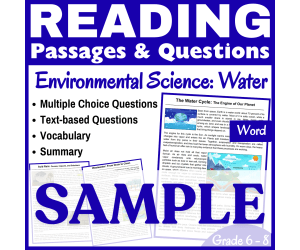
Water Cycle, Acid Rain, & Wastewater: SAMPLE Reading Passage (Word)
Science, Earth and Environmental Sciences, ELA, Reading, Reading Comprehension, Strategies, Resources for Teachers, Environmental Science, Grade 6, 7, 8, 9, Writing Prompts, Worksheets & Printables, Centers, Activities, Teacher Tools, Assessments, Quizzes and Tests, Quizzes, Tests
This is a ONE PASSAGE SAMPLE. The following is the description of the FULL resource and the downloading links: Water Cycle, Acid Rain, & Wastewater: Reading Comprehension Passages (Word) This very engaging collection of environmental science reading passages about Water Cycle, Acid Rain, & Wastewater is designed to bridge the gap between science and literacy through strengthening reading comprehension and sparking scientific curiosity in middle school students. Each passage blends English Language Arts skills with accurate science content that supports NGSS classroom practice. Ideal for interdisciplinary learning in ELA and Science. Suitable for Grade 9 review, too! What Is Included? There are (3) informational passages: Wastewater: From Drain to Clean Follow water from your sink to the treatment plant as screens pull out debris, grit settles, microbes break down leftovers, and disinfection makes the water safe to release or reuse. The Water Cycle: The Engine of Our Planet Watch water move through evaporation, condensation, precipitation, and runoff, with plants and soils helping store and move it. See how this cycle powers weather and refills rivers and aquifers. Acid Rain: Causes, Impacts, and Solutions Learn how certain air pollutants turn rain more acidic, what that means for lakes, forests, and buildings, and how cleaner energy and emission controls help damaged ecosystems recover. Student Tasks for Each Passage: 5 multiple-choice questions targeting main idea, key details, inference, vocabulary in context, and use of evidence 5 vocabulary matching items with clear, student-friendly definitions 5 text-based questions that require citing specific lines or facts 1 summary prompt that asks students to condense central ideas accurately Full answer key for every section Available Formats for this Resource PDF Google Docs FULL CATALOG OF DOWNLOADING LINKS HERE Other Science Reading Collections and Topics You May Find in the Store: 1. Astronomy & Space Science 2. Volcanoes, Rocks, & Mountains 3. Rock Cycle, Soil, & Sinkholes 4. Mars, Glaciers, & Antarctica 5. Water Cycle, Acid Rain, & Wastewater 6. Insects, Animals, & Ecosystems 7. Bioluminescence & Insects 8. Animal Skin, Cats, & T. Rex 9. Human Body and Senses 10. Health & Applied Bioscience 11. Waves, Light, & Imaging 12. Electricity & Energy 13. Motion & Materials 14. Chemistry and Materials Science 15. Electromagnetism 16. Acids and Bases 17. Gas Laws 18. Biotechnology 19. Periodic Trends 20. Protists and Fungi 21. Microevolution 22. Blood 23. Chemical Bonding 24. Magnets 25. Muscles 26. Nuclear Chemistry 27. Electromagnetic Devices 28. Epigenetics 29. The Law of Conservation of Mass 30. Atomic Models 31. Isotopes and Ions 32. Light 33. Human-Environment Interaction 34. Theory of Evolution 35. Photosynthesis 36. Origins of Life and Early Earth 37. Gene Expression and Regulation 38. Thermochemistry 39. Allergies 40. Coevolution 41. Birth to Adulthood 42. Cells 43. Entropy and Free Energy 44. The Human Brain 45. Mixtures and Solutions 46. Invertebrates 47. Zoo Animals 48. Biochemistry 49. Animal Behavior 50. Population Ecology ...and many more engaging science reading passages that cover intriguing and important topics designed to spark curiosity and support student learning. Product Details Length: 15 pages total Grades: 6–8, also suitable for Grade 9 review Use cases: close reading, stations, homework, intervention, test prep, and sub plans Standards support: reinforces informational-text skills and supports NGSS-style sense making through observation, modeling, and clear use of claim, evidence, and reasoning Why Teachers Choose This Set Authentic science content paired with rigorous literacy practice Consistent task structure across all passages for easier planning and smoother student routines Clear, age-appropriate writing that builds confidence without oversimplifying Use this set to reinforce ELA skills in science, to add literacy to your lessons, or to support independent work. The passages strengthen main idea, evidence use, vocabulary in context, inference, cause and effect, and summary writing. With ready-to-use assessments and complete answer keys, you can provide focused practice that is simple to run and fast to review.
Author Middle & High School - CORED Education
Rating
Tags Middle School, Reading Comprehension, Reading Strategies, Reading Passages, ELA, Centers, Reading Passage, Assessments, Vocabulary, Environmental Science
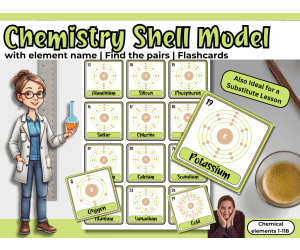
Shell Model – Chemical Elements Flashcards - Element names
STEM, Science, Chemistry, Physics, Life Sciences, Grade 7, 8, 9, 10, 11, 12, Activities, Games, Worksheets & Printables, Task Cards, Quizzes and Tests, Teacher Tools, Word Problems, Word Searches, Worksheets, Flashcards
Shell Model – Chemical Elements Flashcards 118 cards for learning the periodic table Learn atomic structure and the periodic table through play and visual learning 🧪🧠 These flashcards are designed to help students explore the structure of atoms using the shell model. Covering all 118 elements of the periodic table, each card includes the atomic number, element name, symbol, and a visual representation of the electron arrangement in shells. It’s a simple but effective tool for bringing abstract chemistry content into a more visual and interactive format. I’ve used this set in grades 7–10, both in introductory lessons and for revision. What worked especially well was printing the cards twice and using them as a memory game (“Find the Pairs”). Students match element names with their shell models or symbols – and along the way, they start to notice patterns: which elements belong to the same group, how many electrons fit in each shell, and what the outer shells can tell us about chemical reactivity. What’s included: 118 printable flashcards (PDF) – one for each element Each card features: atomic number, element name, chemical symbol, and shell model Suggestions for classroom use (games, sorting tasks, self-study) The cards can be used in a variety of ways: – As a memory game (matching name and shell model) – For group sorting activities (by group, period, metal/non-metal, etc.) – As quick quizzes in pair work – Or as visual aids when introducing atomic theory They’re suitable for different levels of difficulty. Beginners can focus on names and symbols, while more advanced students work with the shell diagrams and explain electron configurations. It’s also a helpful tool for differentiation – everyone works at their own pace, but with the same visual material. This resource comes as a PDF and is easy to print and prepare. Laminating the cards is a good idea if you plan to use them more than once. 📍 Best wishes, Heike from @Lernfitness Did You Know? I teach with a certified therapy dog, and together we create a positive and welcoming learning environment. 🐶
Author Lernfitness
Rating
Tags Educational Card Games, Chemistry, Physics, STEM Science Matching Game, Chemical Elements, Periodic Table Matching Game, Flashcards Chemical Elements, Element Names, Shell Model, Game

Motion: Ranges of Hearing - FLASH-MAC
Science, Physics, Common Core, Grade 5, 6, 7, 8, Activities
Motion: Ranges of Hearing - FLASH-MAC An essential teaching resource tailored for educators in public education and homeschooling environments. This comprehensive tool facilitates students' exploration into the diverse ranges of hearing among different animals, represented in Hertz. Incorporating this learning resource into the curriculum ensures learners of grade levels 5-8 master animal audiology. Interactive Activity for Mac Users Motion: Ranges of Hearing - FLASH-MAC is designed for use with Mac software, offering an interactive activity where the content includes graphical representations. Learning tasks involve matching animals with their respective range of hearing frequencies—promoting engagement and critical thinking skills. Whole Class Instructions: Use during class-wide teaching sessions to encourage collaborative learning. Small Group Work: Implement within small group work sessions to target specific topics closely. Homework Assignments: Utilize as homework material to bolster understanding of animal acoustics outside class hours. Nationwide Curriculum Alignment and Cognitive Development This unique resource aligns with Common Core State Standards—ensuring your instruction remains relevant according to nationwide educational guidelines. Moreover, each component is meticulously created following Bloom's Taxonomy principles; hence they facilitate not only knowledge acquisition but also cognitive skill development such as application and analysis. In Conclusion, The effective, science-centered tool Motion: Ranges of Hearing - FLASH-MAC brings subjects like physics alive within classroom or homeschooling setups efficiently—for grade levels 5 through 8. To summarize, whether you are a public-school professional or dedicated home educator—the Motion: Ranges of Hearing-FLASH-MAC tool is an invaluable instructional resource designed for you!
Author Classroom Complete Press
Tags Software (Mac)

Algorithms (Unplugged Coding #1)
Science, Technology, Computer Science, Grade 1, 2, 3, 4, 5, 6, 7, 8, Activities
You want to introduce or teach your students about programming / coding however you don’t have access to computers? No problem. This “Unplugged Coding” resource works without computers. After completing these printable activities, your students can apply similar logic and strategies to coding websites and apps. This is a great alternative or additional resources before using code.org or Scratch. This resource is apart of an unplugged coding series. In each, a different main concept is focused on. To use this resource, just print the PDF and have your students coding, unplugged today. The main focus of this resource is Algorithms. The purpose is to demonstrate that computer code follows a set of rules. This resource includes the following type of activities and worksheets: Algorithms info page. Explains what an Algorithm is and why it is useful to computers. This handout also has real life examples. It is a great starting point. Brushing Your Teeth Algorithm Activity Making a Sandwich Algorithm Activity Watching TV Algorithm Activity Making a Pizza Algorithm Activity Planting a Seed Algorithm Activity Decorating a Christmas Tree Algorithm Activity Curving a Pumpkin Algorithm Activity
Author Roombop
Tags Coding, Unplugged Coding, Programming, Printables
Chemistry & Physics Extra Credit Packets - Semester 1
Science, Chemistry, Physics, Grade 6, 7, 8, 9, 10, 11, 12, Activities
Chemistry & Physics Extra Credit Packets - Semester 1 This teaching resource, perfect for middle school to high school students, is especially useful for Integrated Chemistry & Physics. The Packet is a learning tool that can engage students both inside and outside the classroom. Product Features: An overarching feature of this product is its flexible utilization across multiple environments such as whole group activities, small group projects, or even individual homework assignments. Included within the Packet are: Seven basic-level Sudoku puzzles Five science-themed word searches Five crosswords loaded with ICP vocabulary - providing one puzzle per unit and Six digestible science articles All these activities align directly with the Semester 1 ICP curriculum enabling reinforcement of concepts explored during regular class sessions. Variations: The packet comes in five variations each featuring similar activities but assorted reading-level specific articles ranging from approximately 600 Lexile (Version 1) to approximately 1200 Lexile (Version 4). Version 5 includes resources for Spanish-speaking individuals by presenting translated articles at about an estimated reading level around an approximate of800 Lexile. Note: The files come in .pdf format which are non-editable but easily accessible through widely available software such as Adobe Reader. Please ensure you have compatible software before purchase and download. In Summary, The Chemistry & Physics Extra Credit Packets - Semester 1 is a versatile addition to any educator's toolbox not just catering classic scientific disciplines like Chemistry and Physics but also comprehensively addressing divergent learner needs.
Author Integrated Chemistry and Physics
Tags Teaching Resource, Interactive Activities, Science Puzzles, Curriculum Reinforcement, Diverse Learner Needs
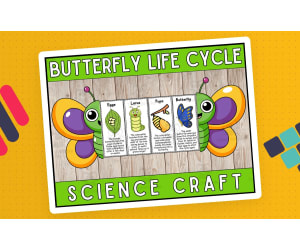
Butterfly Life Cycle Craft Foldable Science Cut and Paste Activity
Animals, Life Sciences, Science, Elementary, Middle School, Crafts, Activities
This interactive and engaging teaching resource is designed to help students explore the life cycle of a butterfly through a hands-on craft activity. The Butterfly Life Cycle Craft Foldable provides a creative way for students to learn about the stages of a butterfly's metamorphosis, from egg to adult, while reinforcing key science and biology concepts. This activity is perfect for science lessons, plant life cycle units, or studies on agriculture and horticulture. It encourages sequencing, critical thinking, and creativity, making it ideal for elementary and middle school students. The foldable can be used individually, in small groups, or as a whole-class project, and it also serves as a great display piece or take-home item to share learning with families. Great for homeschooling, classroom education, or extra practice. Number of pages: 6 pages Format PDF file size: 11*8.5 Inches If you and your students or your children enjoy using this educational and engaging resource. please rate it and follow my store to be the first to know about my new teaching resources and freebies. Enjoy!
Author Wonderland School
Tags Butterfly Life Cycle Craft, Butterfly Craft, Plant Life Cycle, Life Cycle Craft, Spring Craft, Science, Science Craft Foldable, Science Sequencing, Cut And Paste, Cut And Paste Activity

Elements and Compounds - Smart Board Bingo - Middle School Science
Science, Chemistry, Grade 5, 6, 7, 8, 9, Activities, Games
Smart board bingo includes questions on atoms, molecules, elements, compounds, symbols, formulae and naming compounds. A numbered question is generated randomly and, if that number is on their bingo card, students write in the answer. So much fun students don’t realise they are learning! Smart board bingo includes questions on: atoms and molecules; elements and compounds; chemical symbols; formulae; naming compounds. What is Included Random question generator for smart board (interactive white board) – 54 questions 48 bingo cards Answers PowerPoint Answer sheet Suggested Lesson Plan Play bingo – students write the answers into the square on their bingo card which matches the question number in the smart board. Teacher uses answer sheet to check card of winners of lines and full house Pupils use answer PowerPoint to check their answers at end of game.
Author Elf off the Shelf Resources
Tags Science Bingo, Chemistry Bingo, Smart Board Bingo, Elements Digital Activity, Compounds Digital Activity, Element Bingo

Antoine Laurent de Lavoisier – Exploring the Father of Modern Chemistr
Life Sciences, Science, STEM, Social Studies, Biographies, Inventors, Basic Science, Physics, Chemistry, Biology, Grade 6, 7, 8, 9, 10, 11, Worksheets, Worksheets & Printables, Quizzes, Quizzes and Tests, Teacher Tools, Projects, Activities
Antoine Laurent de Lavoisier – Exploring the Father of Modern Chemistry A structured reading and worksheet resource for grades 8–10 (PDF + H5P) ⚗️📚 A printable and digital resource for grades 8–10 science and cross-curricular teaching 🧪🧠 This classroom resource gives students the chance to learn about Antoine Laurent de Lavoisier, the scientist often referred to as the “father of modern chemistry.” Known for his work on the conservation of mass and his role in naming elements like oxygen and hydrogen, Lavoisier helped shape the way we think about matter and chemical reactions today. The material combines a clear, student-friendly text with structured tasks to support understanding and engagement. It’s designed to be flexible enough for regular science lessons, independent study, or even substitute teaching—no special background knowledge is needed. What’s included: Informational text about the life and work of Antoine Lavoisier Profile worksheet for summarizing key points Quiz questions with complete answer key Two optional follow-up activities: – Students write their own questions based on the text – Partner exchange and answer Formats: – PDF (print or digital use) – Editable DOCX (text only, no design) – H5P (interactive version for digital platforms, no images) In the classroom: This resource works well alongside lessons on chemical reactions, the law of conservation of mass, or the history of scientific discovery. I’ve used it both as an introduction to a new unit and as a quiet reading activity when students needed structured but independent work. The H5P version is especially useful for blended learning or homework, allowing students to check their answers and work at their own pace. A practical way to link modern scientific concepts to one of their earliest thinkers—with no extra prep required. Have fun exploring the world of science with your students! Warmly, Lernfitness Did You Know? I teach with a certified therapy dog, and together we focus on creating a positive and inspiring learning environment.
Author Lernfitness
Rating
Tags Science, Famous Scientists Lesson, H5P, Interactive Science Exercises, STEM, Scientists, Chemistry, De Lavoisier, Father Of Modern Chemistry, Antoine Laurent De Lavoisier

Our Planets
ELA, Language Development, Vocabulary, Writing, Science, Basic Science, Grade 2, 3, 4, Activities
Our Planets Teaching Resource Introducing the perfect collaboration of science and literacy, Our Planets,Grade Level N leveled reader is designed to immerse students into the intriguing realm of the Solar System by providing a wealth of exciting details about the planets. A key feature that makes the leveled reader Our Planets a unique teaching tool is its integration of astronomy and literary skills. Science enthusiasts among your students will be intrigued by the interstellar facts. Other students just might catch that astronomy bug! The book is readily accessible in a PDF format enabling printing before class or sharing across digital platforms and can be adapted for individualized learning, small groups, or a whole class activity. It is also great for homeschooling students or science enrichment. Included are several additional activity sheets brimming with interesting task-based assignments designed to bolster several areas including language arts basics, vocabulary-building exercises, and writing skills. Listed on the first page of the reader are specific science concepts and English language skills targeted in the resource to simplify lesson planning. The text integrates The Next Generation Science Standards, specifically Earth and Space Science as well as ELA Common Core Standards that help build creativity and innovation, critical thinking, problem-solving, collaboration, and communication. What’s Included 9 pages and Answer Key.
Author Sue Peterson
Tags Astronomy, Literacy, Science, Solar System, Activity Sheets

Rainy April | Kindergarten Unplugged / Digital Coding
Science, Technology, Computer Science, Preschool, Kindergarten, Grade 1, Activities
Rainy April | Kindergarten Unplugged / Digital Coding An innovative teaching resource that is the ideal solution to educators wanting to introduce programming and coding basics to young learners. Regardless of the types of programmable tools you have, this resource offers an engaging STEM activity that is sure to captivate and educate. The focus of this tool lies in improving students' skills in basic logic puzzles, an essential component necessary for Hour of Code activities. This Rainy April themed package cleverly integrates weather-related aspects like rainfall making it both educational and contextually relevant. Package Contents: User-friendly instructions for teachers enabling easy incorporation into lesson plans. A clear guide for students on how to use map pieces provided in vibrant spring colors! The standout feature? An interactive smartboard chart complemented by a crack-the-code recording sheet! This feature promotes active student participation during lessons while doing the crucial job of nurturing critical thinking processes required for subjects such as Computer Science. Dual Mode Learning: The major advantage of Rainy April lies in its universal applicability; it can be used as physical handouts or digitally via editable Google Slides. This makes it perfect for distance learning or classroom settings, providing a stress-free solution amidst unpredictable learning conditions. Fostering collaboration and individual effort, certain activities can be done alone while others are intended for small group work — adjusting smoothly with varied student-group sizes — from public schools or home schools alike! Suitable from Preschool up till 1st grade thanks to its leveled approach towards complexities within each task worksheet! This kit comes delivered as a printable PDF (size: 11 x 8.5). Distribution couldn't be simpler! Hard copies can be handout and online classes can easily utilize the digital files. Rainy April is an amalgamation of traditional teaching blended with a digital touch, it facilitates a novel learning experience that refuses to let physical location or resources hinder your student's educational progress.
Author Roombop
Tags Coding, Logic Puzzles, STEM Activity, Weather-themed, Interactive Learning
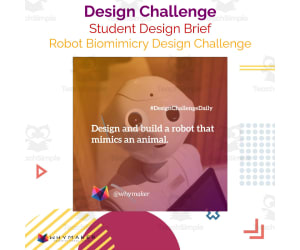
Robot Biomimicry Design Challenge
Science, Technology, Computer Science, Not Grade Specific, Activities
Robot Biomimicry Design Challenge The Robot Biomimicry Design Challenge is a unique educational tool designed to spark creativity, stimulate independent learning, and facilitate technology integration into the classroom. This resource with its emphasis on scientific concepts and computing abilities serves as an exclusive guide for educators across numerous disciplines. This challenge may be incorporated into multiple educational activities such as Makerspace events or Genius Hour sessions meant to encourage student innovation. It also provides captivating material for individual study periods or Choice Time, in which students are encouraged to pursue their personal interests. Other fitting applications include Technology Classes, library hours (melding tradition with technology), and afterschool programs or camps aiming to take learning beyond traditional classroom boundaries. Tailored For STEAM And Design Thinking Classes Specially crafted towards STEAM classes and Design Thinking courses, the Robot Biomimicry Design Challenge conforms well within academic curriculum stipulations. They're based on real-world situations thus making them exceptional tools for imparting practical Science lessons. Furthermore, they can be seamlessly integrated into SEL sessions in order to promote socio-emotional development while simultaneously enhancing scientific proficiency. Package Inclusions Context explanations: For easy comprehension of the challenge by students. Design challenges: Detailing specific tasks that need accomplishing. Certain specifications:Determining must-dos in each task. Limits on constraints:Elightening students about certain obstructions limiting project scope. List of needed materials:To clarify resources required for achieving specific tasks. Please note that these teaching aids are not restricted by grade boundaries thereby allowing learners from diverse age groups to benefit equally. These resources incorporate multiple file types thereby ensuring wide-ranging content mediums centered around inclusivity. Choose the Robot Biomimicry Design Challenge for fostering innovation, critical thinking, and instilling a strong sense of inquiry among your learners.
Author WhyMaker
Tags Robot Biomimicry, Design Challenge, STEAM Education, Creative Problem Solving, Technology Integration
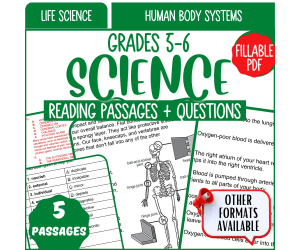
Reading Passages on Human Body Systems (Fillable PDF)
ELA, Reading, Reading Comprehension, Science, Life Sciences, Human Body, Biology, Common Core, ESL, Language Development, Grade 5, 6, 7, Worksheets & Printables, Worksheets, Assessments, Teacher Tools, Tests, Quizzes and Tests, Centers, Activities
Reading Passages on Human Body Systems for Life Science (Biology) Part 2 - Human Body Systems Reading Passage 1: Skeletal & Muscular Systems Reading Passage 2: Circulatory & Respiratory Systems Reading Passage 3: Nervous System Reading Passage 4: Digestive System Reading Passage 5: Reproductive System FILLABLE PDF VERSION Worksheet-style pages, but with type-in answer boxes so students can complete and save their work digitally. Other versions are available in the links list below or in the full catalog. Snapshot Title: Title not stated Genre: Nonfiction Subject: Science / Life Science / Human Body Primary Topic: Human body systems and how they function. Estimated Guided Reading Level (A–Z): V What This Teaches Best Explains how the skeletal and muscular systems work together for support and movement. Shows how the circulatory and respiratory systems work together to move oxygen and nutrients through the body. Teaches the major parts and jobs of the nervous system, including reflexes and brain functions. Traces the path of food through the digestive system and explains how nutrients are absorbed. Introduces reproduction, fertilization, zygote formation, and meiosis in clear body-systems language. Learning Goals Students will identify major structures and functions of several human body systems. Students will explain how body systems work together to keep the body alive and functioning. Students will describe how muscles move bones using tendons and joints. Students will trace the movement of oxygen, blood, or food through the body. Students will explain how reflexes, hormones, and nerve messages help control body actions. Students will describe the roles of fertilization, zygote formation, and meiosis in reproduction. FULL CATALOG OF DOWNLOAD LINKS HERE Grade 5/6 Links: Physical Science Part 1 - Physical and Chemical Properties Google Docs/Slides/Forms PDF PPT Word Free Supplementary Pack Accompanying Videos Physical Science Part 2 - Motion and Energy Google Docs/Slides/Forms PDF PPT Word Free Supplementary Pack Accompanying Videos Physical Science Part 3 - Electricity and Magnets Google Docs/Slides/Forms PDF PPT Word Free Supplementary Pack Accompanying Videos Life Science Part 1 - Cells, Reproduction and Genetics Google Docs/Slides/Forms PDF PPT Word Free Supplementary Pack Accompanying Videos Life Science Part 2 - Human Body Systems Google Docs/Slides/Forms PDF PPT Word Free Supplementary Pack Accompanying Videos Life Science Part 3 - Plant Parts and Ecosystems Google Docs/Slides/Forms PDF PPT Word Free Supplementary Pack Accompanying Videos Earth Science Part 1 - Plate Tectonics and Rock Cycle Google Docs/Slides/Forms PDF PPT Word Free Supplementary Pack Accompanying Videos Earth Science Part 2 - Ocean Exploration and Natural Resources Google Docs/Slides/Forms PDF PPT Word Free Supplementary Pack Accompanying Videos Earth Science Part 3 - Weather and Solar System Google Docs/Slides/Forms PDF PPT Word Free Supplementary Pack Accompanying Videos For similar products and other frees, do check out Cored Group on TeachSimple .
Author Cored Education
Rating
Tags Science, Elementary, Reading, Comprehension, Vocabulary, Worksheets, Printables, Reading Centers, Reading Comprehension Assessments, Science Assessments
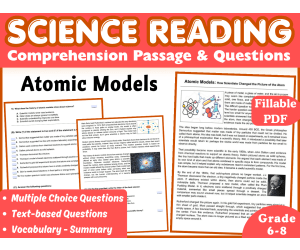
Atomic Models: Physical Science Reading Comprehension (Fillable PDF)
Science, ELA, Reading, Reading Comprehension, Strategies, Resources for Teachers, Common Core, Language Development, Physics, Grade 6, 7, 8, 9, 10, Writing Prompts, Worksheets & Printables, Centers, Activities, Teacher Tools, Assessments, Quizzes and Tests, Quizzes, Tests, Literacy Readers
Physical Science Reading Comprehension Passage and Questions for Middle School: Atomic Models (Fillable PDF) This resource explores how scientists’ understanding of the atom changed over time as new evidence became available . Students follow the development of atomic models from Democritus’s early idea of indivisible particles to Dalton’s solid-sphere model, Thomson’s discovery of the electron, Rutherford’s nuclear model, Bohr’s energy levels, and the modern electron-cloud model . It emphasizes how scientific models are revised when new experiments and discoveries provide better evidence . It also introduces important ideas such as electrons, the nucleus, empty space within atoms, energy levels, electron clouds, and probability . This passage is designed to bridge the gap between science and literacy by strengthening reading comprehension while sparking scientific curiosity in middle school students. It blends English Language Arts skills with accurate science content, helping students build background knowledge, understand key concepts, use evidence from the text, and explain scientific ideas clearly. This resource supports science classroom practice while also reinforcing important literacy skills such as main idea, vocabulary, comprehension, and summarizing. Ideal for interdisciplinary learning in ELA and Science. Suitable for Grade 9 review, too! This passage is designed as a fillable PDF , which means students can type their answers directly into the document on any computer or tablet . Each page includes highlighted text fields that show them exactly where to type! Student Tasks for The Passage: 10 multiple-choice questions targeting main idea, key details, science concepts, comparison, and real-world applications 10 True/False statements to check understanding and address common misconceptions 5 text-based short-answer questions that require students to explain important ideas from the passage 5 vocabulary matching items with clear, student-friendly definitions 1 summary prompt that asks students to condense the central ideas accurately Full answer key for every section Available Formats for this Resource PDF Word Docs Google Docs Product Details Length: 7 pages total Grades: 6–8, also suitable for Grade 9 review Use cases: close reading, stations, homework, intervention, test prep, and sub plans Standards support: Reinforces informational-text skills and supports NGSS-style sense-making by helping students read scientific explanations, connect evidence to key concepts, interpret real-world examples, and explain cause-and-effect relationships in science. FULL CATALOG OF DOWNLOADING LINKS HERE Other Science Reading Collections and Topics You May Find in the Store: 1. Astronomy & Space Science 2. Volcanoes, Rocks, & Mountains 3. Rock Cycle, Soil, & Sinkholes 4. Mars, Glaciers, & Antarctica 5. Water Cycle, Acid Rain, & Wastewater 6. Insects, Animals, & Ecosystems 7. Bioluminescence & Insects 8. Animal Skin, Cats, & T. Rex 9. Human Body and Senses 10. Health & Applied Bioscience 11. Waves, Light, & Imaging 12. Electricity & Energy 13. Motion & Materials 14. Chemistry and Materials Science 15. Electromagnetism 16. Acids and Bases 17. Gas Laws 18. Biotechnology 19. Periodic Trends 20. Protists and Fungi 21. Microevolution 22. Blood 23. Chemical Bonding 24. Magnets 25. Muscles 26. Nuclear Chemistry 27. Electromagnetic Devices 28. Epigenetics 29. The Law of Conservation of Mass 30. Atomic Models 31. Isotopes and Ions 32. Light 33. Human-Environment Interaction 34. Theory of Evolution 35. Photosynthesis 36. Origins of Life and Early Earth 37. Gene Expression and Regulation 38. Thermochemistry 39. Allergies 40. Coevolution 41. Birth to Adulthood 42. Cells 43. Entropy and Free Energy 44. The Human Brain 45. Mixtures and Solutions 46. Invertebrates 47. Zoo Animals 48. Biochemistry 49. Animal Behavior 50. Population Ecology ...and many more engaging science reading passages that cover intriguing and important topics designed to spark curiosity and support student learning. Use this passage to reinforce ELA skills in science, to add literacy to your lessons, and to support independent work. The passages strengthen main idea, evidence use, vocabulary in context, inference, cause and effect, and summary writing. With ready-to-use assessments and complete answer keys, you can provide focused practice that is simple to run and fast to review.
Author Middle & High School - CORED Education
Rating
Tags Middle School, Reading Comprehension, Reading Strategies, ELA, Centers, Reading Passage, Assessments, Vocabulary, Physical Science, Physics

Science Action Labs Electricity & Magnetism
Science, Physics, Grade 4, 5, 6, 7, 8, Labs, Experiments, Activities
Science Action Labs Electricity & Magnetism A comprehensive teaching resource tailor-made for educators working with 4th to 8th grade students. This resource transmutes theoretical knowledge of electricity and magnetism into hands-on experiences. Contents The teaching toolkit contains: 64 ready-to-print pages: Neatly organized in a single PDF format. Detailed experiments : Students will construct an electroscope, generate their own electricity, put various magnets to test, evaluate magnetic potency and much more. Educational Value Theoretical and practical components balanced: This makes it an excellent tool for cultivating scientific curiosity among young learners while strengthening their understanding about electricity and magnetism. Can be used flexibly in various scenarios to meet specific pedagogical needs whether opted for group work or individual assignments; in-class activities or as homework supplements. Promotes physics literacy: Hands-on nature of the activities engages learners directly in scientific exploration. Cultivate future scientists by demystifying complex theories through first-hand experiences! Harnessing such stimulating resources contributes significantly towards building solid foundations today which will help them understand Physics' intricate wonders tomorrow.
Author Classroom Complete Press
Tags Science Labs, Electricity, Magnetism, Electromagnet Lab, Building An Electroscope
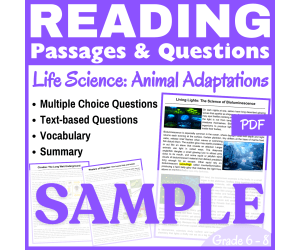
Bioluminescence & Insects: SAMPLE Reading Comprehension passage (PDF)
Science, ELA, Reading, Reading Comprehension, Strategies, Resources for Teachers, Life Sciences, Animals, Insects, Nature & Plants, Grade 6, 7, 8, 9, Writing Prompts, Worksheets & Printables, Centers, Activities, Teacher Tools, Assessments, Quizzes and Tests, Quizzes, Tests
This is a ONE PASSAGE SAMPLE. The following is the description of the FULL resource and the downloading links: Bioluminescence & Insects: Reading Comprehension Passages (PDF) This very engaging collection of life science reading passages about Bioluminescence & Insects is designed to bridge the gap between science and literacy through strengthening reading comprehension and sparking scientific curiosity in middle school students. Each passage blends English Language Arts skills with accurate science content that supports NGSS classroom practice. Ideal for interdisciplinary learning in ELA and Science. Suitable for Grade 9 review, too! What Is Included? There are (3) informational passages: Living Lights: The Science of Bioluminescence Explains how organisms produce “cold light” with luciferin and luciferase, and shows why they glow for signaling, hunting, and protection. Cicadas: The Long Wait Underground Covers the long underground nymph stage, synchronized emergence, molting, loud calls, and how this life cycle supports survival and reproduction. Masters of Disguise: How Insects Hide and Imitate Distinguishes camouflage from mimicry with clear examples, highlighting how color, shape, and behavior help insects avoid predators and capture prey. Student Tasks for Each Passage: 5 multiple-choice questions targeting main idea, key details, inference, vocabulary in context, and use of evidence 5 vocabulary matching items with clear, student-friendly definitions 5 text-based questions that require citing specific lines or facts 1 summary prompt that asks students to condense central ideas accurately Full answer key for every section Available Formats for this Resource Word Docs Google Docs FULL CATALOG OF DOWNLOADING LINKS HERE Other Science Reading Collections and Topics You May Find in the Store: 1. Astronomy & Space Science 2. Volcanoes, Rocks, & Mountains 3. Rock Cycle, Soil, & Sinkholes 4. Mars, Glaciers, & Antarctica 5. Water Cycle, Acid Rain, & Wastewater 6. Insects, Animals, & Ecosystems 7. Bioluminescence & Insects 8. Animal Skin, Cats, & T. Rex 9. Human Body and Senses 10. Health & Applied Bioscience 11. Waves, Light, & Imaging 12. Electricity & Energy 13. Motion & Materials 14. Chemistry and Materials Science 15. Electromagnetism 16. Acids and Bases 17. Gas Laws 18. Biotechnology 19. Periodic Trends 20. Protists and Fungi 21. Microevolution 22. Blood 23. Chemical Bonding 24. Magnets 25. Muscles 26. Nuclear Chemistry 27. Electromagnetic Devices 28. Epigenetics 29. The Law of Conservation of Mass 30. Atomic Models 31. Isotopes and Ions 32. Light 33. Human-Environment Interaction 34. Theory of Evolution 35. Photosynthesis 36. Origins of Life and Early Earth 37. Gene Expression and Regulation 38. Thermochemistry 39. Allergies 40. Coevolution 41. Birth to Adulthood 42. Cells 43. Entropy and Free Energy 44. The Human Brain 45. Mixtures and Solutions 46. Invertebrates 47. Zoo Animals 48. Biochemistry 49. Animal Behavior 50. Population Ecology ...and many more engaging science reading passages that cover intriguing and important topics designed to spark curiosity and support student learning. Product Details Length: 14 pages total Grades: 6–8, also suitable for Grade 9 review Use cases: close reading, stations, homework, intervention, test prep, and sub plans Standards support: reinforces informational-text skills and supports NGSS-style sense making through observation, modeling, and clear use of claim, evidence, and reasoning Why Teachers Choose This Set Authentic science content paired with rigorous literacy practice Consistent task structure across all passages for easier planning and smoother student routines Clear, age-appropriate writing that builds confidence without oversimplifying Use this set to reinforce ELA skills in science, to add literacy to your lessons, or to support independent work. The passages strengthen main idea, evidence use, vocabulary in context, inference, cause and effect, and summary writing. With ready-to-use assessments and complete answer keys, you can provide focused practice that is simple to run and fast to review.
Author Middle & High School - CORED Education
Rating
Tags Middle School, Reading Comprehension, Reading Strategies, ELA, Centers, Reading Passage, Assessments, Vocabulary, Life Science, Insects

Average Atomic Mass Practice
Science, Chemistry, Grade 8, 9, 10, 11, 12, Activities
This resource presents 13 practice problems which cover the topic of average atomic mass. Students are expected to practice t he calculation of the amu of elements, the relative abundance, and to use mass spec data for the determination of the identity of an element. The answers and solutions to all questions are provided. Answers included!
Author Schrim's Chem
Tags Average Atomic Mass, Amu Of Elements, Relative Abundance, Identify Of Element

Science Reading Comprehension Passage: Biotechnology (Fillable PDF)
Science, ELA, Reading, Reading Comprehension, Strategies, Resources for Teachers, Life Sciences, Biology, Grade 6, 7, 8, 9, 10, Writing Prompts, Worksheets & Printables, Centers, Activities, Teacher Tools, Assessments, Quizzes and Tests, Quizzes, Tests
Life Science Reading Comprehension Passage and Questions: Biotechnology (PDF) This very engaging science reading passage is about biotechnology and how living things can be used as tools to solve real-world problems . It explains how people use cells, bacteria, genes, plants, and other biological processes to create useful products and improve everyday life. The passage connects biotechnology to familiar examples such as bread, yogurt, vaccines, insulin, genetically modified crops, bioremediation, lab-grown meat, and biofuels. It also shows students how biotechnology can support medicine, agriculture, environmental cleanup, and a more sustainable future. This passage is designed to bridge the gap between science and literacy by strengthening reading comprehension while sparking scientific curiosity in middle school students. It blends English Language Arts skills with accurate science content, helping students build background knowledge, understand key concepts, use evidence from the text, and explain scientific ideas clearly. This resource supports science classroom practice while also reinforcing important literacy skills such as main idea, vocabulary, comprehension, and summarizing. Ideal for interdisciplinary learning in ELA and Science. Suitable for Grade 9 review, too! Student Tasks for The Passage: 10 multiple-choice questions targeting main idea, key details, science concepts, comparison, and real-world applications 10 True/False statements to check understanding and address common misconceptions 5 text-based short-answer questions that require students to explain important ideas from the passage 5 vocabulary matching items with clear, student-friendly definitions 1 summary prompt that asks students to condense the central ideas accurately Full answer key for every section This passage is designed as a fillable PDF , which means students can type their answers directly into the document on any computer or tablet . Each page includes highlighted text fields that show them exactly where to type! Available Formats for this Resource PDF Word Docs Google Docs FULL CATALOG OF DOWNLOADING LINKS HERE Product Details Length: 7 pages total Grades: 6–8, also suitable for Grade 9 review Use cases: close reading, stations, homework, intervention, test prep, and sub plans Standards support: Reinforces informational-text skills and supports NGSS-style sense-making by helping students read scientific explanations, connect evidence to key concepts, interpret real-world examples, and explain cause-and-effect relationships in science. Why Teachers Choose This Set Authentic science content paired with rigorous literacy practice Consistent task structure across all passages for easier planning and smoother student routines Clear, age-appropriate writing that builds confidence without oversimplifying Other Science Reading Collections and Topics You May Find in the Store: 1. Astronomy & Space Science 2. Volcanoes, Rocks, & Mountains 3. Rock Cycle, Soil, & Sinkholes 4. Mars, Glaciers, & Antarctica 5. Water Cycle, Acid Rain, & Wastewater 6. Insects, Animals, & Ecosystems 7. Bioluminescence & Insects 8. Animal Skin, Cats, & T. Rex 9. Human Body and Senses 10. Health & Applied Bioscience 11. Waves, Light, & Imaging 12. Electricity & Energy 13. Motion & Materials 14. Chemistry and Materials Science 15. Electromagnetism 16. Acids and Bases 17. Gas Laws 18. Biotechnology 19. Periodic Trends 20. Protists and Fungi 21. Microevolution 22. Blood 23. Chemical Bonding 24. Magnets 25. Muscles 26. Nuclear Chemistry 27. Electromagnetic Devices 28. Epigenetics 29. The Law of Conservation of Mass 30. Atomic Models 31. Isotopes and Ions 32. Light 33. Human-Environment Interaction 34. Theory of Evolution 35. Photosynthesis 36. Origins of Life and Early Earth 37. Gene Expression and Regulation 38. Thermochemistry 39. Allergies 40. Coevolution 41. Birth to Adulthood 42. Cells 43. Entropy and Free Energy 44. The Human Brain 45. Mixtures and Solutions 46. Invertebrates 47. Zoo Animals 48. Biochemistry 49. Animal Behavior 50. Population Ecology ...and many more engaging science reading passages that cover intriguing and important topics designed to spark curiosity and support student learning. Use this passage to reinforce ELA skills in science, to add literacy to your lessons, and to support independent work. The passages strengthen main idea, evidence use, vocabulary in context, inference, cause and effect, and summary writing. With ready-to-use assessments and complete answer keys, you can provide focused practice that is simple to run and fast to review.
Author Middle & High School - CORED Education
Rating
Tags Middle School, Reading Comprehension, Reading Strategies, ELA, Centers, Reading Passage, Assessments, Vocabulary, Biology, Life Science
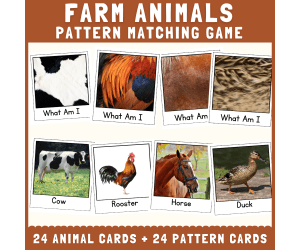
Farm animal skin fur pattern matching cut match science activities
Animals, Life Sciences, Science, Pre-K, Elementary, Games, Activities, Centers
Make learning about farm animal body coverings fun and interactive with this Farm Animal Skin, Fur & Feather Pattern Matching Activity! Students will identify and match different farm animals with their unique skin, fur, and feather patterns while building observation, classification, and life science skills. I like using this resource during farm animal units, animal science lessons, animal coverings studies, life science centers, preschool science activities, and homeschool learning. It’s a hands-on cut-and-match activity that gives students an engaging way to observe animal patterns and learn about different types of body coverings. What You Will Get This printable farm animal pattern matching resource helps students recognize and match farm animals with their skin, fur, or feather patterns. What’s Included in this Resource? • Farm animal picture cards • Animal skin, fur, and feather pattern cards • Cut-and-match activities • Animal body covering recognition practice • Pattern matching activities • Student-friendly printable pages • Easy-to-use science center format This resource is perfect for: • Farm animal science units • Animal coverings lessons • Life science activities • Animal adaptations studies • Science centers • Preschool and elementary science • Hands-on matching activities • Homeschool learning Why you will love this? • Easy to print and use • Builds observation and matching skills • Introduces different animal body coverings • Encourages visual discrimination and classification • Makes animal science hands-on and interactive • Great for science centers and independent learning This Farm Animal Skin, Fur & Feather Pattern Matching Activity is a fun way for students to observe animal coverings, identify unique patterns, and strengthen early science and classification skills through hands-on cut-and-match activities.
Author Perfect_Printables
Rating
Tags Animal Science, Life Science, Animal Adaptations, Science Activities, Animal Pattern Matching, Animal Patterns, Animal Skin Activities, Farm Animals, Farm Animals Activities, Feather Matching
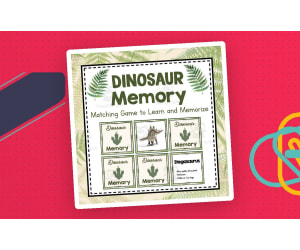
Dinosaur Memory Game
Science, Earth and Environmental Sciences, Preschool, Grade 1, 2, Activities, Games
This dinosaur memory game is the perfect complement to a Dinosaur or Paleontology Unit Study. It will help your students memorize and review a few dinosaurs in a fun way. How to Use This Resource: Cut apart all the cards. Then lightly glue each back to a front. Run through a laminator and then cut apart each pieces. Lay pieces flat and upside down. Take turns with your students to turn over 2 at a time. When you find a match, you get to keep the match. When all the cards have been turned over and matched up, then the game is over. The winner is the one who has found the most matches. Not only do these cards feature a dinosaur-related picture, but they also have the corresponding word printed underneath each picture. They will get to work their brains to try and remember where they saw a certain image, but they will also be able to retrieve where they saw a certain word. This is great differentiation for young learners. They will love playing this memory game and ramping up the competition along the way. What You Get: · Instruction sheet and answer key · 14 pages of dinosaur matches (One match is the name and the other match is a picture of a dinosaur and its characteristics) I hope you enjoy! Here are other similar resources for you to enjoy: Design a Bakery Project Based Activity All About Fossils Number Coloring Pages All About Weathering and Erosion Number of the Week: All About 3 3rd Grade Spelling Curriculum You can find more resources at my storefront here: https://teachsimple.com/contributor/simply-schoolgirl
Author Simply Schoolgirl
Tags Dinosaur Game, Memory Game, Archaeology, Paleontology, Science Cards, Picture Cards, Matching Pictures, Vocabulary

Rocket Activity
Space, Earth and Environmental Sciences, Science, Grade 2, 3, 4, 5, 6, 7, 8, 9, 10, Activities
Activity Introduction An amazing activity designed for the students to learn more about space facts. Rocket Do you like reading about space? If yes, what is your favorite topic? What do you know about our solar system? What is the smallest planet in our solar system? What is the biggest planet in our solar system? What is the hottest planet in our solar system? And what is the coldest one? Do you think there are aliens? If yes, what do you think they look like? What do they eat and how they speak to each other? Where do they live? What is a galaxy? And what is a milky way? Have you recently saw a shooting star? If yes, tell us more about it, like when did it happen and where? What is a blackhole? Can a blackhole gets bigger by time? Do you like counting the stars? What do you think a star is made of? Rocket Activity The activity is perfect for encouraging the researching skills for the students, while learning more about the fantastic space. Rocket This friendly designed worksheet is suitable for students at school, homeschooling, and as a group activity. Instructions Colour the rocket with your favourite colours, then colour the rectangle red, orange, and yellow. Cut the rocket out, then cut along the dotted lines. Now glue the tabs around the rockets to the galaxy as instructed. Your rocket should have a concave shape now on the paper. Lastly, fold each triangle separately along the lines to create the fire. Format Available in a PDF format.
Author Educational Voice
Tags Rocket Activity, Rocket, Rockets, Rockets Facte, Rocketfacts For Kids, Space, Space Facts, Space Facts For Kids, STEM, STEM Facts