



3,978 products added recently
Page 62 - Science Activities
Ignite your students' interest in science with activities that make learning interactive and exciting. This collection offers experiments, demonstrations, and inquiry-based projects covering various scientific fields. By integrating these science activities into your lessons, you can encourage critical thinking, foster curiosity, and deepen understanding of scientific concepts.

 Show filters

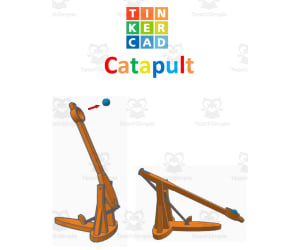
TinkerCAD step-by-step instructions for Catapult
Special Resources, Science, Technology, Engineering, Grade 5, 6, 7, 8, 9, 10, 11, 12, Activities, Projects
TinkerCAD step-by-step instructions for Catapult. Students only need to know the bare basics to complete this. I tested this with a fifth-grade class and most could complete it with no help. Designed to print with no supports for easy printing. Include TinkerCAD tool guide! Has a content page. Great beginners’ tool for learning to make 3D models and learn TinkerCAD. TinkerCAD is a free online program that makes 3D model that work on 3D printers, laser etching machines, water jets, plasma cutters and many more!! Tinkercad is an easy-to-use, browser-based computer-aided design (CAD) software developed by Autodesk. It is primarily used for creating and designing 3D models, particularly in the field of 3D printing. Tinkercad is popular among beginners and hobbyists due to its intuitive interface and simplified tools. Here are some key features and uses of Tinkercad: 1) 3D Modeling: Tinkercad allows users to create 3D models by combining basic shapes and manipulating them using tools such as scaling, rotating, and moving. It provides a wide range of primitive shapes like cubes, spheres, cylinders, and more, which can be customized to create complex designs. 2) Design Customization: Users can apply various modifications to their designs, including resizing, rounding edges, adding text, creating holes, and aligning objects. These tools help in refining the models and making them suitable for specific purposes or fitting them with other components. 3)Import and Export: Tinkercad supports the import of existing 3D models in STL and OBJ formats, allowing users to modify and incorporate them into their designs. It also offers export options to save the designs as STL files, which are widely used in 3D printing. 4) Collaboration and Sharing: Tinkercad provides features for collaboration, allowing multiple users to work on the same project simultaneously. It enables real-time sharing and editing, making it convenient for team projects or educational purposes. 5) Electronics Integration: One notable aspect of Tinkercad is its integration with electronics. It offers a range of electronic components, including resistors, LEDs, motors, and microcontrollers, which can be used to create interactive models and prototypes. Users can simulate circuit connections and test their designs before implementation. 6) Educational Tool: Tinkercad is widely used in educational settings, particularly for teaching students about 3D design, modeling, and prototyping. Its simple interface and beginner-friendly tools make it accessible to users of all ages and skill levels. Overall, Tinkercad is a versatile and user-friendly CAD software that allows individuals to create and customize 3D models. Whether you're a hobbyist, student, or professional, Tinkercad provides a valuable platform for designing, prototyping, and exploring the world of 3D printing and modeling. Total pages: 51 pages Commands to be learned: Group Ungroup Align Mirror Duplicate Holes Solids Rotate Move Drop Subjects: Geometry Engineering Career and technical education Types: Projects Handouts Printables
Author MontyWorks
Tags TinkerCAD, 3D Printing, 3D Printer, Projects
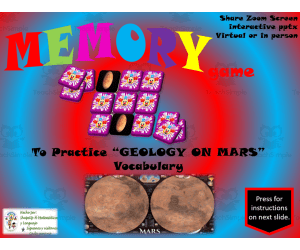
Free Science Interactive Memory Game / Geology on Mars Vocabulary
Science, Earth and Environmental Sciences, Space, Earth Sciences, Environmental Science, Grade 8, Games, Activities
Mars Geology Vocabulary Memory Game for 8th Grade Science Practice, review, and reinforce Mars geology terms for 8th grade science students with this interactive memory game . Students will match geology vocabulary words like caldera, rille, and volcano with their definitions. The game strengthens visual memory, concentration, brain activity, and cognitive abilities. Use it for whole group practice on a projector or have students play individually on devices. The 19-slide PowerPoint includes the terminology list and an interactive matching game that prompts students to locate coordinate points to reveal the vocabulary cards. See more 8th grade science games focused on astronomy, earth science, and environmental concepts in our ShapeUp-N-Matematicas y Lenguaje store.
Author ShapeUp-N-Matematicas y Lenguaje
Tags Geology On Mars, Geology, Geosphere, Habitat, System, Scientific Argument, Small Or Whole Group, Interactive Activity, Games, Weathering
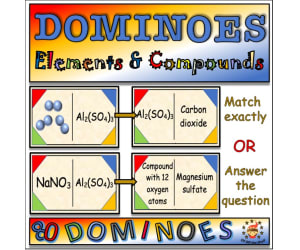
Elements and Compounds Dominoes - Middle School Science
Science, Chemistry, Grade 6, 7, 8, 9, Activities, Games
Elements and Compounds Dominoes - Middle School Science A teaching resource targeted at 6th to 9th-grade educators, the Elements and Compounds Dominoes provides an in-depth understanding of the fundamentals of chemistry like elements, compounds, atoms, and molecules. About the Game The game is composed of 80 dominoes, which feature questions and answers related to various topics instead of numbers. It encourages learners to explore atomic combinations that form different types of molecules from elements or compounds. Additionally, it familiarizes students with elemental symbols derived from either English or Latin names. Unique Learning Approach This product distinguishes itself through intensive chemical formulae explorations. It guides students on interpreting brackets; naming compounds ending in special suffixes like 'ide'; how many atoms are contained in each compound based on a representative symbol. Suitable for whole-group sessions: Promotes cooperative learning dynamics. In small group activities:Fosters focused peer-to-peer interaction. Serves as a homework exercise: Potentiates independent self-learning. The rules are clear and precise—explaining how matches should be recognized whether through matching names with symbols or circuit diagrams . If a challenge arises over incorrect matches, provisions have been made for verification purposes. Aiding PowerPoint Animation, A complementary PowerPoint animation is included covering all necessary rules—making it easy even for first-time players while maintaining educational value. Bring your student's understanding beyond routine textbooks by utilizing this interactive yet informative resource. Through this fun game, students will grasp key chemistry concepts—an innovative approach that can easily replace monotonous lectures and provide a novel dimension that excites as much as it enlightens.
Author Elf off the Shelf Resources
Tags Chemistry, Middle School, Elements, Compounds, Atoms, Domino Element
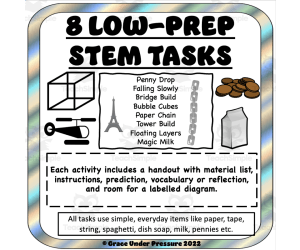
8 Low-Prep STEM Tasks – Elementary & Middle School
Math, Geometry, Measurements, Science, Technology, Engineering, Physics, STEM, Grade 3, 4, 5, 6, 7, 8, Activities
These fun low-prep STEM experiments will get your students building, designing, and learning about science, technology, engineering, and math in a co-operative way! They are great hands-on learning activities. Students will have to make a prediction before completing the experiment and draw a detailed and labelled diagram after they are done. They will also define relevant vocabulary words and answer a question about what they learned. Each STEM experiment includes a handout with material list, instructions, prediction, vocabulary or reflection, and room for a labelled diagram. All experiments use simple, everyday items like paper, tape, string, spaghetti, dish soap, milk, pennies etc. Penny Drop Falling Slowly Bridge Build Bubble Cubes Paper Chain Tower Build Floating Layers Magic Milk How to Use: Students can work in small groups. Go over the instructions and materials and give students time to predict before they start the experiment. Review the findings and relevant vocabulary after students have completed their experiment and diagram. Grades to Use With: These experiments are perfect for your intermediate or middle school (grades 3-8) class! They can be used at the beginning of the year or term as ice breaker activities, on a Friday afternoon or before a holiday, or as part of your regular science curriculum. Standards: NGSS3-5-ETS1-1 Define a simple design problem reflecting a need or a want that includes specified criteria for success and constraints on materials, time, or cost. NGSS3-5-ETS1-2 Generate and compare multiple possible solutions to a problem based on how well each is likely to meet the criteria and constraints of the problem. If you like this activity , check out my science lesson about Independent, Dependent, and Controlled Variables , perfect for before a science fair unit!
Author Grace Under Pressure
Rating
Tags STEM, Science Experiments, Hands-on Learning, Cooperative Learning, Engineering, Experiment, STEM Task, STEM Activity, Math, Technology

Biochemistry - Bell Ringers, Class Warm-Ups, and Exit Tickets
Science, Chemistry, Grade 10, 11, 12, Activities
Biochemistry - Bell Ringers, Class Warm-Ups, and Exit Tickets The Biochemistry - Bell Ringers, Class Warm-Ups, and Exit Tickets package is an extensive collection of educational materials tailored for grade 10-12 chemistry classes. It provides teachers with 20 days’ worth of instructional tools that correspond to the Solutions and Solubility unit. The daily bell ringers or class warm-ups are designed to stimulate student interest and facilitate learning throughout each class session. Topics Covered: Solutions and Solubility Concentration PPM (Parts Per Million) PPB (Parts Per Billion) Dilutions Stoichiometry in Solutions . Acids and Bases. . . " " evning revision by students for prepared next day's class. " "Motivates learners by promoting review consistency" . "" bright="" rhythmic="" cultivation="" of="" an="" orderly="" classroom"" structure."" fostering"" productivity—without"" extra"" grading"" burdens> " Use-in-different-settings- "-topic-specific-benefit-materials-can-be-wevereaged-for-whole-group-discussions-or-smaller-cooperative-learning-groups-or-as-homework-assignments."</blet-main-doffers-multiple-file-types-to-suit-various-platforms-based-on-preferences-and-curriculum-guidelines."</group-beneficial- "<h4-"<Beneficence-</benefine-berickswary-"Bell-blingers-Class-Warm-Ups-and-Exit-Tickets-Bellringers-provide-an-enriching-learning-experience-in-biochemistry-that-sparks-curiosity-and-engagement-making-each-lesson-an-immersive-journey-through-scientific-education.
Author Teach With Fergy
Tags Bell Ringers, Class Warm-ups, Exit Tickets, Solutions And Solubility, Concentration
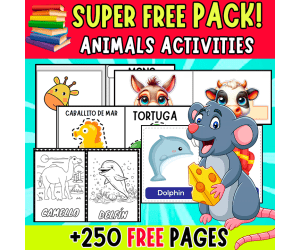
SUPER FREE PACK | +250 PAGES | ANIMALS ACTIVITIES FOR KIDS
Animals, Life Sciences, Science, Creative Arts, Special Resources, STEM, Early Learning, Elementary, Homeschool Resources, Pre-K, Not Grade Specific, Worksheets, Worksheets & Printables, Workbooks, Drawing Templates & Outlines, Coloring Pages, Projects, Activities
SUPER FREE PACK | +250 PAGES | ANIMALS ACTIVITIES FOR KIDS THIS SUPER PACK OF ACTIVITIES HAVE MORE THAN 250 PAGES WITH ANIMALS FUNNY ACTIVITIES. INFORMATION OF THE AUTHOR: Welcome to EDITORIAL ARENAS EDUCATIVAS! We specialize in producing diverse educational tools to support children's learning journeys. Be sure to browse our store for reading, writing, math, and Spanish resources designed to make learning fun and impactful. MAIN DESCRIPTION OF THIS PRODUCT: 1) What age ranges is this resource designed for? This document is designed for children in pre-kindergarten and elementary school. It is simply intended for children in elementary school, but it is also freely available to other grades who may need this document. 2) What version or edition does this material correspond to? This document is designed in PDF format so you can print and use it much more quickly. 3) What is the recommended printing method for this resource? I recommend printing this document in PDF format so you won't experience any errors when printing. 4) What educational standards were used as the basis for creating this material? This document was not developed based on any specific standard. SECONDARY AND COMPLEMENTARY INFORMATION OF THIS RESOURCE: 1) What age range is appropriate for this resource? Our publishing company is dedicated to creating resources for young children between the ages of 3 and 12, as well as for older students or anyone who needs them. 2) What keywords best describe this resource? We can tag this product with keywords such as: teaching resource, resources, materials, teaching materials, worksheets, educational worksheets, worksheets for children. 3) What instructions should I follow for proper printing? I recommend that you first download this document, then check if your printer is capable of printing, and also verify that you have the appropriate document size. 4) How can this resource be implemented in the classroom? You can print this document and use it first both in the classroom and at home. You can also use it individually and in groups.
Author EDITORIAL LAURA EDUCA
Rating
Tags FREE, FREE RESOURCES, SUPER PACK, PACK, BUNDLES, ACTIVITIES, ANIMALS, ANIMALS ACTIVITIES, BEST RESOURCES, TOP RESOURCES

Grassland Habitat animals flashlight cards hidden picture activity
Animals, Life Sciences, Science, Environmental Science, Earth and Environmental Sciences, Kindergarten, Preschool, Toddler, Grade 1, 2, Flashcards, Worksheets & Printables, Centers, Activities, Games
Make learning about grassland habitats and animals fun and interactive with these Grassland Habitat Animals Flashlight Cards! Students will use a flashlight to reveal hidden animal pictures while practicing animal recognition and building science vocabulary through an exciting hands-on activity. I like using these flashlight cards during grassland habitat units, animal science lessons, wildlife studies, nature-themed activities, preschool and kindergarten science centers, and homeschool learning. It's an engaging, low-prep activity that adds a fun element of discovery to habitat and animal learning. What You Will Get This printable Grassland Habitat Animals Flashlight Cards resource gives students an exciting way to discover hidden grassland animals and review animal and habitat vocabulary. What's Included in this Resource? • Printable grassland animal flashlight cards • Hidden picture reveal activity • Grassland animal and habitat vocabulary • Hands-on flashlight discovery activity • Student-friendly science center format • Easy-to-use printable cards • Great for independent or small-group learning This resource is perfect for: • Grassland habitat science units • Grassland animal studies • Wildlife and nature lessons • Animal science activities • Preschool and kindergarten science centers • Life science learning • Small-group activities • Homeschool learning Why you will love this? • Easy to prepare and use • Creates an exciting hands-on learning experience • Builds observation and visual recognition skills • Reinforces grassland animal vocabulary • Encourages curiosity and independent discovery • Great for science centers and habitat-themed units These Grassland Habitat Animals Flashlight Cards are a fun way for young learners to discover hidden grassland animals, practice animal recognition, and build observation skills through an interactive habitat science activity.
Author Perfect_Printables
Rating
Tags Animal Science, Science Center Activities, Hidden Picture Activities, Flashlight Cards, Wildlife Activities, Animal Adaptation, Animal Habitat Activity, Grassland Animals, Grassland, Grassland Activity
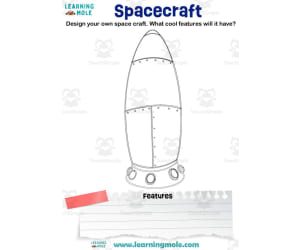
Spacecraft Activity
Science, Earth and Environmental Sciences, Space, Technology, Engineering, Grade 3, 4, 5, 6, 7, 8, 9, Activities
Activity Introduction An amazing activity designed for the students to learn more about STEM subjects. Spacecraft Do you like STEM subjects? what is your favorite one? Have you ever tried to plant a seed? If yes, tell us more about it. Or have you ever tried to invent something? If yes, tell us more about it. And how do you think it will help us? Have you ever seen a microorganism under a microscope? What was it? And how it looked like? Mathematics is a marvelous subject. Let' sharpen our brains and solve some equations. Do you like timetable tricks? What is your favorite one? Do you know how to code? Have you ever created an app or a game before? If yes, how was it like? Spacecraft Activity The activity is perfect for encouraging the researching skills for the students, while learning more about this topic. Spacecraft This friendly designed worksheet is suitable for students at school, homeschooling, and as a group activity. Instructions Design your own space craft . What cool features will it have? Format Available in a PDF format.
Author Educational Voice
Tags Spacecraft Activity, Spacecraft, Spacecrafts, Spacecraft Facts, Spacecraft Facts For Kids

Project: Invasive Species
Science, Earth and Environmental Sciences, Environmental Science, Research, Grade 7, 8, 9, 10, Activities, Projects
Project: Invasive Species is a great resource for students to solve a real-life problem through practicing to solve a fictitious problem. The project involves assigning a ROLE, giving a PROBLEM, providing specific REQUIREMENTS and TOOLS.
Author Mitchell Zuvela
Tags Project, Invasive Species, Research Project, Oral Presentation, Dangerous Travelers Movie
10 Amazing Cell Projects for Grades 4-5
Biology, Life Sciences, Science, Grade 4, 5, Experiments, Activities
🔬 10 Amazing Cell Projects for Grades 4–5 Bring cell biology to life with these hands-on, creative cell projects that help upper elementary students truly understand how cells work! From edible models to digital presentations, this pack includes 10 differentiated project ideas that engage every learner through art, science, and imagination. 🧠 What’s Included 10 detailed project directions (edible cell, diorama, board game, and more) Step-by-step teacher notes and timeline suggestions Differentiation strategies for advanced, ELL, and struggling learners Assessment rubric (accuracy, creativity, completeness, presentation) Student project worksheet with clear instructions Materials master list and parent communication letter Extension and display ideas for showcasing projects 🧬 How It Works in the Classroom Use this project pack to conclude your cells unit or as a culminating STEM project. Perfect for: Whole-class or choice-based projects Science fairs or learning exhibitions Cross-curricular connections with art, writing, and technology Center activities or group projects Each activity encourages creativity while reinforcing key science concepts through real-world analogies and visual learning. 📏 Standards & Learning Goals Aligned with: NGSS 5-LS1-1: Support an argument that plants get materials for growth from air and water. Common Core W.4.2 & W.5.2: Write informative/explanatory texts. State standards on cell structure and function. Students will: Identify major cell organelles and their functions Compare plant and animal cells Demonstrate understanding through creative, multimodal projects 💛 Why Teachers Love It ✅ Highly engaging and creative—students stay motivated for weeks ✅ Differentiated options for all learning styles ✅ Easy to prep with ready-to-use templates and rubrics ✅ Encourages student voice and choice ✅ Great for assessment, enrichment, or science fair projects Empower your young scientists to explore the amazing world of cells through creativity, critical thinking, and fun! Download today and watch your classroom come alive with learning.
Author Bright Classroom Ideas Marketplace
Rating
Tags Biology, Cell, Project, Experiment, Science, Life, Human, Grade 4, Grade 5

Clothespin Giraffe Activity
Science, Life Sciences, Biology, Animals, Grade 2, 3, 4, 5, 6, 7, Activities
Activity Introduction An amazing activity designed for the students to learn more about famous places in different countries. The Giraffes Do you like animals? what is your favorite one? Do you own a pet? If yes, tell us more about it, like what its name? And what do you like most about it? What are the animal kingdoms? Can you write down the characteristics of each animal class like mammals, birds, reptiles, amphibian, fish and mollusks. Do you know that some animals can sing, can you name any of them? What is the largest and the smallest mammal in the world? What is the largest and the smallest bird in the world? What is the largest and the smallest fish in the world? Clothespin Giraffe Activity The activity is perfect for encouraging the researching skills for the students, while learning more about this fantastic place. Giraffes This friendly designed worksheet is suitable for students at school, homeschooling, and as a group activity. Instructions Cut everything out, then color them. Draw the pattern of the giraffe on the oval. Glue the ears and the horns to the head. Glue the head on top of a clothespin to make the neck. Clip the neck to the oval (the body), then clip the other clothespins to the body from the bottom to make the legs. Place the giraffe on a flat surface. Materials Needed 3 Clothespins Scissors Colors Glue Format Available in a PDF format.
Author Educational Voice
Tags Clothespin Giraffe Activity, Giraffe Activity, Giraffe, Giraffes, Giraffes Facts, Giraffes Facts For Kids, Animal, Animals, Animals Facts, Animals Facts For Kids
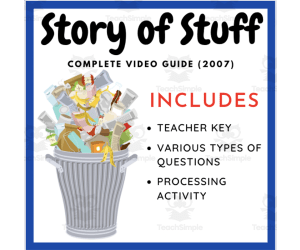
Story of Stuff (2007): Complete Video Guide & Processing Activity
Science, Earth and Environmental Sciences, Earth Sciences, Environmental Science, Grade 6, 7, 8, 9, 10, Activities
The Story of Stuff (2007): Complete Video Guide & Processing Activity This comprehensive teaching resource provides a thorough breakdown of an impactful documentary that critically evaluates the lifecycle of consumer goods. This film shines a spotlight on environmental and social impacts resulting from our economic models of production and consumption. Insights into Modern Linear Systems The film explores the linear system, in which raw materials are turned into goods, used, and finally discarded as waste. It raises awareness around alarming issues including pollution, deforestation, and depletion of natural resources connected to this prevalent system. Furthermore, it delves into social costs such as workplace exploitation and usage of hazardous chemicals throughout production process. Systemic Sustainability: A Question Mark? In 'Story of Stuff', sustainability is questioned while advocating for a transition to more equitable systems. The film concludes on an optimistic note emphasizing conscious consumption and urging support for policies that promote sustainability alongside social justice. The role communities play in initiating change is also underscored. An engaging Teaching Resource: Grades 6-10 This resource encourages students from Grade 6 through Grade 10 to contemplate their environmental footprint by reconsidering their consumer habits. Inclusive Learning Approach: A visually appealing guide that simplifies student engagement during Earth Sciences or Environmental Science lessons - applicable for whole class discussions or small focus groups; it can also be assigned effortlessly as homework due to its straightforward format. Complete with Teacher Key & Reference Chart : This guide includes a teacher key for facilitation during interactive sessions along with stimulating scientific discussions amongst students. The package comes with a material economy reference chart for easier understanding of economic transactions involving material goods, thereby making comprehension easy regardless of science proficiency levels among learners. Educator and Student Version Available: This package includes versions for both the teacher and student. This ensures a seamless blend of information source and processing activity to study. An intensive introductory reading further provides educators with the necessary background information - truly proving itself as an invaluable tool in making Environmental Science engaging and approachable!
Author EduPal Learning
Tags Consumer Goods Lifecycle, Environmental Impacts, Social Costs, Conscious Consumerism, Community Actions

Free Science Human Microbiome Vocabulary Interactive Memory Game
Science, Life Sciences, Human Body, Basic Science, Grade 7, Games, Activities
Human Microbiome Vocabulary Words to Review and Reinforce Definitions of the 7TH Grade Science curriculum . Students will learn and practice terms through definitions and characteristics. The engaging activity promotes collaboration and class discussion as students review terms definitions, and more with multiple visuals and learning formats like multiple choice questions, memory games, hang-man, and others. This versatile resource can be used for whole-group instruction, small-group practice, or independent work, just practice the words and then review them by choosing the correct one, it will self-correct you until you choose the correct answer Practice your Vocabulary with this Free Interactive Game Introduce young learners to a variety of visuals with this entertaining digital game. Students will see the names and images of different words and definitions; exercising visual memory and concentration. This self-checking activity can be played independently or as a whole class game projected on a smartboard. The vibrant slideshow stimulates engagement while building construction classification skills. students will build their knowledge of important terms and definitions while having fun playing games. This activity stimulates intelligence, builds concentration, reinforces letter recognition, improves spelling and pronunciation, and engagingly expands vocabulary. It's a perfect supplement for your lesson. Check our shop, material, and products for more interactive construction vocabulary reviews covering other topics like human microbiome, metabolism, and more grade levels in science and Spanish language arts. Download this versatile 20-slide PowerPoint today!
Author ShapeUp-N-Matematicas y Lenguaje
Tags SCIENCE, Human Microbiome, Bacteria, Infection, Microbiome , Microorganism, Cells, Antibiotic, Cell, Scientific Argument

Penguin Mandala Coloring Page Worksheet activity
Common Core, Life Studies, Animals, Life Sciences, Science, Not Grade Specific, Activities, Worksheets & Printables, Coloring Pages, Worksheets
Use the Mandala Coloring Page Worksheet Activity to engage your students by combining creativity, calmness, and education into an enjoyable, easy-to-use learning resource. Colouring mandalas encourages learners to engage their focus and imagination as they explore their chosen topic while using the mandala-style design they have created. Colouring mandalas to build coordination between the eyes and hands, improve fine motor skills and enhance attention to detail as well as foster creativity and the ability to express oneself artistically. The calmness and structure of this type of design allow learners to slow down, focus and enjoy a more meaningful learning experience. You can incorporate the Mandala Colouring Page Worksheet Activity into many different subject areas such as science, social studies, art, and social and emotional. As an ideal way to assist early finishers or facilitate quiet learning, the Mandala Colouring Activity provides an excellent opportunity to provide students balance between relaxation and learning. What are the Aims of the Mandala Colouring Activity? The Mandala Colouring Page Worksheet Activity aims to: Enhance understanding of a specific subject. Strengthen fine motor skills and pencil grasp ✏️ Help develop focus, patience, and concentration 🧠 Encourage artistic confidence and develop creativity 🎨 Allow students to experience a mindful, stress-reducing educational experience. Completing a mandala is a tactile and fun way to create a fun and engaging method of learning for a wider audience. Steps for Using the Mandala Colouring Page Worksheet Activity The following procedures should be followed to utilize the Mandala Colouring Page Worksheet Activity. The Mandala Colouring Page Worksheet Activity can be accomplished in five simple steps. 1. Print the Mandala Colouring Page. 2. Discuss or introduce key concept(s) associated with the theme. 3. Have students colour in an orderly fashion and pay close attention to symmetry. 4. Discuss relevant vocabulary or concepts related to the theme. 5. Extension of learning: labelling, writing prompts, or creative designs are optional and encouraged. ✅ General Audience All ages and learning levels. Suitable for: Individual or paired work Learning centres Activities for early finishers Mindfulness/calm down activities Homework or take-home assignments Lesson plans for substitutes Use in the Classroom The Mandala Colouring Page Worksheet Activity can be used in many different settings and serves as a versatile tool for both classroom and home. Variations and Extensions to the Mandala Colouring Page Worksheet Activity in the Classroom Creative/Visual Art Extensions 🎨 Design a new mandala focused on the topic. Add images or patterns that represent significant concept(s) Mindful/Intentional Colouring Time ⏳ Establish a time for quiet, deliberate colouring. Writing/Reflection ✏️ Write a short statement, fact, or reflection pertaining to the studied theme. Creative Thinking 🧩 Create, design, or think of new ideas inspired by the theme. Skills Developed Through the Mandala Colouring Page Worksheet Activity: Fine Motor Skills Hand-Eye Coordination Focus & Concentration Creativity & Self-Expression Cross-disciplinary Use of the Mandala Colouring Page Worksheet. File Type / Info to Use When Printing File ✔️ Able to Print as PDF Document ✔️ Pages are Black & White – Save Ink While Printing ✔️ Print Out For Your Classroom Easily ✔️ No Preparation Needed For Teachers To Get Started Teacher Strategies 🌟: Encourage students to take their time, pay attention to the details, and have fun while creating. Coloring Mandalas can be used as an avenue to assist students in their learning by providing a calming, community-oriented environment and motivating the students to remain focused on their work and encourage creative thought within the students as they complete their designs.
Author Classsim
Rating
Tags Penguin, Mandala, Coloring, Page, Worksheet , Activity, Penguin Mandala , Penguin Mandala Coloring Page , Penguin Mandala Coloring Page Worksheet, Penguin Mandala Coloring Page Worksheet Activity
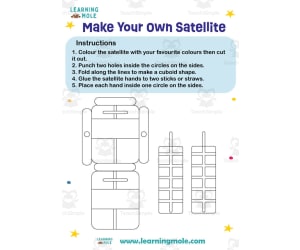
Satellite Activity
Science, Earth and Environmental Sciences, Space, Grade 3, 4, 5, 6, 7, 8, 9, 10, Activities
Activity Introduction An amazing activity designed for the students to learn more about space facts. Satellite Do you like reading about space? If yes, what is your favorite topic? What do you know about our solar system? What is the smallest planet in our solar system? What is the biggest plant in our solar system? What is the hottest plant in our solar system? And what is the coldest one? Do you think there are aliens? If yes, what do you think they look like? What do they eat and how they speak to each other? Where do they live? What is a galaxy? And what is a milky way? Have you recently saw a shooting star? If yes, tell us more about it, like when did it happen and where? What is a blackhole? Can a blackhole gets bigger by time? Do you like counting the stars? What do you think a star is made of? Satellite Activity The activity is perfect for encouraging the researching skills for the students, while learning more about the fantastic space. Satellite This friendly designed worksheet is suitable for students at school, homeschooling, and as a group activity. Instructions Colour the satellite with your favourite colours then cut it out. Punch two holes inside the circles on the sides. Fold along the lines to make a cuboid shape. Glue the satellite hands to two sticks or straws. Place each hand inside one circle on the sides. Format Available in a PDF format.
Author Educational Voice
Tags Space, Space Facts, Space Facts For Kids, Space Activity, Satellite Activity, Satellite, Satellites, Satellite Facts, Satellite Facts For Kids
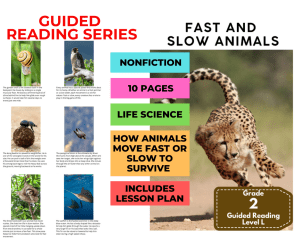
Guided Reading Level L - Fast and Slow Animals (with Lesson Plan)
ELA, Resources for Teachers, Reading Comprehension, Reading, Pre-Reading, Language Development, Life Sciences, Science, Vocabulary, Animals, Grade 1, 2, 3, Worksheets & Printables, Worksheets, Teacher Tools, Centers, Activities, Literacy Readers, Quizzes, Quizzes and Tests, Assessments
This Guided Reading Book - Fast and Slow Animals (Level L) with lesson plan includes: Guided Reading Color Label (front cover x1) This is a quick way to match the book’s demands to what students can generally handle.. The overall goal is to use the level/color to pick books for several smaller groups. To qualify for a certain level, a student is expected to read a book from that level with about 90–94% accuracy. If a student is consistently accurate and understands, move up a level. If the student is struggling at that level, drop down and add more support. Each student will improve at completely different rates, but it is generally one of the best ways to check progress across the class. DOWNLOAD THE CATALOG TO VIEW ALL GUIDED READING BOOKS AVAILABLE (SORTED LEVELS A-Z) Pre-Reading Question (x1) Teacher asks the prompt aloud, can be while showing the cover or first page. Students share what they already know, or make educated guesses from the cover. Prompt them to use the target vocabulary. Write some of their responses on the board to look back at during the reading. Vocabulary Words (x5) Introduce the five words, best doing it one at a time. Start by saying it, while students repeat and then see if anyone knows what it means before reading further. Read through the meaning and try to briefly connect each word to a picture or gesture so it’s meaningful. Ask students to flip through the book pages and point to where they see each of the vocabulary words. While reading the book pause upon coming across one of the vocab words or read the sentence twice to make sure students understand the word has appeared. Optional: Ask students to raise hands whenever they see/hear one of the new words. Guided Reading Pages (x10) Check the book snapshot (below) for: primary topic - do you need to prep extra reading or intro materials on this? what is taught best - decide on 1-2 bullets to focus on, use the prompt or words provided here for best results. learning goals - what you are checking for students to be able to do after the session, elicit answers using prompts or words provided. key vocabulary (see section above). questions overview - so you know what is coming up and if you need to prep extra materials to assist understanding. Run the lesson You may have already looked at a few of the pages together, but you can show them some of the pictures again first to set meaning. Depending on how much time you have and how familiar your students are with guided reading class, you may want to read the book aloud first with the group first. Students whisper or partner read, while you listen in. If time, do it as a group, one student reading a page each. Use the guided page’s prompts to coach: “Check the picture / does it make sense?” “Point under the words / try the first sound” “Reread the sentence smoothly”. Try to focus more on one student per session (rotating every time), so you can work out if they are ready to move up or need to move down a level. Comprehension Questions (back cover x3) This is your way to check that students didn’t just say the words, but actually understood the text. First, let students answer by pointing to the page/picture and saying a short sentence. After any answer, follow with: “Show me where you found that in the text.” In bigger groups, have partners answer first (10–20 seconds), then call on 2–3 students to share. Differentiation tips: Emerging speakers/struggling readers: oral + pointing On-level: oral in a full sentence Higher: one written sentence or draw + label Book Snapshot Title: Fast and Slow Animals Genre: Nonfiction (informational) Subject: Science (Animals) / Reading Primary Topic: How animals move fast or slow to survive Estimated Guided Reading Level (A–Z): L What This Book Teaches Best Fast and slow movement are both important for survival in the wild. Animals have body parts that help them move in special ways (like a cheetah’s tail helping with balance on sharp turns). Animals move fast or slow depending on what works best in their homes and habitats. Readers learn examples of different kinds of movement (running, jumping, swimming, flying/diving, sliding). The text uses comparisons to help readers understand animal abilities (like jumping “over a whole house”). Learning Goals Students will explain why both fast and slow movement can help animals survive. Students will describe how the cheetah uses its tail while running and turning. Students will identify how different animals move (run, jump, swim, dive, slide) using details from the text. Students will explain how an animal’s body parts support its movement (legs, feet, fin, wings, foot). Students will compare two animals from the book and tell how their movement helps them. Key Vocabulary From the Text participate — take part in something. record-breaking — faster or better than before. muscular — having strong muscles. predators — animals that hunt other animals for food. shimmering — shining with a soft, flickering light. Discussion Prompts Pre-reading question: How could moving fast or moving slowly help an animal survive where it lives? Comprehension questions: Why does the book say both fast and slow ways of moving are important in the wild? What helps the garden snail glide over rough surfaces? Which animal in the book is “the fastest swimmer,” and what helps it glide through the water? Printing Tips 1. Best Printing Method (Recommended) “Booklet” Printing (Best if Available) If your printer or PDF viewer supports Booklet Printing , use this. Settings to use: Print mode: Booklet Paper size: Letter or A4 (either works) Orientation: Landscape Print on both sides: Yes Flip on: Short edge Scaling: Fit to printable area Booklet subset: First test: Front sides only Then: Back sides only This will automatically: Pair pages correctly Put the cover on the outside Align everything for folding After printing, fold in half and staple along the spine . 2. If “Booklet” Printing Is NOT Available You can still print this correctly with manual duplex printing . Step-by-step: Open the PDF. Choose Print . Set: Orientation: Landscape Pages per sheet: 1 Print on both sides: Yes Flip on: Short edge Print all pages . Because each PDF page already contains two facing book pages, the result will still fold cleanly into a book. Thousands of Cored Education products are included with your TeachSimple membership. Download links and encyclopedia index available here.
Author Cored Education
Rating
Tags Reading Comprehension, Reading Passages, Reading, Guided Reading, Guided Reading Lesson Plan, Guided Reading Activity, Pre-reading, Vocabulary, Life Science, Animals
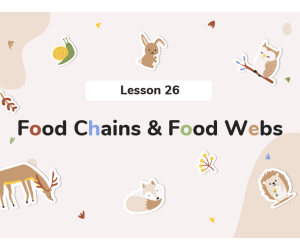
Science Reading Comprehension Passage: Food Chains and Food Webs PPT
Science, Life Sciences, Biology, Common Core, ESL, Language Development, ELA, Spelling, Reading Comprehension, Reading, Grade 2, 3, 4, Teacher Tools, Presentations, Tests, Quizzes and Tests, Activities
Free Reading Passage on Food Chains and Food Webs for Life Science What's inside this free product? Science Reading Comprehension Passage26 : Food Chains and Food Webs Independent PPT Version: This is the independent PPT version containingone lesson with full answer keys. Product Info: 27 SLIDES (US English with Answers) PPT Version Teaching Duration: Approximately 90 Minutes Science Reading Comprehension Outline: Targeted for students in 3rd and 4th grades, these reading passages are enhanced with illustrations and graphs to elucidate critical points. Each lesson aligns with the Common Core State Standards, allowing you to integrate science reading practice effortlessly, knowing that minimal preparation is needed on your part. Each passage comes with a variety of questions in different formats, including multiple-choice formats, data analysis, and fill-in-the-blanks. The topics covered strike a balance between engaging content and core curriculum-based science subjects. Versatile in application, these lessons are suitable for a variety of settings such as whole-class instruction, morning activities, independent desk work, small group discussions, contingency plans for substitute teachers, homework assignments, or even special holiday-themed tasks. FULL CATALOG OF DOWNLOAD LINKS HERE Grade 3/4 Links: Physical Science Part 1 - Properties of Objects and Materials Google Docs/Slides/Forms PDF PPT Word Free Supplementary Pack Accompanying Videos Physical Science Part 2 - Position and Motion of Objects Google Docs/Slides/Forms PDF PPT Word Free Supplementary Pack Accompanying Videos Physical Science Part 3 - Light, Heat, Electricity, Magnetism Google Docs/Slides/Forms PDF PPT Word Free Supplementary Pack Accompanying Videos Life Science Part 1 - Characteristics of Organisms Google Docs/Slides/Forms PDF PPT Word Free Supplementary Pack Accompanying Videos Life Science Part 2 - Life Cycles of Organisms Google Docs/Slides/Forms PDF PPT Word Free Supplementary Pack Accompanying Videos Life Science Part 3 - Organisms and Environments Google Docs/Slides/Forms PDF PPT Word Free Supplementary Pack Accompanying Videos Earth Science Part 1 - Properties of Earth Materials Google Docs/Slides/Forms PDF PPT Word Free Supplementary Pack Accompanying Videos Earth Science Part 2 - Changes in the Earth and Sky Google Docs/Slides/Forms PDF PPT Word Free Supplementary Pack Accompanying Videos Earth Science Part 3 - Objects in the Sky Google Docs/Slides/Forms PDF PPT Word Free Supplementary Pack Accompanying Videos For similar products and other frees, do check out Cored Group on TeachSimple .
Author Cored Education
Tags Science, Elementary, Reading, Comprehension, Vocabulary, Answers, Physics, Physical Science, Ccss, Common Core
Python Programming Activity - Tic Tac Toe (Noughts and Crosses)
Science, Technology, Computer Science, Grade 7, 8, 9, Activities
Python Programming Activity - Tic Tac Toe (Noughts and Crosses) An engaging educational resource crafted for students aged eight to sixteen. Its purpose is to enhance their knowledge of foundational programming concepts through an exciting journey into game creation using Python, a popular text-based programming system. Key Programming Components Sequences: The game sheds light on programming sequences, which are crucial for learning every aspect of software development. If statements and Variables: The learners use IF statements carried by variables to create specific program flows or outcomes. Conditional and Count-controlled loops: Helps understand looping techniques that form the basis of many software operations The use of 1D and 2D arrays:This activity not only brings in an enjoyable perspective but also enhances interactive learning experiences. Ten printable PDF pages are also included for hands-on learning offline—a consideration that caters to varied learner preferences and circumstances—from whole group instruction in classrooms through homework assignments bolstering individual comprehension. Suitable Target Group This resource attunes perfectly with grade 7 through grade 9 science streams—specifically those focusing on propelling advancements in computer science studies. Activities focus on real-life implications syncs up with fostering future-ready skills via applying acquired knowledge onto learned topics. In Essence, The Python Programming Activity - Tic Tac Toe fosters a holistic environment for computational enrichment via teaching reinforcement married with practical application via creating a fun game together—a tool pivoting education plus entertainment—to keep learners motivated during their coding journeys. </p
Author Edulito
Tags Python Programming, Tic Tac Toe, Game Creation, Programming Concepts, Arrays

Science Reading Comprehension Passage: Fingerprints (Fillable PDF)
Science, ELA, Reading, Reading Comprehension, Strategies, Resources for Teachers, Grade 6, 7, 8, 9, Writing Prompts, Worksheets & Printables, Centers, Activities, Teacher Tools, Assessments, Quizzes and Tests, Quizzes, Tests
Science Reading Comprehension Passage and Questions: Fingerprints (Fillable PDF) This very engaging science reading passage is about fingerprints and how they are used to solve crimes . It explains that fingerprints are unique, permanent patterns formed by friction ridges on the skin. It describes how investigators find and develop latent prints left behind by sweat and natural skin oils, compare ridge details, and use modern tools such as AFIS and live-scan devices to search and record fingerprints. The passage also explains why fingerprint evidence can be strong when it is collected, documented, and compared carefully. This passage is designed to bridge the gap between science and literacy through strengthening reading comprehension and sparking scientific curiosity in middle school students. The passage blends English Language Arts skills with accurate science content that supports NGSS classroom practice. Ideal for interdisciplinary learning in ELA and Science. Suitable for Grade 9 review, too! These worksheets are designed as fillable PDFs , which means students can type their answers directly into the document on any computer or tablet . Each page includes highlighted text fields that show them exactly where to type! Student Tasks for The Passage: 5 multiple-choice questions targeting main idea, key details, inference, vocabulary in context, and use of evidence 5 vocabulary matching items with clear, student-friendly definitions 5 text-based questions that require citing specific lines or facts 1 summary prompt that asks students to condense central ideas accurately Full answer key for every section Available Formats for this Resource PDF Word Docs Google Docs FULL CATALOG OF DOWNLOADING LINKS HERE Product Details Length: 4 pages total Grades: 6–8, also suitable for Grade 9 review Use cases: close reading, stations, homework, intervention, test prep, and sub plans Standards support: reinforces informational-text skills and supports NGSS-style sense making through observation, modeling, and clear use of claim, evidence, and reasoning Why Teachers Choose This Set Authentic science content paired with rigorous literacy practice Consistent task structure across all passages for easier planning and smoother student routines Clear, age-appropriate writing that builds confidence without oversimplifying Other Science Reading Collections you May find in the store: 1. Astronomy & Space Science 2. Volcanoes, Rocks, & Mountains 3. Rock Cycle, Soil, & Sinkholes 4. Mars, Glaciers, & Antarctica 5. Water Cycle, Acid Rain, & Wastewater 6. Insects, Animals, & Ecosystems 7. Bioluminescence & Insects 8. Animal Skin, Cats, & T. Rex 9. Human Body and Senses 10. Health & Applied Bioscience 11. Waves, Light, & Imaging 12. Electricity & Energy 13. Motion & Materials 14. Chemistry and Materials Science Use this set to reinforce ELA skills in science, to add literacy to your lessons, and to support independent work. The passages strengthen main idea, evidence use, vocabulary in context, inference, cause and effect, and summary writing. With ready-to-use assessments and complete answer keys, you can provide focused practice that is simple to run and fast to review.
Author Middle & High School - CORED Education
Rating
Tags Middle School, Reading Comprehension, Reading Strategies, ELA, Centers, Reading Passage, Assessments, Vocabulary, Technology
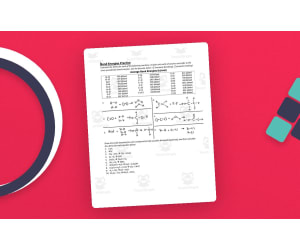
Bond Energy Practice – 16-Problem Chemistry Set
Science, Chemistry, Grade 8, 9, 10, 11, 12, Activities
Resource includes 16 practice problems which covers Bond Energies. Students will practice calculation of the enthalpy of various reactions. They will do so through using the common bond energies between atoms. Six of the questions are designed to use digitally draw Lewis structures. Ten questions are designed so that students draw their own structures. The solutions to all questions are provided.
Author Schrim's Chem
Rating
Tags Bond Energy, Chemistry Practice, Atoms, Chemistry Reactions

Ice Cream Reading Comprehension Passage - Cored Ed Encyclopedia
ELA, Language Development, Resources for Teachers, Reading Comprehension, Reading, Pre-Reading, Writing, Physics, Science, Grade 2, 3, 4, 5, Worksheets & Printables, Worksheets, Teacher Tools, Centers, Activities, Writing Prompts, Assessments, Tests, Quizzes and Tests, Quizzes
This ice cream reading comprehension contains the following: Pre-Reading Trivia Students will write down one thing they already know about the subject and then read five more facts and discuss. These facts are fun, and the students will enjoy learning about the subject before reading more. Reading Passage The text is a high-interest reading passage with set paragraphs, roughly three to four paragraphs long. It contains a variety of themes about the topic, anywhere from history to technology. The passage is between 250 and 350 words in length. Mixed Questions The first question page contains four multiple-choice questions, each with a choice of four answers, and three written response questions that require a sentence or two from the student. Vocabulary Questions Practice seven key words from the text in this section across two activities. First section is scrambled words where students will unscramble three words given a clue for each. The second section is a word to meaning matching activity. Creative Writing In this question, the student will be required to write a five to eight sentence paragraph on a question related to the topic. Extension Activities This page is optional for fast finishers or to take home. There are several activities, each one requiring a different skill. Do some, do none, do all, completely optional - but you will feel reassured knowing every possibility is planned for. Answer Key There are answers for the multiple-choice questions, written response questions have sample answers, vocabulary answers and if there is a summary question then a sample summary will be provided as well. FULL CATALOG OF DOWNLOAD LINKS AND ENCYCLOPEDIA INDEX HERE Lesson Snapshot Title: Ice Cream Genre: Nonfiction (informational text with headings) Subject: Reading (Informational Text) / Science & Food Primary Topic: What ice cream is, why it’s smooth, and its history Estimated Guided Reading Level (A–Z): N What This Lesson Teaches Best Defines ice cream and names common parts: milk or cream, a sweetener, and flavorings. Explains a process (how it gets smooth): chilling/freezing while stirring. Teaches cause and effect about texture: stirring breaks up ice crystals so they stay tiny. Adds another cause and effect idea: stirring mixes in air so ice cream feels lighter and easier to scoop. Builds simple historical understanding with a timeline of examples (1851 factory; 1874 ice cream soda; 1904 cone at the World’s Fair). Learning Goals Students can describe what ice cream is made mostly from, using text details. Students can explain why ice cream is stirred while it freezes, according to the passage. Students can describe how tiny ice crystals affect the way ice cream feels. Students can explain how mixing in air changes ice cream’s texture and scoopability. Students can recount key history facts about ice cream from the passage (1851, 1874, 1904). Key Vocabulary From the Text sweetener — something that makes food taste sweet. flavorings — ingredients that add taste, like vanilla or cocoa. mixture — different ingredients blended together. crystals — tiny frozen pieces that can change texture. commercial — made or sold as part of a business. Cored Ed Encyclopedia Overview The Cored Ed Encyclopedia is a weekly series of lessons that you can pick up and use right away. These short readings fit into whatever time you have available. Each one includes a warm-up, a reading, and a set of questions, but it’s flexible — you can do just the reading, the full lesson, or skip the writing section if you need to. Each lesson focuses on a single topic so students don’t get lost. The writing is clear but never childish, making it perfect for grades two through five. Topics range from animals and science to history, inventions, and everyday things. No matter the level of the student, everyone should take away at least one new idea or fact from each lesson. The materials are easy to print, easy to explain, and require no setup. They work well for whole-class teaching, partner work, or independent study.
Author Cored Education
Rating
Tags Vocabulary, Spelling, Reading Comprehension, Reading Passages, Reading, Creative Writing, Reading Strategies, Writing Prompts, Ice Cream, Physics
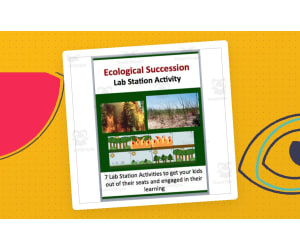
Ecological Succession – Lab Station Activity
Science, Life Sciences, Biology, Grade 6, 7, 8, 9, 10, Labs, Experiments, Activities
This fully editable Lab Station on Ecological Succession is meant to get your students out of their seats and engaged in the content. Each station not only offers a unique opportunity to test your students' knowledge (offer an opinion, answer questions based on a video or reading, draw, etc.), but also provides a fantastic learning opportunity where your kids are learning through assessment. Each station comes with a description card while some also contain more detailed instructions, a reading, questions to answer, etc. Students are equipped with a recording sheet (passport) to write their answers. There is almost no prep for you. Simply print the cards, lay them out around the room and you're all set. An answer key is also provided where applicable. This lab activity covers: - Primary Succession - Secondary Succession - The Role of Forest Fires in an Ecosystem - Pond Succession ---------------------------------------------- Bonus Activities: To ensure your students don’t have any downtime between stations, your lab also includes a 10-word word scramble and word search, both with an answer key. You can use them as part of their mark, as a bonus so it’s not mandatory, etc. However you choose to use it, it will ensure that your students are always busy and never idle. Note: For stronger classes, I give the word scramble and for weaker ones, the word search. ---------------------------------------------- How do the Lab Stations work? Each station is specially designed to be a unique complement to the material while at the same time, provide a valuable learning experience. Below is an overview of how each station works. In your activity , each will be tailored to the specific content. Station 1: Get Hands-On – using their creative skills, students are required to draw or build. Station 2: Research – using a classroom computer or their own device, students must research a specific question/issue surrounding the topic. Station 3: Explain yourself – students write down an opinion to a question in paragraph form. Station 4: Rest Station - students can use this time to catch up on work they didn't have time to complete at a previous station or prepare themselves for an upcoming one. Station 5 - Applicability reading – students read a short passage from an article, website, etc. which directly connects the classroom content to a real life application. Station 6: Test your knowledge – students answer 5 multiple choice questions then provide a written explanation for how/why they came to their conclusions. Station 7: Learn from the expert – using a classroom computer or their own device, students must watch a short video clip and answer the associated questions. They may stop, rewind and restart as often as they like during the time frame. Station 8 - Rest Station. Station 9: Become the question master – Students must create 2 multiple-choice questions, 2 true/false questions and 1 short answer question. Students must also supply the answers. ------------------------------- You might also be interested in my other lab station activities Ecology and the Environment: • Ecosystems • The Classification of Living Things • Biodiversity and Invasive Species • The Carbon and Water Cycle • Climate Change • Photosynthesis • Cellular Respiration and Photosynthesis • Ecological Succession • Plant Sexual and Asexual Reproduction • Earth's Seasons • Interactions Within Ecosystems Biology: • Cell and the Cell Theory • The Human Digestive System • The Circulatory System • The Human Respiratory System • Mitosis and the Cell Cycle • Cellular Respiration and Photosynthesis • Photosynthesis • Cancer: Cell Division Gone Wrong - Volume I • Cancer: Cell Division Gone Wrong - Volume II • Cell Membrane and Transport • Hearing and the Human Ear • The Human Eye • Genetic Material: DNA and RNA • The Nervous System • Energy Flow In Ecosystems Physics: • Newton's Three Laws of Motion • Kinetic and Gravitational Potential Energy • Current Electricity and Circuit Diagrams • Static Electricity • Light Optics and the Production of Light • Sound, Sound Energy and Speed • One and Two-Dimensional Motion • Uniform Acceleration • How Planes Fly • Refraction • Friction • Energy and Its Forms • Density and Buoyancy Space Science: • The Life and Death of Stars • The Moon and its Phases • Life In Space • Our Solar System • Solar and Lunar Eclipse • Earth's Seasons • Asteroids, Comets and Meteors Chemistry: • Atomic Model, Notation and Atoms • Chemical Reactions and Balancing Equations • Molecular and Ionic Compounds • Physical and Chemical Properties & Changes • Acids, Bases, and Neutralization Reactions • The Periodic Table • Single and Double Displacement Reactions • Balancing Chemical Equations • Synthesis, Decomposition and Combustion Reactions • Atomic Theory, Atomic Structure and Isotopes • Types of Bonds and Intermolecular Forces • The Mole/Avogadro's Number • Density and Buoyancy These station cards are meant to be used as a lab activity but can also be utilized in a review task before a test or a quiz. Used either way, your students will love it! I know mine do and I'm telling you from first-hand experience as I've used this activity in my own class. Thank you for your interest in my products. If you have any questions, please send me an email - devon@teachwithfergy.com
Author Teach With Fergy
Tags Forest, Fire, Ecosystem, Soil, Ecology, Ecological Succession Lesson Plan
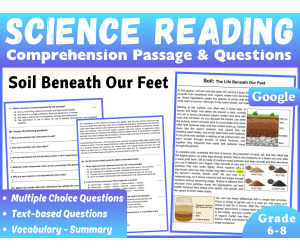
Earth Science Reading Comprehension Passage: Soil Types (Docs)
Science, ELA, Reading, Reading Comprehension, Strategies, Resources for Teachers, Earth and Environmental Sciences, Earth Sciences, Geology, Grade 6, 7, 8, 9, Writing Prompts, Worksheets & Printables, Centers, Activities, Teacher Tools, Assessments, Quizzes and Tests, Quizzes, Tests
Science Reading Comprehension Passages and Questions: Soil Types (Docs) This very engaging earth science reading passage about Soil Types is designed to bridge the gap between science and literacy through strengthening reading comprehension and sparking scientific curiosity in middle school students. The passage blends English Language Arts skills with accurate science content that supports NGSS classroom practice. Ideal for interdisciplinary learning in ELA and Science. Suitable for Grade 9 review, too! Student Tasks for The Passage: 5 multiple-choice questions targeting main idea, key details, inference, vocabulary in context, and use of evidence 5 vocabulary matching items with clear, student-friendly definitions 5 text-based questions that require citing specific lines or facts 1 summary prompt that asks students to condense central ideas accurately Full answer key for every section Available Formats for this Resource PDF Fillable PDF Word Docs FULL CATALOG OF DOWNLOADING LINKS HERE Product Details Length: 5 pages total Grades: 6–8, also suitable for Grade 9 review Use cases: close reading, stations, homework, intervention, test prep, and sub plans Standards support: reinforces informational-text skills and supports NGSS-style sense making through observation, modeling, and clear use of claim, evidence, and reasoning Why Teachers Choose This Set Authentic science content paired with rigorous literacy practice Consistent task structure across all passages for easier planning and smoother student routines Clear, age-appropriate writing that builds confidence without oversimplifying Other Science Reading Collections you May find in the store: 1. Astronomy & Space Science 2. Volcanoes, Rocks, & Mountains 3. Rock Cycle, Soil, & Sinkholes 4. Mars, Glaciers, & Antarctica 5. Water Cycle, Acid Rain, & Wastewater 6. Insects, Animals, & Ecosystems 7. Bioluminescence & Insects 8. Animal Skin, Cats, & T. Rex 9. Human Body and Senses 10. Health & Applied Bioscience 11. Waves, Light, & Imaging 12. Electricity & Energy 13. Motion & Materials 14. Chemistry and Materials Science Use this set to reinforce ELA skills in science, to add literacy to your lessons, and to support independent work. The passages strengthen main idea, evidence use, vocabulary in context, inference, cause and effect, and summary writing. With ready-to-use assessments and complete answer keys, you can provide focused practice that is simple to run and fast to review.
Author Middle & High School - CORED Education
Rating
Tags Middle School, Reading Comprehension, Reading Strategies, ELA, Centers, Reading Passage, Assessments, Vocabulary, Environmental Science, Earth Science
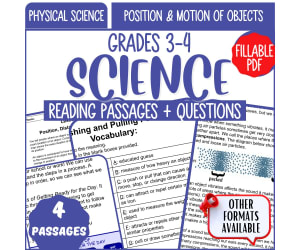
Reading Passages on Position and Motion of Objects (Fillable PDF)
ELA, Reading, Reading Comprehension, Science, Physics, Common Core, ESL, Language Development, Vocabulary, Grade 2, 3, 4, Worksheets & Printables, Worksheets, Assessments, Teacher Tools, Tests, Quizzes and Tests, Centers, Activities
Reading Passages on Position and Motion of Objects for Physical Science Snapshot Genre: Nonfiction Subject: Physical Science Primary Topic: Motion, forces, sound, hearing, and sound properties Estimated Guided Reading Level (A–Z): M What This Teaches Best It explains position, distance, motion, speed, grids, and coordinates in clear everyday language. It teaches that forces are pushes and pulls and gives examples including pedaling, braking, steering, gravity, and magnetism. It connects sound to vibration and shows how sound waves move through air to the ear and brain. It teaches how tone and volume depend on compressions and the force of air against the eardrum. Learning Goals Students will describe position and use coordinates to identify location on a grid. Students will explain how distance and time are used to describe speed. Students will identify examples of push, pull, gravity, and magnetism as forces. Students will explain how vibrations create sound waves. Students will compare high and low tone and explain what makes sounds louder or quieter. Part 2 - Position & Motion of Objects. Reading Passage 1: Position, Distance, and Motion Reading Passage 2: Pushing and Pulling Forces Reading Passage 3: Sound, Hearing, and Force Reading Passage 4: Characteristics of Sound FILLABLE PDF VERSION Worksheet-style pages, but with type-in answer boxes so students can complete and save their work digitally. Other versions are available in the links list below or in the full catalog. FULL CATALOG OF DOWNLOAD LINKS HERE Grade 3/4 Links: Physical Science Part 1 - Properties of Objects and Materials Google Docs/Slides/Forms PDF PPT Word Free Supplementary Pack Accompanying Videos Physical Science Part 2 - Position and Motion of Objects Google Docs/Slides/Forms PDF PPT Word Free Supplementary Pack Accompanying Videos Physical Science Part 3 - Light, Heat, Electricity, Magnetism Google Docs/Slides/Forms PDF PPT Word Free Supplementary Pack Accompanying Videos Life Science Part 1 - Characteristics of Organisms Google Docs/Slides/Forms PDF PPT Word Free Supplementary Pack Accompanying Videos Life Science Part 2 - Life Cycles of Organisms Google Docs/Slides/Forms PDF PPT Word Free Supplementary Pack Accompanying Videos Life Science Part 3 - Organisms and Environments Google Docs/Slides/Forms PDF PPT Word Free Supplementary Pack Accompanying Videos Earth Science Part 1 - Properties of Earth Materials Google Docs/Slides/Forms PDF PPT Word Free Supplementary Pack Accompanying Videos Earth Science Part 2 - Changes in the Earth and Sky Google Docs/Slides/Forms PDF PPT Word Free Supplementary Pack Accompanying Videos Earth Science Part 3 - Objects in the Sky Google Docs/Slides/Forms PDF PPT Word Free Supplementary Pack Accompanying Videos For similar products and other frees, do check out Cored Group on TeachSimple .
Author Cored Education
Rating
Tags Science, Elementary, Reading, Comprehension, Physics, Physical Science, Reading Centers, Reading Comprehension Assessments, Science Assessments, Vocabulary Assessments