3,948 products added recently
Page 2 - History Graphic Organizers
Deepen students' grasp of historical concepts by integrating graphic organizers specific to social studies. This collection includes timelines, event mapping, and comparison charts. By using these tools, you can help students organize complex information and draw meaningful connections.
Reaganomics: Graphic Organizer
Social Studies, History, History: USA, Grade 8, 9, 10, 11, Teacher Tools, Graphic Organizers
Reaganomics: Graphic Organizer A valuable teaching resource, this comprehensive tool simplifies the complex subject of Reagan's economic policies. It is designed for students from grades 8 to 11. Particularly, educators working with subjects in Social Studies, specifically within the subdomain of USA History. Key Principles This graphic organizer focuses on 'Reaganomics', the economic approach used by President Ronald Reagan during his tenure from 1981-1989. The strategies covered include: Supply-side economics Monetarism Deregulation The graphics depict how these mechanisms were implemented to stimulate economic growth and boost job creation through decreases in taxes, reductions in government expenditure, and relaxing regulations across industries. Policy Changes Under Reagan's Administration Notably, important policy changes such as Tax Reform Act of 1986 aimed at simplifying tax code while promoting fairness and efficiency are discussed. The reasoning behind reducing government spending within social welfare programs is also explored – an attempt to downsize federal involvement while increasing individual contributions. Critical Perspectives on Reaganomics Included within it is an examination of arguments both praising and critiquing "Reaganomics". This promises exposure to critical thinking exercises around pertinent ongoing debates. An Excellent Classroom Tool This effective method stimulates classroom discussion or debate among peers during group study sessions or even when given as homework assignments. The Package Includes: A detailed teacher version with answers which can serve as a 'key'. A student template for filling in the blanks to confirm an understanding of Reaganomics. Available in a PDF format, this classroom-ready resource can plunge educators and students into the depths of a significant era in American economic history.
Author EduPal Learning
Tags Reaganomics, Economic Policies, Supply-side Economics, Monetarism, Deregulation, What Is Reaganomics, Were Reaganomics Good For The United States
Sequence of Events – Cycle Graphic Organizer
Social Studies, History, History: World, Not Grade Specific, Graphic Organizers, Teacher Tools
This Sequence of Events Cycle Graphic Organizer is a great way for students to describe the major events that occur in the beginning, middle, and end while reading. It's a helpful tool for teachers who want to help their students improve their reading comprehension skills.
Author Have Fun Teaching
Rating
Tags Sequencing, History, Kindergarten Sequence Of Events, Chain Of Events Graphic Organizers, Teaching Sequence Of Events
French Revolution: Complete Graphic Organizer
Social Studies, History, History: Europe, History: World, Grade 8, 9, 10, 11, Teacher Tools, Graphic Organizers
The French Revolution was a period of radical social and political upheaval in France from 1789 to 1799. It began with the storming of the Bastille prison in Paris on July 14, 1789, and ended with the rise of Napoleon Bonaparte as Emperor in 1799. The French Revolution was sparked by a combination of economic, social, and political factors. France was facing a financial crisis due to its involvement in the American Revolution and the extravagant spending of King Louis XVI and his queen, Marie Antoinette. Meanwhile, the majority of the French population, particularly the lower classes, were suffering from poverty, starvation, and inequality. The revolution began with the Estates-General, a meeting of representatives from the three social classes in France, which had not been convened since 1614. The Third Estate, which represented the common people, demanded more representation and greater political power. When the king refused, the Third Estate declared itself the National Assembly and began drafting a new constitution. The revolution quickly turned violent, as crowds of angry Parisians stormed the Bastille and other symbols of the monarchy. In August 1789, the National Assembly abolished feudalism and established the Declaration of the Rights of Man and of the Citizen, which asserted the equality of all citizens before the law and guaranteed individual rights such as freedom of speech, press, and religion. The revolution continued with the Reign of Terror, a period of mass executions and political repression led by radical Jacobin leader Maximilien Robespierre. The Reign of Terror was brought to an end with the execution of Robespierre in 1794. In 1795, a new constitution was established, creating a Directory government. However, the Directory was plagued by corruption and instability, leading to the rise of Napoleon Bonaparte, who seized power in a coup d'état in 1799. The French Revolution had a profound impact on world history, inspiring political and social revolutions in Europe and beyond. Its legacy includes the spread of revolutionary ideals such as liberty, equality, and fraternity, the emergence of nationalism, and the transformation of Europe's political and social order. Teacher-prepared notes show students what is important and how ideas relate, and offer a model for how students should take notes themselves (Marzano et al., 2001). This graphic organizer helps students understand the underlining causes and effects of the French Revolution. The notes go over The Tennis Court Oath, the Bastille, and The Great Fear. These notes also cover the start and end of the Reign of Terror, and conclude with an overview of the rise and fall of Napoleon. Ready to print and ready to use! Clipart credit: By PrincePadania and byDandy Doodles
Author EduPal Learning
Tags Graphic Organizer, World History, European History, Cause And Effect
New Deal Alphabet Agencies – Graphic Organizer
Social Studies, History, History: USA, Grade 7, 8, 9, 10, 11, Graphic Organizers
The New Deal was a series of economic programs and reforms implemented in the United States during the 1930s by President Franklin D. Roosevelt (FDR). It was a response to the severe economic crisis of the Great Depression, which began with the stock market crash in 1929. The New Deal aimed to address the widespread unemployment, poverty, and economic instability that plagued the country. Its primary goals were relief for the unemployed and those in need, economic recovery, and reform to prevent future economic crises. The New Deal consisted of three main components, often referred to as the "Three Rs": Relief, Recovery, and Reform. Overall, FDR's New Deal represented a significant expansion of the federal government's role in the economy and social welfare, aiming to provide relief to those in need, stimulate economic recovery, and establish long-term reforms to prevent future economic crises. Teacher-prepared notes show students what is important and how ideas relate, and offer a model for how students should take notes themselves (Marzano et al., 2001). This fill-in-the-blank graphic organizer is perfect for your student's interactive notebook. It looks at the 3 R's of the New Deal (Relief, Recovery, and Reform), and provides examples of agencies that aimed to fulfill those goals. Ready to use - no prep.
Author EduPal Learning
Tags New Deal, FDR, US History, Great Depression, Franklin Roosevelt, Graphic Organizer, Alphabet Agencies New Deal, What Were The Alphabet Agencies, Chart
Progressive Era Muckrakers Reading & Graphic Organizer
Social Studies, History, History: USA, Grade 6, 7, 8, 9, 10, 11, 12, Teacher Tools, Graphic Organizers
This is a set of readings on the leading "muckrakers" of the Progressive Era. This resource includes a corresponding graphic organizer . I suggest to finish the lesson with an excerpt from Upton Sinclair’s The Jungle—a big hit with the high school set.
Author Exa's Excellent Social Studies Lessons
Tags Progressive Era, Muckrakers, The Jungle, Ida Tarbell, Theodore Roosevelt, Progressive Era Muckrakers Answer Key, Progressive Era Muckrakers Worksheet Answers, Modern Day Muckrakers
The Antebellum South: Graphic Organizer
Social Studies, History, History: USA, Grade 7, 8, 9, 10, Teacher Tools, Graphic Organizers
The Antebellum South: Graphic Organizer The Antebellum South: Graphic Organizer is a vital teaching resource designed to aid educators in imparting students with an intuitive understanding of the complex societal, economic, and cultural facets of the pre-Civil War era in the Southern United States. This tool proves particularly beneficial for Grade 7 to Grade 10 educators dealing with social studies. Key Features: Insightful Understanding: Alongside explaining topics like slavery and socio-economic division prevalent in the antebellum south, this resource also provides insights into cotton and tobacco - cash crops extensively farmed on plantation farms using enslaved Africans. All-encompassing narrative: This graphic organizer weaves together crucial events such as Nat Turner's rebellion while tracing debates sparked by southern leaders justifying slavery based on economic compulsions which simultaneously raised discussions around racial hierarchy and states' rights.(Refer to appended teacher notes) Versatility: Suitable for whole-class discussions, group activities or assigned as individual research work due to its self-explanatory design. Tailored Resources: Presented in PDF format, The Antebellum South: Graphic Organizer includes both a teacher-prepared notes variant complete with comprehensive explanations and a student variant that promotes self-learning. Note:The uniqueness lies in this tool's succinct yet informative approach – allowing grades 7-10 students to effectively grasp historical contexts without compromising on factual integrity solely aimed at enhancing their educational pursuits. As an added bonus, thumbnail clipart supplied by Clip Art Emporium makes it visually engaging. Not requiring additional software or resources adds icing on the cake – just print it out and you're all set! Encoded with rich education values, this ready-to-use tool indisputably becomes a wonderful addition to any classroom.
Author EduPal Learning
Tags Antebellum South, Graphic Organizer, Social Studies, Slavery, Plantation Farms
Reconstruction 1865-1877 - Two Graphic Organizers
Social Studies, History, History: USA, Grade 8, 9, 10, 11, Teacher Tools, Graphic Organizers
Reconstruction 1865-1877 - Two Graphic Organizers This teaching resource delves into the critical period in American history that followed the Civil War. A valuable tool for educators of Grades 8 through 11, it provides comprehensive content on a complex epoch concerning History or Social Studies related to USA. Main Focus: The resource focuses majorly on Reconstruction protocols post-Civil War and outlines political, social, and economic shifts during this tenure. The primary objective was re-establishing Southern states which had seceded from the Union and integrating African Americans into society. Legislation Elements: 13th to 15th Amendments: Abolished slavery while providing citizenship rights to African Americans. Freedmen's Bureau Policy: Safeguarded interests of those recently freed from enslavement. Dual Graphics Organizers Feature: Packed with valuable information integrating politics within Postwar Reconstruction in South alongside a map highlighting Southern military districts—understanding how Southern states were readmitted post-war handling of issues regarding African American integration and determining controlling parties over Reconstruction. Challenges Faced: Resistance from opposing white Southerners. A rise in clans promoting racial segregation due to societal strains. Fraudulent methods used by white democrats regaining control leading up to Jim Crow era commencing racial segregation till Civil Rights Movement took charge later in mid-20th century. In addition, teacher-prepared notes help streamline complex narratives for students while boosting their note-taking skills (Marzano et al., 2001). Flexibility in Teaching Approach: With multiple file types, including teacher versions and student fill-in-the-blank ones paired with illustrative clipart (credit: Prince Padania), this resource provides flexibility for educators – suitable for large group discussions, small clusters, or homework assignments.
Author EduPal Learning
Tags Reconstruction, Civil War Aftermath, African American Integration, Legislative Changes, Social Challenges
J. Robert Oppenheimer: Graphic Organizer
Social Studies, History, History: USA, History: World, Grade 6, 7, 8, Teacher Tools, Graphic Organizers
This J. Robert Oppenheimer: Graphic Organizer resource is focused on J. Robert Oppenheimer, a pivotal figure in 20th-century science and the development of the atomic bomb. Julius Robert Oppenheimer was not only an exceptional physicist but also a key player in shaping the course of history during World War II through his involvement with the Manhattan Project. Born in New York City in 1904, Oppenheimer's early years were marked by outstanding academic achievements. He pursued studies at esteemed institutions such as Harvard University and later secured his Ph.D. in theoretical physics from the University of Göttingen, Germany. His contributions spanned various facets of quantum mechanics and quantum field theory. However, his paramount influence emerged during the turbulent years of World War II. In 1942, Oppenheimer assumed the role of scientific director for the Manhattan Project, an initiative that bore heavy consequences with the bombings of Hiroshima and Nagasaki. His expertise and leadership were invaluable to the project's culmination. Post-war, Oppenheimer's journey continued in both academic circles and governmental sectors. He chaired the General Advisory Committee of the United States Atomic Energy Commission, advocating for judicious control over atomic energy. Regrettably, the McCarthy-era cast shadows over his accomplishments, leading to the revocation of his security clearance in 1954, a decision that was later revised, albeit not entirely overturned. Oppenheimer's passing in 1967 left behind a legacy characterized by brilliance, innovation, and moments of controversy. To aid in bringing this influential figure's narrative to our students, I've prepared a comprehensive overview of Oppenheimer's life, both preceding and following the Manhattan Project. This resource is complemented by 10 reading comprehension questions, alongside a detailed teacher key, ensuring a holistic teaching experience. It's formatted to be effortlessly integrated into our curriculum. Product Clipart: Prince Padania
Author EduPal Learning
Tags J. Robert Oppenheimer, Graphic Organizer, Manhattan Project, Oppenheimer, World War II, Atomic Bombs
The Cuban Missile Crisis: Graphic Organizer
Social Studies, History, History: USA, Grade 7, 8, 9, 10, 11, Teacher Tools, Graphic Organizers
The Cuban Missile Crisis was a 13-day political and military standoff between the United States and the Soviet Union in October 1962. The crisis was sparked when the United States discovered that the Soviet Union had secretly installed nuclear missiles in Cuba, just 90 miles from the US coastline. The US saw this as a direct threat to their national security. On October 22, 1962, President John F. Kennedy announced the discovery of the missiles and imposed a naval quarantine on Cuba, blocking Soviet ships from delivering more missiles. The Soviet Union responded by stating that the quarantine was an act of aggression and refused to remove the missiles. For the next 13 days, the world was on the brink of nuclear war. The US military was put on high alert, and Kennedy established the Executive Committee of the National Security Council (EXCOMM) to advise him on the crisis. Kennedy and his advisors considered several options, including a military strike on Cuba, a full-scale invasion, and a naval blockade. They also communicated with Soviet Premier Nikita Khrushchev through diplomatic channels to try to find a peaceful solution. On October 28, Khrushchev agreed to remove the missiles in exchange for a US promise not to invade Cuba and to remove US missiles from Turkey. The crisis was over, and nuclear war had been avoided. The Cuban Missile Crisis was a defining moment in the Cold War, demonstrating the danger of nuclear weapons and the need for international diplomacy and cooperation. It also led to improved communication and a "hotline" between the US and the Soviet Union to prevent future crises. Teacher-prepared notes show students what is important and how ideas relate, and offer a model for how students should take notes themselves (Marzano et al., 2001). These notes give students an overview of Cuban Missile Crisis, the main players in the crisis, and the 13-days where the world stood at the brink of nuclear war. These notes also come complete with a fill-in-the-blank student version. Clipart Credit: Dandy Doodles
Author EduPal Learning
Tags Cuban Missile Crisis, Graphic Organizer, Cold War, Kennedy, Missile Graphic, Cuban Graphic, Cuban Missile Crisis Clipart
Greece and Rome Sort
Social Studies, History, History: Ancient, Grade 9, 10, 11, 12, Teacher Tools, Graphic Organizers
If your history students are studying ancient civilizations, this is a great resource that will help students organize their thoughts, take notes, and review their learning in engaging ways. This is aGreece and Rome Sort. This was designed for your high school history students. It is a 1-page resource that is composed of a graphic organizer for students to complete. This is a digital resource that can easily be accessed in Google Slides or Microsoft PowerPoint. If you access it through Google Slides , you can assign it to students’ classrooms for them to complete on their devices. You may also choose to project it onto your smartboard and have it completed as a whole group. Another alternative would be to project it onto your smartboard and have students write their answers on notebook paper independently. Then you could go over the answers as a whole group and students can check their work. Students will put the image or statement under the correct classical civilization. There are 16 statements and 5 images to sort. This is a great introduction or review activity. An answer key is included. I hope you enjoy! Take A Look at My Best Sellers: Reformation Book Cover World History II Remediation Packet Modern World People Foldable The World in 1500 AD Cheat Sheet Explorer Project Genocide Worksheet You can find more resources at my storefront here: https://teachsimple.com/contributor/history-with-delong
Author History with DeLong
Tags Social Studies Graphic Organizer, Ancient History, Greece, Rome, Sorting Activity, Vocabulary Terms, History Images, Picture Sorting, Partner Work
D-Day Invasion: Graphic Organizer
Social Studies, History, History: USA, History: World, Grade 7, 8, 9, 10, 11, Teacher Tools, Graphic Organizers
The D-Day Invasion: Graphic Organizer Functioning as a beneficial teaching tool for educators, the D-Day Invasion: Graphic Organizer focuses on one of World War II's pivotal events. This introduction to the largest seaborne invasion in history marks the definitive turning point against Nazi Germany. Targeted towards grades 7 to 11, this graphic organizer offers an inclusive understanding of both US and world history. The package elucidates complex concepts, planning, and execution strategies associated with the operation. This understanding leads students to comprehend how Allies established their presence inland despite staunch resistance. Key historical aspects emphasized involve courage, determination, sacrifice and unity exhibited by thousands of troops from countries like: America Britain Canada Hundreds of aircraft and naval vessels were also instrumental in shaping these events. Included within this package: Teacher-prepared notes: Insights offering guidance on valuable points alongside reliable study material for learners. Dual edition versions: Student version catering initial comprehension needs along with filled-in teacher version providing reference guide. Optimal utility in classrooms or home studies remotely. Possible medium utilizations are whole group instructions or smaller groups promoting interactive brainstorming sessions or engaging homework assignments fostering critical thinking among peers. The value addition comes from: The visually engaging illustrations by Teachers Resource Force alongside Prince Padania’s maps for better geographical interpretation. This visual teaching aid significantly encourages learning retention better than conventional text-based methods alone. The PDF file type ensures ease-of-use across multiple digital platforms. With The D-Day Invasion: Graphic Organizer , experience new teaching possibilities meticulously created by teachers, for teachers!
Author EduPal Learning
Tags D-Day Invasion, World War II, Allied Forces, Seaborne Invasion, Turning Point
West African Historic Rulers Graphic Organizer
Social Studies, History, History: African, Grade 8, 9, 10, 11, Teacher Tools, Graphic Organizers
This is a West African Historic Rulers Graphic Organizer . This chart includes 4 different rulers for students to complete. They will notate their empire, when they rules and their accomplishments. A completed chart and a set of important vocabulary terms are included.
Author Cogjogger
Tags West African, Historic Rulers, Graphic Organizers, Empires
Roman Republic vs. U.S. Government – Comparison Set
Social Studies, History, History: World, Grade 9, 10, 11, 12, Teacher Tools, Graphic Organizers
This is a Roman Republic vs. U.S. Government Graphic Organizer . Students will use the chart to compare the 3 branches of government, the legal code, and citizenships between Ancient Rome and today's United States government. A completed chart is included.
Author Cogjogger
Rating
Tags Graphic Organizers, Rome, Roman Republic, U.S. Government, Study Guide, Roman Branches Of Government, Roman Republic Worksheet, Comparing Ancient Rome And America Today Worksheet, 3 Branches Of Roman Government
Second Great Awakening: Graphic Organizer
Social Studies, History, History: USA, Grade 9, 10, 11, Teacher Tools, Graphic Organizers
The Second Great Awakening: Graphic Organizer This essential educational tool targets Grade 9-11 students engaging in Social Studies, notably USA History. The organizer elucidates nuanced elements of The Second Great Awakening, a salient religious movement from the early 19th century that dramatically influenced American life. Presents an overview of features such as large-scale camp meetings marked by orations, hymn singing and personal testimonies stimulating conversions. Delves into the onset of new religious denomination like Methodists and Baptists birthed through this awakening. Serves as teacher-guided notes emphasizing on implying connections between ideas for efficient student note-taking (Marzano et al., 2001). Analyzes its influence on aspects from temperance movement to African Americans’ rights movement and abolitionism. Bonus:Selective questions which not only stimulate discussions among learners but enhance student participation guiding them towards advancer grasping of concepts. Evidently based on effective pedagogical methodologies (Marzano et al., 2001), using cues along with advance organizers yield a remarkable percentile gain in student achievement making it especially useful for reviewing AP U.S History curriculum content. Available in pdf format specifically designed for teacher’s use. However, a version dedicated towards students is included catering to distinct learning styles effectively whether delivered via whole group or small group exercises or even assigned as homework thereby further improving their comprehension about pivotal Chapters from America's historic past..
Author EduPal Learning
Tags Second Great Awakening, Religious Movement, United States History, Social Studies, USA History
The Great Awakening – Reading & Graphic Organizer
Social Studies, History, History: USA, Grade 7, 8, 9, 10, Teacher Tools, Graphic Organizers
The First Great Awakening was a religious revival movement that occurred in the American colonies in the 18th century, particularly between the 1730s and 1740s. It marked a significant shift in the religious landscape of the time and had a profound impact on American society, culture, and politics. The First Great Awakening emerged as a response to the growing secularism, complacency, and spiritual apathy that had developed within the established Protestant churches. It sought to reignite religious fervor and bring individuals to a more personal and heartfelt relationship with God. The First Great Awakening had several significant consequences. It led to the growth and diversification of Protestant denominations, as new churches and sects emerged, challenging the authority of established churches. The revival also fostered a greater emphasis on individualism, as people were encouraged to seek their own personal relationship with God, rather than relying solely on religious institutions. Furthermore, the First Great Awakening played a role in shaping American identity and promoting the ideals of religious freedom and personal liberty. It inspired a sense of unity among diverse groups of colonists, as people from different social and economic backgrounds came together in religious gatherings. This shared experience helped lay the groundwork for a common American identity and contributed to the development of democratic ideals in the colonies. Students begin by reading about the causes and effects of the Great Awakening. The students are introduced to the two major preachers: Jonathan Edwards and George Whitfield. Then, the students complete a graphic overview of the Great Awakening (included). Lastly, students answer two "Big Questions." Ready to print and use! Works great with the interactive notebook!
Author EduPal Learning
Rating
Tags Great Awakening, US History, Colonial America
Chinese History Review Sheets
Social Studies, History, History: Asian, Grade 9, 10, 11, 12, Teacher Tools, Graphic Organizers
These Chinese History Review Sheets will make great study guides for your history students. Students will use the charts to learn about China's: - Belief systems - Foreign influence downfall - Achievements - Historical eras & so much more!
Author Cogjogger
Tags Chinese, History, Review Sheets, Study Guide, Vocabulary
Modern Era's Important People Graphic Organizer
Social Studies, History, History: World, Grade 9, 10, 11, 12, Teacher Tools, Graphic Organizers
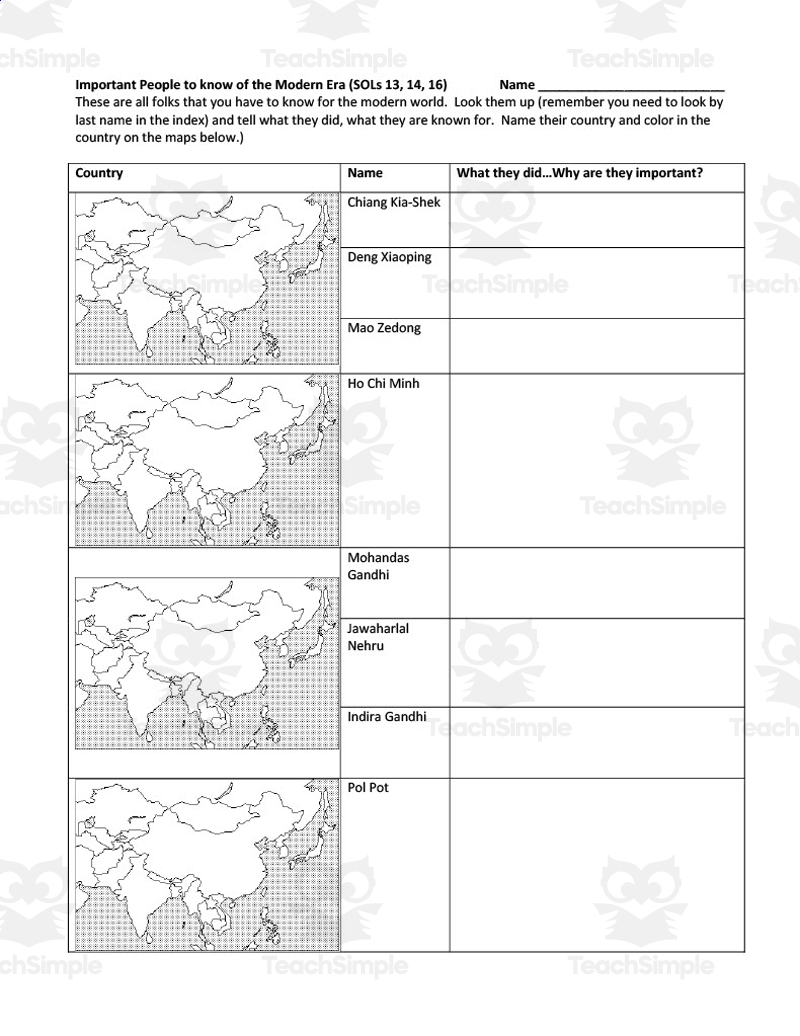
This is a Modern Era's Important People Graphic Organizer . This can be printed or completed digitally. Students will: - Look them up - Tell what they did - Tell what they are known for - Name and color their country on the map There are 14 people. Answer key included.
Author History with DeLong
Tags Modern Era, Geography, World History, Graphic Organizer, Gandhi
People to Know - World History I Matching Sets
Social Studies, History, History: World, Grade 9, 10, 11, 12, Teacher Tools, Graphic Organizers
If your history students are studying important people in history, this is a great resource that will help students organize their thoughts, take notes, and review their learning in engaging ways. This is aPeople to Know World History I Matching Sets. This was designed for your high school history students. It is broken down into 4 different sections: --Greeks & Romans --Asians --People Groups --Others There are 22 terms for students to choose from. Some of the terms included are: --Humanists --Socrates --Vikings --Mongos --Julius Caesar --Socrates --Caesar Augustus --Genghis Khan --Asoka --Hammurabi You may choose to use these matching sets in many different ways. You can have students cut everything out and paste the correct name to the correct description. They can use the matching sets for independent review. If you want to increase engagement, they can also work with a partner to quiz one another. I hope you enjoy! Take A Look at My Best Sellers: Reformation Book Cover World History II Remediation Packet Modern World People Foldable The World in 1500 AD Cheat Sheet Explorer Project Genocide Worksheet You can find more resources at my storefront here: https://teachsimple.com/contributor/history-with-delong
Author History with DeLong
Tags World History I Worksheet, Matching Sets, People To Know, Historical Leaders, Graphic Organizer, Social Studies Definitions, Review
Mapping the Monomyth Graphic Organizer
Social Studies, History, History: Ancient, Grade 11, 12, Teacher Tools, Graphic Organizers
This is a 1-page printable with a Mapping the Monomyth Graphic Organizer . All you have to do is print and go.
Author ELA Resources
Tags Mapping The Monomyth, Journey, Mythology, Ancient, Greek, Social Studies, History, Ancient History, Graphic Organizer
Road to American Revolution Timeline Exercise
Social Studies, History, History: World, Grade 9, 10, 11, 12, Teacher Tools, Graphic Organizers
This is a Road to American Revolution Timeline Exercise. Students can use their textbook to give each event a name and a year to create a timeline.
Author Cogjogger
Tags British, American Revolution, Timelines, Sugar And Stamp Act, French Indian War, The Road To Revolution Timeline, French Revolution Timeline Activity
History Vertical Timeline of Events Graphic Organizer
Social Studies, History, History: World, Not Grade Specific, Graphic Organizers, Teacher Tools
This graphic organizer is perfect for helping students build their sequencing skills. With space to record three events, it's a great tool for any history lesson.
Author Have Fun Teaching
Tags Note Taking, Summarizing, History, A Timeline Is Not A Graphic Organizer., Graphic Organizer Timeline
Great Depression Causes – Flowchart Study Guide
Social Studies, History, History: World, Grade 7, 8, 9, 10, Teacher Tools, Graphic Organizers
This Great Depression Causes Flowchart details important information about this piece of history in an organized way. The flowchart is broken down into 3 sections: - Unequal distribution of wealth - Overproduction of goods - Buying stock on margin This serves as a great study guide for students.
Author Cogjogger
Rating
Tags Great Depression, History, Flowchart, Study Guide, Assessment, Flowchart Graphic Organizer