



3,890 products added recently
Page 3 - 3rd Grade Lesson Plans
Support your third graders' expanding abilities with lesson plans that encourage exploration and deeper understanding. Covering a range of subjects, these resources offer hands-on activities and discussions. Use them to create a vibrant learning atmosphere that fosters enthusiasm.

 Show filters


Adjectives Supplementary Materials - Grade 3-4 Grammar (PDF)
ELA, Language Development, ESL, Grammar, Common Core, Resources for Teachers, Grade 3, 4, Worksheets & Printables, Worksheets, Quizzes and Tests, Teacher Tools, Tests, Assessments, Activities, Lesson Plans
Adjectives Supplementary Materials Note: This download DOES NOT include the tests themselves. You can still make use of these materials without them but they are recommended. Download in a format of your choice in the "Links" section below. Outline Ice Breaker (5-10 minutes) Engaging, interactive activity to introduce the lesson’s theme. Examples: Matching games, sentence races, charades, or storytelling challenges. Guided Practice (10-15 minutes) Teacher-led exercises to reinforce the concept. Examples: Sorting sentences by tense, sentence transformations, or fill-in-the-gap exercises. Group or Partner Task (15 minutes) Collaborative activity to practice the lesson’s focus in a fun and engaging way. Examples: Role-play, storytelling, sentence-building games, or small-group discussions. Independent Worksheet (15 minutes) Individual written activity to solidify understanding. Examples: Sentence corrections, verb conjugation drills, or tense identification exercises. Exit Task (5 minutes) Quick reflective activity to assess understanding before students leave. Examples: Writing a sentence using the target concept, identifying a tense, or explaining a rule. Links: Includes: Identifying Adjectives Gap Filling Comparatives Superlatives Additional Practice Google Docs Google Forms Google Slides PDF PPT Word FULL CATALOG OF DOWNLOAD LINKS HERE Grade 3/4 Links: Adjectives Google Docs Google Forms Google Slides PDF PPT Word Free Supplementary Materials Pack Adverbs Google Docs Google Forms Google Slides PDF PPT Word Free Supplementary Materials Pack Conjunctions Google Docs Google Forms Google Slides PDF PPT Word Free Supplementary Materials Pack Nouns Google Docs Google Forms Google Slides PDF PPT Word Free Supplementary Materials Pack Pronouns Google Docs Google Forms Google Slides PDF PPT Word Free Supplementary Materials Pack Verbs Google Docs Google Forms Google Slides PDF PPT Word Free Supplementary Materials Pack Sentence Structure Google Docs Google Forms Google Slides PDF PPT Word Free Supplementary Materials Pack Present Tense Google Docs Google Forms Google Slides PDF PPT Word Free Supplementary Materials Pack Past Tense Google Docs Google Forms Google Slides PDF PPT Word Free Supplementary Materials Pack Future Tense Google Docs Google Forms Google Slides PDF PPT Word Free Supplementary Materials Pack Context Clues Google Docs Google Forms Google Slides PDF PPT Word Free Supplementary Materials Pack Defining Words Google Docs Google Forms Google Slides PDF PPT Word Free Supplementary Materials Pack Fill the Blanks Google Docs Google Forms Google Slides PDF PPT Word Free Supplementary Materials Pack Homophones Google Docs Google Forms Google Slides PDF PPT Word Free Supplementary Materials Pack Synonyms Google Docs Google Forms Google Slides PDF PPT Word Free Supplementary Materials Pack ELA Review Questions Overview Questions have three answer choices. There are a handful of pictures on each test for aesthetic purposes, as well as a review sheet covering most of the topics covered in the product. Introduction or Example Sheet Each topic will include an introduction or example sheet to go through first with your students. Full Answer Keys Full answer keys and sample responses are provided so no matter how busy you are, you know you're covered! In the Supplementary Pack Interactive Ice Breakers: Fun, hands-on activities that get students thinking about adjectives right from the start. Guided Practice: Teacher-led exercises that reinforce the day’s lesson, ensuring students can confidently identify and use adjectives. Group and Partner Tasks: Collaborative activities that allow students to work together to solve problems, categorize adjectives, and create descriptive sentences. Independent Worksheets: Structured worksheets that provide individual practice and help solidify understanding of key concepts. Exit Tasks: Quick, reflective activities at the end of each lesson that assess understanding and encourage students to apply what they’ve learned. For similar downloads and other frees, do check out Cored Group on TeachSimple.
Author Cored Education
Tags Elementary, Answers, Ccss, Common Core, Grammar, Tests, Test Prep, Grade 3, Grade 4, Lesson Plan
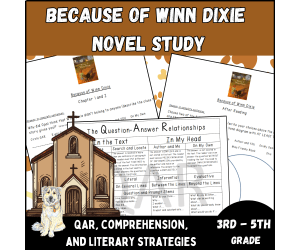
Because of Winn Dixie QAR Skills and Guided Reading Novel Study
ELA, Reading Comprehension, Reading, Grade 3, 4, 5, Lesson Plans, Teacher Tools, Worksheets & Printables, Novel Studies
Bring Because of Winn-Dixie to life in your classroom with this engaging and flexible novel study! Designed for upper elementary and middle school students, this resource helps young readers develop strong comprehension skills while introducing the Question-Answer Relationship (QAR) strategy in a meaningful way. The unit begins with mini-posters and reading journal inserts to teach students the four types of questions: Right There, Think and Search, Author and Me, and On My Own. By mastering this questioning strategy early on, students build the skills they need to dig deeper into the novel as they read. Instead of just answering surface-level questions, they’ll learn how to think critically, analyze text, and discuss ideas with confidence. As students move through the book, they’ll continue to practice and refine their questioning techniques, applying them to character development, themes, and major plot events. This approach encourages independent thinking and richer discussions, giving teachers the opportunity to guide students toward a deeper understanding of the text. How This Unit Works: 📖 QAR Mini-Lessons – Start with clear explanations and visual aids to introduce the questioning strategy. 📖 Active Reading & Skill Building – As students read, they apply QAR techniques to think critically about the story. 📖 Comprehension & Discussion Activities – Thoughtful prompts encourage meaningful conversations about characters, themes, and events. 📖 Final Project & Post-Reading Activities – Wrap up the novel with engaging project work that reinforces key takeaways. Why You’ll Love This Resource: ✔️ Makes questioning strategies easy to teach and apply. ✔️ Encourages higher-level thinking and deep discussions. ✔️ Works well for whole-class instruction, small groups, or independent study. ✔️ Includes ready-to-use mini-posters and journal inserts to support student learning. What’s Included? Mini-posters & reading journal inserts to introduce QAR Comprehension questions that challenge students to think deeply A final project for creative and reflective learning Flexible pacing to fit your teaching style This Because of Winn-Dixie novel study is a simple yet powerful way to help students build comprehension skills, improve questioning techniques, and connect with this heartfelt story. Whether used as a full-class novel study or a small group book unit, it’s a resource that makes reading more meaningful and engaging!
Author Kel's Klass
Tags Because Of Winn Dixie Novel Study, QAR Reading Strategy, Questioning Reading Strategy, Realistic Fiction, Small Group Reading, Whole Class Reading, Because Of Winn Dixie Worksheet, Because Of Winn Dixie Writing Prompts, Because Of Winn Dixie Lesson Plans, Reading Comprehension
No-Prep Substitute Teacher P.E. Pack – Professional Edition
P.E. & Health, Health, Mental Health, Mindfulness, Physical Education, Sports, Yoga, Life Studies, Coaching, Career, Grade 1, 2, 3, 4, 5, 10, 11, 12, Activities, Games, Projects, Teacher Tools, Charts, Assessments, Diagrams, Lesson Plans, Presentations, Graphic Organizers
Unlock the Ultimate No-Prep Substitute Teacher P.E. Pack – Professional Edition – Your Complete 46-Page Lifesaver for Emergency PE Lessons! Created especially for substitute teachers and school administrators, this instant-download digital PDF is your complete solution for no-equipment, high-energy PE lessons in any gym, PE classroom, or outdoor space! From the Substitute Survival Guide and Universal Warm-Up Protocol to Classic Tag Varieties, Relay Races for Large Groups, Simon Says Fitness Edition, Indoor Desk-Side Challenges, Rock-Paper-Scissors Tournaments, Cooperative Team Games, Red Light Green Light Remixes, and a complete Discipline & Behavior Cheat Sheet – it’s all included! Ideal for elementary PE sub plans, rainy-day indoor activities, or last-minute coverage, this pack will keep 20 to 100+ students engaged, safe, and moving while developing teamwork, focus, and sportsmanship. No printing needed, no equipment required – just open, read, and play! Perfect for K-8 physical education teachers in search of professional resources that will make you the hero sub every school needs. Instant access – chaos to confident, active learning in an instant! Why Parents/Schools Love It: Zero Prep, Maximum Impact: Subs walk in and start instantly – no prep work needed. Safety First & Inclusive: Built-in safety bubbles, freeze signals, cool-down zones, and adaptations for all abilities ensure every child is safe, active, and included. High Engagement, Low Chaos: Proven games + attention getters + behavior cheat sheet transform high-energy kids into focused, cooperative learners – school administrators rave about the calm transitions back into class. Standards-Aligned & Professional: Motor skills, teamwork, mindfulness – all while leaving detailed notes for the regular teacher. Versatile for Any Day: Indoors/outdoors, rain or shine – parents appreciate knowing their kids stay happy and healthy even when a substitute is needed! Target Student Classes : This content appears to be best suited for elementary- to early middle-school-aged students, specifically in the Grade K-8 range, with the best fit in the K-6 range. Primary focus: K-5 (Blob Tag, Hospital Tag, Simon Says Fitness, Remixes of Red Light/Green Light, Desk-Intervals, Imaginative Locomotor themes specifically mentioned as "primary" focus, K-3). Adaptable extensions: 4-8 (World Champ RPS, Strategic Relays, Human Knot, Competitive Cheering - these work well in the middle school setting). Not suited for high school students - no sports skills, no athletics, focus on fun, inclusive, low-cost, low-tech movement and classroom management techniques. Large group-friendly - 20 to 100+ students, gym or classroom setting. Copyright/Terms of Use: This Book was copyrighted by Syed Hammad Rizvi. This resource is for personal and single classroom use only. You cannot modify, redistribute, and sell this resource. In other words, do not place this resource on the Internet where it can be publicly found and downloaded. If you want to share this resource with your colleagues, please purchase the license from Teachsimple. Thanks for respecting the Terms of Use. This product is happily brought to you by Syed Hammad Rizvi
Author Creative Book Store
Rating
Tags SubstituteTeacher, NoPrepPE, PEGames, ElementaryPE, SubPlans, SubstitutePE, PhysicalEducation, NoPrepActivities, SubstituteTeacherPEPack, NoPrepSubstituteTeacher
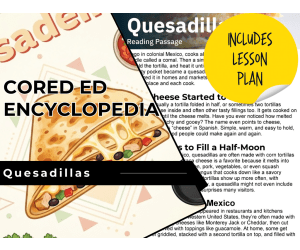
Quesadillas Reading Comprehension Passage - Cored Ed Encyclopedia
ELA, Language Development, Reading Comprehension, Reading, Pre-Reading, Social Studies, Writing, Strategies, Geography, Vocabulary, Grade 2, 3, 4, 5, Worksheets & Printables, Worksheets, Teacher Tools, Centers, Activities, Writing Prompts, Assessments, Quizzes and Tests, Quizzes, Lesson Plans
This quesadillas reading comprehension includes: Visualization (on the front cover) Start your lesson by taking a minute to think and share something about the topic. Read the script aloud (slowly), perhaps prepare some music or sound effects. Student close their eyes and let their imaginations wander. Students open their eyes, read the question aloud and give them a few minutes to complete. Ask a few students to share or keep answers until the end to compare with what they learn in the passage. Quick pause—thousands of Cored Education products are included with your TeachSimple membership. Download links and encyclopedia index available here. Pre-Reading Trivia Students will write down one thing they already know about the subject and then read five more facts and discuss. These facts are fun, and the students will enjoy learning about the subject before reading more. Give 1 minute for students to write what they already know (no pressure—best guess is fine). Read the five facts together. After each fact, do ask a student for their opinion, was it surprising? Set a purpose by asking students to highlight/underline one fact they want to learn more about during the reading. Reading Passage The text is a high-interest reading passage with set paragraphs, roughly three to four paragraphs long. It contains a variety of themes about the topic, anywhere from history to technology. The passage is between 250 and 350 words in length. First, ask students to look at the headings and see what they’ll learn about today. What do they know about the topic/heading? First read options: Teacher read-aloud (best for support). Partner reading (paragraph by paragraph). While reading, students underline important details, and vocabulary words they think may come up in the questions section. Mixed Questions The first question page contains four multiple-choice questions, each with a choice of four answers, and three written response questions that require a sentence or two from the student. Students complete the mcqs first independently, then review quickly as a class. For the 3 written responses, try to get students giving the answer with some form of evidence: “I think ___ because the text says ___.” If students get stuck, send them back to check the passage. Vocabulary Questions Practice seven key words from the text in this section across two activities. First section is scrambled words where students will unscramble three words given a clue for each. The second section is a word to meaning matching activity. Before starting, have some students read out words they underlined in the passage. Ask students to say the word and read aloud the sentence(s) around each word. Ask students to do scrambled words and the matching exercise in pairs then go through answers as a class. For the scrambled spelling task, get four pairs to come up to the board and write the words for extra practice with the other student reading out the clue. For the matching task, prompt students to give full sentences: “I matched ___ with ___ because ___.” Creative Writing In this question, the student will be required to write a five to eight sentence paragraph on a question related to the topic. Before starting, ask students write down 3 key ideas they are going to include in their piece. Ask students for ideas to share around the class to help those struggling. Pro writing expectations: 5–8 sentences At least 2 facts or details from the passage At least 2 vocabulary words from the previous page Students read their paragraphs while classmates listen for facts and vocabulary words. Extension Activities This page is optional for fast finishers or to take home. There are several activities, each one requiring a different skill. Do some, do none, do all, completely optional - but you will feel reassured knowing every possibility is planned for. Includes summary writting question. Answer Key There are answers for the multiple-choice questions, written response questions have sample answers, vocabulary answers and if there is a summary question then a sample summary will be provided as well. Lesson Plan Included Customized lesson plan for this lesson is included. Lesson Snapshot Title: Quesadillas Genre: Nonfiction (informational passage with support pages) Subject: Reading (Informational Text) / Social Studies (Culture & Food Traditions) Primary Topic: How quesadillas began and changed by place Estimated Guided Reading Level (A–Z): Q What This Lesson Teaches Best How foods and traditions change as people share them in different places (homes, markets, restaurants, and around the world). Comparing regional variations (corn vs. flour tortillas; different cheeses and fillings in different parts of Mexico and the U.S.). Building vocabulary and background knowledge about cooking tools and ingredients (comal, Oaxaca cheese, huitlacoche, guacamole). Identifying main ideas and key details across sections with headings (history/origin, filling choices, spreading beyond Mexico). Learning Goals Students can explain how the passage says a quesadilla is made (tortilla, filling, folded, heated). Students can describe how quesadillas changed in different places using details from the text. Students can compare quesadillas in different regions mentioned (central/southern Mexico, northern Mexico, Mexico City, Southwestern United States). Students can identify the main idea of each section heading and support it with one detail. Students can use key vocabulary from the passage when discussing the topic. Key Vocabulary From the Text colonial — from the time when a country was ruled by another comal — a flat griddle for heating and cooking tortillas Oaxaca — a place in Mexico named in the passage huitlacoche — a corn fungus used as a savory filling guacamole — a topping served with some quesadillas Discussion Prompts Pre-reading question: What foods have you seen change in different places or families? Comprehension questions: According to the passage, what is a quesadilla and how is it cooked? Comprehension questions: What are two different fillings or cheeses the passage says people use? Comprehension questions: How does the passage explain quesadillas changing as they spread beyond Mexico? FULL CATALOG OF DOWNLOAD LINKS AND ENCYCLOPEDIA INDEX HERE
Author Cored Education
Rating
Tags Vocabulary, Reading Comprehension, Reading Passages, Reading, Creative Writing, Reading Strategies, Writing Prompts, Lesson Plans, Quesadillas, Social Studies

Yoga Reading Comprehension Passage - Cored Ed Encyclopedia
ELA, Language Development, Reading Comprehension, Reading, History, Social Studies, Pre-Reading, P.E. & Health, Yoga, Geography, Grade 2, 3, 4, 5, Worksheets & Printables, Worksheets, Teacher Tools, Centers, Activities, Writing Prompts, Assessments, Quizzes and Tests, Quizzes, Lesson Plans
This yoga reading comprehension with lesson plan includes: Visualization (on the front cover) Start your lesson by taking a minute to think and share something about the topic. Read the script aloud (slowly), perhaps prepare some music or sound effects. Student close their eyes and let their imaginations wander. Students open their eyes, read the question aloud and give them a few minutes to complete. Ask a few students to share or keep answers until the end to compare with what they learn in the passage. Quick pause—thousands of Cored Education products are included with your TeachSimple membership. Download links and encyclopedia index available here. Pre-Reading Trivia Students will write down one thing they already know about the subject and then read five more facts and discuss. These facts are fun, and the students will enjoy learning about the subject before reading more. Give 1 minute for students to write what they already know (no pressure—best guess is fine). Read the five facts together. After each fact, do ask a student for their opinion, was it surprising? Set a purpose by asking students to highlight/underline one fact they want to learn more about during the reading. Reading Passage The text is a high-interest reading passage with set paragraphs, roughly three to four paragraphs long. It contains a variety of themes about the topic, anywhere from history to technology. The passage is between 250 and 350 words in length. First, ask students to look at the headings and see what they’ll learn about today. What do they know about the topic/heading? First read options: Teacher read-aloud (best for support). Partner reading (paragraph by paragraph). While reading, students underline important details, and vocabulary words they think may come up in the questions section. Mixed Questions The first question page contains four multiple-choice questions, each with a choice of four answers, and three written response questions that require a sentence or two from the student. Students complete the mcqs first independently, then review quickly as a class. For the 3 written responses, try to get students giving the answer with some form of evidence: “I think ___ because the text says ___.” If students get stuck, send them back to check the passage. Vocabulary Questions Practice seven key words from the text in this section across two activities. First section is scrambled words where students will unscramble three words given a clue for each. The second section is a word to meaning matching activity. Before starting, have some students read out words they underlined in the passage. Ask students to say the word and read aloud the sentence(s) around each word. Ask students to do scrambled words and the matching exercise in pairs then go through answers as a class. For the scrambled spelling task, get four pairs to come up to the board and write the words for extra practice with the other student reading out the clue. For the matching task, prompt students to give full sentences: “I matched ___ with ___ because ___.” Creative Writing In this question, the student will be required to write a five to eight sentence paragraph on a question related to the topic. Before starting, ask students write down 3 key ideas they are going to include in their piece. Ask students for ideas to share around the class to help those struggling. Pro writing expectations: 5–8 sentences At least 2 facts or details from the passage At least 2 vocabulary words from the previous page Students read their paragraphs while classmates listen for facts and vocabulary words. Extension Activities This page is optional for fast finishers or to take home. There are several activities, each one requiring a different skill. Do some, do none, do all, completely optional - but you will feel reassured knowing every possibility is planned for. Includes summary writting question. Answer Key There are answers for the multiple-choice questions, written response questions have sample answers, vocabulary answers and if there is a summary question then a sample summary will be provided as well. Lesson Plan Included Customized lesson plan for this lesson is included. Lesson Snapshot Title: Yoga Genre: Nonfiction (informational text) Subject: Social Studies & Health/SEL (culture and well-being) / Informational Reading Primary Topic: Yoga’s origins, key ideas, and modern practice Estimated Guided Reading Level (A–Z): Q Support pages present: pre-reading trivia, mixed questions, vocabulary activities, creative writing, extension activities, and an answer key. What This Lesson Teaches Best Explains yoga as an old practice that began in India and grew over time. Defines what the word “yoga” can mean in the passage (“yoke” or “union,” like two things working as one). Describes key tools in yoga: body positions, steady breathing, and quiet attention (and how breathing can steady the mind). Introduces “sutras” and explains that Patanjali gathered yoga ideas into short lines meant to be remembered, including a description of yoga as a path with eight “limbs.” Traces how yoga changed in the 1900s, noting that teachers such as Tirumalai Krishnamacharya helped create modern postural yoga with flowing sequences taught in classes. Learning Goals Students will describe what the passage says the word “yoga” can mean. Students will identify tools the passage says yoga uses (body positions, steady breathing, quiet attention). Students will explain why careful breathing matters in some yoga traditions, using details from the text. Students will describe what sutras are and why they were written, according to the passage. Students will summarize how yoga changed in the 1900s based on the passage’s timeline. Key Vocabulary From the Text Sanskrit — a very old language from India. traditions — ways people practice and pass ideas over time. sutras — short lines of teaching meant to be remembered. meditation — a quiet practice to help the mind rest. asana — a steady seat for meditation, not a gym pose. FULL CATALOG OF DOWNLOAD LINKS AND ENCYCLOPEDIA INDEX HERE
Author Cored Education
Rating
Tags Vocabulary, Reading Comprehension, Reading Passages, Lesson Plans, Ela Lesson Plans, Reading Comprehension Lesson Plans, Pre-reading, Social Studies Lesson Plans, Yoga, History

Unplugged Algorithms & Coding Logic
Resources for Teachers, Classroom Management, Community Building, STEM, Technology, Science, Computer Science, Engineering, Special Resources, Special Education Needs (SEN), Homeschool Curriculum, Homeschool Templates, Grade 2, 3, 4, 5, 6, Worksheets & Printables, Workbooks, Worksheets, Word Searches, Teacher Tools, Lesson Plans, Quizzes and Tests, Quizzes, Tests, Assessments
Ditch the screens and ignite critical thinking! Are you looking for a way to teach foundational coding skills without increasing screen time? This comprehensive 41-page curriculum, Unplugged Algorithms & Coding Logic: Zero Screen Time Edition , is your all-in-one solution for bringing computational thinking to life in your elementary classroom or homeschool setting. Based on the powerful pedagogy of embodied cognition , this unit transforms abstract concepts into tangible, kinesthetic activities. Students won't just learn about coding; they will become the computer! By physically walking through mazes, performing "Code Dances," and debugging physical sequences, they will build a deep, intuitive understanding of the logic that powers all technology. What's Inside This 41-Page Power-Packed Unit? Phase 1: Core Content & Theory Guide: A robust guide for educators explaining the "why" behind the method. It covers the core pillars of computational thinking: Algorithms & Sequencing: The basic "recipe" for all code. Iteration (Loops): The power of repeating actions efficiently. Conditional Logic ("If/Then"): The fundamentals of decision-making in code. Systematic Debugging: Turning errors into powerful learning opportunities. Phase 2: The Student Workbook (10 Worksheets): A progressive series of 10 engaging worksheets that translate theory into practice. Students will solve puzzles, navigate paper mazes, and identify patterns in a fun, game-like format. Includes a final "Master Programmer" comprehensive challenge! Phase 3: Visuals & Teacher Resources: Everything you need to teach with confidence! Classroom Visuals: Clear, printable flowcharts and diagrams for looping and conditional logic. Comprehensive Answer Key: Detailed solutions and logical explanations for every problem. Teacher Implementation Guide: Expert advice on differentiating for grade levels (2nd-5th), managing kinesthetic activities, and unique methods for assessing student mastery without traditional tests. This isn't just a set of worksheets; it's a transformative approach to teaching 21st-century skills. Perfect for the Hour of Code, STEM centers, a full computer science unit, or for any educator wanting to build resilient, logical, and creative problem-solvers. Keywords for SEO: Unplugged coding, coding without a computer, computational thinking, STEM, STEAM, hour of code, elementary coding, 2nd grade, 3rd grade, 4th grade, 5th grade, algorithms, loops, if/then logic, debugging, kinesthetic learning, embodied cognition, screen-free activities, homeschool curriculum, computer science fundamentals, problem-solving, logic puzzles. Why Parents/Schools Love It: Promotes Screen-Free Learning: Addresses the widespread concern over excessive screen time by teaching vital tech skills in a completely offline, hands-on way. Kinesthetic & Engaging for All Learners: By using physical movement ("Human Robot" protocol) and tactile puzzles, it captures the attention of all students, especially active learners who struggle with passive instruction. Builds Real Foundational Skills: This is not just fluff. It teaches the core logic (sequencing, loops, conditionals, debugging) that forms the backbone of all programming languages, setting students up for future success. Fosters a "Growth Mindset" toward Errors: The entire unit, especially the debugging module, frames mistakes as puzzles to be solved, not failures. The motto "The Bug is a Teacher, Not a Failure" (page 33) is a powerful tool for building resilience. Comprehensive & Teacher-Friendly: It's a "print and go" resource. With a teacher's guide, student worksheets, visual aids, and a full answer key, it saves educators valuable prep time. Target Student Grade Levels : Based on the content, language, and the explicit "Modulating Rigor" guide on page 40, target: Primary Target: 2nd Grade through 5th Grade The resource is brilliantly designed for differentiation across this range: For 2nd - 3rd Graders: The activities on sequential logic, basic loops ("Code Dances"), and relative direction are perfectly suited. The focus is on concrete, physical actions. For 4th - 5th Graders: The curriculum challenges them with more complex concepts like nested loops (Worksheet 9), compound conditional logic ("Else If"), and writing more precise, efficient algorithms. Copyright/Terms of Use: This Book was copyrighted by Syed Hammad Rizvi. This resource is for personal and single classroom use only. You may not alter, redistribute, or sell any part of this resource. In other words, you may not put it on the Internet where it could be publicly found and downloaded. If you want to share this resource with colleagues, please purchase additional licenses from Teachsimple. Thank you for respecting these terms of use. This product is happily brought to you by Syed Hammad Rizvi
Author Creative Book Store
Rating
Tags UnpluggedCoding, ComputationalThinking, STEM, STEAM, CodingForKids, HourOfCode, ComputerScience, KidsWhoCode, LearnToCode, STEMEducation

AI Ethics for Young Learners - Artificial Intelligence Book
Strategies, Reading, ELA, Reading Comprehension, Research, Technology, Science, Computer Science, Engineering, STEM, Grade 3, 4, 5, 9, 10, 11, 12, Activities, Projects, Teacher Tools, Assessments, Lesson Plans, Literacy Readers, Outlines, Rubrics, Writing Prompts, Worksheets & Printables
Unravel the fascinating realm of artificial intelligence through "AI Ethics for Young Learners - Artificial Intelligence," an all-inclusive textbook crafted to inculcate AI concepts and ethical values in young minds in an interesting and young-friendly manner. Offering in-depth information starting from AI in daily life examples such as assistants and video games to more complex topics such as biased computer algorithms, issues of data privacy, fundamental concepts of cybersecurity, and AI use, this SEO-friendly kids’ book is most suited to class 4 to class 12 settings, providing young minds with empowerment to learn AI basics, identify ethical issues, and become responsible digital participants. With 90 chapters spread throughout AI learning patterns in young minds, ethical issues in decision-making algorithms, robot AI while maintaining system security, program accountability in AI, and AI in the coming age of medicine, creativity, and environmental protection, this AI book by subject experts is ideal to disrupt young minds with AI-related critical thinking skills through practical AI examples and ethical tales of AI adventures in society. Tags: AI ethics education in kids, AI textbook in classroom education, AI education in teen brains, ethical AI learning book, classroom learning books in grade 4 to grade12 levels. Why Parents/Schools Love It: Engaging and Age-Appropriate Content: Reduces complex AI and ethics topics to simple and relatable stories and examples that hold the attention of young learners without causing an overload. Encourages Critical Thinking and Responsibility: Students learn to second-guess AI decisions, to perceive bias, and to claim responsibility for their actions as advocates for the appropriate use of technology in daily life. Comprehensive Curriculum Support: With 90 chapters, it leads the students from the basics of AI through advanced ethical dilemmas; perfect for STEM lessons, homeschooling, or classroom discussions. Values and Safety: Stressing the importance of privacy, fairness, and human judgment in AI-all important to giving parents peace of mind that aligns with family values. Inspires Innovation: This lets the kids come up with their own ethical AI ideas and concepts, which can trigger their innovative thinking to make them future-ready in the tech arena. Targeted Classes for Students : It can be seen from the thorough evaluation of the contents and suitability of the material in the book that it is ideally suited for students from grades 4 through 12 as mentioned in the title page. The contents begin with explanatory pieces that are simple and accessible in terms of the examples they use such as “What is Artificial Intelligence?" and examples such as smart assistants in basic forms for earlier grades (4-6), then move into advanced examples such as bias in algorithms, the issue of privacy laws and cybersecurity threats and ethical problem-solving for advanced students from grades 7-12. The text is written in simple sentences and analogies (as in the explanation given in “How A.I. Learns Like Playing a Game"), and sophisticated technical terms are avoided in this manner and can be suited for the entire spectrum mentioned. Copyright/Terms of Use : This Book was copyrighted by Syed Hammad Rizvi. Please do not give out or sell copies of this resource or any part of it. Furthermore, do not post this resource on the Internet in such a way that people can download this resource. By the way, you can modify this resource, but only for your personal or school-class usage. Please note that if you would like to share this resource with your peers, licensing options for additional copies are available via Teachsimple. Thank you for your compliance with this usage agreement. This product is delightedly presented to you by Syed Hammad Rizvi
Author Creative Book Store
Rating
Tags AIEthicsForKids, ArtificialIntelligenceBook, AIEducationForTeens, EthicalAIForYoungLearners, STEMBooksForStudents, AIBasicsForGrades4to12, DataPrivacyForKids, BiasInAIExplained, ResponsibleTechForYouth, AIAndEthicsCurriculum
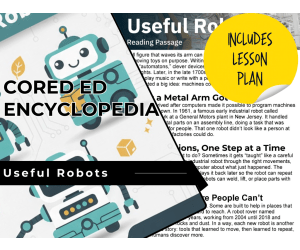
Useful Robots Reading Comprehension Passage - Cored Ed Encyclopedia
ELA, Language Development, Reading Comprehension, Reading, Pre-Reading, History, Social Studies, Technology, Science, Earth and Environmental Sciences, Grade 2, 3, 4, 5, Worksheets & Printables, Worksheets, Teacher Tools, Centers, Activities, Writing Prompts, Assessments, Quizzes and Tests, Quizzes, Lesson Plans
This useful robots reading comprehension with lesson plan includes: Visualization (on the front cover) Start your lesson by taking a minute to think and share something about the topic. Read the script aloud (slowly), perhaps prepare some music or sound effects. Student close their eyes and let their imaginations wander. Students open their eyes, read the question aloud and give them a few minutes to complete. Ask a few students to share or keep answers until the end to compare with what they learn in the passage. Quick pause—thousands of Cored Education products are included with your TeachSimple membership. Download links and encyclopedia index available here. Pre-Reading Trivia Students will write down one thing they already know about the subject and then read five more facts and discuss. These facts are fun, and the students will enjoy learning about the subject before reading more. Give 1 minute for students to write what they already know (no pressure—best guess is fine). Read the five facts together. After each fact, do ask a student for their opinion, was it surprising? Set a purpose by asking students to highlight/underline one fact they want to learn more about during the reading. Reading Passage The text is a high-interest reading passage with set paragraphs, roughly three to four paragraphs long. It contains a variety of themes about the topic, anywhere from history to technology. The passage is between 250 and 350 words in length. First, ask students to look at the headings and see what they’ll learn about today. What do they know about the topic/heading? First read options: Teacher read-aloud (best for support). Partner reading (paragraph by paragraph). While reading, students underline important details, and vocabulary words they think may come up in the questions section. Mixed Questions The first question page contains four multiple-choice questions, each with a choice of four answers, and three written response questions that require a sentence or two from the student. Students complete the mcqs first independently, then review quickly as a class. For the 3 written responses, try to get students giving the answer with some form of evidence: “I think ___ because the text says ___.” If students get stuck, send them back to check the passage. Vocabulary Questions Practice seven key words from the text in this section across two activities. First section is scrambled words where students will unscramble three words given a clue for each. The second section is a word to meaning matching activity. Before starting, have some students read out words they underlined in the passage. Ask students to say the word and read aloud the sentence(s) around each word. Ask students to do scrambled words and the matching exercise in pairs then go through answers as a class. For the scrambled spelling task, get four pairs to come up to the board and write the words for extra practice with the other student reading out the clue. For the matching task, prompt students to give full sentences: “I matched ___ with ___ because ___.” Creative Writing In this question, the student will be required to write a five to eight sentence paragraph on a question related to the topic. Before starting, ask students write down 3 key ideas they are going to include in their piece. Ask students for ideas to share around the class to help those struggling. Pro writing expectations: 5–8 sentences At least 2 facts or details from the passage At least 2 vocabulary words from the previous page Students read their paragraphs while classmates listen for facts and vocabulary words. Extension Activities This page is optional for fast finishers or to take home. There are several activities, each one requiring a different skill. Do some, do none, do all, completely optional - but you will feel reassured knowing every possibility is planned for. Includes summary writting question. Answer Key There are answers for the multiple-choice questions, written response questions have sample answers, vocabulary answers and if there is a summary question then a sample summary will be provided as well. Lesson Plan Included Customized lesson plan for this lesson is included. Lesson Snapshot Title: Useful Robots Genre: Nonfiction (Informational passage) Subject: Science & Technology (Engineering/Robotics) Primary Topic: How robots developed and help people Estimated Guided Reading Level (A–Z): P Support pages included: Pre-reading trivia, mixed questions, vocabulary activities, creative writing prompt, extension activities, and an answer key. QA notes on support pages: Support content generally matches the passage; however, the support pages use “automaton” (singular) while the passage uses “automata” (plural), and an extension prompt suggests “hills,” which is not stated in the passage (the passage names rocks and dust). What This Lesson Teaches Best Robots have a history: Explains that long ago people created “automata” that moved using steam, air, water, or falling weights. Modern robots and factory work: Describes an early industrial robot, Unimate, working in 1961 at a General Motors plant handling hot metal parts that were tough and dangerous for people. How robots learn repeatable motions: Shows how a person can guide a robot’s movements while sensors send signals to a computer that stores a pattern to repeat the job. Robots go where people can’t: Highlights the rover Opportunity exploring Mars for years (2004–2018) and sending back clues from rocks and dust. Big idea across time: Connects early moving devices to today’s robots as tools that learned to move, repeat, and help humans discover more. Learning Goals Students will explain what “automata” were and what powered them. Students will describe why Unimate’s factory job mattered for people. Students will identify how a robot can be “taught” motions and then repeat them. Students will summarize how robots can help in places that are risky, far away, or hard to reach. Students will use details from the text to tell what Opportunity did on Mars and what it sent back. Key Vocabulary From the Text automata — moving devices from long ago; not thinking machines. program — give a machine instructions to do a job. industrial — related to factories and making things. sensors — parts that notice and send signals to a computer. rover — a robot vehicle that travels to explore places. FULL CATALOG OF DOWNLOAD LINKS AND ENCYCLOPEDIA INDEX HERE
Author Cored Education
Rating
Tags Vocabulary, Reading Comprehension, Reading Passages, Lesson Plans, Ela Lesson Plans, Reading Comprehension Lesson Plans, Pre-reading, Science Lesson Plans, Technology, History
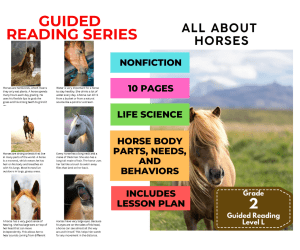
Guided Reading Level L - All About Horses (with Lesson Plan)
ELA, Resources for Teachers, Reading Comprehension, Reading, Science, Language Development, Life Sciences, Animals, Pre-Reading, Vocabulary, Grade 2, 3, 4, Worksheets & Printables, Worksheets, Teacher Tools, Centers, Activities, Literacy Readers, Quizzes, Quizzes and Tests, Assessments, Lesson Plans
This Guided Reading Book - All About Horses (Level L) with lesson plan includes: Guided Reading Color Label (front cover x1) This is a quick way to match the book’s demands to what students can generally handle.. The overall goal is to use the level/color to pick books for several smaller groups. To qualify for a certain level, a student is expected to read a book from that level with about 90–94% accuracy. If a student is consistently accurate and understands, move up a level. If the student is struggling at that level, drop down and add more support. Each student will improve at completely different rates, but it is generally one of the best ways to check progress across the class. DOWNLOAD THE CATALOG TO VIEW ALL GUIDED READING BOOKS AVAILABLE (SORTED LEVELS A-Z) Pre-Reading Question (x1) Teacher asks the prompt aloud, can be while showing the cover or first page. Students share what they already know, or make educated guesses from the cover. Prompt them to use the target vocabulary. Write some of their responses on the board to look back at during the reading. Vocabulary Words (x5) Introduce the five words, best doing it one at a time. Start by saying it, while students repeat and then see if anyone knows what it means before reading further. Read through the meaning and try to briefly connect each word to a picture or gesture so it’s meaningful. Ask students to flip through the book pages and point to where they see each of the vocabulary words. While reading the book pause upon coming across one of the vocab words or read the sentence twice to make sure students understand the word has appeared. Optional: Ask students to raise hands whenever they see/hear one of the new words. Guided Reading Pages (x10) Check the book snapshot (below) for: primary topic - do you need to prep extra reading or intro materials on this? what is taught best - decide on 1-2 bullets to focus on, use the prompt or words provided here for best results. learning goals - what you are checking for students to be able to do after the session, elicit answers using prompts or words provided. key vocabulary (see section above). questions overview - so you know what is coming up and if you need to prep extra materials to assist understanding. Run the lesson You may have already looked at a few of the pages together, but you can show them some of the pictures again first to set meaning. Depending on how much time you have and how familiar your students are with guided reading class, you may want to read the book aloud first with the group first. Students whisper or partner read, while you listen in. If time, do it as a group, one student reading a page each. Use the guided page’s prompts to coach: “Check the picture / does it make sense?” “Point under the words / try the first sound” “Reread the sentence smoothly”. Try to focus more on one student per session (rotating every time), so you can work out if they are ready to move up or need to move down a level. Comprehension Questions (back cover x3) This is your way to check that students didn’t just say the words, but actually understood the text. First, let students answer by pointing to the page/picture and saying a short sentence. After any answer, follow with: “Show me where you found that in the text.” In bigger groups, have partners answer first (10–20 seconds), then call on 2–3 students to share. Differentiation tips: Emerging speakers/struggling readers: oral + pointing On-level: oral in a full sentence Higher: one written sentence or draw + label Book Snapshot Title: All About Horses Genre: Nonfiction (informational) Subject: Life Science / Reading (Informational Text) Primary Topic: Horse body parts, needs, and behaviors Estimated Guided Reading Level (A–Z): L What This Book Teaches Best Key animal facts about horses (they are strong animals, mammals, and live outdoors in grassy areas). How horse body parts help them (mane and tail; tail swishes away flies). What horses need to stay healthy (they eat plants and drink a lot of water). How horses move (trot with “diagonal pairs,” and gallop as the fastest way to move with hooves off the ground). Special horse behaviors and life stages (sleeping while standing; a baby horse is a foal). Learning Goals Students will identify key facts about horses (habitat, body traits, and needs) from the text. Students will explain how a horse uses its tail based on details in the book. Students will describe what horses eat and how they graze using evidence from the text. Students will compare two horse movements (trot and gallop) using information from the book. Students will explain how a horse can sleep while standing without falling over. Students will describe what a foal is and what it can do soon after being born. Key Vocabulary From the Text mammal — an animal that breathes air with lungs. herbivores — animals that eat only plants. grazing — eating grass little by little over time. diagonal — slanted, from one corner to the opposite corner. hooves — the hard feet of a horse. Discussion Prompts Pre-reading question: What do you think a horse needs to stay healthy outdoors? Comprehension questions: What does the text say a horse uses its tail for? How does the text describe a trot? What is a foal, and what can it do within an hour of being born? Printing Tips 1. Best Printing Method (Recommended) “Booklet” Printing (Best if Available) If your printer or PDF viewer supports Booklet Printing , use this. Settings to use: Print mode: Booklet Paper size: Letter or A4 (either works) Orientation: Landscape Print on both sides: Yes Flip on: Short edge Scaling: Fit to printable area Booklet subset: First test: Front sides only Then: Back sides only This will automatically: Pair pages correctly Put the cover on the outside Align everything for folding After printing, fold in half and staple along the spine . 2. If “Booklet” Printing Is NOT Available You can still print this correctly with manual duplex printing . Step-by-step: Open the PDF. Choose Print . Set: Orientation: Landscape Pages per sheet: 1 Print on both sides: Yes Flip on: Short edge Print all pages . Because each PDF page already contains two facing book pages, the result will still fold cleanly into a book. Thousands of Cored Education products are included with your TeachSimple membership. Download links and encyclopedia index available here.
Author Cored Education
Rating
Tags Reading Comprehension, Reading Passages, Reading, Guided Reading, Guided Reading Lesson Plan, Guided Reading Activity, Pre-reading, Science Lesson Plans, Life Science, Animals

Emotional Intelligence Building Blocks - Social Emotional Learning
Life Studies, Career, Research, Life Skills, Special Resources, Social Emotional Learning (SEL), Social Skills, Special Education Needs (SEN), Speech Therapy, Grade 3, 4, 5, 9, 10, 11, 12, Activities, Teacher Tools, Projects, Centers, Assessments, Lesson Plans, Outlines, Presentations, Rubrics, Quizzes and Tests
Uncover the best social emotional learning (SEL) curriculum for grades 3-6 in "Emotional Intelligence Building Blocks - Social Emotional Learning" by Syed Hammad Rizvi, especially designed for elementary-school-going children. With a total of 432 pages of in-depth information, this book maximizes 8- to 12-year-olds' ability to handle their internal world of emotions while developing high-quality social skills, such as mastering personal management skills and responsible decision-making. Full of exciting topics in each installments like recognizing happiness, sadness, anger, fear, and many more, this social emotional learning middle school workbook delves deep into self-awareness, self-management tools like journaling, breathing exercises, goal setting, social awareness with a focus on empathy, body language, and cultural differences. Designed to be highly beneficial for homeschoolers, classroom teaching, or family usage, this social-emotional learning middle school curriculum not only provides exercises to handle conflicts, make friends, and enhance positive thinking but is specifically designed to help in overcoming emotional difficulties by teaching kids to be emotionally intelligent individuals throughout their lives. It is a highly recommended teaching tool for all parents, tutors, and teachers looking for scientifically valid emotional intelligence exercises to be performed by kids in their classroom. Why Parents/Schools Love It: In-Depth SEL Resource: Provides students with a clear continuum of skills from recognizing emotions to applying concepts in a real-life setting. Helps students learn to be resilient, empathetic, and effective conflict resolvers. Practical and Engaging Tools: This category includes solutions such as journaling, breathing exercises, and goal-setting tasks, which require minimal effort to perform in the comfort of one's home or an educational setting in order to promote instant emotional development. Encourages Positive Relations: Deals with skills like listening, boundary marking, and celebrating diversity. Has the effect of reducing misbehavior and increasing positive associations with family, friends, and the broader community. Aligned with Educational Standards: Based on the principles of Emotional Intelligence, the resource is useful for both homeschooling and classroom education as it impacts academic success, health, and bullying intervention. Empowering for Lifelong Skills: It promotes self-discovery and optimistic outlooks, arming children with skills to conquer life's obstacles, resulting in happier and more confident people as manifested in parent and teacher feedbacks. Target Classes/Students : Based on the complete analysis of the content, structure, language, and examples in the book, it is ideally targeted at students in grades 3 to 6 (usually between 8-12 years old). The content uses vocabulary suitable for this age group, scenarios that are easy for students of this age to relate to, such as school challenges and playground and family dynamics, and progresses gradually from simple emotion identification to complex issues such as ethical dilemmas and community involvement. The introductory tone assumes basic reading skills without burdening the younger reader, while the substance in the later chapters on self-awareness and social dynamics fits well with the upper elementary levels. It could extend to advanced grade 2 students or remedial grade 7, but the core focus is perfectly in tune with middle childhood development stages emphasized in the book. Copyright/Terms of Use : This Book was copyrighted by Syed Hammad Rizvi. This resource is to be used only for personal and single-classroom use only. You are not to alter or redistribute any part of this resource or sell this resource. In other words, do not put this resource on the Internet where it could be downloaded. If you would like to share this resource with others, you can purchase other licenses through Teachsimple. Thank you so much for your cooperation! This product is happily brought to you by Syed Hammad Rizvi
Author Creative Book Store
Rating
Tags EmotionalIntelligenceBuildingBlocks, SocialEmotionalLearning, SELForKids, EmotionalIntelligenceForChildren, SELCurriculum, EmotionalRegulationForKids, BuildingEmpathyInChildren, KidsEmotionalWellbeing, ElementarySELActivities
Video Games Reading Comprehension Passage - Cored Ed Encyclopedia
ELA, Language Development, Reading Comprehension, Reading, Pre-Reading, Science, Technology, Engineering, History, Social Studies, Grade 2, 3, 4, 5, Worksheets & Printables, Worksheets, Teacher Tools, Centers, Activities, Writing Prompts, Assessments, Quizzes and Tests, Quizzes, Lesson Plans
This video games reading comprehension with lesson plan includes: Visualization (on the front cover) Start your lesson by taking a minute to think and share something about the topic. Read the script aloud (slowly), perhaps prepare some music or sound effects. Student close their eyes and let their imaginations wander. Students open their eyes, read the question aloud and give them a few minutes to complete. Ask a few students to share or keep answers until the end to compare with what they learn in the passage. Quick pause—thousands of Cored Education products are included with your TeachSimple membership. Download links and encyclopedia index available here. Pre-Reading Trivia Students will write down one thing they already know about the subject and then read five more facts and discuss. These facts are fun, and the students will enjoy learning about the subject before reading more. Give 1 minute for students to write what they already know (no pressure—best guess is fine). Read the five facts together. After each fact, do ask a student for their opinion, was it surprising? Set a purpose by asking students to highlight/underline one fact they want to learn more about during the reading. Reading Passage The text is a high-interest reading passage with set paragraphs, roughly three to four paragraphs long. It contains a variety of themes about the topic, anywhere from history to technology. The passage is between 250 and 350 words in length. First, ask students to look at the headings and see what they’ll learn about today. What do they know about the topic/heading? First read options: Teacher read-aloud (best for support). Partner reading (paragraph by paragraph). While reading, students underline important details, and vocabulary words they think may come up in the questions section. Mixed Questions The first question page contains four multiple-choice questions, each with a choice of four answers, and three written response questions that require a sentence or two from the student. Students complete the mcqs first independently, then review quickly as a class. For the 3 written responses, try to get students giving the answer with some form of evidence: “I think ___ because the text says ___.” If students get stuck, send them back to check the passage. Vocabulary Questions Practice seven key words from the text in this section across two activities. First section is scrambled words where students will unscramble three words given a clue for each. The second section is a word to meaning matching activity. Before starting, have some students read out words they underlined in the passage. Ask students to say the word and read aloud the sentence(s) around each word. Ask students to do scrambled words and the matching exercise in pairs then go through answers as a class. For the scrambled spelling task, get four pairs to come up to the board and write the words for extra practice with the other student reading out the clue. For the matching task, prompt students to give full sentences: “I matched ___ with ___ because ___.” Creative Writing In this question, the student will be required to write a five to eight sentence paragraph on a question related to the topic. Before starting, ask students write down 3 key ideas they are going to include in their piece. Ask students for ideas to share around the class to help those struggling. Pro writing expectations: 5–8 sentences At least 2 facts or details from the passage At least 2 vocabulary words from the previous page Students read their paragraphs while classmates listen for facts and vocabulary words. Extension Activities This page is optional for fast finishers or to take home. There are several activities, each one requiring a different skill. Do some, do none, do all, completely optional - but you will feel reassured knowing every possibility is planned for. Includes summary writting question. Answer Key There are answers for the multiple-choice questions, written response questions have sample answers, vocabulary answers and if there is a summary question then a sample summary will be provided as well. Lesson Plan Included Customized lesson plan for this lesson is included. Lesson Snapshot Title: Video Games Genre: Nonfiction (Informational text) Subject: Science & Technology / Media Literacy Primary Topic: How video games changed from dots to VR Estimated Guided Reading Level (A–Z): P Story text location: Reading Passage on page 3. Support pages included: Visualization prompt (p.1), Pre-Reading Trivia (p.2), Mixed Questions (p.4), Vocabulary (p.5), Creative Writing (p.6), Extension Activities (p.7), Answers (p.8). Support-page QA check: The questions, vocabulary tasks, and answer key match the passage’s details (dates, examples, and key terms). What This Lesson Teaches Best Early video games grew from science tools and big computers: Describes room-sized computers and a “game screen” idea using an oscilloscope. Timeline of key early games and places: Connects Tennis for Two (1958), Spacewar! at MIT (1962), Computer Space (1971), and Atari’s Pong (1972). How cartridges changed home gaming: Explains that swapping cartridges let one system play many different games, and names early cartridge consoles (Fairchild system, Atari 2600). Technology improvements changed how games look, sound, and where they are played: Notes smoother movement, clearer pictures, richer sound, and games moving to handheld screens, computers, consoles, and phones. Games became many types of experiences: Lists examples like puzzles, team sports, building sets, long stories with choices, and virtual reality. Learning Goals Students will describe how Tennis for Two worked and what device showed the moving dot. Students will identify major milestones in early video game history by placing key examples in order. Students will explain how cartridges helped video games spread at home. Students will summarize how video games changed as computers became smaller and stronger. Students will give examples of different kinds of games mentioned in the passage. Key Vocabulary From the Text oscilloscope — a screen tool that can show moving signals. physicist — a scientist who studies matter and energy. arcades — public places where people play games. cartridges — plastic game boxes you swap into a system. virtual — computer-made, not physically real. FULL CATALOG OF DOWNLOAD LINKS AND ENCYCLOPEDIA INDEX HERE
Author Cored Education
Rating
Tags Vocabulary, Reading Comprehension, Reading Passages, Lesson Plans, Ela Lesson Plans, Reading Comprehension Lesson Plans, Pre-reading, Science Lesson Plans, Technology, History Lesson Plans

Quest for 100 Powered Interactive Classroom Journey & Milestone
Math, Early Math, Addition and Subtraction, Algebra, Calculus, Decimals, Basic Operations, Counting, Fact Families, Numbers, Infant, Toddler, Grade 1, 2, 3, 4, 5, Teacher Tools, Anchor Charts, Assessments, Charts, Diagrams, Graphic Organizers, Lesson Plans, Worksheets & Printables, Workbooks, Worksheets
Celebrate the 100th Day of School with this one-stop-shop, AI-powered interactive classroom kit! This resource is designed for students in Kindergarten through 5th grade, helping you turn what is traditionally just a celebration into an interactive educational experience that develops number sense and is easily integrated with your lesson plans. This is what you get in this PDF Bundle: Annotating Available Apricot PHASE 1: Core Teacher Guide Grounded in education literature, this guide explores the educational significance of tracking milestones, design principles for young students, and lesson plans for using AI (Canva AI) to produce high-quality “100 Days of School” posters. PHASE 2: Ready-to-Print Student Workbook – 10 engaging worksheets that make the journey to 100 days interactive! Activities include: Counting and Number Sense Challenges Challenges in Personal Reflections and Self-Improvement Journals Creative Writing & Storytelling Tasks Math calculations or problems using 100 Thinking about the Future and Planning Celebrations PHASE 3: Visual Resources & Teacher Keys - Comes with SVG concept illustrations for implementation in the classrooms, differentiated activity packets (K-1, 2-3, 4-5), and an answer key to make implementation smooth. Why This Kit is a Game-Changer: Powered Customization: See how you can use generate themes, icons, or prompts to make a personalized poster each year. Standards-Aligned: Direct support for the CCSS Math Standards (K.CC.A.1, 1.NBT.A.1, 2 Saves Hours of Planning: From theory to print-ready activities, it all is provided for a rich, educational celebration. Differentiated for All Elementary Grades: Activities are leveled to reach both younger and older students in elementary school. It is perfect for teachers, homeschooling parents, or school-wide events that aim to make the 100th day more significant and interactive as a learning experience. FORMAT: Instant Digital Download (PDF) Pages: More than 30 pages of professional material Grades: K, 1, 2, 3, 4, 5 Disciplines: Math, Writing, Holidays/Seasons, Back to School, All Subjects Resource Type: Activities, Posters, Lesson, Printables 3. Why Parents/Schools Love It Saves Teacher Time: “It offers everything you need for a full 100th Day celebration without searching for ideas or preparing materials by hand.” Boosts Creativity: Equips teachers with the ability to create customized posters for their classrooms so that each year's event is special. Academically Rigorous & Fun: Strives to do more than crafts by integrating authentic math, writing, and SEL skills into their celebratory activities, meeting K-5 standards. Fosters Classroom Community: Class activities such as the interactive poster emphasize the creation of an excellent learning environment that encourages high self-esteem. Differentiated & Flexible: It is a flexible resource that can be used for students of multiple grade levels since it contains activities for K-5. PDF Analysis & Target Audience : Content Summary: This is a total educational kit that is professionally made for educational purposes, entitled "Quest for 100: Powered Interactive Classroom Journey & Milestone Display Kit – 100 Days of School Poster Edition." This is a three-in-one educational resource that can be utilized by teachers, homeschooling parents, or school administrators: Part 1: Teacher’s Guide & Theoretical Foundation Covers the pedagogy related to celebrating the 100th day of school, the principles of effective posters, and ways to make use of software such as for creating customized posters and activities. Part 2: Student Workbook: This package contains 10 ready-to-use student workbooks that include exercises on math, reflection, creative writing, vocabulary, and project-based learning related to the number 100. Part 3: Visuals & Teacher Resources- This part covers concepts of SVG Diagrams, Answer Keys, and Differentiated Activity Sets for K-5 with emphasis on integrating interactive posters and AI prompt tasks. Primary Target Audience (By Grade): K-5 Teachers-Kindergarten through 5th grade It is differentiated learning material that is specifically tied back to K-5 Common Core Math Standards and Social-Emotional Learning Skills. Activities are tiered by complexity, allowing it to be used for a broad range of elementary-aged children. Secondary Audience: Homeschooling parents seeking organized activities to commemorate milestones. School administrators or curriculum coordinators who are looking for resources to celebrate the 100th day of school Teacher students and educational resource creators. Copyright/Terms : Use This Book is copyrighted by Syed Hammad Rizvi. This material is for personal and classroom use only. You cannot modify it, distribute it, or sell it in any form or manner. This means that you cannot upload it onto the Internet for public download. This is plagiarism. You cannot plagiarize your own work. If you would like to share this resource with your colleagues, you are encouraged to purchase additional licenses through the Teachsimple website. Thank you for observing the terms of use. This product is gladly brought to you by Syed Hammad Rizvi
Author Creative Book Store
Rating
Tags Math, Writing, Holidays/Seasonal, Back To School, For All Subjects, 100 Days Of School Poster, Posters, 100's Day, Activities, Lesson
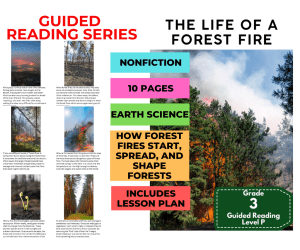
The Life of a Forest Fire: Guided Reading Level P with Lesson Plan
ELA, Resources for Teachers, Reading Comprehension, Reading, Science, Language Development, Life Sciences, Earth and Environmental Sciences, Physics, Technology, Grade 2, 3, 4, Worksheets & Printables, Worksheets, Teacher Tools, Centers, Activities, Literacy Readers, Quizzes, Quizzes and Tests, Assessments, Lesson Plans
This The Life of a Forest Fire (level p) guided reading book with lesson plan includes: Guided Reading Color Label (front cover x1) This is a quick way to match the book’s demands to what students can generally handle.. The overall goal is to use the level/color to pick books for several smaller groups. To qualify for a certain level, a student is expected to read a book from that level with about 90–94% accuracy. If a student is consistently accurate and understands, move up a level. If the student is struggling at that level, drop down and add more support. Each student will improve at completely different rates, but it is generally one of the best ways to check progress across the class. DOWNLOAD THE CATALOG TO VIEW ALL GUIDED READING BOOKS AVAILABLE (SORTED LEVELS A-Z) Pre-Reading Question (x1) Teacher asks the prompt aloud, can be while showing the cover or first page. Students share what they already know, or make educated guesses from the cover. Prompt them to use the target vocabulary. Write some of their responses on the board to look back at during the reading. Vocabulary Words (x5) Introduce the five words, best doing it one at a time. Start by saying it, while students repeat and then see if anyone knows what it means before reading further. Read through the meaning and try to briefly connect each word to a picture or gesture so it’s meaningful. Ask students to flip through the book pages and point to where they see each of the vocabulary words. While reading the book pause upon coming across one of the vocab words or read the sentence twice to make sure students understand the word has appeared. Optional: Ask students to raise hands whenever they see/hear one of the new words. Guided Reading Pages (x10) Check the book snapshot (below) for: primary topic - do you need to prep extra reading or intro materials on this? what is taught best - decide on 1-2 bullets to focus on, use the prompt or words provided here for best results. learning goals - what you are checking for students to be able to do after the session, elicit answers using prompts or words provided. key vocabulary (see section above). questions overview - so you know what is coming up and if you need to prep extra materials to assist understanding. Run the lesson You may have already looked at a few of the pages together, but you can show them some of the pictures again first to set meaning. Depending on how much time you have and how familiar your students are with guided reading class, you may want to read the book aloud first with the group first. Students whisper or partner read, while you listen in. If time, do it as a group, one student reading a page each. Use the guided page’s prompts to coach: “Check the picture / does it make sense?” “Point under the words / try the first sound” “Reread the sentence smoothly”. Try to focus more on one student per session (rotating every time), so you can work out if they are ready to move up or need to move down a level. Comprehension Questions (back cover x3) This is your way to check that students didn’t just say the words, but actually understood the text. First, let students answer by pointing to the page/picture and saying a short sentence. After any answer, follow with: “Show me where you found that in the text.” In bigger groups, have partners answer first (10–20 seconds), then call on 2–3 students to share. Differentiation tips: Emerging speakers/struggling readers: oral + pointing On-level: oral in a full sentence Higher: one written sentence or draw + label Book Snapshot Title: The Life of a Forest Fire Genre: Nonfiction (informational) Subject: Earth & Environmental Science Primary Topic: How forest fires start, spread, and shape forests Estimated Guided Reading Level (A–Z): P What This Book Teaches Best Explains common natural causes of forest fires , including how lightning can ignite dry wood and start a blaze. Teaches the Fire Triangle (heat, fuel, oxygen) and applies it to forest conditions like pine needles, branches, and grass as fuel. Compares types of forest fires (surface fires vs. crown fires) using clear, text-based differences in location, intensity, and damage. Shows how wind affects fire behavior , including carrying embers ahead of the fire and starting new fires through “spotting.” Describes fire’s ecological role and forest recovery , including nutrients returning to soil, new plant growth, and succession over time. Learning Goals Students can explain how a forest fire can begin in nature using details from the text (spark/lightning/heat on dry wood). Students can identify and describe the three parts of the Fire Triangle and explain why each is needed for a fire to keep burning. Students can compare a surface fire and a crown fire by describing where each burns and what the text says it can damage. Students can describe how wind changes a fire’s spread, including what “spotting” means in the text. Students can explain ways fire can help a forest over time (clearing debris, returning nutrients, creating open spaces for sunlight). Students can describe what happens after a fire during succession, using the sequence of changes described in the book. Key Vocabulary From the Text ecosystems — places where living things and land work together. ignite — to start burning. oxygen — a gas in air that fire needs. embers — small burning pieces carried ahead of a fire. succession — how a forest grows back after a fire. Discussion Prompts Pre-reading question: What are some natural ways a forest fire might start? Comprehension questions: What three elements does the text say a fire needs to exist? Comprehension questions: How does the text describe a surface fire as different from a crown fire? Comprehension questions: According to the text, what happens to the forest after a fire during succession? Printing Tips 1. Best Printing Method (Recommended) “Booklet” Printing (Best if Available) If your printer or PDF viewer supports Booklet Printing , use this. Settings to use: Print mode: Booklet Paper size: Letter or A4 (either works) Orientation: Landscape Print on both sides: Yes Flip on: Short edge Scaling: Fit to printable area Booklet subset: First test: Front sides only Then: Back sides only This will automatically: Pair pages correctly Put the cover on the outside Align everything for folding After printing, fold in half and staple along the spine . 2. If “Booklet” Printing Is NOT Available You can still print this correctly with manual duplex printing . Step-by-step: Open the PDF. Choose Print . Set: Orientation: Landscape Pages per sheet: 1 Print on both sides: Yes Flip on: Short edge Print all pages . Because each PDF page already contains two facing book pages, the result will still fold cleanly into a book. Thousands of Cored Education products are included with your TeachSimple membership. Download links and encyclopedia index available here.
Author Cored Education
Rating
Tags Reading Comprehension, Reading Passages, Reading, Guided Reading, Guided Reading Lesson Plan, Guided Reading Activity, Pre-reading, Science Lesson Plans, Earth Science, Physics

Emotional Regulation & "Size of the Problem" Mapping
Special Resources, Life Skills, Social Emotional Learning (SEL), Social Skills, Special Education Needs (SEN), Speech Therapy, STEM, Resources for Teachers, Classroom Management, Community Building, Grade 1, 2, 3, 4, 5, 6, 7, 8, Teacher Tools, Assessments, Lesson Plans, Quizzes and Tests, Quizzes, Tests, Worksheets & Printables, Workbooks, Worksheets, Word Searches
Have you had enough of students throwing tantrums over minor issues? This COMPLETE set of materials will help you to promote emotional regulation in your classroom and/or counselling office. This complete print-and-go curriculum will teach students in grades 1 – 3 the important difference between a “glitch” and an “emergency.” Based upon the popular “Size of The Problem” concept, this toolkit goes far beyond simple worksheets by providing a comprehensive, neuroscience-based approach to building self-regulation skills. This is not just a bunch of activities; it is a comprehensive multi-week program that allows students to learn how their brain works, understand the size of their problems, and respond to those problems with appropriate emotional responses. This program can be used by any teacher, school counselor, special education teacher, or occupational therapist. WHAT IS IN THE PACKAGE - 43 Pages of High Value Content Part 1 – Theory and Clinical Guide (11 Pages) – A detailed educator guide to why the approach is used. This section will include an explanation of the neurobiology of an "amygdala hijack," a review of the principles of Cognitive Behavioural Therapy (CBT), and an explanation of the research supporting visual scales as an assessment tool for young learners. Part 2 – Engaging Student Workbook (20 Pages) – 10 Scaffolded Worksheets: Fun, relatable activities that allow the learners to develop their ability to identify problem sizes and their reaction to those problems. Topics Include: Problem Thermometer, Reaction Rulers, The Match Game, Shrink the Mismatch, What If? Lab, Body Signals, Perspective Taking, and a Personal Problem Map. Part 3 – Teacher Resources and Visuals (12 Pages) – 3 Visual Models for teachers: Classroom poster ("The Proportional Magnitude Scale"), an assessment matrix, and a cognitive mapping flowchart – all are perfect for use as anchor charts and for daily reference. Answer Keys for the student worksheets make it easy to assess your students. Detailed Implementation Guide for teachers: This guide contains a detailed week by week implementation plan for introducing conceptual information and providing reinforcement for long-lasting effects, including scripts and suggestions for implementation activities. Support your students as they develop a base of emotional awareness and skills to be able to deal with emotions throughout their life. Provide your students with the opportunity to not only deal with their emotional responses but to also develop the ability to know, evaluate and manage their emotional responses. CATEGORIES OF LEARNERS: Elementary Education, Social Emotional Learning; Copywriter; Emotion Regulator; Teacher; Student; Self-Regulator; Reference; Help With; Size Of The Problem; Coping Skills; Student Management; Meltdowns; Workbook; Worksheets; Visuals; Posters; Anchor Charts-School; Elementary Grades: 1st, 2nd, 3rd; School Counseling; Special Education; CBT. Reasons for Parents/Schools to Appreciate: Science Based Approach: Proven theories of neurobiology and cognitive behavioral therapy (CBT) provide a scientific basis for the works that are performed based on their use. Develops Lifelong Skills for Children: Children acquire a language and visual representations of their feelings, enabling them to have the tools they need to cope and manage their feelings as well develop independence and resiliency. Reduces Disruption in Classrooms: Students become more self-regulated and are less likely to act out over little things such as breaking a crayon or losing a game. Therefore, there is increased time for typical learning. A Complete Program: The online program is complete and provides all of the materials needed to teach the program to students. Teachers and counselors do not need to create or gather materials themselves; the time savings are significant! Target audience: According to the content, language, and examples of your product (for example, "first through third grades", 7-9 year-old case studies) the target is: Main Student Audience: 1st Grade to 3rd Grade students (6-9 years). Main Buyer Audience: Elementary school teachers, special education teachers, school counsellors, school psychologists, occupational therapists (OT's), child therapists, and the concerned parents of children who have difficulties regulating their emotions. Terms of Use and Copyright : Syed Hammad Rizvi is the owner of this copyrighted book; it is for individual and personal (one classroom) use only. You cannot modify, redistribute, or sell this item or any part of it anywhere else. You are not permitted to post it to the internet so that anyone can find it and download it. If you wish to share it with others, please purchase additional licenses from Teachsimple. Thanks for respecting these terms. Syed Hammad Rizvi (h) is honored to provide you with this resource!
Author Creative Book Store
Rating
Tags SocialEmotionalLearning, SEL, EmotionalRegulation, SelfRegulation, CopingSkills, MindfulnessForKids, EmotionalIntelligence, SocialSkills, Feelings, SizeOfTheProblem
Algebra: Equations - Solving for a Variable - Learn the Skill - FLASH-MAC
Math, Algebra, Common Core, Grade 3, 4, 5, Teacher Tools, Lesson Plans
Algebra: Equations - Solving for a Variable - Learn the Skill - FLASH-MAC This is an advantageous teaching resource meticulously designed for educators catering to 3rd to 5th grade students. This product remarkably encapsulates the essence of Algebra, primarily focussing on solving equations for a variable. Unique Features: The material contained within this software is instrumental in laying solid mathematical foundations in young learners and helping them understand complex concepts with simplicity. The package offers an engaging blend of curriculum-based content and practical real-world word problems that stimulate children's analytical skills while enhancing their problem-solving capabilities. Visually fascinating, this toolkit includes math tools crucial in building conceptual knowledge organically among students. The functionality isn't confined to just English language delivery; there's also a Spanish voiceover and text option available. This feature serves as a instrumental tool for bilingual classrooms or individual homeschooled Spanish-speaking students, aiding linguistic diversity and inclusivity. Educational Alignment: On alignment with widely recognized educational parameters, it adheres to the Common Core State Standards and targets STEM initiatives effectively. Additionally being written with guidance from NCTM standards enables educators to confidently utilize its pedagogical strategies across various classroom settings This tool also enriches digital literacy among pupils from an early age: - Note: The software is compatible with Mac systems only. In Concluson: "Algebra: Equations - Solving for a Variable", does more than teaching algebraic concepts. It integrates user-friendly interactions while creating fun learning pathways.
Author Classroom Complete Press
Tags Software (Mac)

French Math: Mesures 2 - Plan de leçon numérique An. 3-5 | PC Software
Math, Measurements, Grade 3, 4, 5, Teacher Tools, Lesson Plans
French Math: Mesures 2 - Digital Lesson Plan for Grades 3-5 | PC Software An innovative and meticulously crafted educational resource designed specifically for the unique learning requirements of students in grades 3 through 5. Conveniently downloadable, it is an ideal teaching tool for public school educators and homeschooling parents alike. Highlights of the Software: Over 230 independent activities spread over more than 80 immersive digital pages. A comprehensive guide to all standards found within the Measurement strand of both NCTM and State Curriculum Math. A pedagogical design that transforms teaching measurements into an engaging process, reinforces problem-solving skills, and bridges theory with practical real-life situations through word problems. An additional set of about150 drill problems introduced post-lesson to reinforce procedural proficiency in Mathematics. Beyond Lessons and Drills: This math program goes beyond traditional lessons by offering interactive content like: Test Preparations Memory-Match Games Board Games Spinner Games This diverse educational approach paired with dual-language (French and English) feature incorporated simultaneously increases its effectiveness multifold. Offering a user-friendly experience on personal PCs has never been this easy! Inclusive Supplementary Features : Inclusion of useful features such as : Text -to-speech functionality (both English Spanish) Numerous printables Math tools available in both imperial and metric units all stuffed in a singular downloadable zip file. All these attributes together make this resource an excellent tool for mastering measurements, making learning both fun and effortless for students of grades 3 to 5.
Author Classroom Complete Press
Tags Digital Math, French Math Lesson, French Measurement Lesson, Digital Measuring, Lesson Plan

Algebra: Patterns - FLASH-PC
Math, Algebra, Grade 3, 4, 5, Teacher Tools, Lesson Plans
Algebra: Patterns - FLASH-PC The Algebra: Patterns - FLASH-PC is a comprehensive teaching resource, ideally designed to facilitate an understanding of algebra patterns for grade 3 to grade 5 students. This digital download presents a well-rounded approach towards mathematical comprehension through various engaging elements. Inclusive and All-inclusive Curriculum Content Informative and substantive, this resource provides extensive curriculum-based content. Educators will find the included pre- assessment beneficial as it helps gauge students' initial understanding of algebraic patterns and tailor their instruction accordingly. The pre-packaged lesson plan offers educators a structured manner of propagating the subject matter. Interactive Learning Experience Real-world word problems: Included to provide students with an opportunity to apply learned concepts in practical context – thus enhancing their competence and confidence in employing algebraic solutions for everyday problems. Timed drill activities: Encourages learners to improve reaction speed and accuracy when dealing with mathematical questions. Numerous math tools:Easily understandable aids that promote holistic learning of multifaceted concepts. Tailored Teaching Guide The complementary teacher guide provides educators with detailed methods on how best to implement these tools into classroom instruction or homeschooling modules, ensuring learning objectives are duly achieved. A Fun & Practical Approach For Effective Retention Making lessons enjoyable using elements such as printables, memory match games, board game, spinner game! Evaluation Made Easy: SMART Response Assessment Tool This digital tool makes gauging student progress throughout lessons seamless effectively measuring mastery levels among learners across different competencies. Plus A Linguistic Touch:Acknowledging classroom diversity, a Spanish voice-over option is included alongside the default English, leading to enriched math sessions. All this is conveniently packaged within a single zip file that runs on PC software without requiring any additional downloads or installations. Whether you are instructing in traditional classrooms, homeschool settings or even tutoring individual students at home - Algebra: Patterns - FLASH-PC presents an versatile teaching resource.
Author Classroom Complete Press
Tags Algebra, Number Patterns, Math Lesson Plan, Problem Solving, Math Drills
Number & Operations: Multiplication & Division - Practice the Skill 2 - MAC Software
Math, Algebra, Common Core, Grade 3, 4, 5, Teacher Tools, Lesson Plans
Number & Operations: Multiplication & Division - Practice the Skill 2 - MAC Software The 'Number & Operations: Multiplication & Division - Practice the Skill 2' is a MAC software teaching resource targeted at grade-three, four, and five students to advance their mathematic skills. Its precise emphasis on number operation skills in pertinence to multiplication and division makes it indispensable for educators desiring to enhance their mathematics curriculum . This educational application includes thorough mini chapter brimming over with timed drill activities that allow students to practice multiplication and division. Through this interaction, learners get a chance to work on equations illustrated all through the module which creates an individual pace for enhancing mathematical comprehension that can be made effective for both whole groups and smaller subsets of students. This special tool broadens its training capability by offering constructive math tools embedded within the software itself. Learners are equipped with tools crafted ingeniously simplifying tangled math procedures resulting in increased competency in numeracy abilities. Evidently noteworthy is the fact that this tool has been designed considering language barriers as it includes voice overs in English and Spanish paired up with text options, making it inclusive of varied student demographics. Fulfilling not just but exceeding Common Core State Standards while having perfect alignment with STEM initiatives provides teachers absolute confidence they’re providing resources compatible with internationally recognized educational norms. Besides this, having National Council of Teachers of Mathematics (NCTM) standards as a benchmark ensures delivery of an education superior quality specializing on number operations. Packed uniquely into a simple-to-handle zip file compatible exclusively with MAC operating systems simplifies processes thanks to its compatibility hence becoming user-friendly excellently suitable for teachers preferring digital lesson plans. Perfectly customized according to algebra subtopics under the Mathematics subject within grade three-to-five academic curriculum , Number & Operations: Multiplication & Division-Practice The Skill 2-MAC Software serves as a robust pillar illustrating computational foundations duly onto young minds shaping them into future mathematicians dealing with real-world numeracy issues confidently and efficiently. It is worth noting that this tool is advantageous for public school teachers, private tutors, homeschool educators, or anyone intending to amplify a child's mathematics skills in their care.
Author Classroom Complete Press
Tags Math Lesson Plan, Division Skills, Digital Math, Operations, Math Practice

Wright Brothers: History - Hands On
Social Studies, History, History: USA, Grade 1, 2, 3, 4, Teacher Tools, Lesson Plans
Wright Brothers: History - Hands On A comprehensive teaching resource designed to enrich students understanding of aviation history. Ideal for grade 1 through 4, it fits seamlessly into Social Studies curriculums with a sub-focus on USA History. Wright Brothers: History - Hands On employs an immersive approach that transcends mere knowledge acquisition. Its engaging design encourages students to explore why commercial airliners traverse the sky today and recognize the significant strides in flight over the past century. This exploration journey reveals the inspiring tale of two dreamers-cum-pioneers; The Wright Brothers. Key Components: Historical aspects meticulously intertwined in an array of creative activities, games , action rhymes and songs. Creative resources that invite active student participation. Vivid conceptualisations of first airplanes fragile designs and narratives about persistent visionaries transforming dreams into reality The hands-on element encourages active participation from all learners. Teachers can leverage it as a core lesson or even use elements as thought-provoking homework assignments promoting independent research. Beyond introducing facts about The Wright Brothers’ legacy and achievements, this trove incorporates inherent cues for discussions around themes like resilience, innovation and aspiration further broadening student perspective. Product Delivery Format: The resource is delivered as a single product file type – PDF. This ensures convenience for educators without compromising quality or depth of content packed into this meticulously prepared lesson plan series." In conclusion: <p>"With its immersive nature promoting discovery alongside delivering carefully curated historical facts Wright Bothers: History-Hands on remarkably balances information dissemination and nurturing curiosity among young learners stimulating more profound connections with past events shaping our present world."</p>
Author Classroom Complete Press
Tags PDF
Squash Life Cycle Fall Plant Harvest Science unit study fun facts
Life Sciences, Science, Biology, Nature & Plants, Kindergarten, Preschool, Grade 1, 2, 3, Coloring Pages, Worksheets, Worksheets & Printables, Parts of and Anatomy of, Flashcards, Diagrams, Teacher Tools, Lesson Plans
Make learning about the squash life cycle fun and engaging with this printable plant science activity! Students will explore how a squash plant grows from seed to mature plant while learning about germination, plant growth, flowering, pollination, fruit development, and harvest. I like using this resource during fall science units, autumn classroom activities, harvest lessons, gardening studies, botany units, and seasonal learning. It's a low-prep activity that combines plant science with an engaging fall harvest theme. What You Will Get This printable Squash Life Cycle activity helps students understand the stages of squash plant growth while building science vocabulary and learning interesting facts about this popular fall crop. What's Included in this Resource? • Squash life cycle activity • Seed germination and growth stages • Plant parts and development activities • Flowering and pollination information • Fruit development and harvest stages • Fun facts about squash • Student-friendly science activities • Easy-to-use printable pages This resource is perfect for: • Fall science lessons • Autumn classroom activities • Harvest-themed lessons • Plant life cycle units • Botany and gardening studies • Science centers • Homeschool learning • Early finisher activities Why you will love this? • Easy to print and use • Connects science learning with a seasonal fall theme • Reinforces plant life cycle vocabulary • Encourages observation and scientific thinking • Introduces how crops grow from seed to harvest • Great for seasonal science centers and independent work This Squash Life Cycle activity is a fun way for students to discover how squash plants grow from seed to harvest while exploring plant development, pollination, fruit production, and fascinating fall harvest facts.
Author Perfect_Printables
Rating
Tags Plant Science, Life Cycle, Plant Life Cycle, Plants Diagram, Fall Activities, Squash Life Cycle, Squash, Fall Plants, Fall Science, Autumn Activities
Number & Operations: Base-Ten & Place Value for 3rd-5th - Practice the Skill 2 - PC Software
Math, Place Value, Common Core, Grade 3, 4, 5, Teacher Tools, Lesson Plans
Number & Operations: Base-Ten & Place Value for 3rd-5th - Practice the Skill 2 - PC Software This is an innovative digital educational tool, exclusively designed to assist in teaching the number and operations' base-ten and place value concept. Tailored for learners from 3rd through to 5th grade, this resource contains engaging timed drill activities. These interactive tasks help learners accurately discern the numbers represented by base-ten blocks while keeping them fully engaged in learning. Curriculum alignment: Meticulously developed in line with Common Core State Standards, STEM initiatives, as well as NCTM guidelines. Ideal for public school teachers or homeschooling educators, providing efficiency to your teaching process. Inclusivity: Inclusive of both English and Spanish speakers. Coupled with text translations and high-quality voiceover options for a language-neutral learning environment free of communication barriers. Purchasing this resourceful material from TeachSimple.com gives you access to an easy-to-manage zip file that contains all necessary PC software components gathered together for seamless integration into your teaching journey. It's a precise tool needed to successfully impart this crucial Math subtopic! Versatility: This adept resource can be used for whole group instructions in classrooms or small group exercises during individual tutor sessions or even assigned as homework assignments; enhancing understanding while catalyzing academic growth among students at these grades level. Optimize your instructional delivery today by adding the Number & Operations Base-Ten learning resource to your tools! An unprecedented opportunity awaits you, empowering learners while tapping deeply into their mathematical potential with this unparalleled software-focused tool.
Author Classroom Complete Press
Tags Math Lesson Plan, Place Value Lesson, Base-ten, Math Skills, Operations

9 Times Table Trick | Interactive Math Video Lesson
Math, Multiplication and Division, Division, Grade 2, 3, 4, Lesson Plans, Teacher Tools
This animated video is a math lesson 9 Times Table Trick. Students will love this engaging and interactive video. This video serves as a great introduction or review video for your learners. This is a 1-minute video lesson.
Author Educational Voice
Tags Times Table, Multiplication, Math Tricks, Math Tools, Multiplication Video, Hand Trick For 9 Times Table
Number & Operations: Percentages with Fractions - Practice the Skill 3 - MAC Software
Math, Percentages, Common Core, Grade 3, 4, 5, Teacher Tools, Lesson Plans
Product Overview The Number & Operations: Percentages with Fractions - Practice the Skill 3 - MAC Software is a comprehensive educational tool designed for Grades 3 through 5 mathematics teachers. This resource includes timed drills focused on understanding how fractions work within percentages in number operations. Teaching Techniques and Setting Options The activities provoke students to derive fraction from a set of whole numbers, methodically preparing them for more advanced concepts. This effective solution can be used in traditional classrooms, homeschooling settings, whole group sessions, break-out groups or even as homework assignments. Multilingual and Inclusive In Design The software is designed with English texts along with voice-overs and also includes Spanish text version catering significantly to Spanish-speaking learners. Educational Standards Alignment This product notably aligns with various predefined education standards like: Common Core State Standards (CCSS) Science Technology Engineering and Mathematics (STEM) initiatives Adhering well to these guidelines assures quality content that ensures optimal learning experiences. Packaging Details The package comes as a zip file containing the MAC software ensuring no-hassle installation across all compatible systems. Once saved onto your computer system, this tool is ready-to-use! In conclusion, the Number & Operations: Percentages with Fractions - Practice Skill 3 – Mac Software promises efficient teaching/learning of critical mathematical skills. It is indeed noteworthy for incorporation into your teaching collection.
Author Classroom Complete Press
Tags Percentages Printable, Fractions Printable, Operations, Math Skills, Digital Activity
Creative Classroom Cooking Gr. 3-8
Life Studies, Home Economics, Grade 3, 4, Teacher Tools, Lesson Plans
Creative Classroom Cooking Gr. 3-8 A unique approach to teaching, integrating language skills into practical activities. About the Product: Creative Classroom Cooking is a brilliant crossover between Home Economics and Social Studies, providing an engaging hands-on learning experience for students from Grade 3 up to Grade 8. Main Features: 36 Non-Cook Recipes: Easy-to-understand instructions that require minimal teacher supervision to maximise student engagement. The recipes focus heavily on nutritious snacks, promoting health-conscious choices among youngsters. Practical Language Skills: Apart from enhancing cooking vocabulary, it includes concepts like ingredients, utensils and methods - ideal for building student's financial literacy repertoire. Bonus Tools Included: Vocabulary Journal Word Cards: Aids in remembering crucial recipe-specific vocabulary and aids as building blocks towards understanding texts independently and confidently. Metric Measurements System: Familiar context for Canadian learners & broadening understanding of different units of measure for others – subtly incorporating numeracy into the lesson plan without making it overwhelming or off-topic. Action-Packed Activities & Games : The lesson plans also include interactive activities such ton word searches inside them – great for group work or individual practice. The product neatly packages detailed lesson plans in a simple PDF format – ensuring convenient access anytime! In Summary... Creative Classroom Cooking Gr. 3-8 offers an enriching blend of practical skills and theoretical knowledge. It aims to shape students into independent thinkers doers via stimulating educational journeys packed with learning - offering a fresh take on conventional classroom lessons!
Author Classroom Complete Press
Tags PDF