



3,931 products added recently
Page 13 - Reading Comprehension Lesson Plans
Strengthen your students' ability to understand and analyze texts with reading comprehension lesson plans. These resources offer strategies and questions that promote critical thinking. Incorporate them into your teaching to support students in becoming thoughtful and discerning readers.

 Show filters


Know the Ropes | Figurative Language Activity | Micro-Learning Deck
ELA, Reading, Reading Comprehension, Grade 4, 5, 6, 7, Teacher Tools, Lesson Plans
This resource allows students to explore figurative learning in a fun way. The figurative language term for this learning deck is "Know the Ropes." Through close reading and a reading passage with audio, your students will better comprehend figurative language! Included: -Video lesson on language concept -Reading passage w/ audio Comprehension -Quick write
Author Teach Me This
Tags Know The Ropes, Figurative, Language, Comprehension Activity, Reading Lesson
Fifth Wheel | Figurative Language Activity | Micro-Learning Deck
ELA, Reading, Reading Comprehension, Grade 2, 3, 4, 5, Teacher Tools, Lesson Plans
This resource allows students to explore figurative learning in a fun way. The figurative language term for this learning deck is "Fifth Wheel." Through close reading and a reading passage with audio, your students will better comprehend figurative language! Included: -Video lesson on language concept -Reading passage w/ audio Comprehension -Quick write
Author Teach Me This
Tags Fifth Wheel, Figurative, Language, Learning Deck, Writing Template, Fifth Wheel Deck

Farm Animals: Guided Reading Level P with Lesson Plan
ELA, Resources for Teachers, Reading Comprehension, Reading, Science, Language Development, Social Studies, Life Sciences, Economics, Pre-Reading, Grade 2, 3, 4, Worksheets & Printables, Worksheets, Teacher Tools, Centers, Activities, Literacy Readers, Quizzes, Quizzes and Tests, Assessments, Lesson Plans
This Farm Animals (level p) guided reading book with lesson plan includes: Guided Reading Color Label (front cover x1) This is a quick way to match the book’s demands to what students can generally handle.. The overall goal is to use the level/color to pick books for several smaller groups. To qualify for a certain level, a student is expected to read a book from that level with about 90–94% accuracy. If a student is consistently accurate and understands, move up a level. If the student is struggling at that level, drop down and add more support. Each student will improve at completely different rates, but it is generally one of the best ways to check progress across the class. DOWNLOAD THE CATALOG TO VIEW ALL GUIDED READING BOOKS AVAILABLE (SORTED LEVELS A-Z) Pre-Reading Question (x1) Teacher asks the prompt aloud, can be while showing the cover or first page. Students share what they already know, or make educated guesses from the cover. Prompt them to use the target vocabulary. Write some of their responses on the board to look back at during the reading. Vocabulary Words (x5) Introduce the five words, best doing it one at a time. Start by saying it, while students repeat and then see if anyone knows what it means before reading further. Read through the meaning and try to briefly connect each word to a picture or gesture so it’s meaningful. Ask students to flip through the book pages and point to where they see each of the vocabulary words. While reading the book pause upon coming across one of the vocab words or read the sentence twice to make sure students understand the word has appeared. Optional: Ask students to raise hands whenever they see/hear one of the new words. Guided Reading Pages (x10) Check the book snapshot (below) for: primary topic - do you need to prep extra reading or intro materials on this? what is taught best - decide on 1-2 bullets to focus on, use the prompt or words provided here for best results. learning goals - what you are checking for students to be able to do after the session, elicit answers using prompts or words provided. key vocabulary (see section above). questions overview - so you know what is coming up and if you need to prep extra materials to assist understanding. Run the lesson You may have already looked at a few of the pages together, but you can show them some of the pictures again first to set meaning. Depending on how much time you have and how familiar your students are with guided reading class, you may want to read the book aloud first with the group first. Students whisper or partner read, while you listen in. If time, do it as a group, one student reading a page each. Use the guided page’s prompts to coach: “Check the picture / does it make sense?” “Point under the words / try the first sound” “Reread the sentence smoothly”. Try to focus more on one student per session (rotating every time), so you can work out if they are ready to move up or need to move down a level. Comprehension Questions (back cover x3) This is your way to check that students didn’t just say the words, but actually understood the text. First, let students answer by pointing to the page/picture and saying a short sentence. After any answer, follow with: “Show me where you found that in the text.” In bigger groups, have partners answer first (10–20 seconds), then call on 2–3 students to share. Differentiation tips: Emerging speakers/struggling readers: oral + pointing On-level: oral in a full sentence Higher: one written sentence or draw + label Book Snapshot Title: Farm Animals Genre: Nonfiction (informational) Subject: Life Science Primary Topic: How common farm animals live and help people Estimated Guided Reading Level (A–Z): P What This Book Teaches Best Describes key traits and behaviors of farm animals (for example, cows digest tough grasses; pigs use mud to regulate temperature; goats climb steep surfaces). Explains how different farm animals support people , such as animals raised for milk, meat, eggs, wool, or work (pulling plows, transporting goods). Builds understanding of animal groups and social behavior , including flocks and a “pecking order” (social hierarchy). Highlights physical features linked to survival , such as sheep’s wide field of vision to spot predators and donkeys’ large ears helping them stay cool and hear well. Introduces science vocabulary tied to the text’s concepts, including domesticated, ruminants, keratin, descendants, and hierarchy . Learning Goals Students can describe how at least three farm animals are raised or used, using details from the text. Students can explain what the text says makes cows ruminants and what their digestive system allows them to do. Students can explain why the text says pigs use mud and what mud helps them do. Students can describe how chickens live in groups and what “pecking order” means in the text. Students can identify animal body parts mentioned (hooves, feathers, webbed feet, horns) and describe what the text says they help the animal do. Students can compare two animals from the book by stating one similarity and one difference based on text evidence. Key Vocabulary From the Text ruminants — animals that chew food again and digest grass. hierarchy — an order that shows who is in charge. keratin — a hard material that makes hooves and fingernails. descendants — animals that come from earlier animals in a family line. domesticated — animals raised by people, living with or near humans. Discussion Prompts Pre-reading question: What farm animals do you already know, and what do you think they do on a farm? Comprehension questions: What does the text say cows’ digestive system helps them do that some other animals cannot do? Comprehension questions: Why does the text say pigs use mud? Comprehension questions: What does the text say llamas can do because of their height and alert nature? Printing Tips 1. Best Printing Method (Recommended) “Booklet” Printing (Best if Available) If your printer or PDF viewer supports Booklet Printing , use this. Settings to use: Print mode: Booklet Paper size: Letter or A4 (either works) Orientation: Landscape Print on both sides: Yes Flip on: Short edge Scaling: Fit to printable area Booklet subset: First test: Front sides only Then: Back sides only This will automatically: Pair pages correctly Put the cover on the outside Align everything for folding After printing, fold in half and staple along the spine . 2. If “Booklet” Printing Is NOT Available You can still print this correctly with manual duplex printing . Step-by-step: Open the PDF. Choose Print . Set: Orientation: Landscape Pages per sheet: 1 Print on both sides: Yes Flip on: Short edge Print all pages . Because each PDF page already contains two facing book pages, the result will still fold cleanly into a book. Thousands of Cored Education products are included with your TeachSimple membership. Download links and encyclopedia index available here.
Author Cored Education
Rating
Tags Reading Comprehension, Reading Passages, Reading, Guided Reading, Guided Reading Lesson Plan, Guided Reading Activity, Pre-reading, Science Lesson Plans, Life Science, Economics
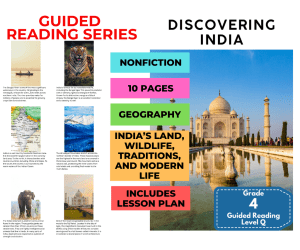
Discovering India: Guided Reading Level Q with Lesson Plan
ELA, Resources for Teachers, Reading Comprehension, Reading, Science, Geography, Social Studies, Technology, History, Life Sciences, Grade 3, 4, 5, Worksheets & Printables, Worksheets, Teacher Tools, Centers, Activities, Literacy Readers, Quizzes, Quizzes and Tests, Assessments, Lesson Plans
This Discovering India (level q) guided reading book with lesson plan includes: Guided Reading Color Label (front cover x1) This is a quick way to match the book’s demands to what students can generally handle.. The overall goal is to use the level/color to pick books for several smaller groups. To qualify for a certain level, a student is expected to read a book from that level with about 90–94% accuracy. If a student is consistently accurate and understands, move up a level. If the student is struggling at that level, drop down and add more support. Each student will improve at completely different rates, but it is generally one of the best ways to check progress across the class. DOWNLOAD THE CATALOG TO VIEW ALL GUIDED READING BOOKS AVAILABLE (SORTED LEVELS A-Z) Pre-Reading Question (x1) Teacher asks the prompt aloud, can be while showing the cover or first page. Students share what they already know, or make educated guesses from the cover. Prompt them to use the target vocabulary. Write some of their responses on the board to look back at during the reading. Vocabulary Words (x5) Introduce the five words, best doing it one at a time. Start by saying it, while students repeat and then see if anyone knows what it means before reading further. Read through the meaning and try to briefly connect each word to a picture or gesture so it’s meaningful. Ask students to flip through the book pages and point to where they see each of the vocabulary words. While reading the book pause upon coming across one of the vocab words or read the sentence twice to make sure students understand the word has appeared. Optional: Ask students to raise hands whenever they see/hear one of the new words. Guided Reading Pages (x10) Check the book snapshot (below) for: primary topic - do you need to prep extra reading or intro materials on this? what is taught best - decide on 1-2 bullets to focus on, use the prompt or words provided here for best results. learning goals - what you are checking for students to be able to do after the session, elicit answers using prompts or words provided. key vocabulary (see section above). questions overview - so you know what is coming up and if you need to prep extra materials to assist understanding. Run the lesson You may have already looked at a few of the pages together, but you can show them some of the pictures again first to set meaning. Depending on how much time you have and how familiar your students are with guided reading class, you may want to read the book aloud first with the group first. Students whisper or partner read, while you listen in. If time, do it as a group, one student reading a page each. Use the guided page’s prompts to coach: “Check the picture / does it make sense?” “Point under the words / try the first sound” “Reread the sentence smoothly”. Try to focus more on one student per session (rotating every time), so you can work out if they are ready to move up or need to move down a level. Comprehension Questions (back cover x3) This is your way to check that students didn’t just say the words, but actually understood the text. First, let students answer by pointing to the page/picture and saying a short sentence. After any answer, follow with: “Show me where you found that in the text.” In bigger groups, have partners answer first (10–20 seconds), then call on 2–3 students to share. Differentiation tips: Emerging speakers/struggling readers: oral + pointing On-level: oral in a full sentence Higher: one written sentence or draw + label Book Snapshot Title: Discovering India Genre: Nonfiction Subject: Social Studies (Geography/Culture) Primary Topic: India’s land, wildlife, traditions, and modern life Estimated Guided Reading Level (A–Z): Q What This Book Teaches Best Key geography facts about India’s location in Southern Asia, nearby borders, and surrounding waters. How landforms shape life in India, including the Himalayan Mountains and the Ganges River. Notable wildlife of India through examples like the Bengal tiger and the Indian elephant. Cultural traditions and everyday life, including spices used in meals and the celebration of Diwali. Modern India today, including transportation (auto-rickshaws) and major cities connected to technology and innovation. Learning Goals Students will describe where India is located and name details about its borders and southern waters. Students will explain how the Himalayan Mountains are described as protecting the inner plains. Students will explain why the Ganges River is important to people and farming in northern India. Students will describe key traits of the Bengal tiger and the Indian elephant using details from the text. Students will identify facts about the Taj Mahal, including where it is and features described in the book. Students will describe examples of Indian culture and modern life mentioned in the text (foods/spices, Diwali, transportation, cities). Key Vocabulary From the Text vast — very large in size. significant — very important. distinctive — easy to notice because it looks different. minarets — tall towers on a monument. diyas — small clay lamps used during Diwali. Discussion Prompts Pre-reading question: What are you hoping to learn about India as you read? Comprehension questions: What warm waters does the text say surround India to the south? Comprehension questions: According to the text, why is the Ganges River essential? Comprehension questions: What does the text say diyas symbolize during Diwali? Printing Tips 1. Best Printing Method (Recommended) “Booklet” Printing (Best if Available) If your printer or PDF viewer supports Booklet Printing , use this. Settings to use: Print mode: Booklet Paper size: Letter or A4 (either works) Orientation: Landscape Print on both sides: Yes Flip on: Short edge Scaling: Fit to printable area Booklet subset: First test: Front sides only Then: Back sides only This will automatically: Pair pages correctly Put the cover on the outside Align everything for folding After printing, fold in half and staple along the spine . 2. If “Booklet” Printing Is NOT Available You can still print this correctly with manual duplex printing . Step-by-step: Open the PDF. Choose Print . Set: Orientation: Landscape Pages per sheet: 1 Print on both sides: Yes Flip on: Short edge Print all pages . Because each PDF page already contains two facing book pages, the result will still fold cleanly into a book. Thousands of Cored Education products are included with your TeachSimple membership. Download links and encyclopedia index available here.
Author Cored Education
Rating
Tags Reading Comprehension, Reading Passages, Reading, Guided Reading, Guided Reading Lesson Plan, Guided Reading Activity, Pre-reading, Social Studies, Geography, History
Late Lunch with Llamas (Magic Tree House #34 Lesson Plan)
ELA, Social Studies, Reading, Reading Comprehension, Grammar, Literature, Language Development, Spelling, Vocabulary, Writing, History, History: Ancient, Geography, Grade 1, 2, 3, Lesson Plans, Teacher Tools
Title: Late Lunch with Llamas (Magic Tree House #34 Lesson Plan) This resource provides a comprehensive 5-day lesson plan for Grades 1 to 3, structured around the enchanting story of Late Lunch with Llamas. Blending Language Arts and Social Studies, this educational tool also sparks students' curiosity and encourages active learning through related activities. An easy-to-use teaching aid, it aligns teaching objectives with chapter comprehension questions, vocabulary practice and includes links to relevant video materials. Group discussions can be tailored according to each day's tasks, accommodating diverse learner interests and styles due to its customizable nature depending on student age or reading level. Multidisciplinary Learning Objectives: Arts: Engage students through drawing and coloring exercises. Comprehension Skills & English Language Arts: Enhance grammar, spelling and writing abilities Social Studies & History: Integration of geography lessons inspires holistic understanding. The material places an emphasis on developing research skills for a strong foundation in critical thinking. Make use of pre-reading activities to prepare young learners; try our comprehensive chapter quizzes for reinforcement; assign worksheets based on story elements that focus on literature-driven vocabulary expansion. Fostering Deep Analysis: Carefully curated character analysis materials guide students throughout their discovery journey. Post-reading project-based tasks boost experiential learning—an integral element in modern education practices. Sustainable Teaching Methods: The worksheets provided are versatile— they can be used traditionally or transformed into interactive digital exercises reducing print usage—a sustainable teaching practice we all aim for today. Use this brilliant tool crafted meticulously intertwining fun elements practical along with pedagogic methodology into learning— there's no better way to deepen students' love for the Magic Tree House collection. Nurture inquiring minds through a journey that not only transforms them into confident readers but also critical thinkers and enthusiastic learners.
Author Heather Huhman
Tags Lesson Plan, Magic Tree House, Comprehension, Vocabulary, Geography

Wishy-Washy | Figurative Language Activity | Micro-Learning Deck
ELA, Reading, Reading Comprehension, Grade 5, 6, 7, 8, Teacher Tools, Lesson Plans
Wishy-Washy Figurative Language Activity Micro-Learning Deck The Wishy-Washy Figurative Language Activity Micro-Learning Deck is a comprehensive tool effective at enhancing language comprehension capabilities in students, especially those in Grade 5 to Grade 8. This resource brings the abstract world of figurative language into sharp focus through an engaging mix of components such as: Video lessons, Reading passages, and Dynamically crafted PowerPoint slides. Incorporating close reading and a captivating audio passage component, this approach transcends rote memorization methods. Students grasp the meaning of figurative language by interacting directly with a fun concept known as 'Wishy-Washy'. An added benefit within these lesson plans is an exercise that encourages students to apply their newly acquired knowledge instantly. Not only does this program enhance comprehension but it reciprocally improves student writing skills. Mainly consisting of Microsoft PowerPoint files: This package affords practicality as one of its highlights. Teachers can simply incorporate its ready-to-display slides without needing extensive preparation time. Educators have flexibility to adapt these resources according to learning needs, suitable for diverse settings such as group study sessions or individual learning tasks given out for homework assignments. Innovatively Improve Language Comprehension Skills A refreshingly innovative approach towards improving language arts comprehension skills awaits teachers who choose. The Wishy-Washy | Figurative Language Activity | Micro-Learning Deck is ready for you!
Author Teach Me This
Tags Figurative Language, Language Comprehension, Close Reading, Interactive Learning, Writing Skills
Turn the Tables | Figurative Language Activity | Micro-Learning Deck
ELA, Reading, Reading Comprehension, Grade 4, 5, 6, 7, Teacher Tools, Lesson Plans
Turn the Tables | Figurative Language Activity | Micro-Learning Deck Turn the Tables is a dynamic and interactive teaching resource, specifically curated for educators in both school settings and homeschooling environments. Its main audience comprises students between 4th to 7th grades. The resource helps students understand figurative language in an engaging manner by using the concept Turn the Tables, turn-taking in conversation rather than literal meaning. Inside this toolkit: A comprehensive PowerPoint presentation with 13 succinct slides ready for display. Each slide showcases pertinent information related to topics under 'Language Arts' and 'Comprehension.' This toolkit also embeds within it a video lesson tailored to illuminate students on various language concepts. The visual medium of instruction aids not just visual learners but also encourages kinesthetic learners who learn better through moving images. In addition to these resources: The resource includes reading passages complete with corresponding audio files catering particularly well to auditory learners or those pupils who might experience difficulties with reading. This allows every student equal opportunity to understand and learn from the materials presented. The kit features quick write comprehension prompts that foster creative thinking skills whilst reinforcing learning objectives about figurative languages throughout lessons or homework assignments hence accommodating diverse learning schedules. About usage: The Turn-the-Tables Figuratively Language Activity - Micro-Learning Deck can be utilized as an effective whole group activity adapted for small group interaction during collaborative sessions alike offering flexibility in different modes of application serving both collective classroom lessons and solitary self-study sessions as well Last words: Treausure this multi-functional toolkit elegantly packaged into one single product that makes an excellent digital package, Turn-the-Tables Figuratively Language Activity which is thoughtfully designed to address various facets of student learning while ensuring that their engagement levels remain high at all times.
Author Teach Me This
Tags Figurative Language, Micro-learning, Interactive Teaching, Comprehension, Language Arts

Blue Whale Unit Study (Endangered Animals Lesson Plan, Videos, Activities)
ELA, Reading, Reading Comprehension, Language Development, Spelling, Writing, Science, Life Sciences, Animals, Grade 1, 2, 3, Lesson Plans, Teacher Tools
Blue Whale Unit Study (Endangered Animals Lesson Plan, Videos, Activities) This teaching resource delivers a fully prepped 5-day unit study centered around the enchanting blue whale. Curated with convenience in mind to ensure efficient use of time by educators. Designed for educators instructing first through third grade learners, this inclusive unit study instills knowledge encompassing: Drawing and coloring for Artistic development Vocabulary enhancement through English language arts and Grammar Promotion of Reading skills Fostering Research skills towards science facts concerning whales & their environment Cultivating basic writing capabilities . The resource comes equipped with daily worksheets providing substantive information on various aspects of blue whales including diet, habitat, life cycle, predators among others. It can be utilized either within an interactive notebook setting or discriminatory oral discussion to reduce printing requirements. Videos and Activities Included! This product offers fun videos and activities tailored to maximize engagement from all types of learners whether they learn optimally by observing or doing. Moreover, this package can be personalized influenced by variables such as learners age or proficiency allowing maximization on each student's comprehension capacity. Fostering Individual Creativity while Building Thorough Understanding Applicable Knowledge! Incorporated also are project-centric activities designed to foster creativity inducing problem-solving skills while reinforcing understanding around endangered animals akin to the blue whale along with other crucial scientific concepts relevant across ocean habitats in general. In essence,'Blue Whale Unit Study'demonstrates an exhaustive yet intriguing journey into one extraordinary creature extending not only knowledge but building appreciation for these gentle giants whereas shedding light on sober topics such as animal endangerment.
Author Heather Huhman
Tags Blue Whale, Endangered Animals, Lesson Plan, Activities, Multimedia

Journey Through South Korea: Guided Reading Level R with Lesson Plan
ELA, Resources for Teachers, Reading Comprehension, Reading, Science, Geography, Social Studies, History, Earth and Environmental Sciences, Technology, Grade 3, 4, 5, Worksheets & Printables, Worksheets, Teacher Tools, Centers, Activities, Literacy Readers, Quizzes, Quizzes and Tests, Assessments, Lesson Plans
This Journey Through South Korea (level r) guided reading book with lesson plan includes: Guided Reading Color Label (front cover x1) This is a quick way to match the book’s demands to what students can generally handle.. The overall goal is to use the level/color to pick books for several smaller groups. To qualify for a certain level, a student is expected to read a book from that level with about 90–94% accuracy. If a student is consistently accurate and understands, move up a level. If the student is struggling at that level, drop down and add more support. Each student will improve at completely different rates, but it is generally one of the best ways to check progress across the class. DOWNLOAD THE CATALOG TO VIEW ALL GUIDED READING BOOKS AVAILABLE (SORTED LEVELS A-Z) Pre-Reading Question (x1) Teacher asks the prompt aloud, can be while showing the cover or first page. Students share what they already know, or make educated guesses from the cover. Prompt them to use the target vocabulary. Write some of their responses on the board to look back at during the reading. Vocabulary Words (x5) Introduce the five words, best doing it one at a time. Start by saying it, while students repeat and then see if anyone knows what it means before reading further. Read through the meaning and try to briefly connect each word to a picture or gesture so it’s meaningful. Ask students to flip through the book pages and point to where they see each of the vocabulary words. While reading the book pause upon coming across one of the vocab words or read the sentence twice to make sure students understand the word has appeared. Optional: Ask students to raise hands whenever they see/hear one of the new words. Guided Reading Pages (x10) Check the book snapshot (below) for: primary topic - do you need to prep extra reading or intro materials on this? what is taught best - decide on 1-2 bullets to focus on, use the prompt or words provided here for best results. learning goals - what you are checking for students to be able to do after the session, elicit answers using prompts or words provided. key vocabulary (see section above). questions overview - so you know what is coming up and if you need to prep extra materials to assist understanding. Run the lesson You may have already looked at a few of the pages together, but you can show them some of the pictures again first to set meaning. Depending on how much time you have and how familiar your students are with guided reading class, you may want to read the book aloud first with the group first. Students whisper or partner read, while you listen in. If time, do it as a group, one student reading a page each. Use the guided page’s prompts to coach: “Check the picture / does it make sense?” “Point under the words / try the first sound” “Reread the sentence smoothly”. Try to focus more on one student per session (rotating every time), so you can work out if they are ready to move up or need to move down a level. Comprehension Questions (back cover x3) This is your way to check that students didn’t just say the words, but actually understood the text. First, let students answer by pointing to the page/picture and saying a short sentence. After any answer, follow with: “Show me where you found that in the text.” In bigger groups, have partners answer first (10–20 seconds), then call on 2–3 students to share. Differentiation tips: Emerging speakers/struggling readers: oral + pointing On-level: oral in a full sentence Higher: one written sentence or draw + label Book Snapshot Title: A Journey Through South Korea Genre: Nonfiction Subject: Social Studies (Geography/Culture) Primary Topic: South Korea’s geography, traditions, and modern innovation Estimated Guided Reading Level (A–Z): R What This Book Teaches Best How geography shapes a country , describing South Korea as a peninsula with seas on three sides and mountains across much of the land. City life and infrastructure , using Seoul to show population size, public transportation, and the mix of historic areas with modern skyscrapers. Cultural traditions and identity , including palaces and Joseon Dynasty heritage, traditional clothing (Hanbok), and national martial arts (Taekwondo). Food culture and processes , highlighting fermentation through kimchi and naming other dishes and ingredients. Modern technology and global influence , explaining South Korea’s role in electronics (including semiconductors) and daily-life innovation. Learning Goals Students will explain how South Korea’s location as a peninsula and its mountains are described in the text. Students will describe Seoul’s role in the nation and cite details about its transportation and city features. Students will identify examples of South Korea’s history and heritage from the text, including details about palaces and architecture. Students will describe how fermentation is connected to Korean food by using the text’s description of kimchi and storage. Students will explain how the text shows South Korea as a leader in technology and innovation. Students will describe one natural environment featured in the text (Jeju Island) using key details provided. Key Vocabulary From the Text peninsula — land with water on most sides, still connected. metropolis — a very large city with many people. fermentation — a process that changes food over time. semiconductors — tiny electronic parts that help devices work. aesthetic — the look and style that feels pleasing. Discussion Prompts Pre-reading question: How can a country honor its past while also building new technology for the future? Comprehension questions: What does the text say about South Korea being a peninsula and the seas around it? Comprehension questions: What details does the text give about Gyeongbokgung Palace and its architecture? Comprehension questions: How does the text describe the Haenyeo and what they do? Printing Tips 1. Best Printing Method (Recommended) “Booklet” Printing (Best if Available) If your printer or PDF viewer supports Booklet Printing , use this. Settings to use: Print mode: Booklet Paper size: Letter or A4 (either works) Orientation: Landscape Print on both sides: Yes Flip on: Short edge Scaling: Fit to printable area Booklet subset: First test: Front sides only Then: Back sides only This will automatically: Pair pages correctly Put the cover on the outside Align everything for folding After printing, fold in half and staple along the spine . 2. If “Booklet” Printing Is NOT Available You can still print this correctly with manual duplex printing . Step-by-step: Open the PDF. Choose Print . Set: Orientation: Landscape Pages per sheet: 1 Print on both sides: Yes Flip on: Short edge Print all pages . Because each PDF page already contains two facing book pages, the result will still fold cleanly into a book. Thousands of Cored Education products are included with your TeachSimple membership. Download links and encyclopedia index available here.
Author Cored Education
Rating
Tags Reading Comprehension, Reading Passages, Reading, Guided Reading, Guided Reading Lesson Plan, Guided Reading Activity, Pre-reading, Social Studies, Geography, History

Sunset of the Sabertooth (Magic Tree House #7 Lesson Plan, Videos, Activities)
Social Studies, ELA, History, History: Ancient, Reading, Reading Comprehension, Grammar, Literature, Language Development, Vocabulary, Spelling, Writing, Grade 1, 2, 3, Lesson Plans, Teacher Tools
Sunset of the Sabertooth (Magic Tree House #7 Lesson Plan, Videos, Activities) is a comprehensive teaching tool packaged for instructors who aim to foster reading comprehension and academic interest in students from first to third grade. This flexible resource wraps a wide range of engaging teaching methodologies. Key Features A thorough five-day instruction plan that needs no extra preparation from educators. Included are chapter-specific comprehension assessments which push towards deep understanding of narrative subtleties. A meticulous approach towards vocab building for each chapter unit. The content merges disciplines such as language arts with geography and history to provide an integrated learning experience. Hands-on activities include art & crafts projects with elements like coloring, sparking full-fledged student participation. Multidisciplinary Approach The significant focus on English Language Arts includes grammar drills complemented by provisions for exhaustive spelling practice. You will find research assignments relevant to social studies themes directly derived from the Magic Tree House's intriguing storyline. Tailored adjustments allow accommodation of different parameters like age groups, varied reading abilities, comprehension levels or individual pupil interests - aptly fitting diverse classroom learning patterns. This resource can also be efficiently applied in homeschooling environments. Narrative Interaction & Worksheets' Utility: The intended dual-purpose behind all activities fosters genuine intellectual curiosity via discussion facilitation while reducing heavy printing reliance. Versatility is embedded into worksheets usage - viable independently or put together into interactive notebooks providing six exclusive options available. Writing exercises hinge on craftivity – combining creativity with practical application directly tied into corresponding project-based engagements included within this lesson plan; complete with extensive lists compiling required material components. Finally—the Sunset of the Sabertooth (Magic Tree House #7 Lesson Plan, Videos, Activities) serves as a versatile educational tool liable to adapt across different teaching settings without straying from its critical focus on cultivating student interest and knowledge enhancement. All material is conveniently configured into PDF format files for easy access.
Author Heather Huhman
Tags Lesson Plan, Comprehension, Vocabulary, Interdisciplinary Education, Activities

Fan the Flames | Figurative Language Activity | Micro-Learning Deck
ELA, Reading, Reading Comprehension, Grade 4, 5, 6, 7, Teacher Tools, Lesson Plans
This resource allows students to explore figurative learning in a fun way. The figurative language term for this learning deck is "Fan the Flames." Through close reading and a reading passage with audio, your students will better comprehend figurative language! Included: -Video lesson on language concept -Reading passage w/ audio Comprehension -Quick write
Author Teach Me This
Tags Learning Deck, Digital Lesson, Figurative, Language, Fan The Flames

Growing Minds in Social Studies #2: Lessons for Stimulating Thinking
Social Studies, Reading, Reading Comprehension, Grade 4, 5, 6, 7, 8, Teacher Tools, Lesson Plans
Growing Minds in Social Studies #2: Lessons for Stimulating Thinking This is a comprehensive teaching resource designed specifically for students in the 4th through 8th grades. Created with middle and intermediate school levels in mind, it deals with various social studies topics. The Main Objective: The beauty of this resource pack lies in its objective to foster critical thinking. The arranged activities aim at subject matters like analyzing phenomena such as hoarding and contemplating the parameters of success - all within the context of social studies. Unique Approach: What sets this package apart is its multifaceted approach towards active learning, providing different levels of student participation based on their ages and capabilities. A Tool for Educators: Equipped with comprehensive teacher guides accompanying every lesson Eases preparation while ensuring you are well-equipped to engage students effectively during lessons Total Content: In total, this PDF file comprises 15 print-ready pages filled with content aiming to ignite interest and stimulate thoughtful analysis among students. Possibilities of Utilization : During whole group instruction time Assign them as homework Small group discussions Crafted Comprehension Oriented Content: "); This resource exemplifies an interactive blend between discipline-oriented instructive materials and cognition- boosting activities seeking to inspire curiosity driven explorations amongst young learners. ")
Author Classroom Complete Press
Tags Growing Minds, Social Studies, Lessons, Thinking Skills, Teacher's Guide

Fly by the Seat of One's Pants | Figurative Language Activity | Micro-Learning Deck
ELA, Reading, Reading Comprehension, Grade 2, 3, 4, 5, Teacher Tools, Lesson Plans
This resource allows students to explore figurative learning in a fun way. The figurative language term for this learning deck is "Fly By the Seat of One's Pants." Through close reading and a reading passage with audio, your students will better comprehend figurative language! Included: -Video lesson on language concept -Reading passage w/ audio Comprehension -Quick write
Author Teach Me This
Tags Figurative, Activity, Learning Deck, Writing Template

Hour of the Olympics (Magic Tree House #16 Lesson Plan, Videos, Activities)
ELA, Social Studies, Reading, Reading Comprehension, Grammar, Literature, Language Development, Spelling, Vocabulary, Writing, History, History: Ancient, Geography, Grade 1, 2, 3, Lesson Plans, Teacher Tools
Hour of the Olympics (Magic Tree House #16 Lesson Plan, Videos, Activities) This is a meticulously devised five-day novel study resource. The book companion material aims to enliven comprehension and enrich learning experiences for first, second, and third graders as they navigate through 'Hour of the Olympics' – a notable installment from the Magic Tree House series. Activities Overview Chapter comprehension quizzes: These test and reinforce what students have learned from each read chapter. Vocabulary worksheets: These resources provide interactive word-usage tasks that are tailored for each chapter reading. Daily lesson plan: This outlines the planned activities for every day with additional pre-reading tasks including KWL charts (K - what they already Know; W - what they Wish to learn; L - Learned after reading). Post-Reading exercises: Assess student understanding while encouraging connections between characters in each story read. The content offers extensive coverage across diverse fields such as Arts, Geography History etc., facilitating interdisciplinary connections. It also caters to various learning styles since all worksheets can be completed interactively or discussed orally if print-outs need tempering down. Skill Development This package inherently develops language arts skills such as grammar reading research through integrated activities. Students also get an opportunity to understand sequence events better along with cause-and-effect relationships via carefully woven worksheets tailored towards understanding key components in every chapter. You would receive a print-and-use curriculum unit that's meant not only to engage kids but enhance their knowledge absorption capabilities while partaking in another adventure narrated by Jack inside his Magic Tree House.</p
Author Heather Huhman
Tags Olympics, Magic Tree House, Comprehension, Vocabulary, Interdisciplinary, Magic Tree House Book 16, Olympics Lesson Plans

Tip of the Iceberg | Figurative Language Activity | Micro-Learning Deck
ELA, Reading, Reading Comprehension, Grade 4, 5, 6, 7, Teacher Tools, Lesson Plans
This resource allows students to explore figurative learning in a fun way. The figurative language term for this learning deck is "Tip of the Iceberg." Through close reading and a reading passage with audio, your students will better comprehend figurative language! Included: -Video lesson on language concept -Reading passage w/ audio Comprehension -Quick write
Author Teach Me This
Tags Tip Of The Iceberg, Learning Deck, Reading Activities, Comprehension, Video Lesson
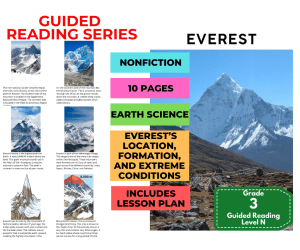
Guided Reading Level N - Everest (with Lesson Plan)
ELA, Resources for Teachers, Reading Comprehension, Reading, Science, Earth and Environmental Sciences, Social Studies, Geography, Life Sciences, Physics, Grade 2, 3, 4, Worksheets & Printables, Worksheets, Teacher Tools, Centers, Activities, Literacy Readers, Quizzes, Quizzes and Tests, Assessments, Lesson Plans
This Guided Reading Book - Everest (Level N) with lesson plan includes: Guided Reading Color Label (front cover x1) This is a quick way to match the book’s demands to what students can generally handle.. The overall goal is to use the level/color to pick books for several smaller groups. To qualify for a certain level, a student is expected to read a book from that level with about 90–94% accuracy. If a student is consistently accurate and understands, move up a level. If the student is struggling at that level, drop down and add more support. Each student will improve at completely different rates, but it is generally one of the best ways to check progress across the class. DOWNLOAD THE CATALOG TO VIEW ALL GUIDED READING BOOKS AVAILABLE (SORTED LEVELS A-Z) Pre-Reading Question (x1) Teacher asks the prompt aloud, can be while showing the cover or first page. Students share what they already know, or make educated guesses from the cover. Prompt them to use the target vocabulary. Write some of their responses on the board to look back at during the reading. Vocabulary Words (x5) Introduce the five words, best doing it one at a time. Start by saying it, while students repeat and then see if anyone knows what it means before reading further. Read through the meaning and try to briefly connect each word to a picture or gesture so it’s meaningful. Ask students to flip through the book pages and point to where they see each of the vocabulary words. While reading the book pause upon coming across one of the vocab words or read the sentence twice to make sure students understand the word has appeared. Optional: Ask students to raise hands whenever they see/hear one of the new words. Guided Reading Pages (x10) Check the book snapshot (below) for: primary topic - do you need to prep extra reading or intro materials on this? what is taught best - decide on 1-2 bullets to focus on, use the prompt or words provided here for best results. learning goals - what you are checking for students to be able to do after the session, elicit answers using prompts or words provided. key vocabulary (see section above). questions overview - so you know what is coming up and if you need to prep extra materials to assist understanding. Run the lesson You may have already looked at a few of the pages together, but you can show them some of the pictures again first to set meaning. Depending on how much time you have and how familiar your students are with guided reading class, you may want to read the book aloud first with the group first. Students whisper or partner read, while you listen in. If time, do it as a group, one student reading a page each. Use the guided page’s prompts to coach: “Check the picture / does it make sense?” “Point under the words / try the first sound” “Reread the sentence smoothly”. Try to focus more on one student per session (rotating every time), so you can work out if they are ready to move up or need to move down a level. Comprehension Questions (back cover x3) This is your way to check that students didn’t just say the words, but actually understood the text. First, let students answer by pointing to the page/picture and saying a short sentence. After any answer, follow with: “Show me where you found that in the text.” In bigger groups, have partners answer first (10–20 seconds), then call on 2–3 students to share. Differentiation tips: Emerging speakers/struggling readers: oral + pointing On-level: oral in a full sentence Higher: one written sentence or draw + label Book Snapshot Title: Everest Genre: Nonfiction (informational text) Subject: Science (Earth Science/Geography) Primary Topic: Mount Everest’s location, formation, and extreme conditions Estimated Guided Reading Level (A–Z): N What This Book Teaches Best Key facts about Mount Everest’s height and setting in the Himalayas in Asia. How mountain ranges form over long periods of time, including tectonic plate movement. How borders and regions connect to physical geography (Nepal/China border across the summit). How extreme environments change with altitude, including the “Death Zone” and low oxygen. How glaciers, weather, earthquakes, and erosion shape Everest and keep it changing. Learning Goals Describe where Mount Everest is located and what mountain system it is part of. Identify what the text says about the border between Nepal and China on Everest. Explain how Everest was formed using the book’s description of tectonic plates. Describe what the “Death Zone” is and why most living things cannot survive there long. Describe how glaciers create features on the mountain, including crevasses. Explain one way Everest is still changing today, using details from the text. Key Vocabulary From the Text summit — the very top point of a mountain. glacier — a huge, slow-moving river of ice. tectonic — related to Earth’s moving crust plates. crevasses — deep cracks in ice. erosion — wind, water, or ice wearing rock away. Discussion Prompts Pre-reading question: Where does the book say Mount Everest stands? Comprehension questions: What does the text say about where the Nepal–China border is on Everest? Comprehension questions: How does the text explain that Everest was formed long ago? Comprehension questions: What is one way the text says Mount Everest is still changing today? Printing Tips 1. Best Printing Method (Recommended) “Booklet” Printing (Best if Available) If your printer or PDF viewer supports Booklet Printing , use this. Settings to use: Print mode: Booklet Paper size: Letter or A4 (either works) Orientation: Landscape Print on both sides: Yes Flip on: Short edge Scaling: Fit to printable area Booklet subset: First test: Front sides only Then: Back sides only This will automatically: Pair pages correctly Put the cover on the outside Align everything for folding After printing, fold in half and staple along the spine . 2. If “Booklet” Printing Is NOT Available You can still print this correctly with manual duplex printing . Step-by-step: Open the PDF. Choose Print . Set: Orientation: Landscape Pages per sheet: 1 Print on both sides: Yes Flip on: Short edge Print all pages . Because each PDF page already contains two facing book pages, the result will still fold cleanly into a book. Thousands of Cored Education products are included with your TeachSimple membership. Download links and encyclopedia index available here.
Author Cored Education
Rating
Tags Reading Comprehension, Reading Passages, Reading, Guided Reading, Guided Reading Lesson Plan, Guided Reading Activity, Pre-reading, Social Studies Lesson Plans, Science Lesson Plans, Geography
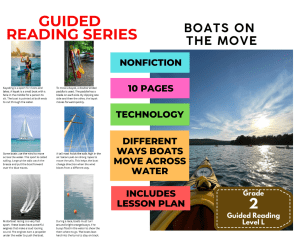
Guided Reading Level L - Boats on the Move (with Lesson Plan)
ELA, Resources for Teachers, Reading Comprehension, Reading, Science, Engineering, Technology, Physics, Sports, P.E. & Health, Grade 2, 3, 4, Worksheets & Printables, Worksheets, Teacher Tools, Centers, Activities, Literacy Readers, Quizzes, Quizzes and Tests, Assessments, Lesson Plans
This Guided Reading Book - Boats on the Move (Level L) with lesson plan includes: Guided Reading Color Label (front cover x1) This is a quick way to match the book’s demands to what students can generally handle.. The overall goal is to use the level/color to pick books for several smaller groups. To qualify for a certain level, a student is expected to read a book from that level with about 90–94% accuracy. If a student is consistently accurate and understands, move up a level. If the student is struggling at that level, drop down and add more support. Each student will improve at completely different rates, but it is generally one of the best ways to check progress across the class. DOWNLOAD THE CATALOG TO VIEW ALL GUIDED READING BOOKS AVAILABLE (SORTED LEVELS A-Z) Pre-Reading Question (x1) Teacher asks the prompt aloud, can be while showing the cover or first page. Students share what they already know, or make educated guesses from the cover. Prompt them to use the target vocabulary. Write some of their responses on the board to look back at during the reading. Vocabulary Words (x5) Introduce the five words, best doing it one at a time. Start by saying it, while students repeat and then see if anyone knows what it means before reading further. Read through the meaning and try to briefly connect each word to a picture or gesture so it’s meaningful. Ask students to flip through the book pages and point to where they see each of the vocabulary words. While reading the book pause upon coming across one of the vocab words or read the sentence twice to make sure students understand the word has appeared. Optional: Ask students to raise hands whenever they see/hear one of the new words. Guided Reading Pages (x10) Check the book snapshot (below) for: primary topic - do you need to prep extra reading or intro materials on this? what is taught best - decide on 1-2 bullets to focus on, use the prompt or words provided here for best results. learning goals - what you are checking for students to be able to do after the session, elicit answers using prompts or words provided. key vocabulary (see section above). questions overview - so you know what is coming up and if you need to prep extra materials to assist understanding. Run the lesson You may have already looked at a few of the pages together, but you can show them some of the pictures again first to set meaning. Depending on how much time you have and how familiar your students are with guided reading class, you may want to read the book aloud first with the group first. Students whisper or partner read, while you listen in. If time, do it as a group, one student reading a page each. Use the guided page’s prompts to coach: “Check the picture / does it make sense?” “Point under the words / try the first sound” “Reread the sentence smoothly”. Try to focus more on one student per session (rotating every time), so you can work out if they are ready to move up or need to move down a level. Comprehension Questions (back cover x3) This is your way to check that students didn’t just say the words, but actually understood the text. First, let students answer by pointing to the page/picture and saying a short sentence. After any answer, follow with: “Show me where you found that in the text.” In bigger groups, have partners answer first (10–20 seconds), then call on 2–3 students to share. Differentiation tips: Emerging speakers/struggling readers: oral + pointing On-level: oral in a full sentence Higher: one written sentence or draw + label Book Snapshot Title: Boats on the Move Genre: Nonfiction (informational) Subject: Science (Forces & Motion) / Reading (Informational Text) Primary Topic: Different ways boats move across water Estimated Guided Reading Level (A–Z): L What This Book Teaches Best Different ways boats move on water (wind, oars, paddles, engines). How specific boat parts help movement (sails, mast, ropes, propeller). How coordinated actions affect motion (oars dipping “at the same time” to go straight). How markers guide movement during a race (boats turn around bright orange buoys to stay on track). Comparing speed and movement styles (quiet glide vs fast roar; forward motion by alternating paddle sides). Learning Goals Students will identify several ways boats move across the water using details from the text. Students will explain how sails and wind help pull a boat forward. Students will describe how rowers use oars together to move a boat straight ahead. Students will describe how a double-ended paddle helps a kayak move forward quickly. Students will explain how an engine and propeller help push a motorboat through the water. Students will describe why boats turn around buoys during a race, based on the text. Key Vocabulary From the Text mast — a tall pole that holds sails up. rhythm — a steady pattern of movement. double-ended — having an end on both sides. propeller — a spinning part that helps push a boat. buoys — floating markers that show where to go. Discussion Prompts Pre-reading question: What are some different ways a boat could move across the water? Comprehension questions: How do large white sails help a boat move forward? What do rowers do “at the same time,” and what does that help the boat do? Why must boats turn around bright orange buoys during a race? Printing Tips 1. Best Printing Method (Recommended) “Booklet” Printing (Best if Available) If your printer or PDF viewer supports Booklet Printing , use this. Settings to use: Print mode: Booklet Paper size: Letter or A4 (either works) Orientation: Landscape Print on both sides: Yes Flip on: Short edge Scaling: Fit to printable area Booklet subset: First test: Front sides only Then: Back sides only This will automatically: Pair pages correctly Put the cover on the outside Align everything for folding After printing, fold in half and staple along the spine . 2. If “Booklet” Printing Is NOT Available You can still print this correctly with manual duplex printing . Step-by-step: Open the PDF. Choose Print . Set: Orientation: Landscape Pages per sheet: 1 Print on both sides: Yes Flip on: Short edge Print all pages . Because each PDF page already contains two facing book pages, the result will still fold cleanly into a book. Thousands of Cored Education products are included with your TeachSimple membership. Download links and encyclopedia index available here.
Author Cored Education
Rating
Tags Reading Comprehension, Reading Passages, Reading, Guided Reading, Guided Reading Lesson Plan, Guided Reading Activity, Pre-reading, Science Lesson Plans, Physics, Technology

Warriors in Winter (Magic Tree House #31 Lesson Plan, Videos, Activities)
ELA, Social Studies, Reading, Reading Comprehension, Grammar, Literature, Language Development, Spelling, Vocabulary, Writing, Geography, Grade 1, 2, 3, Lesson Plans, Teacher Tools
Product Title: Warriors in Winter (Magic Tree House #31 Lesson Plan, Videos, Activities) This comprehensive, five-day novel study of the Magic Tree House book 'Warriors in Winter' provides plentiful resources to foster students' love for literature. A No PREP book companion , it offers a wealth of materials that can be tailored to the needs and abilities of individual students. Key Features: 5-Day Lesson Plan: Organised daily plan with detailed activities including comprehension questions and vocabulary practice. Versatile Activities: Engaging pre-reading, during reading and post-reading activities involving drawing/coloring/crafts related to various curriculum areas. Social Studies Context: The creative use of mapping exercises linking directly with the novel’s plotline enhances research skills and geographical understanding. Diverse Notebook Pieces: Six unique interactive notebook options that work alongside the main reading experience allowing children to explore adventures creatively. KWL Charts : In-depth analysis charts noting what do they already Know(K), what do they Wish(W) to learn more about as well as discuss what has been Learnt(L). The Pack Also Includes: In addition, learners are challenged through engaging character analysis exercises while reinforcing their understanding with writing craftivity built into reading sessions. The pack is created primarily for grades 1 -3 covering language arts and social studies but can be easily customized per student’s age group or skill level. Teachers have full control over how they want to utilize this resource strengthening both teaching effectiveness and student learning outcome! Ranging from guiding a whole group, managing small discussions or assigning homework; this flexible, 112-page PDF companion enhances teaching convenience and student learning process. Transform your classroom into the enchanting world of Jack and Annie with 'Warriors in Winter (Magic Tree House #31 Lesson Plan, Videos, Activities)'.
Author Heather Huhman
Tags Novel Study, Comprehension Questions, Vocabulary Practice, Interactive Notebook, Character Analysis
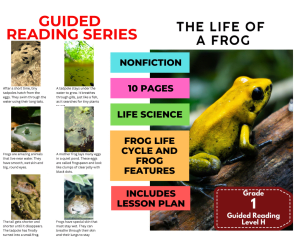
Guided Reading Level H - The Life of a Frog (with Lesson Plan)
ELA, Resources for Teachers, Reading Comprehension, Reading, Science, Animals, Life Sciences, Pre-Reading, Language Development, Vocabulary, Grade 1, 2, 3, Worksheets & Printables, Worksheets, Teacher Tools, Centers, Activities, Literacy Readers, Quizzes, Quizzes and Tests, Assessments, Lesson Plans
This Guided Reading Book - The Life of a Frog (Level H) with lesson plan includes: Guided Reading Color Label (front cover x1) This is a quick way to match the book’s demands to what students can generally handle.. The overall goal is to use the level/color to pick books for several smaller groups. To qualify for a certain level, a student is expected to read a book from that level with about 90–94% accuracy. If a student is consistently accurate and understands, move up a level. If the student is struggling at that level, drop down and add more support. Each student will improve at completely different rates, but it is generally one of the best ways to check progress across the class. DOWNLOAD THE CATALOG TO VIEW ALL GUIDED READING BOOKS AVAILABLE (SORTED LEVELS A-Z) Pre-Reading Question (x1) Teacher asks the prompt aloud, can be while showing the cover or first page. Students share what they already know, or make educated guesses from the cover. Prompt them to use the target vocabulary. Write some of their responses on the board to look back at during the reading. Vocabulary Words (x5) Introduce the five words, best doing it one at a time. Start by saying it, while students repeat and then see if anyone knows what it means before reading further. Read through the meaning and try to briefly connect each word to a picture or gesture so it’s meaningful. Ask students to flip through the book pages and point to where they see each of the vocabulary words. While reading the book pause upon coming across one of the vocab words or read the sentence twice to make sure students understand the word has appeared. Optional: Ask students to raise hands whenever they see/hear one of the new words. Guided Reading Pages (x10) Check the book snapshot (below) for: primary topic - do you need to prep extra reading or intro materials on this? what is taught best - decide on 1-2 bullets to focus on, use the prompt or words provided here for best results. learning goals - what you are checking for students to be able to do after the session, elicit answers using prompts or words provided. key vocabulary (see section above). questions overview - so you know what is coming up and if you need to prep extra materials to assist understanding. Run the lesson You may have already looked at a few of the pages together, but you can show them some of the pictures again first to set meaning. Depending on how much time you have and how familiar your students are with guided reading class, you may want to read the book aloud first with the group first. Students whisper or partner read, while you listen in. If time, do it as a group, one student reading a page each. Use the guided page’s prompts to coach: “Check the picture / does it make sense?” “Point under the words / try the first sound” “Reread the sentence smoothly”. Try to focus more on one student per session (rotating every time), so you can work out if they are ready to move up or need to move down a level. Comprehension Questions (back cover x3) This is your way to check that students didn’t just say the words, but actually understood the text. First, let students answer by pointing to the page/picture and saying a short sentence. After any answer, follow with: “Show me where you found that in the text.” In bigger groups, have partners answer first (10–20 seconds), then call on 2–3 students to share. Differentiation tips: Emerging speakers/struggling readers: oral + pointing On-level: oral in a full sentence Higher: one written sentence or draw + label Book Snapshot Title: The Life of a Frog Genre: Nonfiction (informational life cycle) Subject: Life Science + Reading (Informational Text) Primary Topic: Frog life cycle and frog features Estimated Guided Reading Level (A–Z): H What This Book Teaches Best Explains where frogs live and describes basic frog traits (smooth, wet skin; big, round eyes; living near water). Teaches the frog life cycle in clear steps: eggs (frogspawn) → tadpoles → legs grow → tail disappears → small frog. Shows how a tadpole lives and grows in water, including breathing through gills and eating tiny plants. Describes how frogs breathe (through skin and lungs) and how they get food (long, sticky tongue catching insects). Connects body parts to movement (strong back legs help frogs hop and jump high). Learning Goals Students will describe where frogs live and name physical traits the text mentions. Students will explain what frog eggs are called and describe what they look like. Students will retell the main stages of a frog’s life from eggs to a small frog. Students will describe how tadpoles move, breathe, and find food in the water. Students will explain how the frog’s body changes as legs grow and the tail disappears. Students will use text details to describe how a frog hunts and how it jumps. Key Vocabulary From the Text frogspawn — frog eggs that look like jelly. tadpoles — baby frogs that live in water and have tails. gills — body parts that help an animal breathe underwater. lungs — body parts used for breathing air. insects — small animals a frog can catch and eat. Discussion Prompts Pre-reading question: What changes do you think happen as a tadpole grows into a frog? Comprehension questions: Where does a mother frog lay many eggs, according to the text? Comprehension questions: What do tiny tadpoles use to swim through the water? Comprehension questions: What happens to the tadpole’s tail as it turns into a small frog? Printing Tips 1. Best Printing Method (Recommended) “Booklet” Printing (Best if Available) If your printer or PDF viewer supports Booklet Printing , use this. Settings to use: Print mode: Booklet Paper size: Letter or A4 (either works) Orientation: Landscape Print on both sides: Yes Flip on: Short edge Scaling: Fit to printable area Booklet subset: First test: Front sides only Then: Back sides only This will automatically: Pair pages correctly Put the cover on the outside Align everything for folding After printing, fold in half and staple along the spine . 2. If “Booklet” Printing Is NOT Available You can still print this correctly with manual duplex printing . Step-by-step: Open the PDF. Choose Print . Set: Orientation: Landscape Pages per sheet: 1 Print on both sides: Yes Flip on: Short edge Print all pages . Because each PDF page already contains two facing book pages, the result will still fold cleanly into a book. Thousands of Cored Education products are included with your TeachSimple membership. Download links and encyclopedia index available here.
Author Cored Education
Rating
Tags Reading Comprehension, Reading Passages, Reading, Guided Reading, Guided Reading Lesson Plan, Guided Reading Activity, Pre-reading, Science Lesson Plans, Animals, Frog Life Cycle
By the Skin of My Teeth | Figurative Language Activity | Micro-Learning Deck
ELA, Reading, Reading Comprehension, Grade 4, 5, 6, 7, Teacher Tools, Lesson Plans
This resource allows students to explore figurative learning in a fun way. The figurative language term for this learning deck is "By the Skin of My Teeth." Through close reading and a reading passage with audio, your students will better comprehend figurative language! Included: -Video lesson on language concept -Reading passage w/ audio Comprehension -Quick write
Author Teach Me This
Tags Figurative Language, Language Activity, Comprehension, Learning Deck, Digital Lesson
Keep One's Eyes Peeled | Figurative Language Activity | Micro-Learning Deck
ELA, Reading, Reading Comprehension, Grade 4, 5, 6, 7, Teacher Tools, Lesson Plans
Keep One's Eyes Peeled | Figurative Language Activity | Micro-Learning Deck This is a comprehensive educational resource designed to help educators amplify their students’ comprehension of figurative language. As an interactive teaching tool, this Micro-Learning Deck uses the phrase 'Keep One's Eyes Peeled' as a unique approach to exploring the use of figurative language in daily conversations. Usability The activity deck can be used in whole-group sessions or small group interactions. Alternatively, it could serve as an engaging homework assignment that stimulates independent exploration. Inclusions 13 ready-to-display PowerPoint slides - Vividly animate student engagement with the subject matter in an intuitive manner. A video lesson on 'Keep One's Eyes Peeled' Reading passage with accompanying audio 'Quick Write' exercise- A potent tool drawing out insights from students on how well they have grasped the concept . Suitable For: The Keep One's Eye Peeled | Figurative Language Activity | Micro-Learning Deck was meticulously developed for learners within grades four through seven. Moreover, it fits snugly into any structured Language Arts curriculum primarily those focused on comprehension lessons. Note: This learning deck carries not just quality but immense quantity value-wise evident in its merit as reusable content over time regardless of class size or learning environment modulation(loss/change). Teachers can confidently dwell into subsequent cycles knowing they wield an efficient resource fostering retention and propelling academic growth over time across every student demograph reached.
Author Teach Me This
Tags Figurative Language, Micro-learning, Interactive Teaching, Comprehension Activities, Language Arts Curriculum

Put Something on Hold | Figurative Language Activity | Micro-Learning Deck
ELA, Reading, Reading Comprehension, Grade 4, 5, 6, 7, Teacher Tools, Lesson Plans
Micro-Learning Deck for Figurative Language: “Put Something On Hold” This teaching resource explores the figurative language term “put something on hold” in a fun, engaging way for students. Through close reading of a passage with accompanying audio, students will strengthen comprehension of figurative language. The deck includes a short video lesson explaining the language concept that can be shown to the whole class or small groups. Next, students read or listen to a passage containing examples of “put something on hold.” Finally, a quick write activity lets students reflect on their learning. This activity allows flexible implementation for individual, small group or whole class learning. The passage audio and quick writes provide differentiation for multiple learning styles. Overall, this resource builds familiarity with non-literal language in an easy micro-lesson format for 4th-7th grade ELA .
Author Teach Me This
Tags Figurative, Language, Comprehension Lesson, Reading Activity, Digital Learning
Wild Goose Chase! | Figurative Language Activity | Micro-Learning Deck
ELA, Reading, Reading Comprehension, Grade 4, 5, 6, 7, Teacher Tools, Lesson Plans
Wild Goose Chase! Figurative Language Learning Activity helps students explore figurative language in an engaging way. Through close reading of a passage with audio support, 4th-7th graders will better comprehend the figurative language term "wild goose chase." This teaching resource includes a short video lesson explaining the language concept, a reading passage with audio recording, reading comprehension questions, and a quick write activity. Educators can implement this versatile learning activity in various settings - whole group instruction, small group lesson, independent practice, or even as a homework assignment.
Author Teach Me This
Tags Wild Goose Chase, Figurative, Language, Comprehension, Quick Write

Reading Comprehension: Main Idea
ELA, Reading, Reading Comprehension, Common Core, Grade 5, 6, 7, 8, Teacher Tools, Lesson Plans
Reading Comprehension: Main Idea - An Essential Teaching Resource Reading Comprehension: Main Idea is an essential teaching resource designed to enhance the reading and comprehension skills of students in grades 5 through to 8. Reading, a fundamental communication tool, is vital for success both within and beyond school. Focusing on "Main Idea" This resource specifically zooms in on "Main Idea," a key chapter slice from the full "Reading Comprehension" lesson plan. The ability to understand main ideas within texts enables students to grasp overall themes or concepts, thereby enriching their comprehension ability. An Effective and Structured Learning Tool The instructional material adopts Bloom's Taxonomy of Learning objectives, emphasizing its educational appropriateness. It emphasizes key reading acquisition elements such as: Understanding inference Leveraging context clues. The structure suits various implementation strategies—it can be used for whole group instruction or small group work. Considering each student’s learning style, it can also serve as individual assignments or extra homework tasks. A Compact Yet Informative Resource This teaching tool is compact yet informative and comes across 24 print-ready pages in PDF format. This convenience serves teachers working with diverse classroom environments well. Language Arts teachers will appreciate that this resource aligns closely with Common Core State Standards; thereby assuring curriculum-compliant lessons while instilling confidence that they are equipped with effective materials for stimulating their students' comprehension abilities.</p
Author Classroom Complete Press
Tags Reading, Comprehension, Word Search, Main Idea, Literacy