



3,930 products added recently
Page 7 - Reading Comprehension Lesson Plans
Strengthen your students' ability to understand and analyze texts with reading comprehension lesson plans. These resources offer strategies and questions that promote critical thinking. Incorporate them into your teaching to support students in becoming thoughtful and discerning readers.

 Show filters


Small World | Figurative Language Activity | Micro-Learning Deck
ELA, Reading, Reading Comprehension, Grade 4, 5, 6, 7, Teacher Tools, Lesson Plans
Small World | Figurative Language Activity teaches figurative language using the concept of "Small World." This teaching resource for language arts educators guides students to explore figurative language in an engaging way. After watching an explanatory video lesson, learners will read a passage with audio support to comprehend the "Small World" figurative language technique. Comprehension is then checked through a quick write activity. This product can be used effectively in whole-group, small-group, or individual settings as an in-class lesson or homework assignment for grades 4-7. Presented in an easy-to-use Microsoft PowerPoint format, Small World allows educators to seamlessly integrate rich figurative language instruction into their language arts curriculum .
Author Teach Me This
Tags Figurative, Language, Comprehension Lesson, Small World, Learning Deck

Guided Reading Level M - Shanghai (with Lesson Plan)
ELA, Resources for Teachers, Reading Comprehension, Reading, Science, Earth and Environmental Sciences, Economics, Social Studies, Geography, Language Development, Grade 2, 3, 4, Worksheets & Printables, Worksheets, Teacher Tools, Centers, Activities, Literacy Readers, Quizzes, Quizzes and Tests, Assessments, Lesson Plans
This Guided Reading Book - Shanghai (Level M) with lesson plan includes: Guided Reading Color Label (front cover x1) This is a quick way to match the book’s demands to what students can generally handle.. The overall goal is to use the level/color to pick books for several smaller groups. To qualify for a certain level, a student is expected to read a book from that level with about 90–94% accuracy. If a student is consistently accurate and understands, move up a level. If the student is struggling at that level, drop down and add more support. Each student will improve at completely different rates, but it is generally one of the best ways to check progress across the class. DOWNLOAD THE CATALOG TO VIEW ALL GUIDED READING BOOKS AVAILABLE (SORTED LEVELS A-Z) Pre-Reading Question (x1) Teacher asks the prompt aloud, can be while showing the cover or first page. Students share what they already know, or make educated guesses from the cover. Prompt them to use the target vocabulary. Write some of their responses on the board to look back at during the reading. Vocabulary Words (x5) Introduce the five words, best doing it one at a time. Start by saying it, while students repeat and then see if anyone knows what it means before reading further. Read through the meaning and try to briefly connect each word to a picture or gesture so it’s meaningful. Ask students to flip through the book pages and point to where they see each of the vocabulary words. While reading the book pause upon coming across one of the vocab words or read the sentence twice to make sure students understand the word has appeared. Optional: Ask students to raise hands whenever they see/hear one of the new words. Guided Reading Pages (x10) Check the book snapshot (below) for: primary topic - do you need to prep extra reading or intro materials on this? what is taught best - decide on 1-2 bullets to focus on, use the prompt or words provided here for best results. learning goals - what you are checking for students to be able to do after the session, elicit answers using prompts or words provided. key vocabulary (see section above). questions overview - so you know what is coming up and if you need to prep extra materials to assist understanding. Run the lesson You may have already looked at a few of the pages together, but you can show them some of the pictures again first to set meaning. Depending on how much time you have and how familiar your students are with guided reading class, you may want to read the book aloud first with the group first. Students whisper or partner read, while you listen in. If time, do it as a group, one student reading a page each. Use the guided page’s prompts to coach: “Check the picture / does it make sense?” “Point under the words / try the first sound” “Reread the sentence smoothly”. Try to focus more on one student per session (rotating every time), so you can work out if they are ready to move up or need to move down a level. Comprehension Questions (back cover x3) This is your way to check that students didn’t just say the words, but actually understood the text. First, let students answer by pointing to the page/picture and saying a short sentence. After any answer, follow with: “Show me where you found that in the text.” In bigger groups, have partners answer first (10–20 seconds), then call on 2–3 students to share. Differentiation tips: Emerging speakers/struggling readers: oral + pointing On-level: oral in a full sentence Higher: one written sentence or draw + label Book Snapshot Title: World Cities: Shanghai Genre: Nonfiction (informational text) Subject: Social Studies (Geography) Primary Topic: Shanghai’s location, waterways, and key city features Estimated Guided Reading Level (A–Z): M What This Book Teaches Best Explains where Shanghai is located and why its place near the Yangtze River Delta and the East China Sea matters. Describes how the Huangpu River functions as a major waterway and supports large ships year-round because the water never freezes. Compares two parts of the city along the river—Pudong’s modern skyline and Puxi’s historic area, including the Bund. Connects landforms to city development by explaining Shanghai’s flat, alluvial plain and limited land. Highlights how waterways and islands shape life and trade, including Suzhou Creek, Chongming Island habitats, and a deep-water port for global shipping. Learning Goals Identify Shanghai’s location on the eastern coast of China using details from the text. Explain why the Huangpu River is important for ships, based on the book’s description. Describe how Pudong and Puxi are different, using evidence from the text. Describe Shanghai’s landform (an alluvial plain) and tell what that means for mountains or hills in the main city area. Explain how islands and waterways support wildlife, neighborhoods, and trade in and around Shanghai. Describe Shanghai’s climate and seasons as stated in the book. Key Vocabulary From the Text vital — very important. waterway — a river or channel ships can travel on. district — a part of a city. alluvial — made from soil rivers leave behind over time. tributary — a smaller river or stream that flows into a larger river. Discussion Prompts Pre-reading question: What places in a city might be built near water, and why? Comprehension questions: Where does the text say Shanghai is located? Comprehension questions: What does the text say makes the Huangpu River important for large ships? Comprehension questions: What details does the book give about Shanghai’s climate and seasons? Printing Tips 1. Best Printing Method (Recommended) “Booklet” Printing (Best if Available) If your printer or PDF viewer supports Booklet Printing , use this. Settings to use: Print mode: Booklet Paper size: Letter or A4 (either works) Orientation: Landscape Print on both sides: Yes Flip on: Short edge Scaling: Fit to printable area Booklet subset: First test: Front sides only Then: Back sides only This will automatically: Pair pages correctly Put the cover on the outside Align everything for folding After printing, fold in half and staple along the spine . 2. If “Booklet” Printing Is NOT Available You can still print this correctly with manual duplex printing . Step-by-step: Open the PDF. Choose Print . Set: Orientation: Landscape Pages per sheet: 1 Print on both sides: Yes Flip on: Short edge Print all pages . Because each PDF page already contains two facing book pages, the result will still fold cleanly into a book. Thousands of Cored Education products are included with your TeachSimple membership. Download links and encyclopedia index available here.
Author Cored Education
Rating
Tags Reading Comprehension, Reading Passages, Reading, Guided Reading, Guided Reading Lesson Plan, Guided Reading Activity, Pre-reading, Social Studies Lesson Plans, Geography, Economics
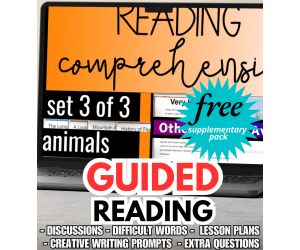
Guided Reading Activities and Lesson Plans Nonfiction Set 3 - Animals
ELA, Reading, Reading Comprehension, Common Core, Resources for Teachers, ESL, Language Development, Pre-Reading, Vocabulary, Grade 2, 3, Worksheets & Printables, Worksheets, Lesson Plans, Teacher Tools, Activities
Guided Reading Activities with Lesson Plans Nonfiction Set 3 Note: This download DOES NOT include the passages themselves. If you have not already done so, download in a format of your choice in the "reading links" section below. Overview The perfect companion materials for Cored Education reading comprehension downloads. This collection of guided reading lessons includes a wide array of engaging themes that aim to foster comprehension, vocabulary development, and creative thinking. Each lesson is crafted to be interactive and immersive, making learning enjoyable while promoting essential literacy skills. The lessons are designed for students to actively engage with both the material and the world around them, creating connections to their personal experiences while developing key skills. Includes Guided Reading Materials For: 1.A Look at Three Bears 2.A Look at Giraffes 3.Camel Humps 4.A Look at Skunks 5.Mountain Animals 6.History of Piggy Banks 7.Very Helpful Dogs 8.Winter Sleep 9.The World's Smallest Penguin 10.The Long Journey Reading Links: This is the guided reading materials version and DOES NOT include the passages themselves. The passages related to this download are available here in GOOGLE Docs, GOOGLE Forms, GOOGLE Slides. PDF, PPT, WORD. Google Docs Google Forms Google Slides PDF PPT Word Details Pre-reading Discussions Each lesson begins with pre-reading questions that help activate prior knowledge and engage students in the theme of the lesson. This allows students to make personal connections with the content before diving into the reading material. Vocabulary Development Every lesson includes vocabulary exploration that introduces key terms students will encounter in the reading. These words are essential for understanding the passage, and activities encourage students to apply the new vocabulary in context. Comprehension Check After the reading, the lessons provide comprehension questions (typically multiple-choice) that assess students’ understanding of the story. These questions help students reflect on key events, characters, and concepts within the text, reinforcing their comprehension. Creative Writing Prompts To foster creativity, the lessons include writing activities that challenge students to apply what they've learned in imaginative ways. These prompts allow students to practice creative expression while reinforcing the lesson’s theme. Discussion Topics Each lesson ends with wrap-up discussion questions that encourage students to think critically and engage in group conversations. These discussions can enhance social learning and deepen understanding by connecting the lesson's content to broader real-world applications. Theme-Based Learning The themes (e.g., winter, nature walks, photography, flowers) are universally appealing and offer opportunities for cross-curricular connections with science, art, and environmental studies. This makes the lessons versatile for a wide range of teaching contexts. Student-Centered Approach The activities are designed to be interactive and student-driven, allowing them to explore the content through discussions, hands-on vocabulary practice, and personal reflections. This promotes active learning and keeps students engaged. FULL CATALOG OF DOWNLOAD LINKS HERE Grade 2/3 Links Fiction Set 1 - Nature Google Docs Google Forms Google Slides PDF PPT Word Guided Reading Materials Fiction Set 2 - Animals Google Docs Google Forms Google Slides PDF PPT Word Guided Reading Materials Fiction Set 3 - Food Google Docs Google Forms Google Slides PDF PPT Word Guided Reading Materials Fiction Set 4 - School Google Docs Google Forms Google Slides PDF PPT Word Guided Reading Materials Fiction Set 5 - Friends Google Docs Google Forms Google Slides PDF PPT Word Guided Reading Materials Fiction Set 6 - Family Google Docs Google Forms Google Slides PDF PPT Word Guided Reading Materials Fiction Set 7 - Sports Google Docs Google Forms Google Slides PDF PPT Word Guided Reading Materials Nonfiction Set 1 - Technology Google Docs Google Forms Google Slides PDF PPT Word Guided Reading Materials Nonfiction Set 2 - Nutrition Google Docs Google Forms Google Slides PDF PPT Word Guided Reading Materials Nonfiction Set 3 - Animals Google Docs Google Forms Google Slides PDF PPT Word Guided Reading Materials Reading Passages Overview Each passage is especially written for Grade 2-3 students, including key vocabulary required for this age group. Topics are varied and are accompanied by colorful graphics. Topics are meant to educate, yet entertain the modern student. These passages are perfect for the modern classroom. Whereas textbooks can become outdated in no time, any changes to technology or the world will result in updates to this product. Mixed Questions The mixed questions section of each lesson includes a variation of fivecomprehension, vocabulary and math questions. In addition, key reading strategies are frequently covered including cause & effect, summarizing, compare & contrast and making conclusions. Three of the questions will be MCQs and two will require a written response of some kind. Full answers and example responses appear at the end of the lesson. Spelling & Vocab Each reading passage contains a variety of words and phrases designed for Grade 2-3 students. Spelling and vocab activities provide the opportunity to build fluency with these words. As it can become quite mundane doing the same activities over and over, each lesson in a set will contain a different spelling and vocab activity . Writing Prompts Writing prompts are designed to continue the theme or lessons learned in the story. Students are persuaded to write in a variety of ways and each prompt includes several cues to help. As with the spelling/vocab section, writing prompts will vary. This includes research pieces, reading responses, poetry and creative writing prompts. Full Answer Keys Full answer keys and sample responses are provided so no matter how busy you are, you know you're covered! Mixed question answers provide evidence from the text, math questions contain the relevant workings. Answers are designed for use by the teacher, but also suitable as a handout to the student. Additional File One lesson will have an additional file. This is something fun to extend the lesson with. For similar downloads and other frees, do check out Cored Group on TeachSimple.
Author Cored Education
Tags Elementary, Reading, Comprehension, Vocabulary, Answers, Ccss, Guided Reading, Guided Reading Activity, Guided Reading Lesson Plans, Guided Reading Lesson Plan
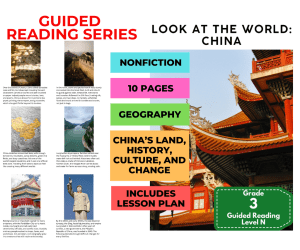
Guided Reading Level N - China (with Lesson Plan)
ELA, Resources for Teachers, Reading Comprehension, Reading, Science, Earth and Environmental Sciences, Social Studies, Geography, Language Development, History, Grade 2, 3, 4, Worksheets & Printables, Worksheets, Teacher Tools, Centers, Activities, Literacy Readers, Quizzes, Quizzes and Tests, Assessments, Lesson Plans
This Guided Reading Book - China (Level N) with lesson plan includes: Guided Reading Color Label (front cover x1) This is a quick way to match the book’s demands to what students can generally handle.. The overall goal is to use the level/color to pick books for several smaller groups. To qualify for a certain level, a student is expected to read a book from that level with about 90–94% accuracy. If a student is consistently accurate and understands, move up a level. If the student is struggling at that level, drop down and add more support. Each student will improve at completely different rates, but it is generally one of the best ways to check progress across the class. DOWNLOAD THE CATALOG TO VIEW ALL GUIDED READING BOOKS AVAILABLE (SORTED LEVELS A-Z) Pre-Reading Question (x1) Teacher asks the prompt aloud, can be while showing the cover or first page. Students share what they already know, or make educated guesses from the cover. Prompt them to use the target vocabulary. Write some of their responses on the board to look back at during the reading. Vocabulary Words (x5) Introduce the five words, best doing it one at a time. Start by saying it, while students repeat and then see if anyone knows what it means before reading further. Read through the meaning and try to briefly connect each word to a picture or gesture so it’s meaningful. Ask students to flip through the book pages and point to where they see each of the vocabulary words. While reading the book pause upon coming across one of the vocab words or read the sentence twice to make sure students understand the word has appeared. Optional: Ask students to raise hands whenever they see/hear one of the new words. Guided Reading Pages (x10) Check the book snapshot (below) for: primary topic - do you need to prep extra reading or intro materials on this? what is taught best - decide on 1-2 bullets to focus on, use the prompt or words provided here for best results. learning goals - what you are checking for students to be able to do after the session, elicit answers using prompts or words provided. key vocabulary (see section above). questions overview - so you know what is coming up and if you need to prep extra materials to assist understanding. Run the lesson You may have already looked at a few of the pages together, but you can show them some of the pictures again first to set meaning. Depending on how much time you have and how familiar your students are with guided reading class, you may want to read the book aloud first with the group first. Students whisper or partner read, while you listen in. If time, do it as a group, one student reading a page each. Use the guided page’s prompts to coach: “Check the picture / does it make sense?” “Point under the words / try the first sound” “Reread the sentence smoothly”. Try to focus more on one student per session (rotating every time), so you can work out if they are ready to move up or need to move down a level. Comprehension Questions (back cover x3) This is your way to check that students didn’t just say the words, but actually understood the text. First, let students answer by pointing to the page/picture and saying a short sentence. After any answer, follow with: “Show me where you found that in the text.” In bigger groups, have partners answer first (10–20 seconds), then call on 2–3 students to share. Differentiation tips: Emerging speakers/struggling readers: oral + pointing On-level: oral in a full sentence Higher: one written sentence or draw + label Book Snapshot Title: Look At the World: China Genre: Nonfiction (informational text) Subject: Social Studies (Geography/History/Culture) Primary Topic: China’s land, history, culture, and change Estimated Guided Reading Level (A–Z): N What This Book Teaches Best How China’s geography includes very different landforms and regions (mountains, deserts, rice fields, coastlines). How rivers shaped early settlement and farming, including the Huang He (Yellow River) valley and the Yangtze River. How ideas and goods traveled through dynasties and trade routes (writing, inventions, the Silk Road). How important places and structures reflect history (the Great Wall, Beijing, the Forbidden City). How China continues to change today while balancing growth, traditions, and environmental concerns. Learning Goals Students will describe the variety of landscapes and regions found in China using text details. Students will explain why people settled near the Huang He (Yellow River) long ago. Students will identify examples of how ideas and inventions spread beyond China’s borders. Students will describe how the Great Wall and the Silk Road are connected to protection and trade. Students will summarize key changes over time described in the text (dynasties, later government changes, modern growth). Students will explain how language, festivals, and conservation are part of life in China today. Key Vocabulary From the Text dynasties — ruling families that lead for long times. civilization — a large, organized society with shared culture. merchants — people who buy and sell goods. dialects — different ways people speak the same language. conservation — protecting plants and animals so they can survive. Discussion Prompts Pre-reading question: What have you heard or learned about China before today? Comprehension questions: What kinds of land and places does the text say China has across East Asia? Comprehension questions: Why do historians call the Huang He (Yellow River) valley important in the text? Comprehension questions: What does the text say merchants and travelers traded on the Silk Road? Printing Tips 1. Best Printing Method (Recommended) “Booklet” Printing (Best if Available) If your printer or PDF viewer supports Booklet Printing , use this. Settings to use: Print mode: Booklet Paper size: Letter or A4 (either works) Orientation: Landscape Print on both sides: Yes Flip on: Short edge Scaling: Fit to printable area Booklet subset: First test: Front sides only Then: Back sides only This will automatically: Pair pages correctly Put the cover on the outside Align everything for folding After printing, fold in half and staple along the spine . 2. If “Booklet” Printing Is NOT Available You can still print this correctly with manual duplex printing . Step-by-step: Open the PDF. Choose Print . Set: Orientation: Landscape Pages per sheet: 1 Print on both sides: Yes Flip on: Short edge Print all pages . Because each PDF page already contains two facing book pages, the result will still fold cleanly into a book. Thousands of Cored Education products are included with your TeachSimple membership. Download links and encyclopedia index available here.
Author Cored Education
Rating
Tags Reading Comprehension, Reading Passages, Reading, Guided Reading, Guided Reading Lesson Plan, Guided Reading Activity, Pre-reading, Social Studies Lesson Plans, Geography, History
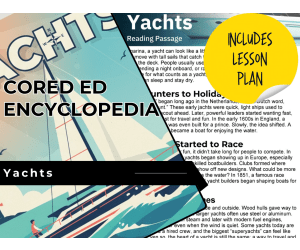
Yachts Reading Comprehension Passage - Cored Ed Encyclopedia
ELA, Language Development, Reading Comprehension, Reading, Science, History, Social Studies, Technology, Engineering, Pre-Reading, Grade 2, 3, 4, 5, Worksheets & Printables, Worksheets, Teacher Tools, Centers, Activities, Writing Prompts, Assessments, Quizzes and Tests, Quizzes, Lesson Plans
This yachts reading comprehension with lesson plan includes: Visualization (on the front cover) Start your lesson by taking a minute to think and share something about the topic. Read the script aloud (slowly), perhaps prepare some music or sound effects. Student close their eyes and let their imaginations wander. Students open their eyes, read the question aloud and give them a few minutes to complete. Ask a few students to share or keep answers until the end to compare with what they learn in the passage. Quick pause—thousands of Cored Education products are included with your TeachSimple membership. Download links and encyclopedia index available here. Pre-Reading Trivia Students will write down one thing they already know about the subject and then read five more facts and discuss. These facts are fun, and the students will enjoy learning about the subject before reading more. Give 1 minute for students to write what they already know (no pressure—best guess is fine). Read the five facts together. After each fact, do ask a student for their opinion, was it surprising? Set a purpose by asking students to highlight/underline one fact they want to learn more about during the reading. Reading Passage The text is a high-interest reading passage with set paragraphs, roughly three to four paragraphs long. It contains a variety of themes about the topic, anywhere from history to technology. The passage is between 250 and 350 words in length. First, ask students to look at the headings and see what they’ll learn about today. What do they know about the topic/heading? First read options: Teacher read-aloud (best for support). Partner reading (paragraph by paragraph). While reading, students underline important details, and vocabulary words they think may come up in the questions section. Mixed Questions The first question page contains four multiple-choice questions, each with a choice of four answers, and three written response questions that require a sentence or two from the student. Students complete the mcqs first independently, then review quickly as a class. For the 3 written responses, try to get students giving the answer with some form of evidence: “I think ___ because the text says ___.” If students get stuck, send them back to check the passage. Vocabulary Questions Practice seven key words from the text in this section across two activities. First section is scrambled words where students will unscramble three words given a clue for each. The second section is a word to meaning matching activity. Before starting, have some students read out words they underlined in the passage. Ask students to say the word and read aloud the sentence(s) around each word. Ask students to do scrambled words and the matching exercise in pairs then go through answers as a class. For the scrambled spelling task, get four pairs to come up to the board and write the words for extra practice with the other student reading out the clue. For the matching task, prompt students to give full sentences: “I matched ___ with ___ because ___.” Creative Writing In this question, the student will be required to write a five to eight sentence paragraph on a question related to the topic. Before starting, ask students write down 3 key ideas they are going to include in their piece. Ask students for ideas to share around the class to help those struggling. Pro writing expectations: 5–8 sentences At least 2 facts or details from the passage At least 2 vocabulary words from the previous page Students read their paragraphs while classmates listen for facts and vocabulary words. Extension Activities This page is optional for fast finishers or to take home. There are several activities, each one requiring a different skill. Do some, do none, do all, completely optional - but you will feel reassured knowing every possibility is planned for. Includes summary writting question. Answer Key There are answers for the multiple-choice questions, written response questions have sample answers, vocabulary answers and if there is a summary question then a sample summary will be provided as well. Lesson Plan Included Customized lesson plan for this lesson is included. Lesson Snapshot Title: Yachts Genre: Nonfiction (informational text) Subject: Social Studies (history of technology) / Informational Reading Primary Topic: What yachts are, their history, and how they changed Estimated Guided Reading Level (A–Z): Q What This Lesson Teaches Best Describes what a yacht can look and sound like at a marina, and explains that yachts may move by sails or by a motor beneath the deck. Explains how people use yachts for pleasure, such as cruising along a coast, spending a night onboard, or racing across open water, and notes that many yachts have a cabin where someone can sleep and stay dry. Traces how the word “yacht” began in Netherlands from a Dutch word meaning “hunt,” and how early yachts were quick ships used to chase pirates and scout ahead before becoming boats for travel and fun. Shows how yacht racing grew in Europe in the 1600s and how a race in 1851 helped launch the America’s Cup, influencing yacht designs for speed and handling. Explains how yachts changed over time (new materials like fiberglass, larger yachts using steel or aluminum, and engines arriving from steam to modern fuel engines), including very large “superyachts” that may need a hired crew. Learning Goals Students will identify two ways yachts can be powered using details from the text. Students will describe what the passage says people do on yachts for pleasure. Students will explain how the meaning and use of “yacht” changed over time in the passage. Students will describe how racing influenced yacht design, using the passage’s examples. Students will describe at least two changes in yacht materials or engines mentioned in the text. Key Vocabulary From the Text marina — a place where boats dock. cabin — a room where someone can sleep and stay dry. hulls — the outer bodies of boats. fiberglass — a newer material used instead of wood. crew — a hired group to run a yacht. FULL CATALOG OF DOWNLOAD LINKS AND ENCYCLOPEDIA INDEX HERE
Author Cored Education
Rating
Tags Vocabulary, Reading Comprehension, Reading Passages, Lesson Plans, Ela Lesson Plans, Reading Comprehension Lesson Plans, Pre-reading, History Lesson Plans, Science Lesson Plans, Engineering
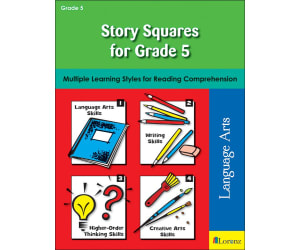
Story Squares for Grade 5: Multiple Learning Styles for Reading Comprehension
ELA, Reading, Reading Comprehension, Grade 5, Teacher Tools, Lesson Plans
Story Squares for Grade 5: Multiple Learning Styles for Reading Comprehension An effective educational resource designed to strengthen reading comprehension skills for Grade 5 students. This teaching tool utilizes the blend of Language Arts, Writing, Higher-Order Thinking, and Creative Arts exercises meant to offer a comprehensive learning experience. About the Resource: The resource is centred around three beloved children's books - 'Strider', 'Frindle', and 'Tuck Everlasting'. By incorporating these timeless tales into its framework, Story Squares fosters an affinity for reading among learners. Each book in the series comes with a precise summary and twenty engaging activities tied directly to the story's narrative. Versatility: Suitable for various classroom settings; whole class instruction or small group collaboration. Creativity encouragement: Because it cultivates independent thought processing and creativity among peers or during isolated study time. In addition to fostering student engagement, this resource also offers several useful tools dedicated exclusively towards teacher convenience which includes handy teaching hints that can facilitate smoother lesson execution. A grading rubric incorporated in the package adds uniformity in evaluating students' work while ensuring fairness across all performance levels. A glossary of terms provides easy reference points when tackling higher-order concepts inherent within the activities. Packaged as a convenient PDF file consisting of meticulously prepared printable pages ensures that educators can access this potent instructional asset readily whenever needed. In conclusion, This truly versatile tool is perfect if you're looking at providing your grade five students an enriching literature-based learning involving critical thinking, creative expression and multi-disciplinary skill set enhancement through well-loved stories. Story Squares is indeed a reliable companion for fostering reading comprehension in diverse learning environments.
Author Classroom Complete Press
Tags Poems, Comprehension, Dictionary, Plural Nouns, Frindle, Reading Squares

Lorikeet Unit Study | Build a Love Bird Craft | Rainforest Animals
ELA, Reading, Reading Comprehension, Grammar, Language Development, Spelling, Writing, Science, Life Sciences, Animals, Grade 2, 3, 4, Lesson Plans, Teacher Tools
Lorikeet Unit Study | Build a Love Bird Craft | Rainforest Animals This engaging and ready-to-use educational resource is designed for Grades 2, 3, and 4. It's versatile enough to fit into any lesson plans, be it language arts or science. Boasting an interactive learning experience, the unit study engages multiple subjects including zoology, spelling, writing, grammar and reading comprehension along with elements of Science. No-Prep Feature One of its key features is its No-Prep functionality. This ensures that high content quality and engagement are delivered without compromising on your valuable teaching time - be it teaching large groups or single students at home. About The Unit The unit revolves around Rainbow Lorikeets. It focuses on developing fine motor skills through cutting & crafting activities while stimulating critical thinking with literature art interactions. 'Fast Facts about rainbow lorikeets' provides inputs for mini projects or class discussions— a hands-on approach in learning about rainforests animal ecosystems. Inclusion of various online sources such as YouTube via QR codes allows user-friendly digital access still maintaining necessary hygiene factor during these times. Holiday-based themes like Valentine’s Day can transform into charming love bird crafts serving as both an educational project each adding value beyond aesthetics besides making early finisher activities fun! All Round Growth & Assessment Avenues Apart from improving cognitive development amongst students by blending varied interdisciplinary methods; to ascertain effective understanding—a delicate balance between interest & assessment —is maintained through designing comprehension quizzes in multiple-choice format yet not intimidating young learners! In essence, the Lorikeet Unit Study isn't just another educational resource.. it's a fun-filled journey exploring the fascinating world of lorikeets.
Author Heather Huhman
Tags Lorikeet, Rainforest Animals, Bird Craft, Language Arts, Science
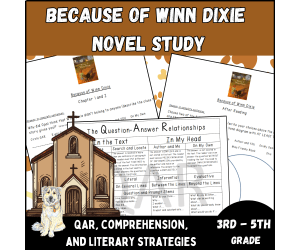
Because of Winn Dixie QAR Skills and Guided Reading Novel Study
ELA, Reading Comprehension, Reading, Grade 3, 4, 5, Lesson Plans, Teacher Tools, Worksheets & Printables, Novel Studies
Bring Because of Winn-Dixie to life in your classroom with this engaging and flexible novel study! Designed for upper elementary and middle school students, this resource helps young readers develop strong comprehension skills while introducing the Question-Answer Relationship (QAR) strategy in a meaningful way. The unit begins with mini-posters and reading journal inserts to teach students the four types of questions: Right There, Think and Search, Author and Me, and On My Own. By mastering this questioning strategy early on, students build the skills they need to dig deeper into the novel as they read. Instead of just answering surface-level questions, they’ll learn how to think critically, analyze text, and discuss ideas with confidence. As students move through the book, they’ll continue to practice and refine their questioning techniques, applying them to character development, themes, and major plot events. This approach encourages independent thinking and richer discussions, giving teachers the opportunity to guide students toward a deeper understanding of the text. How This Unit Works: 📖 QAR Mini-Lessons – Start with clear explanations and visual aids to introduce the questioning strategy. 📖 Active Reading & Skill Building – As students read, they apply QAR techniques to think critically about the story. 📖 Comprehension & Discussion Activities – Thoughtful prompts encourage meaningful conversations about characters, themes, and events. 📖 Final Project & Post-Reading Activities – Wrap up the novel with engaging project work that reinforces key takeaways. Why You’ll Love This Resource: ✔️ Makes questioning strategies easy to teach and apply. ✔️ Encourages higher-level thinking and deep discussions. ✔️ Works well for whole-class instruction, small groups, or independent study. ✔️ Includes ready-to-use mini-posters and journal inserts to support student learning. What’s Included? Mini-posters & reading journal inserts to introduce QAR Comprehension questions that challenge students to think deeply A final project for creative and reflective learning Flexible pacing to fit your teaching style This Because of Winn-Dixie novel study is a simple yet powerful way to help students build comprehension skills, improve questioning techniques, and connect with this heartfelt story. Whether used as a full-class novel study or a small group book unit, it’s a resource that makes reading more meaningful and engaging!
Author Kel's Klass
Tags Because Of Winn Dixie Novel Study, QAR Reading Strategy, Questioning Reading Strategy, Realistic Fiction, Small Group Reading, Whole Class Reading, Because Of Winn Dixie Worksheet, Because Of Winn Dixie Writing Prompts, Because Of Winn Dixie Lesson Plans, Reading Comprehension
Story Squares for Grades 6+: Multiple Learning Styles for Reading Comprehension
ELA, Reading, Reading Comprehension, Grade 6, Teacher Tools, Lesson Plans
Story Squares for Grades 6+: Multiple Learning Styles for Reading Comprehension Excite your teaching routines with Story Squares. This revolutionary resource is a goldmine for any educator in both standard schools and homeschool settings. Story Squares blurs the lines of mere page-by-page review and pushes students to engage deeply with the text. It evokes their language skills, encourages thoughtful responses, and fosters their higher-order thinking abilities. Furthermore, it stirs creativity by interpreting literary works through various creative arts projects. The focus of this resource is four timeless children’s classics: "101 Ways to Bug Your Teacher" "Julie of the Wolves" "Al Capone Does My Shirts" "The Slave Dancer". A brief summary along with 20 thought-provoking activities revolving around key themes or characters are provided for each book. This advantageously promotes reading comprehension by solidifying abstract concepts with concrete examples. Educator Supports Incorporated! The package includes guiding pointers suggesting a lesson plan flow along with a clearly outlined grading rubric presenting smoother classroom management. Additionally, an enclosed glossary clarifies potential queries proactively before they mutate into issues. Its versatility adds to Story Square's appeal - perfectly fit for whole class readings or smaller discussion groups depending on class requirements and dynamics. In addition, individual pages could be assigned as homework enriching delayed understanding rather than information overload. Plus convenience is guaranteed—this teaching tool comprises 18 meticulously designed pages packaged in an accessible PDF file format—readily available for instant printing whenever demanded! In Summary... Story Squares truly teaches beyond reading; it initiates students on an immersive journey through literature where they sharpen their faculties while relishing in the thrill of getting lost in captivating stories! Make way for a newfound love for reading in your students with this uniquely engaging exploration of literature.
Author Classroom Complete Press
Tags Language Arts, Story Writing, Reading, Comprehension, Common Nouns

Reading Comprehension: Main Idea - FLASH-MAC
ELA, Reading, Reading Comprehension, Grade 5, 6, 7, 8, Teacher Tools, Lesson Plans
Reading Comprehension: Main Idea - FLASH-MAC FLASH-MAC is an invaluable resource designed to enhance an educator's toolkit, aimed specifically at grades 5 through 8. It particularly addresses Language Arts Comprehension. This interactive software contains curriculum -based content focusing on students' comprehension of the main idea within reading tasks, using various approaches for engagement and yielding powerful results. Main Components: A chapter mini that sets course material into manageable sections complete with before and after reading questions, and diverse reading passages. Complimentary printables perfect for assignments or pop quizzes shareable across different classroom setups; whole group, small group or homework. Vocabulary flashcards promoting memorization while enhancing understanding required in comprehending main ideas across multiple contexts. Useful graphic organizers aiding visual learners in breaking down complex ideas into simple visually represented concepts. Interactive activities further reinforcing learned skills or introducing new ones. The unique selling proposition of FLASH-MAC lies in its crafting by educators who comprehend both teaching requirements and students' needs making abstract reasoning tangible for grade-level students leading to significant capacity growth over time. For homeschoolers or public school educators seeking high-grade resources to take their language arts comprehension lessons a notch higher, investing in 'Reading Comprehension: Main Idea- FLASH MAC', might prove significantly advantageous!
Author Classroom Complete Press
Tags Software (Mac)
Dry Spell | Figurative Language Activity | Micro-Learning Deck
ELA, Reading, Reading Comprehension, Grade 4, 5, 6, 7, Teacher Tools, Lesson Plans
Micro-Learning Deck | Figurative Language: Dry Spell This teaching resource allows students to explore the figurative language term "dry spell" in an engaging way. Through a short video lesson defining dry spell, an example reading passage with audio recording, and comprehension activity, learners will better understand this figurative language concept. Educators can implement this resource in various settings - assign the deck individually, use it for whole class instruction to introduce dry spell, or provide it in small groups for discussion and analysis. Applicable for 4th-7th grade language arts or reading classes, this micro-learning deck offers a focused, standards-based approach to build students' figurative language skills. Its self-paced format also allows flexible independent practice identifying and interpreting dry spell in text.
Author Teach Me This
Tags Dry Spell, Figurative, Language, Reading, Comprehension, How Do You Spell Figurative Language
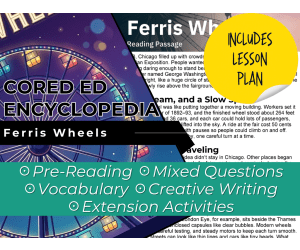
Ferris Wheels Reading Comprehension Passage - Cored Ed Encyclopedia
ELA, Reading Comprehension, Reading, Science, Technology, Language Development, Social Studies, History, Pre-Reading, Writing, Grade 2, 3, 4, 5, Worksheets & Printables, Worksheets, Teacher Tools, Centers, Activities, Writing Prompts, Assessments, Quizzes and Tests, Quizzes, Lesson Plans
This Ferris wheels reading comprehension with lesson plan includes: Visualization (on the front cover) Start your lesson by taking a minute to think and share something about the topic. Read the script aloud (slowly), perhaps prepare some music or sound effects. Student close their eyes and let their imaginations wander. Students open their eyes, read the question aloud and give them a few minutes to complete. Ask a few students to share or keep answers until the end to compare with what they learn in the passage. Quick pause—thousands of Cored Education products are included with your TeachSimple membership. Download links and encyclopedia index available here. Pre-Reading Trivia Students will write down one thing they already know about the subject and then read five more facts and discuss. These facts are fun, and the students will enjoy learning about the subject before reading more. Give 1 minute for students to write what they already know (no pressure—best guess is fine). Read the five facts together. After each fact, do ask a student for their opinion, was it surprising? Set a purpose by asking students to highlight/underline one fact they want to learn more about during the reading. Reading Passage The text is a high-interest reading passage with set paragraphs, roughly three to four paragraphs long. It contains a variety of themes about the topic, anywhere from history to technology. The passage is between 250 and 350 words in length. First, ask students to look at the headings and see what they’ll learn about today. What do they know about the topic/heading? First read options: Teacher read-aloud (best for support). Partner reading (paragraph by paragraph). While reading, students underline important details, and vocabulary words they think may come up in the questions section. Mixed Questions The first question page contains four multiple-choice questions, each with a choice of four answers, and three written response questions that require a sentence or two from the student. Students complete the mcqs first independently, then review quickly as a class. For the 3 written responses, try to get students giving the answer with some form of evidence: “I think ___ because the text says ___.” If students get stuck, send them back to check the passage. Vocabulary Questions Practice seven key words from the text in this section across two activities. First section is scrambled words where students will unscramble three words given a clue for each. The second section is a word to meaning matching activity. Before starting, have some students read out words they underlined in the passage. Ask students to say the word and read aloud the sentence(s) around each word. Ask students to do scrambled words and the matching exercise in pairs then go through answers as a class. For the scrambled spelling task, get four pairs to come up to the board and write the words for extra practice with the other student reading out the clue. For the matching task, prompt students to give full sentences: “I matched ___ with ___ because ___.” Creative Writing In this question, the student will be required to write a five to eight sentence paragraph on a question related to the topic. Before starting, ask students write down 3 key ideas they are going to include in their piece. Ask students for ideas to share around the class to help those struggling. Pro writing expectations: 5–8 sentences At least 2 facts or details from the passage At least 2 vocabulary words from the previous page Students read their paragraphs while classmates listen for facts and vocabulary words. Extension Activities This page is optional for fast finishers or to take home. There are several activities, each one requiring a different skill. Do some, do none, do all, completely optional - but you will feel reassured knowing every possibility is planned for. Includes summary writting question and additional facts. Answer Key There are answers for the multiple-choice questions, written response questions have sample answers, vocabulary answers and if there is a summary question then a sample summary will be provided as well. Lesson Plan Included Customized lesson plan for this lesson is included. Lesson Snapshot Title: Ferris Wheels Genre: Nonfiction (Informational Text) Subject: Social Studies (History) / Science & Technology / Reading (Informational Text) Primary Topic: Origins, design, and purpose of Ferris wheels Estimated Guided Reading Level (A–Z): P What This Lesson Teaches Best Explains the origin story of the first Ferris wheel at the 1893 Chicago world’s fair and why people wanted a daring new attraction. Uses clear facts and measurements (about 264 feet/80 meters , 36 cars , ride cost and time) to build informational reading skills. Shows how Ferris wheels spread to new places and why they’re also called “observation wheels” (because looking is part of the fun). Compares past and present Ferris wheels, including modern wheels built for slow sightseeing like the London Eye with enclosed capsules. Highlights how modern wheels rely on strong steel, careful testing, and steady motors for smooth turns. Learning Goals Students will describe why the 1893 world’s fair crowd wanted something “brand-new” to see. Students will identify key details about the first Ferris wheel (height, number of cars, ride time, and cost). Students will explain why Ferris wheels are also called “observation wheels” using evidence from the text. Students will describe how Ferris wheels spread to other places after Chicago, including the example in Vienna. Students will compare how some Ferris wheels are designed for thrills versus slow sightseeing today. Key Vocabulary From the Text Exposition — a huge fair where inventions and exhibits are shown. engineer — a person who designs and builds things. fairgrounds — the area where a fair is held. capsules — closed pods that carry riders on a wheel. skyline — the outline of a city’s buildings against the sky. FULL CATALOG OF DOWNLOAD LINKS AND ENCYCLOPEDIA INDEX HERE
Author Cored Education
Rating
Tags Vocabulary, Reading Comprehension, Reading Passages, Lesson Plans, Ela Lesson Plans, Reading Comprehension Lesson Plans, Pre-reading, Science Lesson Plans, Social Studies Lesson Plans, History
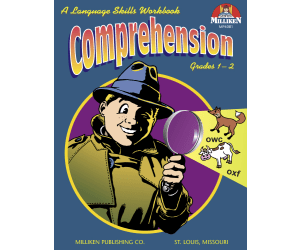
Comprehension Grades 1-2
ELA, Reading, Reading Comprehension, Grade 1, 2, Teacher Tools, Lesson Plans
Comprehension Grades 1-2: A Distinctive Teaching Resource Comprehension Grades 1-2 is a remarkable teaching resource skilfully created to boost the comprehension skills of learners in grade 1 and grade 2. Designed especially for Language Arts, this workbook acts as a skillful guide for teachers striving to instill a deep understanding of written text in their students. Making Sense of Reading Educators understand that reading surpasses mere word recognition. Thus, Comprehension Grades 1-2 delves into making sense of what is read - a critical step towards academic success. This invaluable tool emphasises on cultivating important comprehension skills like: Follwoing directions, Categorising, Sequencing, Main idea identification, Apllication in context, and Finding information. Tailored Learning Journey Per Student & Setting The workbook is crafted with several activities meticulously arranged within its enriching content that guarantees each student's learning journey is exclusively tailored according to their pace and style . The activities are designed for unsupervised individual practice either at home or within classroom settings. The flexible format lets teachers incorporate it effortlessly into varied instructional settings like group or small team sessions. Beyond Classroom Learning & an Efficient Layout In addition to being used within classrooms, each activity can integrate seamlessly into home-learning reinforcement exercises thereby fostering parent-child engagement - equally beneficial for homeschoolers seeking organized practices for developing comprehension skills. The Comprehension Grades 1-2 workbook contains a set of professionally compiled lesson plans spread across 51 ready-to-print pages housed within one handy PDF file. Plus, answer keys are included for convenience and ease of reference during evaluations or review sessions. Conclusion In conclusion, Comprehension Grades 1-2 supplies teachers with easy-to-use content that simplifies teaching comprehensive Language Arts concepts while actively engaging students in their learning journey. The goal is to equip children not just to decode words but truly read by deeply understanding them.
Author Classroom Complete Press
Tags Comprehension, Categorizing, Main Idea, Context Clues, Sequencing

ESL Lesson Plan on Eating Insects - Food of the Future
ELA, Reading, Reading Comprehension, Language Development, ESL, Vocabulary, Grade 7, 8, 9, 10, 11, 12, Teacher Tools, Lesson Plans
ESL Lesson Plan on Eating Insects - Food of the Future This ESL (English Second Language) Teaching Resource Lesson Plan on Eating Insects - Food of the Future (14 Digital PDF Slides) is great to stimulate English as Second or Foreign Language Learners with Interesting Actuality topics (Insects consumption). This ESL Lesson Plan can be ideal for learners from 7th grade to 12th grade; it can also be more than suitable for ESL EFL TESOL Centers around the world and/or private English Second Language Tutors/Private Teachers. This ESL Lesson Plan Teaching Resource on Eating Insects - Food of the Future can be great for Intermediate Advanced English as a Second or Foreign Language Students Within this ESL Teaching Resource (lesson plan) on Eating Insects, it is included: 1 opening slide 5 introductory slides to Eating Insects (presentation of the topic + some vocabulary; tarantulas, termites, grasshoppes, locusts etc) 3 slides for Warm-Up Picture Description Activity (a guy eating insects at a food market + insects farming + insects' burger in a supermarket) 1 slide about the use of Insects consumption around the world 1 slide with Listening Comprehension Video (QR Code-linked video + hyperllink) 1 slide with 9 Comprehensio Questions (with internal link to last slide's answer keys) 1 slide for ESL writing activity prompt ("Would you like to try insects") 1 slide with answer keys This ESL, EFL, TESOL PDF Digital Teaching Resource Lesson Plan on Eating Insects (13 slides + answer keys in the last slide) can be suitable for Intermediate Advanced English as a second or foreign language learners (ESL EFL). Its aim is to make students exercise and improve their vocabulary (Warm-up Picture Description), Listening comprehesion and Writing English as a second language Skills. Learning with Alan is a Brand New Teaching Resources Store whose aim is to help English as a Second or foreign Language Teachers, Educators and Tutors (be it online or offline) to achieve their teaching objectives while creating a fun and stimulating environment. Never Forget! Learning is fun, So should English! Always If you want to browse more of my ESL, EFL, TESOL Teaching Resources, click here Learning with Alan!
Author Learning with Alan
Tags ESL, English Second Language, English, Insects, Future, Food, Lesson Plan, Listening, Writing, Comprehension

Unit of Study all about New Zealand
Social Studies, ELA, Economics, History, History: British, History: World, First Peoples (Native), Government, Geography, Reading, Reading Comprehension, Grammar, Language Development, Vocabulary, Spelling, Writing, Science, Life Sciences, Animals, Basic Science, Grade 4, 5, 6, Teacher Tools, Lesson Plans, Worksheets & Printables, Flashcards, Activities, Projects, Assessments, Worksheets
There's something magical about being able to bring the world into our classrooms. I'm excited to share with you a comprehensiveUnit of Study all about New Zealand. This resource is filled with meticulously designed tools to help our students journey into the vibrant heart of this incredible country. New Zealand, with its stunning landscapes and layered history, offers a world of exploration. Through this unit, our students will unravel tales, traditions, and truths that form the fabric of this nation. Designed with versatility in mind, we can shape the content to fit our students’ unique needs - be it age, reading proficiency, interests, or learning preferences. Here's a Glimpse of What's Inside: Lesson Plans: Flexible and adjustable, we can spread these out to suit our classroom pace and scheduling. Reading Passages: Each lesson is complemented by a passage, giving students a deep textual insight into New Zealand's many aspects. Videos: Handpicked to align with the readings, these videos provide a multisensory experience. Discussion Avenues: Thought-provoking prompts to foster classroom discussions and encourage student reflections. Vocabulary Boosters: Clear, defined vocabulary cards for every lesson. Additionally, dedicated dictionary activity pages will help our students enrich their lexicons. Note-taking & Graphic Organizers: Available in three formats, ensuring each student can comfortably document their learnings. Assessment Tools: Comprehensive tests, in both short answer and multiple-choice formats, come with ready answer keys for our convenience. Writing Opportunities: Every lesson comes with a structured prompt, allowing students to articulate their understanding. Hands-on Activities: Perfect for our kinesthetic learners, these activities are interactive and engaging. Designed with 4th to 6th graders in mind and spanning 345 pages, this PDF resource is ready to be printed and integrated into our lesson plans. It offers a rich, in-depth view of New Zealand, from its breathtaking nature to its societal structures. Whether you've been teaching for years in a school or are homeschooling, thisUnit of Study on New Zealandis a treasure trove. Together, let's embark on this enlightening journey and bring a slice of New Zealand to our eager learners. Happy teaching!
Author Heather Huhman
Tags New Zealand, Unit Study, Maori, Geography, History, James Cook, Ernest Rutherford, Auckland, Christchurch, Treaty Of Waitangi
Historical Fiction Genre Study Book Report
Social Studies, ELA, Reading, Reading Comprehension, Literature, Research, Grade 6, 7, 8, 9, Worksheets & Printables, Novel Studies, Teacher Tools, Graphic Organizers, Activities, Projects, Lesson Plans, Assessments, Worksheets
The 34-page Historical Fiction Genre Study Book Report is designed for grades 6th, 7th, 8th, and 9th, but it can easily be modified for lower or higher grades. This book report is an excellent supplement to a unit on a particular historical period. Through reading historical fiction, students can gain a deeper appreciation for historical periods and how they relate to the present day. The goal of this lesson is to introduce students to the genre of historical fiction and to help them understand its importance and significance. By the end of the lesson, students should have a good understanding of what historical fiction is. Students will read a historical fiction novel, analyze its characters, plot, and author's craft , and present their findings to a small group. The book report includes a detailed lesson plan on the historical fiction genre, objectives and learning targets aligned to the Common Core standards, directions for the book report with handouts and worksheets for students, a student self-evaluation, and a grading sheet for teachers. Many students enjoy reading historical fiction, especially if they are learning about the period in their History/Social Studies class. If you do the genre study component of this resource, the book report offers a high-quality culminating project. In addition, if you teach a Language Arts/History Core or plan with a History/Social Studies partner-teacher, this is an excellent resource for both classes and provides students with a different way to engage with history. Historical fiction is an essential genre for students for a variety of reasons because it makes the study of history more engaging and interesting and it brings the past to life. Students gain a deeper appreciation for historical periods and how they relate to the present day, It also improves critical thinking skills by giving students opportunities tothink critically about the events and people from the past, analyze and interpret historical events, understand different perspectives,and it encourages empathy, tolerance, and respect because students learn to see history through the eyes of characters from different time periods and cultures Historical Fiction Genre Study Book Report includes the following: 2 comprehensive and interactive lesson plans: Book Browse lesson plan Historical Fiction Genre lesson plan with common core standards, objectives, and learning targets easy-to-follow student directions Note taking Guide Note taking Guide Chart Spoke Diagram Plot Diagram Character Chart Sensory Description Chart Other Elements in Historical Fiction Chart Storyboard Presentation in Small Groups Directions Self-Evaluation of Historical Fiction Book Report Check-Off and Grading Sheet Other Resources You Might Be Interested In: Book Reports: Autobiography/Biography Genre Study Book Report and Speech Book into Movie Project: Compare and Contrast Book Report and Essay Book Jacket Book Report Character Analysis Essay, Gift for a Character Book Report, and Oral Presentation Historical Fiction Genre Study Book Report Historical Fiction Genre Study Literature Circle Project Poetry Book Report Mini-Reviews Book Report Mystery, Thriller, Horror, and Suspense Genre Study Book Report Narrative Nonfiction Genre Study Book Report Project Poetry Book Report Dystopian. Science Fiction, and Fantasy Genre Study Game Board Project Reading Units: Creating Independent Readers in your Middle School Classroom which is available as 1 unit or as individual resources Part 1: What We Do When We Read: Part 2: Reading Logs, Setting Goals, and Reflection Part 3: Summary Writing for Short Stories Part 4: Metacognitive Logs: Reading Response Bonus: How to Set Up An Amazing Classroom Library (without Spending Much Money): Google Slide Shows: Characterization: What It Is and How to Develop It Writing with Suspense If you have any questions, please email me at gruenwaldy1@gmail.com
Author Intentional Teaching and Learning
Tags Historical Fiction, Book Report, Research, Assessment, Story Elements, Analysis, History, Author's Craft, Critical Thinking, Self-evaluation

ESL Lesson Plan on the Importance of Reading Books + Favorite Books
ELA, Language Development, ESL, Writing, Creative Writing, Reading, Reading Comprehension, Grade 6, 7, 8, 9, 10, 11, 12, Teacher Tools, Lesson Plans
ESL Lesson Plan on the Importance of Reading Books + Favorite Books This Fantastic ESL-EFL-TESOL Lesson Plan (PDF Digital Presentation; 14 slides + Answer keys in the last slide) on the Importance of Reading + Favorite Books is Great to stimulate English Learning within Newcomers or any English Second Language Student. Ideal participants for this Activity are Foreign Languages Students at Middle School and early High School. This Product can also be Great for ESL Centers Abroad and ESL Tutors or private teachers. This English as a Second Langauge Teaching Resource (Lesson Plan) can be great for intermediate learners This Stimulating ESL-EFL-TESOL Lesson Plan (PDF Digital Presentation; 14 slides + Listening Activity Answer keys in the last slide) on the Importance of Reading + Favorite Books includes: 1 short Introduction to the importance of books and their influence on the way we think 1 Picture Description with four scenes (Harry Potter Fans waiting for J.K Rowling's Last Book in book stores, a guy in a library, a book club and people reading in the subway) 1 Listening Comprehension activity (with Answer Keys in the last slide) with QR Code-Linked YouTube Video (TED Talk on "the power of stories") 1 Writing Activity with 2 Prompts for essays ("Do you like reading" and the way it has changed your life + Your Favorite Book Review ) This ESL, EFL, TESOL, TEFL PDF Digital Teaching Resource (14 slides + answer keys in the last slide) can be great for Intermediate Advanced English as a second or foreign language learners. Its aim is to make students exercise and/or improve their Listening comprehesion and Writing English as a second language Skills. ESL with Alan is a Brand New ESL, EFL, TESOL Store whose aim is to help English as a Second or foreign Language Teachers, Educators and Tutors (be it online or offline) to achieve their teaching objectives while creating a fun and stimulating environment. Never Forget! Learning is fun, So should English! Always If you want to browse more of my PDF ESL, EFL, TESOL Teaching Resources, click here ESL with Alan!
Author Learning with Alan
Tags ESL, EFL, English As A Second Language, Lesson Plans, Presentation, Reading Books, Books, Listening Comprehension, Writing, Book Review
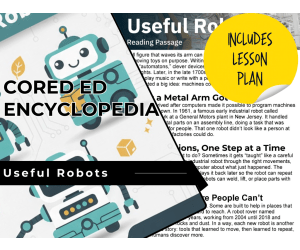
Useful Robots Reading Comprehension Passage - Cored Ed Encyclopedia
ELA, Language Development, Reading Comprehension, Reading, Pre-Reading, History, Social Studies, Technology, Science, Earth and Environmental Sciences, Grade 2, 3, 4, 5, Worksheets & Printables, Worksheets, Teacher Tools, Centers, Activities, Writing Prompts, Assessments, Quizzes and Tests, Quizzes, Lesson Plans
This useful robots reading comprehension with lesson plan includes: Visualization (on the front cover) Start your lesson by taking a minute to think and share something about the topic. Read the script aloud (slowly), perhaps prepare some music or sound effects. Student close their eyes and let their imaginations wander. Students open their eyes, read the question aloud and give them a few minutes to complete. Ask a few students to share or keep answers until the end to compare with what they learn in the passage. Quick pause—thousands of Cored Education products are included with your TeachSimple membership. Download links and encyclopedia index available here. Pre-Reading Trivia Students will write down one thing they already know about the subject and then read five more facts and discuss. These facts are fun, and the students will enjoy learning about the subject before reading more. Give 1 minute for students to write what they already know (no pressure—best guess is fine). Read the five facts together. After each fact, do ask a student for their opinion, was it surprising? Set a purpose by asking students to highlight/underline one fact they want to learn more about during the reading. Reading Passage The text is a high-interest reading passage with set paragraphs, roughly three to four paragraphs long. It contains a variety of themes about the topic, anywhere from history to technology. The passage is between 250 and 350 words in length. First, ask students to look at the headings and see what they’ll learn about today. What do they know about the topic/heading? First read options: Teacher read-aloud (best for support). Partner reading (paragraph by paragraph). While reading, students underline important details, and vocabulary words they think may come up in the questions section. Mixed Questions The first question page contains four multiple-choice questions, each with a choice of four answers, and three written response questions that require a sentence or two from the student. Students complete the mcqs first independently, then review quickly as a class. For the 3 written responses, try to get students giving the answer with some form of evidence: “I think ___ because the text says ___.” If students get stuck, send them back to check the passage. Vocabulary Questions Practice seven key words from the text in this section across two activities. First section is scrambled words where students will unscramble three words given a clue for each. The second section is a word to meaning matching activity. Before starting, have some students read out words they underlined in the passage. Ask students to say the word and read aloud the sentence(s) around each word. Ask students to do scrambled words and the matching exercise in pairs then go through answers as a class. For the scrambled spelling task, get four pairs to come up to the board and write the words for extra practice with the other student reading out the clue. For the matching task, prompt students to give full sentences: “I matched ___ with ___ because ___.” Creative Writing In this question, the student will be required to write a five to eight sentence paragraph on a question related to the topic. Before starting, ask students write down 3 key ideas they are going to include in their piece. Ask students for ideas to share around the class to help those struggling. Pro writing expectations: 5–8 sentences At least 2 facts or details from the passage At least 2 vocabulary words from the previous page Students read their paragraphs while classmates listen for facts and vocabulary words. Extension Activities This page is optional for fast finishers or to take home. There are several activities, each one requiring a different skill. Do some, do none, do all, completely optional - but you will feel reassured knowing every possibility is planned for. Includes summary writting question. Answer Key There are answers for the multiple-choice questions, written response questions have sample answers, vocabulary answers and if there is a summary question then a sample summary will be provided as well. Lesson Plan Included Customized lesson plan for this lesson is included. Lesson Snapshot Title: Useful Robots Genre: Nonfiction (Informational passage) Subject: Science & Technology (Engineering/Robotics) Primary Topic: How robots developed and help people Estimated Guided Reading Level (A–Z): P Support pages included: Pre-reading trivia, mixed questions, vocabulary activities, creative writing prompt, extension activities, and an answer key. QA notes on support pages: Support content generally matches the passage; however, the support pages use “automaton” (singular) while the passage uses “automata” (plural), and an extension prompt suggests “hills,” which is not stated in the passage (the passage names rocks and dust). What This Lesson Teaches Best Robots have a history: Explains that long ago people created “automata” that moved using steam, air, water, or falling weights. Modern robots and factory work: Describes an early industrial robot, Unimate, working in 1961 at a General Motors plant handling hot metal parts that were tough and dangerous for people. How robots learn repeatable motions: Shows how a person can guide a robot’s movements while sensors send signals to a computer that stores a pattern to repeat the job. Robots go where people can’t: Highlights the rover Opportunity exploring Mars for years (2004–2018) and sending back clues from rocks and dust. Big idea across time: Connects early moving devices to today’s robots as tools that learned to move, repeat, and help humans discover more. Learning Goals Students will explain what “automata” were and what powered them. Students will describe why Unimate’s factory job mattered for people. Students will identify how a robot can be “taught” motions and then repeat them. Students will summarize how robots can help in places that are risky, far away, or hard to reach. Students will use details from the text to tell what Opportunity did on Mars and what it sent back. Key Vocabulary From the Text automata — moving devices from long ago; not thinking machines. program — give a machine instructions to do a job. industrial — related to factories and making things. sensors — parts that notice and send signals to a computer. rover — a robot vehicle that travels to explore places. FULL CATALOG OF DOWNLOAD LINKS AND ENCYCLOPEDIA INDEX HERE
Author Cored Education
Rating
Tags Vocabulary, Reading Comprehension, Reading Passages, Lesson Plans, Ela Lesson Plans, Reading Comprehension Lesson Plans, Pre-reading, Science Lesson Plans, Technology, History
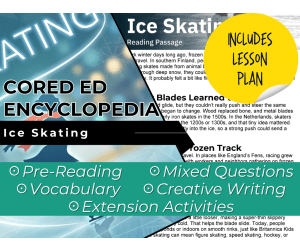
Ice Skating Reading Comprehension Passage - Cored Ed Encyclopedia
ELA, Reading Comprehension, Reading, Language Development, History, Social Studies, Science, Physics, Sports, P.E. & Health, Grade 2, 3, 4, 5, Worksheets & Printables, Worksheets, Teacher Tools, Centers, Activities, Writing Prompts, Assessments, Quizzes and Tests, Quizzes, Lesson Plans
This Ice Skating reading comprehension with lesson plan includes: Visualization (on the front cover) Start your lesson by taking a minute to think and share something about the topic. Read the script aloud (slowly), perhaps prepare some music or sound effects. Student close their eyes and let their imaginations wander. Students open their eyes, read the question aloud and give them a few minutes to complete. Ask a few students to share or keep answers until the end to compare with what they learn in the passage. Quick pause—thousands of Cored Education products are included with your TeachSimple membership. Download links and encyclopedia index available here. Pre-Reading Trivia Students will write down one thing they already know about the subject and then read five more facts and discuss. These facts are fun, and the students will enjoy learning about the subject before reading more. Give 1 minute for students to write what they already know (no pressure—best guess is fine). Read the five facts together. After each fact, do ask a student for their opinion, was it surprising? Set a purpose by asking students to highlight/underline one fact they want to learn more about during the reading. Reading Passage The text is a high-interest reading passage with set paragraphs, roughly three to four paragraphs long. It contains a variety of themes about the topic, anywhere from history to technology. The passage is between 250 and 350 words in length. First, ask students to look at the headings and see what they’ll learn about today. What do they know about the topic/heading? First read options: Teacher read-aloud (best for support). Partner reading (paragraph by paragraph). While reading, students underline important details, and vocabulary words they think may come up in the questions section. Mixed Questions The first question page contains four multiple-choice questions, each with a choice of four answers, and three written response questions that require a sentence or two from the student. Students complete the mcqs first independently, then review quickly as a class. For the 3 written responses, try to get students giving the answer with some form of evidence: “I think ___ because the text says ___.” If students get stuck, send them back to check the passage. Vocabulary Questions Practice seven key words from the text in this section across two activities. First section is scrambled words where students will unscramble three words given a clue for each. The second section is a word to meaning matching activity. Before starting, have some students read out words they underlined in the passage. Ask students to say the word and read aloud the sentence(s) around each word. Ask students to do scrambled words and the matching exercise in pairs then go through answers as a class. For the scrambled spelling task, get four pairs to come up to the board and write the words for extra practice with the other student reading out the clue. For the matching task, prompt students to give full sentences: “I matched ___ with ___ because ___.” Creative Writing In this question, the student will be required to write a five to eight sentence paragraph on a question related to the topic. Before starting, ask students write down 3 key ideas they are going to include in their piece. Ask students for ideas to share around the class to help those struggling. Pro writing expectations: 5–8 sentences At least 2 facts or details from the passage At least 2 vocabulary words from the previous page Students read their paragraphs while classmates listen for facts and vocabulary words. Extension Activities This page is optional for fast finishers or to take home. There are several activities, each one requiring a different skill. Do some, do none, do all, completely optional - but you will feel reassured knowing every possibility is planned for. Includes summary writting question and additional facts. Answer Key There are answers for the multiple-choice questions, written response questions have sample answers, vocabulary answers and if there is a summary question then a sample summary will be provided as well. Lesson Plan Included Customized lesson plan for this lesson is included. Lesson Snapshot Title: Ice Skating Genre: Nonfiction (informational text) Subject: Reading (Informational Text) / Science Primary Topic: How ice skating began and why blades glide Estimated Guided Reading Level (A–Z): R What This Lesson Teaches Best Explains how ice skating was first used for winter travel long ago (frozen lakes and rivers as “the easiest way to travel”). Describes how skates changed over time (from animal bones to wood to metal blades) and why sharpened edges mattered for control. Shows how skating shifted from travel to organized sport, including races, rules, championships, and the Olympic stage. Introduces a simple science idea for why skates glide: a super-thin slippery surface layer where ice molecules are a little looser. Uses text features (section headings) to chunk information and support comprehension. Learning Goals Identify the main idea and key details about how ice skating began and changed over time. Describe the difference between early bone skates and later skates with sharpened metal edges. Explain how sharpened edges helped skaters push, steer, and move with control. Explain, using the text, why a skate blade can slide well on ice. Describe how skating became an organized sport with rules, championships, and worldwide attention. Key Vocabulary From the Text blades — thin metal parts of skates that touch the ice. edges — sharpened sides that help a skate grip ice. molecules — tiny pieces that make up ice. championships — contests to find winners in a sport. standards — agreed rules that keep things consistent. FULL CATALOG OF DOWNLOAD LINKS AND ENCYCLOPEDIA INDEX HERE
Author Cored Education
Rating
Tags Vocabulary, Reading Comprehension, Reading Passages, Lesson Plans, Ela Lesson Plans, Reading Comprehension Lesson Plans, Pre-reading, History, P.e. Lesson Plans, Sports

Reading Comprehension: Fact and Opinion
ELA, Reading, Reading Comprehension, Common Core, Grade 5, 6, 7, 8, Teacher Tools, Lesson Plans
Reading Comprehension: Fact and Opinion An instrumental teaching resource designed to enhance the reading and comprehension skills of children. This product primarily suits students in Grade 5 up to Grade 8, perfect for classroom educators, homeschooling parents, and caregivers. "Fact and Opinion" Chapter Slice The "Fact and Opinion" chapter slice is part of the broader "Reading Comprehension" instruction series focusing on a critical aspect of reading mastery - discerning facts from opinions. This technique forms a robust foundation for understanding various texts while equipping learners with essential communication skills. Vital Reading Acquisition Building Blocks Emphasized Context Clues Inference Understanding Main Idea Determination Framed with definitions of essential terms throughout the product file, learners get guidance as they practice what they learn in an intuitive manner using this user-friendly resource. Versatility The lesson plan's versatility allows for effective use in different settings. Whether educators wish to implement it during whole group instruction or small cluster learning sessions or even assign it as homework, they can custom-tailor its usage according to their needs. Bloom’s Taxonomy & Common Core State Standards Adherence Assessment Tools Framework alignment guaranteed with adherence to both Bloom's Taxonomy frameworks. Compliance with Common Core State Standards assures its relevance. Bookended by detailed lesson plans focusing specifically on Language Arts comprehension tailored explicitly around upper elementary- middle schoolers' requirements. ``` Delivered through one user-friendly PDF file – use Reading Comprehension: Fact and Opinion as an invaluable addition to your educational toolkit. ```
Author Classroom Complete Press
Tags PDF
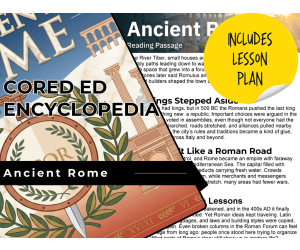
Ancient Rome Reading Comprehension Passage - Cored Ed Encyclopedia
ELA, Language Development, Reading Comprehension, Reading, Social Studies, History, History: Ancient, Writing, Pre-Reading, Vocabulary, Grade 2, 3, 4, 5, Worksheets & Printables, Worksheets, Teacher Tools, Centers, Activities, Writing Prompts, Assessments, Quizzes and Tests, Quizzes, Lesson Plans
This ancient Rome reading comprehension with lesson plan includes: Visualization (on the front cover) Start your lesson by taking a minute to think and share something about the topic. Read the script aloud (slowly), perhaps prepare some music or sound effects. Student close their eyes and let their imaginations wander. Students open their eyes, read the question aloud and give them a few minutes to complete. Ask a few students to share or keep answers until the end to compare with what they learn in the passage. Quick pause—thousands of Cored Education products are included with your TeachSimple membership. Download links and encyclopedia index available here. Pre-Reading Trivia Students will write down one thing they already know about the subject and then read five more facts and discuss. These facts are fun, and the students will enjoy learning about the subject before reading more. Give 1 minute for students to write what they already know (no pressure—best guess is fine). Read the five facts together. After each fact, do ask a student for their opinion, was it surprising? Set a purpose by asking students to highlight/underline one fact they want to learn more about during the reading. Reading Passage The text is a high-interest reading passage with set paragraphs, roughly three to four paragraphs long. It contains a variety of themes about the topic, anywhere from history to technology. The passage is between 250 and 350 words in length. First, ask students to look at the headings and see what they’ll learn about today. What do they know about the topic/heading? First read options: Teacher read-aloud (best for support). Partner reading (paragraph by paragraph). While reading, students underline important details, and vocabulary words they think may come up in the questions section. Mixed Questions The first question page contains four multiple-choice questions, each with a choice of four answers, and three written response questions that require a sentence or two from the student. Students complete the mcqs first independently, then review quickly as a class. For the 3 written responses, try to get students giving the answer with some form of evidence: “I think ___ because the text says ___.” If students get stuck, send them back to check the passage. Vocabulary Questions Practice seven key words from the text in this section across two activities. First section is scrambled words where students will unscramble three words given a clue for each. The second section is a word to meaning matching activity. Before starting, have some students read out words they underlined in the passage. Ask students to say the word and read aloud the sentence(s) around each word. Ask students to do scrambled words and the matching exercise in pairs then go through answers as a class. For the scrambled spelling task, get four pairs to come up to the board and write the words for extra practice with the other student reading out the clue. For the matching task, prompt students to give full sentences: “I matched ___ with ___ because ___.” Creative Writing In this question, the student will be required to write a five to eight sentence paragraph on a question related to the topic. Before starting, ask students write down 3 key ideas they are going to include in their piece. Ask students for ideas to share around the class to help those struggling. Pro writing expectations: 5–8 sentences At least 2 facts or details from the passage At least 2 vocabulary words from the previous page Students read their paragraphs while classmates listen for facts and vocabulary words. Extension Activities This page is optional for fast finishers or to take home. There are several activities, each one requiring a different skill. Do some, do none, do all, completely optional - but you will feel reassured knowing every possibility is planned for. Includes summary writting question and additional facts. Answer Key There are answers for the multiple-choice questions, written response questions have sample answers, vocabulary answers and if there is a summary question then a sample summary will be provided as well. Lesson Plan Included Customized lesson plan for this lesson is included. Lesson Snapshot Title: Ancient Rome Genre: Nonfiction (informational reading passage) Subject: Social Studies (Ancient Civilizations) / Reading (Informational Text) Primary Topic: From early settlement to empire and lasting influence Estimated Guided Reading Level (A–Z): S Support pages noted in the PDF: visualization prompt, pre-reading trivia, mixed questions, vocabulary activities, creative writing prompt, extension activities + “final facts,” and an answer key (some “final facts” add details not stated in the passage). What This Lesson Teaches Best How early life near the Tiber River and a busy meeting space (a forum) helped a town form and grow. How Rome changed its government from kings to a republic, including the role of the Roman Senate and citizen voting in assemblies. How roads, alliances, and shared rules/traditions helped Rome spread across Italy and beyond. How Rome became an empire connected around the Mediterranean Sea , including aqueducts for fresh water and public gathering places like the Colosseum . How Rome’s ideas continued even after the western empire fell, with laws and building styles reused and ruins like the Roman Forum reminding people of the past. Learning Goals Students will describe how the passage explains the early growth of Rome from river paths into a forum. Students will identify what happened in 509 BC and name the new form of government described. Students will explain how the passage connects roads, alliances, and shared rules/traditions to Rome’s expansion. Students will describe what changed in 27 BC when Augustus took control, using details from the text. Students will explain, using the passage, what aqueducts carried and why crowds gathered in major public places. Students will describe what happened to the western empire in the 400s AD and how Roman ideas continued afterward. Key Vocabulary From the Text republic — a government citizens vote in. Senate — a group that debates important choices. empire — many lands under one ruler. aqueducts — long channels that carry fresh water. provinces — faraway areas ruled as part of an empire. FULL CATALOG OF DOWNLOAD LINKS AND ENCYCLOPEDIA INDEX HERE
Author Cored Education
Rating
Tags Vocabulary, Reading Comprehension, Reading Passages, Lesson Plans, Ela Lesson Plans, Reading Comprehension Lesson Plans, Pre-reading, History, Ancient History Lesson Plans, History Lesson Plans

Beethoven - Reading Comprehension Worksheet & Lesson Plan
ELA, Reading, Reading Comprehension, Grade 7, 8, 9, 10, 11, 12, Lesson Plans, Teacher Tools
Reading comprehensions worksheet, activities and lesson plan for perhaps the greatest musician of all time! Teach your students about the genius that is - Ludwig Van Beethoven! Materials include: - Pre-reading activities, - Reading Comprehension Questions - Vocabulary in Context Matching Activity - After reading activity - Presentation - Group work - Full Lesson Plan with links to videos and multimedia content
Author The Laughing Linguist
Tags Beethoven Reading, Beethoven Worksheet, Beethoven Lesson Plan, Reading Comprehension, Informational Text

Indiana State Unit Study (Capital, Bird, Flower, Flag, Animal)
ELA, Social Studies, Reading, Reading Comprehension, Grammar, Language Development, Spelling, Writing, Research, Grade 2, 3, 4, Lesson Plans, Teacher Tools
Indiana State Unit Study An exceptional teaching resource designed for educators seeking a comprehensive yet relaxing introduction to the elements that make up the state of Indiana. This unit study is ideal for public school teachers and homeschoolers of grades 2 through 4 and is easily manageable over five days. Key Features Based around Five Major Symbols: Capital, Bird, Flower, Flag and Animal Diverse Learning Modes: Includes curated videos, reading passages, and research report pages Cross-curricular Activities: Integrated into daily lessons Literacy Skill Development: Focus on reading comprehension and writing skills Art Exploration: Drawing & crafts related to Indiana’s symbols. The unit study not only fosters understanding about geography by examining Indiana's unique place within America's Midwest region, but it also incorporates elements of social studies through historical lessons. Ease-of-Use Enhancements: Inclusive Teacher Instructions: Easily implemented as a full class project or in smaller groups also adaptable for rigorous homework assignments. Included Discussion Guides: Furnished with interactive notebook pieces related to each symbol being studied plus six information-rich symbol cards available in colordagger/black & white formats.p *Bonus* Mix-and-Match Research Report Pages : A set that helps students engage deeply with each topic similarly supplemented by coloring pages adding creativity within daily tasks balancing between critical thinking skills development alongside free-form design work. Your students will be fascinated as they traverse the engaging activities built around artistry crafts bolstering English language arts alongside social studies - making this unit study an indispensable teaching resource year-round or just for quick educational fun.
Author Heather Huhman
Tags Indiana State, Unit Study, Symbols, Cross-curricular, Art Activities, Indiana State Flower Coloring Page, What's Indiana's State Animal, Indianas State Animal, State Animal For Indiana, Indiana State Bird Coloring Page, Indianas State Bird, Indiana's State Bird, What Is Indiana State Animal, Indiana's State Animal
Skating on Thin Ice | Figurative Language Activity | Micro-Learning Deck
ELA, Reading, Reading Comprehension, Grade 4, 5, 6, 7, Teacher Tools, Lesson Plans
Skating on Thin Ice | Figurative Language Lesson Deck for Educators This informative PowerPoint resource helps teachers creatively engage upper elementary and middle school students in learning about the figurative language term "skating on thin ice." Through an introductory video lesson, reading passage with audio, comprehension activities, and quick writing prompts, learners will better understand this common idiom and how figurative language is used. Educators can implement this versatile 20-slide deck in various ways - as an introductory whole-group lesson, small group remediation, independent learning, bell work, or homework. The materials are designed for grades 4-7 language arts or reading classes. This resource provides a complete micro-learning experience to help students comprehend and apply their knowledge of figurative language.
Author Teach Me This
Tags Skating On Thin Ice, Figurative, Language, Comprehension Lesson, Reading Activity