



3,931 products added recently
Page 9 - Reading Comprehension Lesson Plans
Strengthen your students' ability to understand and analyze texts with reading comprehension lesson plans. These resources offer strategies and questions that promote critical thinking. Incorporate them into your teaching to support students in becoming thoughtful and discerning readers.

 Show filters

Arizona State Unit Study (Capital, Bird, Flower, Flag, Animal)
ELA, Social Studies, Reading, Reading Comprehension, Grammar, Language Development, Spelling, Writing, Science, Life Sciences, Animals, History, History: USA, Geography, Grade 2, 3, 4, Lesson Plans, Teacher Tools
Arizona State Unit Study This comprehensive, five-day resource dives into fascinating aspects like the state capital, bird, flower, flag and animal. Designed for low preparation yet rich in detail, making it an ideal tool for second to fourth grade students. Main Integration Areas: Language Arts (Comprehension, grammar, reading spelling & writing) Science (Zoology) Social Studies (U.S. history and geography). This multifaceted resource is equally appealing to artistic learners with colouring exercises or crafting activities that hone their English Language Arts skills. Simultaneously technical subjects like geography or history are catered with rigorous readings and information-loaded research tasks centered around Arizona's state symbols. Cross-curricular resource details: Packed with teaching instructions and a designated five-day lesson plan. Fascinating video content provided as an extra stimulant alongside reading passages or research assignments. The activities improve active learning cycles boosting student engagement whilst the included discussion guides foster interactive communication skills among them. Interactive notebook elements based on Arizona's key identifiers spur visual-spatial stimuli- whether used individually in small groups or full-classroom involvement. Variations considerations: The unit study can be seamlessly adjusted based on age grading comprehension level individual interests learning style utilizing its adaptive features. Note: Reducing pages option exists when discussing aloud is preferred over written assignment submission in its printables. Add-ons: Colourful & B&W versions of six symbol cards about Arizonian state values along with mix-match report sheets supplement research portions perfectly during this journey around Arizona.
Author Heather Huhman
Tags Arizona, State Symbols, Unit Study, Cross-curricular, Interactive Notebook

Twister on Tuesday (Magic Tree House #23 Lesson Plan, Videos, Activities)
Social Studies, ELA, History, History: USA, Reading, Reading Comprehension, Grammar, Literature, Language Development, Vocabulary, Spelling, Writing, Grade 1, 2, 3, Lesson Plans, Teacher Tools
Twister on Tuesday (Magic Tree House #23 Lesson Plan, Videos, Activities) This resource is an all-inclusive, NO PREP teaching aid that focuses on the Magic Tree House book, Twister on Tuesday. Spanning five days of comprehensive lesson plans, it hosts an array of activities aimed at enhancing comprehension skills and providing a holistic educational experience for children in grades 1 through 3. Key Features Focused learning: Covering various subjects like English language arts, geography, history reading and research skills applied to diverse fields such as social studies and art. Versatility: These lesson plans can be customized according to individual student needs - age or interest levels. It provides both interactive worksheets or ones that foster classroom discussions. In Depth Education: Encompasses sub-subjects like USA History comprehension tests, literature tutorials and vocabulary enrichment techniques amongst others that allow educators to deliver a well-rounded lesson. This resource package extends beyond typical curriculum outlines by integrating fun interactive options with academic principles. Engaging lessons include arts & crafts along with key academic principles surrounding spelling procedures or writing instructions. Evaluation Components The product incorporates chapter-based comprehension quizzes focusing on pre-reading, during reading assessments, and post-reading activities. If needed educators will find components such as carefully selected educational videos useful for class engagement and consolidation of key learnings efficiently. The product delivers over 111 pages in PDF format serving as a consistent guide during the five-day teaching schedule irrespective of grade (one through three). Technologically advanced elements are utilized to increase efficiency while reducing the dependency on printed paperwork. Incorporating the Twister on Tuesday (Magic Tree House #23 Lesson Plan, Videos, Activities) into a curriculum will not only provide educators with a comprehensive roadmap for teaching this celebrated children's book, it also encourages an extensive exploration of categories within modern teaching methods resulting in interactive education experiences like never before.
Author Heather Huhman
Tags Lesson Plans, Magic Tree House, Comprehension Skills, Interactive Learning, Educational Videos
Stage Fright on a Summer Night (Magic Tree House #25 Lesson Plan, Activities)
Social Studies, ELA, History, History: Europe, Reading, Reading Comprehension, Grammar, Literature, Language Development, Vocabulary, Spelling, Writing, Grade 1, 2, 3, Lesson Plans, Teacher Tools
Stage Fright on a Summer Night (Magic Tree House #25 Lesson Plan, Activities) is a 5-day NO PREP novel study of Stage Fright on a Summer Night (Magic Tree House #25). This comprehensive book companion includes a lesson plan, chapter comprehension questions, vocabulary practice, and many other activities. Perfect for first grade, second grade, and third grade classrooms, homeschool families, and cooperatives. You can easily customize lessons based on student age, reading and comprehension level, interests, and learning style! Additionally, all worksheets can be completed in an interactive notebook or simply discussed aloud if you desire to reduce the number of pages you print. THIS RESOURCE COVERS: Art (drawing, coloring, arts & crafts) Comprehension English language arts Geography Grammar History Reading Research Social studies Spelling Writing Includes: A 5-day lesson plan List of required materials and optional supplements Curated videos Chapter comprehension quizzes Chapter vocabulary (2 options) Pre-reading, during reading, and post-reading worksheets and activities Interactive notebook pieces (6 options) Book review reports (6 options) Writing craftivity Suggested project-based activity Other activities
Author Heather Huhman
Tags Stage Fright On A Summer Night, Magic Tree House, Book Companion, Novel Study, William Shakespeare, Night Lesson Plan
It's Up To You | Figurative Language Activity | Micro-Learning Deck
ELA, Reading, Reading Comprehension, Grade 4, 5, 6, 7, Teacher Tools, Lesson Plans
It’s Up To You | Figurative Language Activity | Micro-Learning Deck The It’s Up To You | Figurative Language Activity | Micro-Learning Deck is an innovative teaching resource, designed to help students in Grades 4 through 7 delve deeper into the world of figurative language. This educational tool focuses specifically on the term 'It's Up To You', providing students with a fresh perspective for more robust and comprehensive comprehension. Ideal for use across a range of settings, this versatile learning deck is adaptable to various educational scenarios. Teachers can implement it during whole group instruction, or even during smaller targeted group sessions that facilitate focused learning. Additionally, educators might consider incorporating the Micro-Learning Deck into homework assignments or as supplemental material to enhance independent study practices. Features of the Learning Tool: An enriching video lesson that vividly illustrates the language concept at hand. An audio-enhanced reading passage caters for all learners and effectively supports auditory learning styles. Quick write exercises prompt immediate student reflection and application creating an opportunity for instant feedback and discussion topics in following lessons. The provision of slides aids ease-of-use especially within virtual classroom scenarios or digital-friendly environments; however, its format does not limit its application exclusively online – traditional classrooms can also benefit from this highly adaptable tool! To summarize: The It’s Up To You | Figurative Language Activity | Micro-Learning Deck offers an interactive platform that simplifies the exploration of figurative language concepts in engrossing ways applicable across different teaching contexts - whether that's through group work or solo study times outside main lessons. Get ready today to infuse some added excitement around figurative language comprehension both inside and outside your classroom!
Author Teach Me This
Tags Figurative Language, Comprehension, Micro-learning, Interactive Platform, Virtual Classroom
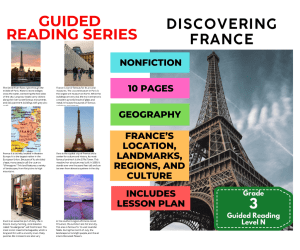
Discovering France: Guided Reading Level N with Lesson Plan
ELA, Resources for Teachers, Reading Comprehension, Reading, Science, Language Development, Vocabulary, Geography, Social Studies, Technology, Grade 2, 3, 4, Worksheets & Printables, Worksheets, Teacher Tools, Centers, Activities, Literacy Readers, Quizzes, Quizzes and Tests, Assessments, Lesson Plans
This Discovering France (level n) guided reading book with lesson plan includes: Guided Reading Color Label (front cover x1) This is a quick way to match the book’s demands to what students can generally handle.. The overall goal is to use the level/color to pick books for several smaller groups. To qualify for a certain level, a student is expected to read a book from that level with about 90–94% accuracy. If a student is consistently accurate and understands, move up a level. If the student is struggling at that level, drop down and add more support. Each student will improve at completely different rates, but it is generally one of the best ways to check progress across the class. DOWNLOAD THE CATALOG TO VIEW ALL GUIDED READING BOOKS AVAILABLE (SORTED LEVELS A-Z) Pre-Reading Question (x1) Teacher asks the prompt aloud, can be while showing the cover or first page. Students share what they already know, or make educated guesses from the cover. Prompt them to use the target vocabulary. Write some of their responses on the board to look back at during the reading. Vocabulary Words (x5) Introduce the five words, best doing it one at a time. Start by saying it, while students repeat and then see if anyone knows what it means before reading further. Read through the meaning and try to briefly connect each word to a picture or gesture so it’s meaningful. Ask students to flip through the book pages and point to where they see each of the vocabulary words. While reading the book pause upon coming across one of the vocab words or read the sentence twice to make sure students understand the word has appeared. Optional: Ask students to raise hands whenever they see/hear one of the new words. Guided Reading Pages (x10) Check the book snapshot (below) for: primary topic - do you need to prep extra reading or intro materials on this? what is taught best - decide on 1-2 bullets to focus on, use the prompt or words provided here for best results. learning goals - what you are checking for students to be able to do after the session, elicit answers using prompts or words provided. key vocabulary (see section above). questions overview - so you know what is coming up and if you need to prep extra materials to assist understanding. Run the lesson You may have already looked at a few of the pages together, but you can show them some of the pictures again first to set meaning. Depending on how much time you have and how familiar your students are with guided reading class, you may want to read the book aloud first with the group first. Students whisper or partner read, while you listen in. If time, do it as a group, one student reading a page each. Use the guided page’s prompts to coach: “Check the picture / does it make sense?” “Point under the words / try the first sound” “Reread the sentence smoothly”. Try to focus more on one student per session (rotating every time), so you can work out if they are ready to move up or need to move down a level. Comprehension Questions (back cover x3) This is your way to check that students didn’t just say the words, but actually understood the text. First, let students answer by pointing to the page/picture and saying a short sentence. After any answer, follow with: “Show me where you found that in the text.” In bigger groups, have partners answer first (10–20 seconds), then call on 2–3 students to share. Differentiation tips: Emerging speakers/struggling readers: oral + pointing On-level: oral in a full sentence Higher: one written sentence or draw + label Book Snapshot Title: Discovering France Genre: Nonfiction Subject: Social Studies (Geography/Culture) Primary Topic: France’s location, landmarks, regions, and culture Estimated Guided Reading Level (A–Z): N What This Book Teaches Best Geography basics about France , including where it is located and how its shape leads to a nickname. Key places and landmarks in Paris , such as the Eiffel Tower, the Seine River, and the Louvre Museum. Regional features of France by describing Provence, the French Alps, the French Riviera, and the Loire Valley. French culture and daily life , especially food traditions like boulangeries, baguettes, and croissants. Modern transportation in France , focusing on the TGV high-speed train and what it allows people to do. Learning Goals Students will identify where France is located and explain why it is called “L’Hexagone.” Students will describe at least two facts about Paris, including details about the Eiffel Tower. Students will explain how the Seine River is described and what people can see from boats on the river. Students will describe characteristics of at least two French regions (Provence, the Alps, the Riviera, or the Loire Valley) using details from the text. Students will describe examples of French culture from the text, including food and museums. Students will explain what the TGV is and how it changes travel across France. Key Vocabulary From the Text landmark — a famous place many people recognize. massive — very big. coastline — the land’s edge next to the sea. lavender — a purple plant/flower that can smell sweet. transportation — ways people travel from place to place. Discussion Prompts Pre-reading question: What do you already know about France, and what would you like to learn? Comprehension questions: Where does the text say France is located, and what nickname do some people give it because of its shape? Comprehension questions: What does the text tell you about the Eiffel Tower (such as when it was built or how tall it is)? Comprehension questions: Choose one region from the book (Provence, the French Alps, the French Riviera, or the Loire Valley) and describe two details the text gives about it. Printing Tips 1. Best Printing Method (Recommended) “Booklet” Printing (Best if Available) If your printer or PDF viewer supports Booklet Printing , use this. Settings to use: Print mode: Booklet Paper size: Letter or A4 (either works) Orientation: Landscape Print on both sides: Yes Flip on: Short edge Scaling: Fit to printable area Booklet subset: First test: Front sides only Then: Back sides only This will automatically: Pair pages correctly Put the cover on the outside Align everything for folding After printing, fold in half and staple along the spine . 2. If “Booklet” Printing Is NOT Available You can still print this correctly with manual duplex printing . Step-by-step: Open the PDF. Choose Print . Set: Orientation: Landscape Pages per sheet: 1 Print on both sides: Yes Flip on: Short edge Print all pages . Because each PDF page already contains two facing book pages, the result will still fold cleanly into a book. Thousands of Cored Education products are included with your TeachSimple membership. Download links and encyclopedia index available here.
Author Cored Education
Rating
Tags Reading Comprehension, Reading Passages, Reading, Guided Reading, Guided Reading Lesson Plan, Guided Reading Activity, Pre-reading, Social Studies, Geography, Technology

ESL Lesson Plan on Bullying - Cyberbullying
ELA, Reading, Reading Comprehension, Language Development, ESL, Writing, Creative Writing, Vocabulary, Grade 7, 8, 9, 10, 11, 12, Teacher Tools, Lesson Plans
ESL Lesson Plan on Bullying - Cyberbullying This ESL EFL Lesson Plan on Bullying and Cyberbullying (PDF Digital Lesson 15 slides + answer key) can be Great to help stimulate English Learning within Newcomers or any English as a Second Language Student. Ideal participants for this Activity are Foreign Languages Students at Middle School and early High School (teens). This Product can also be Great for ESL Centers Abroad and ESL Tutors or private teachers. This ESL EFL TESOL TEFL Lesson Plan on Bullying and Cyberbullying can be more than great for intermediate, advanced English as a Second or Foreign Language Students. This Stimulating ESL EFL Lesson Plan on Bullying and Cyberbullying (15 slides + Answer Keys in the last slide) includes: 1 Introduction to Bullying 1 Warm-Up Picture Description ESL EFL TESOL Activity given of 4 scenes (boy bullying a girl + dark skinned girl being isolated by other girls + a boy browsing harful comments on his phone + a kid and his family at a therapist) 1 Listening comprehension Activity (with answers keys in the last slide) with QR Code-Linked YouTube Video 1 Writing Activity with 2 Essay Prompts (writing about the importance of telling one's experiences with bullying and the reasons this topic shouldn't be be avoided + writing about the ways one can stand against bullying) This ESL, EFL, TESOL, TEFL PDF Digital Teaching Resource Lesson Plan on Bullying and Cyberbullying (15 slides + answer keys in the last slide) can be great for Intermediate Advanced English as a second or foreign language learners. Its aim is to make students exercise and improve their Listening comprehesion and Writing English as a second language Skills. Learning with Alan is a Brand New Teaching Resources Store whose aim is to help English as a Second or foreign Language Teachers, Educators and Tutors (be it online or offline) to achieve their teaching objectives while creating a fun and stimulating environment. Never Forget! Learning is fun, So should English! Always If you want to browse more of my PDF ESL, EFL, TESOL Teaching Resources, click here Learning with Alan!
Author Learning with Alan
Tags ESL, Bullying, Cyberbullying, Anti Bullying, English, Lesson Plan, Listening, Writing, Essay, Comprehension
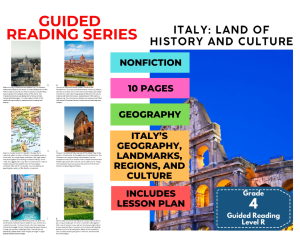
Italy History and Culture: Guided Reading Level R with Lesson Plan
ELA, Resources for Teachers, Reading Comprehension, Reading, Science, Geography, Social Studies, History, Earth and Environmental Sciences, Technology, Grade 3, 4, 5, Worksheets & Printables, Worksheets, Teacher Tools, Centers, Activities, Literacy Readers, Quizzes, Quizzes and Tests, Assessments, Lesson Plans
This Germany: The Heart of Europe (level r) guided reading book with lesson plan includes: Guided Reading Color Label (front cover x1) This is a quick way to match the book’s demands to what students can generally handle.. The overall goal is to use the level/color to pick books for several smaller groups. To qualify for a certain level, a student is expected to read a book from that level with about 90–94% accuracy. If a student is consistently accurate and understands, move up a level. If the student is struggling at that level, drop down and add more support. Each student will improve at completely different rates, but it is generally one of the best ways to check progress across the class. DOWNLOAD THE CATALOG TO VIEW ALL GUIDED READING BOOKS AVAILABLE (SORTED LEVELS A-Z) Pre-Reading Question (x1) Teacher asks the prompt aloud, can be while showing the cover or first page. Students share what they already know, or make educated guesses from the cover. Prompt them to use the target vocabulary. Write some of their responses on the board to look back at during the reading. Vocabulary Words (x5) Introduce the five words, best doing it one at a time. Start by saying it, while students repeat and then see if anyone knows what it means before reading further. Read through the meaning and try to briefly connect each word to a picture or gesture so it’s meaningful. Ask students to flip through the book pages and point to where they see each of the vocabulary words. While reading the book pause upon coming across one of the vocab words or read the sentence twice to make sure students understand the word has appeared. Optional: Ask students to raise hands whenever they see/hear one of the new words. Guided Reading Pages (x10) Check the book snapshot (below) for: primary topic - do you need to prep extra reading or intro materials on this? what is taught best - decide on 1-2 bullets to focus on, use the prompt or words provided here for best results. learning goals - what you are checking for students to be able to do after the session, elicit answers using prompts or words provided. key vocabulary (see section above). questions overview - so you know what is coming up and if you need to prep extra materials to assist understanding. Run the lesson You may have already looked at a few of the pages together, but you can show them some of the pictures again first to set meaning. Depending on how much time you have and how familiar your students are with guided reading class, you may want to read the book aloud first with the group first. Students whisper or partner read, while you listen in. If time, do it as a group, one student reading a page each. Use the guided page’s prompts to coach: “Check the picture / does it make sense?” “Point under the words / try the first sound” “Reread the sentence smoothly”. Try to focus more on one student per session (rotating every time), so you can work out if they are ready to move up or need to move down a level. Comprehension Questions (back cover x3) This is your way to check that students didn’t just say the words, but actually understood the text. First, let students answer by pointing to the page/picture and saying a short sentence. After any answer, follow with: “Show me where you found that in the text.” In bigger groups, have partners answer first (10–20 seconds), then call on 2–3 students to share. Differentiation tips: Emerging speakers/struggling readers: oral + pointing On-level: oral in a full sentence Higher: one written sentence or draw + label Book Snapshot Title: Italy: Land of History and Culture Genre: Nonfiction Subject: Social Studies (Geography/History/Culture) Primary Topic: Italy’s geography, landmarks, regions, and culture Estimated Guided Reading Level (A–Z): R What This Book Teaches Best Describes Italy’s location and physical geography , including its peninsula shape, the Alps, and the Mediterranean Sea. Highlights important historical landmarks and what they represent, such as the Colosseum and the Vatican City/St. Peter’s Basilica. Connects history to art and architecture through Florence and the Renaissance, including the Duomo’s engineering. Explains regional life and land use , including Tuscany’s landscape and agriculture (olive oil, grapes, ingredients for cooking). Shows how Italy blends past and present , from Pompeii and Mount Vesuvius to modern fashion, design, technology, cars, and trains. Learning Goals Students will describe Italy’s location and explain how the text describes its shape. Students will identify key facts about Rome and explain what the text says the Colosseum symbolizes today. Students will describe why Vatican City is important using details from the text. Students will explain why Florence is called the “Cradle of the Renaissance” using text details about arts and learning. Students will describe how Venice’s canals affect transportation in the city. Students will explain one way Italy influences the world today, based on the text’s examples of modern industry and innovation. Key Vocabulary From the Text peninsula — land surrounded by water on three sides. amphitheater — large open building for watching public events. Renaissance — time when art, science, and literature flourished. gondolas — long narrow boats used to travel Venice’s canals. archaeological — about studying the past by examining old remains. Discussion Prompts Pre-reading question: What places or foods do you already connect with Italy? Comprehension questions: What shape does the text say Italy resembles? Comprehension questions: What does the text say the Colosseum could hold in ancient times? Comprehension questions: What does the text say caused the Leaning Tower of Pisa to start tilting? Printing Tips 1. Best Printing Method (Recommended) “Booklet” Printing (Best if Available) If your printer or PDF viewer supports Booklet Printing , use this. Settings to use: Print mode: Booklet Paper size: Letter or A4 (either works) Orientation: Landscape Print on both sides: Yes Flip on: Short edge Scaling: Fit to printable area Booklet subset: First test: Front sides only Then: Back sides only This will automatically: Pair pages correctly Put the cover on the outside Align everything for folding After printing, fold in half and staple along the spine . 2. If “Booklet” Printing Is NOT Available You can still print this correctly with manual duplex printing . Step-by-step: Open the PDF. Choose Print . Set: Orientation: Landscape Pages per sheet: 1 Print on both sides: Yes Flip on: Short edge Print all pages . Because each PDF page already contains two facing book pages, the result will still fold cleanly into a book. Thousands of Cored Education products are included with your TeachSimple membership. Download links and encyclopedia index available here.
Author Cored Education
Rating
Tags Reading Comprehension, Reading Passages, Reading, Guided Reading, Guided Reading Lesson Plan, Guided Reading Activity, Pre-reading, Social Studies, Geography, History

Sharp Cookie | Figurative Language Activity | Micro-Learning Deck
ELA, Reading, Reading Comprehension, Grade 4, 5, 6, 7, Teacher Tools, Lesson Plans
Sharp Cookie | Figurative Language Activity | Micro-Learning Deck Sharp Cookie | Figurative Language Activity | Micro-Learning Deck is an interactive teaching resource meticulously tailored to enhance students' understanding of figurative language. This thoughtfully designed tool envelopes concepts in a playful and enlightening wrapper, making the learning experience enjoyable, insightful and enduring. The resource encompasses a micro-learning deck for students from grades four through seven studying Language Arts. Predominantly, it focuses on the figurative language term 'Sharp Cookie', providing an exciting avenue for young learners to appreciate and adopt this concept within their lexical repository. Teachers can derive immense educational value from using this tool during whole group lessons or breaking it down into smaller segments for small group work. A comprehension-friendly format enables independent exploration by students, allowing teachers to distribute parts of it as homework assignments. Main Components: Built of 13 ready-display slides in PowerPoint format. Involves engaging elements such as video lessons explaining the core concept: 'figurative language'. A reading passage with audio support allows young minds to dive deep into the written material while organically soaking in auditory palpitations—a powerful combination amplifying comprehension rates manifold. To ensure that pupils have understood every bit of knowledge disseminated through this toolset, quick write activities are included within each unit - providing a fertile ground for applying learned concepts along with stimulating creativity. In essence, Sharp Cookie | Figurative Language Activity | Micro-Learning Deck can serve as both comprehensive lesson plans or supplementary resources within any traditional or homeschooling setup aiming to actualize superior education standards.
Author Teach Me This
Tags Figurative Language, Micro-learning, Interactive Teaching, Language Arts, Understanding
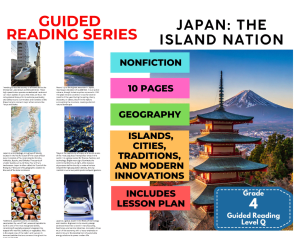
Japan The Island Nation: Guided Reading Level Q with Lesson Plan
ELA, Resources for Teachers, Reading Comprehension, Reading, Science, Geography, Social Studies, History, Earth and Environmental Sciences, Technology, Grade 3, 4, 5, Worksheets & Printables, Worksheets, Teacher Tools, Centers, Activities, Literacy Readers, Quizzes, Quizzes and Tests, Assessments, Lesson Plans
This Japan: The Island Nation (level q) guided reading book with lesson plan includes: Guided Reading Color Label (front cover x1) This is a quick way to match the book’s demands to what students can generally handle.. The overall goal is to use the level/color to pick books for several smaller groups. To qualify for a certain level, a student is expected to read a book from that level with about 90–94% accuracy. If a student is consistently accurate and understands, move up a level. If the student is struggling at that level, drop down and add more support. Each student will improve at completely different rates, but it is generally one of the best ways to check progress across the class. DOWNLOAD THE CATALOG TO VIEW ALL GUIDED READING BOOKS AVAILABLE (SORTED LEVELS A-Z) Pre-Reading Question (x1) Teacher asks the prompt aloud, can be while showing the cover or first page. Students share what they already know, or make educated guesses from the cover. Prompt them to use the target vocabulary. Write some of their responses on the board to look back at during the reading. Vocabulary Words (x5) Introduce the five words, best doing it one at a time. Start by saying it, while students repeat and then see if anyone knows what it means before reading further. Read through the meaning and try to briefly connect each word to a picture or gesture so it’s meaningful. Ask students to flip through the book pages and point to where they see each of the vocabulary words. While reading the book pause upon coming across one of the vocab words or read the sentence twice to make sure students understand the word has appeared. Optional: Ask students to raise hands whenever they see/hear one of the new words. Guided Reading Pages (x10) Check the book snapshot (below) for: primary topic - do you need to prep extra reading or intro materials on this? what is taught best - decide on 1-2 bullets to focus on, use the prompt or words provided here for best results. learning goals - what you are checking for students to be able to do after the session, elicit answers using prompts or words provided. key vocabulary (see section above). questions overview - so you know what is coming up and if you need to prep extra materials to assist understanding. Run the lesson You may have already looked at a few of the pages together, but you can show them some of the pictures again first to set meaning. Depending on how much time you have and how familiar your students are with guided reading class, you may want to read the book aloud first with the group first. Students whisper or partner read, while you listen in. If time, do it as a group, one student reading a page each. Use the guided page’s prompts to coach: “Check the picture / does it make sense?” “Point under the words / try the first sound” “Reread the sentence smoothly”. Try to focus more on one student per session (rotating every time), so you can work out if they are ready to move up or need to move down a level. Comprehension Questions (back cover x3) This is your way to check that students didn’t just say the words, but actually understood the text. First, let students answer by pointing to the page/picture and saying a short sentence. After any answer, follow with: “Show me where you found that in the text.” In bigger groups, have partners answer first (10–20 seconds), then call on 2–3 students to share. Differentiation tips: Emerging speakers/struggling readers: oral + pointing On-level: oral in a full sentence Higher: one written sentence or draw + label Book Snapshot Title: Japan: The Island Nation Genre: Nonfiction Subject: Social Studies (Geography/Culture) Primary Topic: Japan’s islands, cities, traditions, and modern innovations Estimated Guided Reading Level (A–Z): Q What This Book Teaches Best Explains Japan’s geography as an archipelago , naming the four main islands and describing its location off East Asia. Highlights Tokyo as a major metropolitan area , describing its role and features of city life. Describes transportation and technology through the Shinkansen (bullet train), including its speed, safety, and punctuality. Connects landforms and natural features to Japan’s identity by describing Mount Fuji, snow cover, and spring sakura blossoms. Builds understanding of culture and history through Shinto and Buddhism, matsuri festivals, and the Edo period (shoguns, samurai, and castles like Himeji). Learning Goals Students will explain what an archipelago is and name Japan’s four main islands. Students will describe Tokyo’s importance and identify details the text gives about the city. Students will explain how the Shinkansen helps people travel and identify key features the text highlights (such as speed or punctuality). Students will describe Mount Fuji using details from the text, including its height and volcanic history. Students will identify key ideas about Japanese traditions from the text (religions, shrines/torii, cuisine, or festivals). Students will explain how Japan’s climate varies and describe the text’s example of the “snow monkey” in winter. Key Vocabulary From the Text archipelago — a group of islands. metropolitan — related to a very large city area. punctuality — being on time. terraced — built in step-like levels on a hillside. geothermal — heat that comes from inside the Earth. Discussion Prompts Pre-reading question: What places, traditions, or inventions do you expect to learn about in Japan? Comprehension questions: What four main islands does the text name as part of Japan? Comprehension questions: What does the text say the Shinkansen is known for? Comprehension questions: How does the text say the “snow monkey” adapts to cold winters? Printing Tips 1. Best Printing Method (Recommended) “Booklet” Printing (Best if Available) If your printer or PDF viewer supports Booklet Printing , use this. Settings to use: Print mode: Booklet Paper size: Letter or A4 (either works) Orientation: Landscape Print on both sides: Yes Flip on: Short edge Scaling: Fit to printable area Booklet subset: First test: Front sides only Then: Back sides only This will automatically: Pair pages correctly Put the cover on the outside Align everything for folding After printing, fold in half and staple along the spine . 2. If “Booklet” Printing Is NOT Available You can still print this correctly with manual duplex printing . Step-by-step: Open the PDF. Choose Print . Set: Orientation: Landscape Pages per sheet: 1 Print on both sides: Yes Flip on: Short edge Print all pages . Because each PDF page already contains two facing book pages, the result will still fold cleanly into a book. Thousands of Cored Education products are included with your TeachSimple membership. Download links and encyclopedia index available here.
Author Cored Education
Rating
Tags Reading Comprehension, Reading Passages, Reading, Guided Reading, Guided Reading Lesson Plan, Guided Reading Activity, Pre-reading, Social Studies, Geography, History
Guided Reading Activities and Lesson Plans Fiction Set 1 - Animals
ELA, Reading, Reading Comprehension, Common Core, ESL, Language Development, Pre-Reading, Vocabulary, Resources for Teachers, Grade 4, 5, Worksheets & Printables, Worksheets, Teacher Tools, Lesson Plans
Guided Reading Activities with Lesson Plans Fiction Set 1 Note: This download DOES NOT include the passages themselves. If you have not already done so, download in a format of your choice in the "reading links" section below. Overview The perfect companion materials for Cored Education reading comprehension downloads. This collection provides structured lessons designed to enhance students' reading, comprehension, vocabulary, and creative thinking. Each lesson follows a consistent format that includes pre-reading activities to engage students, vocabulary-building exercises, comprehension checks, creative writing prompts, and discussion topics that promote critical thinking. The lessons are designed to foster active participation, encourage reflection, and develop key literacy skills through interactive and immersive learning experiences. The series is ideal for guided reading sessions, providing teachers with a comprehensive toolkit to engage students in both individual and group activities, enhancing their understanding of text and expanding their language skills. Includes Guided Reading Materials For: 1.Donny's Glasses 2.Hare & Bear 3.Maggie's Turtle 4.New Pup 5.Naughty Cat 6.Ella's Baseball Bat 7.Ola the Rabbit 8.Ethan and the Puppies 9.Endangered Animals 10.Chinese New Year Reading Links: This is the guided reading materials version and DOES NOT include the passages themselves. The passages related to this download are available here in GOOGLE Docs, GOOGLE Forms, GOOGLE Slides. PDF, PPT, WORD. Google Docs Google Forms Google Slides PDF PPT Word Key Features: Engaging Lesson Structure: Each lesson follows a clear and predictable format, which includes pre-reading discussions, vocabulary exercises, reading activities, and creative tasks to maintain student engagement. Vocabulary Development: Focus on introducing and applying new vocabulary in context, helping students internalize new words and use them effectively. Comprehension and Reflection: The lessons include comprehension questions and reflective prompts that encourage students to think critically about the text and its themes. Creative Writing and Discussion: Opportunities for students to express themselves through writing and group discussions, reinforcing their understanding while fostering creativity. Interactive and Student-Centered: The activities are designed to be interactive, allowing students to engage directly with the content and each other, promoting active learning. Browse the Complete Cored Catalog — 2,000+ Resources Included Reading Passages Each reading passage has been written specifically for students in Grades 4–5, using vocabulary and language that match their age and ability level. The collection covers a wide range of engaging topics, supported by colorful visuals that help bring the content to life. Every lesson is designed to build knowledge while keeping students interested and motivated to read. These resources are also designed with flexibility in mind. Unlike traditional textbooks that can quickly become outdated, lessons can be updated over time to reflect changes in technology, discoveries, and the world around us. Mixed Questions Every lesson includes a variety of questions that help students think more deeply about what they have read. The question section combines reading comprehension, vocabulary, and math skills, while also regularly reinforcing important reading strategies such as cause and effect, summarizing, compare and contrast, and drawing conclusions. Most lessons include a mix of multiple-choice and written-response questions, giving students opportunities to explain their thinking as well as select answers. Complete answer keys and sample responses are provided at the end of each lesson for quick and easy reference. Spelling & Vocabulary Each passage introduces students to useful words and phrases appropriate for Grades 4–5. To help build confidence and word knowledge, every lesson includes a spelling or vocabulary activity. Rather than repeating the same task throughout the collection, activities vary from lesson to lesson to keep practice fresh and engaging. Activities may include spelling challenges, sentence matching, decoding activities, mixed-up text exercises, and other vocabulary-building tasks connected directly to the reading. Writing Prompts Each lesson includes a writing activity that extends the ideas, themes, or topics explored in the passage. Students are encouraged to write in a variety of formats, with prompts providing helpful guidance and ideas to get them started. Writing tasks vary throughout the collection and may include creative writing, research activities, personal responses, poetry, opinion writing, and other engaging assignments. Full Answer Keys Complete answer keys and sample responses are included with every lesson, making planning and marking quicker and easier. Reading comprehension answers include evidence and support from the text, while math-based questions show the relevant working where appropriate. The answer keys are designed primarily for teachers but can also be shared with students when needed. Just for Fun Each lesson finishes with an optional extension activity called Just for Fun . These bonus activities provide an enjoyable way to extend learning beyond the main lesson and often encourage creativity, discussion, or independent thinking. They are completely optional, giving you the flexibility to use the activities that best suit your students and classroom needs. For similar downloads and other frees, do check out Cored Group on TeachSimple.
Author Cored Education
Rating
Tags Elementary, Reading, Comprehension, Vocabulary, Answers, Ccss, Guided Reading, Guided Reading Activity, Guided Reading Lesson Plans, Guided Reading Lesson Plan

AI Ethics for Young Learners - Artificial Intelligence Book
Strategies, Reading, ELA, Reading Comprehension, Research, Technology, Science, Computer Science, Engineering, STEM, Grade 3, 4, 5, 9, 10, 11, 12, Activities, Projects, Teacher Tools, Assessments, Lesson Plans, Literacy Readers, Outlines, Rubrics, Writing Prompts, Worksheets & Printables
Unravel the fascinating realm of artificial intelligence through "AI Ethics for Young Learners - Artificial Intelligence," an all-inclusive textbook crafted to inculcate AI concepts and ethical values in young minds in an interesting and young-friendly manner. Offering in-depth information starting from AI in daily life examples such as assistants and video games to more complex topics such as biased computer algorithms, issues of data privacy, fundamental concepts of cybersecurity, and AI use, this SEO-friendly kids’ book is most suited to class 4 to class 12 settings, providing young minds with empowerment to learn AI basics, identify ethical issues, and become responsible digital participants. With 90 chapters spread throughout AI learning patterns in young minds, ethical issues in decision-making algorithms, robot AI while maintaining system security, program accountability in AI, and AI in the coming age of medicine, creativity, and environmental protection, this AI book by subject experts is ideal to disrupt young minds with AI-related critical thinking skills through practical AI examples and ethical tales of AI adventures in society. Tags: AI ethics education in kids, AI textbook in classroom education, AI education in teen brains, ethical AI learning book, classroom learning books in grade 4 to grade12 levels. Why Parents/Schools Love It: Engaging and Age-Appropriate Content: Reduces complex AI and ethics topics to simple and relatable stories and examples that hold the attention of young learners without causing an overload. Encourages Critical Thinking and Responsibility: Students learn to second-guess AI decisions, to perceive bias, and to claim responsibility for their actions as advocates for the appropriate use of technology in daily life. Comprehensive Curriculum Support: With 90 chapters, it leads the students from the basics of AI through advanced ethical dilemmas; perfect for STEM lessons, homeschooling, or classroom discussions. Values and Safety: Stressing the importance of privacy, fairness, and human judgment in AI-all important to giving parents peace of mind that aligns with family values. Inspires Innovation: This lets the kids come up with their own ethical AI ideas and concepts, which can trigger their innovative thinking to make them future-ready in the tech arena. Targeted Classes for Students : It can be seen from the thorough evaluation of the contents and suitability of the material in the book that it is ideally suited for students from grades 4 through 12 as mentioned in the title page. The contents begin with explanatory pieces that are simple and accessible in terms of the examples they use such as “What is Artificial Intelligence?" and examples such as smart assistants in basic forms for earlier grades (4-6), then move into advanced examples such as bias in algorithms, the issue of privacy laws and cybersecurity threats and ethical problem-solving for advanced students from grades 7-12. The text is written in simple sentences and analogies (as in the explanation given in “How A.I. Learns Like Playing a Game"), and sophisticated technical terms are avoided in this manner and can be suited for the entire spectrum mentioned. Copyright/Terms of Use : This Book was copyrighted by Syed Hammad Rizvi. Please do not give out or sell copies of this resource or any part of it. Furthermore, do not post this resource on the Internet in such a way that people can download this resource. By the way, you can modify this resource, but only for your personal or school-class usage. Please note that if you would like to share this resource with your peers, licensing options for additional copies are available via Teachsimple. Thank you for your compliance with this usage agreement. This product is delightedly presented to you by Syed Hammad Rizvi
Author Creative Book Store
Rating
Tags AIEthicsForKids, ArtificialIntelligenceBook, AIEducationForTeens, EthicalAIForYoungLearners, STEMBooksForStudents, AIBasicsForGrades4to12, DataPrivacyForKids, BiasInAIExplained, ResponsibleTechForYouth, AIAndEthicsCurriculum
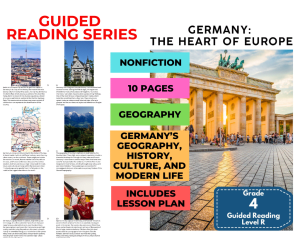
Germany: The Heart of Europe: Guided Reading Level R with Lesson Plan
ELA, Resources for Teachers, Reading Comprehension, Reading, Science, Geography, Social Studies, History, Earth and Environmental Sciences, Technology, Grade 3, 4, 5, Worksheets & Printables, Worksheets, Teacher Tools, Centers, Activities, Literacy Readers, Quizzes, Quizzes and Tests, Assessments, Lesson Plans
This Germany: The Heart of Europe (level r) guided reading book with lesson plan includes: Guided Reading Color Label (front cover x1) This is a quick way to match the book’s demands to what students can generally handle.. The overall goal is to use the level/color to pick books for several smaller groups. To qualify for a certain level, a student is expected to read a book from that level with about 90–94% accuracy. If a student is consistently accurate and understands, move up a level. If the student is struggling at that level, drop down and add more support. Each student will improve at completely different rates, but it is generally one of the best ways to check progress across the class. DOWNLOAD THE CATALOG TO VIEW ALL GUIDED READING BOOKS AVAILABLE (SORTED LEVELS A-Z) Pre-Reading Question (x1) Teacher asks the prompt aloud, can be while showing the cover or first page. Students share what they already know, or make educated guesses from the cover. Prompt them to use the target vocabulary. Write some of their responses on the board to look back at during the reading. Vocabulary Words (x5) Introduce the five words, best doing it one at a time. Start by saying it, while students repeat and then see if anyone knows what it means before reading further. Read through the meaning and try to briefly connect each word to a picture or gesture so it’s meaningful. Ask students to flip through the book pages and point to where they see each of the vocabulary words. While reading the book pause upon coming across one of the vocab words or read the sentence twice to make sure students understand the word has appeared. Optional: Ask students to raise hands whenever they see/hear one of the new words. Guided Reading Pages (x10) Check the book snapshot (below) for: primary topic - do you need to prep extra reading or intro materials on this? what is taught best - decide on 1-2 bullets to focus on, use the prompt or words provided here for best results. learning goals - what you are checking for students to be able to do after the session, elicit answers using prompts or words provided. key vocabulary (see section above). questions overview - so you know what is coming up and if you need to prep extra materials to assist understanding. Run the lesson You may have already looked at a few of the pages together, but you can show them some of the pictures again first to set meaning. Depending on how much time you have and how familiar your students are with guided reading class, you may want to read the book aloud first with the group first. Students whisper or partner read, while you listen in. If time, do it as a group, one student reading a page each. Use the guided page’s prompts to coach: “Check the picture / does it make sense?” “Point under the words / try the first sound” “Reread the sentence smoothly”. Try to focus more on one student per session (rotating every time), so you can work out if they are ready to move up or need to move down a level. Comprehension Questions (back cover x3) This is your way to check that students didn’t just say the words, but actually understood the text. First, let students answer by pointing to the page/picture and saying a short sentence. After any answer, follow with: “Show me where you found that in the text.” In bigger groups, have partners answer first (10–20 seconds), then call on 2–3 students to share. Differentiation tips: Emerging speakers/struggling readers: oral + pointing On-level: oral in a full sentence Higher: one written sentence or draw + label Book Snapshot Title: Germany: The Heart of Europe Genre: Nonfiction Subject: Social Studies (Geography/Culture/History) Primary Topic: Germany’s geography, history, culture, and modern life Estimated Guided Reading Level (A–Z): R What This Book Teaches Best Germany’s central location in Europe and how that makes it a crossroads for trade, travel, and cultural exchange. Physical geography and waterways , including the Bavarian Alps and the Rhine River’s role in transportation. History meeting modern life through Berlin’s past division (Berlin Wall) and the Brandenburg Gate as a symbol of reunification. Cultural traditions , including long-held festivals, music (Bach and Beethoven), and traditional clothing like lederhosen and dirndls. Modern strengths and priorities , such as engineering/technology, renewable energy, public transportation, and environmental conservation. Learning Goals Students will describe where Germany is located in Europe and explain why its location matters in the text. Students will identify major physical features of Germany (plains, mountains, or the Bavarian Alps) using details from the text. Students will explain why the text says rivers like the Rhine are important for moving goods between cities. Students will describe Berlin as the capital and explain one way the text shows history and modern life together there. Students will describe what the text says about castles from the Middle Ages and what they are used for today. Students will identify examples of Germany today (technology/engineering, renewable energy, conservation, education, or democracy) using text evidence. Key Vocabulary From the Text crossroads — central meeting place where routes and people connect. metropolis — a very large, busy city. reunification — joining back together after being separated. renewable — energy source replaced naturally, like wind or sun. conservation — protecting nature so it stays healthy for the future. Discussion Prompts Pre-reading question: What kinds of facts do you think a book about Germany might teach you? Comprehension questions: Why does the text say Germany is a major crossroads within the European Union? Comprehension questions: What does the text say the Brandenburg Gate represents today? Comprehension questions: What is one way the text says Germany works to protect the climate? Printing Tips 1. Best Printing Method (Recommended) “Booklet” Printing (Best if Available) If your printer or PDF viewer supports Booklet Printing , use this. Settings to use: Print mode: Booklet Paper size: Letter or A4 (either works) Orientation: Landscape Print on both sides: Yes Flip on: Short edge Scaling: Fit to printable area Booklet subset: First test: Front sides only Then: Back sides only This will automatically: Pair pages correctly Put the cover on the outside Align everything for folding After printing, fold in half and staple along the spine . 2. If “Booklet” Printing Is NOT Available You can still print this correctly with manual duplex printing . Step-by-step: Open the PDF. Choose Print . Set: Orientation: Landscape Pages per sheet: 1 Print on both sides: Yes Flip on: Short edge Print all pages . Because each PDF page already contains two facing book pages, the result will still fold cleanly into a book. Thousands of Cored Education products are included with your TeachSimple membership. Download links and encyclopedia index available here.
Author Cored Education
Rating
Tags Reading Comprehension, Reading Passages, Reading, Guided Reading, Guided Reading Lesson Plan, Guided Reading Activity, Pre-reading, Social Studies, Geography, History

Get Out of Town | Figurative Language Activity | Micro-Learning Deck
ELA, Reading, Reading Comprehension, Grade 4, 5, 6, 7, Teacher Tools, Lesson Plans
Get Out of Town | Figurative Language Activity | Micro-Learning Deck This is a unique resource designed to bolster students' comprehension skills in figurative language, focusing on the phrase Get Out of Town. Suitable for grade levels four through seven, it can be used as an introduction tool, reinforcement instrument or extension activity for language arts instruction. With its interactive nature, it's adaptable to diverse learners and education settings. The Unique Features: Mix of teaching techniques: video lessons, reading passages with audio support, writing activities and comprehension tasks. Akin to different learning styles: auditory learners can utilize sound clips while visual learners have text available. Strays from rote learning and encourages creativity with quick writing tasks. At the core lies a 13-slide PowerPoint presentation, suitable for whole-group lessons or individual use on students' devices. Each slide is crafted to stimulate thinking and curiosity about the topic without overwhelming cognitive load. Hallmarks: Narrow focus contents ensuring deeper understanding of figurative language A variety of tasks like close reading exercises that enhance literacy skills and vocabulary expansion 'Get Out Of Town' , an idiomatic expression being the highlight here - best understood via these focused exercises. The concise nature ensures no unnecessary information that typically tends a busy teacher towards skimming behaviour! Presents enough flexibility so educators may choose how they want to incorporate parts or entire module into lesson plans – suited for homework assignments or self-paced learning plans. ; "A flawless teaching aid promoting higher-order thinking skills without fuss.";
Author Teach Me This
Tags Figurative Language, Comprehension Skills, Idiomatic Expressions, Literacy Skills, Interactive Resource
Gliders Reading Comprehension Passage - Cored Ed Encyclopedia
ELA, Reading Comprehension, Reading, Science, Technology, Pre-Reading, Language Development, Physics, History, Social Studies, Grade 2, 3, 4, 5, Worksheets & Printables, Worksheets, Teacher Tools, Centers, Activities, Writing Prompts, Assessments, Quizzes and Tests, Quizzes, Lesson Plans
This gliders reading comprehension with lesson plan includes: Visualization (on the front cover) Start your lesson by taking a minute to think and share something about the topic. Read the script aloud (slowly), perhaps prepare some music or sound effects. Student close their eyes and let their imaginations wander. Students open their eyes, read the question aloud and give them a few minutes to complete. Ask a few students to share or keep answers until the end to compare with what they learn in the passage. Quick pause—thousands of Cored Education products are included with your TeachSimple membership. Download links and encyclopedia index available here. Pre-Reading Trivia Students will write down one thing they already know about the subject and then read five more facts and discuss. These facts are fun, and the students will enjoy learning about the subject before reading more. Give 1 minute for students to write what they already know (no pressure—best guess is fine). Read the five facts together. After each fact, do ask a student for their opinion, was it surprising? Set a purpose by asking students to highlight/underline one fact they want to learn more about during the reading. Reading Passage The text is a high-interest reading passage with set paragraphs, roughly three to four paragraphs long. It contains a variety of themes about the topic, anywhere from history to technology. The passage is between 250 and 350 words in length. First, ask students to look at the headings and see what they’ll learn about today. What do they know about the topic/heading? First read options: Teacher read-aloud (best for support). Partner reading (paragraph by paragraph). While reading, students underline important details, and vocabulary words they think may come up in the questions section. Mixed Questions The first question page contains four multiple-choice questions, each with a choice of four answers, and three written response questions that require a sentence or two from the student. Students complete the mcqs first independently, then review quickly as a class. For the 3 written responses, try to get students giving the answer with some form of evidence: “I think ___ because the text says ___.” If students get stuck, send them back to check the passage. Vocabulary Questions Practice seven key words from the text in this section across two activities. First section is scrambled words where students will unscramble three words given a clue for each. The second section is a word to meaning matching activity. Before starting, have some students read out words they underlined in the passage. Ask students to say the word and read aloud the sentence(s) around each word. Ask students to do scrambled words and the matching exercise in pairs then go through answers as a class. For the scrambled spelling task, get four pairs to come up to the board and write the words for extra practice with the other student reading out the clue. For the matching task, prompt students to give full sentences: “I matched ___ with ___ because ___.” Creative Writing In this question, the student will be required to write a five to eight sentence paragraph on a question related to the topic. Before starting, ask students write down 3 key ideas they are going to include in their piece. Ask students for ideas to share around the class to help those struggling. Pro writing expectations: 5–8 sentences At least 2 facts or details from the passage At least 2 vocabulary words from the previous page Students read their paragraphs while classmates listen for facts and vocabulary words. Extension Activities This page is optional for fast finishers or to take home. There are several activities, each one requiring a different skill. Do some, do none, do all, completely optional - but you will feel reassured knowing every possibility is planned for. Includes summary writting question and additional facts. Answer Key There are answers for the multiple-choice questions, written response questions have sample answers, vocabulary answers and if there is a summary question then a sample summary will be provided as well. Lesson Plan Included Customized lesson plan for this lesson is included. Lesson Snapshot Title: Gliders Genre: Nonfiction (informational text) Subject: Science (flight/engineering) Primary Topic: How gliders fly using lift and launch methods Estimated Guided Reading Level (A–Z): Q What This Lesson Teaches Best Explains what makes a glider different from a small airplane (no motor; quiet flight; “trade height for distance”). Describes how gliders get into the sky (help at the start, including being towed; later mentions aerotows and winches). Teaches how moving air helps a glider climb—especially rising warm air (“thermals”) and wind pushed upward at a ridge or hill. Shows how design features support gliding (long, narrow wings; smooth body; low drag to lose little energy). Connects gliders to early flight experiments through Otto Lilienthal’s repeated testing and “fly hill.” Learning Goals Students will describe how a glider is similar to and different from a small airplane. Students will explain how a glider usually starts flying using details from the text. Students will identify two kinds of lift described in the passage and tell how each helps a glider climb. Students will explain why long, narrow wings and low drag help a glider glide efficiently. Students will describe how gliders and launch methods changed over time, using examples from the text. Students will explain how spoilers or airbrakes help with landing safely. Key Vocabulary From the Text cockpit — where the pilot sits and reads instruments. thermals — rising columns of warm air. drag — air resistance that slows motion. aerotows — launches where an airplane tows the glider. spoilers — panels that help a glider slow down and descend. FULL CATALOG OF DOWNLOAD LINKS AND ENCYCLOPEDIA INDEX HERE
Author Cored Education
Rating
Tags Vocabulary, Reading Comprehension, Reading Passages, Lesson Plans, Ela Lesson Plans, Reading Comprehension Lesson Plans, Pre-reading, Science Lesson Plans, Physics, History

Batteries Reading Comprehension Passage - Cored Ed Encyclopedia
ELA, Language Development, Reading Comprehension, Reading, Social Studies, Writing, History, Pre-Reading, Physics, Science, Grade 2, 3, 4, 5, Worksheets & Printables, Worksheets, Teacher Tools, Centers, Activities, Writing Prompts, Assessments, Quizzes and Tests, Quizzes, Lesson Plans
This batteries reading comprehension with lesson plan includes: Visualization (on the front cover) Start your lesson by taking a minute to think and share something about the topic. Read the script aloud (slowly), perhaps prepare some music or sound effects. Student close their eyes and let their imaginations wander. Students open their eyes, read the question aloud and give them a few minutes to complete. Ask a few students to share or keep answers until the end to compare with what they learn in the passage. COMPANION VIDEO NOW AVAILABLE (EMBEDDED AFTER PREVIEW PICTURES IN PRODUCT DESCRIPTION) Quick pause—thousands of Cored Education products are included with your TeachSimple membership. Download links and encyclopedia index available here. Pre-Reading Trivia Students will write down one thing they already know about the subject and then read five more facts and discuss. These facts are fun, and the students will enjoy learning about the subject before reading more. Give 1 minute for students to write what they already know (no pressure—best guess is fine). Read the five facts together. After each fact, do ask a student for their opinion, was it surprising? Set a purpose by asking students to highlight/underline one fact they want to learn more about during the reading. Reading Passage The text is a high-interest reading passage with set paragraphs, roughly three to four paragraphs long. It contains a variety of themes about the topic, anywhere from history to technology. The passage is between 250 and 350 words in length. First, ask students to look at the headings and see what they’ll learn about today. What do they know about the topic/heading? First read options: Teacher read-aloud (best for support). Partner reading (paragraph by paragraph). While reading, students underline important details, and vocabulary words they think may come up in the questions section. Mixed Questions The first question page contains four multiple-choice questions, each with a choice of four answers, and three written response questions that require a sentence or two from the student. Students complete the mcqs first independently, then review quickly as a class. For the 3 written responses, try to get students giving the answer with some form of evidence: “I think ___ because the text says ___.” If students get stuck, send them back to check the passage. Vocabulary Questions Practice seven key words from the text in this section across two activities. First section is scrambled words where students will unscramble three words given a clue for each. The second section is a word to meaning matching activity. Before starting, have some students read out words they underlined in the passage. Ask students to say the word and read aloud the sentence(s) around each word. Ask students to do scrambled words and the matching exercise in pairs then go through answers as a class. For the scrambled spelling task, get four pairs to come up to the board and write the words for extra practice with the other student reading out the clue. For the matching task, prompt students to give full sentences: “I matched ___ with ___ because ___.” Creative Writing In this question, the student will be required to write a five to eight sentence paragraph on a question related to the topic. Before starting, ask students write down 3 key ideas they are going to include in their piece. Ask students for ideas to share around the class to help those struggling. Pro writing expectations: 5–8 sentences At least 2 facts or details from the passage At least 2 vocabulary words from the previous page Students read their paragraphs while classmates listen for facts and vocabulary words. Extension Activities This page is optional for fast finishers or to take home. There are several activities, each one requiring a different skill. Do some, do none, do all, completely optional - but you will feel reassured knowing every possibility is planned for. Includes summary writting question and additional facts. Answer Key There are answers for the multiple-choice questions, written response questions have sample answers, vocabulary answers and if there is a summary question then a sample summary will be provided as well. Lesson Plan Included Customized lesson plan for this lesson is included. Lesson Snapshot Title: Batteries Genre: Nonfiction (informational passage) Subject: Science (Physical Science / Electricity) Primary Topic: How batteries store energy and changed over time Estimated Guided Reading Level (A–Z): T What This Lesson Teaches Best Explains what a battery does and how it powers devices when connected in a circuit (electrons moving through a wire to light a bulb or spin a motor). Introduces key electricity ideas in context (plus/minus ends guiding the “flow” the right way; current moving for a while). Gives a clear mini-history of batteries, from 1800’s “voltaic pile” to later “wet cells,” “dry cells,” and rechargeable batteries. Connects science to real-world uses, from small watch batteries to lithium-ion packs and room-size battery banks for the power grid. Highlights responsible use: batteries don’t last forever, so careful charging and recycling can help protect people and the planet. Learning Goals Identify what the passage says is stored inside a battery and what makes electricity move in a circuit. Explain, using the text, how electrons help a flashlight make a bright beam. Describe what Alessandro Volta built in 1800 and what materials were stacked. Compare “wet cells” and “dry cells” using details from the passage about carrying and spilling. Explain what makes a rechargeable battery different, based on how the passage describes “pushing” chemical changes backward. Describe how batteries are used today, including small devices and large battery banks on the power grid. Key Vocabulary From the Text electrons — tiny particles that can move through a wire. circuit — a path electricity travels through to do work. current — electricity moving steadily in a path. rechargeable — able to be filled up again with electricity. recycling — using materials again instead of throwing them away. FULL CATALOG OF DOWNLOAD LINKS AND ENCYCLOPEDIA INDEX HERE
Author Cored Education
Rating
Tags Vocabulary, Reading Comprehension, Reading Passages, Lesson Plans, Ela Lesson Plans, Reading Comprehension Lesson Plans, Pre-reading, History, Science Lesson Plans, Physics

Story Squares for Grades 3-4: Multiple Learning Styles for Reading Comprehension
ELA, Reading, Reading Comprehension, Grade 3, 4, Teacher Tools, Lesson Plans
Story Squares for Grades 3-4: Multiple Learning Styles for Reading Comprehension Story Squares for Grades 3-4: Multiple Learning Styles for Reading Comprehension is a captivating teaching resource that metamorphoses reading comprehension into an interactive and exciting journey. This unique tool beautifully integrates Language Arts, Writing, Higher-Order Thinking, and Creative Arts methods. Exclusively crafted keeping third and fourth-grade students in mind who ready to explore deeper levels of reading and critical thinking; this product cultivates a bridge between text analysis and innovative responses. Its goal being to help students comprehend concepts effortlessly while still maintaining their curiosities. Complete with content specifically centered around six famous children's novels "Class President," "Charlotte’s Web," "How to Eat Fried Worms," “The Hundred Dress,” “Bunnicula,” and "The Whipping Boy.” This product accompanies each story with 20 activity alternatives that stimulate multiple learning styles. This resource goes beyond simply supplying lesson plans —it includes essential teacher hints aiding educators to enhance their approach during lessons based on best practices. An easy-to-comprehend rubric is provided – allowing teachers individually measure student work based on objective grading standards while promoting learner progression. Incorporated within the package you also find a glossary of terms - removing language arts instruction barriers by simplifying vocabulary-related doubts. Story Squares™ excels at adaptability— it can fit effortlessly into either large group formats or small focused groups urging collaborative learning efforts or one-on-one focuses respectively. It affirms itself when designated as homework—supplying chances for ongoing parental involvement in monitoring their child's educational progression. The resource file comes in a PDF format, ensuring effortless download on any device. In conclusion, Story Squares introduces innovation into your classrooms by implementing a novel yet highly-effective approach towards developing reading comprehension skills amongst learners.
Author Classroom Complete Press
Tags PDF
Reading Logs, Goal-Setting, and Reflection for Middle School Readers
ELA, Reading, Reading Comprehension, Grade 6, 7, 8, Teacher Tools, Lesson Plans
This 47-page editable resource, Reading Logs, Goal-Setting, and Reflection for Middle School Readers is a how-to lesson to help teachers center the importance of reading (and independent reading) in their 6th, 7th, and 8th grade Language Arts classrooms by having students be accountable for their reading. Students establish goals for their reading: the number of pages, minutes, and books they would like to read over the course of a grading period (quarter, trimester, or semester). They initially reflect on their feelings about reading, then establish goals for the first marking period. (The resource offers a step-by-step instruction for teachers to help students set reasonable and realistic goals for how much they want to read.) Each grading period, they review their goals to see if they achieved, surpassed, or fell short of achieving them. They reflect on their successes and challenges, and then. establish new goals. This resource offers teachers the following: a hyperlinked Table of Contents About this Resource- a handy guide with everything you need for this resource in one place a detailed lesson plan that includes how students can determine their reading goals Essential and Guiding Questions Standards, Objectives, and Learning Targets a sample Reading Requirements handout for a typical classroom which is easily editable to fit your needs a self-reflection as readers, before they establish goals the first time Reading Goals for each marking period (Quarters and Trimesters are included) which contain self-reflections for students to complete in which they celebrate their successes, identify their challenges, offer solutions for these challenges, and set new goals for the next grading period. Reading Log Template for Quarters or Trimesters for students to complete Reflections for each marking period End-of-Year Reflection with guiding questions for them to think about their goals, their successes, their challenges, what they learned about themselves as readers, favorite books or authors, etc. 6 Sample Student End-of-Year Reflections Most students don't read enough and many of our students read below grade level. As English teachers, we struggle with providing our students enough in-class time for reading, whether it's through SSR (Sustained Silent Reading) or DEAR (Drop Everything and Read) or some other carved out time for reading. Many teachers will tell you that they have tried reading logs, and students often cheat on them or don't turn them in. My experience has been different. By building in student accountability by having them establish reading goals, in addition to giving them 10-15 minutes of silent reading in class twice a week (or however much time you have dedicated to it), and by checking in with them regularly on their reading practice, students turn in their reading logs. Of course there has to be follow-through on the teacher's part by contacting parents, discussing with students how to choose the just-right book, making sure books are available, talking about reading, doing book talks, or having them do book talks, etc. You might be interested in the following resources that pair nicely with Reading Logs, Goal Setting, and Reflection for Middle School Readers. Part 1: What We Do When We Read: Teach or Review Reading Strategies for Middle School, When we read, our brain is engaging in subconscious activities related to what we are reading. In this lesson, students complete a reading survey, write a personal reading history, and through the poem, "The Voice You Hear When You Read Silently," by Thomas Lux, identify reading strategies we use subconsciously. Part 2: Reading Logs and Goal Setting for Middle School Readers, in this how-to lesson, teachers introduce what they expect from their students in terms of their accountability for their reading. Students have handouts to help them establish goals for their reading for each grading period: how many books they want to finish and how many pages they want to read, and a self-reflection on their accomplishments. Part 4: Summary Writing for Short Stories in your Middle School Classroom : A step-by-step lesson to teach students write a summary of a short story by completing a graphic organizer. Includes links to several stories. Also includes an optional group summary project In addition, using Chris Van Allsburg picture books. Part 5: Metacognitive Logs: Reading Response (Strategies to Teach) : Provides teachers with detailed lessons to teach students how to respond to literature by analyzing and interpreting their thoughts while reading. This process trains students to focus on their reading. There are many student examples and opportunities for interactive activities. I also offer a number of book reports that help students stay accountable to their reading. Character Analysis Essay, Gift for a Character Book Report, and Oral Presentation Book into Movie Project: Comparing and Contrasting Poetry Book Report Mini-Reviews Book Report Mystery, Thriller, Horror, and Suspense Book Report Book Jacket Book Report Historical Fiction Book Report Historical Fiction Literature Circle Project
Author Intentional Teaching and Learning
Tags Independent Reading, Middle School Reading, Reading Logs, Goal-setting, Self-reflection, Accountability, Reading Goals, Student Accountability, Middle School Readers

Viking Ships at Sunrise (Magic Tree House #15 Lesson Plan, Videos, Activities)
ELA, Social Studies, Reading, Reading Comprehension, Grammar, Literature, Language Development, Spelling, Vocabulary, Writing, History, History: Europe, Grade 1, 2, 3, Lesson Plans, Teacher Tools
Magic Tree House #15: Viking Ships at Sunrise Lesson Plans and Activities This comprehensive 5-day novel study for Viking Ships at Sunrise guides students through reading comprehension, writing, grammar, vocabulary, art, and more. Through engaging activities like comprehension questions, read-alouds, crafts , and videos, students will strengthen literacy skills while learning about Viking history and culture. Teachers can easily customize or scaffold lessons for different ages, reading levels, and learning styles. This versatile resource can be used for whole group instruction, small groups, independent work, or homework. With cross-curricular connections to social studies, geography, spelling, and language arts, these lesson plans turn independent reading into meaningful learning experiences.
Author Heather Huhman
Tags Viking Ships At Sunrise, Magic Tree House, Book Companion, Novel Study, Vikings
A Guide to Fish: Guided Reading Level Q with Lesson Plan
ELA, Resources for Teachers, Reading Comprehension, Reading, Science, Language Development, Life Sciences, Earth and Environmental Sciences, Pre-Reading, Vocabulary, Grade 3, 4, 5, Worksheets & Printables, Worksheets, Teacher Tools, Centers, Activities, Literacy Readers, Quizzes, Quizzes and Tests, Assessments, Lesson Plans
This A Guide to Fish (level q) guided reading book with lesson plan includes: Guided Reading Color Label (front cover x1) This is a quick way to match the book’s demands to what students can generally handle.. The overall goal is to use the level/color to pick books for several smaller groups. To qualify for a certain level, a student is expected to read a book from that level with about 90–94% accuracy. If a student is consistently accurate and understands, move up a level. If the student is struggling at that level, drop down and add more support. Each student will improve at completely different rates, but it is generally one of the best ways to check progress across the class. DOWNLOAD THE CATALOG TO VIEW ALL GUIDED READING BOOKS AVAILABLE (SORTED LEVELS A-Z) Pre-Reading Question (x1) Teacher asks the prompt aloud, can be while showing the cover or first page. Students share what they already know, or make educated guesses from the cover. Prompt them to use the target vocabulary. Write some of their responses on the board to look back at during the reading. Vocabulary Words (x5) Introduce the five words, best doing it one at a time. Start by saying it, while students repeat and then see if anyone knows what it means before reading further. Read through the meaning and try to briefly connect each word to a picture or gesture so it’s meaningful. Ask students to flip through the book pages and point to where they see each of the vocabulary words. While reading the book pause upon coming across one of the vocab words or read the sentence twice to make sure students understand the word has appeared. Optional: Ask students to raise hands whenever they see/hear one of the new words. Guided Reading Pages (x10) Check the book snapshot (below) for: primary topic - do you need to prep extra reading or intro materials on this? what is taught best - decide on 1-2 bullets to focus on, use the prompt or words provided here for best results. learning goals - what you are checking for students to be able to do after the session, elicit answers using prompts or words provided. key vocabulary (see section above). questions overview - so you know what is coming up and if you need to prep extra materials to assist understanding. Run the lesson You may have already looked at a few of the pages together, but you can show them some of the pictures again first to set meaning. Depending on how much time you have and how familiar your students are with guided reading class, you may want to read the book aloud first with the group first. Students whisper or partner read, while you listen in. If time, do it as a group, one student reading a page each. Use the guided page’s prompts to coach: “Check the picture / does it make sense?” “Point under the words / try the first sound” “Reread the sentence smoothly”. Try to focus more on one student per session (rotating every time), so you can work out if they are ready to move up or need to move down a level. Comprehension Questions (back cover x3) This is your way to check that students didn’t just say the words, but actually understood the text. First, let students answer by pointing to the page/picture and saying a short sentence. After any answer, follow with: “Show me where you found that in the text.” In bigger groups, have partners answer first (10–20 seconds), then call on 2–3 students to share. Differentiation tips: Emerging speakers/struggling readers: oral + pointing On-level: oral in a full sentence Higher: one written sentence or draw + label Book Snapshot Title: A Guide to: Fish Genre: Nonfiction (informational) Subject: Life Science Primary Topic: Fish structures and survival adaptations Estimated Guided Reading Level (A–Z): Q What This Book Teaches Best Explains how gills help fish breathe by extracting oxygen from water and releasing carbon dioxide. Describes how a fish’s streamlined shape and fins support efficient movement, stability, steering, and turning. Introduces the lateral line as a sensory system that detects vibrations and pressure changes to help fish navigate and find prey. Compares freshwater and saltwater habitats and explains how fish maintain the right internal balance of salt and water. Shows multiple survival strategies such as bioluminescence, camouflage, cartilaginous skeletons, and schooling (“safety in numbers”). Learning Goals Explain how fish breathe using gills and what happens as water passes over gill filaments. Describe how fins and a streamlined body shape help fish move, steer, and turn in water. Identify what the lateral line does and how it helps fish survive (navigation and finding prey). Compare how freshwater fish and saltwater fish manage water and salt in their bodies. Explain at least two survival adaptations described in the text (camouflage, bioluminescence, schooling). Describe what “cartilaginous fish” are and what the text says cartilage allows them to do. Key Vocabulary From the Text vertebrates — animals that have a backbone. specialized — made for a specific job or purpose. filaments — thin, threadlike parts of the gills. bioluminescence — the ability to make your own light. cartilaginous — having a skeleton made of cartilage, not hard bone. Discussion Prompts Pre-reading question: What body parts or behaviors might help fish survive in different kinds of water? Comprehension questions: What does the text explain that gills do for a fish? Comprehension questions: How does the lateral line help fish, according to the text? Comprehension questions: Why does the text say swimming in a school can help fish survive? Printing Tips 1. Best Printing Method (Recommended) “Booklet” Printing (Best if Available) If your printer or PDF viewer supports Booklet Printing , use this. Settings to use: Print mode: Booklet Paper size: Letter or A4 (either works) Orientation: Landscape Print on both sides: Yes Flip on: Short edge Scaling: Fit to printable area Booklet subset: First test: Front sides only Then: Back sides only This will automatically: Pair pages correctly Put the cover on the outside Align everything for folding After printing, fold in half and staple along the spine . 2. If “Booklet” Printing Is NOT Available You can still print this correctly with manual duplex printing . Step-by-step: Open the PDF. Choose Print . Set: Orientation: Landscape Pages per sheet: 1 Print on both sides: Yes Flip on: Short edge Print all pages . Because each PDF page already contains two facing book pages, the result will still fold cleanly into a book. Thousands of Cored Education products are included with your TeachSimple membership. Download links and encyclopedia index available here.
Author Cored Education
Rating
Tags Reading Comprehension, Reading Passages, Reading, Guided Reading, Guided Reading Lesson Plan, Guided Reading Activity, Pre-reading, Science Lesson Plans, Life Science, Earth Science

Day of the Dragon King (Magic Tree House #14 Lesson Plan, Videos, Activities)
ELA, Social Studies, Reading, Reading Comprehension, Grammar, Literature, Language Development, Spelling, Vocabulary, Writing, History, History: Asian, Geography, Grade 1, 2, 3, Lesson Plans, Teacher Tools
Day of the Dragon King (Magic Tree House #14 Lesson Plan, Videos, Activities) A comprehensive NO PREP novel study designed for first through third grade classrooms which robustly covers Language Arts and seamlessly extends into Social Studies too. About the Resource Focused on the Day of the Dragon King from the popular Magic Tree House series, this resource constructs a 5-day lesson plan that cultivates students' comprehension and vocabulary through situations which engage them in activities within multiple subjects. The interactive format of exercises help reinforce understanding and appreciation for literature among students. What it Includes? Reading Skills: This is nurtured with chapter-wise comprehension quizzes. Vocabulary Building: Mastery is promoted via two distinct options to cater different learning styles. Writing Abilities: Capacities are sharpened as students get involved in writing craftivity expressions post reading sessions. Students also demonstrate their learnings via book review reports. Beyond Language Art's reach expands into Social Studies with compelling content: Geography-related tasks arouse curiosity about Asian locations central to this story; History-focused activities that impel research and exploration regarding fascinating elements from past-times related to China. The resource includes all essential worksheets required across course duration, . All interactive note-book pieces can be easily tweaked if tutors prefer reducing paper usage without hampering valuable discussions these segments instigate. Limited Paper Usage Option The planning emphasizes an interesting narrative experience fostering independent thought paired with a structured pattern ensuring retention amongst Grade 1-3 learners. All materials required are detailed, along with optional supplements so teachers have an effortless guided journey from preparation through closure of each chapter - viewed via videos leading towards suggested project-based activities. Summary Day of The Dragon King (Magic Tree House #14 Lesson Plan, Videos & Activities) is a comprehensive package that includes: language arts elevation via creative sentence construction opportunities; cultural exposure via Geography & Asian History lessons; and also cross-disciplinary integration fostering holistic knowledge acquisition among young learners.
Author Heather Huhman
Tags Magic Tree House, Comprehension, Vocabulary Enrichment, Writing Skills, Social Studies
Metacognitive Logs: Reading Response
ELA, Reading, Reading Comprehension, Literature, Strategies, Writing, Grade 6, 7, 8, Teacher Tools, Lesson Plans
This 31-page mini-unit, Metacognitive Logs: Reading Response, is part 5 in my unit Creating Independent Readers in Your Middle School Classroom . In this mini-unit, students learn the following: --how to identify the reading strategies they are using --how to “Talk to the Text” or annotate the text with their thoughts, feelings, ideas, etc. --how to write a thoughtful and cohesive response to what they are reading Response writing allows students to access their subconscious or deeper thinking. Although you will have some students who take to this immediately and come up with amazing observations and thoughtful analyses, most students start out being very self-conscious about their thinking, even students who are reading at or beyond grade level. They are not used to bringing their thoughts to the surface. It is a skill that we have to teach them. Once they learn it, though, you will be surprised at and delighted by their insightful comments. Talking to the Text or annotating a text is an important skill that students need to be taught. Often they are insecure about or inhibited by the idea of marking up the text with their thoughts, feelings, ideas, reactions, etc. Some students come to it naturally, whereas others really struggle with this. I have found over the years that the insecurity or inhibition, as well as the confidence to access their subconscious thoughts, can be in both advanced and struggling readers. Their reading skill or level ultimately isn’t a guarantee that they will do this confidently. This is why it is good to break down the skill by using reading strategies and giving them time to practice. The mini-unit includes detailed lesson plans with clearly stated objectives and learning targets that are aligned with the Common Core Standards for Reading along with the necessary resources you need to engage your students in reading response. Typically, I teach this after I've taught my students how to write a summary of a short story, which I offer in Lesson 4 of my unit. My 95-page complete unit, Creating Independent Readers in Your Middle School Classroom , includes the following: Part 1: What We Do When We Read Part 2: Reading Requirements Part 3: Reading Logs, Setting Goals, and Reflection Part 4: Summary Writing for Short Stories Part 5: Metacognitive Logs: Reading Response Part 6: How to Set Up An Amazing Classroom Library
Author Intentional Teaching and Learning
Tags Independent Readers, Readers Unit, Metacognitive, Reading Logs, Reading Response, Critical Thinking, Literary Analysis, Reading Program, Evidence, Interpretation
Reading Comprehension: Fact and Opinion - FLASH-MAC
ELA, Reading, Reading Comprehension, Grade 5, 6, 7, 8, Teacher Tools, Lesson Plans
Reading Comprehension: Fact and Opinion - FLASH-MAC Reading Comprehension: Fact and Opinion - FLASH-MAC is a crucial educational tool both for public-school teachers as well as homeschooling educators. This software focuses chiefly on improving students' understanding of reading materials, primarily divided into fact and opinion. It is thoughtfully tailored for pupils from grade 5 to 8, largely catering to the Language Arts subject. Inherent in this application is a chapter mini that provides modern curriculum -based content to your students. It delivers an advantageous mix of Reading Passages followed by carefully designed 'Before you Read' and 'After you Read' questions, striving to promote critical thinking while adding onto learners’ pre-existing knowledge. This software includes more than just reading resources – boasting additional tools specifically created for comprehension learning purposes. The application has a collection of printables providing interactive hands-on exercises, vocabulary flashcards aimed at enhancing language skills along with precisely designed graphic organizers are included within this comprehensive language arts package. In order to encourage active over passive learning, the software offers interactive activities that ensure student engagement while efficiently absorbing lessons about distinguishing facts from opinions in texts they encounter. This all-in-one tool known as FLASH-MAC is incredibly useful whether deployed for group teaching within classrooms or private homeschooling sessions. The scope can even be further expanded into smaller groups where collaborative learning can take place or its components assigned as homework tasks promoting self-paced study outside conventional coaching environments. The product comes as a MAC compatible zip file making it relatively easy yet secure when accessed online.Note: even though it falls under lesson plans does not strictly confine its usage within those parameters! You can leverage Reading Comprehension: Fact & Opinion - FLASH-MAC for various teaching requirements – it can either supplement your existing modules or be instrumental in launching new ones, making this tool a necessary educational resource. Reading Comprehension: Fact and Opinion - FLASH-MAC showcases the perfect harmony of integrating technology for improved learning results. By equally balancing academic demands with engaging activities, it attends to the unique needs of current dynamic educational landscapes, promising to be an educator's faithful ally.
Author Classroom Complete Press
Tags Language Arts, Fact And Opinion, Reading, Comprehension, Reading Passages

Vegetables Reading Comprehension Passage - Cored Ed Encyclopedia
ELA, Language Development, Reading Comprehension, Reading, Pre-Reading, Science, Life Sciences, Health, P.E. & Health, Nature & Plants, Grade 2, 3, 4, 5, Worksheets & Printables, Worksheets, Teacher Tools, Centers, Activities, Writing Prompts, Assessments, Quizzes and Tests, Quizzes, Lesson Plans
This vegetables reading comprehension with lesson plan includes: Visualization (on the front cover) Start your lesson by taking a minute to think and share something about the topic. Read the script aloud (slowly), perhaps prepare some music or sound effects. Student close their eyes and let their imaginations wander. Students open their eyes, read the question aloud and give them a few minutes to complete. Ask a few students to share or keep answers until the end to compare with what they learn in the passage. Quick pause—thousands of Cored Education products are included with your TeachSimple membership. Download links and encyclopedia index available here. COMPANION VIDEO NOW AVAILABLE (EMBEDDED AFTER PREVIEW PICTURES IN PRODUCT DESCRIPTION) Pre-Reading Trivia Students will write down one thing they already know about the subject and then read five more facts and discuss. These facts are fun, and the students will enjoy learning about the subject before reading more. Give 1 minute for students to write what they already know (no pressure—best guess is fine). Read the five facts together. After each fact, do ask a student for their opinion, was it surprising? Set a purpose by asking students to highlight/underline one fact they want to learn more about during the reading. Reading Passage The text is a high-interest reading passage with set paragraphs, roughly three to four paragraphs long. It contains a variety of themes about the topic, anywhere from history to technology. The passage is between 250 and 350 words in length. First, ask students to look at the headings and see what they’ll learn about today. What do they know about the topic/heading? First read options: Teacher read-aloud (best for support). Partner reading (paragraph by paragraph). While reading, students underline important details, and vocabulary words they think may come up in the questions section. Mixed Questions The first question page contains four multiple-choice questions, each with a choice of four answers, and three written response questions that require a sentence or two from the student. Students complete the mcqs first independently, then review quickly as a class. For the 3 written responses, try to get students giving the answer with some form of evidence: “I think ___ because the text says ___.” If students get stuck, send them back to check the passage. Vocabulary Questions Practice seven key words from the text in this section across two activities. First section is scrambled words where students will unscramble three words given a clue for each. The second section is a word to meaning matching activity. Before starting, have some students read out words they underlined in the passage. Ask students to say the word and read aloud the sentence(s) around each word. Ask students to do scrambled words and the matching exercise in pairs then go through answers as a class. For the scrambled spelling task, get four pairs to come up to the board and write the words for extra practice with the other student reading out the clue. For the matching task, prompt students to give full sentences: “I matched ___ with ___ because ___.” Creative Writing In this question, the student will be required to write a five to eight sentence paragraph on a question related to the topic. Before starting, ask students write down 3 key ideas they are going to include in their piece. Ask students for ideas to share around the class to help those struggling. Pro writing expectations: 5–8 sentences At least 2 facts or details from the passage At least 2 vocabulary words from the previous page Students read their paragraphs while classmates listen for facts and vocabulary words. Extension Activities This page is optional for fast finishers or to take home. There are several activities, each one requiring a different skill. Do some, do none, do all, completely optional - but you will feel reassured knowing every possibility is planned for. Includes summary writting question. Answer Key There are answers for the multiple-choice questions, written response questions have sample answers, vocabulary answers and if there is a summary question then a sample summary will be provided as well. Lesson Plan Included Customized lesson plan for this lesson is included. Lesson Snapshot Title: Vegetables Genre: Nonfiction (Informational text) Subject: Science (Life Science: plants, nutrition) / Reading (informational text) Primary Topic: What vegetables are and why they matter Estimated Guided Reading Level (A–Z): N What This Lesson Teaches Best What counts as a vegetable (in this text): Defines vegetables as edible parts of plants people choose to eat, including roots (carrot), leaves (spinach), and flower buds (broccoli). Plant parts and categories: Explains that many vegetables come from soft-stemmed, herbaceous plants rather than woody trees, and that vegetables come in many shapes because plants have many useful parts. Early farming and seed-saving: Describes how people once gathered edible plants from the wild, then began planting and saving seeds (about 10,000–7,000 BC), keeping and sharing plants that tasted better or grew bigger. Science vs. everyday language (tomato debate): Contrasts the botanical definition of “fruit” (seed-bearing part formed from a flower’s ovary) with how “vegetable” often means a savory plant food served with meals, noting a U.S. court decision in 1893 calling tomatoes vegetables for a tax rule. Nutrition and food preservation: States vegetables are usually low in fat and calories, filling because they bring water and fiber, and may contain vitamins/minerals (examples include vitamin A and vitamin C); also notes chilling, freezing, or canning to keep vegetables longer. Learning Goals Students will define a vegetable using examples from the text (root, leaf, bud). Students will describe where many vegetables come from (soft-stemmed, herbaceous plants) and explain what that means. Students will explain how seed-saving helped wild plants become “garden favorites,” using details from the passage. Students will compare the botanical meaning of fruit with the cooking meaning of vegetable, using the tomato example. Students will identify two reasons vegetables can be filling and healthy (water, fiber, vitamins/minerals) based on the text. Key Vocabulary From the Text edible — safe and good to eat. herbaceous — soft-stemmed; not woody. botanists — scientists who study plants. ovary — flower part that can form fruit. fiber — nutrient that helps you feel full. FULL CATALOG OF DOWNLOAD LINKS AND ENCYCLOPEDIA INDEX HERE
Author Cored Education
Rating
Tags Vocabulary, Reading Comprehension, Reading Passages, Lesson Plans, Ela Lesson Plans, Reading Comprehension Lesson Plans, Pre-reading, Science Lesson Plans, Nature And Plants, Health

Story Squares #2 for Grades 5-6: Multiple Learning Styles for Reading Comprehension
ELA, Reading, Reading Comprehension, Grade 5, 6, Teacher Tools, Lesson Plans
Story Squares #2 for Grades 5-6: Multiple Learning Styles for Reading Comprehension A dynamic teaching resource that bridges the gap between learning and fun in reading comprehension. Specifically designed for grades 5 and 6, this tool thinks outside the box, channeling students' multiple learning styles and tapping into their creativity. Understanding that not all children learn the same way, Story Squares goes beyond traditional comprehension approaches. It doesn't just help learners remember what they've read; it challenges them to connect deeply with the subject matter. Engages Language Arts skills Taps into Creative Arts abilities Harnesses Writing capabilities Incorporates Higher-Order Thinking processes. The integrated approach creates a robust learning experience centered around reading. Focused Classics: Makes comprehension tangible with its focus on five beloved children's classics: "Crash" "The Cay" "Walk Two Moons" "The Library Card" "Chasing Vermeer." For each of these timeless books, a story summary along with twenty activity options is provided to prompt student responses—inspiring diverse thinking avenues whilst elevating their grasp of literature. To further enhance educators' use of this resource in diverse settings, teacher hints are provided within the material. These helpful clues can guide educators to make each class engagement more effective and might serve as quick insights when grading student activities. Moreover, a grading rubric is included—an objectivity tool designed not just to assess but also feedback into improving students' comprehensive abilities over time. Glossary & Format: It also features a glossary of terms—a handy reference ensuring unfamiliar words become valuable additions to each student's vocabulary bank and promoting language expansion side by side improvement in comprehension skill level. With one product file presented in an easily accessible PDF format—Story Squares serves as an authentic course companion ideal for any Language arts module focused on comprehension. It paves a profound yet straightforward path towards the cultivation of well-rounded readers, enriched by an interactive learning process that leaves no stone unturned.
Author Classroom Complete Press
Tags PDF